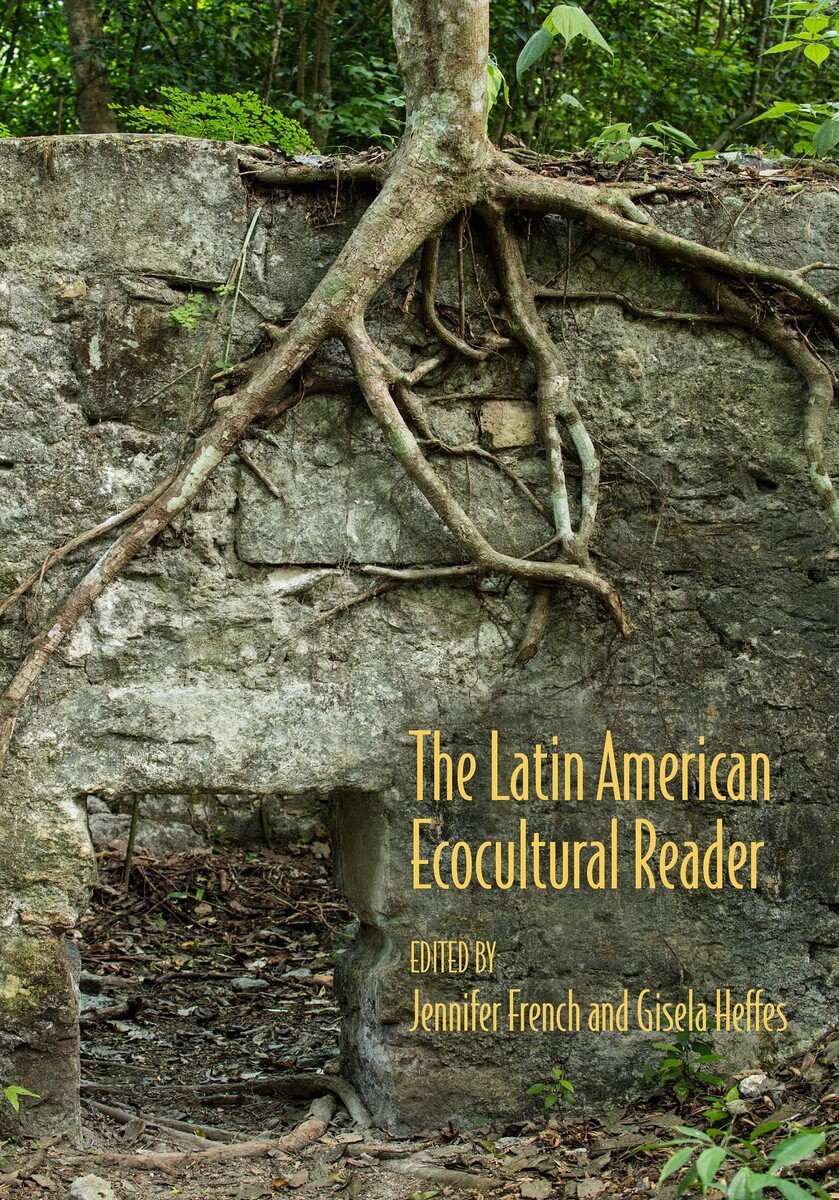
edited by Jennifer French and Gisela Heffes contributions by Father Antonio Ruiz de Montoya, André Joao Antonil, Father Jacinto Morán de Butrón, Georges Louis Le Clerc, José Martín Félix de Árrate y Acosta, Francisco Javier de Clavijero, Juan Ignacio Molina, Simón Bolívar, Andrés Bello, Simón Rodríguez, Johann Rudolf Rengger, José María Heredia y Heredia, Gertrudis Gómez de Avellaneda, Domingo F. Sarmiento, José María Samper, José Martí, Baldomero Lillo, Horacio Quiroga, José Eustasio Rivera, César Uribe Piedrahita, Christopher Columbus, Juan Marín, Graciliano Ramos, Ramón Amaya Amador, Julián del Casal, Rafael Barrett, Manuel González Prada, Pierre Quiroule, Oswald de Andrade, Rubén Darío, Alfonsina Storni, Gonzalo Fernández de Oviedo y Valdés, María Luis Bombal, Pablo Neruda, Juan Rulfo, Lydia Cabrera, José María Arguedas, Esteban Montejo, Clarice Lispector, Carlos Drummond de Andrade, Rigoberta Menchú, Chico Mendes, Fray Bartolomé de las Casas, Octavio Paz, Juan Carlos Galeano, Fernando Contreras Castro, Gioconda Belli, Subcommandant Marcos, Eduardo del Llano, Esthela Calderón, Homero Aridjis, José Emilio Pacheco, Mayra Montero, Gaspar de Carvajal, Jaime Huenún, Samanta Schweblin, Berta Cáceres, Pope Francis, Eduardo Chirinos, Jean de Léry, José de Acosta and Garcilaso de la Vega, El Inca translated by Idra Novey, Charles A. Perrone, Ann Wright, Chris Whitehouse, Anthony Stanton, James Kimbrell, Rebecca Morgan, Rose Schreiber-Stainthorp, George McWhirter, Margaret Sayers Pedan, Edith Grossman, John Bierhorst, Megan McDowell, J.M. Cohen, Nina M. Scott, Sandra Ferdman, Bertram T. Lee, Janet Whatley, Frances M. López-Morillas, Delia Goetz, Sylvanus G. Morley, Grady C. Wray, Harold V. Livermore, Paul J. Kaveney, Timothy Coates, Frederick H. Fornoff, Elizabeth Kieffer, G. J. Racz, Kathleen Ross, Esther Allen, Steven Dolph, J. David Danielson, John Charles Chasteen, Patricia González, Ralph Edward Dimmick, Arthur Dixon, Leslie Bary, Andrew Hurley, Greg Simon, Steven F. White, Orlando Ricardo Menes, Lucia Cunningham, Richard Cunningham, Jack Schmitt, Ilan Stavans, Harold Augenbraum, Frances Horning Barraclough and W. Nick Hill
Northwestern University Press, 2021 eISBN: 978-0-8101-4265-7 | Paper: 978-0-8101-4263-3 | Cloth: 978-0-8101-4264-0 Library of Congress Classification PN849.L292L38 2021 Dewey Decimal Classification 808.803272
ABOUT THIS BOOK | AUTHOR BIOGRAPHY | REVIEWS | TOC | REQUEST ACCESSIBLE FILE
ABOUT THIS BOOK
The Latin AmericanEcocultural Reader is a comprehensive anthology of literary and cultural texts about the natural world. The selections, drawn from throughout the Spanish-speaking countries and Brazil, span from the early colonial period to the present. Editors Jennifer French and Gisela Heffes present work by canonical figures, including José Martí, Bartolomé de las Casas, Rubén Darío, and Alfonsina Storni, in the context of our current state of environmental crisis, prompting new interpretations of their celebrated writings. They also present contemporary work that illuminates the marginalized environmental cultures of women, indigenous, and Afro-Latin American populations. Each selection is introduced with a short essay on the author and the salience of their work; the selections are arranged into eight parts, each of which begins with an introductory essay that speaks to the political, economic, and environmental history of the time and provides interpretative cues for the selections that follow.
The editors also include a general introduction with a concise overview of the field of ecocriticism as it has developed since the 1990s. They argue that various strands of environmental thought—recognizable today as extractivism, eco-feminism, Amerindian ontologies, and so forth—can be traced back through the centuries to the earliest colonial period, when Europeans first described the Americas as an edenic “New World” and appropriated the bodies of enslaved Indians and Africans to exploit its natural bounty.
AUTHOR BIOGRAPHY
JENNIFER FRENCH is a professor of Spanish at Williams College. She is the author of Nature,Neo-Colonialism, and the Spanish-American Regional Writers.
GISELA HEFFES is an associate professor of Latin American literature and culture at Rice University. She has published two monographs and four novels in Spanish.
REVIEWS
“This book brings together for the first time in English a cornucopia of vital writings about the environmental politics and art of Latin America. French and Heffes have compiled a volume of remarkable intellectual, geographic, and historical reach. The Latin American Ecocultural Reader will prove transformative in many, many classrooms. It will also become an indispensable text for environmental humanities scholars.” —Rob Nixon, author of Slow Violence and the Environmentalism of the Poor
— -
“Part anthology, part critical exploration, the collection is an excellent pedagogical tool for the environmental humanities that should delight Latin Americanists and ecocritics alike.” —Maria Alessandra Woolson, ISLE: Interdisciplinary Studies in Literature and Environment— -
TABLE OF CONTENTS
Acknowledgment
General Introduction: Genealogies of Latin American Environmental Culture
Chapter 1: New World Natures
1. Christopher Columbus: “Letter to Various Persons” (1493)
2. Gonzalo Fernández de Oviedo y Valdés: from General and Natural History of the Indies (1535-1557)
3. Fray Bartolomé de las Casas: “Plague of Ants” (1875)
4. Gaspar de Carvajal: from The Discovery of the Amazon (c. 1542)
5. Jean de Léry: “Of the Trees, Herbs, Roots, and Exquisite Fruits Produced by the Land of Brazil” (1578)
6. José de Acosta: “Of the Three Kinds of Mixtures that will be Dealt with in this History” (1590)
7. Anonymous: from Popol vuh: The Sacred Book of the Ancient Quiché Maya (c. 1554-1558/1701)
8. Garcilaso de la Vega, El Inca: from Royal Commentaries of the Incas and General History of Peru (1609)
Chapter 2: Creole Landscapes
1. Father Antonio Ruiz de Montoya: from The Spiritual Conquest (1639)
2. The Catholic Church: from The True Life of Saint Rosa of Lima (1897)
3. André Joao Antonil: from Brazil at the Dawn of the Eighteenth Century (1711)
4. Father Jacinto Morán de Butrón: “She Flees to the Desert” (1724)
5. Georges Louis Le Clerc, Comte de Buffon: from Buffon's Natural History, Abridged (1749-1788)
6. José Martín Félix de Árrate y Acosta: “On the Goodness and Excellence of the Open Spaces of this City” (1761)
7. Francisco Javier de Clavijero: from Geographical Description of Mexico (1780)
8. Juan Ignacio Molina: from The Geographical, Natural, and Civil History of Chile (1782)
Chapter 3: Nature and the Foundation of the Nation-States
1. Simón Bolívar: “My Delirium on Chimborazo” (1822)
2. Andrés Bello: “Ode to Tropical Agriculture” (1826)
3. Simón Rodríguez: “Observations on the Terrain of Vincocaya” (1830)
4. Johann Rudolf Rengger: From Journey to Paraguay in the Years 1818 to 1826 (1835)
5. José María Heredia y Heredia: “In a Storm” (c. 1835)
6. Gertrudis Gómez de Avellaneda: From Sab (1841)
7. Domingo F. Sarmiento: “Physical Aspect of the Argentine Republic” (1845)
8. José María Samper: “The Marvelous Exuberance of Life and the Forces of Nature…” (1861)
Chapter 4: Regionalism and the Export Boom
1. José Martí: “Our America” (1891)
2. Baldomero Lillo: “The Invalids,” from Sub-terra (1904)
3. Horacio Quiroga: “The Log-Fishermen” (1913)
4. José Eustasio Rivera: from The Vortex (1924)
5. César Uribe Piedrahita: “Mun Hospital,” from Oil Stain (1935)
6. Juan Marín: from 53rd Parallel South (1936)
7. Graciliano Ramos: “The Birds,” from Barren Lives (1938)
8. Ramón Amaya Amador: “Green Destiny,” from Green Prison (1950)
Chapter 5: Modern Metropoles
1. Julián del Casal: “In the Country” (1893)
2. Rafael Barrett: “Tree Haters” (1907)
3. Manuel González Prada: “Le Tour du Propriétaire” (1911)
4. Pierre Quiroule: from The American Anarchist City (1914)
5. Oswald de Andrade: “Cannibalist Manifesto” (1928)
6. Rubén Darío: “Reincarnations” (1890); “Philosophy” (1905); “Song of the Pines” (1907), and “Revelation” (1907)
7. Alfonsina Storni: “You Wish I Were Fair” (1918); “Sadness” (1920); “Slum Rosebushes” (1920), and “Buenos Aires Danzón” (1938)
8. María Luis Bombal: “The Tree” (1939)
Chapter 6: Developmentalism
1. Pablo Neruda: “The Heights of Macchu Picchu” (1950)
2. Juan Rulfo: “Luvina” (1953)
3. Lydia Cabrera: “The Ceiba,” from The Woods (1954)
4. José María Arguedas: “Bridge Over the World,” from Deep Waters (1958)
5. Esteban Montejo: “Life in the Woods,” from Biography of a Runaway Slave (1966)
6. Clarice Lispector: from The Passion According to G.H. (1964)
7. Carlos Drummond de Andrade: “Farewell to the Seven Falls” (1982)
8. Rigoberta Menchú: from I, Rigoberta Menchú: An Indian Woman in Guatemala (1985)
Chapter 7: Neoliberalism and Globalization
1. Chico Mendes: “The Landowners Strike Back,” from Fight for the forest (1989)
2. Octavio Paz: from “In Search of the Present,” (Nobel Lecture) (1990)
3. Juan Carlos Galeano: “Curupira;” “Dark Shamans;” “Cantagalo,” and “Lupuna” (1992)
4. Fernando Contreras Castro: from Única looking out to sea (1994)
5. Gioconda Belli: from Waslala (1996)
6. Subcommandant Marcos: A Letter from Subcomandante Marcos to Saramago (1999)
7. Eduardo del Llano: “Greenpeace” (2000)
8. Esthela Calderón: “The Woman I Could Have Been;” “Seed of I Don’t Know What,” and “Talking with My Worms” (2012)
Chapter 8: End Times: Climate Change and Mass Extinction
1. Homero Aridjis: “Uncreation” (1994); “The Last Night of the World” (1994); “The Hunt for the Red Jaguar” (2005), and “Images of Butterflies” (2014)
2. José Emilio Pacheco: “Equation to the First Degree, with Unknown Quantity;” “Whales;” “Augury,” and “Baboon Babble” (1993)
3. Mayra Montero: “Indian Hut,” from In the Palm of Darkness (1997)
4. Jaime Huenún: “Ceremony of Love” and “Ceremony of Death” (1998)
5. Samanta Schweblin: from Fever Dream (2014)
6. Berta Cáceres: Goldman Environmental Prize Acceptance Speech (2015)
7. Pope Francis: from Laudato Si’ (2015)
8. Eduardo Chirinos: “The K/T Boundary Chronicle;” “The Toba Chronicle,” and “The Chernobyl Chronicle” (2013)
Notes
Bibliography
Index
REQUEST ACCESSIBLE FILE
If you are a student who cannot use this book in printed form, BiblioVault may be able to supply you
with an electronic file for alternative access.
Please have the accessibility coordinator at your school fill out this form.