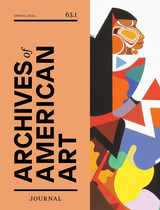
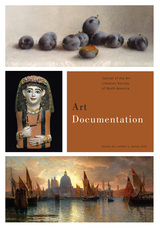
front cover of Archives of American Art Journal, volume 63 number 1 (Spring 2024)
Archives of American Art Journal, volume 63 number 1 (Spring 2024)
The University of Chicago Press
University of Chicago Press Journals, 2024
This is volume 63 issue 1 of Archives of American Art Journal. First published in 1960 as the Archives of American Art Bulletin, the Archives of American Art Journal is the longest-running scholarly periodical devoted to the history of art in the United States. This peer-reviewed publication showcases new approaches to and out-of-the-box thinking about primary sources. All contributions must be appropriate for the journal's broad audience and engage in a substantial, meaningful way with the holdings of the Archives of American Art.
[more]

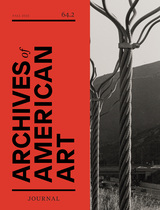
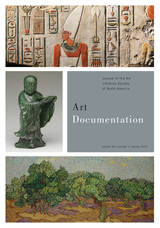
front cover of Archives of American Art Journal, volume 63 number 2 (Fall 2024)
Archives of American Art Journal, volume 63 number 2 (Fall 2024)
The University of Chicago Press
University of Chicago Press Journals, 2024
This is volume 63 issue 2 of Archives of American Art Journal. First published in 1960 as the Archives of American Art Bulletin, the Archives of American Art Journal is the longest-running scholarly periodical devoted to the history of art in the United States. This peer-reviewed publication showcases new approaches to and out-of-the-box thinking about primary sources. All contributions must be appropriate for the journal's broad audience and engage in a substantial, meaningful way with the holdings of the Archives of American Art.
[more]

front cover of Archives of American Art Journal, volume 64 number 1 (Spring 2025)
Archives of American Art Journal, volume 64 number 1 (Spring 2025)
The University of Chicago Press
University of Chicago Press Journals, 2025
This is volume 64 issue 1 of Archives of American Art Journal. First published in 1960 as the Archives of American Art Bulletin, the Archives of American Art Journal is the longest-running scholarly periodical devoted to the history of art in the United States. This peer-reviewed publication showcases new approaches to and out-of-the-box thinking about primary sources. All contributions must be appropriate for the journal's broad audience and engage in a substantial, meaningful way with the holdings of the Archives of American Art.
[more]

front cover of Archives of American Art Journal, volume 64 number 2 (Fall 2025)
Archives of American Art Journal, volume 64 number 2 (Fall 2025)
The University of Chicago Press
University of Chicago Press Journals, 2025
This is volume 64 issue 2 of Archives of American Art Journal. First published in 1960 as the Archives of American Art Bulletin, the Archives of American Art Journal is the longest-running scholarly periodical devoted to the history of art in the United States. This peer-reviewed publication showcases new approaches to and out-of-the-box thinking about primary sources. All contributions must be appropriate for the journal's broad audience and engage in a substantial, meaningful way with the holdings of the Archives of American Art.
[more]

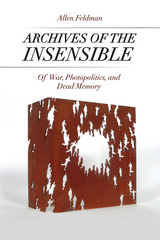
front cover of Archives of the Insensible
Archives of the Insensible
Of War, Photopolitics, and Dead Memory
Allen Feldman
University of Chicago Press, 2015
In this jarring look at contemporary warfare and political visuality, renowned anthropologist of violence Allen Feldman provocatively argues that contemporary sovereign power mobilizes asymmetric, clandestine, and ultimately unending war as a will to truth. Whether responding to the fantasy of weapons of mass destruction or an existential threat to civilization, Western political sovereignty seeks to align justice, humanitarian right, and democracy with technocratic violence and visual dominance. Connecting Guantánamo tribunals to the South African Truth and Reconciliation Commission, American counterfeit killings in Afghanistan to the Baader-Meinhof paintings of Gerhard Richter, and the video erasure of Rodney King to lynching photography and political animality, among other scenes of terror, Feldman contests sovereignty’s claims to transcendental right —whether humanitarian, neoliberal, or democratic—by showing how dogmatic truth is crafted and terror indemnified by the prosecutorial media and materiality of war.
           
Excavating a scenography of trials—formal or covert, orchestrated or improvised, criminalizing or criminal—Feldman shows how the will to truth disappears into the very violence it interrogates. He maps the sensory inscriptions and erasures of war, highlighting war as a media that severs factuality from actuality to render violence just. He proposes that war promotes an anesthesiology that interdicts the witness of a sensory and affective commons that has the capacity to speak truth to war. Feldman uses layered deconstructive description to decelerate the ballistical tempo of war to salvage the embodied actualities and material histories that war reduces to the ashes of collateral damage, the automatism of drones, and the opacities of black sites. The result is a penetrating work that marries critical visual theory, political philosophy, anthropology, and media archeology into a trenchant dissection of emerging forms of sovereignty and state power that war now makes possible. 
[more]

front cover of Arcimboldo
Arcimboldo
Visual Jokes, Natural History, and Still-Life Painting
Thomas DaCosta Kaufmann
University of Chicago Press, 2010

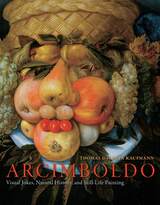
In Giuseppe Arcimboldo’s most famous paintings, grapes, fish, and even the beaks of birds form human hair. A pear stands in for a man’s chin. Citrus fruits sprout from a tree trunk that doubles as a neck. All sorts of natural phenomena come together on canvas and panel to assemble the strange heads and faces that constitute one of Renaissance art’s most striking oeuvres. The first major study in a generation of the artist behind these remarkable paintings, Arcimboldo tells the singular story of their creation. 

Drawing on his thirty-five-year engagement with the artist, Thomas DaCosta Kaufmann begins with an overview of Arcimboldo’s life and work, exploring the artist’s early years in sixteenth-century Lombardy, his grounding in Leonardesque traditions, and his tenure as a Habsburg court portraitist in Vienna and Prague. Arcimboldo then trains its focus on the celebrated composite heads, approaching them as visual jokes with serious underpinnings—images that poetically display pictorial wit while conveying an allegorical message. In addition to probing the humanistic, literary, and philosophical dimensions of these pieces, Kaufmann explains that they embody their creator’s continuous engagement with nature painting and natural history. He reveals, in fact, that Arcimboldo painted many more nature studies than scholars have realized—a finding that significantly deepens current interpretations of the composite heads.

Demonstrating the previously overlooked importance of these works to natural history and still-life painting, Arcimboldo finally restores the artist’s fantastic visual jokes to their rightful place in the history of both science and art.
[more]

front cover of Argentine, Mexican, and Guatemalan Photography
Argentine, Mexican, and Guatemalan Photography
Feminist, Queer, and Post-Masculinist Perspectives
By David William Foster
University of Texas Press, 2014

One of the important cultural responses to political and sociohistorical events in Latin America is a resurgence of urban photography, which typically blends high art and social documentary. But unlike other forms of cultural production in Latin America, photography has received relatively little sustained critical analysis. This pioneering book offers one of the first in-depth investigations of the complex and extensive history of gendered perspectives in Latin American photography through studies of works from Argentina, Mexico, and Guatemala.

David William Foster examines the work of photographers ranging from the internationally acclaimed artists Graciela Iturbide, Pedro Meyer, and Marcos López to significant photographers whose work is largely unknown to English-speaking audiences. He grounds his essays in four interlocking areas of research: the experience of human life in urban environments, the feminist matrix and gendered cultural production, Jewish cultural production, and the ideological principles of cultural works and the connections between the works and the sociopolitical and historical contexts in which they were created. Foster reveals how gender-marked photography has contributed to the discourse surrounding the project of redemocratization in Argentina and Guatemala, as well as how it has illuminated human rights abuses in both countries. He also traces photography’s contributions to the evolution away from the masculinist-dominated post–1910 Revolution ideology in Mexico. This research convincingly demonstrates that Latin American photography merits the high level of respect that is routinely accorded to more canonical forms of cultural production.
[more]

front cover of Arijana Lekic-Fridrih
Arijana Lekic-Fridrih
All Art Is a Political Statement / Svaka Umjetnost Je Politicka Izava
Rebekah Modrak
Disobedience Press, 2024

Arijana Lekić-Fridrih: All Art is a Political Statement introduces audiences to the work of Croatian artist Arijana Lekić-Fridrih and, in particular, to her Silent Mass, a performance resisting the “Be Manly” movement, a series of mass prayer events held in Croatian public squares by a battalion of men who pray for the abolition of women’s rights, for women’s “chastity,” and for men’s “masculine authority.” All Art is a Political Statement links the erosion of women’s rights across intercontinental boundaries and offers Lekić-Fridrih’s multimedia art as a guide for activism against retrograde restrictions on the freedom of women.

Arijana Lekić-Fridrih: Svaka umjetnost je politička izjava upoznaje publiku s radom hrvatske umjetnice Arijane Lekić-Fridrih, a posebno s njezinom Tihom misom, performansom otpora pokretu “Budi muško”, nizu masovnih molitvenih događanja koje na hrvatskim javnim trgovima održava bataljun muškaraca moleći za ukidanje ženskih prava, za žensku “čednost”, a za muškarce “muški autoritet”. Svaka umjetnost je politička izjava spaja eroziju ženskih prava preko interkontinentalnih granica i nudi multimedijsku umjetnost Lekić-Fridrih kao vodič za aktivizam protiv nazadnih ograničenja slobode žena.
[more]

front cover of Aristotle's Rhetoric
Aristotle's Rhetoric
An Art of Character
Eugene Garver
University of Chicago Press, 1995
In this major contribution to philosophy and rhetoric, Eugene Garver shows how Aristotle integrates logic and virtue in his great treatise, the Rhetoric. He raises and answers a central question: can there be a civic art of rhetoric, an art that forms the character of citizens? By demonstrating the importance of the Rhetoric for understanding current philosophical problems of practical reason, virtue, and character, Garver has written the first work to treat the Rhetoric as philosophy and to connect its themes with parallel problems in Aristotle's Ethics and Politics. Garver's study will help put rhetoric at the center of investigations of practice and practical reason.
[more]

front cover of An Arkansas Florilegium
An Arkansas Florilegium
The Atlas of Botanist Edwin Smith Illustrated by Naturalist Kent Bonar
Edwin Smith
University of Arkansas Press, 2017
An Arkansas Florilegium is a late-flowering extension of the work initiated sixty years ago with University of Arkansas botanist Edwin B. Smith’s first entries in his pioneering Atlas and Annotated List of the Vascular Plants of Arkansas. Soon after this seminal survey of the state’s flora was published in 1978, Kent Bonar, a Missouri-born Thoreau acolyte employed as a naturalist by the Arkansas Park Service, began lugging the volume along on hikes through the woods surrounding his Newton County home, entering hundreds upon hundreds of meticulous illustrations into Smith’s work.

Thirty-five years later, with Smith retired and Bonar long gone from the park service but still drawing, Bonar’s weathered and battered copy of the atlas was seized by a diverse cadre of amateur admirers motivated by fears of its damage or loss. Their fears were certainly justified; after all, the pages were now jammed to the margins with some 3,500 drawings, and the volume had already survived one accidental dunking in an Ozark stream.

An Arkansas Florilegium brings Smith’s and Bonar’s knowledge and lifelong diligence to the world in this unique mix of art, science, and Arkansas saga.
[more]

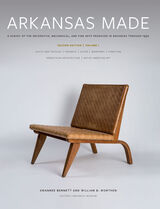
front cover of Arkansas Made, Volume 1
Arkansas Made, Volume 1
A Survey of the Decorative, Mechanical, and Fine Arts Produced in Arkansas through 1950
Swannee Bennett
University of Arkansas Press, 2020

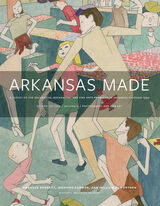
Arkansas Made is the culmination of Historic Arkansas Museum’s exhaustive investigations into the history of the state’s material culture. Decades of meticulous research have resulted in this exciting two-volume survey of cabinetmakers, silversmiths, potters, fine artists, quilters, and other artisans working in communities all over the state.

The work of the artisans documented here has been the driving force of Historic Arkansas Museum’s mission to collect and preserve Arkansas’s creative legacy and rich artistic traditions. Artisans from across Arkansas’s rich cultural landscape come to life among the colorful quilts, playful temperance jugs, and inventive effigies included in Volume I. Readers will delight not only in the striking full-color images but also in the stories that weave them together across time and region to create a lively picture of art and artisanship in a state too little celebrated for its creative output.

Volume 1
Quilts and Textiles • Ceramics • Silver •Weaponry • Furniture • Vernacular Architecture • Native American Art
 
[more]

front cover of Arkansas Made, Volume 2
Arkansas Made, Volume 2
A Survey of the Decorative, Mechanical, and Fine Arts Produced in Arkansas through 1950
Swannee Bennett
University of Arkansas Press, 2020

Arkansas Made is the culmination of Historic Arkansas Museum’s exhaustive investigations into the history of the state’s material culture. Decades of meticulous research have resulted in this exciting two-volume survey of cabinetmakers, silversmiths, potters, fine artists, quilters, and other artisans working in communities all over the state.

The work of the artisans documented here has been the driving force of Historic Arkansas Museum’s mission to collect and preserve Arkansas’s creative legacy and rich artistic traditions. The photographs and fine artworks that enliven the pages of Volume II represent not only a delightfully broad scope of talent in genres ranging from landscapes to cubist portraits to political cartoons, but also a longstanding tradition of advocacy and support for the arts in Arkansas.

Volume 2
Photography • Fine Art

 
[more]

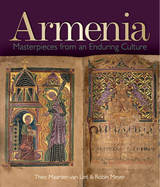
front cover of Armenia
Armenia
Masterpieces from an Enduring Culture
Theo Maarten van Lint and Robin Meyer
Bodleian Library Publishing, 2015
Between East and West, Armenian culture bears the influence of the country’s long history of foreign occupation, with a vibrant national art and literature that reinterprets elements from a wide variety of cultures, from the Sasanian dynasty of Iran to the Byzantine Empire.
           
Published to accompany an exhibition at the Bodleian Library, Armenia: Masterpieces from an Enduring Culture draws on the Libraries’ magnificent collection of Armenian manuscripts and early printed books, as well as works of art and religious artifacts to tell the story of the region. The book contains nearly two hundred color illustrations of some of the most treasured masterpieces, from philosophical treatises to splendidly illuminated gospel manuscripts. Also including four essays by experts in the field, the book affords ample insight into the perseverance of the Armenian people in the face of tremendous adversity.

[more]

logo for Harvard University Press
Arrest and Movement
Space and Time in the Representational Art of the Ancient Near East
H. A. Groenewegen Frankfort
Harvard University Press, 1987
The beauty of Egyptian, Babylonian, and Cretan art is shot through with oddity. However much we are fascinated by the ancient works, we find ourselves wondering what precisely the artists meant when they rendered objects and indicated spatial relations the way they did. Arrest and Movement is the only book to analyze pre-Greek art in terms of issues such as space and narrative. It is a landmark book that will bring to students and museum-goers deeper understanding of this eloquent but seemingly eccentric art.
[more]

front cover of Arrows Tipped with Flowers
Arrows Tipped with Flowers
Threshold Theory for Transformative Learning
Julie Geredien
University of Illinois Press, 2026
A radical new approach to a contemporary trend in education

How can learning at the threshold change us and our world? Julie Geredien introduces an approach to transformative learning that draws on a wide range of cultural and disciplinary viewpoints.

Threshold theory challenges unexamined mental habits and exposes absolutisms that hold social order by impeding the comprehension process. As those learning at the threshold approach transition and the unknown, they participate in transformations that illuminate hidden developmental patterns and ecological relationships. Geredien’s threshold theorizing brings together realities at the heart of creativity, relational worldview, and anti-oppression work to forge the philosophical and psychological foundations necessary to reshape policies and practices.

Innovative and expansive, Arrows Tipped with Flowers reveals the psychology of integrity that underpins truly global learning and explains the need to develop more inclusive and reflective approaches to knowledge formation.

[more]

logo for University of Chicago Press
Art & Money
Marc Shell
University of Chicago Press, 1995
In our age of art as investment and of skyrocketing prices at the gallery and the auction house, the study of art and money has become urgent—at least for investors and cultural critics. At the same time, crises in finance have disrupted economic and credit institutions and in turn assumptions about the value of art. Art & Money is a frank, provocative, and entirely unconventional look at two worlds in tandem, focusing on what binds together and drives apart the realms of art and money. Profusely illustrated, it investigates how money becomes (or is) artwork and how artwork comes to assume some of the characteristics of money.

Unlike traditional approaches to the topic, Art & Money is not a study of money and exchange as an artistic "theme." It is also not a study of economics as a context for the history of art. Rather, it is a path-breaking exploration of the internal logic—the set of meanings and values—common to both money and art.

Art & Money provides striking insight into current matters of art collection, counterfeiting, and problems of attribution, into the general relation between word and image, and into controversies over taxation and crises or scandals in the financial world. Shell's historical range is immense, and he fills this study with amusing anecdotes and insights ranging from the relic of the Holy Foreskin to the state's arrest of J. S. G. Boggs, a conceptual artist who draws money. Illustrated with over one hundred halftones and eight color plates, this stunning volume will force a rethinking of our old presumptions about where money ends and art begins.
[more]

logo for Pluto Press
Art & Outrage
Provocation, Controversy and the Visual Arts
John A. Walker
Pluto Press, 1998

When art hits the headlines, it is usually because it has caused offence or is perceived by the media to have shock-value. Over the last fifty years many artists have been censored, vilified, accused of blasphemy and obscenity, threatened with violence, prosecuted and even imprisoned. Their work has been trashed by the media and physically attacked by the public.

In Art & Outrage, John A. Walker covers the period from the late 1940s to the 1990s to provide the first detailed survey of the most prominent cases of art that has scandalised. The work of some of Britain’s leading, and less well known, painters and sculptors of the postwar period is considered, such as Richard Hamilton, Bryan Organ, Rachel Whiteread, Reg Butler, Damien Hirst, Jamie Wagg, Barry Flanagan and Antony Gormley. Included are works made famous by the media, such as Carl Andre’s Tate Gallery installation of 120 bricks, Rick Gibson’s foetus earrings, Anthony-Noel Kelly’s cast body-parts sculptures and Marcus Harvey’s portrait of Myra Hindley. Walker describes how each incident emerged, considers the arguments for and against, and examines how each was concluded. While broadly sympathetic to radical contemporary art, Walker has some residual sympathy for the layperson’s bafflement and antagonism. This is a scholarly yet accessible study of the interface between art, society and mass media which offers an alternative history of postwar British art and attitudes.
[more]

front cover of Art, Activism, and Oppositionality
Art, Activism, and Oppositionality
Essays from Afterimage
Grant Kester, ed.
Duke University Press, 1998
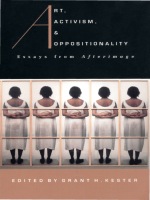
There is a common perception in the arts today that overtly activist art—often seen to sacrifice an aesthetic pleasure for a subversive one—is no longer in fashion. In bringing together sixteen of the most important essays on activist and community-based art from the pages of Afterimage—one of the most influential journals in the media and visual arts fields for more than twenty-five years—Grant H. Kester demonstrates that activist art, far from being antithetical to the true meaning of the aesthetic, can be its most legitimate expression.

Forging a style of criticism where aesthetic, critical, theoretical, and activist concerns converge, Afterimage has shaped American debates around the politics of visual production and arts education while offering a voice to politically involved artists and scholars. Art, Activism, and Oppositionality insists not only on the continuing relevance of an activist stance to contemporary art practice and criticism, but also on the significance of an engaged art practice that is aligned with social or political activism. With essays that span fifteen years—roughly from Ronald Reagan’s 1980 presidential win to the 1994 Republican victories in Congress, a period marked by waning public support for the arts and growing antagonism toward activist art—Art, Activism, and Oppositionality confronts issues ranging from arts patronage, pedagogy, and the very definitions of art and activism to struggles involving AIDS, reproductive rights, sexuality, and racial identity.

Contributors. Maurice Berger, Richard Bolton, Ann Cvetkovich, Coco Fusco, Brian Goldfarb, Mable Haddock, Grant H. Kester, Ioannis Mookas, Chiquita Mullins Lee, Darrell Moore, Lorraine O’Grady, Michael Renov, Martha Rosler, Patricia Thomson, David Trend, Charles A. Wright Jr., Patricia R. Zimmerman
[more]

front cover of Art after Money, Money after Art
Art after Money, Money after Art
Creative Strategies Against Financialization
Max Haiven
Pluto Press, 2018
We like to imagine that money and art are old enemies, but beneath the veneer of creative utopianism is a dark capitalist underbelly. To expose the fraught intersection of art and money, Max Haiven proposes we examine how money is mobilized in art.
            Even as he shows how imaginary money and the so-called “creative economy” extract an artist’s potential, Haiven identifies and assesses a range of creative strategies for mocking, decrypting, hacking, sabotaging, and exiting capitalism through art. Focusing on the ways contemporary artists understand, imagine, and contend with material and immaterial forms of cash, debt, and credit, Haiven reveals the potential for creativity and resistance in a world dominated by financialization.
            Written for artists, activists, and scholars, this book takes seriously the need to understand and resist capitalism in an age of corporate abuse and exploitation.
 
[more]

front cover of Art Against Dictatorship
Art Against Dictatorship
Making and Exporting Arpilleras Under Pinochet
By Jacqueline Adams
University of Texas Press, 2013

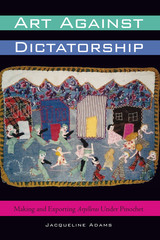
Art can be a powerful avenue of resistance to oppressive governments. During the dictatorship of Augusto Pinochet in Chile, some of the country’s least powerful citizens—impoverished women living in Santiago’s shantytowns—spotlighted the government’s failings and use of violence by creating and selling arpilleras, appliquéd pictures in cloth that portrayed the unemployment, poverty, and repression that they endured, their work to make ends meet, and their varied forms of protest. Smuggled out of Chile by human rights organizations, the arpilleras raised international awareness of the Pinochet regime’s abuses while providing income for the arpillera makers and creating a network of solidarity between the people of Chile and sympathizers throughout the world.

Using the Chilean arpilleras as a case study, this book explores how dissident art can be produced under dictatorship, when freedom of expression is absent and repression rife, and the consequences of its production for the resistance and for the artists. Taking a sociological approach based on interviews, participant observation, archival research, and analysis of a visual database, Jacqueline Adams examines the emergence of the arpilleras and then traces their journey from the workshops and homes in which they were made, to the human rights organizations that exported them, and on to sellers and buyers abroad, as well as in Chile. She then presents the perspectives of the arpillera makers and human rights organization staff, who discuss how the arpilleras strengthened the resistance and empowered the women who made them.

[more]

front cover of Art Against the Law
Art Against the Law
Edited by Rebecca Zorach
School of the Art Institute of Chicago, 2014
In 1968, Chicago made headlines for the ferocity of its police response to protesters at the Democratic National Convention, prompting outrage in the art world. Some artists pulled their shows from the city and called for a boycott until the mayor left office. But others responded artistically, creating new works and even full exhibitions in reaction to the political and social issues raised by the summer’s events.

Despite the city's sometimes notorious political and social history, art practices that challenge authority have thrived in Chicago. Art Against the Law examines the creative tactics of the city’s activist artists and their ways of addressing the broad definitions of the law—from responses to excessive policing to inequities in public policy. These include creative forms of protest, rebellion against the law through illegal art practices, and using the political system itself as an art medium to alter existing laws. The essays and conversations in this volume also address the boundaries between art and creative activism and question whether lines should be drawn at all. Through these texts and interviews, Art Against the Law proves that creative imagination can be formidable in challenging the status quo.

Art Against the Law is part of the new Chicago Social Practice History series, edited by Mary Jane Jacob and Kate Zeller in the Department of Exhibitions and Exhibition Studies at the School of the Art Institute of Chicago (SAIC).
[more]

front cover of Art & Language International
Art & Language International
Conceptual Art between Art Worlds
Robert Bailey
Duke University Press, 2016
In Art & Language International Robert Bailey reconstructs the history of the conceptual art collective Art & Language, situating it in a geographical context to rethink its implications for the broader histories of contemporary art. Focusing on its international collaborations with dozens of artists and critics in and outside the collective between 1969 and 1977, Bailey positions Art & Language at the center of a historical shift from Euro-American modernism to a global contemporary art. He documents the collective’s growth and reach, from transatlantic discussions on the nature of conceptual art and the establishment of distinct working groups in New York and England to the collective’s later work in Australia, New Zealand, and Yugoslavia. Bailey also details its publications, associations with political organizations, and the internal power struggles that precipitated its breakdown. Analyzing a wide range of artworks, texts, music, and films, he reveals how Art & Language navigated between art worlds to shape the international profile of conceptual art. Above all, Bailey underscores how the group's rigorous and interdisciplinary work provides a gateway to understanding how conceptual art operates as a mode of thinking that exceeds the visual to shape the philosophical, historical, and political.
[more]

front cover of Art and Activism
Art and Activism
Jazz Artists and Writers in the Civil Rights Vanguard
Jack Marchbanks
Ohio University Press, 2026

Explore how jazz legends and literary icons united art and activism, shaping the civil rights movement and transforming American culture during the pivotal period between 1955 and 1965.

Art and Activism explores the powerful, symbiotic relationships among artists such as Nina Simone, Abbey Lincoln, and Lena Horne and their literary counterparts—Lorraine Hansberry, Maya Angelou, and Langston Hughes. These creative figures positioned themselves as cultural thought leaders within the evolving civil rights movement. While the Jim Crow South was the movement’s operational front, Jack Marchbanks argues that New York City’s intellectual, cultural, and fundraising communities functioned as its strategic command center.

Readers who admire jazz legends like Duke Ellington, Dave Brubeck, Miles Davis, and Charles Mingus—and those fascinated by prominent African American writers like James Baldwin and Ralph Ellison—will discover how these artists intertwined their work with the civil rights struggle. The book examines their involvement in pivotal confrontations and their connections with key leaders such as the Reverend Dr. Martin Luther King Jr., Daisy Bates, Ella Baker, and Malcolm X.

By illuminating the intersection of art and activism, this study offers a fresh perspective on the pivotal decade from 1955 to 1965. It is an essential resource for undergraduate courses and an engaging read for anyone seeking to understand the civil rights era through a cultural lens.
[more]

front cover of Art and Anarchy
Art and Anarchy
Edgar Wind
Northwestern University Press, 1985
Will works of the imagination ever regain the power they once had to challenge and mould society and the individual? This was the question posed by Edgar Wind's influential Reith Lectures delivered in 1960 and later expanded into his book Art and Anarchy. The book examines the various forces that have fashioned the modern view of the art, from mechanization and fear of intellect to connoisseurship and—perhaps the fundamental weakness of our age—the dispassionate acceptance of art. In the course of his discussion, Wind surveyed a wide range of topics in the history of painting, literature, music, and the plastic arts from the Renaissance to modern times.
[more]

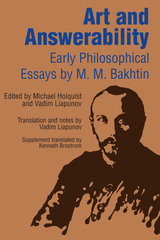
front cover of Art and Answerability
Art and Answerability
Early Philosophical Essays
By M. M. Bakhtin
University of Texas Press, 1990

Art and Answerability contains three of Mikhail Bakhtin's early essays from the years following the Russian Revolution, when Bakhtin and other intellectuals eagerly participated in the debates, lectures, demonstrations, and manifesto writing of the period. Because they predate works that have already been translated, these essays—"Art and Answerability," "Author and Hero in Aesthetic Activity," and "The Problem of Content, Material, and Form in Verbal Art"—are essential to a comprehensive understanding of Bakhtin's later works. A superb introduction by Michael Holquist sets out the major themes and concerns of the three essays and identifies their place in the canon of Bakhtin's work and in intellectual history. The introduction, together with Vadim Liapunov's scholarly gloss, makes these essays accessible to students as well as scholars.
[more]

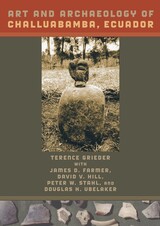
front cover of Art and Archaeology of Challuabamba, Ecuador
Art and Archaeology of Challuabamba, Ecuador
By Terence Grieder
University of Texas Press, 2009

Challuabamba (chī-wa-bamba)—now a developing suburb of Cuenca, the principal city in the southern highlands of Ecuador—has been known for a century as an ancient site that produced exceptionally fine pottery in great quantities. Suspecting that Challuabamban ceramics might provide a link between earlier, preceramic culture and later, highly developed Formative period art, Terence Grieder led an archaeological investigation of the site between 1995 and 2001. In this book, he and the team of art historians and archaeologists who excavated at Challuabamba present their findings, which establish the community's importance as a center in a network of trade and artistic influence that extended to the Amazon River basin and the Pacific Coast.

Art and Archaeology of Challuabamba, Ecuador presents an extensive analysis of ceramics dating to 2100-1100 BC, along with descriptions of stamps and seals, stone and shell artifacts, burials and their offerings, human remains, and zooarchaeology. Grieder and his coauthors demonstrate that the pottery of Challuabamba fills a gap between early and late Formative styles and also has a definite connection with later highland styles in Peru. They draw on all the material remains to reconstruct the first clear picture of Challuabamba's prehistory, including agriculture and health, interregional contacts and exchange, red-banded incised ware and ceramic production, and shamanism and cosmology.

Because southern Ecuador has received relatively little archaeological study, Art and Archaeology of Challuabamba, Ecuador offers important baseline data for what promises to be a key sector of the prehistoric Andean region.
[more]

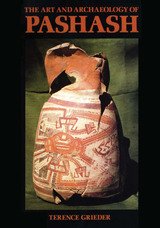
front cover of The Art and Archaeology of Pashash
The Art and Archaeology of Pashash
By Terence Grieder
University of Texas Press, 1978

Among the vast treasures discovered in Peru since its conquest by Pizarro, only a small fraction has been excavated scientifically. The Art and Archaeology of Pashash is an account of the discovery and excavation of one of the richest Pre-Columbian burials ever scientifically excavated in Peru. The tomb and its offerings unearthed at Pashash, in the northern Andes, provide new perspectives on the cultural meaning of Andean funerary treasure.

About A.D. 500 the flexed body of an aristocrat was wrapped in cloth and set in a small tomb sealed by a heavy stone. Three separate offerings were put in place during the construction of the funerary temple above the tomb. Near the body were placed about fifty large gold pins with elaborately sculptured heads, the most important set of Peruvian metalwork scientifically recorded in context. Decorated pottery also accompanied the body. Beneath the doorway to the temple chamber above the tomb a second offering was placed, composed of vessels modeled as jaguars, snakes, and dragonlike combinations of the two, with other fine pottery, unfired clay bowls, and stone bowls. The images in this offering represented the theology of a shamanistic religion. A third offering of broken ritual vessels was placed in the earth fill just before the temple floor was built.

This collection of several hundred works of art found together and dated by radiocarbon, related to a stratigraphic sequence for the site as a whole, makes possible a unique history of the art of this highland Andean region. Grieder describes the phases of development and the symbolism of the previously little-known Recuay style of pottery and attributes many works to individuals, illuminating the role of artists and their relations with their patrons. Among the author's discoveries is evidence of the use of potters' wheels and lathes to make ceramic and stone vessels and ritual objects, reversing the long-held contention that these tools were unknown in Pre-Columbian America.

The Art and Archaeology of Pashash will be valuable to specialists in Andean archaeology as well as to those interested in the art and culture of Pre-Columbian America.
[more]

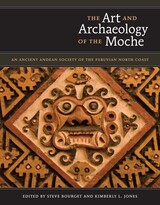
front cover of The Art and Archaeology of the Moche
The Art and Archaeology of the Moche
An Ancient Andean Society of the Peruvian North Coast
Edited by Steve Bourget and Kimberly L. Jones
University of Texas Press, 2008

Renowned for their monumental architecture and rich visual culture, the Moche inhabited the north coast of Peru during the Early Intermediate Period (AD 100-800). Archaeological discoveries over the past century and the dissemination of Moche artifacts to museums around the world have given rise to a widespread and continually increasing fascination with this complex culture, which expressed its beliefs about the human and supernatural worlds through finely crafted ceramic and metal objects of striking realism and visual sophistication.

In this standard-setting work, an international, multidisciplinary team of scholars who are at the forefront of Moche research present a state-of-the-art overview of Moche culture. The contributors address various issues of Moche society, religion, and material culture based on multiple lines of evidence and methodologies, including iconographic studies, archaeological investigations, and forensic analyses. Some of the articles present the results of long-term studies of major issues in Moche iconography, while others focus on more specifically defined topics such as site studies, the influence of El Niño/Southern Oscillation on Moche society, the nature of Moche warfare and sacrifice, and the role of Moche visual culture in decoding social and political frameworks.
[more]

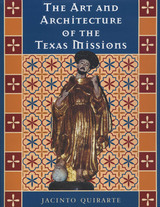
front cover of The Art and Architecture of the Texas Missions
The Art and Architecture of the Texas Missions
By Jacinto Quirarte
University of Texas Press, 2002

Winner, Presidio La Bahia Award, Sons of the Republic of Texas

Built to bring Christianity and European civilization to the northern frontier of New Spain in the seventeenth and eighteenth centuries...secularized and left to decay in the nineteenth century...and restored in the twentieth century, the Spanish missions still standing in Texas are really only shadows of their original selves. The mission churches, once beautifully adorned with carvings and sculptures on their façades and furnished inside with elaborate altarpieces and paintings, today only hint at their colonial-era glory through the vestiges of art and architectural decoration that remain.

To paint a more complete portrait of the missions as they once were, Jacinto Quirarte here draws on decades of on-site and archival research to offer the most comprehensive reconstruction and description of the original art and architecture of the six remaining Texas missions—San Antonio de Valero (the Alamo), San José y San Miguel de Aguayo, Nuestra Señora de la Purísima Concepción, San Juan Capistrano, and San Francisco de la Espada in San Antonio and Nuestra Señora del Espíritu Santo in Goliad. Using church records and other historical accounts, as well as old photographs, drawings, and paintings, Quirarte describes the mission churches and related buildings, their decorated surfaces, and the (now missing) altarpieces, whose iconography he extensively analyzes. He sets his material within the context of the mission era in Texas and the Southwest, so that the book also serves as a general introduction to the Spanish missionary program and to Indian life in Texas.
[more]

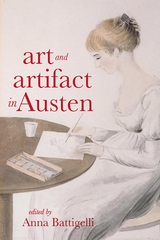
front cover of Art and Artifact in Austen
Art and Artifact in Austen
Anna Battigelli
University of Delaware Press, 2020
Jane Austen distinguished herself with genius in literature, but she was immersed in all of the arts. Austen loved dancing, played the piano proficiently, meticulously transcribed piano scores, attended concerts and art exhibits, read broadly, wrote poems, sat for portraits by her sister Cassandra, and performed in theatricals. For her, art functioned as a social bond, solidifying her engagement with community and offering order. And yet Austen’s hold on readers’ imaginations owes a debt to the omnipresent threat of disorder that often stems—ironically—from her characters’ socially disruptive artistic sensibilities and skill. Drawing from a wealth of recent historicist and materialist Austen scholarship, this timely work explores Austen’s ironic use of art and artifact to probe selfhood, alienation, isolation, and community in ways that defy simple labels and acknowledge the complexity of Austen’s thought.

Published by University of Delaware Press. Distributed worldwide by Rutgers University Press.
 
[more]

logo for University of Chicago Press
Art and Cartography
Six Historical Essays
Edited by David Woodward
University of Chicago Press, 1987
The contributors—Svetlana Alpers, Samuel Y. Edgerton, Jr., Ulla Ehrensvard, Juergen Schulz, James A. Welu, and David Woodward—examine the historical links between art and cartography from varied perspectives.
[more]

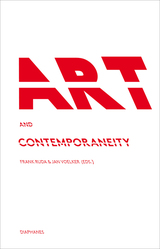
front cover of Art and Contemporaneity
Art and Contemporaneity
Edited by Frank Ruda and Jan Voelker
Diaphanes, 2015
Art is often said to be timeless, but specific works of art always take place within time and maintain a dynamic balance between their conditions of production and reception.
           
Art and Contemporaneity features contributions from leading scholars, including Alain Badiou and Alexander García Düttmann, who bring theories of aesthetic philosophy to bear on one of the most crucial questions about contemporary art: how do works of art come to exist within and in relation to time? A specific temporality of an artwork emerges from the material and political conditions of its production. But works of art also forge new relationships to time in their reception, which are continually superimposed upon layers of history. With a broad range of perspectives, Art and Contemporaneity offers a sustained reflection on the relationship between art and time, and it will appeal to those interested in both the theory and practice of contemporary art.
[more]

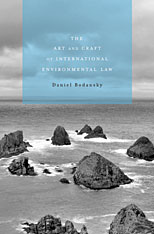
front cover of The Art and Craft of International Environmental Law
The Art and Craft of International Environmental Law
Daniel Bodansky
Harvard University Press, 2010

International environmental law is often closer to home than we know, affecting the food we eat, the products we buy, and even the air we breathe. Drawing on more than two decades of experience as a government negotiator, consultant, and academic, Daniel Bodansky brings a real-world perspective on the processes by which international environmental law develops, and influences the behavior of state and non-state actors.

In self-contained chapters that offer a clear guide to a complex field, Bodansky answers fundamental questions about how international environmental law works. What role can law play in addressing global environmental challenges such as climate change, ozone depletion, and loss of biodiversity? How do environmental problems come onto the international agenda? What are the obstacles to international cooperation, and what can international environmental law do to address them? How do international rules develop? How are they put into practice and what makes them effective?
[more]

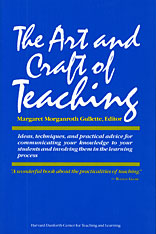
front cover of The Art and Craft of Teaching
The Art and Craft of Teaching
Margaret Morganroth Gullette
Harvard University Press, 1984

A concise and lively guide for college and university teachers, this collection of essays provides insights and solid advice for beginners as well as more experienced teachers. For the past eight years, the Harvard–Danforth Center for Teaching and Learning has been organizing programs that seek to improve university instruction. As part of these programs, the Center sponsors a faculty seminar on teaching lead by noted Harvard Professor C. Roland Christensen. The authors of this book—teachers in a wide variety of academic fields—were all participants in the seminar. In writing the book together, they drew on the Center’s resources and on their combined store of skills, techniques, and attitudes.

Topics include preparing for the first day of class, delivering good lectures, leading effective discussions, using the rhythms of the semester, teaching essay writing, grading and evaluation, and learning how to become a better teacher. The authors offer workable solutions for problems that every instructor faces and suggest strategies that will enrich the classroom experience for both teachers and students.
[more]

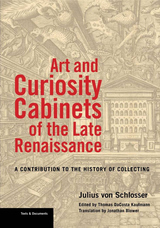
front cover of Art and Curiosity Cabinets of the Late Renaissance
Art and Curiosity Cabinets of the Late Renaissance
A Contribution to the History of Collecting
Julius von Schlosser
J. Paul Getty Trust, The, 2021

For the first time, the pioneering book that launched the study of art and curiosity cabinets is available in English.

Julius von Schlosser’s Die Kunst- und Wunderkammern der Spätrenaissance (Art and Curiosity Cabinets of the Late Renaissance) is a seminal work in the history of art and collecting. Originally published in German in 1908, it was the first study to interpret sixteenth- and seventeenth-century cabinets of wonder as precursors to the modern museum, situating them within a history of collecting going back to Greco-Roman antiquity. In its comparative approach and broad geographical scope, Schlosser’s book introduced an interdisciplinary and global perspective to the study of art and material culture, laying the foundation for museum studies and the history of collections. Schlosser was an Austrian professor, curator, museum director, and leading figure of the Vienna School of art history whose work has not achieved the prominence of his contemporaries until now.
 
This eloquent and informed translation is preceded by Thomas DaCosta Kaufmann’s substantial introduction. Tracing Schlosser’s biography and intellectual formation in Vienna at the turn of the twentieth century, it contextualizes his work among that of his contemporaries, offering a wealth of insights along the way.
[more]

front cover of Art And Engagement
Art And Engagement
Arnold Berleant
Temple University Press, 1993

In this book Arnold Berleant develops a bold alternative to the eighteenth-century aesthetic of disinterestedness. Centering on the notion of participatory engagement in the appreciation of art, he explores its appearance in art and in aesthetic perception, especially during the past century. Aesthetic engagement becomes a key, both on historical and theoretical grounds, to making intelligible our experiences with both contemporary and classical arts. In place of the traditional aesthetic that enjoins the appreciator to adopt a contemplative attitude, distancing the art object in order to ensure its removal from practical uses, Art and Engagement examines the ways in which art entices us into intimate participation in its workings.

Beginning with the historical and theoretical underpinnings of the idea of engagement, Berleant focuses on how engagement works as a force in different arts. Successive chapters pursue its influence in landscape painting, architecture and environmental design, literature, music, dance, and film.

Art and Engagement argues forcefully for the originality and power of aesthetic perception. Demolishing the conceptual barriers erected by the Western world’s limiting tradition, the book discloses the condition of engagement that has always been present when our aesthetic encounters have been most effective and suggests a new direction for aesthetic inquiry.
[more]

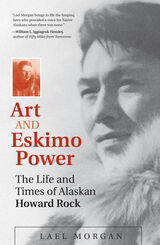
front cover of Art and Eskimo Power
Art and Eskimo Power
The Life and Times of Alaskan Howard Rock
Lael Morgan
University of Alaska Press, 2008
At Howard Rock's birth, a shaman predicted that he would become a great man. Born in 1911 in a sod igloo in Point Hope, an ancient Eskimo village, Howard became an accomplished artist and crusading newspaper editor who helped to defend his people from a controversial Atomic Energy Commission proposal to excavate a harbor near his native village with an atomic blast. Art and Eskimo Power chronicles the life of this influential and artist, editor, and founder of the Tundra Times—under whose leadership the newspaper helped to organize Alaska’s native people to press their aboriginal land claims before Congress, which ultimately led to their being awarded over $1 billion and 40 million acres.
[more]

front cover of Art and Freedom
Art and Freedom
E. E. Sleinis
University of Illinois Press, 2002

What does a life with art offer that a life without art does not? Art and Freedom asserts that the fundamental point of the enterprise of art is the creation and delivery of values that are not singularly available in the nonart world.

E. E. Sleinis discusses visual art, literature, music, theater, and other art forms, arguing that as art both liberates and provides new points of focus and awareness, the art enterprise depends on a positive freeing from the nonart world, rather than on mere addition to it.

Art and Freedom introduces a novel classificatory system for representation, expression, and formalist theories of art. Sleinis argues that a characteristic defect of contemporary theories of art is their neglect of the issue of value. Challenging these reductive, formalist notions of art, he emphasizes the potential, and the need, for art to evolve and make progress in ways comparable to the sciences, albeit on a very different model.

A smart blend of incisive commentary and illuminating philosophy, Art and Freedom provides a useful context for transforming a sometimes baffling medium into a means of fostering personal growth and creating and sharing values.
[more]

front cover of Art and Freedom of Speech
Art and Freedom of Speech
Randall P. Bezanson
University of Illinois Press, 2009

This book analyzes the broad range of Supreme Court cases that concern the protection of art and free speech under the First Amendment. Finding that debates about free expression (whether in speech or art) swirl around sex and cultural blasphemy, Randall P. Bezanson tracks and interprets the Court's decisions on film, nude dancing, music, painting, and other visual expressions.

Showing how the Court has dealt with judgments of art, quality, meaning, and how to distinguish types of speech and expression, Bezanson explores issues as diverse as homosexuality in the Boy Scouts, gay and lesbian parade floats, 2 Live Crew's alleged copyright infringement, National Endowment for the Arts grants and diversity, dangerous art, and screenings of the film Carnal Knowledge. In considering the transformative meaning of art, the importance of community judgments, and the definition of speech in Court rulings, Bezanson focuses on the fundamental questions underlying the discussion of art as protected free speech: What are the boundaries of art? What are the limits on the government's role as supporter and "patron" of the arts? And what role, if any, may core social values of decency, respect, and equality play in limiting the production or distribution of art?

Accessibly written and evocatively argued, Art and Freedom of Speech explores these questions and concludes with the argument that, for legal purposes, art should be absolutely free under the First Amendment--in fact, even more free than other forms of speech.

[more]

logo for Harvard University Press
Art and Geometry
A Study in Space Intuitions
William M. Ivins Jr.
Harvard University Press

logo for Harvard University Press
The Art and Iconography of Late Post-Classic Central Mexico
Elizabeth Hill Boone
Harvard University Press, 1982

front cover of The Art and Iconography of Late Post-Classic Central Mexico
The Art and Iconography of Late Post-Classic Central Mexico
Elizabeth Hill Boone
Harvard University Press
This volume examines the art and archaeology of Late Post-Classic Central Mexico and thematically proposes that Aztec culture was in fact creative, fighting against suggestions in academia to the contrary. The essays characteristically interweave archaeology and ethnohistory to produce more fully rounded reconstructions and analyses of an often-overlooked historical era. In recentering Central Mexico, they contribute to an improved knowledge of the aesthetic and ideological aspects of an important cultural climax zone of native America’s most advanced civilization.
[more]

front cover of Art and Imagination
Art and Imagination
A Study in the Philosophy of Mind
Roger Scruton
St. Augustine's Press, 2015
This book presents a theory of aesthetic judgment and appreciation in the spirit of modern empiricism. There are three parts: the first deals with questions of philosophical logic, the second with questions in the philosophy of mind, and the third with questions in the philosophy of art. Thus the argument advances from a theory of aesthetic judgment (and in particularly of “aesthetic description”) to a theory of aesthetic appreciation, and thence to an account of the nature and value of art. 
       Scruton examines and rejects various attempts made by recent philosophers to demarcate the realm of aesthetic judgment. He argues that the logic of aesthetic judgment does not suffice to distinguish what is “aesthetic” from what is not, for aesthetic judgments must be explained in terms of the conditions for their acceptance rather than the conditions for their truth. These “acceptance conditions” can be understood only if we first know what is meant by aesthetic experience. This theory attempts to show how aesthetic experience can be regarded as autonomous, even though it is intimately connected with ordinary experience, and is indeed dependent on ordinary experience for its full description.
[more]

logo for Harvard University Press
The Art and Imagination of W. E. B. DuBois
Arnold Rampersad
Harvard University Press, 1976

front cover of Art and Intellect in the Philosophy of Étienne Gilson
Art and Intellect in the Philosophy of Étienne Gilson
Francesca Aran Murphy
University of Missouri Press, 2004
In Art and Intellect in the Philosophy of Étienne Gilson, Francesca Aran Murphy tells the story of this French philosopher’s struggle to reconcile faith and reason. In his lifetime, Gilson often stood alone in presenting Saint Thomas Aquinas as a theologian, one whose philosophy came from his faith. Today, Gilson’s view is becoming the prevalent one. Murphy provides us with an intellectual biography of this Thomist leader throughout the stages of his scholarly development.
 
Murphy covers more than a half century of Gilson’s life while reminding readers of the political and social realities that confronted intellectuals of the early twentieth century. She shows the effects inner-church politics had on Gilson and his contemporaries such as Alfred Loisy, Lucien Lévy Bruhl, Charles Maurras, Henri de Lubac, Marie-Dominique Chenu, and Jacques Maritain, while also contextualizing Gilson’s own life and thoughts in relation to these philosophers and theologians. 
 
            These great thinkers, along with Gilson, continue to be sources of important intellectual debate among scholars, as do the political periods through which Gilson’s story threads—World Wars I and II, the rise and fall of Fascism, and the political upheavals of Europe. By placing Gilson’s twentieth-century Catholic life against a dramatic background of opposed political allegiances, clashing spiritualities, and warring ideas of philosophy, this book shows how rival factions each used their own interpretations of Thomas Aquinas to legitimate their conceptions of the Catholic Church.        In Art and Intellect in the Philosophy of Étienne Gilson, Murphy shows Gilson’s early openness to the artistic revolution of the Cubist and the Expressionist movements and how his love of art inspired his existential theology. She demonstrates the influence that Henri Bergson continued to have on Gilson and how Gilson tried to bring together the intellectual, Dominican side of Christianity with the charismatic, experiential Franciscan side.
 
Murphy concludes with a chapter on issues inspired by the Gilsonist tradition as developed by recent thinkers. This volume makes an original contribution to the study of Gilson, for the first time providing an organic and synthetic treatment of this major spiritual philosopher of modern times.           
[more]

front cover of The Art and Life of Merritt Dana Houghton in the Northern Rockies, 1878-1919
The Art and Life of Merritt Dana Houghton in the Northern Rockies, 1878-1919
by Michael A. Amundson
University of Wyoming Press, 2022
Between 1891 and 1915, pen-and-ink artist Merritt Dana Houghton made over 200 bird’s-eye sketches of towns, ranches, mines, businesses, historic sites, and animals in Wyoming, northern Colorado, Montana, Idaho, and Washington state. Historian Michael A. Amundson brings these many views together for the first time in these pages.
 
This lavishly illustrated biography details Houghton’s life and work from his birth in Michigan in 1846 to his death in 1919 in Spokane through extensive genealogical records, newspaper accounts, and his illustrations—including historic ranches and bird’s-eye views of Fort Collins, Colorado; Dillon, Montana; and Spokane, Washington and the only known illustrations of long-lost places like Pearl, Colorado, and Rambler, Wyoming. Also included is reproduction of a four-foot-by-eight-foot view of Sheridan, Wyoming and a sixty-image sample portfolio of his best-preserved illustrations organized by type.
 
Houghton’s work depicts the infrastructure of the new settler society that was remaking the West in the late nineteenth century and early twentieth century, and Amundson demonstrates how Houghton’s vision of the American West remains active today.
 
[more]

front cover of Art and Objecthood
Art and Objecthood
Essays and Reviews
Michael Fried
University of Chicago Press, 1998
Much acclaimed and highly controversial, Michael Fried's art criticism defines the contours of late modernism in the visual arts. This volume contains twenty-seven pieces, including the influential introduction to the catalog for Three American Painters, the text of his book Morris Louis, and the renowned "Art and Objecthood." Originally published between 1962 and 1977, they continue to generate debate today. These are uncompromising, exciting, and impassioned writings, aware of their transformative power during a time of intense controversy about the nature of modernism and the aims and essence of advanced painting and sculpture.

Ranging from brief reviews to extended essays, and including major critiques of Jackson Pollock, Morris Louis, Kenneth Noland, Jules Olitski, Frank Stella, and Anthony Caro, these writings establish a set of basic terms for understanding key issues in high modernism: the viability of Clement Greenberg’s account of the infralogic of modernism, the status of figuration after Pollock, the centrality of the problem of shape, the nature of pictorial and sculptural abstraction, and the relationship between work and beholder. In a number of essays Fried contrasts the modernist enterprise with minimalist or literalist art, and, taking a position that remains provocative to this day, he argues that minimalism is essentially a genre of theater, hence artistically self-defeating.

For this volume Fried has also provided an extensive introductory essay in which he discusses how he became an art critic, clarifies his intentions in his art criticism, and draws crucial distinctions between his art criticism and the art history he went on to write. The result is a book that is simply indispensable for anyone concerned with modernist painting and sculpture and the task of art criticism in our time.
[more]

front cover of Art and Politics
Art and Politics
Between Purity and Propaganda
Joes Segal
Amsterdam University Press, 2016
In Art and Politics, Segal explores the collision of politics and art in seven enticing essays. The book explores the position of art and artists under a number of different political regimes of the twentieth and twenty-first centuries, traveling around the world to consider how art and politics have interacted and influenced each other in different conditions.

Joes Segal takes you on a journey to the Third Reich, where Emil Nolde supported the regime while being called degenerate; shows us Diego Rivera creating Marxist murals in Mexico and the United States for anti-Marxist governments and clients; ties Jackson Pollock's drip paintings in their Cold War context to both the FBI and the CIA; and considers the countless images of Mao Zedong in China as unlikely witnesses of radical political change.
[more]

logo for Pluto Press
Art and Politics
Psychoanalysis, Ideology, Theatre
Walter A. Davis
Pluto Press, 2006
This book explores the complex relationship between art and politics. Walter A. Davis uses his extensive knowledge of psychoanalysis to develop a philosophical critique of the impact that the current political climate is having on all artistic endeavor. He uses examples from a wide variety of fields, including the theater and popular culture, to show how true artistic freedom of expression is under threat from the ideological constraints imposed by contemporary capitalism.


Starting with an analysis of the censorship of the play My Name is Rachel Corrie, which was withdrawn from production by a major New York theater due to a political pressure, Davis shows how all art that challenges the mainstream is either suppressed or distorted to suit the politics of our time---one that will not recognize the truth of human experience and the disorder at the heart of all civilization.
[more]

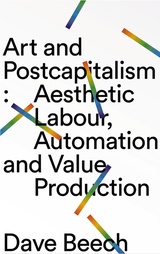
front cover of Art and Postcapitalism
Art and Postcapitalism
Aesthetic Labour, Automation and Value Production
Dave Beech
Pluto Press, 2019
Artistic labour was exemplary for Utopian Socialist theories of 'attractive labour', and Marxist theories of 'nonalienated labour', but the rise of the anti-work movement and current theories of 'fully automated luxury communism' have seen art topple from its privileged place within the left's political imaginary as the artist has been reconceived as a prototype of the precarious 24/7 worker. Art and Postcapitalism argues that art remains essential for thinking about the intersection of labour, capitalism and postcapitalism not insofar as it merges work and pleasure but as an example of noncapitalist production. Reassessing the contemporary politics of work by revisiting debates about art, technology and in the nineteenth and twentieth century, Dave Beech challenges the aesthetics of labour in John Ruskin, William Morris and Oscar Wilde with a value theory of the supersession of capitalism that sheds light on the anti-work theory by Silvia Federici, Andre Gorz, Kathi Weeks and Maurizio Lazzarato, as well as the technological Cockayne of Srnicek and Williams and Paul Mason. Formulating a critique of contemporary postcapitalism, and developing a new understanding of art and labour within the political project of the supersession of value production, this book is essential for activists, scholars and anyone interested in the real and imagined escape routes from capitalism.
[more]

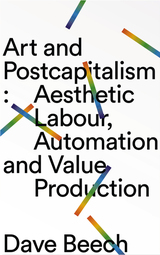
front cover of Art and Postcapitalism
Art and Postcapitalism
Aesthetic Labour, Automation and Value Production
Dave Beech
Pluto Press, 2019
Artistic labour was exemplary for Utopian Socialist theories of 'attractive labour', and Marxist theories of 'nonalienated labour', but the rise of the anti-work movement and current theories of 'fully automated luxury communism' have seen art topple from its privileged place within the left's political imaginary as the artist has been reconceived as a prototype of the precarious 24/7 worker. Art and Postcapitalism argues that art remains essential for thinking about the intersection of labour, capitalism and postcapitalism not insofar as it merges work and pleasure but as an example of noncapitalist production. Reassessing the contemporary politics of work by revisiting debates about art, technology and in the nineteenth and twentieth century, Dave Beech challenges the aesthetics of labour in John Ruskin, William Morris and Oscar Wilde with a value theory of the supersession of capitalism that sheds light on the anti-work theory by Silvia Federici, Andre Gorz, Kathi Weeks and Maurizio Lazzarato, as well as the technological Cockayne of Srnicek and Williams and Paul Mason. Formulating a critique of contemporary postcapitalism, and developing a new understanding of art and labour within the political project of the supersession of value production, this book is essential for activists, scholars and anyone interested in the real and imagined escape routes from capitalism.
[more]

front cover of Art and Posthumanism
Art and Posthumanism
Essays, Encounters, Conversations
Cary Wolfe
University of Minnesota Press, 2021

A sustained engagement between contemporary art and philosophy relating to our place in, and responsibility to, the nonhuman world

How do contemporary art and theory contemplate the problem of the “bio” of biopolitics and bioart? How do they understand the question of “life” that binds human and nonhuman worlds in their shared travail? In Art and Posthumanism, Cary Wolfe argues for the reconceptualization of nature in art and theory to turn the idea of the relationship between the human and the planet upside down.

Wolfe explores a wide range of contemporary artworks—from Sue Coe’s illustrations of animals in factory farms and Eduardo Kac’s bioart to the famous performance pieces of Joseph Bueys and the video installations of Eija-Liisa Ahtila, among others—examining how posthumanist theory can illuminate, and be illuminated by, artists’ engagement with the more-than-human world. Looking at biological and social systems, the question of the animal, and biopolitics, Art and Posthumanism explores how contemporary art rivets our attention on the empirically thick, emotionally charged questions of “life” and the “living” amid ecological catastrophe.

One of the foremost theorists of posthumanism, Wolfe pushes that philosophy out of the realm of the purely theoretical to show how a posthumanist engagement with particular works and their conceptual underpinnings help to develop more potent ethical and political commitments. 

[more]

logo for Pluto Press
Art and Production
Boris Arvatov
Pluto Press, 2017
Boris Arvatov's Art and Production is a classic of the early Soviet avant-garde. Now nearing a century since its first publication, it is a crucial intervention for those seeking to understand the social dynamic of art and revolution during the period.

Derived from the internal struggles of Soviet Constructivism, as it confronted the massive problems of cultural transformation after 'War Communism', Arvatov's writing is a major force in the split that occurred in the revolutionary horizons of Constructivism in the early 1920s. Critical of early Constructivism's social-aesthetic process of art's transformation of daily life - epitomised in studio-based painting, photography and object making - Arvatov polemicises for the devolution of artistic skills directly into the relations of production and the factory.

Whilst acknowledging the problems of a pure factory-based Productivism, Arvatov remains overwhelmingly committed to a new role and function for art outside the conventional studio and traditional gallery. Addressing issues such as artistic labour and productive labour, the artist as technician, art and multidisciplinarity and a life for art beyond 'art' - finding new relevance amidst the extensive social turn of contemporary participatory art - Art and Production offers a timely and compelling manifesto.
[more]

front cover of Art and Race
Art and Race
The African (Up) Against the Enlightenment’s Eye
Anne Lafont
J. Paul Getty Trust, The, 2026
This groundbreaking study investigates the close and paradoxical relationship of art and race during the Enlightenment.

In this text, French art historian Anne Lafont examines the complexities and contradictions in Enlightenment-era ideas about race, focusing on the figurations of Africans and other people of color. Through studies of a wide range of eighteenth-century art, Lafont grounds her analysis in the objects themselves and, by doing so, highlights how visual works can reveal the values of the culture that produced them.

While Lafont locates—unsurprisingly—instances of the marginalization and objectification of Black people, she also draws attention to depictions that present African sitters as subjects in their own right. For example, Anne-Louis Girodet’s Portrait of Jean-Baptiste Belley (1797) offers a dignified, individualized representation of this formerly enslaved French politician from Saint-Domingue; and portraits of anonymous sitters show them as actual persons whose costumes and poses demonstrate their agency.

Ultimately, Lafont moves beyond artworks to consider the broader intellectual context of the Enlightenment, particularly ideas about freedom, equality, and universal human rights, which were anchored in visual culture and indexed by it. She reveals how these ideals often conflicted with the realities of colonialism and the shifting status of Black people during this era.
[more]

front cover of The Art and Science of Negotiation
The Art and Science of Negotiation
Howard Raiffa
Harvard University Press, 1982

Whether you are selling a house, closing a business deal, settling a divorce, arbitrating a labor dispute, or trying to hammer out an international treaty, Howard Raiffa’s new book will measurably improve your negotiating skills.

Although it is a sophisticated self-help book—directed to the lawyer, labor arbitrator, business executive, college dean, diplomat—it is not cynical or Machiavellian: Raiffa emphasizes problems and situations where, with the kinds of skills he aims to develop, disputants can achieve results that are beneficial to all parties concerned. Indeed, he argues that the popular “zero-sum” way of thinking, according to which one side must lose if the other wins, often makes both sides worse off than they would be when bargaining for joint mutual gains.

Using a vast array of specific cases and clear, helpful diagrams, Raiffa not only elucidates the step-by-step processes of negotiation but also translates this deeper understanding into practical guidelines for negotiators and “intervenors.” He examines the mechanics of negotiation in imaginative fashion, drawing on his extensive background in game theory and decision analysis, on his quarter-century of teaching nonspecialists in schools of business and public policy, on his personal experiences as director of an international institute dealing with East/West problems, and on the results of simulated negotiation exercises with hundreds of participants.

There are popular books on the art of winning and scholarly books on the science of negotiation, but this is the first book to bridge the two currents. Shrewd, accessible, and engagingly written, it shows how a little analysis sprinkled with a touch of art can work to the advantage of any negotiator.

[more]

logo for Intellect Books
The Art and Science of Screenwriting
Second Edition
Philip Parker
Intellect Books, 2006
In an age where many see screenwriters as the storytellers of the new century and everyone appears to be trying to write a screenplay, this book provides the framework for you to write a great screenplay. It goes beyond the concerns of act structure and the merits of story-driven – as opposed to character-driven – screenplays to tackle the real complexities of writing a compelling screenplay.

This second edition contains:
• the different layouts for film, television, documentary and corporate screenplays
• a detailed analysis of what is required from a premise, an outline, a step outline, a treatment and a first draft
• a simple stage by stage guide to the inevitable re-write
• tips on finding an agent.

This new approach to writing for film and television covers everything from finding an idea to writing a finished screenplay. The author's framework, 'A Creative Matrix', brings together all the elements of screenplay writing - from story, character, theme, and dramatic structure to plot, genre, tone and style in an understandable way that is easy to follow. His analysis includes illustrating what comprises a good thriller, identifying the different types of sit-com, and showing the qualities of a screen romance that both works and convinces.

The author uses examples from across European, American and World Cinema, as well as television, and this revised edition now contains a comprehensive index.
[more]

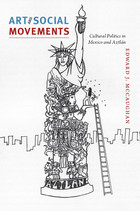
front cover of Art and Social Movements
Art and Social Movements
Cultural Politics in Mexico and Aztlán
Edward J. McCaughan
Duke University Press, 2012
Art and Social Movements offers a comparative, cross-border analysis of the role of visual artists in three social movements from the late 1960s through the early 1990s: the 1968 student movement and related activist art collectives in Mexico City, a Zapotec indigenous struggle in Oaxaca, and the Chicano movement in California. Based on extensive archival research and interviews, Edward J. McCaughan explores how artists helped to shape the identities and visions of a generation of Mexican and Chicano activists by creating new visual discourses.

McCaughan argues that the social power of activist artists emanates from their ability to provoke people to see, think, and act in innovative ways. Artists, he claims, help to create visual languages and spaces through which activists can imagine and perform new collective identities and forms of meaningful citizenship. The artists' work that he discusses remains vital today—in movements demanding fuller democratic rights and social justice for working people, women, ethnic communities, immigrants, and sexual minorities throughout Mexico and the United States. Integrating insights from scholarship on the cultural politics of representation with structural analyses of specific historical contexts, McCaughan expands our understanding of social movements.

[more]

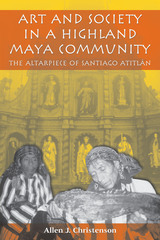
front cover of Art and Society in a Highland Maya Community
Art and Society in a Highland Maya Community
The Altarpiece of Santiago Atitlán
By Allen J. Christenson
University of Texas Press, 2001
A study of a major piece of modern Mayan religious art.
[more]

logo for Rutgers University Press
Art and the Academy in the Nineteenth Century
Rafael Cardoso Denis
Rutgers University Press, 2000

"Intellectually broad and carefully grounded in fundamental issues affecting the time, role, and place of the academy in society, this collection explores the ways in which art and tradition are either maintained or rearticulated late in the Victorian Era. Art and the Academy forges a distinctive new way to look at the broad range of academic creativity against a complex network of changing social patterns." -Gabriel P. Weisberg, department of art history, University of Minnesota

Throughout the nineteenth century, academies functioned as the main venues for the teaching, promotion, and display of art. Contemporary scholars have, for the most part, denigrated academic art, calling it formulaic, unoriginal, and repetitious. The contributors to Art and the Academy in the Nineteenth Century challenge this entrenched notion and consider how academies worldwide have represented an important system of artistic preservation and transmission. Their essays eschew easy binaries that have reigned in academia for over half a century and that simply oppose the avant-garde to academism.

The essayists uncover the institutional structures and artistic practices of academies in England, France, Germany, and Brazil. Investigating artistic protocols across national and cultural boundaries, the scholars examine the relationship between artistic training and cultural identity. Their essays provide new insights into the ways in which institutions of art helped shape the nineteenth century's view of itself as an age of civilization amidst the turmoil of rapid social and cultural change. With an engaging mix of works by leading scholars, Art and the Academy will be essential reading for anyone interested in the artistic, cultural, and social history of the nineteenth century.

Rafael Cardoso Denis is adjunct professor (visiting) at the Escola Superior de Desenho Industrial (Universidade do Estado do Rio de Janeiro). Colin Trodd is senior lecturer in art history at the University of Sunderland.

.

[more]

logo for Harvard University Press
Art and the Christian Intelligence in St. Augustine
Robert J. O'Connell
Harvard University Press, 1978

Although it is widely acknowledged that St. Augustine was a consummate artist as well as a great philosopher, and that he was deeply concerned with art, beauty and human values, relatively little attention has been paid to his theory of aesthetics. Now a distinguished Augustine scholar turns to this important subject and offers a book that is at once engaging, comprehensive and complete.

Father O'Connell begins with a paradox: how could so dedicated a literary artist propose, at times, a theory of art that amounts to the banishment of art? In attempting to answer this and other important questions, the author's purpose is not merely to recount but to retrieve St. Augustine's views. He suggests that Augustine's need to understand, and by understanding to exorcise, art's spell on him provides a key to all the philosophical and theological questions that absorbed him. Seen in this light, St. Augustine's aesthetic may lie at the very heart of his philosophy.
[more]

front cover of Art and the Crisis of Marriage
Art and the Crisis of Marriage
Edward Hopper and Georgia O'Keeffe
Vivien Green Fryd
University of Chicago Press, 2002
Between the two world wars, middle-class America experienced a "marriage crisis" that filled the pages of the popular press. Divorce rates were rising, birthrates falling, and women were entering the increasingly industrialized and urbanized workforce in larger numbers than ever before, while Victorian morals and manners began to break down in the wake of the first sexual revolution.

Vivien Green Fryd argues that this crisis played a crucial role in the lives and works of two of America's most familiar and beloved artists, Georgia O'Keeffe (1887-1986) and Edward Hopper (1882-1967). Combining biographical study of their marriages with formal and iconographical analysis of their works, Fryd shows how both artists expressed the pleasures and perils of their relationships in their paintings. Hopper's many representations of Victorian homes in sunny, tranquil landscapes, for instance, take on new meanings when viewed in the context of the artist's own tumultuous marriage with Jo and the widespread middle-class fears that the new urban, multidwelling homes would contribute to the breakdown of the family. Fryd also persuasively interprets the many paintings of skulls and crosses that O'Keeffe produced in New Mexico as embodying themes of death and rebirth in response to her husband Alfred Stieglitz's long-term affair with Dorothy Norman.

Art and the Crisis of Marriage provides both a penetrating reappraisal of the interconnections between Georgia O'Keeffe's and Edward Hopper's lives and works, as well as a vivid portrait of how new understandings of family, gender, and sexuality transformed American society between the wars in ways that continue to shape it today.
[more]

front cover of Art and the Higher Life
Art and the Higher Life
Painting and Evolutionary Thought in Late Nineteenth-Century America
By Kathleen Pyne
University of Texas Press, 1996
Late in the nineteenth century, many Americans were troubled by the theories of Charles Darwin, which contradicted both traditional Christian teachings and the idea of human supremacy over nature, and by an influx of foreign immigrants, who challenged the supremacy of the old Anglo-Saxon elite. In response, many people drew comfort from the theories of philosopher Herbert Spencer, who held that human society inevitably develops towards higher and more spiritual forms. In this illuminating study, Kathleen Pyne explores how Spencer’s theories influenced a generation of American artists. She shows how the painters of the 1880s and 1890s, particularly John La Farge, James McNeill Whistler, Thomas Dewing and the Boston school, and the impressionist painters of the Ten, developed an art dedicated to social refinement and spiritual ideals and to defending the Anglo-Saxon elite of which they were members. This linking of visual culture to the problematic conditions of American life radically reinterprets the most important trends in late nineteenth-century American painting.
[more]

logo for Harvard University Press
Art and the Human Enterprise
Iredell Jenkins
Harvard University Press

front cover of Art and the Market
Art and the Market
Roger Fry on Commerce in Art, Selected Writings, Edited with an Interpretation
Craufurd D. Goodwin
University of Michigan Press, 1998
Roger Fry, a core member of the Bloomsbury Group, was involved with all aspects of the art market as artist, critic, curator, historian, journalist, advisor to collectors, and gallery operator. He is especially remembered as the person who introduced postimpressionist art to Britain.
Reprinted in this volume are seventeen of Fry's works on commerce in art. Although he had no formal training in economics, Fry addressed the art market as a modern economist might do. It is therefore fitting that his writings receive here an original interpretation from the perspective of a modern economist, Craufurd D. Goodwin. Goodwin explores why Fry's work is both a landmark in the history of cross-disciplinary thought and a source of fresh insights into a wide range of current policy questions.
The new writings included contain Fry's most important contributions to theory, history, and debates over policy as he explored the determinants of the supply of art, the demand for art, and the art market institutions that facilitate exchange. His ideas and speculations are as stimulating and provocative today as when they were written.
"A fascinating selection of essays by one of the twentieth century's most thoughtful and stimulating critics. Goodwin's introduction sets the stage beautifully, providing useful links to Veblen and Keynes." --D. E. Moggridge, University of Toronto
"Art and the Market uncovers new connections between aesthetics and art in the Bloomsbury Group. . . . Goodwin adds significantly to the understanding of cultural economics in the work of Fry himself as well as J. M. Keynes and even Leonard and Virginia Woolf." --S. P. Rosenbaum, University of Toronto
"All those interested in the arts and economics, and their connections, will be delighted by this collection, as will be students of Bloomsbury." --Peter Stansky, Stanford University
Craufurd D. Goodwin is James B. Duke Professor of Economics, Duke University.
[more]

front cover of Art and the Public Sphere
Art and the Public Sphere
Edited by W. J. T. Mitchell
University of Chicago Press, 1992
What is the fate of art in an age of publicity? How has the role of traditional public (i.e., government-owned) art changed in contemporary culture, and how have changing conditions of public space and mass communications altered the whole relationship between art and its potential audiences?

With contributions from the arts, philosophy, criticism, and the law, the thirteen essays in this volume explore the aesthetic, social, and political dynamics that make contemporary public art so controversial, and that that have placed recent art work at the center of public debates.

Contributors include Vito Acconci, "Public Space in a Private Time"; Agnes Denes, "The Dream"; W. J. T. Mitchell, "The Violence of Public Art: Do the Right Thing"; Ben Nicholson, "Urban Poises"; Michael North, "The Public as Sculpture: From Heavenly City to Mass Ornament"; Barbara Kruger, in an interview with W. J. T. Mitchell; Barbara Hoffman, "Law for Art's Sake in the Public Realm"; Richard Serra, "Art and Censorship"; James E. Young, "The Counter-Monument: Memory Against Itself in Germany Today": Charles Griswold, "The Vietnam Veterans Memorial and the Washington Mall: Philosophical Thoughts on Political Iconography"; John Hallmark Neff, "Daring to Dream"; and David Antin and Virginia Maksymowicz.

Presenting a balance of theoretical and performative essays by both critics and artists, this book will provide deep and discordant analyses of contemporary public art for general readers, as well as students and scholars of art, architecture, and public policy related to the arts.

Most of these articles originally appeared in the journal Critical Inquiry.
[more]

front cover of Art and the Subway
Art and the Subway
New York Underground
Fitzpatrick, Tracy
Rutgers University Press, 2009
The New York City subway, considered an engineering feat and a work of art, has kindled the imagination of millions. Art and the Subway explores artistic production surrounding the world's most famous public transportation system, from just before its opening in 1904 to the present day. Using a stunning array of images, Tracy Fitzpatrick offers perspectives on ways in which the subway has been used as a subject about which to make art, as a site within which to make art, and as a canvas upon which to make art.

Fitzpatrick captures the emotions of artists and riders alike, as she explores paintings, photographs, performance art, graffiti, and public art by artists such as Walker Evans, Bruce Davidson, DONDI, Keith Haring, Yayoi Kusama, Jacob Lawrence, Reginald Marsh, Elizabeth Murray, and many others. She also considers representations of the subway in film, on song sheet covers, and in illustration. By examining the cultural, technological, and social contexts for these creative interpretations, Fitzpatrick illuminates in fresh ways the contradictions and harmonies between public and private space.

Featuring 17 color plates and 80 black-and-white images, Art and the Subway takes readers on a fascinating ride through the visual history of one of the twentieth century's greatest urban planning endeavors as it grew, changed form, and reinvented itself with passion and vitality.
[more]

front cover of Art and Trousers
Art and Trousers
Tradition and Modernity in Contemporary Asian Art
David Elliott
National University of Singapore Press, 2021
An illustrated collection of essays on modern and contemporary Asian art by a key figure of the international contemporary art world.

An illustrated collection of more than thirty essays and 640 color images, Art and Trousers moves deftly between regional analysis, portraits of individual artists, and a metaphorical history of trousers. This book presents a panoramic view of modern and contemporary Asian art, varying its focus on the impacts of invention, tradition, exchange, colonization, politics, social development, and gender. David Elliott spotlights the practice of many leading global artists of the early twenty-first century, including Hiroshi Sugimoto, Cai Guo-Qiang, Ai Weiwei, Xu Bing, Rashid Rana, Bharti Kher, Makoto Aida, Chatchai Puipia, and Yeesookyung, among many others. Art and Trousers offers insight into the development of a key curatorial practice for our times, and it will be an essential resource for anyone seeking to understand contemporary art and the way it operates across borders.
[more]

front cover of Art and Truth after Plato
Art and Truth after Plato
Tom Rockmore
University of Chicago Press, 2013
Despite its foundational role in the history of philosophy, Plato’s famous argument that art does not have access to truth or knowledge is now rarely examined, in part because recent philosophers have assumed that Plato’s challenge was resolved long ago. In Art and Truth after Plato, Tom Rockmore argues that Plato has in fact never been satisfactorily answered—and to demonstrate that, he offers a comprehensive account of Plato’s influence through nearly the whole history of Western aesthetics.
 
Rockmore offers a cogent reading of the post-Platonic aesthetic tradition as a series of responses to Plato’s position, examining a stunning diversity of thinkers and ideas. He visits Aristotle’s Poetics, the medieval Christians, Kant’s Critique of Judgment, Hegel’s phenomenology, Marxism, social realism, Heidegger, and many other works and thinkers, ending with a powerful synthesis that lands on four central aesthetic arguments that philosophers have debated. More than a mere history of aesthetics, Art and Truth after Plato presents a fresh look at an ancient question, bringing it into contemporary relief.
[more]

logo for Harvard University Press
Art, Artist, and Layman
A Study of the Teaching of the Visual Arts
Arthur Pope
Harvard University Press
All who are in any way concerned with visual art or with art education will be interested in this stimulating volume. The first part considers the difficulty with some of our present aims and methods in education. The second part outlines a rational program for schools, colleges, and graduate professional schools. Professor Pope puts forward the revolutionary proposal that advanced training for the visual arts—architecture, painting, sculpture, the so-called industrial arts, museum work, technical care of works of art, and teaching of the history and theory of art—should all be incorporated in a comprehensive professional school and that this should assume a general background of study in school and college which would be much the same for both professional people and laymen. The book concludes with a brief explanation of what we mean by the theory of the visual arts, a subject on which many persons are little informed.
[more]

front cover of Art as Information Ecology
Art as Information Ecology
Artworks, Artworlds, and Complex Systems Aesthetics
Jason Hoelscher
Duke University Press, 2021
In Art as Information Ecology, Jason A. Hoelscher offers not only an information theory of art but an aesthetic theory of information. Applying close readings of the information theories of Claude Shannon and Gilbert Simondon to 1960s American art, Hoelscher proposes that art is information in its aesthetic or indeterminate mode—information oriented less toward answers and resolvability than toward questions, irresolvability, and sustained difference. These irresolvable differences, Hoelscher demonstrates, fuel the richness of aesthetic experience by which viewers glean new information and insight from each encounter with an artwork. In this way, art constitutes information that remains in formation---a difference that makes a difference that keeps on differencing. Considering the works of Frank Stella, Robert Morris, Adrian Piper, the Drop City commune, Eva Hesse, and others, Hoelscher finds that art exists within an information ecology of complex feedback between artwork and artworld that is driven by the unfolding of difference. By charting how information in its aesthetic mode can exist beyond today's strictly quantifiable and monetizable forms, Hoelscher reconceives our understanding of how artworks work and how information operates.
[more]

logo for Intellect Books
Art as Research
Opportunities and Challenges
Edited by Shaun McNiff
Intellect Books, 2013
The new practice of art-based research uses art making as a primary mode of enquiry rather than continuing to borrow research methodologies from other disciplines to study artistic processes. Drawing on contributions from arts therapies, education, history, organizational studies, and philosophy, the essays critically examine unique challenges that include the personal and sometimes intimate nature of artistic enquiry and the complexities of the partnership with social science which has dominated applied arts research; how artistic discoveries are apt to emerge spontaneously, even contrary to plans and what we think we know; how truth can be examined through both fact and fiction as well as the interplay of objective and subjective experience; and ways of generating artistic evidence and communicating outcomes. Offering examples from all of the arts this volume will be welcomed by researchers and students in many fields.

[more]

front cover of Art as Sanctuary
Art as Sanctuary
Conjuring an Africana Aesthetic
Michael D. Harris. Edited and with an introduction by Dianne M. Stewart and Theophus H. Smith. Foreword by Richard J. Powell.
Duke University Press, 2026
In Art as Sanctuary, Michael D. Harris considers literal and metaphorical uses of sanctuary in the black experience and African diaspora art, including locales of spiritual expression, self-renewal, and cultural celebration. Harris offers an alternative framework to the Duboisian philosophy of double consciousness, pushing the boundaries of Africana aesthetic analysis by exploring the cultural signifiers embedded consciously or unconsciously in African diaspora art. Within these works, he reveals how these cultural cues speak to the vibrancy of African American life. While acknowledging the presence of the white observer’s gaze, Harris wishes to relieve the black interior from the panoptic assumptions of that gaze and its disciplines. Art as Sanctuary provides innovative pathways to understand African American visual culture and music as autobiographies of cultural identity and experience.
[more]

front cover of Art beyond Borders
Art beyond Borders
Artistic Exchange in Communist Europe (1945-1989)
Jérôme Bazin
Central European University Press, 2016
This book presents and analyzes artistic interactions both within the Soviet bloc and with the West between 1945 and 1989. During the Cold War the exchange of artistic ideas and products united Europe’s avant-garde in a most remarkable way. Despite the Iron Curtain and national and political borders there existed a constant flow of artists, artworks, artistic ideas and practices. The geographic borders of these exchanges have yet to be clearly defined. How were networks, centers, peripheries (local, national and international), scales, and distances constructed? How did (neo)avant-garde tendencies relate with officially sanctioned socialist realism? The literature on the art of Eastern Europe provides a great deal of factual knowledge about a vast cultural space, but mostly through the prism of stereotypes and national preoccupations. By discussing artworks, studying the writings on art, observing artistic evolution and artists’ strategies, as well as the influence of political authorities, art dealers and art critics, the essays in Art beyond Borders compose a transnational history of arts in the Soviet satellite countries in the post war period.
[more]

front cover of Art beyond Itself
Art beyond Itself
Anthropology for a Society without a Story Line
Néstor García Canclini
Duke University Press, 2014
First published in Spanish in 2010, Art beyond Itself is Néstor García Canclini's deft assessment of contemporary art. The renowned cultural critic suggests that, ideally, art is the place of imminence, the place where we glimpse something just about to happen. Yet, as he demonstrates, defining contemporary art and its role in society is an ever more complicated endeavor. Museums, auction houses, artists, and major actors in economics, politics, and the media are increasingly chummy and interdependent. Art is expanding into urban development and the design and tourism industries. Art practices based on objects are displaced by practices based on contexts. Aesthetic distinctions dissolve as artworks are inserted into the media, urban spaces, digital networks, and social forums. Oppositional artists are adrift in a society without a clear story line. What, after all, counts as transgression in a world of diverse and fragmentary narratives? Seeking a new analytic framework for understanding contemporary art, García Canclini is attentive to particular artworks; to artists including Francis Alÿs, León Ferrari, Teresa Margolles, Antoni Muntadas, and Gabriel Orozco; and to efforts to preserve, for art and artists, some degree of independence from religion, politics, the media, and the market.
[more]

front cover of Art, Culture, and Cuisine
Art, Culture, and Cuisine
Ancient and Medieval Gastronomy
Phyllis Pray Bober
University of Chicago Press, 1999
In Art, Culture, and Cuisine, Phyllis Pray Bober examines cooking through an assortment of recipes as well as the dual lens of archaeology and art history. Believing that the unity of a culture extends across all forms of expression, Bober seeks to understand the minds and hearts of those who practiced cookery or consumed it as reflected in the visual art of the time.

Bober draws on archaeology and art history to examine prehistoric eating customs in ancient Turkey; traditions of the great civilizations of Egypt, Mesopotamia, Greece, and Rome; and rituals of the Middle Ages. Both elegant and entertaining, Art, Culture, and Cuisine reveals cuisine and dining's place at the heart of cultural, religious, and social activities that have shaped Western sensibilities.
 
[more]

front cover of Art, Culture, and Media Under the Third Reich
Art, Culture, and Media Under the Third Reich
Edited by Richard A. Etlin
University of Chicago Press, 2002
Art, Culture, and Media Under the Third Reich explores the ways in which the Nazis used art and media to portray their country as the champion of Kultur and civilization. Rather than focusing strictly on the role of the arts in state-supported propaganda, this volume contributes to Holocaust studies by revealing how multiple domains of cultural activity served to conceptually dehumanize Jews and other groups.

Contributors address nearly every facet of the arts and mass media under the Third Reich—efforts to define degenerate music and art; the promotion of race hatred through film and public assemblies; views of the racially ideal garden and landscape; race as portrayed in popular literature; the reception of art and culture abroad; the treatment of exiled artists; and issues of territory, conquest, and appeasement. Familiar subjects such as the Munich Accord, Nuremberg Party Rally Grounds, and Lebensraum (Living Space) are considered from a new perspective. Anyone studying the history of Nazi Germany or the role of the arts in nationalist projects will benefit from this book.

Contributors:
Ruth Ben-Ghiat
David Culbert
Albrecht Dümling
Richard A. Etlin
Karen A. Fiss
Keith Holz
Kathleen James-Chakraborty
Paul B. Jaskot
Karen Koehler
Mary-Elizabeth O'Brien
Jonathan Petropoulos
Robert Jan van Pelt
Joachim Wolschke-Bulmahn and Gert Gröning
[more]

front cover of Art Documentation
Art Documentation
Journal of the Art Libraries Society of North America, volume 40 number 2 (Fall 2021)
The University of Chicago Press
University of Chicago Press Journals, 2021
This is volume 40 issue 2 of Art Documentation: Journal of the Art Libraries Society of North America. Art Documentation: Journal of the Art Libraries Society of North America is a peer-reviewed journal presenting issues of concern to librarians working within art history, art criticism, the history of architecture, archaeology, and similar areas. The journal has established itself as a vital publication for art information professionals, acting as a forum for issues relating to both the documentation of art and the practice and theory of art librarianship and visual resources curatorship. Art Documentation will publish articles pertinent to issues surrounding the documentation of art and the use of visual resources in academic and special libraries and museum settings. It is a key resource for professionals entering the field as well as those more seasoned professionals.
[more]

front cover of Art Documentation
Art Documentation
Journal of the Art Libraries Society of North America, volume 41 number 1 (Spring 2022)
The University of Chicago Press
University of Chicago Press Journals, 2022
This is volume 41 issue 1 of Art Documentation: Journal of the Art Libraries Society of North America. Art Documentation: Journal of the Art Libraries Society of North America is a peer-reviewed journal presenting issues of concern to librarians working within art history, art criticism, the history of architecture, archaeology, and similar areas. The journal has established itself as a vital publication for art information professionals, acting as a forum for issues relating to both the documentation of art and the practice and theory of art librarianship and visual resources curatorship. Art Documentation will publish articles pertinent to issues surrounding the documentation of art and the use of visual resources in academic and special libraries and museum settings. It is a key resource for professionals entering the field as well as those more seasoned professionals.
[more]

front cover of Art Documentation
Art Documentation
Journal of the Art Libraries Society of North America, volume 41 number 2 (Fall 2022)
The University of Chicago Press
University of Chicago Press Journals, 2022
This is volume 41 issue 2 of Art Documentation: Journal of the Art Libraries Society of North America. Art Documentation: Journal of the Art Libraries Society of North America is a peer-reviewed journal presenting issues of concern to librarians working within art history, art criticism, the history of architecture, archaeology, and similar areas. The journal has established itself as a vital publication for art information professionals, acting as a forum for issues relating to both the documentation of art and the practice and theory of art librarianship and visual resources curatorship. Art Documentation will publish articles pertinent to issues surrounding the documentation of art and the use of visual resources in academic and special libraries and museum settings. It is a key resource for professionals entering the field as well as those more seasoned professionals.
[more]

front cover of Art Documentation
Art Documentation
Journal of the Art Libraries Society of North America, volume 42 number 1 (Spring 2023)
The University of Chicago Press
University of Chicago Press Journals, 2023
This is volume 42 issue 1 of Art Documentation: Journal of the Art Libraries Society of North America. Art Documentation: Journal of the Art Libraries Society of North America is a peer-reviewed journal presenting issues of concern to librarians working within art history, art criticism, the history of architecture, archaeology, and similar areas. The journal has established itself as a vital publication for art information professionals, acting as a forum for issues relating to both the documentation of art and the practice and theory of art librarianship and visual resources curatorship. Art Documentation will publish articles pertinent to issues surrounding the documentation of art and the use of visual resources in academic and special libraries and museum settings. It is a key resource for professionals entering the field as well as those more seasoned professionals.
[more]

front cover of Art Documentation
Art Documentation
Journal of the Art Libraries Society of North America, volume 42 number 2 (Fall 2023)
The University of Chicago Press
University of Chicago Press Journals, 2023
This is volume 42 issue 2 of Art Documentation: Journal of the Art Libraries Society of North America. Art Documentation: Journal of the Art Libraries Society of North America is a peer-reviewed journal presenting issues of concern to librarians working within art history, art criticism, the history of architecture, archaeology, and similar areas. The journal has established itself as a vital publication for art information professionals, acting as a forum for issues relating to both the documentation of art and the practice and theory of art librarianship and visual resources curatorship. Art Documentation will publish articles pertinent to issues surrounding the documentation of art and the use of visual resources in academic and special libraries and museum settings. It is a key resource for professionals entering the field as well as those more seasoned professionals.
[more]

front cover of Art Documentation
Art Documentation
Journal of the Art Libraries Society of North America, volume 43 number 1 (Spring 2024)
The University of Chicago Press
University of Chicago Press Journals, 2024
This is volume 43 issue 1 of Art Documentation: Journal of the Art Libraries Society of North America. Art Documentation: Journal of the Art Libraries Society of North America is a peer-reviewed journal presenting issues of concern to librarians working within art history, art criticism, the history of architecture, archaeology, and similar areas. The journal has established itself as a vital publication for art information professionals, acting as a forum for issues relating to both the documentation of art and the practice and theory of art librarianship and visual resources curatorship. Art Documentation will publish articles pertinent to issues surrounding the documentation of art and the use of visual resources in academic and special libraries and museum settings. It is a key resource for professionals entering the field as well as those more seasoned professionals.
[more]

logo for University of Chicago Press Journals
Art Documentation
Journal of the Art Libraries Society of North America, volume 43 number 2 (Fall 2024)
The University of Chicago Press
University of Chicago Press Journals, 2024
This is volume 43 issue 2 of Art Documentation: Journal of the Art Libraries Society of North America. Art Documentation: Journal of the Art Libraries Society of North America is a peer-reviewed journal presenting issues of concern to librarians working within art history, art criticism, the history of architecture, archaeology, and similar areas. The journal has established itself as a vital publication for art information professionals, acting as a forum for issues relating to both the documentation of art and the practice and theory of art librarianship and visual resources curatorship. Art Documentation will publish articles pertinent to issues surrounding the documentation of art and the use of visual resources in academic and special libraries and museum settings. It is a key resource for professionals entering the field as well as those more seasoned professionals.
[more]

front cover of Art Documentation
Art Documentation
Journal of the Art Libraries Society of North America, volume 44 number 1 (Spring 2025)
The University of Chicago Press
University of Chicago Press Journals, 2025
This is volume 44 issue 1 of Art Documentation: Journal of the Art Libraries Society of North America. Art Documentation: Journal of the Art Libraries Society of North America is a peer-reviewed journal presenting issues of concern to librarians working within art history, art criticism, the history of architecture, archaeology, and similar areas. The journal has established itself as a vital publication for art information professionals, acting as a forum for issues relating to both the documentation of art and the practice and theory of art librarianship and visual resources curatorship. Art Documentation will publish articles pertinent to issues surrounding the documentation of art and the use of visual resources in academic and special libraries and museum settings. It is a key resource for professionals entering the field as well as those more seasoned professionals.
[more]

front cover of Art during Wartime
Art during Wartime
Painting Everyday Life in the Civil War North
Vanessa Meikle Schulman
University of Massachusetts Press, 2024

While the Civil War raged on, many northern artists depicted everyday life rather than grand battles or landscapes of noble sacrifice. Amidst a conflict that was upending antebellum social norms, these artists created realistic scenes of mundane events, known as genre paintings. While many of the paintings seem merely to show everyday incidents, Vanessa Meikle Schulman argues that artists connected the visuals to larger concerns.

With attention to how the war shaped new definitions of gender, race, and disability, Art during Wartime uncovers the complexity of these genre paintings. Schulman uses seven case studies of prominent and lesser-known artists who explored how the war instigated social change and shaped northern opinions about current events, including George Cochran Lambdin, Vincent Colyer, and Eastman Johnson. Utilizing detailed visual analysis and extensive historical research, Art during Wartime reframes our narrative of Civil War visual culture, placing genre painting in a central ideological role.

[more]

logo for University of Illinois Press
Art Education
A CRITICAL NECESSITY
Albert William Levi and Ralph A. Smith
University of Illinois Press, 1991
        Recommending that art be taught as a humanity, this volume provides a
        philosophical rationale for the idea of discipline-based art education.
        Levi and Smith discuss topics ranging over both the public and private
        aspects of art, the disciplines of artistic creation, art history, art
        criticism, and aesthetics, and curriculum proposals featuring five phases
        of aesthetic learning.
      While there is no consensus on how the various components of aesthetic
        learning should be presented in order to accomplish the goals of discipline-based
        art education, the authors point out that progress toward those goals
        will require that those who design art education programs bring an understanding
        of the four disciplines to their work. The introductory volume of a five-volume
        series, this book will appeal to elementary and secondary art teachers,
        those who prepare teachers at the college level, and museum educators.
      
 
[more]

logo for Intellect Books
Art Education in a Postmodern World
Collected Essays
Edited by Tom Hardy
Intellect Books, 2006
This volume presents a series of papers concerned with the interrelations between the postmodern and the present state of art and design education. Spanning a range of thematic concerns, the book reflects upon existing practice and articulates revolutionary prospects potentially viable through a shift in educative thinking.

Many of the essays pinpoint the stagnancy of teaching methods today and discuss the reductive parameters enforced by the current curriculum. The radical tone that echoes through the entire series of papers is unmistakable. Throughout the book, postmodern theory informs the polemical debate concerning new directions in educative practice. Contributors shed new light on a postmodern view of art in education with emphasis upon difference, plurality and independence of mind. Ultimately, the paper provides a detailed insight into the various concepts that shape and drive the contemporary art world and expands the debate regarding the impression of postmodern thinking in art education.
[more]

front cover of Art Essays
Art Essays
A Collection
Alexandra Kingston-Reese
University of Iowa Press, 2021
Art Essays is a passionate collection of the best essays on the visual arts written by contemporary novelists. This vibrant and diverse selection includes essays by award-winning writers such as Zadie Smith, Chris Kraus, Teju Cole, Orhan Pamuk, and Jhumpa Lahiri. From the art of Sonia Delaunay to contemporary photography, from the docks of Malaysia to Leonora Carrington’s home in Mexico City, and from reflections on modern Black British paintings to meditations on the female gaze, these essays bring together blazing insights to the visual world, with personal, intimate reflections. With an introduction by literary critic and editor Alexandra Kingston-Reese, Art Essays is an enthralling vision of a new wave of literary essays shaping contemporary culture.

Contributors: Chloe Aridjis, Tash Aw, Claire-Louise Bennett, Teju Cole, Geoff Dyer, Sheila Heti, Katie Kitamura, Chris Kraus, Jhumpa Lahiri, Ben Lerner, Orhan Pamuk, Ali Smith, Zadie Smith, Heidi Sopinka, Hanya Yanagihara


[more]

front cover of Art for a Modern India, 1947-1980
Art for a Modern India, 1947-1980
Rebecca M. Brown
Duke University Press, 2009
Following India’s independence in 1947, Indian artists creating modern works of art sought to maintain a local idiom, an “Indianness” representative of their newly independent nation, while connecting to modernism, an aesthetic then understood as both universal and presumptively Western. These artists depicted India’s precolonial past while embracing aspects of modernism’s pursuit of the new, and they challenged the West’s dismissal of non-Western places and cultures as sources of primitivist imagery but not of modernist artworks. In Art for a Modern India, Rebecca M. Brown explores the emergence of a self-conscious Indian modernism—in painting, drawing, sculpture, architecture, film, and photography—in the years between independence and 1980, by which time the Indian art scene had changed significantly and postcolonial discourse had begun to complicate mid-century ideas of nationalism.

Through close analyses of specific objects of art and design, Brown describes how Indian artists engaged with questions of authenticity, iconicity, narrative, urbanization, and science and technology. She explains how the filmmaker Satyajit Ray presented the rural Indian village as a socially complex space rather than as the idealized site of “authentic India” in his acclaimed Apu Trilogy, how the painter Bhupen Khakhar reworked Indian folk idioms and borrowed iconic images from calendar prints in his paintings of urban dwellers, and how Indian architects developed a revivalist style of bold architectural gestures anchored in India’s past as they planned the Ashok Hotel and the Vigyan Bhavan Conference Center, both in New Delhi. Discussing these and other works of art and design, Brown chronicles the mid-twentieth-century trajectory of India’s modern visual culture.
[more]

front cover of Art for a New Understanding
Art for a New Understanding
Native Voices, 1950s to Now
Mindy N. Besaw
University of Arkansas Press, 2018
Art for a New Understanding, an exhibition from Crystal Bridges Museum of American Art that opened in October 2018, seeks to radically expand and reposition the narrative of American art since 1950 by charting a history of the development of contemporary Indigenous art from the United States and Canada, beginning when artists moved from more regionally-based conversations and practices to national and international contemporary art contexts.

This fully illustrated volume includes essays by art historians and historians and reflections by the artists included in the collection. Also included are key contemporary writings—from the 1950s onward—by artists, scholars, and critics, investigating the themes of transculturalism and pan-Indian identity, traditional practices conducted in radically new ways, displacement, forced migration, shadow histories, the role of personal mythologies as a means to reimagine the future, and much more.

As both a survey of the development of Indigenous art from the 1950s to the present and a consideration of Native artists within contemporary art more broadly, Art for a New Understanding expands the definition of American art and sets the tone for future considerations of the subject. It is an essential publication for any institution or individual with an interest in contemporary Native American art, and an invaluable resource in ongoing scholarly considerations of the American contemporary art landscape at large.
[more]

front cover of Art for an Undivided Earth
Art for an Undivided Earth
The American Indian Movement Generation
Jessica L. Horton
Duke University Press, 2017
In Art for an Undivided Earth Jessica L. Horton reveals how the spatial philosophies underlying the American Indian Movement (AIM) were refigured by a generation of artists searching for new places to stand. Upending the assumption that Jimmie Durham, James Luna, Kay WalkingStick, Robert Houle, and others were primarily concerned with identity politics, she joins them in remapping the coordinates of a widely shared yet deeply contested modernity that is defined in great part by the colonization of the Americas. She follows their installations, performances, and paintings across the ocean and back in time, as they retrace the paths of Native diplomats, scholars, performers, and objects in Europe after 1492. Along the way, Horton intervenes in a range of theories about global modernisms, Native American sovereignty, racial difference, archival logic, artistic itinerancy, and new materialisms. Writing in creative dialogue with contemporary artists, she builds a picture of a spatially, temporally, and materially interconnected world—an undivided earth.
[more]

logo for University of Minnesota Press
Art for Daily Living
The Story of the Owatonna Art Education Project
Edwin Ziegfeld
University of Minnesota Press, 1944
Art for Daily Living was first published in 1944. Minnesota Archive Editions uses digital technology to make long-unavailable books once again accessible, and are published unaltered from the original University of Minnesota Press editions.Art education has faced two great crises in one decade–first the depression and now the war. Out of the chaos and destruction of the early 1930’s came a critical evaluation of educational practices, which challenged art as it was being taught in the schools. the Owatonna Art Education Project was developed to help evolve a sound art education program that could justify itself educationally and financially as an indispensable part of education.Believing that art plays an integral part in the life of every human being, the late Melvin E. Haggerty, dean of the College of Education and the University of Minnesota, obtained a grant from the Carnegie Foundation to develop a new approach to the teaching of art in the public schools–and approach based on the study of a typical Midwestern community and its use of art in everyday living.
[more]

front cover of Art for People's Sake
Art for People's Sake
Artists and Community in Black Chicago, 1965-1975
Rebecca Zorach
Duke University Press, 2019
In the 1960s and early 1970s, Chicago witnessed a remarkable flourishing of visual arts associated with the Black Arts Movement. From the painting of murals as a way to reclaim public space and the establishment of independent community art centers to the work of the AFRICOBRA collective and Black filmmakers, artists on Chicago's South and West Sides built a vision of art as service to the people. In Art for People's Sake Rebecca Zorach traces the little-told story of the visual arts of the Black Arts Movement in Chicago, showing how artistic innovations responded to decades of racist urban planning that left Black neighborhoods sites of economic depression, infrastructural decay, and violence. Working with community leaders, children, activists, gang members, and everyday people, artists developed a way of using art to help empower and represent themselves. Showcasing the depth and sophistication of the visual arts in Chicago at this time, Zorach demonstrates the crucial role of aesthetics and artistic practice in the mobilization of Black radical politics during the Black Power era.
[more]

front cover of Art from a Fractured Past
Art from a Fractured Past
Memory and Truth-Telling in Post-Shining Path Peru
Cynthia E. Milton, ed.
Duke University Press, 2014
Peru's Truth and Reconciliation Commission not only documented the political violence of the 1980s and 1990s but also gave Peruvians a unique opportunity to examine the causes and nature of that violence. In Art from a Fractured Past, scholars and artists expand on the commission's work, arguing for broadening the definition of the testimonial to include various forms of artistic production as documentary evidence. Their innovative focus on representation offers new and compelling perspectives on how Peruvians experienced those years and how they have attempted to come to terms with the memories and legacies of violence. Their findings about Peru offer insight into questions of art, memory, and truth that resonate throughout Latin America in the wake of "dirty wars" of the last half century. Exploring diverse works of art, including memorials, drawings, theater, film, songs, painted wooden retablos (three-dimensional boxes), and fiction, including an acclaimed graphic novel, the contributors show that art, not constrained by literal truth, can generate new opportunities for empathetic understanding and solidarity.

Contributors. Ricardo Caro Cárdenas, Jesús Cossio, Ponciano del Pino, Cynthia M. Garza, Edilberto Jímenez Quispe, Cynthia E. Milton, Jonathan Ritter, Luis Rossell, Steve J. Stern, María Eugenia Ulfe, Víctor Vich, Alfredo Villar
 
[more]

front cover of Art from Start to Finish
Art from Start to Finish
Jazz, Painting, Writing, and Other Improvisations
Edited by Howard S. Becker, Robert R. Faulkner, and Barbara Kirshenblatt-Gimblett
University of Chicago Press, 2006
When is an artistic work finished? When the copyeditor makes the final correction to a manuscript, when the composer writes the last note of a symphony, or when the painter puts the last brushstroke on the canvas? Perhaps it's even later, when someone reads the work, when an ensemble performs, or when the painting is hung on a gallery wall for viewing?

Art from Start to Finish gathers a unique group of contributors from the worlds of sociology, musicology, literature, and communications—many of them practicing artists in their own right—to discuss how artists from jazz musicians to painters work: how they coordinate their efforts, how they think, how they start, and, of course, how they finish their productions.

Specialists in the arts have much to say about the works themselves, which are often neglected by scholarsi n other fields. Art from Start to Finish takes a different tack by exploring the creative process itself and its social component. Any reader who makes art or has an interest in it will value this book.
[more]

front cover of Art History after Modernism
Art History after Modernism
Hans Belting
University of Chicago Press, 2003
"Art history after modernism" does not only mean that art looks different today; it also means that our discourse on art has taken a different direction, if it is safe to say it has taken a direction at all.

So begins Hans Belting's brilliant, iconoclastic reconsideration of art and art history at the end of the millennium, which builds upon his earlier and highly successful volume, The End of the History of Art?. "Known for his striking and original theories about the nature of art," according to the Economist, Belting here examines how art is made, viewed, and interpreted today. Arguing that contemporary art has burst out of the frame that art history had built for it, Belting calls for an entirely new approach to thinking and writing about art. He moves effortlessly between contemporary issues—the rise of global and minority art and its consequences for Western art history, installation and video art, and the troubled institution of the art museum—and questions central to art history's definition of itself, such as the distinction between high and low culture, art criticism versus art history, and the invention of modernism in art history. Forty-eight black and white images illustrate the text, perfectly reflecting the state of contemporary art.

With Art History after Modernism, Belting retains his place as one of the most original thinkers working in the visual arts today.
[more]

front cover of Art History and Anthropology
Art History and Anthropology
Modern Encounters, 1870–1970
Peter Probst
J. Paul Getty Trust, The, 2023
An in-depth and nuanced look at the complex relationship between two dynamic fields of study.

While today we are experiencing a revival of world art and the so-called global turn of art history, encounters between art historians and anthropologists remain rare. Even after a century and a half of interactions between these epistemologies, a skeptical distance prevails with respect to the disciplinary other. This volume is a timely exploration of the roots of this complex dialogue, as it emerged worldwide in the colonial and early postcolonial periods, between 1870 and 1970.

Exploring case studies from Australia, Austria, Brazil, France, Germany, and the United States, this volume addresses connections and rejections between art historians and anthropologists—often in the contested arena of “primitive art.” It examines the roles of a range of figures, including the art historian–anthropologist Aby Warburg, the modernist artist Tarsila do Amaral, the curator-impresario Leo Frobenius, and museum directors such as Alfred Barr and René d’Harnoncourt. Entering the current debates on decolonizing the past, this collection of essays prompts reflection on future relations between these two fields.
[more]

logo for University of Illinois Press
Art History and Education
Stephen Addiss and Mary Erickson
University of Illinois Press, 1993
 
Guided by Stephen Addiss's grounding in art history scholarship and Mary Erickson's expertise in art education theory and practice, this volume approaches the issue of teaching art history from theoretical and philosophical as well as practical and political standpoints. In the first section, Addiss raises issues about the discipline of art history. In the second, Erickson examines proposals about how art history can be incorporated into the general education of children and offers some curriculum guides and lesson plans for art educators.
 
[more]

front cover of Art, Ideology, and the City of Teotihuacan
Art, Ideology, and the City of Teotihuacan
Janet Catherine Berlo
Harvard University Press, 1992
Art, Ideology, and the City of Teotihuacan focuses on a singular site in Mesoamerican archaeology. The only city in Mesoamerica that represents an entire culture, Teotihuacan set itself apart from other cities in the same time period, acting as part of the foundation for our understanding of Mesoamerican cultures. The papers in this volume seek to explain the particular features that set it apart from other Mesoamerican places. Drawing on fields ranging from art history to political analysis, these essays provide a synthesis and new appraisal of Teotihuacan’s unique cultural manifestations and reflect a new stage in Teotihuacan studies.
[more]

front cover of Art, Imagination and Public Service
Art, Imagination and Public Service
Hughie O'Donoghue, Brenda Hale, James O'Donnell, Clare Moriarty, Micheal O'Siadhail, and David Blunkett
Haus Publishing, 2021
A collection of three conversations between artists and public servants.

Intended to inspire public servants of all kinds to reconnect fearlessly with their fundamental humanity, the three conversations in Art, Imagination and Public Service present a way of thinking about imaginative, compassionate, and intelligent public service. The book consists of three dialogues: between former UK Home Secretary David Blunkett and poet Micheal O’Siadhail, former UK Supreme Court president Brenda Hale and painter Hughie O’Donoghue, and UK Permanent Secretary Clare Moriarty and musician James O’Donnell. Together they explore how art and imagination can sustain public servants and enable them to find new ways of addressing the problems facing government, parliament, and the law—problems that resist utilitarian responses in which people end up being treated only as statistics in a target-driven world. Through these conversations, the speakers discover surprising connections in approaches to their work.
 
[more]


Send via email Share on Facebook Share on Twitter