
 A SCHOLARLY BOOK REPOSITORY
338 start with C start with C
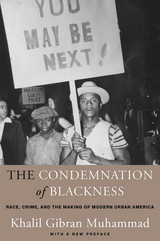
Winner of the John Hope Franklin Prize
A Moyers & Company Best Book of the Year
“A brilliant work that tells us how directly the past has formed us.”
—Darryl Pinckney, New York Review of Books
How did we come to think of race as synonymous with crime? A brilliant and deeply disturbing biography of the idea of black criminality in the making of modern urban America, The Condemnation of Blackness reveals the influence this pernicious myth, rooted in crime statistics, has had on our society and our sense of self. Black crime statistics have shaped debates about everything from public education to policing to presidential elections, fueling racism and justifying inequality. How was this statistical link between blackness and criminality initially forged? Why was the same link not made for whites? In the age of Black Lives Matter and Donald Trump, under the shadow of Ferguson and Baltimore, no questions could be more urgent.
“The role of social-science research in creating the myth of black criminality is the focus of this seminal work…[It] shows how progressive reformers, academics, and policy-makers subscribed to a ‘statistical discourse’ about black crime…one that shifted blame onto black people for their disproportionate incarceration and continues to sustain gross racial disparities in American law enforcement and criminal justice.”
—Elizabeth Hinton, The Nation
“Muhammad identifies two different responses to crime among African-Americans in the post–Civil War years, both of which are still with us: in the South, there was vigilantism; in the North, there was an increased police presence. This was not the case when it came to white European-immigrant groups that were also being demonized for supposedly containing large criminal elements.”
—New Yorker
A collection of essays that provides advice and strategies for BIPOC scholars on how to survive, thrive, and resist in academic institutions.
Conditionally Accepted builds upon an eponymous blog on InsideHigherEd.com, which is now a decade-old national platform for BIPOC academics in the United States. Bringing together perspectives from academics of color on navigating intersecting forms of injustice in the academy, each chapter offers situated knowledge about experiencing—and resisting—marginalization in academia. Contextualized within existing scholarship, these personal narratives speak to institutional betrayals while highlighting agency and sharing stories of surviving on treacherous terrain. Covering topics from professional development to the emptiness of diversity, equity, and inclusion efforts, and redefining what it means to be an academic in our contemporary moment, this edited collection directly confronts issues of systemic exclusion, discrimination, harassment, microaggressions, tokenism, and surveillance. Letting marginalized scholars know they are not alone, Conditionally Accepted offers concrete wisdom for readers seeking to navigate and transform oppressive academic institutions.
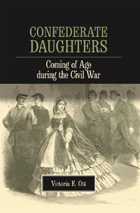
Confederate Daughters: Coming of Age during the Civil War explores gender, age, and Confederate identity by examining the lives of teenage daughters of Southern slaveholding, secessionist families. These young women clung tenaciously to the gender ideals that upheld marriage and motherhood as the fulfillment of female duty and to the racial order of the slaveholding South, an institution that defined their status and afforded them material privileges. Author Victoria E. Ott discusses how the loyalty of young Southern women to the fledgling nation, born out of a conservative movement to preserve the status quo, brought them into new areas of work, new types of civic activism, and new rituals of courtship during the Civil War.
Social norms for daughters of the elite, their preparation for their roles as Southern women, and their material and emotional connections to the slaveholding class changed drastically during the Civil War. When differences between the North and South proved irreconcilable, Southern daughters demonstrated extraordinary agency in seeking to protect their futures as wives, mothers, and slaveholders.
From a position of young womanhood and privilege, they threw their support behind the movement to create a Confederate identity, which was in turn shaped by their participation in the secession movement and the war effort. Their political engagement is evident from their knowledge of military battles, and was expressed through their clothing, social activities, relationships with peers, and interactions with Union soldiers.
Confederate Daughters also reveals how these young women, in an effort to sustain their families throughout the war, adjusted to new domestic duties, confronting the loss of slaves and other financial hardships by seeking paid work outside their homes.
Drawing on their personal and published recollections of the war, slavery, and the Old South, Ott argues that young women created a unique female identity different from that of older Southern women, the Confederate bellehood. This transformative female identity was an important aspect of the Lost Cause mythology—the version of the conflict that focused on Southern nationalism—and bridged the cultural gap between the antebellum and postbellum periods.
Augmented by twelve illustrations, this book offers a generational understanding of the transitional nature of wartime and its effects on women’s self-perceptions. Confederate Daughters identifies the experiences of these teenage daughters as making a significant contribution to the new woman in the New South.
Pulitzer Prize Finalist
Winner of the Frederick Douglass Book Prize
Winner of the Merle Curti Award
“McCurry strips the Confederacy of myth and romance to reveal its doomed essence. Dedicated to the proposition that men were not created equal, the Confederacy had to fight a two-front war. Not only against Union armies, but also slaves and poor white women who rose in revolt across the South. Richly detailed and lucidly told, Confederate Reckoning is a fresh, bold take on the Civil War that every student of the conflict should read.”
—Tony Horwitz, author of Confederates in the Attic
“McCurry challenges us to expand our definition of politics to encompass not simply government but the entire public sphere. The struggle for Southern independence, she shows, opened the door for the mobilization of two groups previously outside the political nation—white women of the nonslaveholding class and slaves…Confederate Reckoning offers a powerful new paradigm for understanding events on the Confederate home front.”
—Eric Foner, The Nation
“Perhaps the highest praise one can offer McCurry’s work is to say that once we look through her eyes, it will become almost impossible to believe that we ever saw or thought otherwise…At the outset of the book, McCurry insists that she is not going to ask or answer the timeworn question of why the South lost the Civil War. Yet in her vivid and richly textured portrait of what she calls the Confederacy’s ‘undoing,’ she has in fact accomplished exactly that.”
—Drew Gilpin Faust, New Republic
“A brilliant, eye-opening account of how Southern white women and black slaves fatally undermined the Confederacy from within.”
—Edward Bonekemper, Civil War News
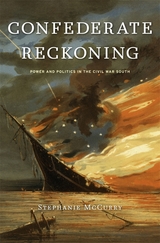
The story of the Confederate States of America, the proslavery, antidemocratic nation created by white Southern slaveholders to protect their property, has been told many times in heroic and martial narratives. Now, however, Stephanie McCurry tells a very different tale of the Confederate experience. When the grandiosity of Southerners’ national ambitions met the harsh realities of wartime crises, unintended consequences ensued. Although Southern statesmen and generals had built the most powerful slave regime in the Western world, they had excluded the majority of their own people—white women and slaves—and thereby sowed the seeds of their demise.
Wartime scarcity of food, labor, and soldiers tested the Confederate vision at every point and created domestic crises to match those found on the battlefields. Women and slaves became critical political actors as they contested government enlistment and tax and welfare policies, and struggled for their freedom. The attempt to repress a majority of its own population backfired on the Confederate States of America as the disenfranchised demanded to be counted and considered in the great struggle over slavery, emancipation, democracy, and nationhood. That Confederate struggle played out in a highly charged international arena.
The political project of the Confederacy was tried by its own people and failed. The government was forced to become accountable to women and slaves, provoking an astounding transformation of the slaveholders’ state. Confederate Reckoning is the startling story of this epic political battle in which women and slaves helped to decide the fate of the Confederacy and the outcome of the Civil War.
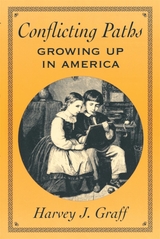
We grow up--so simple, it just seems to happen--and yet there are endless variations in the way we do it. What part does culture play in the process? How much do politics and economics have to do with it? As the nation has matured, have the ways people grow up changed too? This book traces the many paths to adulthood that Americans have pursued over time. Spanning more than two centuries of intense transformation in the lives of individuals and the life of a nation, Conflicting Paths is an innovative history of growing up in America.
Harvey J. Graff, a distinguished social historian, mines more than five hundred personal narratives for what they can tell us about the passage from childhood to maturity. Drawing on diaries, memoirs, autobiographies, and letters, he builds a penetrating, complex, firsthand account of how childhood, adolescence, and youth have been experienced and understood--as functions of familial and social relations, as products of biology and physiology, and as cultural and political constructs. These first-person testimonies cross the lines of time and space, gender and class, ethnicity, age, and race. In these individual stories and the larger story they constitute, Graff exposes the way social change--including institutional developments and shifting attitudes, expectations, and policy--and personal experience intertwine in the process of growing up. Together, these narratives form a challenging, subtle guide to historical experiences and to the epochal remaking of growing up.
The most socially inclusive and historically extensive of any such research, Graff's work constitutes an important chapter in the story of the family, the formation of modern society, and the complex interweaving of young people, tradition, and change.

The preeminent sociologist and National Book Award–winning author of Freedom in the Making of Western Culture grapples with the paradox of his homeland: its remarkable achievements amid continuing struggles since independence.
There are few places more puzzling than Jamaica. Jamaicans claim their home has more churches per square mile than any other country, yet it is one of the most murderous nations in the world. Its reggae superstars and celebrity sprinters outshine musicians and athletes in countries hundreds of times its size. Jamaica’s economy is anemic and too many of its people impoverished, yet they are, according to international surveys, some of the happiest on earth. In The Confounding Island, Orlando Patterson returns to the place of his birth to reckon with its history and culture.
Patterson investigates the failures of Jamaica’s postcolonial democracy, exploring why the country has been unable to achieve broad economic growth and why its free elections and stable government have been unable to address violence and poverty. He takes us inside the island’s passion for cricket and the unparalleled international success of its local musical traditions. He offers a fresh answer to a question that has bedeviled sports fans: Why are Jamaican runners so fast?
Jamaica’s successes and struggles expose something fundamental about the world we live in. If we look closely at the Jamaican example, we see the central dilemmas of globalization, economic development, poverty reduction, and postcolonial politics thrown into stark relief.
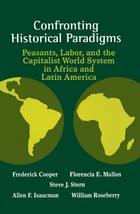
Confronting Historical Paradigms argues that confrontation with major paradigms of world history has marked the fields of African and Latin American history during the last quarter-century, and that the process has dramatically restructured historical and theoretical understanding of peasantries, labor, and the capitalist world system. Moreover, it maintains, the intellectual reverberations within and across the African and Latin American fields constitute a challenging and underappreciated counterpoint to laments that contemporary historical knowledge has suffered a splintering so extreme that it undermines larger dialogue and meaning.
The authors, in their substantive essays, synthesize, order, and evaluate the significance of the enormous resonating literatures that have come to exist for Africa and Latin America on the themes of the capitalist world system, labor, and peasantries. They historicize these literatures by analyzing an entire cycle of critical dialogue and confrontation with historical paradigms and the professional upheavals that accompanied them. They review the initial confrontations with frameworks of historical knowledge that erupted in the 1960s and the early 1970s; the emergence of new “dissident” paradigms; the outpouring of subsequent scholarship on peasants, labor, and capitalism that began to unravel the newly proposed paradigms by the 1980s and 1990s; and the outlines of the new interpretive frameworks that tended to displace both the “traditional” and “early dissident” paradigms. They also suggest possible outlines of a new cycle of “Third World” confrontations with paradigm, anchored in themes such as gender and ethnicity.
Confronting Historical Paradigms employs a historicized awareness of intellectual networks, conversations, and history–theory dialogues. The result is a critical analysis and synthetic presentation of substantive advances that have preoccupied scholarship on Africa and Latin America in recent decades and a powerful challenge to notions that “new” fields of history have ended up destroying intellectual coherence and community.

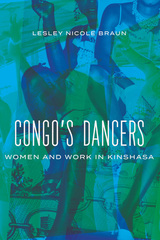
In Congo’s Dancers, Lesley Nicole Braun uses the prism of the Congolese danseuse to examine the politics of control and the ways in which notions of visibility, virtue, and socio-economic opportunity are interlinked in this urban African context. The work of the danseuse highlights the fact that public visibility is necessary to build the social networks required for economic independence, even as this visibility invites social opprobrium for women. The concert dancer therefore exemplifies many of the challenges that women face in Kinshasa as they navigate the public sphere, and she illustrates the gendered differences of local patronage politics that shape public morality. As an ethnographer, Braun had unusual access to the world she documents, having been invited to participate as a concert dancer herself.
2022 Honorable Mention, John Leo & Dana Heller Award for Best Single Work, Anthology, Multi-Authored, or Edited Book in LGBTQ Studies, Popular Culture Association (PCA)
2023 Honorable Mention, Outstanding Book, Latinx Studies Section of Latin American Studies Association (LASA)
2024 Honorable Mention — Best LGBTQ+ Themed Book, Empowering Latino Futures’ International Latino Book Awards
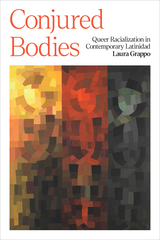
This study argues that powerful authorities and institutions exploit the ambiguity of Latinidad in ways that obscure inequalities in the United States.
Is Latinidad a racial or an ethnic designation? Both? Neither? The increasing recognition of diversity within Latinx communities and the well-known story of shifting census designations have cast doubt on the idea that Latinidad is a race, akin to white or Black. And the mainstream media constantly cover the “browning” of the United States, as though the racial character of Latinidad were self-evident.
Many scholars have argued that the uncertainty surrounding Latinidad is emancipatory: by queering race—by upsetting assumptions about categories of human difference—Latinidad destabilizes the architecture of oppression. But Laura Grappo is less sanguine. She draws on case studies including the San Antonio Four (Latinas who were wrongfully accused of child sex abuse); the football star Aaron Hernandez’s incarceration and suicide; Lorena Bobbitt, the headline-grabbing Ecuadorian domestic-abuse survivor; and controversies over the racial identities of public Latinx figures to show how media institutions and state authorities deploy the ambiguities of Latinidad in ways that mystify the sources of Latinx political and economic disadvantage. With Latinidad always in a state of flux, it is all too easy for the powerful to conjure whatever phantoms serve their interests.
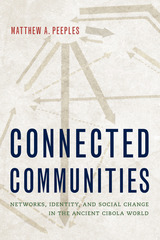
In Connected Communities, Matthew A. Peeples examines a period of dramatic social and political transformation in the ancient Cibola region (ca. A.D. 1150–1325). He analyzes archaeological data generated during a century of research through the lens of new and original social theories and methods focused on exploring identity, social networks, and social transformation. In so doing, he demonstrates the value of comparative, synthetic analysis.
The book addresses some of the oldest enduring questions in archaeology: How do large-scale social identities form? How do they change? How can we study such processes using material remains? Peeples approaches these questions using a new set of methods and models from the broader comparative social sciences (relational sociology and social networks) to track the trajectories of social groups in terms of both networks of interactions (relations) and expressions of similarity or difference (categories). He argues that archaeological research has too often conflated these different kinds of social identity and that this has hindered efforts to understand the drivers of social change.
In his strikingly original approach, Peeples combines massive amounts of new data and comparative explorations of contemporary social movements to provide new insights into how social identities formed and changed during this key period.

Connective Tissue revisits scholarship on factory labor by analyzing the accident as constitutive of the experience of work itself, and it refines existing conversations about the body, trauma, and care by introducing an analysis informed by theories of labor and production. Author Lily N. Shapiro argues that care does not happen in spite of or on the margins of capitalism, but rather that capitalism happens in and through care and caring relations. These experiences are intersected by identities of caste, class, and gender, and entangled in state discourse about labor rights, welfare, and industrial law.

In the middle of the fifteenth century, ominous portents like columns of fire and dense fog were seen above the skies of Constantinople as the Byzantine capital fell under siege by the Ottomans. Allegedly, similar signs appeared a few decades later and seven thousand miles away, forecasting the fall of the Mexica capital of Tenochtitlan—Tlatelolco to the Spanish and their indigenous allies. After both cities had fallen, some Greeks and Mexica turned to poetry and song to express their anguish at the birth of what has come to be called the “modern” era.
This study probes issues of collective memory and cultural trauma in three sorrowful poems, the “Lament for Constantinople,” the “Huexotzinca Piece,” and the “Tlaxcala Piece.” Composed by anonymous authors soon after the conquest of the two cities, these texts describe the fall of an empire as a fissure in the social fabric and an open wound on the body politic. They are the workings of creators who draw on tradition and historical particulars to articulate, in a familiar language, the trauma of the conquered.

The colonial society and economy of Latin America were based on local communities of three principal types: Spanish towns, Indian villages, and landed estates or haciendas. Of these, it was the latter that provided the economic foundations for the aristocratic social system. This book tells how and why the Spaniards who settled the Peruvian coastal valleys originally came to establish their estates. Some of the questions it attempts to answer are: Why did the hacienda system arise in the second half of the sixteenth century? Was it primarily a product of Spanish history and culture? Was it an inevitable result of the conquest? What did it owe to Indian customs and traditions? To local geography? To economic and social conditions?
Concentrating on seven major valleys of the central coast, the author investigates varying local conditions and circumstances as they appear in wills, bills of sale, contracts, and other notarial documents. The story begins with the indigenous coastal societies before the conquest and concludes with the consolidation of the hacienda system in the early seventeenth century.
"[Thomas Frank is] perhaps the most provocative young cultural critic of the moment."—Gerald Marzorati, New York Times Book Review
"An indispensable survival guide for any modern consumer."—Publishers Weekly, starred review
"Frank makes an ironclad case not only that the advertising industry cunningly turned the countercultural rhetoric of revolution into a rallying cry to buy more stuff, but that the process itself actually predated any actual counterculture to exploit."—Geoff Pevere, Toronto Globe and Mail
"The Conquest of Cool helps us understand why, throughout the last third of the twentieth century, Americans have increasingly confused gentility with conformity, irony with protest, and an extended middle finger with a populist manifesto. . . . His voice is an exciting addition to the soporific public discourse of the late twentieth century."—T. J. Jackson Lears, In These Times
"An invaluable argument for anyone who has ever scoffed at hand-me-down counterculture from the '60s. A spirited and exhaustive analysis of the era's advertising."—Brad Wieners, Wired Magazine
"Tom Frank is . . . not only old-fashioned, he's anti-fashion, with a place in his heart for that ultimate social faux pas, leftist politics."—Roger Trilling, Details
West reveals how every aspect of the Crater Mountain Wildlife Management Area—including ideas of space, place, environment, and society—was socially produced, created by changing configurations of ideas, actions, and material relations not only in Papua New Guinea but also in other locations around the world. Complicating many of the assumptions about nature, culture, and development underlying contemporary conservation efforts, Conservation Is Our Government Now demonstrates the unique capacity of ethnography to illuminate the relationship between the global and the local, between transnational processes and individual lives.

How West Texas business and culture molded the rise of conservatism in the United States.
Much of what we understand as modern American political conservatism was born in West Texas, where today it predominates. How did the people of such a vast region—larger than New England and encompassing big cities like Lubbock and Amarillo, as well as tiny towns from Anson to Dalhart—develop such a uniform political culture? And why and how did it go national?
Jeff Roche finds answers in the history of what he calls cowboy conservatism. Political power players matter in this story, but so do football coaches, newspaper editors, and a breakfast cereal tycoon who founded a capitalist utopia. The Conservative Frontier follows these and other figures as they promoted an ideology grounded in the entrepreneurial and proto-libertarian attitudes of nineteenth-century Texas ranchers, including a fierce devotion to both individualism and small-town notions of community responsibility. This political sensibility was in turn popularized by its association with the mythology and iconography of the cowboy as imagined in twentieth-century mass media. By the 1970s and the rise of Ronald Reagan, Roche shows, it was clear that the cowboy conservatism of West Texas had set the stage for the emergence of the New Right—the more professionalized and tech-savvy operation that dominated national conservative politics for the next quarter century.

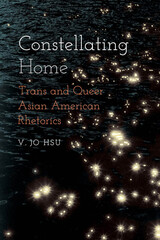
Winner of the 2024 Winifred Bryan Horner Outstanding Book Award
Winner of the 2023 NCA Diamond Anniversary Book Award
Winner of the Innovations in Community Writing Book Award from the Conference on Community Writing
Constellating Home: Trans and Queer Asian American Rhetorics explores how race, migration, gender, and disability entwine in conceptions of deserving citizens. V. Jo Hsu explores three archives of trans and queer Asian American (QTAPI) rhetorics, considering a range of texts including oral histories, photography, personal essays, and performance showcases. To demonstrate how QTAPI use personal narrative to critique and revise the conditions of their exclusion, Hsu forwards a critical approach to storytelling, homing, which deliberately engages sites of alienation and belonging. Through a practice of diasporic listening, Hsu tracks confluences among seemingly divergent journeys and locates trans and queer Asian American experiences within broader US and global politics.
The stories at the heart of Constellating Home center the voices of trans and nonbinary people, disabled people, and others often overlooked in conceptions of US citizenry. Hsu’s analyses demonstrate the inextricability of Asian American activism from queer politics, disability activism, and racial justice, and they consider how stories network individual experiences with resonant histories and struggles. Finding unlikely intimacies among individual and communal histories, Constellating Home provides tools for fostering mutual care, revealing harmful social patterns, and orienting shared values and politics.
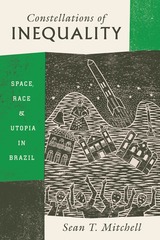
In 1982, the Brazilian Air Force arrived on the Alcântara peninsula to build a state-of-the-art satellite launch facility. They displaced some 1,500 Afro-Brazilians from coastal land to inadequate inland villages, leaving many more threatened with displacement. Completed in 1990, this vast undertaking in one of Brazil’s poorest regions has provoked decades of conflict and controversy.
Constellations of Inequality tells this story of technological aspiration and the stark dynamics of inequality it laid bare. Sean T. Mitchell analyzes conflicts over land, ethnoracial identity, mobilization among descendants of escaped slaves, military-civilian competition in the launch program, and international intrigue. Throughout, he illuminates Brazil’s changing politics of inequality and examines how such inequality is made, reproduced, and challenged. How people conceptualize and act on the unequal conditions in which they find themselves, he shows, is as much a cultural and historical matter as a material one. Deftly broadening our understanding of race, technology, development, and political consciousness on local, national, and global levels, Constellations of Inequality paints a portrait of contemporary Brazil that will interest a broad spectrum of readers.

How Black and white Cubans navigated issues of race, politics, and identity during the post-Civil War and early Jim Crow eras in South Florida.
On July 4, 1876, during the centennial celebration of US independence, the city of Key West was different from other cities. In some of post–Civil War Florida, Black residents were hindered from participating in 4th of July festivities, but Key West's celebration, “led by a Cuban revolutionary mayor working in concert with a city council composed of Afro-Bahamians, Cubans, African Americans, and Anglos,” represented a profound exercise in interracial democracy amid the Radical Reconstruction era.
Constructing Cuban America examines the first Cuban American communities in South Florida—Key West and Tampa—and how race played a central role in shaping the experiences of white and Black Cubans. Andrew Gomez argues that factors such as the Cuban independence movement and Radical Reconstruction produced interracial communities of Cubans that worked alongside African Americans and Afro-Bahamians in Florida, yielding several successes in interracial democratic representation, even as they continued to wrestle with elements of racial separatism within the Cuban community. But the conclusion of the Cuban War of Independence and early Jim Crow laws led to a fracture in the Cuban-American community. In the process, both Black and white Cubans posited distinct visions of Cuban-American identity.
Consider this paradox: Ecologists estimate that it would take three planets Earth to provide an American standard of living to the entire world. Yet it is that standard of living to which the whole world aspires.
In Consuming Desires, award-winning writer and social commentator Roger Rosenblatt brings together a brilliant collection of thinkers and writers to shed light on the triumphs and tragedies of that disturbing paradox. The book represents a captivating salon, offering a rich and varied dialogue on the underlying roots of consumer culture and its pervasive impact on ourselves and the world around us. Each author offers a unique perspective, their layers of thoughts and insights building together to create a striking, multifaceted picture of our society and culture.
Jane Smiley probes the roots of consumerism in the emancipation of women from household drudgery afforded by labor-saving devices and technological innovation; Alex Kotlowitz describes the mutual reinforcement of fashion trends as poor inner-city kids and rich suburban kids strive to imitate each other; Bill McKibben discusses the significance, and the irony, of defining yourself not by what you buy, but by what you don't buy.
The essays range widely, but two ideas are central to nearly all of them: that consumption is driven by yearning and desire -- often unspoken, seemingly insatiable -- and that what prevents us from keeping our consumptive impulse in check is the western concept of self, the solitary and restless self, entitled to all it can pay for.
As Rosenblatt explains in his insightful introduction: "Individualism and desire are what makes us great and what makes us small. Freedom is our dream and our enemy. The essays touch on these paradoxes, and while all are too nuanced and graceful to preach easy reform, they give an idea of what reform means, where it is possible, and, in some cases, where it may not be as desirable as it appears."

Contemporary Chinese America is the most comprehensive sociological investigation of the experiences of Chinese immigrants to the United States—and of their offspring—in the late twentieth and early twenty-first centuries. The author, Min Zhou, is a well-known sociologist of the Chinese American experience. In this volume, she collects her original research on a range of subjects, including the causes and consequences of emigration from China, demographic trends of Chinese Americans, patterns of residential mobility in the U.S., Chinese American "ethnoburbs," immigrant entrepreneurship, ethnic enclave economies, gender and work, Chinese language media, Chinese schools, and intergenerational relations. The concluding chapter, "Rethinking Assimilation," ponders the future for Chinese Americans. Also included are an extensive bibliography and a list of recommended documentary films.
While the book is particularly well-suited for college courses in Chinese American studies, ethnic studies, Asian studies, and immigration studies, it will interest anyone who wants to more fully understand the lived experience of contemporary Chinese Americans.

Drawing on nearly fifty interviews with activists who fled El Salvador, Zimmerman traces how political refugees carried with them strategies of resistance and community organizing that shaped social justice movements in the United States. The book addresses the political turmoil and grassroots mobilizations in El Salvador, the sanctuary movement of the 1980s, contemporary activism, and the impact of women’s strategies and forms of resistance.
Essential reading for scholars and students of migration, Central American studies, and political movements, Contentious Citizenship is a bold intervention into contemporary debates on identity, legality, and resistance. Zimmerman’s work honors the ingenuity and resilience of Salvadoran activists and invites readers to consider what it means to belong.
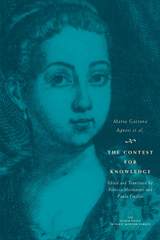
The Contest for Knowledge reveals how these four women used the methods and themes of their male counterparts to add their voices to the vigorous and prolific debate over the education of women during the eighteenth century. In the texts gathered here, the women discuss the issues they themselves thought most urgent for the equality of women in Italian society specifically and in European culture more broadly. Their thoughts on this important subject reveal how crucial the eighteenth century was in the long history of debates about women in the academy.
The U.S.-Mexico borderlands have long supported a web of relationships that transcend the U.S. and Mexican nations. Yet national histories usually overlook these complex connections. Continental Crossroads rediscovers this forgotten terrain, laying the foundations for a new borderlands history at the crossroads of Chicano/a, Latin American, and U.S. history. Drawing on the historiographies and archives of both the U.S. and Mexico, the authors chronicle the transnational processes that bound both nations together between the early nineteenth century and the 1940s, the formative era of borderlands history.
A new generation of borderlands historians examines a wide range of topics in frontier and post-frontier contexts. The contributors explore how ethnic, racial, and gender relations shifted as a former frontier became the borderlands. They look at the rise of new imagined communities and border literary traditions through the eyes of Mexicans, Anglo-Americans, and Indians, and recover transnational border narratives and experiences of African Americans, Chinese, and Europeans. They also show how surveillance and resistance in the borderlands inflected the “body politics” of gender, race, and nation. Native heroine Bárbara Gandiaga, Mexican traveler Ignacio Martínez, Kiowa warrior Sloping Hair, African American colonist William H. Ellis, Chinese merchant Lee Sing, and a diverse cast of politicos and subalterns, gendarmes and patrolmen, and insurrectos and exiles add transnational drama to the formerly divided worlds of Mexican and U.S. history.
Contributors. Grace Peña Delgado, Karl Jacoby, Benjamin Johnson, Louise Pubols, Raúl Ramos, Andrés Reséndez, Bárbara O. Reyes, Alexandra Minna Stern, Samuel Truett, Elliott Young
Applying a broad geographical approach to comparative Latino literary and cultural studies, Continental Shifts illuminates how the discursive treatment of Latinos changed dramatically following the enactment of NAFTA—a shift exacerbated by 9/11. While previous studies of immigrant representation have focused on single regions (the US/Mexico border in particular), specific genres (literature vs. political rhetoric), or individual groups, Continental Shifts unites these disparate discussions in a provocative, in-depth examination.
Bringing together a wide range of groups and genres, this intercultural study explores novels by Latin American and Latino writers, a border film by Tommy Lee Jones and Guillermo Arriaga, “viral” videos of political speeches, popular television programming (particularly shows that feature incarceration and public shaming), and user-generated YouTube videos. These cultural products reveal the complexity of Latino representations in contemporary discourse. While tropes of Latino migrants as threatening, diseased foreign bodies date back to the nineteenth century, Continental Shifts marks the more pernicious, recent images of Latino laborers (legal and not) in a variety of contemporary media. Using vivid examples, John Riofrio demonstrates the connections between rhetorical and ideological violence and the physical and psychological violence that has more intensely plagued Latino communities in recent decades. Culminating with a consideration of the “American” identity, this eye-opening work ultimately probes the nation’s ongoing struggle to uphold democratic ideals amid dehumanizing multiethnic tension.
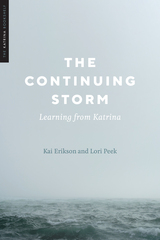
2023 Finalist, Colorado Book Awards, History/Biography Category
This final volume in the award-winning Katrina Bookshelf series reflects upon the lessons of Hurricane Katrina and what they reveal about our society and current cultural climate.
More than fifteen years later, Hurricane Katrina maintains a strong grip on the American imagination. The reason is not simply that Katrina was an event of enormous scale, although it certainly was by any measure one of the most damaging storms in American history. But, quite apart from its lethality and destructiveness, Katrina retains a place in living memory because it is one of the most telling disasters in our recent national experience, revealing important truths about our society and ourselves.
The final volume in the award-winning Katrina Bookshelf series The Continuing Storm reflects upon what we have learned about Katrina and about America. Kai Erikson and Lori Peek expand our view of the disaster by assessing its ongoing impact on individual lives and across the wide-ranging geographies where displaced New Orleanians landed after the storm. Such an expanded view, the authors argue, is critical for understanding the human costs of catastrophe across time and space. Concluding with a broader examination of disasters in the years since Katrina—including COVID-19—The Continuing Storm is a sobering meditation on the duration of a catastrophe that continues to exact steep costs in human suffering.
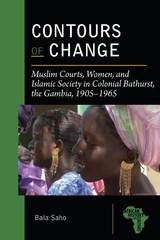
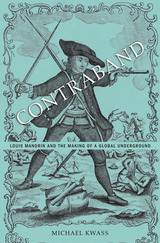
Louis Mandrin led a gang of bandits who brazenly smuggled contraband into eighteenth-century France. Michael Kwass brings new life to the legend of this Gallic Robin Hood and the thriving underworld he helped to create. Decades before the storming of the Bastille, surging world trade excited a revolution in consumption that transformed the French kingdom. Contraband exposes the dark side of this early phase of globalization, revealing hidden connections between illicit commerce, criminality, and popular revolt.
France's economic system was tailor-made for an enterprising outlaw like Mandrin. As French subjects began to crave colonial products, Louis XIV lined the royal coffers by imposing a state monopoly on tobacco from America and an embargo on brilliantly colored calico cloth from India. Vigorous black markets arose through which traffickers fed these exotic goods to eager French consumers. Flouting the law with unparalleled panache, Mandrin captured widespread public attention to become a symbol of a defiant underground.
This furtive economy generated violent clashes between gangs of smugglers and customs agents in the borderlands. Eventually, Mandrin was captured by French troops and put to death in a brutal public execution intended to demonstrate the king's absolute authority. But the spectacle only cemented Mandrin's status as a rebel folk hero in an age of mounting discontent. Amid cycles of underground rebellion and agonizing penal repression, the memory of Mandrin inspired ordinary subjects and Enlightenment philosophers alike to challenge royal power and forge a movement for radical political change.

Control and Order in French Colonial Louisbourg, 1713-1758 is the culmination of nearly a quarter century of research and writing on 18th-century Louisbourg by A. J. B. Johnston. The author uses a multitude of primary archival sources-official correspondence, court records, parish registries, military records, and hundreds of maps and plans-to put together a detailed analysis of a distinctive colonial society. Located on Cape Breton Island (then known as Île Royale), the seaport and stronghold of Louisbourg emerged as one of the most populous and important settlements in all of New France. Its economy was based on fishing and trade, and the society that developed there had little or nothing to do with the fur trade, or the seigneurial regime that characterized the Canadian interior. Johnston traces the evolution of a broad range of controlling measures that were introduced and adapted to achieve an ordered civil and military society at Louisbourg. Town planning, public celebrations, diversity in the population, use of punishments, excessive alcohol consumption, the criminal justice system, and sexual abuse are some of the windows that reveal attempts to control and regulate society. A. J. B. Johnston's Control and Order in French Colonial Louisbourg offers both a broad overview of the colony's evolution across its half-century of existence, and insightful analyses of the ways in which control was integrated into the mechanisms of everyday life.
Control and Subversion investigates the relationship of gender to the inner workings of social control, such as exposing ways in which Tajik society threatens men’s masculinity, thereby bringing them to force family members into conformity, irrespective of the suffering this may cause. It examines how masculine and feminine gender characteristics influence personal relationships and explores gender relations at their most intimate – from the secret musings of adolescent girls, through the painful experiences of young men, to the trauma of sexual initiation. Although largely concentrating on contemporary life, the book also discusses historical materials and Soviet influence on Tajik society. Control and Subversion is essential reading for anyone interested in Central Asia, Muslim societies, the lives of Muslim women, or gender in a Muslim context.

Controlling Anger examines the dilemmas facing rural people who live within the broader context of political instability. Following Uganda’s independence from Britain in 1962, the Bagisu men of Southeastern Uganda developed a reputation for extreme violence.
Drawing on a wide range of historical sources including local court records, statistical survey analysis, and intensive fieldwork, Suzette Heald portrays and analyzes the civil violence that grew out of intense land shortage, the marginalization of the Gisu under British rule, and the construction of male gender identity among the Gisu. Now available in a paperback edition with a new preface by the author, Controlling Anger is an important contribution to rural sociology in Africa.

Surveying American political, social, and intellectual life from the late 17th to the end of the 19th century, Burke examines in detail the contested discourse about equality—the way Americans thought and wrote about class, class relations, and their meaning in society.
Burke explores a remarkable range of thought to establish the boundaries of class and the language used to describe it in the works of leading political figures, social reformers, and moral philosophers. He traces a shift from class as a legal category of ranks and orders to socio-economic divisions based on occupations and income. Throughout the century, he finds no permanent consensus about the meaning of class in America and instead describes a culture of conflicting ideas and opinions.
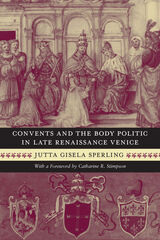
Sperling explains how women were not allowed to marry beneath their social status while men could, especially if their brides were wealthy. Faced with a shortage of suitable partners, patrician women were forced to offer themselves as "a gift not only to God, but to their fatherland," as Patriarch Giovanni Tiepolo told the Senate of Venice in 1619. Noting the declining birth rate among patrician women, Sperling explores the paradox of a marriage system that preserved the nobility at the price of its physical extinction. And on a more individual level, she tells the fascinating stories of these women. Some became scholars or advocates of women's rights, some took lovers, and others escaped only to survive as servants, prostitutes, or thieves.
In the summer of 2007, Louis G. Mendoza set off on a bicycle trip across the United States with the intention of conducting a series of interviews along the way. Wanting to move beyond the media’s limited portrayal of immigration as a conflict between newcomers and “citizens,” he began speaking with people from all walks of life about their views on Latino immigration. From the tremendous number of oral histories Mendoza amassed, the resulting collection offers conversations with forty-three different people who speak of how they came to be here and why they made the journey. They touch upon how Latino immigration is changing in this country, and how this country is being changed by Latinoization. Interviewees reflect upon the concerns and fears they’ve encountered about the transformation of the national culture, and they relate their own experiences of living and working as “other” in the United States.
Mendoza’s collection is unique in its vastness. His subjects are from big cities and small towns. They are male and female, young and old, affluent and impoverished. Many are political, striving to change the situation of Latina/os in this country, but others are “everyday people,” reflecting upon their lives in this country and on the lives they left behind. Mendoza’s inclusion of this broad swath of voices begins to reflect the diverse nature of Latino immigration in the United States today.
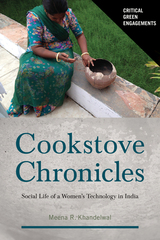
Based on anthropological research in Rajasthan, Cookstove Chronicles argues that the supposedly obsolete chulha persists because it offers women control over the tools needed to feed their families. Their continued use of old stoves alongside the new is not a failure to embrace new technologies but instead a strategy to maximize flexibility and autonomy. The chulha is neither the villain nor hero of this story. It produces particulate matter that harms people’s bodies, leaves soot on utensils and walls, and accelerates glacial melting and atmospheric warming. Yet it also depends on renewable biomass fuel and supports women’s autonomy as a local, do-it-yourself technology.
Meena Khandelwal, a feminist anthropologist, describes her collaboration with engineers, archaeologists, and others. She employs critical social theory and reflections from fieldwork to bring together research from a range of fields, including history, geography, anthropology, energy and environmental studies, public health, and science and technology studies (STS). In so doing she not only demystifies multidisciplinary research but also highlights the messy reality of actual behavior.
Cookstove Chronicles critically examines why, despite extensive development efforts, use of the chulha persists. It offers an important new framework for looking at development, technology, environmental change, and human behavior.
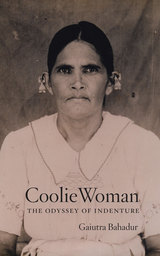
Shunned by society, and sometimes in mortal danger, many coolie women were either runaways, widows, or outcasts. Many of them left husbands and families behind to migrate alone in epic sea voyages—traumatic “middle passages”—only to face a life of hard labor, dismal living conditions, and, especially, sexual exploitation. As Bahadur explains, however, it is precisely their sexuality that makes coolie women stand out as figures in history. Greatly outnumbered by men, they were able to use sex with their overseers to gain various advantages, an act that often incited fatal retaliations from coolie men and sometimes larger uprisings of laborers against their overlords. Complex and unpredictable, sex was nevertheless a powerful tool.
Examining this and many other facets of these remarkable women’s lives, Coolie Woman is a meditation on survival, a gripping story of a double diaspora—from India to the West Indies in one century, Guyana to the United States in the next—that is at once a search for one’s roots and an exploration of gender and power, peril and opportunity.
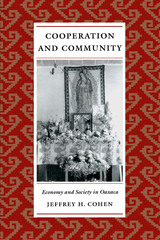
In the villages and small towns of Oaxaca, Mexico, as in much of rural Latin America, cooperation among neighbors is essential for personal and community survival. It can take many forms, from godparenting to sponsoring fiestas, holding civic offices, or exchanging agricultural or other kinds of labor. This book examines the ways in which the people of Santa Ana del Valle practice these traditional cooperative and reciprocal relationships and also invent new relationships to respond to global forces of social and economic change at work within their community.
Based on fieldwork he conducted in this Zapotec-speaking community between 1992 and 1996, Jeffrey Cohen describes continuities in the Santañeros' practices of cooperation, as well as changes resulting from transnational migration, tourism, increasing educational opportunities, and improved communications. His nuanced portrayal of the benefits and burdens of cooperation is buttressed by the words of many villagers who explain why and how they participate-or not-in reciprocal family and community networks. This rich ethnographic material offers a working definition of community created in and through cooperative relationships.
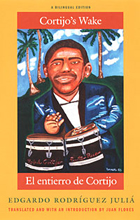
Winding through the streets of working-class San Juan with Cortijo’s funeral procession, Rodríguez Juliá’s autobiographical chronicle provides a rare portrait of the impoverished society from which Cortijo’s music emerged. Along with detailed renderings of grief-stricken mourners—including Cortijo’s childhood friend and fellow musician, the celebrated singer Ismael ("Maelo") Rivera—Rodríguez Juliá records his feelings as he, a light-skinned, middle-class writer, confronts the world of poor black Puerto Ricans. The author’s masterful shifting of linguistic registers, his acute sensitivity to Puerto Rican social codes, his broad knowledge of popular music, and his sardonic ruminations on death and immortality make this one of the most widely read books of modern Puerto Rican literature. Well-known critic and cultural historian Juan Flores has provided a scrupulous translation of Rodríguez Juliá’s text and an introduction situating the book in relation to Puerto Rican music and culture and the careers of Cortijo and Rodríguez Juliá.
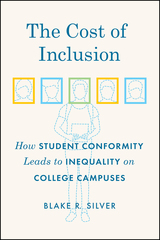
Blake R. Silver spent a year immersed in student life at a large public university. He trained with the Cardio Club, hung out with the Learning Community, and hosted service events with the Volunteer Collective. Through these day-to-day interactions, he witnessed how students sought belonging and built their social worlds on campus. Over time, Silver realized that these students only achieved inclusion at significant cost. To fit in among new peers, they clung to or were pushed into raced and gendered cultural assumptions about behavior, becoming “the cool guy,” “the nice girl,” “the funny one,” “the leader,” “the intellectual,” or “the mom of the group.” Instead of developing dynamic identities, they crafted and adhered to a cookie-cutter self, one that was rigid and two-dimensional. Silver found that these students were ill-prepared for the challenges of a diverse college campus, and that they had little guidance from their university on how to navigate the trials of social engagement or the pressures to conform. While colleges are focused on increasing the diversity of their enrolled student body, Silver’s findings show that they need to take a hard look at how they are failing to support inclusion once students arrive on campus.
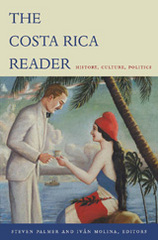
This essential introduction to Costa Rica includes more than fifty texts related to the country’s history, culture, politics, and natural environment. Most of these newspaper accounts, histories, petitions, memoirs, poems, and essays are written by Costa Ricans. Many appear here in English for the first time. The authors are men and women, young and old, scholars, farmers, workers, and activists. The Costa Rica Reader presents a panoply of voices: eloquent working-class raconteurs from San José’s poorest barrios, English-speaking Afro-Antilleans of the Limón province, Nicaraguan immigrants, factory workers, dissident members of the intelligentsia, and indigenous people struggling to preserve their culture. With more than forty images, the collection showcases sculptures, photographs, maps, cartoons, and fliers. From the time before the arrival of the Spanish, through the rise of the coffee plantations and the Civil War of 1948, up to participation in today’s globalized world, Costa Rica’s remarkable history comes alive. The Costa Rica Reader is a necessary resource for scholars, students, and travelers alike.
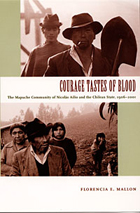
Mallon recounts the land usurpation Nicolás Ailío endured in the first decades of the twentieth century and the community’s ongoing struggle for restitution. Facing extreme poverty and inspired by the agrarian mobilizations of the 1960s, some community members participated in the agrarian reform under the government of socialist president Salvador Allende. With the military coup of 1973, they suffered repression and desperate impoverishment. Out of this turbulent period the Mapuche revitalization movement was born. What began as an effort to protest the privatization of community lands under the military dictatorship evolved into a broad movement for cultural and political recognition that continues to the present day. By providing the historical and local context for the emergence of the Mapuche revitalization movement, Courage Tastes of Blood offers a distinctive perspective on the evolution of Chilean democracy and its rupture with the military coup of 1973.

Based on over six years of fieldwork, Sandra L. Faiman-Silva's The Courage to Connect traces the transformation of the Cape Cod community of Provincetown from its nineteenth-century origins as a fishing town where Portuguese immigrants settled to its present status as a welcoming, sexually diverse tourist enclave. Faiman-Silva examines the community’s history and economy as well as how gay and straight cultures intersect in areas such as public education, local government, and law enforcement. Using queer and critical culture theory to deconstruct day-to-day local encounters, Faiman-Silva describes the causes of social conflicts and how these conflicts can be resolved. Capturing the pathos and joy of a community that has struggled to accommodate radical social changes, The Courage to Connect yields understanding of the ways in which communities can construct themselves to overcome differences.

This book traces changing gender relations in China from the tenth to fourteenth centuries by examining three critical categories of women: courtesans, concubines, and faithful wives. It shows how the intersection and mutual influence of these groups—and of male discourses about them—transformed ideas about family relations and the proper roles of men and women.
Courtesan culture had a profound effect on Song social and family life, as entertainment skills became a defining feature of a new model of concubinage, and as entertainer-concubines increasingly became mothers of literati sons. Neo-Confucianism, the new moral learning of the Song, was significantly shaped by this entertainment culture and by the new markets—in women—that it created. Responding to a broad social consensus, Neo-Confucians called for enhanced recognition of concubine mothers in ritual and expressed increasing concern about wifely jealousy. The book also details the surprising origins of the Late Imperial cult of fidelity, showing that from inception, the drive to celebrate female loyalty was rooted in a complex amalgam of political, social, and moral agendas. By taking women—and men’s relationships with women—seriously, this book makes a case for the centrality of gender relations in the social, political, and intellectual life of the Song and Yuan dynasties.
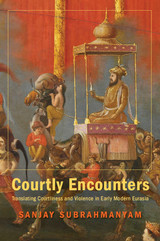
Cross-cultural encounters in Europe and Asia in the sixteenth and seventeenth centuries brought the potential for bafflement, hostility, and admiration. The court was the crucial site where expanding Eurasian states and empires met and were forced to make sense of one another. By looking at these interactions, Courtly Encounters provides a fresh cross-cultural perspective on the worlds of early modern Islam, Counter-Reformation Catholicism, Protestantism, and a newly emergent Hindu sphere.
Both individual agents and objects such as texts and paintings helped mediate encounters between courts, which possessed rules and conventions that required decipherment and translation, whether in words or in pictures. Sanjay Subrahmanyam gives special attention to the depiction of South Asian empires in European visual representations, finding a complex history of cultural exchange: the Mughal paintings that influenced Rembrandt and other seventeenth-century Dutch painters had themselves been earlier influenced by Dutch naturalism. Courtly Encounters provides a rich array of images from Europe, the Islamic world, India, and Southeast Asia as aids for understanding the reciprocal nature of cross-cultural exchanges. It also looks closely at how insults and strategic use of martyrdom figured in courtly encounters.
As he sifts through the historical record, Subrahmanyam finds little evidence for the cultural incommensurability many ethnohistorians have insisted on. Most often, he discovers negotiated ways of understanding one another that led to mutual improvisation, borrowing, and eventually change.

Everyone got married in the 1950s, then moved to the suburbs to have the children of the soon-to-be-famous baby boom. For Americans who had survived the Great Depression and World War II, prosperous married life was a triumph. The unwed were objects of pity, scorn, even suspicion. And so in the 1950s, Eva Eldridge, no longer so young and marginally employed, was the perfect target for handsome Vick, who promised everything: storybook romance, marital respectability, and the lively social life she loved. When he disappeared not long after their honeymoon, she was devastated.
Eva hadn’t always been so vulnerable. Growing up pretty and popular in rural Oregon, she expected to marry young and live a life much like that of her parents, farming and rearing children. But then the United States threw its weight into World War II and as men headed to battle, the government started recruiting women to work in their places. Eva, like many other young women, found that life in the city with plenty of money, personal freedom, and lots of soldiers and sailors eager to pay court was more exhilarating than life down on the farm. After the war, she was ambivalent about getting married and settling down—at least until Vick arrived.
Refusing to believe her brand-new husband had abandoned her, Eva set about tracking down a man who, she now believed, was more damaged by wartime trauma than she had known. But instead of a wounded hero, she found a long string of women much like herself—hard-working, intelligent women who had loved and married Vick and now had no idea where—or even who—he was.
Drawing on a trove of some eight hundred letters and papers, Diane Simmons tells the story of Eva’s poignant struggle to get her dream husband back, as well as the stories of the women who had stood at the altar with Vick before and after her. Eva’s remarkable life illuminates women’s struggle for happiness at a time when marriage—and the perfect husband—meant everything.
As the coronavirus ravages the globe, its aftermaths have brought gender inequalities to the forefront of many conversations. Countries in the Middle East and North Africa have been slow to prepare for, adapt to, and mitigate the COVID-19 health crisis and its impacts on governance, economics, security, and rights. Women’s physical well-being, social safety nets, and economic participation have been disproportionately affected, and with widespread shutdowns and capricious social welfare programs, women are exiting the workplace and the classroom, carrying the caregiving burden.
With feminist foregrounding, Rita Stephan's collection COVID and Gender in the Middle East gathers an impressive group of local scholars, activists, and policy experts. The book examines a range of national and localized responses to gender-specific issues around COVID’s health impact and the economic fallout and resulting social vulnerabilities, including the magnified marginalization of Syrian refugees; the inequitable treatment of migrant workers in Bahrain; and the inadequate implementation of gender-based violence legislation in Morocco. An essential global resource, this book is the first to provide empirical evidence of COVID’s gendered effects.

The American criminal justice system was in flux in 2020, a clash of possibilities for reform, retrenchment, and radical change—nowhere more so than in Massachusetts, which had just passed major criminal justice reform. The COVID-19 pandemic interrupted the moment with life-threatening force, ravaging people held in prisons and jails across the country. However, it did not so much create new deprivations and suffering as it exposed prisons as sites of physical, institutional, and psychological violence that do not make communities safer. At the same time, advocates for people in prisons—including many incarcerated and formerly incarcerated people—seized on the pandemic’s disruptions to demand change. Detailing the first year of the pandemic inside the Massachusetts state prison system, this book argues that the history of the pandemic inside prisons exposed both the cruelties of incarceration and the power of change when it is led by directly affected people.

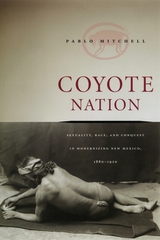
Coyote Nation considers these questions as it explores how New Mexicans evaluated and categorized racial identities through bodily practices. Where ethnic groups were numerous and—in the wake of miscegenation—often difficult to discern, the ways one dressed, bathed, spoke, gestured, or even stood were largely instrumental in conveying one's race. Even such practices as cutting one's hair, shopping, drinking alcohol, or embalming a deceased loved one could inextricably link a person to a very specific racial identity.
A fascinating history of an extraordinarily plural and polyglot region, Coyote Nation will be of value to historians of race and ethnicity in American culture.
"Tuller's observant reporting and personal experiences make for absorbing reading: the human comedy rendered in unexpected ways."—New Yorker
"Anyone who thinks San Francisco is the world capital of sexual polymorphism should read this book."—Adam Goodheart, Washington Post
"[This book is] is profoundly moving."—Jim Van Buskirk, San Francisco Chronicle
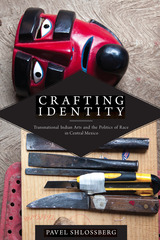
The first ethnographic study of its kind, the book examines how indigenous and mestizo mask makers, both popular and elite, view and contest relations of power and inequality through their craft. Using data from his interviews with mask makers, collectors, museum curators, editors, and others, Pavel Shlossberg places the artisans within the larger context of their relationships with the nation-state and Mexican elites, as well as with the production cultures that inform international arts and crafts markets. In exploring the connection of mask making to capitalism, the book examines the symbolic and material pressures brought to bear on Mexican artisans to embody and enact self-racializing stereotypes and the performance of stigmatized indigenous identities.
Shlossberg’s weaving of ethnographic data and cultural theory demystifies the way mask makers ascribe meaning to their practices and illuminates how these practices are influenced by state and cultural institutions. Demonstrating how the practice of mask making negotiates ethnoracial identity with regard to the Mexican state and the United States, Shlossberg shows how it derives meaning, value, and economic worth in the eyes of the state and cultural institutions that mediate between the mask maker and the market.

"Kondo's work is significant because she goes beyond disharmony, insisting on complexity. Kondo shows that inequalities are not simply oppressive-they are meaningful ways to establish identities."—Nancy Rosenberger, Journal of Asian Studies
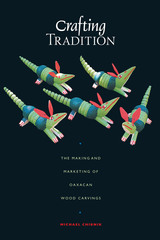
Since the mid-1980s, whimsical, brightly colored wood carvings from the Mexican state of Oaxaca have found their way into gift shops and private homes across the United States and Europe, as Western consumers seek to connect with the authenticity and tradition represented by indigenous folk arts. Ironically, however, the Oaxacan wood carvings are not a traditional folk art. Invented in the mid-twentieth century by non-Indian Mexican artisans for the tourist market, their appeal flows as much from intercultural miscommunication as from their intrinsic artistic merit.
In this beautifully illustrated book, Michael Chibnik offers the first in-depth look at the international trade in Oaxacan wood carvings, including their history, production, marketing, and cultural representations. Drawing on interviews he conducted in the carving communities and among wholesalers, retailers, and consumers, he follows the entire production and consumption cycle, from the harvesting of copal wood to the final purchase of the finished piece. Along the way, he describes how and why this "invented tradition" has been promoted as a "Zapotec Indian" craft and explores its similarities with other local crafts with longer histories. He also fully discusses the effects on local communities of participating in the global market, concluding that the trade in Oaxacan wood carvings is an almost paradigmatic case study of globalization.
Hsu’s ethnographic research, conducted in the city of Harbin in northwestern China, included participant observation at twenty workplaces and interviews with working adults from a range of professions. By analyzing the shared stories about status and class, jobs and careers, and aspirations and hopes that circulate among Harbiners from all walks of life, Hsu reveals the logic underlying the emerging stratification system. In the post-socialist era, Harbiners must confront a fast-changing and bewildering institutional landscape. Their collective narratives serve to create meaning and order in the midst of this confusion. Harbiners collectively agree that “intellectuals” (scientists, educators, and professionals) are the most respected within the new social order, because they contribute the most to Chinese society, whether that contribution is understood in terms of traditional morality, socialist service, or technological and economic progress. Harbiners understand human capital as an accurate measure of a person’s status. Their collective narratives about suzhi shape their career choices, judgments, and child-rearing practices, and therefore the new practices and institutions developing in post-socialist China.
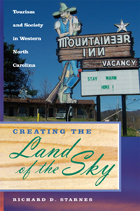
A sophisticated inquiry into tourism's social and economic power across the South.
In the early 19th century, planter families from South Carolina, Georgia, and eastern North Carolina left their low-country estates during the summer to relocate their households to vacation homes in the mountains of western North Carolina. Those unable to afford the expense of a second home relaxed at the hotels that emerged to meet their needs. This early tourist activity set the stage for tourism to become the region's New South industry. After 1865, the development of railroads and the bugeoning consumer culture led to the expansion of tourism across the whole region.
Richard Starnes argues that western North Carolina benefited from the romanticized image of Appalachia in the post-Civil War American consciousness. This image transformed the southern highlands into an exotic travel destination, a place where both climate and culture offered visitors a myriad of diversions. This depiction was futher bolstered by partnerships between state and federal agencies, local boosters, and outside developers to create the atrtactions necessary to lure tourists to the region.
As tourism grew, so did the tension between leaders in the industry and local residents. The commodification of regional culture, low-wage tourism jobs, inflated land prices, and negative personal experiences bred no small degree of animosity among mountain residents toward visitors. Starnes's study provides a better understanding of the significant role that tourism played in shaping communities across the South.
"It'll be a great place if they ever finish it," O. Henry wrote about New York City. This laconic remark captures the relentlessly transitory character of New York, and it points toward Max Page's synthetic perspective. Against the prevailing motif of a naturally expanding metropolis, Page argues that the early-twentieth-century city was dominated by the politics of destruction and rebuilding that became the hallmark of modern urbanism.
The oxymoron "creative destruction" suggests the tensions that are at the heart of urban life: between stability and change, between particular places and undifferentiated spaces, between market forces and planning controls, and between the "natural" and "unnatural" in city growth. Page investigates these cultural counterweights through case studies of Manhattan's development, with depictions ranging from private real estate development along Fifth Avenue to Jacob Riis's slum clearance efforts on the Lower East Side, from the elimination of street trees to the efforts to save City Hall from demolition.
In these examples some New Yorkers celebrate planning by destruction or marvel at the domestication of the natural environment, while others decry the devastation of their homes and lament the passing of the city's architectural heritage. A central question in each case is the role of the past in the shaping of collective memory—which buildings are preserved? which trees are cut down? which fragments are enshrined in museums? Contrary to the popular sense of New York as an ahistorical city, the past—as recalled by powerful citizens—was, in fact, at the heart of defining how the city would be built.
Beautifully illustrated and written in clear, engaging prose, The Creative Destruction of Manhattan offers a new way of viewing the development of the American city.
"An excellent, multifaceted analysis of the process of urban development-not the inevitability of development but the choices individuals, organizations, and developers made that transformed Manhattan. The politics of place was, Max Page convincingly argues, an ongoing battle to define and thereby control the evolving shape of the city."—David Schuyler, author of Apostle of Taste: Andrew Jackson Downing 1815-1852
"Max Page transcends the usual dichotomy between those who glorify destruction for the sake of change and those who would avoid both at all cost. The sizeable borderland between architecture and preservation reveals new dimensions about science and history, innovation and memory, the cities that have been, and those yet to come."—Gwendolyn Wright, author of The Politics of Design in French Colonial Urbanism
"A sober, humane explanation of how and why New York City became a place of continuous rebuilding. . . . For real or armchair New Yorkers, the whole package is a treat."—Kirkus Reviews
During the colonial period in Guyana, the country’s coastal lands were worked by enslaved Africans and indentured Indians. In Creole Indigeneity, Shona N. Jackson investigates how their descendants, collectively called Creoles, have remade themselves as Guyana’s new natives, displacing indigenous peoples in the Caribbean through an extension of colonial attitudes and policies.
Looking particularly at the nation’s politically fraught decades from the 1950s to the present, Jackson explores aboriginal and Creole identities in Guyanese society. Through government documents, interviews, and political speeches, she reveals how Creoles, though unable to usurp the place of aboriginals as First Peoples in the New World, nonetheless managed to introduce a new, more socially viable definition of belonging, through labor. The very reason for bringing enslaved and indentured workers into Caribbean labor became the organizing principle for Creoles’ new identities.
Creoles linked true belonging, and so political and material right, to having performed modern labor on the land; labor thus became the basis for their subaltern, settler modes of indigeneity—a contradiction for belonging under postcoloniality that Jackson terms “Creole indigeneity.” In doing so, her work establishes a new and productive way of understanding the relationship between national power and identity in colonial, postcolonial, and anticolonial contexts.
In this collection, Amy Louise Wood and Natalie J. Ring present nine groundbreaking essays about the carceral system and its development over time. Topics range from activism against police brutality to the peculiar path of southern prison reform to the fraught introduction of the electric chair. The essays tell nuanced stories of rapidly changing state institutions, political leaders who sought to manage them, and African Americans who appealed to the regulatory state to protect their rights.
Contributors: Pippa Holloway, Tammy Ingram, Brandon T. Jett, Seth Kotch, Talitha L. LeFlouria, Vivien Miller, Silvan Niedermeier, K. Stephen Prince, and Amy Louise Wood
Crime and Social Justice in Indian Country calls to attention the need for culturally appropriate research protocols and critical discussions of social and criminal justice in Indian Country. The contributors come from the growing wave of Native American as well as non-Indigenous scholars who employ these methods. They reflect on issues in three key areas: crime, social justice, and community responses to crime and justice issues. Topics include stalking, involuntary sterilization of Indigenous women, border-town violence, Indian gaming, child welfare, and juvenile justice. These issues are all rooted in colonization; however, the contributors demonstrate how Indigenous communities are finding their own solutions for social justice, sovereignty, and self-determination.
Thanks to its focus on community responses that exemplify Indigenous resilience, persistence, and innovation, this volume will be valuable to those on the ground working with Indigenous communities in public and legal arenas, as well as scholars and students. Crime and Social Justice in Indian Country shows the way forward for meaningful inclusions of Indigenous peoples in their own justice initiatives.
Contributors
Alisse Ali-Joseph
William G. Archambeault
Cheryl Redhorse Bennett
Danielle V. Hiraldo
Lomayumptewa K. Ishii
Karen Jarratt-Snider
Eileen Luna-Firebaugh
Anne Luna-Gordinier
Marianne O. Nielsen
Linda M. Robyn
Carlson analyzes the situations of several women of varying historical stature, from the insanity trials of Mary Todd Lincoln and Lizzie Borden's trial for the brutal slaying of her father and stepmother, to lesser-known trials involving insanity, infidelity, murder, abortion, and interracial marriage. The insanity trial of Elizabeth Parsons Ware Packard, the wife of a minister, resulted from her attempts to change her own religion, while a jury acquitted Mary Harris for killing her married lover, suggesting that loss of virginity to an adulterous man was justifiable grounds for homicide. The popular conception of abortion as a "woman's crime" came to the fore in the case of Ann Loman (also known as Madame Restell), who performed abortions in New York both before and after it became a crime. Finally, Alice Rhinelander was sued for fraud by her new husband Leonard for "passing" as white, but the jury was more moved by the notion of Alice being betrayed as a woman by her litigious husband than by the supposed defrauding of Leonard as a white male. Alice won the case, but the image of womanhood as in need of sympathy and protection won out as well.
At the heart of these cases, Carlson reveals clearly just how narrow was the line that women had to walk, since the same womanly virtues that were expected of them--passivity, frailty, and purity--could be turned against them at any time. These trials of popular status are especially significant because they reflect the attitudes of the broad audience, indicate which forms of knowledge are easily manipulated, and allow us to analyze how the verdict is argued outside the courtroom in the public and press. With gripping retellings and incisive analysis of these scandalous criminal and civil cases, this book will appeal to historians, rhetoricians, feminist researchers, and anyone who enjoys courtroom drama.

Each of the fourteen chapters of Criminal Justice in Native America was commissioned specifically for this volume. Contributors—many of whom are Native Americans—rank among the top scholars in their fields. Some of the chapters treat broad subjects, including crime, police, courts, victimization, corrections, and jurisdiction. Others delve into more specific topics, including hate crimes against Native Americans, state-corporate crimes against Native Americans, tribal peacemaking, and cultural stresses of police officers. Separate chapters are devoted to women and juveniles.
The well-known scholar Marianne Nielsen provides a context-setting introduction, in which she addresses the history of the legal treatment of Native Americans in the United States as well as a provocative conclusion that details important issues for current and future research in Native American criminal justice studies. Intended to introduce students to the substantive concerns of a range of disciplines that contribute to Native American Studies—among them, criminal justice and criminology, law, sociology, and anthropology—Criminal Justice in Native America will interest all readers who are concerned about relationships between Native peoples and prevailing criminal justice systems.

Eggers-Barison uncovers the narratives of economically disadvantaged, Indigenous, and immigrant women who broke the Chilean law by terminating a pregnancy. Their stories reveal how laws and policies that regulate and control women’s reproductive lives also construct women as criminals. As Eggers-Barison shows, systems of inequality legitimize and sustain harmful attitudes and practices while creating concrete expressions of discrimination and other forms of violence against women. Their experience with abortion remains hidden within spaces of illegality and only becomes visible due to health or legal consequences. Yet despite the obstacles, women used individual and collective forms of group action to resist anti-abortion laws.
Timely and vivid, Criminalization of Women shows how abortion’s illegality inscribes itself on a woman’s body and reality.
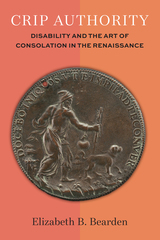
Disabled authors include Francesco Petrarca, Teresa de Cartagena, Giovani Paolo Lomazzo, Miguel de Cervantes Saavedra, Robert Burton, and John Milton. They all explore their experiences of disability, but their work has rarely or never been considered from a disability studies perspective. Bearden thus brings today’s models of disability studies and crip theory together with early modern articulations of disability based on ancient and Renaissance models of military, political, biblical, and literary authority. In sum, Crip Authority makes a significant contribution to the growing field of early modern disability studies and invites us to rethink the extent of crip history and the endurance of disability gain.

By closely examining the ways that disabled girls represent themselves, Anastasia Todd goes beyond a critique of the figure of the privileged, disabled girl subject in the national imagination to explore how disabled girls circulate their own capacious re-envisioning of what it means to be a disabled girl. In analyzing a range of cultural sites, including YouTube, TikTok, documentaries, and GoFundMe campaigns, Todd shows how disabled girls actively upend what we think we know about them and their experience, recasting the meanings ascribed to their bodyminds in their own terms. By analyzing disabled girls’ self-representational practices and cultural productions, Todd shows how disabled girls deftly theorize their experiences of ableism, sexism, racism, and ageism, and cultivate communities online, creating archives of disability knowledge and politicizing other disabled people in the process.
George L. Mosse (1918–99) was a legendary scholar, teacher, and mentor. A refugee from Nazi Germany, in 1955 he joined the Department of History at the University of Wisconsin–Madison, where he was both influential and popular. Mosse was an early leader in the study of modern European cultural and intellectual history, fascism, and the history of sexuality and masculinity. Over his career he authored more than two dozen books.
Young people will bear the brunt of the impacts of present and emerging crises occurring at all scales, from the national to the global. This volume brings together scholars and activists from various backgrounds to analyze youth interactions with law and politics, focusing specifically on the US legal landscape. It uses the lens of youth geographies to consider how legal and political systems shape our spaces, and provides leading-edge perspectives through case studies of child labor, compulsory education, asylum claims, criminalization of youth, youth activism, and more.
Of special interest in this volume is the tension between young people as both objects of law and policy and creative agents of change. Despite being directly affected by law and policy, young people are denied access to many legally sanctioned paths to shape them. Yet youth find ways to work within and mold the social, political, and legal spheres and set the stage for alternative futures.

In Massachusetts, the Latino population increased by 475 percent between 1980 and 2017, marking a dramatic growth. This diverse ethnic community of Puerto Ricans, Dominicans, Salvadoreans, Colombians, Brazilians, and more also contains a wide range of cultures, immigration and migration experiences, languages, and socio-political backgrounds. However, there are numerous commonalities involving education. Recent research at the Mauricio Gastón Institute for Latino Community Development and Policy reveals that Latino students in Massachusetts are more likely to attend public schools, in communities with significant academic achievement and opportunity gaps as well as other challenges, from food scarcity to higher rates of unemployment. At the same time, the state-wide shift to standards-based education has had a disproportionately negative impact on Latino students, who already feel the effects of politically motivated anti-immigrant policies and laws that limit bilingual education.
This collection of essays, from those working inside the classroom as well as researchers taking a broader look at policy, addresses the array of issues facing Latino students in Massachusetts. These perspectives paint a complex picture of the educational experience for Latinos, and offer expert suggestions for improving classrooms, school environments, and ultimate educational outcomes for an important growing demographic in the Commonwealth.
In addition to editors Lorna Rivera and Melissa Colón, this volume’s contributors include Almudena G. Abeyta, Nasteho Ali, Cristina Araujo Brinkerhoff, Michael Berardino, Alex Briesacher, Thomas Conroy, Judenie Dabel, Liya Escalera, Luis Enrique Esquivel, Deyja Enriquez, Isahiah Erilus, Nyal Fuentes, Jazmin Rubi Flete Gomez, Manuel Frau-Ramos, Kimberly A. S. Howard, Patricia Krueger-Henney, Steven Lue, Mary Jo Marion, Timothy E. Murphy, Cecilia Nardi, Laurie Occhipinti, Alexandra Oliver-Davila, Chong Myung Park, Angelica Rodriquez, Marta T. Rosa, Diana Santiago, Melissa Sargent, Ester Shapiro, V. Scott H. Solberg, Fabián Torres-Ardila, Ashley Torres Carrasquillo, Paul Trunfio, Carmen N. Veloria, and Heilam Xie.
Along the U.S.-Mexico frontier, where border crossings are a daily occurrence for many people, reinforcing borders is also a common activity. Not only does the U.S. Border Patrol strive to "hold the line" against illegal immigrants, but many residents on both sides of the border seek to define and bound themselves apart from groups they perceive as "others."
This pathfinding ethnography charts the social categories, metaphors, and narratives that inhabitants of El Paso and Ciudad Juárez use to define their group identity and distinguish themselves from "others." Pablo Vila draws on over 200 group interviews with more than 900 area residents to describe how Mexican nationals, Mexican immigrants, Mexican Americans, African Americans, and Anglos make sense of themselves and perceive their differences from others.
This research uncovers the regionalism by which many northern Mexicans construct their sense of identity, the nationalism that often divides Mexican Americans from Mexican nationals, and the role of ethnicity in setting boundaries among Anglos, Mexicans, and African Americans. Vila also looks at how gender, age, religion, and class intertwine with these factors. He concludes with fascinating excerpts from re-interviews with several informants, who modified their views of other groups when confronted by the author with the narrative character of their identities.

Conventional urban environmental reform has made modern city life possible, but it has done little to limit the despoliation of distant places. Nevertheless, the successes of urban environmental reform remind us of what is possible.
John Fairfield concludes with a case study of Phoenix, Arizona to demonstrate this dysfunctional relationship between city and country while developing a sympathetic critique of the Green New Deal. He suggests how we might bridge the “great divide” as we face the daunting challenges the twenty-first century is pressing upon us.
Winner of the 2017 Aidoo-Snyder Book Prize
Winner of the 2016 American Historical Association’s Wesley-Logan Prize in African diaspora
Finalist for the 2016 Fage and Oliver Prize from the African Studies Association of the UK
Interracial sex mattered to the British colonial state in West Africa. In Crossing the Color Line, Carina E. Ray goes beyond this fact to reveal how Ghanaians shaped and defined these powerfully charged relations. The interplay between African and European perspectives and practices, argues Ray, transformed these relationships into key sites for consolidating colonial rule and for contesting its hierarchies of power. With rigorous methodology and innovative analyses, Ray brings Ghana and Britain into a single analytic frame to show how intimate relations between black men and white women in the metropole became deeply entangled with those between black women and white men in the colony in ways that were profoundly consequential.
Based on rich archival evidence and original interviews, the book moves across different registers, shifting from the micropolitics of individual disciplinary cases brought against colonial officers who “kept” local women to transatlantic networks of family, empire, and anticolonial resistance. In this way, Ray cuts to the heart of how interracial sex became a source of colonial anxiety and nationalist agitation during the first half of the twentieth century.
One day in the dentist's office journalist Walt Harrington heard a casual racist joke that left him enraged. Married to a black woman, Harrington is the father of two biracial children. His experience in the dentist's office made him realize not only that the joke was about his own children but also that he really knew very little about what it was like to be a black person in America.
After this rude awakening, Harrington set off on a twenty- five-thousand-mile journey through black America, talking with scores of black and white people along the way, including an old sharecropper, a city police chief, a jazz trumpeter, a convicted murderer, a welfare mother, and a corporate mogul. In Crossings, winner of the Gustavus Myers Award for the Study of Human Rights, he relates what he learned as he listened.
McGilvray explores the densely populated farming and fishing settlements in this coastal zone, focusing on the Tamil and Muslim inhabitants of an agricultural town in the Ampara District. Drawing on fieldwork conducted over more than thirty years as well as on Tamil and Dutch historical sources, he describes the regional dominance of a non-Brahmin matrilineal caste of thirteenth-century Kerala origin. The Muslims, who acquired dowry lands and matrilineal family patterns through local intermarriages, have in the twentieth century emerged from Hindu caste domination and are now the Tamil Hindus’ political and economic equals. Crucible of Conflict offers a uniquely detailed account of Muslim kinship and community organization in eastern Sri Lanka, as well as a comparison of Tamil and Muslim practices and institutions. McGilvray concludes with an analysis of the interethnic tensions and communal violence that have intensified in recent years.
"Quite the contrary of old generals, nations do not fade away; they have to be killed."
Richard Adams' view of the nation as a basic social unit is central to this pioneering study in social anthropology. The result of many years of research in Guatemala, this volume utilizes the author's fieldwork as well as that of his colleagues and students to construct a set of concepts explaining how Guatemala reached the difficult circumstances in which it found itself in the 1960s—and still finds itself today.
With the breakup of the great colonial empires after the Second World War, the curtain that had been drawn around Marx by Western social scientists fell away; countries once called "primitive" began to be seen as "underdeveloped," while those once thought to be stable and advanced began to appear predatory and conflict ridden. The theme of Mr. Adams' book is that, in the world as a whole, there is a structural escalation of power concentration.
The author believes that Guatemala, as a small nation within the general domain of the United States, is caught in the developmental hinterland of that powerful neighbor and that the United States, within its own capitalistic development pattern and in competition with other leading world powers, cannot allow the smaller nation to resolve its own political and social problems. Thus Guatemala, he declares, finds itself crucified by unyielding and uncontrollable power plays beyond its national borders.
As a background for the study of specific sectors in Guatemalan society, the author discusses the theoretical nature of complex societies. He shows the cohesive force of a nation to be its power structure and then examines mechanisms whereby this structure is kept intact in Guatemala. Special emphasis is given to the lack of access to power by the poor, the development of the military, the organization of power within the Catholic Church, and the expansion of upper-sector interest groups.
While there was important growth in the power of upper-sector Guatemalan society over the two decades of the study, there was no comparable increase in distribution; the position of the lower sectors within the power structure has therefore changed very slightly. "Development," then, in Guatemala was principally in terms of what was advantageous to the major powers.
Through her rich ethnography of indigenous marches, demonstrations, occupations, and negotiations, Sawyer tracks the growing sophistication of indigenous politics as Indians subverted, re-deployed, and, at times, capitulated to the dictates and desires of a transnational neoliberal logic. At the same time, she follows the multiple maneuvers and discourses that the multinational corporation and the Ecuadorian state used to circumscribe and contain indigenous opposition. Ultimately, Sawyer reveals that indigenous struggles over land and oil operations in Ecuador were as much about reconfiguring national and transnational inequality—that is, rupturing the silence around racial injustice, exacting spaces of accountability, and rewriting narratives of national belonging—as they were about the material use and extraction of rain-forest resources.
READERS
Browse our collection.
PUBLISHERS
See BiblioVault's publisher services.
STUDENT SERVICES
Files for college accessibility offices.
RECENTLY PUBLISHED




UChicago Accessibility Resources
home | accessibility | search | about | contact us
BiblioVault ® 2001 - 2026
The University of Chicago Press