
 A SCHOLARLY BOOK REPOSITORY
137 start with L start with L

Intrepid, docile, and cloaked in coats of white, black, and tan, beagles were one of the most popular breeds in the United States in the twentieth century. From Snoopy to dog shows, many Americans loved and identified with beagles. But during the same period, as scientists searched for a standard research dog, beagles emerged as something else: an ideal animal for laboratory experimentation.
In Lab Dog, historian Brad Bolman explains how the laboratory dog became a subject of intense focus for twentieth-century scientists and charts the beagle’s surprising trajectory through global science. Following beagles as they moved from eugenics to radiobiology, pharmaceutical testing to Alzheimer’s studies, Lab Dog sheds new light on pivotal stories of twentieth-century science, including the Manhattan Project, tobacco controversies, contraceptive testing, and behavioral genetics research. Bolman shows how these experiments shaped our understanding of dogs as intelligent companions who deserve moral protection and socialization—and in some cases, daily medication. Compelling and accessible, Lab Dog tells the thorny story of the participation of beagles in science, including both their sacrifices and their contributions, and offers a glimpse into the future of animal experimentation.


In seventeenth-century England, intellectuals of all kinds discovered their idealized self-image in the Adam who investigated, named, and commanded the creatures. Reinvented as the agent of innocent curiosity, Adam was central to the project of redefining contemplation as a productive and public labor. It was by identifying with creation’s original sovereign, Joanna Picciotto argues, that early modern scientists, poets, and pamphleteers claimed authority as both workers and “public persons.”
Tracking an ethos of imitatio Adami across a wide range of disciplines and devotions, Picciotto reveals how practical efforts to restore paradise generated the modern concept of objectivity and a novel understanding of the author as an agent of estranged perception. Finally, she shows how the effort to restore Adam as a working collective transformed the corpus mysticum into a public. Offering new readings of key texts by writers such as Robert Hooke, John Locke, Andrew Marvell, Joseph Addison, and most of all John Milton, Labors of Innocence in Early Modern England advances a new account of the relationship between Protestantism, experimental science, the public sphere, and intellectual labor itself.
So begins Jiří Weil’s unforgettable prose poem, Lamentation for 77, 297 Victims, his literary monument to the Czech Jews killed during the Holocaust. A Czech-Jewish writer who worked at Prague’s Jewish Museum both during and after the Nazi Occupation—he survived the Holocaust by faking his own death and hiding out until the war had ended—Weil wrote Lamentation while he served as the museum’s senior librarian in the 1950s. This remarkable literary experiment presents a number of innovative approaches to writing about a horror many would deem indescribable, combining a narrative account of the Shoah with newspaper-style reportage on a handful of the lives ended by the Holocaust and quotes from the Hebrew Bible to create a specific and powerful portrait of loss and remembrance. Translated by David Lightfoot, Lamentation for 77,297 Victims is a startling and singular introduction to a writer whose works have been acclaimed by Philip Roth, Michiko Kakutani, and Siri Hustvedt.

The Land of Too Much presents a simple but powerful hypothesis that addresses three questions: Why does the United States have more poverty than any other developed country? Why did it experience an attack on state intervention starting in the 1980s, known today as the neoliberal revolution? And why did it recently suffer the greatest economic meltdown in seventy-five years?
Although the United States is often considered a liberal, laissez-faire state, Monica Prasad marshals convincing evidence to the contrary. Indeed, she argues that a strong tradition of government intervention undermined the development of a European-style welfare state. The demand-side theory of comparative political economy she develops here explains how and why this happened. Her argument begins in the late nineteenth century, when America’s explosive economic growth overwhelmed world markets, causing price declines everywhere. While European countries adopted protectionist policies in response, in the United States lower prices spurred an agrarian movement that rearranged the political landscape. The federal government instituted progressive taxation and a series of strict financial regulations that ironically resulted in more freely available credit. As European countries developed growth models focused on investment and exports, the United States developed a growth model based on consumption.
These large-scale interventions led to economic growth that met citizen needs through private credit rather than through social welfare policies. Among the outcomes have been higher poverty, a backlash against taxation and regulation, and a housing bubble fueled by “mortgage Keynesianism.” This book will launch a thousand debates.

This book is about lives lived out on the borderlands, lives for which the central interpretative devices of the culture don't quite work. It has a childhood at its centre - my childhood, a personal past - and it is about the disruption of that fifties childhood by the one my mother had lived out before me, and the stories she told about it.'
Intricate and inspiring, this unusual book uses autobiographical elements to depict a mother and her daughter and two working-class childhoods (Burnley in the 1920s, South London in the 1950s) and to find a place for their stories in history and politics, in psychoanalysis and feminism.
'Provocative and quite dazzling in its ambitions. . . Beautifully written, intellectually compelling'.' Judith Walkowitz
--From 500 Great Books by Women; review by Jesse Larsen.
Historian Otto Dov Kulka has dedicated his life to studying and writing about Nazism and the Holocaust. Until now he has always set to one side his personal experiences as a child inmate at Auschwitz. Breaking years of silence, Kulka brings together the personal and historical, in a devastating, at times poetic, account of the concentration camps and the private mythology one man constructed around his experiences.
Auschwitz is for the author a vast repository of images, memories, and reveries: “the Metropolis of Death” over which rules the immutable Law of Death. Between 1991 and 2001, Kulka made audio recordings of these memories as they welled up, and in Landscapes of the Metropolis of Death he sifts through these fragments, attempting to make sense of them. He describes the Family Camp’s children’s choir in which he and others performed “Ode to Joy” within yards of the crematoria, his final, indelible parting from his mother when the camp was liquidated, and the “black stains” along the roadside during the winter death march. Amidst so much death Kulka finds moments of haunting, almost unbearable beauty (for beauty, too, Kulka says, is an inescapable law).
As the author maps his interior world, readers gain a new sense of what it was to experience the Shoah from inside the camps—both at the time, and long afterward. Landscapes of the Metropolis of Death is a unique and powerful experiment in how one man has tried to understand his past, and our shared history.
“We have been given a powerful and often uplifting vision of what it is to be truly human.” —John Cottingham, The Tablet
In seminal works ranging from Sources of the Self to A Secular Age, Charles Taylor has shown how we create possible ways of being, both as individuals and as a society. In his new book setting forth decades of thought, he demonstrates that language is at the center of this generative process.
For centuries, philosophers have been divided on the nature of language. Those in the rational empiricist tradition—Hobbes, Locke, Condillac, and their heirs—assert that language is a tool that human beings developed to encode and communicate information. In The Language Animal, Taylor explains that this view neglects the crucial role language plays in shaping the very thought it purports to express. Language does not merely describe; it constitutes meaning and fundamentally shapes human experience. The human linguistic capacity is not something we innately possess. We first learn language from others, and, inducted into the shared practice of speech, our individual selves emerge out of the conversation.
Taylor expands the thinking of the German Romantics Hamann, Herder, and Humboldt into a theory of linguistic holism. Language is intellectual, but it is also enacted in artistic portrayals, gestures, tones of voice, metaphors, and the shifts of emphasis and attitude that accompany speech. Human language recognizes no boundary between mind and body. In illuminating the full capacity of “the language animal,” Taylor sheds light on the very question of what it is to be a human being.
“We have been given a powerful and often uplifting vision of what it is to be truly human.” —John Cottingham, The Tablet
In seminal works ranging from Sources of the Self to A Secular Age, Charles Taylor has shown how we create possible ways of being, individually and as a society. The Language Animal examines the foundation of this generative process.
For centuries, philosophers have been divided on the nature of language. Rational empiricists—Hobbes, Locke, Condillac, and their heirs—assert that language is a tool to encode and communicate information. Yet this view neglects language’s crucial role in shaping the thought it expresses. Taylor argues that language does not merely describe; it constitutes meaning. Nor is linguistic capacity innately possessed. We learn language from others, and our individual selves emerge from the conversation.
Taylor expands the thinking of the German Romantics Hamann, Herder, and Humboldt into a theory of linguistic holism. Language is intellectual, but it is also enacted in artistic portrayals, gestures, metaphors, tones of voice, and the shifts of emphasis and attitude that accompany speech. Language recognizes no boundary between mind and body. In illuminating the full capacity of the language animal, Taylor sheds light on the very question of what it is to be human.
Joining the unfinished conversation between the satirist Jonathan Swift and the critic Edward Said, The Last Amateur argues for the transformative potential of literature.
What does “Swiftian” mean to you? For many, the name is synonymous with ingenious satire and an acid, clarifying mix of decorum and outrage. Jonathan Swift was, of course, the author of not only Gulliver’s Travels but also A Modest Proposal, which the columnist Gene Lyons recently called “perhaps the most penetrating anti-racist essay in the English language.” Small wonder, then, that the Anglo-Irish satirist was a lifelong inspiration to the great Palestinian American critic Edward Said, who for many years worked on an unfinished book about Swift and cultivated a Swiftian voice across his career.
Helen Deutsch’s highly personal book explores what Said’s love of Swift—and hers of both—tells us about not only these authors but also the powers of criticism itself. The Last Amateur is about how one comes to love one writer through another. Deutsch scrutinizes Said in relationship to Swift to raise questions of her own about the profession of literary studies. At a time when many in the field have lost faith in critique, Deutsch shows how passion and a refusal of professional propriety—the hallmarks of the amateur—can enliven critique again.
What, then, does it mean to be a Swiftian? The Swiftian hears Swift’s animus and uses it as an incentive for their own freedom of thought. Said was a Swiftian because the experience of reading Swift freed him to speak out, to have something serious to say. Deutsch’s revelatory book is an exercise in hearing Swift’s voice and speaking in her own.
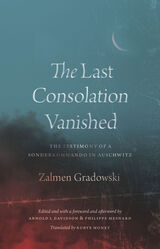
On October 7, 1944, a group of Jewish prisoners in Auschwitz obtained explosives and rebelled against their Nazi murderers. It was a desperate uprising that was defeated by the end of the day. More than four hundred prisoners were killed. Filling a gap in history, The Last Consolation Vanished is the first complete English translation and critical edition of one prisoner’s powerful account of life and death in Auschwitz, written in Yiddish and buried in the ashes near Crematorium III.
Zalmen Gradowski was in the Sonderkommando (special squad) at Auschwitz, a Jewish prisoner given the unthinkable task of ushering Jewish deportees into the gas chambers, removing their bodies, salvaging any valuables, transporting their corpses to the crematoria, and destroying all evidence of their murders. Sonderkommandos were forcibly recruited by SS soldiers; when they discovered the horror of their assignment, some of them committed suicide or tried to induce the SS to kill them. Despite their impossible situation, many Sonderkommandos chose to resist in two interlaced ways: planning an uprising and testifying. Gradowski did both, by helping to lead a rebellion and by documenting his experiences. Within 120 scrawled notebook pages, his accounts describe the process of the Holocaust, the relentless brutality of the Nazi regime, the assassination of Czech Jews, the relationships among the community of men forced to assist in this nightmare, and the unbearable separation and death of entire families, including his own. Amid daily unimaginable atrocities, he somehow wrote pages that were literary, sometimes even lyrical—hidden where and when one would least expect to find them.
The October 7th rebellion was completely crushed and Gradowski was killed in the process, but his testimony lives on. His extraordinary and moving account, accompanied by a foreword and afterword by Philippe Mesnard and Arnold I. Davidson, is a voice speaking to us from the past on behalf of millions who were silenced. Their story must be shared.
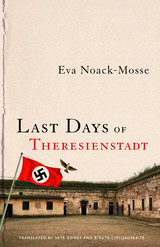
Noack-Mosse's aim in documenting the horrors of daily life within Theresienstadt was to ensure that such a catastrophe could never be repeated. She also gathered from surviving inmates information about earlier events within the walled fortress, witnessed the defeat and departure of the Nazis, saw the arrival of the International Red Cross and the Soviet Army takeover of the camp and town, assisted in administration of the camp's closure, and aided displaced persons in discovering the fates of their family and friends. After the war ended, and she returned home, Noack-Mosse cross-referenced her data with that of others to provide evidence of Nazi crimes. At least 35,000 people died at Theresienstadt and another 90,000 were sent on to death camps.
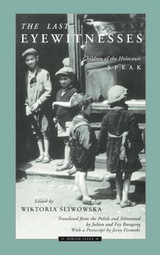
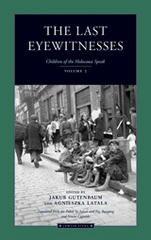
This book serves as a memorial to loved ones who do not even have a grave, as well as a tribute to those who risked their lives and families to save a Jewish child. A wide variety of experiences during the Nazi occupation of Poland are related with wrenching simplicity and candor, experiences that illustrate horrors and deprivation, but also present examples of courage and compassion.
These recollections-whether of hiding in forests or camouflaged bunkers, fighting with groups of partisans, enduring the horrors of concentration camps, or living in fear under disguised identities-serve as eloquent testimony to the depth, diversity, and richness of humanity under siege and offer a powerful lesson for future generations. Written by people who remained in Poland after the war, these accounts convey a great immediacy; the authors are not removed from the environment in which these experiences took place. The psychological impact on these child survivors and the difficulties they encountered even after the war are very poignant. The passing years have brought urgency to the publication of these stories, as those who wrote them are the last surviving eyewitnesses of these tumultuous events.
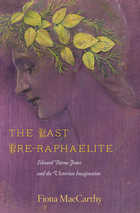
While still a student at Oxford, Edward Burne-Jones formed a friendship and made a renunciation that would shape art history. The friendship was with William Morris, with whom he would occupy the social and intellectual center of the era's cult of beauty. The renunciation was of his intention to enter the clergy, when he-together with Morris-vowed to throw over the Church in favor of art. In Fiona MacCarthy's riveting account of Burne-Jones's life, that exchange of faith for art places him at the intersection of the nineteenth century and the Modern, as he leads us forward from Victorian mores and attitudes to the psychological, sexual, and artistic audacity that would characterize the early twentieth century.
In MacCarthy's hands, Burne-Jones emerges as a great visionary painter, a master of mystic reverie, and a pivotal late nineteenth-century cultural and artistic figure. Lavishly illustrated with color plates, The Last Pre-Raphaelite shows that Burne-Jones's influence extended far beyond his own circle to Freudian Vienna and the delicately gilded erotic dream paintings of Gustav Klimt, the Swiss Symbolist painter Ferdinand Hodler, and the young Pablo Picasso and the Catalan painters.
Drawing on extensive research, MacCarthy offers a fresh perspective on the achievement of Burne-Jones, a precursor to the Modern, and tells the dramatic, fascinating story of this peculiarly captivating and elusive man.
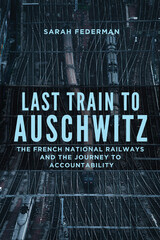
In the immediate decades after World War II, the French National Railways (SNCF) was celebrated for its acts of wartime heroism. However, recent debates and litigation have revealed the ways the SNCF worked as an accomplice to the Third Reich and was actively complicit in the deportation of 75,000 Jews and other civilians to death camps. Sarah Federman delves into the interconnected roles—perpetrator, victim, and hero—the company took on during the harrowing years of the Holocaust.
Grounded in history and case law, Last Train to Auschwitz traces the SNCF’s journey toward accountability in France and the United States, culminating in a multimillion-dollar settlement paid by the French government on behalf of the railways.The poignant and informative testimonies of survivors illuminate the long-term effects of the railroad’s impact on individuals, leading the company to make overdue amends. In a time when corporations are increasingly granted the same rights as people, Federman’s detailed account demonstrates the obligations businesses have to atone for aiding and abetting governments in committing atrocities. This volume highlights the necessity of corporate integrity and will be essential reading for those called to engage in the difficult work of responding to past harms.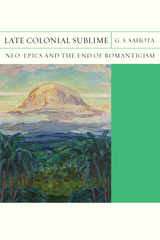
By bringing together distinct literary canons—both metropolitan and colonial, hegemonic and subaltern, Western and Eastern, all of which took shape upon the common realities of imperial capitalism—Late Colonial Sublime takes an original dialectical approach. It experiments with fragments, parallaxes, and constellational form to explore the aporias of modernity as well as the possible futures they may signal in our midst. A bold intervention into contemporary debates that synthesizes a wealth of sources, this book will interest readers and scholars in world literature, critical theory, postcolonial criticism, and South Asian studies.
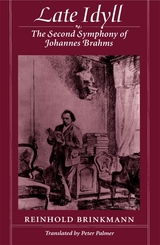
Though central to our concert and recording repertory, and crucial to the history of the symphony, the four symphonies of Johannes Brahms have proved surprisingly resistant to critical analysis. In this brief, elegant book, a premier musicologist conducts us through the Second Symphony to show us what is unique and remarkable about this particular work and what it reveals about the composer and his time.
Reinhold Brinkmann guides us through the symphony movement by movement, examining musical ideas in all their compositional facets and placing them in the context of major trends in the intellectual history of late nineteenth-century Europe. He delineates connections between this symphony and the composer's other works and traces its relation to the music of Brahms's predecessors, particularly Beethoven. The product of a long and deep engagement with the music of Brahms, Late Idyll captures the spirit of the composer, probes the impulses behind his revisions of the original manuscript, and explores the meaning of the disparity between the first two movements of the symphony and the last. The result is a penetrating reading of a perplexing and important composition, clearly placed within its biographical, historical, and artistic context. It will engage and enlighten students and concertgoers alike.
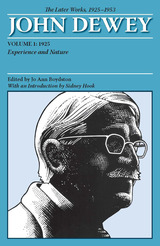
John Dewey’s Experience and Nature has been considered the fullest expression of his mature philosophy since its eagerly awaited publication in 1925.Irwin Edman wrote at that time that “with monumental care, detail and completeness, Professor Dewey has in this volume revealed the metaphysical heart that beats its unvarying alert tempo through all his writings, whatever their explicit themes.” In his introduction to this volume, Sidney Hook points out that “Dewey’s Experience and Nature is both the most suggestive and most difficult of his writings.”
The meticulously edited text published here as the first volume in the series The Later Works of John Dewey, 1925–1953spans that entire period in Dewey’s thought by including two important and previously unpublished documents from the book’s history: Dewey’s unfinished new introduction written between 1947and 1949,edited by the late Joseph Ratner, and Dewey’s unedited final draft of that introduction written the year before his death. In the intervening years Dewey realized the impossibility of making his use of the word “experience” understood. He wrote in his 1951draft for a new introduction: “Were I to write (or rewrite) Experience and Nature today I would entitle the book Culture and Nature and the treatment of specific subject-matters would be correspondingly modified. I would abandon the term ‘experience’ because of my growing realization that the historical obstacles which prevented understanding of my use of ‘experience’ are, for all practical purposes, insurmountable. I would substitute the term ‘culture’ because with its meanings as now firmly established it can fully and freely carry my philosophy of experience.”
Art as Experience evolved from John Dewey’s Willam James Lectures, delivered at Harvard University from February to May 1931.
In his Introduction, Abraham Kaplan places Dewey’s philosophy of art within the context of his pragmatism. Kaplan demonstrates in Dewey’s esthetic theory his traditional “movement from a dualism to a monism” and discusses whether Dewey’s viewpoint is that of the artist, the respondent, or the critic.
This volume includes ninety-two items from 1935, 1936, and 1937, including Dewey’s 1935 Page-Barbour Lectures at the University of Virginia, published as Liberalism and Social Action.
In essay after essay Dewey analyzed, criticized, and reevaluated liberalism. When his controversial Liberalism and Social Action appeared, asking whether it was still possible to be a liberal, Horace M. Kallen wrote that Dewey “restates in the language and under the conditions of his times what Jefferson’s Declaration of Independence affirmed in the language and under the conditions of his.”
The diverse nature of the writings belies their underlying unity: some are technical philosophy; other philosophical articles shade into social and political themes; social and political issues permeate the educational articles, which in turn involve Dewey’s philosophical ideas.
This volume includes all Dewey’s writings for 1938 except for Logic: The Theory of Inquiry (Volume 12 of The Later Works), as well as his 1939 Freedom and Culture, Theory of Valuation, and two items from Intelligence in the Modern World.
Freedom and Culture presents, as Steven M. Cahn points out, “the essence of his philosophical position: a commitment to a free society, critical intelligence, and the education required for their advance.”
This volume republishes forty-four essays, reviews, and miscellaneous pieces from 1939, 1940, and 1941.
In his Introduction, R. W. Sleeper characterizes the contents of this volume as “vintage Dewey. Ranging widely over problems of theory and practice, they reveal him commencing his ninth decade at the peak of his intellectual powers.”
“Nature in Experience,” Dewey’s reply to Morris R. Cohen and William Ernest Hocking, “is a model of clarity and responsiveness,” writes Sleeper, “perhaps his clearest statement of why it is that metaphysics does not play the fundamental role for him that it had regularly played for his predecessors.”
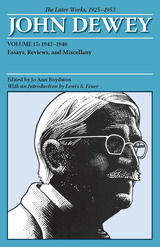
This volume republishes sixty-two of Dewey’s writings from the years 1942 to 1948; four other items are published here for the first time.
A focal point of this volume is Dewey’s introduction to his collective volume Problems of Men. Exchanges in the Journal of Philosophy with Donald C. Mackay, Philip Blair Rice, and with Alexander Meiklejohn in Fortune appear here, along with Dewey’s letters to editors of various publications and his forewords to colleagues’ books. Because 1942 was the centenary of the birth of William James, four articles about James are also included in this volume.
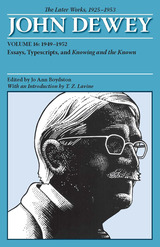
Typescripts, essays, and an authoritative edition of Knowing and the Known, Dewey’s collaborative work with Arthur F. Bentley.
In an illuminating Introduction T. Z. Lavine defines the collaboration's three goals—the "construction of a new language for behavioral inquiry," "a critique of formal logicians, in defense of Dewey’s Logic," and "a critique of logical positivism." In Dewey’s words: "Largely due to Bentley, I’ve finally got the nerve inside of me to do what I should have done years ago."
"What Is It to Be a Linguistic Sign or Name?" and "Values, Valuations, and Social Facts,’ both written in 1945, are published here for the first time.
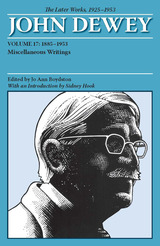
This is the final textual volume in The Collected Works of John Dewey, 1882–1953, published in 3 series comprising 37 volumes: The Early Works, 1882–1898 (5 vols.); The Middle Works, 1899–1924 (15 vols.); The Later Works, 1925–1953 (17 vols.).
Volume 17 contains Dewey’s writings discovered after publication of the appropriate volume of The Collected Works and spans most of Dewey’s publishing life. There are 83 items in this volume, 24 of which have not been previously published.
Among works highlighted in this volume are 10 “Educational Lectures before Brigham Young Academy,” early essays “War’s Social Results” and “The Problem of Secondary Education after the War,” and the previously unpublished “The Russian School System.”

For Latin America, the Cold War was anything but cold. Nor was it the so-called “long peace” afforded the world’s superpowers by their nuclear standoff. In this book, the first to take an international perspective on the postwar decades in the region, Hal Brands sets out to explain what exactly happened in Latin America during the Cold War, and why it was so traumatic.
Tracing the tumultuous course of regional affairs from the late 1940s through the early 1990s, Latin America’s Cold War delves into the myriad crises and turning points of the period—the Cuban revolution and its aftermath; the recurring cycles of insurgency and counter-insurgency; the emergence of currents like the National Security Doctrine, liberation theology, and dependency theory; the rise and demise of a hemispheric diplomatic challenge to U.S. hegemony in the 1970s; the conflagration that engulfed Central America from the Nicaraguan revolution onward; and the democratic and economic reforms of the 1980s.
Most important, the book chronicles these events in a way that is both multinational and multilayered, weaving the experiences of a diverse cast of characters into an understanding of how global, regional, and local influences interacted to shape Cold War crises in Latin America. Ultimately, Brands exposes Latin America’s Cold War as not a single conflict, but rather a series of overlapping political, social, geostrategic, and ideological struggles whose repercussions can be felt to this day.
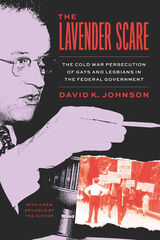
In The Lavender Scare, David K. Johnson tells the frightening story of how, during the Cold War, homosexuals were considered as dangerous a threat to national security as Communists. Charges that the Roosevelt and Truman administrations were havens for homosexuals proved a potent political weapon, sparking a “Lavender Scare” more vehement and long-lasting than Joseph McCarthy’s Red Scare. Drawing on declassified documents, years of research in the records of the National Archives and the FBI, and interviews with former civil servants, Johnson recreates the vibrant gay subculture that flourished in midcentury Washington and takes us inside the security interrogation rooms where anti-homosexual purges ruined the lives and careers of thousands of Americans. This enlarged edition of Johnson’s classic work of history—the winner of numerous awards and the basis for an acclaimed documentary broadcast on PBS—features a new epilogue, bringing the still-relevant story into the twenty-first century.

The 1950s were a decade of considerable legal development in England and Wales, despite often being regarded as very conservative in contrast to the more radical 1960s and 1970s. This collection illustrates the breadth of those developments, providing a sociolegal perspective on a range of topics across criminal, property, family, commercial, environmental, and public law, as well as legal education.
Drawing on case studies from the Great London Smog in 1952, the treatment of women in the Wolfenden Report, divorce law reform, the takeover battle for the Savoy Hotel in 1953, law on the radio, and more, this book throws new light on current debates about the relationship between law and issues of justice, inclusion, and equality in different spheres of activity.
Written for historians and legal specialists alike, Law and Justice in the 1950s explores the stories behind the laws in this neglected decade. In revealing the historical context, arguments, and controversies raised at the time and the different perspectives of the parties involved, it offers a greater understanding of why we have the law we have now and of these issues as they continue to be played out in the early twenty-first century.
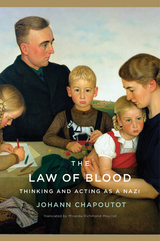
Winner of the Yad Vashem International Book Prize for Holocaust Research
The scale and the depth of Nazi brutality seem to defy understanding. What could drive people to fight, kill, and destroy with such ruthless ambition? Observers and historians have offered countless explanations since the 1930s. According to Johann Chapoutot, we need to understand better how the Nazis explained it themselves. We need a clearer view, in particular, of how they were steeped in and spread the idea that history gave them no choice: it was either kill or die.
Chapoutot, one of France’s leading historians, spent years immersing himself in the texts and images that reflected and shaped the mental world of Nazi ideologues, and that the Nazis disseminated to the German public. The party had no official ur-text of ideology, values, and history. But a clear narrative emerges from the myriad works of intellectuals, apparatchiks, journalists, and movie-makers that Chapoutot explores.
The story went like this: In the ancient world, the Nordic-German race lived in harmony with the laws of nature. But since Late Antiquity, corrupt foreign norms and values—Jewish values in particular—had alienated Germany from itself and from all that was natural. The time had come, under the Nazis, to return to the fundamental law of blood. Germany must fight, conquer, and procreate, or perish. History did not concern itself with right and wrong, only brute necessity. A remarkable work of scholarship and insight, The Law of Blood recreates the chilling ideas and outlook that would cost millions their lives.

The Covid pandemic has put all modern societies to a serious test of resilience. The interdisciplinary research on which this book is based examined how four European governments behaved in these circumstances. During the months of the crisis, the team of experts coordinated by the editors of this volume took a close look at the decision-making processes in the Czech Republic, Hungary, Poland, and Slovakia – the so-called Visegrad Four.
The inquiries focused on experiences from the academic, health, economic and social fields. The methods of comparison included surveys, interviews, discourse analysis, for which the adaptive leadership theory provided the conceptual framework.
The conclusions are both academic and practical. Aside the description of the pandemic responses, the research had a formative dimension: how can an adaptive leadership approach better help societies manage the health and societal impacts of similar challenges? The spectrum of emerging anti-democratic tendencies in the region provided the specific context of the exercise. The four states face varying degrees of democratic backsliding as well as illiberal influences that have affected their response to the pandemic, which gives this research on the Visegrad Four a worldwide resonance.
Eldridge sees Wittgenstein as a Romantic protagonist, engaged in an ongoing internal dialogue over the nature of intentional consciousness, ranging over ethics, aesthetics, and philosophy of mind. The picture of the human mind that emerges through this dialogue unsettles behaviorism, cognitivism, and all other scientifically oriented orthodoxies. Leading a human life becomes a creative act, akin to writing a poem, of continuously seeking to overcome both complacency and skepticism. Eldridge's careful reconstruction of the central motive of Wittgenstein's work will influence all subsequent scholarship on it.

The premier political philosopher of his day, John Rawls, in three decades of teaching at Harvard, has had a profound influence on the way philosophical ethics is approached and understood today. This book brings together the lectures that inspired a generation of students--and a regeneration of moral philosophy. It invites readers to learn from the most noted exemplars of modern moral philosophy with the inspired guidance of one of contemporary philosophy's most noteworthy practitioners and teachers.
Central to Rawls's approach is the idea that respectful attention to the great texts of our tradition can lead to a fruitful exchange of ideas across the centuries. In this spirit, his book engages thinkers such as Leibniz, Hume, Kant, and Hegel as they struggle in brilliant and instructive ways to define the role of a moral conception in human life. The lectures delineate four basic types of moral reasoning: perfectionism, utilitarianism, intuitionism, and--the ultimate focus of Rawls's course--Kantian constructivism. Comprising a superb course on the history of moral philosophy, they also afford unique insight into how John Rawls has transformed our view of this history.
This last book by the late John Rawls, derived from written lectures and notes for his long-running course on modern political philosophy, offers readers an account of the liberal political tradition from a scholar viewed by many as the greatest contemporary exponent of the philosophy behind that tradition.
Rawls's goal in the lectures was, he wrote, "to identify the more central features of liberalism as expressing a political conception of justice when liberalism is viewed from within the tradition of democratic constitutionalism." He does this by looking at several strands that make up the liberal and democratic constitutional traditions, and at the historical figures who best represent these strands--among them the contractarians Hobbes, Locke, and Rousseau; the utilitarians Hume, Sidgwick, and J. S. Mill; and Marx regarded as a critic of liberalism. Rawls's lectures on Bishop Joseph Butler also are included in an appendix. Constantly revised and refined over three decades, Rawls's lectures on these figures reflect his developing and changing views on the history of liberalism and democracy--as well as how he saw his own work in relation to those traditions.
With its clear and careful analyses of the doctrine of the social contract, utilitarianism, and socialism--and of their most influential proponents--this volume has a critical place in the traditions it expounds. Marked by Rawls's characteristic patience and curiosity, and scrupulously edited by his student and teaching assistant, Samuel Freeman, these lectures are a fitting final addition to his oeuvre, and to the history of political philosophy as well.
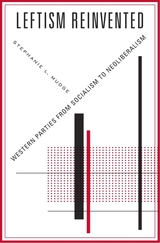
Left-leaning political parties play an important role as representatives of the poor and disempowered. They once did so by promising protections from the forces of capital and the market’s tendencies to produce inequality. But in the 1990s they gave up on protection, asking voters to adapt to a market-driven world. Meanwhile, new, extreme parties began to promise economic protections of their own—albeit in an angry, anti-immigrant tone.
To better understand today’s strange new political world, Stephanie L. Mudge’s Leftism Reinvented analyzes the history of the Swedish and German Social Democrats, the British Labour Party, and the American Democratic Party. Breaking with an assumption that parties simply respond to forces beyond their control, Mudge argues that left parties’ changing promises expressed the worldviews of different kinds of experts. To understand how left parties speak, we have to understand the people who speak for them.
Leftism Reinvented shows how Keynesian economists came to speak for left parties by the early 1960s. These economists saw their task in terms of discretionary, politically-sensitive economic management. But in the 1980s a new kind of economist, who viewed the advancement of markets as left parties’ main task, came to the fore. Meanwhile, as voters’ loyalties to left parties waned, professional strategists were called upon to “spin” party messages. Ultimately, left parties undermined themselves, leaving a representative vacuum in their wake. Leftism Reinvented raises new questions about the roles and responsibilities of left parties—and their experts—in politics today.

This volume examines the legacy of the East–West divide since the implosion of the communist regimes in Europe. The ideals of 1989 have largely been frustrated by the crises and turmoil of the past decade. The liberal consensus was first challenged as early as the mid-2000s. In Eastern Europe, grievances were directed against the prevailing narratives of transition and ever sharper ethnic-racial antipathies surfaced in opposition to a supposedly postnational and multicultural West. In Western Europe, voices regretting the European Union's supposedly careless and premature expansion eastward began to appear on both sides of the left–right and liberal–conservative divides. The possibility of convergence between Europe's two halves has been reconceived as a threat to the European project.
In a series of original essays and conversations, thirty-three contributors from the fields of European and global history, politics and culture address questions fundamental to our understanding of Europe today: How have perceptions and misperceptions between the two halves of the continent changed over the last three decades? Can one speak of a new East–West split? If so, what characterizes it and why has it reemerged? The contributions demonstrate a great variety of approaches, perspectives, emphases, and arguments in addressing the daunting dilemma of Europe's assumed East–West divide.

The Enlightenment has come under substantial attack over the past several years, with some going so far as to recommend leaving behind its thinkers and their Eurocentric prejudices. In response, the most orthodox defenders of the Enlightenment have insisted that its values are not just foundational but indispensable and that abandoning them would mean opening the door to nihilism and relativism. For Antoine Lilti, one of the leading scholars of the French Enlightenment, both sides are wrong.
In this tactfully argued series of essays, Lilti emphasizes a non-dogmatic, non-ideological view of the Enlightenment—one that sees its legacy as a critical, attentive approach that can and should serve as its own best critic. Along the way, he engages with everyone from Rousseau and Kant to Foucault and Habermas, as well as prominent contemporary voices, such as Jonathan Israel. The result is a remarkable new reading of the Enlightenment that redraws the stakes of old debates and offers an alternative way to engage with both canonical thinkers and later scholarship that is both honest about the past and useful for the future.
In Leo Strauss and Nietzsche, the eminent Nietzsche scholar Laurence Lampert offers a controversial new assessment of the Strauss-Nietzsche connection. Lampert undertakes a searching examination of the key Straussian essay, "Note on the Plan of Nietzsche's Beyond Good and Evil." He shows that this essay, written toward the end of Strauss's life and placed at the center of his final work, reveals an affinity for and debt to Nietzsche greater than Strauss's followers allow. Lampert argues that the essay comprises the most important interpretation of Nietzsche ever published, one that clarifies Nietzsche's conception of nature and of human spiritual history and demonstrates the logical relationship between the essential themes in Nietzsche's thought—the will to power and the eternal return.
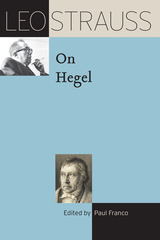
Leo Strauss on Hegel reconstructs Strauss’s seminar on Hegel, supplemented by passages from an earlier version of the seminar from which only fragments of a transcript remain. Strauss focused his seminar on the lectures collected in The Philosophy of History, which he considered more accessible than Hegel’s written works. In his own lectures on Hegel, Strauss continues his project of demonstrating how modern philosophers related to ancient thought and explores the development and weaknesses of modern political theory. Strauss is especially concerned with the relationship in Hegel between empirical history and his philosophy of history, and he argues for the primacy of religion in Hegel’s understanding of history and society. In addition to a relatively complete transcript, Leo Strauss on Hegel also includes annotations, which bring context and clarity to the text.


Lessons and Legacies II focuses on matters unique to Holocaust education. Consisting of selected papers delivered at the second Lessons and Legacies conference in 1992, the volume is organized in three sections: Issues, Resources, and Applications. Taken individually, the essays speak directly to specific concerns surrounding Holocaust education: the growing maturity of the Holocaust as a field of study; the difficult issue of explaining the perpetrators' behavior; the process of decision-making within Jewish communities during the Holocaust; issues of gender and family; the scope and content of survivor literature; and the structure of courses and the implications of being an educator in the field. Taken as a whole, the volume speaks to the reciprocal and mutually reinforcing relationship between teaching and scholarship in this important field.
A collection of nineteen essays, this book is organized into four sections: the first focuses on how various fields of study can open new perspectives on the Holocaust and sharpen old ones; the second examines culture and politics in Germany before and after 1933; the third addresses the problems associated with the memorialization of those years; and the final section examines the shocking denials of the Holocaust.
Variously concerned with issues of guilt and victimization, the essays examine individuals like Pius XII and Romano Guardini and the institutions of organized religion as well as the roles of the Jewish Councils and the retributive judicial proceedings in Hungary. They reveal that victimization within the Holocaust experience is surprisingly open-ended, with Jewish women doubly victimized by their gender; postwar Germans viewing themselves as the epoch's greatest victims; Poles, whether Jewish or not, victimized beyond others because of their proximity to the epicenter of the Holocaust; and German university students corrupted by ideological inculcation and racist propaganda.
Though offering no "positive lessons" or comforting assurances, these essays add to the ongoing examination of Holocaust consequences and offer insightful analyses of facets previously minimized or neglected. Together they illustrate that matters of gender, sexuality, and proximity are crucial for shaping perceptions of a Holocaust reality that will always remain elusive.
Seeking a historical context, the contributors ask, What were the political, social, psychological, and ideological prerequisites for this tragedy? Considering the courts and trials both during and immediately after World War II, and recent cases against aging perpetrators, the contributors examine the legal circumstances for trying to provide justice, the dimming impact of passing time, and other issues that complicate litigation. Their inquiry extends to questions about memory--how it is shaped and reshaped and whether it can be reliable--and about the re-creation of events of the Holocaust by a second generation. Does reassembling the evidence through the lenses of a later generation provide a deeper understanding, and does this understanding include a sense of justice accomplished?
Several of the essays-such as one on nonarmed "amidah" or resistance and others on the role of gender in the behavior of perpetrators and victims-provide innovative and potentially significant interpretive frameworks for the field of Holocaust studies. Others; for instance, the rounding up of Jews in Italy, Nazi food policy in Eastern Europe, and Nazi anti-Jewish scholarship, emphasize the importance of new sources for reconstructing the historical record. Still others, including essays on the 1964 Frankfurt trial of Auschwitz guards and on the response of the Catholic Church to the question of German guilt, bring a new depth and sophistication to highly charged, sharply politicized topics. Together these essays will inform the future of the Holocaust in scholarly research and in popular understanding.
A thorough, thoughtful, and insightful introduction clarifies the volume's themes and concisely places them within the larger context of Holocaust scholarship; and an introductory essay by Omer Bartov brings into focus the numerous paradoxes structuring early twenty-first-century retrospective thinking about the significance of the Holocaust as a central theme of the twentieth century.
The contributions to this volume not only indicate the intellectual vibrancy and diversity of cutting-edge research in Holocaust studies but also reflect multiple approaches to the necessary work of expanding the canon of research in the field and of adopting varied disciplinary perspectives, engaging with global perspectives as well as local studies.
This collection’s chapters manifest three broad categories: history, literature, and memory; at the same time, however, as the interdisciplinary nature of these chapters indicate, these categories should not be regarded as mutually exclusive or discrete. On the contrary, they overlap and intersect in compelling ways, demonstrating the dynamic character of contemporary Holocaust studies, which views history, narrative representation, and commemoration as mutually informative. Further, the contributors continue the recent trend in Holocaust studies whereby specific regional and national narratives are integrated into a more global approach to the event: Newer studies have continued to incorporate what was once termed the periphery into a more global examination of the experiences of Jewish refugees in flight to Latin America, Africa, and the Soviet Union. At the same time, very specific local studies deepen our knowledge of the mechanics of genocide, along with the experiences of refugees in flight, and the subsequent dimensions of Holocaust memory and representation.
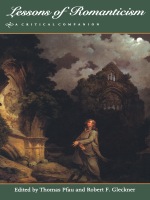
With over twenty essays on such diverse topics as the aesthetic and pedagogical purposes of art exhibits in London, the materiality of late Romantic salon culture, the extracanonical status of Jane Austen and Fanny Burney, and Romantic imagery in Beethoven’s music and letters, Lessons of Romanticism reveals the practices that were at the heart of European Romantic life. Focusing on the six decades from 1780 to 1832, this collection is arranged thematically around gender and genre, literacy, marginalization, canonmaking, and nationalist ideology. As Americanists join with specialists in German culture, as Austen is explored beside Beethoven, and as discussions on newly recovered women’s writings follow fresh discoveries in long-canonized texts, these interdisciplinary essays not only reflect the broad reach of contemporary scholarship but also point to the long-neglected intertextual and intercultural dynamics in the various and changing faces of Romanticism itself.
Contributors. Steven Bruhm, Miranda J. Burgess, Joel Faflak, David S. Ferris, William Galperin, Regina Hewitt, Jill Heydt-Stevenson, H. J. Jackson, Theresa M. Kelley, Greg Kucich, C. S. Matheson, Adela Pinch, Marc Redfield, Nancy L. Rosenblum, Marlon B. Ross, Maynard Solomon, Richard G. Swartz, Nanora Sweet, Joseph Viscomi, Karen A. Weisman, Susan I. Wolfson
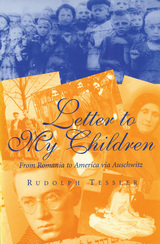
"Sixty-seven members of my family—my mother, her father, my three sisters, three of my brothers, aunts, uncles, and cousins—were murdered at Auschwitz."
As Rudolph Tessler's mother stepped from the train in Auschwitz, shortly before she was sent to the gas chamber, she heard "Hello, Esther." In a polite tone, a young German SS officer greeted her as he would any old friend. His family lived down the road from the Tessler family in Viseu, their hometown in northern Romania. They, like the rest of the town, admired Esther for her wonderful cooking, particularly the delicious cakes she brought them each Christmas. Now he ushered her and six of her children to their deaths.Throughout Letter to My Children, Tessler offers vivid glimpses of the senselessness that surrounded him during World War II. Of the thousands packed in trains and transported from Viseu to Auschwitz, just a small group survived to see liberation. Among the survivors were Tessler, his father, and two of his brothers. This is the amazing story of their experiences as Hasidic Jews caught in the chaos and terror of the Holocaust.
Tessler's upbringing had emphasized community and family devotion—traits not forgotten in the concentration camps, where he and his family members often rescued one another from certain death. Few fathers and sons survived the concentration camps together. In spite of the odds, Tessler and his brother Buroch managed to stick together, sharing their father's labor assignments to protect him from death, preserving not only their family bond but also their spirituality. Tessler's father, always a source of strength and guidance to his family, provided counsel to many prisoners in the camp and eventually assumed the role of rabbi.
Despite an environment in which their captors tried to reduce them to animals, Tessler's remaining family and seven other Jews from Viseu made a special effort to observe their faith. Bending rules in ways that risked their lives, they worked together to smuggle wheat, grind it into flour, and bake matzos to distribute for Passover. The group also secretly gathered to pray on the eve of Rosh Hashanah. These religious observances offered some comfort in the camp.
In addition to vividly portraying the daily struggles of camp life, Letter to My Children follows Tessler beyond liberation, recounting his days as a displaced person struggling for a new life in the midst of the devastation of postwar Europe, as an American immigrant striving to rebuild his family and succeed in business, and as a philanthropist for education and health care. Recalling the age-old way of life in Viseu that was erased by the Holocaust, this inspiring story conveys the hope, determination, and perseverance that made Tessler a survivor.
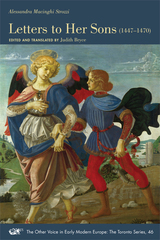
The seventy-three surviving letters written by Florentine widow, Alessandra Macinghi Strozzi (c.1406–1471), to her distant sons first appeared in print well over a century ago, but are here translated into English in their entirety for the first time. Whether for the professional historian or for the general reader interested in Renaissance Florence, they constitute a most precious testimony regarding both private and public life in the mid-fifteenth century, with themes ranging from familial relations, motherhood, marriage, and aspects of material culture to the harsh realities of political exile meted out by the Medici to their perceived opponents, these latter including her husband and, subsequently, her sons.
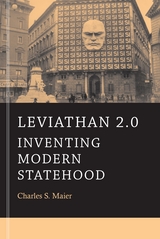
Thomas Hobbes laid the theoretical groundwork of the nation-state in Leviathan, his tough-minded treatise of 1651. Leviathan 2.0 updates this classic account to explain how modern statehood took shape between the mid-nineteenth and mid-twentieth centuries, before it unraveled into the political uncertainty that persists today.
Modern states were far from immune to the modernizing forces of war, technology, and ideology. From 1845 to 1880, the United States, Canada, Mexico, and Argentina were all reconstituted through territorial violence. Europe witnessed the unification of Germany and Italy, while Asian nations such as Japan tried to mitigate foreign incursions through state-building reforms. A global wave of revolution at the turn of the century pushed the modernization process further in China, Russia, Iran, and Ottoman Turkey. By the late 1930s, with the rise of the Soviet Union and Nazi Germany, the momentum of history seemed to shift toward war-glorifying totalitarian states. But several variants of the modern state survived World War II: the welfare states of Western democracies; single-party socialist governments; and governments dominated by the military, especially prevalent in Latin America, Asia, and the Middle East.
Toward the end of the twentieth century, all of these forms stood in growing tension with the transformative influences of globalized capitalism. Modern statehood recreated itself in many ways, Charles S. Maier concludes, but finally had to adopt a precarious equilibrium with ever more powerful economic forces.
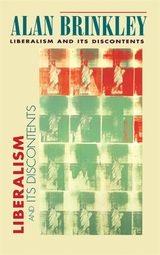
How did liberalism, the great political tradition that from the New Deal to the 1960s seemed to dominate American politics, fall from favor so far and so fast? In this history of liberalism since the 1930s, a distinguished historian offers an eloquent account of postwar liberalism, where it came from, where it has gone, and why. The book supplies a crucial chapter in the history of twentieth-century American politics as well as a valuable and clear perspective on the state of our nation's politics today.
Liberalism and Its Discontents moves from a penetrating interpretation of Franklin D. Roosevelt and the New Deal to an analysis of the profound and frequently corrosive economic, social, and cultural changes that have undermined the liberal tradition. The book moves beyond an examination of the internal weaknesses of liberalism and the broad social and economic forces it faced to consider the role of alternative political traditions in liberalism's downfall. What emerges is a picture of a dominant political tradition far less uniform and stable--and far more complex and contested--than has been argued. The author offers as well a masterly assessment of how some of the leading historians of the postwar era explained (or failed to explain) liberalism and other political ideologies in the last half-century. He also makes clear how historical interpretation was itself a reflection of liberal assumptions that began to collapse more quickly and completely than almost any scholar could have imagined a generation ago. As both political history and a critique of that history, Liberalism and Its Discontents, based on extraordinary essays written over the last decade, leads to a new understanding of the shaping of modern America.
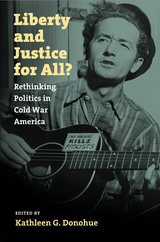
From the congressional debate over the “fall of China” to the drama of the Army–McCarthy hearings to the kitchen faceoff between Richard Nixon and Nikita Khrushchev, the political history of the early Cold War was long dominated by studies of presidential administrations, anticommunism, and foreign policy. In Liberty and Justice for All? a group of distinguished historians representing a variety of disciplinary perspectives—social history, cultural history, intellectual history, labor history, urban history, women's history, African American studies, and media studies—expand on the political history of the early Cold War by rethinking the relationship between politics and culture. How, for example, did folk music help to keep movement culture alive throughout the 1950s? How did the new medium of television change fundamental assumptions about politics and the electorate? How did American experiences with religion in the 1950s strengthen the separation of church and state? How did race, class, and gender influence the relationship between citizens and the state? These are just some of the questions addressed in this wide-ranging set of essays.
In addition to volume editor Kathleen G. Donohue, contributors include Howard Brick, Kari Frederickson, Andrea Friedman, David Greenberg, Grace Elizabeth Hale, Jennifer Klein, Laura McEnaney, Kevin M. Schultz, Jason Scott Smith, Landon R. Y. Storrs, and Jessica Weiss.


A history of early modern libraries and the imperial desire for total knowledge—now in paperback.
Medieval scholars imagined the library as a microcosm of the world, but as novel early modern ways of managing information facilitated empire in both the New and Old Worlds, the world became a projection of the library. In The Librarian’s Atlas, Seth Kimmel offers a sweeping material history of how the desire to catalog books coincided in the sixteenth and seventeenth centuries with the aspiration to control territory. Through a careful study of library culture in Spain and Morocco—close readings of catalogs, marginalia, indexes, commentaries, and maps—Kimmel reveals how the booklover’s dream of a comprehensive and well-organized library shaped an expanded sense of the world itself.
Published by Bucknell University Press. Distributed worldwide by Rutgers University Press.
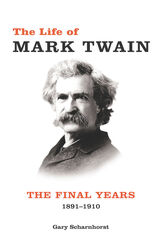
In the final volume of his three-volume biography, Gary Scharnhorst chronicles the life of Samuel Langhorne Clemens from his family’s extended trip to Europe in 1891 to his death in 1910 at age 74. During these years Clemens grapples with bankruptcy, returns to the lecture circuit, and endures the loss of two daughters and his wife. It is also during this time that he writes some of his darkest, most critical works; among these include Pudd’nhead Wilson; Personal Recollections of Joan of Arc; Tom Sawyer Abroad; Tom Sawyer, Detective; Following the Equator; No. 44, the Mysterious Stranger; and portions of his Autobiography.
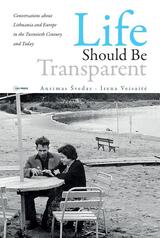
This book of thirteen conversations introduces us to the life of an exceptional person—theatre critic, Germanist, and long-time chair of the Open Lithuania Fund board—Irena Veisaitė. The dialogue between Lithuanian historian Aurimas Švedas and a woman who reflects deeply on her experiences reveals both one individual’s historically dramatic life and the fate of Europe and Lithuania in the twentieth century.
Through the complementary lenses of history and memory, we confront with Veisaitė the horrific events of the Holocaust, which brought about the end of the Lithuanian Jewish world. We also meet an array of world-class cultural figures, see fragments of legendary theatre performances, and hear meaningful words that were spoken or heard decades ago.
This book’s interlocutors do not so much seek to answer the question “What was it like?” but instead repeatedly ask each other: “What, how, and why do we remember? What is the meaning of our experiences? How can history help us to live in the present and create the future? How do we learn to understand and forgive?”
A series of Veisaitė’s texts, statements, and letters, presented at the end of the book suggest further ways of answering these questions.

Reed looks closely at the arguments, achievements, conflicts, and controversies of these major thinkers and how their development of a lucid and active liberal thinking matured in the late eighteenth century into an imaginative branching that ran through philosophy, theology, literature, historiography, science, and politics. He traces the various pathways of their thought and how one engendered another, from the principle of thinking for oneself to the development of a critical epistemology; from literature’s assessment of the past to the formulation of a poetic ideal of human development. Ultimately, Reed shows how the ideas of the German Enlightenment have proven their value in modern secular democracies and are still of great relevance—despite their frequent dismissal—to us in the twenty-first century.
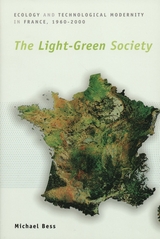
The Light-Green Society limns sharply these trends over the last fifty years. The rise of environmentalism in the 1960s stemmed from a fervent desire to "save" wild nature-nature conceived as a qualitatively distinct domain, wholly separate from human designs and endeavors. And yet, Bess shows, after forty years of environmentalist agitation, much of it remarkably successful in achieving its aims, the old conception of nature as a "separate sphere" has become largely untenable. In the light-green society, where ecology and technological modernity continually flow together, a new hybrid vision of intermingled nature-culture has increasingly taken its place.
In Sharon Cameron’s essays, a magnetic constellation gathers works of Emerson, Whitman, Dickinson, Cather, and Stevens—each manifesting in its own terms “the likeness of things unlike”—to form a loose commonality in a strain of American writing in which incommensurable elements can’t be integrated and can’t be separated. The Likeness of Things Unlike is concerned with discordant elements of an aesthetic work and argues that these elements refigure the aesthetic wholes whose integrity they apparently violate. These intertwined, subversive elements are challenges to literary systems and are essentially philosophical in their rethinking of categories, and thus go beyond the aesthetic particulars that exemplify them.
Cameron is known for rigorously and brilliantly connecting artistic achievement to radical ways of thinking. Georg Lukcás describes the essayist as one who “adapts himself to the essay’s ‘smallness’ of form—the eternal smallness of the most profound work of the intellect in [the] face of life.” With The Likeness of Things Unlike Cameron powerfully demonstrates Lukács’s remarkable insight.

Until the previous decade, constitutionalism in Eastern Europe was considered to be an outmoded concept of the nineteenth century. Changes in the region, however, have brought back the fundamental question of the need to restrict government power through social self-binding.
This book discusses the mechanisms of such restriction, including different forms of the separation of powers and constitutional review. It relates the theoretical and practical importance of the issue to the present world-wide discontent with majoritarian democracy and the growing disrepute of parliaments. Increasing executive efficiency is, however, a threat to fundamental rights, and the battlecry of efficiency is often only a means to new despotism and inefficiency. A careful re-evaluation of the concept of constitutionalism assists in the search for a useful balance between majoritarianism and rights, and in the avoidance of all forms of public tyranny.
Written in non-technical language and using the most important English, American, French, and German examples of constitutional history, the book also examines East European (in particular, Russian) and Latin American examples, in part to illustrate certain dead-ends in constitutional development. It is intended to be an introduction for all those concerned with liberty.
Why must critics unmask and demystify literary works? Why do they believe that language is always withholding some truth, that the critic’s task is to reveal the unsaid or repressed? In this book, Rita Felski examines critique, the dominant form of interpretation in literary studies, and situates it as but one method among many, a method with strong allure—but also definite limits.
Felski argues that critique is a sensibility best captured by Paul Ricoeur’s phrase “the hermeneutics of suspicion.” She shows how this suspicion toward texts forecloses many potential readings while providing no guarantee of rigorous or radical thought. Instead, she suggests, literary scholars should try what she calls “postcritical reading”: rather than looking behind a text for hidden causes and motives, literary scholars should place themselves in front of it and reflect on what it suggests and makes possible.
By bringing critique down to earth and exploring new modes of interpretation, The Limits of Critique offers a fresh approach to the relationship between artistic works and the social world.

Why must critics unmask and demystify literary works? Why do they believe that language is always withholding some truth, that the critic’s task is to reveal the unsaid or repressed? In this book, Rita Felski examines critique, the dominant form of interpretation in literary studies, and situates it as but one method among many, a method with strong allure—but also definite limits.
Felski argues that critique is a sensibility best captured by Paul Ricoeur’s phrase “the hermeneutics of suspicion.” She shows how this suspicion toward texts forecloses many potential readings while providing no guarantee of rigorous or radical thought. Instead, she suggests, literary scholars should try what she calls “postcritical reading”: rather than looking behind a text for hidden causes and motives, literary scholars should place themselves in front of it and reflect on what it suggests and makes possible.
By bringing critique down to earth and exploring new modes of interpretation, The Limits of Critique offers a fresh approach to the relationship between artistic works and the social world.
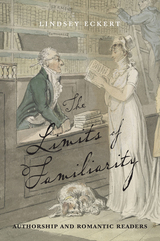
What did Wordsworth wear, and where did he walk? Who was Byron’s new mistress, and how did his marriage fare? Answers—sometimes accurate, sometimes not—were tantalizingly at the ready in the Romantic era, when confessional poetry, romans à clef, personal essays, and gossip columns offered readers exceptional access to well-known authors. But at what point did familiarity become overfamiliarity? Widely recognized as a social virtue, familiarity—a feeling of emotional closeness or comforting predictability—could also be dangerous, vulgar, or boring. In The Limits of Familiarity, Eckert persuasively argues that such concerns shaped literary production in the Romantic period. Bringing together reception studies, celebrity studies, and literary history to reveal how anxieties about familiarity shaped both Romanticism and conceptions of authorship, this book encourages us to reflect in our own fraught historical moment on the distinction between telling all and telling all too much.
Fors reveals how, early in the eighteenth century, chemists began to view metals no longer as the ingredients for “chrysopoeia”—or gold making—but as elemental substances, or the basic building blocks of matter. At the center of this emerging idea, argues Fors, was the Bureau of Mines of the Swedish State, which saw the practical and profitable potential of these materials in the economies of mining and smelting.
By studying the chemists at the Swedish Bureau of Mines and their networks, and integrating their practices into the wider European context, Fors illustrates how they and their successors played a significant role in the development of our modern notion of matter and made a significant contribution to the modern European view of reality.
The role of Bolivian mining families in revolution and politics.
In 1952, Bolivia’s Revolutionary Nationalist Movement (MNR) swept into power, promising collective prosperity through class-based nationalism. The heroic symbol of the movement was the worker citizen—the formerly indigenous miner who would fuel economic development in a nationalized mining economy.
The Limits of Revolution explores this history from the worker barrios of the copper mining city of Corocoro. As the state walked back its promises of worker political power at the national level, mining men and women in Corocoro struggled—through protests, court battles, and barfights—to maintain the benefits of worker citizenship locally. After the MNR fell to a military dictatorship in 1964, however, families retreated to defending the nationalized mining company against an increasingly hostile state. In this battle to keep the revolution alive, the expansive potential of worker citizenship disappeared and old racial exclusions resurfaced. Largely forgotten today, Bolivia’s experience of revolution exposes the contradictions of postcolonial nationalism and sheds light on Latin America’s transition from Cold War–era class politics to twenty-first-century Pink Tide politics.
While Cartesianism has long served as a synonym for rationalism, the contents of Descartes’s method and cogito have remained infamously resistant to rational analysis. Similarly, although modern phenomenological analyses descend from Descartes’s notion of intuition, the “things” Cartesian intuitions represent bear no resemblance to phenomena. By returning to what Descartes calls the construction of his “foundation” in the Discours, Brodsky Lacour identifies the conceptual problems at the root of Descartes’s literary and aesthetic theory as well as epistemology. If, for Descartes, linear extension and “I” are the only “things” we can know exist, the Cartesian subject of thought, she shows, derives first from the intersection of discourse and drawing, representation and matter. The crux of that intersection, Brodsky Lacour concludes, is and must be the cogito, Descartes’s theoretical extension of thinking into material being. Describable in accordance with the Géométrie as a freely constructed line of thought, the cogito, she argues, extends historically to link philosophy with theories of discursive representation and graphic delineation after Descartes. In conclusion, Brodsky Lacour analyzes such a link in the writings of Claude Perrault, the architectural theorist whose reflections on beauty helped shape the seventeenth-century dispute between “the ancients and the moderns.”
Part of a growing body of literary and interdisciplinary considerations of philosophical texts, Lines of Thought will appeal to theorists and historians of literature, architecture, art, and philosophy, and those concerned with the origin and identity of the modern.


Greil Marcus, author of Mystery Train, widely acclaimed as the best book ever written about America as seen through its music, began work on this new book out of a fascination with the Sex Pistols: that scandalous antimusical group, invented in London in 1975 and dead within two years, which sparked the emergence of the culture called punk. "I am an antichrist!" shouted singer Johnny Rotten--where in the world of pop music did that come from? Looking for an answer, with a high sense of the drama of the journey, Marcus takes us down the dark paths of counterhistory, a route of blasphemy, adventure, and surprise.
This is no mere search for cultural antecedents. Instead, what Marcus so brilliantly shows is that various kinds of angry, absolute demands--demands on society, art, and all the governing structures of everyday life--seem to be coded in phrases, images, and actions passed on invisibly, but inevitably, by people quite unaware of each other. Marcus lets us hear strange yet familiar voices: of such heretics as the Brethren of the Free Spirit in medieval Europe and the Ranters in seventeenth-century England; the dadaists in Zurich in 1916 and Berlin in 1918, wearing death masks, chanting glossolalia; one Michel Mourre, who in 1950 took over Easter Mass at Notre-Dame to proclaim the death of God; the Lettrist International and the Situationist International, small groups of Paris--based artists and writers surrounding Guy Debord, who produced blank-screen films, prophetic graffiti, and perhaps the most provocative social criticism of the 1950s and '60s; the rioting students and workers of May '68, scrawling cryptic slogans on city walls and bringing France to a halt; the Sex Pistols in London, recording the savage "Anarchy in the U.K." and "God Save the Queen."
Although the Sex Pistols shape the beginning and the end of the story, Lipstick Traces is not a book about music; it is about a common voice, discovered and transmitted in many forms. Working from scores of previously unexamined and untranslated essays, manifestos, and filmscripts, from old photographs, dada sound poetry, punk songs, collages, and classic texts from Marx to Henri Lefebvre, Marcus takes us deep behind the acknowledged events of our era, into a hidden tradition of moments that would seem imaginary except for the fact that they are real: a tradition of shared utopias, solitary refusals, impossible demands, and unexplained disappearances. Written with grace and force, humor and an insistent sense of tragedy and danger, Lipstick Traces tells a story as disruptive and compelling as the century itself.

Greil Marcus, author of Mystery Train, widely acclaimed as the best book ever written about America as seen through its music, began work on this new book out of a fascination with the Sex Pistols: that scandalous antimusical group, invented in London in 1975 and dead within two years, which sparked the emergence of the culture called punk. “I am an antichrist!” shouted singer Johnny Rotten—where in the world of pop music did that come from? Looking for an answer, with a high sense of the drama of the journey, Marcus takes us down the dark paths of counterhistory, a route of blasphemy, adventure, and surprise.
This is no mere search for cultural antecedents. Instead, what Marcus so brilliantly shows is that various kinds of angry, absolute demands—demands on society, art, and all the governing structures of everyday life—seem to be coded in phrases, images, and actions passed on invisibly, but inevitably, by people quite unaware of each other. Marcus lets us hear strange yet familiar voices: of such heretics as the Brethren of the Free Spirit in medieval Europe and the Ranters in seventeenth-century England; the dadaists in Zurich in 1916 and Berlin in 1918, wearing death masks, chanting glossolalia; one Michel Mourre, who in 1950 took over Easter Mass at Notre-Dame to proclaim the death of God; the Lettrist International and the Situationist International, small groups of Paris—based artists and writers surrounding Guy Debord, who produced blank-screen films, prophetic graffiti, and perhaps the most provocative social criticism of the 1950s and ’60s; the rioting students and workers of May ’68, scrawling cryptic slogans on city walls and bringing France to a halt; the Sex Pistols in London, recording the savage “Anarchy in the U.K.” and “God Save the Queen.”
Although the Sex Pistols shape the beginning and the end of the story, Lipstick Traces is not a book about music; it is about a common voice, discovered and transmitted in many forms. Working from scores of previously unexamined and untranslated essays, manifestos, and filmscripts, from old photographs, dada sound poetry, punk songs, collages, and classic texts from Marx to Henri Lefebvre, Marcus takes us deep behind the acknowledged events of our era, into a hidden tradition of moments that would seem imaginary except for the fact that they are real: a tradition of shared utopias, solitary refusals, impossible demands, and unexplained disappearances. Written with grace and force, humor and an insistent sense of tragedy and danger, Lipstick Traces tells a story as disruptive and compelling as the century itself.

Le titre est, bien entendu, inspiré par Althusser (“Lire Le Capital”) – mais de façon polémique. Par “lire Marx” j'entends lire Marx et non pas Engels, Mao, Gramsci, Lukács, Marcuse, Althusser et ainsi de suite. En d'autres termes : le but de ce cours est, avant tout, de délibérément désintriquer la pensée de Marx de la pensée marxiste. Une polémique avec certains marxistes sera ainsi menée en sous-main, par des allusions ponctuelles. Un tel programme véhicule trois implications majeures : Qu'il y a effectivement une différence de pensée entre Marx et le marxisme. Ce premier point sera établi à travers une lecture philosophique de Marx : l'hypothèse étant que ce qui se trouve de plus original dans Marx, ce n'est ni sa pensée politique, ni sa pensée sociologique ou économique, mais bien sa charpente philosophique. Cette charpente philosophique détermine et situe ses autres théories. La seconde implication, c'est qu'un clivage entre Marx et les marxistes existe comme tel, qu'il peut être défini par certaines caractéristiques générales, et que ces caractéristiques générales différent de la pensée originale de Marx ou la restreignent. Il s'agit là d'un sujet passablement complexe, voire compliqué ; mais on peut résumer ce clivage en disant que le marxisme
a surtout retenu de Marx les éléments utiles à l'action politique dans une situation donnée, urgente. Une théorie de la “praxis révolutionnaire” a donc pris la place de la philosophie. La troisième implication est la précompréhension qui préside à l'approche du texte. Un texte est quelque chose d'imprimé : il représente comme tel un objet clos, constitué, fini. Mais nous n'en obtiendrons de réponses décisives que si nous le soumettons à des questions décisives. Et la question décisive que soulèvent les marxistes, c'est l'urgence d'une situation révolutionnaire (qu'elle existe de fait ou doive être réalisée). Leur question est donc généralement homothétique à celle de Lénine : “Que faire ?” C'est la question de ceux qu'Althusser appelle les “intellectuels militants” (pour Marx 24), et qui participent directement aux luttes de la classe ouvrière. Une telle “ lecture” de Marx est stratégique. Or, je tiens que la lecture stratégique ne peut que rester aveugle, de par sa nature même, au questionnement philosophique. Notre précompréhension des textes de Marx n'a, par conséquent, rien de stratégique ; elle est bien plutôt qu'ils proposent une réponse à la plus ancienne question de la philosophie occidentale : ti to on, savoir : qu'est-ce que l'être ? ou : qu'est-ce que la réalité, ainsi que son corollaire : qu'est-ce que la vérité ? Donc : Marx versus marxisme ; le concept de “praxis” comme étant le concept différenciant Marx du marxisme ; une double théorie des textes. Développons plus avant ces trois points

Winner, 2022 Society of Midland Authors award for Biography/Memoir
Evan S. Connell (1924–2013) emerged from the American Midwest determined to become a writer. He eventually made his mark with attention-getting fiction and deep explorations into history. His linked novels Mrs. Bridge (1959) and Mr. Bridge (1969) paint a devastating portrait of the lives of a prosperous suburban family not unlike his own that, more than a half century later, continue to haunt readers with their minimalist elegance and muted satire. As an essayist and historian, Connell produced a wide range of work, including a sumptuous body of travel writing, a bestselling epic account of Custer at the Little Bighorn, and a singular series of meditations on history and the human tragedy.
This first portrait and appraisal of an under-recognized American writer is based on personal accounts by friends, relatives, writers, and others who knew him; extensive correspondence in library archives; and insightful literary and cultural analysis of Connell’s work and its context. It also illuminates aspects of American publishing, Hollywood, male anxieties, and the power of place.
Literary Criticism offers a concise overview of literary studies in the English-speaking world from the early twentieth century to the present. Joseph North steps back from the usual tangle of figures, schools, and movements in order to analyze the intellectual paradigms that underpinned them. The result is a radically new account of the discipline’s development, together with a trenchant argument about where its political future lies.
People in today’s literature departments often assume that their work is politically progressive, especially when compared with the work of early- and mid-twentieth-century critics. North’s view is less cheering. For when understood in relation to the longer arc of the discipline, the current historicist and contextualist mode in literary studies represents a step to the Right. Since the global turn to neoliberalism in the late 1970s, all the major movements within literary studies have been diagnostic rather than interventionist in character: scholars have developed sophisticated techniques for analyzing culture, but they have retreated from systematic attempts to transform it. In this respect, the political potential of current literary scholarship compares poorly with that of earlier critical modes, which, for all their faults, at least had a programmatic commitment to cultural change.
Yet neoliberalism is now in crisis—a crisis that presents opportunities as well as dangers. North argues that the creation of a genuinely interventionist criticism is one of the central tasks facing those on the Left of the discipline today.
Ranging as widely as Grene's own interests in Greek and Roman antiquity, in drama, poetry, and the novel, in the art of translation, and in English history, these essays include discussions of the Odyssey and Ulysses, the Metamorphoses of Ovid and Apuleius, Mallarmé's English and T. S. Eliot's religion, and the mutually antipathetic minds of Edmund Burke and Thomas Jefferson. The introduction by Todd Breyfogle sketches for the first time the contours of Grene's own thought.
Classicists, political theorists, intellectual historians, philosophers, and students of literature will all find much of value in the individual essays here and in the juxtaposition of their themes.
Contributors: Saul Bellow, Seth Benardete, Todd Breyfogle, Amirthanayagam P. David, Wendy Doniger, Mary Douglas, Joseph N. Frank, Victor Gourevitch, Nicholas Grene, W. R. Johnson, Brendan Kennelly, Edwin McClellan, Françoise Meltzer, Stephanie Nelson, Conor Cruise O'Brien, Martin Ostwald, Robert B. Pippin, James Redfield, Sandra F. Siegel, Norma Thompson, and David Tracy
“This is splendid historical writing…Darnton [has] a well-justified reputation as one of the most original contributors to our understanding of life in pre-revolutionary Paris.” —New York Review of Books
Robert Darnton introduces us to the shadowy world of pirate publishers, garret scribblers, under-the-cloak book peddlers, smugglers, and police spies that composed the literary underground of the Enlightenment.
Here are the ambitious writers who crowded into Paris seeking fame and fortune within the Republic of Letters, but who instead sank into the miserable world of Grub Street—victims of a closed world of protection and privilege. Venting their frustrations in an illicit literature of vitriolic pamphlets, libelles, and chroniques scandaleuses, these “Rousseaus of the gutter” desecrated everything sacred in the social order of the Old Regime. Here too are the workers who printed their writings and the clandestine booksellers who distributed them.
While censorship, a monopolistic guild, and the police contained the visible publishing industry within the limits of official orthodoxies, a prolific literary underworld disseminated a vast illegal literature that conveyed a seditious ideology to readers everywhere in France. Covering their traces in order to survive, the creators of this eighteenth-century counterculture have virtually disappeared from history. By drawing on an ingenious selection of previously hidden sources, such as police ledgers and publishers’ records, Robert Darnton reveals for the first time the fascinating story of that forgotten underworld.
The activities of the underground bear on a broad range of issues in history and literature, and they directly concern the problem of uncovering the ideological origins of the French Revolution. This engaging book illuminates those issues and provides a fresh view of publishing history that will inform and delight the general reader.
This book examines how a heterogeneous group of authors in Britain responded to the Commune. In doing so, it provides the first full-length critical study of the reception and representation of the Commune in Britain during the closing decades of the nineteenth century, showing how discussions of the Commune functioned as a screen to project hope and fear, serving as a warning for some and an example to others. Writers considered in the book include John Ruskin, Edward Bulwer-Lytton, Eliza Lynn Linton, Mary Elizabeth Braddon, Anne Thackeray Ritchie, Margaret Oliphant, George Gissing, Henry James, William Morris, Alfred Austin and H.G. Wells. As the book shows, many, but not all, of these writers responded to the Commune with literary strategies that sought to stabilize bourgeois subjectivity in the wake of the traumatic shock of a revolutionary event. The book extends critical understanding of the Commune’s cultural afterlives and explores the relationship between literature and revolution.
READERS
Browse our collection.
PUBLISHERS
See BiblioVault's publisher services.
STUDENT SERVICES
Files for college accessibility offices.
RECENTLY PUBLISHED



UChicago Accessibility Resources
home | accessibility | search | about | contact us
BiblioVault ® 2001 - 2026
The University of Chicago Press