
 A SCHOLARLY BOOK REPOSITORY

The contributors consider how methodology informs mentorship, how mentorship activates methodology, and how to locate the future of the field in these moments of intersection. Mentorship, through the research and relationships it nourishes, creates the future of writing studies—or, conversely, reproduces the past. At the juncture where this happens, the contributors inquire, Where have current arrangements of mentorship/methodology taken writing studies? Where do these points of intersection exist in performance and practice, in theory, in research? What images of the field do they produce? How can scholars better articulate and write about these moments or spaces in which mentorship and methodology collide in productive disciplinary work?
By making the “slash” more visible, Mentorship/Methodology provides significant opportunities to support and cultivate diverse ways of knowing and being in rhetoric and composition, both locally and globally. The volume will appeal to students and scholars of rhetoric, composition, and technical and professional communication, as well as readers interested in conversations about mentorship and methodology.
Part travelogue, part cookbook, Mercados takes us on a tour of Mexico’s most colorful destinations—its markets—led by an award-winning, preeminent guide whose passion for Mexican food attracted followers from around the globe. Just as David Sterling’s Yucatán earned him praise for his “meticulously researched knowledge” (Saveur) and for producing “a labor of love that well documents place, people and, yes, food” (Booklist), Mercados now invites readers to learn about local ingredients, meet vendors and cooks, and taste dishes that reflect Mexico’s distinctive regional cuisine.
Serving up more than one hundred recipes, Mercados presents unique versions of Oaxaca’s legendary moles and Michoacan’s carnitas, as well as little-known specialties such as the charcuterie of Chiapas, the wild anise of Pátzcuaro, and the seafood soups of Veracruz. Sumptuous color photographs transport us to the enormous forty-acre, 10,000-merchant Central de Abastos in Oaxaca as well as tiny tianguises in Tabasco. Blending immersive research and passionate appreciation, David Sterling’s final opus is at once a must-have cookbook and a literary feast for the gastronome.
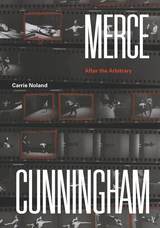
Examining a rich and previously unseen archive that includes photographs, film footage, and unpublished writing by Cunningham, Noland counters prior understandings of Cunningham’s influential embrace of the unintended, demonstrating that Cunningham in fact set limits on the role chance played in his dances. Drawing on Cunningham’s written and performed work, Noland reveals that Cunningham introduced variables before the chance procedure was applied and later shaped and modified the chance results. Chapters explore his relation not only to Cage, but also Marcel Duchamp, Robert Rauschenberg, James Joyce, and Bill T. Jones. Ultimately, Noland shows that Cunningham approached movement as more than “movement in itself,” and that his work enacted archetypal human dramas. This remarkable book will forever change our appreciation of the choreographer’s work and legacy.

A powerful novel of war, history, and the deadly draw of violence, The Mercenary is an unforgettable look into the mind of a man who cannot escape the killing that has become his occupation.
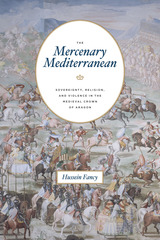
They were not the first or only Muslim soldiers to do so. Over the course of the thirteenth and fourteenth centuries, the Christian kings of Aragon recruited thousands of foreign Muslim soldiers to serve in their armies and as members of their royal courts. Based on extensive research in Arabic, Latin, and Romance sources, The Mercenary Mediterranean explores this little-known and misunderstood history. Far from marking the triumph of toleration, Hussein Fancy argues, the alliance of Christian kings and Muslim soldiers depended on and reproduced ideas of religious difference. Their shared history represents a unique opportunity to reconsider the relation of medieval religion to politics, and to demonstrate how modern assumptions about this relationship have impeded our understanding of both past and present.
The rise of merchant capital in Mecca conditioned the development of Meccan social, economic, religious, and political structure. Mahmood Ibrahim traces the roots of capitalism from the emergence of merchants as the main force in Mecca through the first civil war in Islam (656–661). Through a rereading of original Arabic sources and drawing from modern scholarship on the subject, Ibrahim offers a new interpretation of the rise of Islam.
He argues that Islam contributed certain institutional beliefs and practices that unblocked obstacles and helped merchants gain political and economic hegemony over western Asia. Ibrahim contends that, with the conquest of Mecca, the newly formed Muslim state spread its control to the rest of Arabia, which mobilized a significant social force and allowed for further expansion outside Arabia, thus extending merchant control to include new surplus-producing regions, a vast network of trade routes, and wider markets.
This extensively researched study offers a new interpretation of the history of Islam, including the formation of Islamic society and the unfolding of the first civil war. In offering a better understanding of the Umayyad Caliphate that ruled Islam for a century to come, Ibrahim helps lay the groundwork for understanding the Middle East as it is today.
Of interest to scholars of Middle Eastern studies, this important work will be necessary reading for students of Near Eastern and North African history, as well as students of the history of Medieval Europe.

As Cuba industrialized in the nineteenth century, an epochal realignment of the social order occurred. In this period of change, two seemingly disparate, yet nevertheless intertwined, ideological forces appeared: anti-Semitism and abolitionism. As the antislavery movement became organized in Cuba, the argument grew that Jews participated in the African slave trade and in New World slavery, and that this participation gave Jews extraordinary influence in the new Cuban economy and culture. What was remarkable about this anti-Semitism was the decidedly small Jewish population on the island in this era. This form of anti-Semitism, Silverstein reveals, sprang almost exclusively from mythological beliefs.

Elise Thoron’s translation of Shakespeare’s searing The Merchant of Venice cuts straight to the heart of today’s fraught issues of social justice and systemic racism. Thoron’s clear, compelling contemporary verse translation retains the power of the original iambic pentameter while allowing readers and audiences to fully comprehend and directly experience the brutal dilemmas of Shakespeare’s Venice, where prejudice and privilege reign unchallenged. As the author of three acclaimed music-theater works on the Jewish experience and informed by her work directing cross-cultural projects in locations as different as Russia, Japan, Cuba, and New York City, Thoron brings to her Merchant an immediacy that speaks directly to the present reckoning with race in America.
This translation was written as part of the Oregon Shakespeare Festival’s Play On! project, which commissioned new translations of thirty-nine Shakespeare plays. These translations present the work of "The Bard" in language accessible to modern audiences while never losing the beauty of Shakespeare’s verse. These volumes make these works available for the first time in print—a new First Folio for a new era.
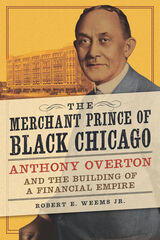
Robert E. Weems Jr. restores Overton to his rightful place in American business history. Dispelling stubborn myths, he traces Overton's rise from mentorship by Booker T. Washington, through early failures, to a fateful move to Chicago in 1911. There, Overton started a popular magazine aimed at African American women that helped him dramatically grow his cosmetics firm. Overton went on to become the first African American to head a major business conglomerate, only to lose significant parts of his businesses—and his public persona as ”the merchant prince of his race”—in the Depression, before rebounding once again in the early 1940s.
Revealing and panoramic, The Merchant Prince of Black Chicago weaves the fascinating life story of an African American trailblazer through the eventful history of his times.

Voss and Prudlo provide a rich resource for readers concerned with the proper aims and boundaries of a life in the world of commerce, the nature of work, the ethics of profit, the problem of money-lending, the virtues needed for moral capitalism, and the tension between otium and negotium. Voss and Prudlo have accumulated a veritable trove of primary text materials relating to the life of Omobono, and provide translations and commentary to complete their analysis. This fascinating account crosses the threshold of pure history and stimulates inquiry in the fields of philosophy, economics, and theology.

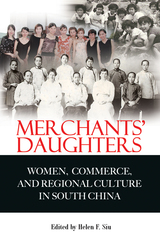
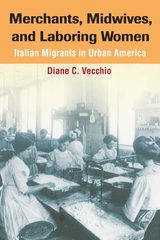

In Merchants of Medicines, Zachary Dorner follows the earliest industrial pharmaceuticals from their manufacture in the United Kingdom, across trade routes, and to the edges of empire, telling a story of what medicines were, what they did, and what they meant. He brings to life business, medical, and government records to evoke a vibrant early modern world of London laboratories, Caribbean estates, South Asian factories, New England timber camps, and ships at sea. In these settings, medicines were produced, distributed, and consumed in new ways to help confront challenges of distance, labor, and authority in colonial territories. Merchants of Medicines offers a new history of economic and medical development across early America, Britain, and South Asia, revealing the unsettlingly close ties among medicine, finance, warfare, and slavery that changed people’s expectations of their health and their bodies.


"This book is another in the excellent University of Arizona Space Science Series, each of which is based on a conference. . . .but goes far beyond a conference proceedings to present a comprehensive summary of current knowledge. . . .I recommend this book as a valuable compendium of current knowledge."—Pageoph
"This collection will be a most valuable addition to any research library."—Choice
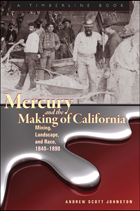
Gold and silver could not be refined without mercury; therefore, its production and use were vital to securing power and wealth in the West. The first industrialized mining in California, mercury mining had its own particular organization, structure, and built environments. These were formed within the Spanish Empire, subsequently transformed by British imperial ambitions, and eventually manipulated by American bankers and investors. In California, mercury mining also depended on a workforce differentiated by race and ethnicity. The landscapes of work and camp and the relations among the many groups involved in the industry—Mexicans, Chileans, Spanish, English, Irish, Cornish, American, and Chinese—form a crucial chapter in the complex history of race and ethnicity in the American West.
This pioneering study explicates the mutual structuring of the built environments of the mercury-mining industry and the emergence of California’s ethnic communities. Combining rich documentary sources with a close examination of the existing physical landscape, Johnston explores both the detail of everyday work and life in the mines and the larger economic and social structures in which mercury mining was enmeshed, revealing the significance of mercury mining for Western history.
As a bright student-athlete on his way to West Point, Eric Wilson seemed to be well on the way to a fulfilling life. Yet he was haunted by overwhelming feelings of his deep insignificance. As he grew older, the traditional means of fulfillment—marriage and professional success—did nothing to assuage the descents into darkness and destructive behavior. Therapy and medication have offered some relief, but the birth of his daughter ultimately forces his hand. In some ways, the answer has been in front of him the whole time, for English professor Wilson finds in the literature of Coleridge, Blake, and others the lessons that depression might teach. When he comes upon “negative theology”—the school of thought that finds God in the “dark night of the soul”—Wilson discovers the framework for a radical call to forgive depression.
Only by forgiving this capricious, impersonal force is Wilson able to find the grace to move beyond the cycles of destructive self-absorption.Wilson admits that he continues to struggle, but in facing his depression instead of trying to escape it, he finds wisdom and grace.
Beautifully and accessibly written, The Mercy of Eternity is a brief yet profound meditation on the largest question of life.


These eighteen essays span more than thirty years of Lavina Fielding Anderson’s concerns about and reflections on issues of inclusiveness in the Church of Jesus Christ of Latter-day Saints, including her own excommunication for “apostasy” in 1993, followed by twenty-five years of continued attendance at weekly LDS ward meetings. Written with a taste for irony and an eye for documentation, the essays are timeless snapshots of sometimes controversial issues, beginning with official resistance to professionally researched Mormon history in the 1980s. They underscore unanswered questions about gender equality and repeatedly call attention to areas in which the church does not live up to its better self. Compassionately and responsibly, it calls Anderson’s beloved religion back to its holiest nature.
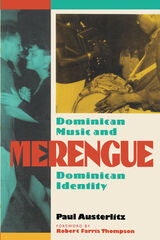
Merengue—the quintessential Dominican dance music—has a long and complex history, both on the island and in the large immigrant community in New York City. In this ambitious work, Paul Austerlitz unravels the African and Iberian roots of merengue and traces its growth under dictator Rafael Trujillo and its renewed popularity as an international music.
Using extensive interviews as well as written commentaries, Austerlitz examines the historical and contemporary contexts in which merengue is performed and danced, its symbolic significance, its social functions, and its musical and choreographic structures. He tells the tale of merengue's political functions, and of its class and racial significance. He not only explores the various ethnic origins of this Ibero-African art form, but points out how some Dominicans have tried to deny its African roots.
In today's global society, mass culture often marks ethnic identity. Found throughout Dominican society, both at home and abroad, merengue is the prime marker of Dominican identity. By telling the story of this dance music, the author captures the meaning of mass and folk expression in contemporary ethnicity as well as the relationship between regional, national, and migrant culture and between rural/regional and urban/mass culture. Austerlitz also traces the impact of migration and global culture on the native music, itself already a vibrant intermixture of home-grown merengue forms.
From rural folk idiom to transnational mass music, merengue has had a long and colorful career. Its well-deserved popularity will make this book a must read for anyone interested in contemporary music; its complex history will make the book equally indispensable to anyone interested in cultural studies.

With deepening financial problems, Allegheny Heath, Education and Research Foundation filed for bankruptcy in 1998—in the midst of its landmark merger of The Medical College of Pennsylvania and Hahnemann University. What resulted was another dire event in an escalating disaster. As civil and criminal investigations probed Allegheny's collapse, the survival of the medical school and other health sciences university schools, and the operation of the hospitals hung in the balance. Fortunately, a savior arrived in the form of Drexel University who used this opportunity to create its own medical school.
Merger Games is Judith Swazey's gripping account of this historic transaction. Based on extraordinarily detailed first-hand research and continuous inside access to the developments, this book clearly delineates who the players were and what this merger means for the future of medical education and institutional healthcare.
Merger Games is a definitive history of one of the most important academic medicine mergers in Philadelphia and the country, which happened at a time when medical care was becoming commodified in almost every state.
Sifting through a wealth of carefully gathered evidence, these papers capture the richness, the complexity, and the economic intangibles inherent in contemporary merger activity in a way that large-scale studies of mergers cannot.

If a teaching hospital loses funding, what is the next option?
Mergers of Teaching Hospitals in Boston, New York, and Northern California investigates the recent mergers of six of the nation's most respected teaching hospitals. The author explains the reasons why these institutions decided to change their governance and the factors that have allowed two of them to continue to operate while forcing the third to dissolve after only 23 months of operation.
The case studies contained within this book rely on an impressive amount of research. Notably, instead of citing only published articles and books, the author includes information from numerous, extensive personal interviews with key participants in the various mergers. With this research the author not only presents to the reader a picture of why these mergers came about, but also investigates how the organizations have fared since joining together. The mergers are analyzed and compared in order to identify various methods of merger formation as well as ways in which other newly formed hospitals might accomplish a variety of important goals.
Offering a spectacular account of some of the mergers that occurred in the health care field at the close of the twentieth century, these stories provide insight into academia's relationship with teaching hospitals and the challenges involved in bringing prestigious and powerful medical institutions together. The institutions discussed are Partners, the corporation which includes the Massachusetts General Hospital and the Brigham and Women's Hospital, New York-Presbyterian Hospital, the union of the New York and Presbyterian hospitals in New York City, and the UCSF Stanford, the merged teaching hospitals of the University of California, San Francisco and Stanford. This book will particularly appeal to professionals and academics interested in medicine, business, and organizational studies.

The quartet follows Louie, a Yale graduate from a modest background with a gift for forging connections in high and low places. Beginning in the 1960s, as he documents a going-away party for a fellow Yalie on his way to Vietnam, and continuing through his spiritual encounters with a 1970s group of city misfits, his turn to television writing in the 1980s, and a tragic love story between two of his close friends in the 1990s, Louie chronicles not only his own personal struggles—his silent love for his best friend’s girl, his delicate relationship with an at-times absent father—but also the attitudes, events, and people that marked his generation. From the Vietnam War to George W. Bush, from television trends to the divide between the haves and have-nots, The Meritocracy Quartet is a moving witness to everything America had to offer in the latter portion of the twentieth century.
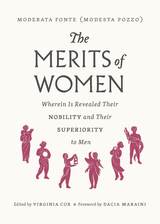
Without help from their wives, men are just like unlit lamps . . .
Just think of them as an unreliable clock that tells you it’s ten o’clock when it’s in fact barely two . . .
A man without a woman is like a fly without a head . . .
These are but a small selection of the quips bandied about at this lively gathering of women. The broad topic at hand is the relative pros and cons of men, and the cases in point range from pick-up artists to locker-room talk, and from double standards to fragile masculinity.
Yet this dialogue unfolds not among ironically misandrist millenials venting at their local dive bar, but rather among sixteenth-century women—variously married, widowed, single, and betrothed—attending a respectable Venice garden party. Written in the early 1590s by Moderata Fonte, pseudonym of the Renaissance poet and writer Modesta Pozzo, this literary dialogue interrogates men and men’s treatment of women, and explores by contrast the virtues of singledom and female friendship. As the women diverge from their theme—discussing everything from astrology to the curative powers of plants and minerals—a remarkable group portrait of wisdom, wit, and erudition emerges.
A new introduction by translator Virginia Cox and foreword by Dacia Maraini situate The Merits of Women in its historical context, written as it was on the cusp of Shakespeare’s heyday, and straddling the centuries between the feminist works of Christine de Pizan and Mary Wollstonecraft. Elegantly presented for a general audience, this is a must-read for baby feminists and “nasty women” alike, not to mention the perfect subtle gift for any mansplaining friend who needs a refresher on the merits of women . . . and their superiority to men.
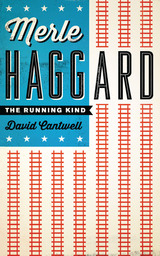
Merle Haggard has enjoyed artistic and professional triumphs few can match. He’s charted more than a hundred country hits, including thirty-eight number ones. He’s released dozens of studio albums and another half dozen or more live ones, performed upwards of ten thousand concerts, been inducted into the Country Music Hall of Fame, and seen his songs performed by artists as diverse as Lynryd Skynyrd, Elvis Costello, Tammy Wynette, Willie Nelson, the Grateful Dead, and Bob Dylan. In 2011 he was feted as a Kennedy Center Honoree. But until now, no one has taken an in-depth look at his career and body of work.
In Merle Haggard: The Running Kind, David Cantwell takes us on a revelatory journey through Haggard’s music and the life and times out of which it came. Covering the entire breadth of his career, Cantwell focuses especially on the 1960s and 1970s, when Haggard created some of his best-known and most influential music, which helped invent the America we live in today. Listening closely to a masterpiece-crowded catalogue (including songs such as “Okie from Muskogee,” “Sing Me Back Home,” “Mama Tried,” “Working Man Blues,” “Kern River,” “White Line Fever,” “Today I Started Loving You Again,” and “If We Make It through December,” among many more), Cantwell explores the fascinating contradictions—most of all, the desire for freedom in the face of limits set by the world or self-imposed—that define not only Haggard’s music and public persona but the very heart of American culture.
While there have been many essays devoted to comparing the work of Maurice Merleau-Ponty with that of Jacques Derrida, there has been no sustained book-length treatment of these two French philosophers. Additionally, many of the essays presuppose an oppositional relationship between them, and between phenomenology and deconstruction more generally.
Jack Reynolds systematically explores their relationship by analyzing each philosopher in terms of two important and related issues—embodiment and alterity. Focusing on areas with which they are not commonly associated (e.g., Derrida on the body and Merleau-Ponty on alterity) makes clear that their work cannot be adequately characterized in a strictly oppositional way. Merleau-Ponty and Derrida: Intertwining Embodiment and Alterity proposes the possibility of a Merleau-Ponty-inspired philosophy that does not so avowedly seek to extricate itself from phenomenology, but that also cannot easily be dismissed as simply another instantiation of the metaphysics of presence. Reynolds argues that there are salient ethico-political reasons for choosing an alternative that accords greater attention to our embodied situation.
As the first full-length monograph comparing the philosophers, Merleau-Ponty and Derrida will interest scholars and students in European philosophy and teachers of courses dealing with deconstruction.
Arranged chronologically, the essays are grouped in three sections corresponding to the major periods of Merleau-Ponty’s work: First, the years prior to his appointment to the Sorbonne in 1949, the early, existentialist period during which he wrote important works on the phenomenology of perception and the primacy of perception; second, the years of his work as professor of child psychology and pedagogy at the Sorbonne, a period especially concerned with language; and finally, his years as chair of modern philosophy at the Collège de France, a time devoted to the articulation of a new ontology and philosophy of nature. The editors, who provide an interpretive introduction, also include previously unpublished working notes found in Merleau-Ponty’s papers after his death. Translations of all selections have been updated and several appear here in English for the first time.
By contextualizing Merleau-Ponty’s writings on the philosophy of art and politics within the overall development of his thought, this volume allows readers to see both the breadth of his contribution to twentieth-century philosophy and the convergence of the various strands of his reflection.
Phenomenology has played a decisive role in the emergence of the discourse of place, now indispensable to many disciplines in the humanities and social sciences, and the contribution of Merleau-Ponty’s thought to architectural theory and practice is well established. Merleau-Ponty: Space, Place, Architecture is a vibrant collection of original essays by twelve eminent philosophers who mine Merleau-Ponty’s work to consider how we live and create as profoundly spatial beings. The resulting collection is essential to philosophers and creative artists as well as those concerned with the pressing ethical issues of our time.
Each contributor presents a different facet of space, place, or architecture. These essays carve paths from Merleau-Ponty to other thinkers such as Irigaray, Deleuze, Ettinger, and Piaget. As the first collection devoted specifically to developing Merleau-Ponty’s contribution to our understanding of place and architecture, this book will speak to philosophers interested in the problem of space, architectural theorists, and a wide range of others in the arts and design community.
Contributors: Nancy Barta-Smith, Edward S. Casey, Helen Fielding, Lisa Guenther, Galen A. Johnson, Randall Johnson, D. R. Koukal, Suzanne Cataldi Laba, Patricia M. Locke, Glen Mazis, Rachel McCann, David Morris, and Dorothea Olkowski.
Merleau-Ponty's Developmental Ontology shows how the philosophy of Maurice Merleau-Ponty, from its very beginnings, seeks to find sense or meaning within nature, and how this quest calls for and develops into a radically new ontology.
David Morris first gives an illuminating analysis of sense, showing how it requires understanding nature as engendering new norms. He then presents innovative studies of Merleau-Ponty's The Structure of Behavior and Phenomenology of Perception, revealing how these early works are oriented by the problem of sense and already lead to difficulties about nature, temporality, and ontology that preoccupy Merleau-Ponty's later work. Morris shows how resolving these difficulties requires seeking sense through its appearance in nature, prior to experience—ultimately leading to radically new concepts of nature, time, and philosophy.
Merleau-Ponty's Developmental Ontology makes key issues in Merleau-Ponty's philosophy clear and accessible to a broad audience while also advancing original philosophical conclusions.
In our time, Ted Toadvine observes, the philosophical question of nature is almost entirely forgotten—obscured in part by a myopic focus on solving "environmental problems" without asking how these problems are framed. But an "environmental crisis," existing as it does in the human world of value and significance, is at heart a philosophical crisis. In this book, Toadvine demonstrates how Maurice Merleau-Ponty’s phenomenology has a special power to address such a crisis—a philosophical power far better suited to the questions than other modern approaches, with their over-reliance on assumptions drawn from the natural sciences.
The book examines key moments in the development of Merleau-Ponty’s philosophy of nature while roughly following the historical sequence of his major works. Toadvine begins by setting out an ontology of nature proposed in Merleau-Ponty’s first book, The Structure of Behavior. He takes up the theme of the expressive role of reflection in Phenomenology of Perception, as it negotiates the area between nature’s own "self-unfolding" and human subjectivity. Merleau-Ponty’s notion of "intertwining" and his account of space provide a transition to Toadvine’s study of the philosopher’s later work—in which the concept of "chiasm," the crossing or intertwining of sense and the sensible, forms the key to Merleau-Ponty’s mature ontology—and ultimately to the relationship between humans and nature.
The second half of the book combines explorations of various corners and horizons of the poetry scene, including neglected American poets and Hadas's thoughts on her own poetics and career. "Two Letters from New York" and "Tangled Web Sites" take bemused looks at literary or cultural landscapes. Hadas also looks inward: to dreams and dreamwork, to her dead mother's address book, to the emblematic drilling of a well in a country house. The range of selections includes essays, interviews, memoir, criticism, and a few of Hadas's own poems.
Rachel Hadas is the author of eleven books of poetry, essays, and translations. Her most recent book is Halfway Down the Hall: New and Selected Poems. She has received a Guggenheim Fellowship in Poetry and an American Academy-Institute of Arts and Letters Award in Literature, and is a member of the American Academy of Arts and Sciences. She is Professor of English at the Newark campus of Rutgers University.

In her translation of The Merry Wives of Windsor, Dipika Guha updates the language of Shakespeare’s comedy through the lens of our current moment. Guha maintains the humor at the heart of the play while making it accessible for both performers and audiences.
This translation was written as part of the Oregon Shakespeare Festival’s Play On! project, which commissioned new translations of thirty-nine Shakespeare plays. These translations present the work of "The Bard" in language accessible to modern audiences while never losing the beauty of Shakespeare’s verse. These volumes make these works available for the first time in print—a new First Folio for a new era.

Drawing on the remarkable wealth of documentation in the college’s archives, this is the first history of the library to explore collections, buildings, readers, and staff across more than seven hundred years. The story is told in part through stunning color images that depict not only exceptional treasures but also the library furnishings and decorations, and which show manuscripts, books, bindings, and artifacts of different periods in their changing contexts. Featuring a historical timeline and a floor plan of the college, this book will be of interest to historians, alumni, and tourists alike.
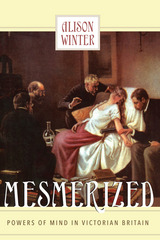
"Dazzling. . . . This splendid book . . . gives us a new form of historical understanding and a model for open and imaginative reading."—James R. Kinkaid, Boston Globe
"A landmark in the history of science scholarship."—John Sutherland, The Independent
"It is difficult to imagine the documentary side of the story being better done than by Winter's well-researched and generously illustrated study. . . . She is a lively and keen observer; and her book is a pleasure to read purely for its range of material and wealth of detail. . . . Fruitful and suggestive."—Daniel Karlin, Times Literary Supplement
"An ambitious, sweeping and fascinating historical study. . . . Beautifully written, thoroughly researched, and well-illustrated."—Bernard Lightman, Washington Times
Contributors. Sabina Cruz de la Cruz, Rebecca Dufendach, Servando Hinojosa, Timothy W. Knowlton, Gabrielle Vail, Edber Dzidz Yam
Healing practices in Mesoamerica span a wide range, from traditional folk medicine with roots reaching back into the prehispanic era to westernized biomedicine. These sometimes cooperating, sometimes competing practices have attracted attention from researchers and the public alike, as interest in alternative medicine and holistic healing continues to grow.
Responding to this interest, the essays in this book offer a comprehensive, state-of-the-art survey of Mesoamerican healers and medical practices in Mexico and Guatemala. The first two essays describe the work of prehispanic and colonial healers and show how their roles changed over time. The remaining essays look at contemporary healers, including bonesetters, curers, midwives, nurses, physicians, social workers, and spiritualists. Using a variety of theoretical approaches, the authors examine such topics as the intersection of gender and curing, the recruitment of healers and their training, healers' compensation and workload, types of illnesses treated and recommended treatments, conceptual models used in diagnosis and treatment, and the relationships among healers and between indigenous healers and medical and political authorities.
Any overview of prehispanic society in the Americas would identify its obsidian core-blade production as a unique and highly inventive technology. Normally termed prismatic blades, these long, parallel-sided flakes are among the sharpest cutting tools ever produced by humans. Their standardized form permitted interchangeable use, and such blades became the cutting tool of choice throughout Mesoamerica between 600–800 B.C. Because considerable production skill is required, increased demand may have stimulated the appearance of craft specialists who played an integral role in Mesoamerican society. Some investigators have argued that control over obsidian also had a significant effect on the development and organization of chiefdom and state-level societies.
While researchers have long recognized the potential of obsidian studies, recent work has focused primarily on compositional analysis to reconstruct trade and distribution networks. Study of blade production has received much less attention, and many aspects of this highly evolved craft are still lost.
This volume seeks to identify current research questions in Mesoamerican lithic technology and to demonstrate that replication studies coupled with experimental research design are valuable analytical approaches to such questions.
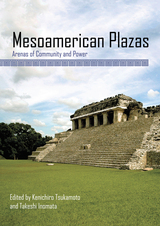
The primary question that has motivated the contributors is how Mesoamerican plazas became arenas for the creation and negotiation of social relations and values in a community. The thirteen contributions stress the significance of interplay between power relations and embodied practices set in specific historical and material settings, as outlined by practice theory and performance theory. This approach allows the contributors to explore broader anthropological issues, such as the negotiation of power relations, community making, and the constitution of political authorities.
Overall, the contributions establish that physical interactions among people in communal events were not the outcomes of political machinations held behind the scenes, but were the actual political processes through which people created, negotiated, and subverted social realities. If so, spacious plazas that were arguably designed for interactions among a large number of individuals must have also provided critical arenas for the constitution and transformation of society.
Exploring the intersection of spirituality and materiality, Mesoamerican Ritual Economy will be of interest to all scholars studying how worldview and belief motivate economic behavior. The authors consider a diverse set of Mesoamerican cultural patterns in order to investigate the ways in which ritual and economic practices influenced each other in the operation of communities, small-scale societies, and state-level polities. Contributors include: Sarah B. Barber, Frances F. Berdan, Karla L. Davis-Salazar, Barbara W. Fash, William L. Fash, Antonia E. Foias, Arthur A. Joyce, Brigitte Kovacevich, Ben A. Nelson, Enrique Rodríguez-Alegría, Katherine A. Spielmann, John M. Watanabe, E. Christian Wells.
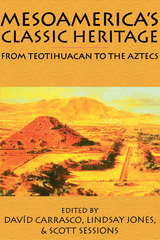
The contributors to Mesoamerica's Classic Heritage offer a wide range of individual interpretations, but they agree that Teotihuacan, more than any other pre-Hispanic center, was a paradigmatic source that formed the art and architecture, cosmology and ritual life, and conceptions of urbanism and political authority for significant parts of the Mesoamerican world. This great city achieved the prestige of being the site of the creation of the cosmos and of effective social and political space in Mesoamerica through its capacity to symbolize, perform, and export its imperial authority. These essays reveal the different ways in which Teotihuacan's classic heritage both fed and fed on the dynamic interactivity of the entire area. Whether or not a paradigm shift in Mesoamerican studies is taking place, certainly a new contextual understanding of Teotihuacan and the diversities and unities of Mesoamerica is emerging in these pages.
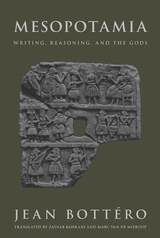
To give the reader some sense of how Mesopotamian civilization has been mediated and interpreted in its transmission through time, Bottero begins with an account of Assyriology, the discipline devoted to the ancient culture. This transmission, compounded with countless discoveries, would not have been possible without the surprising decipherment of the cuneiform writing system. Bottero also focuses on divination in the ancient world, contending that certain modes of worship in Mesopotamia, in their application of causality and proof, prefigure the "scientific mind."

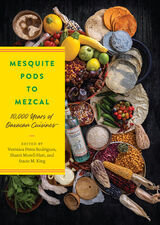
New case studies documenting ten thousand years of cuisines across the cultures of Oaxaca, Mexico, from the earliest gathered plants, such as guajes, to the contemporary production of tejate and its health implications.
Among the richest culinary traditions in Mexico are those of the “eight regions” of the state of Oaxaca. Mesquite Pods to Mezcal brings together some of the most prominent scholars in Oaxacan archaeology and related fields to explore the evolution of the area’s world-renowned cuisines. This volume, the first to address food practices across Oaxaca through a long-term historical lens, covers the full spectrum of human occupation in Oaxaca, from the early Holocene to contemporary times. Contributors consider the deep history of agroecological management and large-scale landscape transformation, framing food production as a human-environment relation. They explore how, after the arrival of the Spanish, Oaxacan cuisines adapted, diets changed, and food became a stronger marker of identity. Examining the present, further studies document how traditional foodways persist and what they mean for contemporary Oaxacans, whether they are traveling ancient roads, working outside the region, or rebuilding after an earthquake. Together, the original case studies in this volume demonstrate how new methods and diverse theoretical approaches can come together to trace the development of a rich food tradition, one that is thriving today.
This edition of Messa da Requiem is based on Verdi’s autograph score and other original sources. The appendices include two pieces from the compositional history of the Requiem: an early version of the Libera me, composed in 1869 as part of a collaborative work planned as a memorial to Rossini; and the Liber scriptus, which in the original score of the Manzoni memorial Requiem was composed as a fugue for chorus. The introduction to the score traces the complex compositional and performance histories of the Requiem and discusses the work’s problems of instrumentation and notation, while the critical commentary gives a full description of the sources and an account of all editorial decisions.


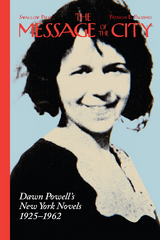
Dawn Powell was a gifted satirist who moved in the same circles as Dorothy Parker, Ernest Hemingway, renowned editor Maxwell Perkins, and other midcentury New York luminaries. Her many novels are typically divided into two groups: those dealing with her native Ohio and those set in New York. “From the moment she left behind her harsh upbringing in Mount Gilead, Ohio, and arrived in Manhattan, in 1918, she dove into city life with an outlander’s anthropological zeal,” reads a recent New Yorker piece about Powell, and it is those New York novels that built her reputation for scouring wit and social observation.
In this critical biography and study of the New York novels, Patricia Palermo reminds us how Powell earned a place in the national literary establishment and East Coast social scene. Though Powell’s prolific output has been out of print for most of the past few decades, a revival is under way: the Library of America, touting her as a “rediscovered American comic genius,” released her collected novels, and in 2015 she was posthumously inducted into the New York State Writer’s Hall of Fame.
Engaging and erudite, The Message of the City fills a major gap in in the story of a long-overlooked literary great. Palermo places Powell in cultural and historical context and, drawing on her diaries, reveals the real-life inspirations for some of her most delicious satire.
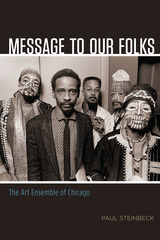
In Message to Our Folks, Paul Steinbeck combines musical analysis and historical inquiry to give us the definitive study of the Art Ensemble. In the book, he proposes a new theory of group improvisation that explains how the band members were able to improvise together in so many different styles while also drawing on an extensive repertoire of notated compositions. Steinbeck examines the multimedia dimensions of the Art Ensemble’s performances and the ways in which their distinctive model of social relations kept the group performing together for four decades. Message to Our Folks is a striking and valuable contribution to our understanding of one of the world’s premier musical groups.

The Parent-Child Home Program, a pre-preschool home visiting program, has grown greatly since the first edition of Messages from Home was published in 1988. This expanded and updated edition shows the continued success of this program-spearheaded by the late Phyllis Levenstein-which prepares at-risk children for school success, overcoming educational disadvantage.
Since The Parent-Child Home Program was founded in the 1960s, it has enriched the cognitive, social, and emotional school readiness of tens of thousands of children. The Program's methods, its theoretical underpinnings, and its impressive results are presented in detail. The success stories of both parents and children make inspiring reading. The combination of lively writing and data-driven scientific rigor give it both broad appeal and academic relevance.
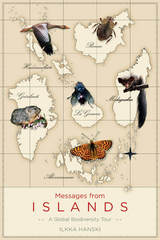
Beginning each chapter on a particular island, Hanski dives into reflections on his own field studies before going on to pursue a variety of ecological questions, including: What is the biodiversity crisis? What are extinction thresholds and extinction debts? What can the biodiversity hypothesis tell us about rapidly increasing allergies, asthma, and other chronic inflammatory disorders? The world’s largest island, Greenland, for instance, is the starting point for a journey into the benefits that humankind acquires from biodiversity, including the staggering biodiversity of microbes in the ecosystems that are closest to us—the ecosystems in our guts, in our respiratory tracts, and under our skin. Conceptually oriented but grounded in an adventurous personal narrative, Messages from Islands is a landmark work that lifts the natural mysteries of islands from the sea, bringing to light the thrilling complexities and connections of ecosystems worldwide.

Seeking a closer connection with nature than the manicured lawns of suburbia, naturalist Fred Gehlbach and his family built a house on the edge of a wooded ravine in Central Texas in the mid-1960s. On daily walks over the hills, creek hollows, and fields of the ravine, Gehlbach has observed the cycles of weather and seasons, the annual migrations of birds, and the life cycles of animals and plants that also live in the ravine.
In this book, Gehlbach draws on thirty-five years of journal entries to present a composite, day-by-day almanac of the life cycles of this semiwild natural island in the midst of urban Texas. Recording such events as the hatching of Eastern screech owl chicks, the emergence of June bugs, and the first freeze of November, he reminds us of nature's daily, monthly, and annual cycles, from which humans are becoming ever more detached in our unnatural urban environments. The long span of the almanac also allows Gehlbach to track how local and even global developments have affected the ravine, from scars left by sewer construction to an increase in frost-free days probably linked to global warming.
This long-term record of natural cycles provides one of only two such baseline data sets for North America. At the same time, the book is an eloquent account of one keen observer's daily interactions with his wild and human neighbors and of the lessons in connectedness and the "play of life" that they teach.
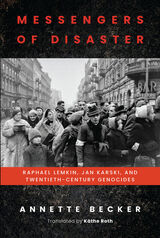
Messengers of Disaster draws upon little-known texts from an array of archives, including the International Committee of the Red Cross in Geneva and the International Tracing Service in Bad Arolsen. Carrying the knowledge of disaster took a toll on Lemkin and Karski, but their work prepared the way for the United Nations to unanimously adopt the first human rights convention in 1948 and influenced the language we use to talk about genocide today. Annette Becker's detailed study of these two important figures illuminates how distortions of fact can lead people to deny knowledge of what is happening in front of their own eyes.

Messiah of the New Technique: John Howard Lawson, Communism, and American Theatre, 1923–1937 is a critical and political biography and a cultural and social history that focuses on Lawson’s career in the theatre. Using a materialist methodology, Jonathan L. Chambers emphasizes the evolution and interplay of the playwright’s artistic vision and political ideology, considering his art as both a documentation of this evolution and a product of the socio-political and cultural matrix in which he was immersed.
Spanning the playwright’s career, the volume details Lawson’s early indoctrination in and commitment to the avant-garde, his use and development of various nonrealistic playwriting techniques, his subtle though unfocused attacks on bourgeois society, and the varied critical responses he received. Chambers addresses Lawson’s involvement with the New Playwrights’ Theatre and his participation in the protests surrounding the case of Nicola Sacco and Bartolomeo Vanzetti, which stimulated his growing commitment to left-wing politics and radical causes.
Chambers also analyzes the social and cultural factors that shaped Lawson’s growing interest in revolutionary politics, his tutelage in Marxism under Edmund Wilson, and his tenure as president of the Screen Writers Guild. He also covers the final phase of Lawson’s playwriting career, which reveals the playwright’s internal struggle. That struggle, suggests Chambers, pitted Lawson’s view of aesthetics against his political ideology and is reflected in his scripts and theoretical writings.
Messiah of the New Technique provides a wealth of new material about both the playwright and the period, offering a critical synopsis of the artist’s career, addressing his often vehement rebuttals to his critics, and summarizing both his political activism and his creative and critical endeavors in the last forty years of his life.
2021 BIG OTHER BOOK AWARD FICTION FINALIST
A fiercely ecstatic tale of betrayal and self-sacrifice
Messiahs centers on two nameless lovers, a woman of east Asian descent and a former state prisoner, a black man who volunteered incarceration on behalf of his falsely convicted nephew, yet was “exonerated” after more than two years on death row. In this dystopian America, one can assume a relative’s capital sentence as an act of holy reform—“the proxy initiative,” patterned after the Passion.
The lovers begin their affair by exchanging letters, and after his release, they withdraw to a remote cabin during a torrential winter, haunted by their respective past tragedies. Savagely ostracized by her family for years, the woman is asked by her mother to take the proxy initiative for her brother—creating a conflict she cannot bear to share with her lover. Comprised of ten poetic paragraphs, Messiahs’ rigorous style and sustained intensity equals agony and ecstasy.
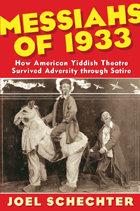
Joel Schechter has rediscovered the funny and often politically-charged plays of the American Yiddish theatre of the 1930s. In Messiahs of 1933 he celebrates their satire, their radical imagination, and their commitment to social change. He introduces readers to the once-famous writers and actors—Moishe Nadir, David Pinski, Yosl Cutler, and others—who brought into artistic form their visions of peace, social justice, and satire for all.
Messiahs of 1933 greatly enlarges our understanding of Yiddish theatre and culture in the United States. It examines the innovative stage performances created by the Artef collective, the Modicut puppeteers, and the Yiddish Unit of the Federal Theatre Project. And it introduces to contemporary readers some of the most popular theatre actors of the 30s, including Leo Fuchs, Menasha Skulnik, and Yetta Zwerling. Throughout, it includes relevant photographs and contemporary comic strips, along with the first English-language publication of excerpts from the featured plays.
Winner of the 2025 American Academy of Religion Award for Excellence in the Study of Religion: Analytical-Descriptive Studies
Winner of the 2023 Association for Jewish Studies Jordan Schnitzer First Book Prize
Judaism in the twenty-first century has seen the rise of the messianic Third Temple movement, as religious activists based in Israel have worked to realize biblical prophecies, including the restoration of a Jewish theocracy and the construction of the third and final Temple on Jerusalem’s Temple Mount. Through groundbreaking ethnographic research, Messianic Zionism in the Digital Age details how Third Temple visions have gained considerable momentum and political support in Israel and abroad .
The role of technology in this movement’s globalization has been critical. Feldman skillfully highlights the ways in which the internet and social media have contributed to the movement's growth beyond the streets of Jerusalem into communities of former Christians around the world who now identify as the Children of Noah (Bnei Noah). She charts a path for future research while documenting the intimate effects of political theologies in motion and the birth of a new transnational Judaic faith.
Ravitzky traces the roots of Haredi ideology, which opposes the Zionist enterprise, and shows how Haredim living in Israel have come to terms with a state to them unholy and therefore doomed. Ravitzky also examines radical religious movements, including the Gush Emunim, to whom the State of Israel is a divine agent. He concludes with a discussion of the recent transformation of Habad Hassidism from conservatism to radical messianism.
This book is indispensable to anyone concerned with the complex confrontation between Jewish fundamentalism and Israeli political sovereignty, especially in light of the tragic death of Israeli Prime Minister Yitzhak Rabin.
When exploring the links between America and postcolonialism, scholars tend to think either in terms of contemporary multiculturalism, or of imperialism since 1898. This narrow view has left more than the two prior centuries of colonizing literary and political culture unexamined.
Messy Beginnings challenges the idea of early America’s immunity from issues of imperialism, that its history is not as “clean” as European colonialism. By addressing the literature ranging from the diaries of American women missionaries in the Middle East to the work of Benjamin Franklin and Nathaniel Hawthorne, and through appraisals of key postcolonial theorists such as Edward Said, Gayatri Spivak, and Homi Bhabha, the contributors to this volume explore the applicability of their models to early American culture.
Messy Beginnings argues against the simple concept that the colonization of what became the United States was a confrontation between European culture and the “other.” Contributors examine the formation of America through the messy or unstable negotiations of the idea of “nation.”
The essays forcefully show that the development of “Americanness” was a raced and classed phenomenon, achieved through a complex series of violent encounters, legal maneuvers, and political compromises. The complexity of early American colonization, where there was not one coherent “nation” to conquer, contradicts the simple label of imperialism used in other lands. The unique approach of Messy Beginnings will reshape both pre-conceived notions of postcolonialism, and how postcolonialists think about the development of the American nation.
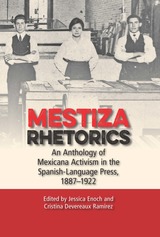
Mestiza Rhetorics is the first anthology dedicated to mexicana rhetors and provides unmatched access to mexicana rhetorics. This collection puts forward the work of mexicana newspaperwomen in Spanish and English, provides evidence of their participation in political and educational debates at the turn of the twentieth century, and demonstrates how the Spanish-language press operated as a rhetorical space for mexicanas.
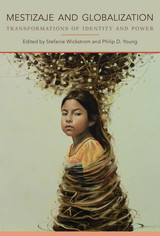
Mestizaje and Globalization presents perspectives on the underlying transformation of identity and power associated with the term during times of great change in the Americas. The volume offers a comprehensive and empirically diverse collection of insights concerning mestizaje’s complex relationship with indigeneity, the politics of ethnic identity, transnational social movements, the aesthetic of cultural production, development policies, and capitalist globalization, with particular attention to cases in Latin America and the United States.
Beyond the narrow and often inadequate meaning of mestizaje as biological and racial mixing, the concept deserves an innovative theoretical consideration due to its multidimensional, multifaceted character and its resilience as an ideological construct. The contributors argue that historical analyses of mestizaje do not sufficiently understand contemporary ways that racism, ethnic discrimination, and social injustice intermingle with current discourse and practice of cultural recognition and multiculturalism in the Americas.
Mestizaje and Globalization contributes to an emerging multidisciplinary effort to explore how identities are imposed, negotiated, and reconstructed. The chapter authors clearly set forth the issues and obstacles that indigenous peoples and subjugated minorities face, as well as the strategies they have employed to gain empowerment in the face of globalization.
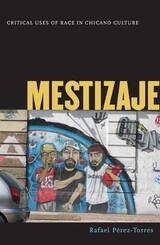
Informed by a broad-ranging theoretical investigation of identity politics and race and incorporating feminist and queer critiques, Pérez-Torres skillfully analyzes Chicano cultural production. Contextualizing the history of mestizaje, he shows how the concept of mixed race has been used to engage issues of hybridity and voice and examines the dynamics that make mestizo and mestiza identities resistant to, as well as affirmative of, dominant forms of power. He also addresses the role that mestizaje has played in expressive culture, including the hip-hop music of Cypress Hill and the vibrancy of Chicano poster art. Turning to issues of mestizaje in literary creation, Pérez-Torres offers critical readings of the works of Emma Pérez, Gil Cuadros, and Sandra Cisneros, among others. This book concludes with a consideration of the role that the mestizo body plays as a site of elusive or displaced knowledge.
Moving beyond the oppositions—nationalism versus assimilation, men versus women, Texans versus Californians—that have characterized much of Chicano studies, Mestizaje synthesizes and assesses twenty-five years of pathbreaking thinking to make a case for the core components, sensibilities, and concerns of the discipline.
Rafael Pérez-Torres is professor of English at the University of California, Los Angeles. He is author of Movements in Chicano Poetry: Against Myths, Against Margins, coauthor of To Alcatraz, Death Row, and Back: Memories of an East LA Outlaw, and coeditor of The Chicano Studies Reader: An Anthology of Aztlán, 1970–2000.
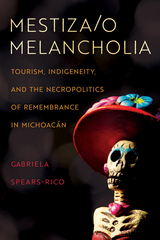
Through the concept of mestiza/o melancholia, scholar Gabriela Spears-Rico offers a new way to think about the relationship between mestizaje and indigeneity in Mexico. For Spears-Rico, the concept is a longing for the lost part of one’s identity, manifested in touristic visits and material appropriations of folklorized indigeneity, yet unconcerned with political reparations for Indigenous people.
Relying on a rich ethnography in mestiza/o and P’urhépecha pueblos in Michoacán, the book examines mestiza/o mourning and melancholia as it appears in Day of the Dead tourism and in Virgin of Guadalupe worship among Mexican mestizos. This book centers Indigenous resistance, articulating a P’urhépecha critique of regional necropolitics and obstinate appropriations, arguing for the need to decolonize mestizaje. A deep conversation with P’urhépecha dissent, this book elevates the need for solidarity with current Indigenous movements in a region fraught by extractive settler colonialism.
Mestiza/o Melancholia challenges readers to rethink identity, tourism, and belonging in Mexico.
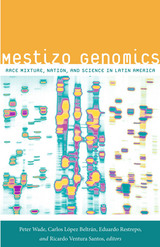
Drawing on ethnographic research in Brazil, Colombia, and Mexico, the contributors to Mestizo Genomics explore how the concepts of race, ethnicity, nation, and gender enter into and are affected by genomic research. In Latin America, national identities are often based on ideas about mestizaje (race mixture), rather than racial division. Since mestizaje is said to involve relations between European men and indigenous or African women, gender is a key factor in Latin American genomics and in the analyses in this book. Also important are links between contemporary genomics and recent moves toward official multiculturalism in Brazil, Colombia, and Mexico. One of the first studies of its kind, Mestizo Genomics sheds new light on the interrelations between "race," identity, and genomics in Latin America.
Contributors. Adriana Díaz del Castillo H., Roosbelinda Cárdenas, Vivette García Deister, Verlan Valle Gaspar Neto, Michael Kent, Carlos López Beltrán, María Fernanda Olarte Sierra, Eduardo Restrepo, Mariana Rios Sandoval, Ernesto Schwartz-Marín, Ricardo Ventura Santos, Peter Wade
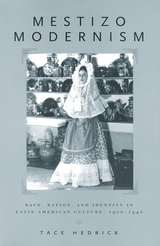
We use the term “modernism” almost exclusively to characterize the work of European and American writers and artists who struggled to portray a new kind of fractured urban life typified by mechanization and speed. Between the 1880s and 1930s, Latin American artists were similarly engaged--but with a difference. While other modernists drew from “primitive” cultures for an alternative sense of creativity, Latin American modernists were taking a cue from local sources, primarily indigenous and black populations in their own countries. Although these artists remained outsiders to modernism elsewhere as a result of their race, nation, and identity, their racial heritage served as a positive tool in negotiating their relationship to the dichotomy between tradition and modernity.
In Mestizo Modernism Tace Hedrick focuses on four key artists who represent Latin American modernism—Peruvian poet Cesar Vallejo, Chilean poet Gabriela Mistral, Mexican muralist Diego Rivera, and Mexican artist Frida Kahlo. Hedrick interrogates what being “modern” and “American” meant for them and illuminates the cultural contexts within which they worked, as well as the formal methods they shared, including the connection they drew between ancient cultures and modern technologies. In so doing, she defines “modernism” more as a time frame at the turn of the twentieth century, marked broadly across the arts and national boundaries, than as a strict aesthetic or formal category. In fact, this look at Latin American artists will force the reconceptualization of what modernism has meant in academic study and what it might mean for future research.
Through them, he delineates some of the ambiguities and contradictions that have beset this discourse. Among texts considered are the Indianist novel Iracema by the nineteenth-century Brazilian author José de Alencar; the Tradiciones peruanas, Peruvian Ricardo Palma's fictionalizations of national difference; and historical and sociological essays by the Peruvian Marxist José Carlos Mariátegui and the Brazilian intellectual Gilberto Freyre. And because questions raised by this discourse are equally relevant to postmodern concerns with national and transnational heterogeneity, De Castro also analyzes such recent examples as the Cuban dance band Los Van Van's use of Afrocentric lyrics; Richard Rodriguez's interpretations of North American reality; and points of contact and divergence between José María Arguedas's novel The Fox from Up Above and the Fox from Down Below and writings of Gloria Anzaldúa and Julia Kristeva.
By updating the concept of mestizaje as a critical tool for analyzing literary text and cultural trends—incorporating not only race, culture, and nationality but also gender, language, and politics—De Castro shows the implications of this Latin American discursive tradition for current critical debates in cultural and area studies. Mestizo Nations contains important insights for all Latin Americanists as a tool for understanding racial relations and cultural hybridization, creating not only an important commentary on Latin America but also a critique of American life in the age of multiculturalism.
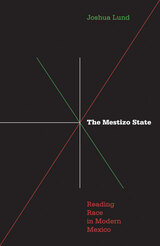
The Mestizo State examines how the ideas, images, and public discourse around race, nation, and citizen formation have been transformed in Mexico from the mid-nineteenth century to the present. Starting with the Porfiriato, Joshua Lund investigates the rise of a racialized “mestizo state,” its reinvention after the Mexican Revolution, and its mobilization as a critical lever that would act both on behalf of and against mainstream Mexican political culture during the long hegemony of the Partido Revolucionario Institucional.
Lund takes race as his object of critical reflection in the context of modern Mexico. An analysis that does not confuse race with mestizaje, indigeneity, African identity, or whiteness, the book sheds light on the history of the materialism of race as it unfolds within the cultural production of modern Mexico, grounded on close readings of four writers whose work explicitly challenged the politics of race in Mexico: Luis Alva, Ignacio Manuel Altamirano, Rosario Castellanos, and Elena Garro.
In seeking to address race as a cultural-political problematic, Lund considers race as integral to the production of the materiality of Mexican national history: constitutive of the nation form, a mediator of capitalist accumulation, and a central actor in the rise of modernity.



READERS
Browse our collection.
PUBLISHERS
See BiblioVault's publisher services.
STUDENT SERVICES
Files for college accessibility offices.
RECENTLY PUBLISHED


UChicago Accessibility Resources
home | accessibility | search | about | contact us
BiblioVault ® 2001 - 2026
The University of Chicago Press