
 A SCHOLARLY BOOK REPOSITORY

Hard-boiled crime fiction doesn't get any better than this, an unforgettable entry in the classic series starring Parker, the deadliest heister around
Richard Stark's Parker novels are the hardest of hard-boiled, classic crime novels where the heists are huge, the body counts are high, and the bad guys usually win.
The Parker novels have been a huge influence on countless writers and filmmakers, including Quentin Tarantino, Stephen King, George Pelecanos, Colson Whitehead, Lucy Sante, John Banville, and many more. Their stripped-down language and hard-as-nails amorality create an unforgettable world where the next score could be the big one, but your next mistake could also be your last. There's nothing else like them.
The Mourner is a story of convergence—of cultures and of guys with guns. Hot on the trail of a statue stolen from a fifteenth-century French tomb, Parker enters a world of eccentric art collectors, greedy foreign officials, and shady KGB agents. Hired by a shifty dame who has something he needs, Parker will find out just who intends to bury whom—and who he needs to kill to finish the job.

But first, Sarah would need to navigate the growing tensions of small-town Arkansas in the 1960s. Both smarter and more serious than her years (a “fifty-year-old mind in an eight-year-old body,” according to Esther), Sarah was torn between the traditions, religion, and work ethic of her community and the progressive civil rights and feminist politics of her mother, who had recently returned from art school in Chicago. When organizers from the Student Non-Violent Coordinating Committee (SNCC) came to town just as the revival was beginning, Sarah couldn’t help but be caught up in the turmoil. Most folks just wanted to keep the peace, and Reverend Jefferson called the SNCC organizers “the evil among us.” But her mother, along with local civil rights activist Carrie Dilworth, the SNCC organizers, Daisy Bates, attorney John Walker, and indeed most of the country, seemed determined to push Maeby toward integration.
With characters as vibrant and evocative as their setting, Mourner’s Bench is the story of a young girl coming to terms with religion, racism, and feminism while also navigating the terrain of early adolescence and trying to settle into her place in her family and community.
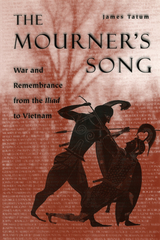
Tatum's touchstone throughout is the Iliad, not just one of the earliest war poems, but also one of the most powerful examples of the way poetry can be a tribute to and consolation for what is lost in war. Reading the Iliad alongside later works inspired by war, Tatum reveals how the forms and processes of art convert mourning to memorial. He examines the role of remembrance and the distance from war it requires; the significance of landscape in memorialization; the artifacts of war that fire the imagination; the intimate relationship between war and love and its effects on the ferocity with which soldiers wage battle; and finally, the idea of memorialization itself. Because all survivors suffer the losses of war, Tatum's is a story of both victims and victors, commanders and soldiers, women and men. Photographs of war memorials in Vietnam, France, and the United States beautifully augment his testimonials.
Eloquent and deeply moving, The Mourner's Song will speak to anyone interested in the literature of war and the relevance of the classics to our most pressing contemporary needs.
Told in a series of flashbacks and remembrances, the novel concludes with a whirlwind of revelations that both complicate and resolve Reb’s view of his world and his lover.
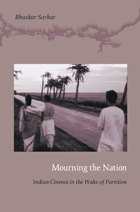
Sarkar tracks the initial reticence to engage with the trauma of 1947 and the subsequent emergence of a strong Partition discourse, revealing both the silence and the eventual “return of the repressed” as strands of one complex process. Connecting the relative silence of the early decades after Partition to a project of postcolonial nation-building and to trauma’s disjunctive temporal structure, Sarkar develops an allegorical reading of the silence as a form of mourning. He relates the proliferation of explicit Partition narratives in films made since the mid-1980s to disillusionment with post-independence achievements, and he discusses how current cinematic memorializations of 1947 are influenced by economic liberalization and the rise of a Hindu-chauvinist nationalism. Traversing Hindi and Bengali commercial cinema, art cinema, and television, Sarkar provides a history of Indian cinema that interrogates the national (a central category organizing cinema studies) and participates in a wider process of mourning the modernist promises of the nation form.
2004 – Clifford G. Christians Ethics Research Award — The Carl Couch Center for Social and Internet Research
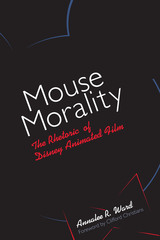
Kids around the world love Disney animated films, and many of their parents trust the Disney corporation to provide wholesome, moral entertainment for their children. Yet frequent protests and even boycotts of Disney products and practices reveal a widespread unease with the sometimes mixed and inconsistent moral values espoused in Disney films as the company attempts to appeal to the largest possible audience.
In this book, Annalee R. Ward uses a variety of analytical tools based in rhetorical criticism to examine the moral messages taught in five recent Disney animated films—The Lion King, Pocahontas, The Hunchback of Notre Dame, Hercules, and Mulan. Taking the films on their own terms, she uncovers the many mixed messages they purvey: for example, females can be leaders—but male leadership ought to be the norm; stereotyping is wrong—but black means evil; historical truth is valued—but only tell what one can sell, etc. Adding these messages together, Ward raises important questions about the moral ambiguity of Disney's overall worldview and demonstrates the need for parents to be discerning in letting their children learn moral values and life lessons from Disney films.
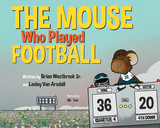
Some folks think Brian the mouse is too small. He may be a tough little fella, but they are not sure Brian has what it takes. The Mouse Who Played Football, by former Philadelphia Eagles running back Brian Westbrook Sr. and sports reporter Lesley Van Arsdall, shows how Brian the mouse proves everyone wrong with unyielding confidence that his small size can be his strength.
This charming children’s book, featuring appealing and dynamic illustrations by Mr. Tom, demonstrates how Brian the mouse overcomes what others see as a “big problem.” His determination—as well as speed and toughness on the gridiron—helps him become a star player in high school, college, and eventually, the MFL, the Mouse Football League.
The Mouse Who Played Football, based on Westbrook’s own experiences,is an inspiring story that encourages young readers to believe in themselves and make their unique differences their strengths.
The winner of the Drinking Gourd Chapbook Poetry Prize, Rodney Gomez’s collection Mouth Filled with Night employs familiar emblems of Mexican American identity to repeatedly subvert expectations while intensifying the dilemmas of affiliation. The poems run beyond more conventional ideas of agency, identity, and experience, creating a newly invigorated imaginative space. As a collection, Mouth Filled with Night gains particular momentum—a pitched anxiety that slowly grows throughout the volume—to create a poetic experience unique to the chapbook form.
The Mouth of Earth serves as both a survival guide for those seeking connection with our planet and one another as well as a compassionate tribute to what we have lost or are losing—the human consequences of such destruction in a time of climate crisis and lost connectivity. Strong’s powerful poems offer us, if not consolation, at least a way toward comprehension in an age of loss, revealing both our ongoing denial of our planet’s fragility and the compelling urgency of our hunger for connection with all life.
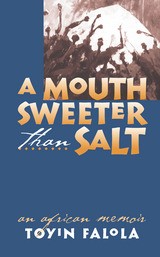
-Ama Ata Aidoo
"A splendid coming-of-age story so full of vivid color and emotion, the words seem to dance off the page. But this is not only Falola's memoir; it is an account of a new nation coming into being and the tensions and negotiations that invariably occur between city and country, tradition and modernity, men and women, rich and poor. A truly beautiful book."
-Robin D. G. Kelley
"More than a personal memoir, this book is a rich minihistory of contemporary Nigeria recorded in delicious detail by a perceptive eyewitness who grew up at the crossroads of many cultures."
-Bernth Lindfors
"The reader is irresistibly drawn into Falola's world. The prose is lucid. There is humor. This work is sweet. Period."
-Ngugi wa Thiongo'o
A Mouth Sweeter Than Salt gathers the stories and reflections of the early years of Toyin Falola, the grand historian of Africa and one of the greatest sons of Ibadan, the notable Yoruba city-state in Nigeria.
Redefining the autobiographical genre altogether, Falola miraculously weaves together personal, historical, and communal stories, along with political and cultural developments in the period immediately preceding and following Nigeria's independence, to give us a unique and enduring picture of the Yoruba in the mid-twentieth century. This is truly a literary memoir, told in language rich with proverbs, poetry, song, and humor.
Falola's memoir is far more than the story of one man's childhood experiences; rather, he presents us with the riches of an entire culture and community-its history, traditions, pleasures, mysteries, household arrangements, forms of power, struggles, and transformations.
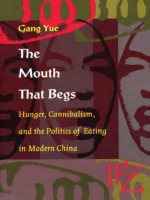
Yue’s discussion begins with a brief look at ancient Chinese alimentary writing and then moves on to its main concern: the exploration and textual analysis of themes of eating in modern Chinese literature from the May Fourth period through the post-Tiananmen era. The broad historical scope of this volume illustrates how widely applicable eating-related metaphors can be. For instance, Yue shows how cannibalism symbolizes old China under European colonization in the writing of Lu Xun. In Mo Yan’s 1992 novel Liquorland, however, cannibalism becomes the symbol of overindulgent consumerism. Yue considers other writers as well, such as Shen Congwen, Wang Ruowang, Lu Wenfu, Zhang Zianliang, Ah Cheng, Zheng Yi, and Liu Zhenyun. A special section devoted to women writers includes a chapter on Xiao Hong, Wang Anyi, and Li Ang, and another on the Chinese-American women writers Jade Snow Wong, Maxine Hong Kingston, and Amy Tan. Throughout, the author compares and contrasts the work of these writers with similarly themed Western literature, weaving a personal and political semiotics of eating.
The Mouth That Begs will interest sinologists, literary critics, anthropologists, cultural studies scholars, and everyone curious about the semiotics of food.


A Booklist Top 10 Arts Book of 2019
A No Depression Top Music Book of 2019
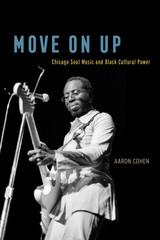
Curtis Mayfield. The Chi-Lites. Chaka Khan. Chicago’s place in the history of soul music is rock solid. But for Chicagoans, soul music in its heyday from the 1960s to the 1980s was more than just a series of hits: it was a marker and a source of black empowerment. In Move On Up, Aaron Cohen tells the remarkable story of the explosion of soul music in Chicago. Together, soul music and black-owned businesses thrived. Record producers and song-writers broadcast optimism for black America’s future through their sophisticated, jazz-inspired productions for the Dells and many others. Curtis Mayfield boldly sang of uplift with unmistakable grooves like “We’re a Winner” and “I Plan to Stay a Believer.” Musicians like Phil Cohran and the Pharaohs used their music to voice Afrocentric philosophies that challenged racism and segregation, while Maurice White of Earth, Wind, and Fire and Chaka Khan created music that inspired black consciousness. Soul music also accompanied the rise of African American advertisers and the campaign of Chicago’s first black mayor, Harold Washington, in 1983. This empowerment was set in stark relief by the social unrest roiling in Chicago and across the nation: as Chicago’s homegrown record labels produced rising stars singing songs of progress and freedom, Chicago’s black middle class faced limited economic opportunities and deep-seated segregation, all against a backdrop of nationwide deindustrialization.
Drawing on more than one hundred interviews and a music critic’s passion for the unmistakable Chicago soul sound, Cohen shows us how soul music became the voice of inspiration and change for a city in turmoil.

Foreword by Jamie Campbell Naidoo
Get ready to break out of your storytime routine by encouraging children’s natural instincts to move, sing, and play! Unlike traditional storytimes, where children are expected to sit quietly and just watch, music and movement storytimes encourage children to learn by getting inside stories while interacting with others. Research shows that this kind of play stimulates the senses, provides connections to all four lobes of the brain, touches on a variety of intelligences, and heightens social and emotional awareness—all while extending the early literacy practices of Every Child Ready to Read® and preparing children for school. And because there are no crafts to cut out, no snacks to pack, no scripts to memorize, and no story kits to make, it’s one of the simplest, most cost-effective storytime models to implement. Jewell’s complete guide shows the way, offering
- 20 ready-to-use storytime plans tailored to specific age groups, including babies, toddlers, preschool and all-ages programs, a real time-saver for storytime organizers and presenters;
- advice and best practices gleaned from interviews with professionals who specialize in storytimes, music making with children and families, yoga storytime, and drama education; and
- lists of recommended resources, from interactive print books to children’s music and videos available digitally, with tips on choosing the best materials.
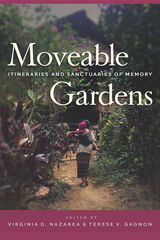
Moveable Gardens highlights itineraries and sanctuaries in an era of massive dislocation, addressing concerns about finding comforting and familiar refuges in the Anthropocene. The worlds of marginalized individuals who live in impoverished rural communities, many Indigenous peoples, and refugees are constantly under threat of fracturing. Yet, in every case, there is resilience and regeneration as these individuals re-create their worlds through the foods, traditions, and plants they carry with them into their new realities.
This volume offers a new understanding of the performances and routines of sociality in the face of daunting market forces and perilous climate transformations. These traditions sustained our ancestors, and they may suffice to secure a more meaningful, diverse future. By delving into the nature of nostalgia, burrowing into memory and knowledge, and embracing the specific wonders of each deeply rooted or newly displaced community, endlessly valuable ways of being and understanding can be preserved.
Contributors: Guntra A. Aistara, Aida Curtis, Terese V. Gagnon, John Hartigan Jr., Tracey Heatherington, Taylor Hosmer, Hayden S. Kantor, Melanie Narciso, Virginia D. Nazarea, Emily F. Ramsey, Krishnendu Ray, David Sutton, James R. Veteto, Marc N. Williams

Beginning with the hurricane of 1938, the biggest natural disaster to strike Connecticut since its settlement by Europeans, the authors demonstrate the continuing pattern of development of coastal land prone to flooding and high winds. Although the Connecticut coast faces Long Island and Block Island sounds, it is subject to the same natural hazards, land-use risks, and regulations as opean ocean shorelines. Global climatic events--glaciation, global warming, and rising sea levels--influence the shape and composition of the Connecticut shoreline, as do small-scale forces such as wind, waves, and tides.
Patton and Kent seek to instill a respect for the force of natural events and provide a guide for lessening the dangers of construction and development. A practical question-and-answer chapter explains what homeowners need to know to meet land-use regulations along the coast. In a state where the entire population lives within 100 miles of the coast, this important book will serve as a citizens’ guide to living with the Connecticut shore and will be of interest to coastal residents, developers, geologists, policymakers, and vacationers.
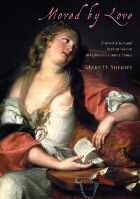
Mary D. Sheriff uses these very different visions of enthusiasm to explore the complex interrelationships among creativity, sexuality, the body and the mind in eighteenth-century France. Drawing on evidence from the visual arts, literature, philosophy, and medicine, she portrays the deviance ascribed to both inspired men and women. But while various mythologies worked to normalize deviance in male artists, women had no justification for their deviance. For instance, the mythical sculptor Pygmalion was cured of an abnormal love for his statue through the making of art. He became a model for creative artists, living happily with his statue come to life. No happy endings, though, were imagined for such inspired women writers as Sappho and Heloise, who burned with erotomania their art could not quench. Even so, Sheriff demonstrates, the perceived connections among sexuality, creativity, and disease also opened artistic opportunities for creative women took full advantage of them.
Brilliantly reassessing the links between sexuality and creativity, artistic genius and madness, passion and reason, Moved by Love will profoundly reshape our view of eighteenth- century French culture.
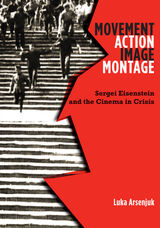
A major new study of Sergei Eisenstein delivers fresh, in-depth analyses of the iconic filmmaker’s body of work
What can we still learn from Sergei Eisenstein? Long valorized as the essential filmmaker of the Russian Revolution and celebrated for his indispensable contributions to cinematic technique, Eisenstein’s relevance to contemporary culture is far from exhausted. In Movement, Action, Image, Montage, Luka Arsenjuk considers the auteur as a filmmaker and a theorist, drawing on philosophers such as Georg Wilhelm Friedrich Hegel and Gilles Deleuze—as well as Eisenstein’s own untranslated texts—to reframe the way we think about the great director and his legacy.
Focusing on Eisenstein’s unique treatment of the foundational concepts of cinema—movement, action, image, and montage—Arsenjuk invests each aspect of the auteur’s art with new significance for the twenty-first century. Eisenstein’s work and thought, he argues, belong as much to the future as the past, and both can offer novel contributions to long-standing cinematic questions and debates.
Movement, Action, Image, Montage brings new elements of Eisenstein’s output into academic consideration, by means ranging from sustained and comprehensive theorization of Eisenstein’s practice as a graphic artist to purposeful engagement with his recently published, unfinished book Method, still unavailable in English translation. This tour de force offers new and significant insights on Eisenstein’s oeuvre—the films, the art, and the theory—and is a landmark work on an essential filmmaker.
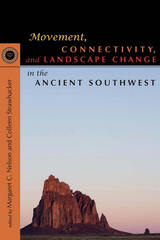
Particular attention is paid to the various ways that archaeology can and should contribute to contemporary social and environmental issues. Contributors come together to provide a synthetic volume on current research and possibilities for future explorations. Moving forward, they argue that archaeologists must continue to include researchers from across political and disciplinary boundaries and enhance collaboration with Native American groups.
This book will be of interest to professional and academic archaeologists, as well as students working in the field of the American Southwest.
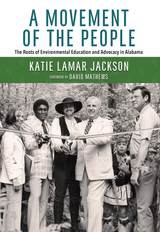
A Movement of the People: The Roots of Environmental Education and Advocacy in Alabama is a detailed history of the Alabama Environmental Quality Association (AEQA). The AEQA helped to establish groundbreaking environmental protection and natural resource preservation policies for the state and the region and grew into one of the nation’s most progressive environmental education efforts.
The AEQA began in 1966 with the relatively simple political action agenda of cleaning up unsightly and unsanitary roadside trash. These inspired citizens collaborated with civic leaders to identify and remove illegal rural dumps and create more regulated landfills statewide. Eventually they became involved in the “Keep America Beautiful” campaign and with the US Public Health Service in its attempt to rid the state of the yellow-fever mosquito vector, Aedes aegypti, which breeds in standing, fetid water. The acme of these early efforts was the passage of Alabama’s Solid Waste Disposal Law of 1969, one of the nation’s first such bills.
The AEQA’s dedicated staff and supporters spearheaded other environmental projects, many of which remain active today, such as recycling programs with industry giants throughout the Southeast and the founding of the Bartram Trail Conference, a multistate initiative to identify and preserve the path that Quaker botanist William Bartram took through the territory before its formation into states.
Using recorded interviews with Martha McInnis, executive vice president of the AEQA, and full access to a meticulously preserved archive of the organization’s papers and artifacts, Katie Lamar Jackson relates this previously untold story of remarkable “citizen activism.” A Movementof the People is a valuable account of the organization’s growth and advancement, both economically and societally, which serves as a blueprint for successful civic activism and grassroots organizing.
The editors and contributors to Movements in Times of Democratic Transition examine in comparative detail how social movements act within the context of the democratic transitions they have been fighting for, and how they are affected by the changes they helped bring about. Offering insights into the nature of how social movements decline, radicalize, revitalize, or spark new cycles of activism, Movements in Times of Democratic Transition provides a comprehensive analysis of these key questions of mobilization research.
Contributors include: Paul Almeida, Christopher J. Colvin, Stephen Ellis, Grzegorz Ekiert, Grzegorz Forys, Krzysztof Gorlach, Camila Penna, Sebastián Pereyra, Steven Robbins, Ton Salman, Mate Szabo, Ineke van Kessel, Michal Wenzel, and the editors.
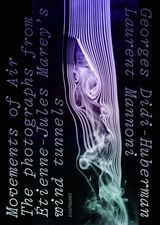
Featuring more than one hundred and fifty photographs and images, Movements of Air reprints the breathtaking pictures of Étienne-Jules Marey—images captured between 1899 and 1901 during his scientific experiments with moving air and smoke—and complements them with essays by Georges Didi-Huberman and Laurent Mannoni.
Mannoni begins by reflecting on Marey’s experimental approach. As the founder of the “graphic method,” Marey was also the developer of an aerodynamic wind tunnel. His experiments’ photographs of fluid motion introduced a whole world of movements and turbulences, and fluids, and influenced generations of scientists and artists alike. Didi-Huberman expands on the philosophical debates surrounding these aesthetically and technically instructive images. Even though Marey’s main interest was graphic information, Didi-Huberman shows us how the flow of all things drew this ingenious experimenter to a photographic practice that creates drags, streaks, expansions, and visual dances. Marey’s wind tunnel photographs were also themselves causes of turbulence in the history of images. The artists Dombois and Oeschger explore these “graphical” vortices of the last 120 years, providing at the end of the book a collage from historical and contemporary material interlaced with their own image-making in Dombois’s wind tunnel at the Zurich University of the Arts.

An invaluable collection of rare archival sources, Movie Mavens reveals women's essential contribution to the creation of American film culture.

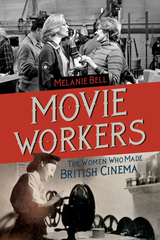
After the advent of sound, women in the British film industry formed an essential corps of below-the-line workers, laboring in positions from animation artist to negative cutter to costume designer. Melanie Bell maps the work of these women decade-by-decade, examining their far-ranging economic and creative contributions against the backdrop of the discrimination that constrained their careers. Her use of oral histories and trade union records presents a vivid counter-narrative to film history, one that focuses not only on women in a male-dominated business, but on the innumerable types of physical and emotional labor required to make a motion picture. Bell's feminist analysis looks at women's jobs in film at important historical junctures while situating the work in the context of changing expectations around women and gender roles.
Illuminating and astute, Movie Workers is a first-of-its-kind examination of the unsung women whose invisible work brought British filmmaking to the screen.
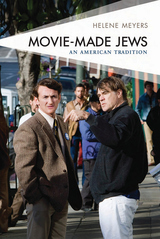
With incisive analysis, Movie-Made Jews challenges the assumption that American Jewish cinema is a cinema of impoverishment and assimilation. While it’s a truism that Jews make movies, this book brings into focus the diverse ways movies make Jews.


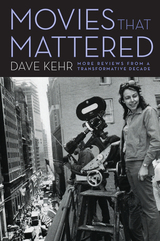
With When Movies Mattered, readers welcomed the first collection of Kehr’s criticism, written during his time at the Chicago Reader. Movies That Mattered is its sequel, with fifty more reviews and essays drawn from the archives of both the Chicago Reader and Chicago magazine from 1974 to 1986. As with When Movies Mattered, the majority of the reviews offer in-depth analyses of individual films that are among Kehr’s favorites, from a thoughtful discussion of the sobering Holocaust documentary Shoah to an irresistible celebration of the raucous comedy Used Cars. But fans of Kehr’s work will be just as taken by his dissections of critically acclaimed films he found disappointing, including The Shining, Apocalypse Now, and Raiders of the Lost Ark.
Whether you’re a long-time reader or just discovering Dave Kehr, the insights in Movies That Mattered will enhance your appreciation of the movies you already love—and may even make you think twice about one or two you hated.

A cultural history of the enduring relationship between film spectatorship and intoxicating substances
Movies under the Influence charts the entangled histories of moviegoing and mind-altering substances from early cinema through the psychedelic 1970s. Jocelyn Szczepaniak-Gillece examines how the parallel trajectories of these two enduring aspects of American culture, linked by their ability to influence individual and collective consciousness, resulted in them being treated and regulated in similar ways. Rather than looking at representations of drug use within film, she regards cinema and intoxicants as kindred experiences of immersion that have been subject to corresponding forces of ideology and power.
Exploring the effects of intoxicants such as caffeine, nicotine, alcohol, marijuana, and psychedelics on film spectatorship, Szczepaniak-Gillece demonstrates how American movie theaters sought to cultivate a dual identity, presenting themselves as both a place of wholesome entertainment and a shadowy zone of illicit behavior. Movies under the Influence highlights the various legislative, legal, and corporate powers that held sway over the darkened anonymity of theaters, locating the convergence of moviegoing and drug use as a site of mediation and social control in America.
As much as substances and cinema are points where power intervenes, they are also settings of potential transcendence, and Movies under the Influence maintains this paradox as a necessary component of American film history. Recontextualizing a wide range of films, from Hollywood to the avant-garde, this book examines the implicit relationship intoxicants suggest between mass media, spectatorship, and governmental regulation and provides a new angle from which to understand cinema’s lasting role in evolving American culture.

Against a backdrop of widespread racism in the West and ongoing colonialism and imperialism in the Global South, this group of activists, writers, and political figures gathered to discuss the history and struggles of people of African descent and the meaning of black power.
For the first time since 1968, David Austin brings alive the speeches and debates of the most important international gathering of black radicals of the era. With never-before-seen texts from Stokely Carmichael, Walter Rodney and C.L.R. James, these documents will prove invaluable to anyone interested in black radical thought and political activism of the 1960s.
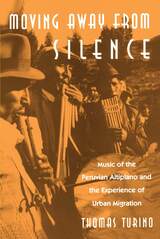
Turino's ethnography is the first large-scale study to concentrate on the pervasive effects of migration on Andean people and their music. Turino uses the musical traditions of Conima, Peru as a unifying thread, tracing them through the varying lives of Conimeos in different locales. He reveals how music both sustains and creates meaning for a people struggling amid the dramatic social upheavals of contemporary Peru.
Moving Away from Silence contains detailed interpretations based on comparative field research of Conimeo musical performance, rehearsals, composition, and festivals in the highlands and Lima. The volume will be of great importance to students of Latin American music and culture as well as ethnomusicological and ethnographic theory and method.
Moving student writing beyond academic discourse and into larger public spheres is a difficult task, but Christian R. Weisser’s study challenges composition instructors to do just that. This highly accessible book does what no other study has attempted to do: place the most current, cutting-edge theories and pedagogies in rhetoric and composition in their intellectual and historical contexts, while at the same time offering a unique, practical theory and pedagogy of public writing for use both inside and outside of the classroom.
By positing a theory of the public for composition studies, one which envisions the public sphere as a highly contested, historically textured, multilayered, and sometimes contradictory site, Weisser offers a new approach to the roles that compositionists might assume in their attempts to initiate progressive political and social change.
After first providing a historical context that situates composition’s recent interest in public writing, Weisser next examines recent theories in composition studies that consider writing an act of social engagement before outlining a more complex theory of the public based on the work of Jürgen Habermas. The resulting re-envisioning of the public sphere expands current conversations in rhetoric and composition concerning the public.
Weisser concludes with a holistic vision that places greater political and social import on addressing public issues and conversations in the composition classroom and that elucidates the role of the public intellectual as it relates specifically to compositionists in postmodern society.
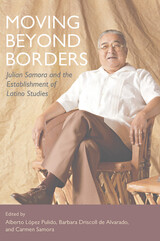
Moving Beyond Borders examines the life and accomplishments of Julian Samora, the first Mexican American sociologist in the United States and the founding father of the discipline of Latino studies. Detailing his distinguished career at the University of Notre Dame from 1959 to 1984, the book documents the history of the Mexican American Graduate Studies program that Samora established at Notre Dame and traces his influence on the evolution of border studies, Chicano studies, and Mexican American studies.
Samora's groundbreaking ideas opened the way for Latinos to understand and study themselves intellectually and politically, to analyze the complex relationships between Mexicans and Mexican Americans, to study Mexican immigration, and to ready the United States for the reality of Latinos as the fastest growing minority in the nation. In addition to his scholarly and pedagogical impact, his leadership in the struggle for civil rights was a testament to the power of community action and perseverance. Focusing on Samora's teaching, mentoring, research, and institution-building strategies, Moving Beyond Borders explores the legacies, challenges, and future of ethnic studies in United States higher education.
Contributors are Teresita E. Aguilar, Jorge A. Bustamante, Gilberto Cárdenas, Miguel A. Carranza, Frank M. Castillo, Anthony J. Cortese, Lydia Espinosa Crafton, Barbara Driscoll de Alvarado, Herman Gallegos, Phillip Gallegos, José R. Hinojosa, Delfina Landeros, Paul López, Sergio X. Madrigal, Ken Martínez, Vilma Martínez, Alberto Mata, Amelia M. Muñoz, Richard A. Navarro, Jesus "Chuy" Negrete, Alberto López Pulido, Julie Leininger Pycior, Olga Villa Parra, Ricardo Parra, Victor Rios, Marcos Ronquillo, Rene Rosenbaum, Carmen Samora, Rudy Sandoval, Alfredo Rodriguez Santos, and Ciro Sepulveda.

--Paul McHugh, Johns Hopkins University School of Medicine
"Remarkable in its breadth-an interesting and valuable contribution to the burgeoning literature of the philosophy of psychiatry."
--Christian Perring, Dowling College
Moving Beyond Prozac, DSM, and the New Psychiatry looks at contemporary psychiatric practice from a variety of critical perspectives ranging from Michel Foucault to Donna Haraway. This contribution to the burgeoning field of medical humanities contends that psychiatry's move away from a theory-based model (one favoring psychoanalysis and other talk therapies) to a more scientific model (based on new breakthroughs in neuroscience and pharmacology) has been detrimental to both the profession and its clients. This shift toward a science-based model includes the codification of the Diagnostic and Statistical Manual of Mental Disorders to the status of standard scientific reference, enabling mental-health practitioners to assign a tidy classification for any mental disturbance or deviation. Psychiatrist and cultural studies scholar Bradley Lewis argues for "postpsychiatry," a new psychiatric practice informed by the insights of poststructuralist theory.
Engaging with theories of anti-Black racism, modernity, coloniality, and the Black diaspora, the book frames storytelling and the circulation of narratives as performances deeply rooted in the everyday lives of Black people across the diaspora. Starting with an examination of the racial construction of movement during colonialism and slavery, the book traces how this history shapes contemporary interactions. With its exploration of how Black circulation transforms movement and space, the book introduces a forward-thinking approach to the Black diaspora, anchored in a politics of identification rather than being confined to the past or a specific location. Moving Blackness argues that the desire for homespace, a yearning for belonging that transcends any particular physical space, fuels this envisioned future, rooted in the historical and material conditions of racism and marginalization.
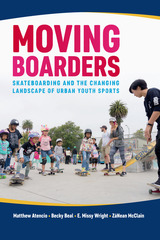
This excellent treatise on the contemporary youth sports scene examines how modern families embrace skateboarding and the role commerce plays in this unexpected new parent culture, and highlights how private corporations, community leaders, parks and recreation departments, and nonprofits like the Tony Hawk Foundation have united to energize skate parks—like soccer fields before them—as platforms for community engagement and the creation of social and economic capital.
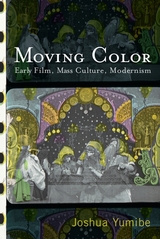
Color was used in film well before The Wizard of Oz. Thomas Edison, for example, projected two-colored films at his first public screening in New York City on April 23, 1896. These first colors of early cinema were not photographic; they were applied manually through a variety of laborious processes—most commonly by the hand-coloring and stenciling of prints frame by frame, and the tinting and toning of films in vats of chemical dyes. The results were remarkably beautiful.
Moving Color is the first book-length study of the beginnings of color cinema. Looking backward, Joshua Yumibe traces the legacy of color history from the beginning of the nineteenth century to the cinema of the early twentieth century. Looking forward, he explores the implications of this genealogy on experimental and contemporary digital cinemas in which many colors have become, once again, vividly unhinged from photographic reality. Throughout this history, Moving Color revolves around questions pertaining to the sensuousness of color: how color moves us in the cinema—visually, emotionally, and physically.
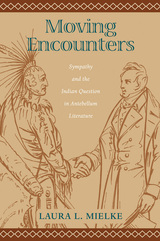
An old Indian woman comforts two young white children she finds lost in the woods and lovingly carries them back to their eager parents. A frontiersman sheds tears over the grave of a Mohican youth, holding hands with the mourning father. According to Laura L. Mielke, such emotionally charged scenes between whites and Indians paradoxically flourished in American literature from 1820 to 1850, a time when the United States government developed and applied a policy of Indian removal.
Although these “moving encounters,” as Mielke terms them, often promoted the possibility of mutual sympathy between Native Americans and Euro-Americans, they also suggested that these emotional links were inherently unstable, potentially dangerous, and ultimately doomed. At the same time, the emphasis on Indian-white sympathy provided an opportunity for Indians and non-Native activists to voice an alternative to removal and acculturation, turning the language of a sentimental U.S. culture against its own imperial impulse. Mielke details not only how such writers as James Fenimore Cooper and Henry Rowe Schoolcraft forecast the inevitable demise of Indian-white sympathy, but also how authors like Lydia Maria Child and William Apess insisted that a language of feeling could be used to create shared community or defend American Indian sovereignty. In this way, Moving Encounters sheds new light on a wide range of texts concerning the “Indian Question” by emphasizing their engagement with popular sentimental forms and by challenging the commonly held belief that all Euro-American expressions of sympathy for American Indians in this period were fundamentally insincere. While portraits of Indian-white sympathy often prompted cynical rejoinders from parodists, many never lost faith in the power of emotion to overcome the greed and prejudice fueling the dispossession of American Indians.
Written between the early 1960s and the mid-1970s, the articles and lectures collected in Moving Focus reflect on some of the major concerns of the practicing artist and scholar of modern Indian art: tradition and modernism, the question of the image, and the use of art criticism. The collection also includes essays on the work of Rabindranath Tagore, Abanindranath Tagore, Binodebehari Mukherjee, Ramkinker Baij, and Amrita Sher-Gil. Together, they deal with the focal changes taking place in the contemporary art situation—a period of great significance in terms of cultural development, just about a decade and a half after India’s hard-won Independence—and seek to put them in perspective. The analytical essays of K. G. Subramanyan, one of India's most celebrated artists, remain as relevant and useful today as they were when this collection first appeared decades ago, and are perfectly suited to introducing the non-specialist to Indian modernism and its global concerns.
Subramanyan played a pivotal role in shaping India’s artistic identity after Independence. Mani-da, as he was fondly called, seamlessly blended elements of modernism with folk expression in his works, spanning paintings, murals, sculptures, prints, set designs, and toys. Beyond his visual artistry, his writings have laid a solid foundation for understanding the demands of art on the individual. In the year of his centenary, Seagull is proud to publish his writings in special new editions.
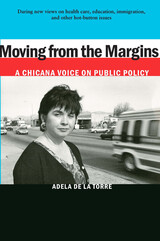
Addressing immigration, education, health care, and economic and political concerns, Adela de la Torre provides a distinctly Chicana perspective that often differs from that of mainstream readers and voters. Drawn from the author's syndicated column in the Los Angeles Times along with writings from other publications, Moving from the Margins includes incisive and often provocative commentaries that provide insights into the roots of ethnic tensions in the Golden State.
The book also includes readers' reactions to the articles, creating a dialogue of ideas while confronting fears of what many Americans view as an alien culture. Whether addressing entitlements granted to noncitizens, the future of public schools, or access to health care, de la Torre challenges readers to move beyond their own frame of reference and consider new points of view. The issues she faces have shaped today's California—and they also lie at the heart of urban public policy in America for the twenty-first century.
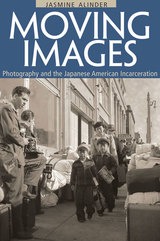
Considering such factors as artistic intention, institutional deployment, critical interpretation, and popular reception, Alinder provides calibrated readings of the photographs from this period. She uncovers the tension between Dorothea Lange's moving and critical images of the camps and the War Relocation Authority's blindly positive captions. She also analyzes Ansel Adams's attempt to combat negative war propaganda through humanizing photographs of Japanese Americans and locates the limits of such a counternarrative in the midst of a national mobilization against Japan.
Moving Images examines the work of Japanese American photographers operating both during and after the incarceration, including Manzanar inmate Toyo Miyatake, who constructed his own camera to document the complicated realities of camp life for his fellow inmates. More recently, contemporary artists Patrick Nagatani and Masumi Hayashi have used photography to reckon with the legacy of incarceration by journeying to the camp sites and creating photographs that bridge the intergenerational divides between their parents, themselves, and their children.
Illustrated with more than forty photographs, Moving Images reveals the significance of the camera in the process of incarceration as well as the construction of race, citizenship, and patriotism in this complex historical moment.
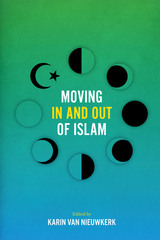
Embracing a new religion, or leaving one’s faith, usually constitutes a significant milestone in a person’s life. While a number of scholars have examined the reasons why people convert to Islam, few have investigated why people leave the faith and what the consequences are for doing so. Taking a holistic approach to conversion and deconversion, Moving In and Out of Islam explores the experiences of people who have come into the faith along with those who have chosen to leave it—including some individuals who have both moved into and out of Islam over the course of their lives.
Sixteen empirical case studies trace the processes of moving in or out of Islam in Western and Central Europe, the United States, Canada, and the Middle East. Going beyond fixed notions of conversion or apostasy, the contributors focus on the ambiguity, doubts, and nonlinear trajectories of both moving in and out of Islam. They show how people shifting in either direction have to learn or unlearn habits and change their styles of clothing, dietary restrictions, and ways of interacting with their communities. They also look at how communities react to both converts to the religion and converts out of it, including controversies over the death penalty for apostates. The contributors cover the political aspects of conversion as well, including debates on radicalization in the era of the “war on terror” and the role of moderate Islam in conversions.
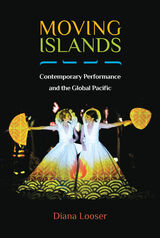
Moving Islands reveals the international and intercultural connections within contemporary performance from Oceania, focusing on theater, performance art, art installations, dance, film, and activist performance in sites throughout Oceania and in Australia, Asia, North America, and Europe. Diana Looser’s study moves beyond a predictable country-specific or island-specific focus to encompass an entire region defined by diversity and global exchange, showing how performance operates to frame social, artistic, and political relationships across widely dispersed locations. The study also demonstrates how Oceanian performance contributes to international debates about diaspora, indigeneity, urbanization, and environmental sustainability. The author considers the region’s unique cultural and geographic dynamics as she brings forth the paradigm of transpasifika to suggest a way of understanding these intercultural exchanges and connections, with the aim to “rework the cartographic and disciplinary priorities of transpacific studies to privilege the activities of Islander peoples.”
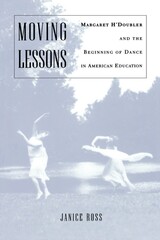
Ross brings together many discourses—from dance history, pedagogical theory, women's history, feminist theory, American history, and the history of the body—in intelligent, exciting, and illuminating ways and adds a new chapter to each of them. She shows how H'Doubler, like Isadora Duncan and other modern dancers, helped to raise dance in the eyes of the middle class from its despised status as lower-class entertainment and "dangerous" social interaction to a serious enterprise. Taking a nuanced critical approach to the history of women's bodies and their representations, Moving Lessons fills a very large gap in the history of dance education.
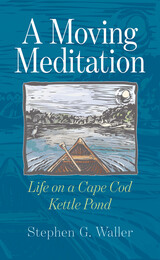
Cape Cod is known for its beaches, throngs of summer visitors, and the activities that accompany seaside living, but it is also home to many kettle ponds, which offer a more tranquil setting. Formed from glaciers breaking apart and so named due to a rounded shape that appears like a kettle, these waterways are home to a diverse array of wildlife, while remaining peaceful and even a bit hidden.
Big enough for a canoeist to feel solitude and serenity, small enough to not appear on large-scale maps, Centerville’s Long Pond (one of seven on the Cape that share this name), consists of fifty-one acres of crystal clear waters, fresh air, and the fish, turtles, waterfowl, ospreys, and otters that call this special place home. In A Moving Meditation, Stephen G. Waller offers an intimate look at the pond’s intriguing natural and human history; its abundant animal life, across the seasons; and the encroaching effects of climate change.

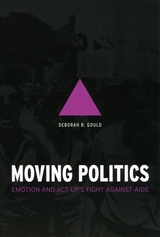
In the late 1980s, after a decade spent engaged in more routine interest-group politics, thousands of lesbians and gay men responded to the AIDS crisis by defiantly and dramatically taking to the streets. But by the early 1990s, the organization they founded, ACT UP, was no more—even as the AIDS epidemic raged on. Weaving together interviews with activists, extensive research, and reflections on the author’s time as a member of the organization, Moving Politics is the first book to chronicle the rise and fall of ACT UP, highlighting a key factor in its trajectory: emotion.
Surprisingly overlooked by many scholars of social movements, emotion, Gould argues, plays a fundamental role in political activism. From anger to hope, pride to shame, and solidarity to despair, feelings played a significant part in ACT UP’s provocative style of protest, which included raucous demonstrations, die-ins, and other kinds of street theater. Detailing the movement’s public triumphs and private setbacks, Moving Politics is the definitive account of ACT UP’s origin, development, and decline as well as a searching look at the role of emotion in contentious politics.
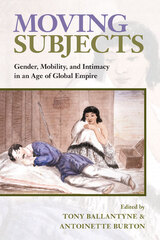
Moving Subjects is the first of its kind to make a case not simply for the necessity of a spatial analysis of imperial formations, but for the indispensability of an investigative approach that links space and movement with the domain of the intimate. Through careful archival research and a commitment to excavating the variety of "mobile intimacies" at the heart of imperial power, its agents, and its interlocutors, contributors offer new evidence and approaches for scholars engaged in capturing the historical nuances of imperial domination.
Contributors are Tony Ballantyne, Antoinette Burton, Adrian Carton, David Haines, Katherine Ellinghaus, Charlotte Macdonald, Michael A. McDonnell, Kirsten McKenzie, Michelle Moran, Fiona Paisley, Adele Perry, Dana Rabin, Christine M. Skwiot, Rachel Standfield, Frances Steel, Elizabeth Vibert, and Kerry Wynn.

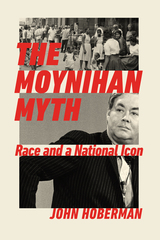
John Hoberman cuts through decades of media adulation and high-profile reverence to illuminate Moynihan’s shortcomings and the Report’s disastrous legacy. As a model of the eloquent scholar-politician, Moynihan answered the demand for a white authority figure to explain Black dysfunction. But his undoubted intellect and gift for language eclipsed a singular lack of qualifications and endowed the Report with an authority it did not deserve. Hoberman delves into the factors that raised Moynihan to the role of race expert while revealing the depths of his naïveté about white racial animosity and how policymakers would use his Report against Black Americans.
Incisive and in-depth, The Moynihan Myth is a long-overdue exposé of a deeply flawed race expert.
Agricultural extension services are undergoing rapid change in many countries, with a shift in funding and management from the public to the private sector. This is especially true in Africa, where donors from industrial countries, and more recently from the middle-income developing countries such as Chile, have historically promoted and financed those extension models. Currently, African nations are being encouraged to import the Farmer Field School extension model, which is meeting with some success in Asia.
Mozambique, a former Portuguese colony, became independent in 1975 but was wracked by civil war in the 1980s. It was unable to establish its public extension service until 1987. The authors analyze the growth and evolution of extension from 1987 to 2004, as provided by public, private, and NGO sources in Mozambique.
This work highlights the Ministry of Agriculture's drive to develop and test both local and imported extension models and share its experience with other African countries.
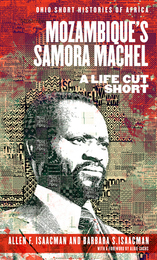
The precipitous rise and controversial fall of a formidable African leader.
Samora Machel (1933–1986), the son of small-town farmers, led his people through a war against their Portuguese colonists and became the first president of the People’s Republic of Mozambique.
Machel’s military successes against a colonial regime backed by South Africa, Rhodesia, the United States, and its NATO allies enhanced his reputation as a revolutionary hero to the oppressed people of Southern Africa. In 1986, during the country’s civil war, Machel died in a plane crash under circumstances that remain uncertain.
Allen and Barbara Isaacman lived through many of these changes in Mozambique and bring personal recollections together with archival research and interviews with others who knew Machel or participated in events of the revolutionary or post-revolutionary years.
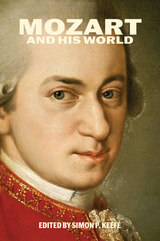
A collection of essays that reinvigorates our understanding of some of Mozart's best-loved works.
One of the world’s most revered composers, Wolfgang Amadeus Mozart (1756–1791) wrote works in almost every genre. His life and work continue to fascinate scholars, performers, and music lovers alike. Mozart and His World brings original perspectives to perennially popular topics in Mozart studies. Through wide-ranging essays that address interpretive, biographical, and contextual themes, the volume simultaneously widens and refines our view of Mozart’s oeuvre.
Mozart and His World moves from studies of instrumental music and musicians to the interpretation and reception of Mozart’s operas, and finally to primary sources from the decade or so after Mozart’s death. Across original chapters and several archival documents, Mozart and His World points new ways forward in key areas of Mozart scholarship, including the study of intellectual and stylistic ideas informing his works and of musicians and institutions within his orbit. While the volume reshapes our understanding of some of Mozart’s best-loved works, including The Magic Flute and his other operas, it also probes works that have received less attention, such as his early string quartets, an opera parody, and wind-music culture and arrangements.
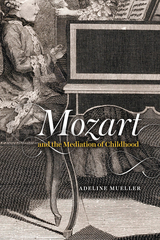
The story of Wolfgang Amadeus Mozart’s precocity is so familiar as to be taken for granted. In scholarship and popular culture, Mozart the Wunderkind is often seen as belonging to a category of childhood all by himself. But treating the young composer as an anomaly risks minimizing his impact. In this book, Adeline Mueller examines how Mozart shaped the social and cultural reevaluation of childhood during the Austrian Enlightenment. Whether in a juvenile sonata printed with his age on the title page, a concerto for a father and daughter, a lullaby, a musical dice game, or a mass for the consecration of an orphanage church, Mozart’s music and persona transformed attitudes toward children’s agency, intellectual capacity, relationships with family and friends, political and economic value, work, school, and leisure time.
Thousands of children across the Habsburg Monarchy were affected by the Salzburg prodigy and the idea he embodied: that childhood itself could be packaged, consumed, deployed, “performed”—in short, mediated—through music. This book builds upon a new understanding of the history of childhood as dynamic and reciprocal, rather than a mere projection or fantasy—as something mediated not just through texts, images, and objects but also through actions. Drawing on a range of evidence, from children’s periodicals to Habsburg court edicts and spurious Mozart prints, Mueller shows that while we need the history of childhood to help us understand Mozart, we also need Mozart to help us understand the history of childhood.

We know Mozart as one of history’s greatest composers. But his contemporaries revered him as a multi-instrumentalist, a dazzling improviser, and the foremost keyboard virtuoso of his time. When he composed, it was often with a single aim in mind: to set the stage, quite literally, for compelling and captivating performances. He wrote piano concertos not with an eye to posterity but to give himself a repertoire with which to flaunt his keyboard wizardry before an awestruck public. The same was true of his sonatas, string quartets, symphonies, and operas, all of which were painstakingly crafted to produce specific effects on those who played or heard them, amusing, stirring, and ravishing colleagues and consumers alike.
Mozart the Performer brings to life this elusive side of Mozart’s musicianship. Dorian Bandy traces the influence of showmanship on Mozart’s style, showing through detailed analysis and imaginative historical investigation how he conceived his works as a series of dramatic scripts. Mozart the Performer is a book for anyone who wishes to engage more deeply with Mozart’s artistry and legacy and understand why, centuries later, his music still captivates us.
The volume's first section consists of commentaries on the texts of the concertos, including thoughts on creating a critical edition. In subsequent sections, contributors analyze the structure of the pieces and the circumstances in which they were first composed and performed. How do these works compare with other concertos of the period? Where were Mozart's contributions truly original, where conventional? What musical references did he expect his listeners to catch?
Generously illustrated with facsimiles, tables, and more than one-hundred musical examples, Mozart's Piano Concertos substantially advances our understanding of these wonderful works. Its exceptional scope--addressing everything from textual problems (what notes should be played?) to performance practice (how can we make the music sound more nearly as Mozart heard it?)--will make it invaluable to anyone who loves his piano concertos.
Contributors:
V. Kofi Agawu, Wye Jameson Allanbrook, Eva Badura-Skoda, Karol Berger, Richard Crawford, Ellwood Derr, Dexter Edge, Cliff Eisen, Martha Feldman, David Grayson, William Kinderman, Robert D. Levin, Janet M. Levy, David Rosen, Carl Schachter, Elaine Sisman, Jane R. Stevens, Alan Tyson, James Webster, Christoph Wolff, and Neal Zaslaw.
Neal Zaslaw is Professor of Music, Cornell University.

READERS
Browse our collection.
PUBLISHERS
See BiblioVault's publisher services.
STUDENT SERVICES
Files for college accessibility offices.
RECENTLY PUBLISHED



UChicago Accessibility Resources
home | accessibility | search | about | contact us
BiblioVault ® 2001 - 2026
The University of Chicago Press