
 A SCHOLARLY BOOK REPOSITORY
74 start with O start with O
Visibility matters to activists—to their social and political relevance, their credibility, their influence. But invisibility matters, too, in times of political hostility or internal crisis. Out in Africa is the first to present an intimate look at how Namibian and South African lesbian, gay, bisexual, and transgender (LGBT) organizations have cultivated visibility and invisibility as strategies over time. As such, it reveals the complexities of the LGBT movements in both countries as these organizations make use of Western terminology and notions of identity to gain funding even as they work to counter the perception that they are “un-African.”
Different sociopolitical conditions in Namibia and South Africa affected how activists in each country campaigned for LGBT rights between 1995 and 2006. Focusing on this period, Ashley Currier shows how, in Namibia, LGBT activists struggled against ruling party leaders’ homophobic rhetoric and how, at the same time, black LGBT citizens of South Africa, though enjoying constitutional protections, greater visibility, and heightened activism, nonetheless confronted homophobic violence because of their gender and sexual nonconformity.
As it tells the story of the evolving political landscape in postapartheid Namibia and South Africa, Out in Africa situates these countries’ movements in relation to developments in pan-African LGBT organizing and offers broader insights into visibility as a social movement strategy rather than simply as a static accomplishment or outcome of political organizing.
Uniquely accessible, Out in Culture presents such popular writers as B. Ruby Rich, Essex Hemphill, and Michael Musto as well as influential critics such as Richard Dyer, Chris Straayer, and Julia Lesage, on topics ranging from the queer careers of Agnes Moorehead and Pee Wee Herman to the cultural politics of gay drag, lesbian style, the visualization of AIDS, and the black snap! queen experience. Of particular interest are two "dossiers," the first linking essays on the queer content of Alfred Hitchcock’s films, and the second on the production and reception of popular music within gay and lesbian communities. The volume concludes with an extensive bibliography—the most comprehensive currently available—of sources in gay, lesbian, and queer media criticism.
Out in Culture explores the distinctive and original ways in which gays, lesbians, and queers have experienced, appropriated, and resisted the images and artifacts of popular culture. This eclectic anthology will be of interest to a broad audience of general readers and scholars interested in gay and lesbian issues; students of film, media, gender, and cultural studies; and those interested in the emerging field of queer theory.
Contributors. Sabrina Barton, Edith Becker, Rhona J. Berenstein, Nayland Blake, Michelle Citron, Danae Clark, Corey K. Creekmur, Alexander Doty, Richard Dyer, Heather Findlay, Jan Zita Grover, Essex Hemphill, John Hepworth, Jeffrey Hilbert, Lucretia Knapp, Bruce La Bruce, Al LaValley, Julia Lesage, Michael Moon, Michael Musto, B. Ruby Rich, Marlon Riggs, Arlene Stein, Chris Straayer, Anthony Thomas, Mark Thompson, Valerie Traub, Thomas Waugh, Patricia White, Robin Wood

Both sides base their views on assumptions about the consequences of integration. Even defenders of the ban grudgingly acknowledge that homosexuals are fully capable of serving with distinction. Few question gay service members' abilities or patriotism; justifications for the ban are now predicated on heterosexuals' negative reactions.
Out in Force refutes the notions that homosexuality is incompatible with military service and that gay personnel would undermine order and discipline. Leading social science scholars of sexual orientation and the military offer reasoned and comprehensive discussions about military organizations, human sexuality, and attitudes toward individuals and groups. They demonstrate forcefully that the debate is really about the military as an institution, and how that institution will adapt to larger social changes. The contributors show that the ban could be successfully eliminated, and set forth a program for implementation. In sorting opinion from fact, myth from reality, Out in Force stands as an invaluable guide for the military, lawmakers, and the courts as they continue to grapple with this question of institutional and societal change.
A diverse group of contributors interweaves personal experience with writing center theory and critical race theory, as well as theories on the politics and performance of identity. In doing so, Out in the Center extends upon the writing center corpus to disrupt and reimagine conventional approaches to writing center theory and practice. Out in the Center proposes that practitioners benefit from engaging in dialogue about identity to better navigate writing center work—work that informs the local and carries forth a social and cultural impact that stretches well beyond academic institutions.
Contributors:
Allia Abdullah-Matta, Nancy Alvarez, Hadi Banat, Tammy S. Conard-Salvo, Michele Eodice, Rochell Isaac, Sami Korgan, Ella Leviyeva, Alexandria Lockett, Talisha Haltiwanger Morrison, Anna Rita Napoleone, Beth A. Towle, Elizabeth Weaver, Tim Zmudka

manage issues of identity and sexuality in field research and professional
life. In an era when the field worker's positionality is critical to research
and ethnographic writing, this insightful book has much to say to gay
and straight researchers alike." -- Louise Lamphere, University of
New Mexico
"Addresses sensitive, controversial, and tabooed subjects. . . .
Out in the Field will be read by a variety of audiences, within
and outside of anthropology." -- Jean Jackson, Massachusetts Institute
of Technology
Lesbian and gay anthropologists write candidly in Out in the Field
about their research and personal experiences in conducting fieldwork,
about the ethical and intellectual dilemmas they face in writing about
lesbian or gay populations, and about the impact on their careers of doing
lesbian/gay research.
The first volume in which lesbian and gay anthropologists discuss personal
experiences, Out in the Field offers compelling illustrations of
professional lives both closeted and out to colleagues and fieldwork informants.
It also concerns aligning career goals with personal sexual preferences
and speaks directly to issues of representation and authority currently
being explored throughout the social sciences.
CONTRIBUTORS: Geoffrey Burkhart, Liz Goodman, Delores M. Walters, Walter
L. Williams, Sabine Lang, Ellen Lewin, William L. Leap, Ralph Bolton,
Elizabeth Lapovsky Kennedy, Madeline Davis, Will Roscoe, Esther Newton,
Stephen O. Murray, James Wafer, Kath Weston, Sue-Ellen Jacobs

In this book gays and lesbians from the Deep South to East Texas and Appalachia speak from vivid personal experience and turn an analytical eye on the South and its culture. Some contributors examine the power of traditional Southern attitudes toward race and religion, and consider the "don't ask, don't tell" attitude about homosexuality in some communities (the "public secret"). Other contributors show how gay culture is thriving in the form of women's festivals, gay bars, and unusual networks like that of Asian and Pacific Islanders in Atlanta.
Out in the South is organized into sections that focus on a central metaphor of space and location. This grounds the book in the sense of the South as a special region and in the inside/outside dilemma faced by many gay and lesbian Southerners as they negotiate their place in an often-inhospitable homeland.

Out in the Union tells the continuous story of queer American workers from the mid-1960s through 2013. Miriam Frank shrewdly chronicles the evolution of labor politics with queer activism and identity formation, showing how unions began affirming the rights of lesbian, gay, bisexual, and transgender workers in the 1970s and 1980s. She documents coming out on the job and in the union as well as issues of discrimination and harassment, and the creation of alliances between unions and LGBT communities.
Featuring in-depth interviews with LGBT and labor activists, Frank provides an inclusive history of the convergence of labor and LGBT interests. She carefully details how queer caucuses in local unions introduced domestic partner benefits and union-based AIDS education for health care workers-innovations that have been influential across the U.S. workforce. Out in the Union also examines organizing drives at queer workplaces, campaigns for marriage equality, and other gay civil rights issues to show the enduring power of LGBT workers.
This compelling collection of essays details the scholarly and personal factors that affected the emergence of lesbian and gay anthropology and speculates on the directions it will take as it continues to grow and diversify. Seeking to legitimize the field's scholarship and address issues in terminology, the essays also define the lesbian and gay anthropology's scope and subject matter and locate factors that separate it from the wider concerns of the profession.
Specific essays track the emergence of lesbian and gay studies in social and cultural anthropology, linguistics, archaeology, and in various areas of anthropological activism. They also consider how feminist anthropology helped define the field and how transgendered experience, queer theory, and race and class studies are promoting new directions of inquiry within lesbian and gay anthropology.
Explores the intrinsic relation of life to air, and breathing, through contemporary art
In Out of Breath, Caterina Albano examines the cultural significance of breath and air to a wide array of forces in our midst, including economy, politics, infection, and ecological violence. Through a consideration of recent art practices and projects, including the dance project Breath Catalogue, which makes visible the breathing patterns of dancers, and Forensic Architecture’s Cloud Studies video, which investigates eight different kinds of clouds from airstrikes to herbicides to tear gas, Albano focuses on breath as both an intuitive process and a conveyer of meanings.
Conceived in response to the Covid-19 pandemic and systemic inequalities that it has laid bare, Out of Breath shows the potential of artistic practices to mobilize affect as a form of cultural and political critique.
Forerunners is a thought-in-process series of breakthrough digital works. Written between fresh ideas and finished books, Forerunners draws on scholarly work initiated in notable blogs, social media, conference plenaries, journal articles, and the synergy of academic exchange. This is gray literature publishing: where intense thinking, change, and speculation take place in scholarship.

The writers recall being on the run between different countries, escaping over mountains, hiding and even sometimes forgetting their Jewish identities in convents and rescuers’ homes and hovels, basements and attics. Some were left on their own; others found themselves embroiled in rescuer family conflicts. Some writers chose to write story clusters, each one capturing a moment or incident and often disconnected by memory or temporal and spatial divides.
Through a detailed examination of seven stories, Daniel Balderston shows how Borges's historical and political references, so often misread as part of a literary game, actually open up a much more complex reality than the one made explicit to the reader. Working in tension with the fantastic aspects of Borges' work, these precise references to realities outside the text illuminate relations between literature and history as well as the author's particular understanding of both. In Borges's perspective as it is revealed here, history emerges as an "other" only partially recoverable in narrative form. From what can be recovered, Balderston is able to clarify Borges's position on historical episodes and trends such as colonialism, the Peronist movement, "Western culture," militarism, and the Spanish invasion of the Americas.
Informed by a wide reading of history, a sympathetic use of critical theory, and a deep understanding of Borges's work, this iconoclastic study provides a radical new approach to one of the most celebrated and—until now—hermetic authors of our time.

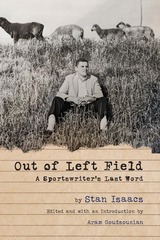
“Stan Isaacs is directly responsible for my television career--and much of how I approached what I’ve said and whom I’ve said it about.” --Keith Olbermann
Iconoclastic and irreverent, Stan Isaacs was part of a generation that bucked the sports establishment with a skepticism for authority, an appreciation for absurdity, and a gift for placing athletes and events within the context of their tumultuous times. Isaacs draws on his trademark wink-and-a-grin approach to tell the story of the long-ago Brooklyn that formed him and a career that placed him amidst the major sporting events of his era. Mixing reminiscences with column excerpts, Isaacs recalls antics like stealing a Brooklyn Dodgers pennant after the team moved to Los Angeles and his many writings on Paul Revere’s horse. But Isaacs also reveals the crusading and humanist instincts that gave Black athletes like Muhammad Ali a rare forum to express their views and celebrated the oddball, unsung Mets over the straitlaced Yankees.
Insightful and hilarious, Out of Left Field is the long-awaited memoir of the influential sportswriter and his adventures in the era of Jim Brown, Arthur Ashe, and the Amazin’ Mets.
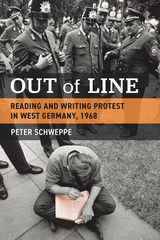
By analyzing how protest fused the politics of reading and writing in 1968 West Germany, author Peter Schweppe uncovers the vibrant history of an alternative literary form during a watershed moment of social upheaval. Out of Line interlinks the politics of reading and writing with the verve of Global Sixties’ protest, where fringe books, underground newspapers, incendiary flyers, and furtive graffiti galvanized readers and writers alike. The phrase “out of line” scrutinizes the emerging performative relationship between visual and textual media in the late 1960s as it metamorphosed modes of West German literary production, channeled the agenda of the protest movement, and, in doing so, shaped new kinds of textual meaning. Through its engagement with theories of materiality and “things,” Out of Line interrogates the dynamic ways that protest readers and writers pushed and broke conventional boundaries. Schweppe’s exploration of form discloses how reading and writing out of line implicates a textual and material history of protest and the lessons it offers protest histories to come.

Bearing traces of Baruch Spinoza, John Dewey, and Saul Alinsky, Obama’s progressivism embraces the ideas of mutual reliance and collective responsibility, and adopts an interconnected view of the individual and the state. So, while Obama might emphasize difference, he rejects identity politics, which can create permanent minorities and diminish individual agency. Analyzing Obama’s major legislative victories—financial regulation, health care, and the stimulus package—O’Brien shows how they reflect a stakeholder society that neither regulates in the manner of the New Deal nor deregulates. Instead, Obama focuses on negotiated rule making and allows executive branch agencies to fill in the details when dealing with a deadlocked Congress. Similarly, his commitment to difference and his resistance to universal mandates underlies his reluctance to advocate for human rights as much as many on the Democratic left had hoped.
Normal0falsefalsefalseEN-USX-NONEX-NONEMicrosoftInternetExplorer4
A history of modern mindfulness meditation and a critique of it as a practice that deeply misunderstands human consciousness.
Mindfulness meditation is often presented as a simple practice of turning inward and quieting the world to discover an authentic “inner voice,” but the very idea that consciousness contains such a voice depends on a slew of contradictory beliefs about Buddhism, neuroscience, and more. In Out of Mind, R. John Williams challenges the core (and misguided) assumptions about human nature that shaped the development of modern meditation, revealing how they were informed by nineteenth-century theosophy, German idealism, Buddhist modernism, Heideggerian mindfulness, Cold War brainwashing, and even phenomena like sensory deprivation tanks. Against the notion that truth lies hidden in our brains, Williams argues that we are never sealed off from the world. Our consciousness extends beyond our own minds—into the intricate web of language, literature, art, and other people to which we are intimately connected.
Out of Mind makes a compelling case for understanding narrative forms and cognitive-scientific frameworks as co-emergent and cross-pollinating. To this end, Ghosal harnesses narrative theory, multimodality studies, cognitive sciences, and disability studies to track competing perspectives on remembering, reading, and sense of place and self. Through new readings of the works of Kamila Shamsie, Aleksandar Hemon, Mark Haddon, Lance Olsen, Steve Tomasula, Jonathan Safran Foer, and others, Out of Mind generates unique insights into literary imagination’s influence on how we think and perceive amid twenty-first-century social, technological, and environmental changes.
About half of all species under threat of extinction in the world today are plants. The loss of plant biodiversity is disturbing for many reasons, but especially because it is a reflection of the growing disconnect between humans and nature. Plants have been used for millennia in traditional systems of healing and have held a significant place in drug development for Western medicine as well. Despite the recent dominance of synthetic drug production, natural product discovery remains the backbone of drug development. As the diversity of life on Earth is depleted and increasing numbers of species become lost to extinction, we continue to lose opportunities to achieve advances in medicine.
Through stories of drug revelation in nature and forays into botany, human behavior, and conservation, Kara Rogers sheds light on the multiple ways in which humans, medicine, and plants are interconnected. With accessible and engaging writing, she explores the relationships between humans and plants, relating the stories of plant hunters of centuries past and examining the impact of human activities on the environment and the world's biodiversity. Rogers also highlights the role that plant-based products can play in encouraging conservation and protecting the heritage and knowledge of indigenous peoples.
Out of Nature provides a fresh perspective on modern drug innovation and its relationship with nature. The book delves into the complexity of biophilia—the innate human attraction to life in the natural world—and suggests that the reawakening of this drive is fundamental to expanding conservation efforts and improving medicine. Rogers's examination of plants, humans, and drug discovery also conveys a passionate optimism for the future of biodiversity and medicine. Including a collection of hand-drawn maps and plant illustrations created by the author, this well-researched narrative will inspire as well as inform.

Where ghosts speak and memory listens, nothing becomes everything
The ghosts—literal and figurative—that drive our deepest impulses, disturb our most precious memories, and haunt the passages of our daily lives are present in this collection of sublime meditations on the unbelievable, the coincidental, and the apparitional. Often containing reflections on the art of storytelling, Caryl Pagel’s essays blend memoir, research, and reflection, and are driven by a desire to observe connections between the visual and the invisible. The narrator of Pagel’s essays explores each enigma or encounter (a football coach’s faked death, the faces of women walking, historical accounts of hallucinations, a city’s public celebration gone wrong) as an intellectual detective ascending a labyrinthine tower of clues in pursuit of a solution to an unreachable problem: always curious, and with a sense of profound wonder.
Out of Nowhere Into Nothing is a sprawling, highly associative consideration of the ways in which the observed material world recalls us to larger narrative and aesthetic truths. Interspersed with documentary-style photographs, Pagel’s first collection of prose is a radiant, obsessive investigation into the mysteries at the center of our seemingly mundane lives.
By surveying the present predicament and the current grassroots impulse toward reconsidering the meaning of the continent, Out of One, Many Africas gives shape and momentum to a crucial dialogue aimed at transforming the study of Africa

As she embarks on her year’s journey, Norah grapples with a medical practice that is experiencing a concerning loss of income. She is supervising two medical students, one whose shyness hampers his development and another whose arrogance and contempt for family medicine creates major friction at the clinic. Norah’s life is further complicated by her elderly mother, a feisty 86-year-old living in Sun City, who once rejoiced at Woodstock and recently partied at Burning Man. Troubled by a shadow in their past, both women find themselves on a quest for self-worth in their shifting worlds. Norah also must cope with the end of an unhappy, long-term relationship with an aspiring, but deadbeat, novelist.
Supported by her steadfast dog, a misfit veterinarian, and a thoughtful radiologist, Norah wrestles through a surprising assortment of obstacles, sometimes amusing and sometimes dreadful, on her way to making a decision about her future.
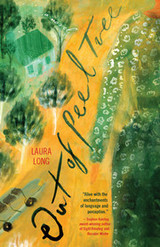
Moving through time and space, Out of Peel Tree unfolds the patterns of an Appalachian sensibility that reverberate everywhere: a fatalism balanced by humor and flinty, hard-won hope, an appreciation for the surprises of the everyday, and a search for love and home amid strange and familiar places and people.
This innovative debut novel reveals the lives of a far-flung contemporary Appalachian family through a web of delicate turning points. A child discovers a grandmother she never knew has died. A runaway teen schemes to start a new life in Texas. A man on parole falls hopelessly in love with a shoplifter. A woman receives a letter about her husband’s other wife. An old woman confronts a burglar with the help of her ghost-husband.
United by a connection to their matriarch, these characters search at home and beyond to make a fresh sense of their changing lives. As a novel in stories, Out of Peel Tree brings a new lyricism to the page and a new voice to American and Appalachian literature—a voice deeply inflected by the beauty of the natural world and by working-class grit.
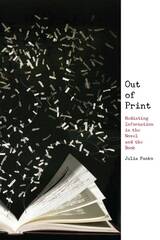
This innovative study chronicles how the print book has fared as both novelists and the burgeoning profession of information science have grappled with unprecedented quantities of data across the twentieth and twenty-first centuries. As the novel's archival project took a critical turn from realism to an investigation of the structures, possibilities, and ideologies of information media, novelists have considered ideas about how data can best be collected and stored. Julia Panko pairs case studies from information history with close readings of modernist works such as James Joyce's Ulysses and Virginia Woolf's Orlando and contemporary novels from Jonathan Safran Foer, Stephen King, and Mark Z. Danielewski that emphasize their own informational qualities and experiment with the aesthetic potential of the print book.

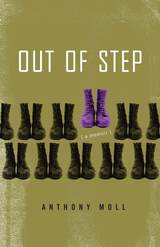
What makes a pink-haired queer raise his hand to enlist in the military just as the nation is charging into war? In his memoir, Out of Step, Anthony Moll tells the story of a working-class bisexual boy running off to join the army in the midst of two wars and the “Don’t Ask, Don’t Tell” era. Set against the backdrop of hypermasculinity and sexual secrecy, Moll weaves a queer coming-of-age story.
Out of Step traces Moll’s development through his military service, recounting how the army both breaks and builds relationships, and what it was like to explore his queer identity while also coming to terms with his role in the nation’s ugly foreign policy. From a punk, nerdy, left-leaning, poor boy in Nevada leaving home for the first time to an adult returning to civilian life and forced to address a world more complicated than he was raised to believe, Moll’s journey isn’t a classic flag-waving memoir or war story—it’s a tale of finding one’s identity in the face of war and changing ideals.
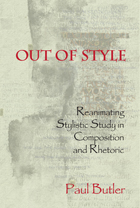
Scholars in composition know that the ideas about writing most common in the discourse of public intellectuals are egregiously backward. Without a vital approach to stylistics, Butler argues, writing studies will never dislodge the controlling fantasies of self-authorized pundits in the nation’s intellectual press. Rhetoric and composition must answer with a public discourse that is responsive to readers’ ongoing interest in style but is also grounded in composition theory.
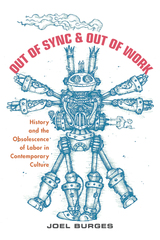


In this era of Antiques Roadshow and eBay, it is hard to imagine a time when Americans did not treasure the home furnishings of elite early American families. But as this book demonstrates, antiquing—particularly the practice of valuing old things for their aesthetic qualities—is a relatively recent invention whose origins can be found in the early years of the twentieth century. Although nineteenth-century Americans did appreciate heirlooms, they saw them as memory markers, tangible representations of honored ancestors or local history.
In Out of the Attic, Briann G. Greenfield traces the transformation of antiques from family keepsakes to valuable artistic objects, examining the role of collectors, dealers, and museum makers in the construction of a new tradition based on the aesthetic qualities of early American furnishings. While recognizing the significance of antiques as symbols of an enduring American culture, Greenfield also delves behind popular rhetoric to examine the development of a retail structure specifically designed to facilitate the buying and selling of old wares. With antique shops proliferating all over New England, pickers going door-to-door in search of “finds,” and forgers taking illicit advantage of growing demand, antique owners and collectors found themselves trying to navigate a retail market characterized by escalating prices and high stakes purchases. In this sense, antiques functioned as more than remnants of a treasured past; they became modern consumer goods.
The book is divided into a series of case studies, each intended to illuminate some aspect of “the dynamic of consumer history.” One chapter examines the role of Jewish dealers in promoting American antiques; another profiles Jessie Baker Gardner, a small-time collector and would-be museum maker from Providence, Rhode Island. Greenfield also looks at the institutionalization of antiques, with chapters focusing on Henry Flynt of Deerfield, Massachusetts, who embraced the “aestheticization of antiques” in the 1940s and 1950s, and on Smithsonian curator C. Malcolm Watkins, who challenged the decorative art market during the 1950s and 1960s by purchasing old tools and crude furniture for the nation's museum.

Effie Marquess Carmack (1885-1974) grew up in the tobacco-growing region of southern Kentucky known as the Black Patch. As an adult she moved to Utah, back to Kentucky, to Arizona, and finally to California. Economic necessity primarily motivated Effie and her husband's moves, but her conversion to the Mormon Church in youth also was a factor. Throughout her life, she was committed to preserving the rural, southern folkways she had experienced as a child. She and other members of her family were folk musicians, at times professionally, and she also became a folk poet and artist, teaching herself to paint. In the 1940s she began writing her autobiography and eventually also completed a verse adaptation of it and an unpublished novel about life in the Black Patch.
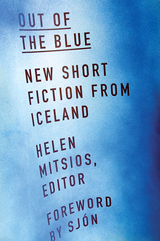
A groundbreaking collection of fiction from Iceland’s best contemporary authors
This extraordinary collection, the first anthology of Icelandic short fiction published in English translation, features work by twenty of Iceland’s most popular and celebrated living authors—including Andri Snær Magnason, Jón Kalman Stefánsson, Kristín Ómarsdóttir, and Auður Jónsdóttir—granddaughter of Halldór Laxness, who won the 1955 Nobel Prize in Literature.
Celebrated in Europe and Scandinavia but less known in the English-speaking world, these writers traverse realms of darkness and light that will be familiar to readers who have fallen under the spell of Scandinavian fiction. While uniquely Icelandic in topography and tenor, with a touch of the island’s supernatural charm, the stories traffic in the enduring and universal complexities of human nature. Here is a fictional universe where the ghosts of Vikings and spirits tread, volcanoes grumble underfoot, and writers trip the Northern Lights fantastic across the landscape of the Icelandic imagination.
At long last, readers can enjoy award-winning stories now expertly rendered into English by the country’s most renowned translators. In “Killer Whale” a father contemplates euthanasia for a terminally ill child, in “Self Portrait” a vacationing family in Spain crosses paths with migrants, in “Escape for Men” a woman searches for an ex-lover in the South of France, and in “The Most Precious Secret” the nature of artists and the art world is mercilessly revealed. Both the Viking myths of Iceland’s forefathers and the cutting-edge modern world of the country today are brilliantly alive in these remarkable and original stories.
This collection is an excursion to an island where almost two million travelers descend yearly on a population of 345 thousand natives. Iceland is the place Björk calls home, the location where Game of Thrones was filmed—a place with open lava fields, glaciers, and iceberg lagoons among other natural wonders that is becoming one of the “hottest” tourist destinations on earth.
Out of the Blue transports readers to Iceland’s timeless and magical island of Vikings and geographical wonders, and it promises to be a seminal collection that will define Icelandic literature in translation for decades to come.
Contributors: Auður Ava Olafsdóttir, Kristín Eiríksdóttir, Þórarinn Eldjárn, Gyrðir Elíasson, Einar Örn Gunnarsson, Ólafur Gunnarsson, Einar Már Guðmundsson, Auður Jónsdóttir, Gerður Kristný, Andri Snær Magnason, Óskar Magnússon, Bragi Ólafsson, Kristín Ómarsdóttir, Óskar Árni Óskarsson, Magnús Sigurðsson, Jón Kalman Stefánsson, Ágúst Borgþór Sverrisson, Guðmundur Andri Thorsson, Þórunn Erlu-Valdimarsdóttir, Rúnar Helgi Vignisson.
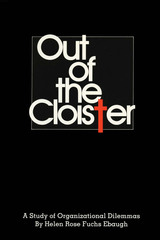
Since Vatican Council II, convent walls have crumbled. and the structures that once separated nuns from the world are gone. Out of the Cloister is an organizational analysis of the structural and ideological changes that took place in Catholic religious orders of women in the United States. Many nuns today dress in street clothes, choose their own jobs, have a degree of financial independence from the larger order, and may not be recognized by their coworkers as nuns. What might once have been defined as a "total institution" has become, within the span of a few years, a type of voluntary organization where members join together loosely to achieve a common purpose.
Helen Rose Fuchs Ebaugh approaches religious orders as utopian communities and examines how contact with the larger society has affected the distinctiveness and solidarity that hold such groups together. She analyzes the patterns occurring within orders with particular focus on the relationship between organizational change and membership loss. Since changes have been introduced into religious orders at different rates, and since orders vary in such characteristics as size and educational level of members, it is possible to analyze relationships between exit rates and other organizational variables. The complex interplay of education and membership loss is one of the organizational dilemmas the author examines.
Although she is no longer a part of organized religious life, Ebaugh spent ten years as a nun and during that time collected much of the data presented in this book. As a nun she also helped conduct a number of self-studies and evaluations involved with the post-Vatican II reform and renewal efforts. She is therefore in the unique position of a researcher who collected data as an insider and analyzed it as an outsider.
This book is one of the first systematic, empirical studies of religious orders in the United States and one of the few sociological investigations of convents and the changes occurring within them.

Out of the Closets and into the Courts explores both the promise and the limits of using legal mobilization to effect social change. Crossing disciplinary boundaries, Ellen Andersen draws on the accumulated knowledge of political science, law, and sociology to explain the origins and outcomes of gay rights litigation. The resulting book is essential reading for anyone interested in gay rights, legal change, and social movements.
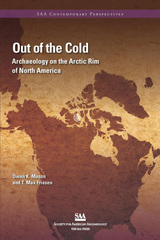

From the Grand Ole Opry to the National Barn Dance, how radio changed life in rural America
Out of the Dark: A History of Radio and Rural America shows how radio—especially clear channel network stations—brought news, markets, weather, religion, and entertainment into isolated farm homes between the 1920s and 1950s, narrowing rural–urban divides while also sustaining distinctly rural tastes (e.g., barn dance music). Craig argues that battery “farm radios,” high power stations, and national networking transformed daily life, work rhythms, consumer habits, and political participation, making radio the central domestic technology of the Depression era and beyond.
Craig blends regulatory and industry milestones, such as the Radio Act of 1927, with sociological studies, USDA extension records, FCC surveys, census tables, and rich case studies including WLS Chicago’s “National Barn Dance,” WSM Nashville’s “Grand Ole Opry,” and others. He mines audience research, diaries, program schedules, and tables that track the spread of radio. The book’s distinctive contributions include detailed charts (ownership by region; clear channel assignments) and vivid narratives of stations, formats, and personalities that connected farm families to national culture while preserving local identity.
The book is ideal for scholars and students of US social, rural, and media history; communication policy and political communication; country and bluegrass music history; agricultural extension; and American studies. It will also engage librarians, curators, and public historians seeking context for rural collections; journalists and podcasters tracing the roots of today’s information ecosystems; and general readers interested in how radio re made community life long before the internet.
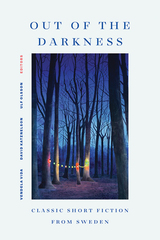
A treasure chest of stories by Swedish authors from the 1880s to the 1950s, many appearing for the first time in English
In the late nineteenth century, Swedish romanticism gave way to vibrant new literary styles that flourished through the 1950s. Out of the Darkness is the first anthology to bring the short fiction of this golden age of Swedish literature to English readers, celebrating the country’s rich literary tradition and several of its most renowned authors. The stories in this volume (many in entirely new translations, and most never before published in English) reflect the arc of the short story in Sweden, from realism to symbolism to modernist experimentation, and stand as lyrical exemplars of the creativity and depth of Swedish literature.
Some stories explore themes of crime and refuge, others ask what makes life meaningful, and some challenge sexual and social constructs of their time. All are fueled by shadows—of evil, madness, or fate, eerie fantasy or grim reality. Including internationally famous authors like August Strindberg, Stig Dagerman, and Nobel laureate Selma Lagerlöf, Out of the Darkness also features writing by influential women such as Victoria Benedictsson and Agnes von Krusenstjerna, who are less familiar to English readers. A showcase of stylistic virtuosity and incisive social commentary, Out of the Darkness at last brings this remarkable period of Swedish prose into the light.
Contributors: Victoria Benedictsson, Hjalmar Bergman, Karin Boye, Stig Dagerman, Thorsten Jonsson, Agnes von Krusenstjerna, Selma Lagerlöf, August Strindberg, Hjalmar Söderberg.
Retail e-book files for this title are screen-reader friendly.

Susan Wells combines studies of medical genres, such as the patient history or the diagnostic conversation, with discussions of individual writers. The women she discusses include Ann Preston, the first woman dean of a medical college; Hannah Longshore, a successful practitioner who combined conventional and homeopathic medicine; Rebecca Crumpler, the first African American woman physician to publish a medical book; and Mary Putnam Jacobi, writer of more than 180 medical articles and several important books. Wells shows how these women learned to write, what they wrote, and how these texts were read.
Out of the Dead House also documents the ways that women doctors influenced medical discourse during the formation of the modern profession. They invented forms and strategies for medical research and writing, including methods of using survey information, taking patient histories, and telling case histories. Out of the Dead House adds a critical episode to the developing story of women as producers and critics of culture, including scientific culture.

Even before he wrote his bestselling book The Ethnic Cleansing of Palestine, historian Ilan Pappe was a controversial figure in Israel. In Out of the Frame, he gives a full account of his break with mainstream Israeli scholarship and its consequences.
Here he traces his journey of discovery from the whispers of Palestinian classmates to his realisation that the 'enemy's' narrative of the events of 1948 was correct. After completing his thesis at Oxford University in the early 1980s, he returned to Palestine determined to protect the memory of the Nakbah. For the first time he gives the details of the formidable opposition he faced in Israel, including death threats fed by the media, denunciations by the Knesset and calls for him to be sacked from his post at Haifa university.
This revealing work, written with dignity and humour, highlights Israel's difficulty in facing up to its past and forging a peaceful, inclusive future in Palestine.

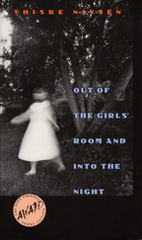
Out of the Girls' Room and into the Night is a spirited, offbeat collection of stories, elongated riffs on that thing we call …love. All manner of love stories: thwarted love stories, imaginary love stories, love stories offhand and obsessive, philosophical love stories, erudite and amusing love stories.
“People don't meet because they both like Burmese food,” says one character, “or because someone's sister has a friend who's single and new in town, or because Billy's nose happened to crook just slightly to the left at an angle that made me want to weep…People don't fall in love with each other …they just fall into love.”
Everyone does it: women of fierce independence, men of thin character, rambling Deadheads, gay teenage girls, despondent Peace Corps volunteers, anorexic Broadway theatre dancers, the eager, the grieving, the uncommunicative. Even the confused do it. And they don't just fall in love with each other—they fall in love with certain moments and familiar places, with things as ephemeral as gestures and as evanescent as sunlight.
Quirky, real, idealistic, deluded, bohemian, and true, these are people who can—and often do—fall in love with a pair of ears, August afternoons, saucers of vitamins, New Age carpenters, and dead bumblebees. And if there's something they can teach us, it's how to conceive of alternative worlds and the terror and the exhilaration of venturing outside the confines of the lives we know and making our way into a dark, glittering unknown.
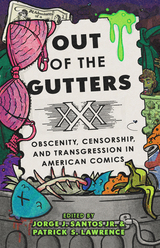
Comics have long been a subject of moral panics, no doubt thanks to their in-your-face illustrations and their association with young readers. Indeed, the politicians and parents behind today’s book-banning campaigns reserve special ire for graphic novels. What makes today’s controversies different is the content of the alleged obscenity. Instead of targeting sex as such, censors now focus on affirmations of nonheteronormative identity, as in Maia Kobabe’s Gender Queer. And while violence is a constant in comics, stories that acknowledge nationalist oppression and violence, such as Art Spiegelman’s Maus, are also being blacklisted.
Out of the Gutters assembles scholars from diverse disciplines to examine US comics, graphic novels, and cartooning that have been challenged as obscene or transgressive. Covering well-known underground figures like Robert Crumb and Charles Burns, newcomers such as C. Spike Trotman and Emil Ferris, and mainstream creators including Chris Claremont and Archie Goodwin, the collection explores the market economics of transgression, historical representations of graphic violence, the ever-changing meaning of pornography, sex-positive comics by BIPOC authors, and queerness in pop-culture mega-properties like X-Men and The Walking Dead.

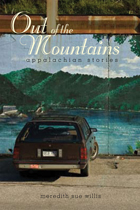
Meredith Sue Willis’s Out of the Mountains is a collection of thirteen short stories set in contemporary Appalachia. Firmly grounded in place, the stories voyage out into the conflicting cultural identities that native Appalachians experience as they balance mainstream and mountain identities.
Willis’s stories explore the complex negotiations between longtime natives of the region and its newcomers and the rifts that develop within families over current issues such as mountaintop removal and homophobia. Always, however, the situations depicted in these stories are explored in the service of a deeper understanding of the people involved, and of the place. This is not the mythic version of Appalachia, but the Appalachia of the twenty-first century.

Medieval literature is full of strange moments when infants (even fetuses) speak. In Out of the Mouths of Babes, Julie Singer explores the unsettling questions raised by these events, including What is a person? Is speech fundamental to our humanity? And what does it mean, or what does it matter, to speak truth to power?
Singer contends that descriptions of baby talk in medieval French literature are far from trivial. Through treatises, manuals, poetry, and devotional texts, Singer charts how writers imagined infants to speak with an authority untainted by human experience. What their children say, then, offers unique insight into medieval hopes for universal answers to life’s deepest wonderings.
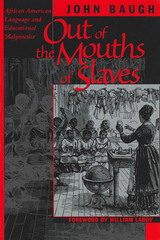
Winner, A Choice Outstanding Academic Book
When the Oakland, California, school board called African American English "Ebonics" and claimed that it "is not a black dialect or any dialect of English," they reignited a debate over language, race, and culture that reaches back to the era of slavery in the United States. In this book, John Baugh, an authority on African American English, sets new parameters for the debate by dissecting and challenging many of the prevailing myths about African American language and its place in American society.
Baugh's inquiry ranges from the origins of African American English among slaves and their descendants to its recent adoption by standard English speakers of various races. Some of the topics he considers include practices and malpractices for educating language minority students, linguistic discrimination in the administration of justice, cross-cultural communication between Blacks and whites, and specific linguistic aspects of African American English. This detailed overview of the main points of debate about African American language will be important reading for both scholars and the concerned public.

Every American has heard of the lumberjack hero Paul Bunyan and his big blue ox. For 100 years his exploits filled cartoons, magazines, short stories, and children's books, and his name advertised everything from pancake breakfasts to construction supplies. By 1950 Bunyan was a ubiquitous icon of America's strength and ingenuity. Until now, no one knew where he came from—and the extent to which this mythical hero is rooted in Wisconsin.
Out of the Ordinary explores the functions of belief and supernatural experience within an array of cultures, as well as the stance of academe toward the study of belief and the supernatural. The essays in this volume call into question the idea that supernatural experience is extraordinary.
Among the contributors are Shelley Adler, David Hufford, Barre Toelken, and Gillian Bennett.
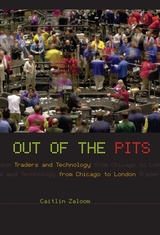
From New York to Singapore, from Chicago to London, the trading floors of the world’s financial markets are icons of global capitalism. Images of them are used on the news all the time—traders burying their heads in their hands when the market is down, their arms flailing in a frenzy when fortunes are rising—to convey the current state of the economy. But these marketplaces, and the cultural life that sustains them, are dissolving into the ether of the digital age: powerful financial institutions are shutting down the trading pits, replacing face-to-face exchanges with an electronic network where traders sit, face to screen, finger to mouse, and compete in a global arena made up of digits and charts.
Out of the Pits considers the implications of this sea change for everyone involved, from the traders and brokers to the market as a whole. Caitlin Zaloom takes us down to the floor at the Chicago Board of Trade and into a digital dealing room in the City of London. Drawing on her own firsthand experiences as a clerk and a trader and on her unusual access to these key sites of global finance, she explainshow changes at the world’s leading financial exchanges have transformed economic cultures and the craft of speculation; how people and places are responding to the digital transition; how traders are remaking themselves to compete in the contemporary marketplace; and how brokers, business managers, and software designers are collaborating to build new financial markets.
A penetrating and richly detailed account of how cities, culture, and technology shape everyday life in the new global economy, Out of the Pits will be must reading for business buffs or anyone who has ever wondered how financial markets work.
A detailed analysis of Poland and the Czech Republic suggests that alternation between strategies has been the secret to the success of East-Central European countries.
This comparative case analysis identifies the significance of reform mistakes during transition and the corrective benefits of policy alternation, its claims illustrated with an in-depth study of privatization policy in the two countries.
Mitchell A. Orenstein delves into the historic struggle to build capitalism and democracy during a decade of post- communist transition in East-Central Europe and develops a model that explains why democratic policy alternation may accelerate policy learning under conditions of uncertainty and constraint.
Out of the Red is accessible to a general audience and as such is suitable for both graduate and undergraduate courses on political economy. It will be of particular interest to economists, political scientists, sociologists, students of postcommunism, and anyone interested in the relations between capitalism and democracy in the contemporary world.
Mitchell A. Orenstein is Assistant Professor of Political Science, Syracuse University.
Faculty Senate Award for Research from Loyola University New Orleans
Out of the Red is one man’s pathbreaking story of how social forces and personal choices combined to deliver an unfortunate fate. After a childhood of poverty, institutional discrimination, violence, and being thrown away by the public education system, Bolden's life took him through the treacherous landscape of street gangs at the age of fourteen. The Bloods offered a sense of family, protection, excitement, and power. Incarcerated during the Texas prison boom, the teenage former gangster was thrust into a fight for survival as he navigated the perils of adult prison. As mass incarceration and prison gangs swallowed up youth like him, survival meant finding hope in a hopeless situation and carving a path to his own rehabilitation. Despite all odds, he forged a new path through education, ultimately achieving the seemingly impossible for a formerly incarcerated ex-gangbanger.
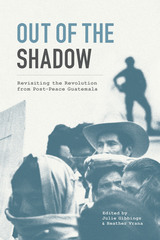
Guatemala’s “Ten Years of Spring” (1944–1954) began when citizens overthrew a military dictatorship and ushered in a remarkable period of social reform. This decade of progressive policies ended abruptly when a coup d’état, backed by the United States at the urging of the United Fruit Company, deposed a democratically elected president and set the stage for a period of systematic human rights abuses that endured for generations. Presenting the research of diverse anthropologists and historians, Out of the Shadow offers a new examination of this pivotal chapter in Latin American history.
Marshaling information on regions that have been neglected by other scholars, such as coastlines dominated by people of African descent, the contributors describe an era when Guatemalan peasants, Maya and non-Maya alike, embraced change, became landowners themselves, diversified agricultural production, and fully engaged in electoral democracy. Yet this volume also sheds light on the period’s atrocities, such as the US Public Health Service’s medical experimentation on Guatemalans between 1946 and 1948. Rethinking institutional memories of the Cold War, the book concludes by considering the process of translating memory into possibility among present-day urban activists.
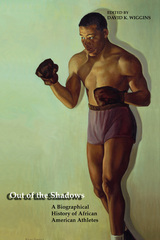

Because Willis stopped writing about music in the early 1980s—when, she felt, rock ’n’ roll had lost its political edge—her significant contribution to the history and reception of rock music has been overshadowed by contemporary music critics like Robert Christgau, Lester Bangs, and Dave Marsh. Out of the Vinyl Deeps collects for the first time Willis’s Rock, Etc. columns and her other writings about popular music from this period (includingliner notes for works by Lou Reed and Janis Joplin) and reasserts her rightful place in rock music criticism.
More than simply setting the record straight, Out of the Vinyl Deeps reintroduces Willis’s singular approach and style—her use of music to comment on broader social and political issues, critical acuity, vivid prose, against-the-grain opinions, and distinctly female (and feminist) perspective—to a new generation of readers. Featuring essays by the New Yorker’s current popular music critic, Sasha Frere-Jones, and cultural critics Daphne Carr and Evie Nagy, this volume also provides a lively and still relevant account of rock music during, arguably, its most innovative period.
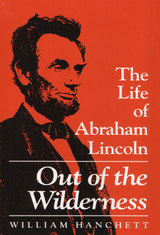
follows Abraham Lincoln from his birth and chronicles his thirst for education,
his achievements as a lawyer and congressman, his presidency, and his
assassination.
Hanchett gives readers a deeper understanding of how Lincoln's self-directed
study and clear thinking offset his lack of a formal education, enabling
him to become a respected and successful attorney. He also shows how Lincoln's
uncanny leadership helped him to end slavery and still keep the divided
North sufficiently united to win the Civil War. By focusing on a variety
of roles and settings, Hanchett invites readers to get to know Lincoln
as a president, as well as a lover, husband, father, and friend.
"Excellent! Hanchett is a fine writer, and his biography of Lincoln
is succinct and thought-provoking."
-- Frank J. Williams, president, Abraham Lincoln Association
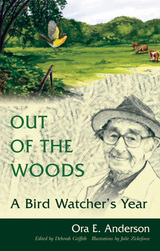
Out of the Woods: A Bird Watcher’s Year is a journey through the seasons and a joyous celebration of growing old. In fifty-nine essays and poems, Ora E. Anderson, birder, bird carver, naturalist, and nature writer, reveals the insights and recollections of a keen-eyed observer of nature, both human and avian. The essays follow the rivers and creeks, the highways and little-known byways of Appalachia, and along the way we become nearly as familiar with its numerous bird, plant, and animal species as with the author himself.
These are not the memories of a single year, however, but of a long lifetime spent immersed in the natural world. Out of the Woods, presented with humor and passion, is an account of a well-lived, productive, and satisfying life. The essays offer an intimate portrait of a half century of Anderson's life on his beloved old farm (more nearly a nature preserve), where he lived in harmony with birds and nature and followed the rhythm of the seasons. We are invited to share the joys—and the disappointments and sorrows—inherent in such a life.
Generously illustrated with Julie Zickefoose’s detailed and evocative drawings, this book will delight bird watchers, artists, naturalists, backyard gardeners, and anyone who is ever tempted to take a rutted, overgrown path just to see where it leads.

Have you ever wondered about society’s desire to cultivate the perfect lawn, why we view some animals as “good” and some as “bad,” or even thought about the bits of nature inside everyday items–toothbrushes, cell phones, and coffee mugs? In this fresh and introspective collection of essays, Julia Corbett examines nature in our lives with all of its ironies and contradictions by seamlessly integrating personal narratives with morsels of highly digestible science and research. Each story delves into an overlooked aspect of our relationship with nature—insects, garbage, backyards, noise, open doors, animals, and language—and how we cover our tracks.
With a keen sense of irony and humor and an awareness of the miraculous in the mundane, Julia recognizes the contradictions of contemporary life. She confronts the owner of a high-end market who insists on keeping his doors open in all temperatures. Takes us on a trip to a new mall with a replica of a trout stream that once flowed nearby. The phrase “out of the woods” guides us through layers of meaning to a contemplation of grief, remembrance, and resilience.
Out of the Woods leads to surprising insights into the products, practices, and phrases we take for granted in our everyday encounters with nature and encourages us all to consider how we might re-value or reimagine our relationships with nature in our everyday lives.
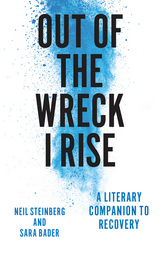
Addiction is easy to fall into and hard to escape. It destroys the lives of individuals, and has a devastating cost to society. The National Institute of Health estimates seventeen million adults in the United States are alcoholics or have a serious problem with alcohol. At the same time, the country is seeing entire communities brought to their knees because of opioid additions. These scourges affect not only those who drink or use drugs but also their families and friends, who witness the horror of addiction. With Out of the Wreck I Rise, Neil Steinberg and Sara Bader have created a resource like no other—one that harnesses the power of literature, poetry, and creativity to illuminate what alcoholism and addiction are all about, while forging change, deepening understanding, and even saving lives.
Structured to follow the arduous steps to sobriety, the book marshals the wisdom of centuries and explores essential topics, including the importance of time, navigating family and friends, relapse, and what Raymond Carver calls “gravy,” the reward that is recovery. Each chapter begins with advice and commentary followed by a wealth of quotes to inspire and heal. The result is a mosaic of observations and encouragement that draws on writers and artists spanning thousands of years—from Seneca to David Foster Wallace, William Shakespeare to Patti Smith. The ruminations of notorious drinkers like John Cheever, Charles Bukowski, and Ernest Hemingway shed light on the difficult process of becoming sober and remind the reader that while the literary alcoholic is often romanticized, recovery is the true path of the hero.
Along with traditional routes to recovery—Alcoholics Anonymous, out-patient therapy, and intensive rehabilitation programs—this literary companion offers valuable support and inspiration to anyone seeking to fight their addiction or to a struggling loved one.
Featuring Charles Bukowski, John Cheever, Dante, Ricky Gervais, Ernest Hemingway, Billie Holiday, Anne Lamott, John Lennon, Haruki Murakami, Anaïs Nin, Mary Oliver, Samuel Pepys, Rainer Maria Rilke, J. K. Rowling, Patti Smith, Kurt Vonnegut, and many more.

From her perch in rural Kalona, Iowa, Swander discovers new strength and self-reliance along with a community of hardworking and hospitable neighbors. Raising goats and poultry, participating in barn raisings and auctions, protecting her garden from a plague of grasshoppers, creating a living crèche at Christmastime, all the while laughing at her attempts to wrestle with the pioneer challenges of midwestern winters and summers, she explores what it means to be a lone physical and spiritual homesteader at the end of the twentieth century.
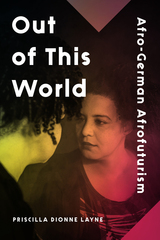
Examining Afro-German artists’ use of Afrofuturist tropes to critique German racial history
The term Afrofuturism was first coined in the 1990s to describe African diasporic artists’ use of science fiction, speculative fiction, and fantasy to reimagine the diaspora’s pasts and to counter not only Eurocentric prejudices but also pessimistic narratives. Out of This World: Afro-German Afrofuturism focuses on contemporary Black German Afrofuturist literature and performance that critiques Eurocentrism and, specifically, German racism and colonial history. This young generation has, Priscilla Layne argues, engaged with Afrofuturism to disrupt linear time and imagine alternative worlds, to introduce non-Western technologies into the German cultural milieu, and to consider the possibilities of posthumanism. Their experiments in futurist and speculative narratives offer new tools for breaking with the binary thinking about race, culture, and gender identity that have been enforced by repressive ideological and state apparatuses, such as educational, cultural, and police institutions. Rather than providing escapism or purely imaginary alternatives, however, they have created a space—outer and artistic—in which their lives matter.
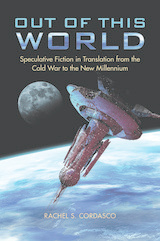
An informative and one-of-a-kind guide, Out of This World offers readers and scholars alike a tour of speculative fiction's new globalized era.
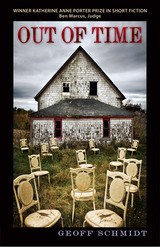
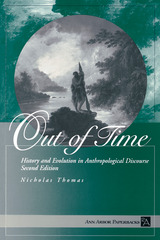
When it was first published in 1989, Out of Time generated much-needed discussion on the appropriate models for historical anthropology. Thomas considered that both the historical structuralism of Marshall Sahlins and neo-Marxist regional systems theory had failed to transcend crucial limitations of conventional anthropology. Yet they provided elements of a more stimulating and critical perspective, which would also take account of contemporary political developments in the Pacific region.
For this second edition, Thomas has added an afterword that reflects on the book's initial reception and brings its critique up to date. He suggests a need to historicize the professionalization of anthropology as a discipline to understand shifts in practice and the need to acknowledge the historical specificity and limits of all forms of cultural knowledge, whether "Western" or indigenous.
Out of Time will be a useful text for graduate courses in anthropology, history, and cultural studies.
"This book displays rare integrity: Thomas' intellectual stance toward the theoretical approaches of others is fully consistent with his own discursive practices." --Contemporary Pacific
Nicholas Thomas is Senior Research Fellow, Department of Archaeology and Anthropology, Australian National University.
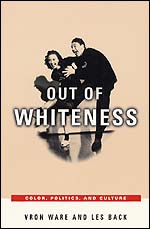
Vron Ware and Les Back look at key points in recent American and British culture where the "color line" has been blurred. Through probing accounts of racial masquerades in popular literature, the growth of the white power music scene on the Internet, the meteoric rise of big band jazz during the Second World War, and the pivotal role of white session players in crafting rhythm and blues classics by black artists, Ware and Back upset the idea of race as a symbol of inherent human attributes. Their book gives us a timely reckoning of the forces that continue to make people "white," and reveals to us the polyglot potential of identities and cultures.
READERS
Browse our collection.
PUBLISHERS
See BiblioVault's publisher services.
STUDENT SERVICES
Files for college accessibility offices.
RECENTLY PUBLISHED


UChicago Accessibility Resources
home | accessibility | search | about | contact us
BiblioVault ® 2001 - 2026
The University of Chicago Press