
 A SCHOLARLY BOOK REPOSITORY
195 start with P start with P

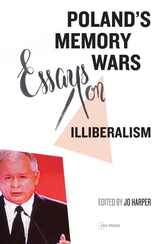
This volume of essays and interviews by Polish, British, and American academics and journalists provides an overview of current Polish politics for both informed and non-specialist readers. The essays consider why and how PiS, Law and Justice, the party of Jarosław Kaczynski, returned to power, and the why and how of its policies while in power. They help to make sense of how “history” plays a key role in Polish public life and politics.
The descriptions of PiS in Western media tend to rework old stereotypes about Eastern Europe that had lain dormant for some time. The book addresses the underlying question whether PiS was simply successful in understanding its electorate, and just helped Poland to revert to its normal state. This new Normal seems quite similar to the old one: insular, conservative, xenophobic, and statist.
The book looks at the current struggle between one ‘Poland’ and another; between a Western-looking Poland and an inward-looking Poland, the former more interested in opening to the world, competing in open markets, and working within the EU, and the latter more concerned with holding onto tradition.
The question of illiberalism has gone from an ‘Eastern’ problem (Russia, Turkey, Hungary, etc.) to a global one (Brexit and the U.S. elections). This makes the very specific analysis of Poland’s illiberalism applicable on a broader scale.

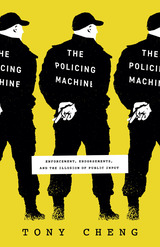
The past few years have seen Americans express passionate demands for police transformation. But even as discussion of no-knock warrants, chokeholds, and body cameras has exploded, any changes to police procedures have only led to the same outcomes. Despite calls for increased accountability, police departments have successfully stonewalled change.
In The Policing Machine, Tony Cheng reveals the stages of that resistance, offering a close look at the deep engagement strategies that NYPD precincts have developed with only subsets of the community in order to counter any truly meaningful, democratic oversight. Cheng spent nearly two years in an unprecedented effort to understand the who and how of police-community relationship building in New York City, documenting the many ways the police strategically distributed power and privilege within the community to increase their own public legitimacy without sacrificing their organizational independence. By setting up community councils that are conveniently run by police allies, handing out favors to local churches that will promote the police to their parishioners, and offering additional support to institutions friendly to the police, the NYPD, like police departments all over the country, cultivates political capital through a strategic politics that involves distributing public resources, offering regulatory leniency, and deploying coercive force. The fundamental challenge with police-community relationships, Cheng shows, is not to build them. It is that they already exist and are motivated by a machinery designed to stymie reform.
Health care delivery in the United States is an enormously complex enterprise, and its $1.6 trillion annual expenditures involve a host of competing interests. While arguably the nation offers among the most technologically advanced medical care in the world, the American system consistently under performs relative to its resources. Gaps in financing and service delivery pose major barriers to improving health, reducing disparities, achieving universal insurance coverage, enhancing quality, controlling costs, and meeting the needs of patients and families.
Bringing together twenty-five of the nation’s leading experts in health care policy and public health, this book provides a much-needed perspective on how our health care system evolved, why we face the challenges that we do, and why reform is so difficult to achieve. The essays tackle tough issues including: socioeconomic disadvantage, tobacco, obesity, gun violence, insurance gaps, the rationing of services, the power of special interests, medical errors, and the nursing shortage.
Linking the nation’s health problems to larger political, cultural, and philosophical contexts, Policy Challenges in Modern Health Care offers a compelling look at where we stand and where we need to be headed.

Political and Social Writings: Volume 3, 1961–1979 was first published in 1992. Minnesota Archive Editions uses digital technology to make long-unavailable books once again accessible, and are published unaltered from the original University of Minnesota Press editions.
This work offers an extraordinary wealth and variety of writings from the crucial years that followed the publication of Castoriadis's landmark text, Modern Capitalism and Revolution. The "new orientation" he proposed for the Socialisme ou Barbarie group centered on the emerging roles of women, youth, and minorities in the growing challenge to established society in the early sixties. Resistance within the group to this new orientation led Castoriadis to criticize the "neopaleo- Marxism" of Jean-François Lyotard and others who ultimately left Socialisme ou Barbarie. A heightened concern for ethnological issues culminated in what might be called, to the embarrassment of today's "poststructuralists," Castoriadis's "premature antistructuralism."
Additional texts examine the dissolution of the group itself and analyze the May 1968 rebellion of workers and students - who, according to their own testimony, were inspired by ideas developed in the group's journal. Also included were many of Castoriadis's still-relevant political writings from the seventies, which were developed in tandem with the more explicitly philosophical work now found in The Imaginary Institution of Society and Crossroads in the Labyrinth.
Political and Social Writings: Volume 3 provides key elements for a radical renewal of emancipatory thought and action while offering an irreplaceable and hitherto missing perspective on postwar French thought.
In the variegated history of the philosophical definitions of man, one has survived since it has been given the status of the self-evident. The definition in question comes from Aristotle’s Politics: “the human is a political animal” (1253a3). There is something indisputable about this characterization: humans are, indeed, the most social of animals – they are denizens of the polis with its institutions and laws, its rulers, judges and generals. It would be difficult to contend that any other animal has recourse to the political as much as the human.
Aristotle’s Politics need not be surrendered to the strictures of humanism. It remains amenable to the new schema for the political animal that we are sketching here. Each article collected in this issue responds – in its own way and by establishing its own protocols – to the exigency of the animal as it was formulated in Aristotle’s Politics. Each article is an act of response, a moment of interruption.
Eight analytical histories of the automobile, steel, semiconductor, lumber, wheat, and textile and apparel industries demonstrate that trade barriers rarely have unequivocal benefits and may be counterproductive. They show that criteria for awarding protection do not take into account the interests of consumers or other industries and that political influence and an organized lobby are major sources of protection.
Based on these findings, a final essay suggests that current policy fails to consider adequately economic efficiency, the public good, and indirect negative effects. This volume will interest scholars in economics, business, and public policy who deal with trade issues.
In case studies of trade barriers imposed during the 1980s to help the steel, semiconductor, automobile, lumber, wheat, and textile and apparel industries, the contributors trace the evolution of efforts to obtain protection, protectionist measures, and their results. A chapter assessing the common themes that emerge from the studies concludes that the focus of current trade law is exclusively on the individual protection-seeking industries, with little regard for indirect effects on using industries or for consumers. Reform could usefully take these effects into account.
This volume will interest policymakers, business executives, and anyone interested in trade policy formulation and practice.
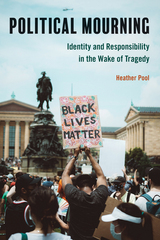
What leads us to respond politically to the deaths of some citizens and not others? This is one of the critical questions Heather Pool asks in Political Mourning. Born out of her personal experiences with the trauma of 9/11, Pool’s astute book looks at how death becomes political, and how it can mobilize everyday citizens to argue for political change.
Pool examines four tragedies in American history—the Triangle Shirtwaist Factory Fire, the lynching of Emmett Till, the September 11 attacks, and the Black Lives Matter movement—that offered opportunities to tilt toward justice and democratic inclusion. Some of these opportunities were taken, some were not. However, these watershed moments show, historically, how political identity and political responsibility intersect and how racial identity shapes who is mourned. Political Mourning helps explain why Americans recognize the names of Trayvon Martin and Sandra Bland; activists took those cases public while many similar victims have been ignored by the news media.
Concluding with an afterword on the coronavirus, Pool emphasizes the importance of collective responsibility for justice and why we ought to respond to tragedy in ways that are more politically inclusive.

Several French theorists have recently attempted a new account of rights, one that would replace the discredited Marxist view of rights as mere formalities concealing the realities of class domination. In this final volume of Political Philosophy, Luc Ferry and Alain Renaut summarize these efforts and put forward their own set of arguments.
Political Prairie Fire was first published in 1955. Minnesota Archive Editions uses digital technology to make long-unavailable books once again accessible, and are published unaltered from the original University of Minnesota Press editions.
Political Prairie Fire was first published in 1955.
The farmers of North Dakota were ripe for revolt when the magnetic figure of A. C. Townley strode into their midst and offered them a new political formula to redress their grievances. Townley's plan was simple but revolutionary; it called for the formation of a Nonpartisan Political League dedicated to the election of candidates through the established two-party system and to a platform emphasizing public ownership of certain vital farm services and facilities, such as terminal grain elevators and hail insurance on crops.
Like the great prairie fires of the plains states, the political flames of the Nonpartisan League spread swiftly from one farm to the next across North Dakota and into the adjoining states. The League is regarded by many as the last of the great agrarian protest movements. It is historically significant because it achieved a measure of success well beyond that of most similar movements. It controlled the government of one state for some years, elected state officials and legislators in a number of midwestern and western states, and sent several congressmen to Washington. Its impact helped shape the destinies of a dozen states and the political philosophies of an important segment of the nation's voters. The League's methods of operation often serve today as a guide for political action.
This is the first detailed, unbiased history of the Nonpartisan League. Thoroughly documented for the specialist, it is nevertheless equally interesting for the general reader.
In this provocative and engagingly written book, the authors argue that the reality is quite the opposite. In fact, when not facing election, contemporary presidents and members of Congress routinely ignore the public's policy preferences and follow their own political philosophies, as well as those of their party's activists, their contributors, and their interest group allies. Politicians devote substantial time, effort, and money to tracking public opinion, not for the purposes of policymaking, but to change public opinion—to determine how to craft their public statements and actions to win support for the policies they and their supporters want.
Taking two recent, dramatic episodes—President Clinton's failed health care reform campaign, and Newt Gingrich's "Contract with America"—as examples, the authors show how both used public opinion research and the media to change the public's mind. Such orchestrated displays help explain the media's preoccupation with political conflict and strategy and, the authors argue, have propelled levels of public distrust and fear of government to record highs.
Revisiting the fundamental premises of representative democracy, this accessible book asks us to reexamine whether our government really responds to the broad public or to the narrower interests and values of certain groups. And with the 2000 campaign season heating up, Politicians Don't Pander could not be more timely.
"'Polling has turned leaders into followers,' laments columnist Marueen Dowd of The New York Times. Well, that's news definitely not fit to print say two academics who have examined the polls and the legislative records of recent presidents to see just how responsive chief executives are to the polls. Their conclusion: not much. . . . In fact, their review and analyses found that public opinion polls on policy appear to have increasingly less, not more, influence on government policies."—Richard Morin, The Washington Post
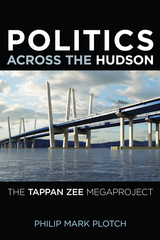
The State of New York built one of the world’s longest, widest, and most expensive bridges—the new Tappan Zee Bridge—stretching more than three miles across the Hudson River, approximately thirteen miles north of New York City. In Politics Across the Hudson, urban planner Philip Plotch offers a behind-the-scenes look at three decades of contentious planning and politics centered around this bridge, recently renamed for Governor Mario M. Cuomo, the state's governor from 1983 to 1994. He reveals valuable lessons for those trying to tackle complex public policies while also confirming our worst fears about government dysfunction.
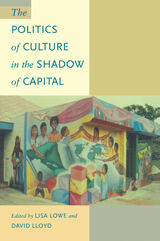
Reworking Marxist critique, these essays on Asia, Latin America, the Caribbean, North America, and Europe advance a new understanding of "cultural politics" within the context of transnational neocolonial capitalism. This perspective contributes to an overall critique of traditional approaches to modernity, development, and linear liberal narratives of culture, history, and democratic institutions. It also frames a set of alternative social practices that allows for connections to be made between feminist politics among immigrant women in Britain, women of color in the United States, and Muslim women in Iran, Egypt, Pakistan, and Canada; the work of subaltern studies in India, the Philippines, and Mexico; and antiracist social movements in North and South America, the Caribbean, and Europe. These connections displace modes of opposition traditionally defined in relation to the modern state and enable a rethinking of political practice in the era of global capitalism.
Contributors. Tani E. Barlow, Nandi Bhatia, Dipesh Chakrabarty, Chungmoo Choi, Clara Connolly, Angela Davis, Arturo Escobar, Grant Farred, Homa Hoodfar, Reynaldo C. Ileto, George Lipsitz, David Lloyd, Lisa Lowe, Martin F. Manalansan IV, Aihwa Ong, Pragna Patel, José Rabasa, Maria Josefina Saldaña-Portillo, Jaqueline Urla
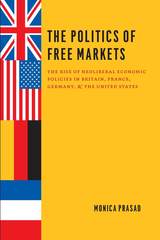
In The Politics of Free Markets, a comparative-historical analysis of the development of neoliberal policies in these four countries,Monica Prasad argues that neoliberalism was made possible in the United States and Britain not because the Left in these countries was too weak, but because it was in some respects too strong. At the time of the oil crisis in the 1970s, American and British tax policies were more punitive to business and the wealthy than the tax policies of France and West Germany; American and British industrial policies were more adversarial to business in key domains; and while the British welfare state was the most redistributive of the four, the French welfare state was the least redistributive. Prasad shows that these adversarial structures in the United States and Britain created opportunities for politicians to find and mobilize dissatisfaction with the status quo, while the more progrowth policies of France and West Germany prevented politicians of the Right from anchoring neoliberalism in electoral dissatisfaction.


When workmen excavating the ruins of Pompeii eagerly gathered the native medicinal plants growing there, Wilhelmina Jashemski discovered that this was another example of the continuity of life in the shadow of Vesuvius. Many of the plants used for herbal medicine around Pompeii today are the same ones that ancient authorities such as Pliny the Elder and Dioscorides recommended for treating the same types of disorders.
In this book, Jashemski presents an herbal of thirty-six medicinal plants, most of them known to the ancients and still employed today. She describes each plant's contemporary medicinal uses and compares them to ancient practices as recorded in literary sources. Scientific, English, and Italian names and the plant's mythological associations complete the entries, while elegant, full-page portraits depict each plant visually.

This fascinating study traces the birth of containerization to Port Newark, New Jersey, in 1956 when trucker Malcom McLean thought of a brilliant new way to transport cargo. It tells the story of how Port Newark grew rapidly as McLean’s idea was backed by both New York banks and the US military, who used containerization to ship supplies to troops in Vietnam. Angus Gillespie takes us behind the scenes of today’s active container shipping operations in Port Newark, talking to the pilots who guide the ships into port, the Coast Guard personnel who help manage the massive shipping traffic, the crews who unload the containers, and even the chaplains who counsel and support the mariners. Port Newark shines a spotlight on the unsung men and women who help this complex global shipping operation run smoothly.
Since McLean's innovation, Port Newark has expanded with the addition of the nearby Elizabeth Marine Terminal. This New Jersey complex now makes up the busiest seaport on the East Coast of the United States. Some have even called it “America’s Front Door.” The book tells the story of the rapid growth of worldwide containerization, and how Port Newark has adapted to bigger ships with deeper channels and a raised bridge. In the end, there is speculation of the future of this port with ever-increasing automation, artificial intelligence, and automation.
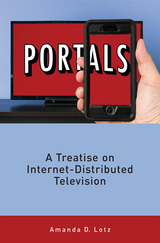
Portals: A Treatise on Internet-Distributed Television pushes understandings of the business of television to keep pace with the considerable technological change of the last decade. It explains why shows such as Orange is the New Black or Transparent are indeed television despite coming to screens over internet connection and in exchange for a monthly fee. It explores how internet-distributed television is able to do new things – particularly, allow different people to watch different shows chosen from a library of possibilities. This technological ability allows new audience behaviors and new norms in making television.
Portals are the “channels” of internet-distributed television, and Portals identifies how the task of curating a library of shows differs from channels’ task of building a schedule. It explores the business model—subscriber funding—that supports many portals, and identifies the key differences from advertiser or direct purchase. Portals considers what we know about the future of television, even though we remain early in a process of transformative change.
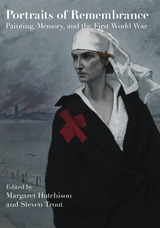
Although photography and moving pictures achieved ubiquity during the First World War as technological means of recording history, the far more traditional medium of painting played a vital role in the visual culture of combatant nations. The public’s appetite for the kind of up-close frontline action that snapshots and film footage could not yet provide resulted in a robust market for drawn or painted battle scenes.
Painting also figured significantly in the formation of collective war memory after the armistice. Paintings became sites of memory in two ways: first, many governments and communities invested in freestanding panoramas or cycloramas that depicted the war or featured murals as components of even larger commemorative projects, and second, certain paintings, whether created by official artists or simply by those moved to do so, emerged over time as visual touchstones in the public’s understanding of the war.
Portraits of Remembrance: Painting, Memory, and the First World War examines the relationship between war painting and collective memory in Australia, Austria, Belgium, Canada, Croatia, France, Germany, Great Britain, New Zealand, Russia, Serbia, Turkey, and the United States. The paintings discussed vary tremendously, ranging from public murals and panoramas to works on a far more intimate scale, including modernist masterpieces and crowd-pleasing expressions of sentimentality or spiritualism. Contributors raise a host of topics in connection with the volume’s overarching focus on memory, including national identity, constructions of gender, historical accuracy, issues of aesthetic taste, and connections between painting and literature, as well as other cultural forms.

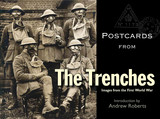
The cards in this compelling volume were created not only by soldiers, but also by embedded journalists from France, Belgium, Austria, Germany, and Britain. The images capture scenes both humorous and poignant, including soldiers having a mock party with little food to eat, wounded soldiers smiling for the camera, a makeshift trench hospital, the bloody aftermath of a battle, and a huddle of men taking what they know could be their last communion before marching onto the battlefield. Other cards document the mundane duties that dominated wartime life, including men digging trenches, troops marching to new trenches and battlefields, and or soldiers nearly comatose with boredom while waiting for the fight to begin. This stunning visual narrative opens a new window into one of the most analyzed events in history, as the postcards’ images testify to the resilience and bravery of soldiers in the most trying circumstances.
A fascinating and unprecedented historical document, Postcards from the Trenches draws back the curtain to unflinchingly show the daily horror and humanity that define life in war.
Dobrin evaluates the current state of composition studies, underscoring the difference between composition and writing and arguing that the field's focus on the administration of writing students and its historically imposed prohibition on theory greatly limit what can be understood about writing. Instead he envisions a more significant approach to writing, one that questions the field's conservative allegiance to subject and administration and reconsiders writing as spatial and ecological. Using concepts from ecocomposition, spatial theory, network theory, complexity theory, and systems theory, Postcomposition lays the groundwork for a networked theory of writing, and advocates the abandonment of administration as a useful part of the field. He also challenges the usefulness of rhetoric in writing studies, showing how writing exceeds rhetoric.
Postcomposition is a detailed consideration of how posthumanism affects the field's understanding of subjectivity. It also tears at the seams of the "contingent labor problem." As he articulates his own frustrations with the conservatism of composition studies and builds on previous critiques of the discipline, Dobrin stages a courageous-and inevitably polemical-intellectual challenge to the entrenched ideas and assumptions that have defined composition studies.
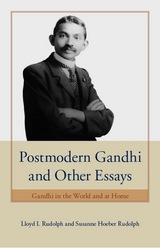
Gandhi, with his loincloth and walking stick, seems an unlikely advocate of postmodernism. But in Postmodern Gandhi, Lloyd and Susanne Rudolph portray him as just that in eight thought-provoking essays that aim to correct the common association of Gandhi with traditionalism.
Combining core sections of their influential book Gandhi: The Traditional Roots of Charisma with substantial new material, the Rudolphs reveal here that Gandhi was able to revitalize tradition while simultaneously breaking with some of its entrenched values and practices. Exploring his influence both in India and abroad, they tell the story of how in London the young activist was shaped by the antimodern “other West” of Ruskin, Tolstoy, and Thoreau and how, a generation later, a mature Gandhi’s thought and action challenged modernity’s hegemony. Moreover, the Rudolphs argue that Gandhi’s critique of modern civilization in his 1909 book Hind Swaraj was an opening salvo of the postmodern era and that his theory and practice of nonviolent collective action (satyagraha) articulate and exemplify a postmodern understanding of situational truth.
This radical interpretation of Gandhi's life will appeal to anyone who wants to understand Gandhi’s relevance in this century, as well as students and scholars of politics, history, charismatic leadership, and postcolonialism.

Beginning with his early days with the Peace Corps in Africa and culminating with a recent bout with cancer, The Power of the Between is an evocative account of the circuitous path Stoller’s life has taken, offering a fascinating depiction of how a career is shaped over decades of reading and research. Stoller imparts his accumulated wisdom not through grandiose pronouncements but by drawing on his gift for storytelling. Tales of his apprenticeship to a sorcerer in Niger, his studies with Claude Lévi-Strauss in Paris, and his friendships with West African street vendors in New York City accompany philosophical reflections on love, memory, power, courage, health, and illness.
Graced with Stoller’s trademark humor and narrative elegance, The Power of the Between is both the story of a distinguished career and a profound meditation on coming to terms with the impermanence of all things.

In a thorough comparison of the Bush and Obama administrations’ national security policies, Chris Edelson demonstrates that President Obama and his officials have used softer rhetoric and toned-down legal arguments, but in key areas—military action, surveillance, and state secrets—they have simply found new ways to assert power without meaningful constitutional or statutory constraints.
Edelson contends that this legacy of the two immediately post-9/11 presidencies raises crucial questions for future presidents, Congress, the courts, and American citizens. Where is the political will to restore a balance of powers among branches of government and adherence to the rule of law? What are the limits of authority regarding presidential national security power? Have national security concerns created a permanent shift to unconstrained presidential power?
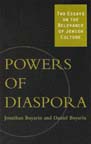
Reasserts the centrality of Jewish culture to contemporary discussions of diaspora
Diaspora: the scattering of a people, often described as a condition of helplessness and a pathology to be overcome. It can also be, as Jonathan Boyarin and Daniel Boyarin assert in this provocative work, a unique source of power and strength. Focusing on Jewish experience, Powers of Diaspora forcefully argues that diasporic communities exercise a distinct form of cultural power in order to maintain themselves.
With reference to rabbinic culture and contemporary Jewish ethnography, the authors evoke the cultural strategies of Jewish diaspora—of regeneration through statelessness—that should prove increasingly relevant to the dilemmas and possibilities of the "new diasporas" born in the midst and in the aftermath of the modern world-system. Their work exposes the various methods by which peoples in diaspora "legislate" distinctive ways of life and establish formal communal structures, thus creating fluid yet effective boundaries between themselves and the others who surround them, and critiques the internal power dynamics that can sometimes result.Powers of Diaspora strongly reasserts the place of Jewish culture in contemporary discussions of diaspora, where the cultural politics of postcolonialism have remarginalized Jewish experience; at the same time, it brings insights from studies of other diasporas to bear on the study of Jews. In challenging the equation of diaspora with powerlessness, the book questions the modern nation-state ideal and suggests that diasporic cultural formations offer important clues toward an alternative means of relating culture to polity.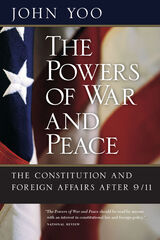
John Yoo, formerly a lawyer in the Department of Justice, here makes the case for a completely new approach to understanding what the Constitution says about foreign affairs, particularly the powers of war and peace. Looking to American history, Yoo points out that from Truman and Korea to Clinton's intervention in Kosovo, American presidents have had to act decisively on the world stage without a declaration of war. They are able to do so, Yoo argues, because the Constitution grants the president, Congress, and the courts very different powers, requiring them to negotiate the country's foreign policy. Yoo roots his controversial analysis in a brilliant reconstruction of the original understanding of the foreign affairs power and supplements it with arguments based on constitutional text, structure, and history.
Accessibly blending historical arguments with current policy debates, The Powers of War and Peace will no doubt be hotly debated. And while the questions it addresses are as old and fundamental as the Constitution itself, America's response to the September 11 attacks has renewed them with even greater force and urgency.
“Yoo’s theory promotes frank discussion of the national interest and makes it harder for politicians to parade policy conflicts as constitutional crises. Most important, Yoo’s approach offers a way to renew our political system’s democratic vigor.”—David B. Rivkin Jr. and Carlos Ramos-Mrosovsky, National Review
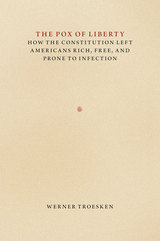
Werner Troesken looks at the history of the United States with a focus on three diseases—smallpox, typhoid fever, and yellow fever—to show how constitutional rules and provisions that promoted individual liberty and economic prosperity also influenced, for good and for bad, the country’s ability to eradicate infectious disease. Ranging from federalism under the Commerce Clause to the Contract Clause and the Fourteenth Amendment, Troesken argues persuasively that many institutions intended to promote desirable political or economic outcomes also hindered the provision of public health. We are unhealthy, in other words, at least in part because our political and legal institutions function well. Offering a compelling new perspective, The Pox of Liberty challenges many traditional claims that infectious diseases are inexorable forces in human history, beyond the control of individual actors or the state, revealing them instead to be the result of public and private choices.

Practical Botany for Gardeners provides an elegant and accessible introduction to the world of botany. It presents the essentials that every gardener needs to know, connecting explanations of scientific facts with useful gardening tips. Flip to the roots section and you’ll not only learn how different types of roots support a plant but also find that adding fungi to soil aids growth. The pruning section both defines “lateral buds” and explains how far back on a shoot to cut in order to propagate them.
The book breaks down key areas and terminology with easy-to-navigate chapters arranged by theme, such as plant types, plant parts, inner workings, and external factors. “Great Botanists” and “Botany in Action” boxes delve deeper into the fascinating byways of plant science. This multifaceted book also includes two hundred botanical illustrations and basic diagrams that hearken to the classic roots of botany.
Part handbook, part reference, Practical Botany for Gardeners is a beautifully captivating read. It’s a must for garden lovers and backyard botanists who want to grow and nurture their own plant knowledge.
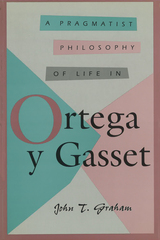
Jose Ortega y Gasset (1883-1955), the most widely known and well liked of Spanish philosophers, was much admired in the United States from the 1930s through the 1960s for Revolt of the Masses, History as a System, and Dehumanization of Art, among other works. Those popular works, however, poorly reflected the complexity of Ortega's philosophy. In this first historical analysis of all the parts of Ortega's total thought, John Graham explores the extent to which Ortega's metaphysics was built not only on a native Spanish realism but also upon the pragmatism of William James. Graham details the extent to which Ortega developed an existentialsim before Martin Heidegger and a new historicism less absolute than Benedetto Croce's, by means of a phenomenological method-all within a comprehensive philosophy of life similar to Wilhelm Dilthey's, but more realist and social. In addition, an extensive bibliographical essay examines how Ortega's philosophy, as a whole and in each part, has stood in the estimation of critics worldwide from the 1920s to the present.
Over ten years in preparation, A Pragmatist Philosophy of Life in Ortega y Gasset reveals how open, adaptable, and inventive was pragmatism as Ortega elaborated its philosophical implications and applications for Spain, Europe, and the Americas. It is based on extensive use of the twelve volumes of Ortega's Obras completas, the eighty microfilm reels of his archive in the Library of Congress, and his private library of fifteen hundred volumes in Madrid. These sources, many of which have not been available previously, provide the essential evidence needed to demonstrate the novelty and subtlety, the diversity and unity, of Ortega's thematic "system" of thought.
Students and scholars of intellectual history, Spanish literature, and philosophy will welcome this important new study.
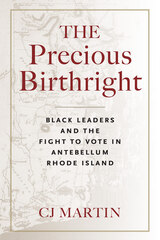
In 1842, Black Rhode Islanders secured a stunning victory, a success rarely seen in antebellum America: they won the right to vote. Amid heightened public discourse around shifting ideas of race, citizenship, and political rights, they methodically deconstructed the arguments against their enfranchisement, exposing the arbitrariness of the color line in delineating citizenship rights and choosing the perfect moments in which to act forcefully. At the head of this movement, a cohort of prominent business and community members formed an early example of a Black leadership class in the US.
CJ Martin draws upon a wealth of sources—including personal correspondences, government and organizational documents, tax records, and petitions—to argue that Black leaders employed a unique combination of agitation and accommodation to ensure the success of the movement. By investigating their tactics, Martin deepens the story of how race played a crucial role in American citizenship, and by focusing on Black leadership, he relates this history through the people who lived it—who thought, debated, petitioned, and enacted their own liberation. Telling the story of a fight that was as important to the pioneers of interracial democracy as it was for the civil rights activists of the twentieth century, The Precious Birthright provides new insight into the larger story of Black freedom.


What does it mean for human beings to exist in an era of dronified state violence? How can we understand the rise of robotic systems of power and domination? Focusing on U.S. drone warfare and its broader implications as no other book has to date, Predator Empire argues that we are witnessing a transition from a labor-intensive “American empire” to a machine-intensive “Predator Empire.”
Moving from the Vietnam War to the War on Terror and beyond, Ian G. R. Shaw reveals how changes in military strategy, domestic policing, and state surveillance have come together to enclose our planet in a robotic system of control. The rise of drones presents a series of “existential crises,” he suggests, that are reengineering not only spaces of violence but also the character of the modern state. Positioning drone warfare as part of a much longer project to watch and enclose the human species, he shows that for decades—centuries even—human existence has slowly but surely been brought within the artificial worlds of “technological civilization.” Instead of incarcerating us in prisons or colonizing territory directly, the Predator Empire locks us inside a worldwide system of electromagnetic enclosure—in which democratic ideals give way to a system of totalitarian control, a machinic “rule by Nobody.”
As accessibly written as it is theoretically ambitious, Predator Empire provides up-to-date information about U.S. drone warfare, as well as an in-depth history of the rise of drones.
Lang's Introduction describes briefly the founding of the Pre-Raphaelite Brotherhood, discusses each of the Pre-Raphaelite poets, both individually and in relation to the others, and grapples with the questions of definition of Pre-Raphaelitism and the similarities between its painting and poetry. The book is appropriately illustrated with thirty-two works by D. G. Rossetti, John Ruskin, William H. Hunt, and other Pre-Raphaelite artists.
This is the only anthology available that provides a representative selection of the work of these important poets. It will be indispensable to students of Victorian poetry and appreciated by readers interested in the Pre-Raphaelites.
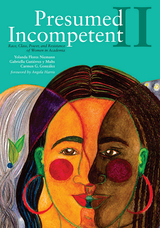
The courageous and inspiring personal narratives and empirical studies in Presumed Incompetent II: Race, Class, Power, and Resistance of Women in Academia name formidable obstacles and systemic biases that all women faculty—from diverse intersectional and transnational identities and from tenure track, terminal contract, and administrative positions—encounter in their higher education careers. They provide practical, specific, and insightful guidance to fight back, prevail, and thrive in challenging work environments. This new volume comes at a crucial historical moment as the United States grapples with a resurgence of white supremacy and misogyny at the forefront of our social and political dialogues that continue to permeate the academic world.
Contributors: Marcia Allen Owens, Sarah Amira de la Garza, Sahar Aziz, Jacquelyn Bridgeman, Jamiella Brooks, Lolita Buckner Inniss, Kim Case, Donna Castaneda, Julia Chang, Meredith Clark, Meera Deo, Penelope Espinoza, Yvette Flores, Lynn Fujiwara, Jennifer Gomez, Angela Harris, Dorothy Hines, Rachelle Joplin, Jessica Lavariega Monforti, Cynthia Lee, Yessenia Manzo, Melissa Michelson, Susie E. Nam, Yolanda Flores Niemann, Jodi O’Brien, Amelia Ortega, Laura Padilla, Grace Park, Stacey Patton, Desdamona Rios, Melissa Michal Slocum, Nellie Tran, Rachel Tudor, Pamela Tywman Hoff, Adrien Wing, Jemimah Li Young
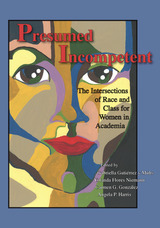
Presumed Incompetent is a pathbreaking account of the intersecting roles of race, gender, and class in the working lives of women faculty of color. Through personal narratives and qualitative empirical studies, more than 40 authors expose the daunting challenges faced by academic women of color as they navigate the often hostile terrain of higher education, including hiring, promotion, tenure, and relations with students, colleagues, and administrators. The narratives are filled with wit, wisdom, and concrete recommendations, and provide a window into the struggles of professional women in a racially stratified but increasingly multicultural America.


Jen Beagin’s funny, moving, fearless debut novel introduces an unforgettable character, Mona—almost 24, cleaning houses to get by, emotionally adrift. Handing out clean needles to drug addicts, she falls for a recipient who proceeds to break her heart in unimaginable ways. She decamps to Taos, New Mexico, for a fresh start, where she finds a community of seekers and cast-offs. But they all have one or two things to teach her—the pajama-wearing, blissed-out New Agers, the slightly creepy client with peculiar tastes in controlled substances, the psychic who might really be psychic. Always just under the surface are her memories of growing up in a chaotic, destructive family from which she’s trying to disentangle herself. The story of her journey toward a comfortable place in the world and a measure of self-acceptance is psychologically acute, often surprising, and entirely human.

Primate Conservation Biology begins with detailed overviews of the diversity, life history, ecology, and behavior of primates and the ways these factors influence primate abundance and distribution. Cowlishaw and Dunbar then discuss the factors that put primates at the greatest risk of extinction, especially habitat disturbance and hunting. The remaining chapters present a comprehensive review of conservation strategies and management practices, highlighting the key issues that must be addressed to protect primates for the future.




Martin J. S. Rudwick has compiled a bibliography giving full references for the sources Lyell cites in all three volumes of the Principles.

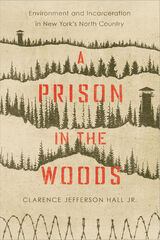
Clarence Jefferson Hall Jr. reveals that the introduction of correctional facilities—especially in the last three decades of the twentieth century—unearthed long-standing conflicts over the proper uses of Adirondack nature, particularly since these sites have contributed to deforestation, pollution, and habitat decline, even as they've provided jobs and spurred economic growth. Additionally, prison plans have challenged individuals' commitment to environmental protection, tested the strength of environmental regulations, endangered environmental and public health, and exposed tensions around race, class, place, and belonging in the isolated prison towns of America's largest state park.
Much like the rest of the traditional television industry, children’s programming is undergoing a revolution. In this book, Anna Potter provides a detailed insider account of the creative circumstances that are transforming contemporary children’s screen content and reshaping the surrounding digital media landscape. Drawing on extended interviews with leading screen industry figures, Potter explores television’s distribution revolution and reveals how creative practices, funding models, and production norms in children’s TV have adapted to fit the changing times.
Combining comprehensive case studies, scholarly research, and industry perspectives, Potter presents a rigorous study of success stories in the children’s screen production sector. The book explores effects on the industry from disruptions by streaming giants like Netflix, Amazon, and YouTube, and describes the challenges faced by public service broadcasters like the BBC in their efforts to stay relevant to adolescent culture in the UK. Interdisciplinary and informative, this volume is compulsory reading for anyone struggling to make sense of television’s distribution revolution and what it means for children and young people.
Alley considers the question of how VRS fits into the professional field of interpreting, and discovers that—regardless of the profit-focused mentality of VRS providers—interpreters make decisions with the goal of creating quality customer service experiences for deaf consumers, even if it means “breaking the rules.” Her findings shed light on the decision-making process of interpreters and how their actions are governed by principles of self-care, care for colleagues, and concern for the quality of services provided. Professional Autonomy in Video Relay Service Interpreting is essential reading in interpreter education courses and interpreter training programs.

It happens every summer: packs of beer-bellied men with gloves and aluminum bats, putting their middle-aged bodies to the test on the softball diamond. For some, this yearly ritual is driven by a simple desire to enjoy a good ballgame; for others, it’s a way to forge friendships—and rivalries. But for one short, wild-haired, bespectacled professor, playing softball in New York’s Central Park means a whole lot more. It's one last chance to heal the nagging wounds of Little League trauma before the rust of decline and the relentless responsibilities of fatherhood set in.
Professor Baseball is the coming-of-middle-age story of New York University professor and Little League benchwarmer Edwin Amenta. As rookie manager of the Performing Arts Softball League’s doormat Sharkeys, he reverses softball’s usual brawn-over-brains formula. He coaxes his skeptical teammates to follow his sabermetric and sociological approach, based equally on Bill James and Max Weber, which in the heady days of early success he dubs “Eddy Ball.” But Amenta soon learns that his teammates’ attachments to favorite positions and time-honored (if ineffective) strategies are hard to break—especially when the team begins losing. And though he rejects the baseball-as-life metaphor, life keeps intruding on his softball season. Amenta here comes to grips with the humiliation of assisted reproduction, suffers mysterious ailments, and finds himself lingering at the sponsor’s bar, while his partner, a beautiful but baseball-challenged professor, second-guesses his book in the making. Can he turn his team—and his life—around?
Packed with colorful personalities, dramatic games, and the bustle of New York life, Professor Baseball will charm anyone who has ever root, root, rooted for the underdog.

Project Management for Researchers tackles the how, what, and why of project management. It offers step-by-step guidance on choosing tools and developing a personalized system that will help the reader manage and organize their research so that steps and decisions are documented for accountability and reproducibility. Readers will find worksheets they can adapt to their own needs, priorities, and research as well as practical tips on issues ranging from emails to scheduling. Suitable for work across methods, experience levels, and disciplines and adaptable for those working alone, with others, or as team managers, this book will guide readers between various research stages–from planning, to execution, to adjustment of research projects big and small.

In 1649, a seamstress named Elizabeth Poole appeared at the Whitehall debates in London to prophesy in front of Parliament’s army shortly after it had defeated the crown in the English civil wars. Invited to help deliberate the fate of Charles I, Poole advised the army to spare the king’s life but to put him on trial for tyranny and to enter into a new compact with the people. After her visions proved controversial, she was defamed as a prostitute and a witch. She retaliated by printing her prophecies, along with two new defenses of her original revelations. This collection publishes Poole’s pamphlets in full for the first time.
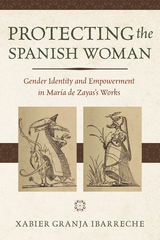
María de Zayas is unique in the seventeenth century as the only Spanish woman to write a collection of exemplary novels whose quality is often compared to Miguel de Cervantes’ masterful works. Her two main collections of short stories, Novelas amorosas y ejemplares and Desengaños amorosos, encompass a social critique based on literary fiction that exposes flaws in the idealized archetypes of masculine identity in early modern Spain. Zayas’s stories redefine women’s patriarchal disadvantage as a tool to expose the ways in which early modern Spanish women could be empowered to counteract men’s discursive and political authority, which they use to unfairly maintain their own social privilege.
Xabier Granja Ibarreche explores how Zayas defies Spanish hegemony by manipulating and transforming the ideals of courtly masculinity that had been popularized by conduct manuals and the traits they specified for appropriate noble comportment. In doing so, Zayas elaborates a nonofficial discourse throughout plots that subvert patriarchal hierarchies: she rearticulates the existing ideological order to empower women who are no longer willing to remain silent and oppressed by masculine domination after centuries of failing to attain a sufficiently self-sufficient political position to ascend in the social hierarchy. By inverting the male gaze that assumes masculinity as a preeminent identity, Zayas subverts the patriarchal subject/masculine, object/feminine order and destabilizes manly superiority as a basic universal reality, thereby empowering and unshackling Spanish women to liberate Iberian culture from the repressive and pernicious future she forebodes.
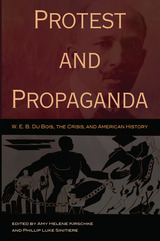
In looking back on his editorship of Crisis magazine, W. E. B. Du Bois said, “We condensed more news about Negroes and their problems in a month than most colored papers before this had published in a year.” Since its founding by Du Bois in 1910, Crisis has been the primary published voice of the NAACP. Born in an age of Jim Crow racism, often strapped for funds, the magazine struggled and endured, all the while providing a forum for people of color to document their inherent dignity and proclaim their definitive worth as human beings.
As the magazine’s editor from 1910 until 1934, Du Bois guided the content and the aim of Crisis with a decisive hand. He ensured that each issue argued for civil rights, economic justice, and social equality, always framing America’s intractable color line in an international perspective. Du Bois benefited from a deep pool of black literary and artistic genius, whether by commissioning the visual creativity of Harlem Renaissance artists for Crisis covers or by publishing poems and short stories from New Negro writers. From North to South, from East to West, and even reaching across the globe, Crisis circulated its ideas and marshaled its impact far and wide.
Building on the solid foundation Du Bois laid, subsequent editors and contributors covered issues vital to communities of color, such as access to resources during the New Deal era, educational opportunities related to the historic Brown decision, the realization of basic civil rights at midcentury, American aid to Africa and Caribbean nations, and the persistent economic inequalities of today’s global era.
Despite its importance, little has been written about the historical and cultural significance of this seminal magazine. By exploring how Crisis responded to critical issues, the essays in Protest and Propaganda provide the first well-rounded, in-depth look at the magazine's role and influence. The authors show how the essays, columns, and visuals published in Crisis changed conversations, perceptions, and even laws in the United States, thereby calling a fractured nation to more fully live up to its democratic creed. They explain how the magazine survived tremendous odds, document how the voices of justice rose above the clamor of injustice, and demonstrate how relevant such literary, journalistic, and artistic postures remain in a twenty-first-century world still in crisis.
Protostars and Planets III reflects the enormous progress made in understanding star and planet formation as a result of new observational capabilities and cooperative research among scientists from diverse fields.
The Provisions of War examines how soldiers, civilians, communities, and institutions have used food and its absence as both a destructive weapon and a unifying force in establishing governmental control and cultural cohesion during times of conflict. Historians as well as scholars of literature, regional studies, and religious studies problematize traditional geographic boundaries and periodization in this essay collection, analyzing various conflicts of the nineteenth and twentieth centuries through a foodways lens to reveal new insights about the parameters of armed interactions.
The subjects covered are as varied and inclusive as the perspectives offered—ranging from topics like military logistics and animal disease in colonial Africa, Indian vegetarian identity, and food in the counterinsurgency of the Malayan Emergency, to investigations of hunger in Egypt after World War I and American soldiers’ role in the making of US–Mexico borderlands. Taken together, the essays here demonstrate the role of food in shaping prewar political debates and postwar realities, revealing how dietary adjustments brought on by military campaigns reshape national and individual foodways and identities long after the cessation of hostilities
Two of these new journalists, a Pulitzer Prize—winning, Harvard-educated New York Times reporter named J. Anthony Lukas, and a former Newsweek media writer named Richard Pollak, founded a journalism review called (MORE) in 1971, with its pilot issue appearing the same month that the Times began publishing the Pentagon Papers. (MORE) covered the press with a critical attitude that blended seriousness and satire—part New York Review of Books, part underground press. In the eight years that it published, (MORE) brought together nearly every important American journalist of the 1970s, either as a writer, a subject of its critical eye, or as a participant in its series of raucous "A.J. Liebling Counter-Conventions"—meetings named after the outspoken press critic—the first of which convened in 1974. In issue after issue the magazine considered and questioned the mainstream press's coverage of explosive stories of the decade, including the Watergate scandal; the "seven dirty words" obscenity trial; the debate over a reporter's constitutional privilege; the rise of public broadcasting; the struggle for women and minorities to find a voice in mainstream newsrooms; and the U.S. debut of press baron Rupert Murdoch.
In telling the story of (MORE) and its legacy, Kevin Lerner explores the power of criticism to reform and guide the institutions of the press and, in turn, influence public discourse.

This essay collection explores how the definition of catastrophe might be expanded to include many forms of large-scale structural violence on communities, species, and ecosystems. Using feminist methodologies, the contributors to Public Catastrophes, Private Losses trace the connections between seemingly unrelated forms of violence such as structural racism, environmental degradation, and public health crises. In contrast to a news media that focuses on mass fatalities and immediate consequences, these essays call our attention to how catastrophes can also involve slow violence with long-term effects.
The authors also consider how these catastrophes are profoundly shaped by government action or inaction, offering a powerful critique of how government neglect has cost lives and demonstrating how vulnerable populations can be better protected. The essays in this collection examine how public catastrophes imprint themselves on lives, as individuals and communities narrate, process, and grapple with legacies of loss. The book is thus a feminist intervention that challenges the binary between public and private, personal and political.
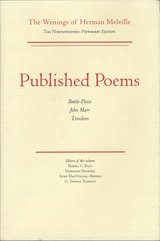
Although he surprised the world in 1866 with his first published book of poetry, Battle-Pieces and Aspects of the War, Herman Melville had long been steeped in poetry. This new offering in the authoritative Northwestern-Newberry series, The Writings of Herman Melville, with a historical note by Hershel Parker, is testament to Melville the poet. Penultimate in the publication of the series, Published Poems follows the release of Melville’s verse epic, Clarel (1876), and with it, contains the entirety of the poems published during Melville’s lifetime: Battle-Pieces, as well as John Marr and Other Sailors, with Some Sea-Pieces (1888), and Timoleon Etc. (1891).
Battle-Pieces and Aspects of the War has long been recognized as a great contribution to the poetry of the Civil War, comparable only to Whitman’s Drum-Taps. Its idiosyncrasies, many of them grounded in British poetry, kept it from immediate popularity, but it was not the production of a novice. Melville had made himself over into a poet in the late 1850s and had tried to publish a previous collection of poetry—now lost—in 1860.
John Marr and Other Sailors is a retrospective nautical book. Its portraits of sailors were influenced by Melville’s own experience of aging as well as by his long acquaintance with wasted mariners at the Sailors’ Snug Harbor on Staten Island, where his brother was governor.
The book modulates into "Sea-Pieces," including the grisly "Maldive Shark" and "To Ned," a powerful reflection on how Melville’s personal adventures with the Typee islanders in 1842 had accrued rich historical significance over the decades.
Thematically less unified, Timoleon Etc. contains poems with many European and exotic settings from ancient to modern times. The most famous are "After the Pleasure Party" and "The Age of the Antonines." Published in the last year of Melville’s life, some of the poems were first written many years earlier; for example, Melville copied "The Age of the Antonines" out for his brother-in-law in 1877, describing it as something found in a bundle of old papers. One whole section seems to have been almost entirely salvaged from the unpublished 1860 volume of poetry. As with the other volumes in the Northwestern-Newberry series, the aim of this edition of Published Poems is to present a text as close to the author’s intention as surviving evidence permits. To that end, the editorial appendix includes a historical note by Hershel Parker, the dean of Melville scholars, which gives a compelling, in-depth account of how one of America’s greatest writers grew into the vocation of a poet; an essay by G. Thomas Tanselle on the printing and publishing history of the works in Published Poems; a textual record that identifies the copy-texts for the present edition and explains the editorial policy; and substantial scholarly notes on individual poems.
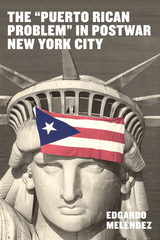
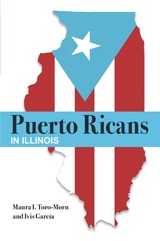
As the first book to document the experiences of Puerto Ricans in the state of Illinois, this inviting book maps the pedacito de patria (little piece of home) that many Puerto Ricans have carved from the bitter hardships faced in Illinois. Authors Maura Toro-Morn and Ivis García illustrate the multiple paradoxes underlying the experience of Puerto Ricans in Illinois: an island people in a heartland state, native-born citizens living an immigrant’s experience, climate refugees in the Midwest. They live a vaivén (coming and going). This volume partially exposes these paradoxes through a narrative of common survival and achievement. Along the proud Paseo Boricua (Puerto Rican Promenade) in Chicago and in smaller cities around the state, Puerto Ricans find and create the means to keep their national identity while contributing to the health and wealth of their adopted state.
From the voices of the people, the authors offer readers an opportunity to learn about the history of Puerto Rico, the migration of Puerto Ricans to Illinois, and the cultural, economic, and political contributions of the Puerto Rican women, men, and families that call Illinois home. In Chicago and across the heartland, Puerto Ricans have negotiated the gap between home and country, mobilized state-wide against the federal government’s virtual abandonment in the aftermath of Hurricane Maria. A compelling weave of scholarship summary, archival research, and extensive sociological study including interviews conducted across the state, the book documents just how much many fail to know about a growing and transforming community in Illinois. The stories of Puerto Ricans are here.



J.B. Hunt’s triumphs and struggles provide a fascinating case study of how business theory, leadership, culture, and organizational best-practices have combined to create one of the most successful companies in American history. Kirk Thompson, with more than forty years of experience inside the company, gives a CEO’s account of the company’s evolution, while Matt Waller connects the leadership decisions to business theories that are transferrable to other leaders and industries.
Purple on the Inside is more than a corporate history or business management primer. It’s a practical case study that illustrates what Seth Godin described in Purple Cow, his best-selling book that considers what characteristics make for a remarkable business. It’s the story of leaders and team members who tap into their founder’s spirit for innovation while maintaining the focus and high level of performance needed to grow. It’s a story about developing partnerships, technologies, and expertise that others can’t easily duplicate. And it’s a story of overcoming disheartening setbacks and cultivating the purple cows that have allowed J.B. Hunt Transport to do what many experts said was impossible—stand out from its competition in an industry full of brown cows.
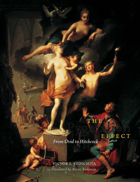
Stoichita traces the reverberations of Ovid’s founding myth from ancient times through the advent of cinema. Emphasizing its erotic origins, he locates echoes of this famous fable in everything from legendary incarnations of Helen of Troy to surrealist painting to photographs of both sculpture and people artfully posed to simulate statues. But it was only with the invention of moving pictures, Stoichita argues, that the modern age found a fitting embodiment of the Pygmalion story’s influence. Concluding with an analysis of Alfred Hitchcock films that focuses on Kim Novak’s double persona in Vertigo, The Pygmalion Effect illuminates the fluctuating connections that link aesthetics, magic, and technical skill. In the process, it sheds new light on a mysterious world of living artifacts that, until now, has occupied a dark and little-understood realm in the history of Western image making.

In the last decade, fire has blasted into public attention. California’s blazes have captured national and global media interest with their drama and urgency. Expand the realm of fire to include the burning of fossil fuels, and the fire story also subsumes climate change. Renowned fire historian Stephen J. Pyne argues that the relationship between fire and humans has become a defining feature of our epoch, and he reveals how Yosemite offers a cameo of how we have replaced an ice age with a fire age: the Pyrocene.
Organized around a backcountry trek to a 50-year experiment in restoring fire, Pyrocene Park describes the 150-year history of fire suppression and management that has led us, in part, to where the park is today. But there is more. Yosemite’s fire story is America’s, and the Earth’s, as it shifts from an ice-informed world to a fire-informed one. Pyrocene Park distills that epic story into a sharp miniature.
Flush with people, ideas, fires, and controversy, Pyrocene Park is a compelling and accessible window into the American fire scene and the future it promises.
READERS
Browse our collection.
PUBLISHERS
See BiblioVault's publisher services.
STUDENT SERVICES
Files for college accessibility offices.
RECENTLY PUBLISHED




UChicago Accessibility Resources
home | accessibility | search | about | contact us
BiblioVault ® 2001 - 2026
The University of Chicago Press