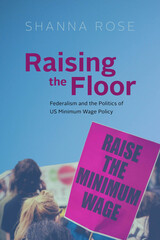
front cover of Raising the Floor
Raising the Floor
Federalism and the Politics of US Minimum Wage Policy
Shanna Rose
University of Chicago Press, 2026

A rich history of the development of American minimum wage policy with lessons for today.

Despite broad popular support for robust minimum wage policy, the federal minimum wage is now worth less—in real, inflation-adjusted terms—than at any time since 1949. While some state and local governments have stepped in to fill this void, others have declined to set any minimum wage standard at all. Traversing more than 100 years of history, Raising the Floor examines how interest groups have navigated the highly decentralized American political system to shape the development of federal, state, and local minimum wage laws.

In her analysis, Shanna Rose highlights the importance of American federalism. She argues that because federalism creates multiple arenas for policy change, interest groups have sought out the sites most conducive to their goals, shifting their lobbying efforts as new obstacles and opportunities emerge. Federalism has facilitated minimum wage policymaking by fostering policy experimentation, learning, and diffusion across states and by allowing state and local governments to overcome gridlock and status-quo biases at the national level. Yet, federalism has also been an instrument for containment, enabling those opposed to minimum wage increases to litigate and preempt local-level laws.

With rich historical chapters that illuminate different phases in the development of today’s patchwork of wage standards, Raising the Floor is a deep examination of the past, present, and future of American minimum wage law.
[more]

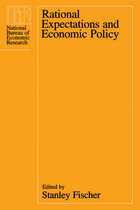
front cover of Rational Expectations and Economic Policy
Rational Expectations and Economic Policy
Edited by Stanley Fischer
University of Chicago Press, 1982
"Several areas in economics today have unprecedented significance and vitality. Most people would agree that stabilization policy ranks with the highest of these. Continuing inflation and periodic serious acceleration of inflation combined with high and secularly rising unemployment combine to give the area high priority. This book brings us up to date on an extremely lively discussion involving the role of expectations, and more particularly rational expectations, in the conduct of stabilization policy. . . . Anyone interested in the role of government in economics should read this important book."—C. Glyn Williams, The Wall Street Review of Books

"This is a most timely and valuable contribution. . . . The contributors and commentators are highly distinguished and the editor has usefully collated comments and the ensuing discussion. Unusually for a conference proceedings the book is well indexed and it is also replete with numerous and up-to-date references. . . . This is the first serious book to examine the rational expectations thesis in any depth, and it will prove invaluable to anyone involved with macroeconomic policy generally and with monetary economics in particular."—G. K. Shaw, The Economic Journal
[more]

front cover of Realizing Equality in Policy
Realizing Equality in Policy
Edited by Alexander Kaufman
University of Michigan Press, 2025
Economic and social inequality have become defining features of the world economy in the late twentieth and early twenty-first centuries. While increased inequality has been particularly pronounced in the United States, a similar phenomenon of increasing inequality of incomes and wealth has emerged in the economies of most major western European states. Realizing Equality in Policy brings together leading scholars to address current issues relating to rising inequality as it affects policy in the areas of education, health care, anti-poverty, employment, and economic policy. 

With contributions from scholars of both luck and relational egalitarianism, the essays reexamine a number of basic assumptions regarding social and economic policy from an egalitarian perspective. They explore gender-based discrimination, international justice, and the possibility for engagement between socialist and left-liberal thought. Rather than focusing on the subtle distinctions that divide egalitarian views, this volume shows that both views have the potential to offer important insights about how differences might be overcome and gaps might be closed. In offering new directions for solving wealth inequality through policy, Realizing Equality in Policy contributes to ongoing conversations in political theory, economic theory, and moral philosophy.
[more]

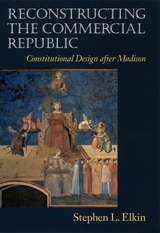
front cover of Reconstructing the Commercial Republic
Reconstructing the Commercial Republic
Constitutional Design after Madison
Stephen L. Elkin
University of Chicago Press, 2006
James Madison is the thinker most responsible for laying the groundwork of the American commercial republic. But he did not anticipate that the propertied class on which he relied would become extraordinarily politically powerful at the same time as its interests narrowed. This and other flaws, argues Stephen L. Elkin, have undermined the delicately balanced system he constructed. In Reconstructing the Commercial Republic, Elkin critiques the Madisonian system, revealing which of its aspects have withstood the test of time and which have not. 

The deficiencies Elkin points out provide the starting point for his own constitutional theory of the republic—a theory that, unlike Madison’s, lays out a substantive conception of the public interest that emphasizes the power of institutions to shape our political, economic, and civic lives. Elkin argues that his theory should guide us toward building a commercial republic that is rooted in a politics of the public interest and the self-interest of the middle class. He then recommends specific reforms to create this kind of republic, asserting that Americans today can still have the lives a commercial republic is intended to promote: lives with real opportunities for economic prosperity, republican political self-government, and individual liberty.

[more]

front cover of Re-Forming the State
Re-Forming the State
The Politics of Privatization in Latin America and Europe
Hector E. Schamis
University of Michigan Press, 2002
With evidence drawn from Argentina, Chile, Mexico, Great Britain, and Hungary, Re-forming the State examines the processes leading to, and the political effects of, market reform experiments and focuses specifically on the patterns of collective action and coalition building that drive privatization. The author's argument calls into question established approaches in the discipline of economics and in the fields of comparative and international political economy.
The experience of privatization shows that the public and the private are neither contradictory nor mutually exclusive spheres, and that power relations between them are not necessarily zero-sum. To stress the point, the author borrows from the literature on state formation, which has extensively examined the historical processes of key private groups. The evidence presented shows why and how, by restructuring coalitional and institutional arenas, the state uses marketization to generate political order and to distribute political power. Thus, the author specifies the conditions under which political change is conceived in terms of and channeled through economic policy; in other words, how the state is "re-formed" through privatization. Re-forming the State thus highlights how privatization is simultaneously a movement from public to private, but also a movement from non-state to state, as the reduction of state assets leads to institutional changes that increase state capacities for defining and enforcing property rights, extracting revenue, and centralizing administrative and political resources.
Hector E. Schamis is Assistant Professor of Government, Cornell University.
[more]

front cover of Regulating Finance
Regulating Finance
The Political Economy of Spanish Financial Policy from Franco to Democracy
Arvid John Lukauskas
University of Michigan Press, 1997
In recent years many countries have liberalized their financial markets as a central element of their efforts to reform their economies and increase their economic growth rates. Financial deregulation leads to a fundamental restructuring of a country's economy and polity, as market forces, not state officials, begin to determine who obtains financial resources and at what cost. A critical question is whether countries can undertake a program of liberalization while undergoing democratic transformation. In this study, Arvid John Lukauskas explores why governments tightly regulate their country's financial system and why they choose to liberalize it. Using a rational choice approach, Lukauskas contends that public officials provide the dynamic behind the evolution of financial regulation as they seek to retain power and generate public revenue. Lukauskas argues that the nature of a country's political institutions shape the incentives facing politicians and influence whether they seek to regulate closely or liberalize financial markets in the pursuit of their goals. Lukauskas then tests his ideas in an in-depth case study of the evolution of financial policy in Spain, a country that transformed its financial system into a mostly market-based system after years of heavy state intervention, while undergoing a transformation from a dictatorship to a democracy. Contrary to the conventional wisdom that leaders will not undertake structural change during periods of democratization, he finds that leaders in Spain undertook financial liberalization despite opposition from powerful groups, because democratization gave Spanish leaders a strong incentive to improve economic performance through financial reform in order to compete for votes. Regulating Finance will be of interest to political scientists and economists interested in studying financial markets and the effects of regime change, including democratization, on economic reform.
[more]

front cover of Regulation, Organizations, and Politics
Regulation, Organizations, and Politics
Motor Freight Policy at the Interstate Commerce Commission
Lawrence S. Rothenberg
University of Michigan Press, 1994
Regulation, Organizations, and Politics examines the evolution of regulation at the Interstate Commerce Commission (ICC). The ICC has probably had the most profound impact on any federal agency on the way social scientists view politics. From a perspective based in modern political economy, the author develops an analysis that improves our understanding of the determinants of bureaucratic performance and clarifies the conditions under which organizations are likely to have a substantial influence.   Employing a variety of techniques, Regulation, Organizations, and Politics explains how motor carriers, particularly the larger truckers who controlled the American Trucking Association, were unable to control public policy once the chief executive decided to expand substantial political resources on reforming the motor carrier system. The author shows that this failure was rooted in the carriers' inability to offer the requisite rewards and sanctions required to influence those with power over the outcome. This work thus demonstrates that an integrated approach to the intersections of rational, if often incompletely informed, actors can help us to understand phenomena that seem puzzling at first consideration.
[more]

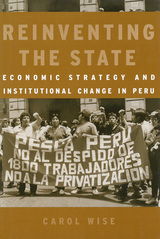
front cover of Reinventing the State
Reinventing the State
Economic Strategy and Institutional Change in Peru
Carol Wise
University of Michigan Press, 2003
The political economic history of Latin America in the post-World War II era has largely been one of underachievement and opportunities lost. This all changed with the wave of market reforms that were implemented in the 1990s. However, the precise role of these reforms as an agent of change is still hotly debated. This in-depth analysis of the Peruvian case argues for an explanation that treats institutional innovation and state reconstruction as necessary conditions for the apparent success of the market in Latin America.
Exploring how state intervention has been both the cause of Latin America's economic downfall in the 1980s and the solution to its recovery, Reinventing the State analyzes three main phases of state intervention: the developmentalism that lasted until 1982, the state in retreat of the 1980s, and the streamlined state of the 1990s. Through a comprehensive examination of the Peruvian experience, the book explains the country's impressive turnaround from the standpoint of institutional modernization and internal state reform.
Written for a broad academic audience, the public-policy community, and the private sector, this book is also meant as a quick primer for any journalist, consultant, or private-sector analyst in need of an overview of the region's market-reform effort and how it has played out in Peru.
Carol Wise is Associate Professor, School of International Relations, University of Southern California.
[more]

front cover of Reluctant Partners
Reluctant Partners
A History of Multilateral Trade Cooperation, 1850-2000
Andrew G. Brown
University of Michigan Press, 2003
With globalization drawing countries closer together, greater international cooperation is essential for peace and stability. The collective arrangement made by governments to manage their trade relations is one of the few successes of globalization. This book assesses the progress of multilateral trade cooperation, exploring the interests at work and the issues raised in successive postwar rounds of negotiations. It traces how the narrow perception of reciprocity has gradually yielded to a broader evaluation of the benefits to the regime as a whole as the major trading nations have mutually reduced trade barriers. Andrew G. Brown demonstrates the increasing importance of rule making and shows the diversity of issues on which negotiations have focused, such as customs procedures, technical standards, subsidies, anti-dumping duties, intellectual property rights, and the treatment of foreign direct investment. Despite the progress, however, the regime has remained vulnerable. The book also analyzes the major sources of strain that have been evident.
This is a nontechnical book for those curious about the possibilities for cooperation among states and should be of interest to both the nonspecialist and the specialist. It draws on more than one discipline to interpret the events, lying in the triangle bounded by political science, economics, and history.
Andrew G. Brown is a former Director of the General Analysis and Policies Division for the United Nations, New York.
[more]

logo for Pluto Press
The Rise of China and the Demise of the Capitalist World-Economy
Minqi Li
Pluto Press, 2008
China's increasing power in the global economy is destabilizing the established system. This book analyses the possible historical trajectories of China and the capitalist world-economy in the twenty-first century.

Minqi Li examines the future global prospects from the perspectives of Marxism, world-system theories, and ecological limits to growth. He argues that China is likely to exacerbate many of the major contradictions of world capitalism, which could lead to the demise of the existing world-system.

This is an essential text for students of political economy, economics and global politics.
[more]

front cover of The Road to Serfdom
The Road to Serfdom
Text and Documents--The Definitive Edition
F. A. Hayek
University of Chicago Press, 2007
An unimpeachable classic work in political philosophy, intellectual and cultural history, and economics, The Road to Serfdom has inspired and infuriated politicians, scholars, and general readers for half a century. Originally published in 1944—when Eleanor Roosevelt supported the efforts of Stalin, and Albert Einstein subscribed lock, stock, and barrel to the socialist program—The Road to Serfdom was seen as heretical for its passionate warning against the dangers of state control over the means of production. For F. A. Hayek, the collectivist idea of empowering government with increasing economic control would lead not to a utopia but to the horrors of Nazi Germany and Fascist Italy.

First published by the University of Chicago Press on September 18, 1944, The Road to Serfdom garnered immediate, widespread attention. The first printing of 2,000 copies was exhausted instantly, and within six months more than 30,000 books were sold. In April 1945, Reader’s Digest published a condensed version of the book, and soon thereafter the Book-of-the-Month Club distributed this edition to more than 600,000 readers. A perennial best seller, the book has sold 400,000 copies in the United States alone and has been translated into more than twenty languages, along the way becoming one of the most important and influential books of the century.

With this new edition, The Road to Serfdom takes its place in the series The Collected Works of F. A. Hayek.  The volume includes a foreword by series editor and leading Hayek scholar Bruce Caldwell explaining the book's origins and publishing history and assessing common misinterpretations of Hayek's thought.  Caldwell has also standardized and corrected Hayek's references and added helpful new explanatory notes.  Supplemented with an appendix of related materials ranging from prepublication reports on the initial manuscript to forewords to earlier editions by John Chamberlain, Milton Friedman, and Hayek himself, this new edition of The Road to Serfdom will be the definitive version of Hayek's enduring masterwork.
[more]

front cover of The Role of the Judge in International Trade Regulation
The Role of the Judge in International Trade Regulation
Experience and Lessons for the WTO
Thomas Cottier and Petros C. Mavroidis, Editors
University of Michigan Press, 2003
The WTO is generally seen as a key actor of globalization and, as such, has been the point of convergence of popular irritation worldwide. Many of the reproaches addressed to the WTO show civil societys concern with what is perceived as a democratic deficit in the way the organization operates. The main fear is to see trade rise as the ultimate value, prevailing over concerns such as health and environment. The Role of the Judge offers insight into how disputes are solved at the WTO level, into how the judicial branch interacts with the rest of the organization, and into the degree of sensitivity of the system to external input. The book sheds light on the judicial system governing the WTO and shows it to be the only truly multilateral system where disputes are solved by third-party adjudication.
The book develops along three lines: the first a search for cases submitted to the WTO where the judge exceeded its authority; the second a comparison of the WTO with the operations of national judicial systems having different levels of integration, specifically the United States (federal level) and the EC (quasi-federal level); and the third an exploration of directions for the future of dispute settlement in the WTO.
Reflecting the diversity of its contributors, this book addresses questions of economics, political science, and law, bringing an unusual level of multidisciplinarity to this topic and context. It is designed for both academic readers and practitioners, who will find it full of practical insights as well as rich and detailed analysis.
Thomas Cottier is Professor of European and International Economic Law, University of Bern, and Managing Director, World Trade Institute, University of Bern.
Petros C. Mavroidis is Professor of Law, University of Neuchâtel. He formerly worked in the Legal Affairs Division of the World Trade Organization.
Patrick Blatter is Mavroidiss scientific collaborator.
[more]

front cover of Royal Capitalism
Royal Capitalism
Wealth, Class, and Monarchy in Thailand
Puangchon Unchanam
University of Wisconsin Press, 2022
Thanks to its active role in national politics, the market economy, and popular culture, the Thai crown remains both the country's dominant institution and one of the world's wealthiest monarchies. Puangchon Unchanam examines the reign of Thailand's King Bhumibol Adulyadej or Rama IX (1946–2016) and how the crown thrived by transforming itself into a distinctly "bourgeois" monarchy that co-opted middle-class values of hard work, frugality, and self-sufficiency.
The kingdom positioned itself to connect business elites, patronize local industries, and form strategic partnerships with global corporations. Instead of restraining or regulating royal power, white-collar workers joined with the crown to form a dynamic, symbiotic force that has left the lower classes to struggle in their wake. Unchanam presents a surprising case study that kings and queens live long and large in cooperation with the bourgeoisie's interests and ideology.
[more]

front cover of Rules and Restraint
Rules and Restraint
Government Spending and the Design of Institutions
David M. Primo
University of Chicago Press, 2007
Government spending has increased dramatically in the United States since World War II despite the many rules intended to rein in the insatiable appetite for tax revenue most politicians seem to share. Drawing on examples from the federal and state governments, Rules and Restraint explains in lucid, nontechnical prose why these budget rules tend to fail, and proposes original alternatives for imposing much-needed fiscal discipline on our legislators.

One reason budget rules are ineffective, David Primo shows, is that politicians often create and preserve loopholes to protect programs that benefit their constituents. Another reason is that legislators must enforce their own provisions, an arrangement that is seriously compromised by their unwillingness to abide by rules that demand short-term sacrifices for the sake of long-term gain. Convinced that budget rules enacted through such a flawed legislative process are unlikely to work, Primo ultimately calls for a careful debate over the advantages and drawbacks of a constitutional convention initiated by the states—a radical step that would bypass Congress to create a path toward change. Rules and Restraint will be required reading for anyone interested in institutional design, legislatures, and policymaking.
[more]

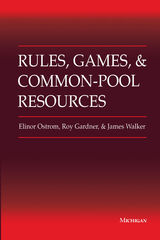
front cover of Rules, Games, and Common-Pool Resources
Rules, Games, and Common-Pool Resources
Elinor Ostrom, Roy Gardner, and James Walker
University of Michigan Press, 1994
Explores ways that the tragedy of the commons can be avoided by people who use common-property resources
[more]

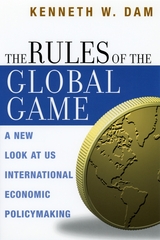
front cover of The Rules of the Global Game
The Rules of the Global Game
A New Look at US International Economic Policymaking
Kenneth W. Dam
University of Chicago Press, 2001
Economic news once confined to the business pages of the newspapers now receives headline coverage, whether it involves protests in Seattle or sweatshops in Asia. As attention is increasingly focused on economic policy, it becomes even more important for noneconomists to be able to make sense of these stories. Is the Asian economy sinking or rising? What effects will a single European currency have on the US economy? Kenneth W. Dam's The Rules of the Global Game provides, in clear and practical language, a framework to help readers understand and answer such questions. Dam takes us beyond the headlines and inside the decision-making process as it is populated by lobbyists, special interest groups, trade associations, and public relations firms. While some economists and thinkers have idealized plans for US international economic policy, Dam, currently the deputy secretary of the treasury, manages to merge this idealism with a consideration of what it means to govern at the intersection of competing groups with competing claims.

In The Rules of the Global Game, Dam first lays out what US international economic policies are and compares them to what they should be based on how they affect US per capita income. With this foundation in place, Dam then develops and applies principles for elucidating the major components of economic policy, such as foreign trade and investment, international monetary and financial systems, and current controversial issues, including intellectual property and immigration. Underlying his explanations is a belief in the importance of worldwide free trade and open markets as well as a crucial understanding of the political forces that shape decision making. Because economic policy is not created in a political vacuum, Dam argues, sound policymaking requires an understanding of "statecraft"-the creation and use of institutions that channel the efforts of interest groups and political forces in directions that encourage good economic outcomes.

Dam's vast experience with the politics and practicalities of economic policy translates into a view of policy that is neither academic nor abstract. Rather, Dam shows us how policy is actually made, who makes it, and why, using examples such as GATT, NAFTA, the US-Japan semiconductor agreement, and the Asian financial crisis. A rare book that can be read with pleasure and profit by layperson and economist alike, The Rules of the Global Game allows readers to understand the policies that shape our economy and our lives.
[more]


Send via email Share on Facebook Share on Twitter