
 A SCHOLARLY BOOK REPOSITORY
Elegant data and ideas deserve elegant expression, argues Helen Sword in this lively guide to academic writing. For scholars frustrated with disciplinary conventions, and for specialists who want to write for a larger audience but are unsure where to begin, here are imaginative, practical, witty pointers that show how to make articles and books a pleasure to read—and to write.
Dispelling the myth that you cannot get published without writing wordy, impersonal prose, Sword shows how much journal editors and readers welcome work that avoids excessive jargon and abstraction. Sword’s analysis of more than a thousand peer-reviewed articles across a wide range of fields documents a startling gap between how academics typically describe good writing and the turgid prose they regularly produce.
Stylish Academic Writing showcases a range of scholars from the sciences, humanities, and social sciences who write with vividness and panache. Individual chapters take up specific elements of style, such as titles and headings, chapter openings, and structure, and close with examples of transferable techniques that any writer can master.
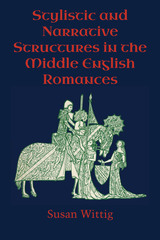
This volume provides a generic description, based on a formal analysis of narrative structures, of the Middle English noncyclic verse romances. As a group, these poems have long resisted generic definition and are traditionally considered to be a conglomerate of unrelated tales held together in a historical matrix of similar themes and characters. As single narratives, they are thought of as random collections of events loosely structured in chronological succession. Susan Wittig, however, offers evidence that the romances are carefully ordered (although not always consciously so) according to a series of formulaic patterns and that their structures serve as vehicles for certain essential cultural patterns and are important to the preservation of some community-held beliefs.
The analysis begins on a stylistic level, and the same theoretical principles applied to the linguistic formulas of the poems also serve as a model for the study of narrative structures. The author finds that there are laws that govern the creation, selection, and arrangement of narrative materials in the romance genre and that act to restrict innovation and control the narrative form.
The reasons for this strict control are to be found in the functional relationship of the genre to the culture that produced it. The deep structure of the romance is viewed as a problem-solving pattern that enables the community to mediate important contradictions within its social, economic, and mythic structures. Wittig speculates that these contradictions may lie in the social structures of kinship and marriage and that they have been restructured in the narratives in a “practical” myth: the concept of power gained through the marriage alliance, and the reconciliation of the contradictory notions of marriage for power’s sake and marriage for love’s sake.
This advanced, thorough, and completely original study will be valuable to medieval specialists, classicists, linguists, folklorists, and Biblical scholars working in oral-formulaic narrative structure.

E. R. Eddison’s classic saga novel now in paperback—includes for the first time Eddison’s remarkable letter of introduction and his unabridged closing note
Styrbiorn the Strong tells the grand tale of Styrbiorn Olafsson, heir to the Swedish throne and known both for his impressive size and strength and his unruly, quarrelsome nature. Denied his birthright and exiled from Sweden, Styrbiorn becomes the leader of the Jomsvikings and sets out to reclaim the Swedish throne in the epic Battle of Fýrisvellir. A rediscovered classic, Styrbiorn the Strong is a tale reminiscent of the Old Norse sagas, a historical novel from one of the twentieth century’s most influential masters of fantasy.
With acclaimed films like Sink or Swim and The Odds of Recovery, Su Friedrich’s body of work stands at the forefront of avant-garde and Queer cinema. Barbara Mennel examines the career of an experimental auteur whose merger of technical innovation and political critique connects with both cinephiles and activists. Friedrich’s integration of cinematic experimentation with lesbian advocacy serves as a beginning rather than an end point of analysis. With that in mind, Mennel provides an essential overview of the filmmaker’s oeuvre while highlighting the defining characteristics of her artistic and political signature. She also situates Friedrich within the cultural, political, and historical contexts that both shape the films and are shaped by them. Finally, Mennel expands our notion of auteurism to include directors who engage in collaborative and creative processes rooted in communities.

State and Capital reign over the Age of Sorrow. We face inequality, pandemics, ethnocide, climate crisis, and mass extinction. Our desire for security and power governs us as State. Our desire for possessions governs us as Capital. Our desires imprison and rule us beings as Unbeing. Yet, from Nagaland to New Zealand, Bhutan to Bolivia, a second wave of anti-colonial revolutions has begun. Arising from assemblies of humans and other-than-humans, these revolutions replace possessive individualism with non-exploitative interdependence. Naga elders, Bhutanese herders and other indigenous communities, feminists, poets, seers, yaks, cranes, vultures, and fungi haunt this pamphlet. The original Subaltern Studies narrated how Indian peasant communities destroyed the British empire. Subaltern Studies 2.0 prophesies the multi-being demos and liberates Being from Unbeing. Re-kin, Re-nomad, Re-animate, Re-wild! The Animist Revolution has come.
The Subaltern Ulysses was first published in 1994. Minnesota Archive Editions uses digital technology to make long-unavailable books once again accessible, and are published unaltered from the original University of Minnesota Press editions.
How might an IRA bomb and James Joyce's Ulysses have anything in common? Could this masterpiece of modernism, written at the violent moment of Ireland's national emergence, actually be the first postcolonial novel? Exploring the relation of Ulysses to the colony in which it is set, and to the nation being born as the book was written, Enda Duffy uncovers a postcolonial modernism and in so doing traces another unsuspected strain within the one-time critical monolith. In the years between 1914 and 1921, as Joyce was composing his text, Ireland became the first colony of the British Empire to gain its independence in this century after a violent anticolonial war. Duffy juxtaposes Ulysses with documents and photographs from the archives of both empire and insurgency, as well as with recent postcolonial literary texts, to analyze the political unconscious of subversive strategies, twists on class and gender, that render patriarchal colonialist culture unfamiliar.
Ulysses, Duffy argues, is actually a guerrilla text, and here he shows how Joyce's novel pinpoints colonial regimes of surveillance, mocks imperial stereotypes of the "native," exposes nationalism and other chauvinistic ideologies of "imagined community" as throwbacks to the colonial ethos, and proposes versions of a postcolonial subject. A significant intervention in the massive "Joyce industry" founded on the rhetoric and aesthetics of high modernism, Duffy's insights show us not only Ulysses, but also the origins of postcolonial textuality, in a startling new way.Enda Duffy is assistant professor of English at the University of California at Santa Barbara.
Dismissed by some as simply another new fashion in the critique of culture and by others as a postmarxist heresy, subaltern studies began with the work of Ranajit Guha and the South Asian Subaltern Studies collective in the 1980s. Beverley’s focus on Latin America, however, is evidence of the growing province of this field. In assessing subaltern studies’ purposes and methods, the potential dangers it presents, and its interactions with deconstruction, poststructuralism, cultural studies, Marxism, and political theory, Beverley builds his discussion around a single, provocative question: How can academic knowledge seek to represent the subaltern when that knowledge is itself implicated in the practices that construct the subaltern as such? In his search for answers, he grapples with a number of issues, notably the 1998 debate between David Stoll and Rigoberta Menchú over her award-winning testimonial narrative, I, Rigoberta Menchú. Other topics explored include the concept of civil society, Florencia Mallon’s influential Peasant and Nation, the relationship between the Latin American “lettered city” and the Túpac Amaru rebellion of 1780–1783, the ideas of transculturation and hybridity in postcolonial studies and Latin American cultural studies, multiculturalism, and the relationship between populism, popular culture, and the “national-popular” in conditions of globalization.
This critique and defense of subaltern studies offers a compendium of insights into a new form of knowledge and knowledge production. It will interest those studying postcolonialism, political science, cultural studies, and Latin American culture, history, and literature.

In this bold and innovative book, Massimo Modonesi weaves together theory and political practice by relating the concepts of subalternity, antagonism and autonomy to contemporary movements in Latin America and elsewhere.
In a sophisticated account, Modonesi reconstructs the debates between Marxist authors and schools of thought in order to sketch out informed strategies of resistance. He reviews the works of Gramsci, Negri, Castoriadis and Lefort, and engages with the arguments made by E. P. Thompson, Spivak, Laclau and Mouffe.
Subalternity, Antagonism, Autonomy firmly roots key theoretical arguments from a range of critical thinkers within specific political movements in order to recover these concepts as analytical instruments which can help to guide contemporary struggles.
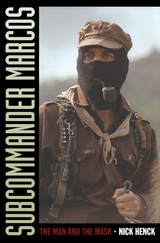
In this, the first English-language biography of Subcommander Marcos, Nick Henck describes the thought, leadership, and personality of this charismatic rebel spokesperson. He traces Marcos’s development from his provincial middle-class upbringing, through his academic career and immersion in the clandestine world of armed guerrillas, to his emergence as the iconic Subcommander. Henck reflects on what motivated an urbane university professor to reject a life of comfort in Mexico City in favor of one of hardship as a guerrilla in the mountainous jungles of Chiapas, and he examines how Marcos became a conduit through which impoverished indigenous Mexicans could communicate with the world.
Henck fully explores both the rebel leader’s renowned media savvy and his equally important flexibility of mind. He shows how Marcos’s speeches and extensive writings demonstrate not only the Subcommander’s erudition but also his rejection of Marxist dogmatism. Finally, Henck contextualizes Marcos, locating him firmly within the Latin American guerrilla tradition.

How domestic constraints hamper India’s foreign policy and its potential as a superpower
One of the most important developments in today’s changing international system is the emergence of India as a rising power. However, Rajesh Basrur finds that India is hobbled by serious domestic constraints. Subcontinental Drift explains why India’s foreign policy is often characterized by multiple hesitations, delays, and diversions that may ultimately hamper its rise.
Basrur analyzes the concept of policy drift through the lens of neoclassical realist theory to reveal why this drift occurs so regularly in Indian foreign policy and how it affects India’s quest for major power status. Using four cases—the India-US strategic partnership, India-Sri Lanka relations, India’s nuclear strategy, and crossborder terrorism—Basrur identifies two basic explanations for India’s indecision on critical issues. The first, involuntary drift, is related to the distribution of domestic material power, while the second, voluntary drift, is produced by a responsibility deficit.
Basrur develops a fresh theoretical basis for understanding the relationship between India’s foreign and domestic policies and introduces a series of theoretical refinements to neoclassical realism. Subcontinental Drift also provides advice on how policy makers might lower the costs of policy drift. This innovative analysis is essential to understanding the constraints around India’s foreign and domestic security decisions and how they will affect its rise.
Whether it is the ocean, the ground, or soil, a metaphorical or symbolic underworld, or a political figure of thought, the subsurface intervenes in recent debates about ecological, social, and postcolonial conflicts and power inequalities in the humanities and beyond. However, turning to the unstable grounds of the subterranean always involves a conceptual or methodological movement and a practice of submersion, and thus a critical reflection on the conditions, technologies, aesthetics, and politics of knowledge production.
It is precisely at this point that this volume picks up with approaches from the fields of artistic practice as well as media studies, art history, queer theory, and decolonial studies. From this transdisciplinary perspective, this anthology explores the medial, aesthetic, and material aspects of sub(e)merging, as well as its potential as a resistant practice and figure of thought: from submerging to emerging.
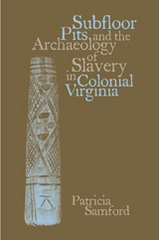
Enslaved Africans and their descendants comprised a significant portion of colonial Virginia populations, with most living on rural slave quarters adjacent to the agricultural fields in which they labored. Archaeological excavations into these home sites have provided unique windows into the daily lifeways and culture of these early inhabitants.

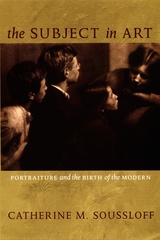
Soussloff combines a historically grounded examination of art and art historical thinking in Vienna with subsequent theories of portraiture and a careful historiography of philosophical and psychoanalytic approaches to human consciousness from Hegel to Sartre and from Freud to Lacan. She chronicles the emergence of a social theory of art among the art historians of the Vienna School, demonstrates how the Expressionist painter Oskar Kokoschka depicted the Jewish subject, and explores the development of pictorialist photography. Reflecting on the implications of the visualized, modern subject for textual and linguistic analyses of subjectivity, Soussloff concludes that the Viennese art historians, photographers, and painters will henceforth have to be recognized as precursors to such better-known theorists of the subject as Sartre, Foucault, and Lacan.
Responding to the ongoing “objectal turn” in contemporary humanities and social sciences, the essays in Subject Lessons present a sustained case for the continued importance— indeed, the indispensability—of the category of the subject for the future of materialist thought.
Approaching matters through the frame of Hegel and Lacan, the contributors to this volume, including the editors, as well as Andrew Cole, Mladen Dolar, Nathan Gorelick, Adrian Johnston, Todd McGowan, Borna Radnik, Molly Anne Rothenberg, Kathryn Van Wert, and Alenka Zupančič—many of whom stand at the forefront of contemporary Hegel and Lacan scholarship—agree with neovitalist thinkers that material reality is ontologically incomplete, in a state of perpetual becoming, yet they maintain that this is the case not in spite of but, rather, because of the subject.
Incorporating elements of philosophy, psychoanalysis, and literary and cultural studies, Subject Lessons contests the movement to dismiss the subject, arguing that there can be no truly robust materialism without accounting for the little piece of the Real that is the subject.
Drawing on history, political science, anthropology, and philosophy, Seth interprets the debates and controversies that came to surround western education. Central among these were concerns that Indian students were acquiring western education by rote memorization—and were therefore not acquiring “true knowledge”—and that western education had plunged Indian students into a moral crisis, leaving them torn between modern, western knowledge and traditional Indian beliefs. Seth argues that these concerns, voiced by the British as well as by nationalists, reflected the anxiety that western education was failing to produce the modern subjects it presupposed. This failure suggested that western knowledge was not the universal epistemology it was thought to be. Turning to the production of collective identities, Seth illuminates the nationalists’ position vis-à-vis western education—which they both sought and criticized—through analyses of discussions about the education of Muslims and women.

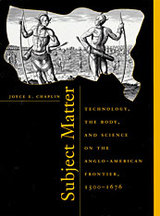
With this sweeping reinterpretation of early cultural encounters between the English and American natives, Joyce E. Chaplin thoroughly alters our historical view of the origins of English presumptions of racial superiority, and of the role science and technology played in shaping these notions. By placing the history of science and medicine at the very center of the story of early English colonization, Chaplin shows how contemporary European theories of nature and science dramatically influenced relations between the English and Indians within the formation of the British Empire.
In Chaplin's account of the earliest contacts, we find the English--impressed by the Indians' way with food, tools, and iron--inclined to consider Indians as partners in the conquest and control of nature. Only when it came to the Indians' bodies, so susceptible to disease, were the English confident in their superiority. Chaplin traces the way in which this tentative notion of racial inferiority hardened and expanded to include the Indians' once admirable mental and technical capacities. Here we see how the English, beginning from a sense of bodily superiority, moved little by little toward the idea of their mastery over nature, America, and the Indians--and how this progression is inextricably linked to the impetus and rationale for empire.

Stodolsky presents a challenge to educational research. She shows that classroom activities are coherent actions shaped by the instructional context—especially what is taught. Stodolsky contradicts the received view of both teaching and learning as uniform and consistent. Individual teachers arrange instruction very differently, depending on what they are teaching, and students respond to instruction very differently, depending on the structure and demands of the lesson.
The instructional forms used in math classes, a "basic" subject, and social studies classes, an "enrichment" subject, differ even when the same teacher conducts both classes. Social studies classes show more diversity in activities, while math classes are very similar to one another. Greater variety is found in social studies within a given teacher's class and when different teachers' classes are compared. Nevertheless, in the classrooms Stodolsky studied, the range of instructional arrangements is very constricted.
Challenging the "back to basics" movement, Stodolsky's study indicates that, regardless of subject matter, students are more responsive to instruction that requires a higher degree of intellectual complexity and performance, to learning situations that involve them in interaction with their peers, and to active modes of learning. Stodolsky also argues that students develop ideas about how to learn a school subject, such as math, by participating in particular activities tied to instruction in the subject. These conceptions about learning are unplanned but enduring and significant consequences of schooling.
The Subject Matters has important implications for instructional practice and the training, education, and supervision of teachers. Here is a new way of understanding the dynamics of teaching and learning that will transform how we think about schools and how we study them.
In this pioneering book, Louiza Odysseos argues that debates about ethnic conflict, human rights, and the viability of multicultural communities all revolve around the question of coexistence. Yet, issues of coexistence have not been adequately addressed by international relations. Instead of being regarded as a question, “coexistence” is a term whose meaning is considered self-evident.
The Subject of Coexistence traces the institutional neglect of coexistence to the ontological commitments of international relations as a modern social science predicated on conceptions of modern subjectivity. This reliance leads to the assumption that coexistence means little more than the social and political copresence of individuals, a premise that occludes the roles of otherness in the constitution of the self. Countering this reliance necessitates the examination of how existence itself is coexistential from the start.
Odysseos opens up the possibility of a coexistential ontology, drawing on Martin Heidegger and his interlocutors, in which selfhood can be rethought beyond subjectivism, reinstating coexistence as a question for global politics—away from the restrictive discursive parameters of the modern subject.
Louiza Odysseos is senior lecturer in international relations at the University of Sussex.
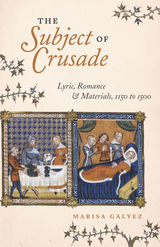
In The Subject of Crusade, Marisa Galvez offers a nuanced view of holy war and crusade poetry, reading these lyric works within a wider conversation with religion and culture. Arguing for an interdisciplinary treatment of crusade lyric, she shows how such poems are crucial for understanding the crusades as a complex cultural and historical phenomenon. Placing them in conversation with chronicles, knightly handbooks, artworks, and confessional and pastoral texts, she identifies a particular “crusade idiom” that emerged out of the conflict between pious and earthly duties. Galvez fashions an expanded understanding of the creative works made by crusaders to reveal their experiences, desires, ideologies, and reasons for taking up the cross.
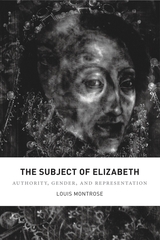
Montrose offers a masterful account of the texts, pictures, and performances in which the Queen was represented to her people, to her court, to foreign powers, and to Elizabeth herself. Retrieving this “Elizabethan imaginary” in all its richness and fascination, Montrose presents a sweeping new account of Elizabethan political culture. Along the way, he explores the representation of Elizabeth within the traditions of Tudor dynastic portraiture; explains the symbolic manipulation of Elizabeth’s body by both supporters and enemies of her regime; and considers how Elizabeth’s advancing age provided new occasions for misogynistic subversions of her royal charisma.
This book, the remarkable product of two decades of study by one of our most respected Renaissance scholars, will be welcomed by all historians, literary scholars, and art historians of the period.
Much recent scholarship has sought to identify the linguistic and social factors that favor the expression or omission of subject pronouns in Spanish. This volume brings together leading experts on the topic of language variation in Spanish to provide a panoramic view of research trends, develop probabilistic models of grammar, and investigate the impact of language contact on pronoun expression.
The book consists of three sections. The first studies the distributional patterns and conditioning forces on subject pronoun expression in four monolingual varieties—Dominican, Colombian, Mexican, and Peninsular—and makes cross-dialectal comparisons. In the second section, experts explore Spanish in contact with English, Maya, Catalan, and Portuguese to determine the extent to which each language influences this syntactic variable. The final section examines the acquisition of variable subject pronoun expression among monolingual and bilingual children as well as adult second language learners.
"[A] superb collection of studies that substantially increases our understanding, not only of variation in subject personal pronouns, but also of variable morphosyntactic processes generally.... clearly relevant to all students and scholars who wish to understand the complexities of linguistic variation and dialect contact." -- Robert Bayley, professor of linguistics, University of California, Davis
"Students and scholars will find that this volume is an essential reference in the field of Spanish language variation. If the study of final /s/ has led Spanish sociophonetics, the study of subject pronouns stars in sociogrammar. This volume presents a 3D analysis of how subject pronouns are used and acquired in Spanish. This comprehensive volume is not only of interest to those concerned with Spanish grammar, but also to anyone interested in pro-drop languages. The vision of Carvalho, Orozco and Shin has harmonized an excellent collective volume." -- Francisco Moreno-Fernández, professor of Hispanic linguistics. University of Alcala (Spain) and Instituto Cervantes at Harvard University.
,
"If you seek innovative, theoretically and empirically driven research into syntactic variation, open this book and read on. Here a variationist focus on alternating sound and silence, something and nothing, or subject pronouns and nulls generates striking insights into the nature of Spanish and those who speak and learn it." -- Richard Cameron,, University of Illinois at Chicago
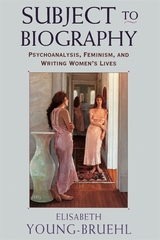
In this provocative new book, Elisabeth Young-Bruehl illuminates the psychological and intellectual demands writing biography makes on the biographer and explores the complex and frequently conflicted relationship between feminism and psychoanalysis.
A practicing psychoanalyst, a distinguished scholar, and the widely praised biographer of Anna Freud and Hannah Arendt, Young-Bruehl here reflects on the relations between self-knowledge, autobiography, biography, and cultural history. She considers what remains valuable in Sigmund Freud's work, and what areas--theory of character, for instance--must be rethought to be useful for current psychoanalytic work, for feminist studies, and for social theory.
Psychoanalytic theory used for biography, she argues, can yield insights for psychoanalysis itself, particularly in the understanding of creativity. Subject to Biography offers not simply the products of an astute mind, but an entrée into the thinking process; it welcomes the reader into the writer's workshop.
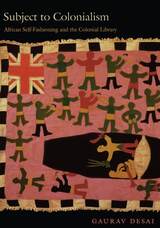
Presenting colonialism not as a singular, monolithic structure but rather as a practice frought with contradictions and tensions, Desai works to historicize the foundation of postcolonialism by decentering both canonical texts and privileged categories of analysis such as race, capitalism, empire, and nation. To achieve this, he focuses on texts that construct or reform—rather than merely reflect—colonialism, placing explicit emphasis on processes, performances, and the practices of everyday life. Reading these texts not merely for the content of their assertions but also for how they were created and received, Desai looks at works such as Jomo Kenyatta’s ethnography of the Gikuyu and Akiga Sai’s history of the Tiv and makes a particular plea for the canonical recuperation of African women’s writing.
Scholars in African history, literature, and philosophy, postcolonial studies, literary criticism, and anthropology will welcome publication of this book.

Because "the other," or the object, is constructed, Rupprecht finds in narcissism the possibility of rewriting notions of identity. She then pursues this possibility through modern literary texts in which narcissism acts as a structuring principle—works by the expressionist poet Henriette Hardenberg, the American avant-garde novelist Djuna Barnes, and the surrealist writer Unica Zürn—reading each within the critical framework of the evolution of the idea of narcissism in psychoanalytic theory. All written by women, these works also raise questions of gender and sexuality. Moreover, because each of these authors belonged to or was influenced by a particular literary movement, Rupprecht's analysis advances our understanding of the poetics of these movements and of the movement of modernism itself. Underlying all is a deep engagement with psychoanalytic theory. Drawing on Freud, his contemporaries and rivals, Jacques Lacan, Melanie Klein, and many other theorists, Rupprecht interrogates preconceived notions of identity and subjectivity through her readings of the "transgressive potential" of narcissism as it is enacted in the texts under study. Bringing the works of literary modernism and psychoanalysis together in an innovative and provocative way, her book succeeds in enhancing our sense of both, and in clarifying the complex role of narcissism in our cultural narrative.
Shilyh Warren reopens this understudied period and links it to a neglected era of women's filmmaking that took place from 1920 to 1940, another key period of thinking around documentary, race, and gender. Drawing women’s cultural expression during these two explosive times into conversation, Warren reconsiders key debates about subjectivity, feminism, realism, and documentary and their lasting epistemological and material consequences for film and feminist studies. She also excavates the lost ethnographic history of women's documentary filmmaking in the earlier era and explores the political and aesthetic legacy of these films in more explicitly feminist periods like the Seventies.
Filled with challenging insights and new close readings, Subject to Reality sheds light on a profound and unexamined history of feminist documentaries while revealing their influence on the filmmakers of today.
It was to this society that Musil responded in his great work The Man Without Qualities. Exploring the nooks and crannies of this modernist classic, Jonsson shows that Musil’s narrative evolves along two axes that must be considered in tandem: Whereas the central plot portrays a Viennese elite that in 1913 attempts to restore social cohesion by gathering popular support for the cultural essence of the empire, the protagonist discovers that he lacks essence altogether and finds himself attracted by monsters, criminals, and revolutionary figures that reject the social order. In this way, Musil’s novel traces the disappearance of what Jonsson calls the expressivist paradigm—the conviction that identities such as gender, nationality, class, and social character are expressions of permanent intrinsic dispositions. This, Jonsson argues, is Musil’s great legacy. For not only did the Austrian author seek to liquidate prevailing conceptions of personal and cultural identity; he also projected “a new human being,” one who would resist assimilation into imperialist, nationalist, or fascist communities.
Subject Without Nation presents a new interpretation of Viennese modernity and uncovers the historical foundations of poststructural and postcolonial reconceptualizations of human subjectivity. Illuminating links between Musil’s oeuvre as a whole and post-war developments in critical thought, this book locates an important crossroads between literary criticism, intellectual history, and cultural theory.
The key point Luft brings into focus is that Husserl's hermeneutic phenomenology is distinct from other hermeneutic philosophers', namely Ernst Cassirer, Martin Heidegger, and Hans-Georg Gadamer. Unlike them, Husserl's focus centers on the work subjects must do in order to uncover the prejudices that guide their unreflective relationship to the world. Luft also demonstrates that there is a deep consistency within Husserl's own writings—from early to late—around the guiding themes of the natural attitude, the need and function of the epoché, and the split between egos, where the transcendental self (distinct from the natural self) is seen as the fundamental ability we all have to inquire into the genesis of our tradition-laden attitudes toward the world.
During the Middle Ages, philosophers and theologians argued over the extramental reality of universal forms or essences. In the early modern period, the relation between subjectivity and objectivity, the individual self and knowledge of the outside world, was a rich subject of debate. Today, there is considerable argument about the relation between spontaneity and determinism within the evolutionary process, whether a principle of spontaneous self-organization as well as natural selection is at work in the aggregation of molecules into cells and the development of primitive forms of life into complex organisms. In Subjectivity, Objectivity and Intersubjectivity, Joseph A. Bracken proposes that what is ultimately at stake here is the age-old problem of the relationship between the One and the Many, universality and particularity on different levels of existence and activity within nature.

Subject/Object and Beyond brings together essays by established and emerging scholars to honor the exceptionally rich contributions and career of scholar Colette H. Winn. It also celebrates fifty years of sustained scholarship on early modern women, along with the foundation of Women’s Studies as a recognized academic discipline in North America. The collection comprises seventeen articles that explore multiple perspectives on early modern women, including their writings, translations, reception, and contributions to various fields, including literature, music, politics, religion, and science.
Pyotr Pavlensky turns state violence into his medium—now, in his own words, he reveals the theory behind the fire.
Pyotr Pavlensky’s Subject–Object Art Theory is both a manifesto and a method—an incendiary redefinition of what art can and should be in an era of increasing repression. Known for his radical public events, such as setting fire to government buildings, stitching his lips shut, or nailing his own body to the ground, Pavlensky has been called a provocateur. In this book, he offers his own framework: subject–object art, a practice that redefines the position of art with respect to power and forces state mechanisms to work for art.
Venturing past the confines of political art, he examines the historical intersections of art and power, situating his work within a lineage of radical avant-garde movements. Whether seen as a guide or an act of defiance in itself, Subject–Object Art Theory urges the reader to rethink artistic freedom but as a means of bringing art back to its true independence.
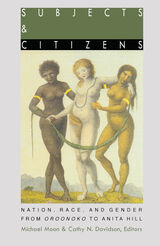
Defining the landscape of the New American literary history, these essays are united by three interrelated concerns: ideas of origin (where does "American literature" begin?), ideas of nation (what does "American literature" mean?), and ideas of race and gender (what does "American literature" include and exclude and how?). Work by writers as diverse as Aphra Behn, James Fenimore Cooper, Edgar Allan Poe, Frances Harper, Harriet Beecher Stowe, Herman Melville, William Faulkner, Harriet Jacobs, Frederick Douglass, Abraham Lincoln, Bharati Mukherjee, Booker T. Washington, Mark Twain, Kate Chopin, Américo Paredes, and Toni Morrison are discussed from several theoretical perspectives, using a variety of methodologies. Issues of the "frontier" and the "border" as well as those of coloniality and postcoloniality are explored. In each case, these essays emphasize the ideological nature of national identity and, more specifically, the centrality of race and gender to our concept of nationhood.
Collected from recent issues of American Literature, with three new essays added, Subjects and Citizens charts the new directions being taken in American literary studies.
Contributors. Daniel Cooper Alarcón, Lori Askeland, Stephanie Athey, Nancy Bentley, Lauren Berlant, Michele A. Birnbaum, Kristin Carter-Sanborn, Russ Castronovo, Joan Dayan, Julie Ellison, Sander L. Gilman, Karla F. C. Holloway, Annette Kolodny, Barbara Ladd, Lora Romero, Ramón Saldívar, Maggie Sale, Siobhan Senier, Timothy Sweet, Maurice Wallace, Elizabeth Young
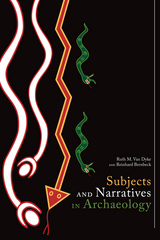
Seeking to move beyond the customary limits of archaeological prose and representation, Subjects and Narratives in Archaeology presents archaeology in a variety of nontraditional formats. The volume demonstrates that visual art, creative nonfiction, archaeological fiction, video, drama, and other artistic pursuits have much to offer archaeological interpretation and analysis.
Chapters in the volume are augmented by narrative, poetry, paintings, dialogues, online databases, videos, audio files, and slideshows. The work will be available in print and as an enhanced ebook that incorporates and showcases the multimedia elements in archaeological narrative. While exploring these new and not-so-new forms, the contributors discuss the boundaries and connections between empirical data and archaeological imagination.
Both a critique and an experiment, Subjects and Narratives in Archaeology addresses the goals, advantages, and difficulties of alternative forms of archaeological representation. Exploring the idea that academically sound archaeology can be fun to create and read, the book takes a step beyond the boundaries of both traditional archaeology and traditional publishing.
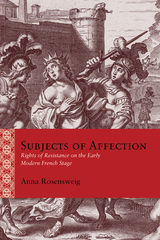
Contemporary scholars have critiqued the modern rights paradigm for its failure to acknowledge the ways in which individual rights depend upon state protection and national belonging. Through a reappraisal of early modern French tragedy, Rosensweig provides a corrective to accounts of human rights that begin with the French Revolution, exploring previously unrecognized models for collective action that had emerged during the religious wars. Subjects of Affection reveals how French tragedy sustained these models of collective action by binding together individuals and groups through affect. Rosensweig places sixteenth-century political treatises in dialogue with dramas by Robert Garnier, Jean Rotrou, Pierre Corneille, and Jean Racine that were performed and published between 1550 and 1700. In so doing, she demonstrates how these tragedies, through their poetics and performance potential, stage a subject of rights whose collective constitution differs from the individualism of our modern rights framework. Through fresh insights and incisive readings, Subjects of Affection explores a form of political subjectivity that locates political power in connection to others—from staged characters and choruses to unseen collectives.
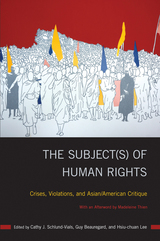
Human rights violations have always been part of Asian American studies. From Chinese immigration restrictions, the incarceration of Japanese Americans, yellow peril characterizations, and recent acts of deportation and Islamophobia, Asian Americans have consistently functioned as subordinated “subjects” of human rights violations. The Subject(s) of Human Rights brings together scholars from North America and Asia to recalibrate these human rights concerns from both sides of the Pacific.
The essays in this collection provide a sharper understanding of how Asian/Americans have been subjected to human rights violations, how they act as subjects of history and agents of change, and how they produce knowledge around such subjects. The editors of and contributors to The Subject(s) of Human Rights examine refugee narratives, human trafficking, and citizenship issues in twentieth- and twenty-first century literature. These themes further refract issues of American war-making, settler colonialism, military occupation, collateral damage, and displacement that relocate the imagined geographies of Asian America from the periphery to the center of human rights critique.
Being human while trying to scientifically study human nature confronts us with our most vexing problem. Efforts to explicate the human mind are thwarted by our cultural biases and entrenched infirmities; our first-person experiences as practical agents convince us that we have capacities beyond the reach of scientific explanation. What we need to move forward in our understanding of human agency, Paul Sheldon Davies argues, is a reform in the way we study ourselves and a long overdue break with traditional humanist thinking.
Davies locates a model for change in the rhetorical strategies employed by Charles Darwin in On the Origin of Species. Darwin worked hard to anticipate and diminish the anxieties and biases that his radically historical view of life was bound to provoke. Likewise, Davies draws from the history of science and contemporary psychology and neuroscience to build a framework for the study of human agency that identifies and diminishes outdated and limiting biases. The result is a heady, philosophically wide-ranging argument in favor of recognizing that humans are, like everything else, subjects of the natural world—an acknowledgement that may free us to see the world the way it actually is.
Subjects on Display explores a recurrent figure at the heart of many nineteenth-century English novels: the retiring, self-effacing woman who is conspicuous for her inconspicuousness. Beth Newman draws upon both psychoanalytic theory and recent work in social history as she argues that this paradoxical figure, who often triumphs over more dazzling, eye-catching rivals, is a response to the forces that made personal display a vexed issue for Victorian women. Chief among these is the changing socioeconomic landscape that made the ideal of the modest woman outlive its usefulness as a class signifier even as it continued to exert moral authority.
This problem cannot be grasped in its full complexity, Newman shows, without considering how the unstable social meanings of display interacted with psychical forces-specifically, the desire to be seen by others that is central to both masculine and feminine subjectivity. This desire raises an issue that feminist theorists have been reluctant to address: the importance of pleasure in being the object of the look. Their reluctance is characteristic of cultural theory, which has tended to equate subjectivity with the position of the observer rather than the observed.
Through a consideration of fiction by Charlotte Brontë, Charles Dickens, George Eliot, and Henry James, Newman shifts the inquiry toward the observed in the experience of being seen. In the process she reopens the question of the gaze and its relation to subjectivity.
Subjects on Display will appeal to scholars and students in several disciplines as it returns psychoanalysis to a central position within literary and cultural studies.
How do aesthetic forms contribute to different kinds of cultural knowledge? Gabriele Schwab responds to this question with an analysis of the nature of subjectivity in modernist fiction. Drawing on French and Anglo-American psychoanalysis as well as reader response theory, she explores the relationship between language and subjectivity and in so doing illuminates the cultural politics and psychological functions implicit in the aesthetic practices and literary forms of modernism and postmodernism. The result of this exploration is a new understanding of the function of literature as a form of cultural knowledge.
Schwab demonstrates how literature creates a transitional space where boundaries of language and subjectivity are continually aped and reshaped on both an individual and a cultural eve. Modern and postmodern experimental texts, in particular, fulfill this function through the multifarious exploration of the boundaries of poetic language and their opening to the unconscious. Undertaking what she terms a literary ethnography of the decentered subject, Schwab examines five novels: Herman Melville's Moby-Dick, Virginia Woolfs The Waves, James Joyce's Finnegans Wake, Samuel Beckett's The Unnamable, and Thomas Pynchon's Gravity's Rainbow. Schwab demonstrates how the aesthetic figurations of unconscious experience in these texts generate new forms of literary language and an aesthetic reception that is directly relevant to an increasingly global and hybridized culture.
In her concluding chapter, which introduces the notion of “textual ecologies,” Schwab analyzes the literary subjectivity of “transitional texts” in light of such contemporary theories as systems theory, cybernetics, and the new physics. From this perspective, such texts not only reflect cultural practices but take part in shaping their change and innovation.

Honorable Mention, LASA Environment Best Book Prize, Latin American Studies Association–Environment Section, 2025
During the twenty-first century, Mexico has escalated extractive concessions at the same time that it has positioned itself as an international leader in the fight against climate change. Cultural production emergent from this contradiction frames this impasse as a crisis of imagination. Subjunctive Aesthetics studies how contemporary writers, filmmakers, and visual artists grapple with the threat that climate change and extractivist policies pose to Mexico's present and future. It explores how artists rise to the challenge of envisioning alternative forms of territoriality (ways of being in relation to the environment) through strategies ranging from rewriting to counterfactual speculation.
Whereas ecocritical studies have often focused on art's evidentiary role—its ability to visualize and prove the urgency of environmental damage—author Carolyn Fornoff argues that what unites the artists under consideration is their use of more hypothetical, uncertain representational modes, or "subjunctive aesthetics." In English, the subjunctive is a grammatical mode that articulates the imagined, desired, and possible. In the Spanish language, it is even more widely used to express doubts, denials, value judgments, and emotions. Each chapter of Subjunctive Aesthetics takes up one of these modalities to examine how Mexican artists, writers, and filmmakers activate approaches to the planet not just as it is, but as it could be or should be.
In his youth, Vladimir Nabokov aspired to become a landscape artist. Even though he eventually realized that his true vocation was literature, his keen sense of visual detail, nuanced perception of color, and vast knowledge of the fine arts are all manifest in his literary works, which abound with painters and paintings, real and imaginary, as well as with magnificent pictorial imagery rendered in a verbal medium. The relation of the visual arts to Nabokov’s work is the subject of The Sublime Artist’s Studio, an in-depth and detailed study of one of the most significant facets of this modern master’s oeuvre.
Gavriel Shapiro pursues his inquiry throughout Nabokov’s literary legacy—poetry, short prose, novels, plays, memoirs, lectures, essays, interviews, and letters. What is the import of Nabokov’s lifelong fascination with the Old Masters? How does landscape function in Nabokov’s writings? What was the author’s relationship to contemporary artists? By addressing these and other questions, while examining Nabokov’s references and allusions to the visual arts and to particular works and artists, Shapiro is able to reveal the centrality of painting to Nabokov’s belles lettres. His book offers a new and promising approach to one of the twentieth century’s most celebrated writers.
In this hermeneutic analysis of seven literary texts, Stephanie Barbé Hammer studies the roles of criminal protagonists in the dramas of George Lillo (The London Merchant) and Friedrich Schiller (The Robbers) and in the narratives of Abbé de Prévost (Manon Lescaut), Henry Fielding (Jonathan Wild), Marquis de Sade (Justine), William Godwin (Caleb Williams), and Heinrich von Kleist (Michael Kohlhaas).
Hammer reflects the current interest in cultural critique by utilizing the social theories of Michel Foucault and the feminist approaches of Hélène Cixous and Eve Sedgwick to redefine the Enlightenment as a movement of thought rather than as a strictly defined period synonymous with the eighteenth century. In addition, through the examination of the works of three post–World War II authors (Jean Genet, Anthony Burgess, and Peter Handke), Hammer suggests that the Enlightenment’s artistic representations of criminality are unparalleled by subsequent modern literature.
Hammer explains that the seven works she focuses on have been dismissed as failures by readers who have misunderstood the texts’ aesthetic elements. While claiming that the form of these works breaks down under the pressure of their criminal protagonists, she asserts that this formal failure actually contributes to the success of the works as art. The works "fail" because, like the criminal characters themselves, they break laws. The criminal protagonist effectively sabotages the official story that the text seeks to tell by deflecting the plot, style, and formal requirements in question, subverting its message—be it moral, sentimental, or libertine— through a kind of structural undermining, forcing the text beyond its own formal boundaries. For example, Hammer maintains that the presence of the criminal figure, Millwood, in Lillo’s bourgeois tragedy actually makes the play covertly antibourgeois.
Hammer insists that the criminal’s subversive presence in these seven works inaugurates new insight, and her analysis thereby challenges late twentieth-century readers to continue the investigation that the works themselves have begun.
This book will prove indispensable to scholars of comparative literature, especially eighteenth-century specialists, as well as to all individuals interested in cultural critique.
From the dawn of European civilization to the twentieth century, the automaton—better known today as the robot—has captured the Western imagination and provided a vital lens into the nature of humanity.
Historian Minsoo Kang argues that to properly understand the human-as-machine and the human-as-fundamentally-different-from-machine, we must trace the origins of these ideas and examine how they were transformed by intellectual, cultural, and artistic appearances of the automaton throughout the history of the West. Kang tracks the first appearance of the automaton in ancient myths through the medieval and Renaissance periods, marks the proliferation of the automaton as a central intellectual concept in the Scientific Revolution and the subsequent backlash during the Enlightenment, and details appearances in Romantic literature and the introduction of the living machine in the Industrial Age. He concludes with a reflection on the destructive confrontation between humanity and machinery in the modern era and the reverberations of the humanity-machinery theme today.
Sublime Dreams of Living Machines is an ambitious historical exploration and, at heart, an attempt to fully elucidate the rich and varied ways we have utilized our most uncanny creations to explore essential questions about ourselves.
The Sublime South: Andalusia, Orientalism, and the Making of Modern Spain is the first systematic study on cultural images of Andalusia as Spain’s “Orient” and the impact they have had on nation-building and modernization since the late nineteenth century. While a wealth of studies have examined how northern Europeans from the Romantic period viewed Spain and Andalusia as Europe’s Orient, little attention has been paid to how contemporary Spanish artists and intellectuals assimilated Romantic legacies to engage in an internal form of orientalism.
José Luis Venegas deftly explores Spain’s shifting engagements with oriental identity and otherness by looking, not just beyond national, ethnic, and racial borders, but at a territory that is institutionally embedded in the nation-state while symbolically placed between inclusion and abjection. The Sublime South shifts the focus and scale of Edward Said’s notion of orientalism by examining how it evolves and manifests transnationally, as the result of European colonialism in Africa and Asia, and intra-nationally, in a European yet orientalized country. Finally, Venegas challenges ethnocentric notions of Iberian cultures and fosters an understanding of the encounters between Western and Muslim cultures beyond opposing, and often mutually negating, essentialisms.
Since the 1950s, Abe Kōbō (1924–1993) has achieved an international reputation for his surreal or grotesque brand of avant-garde literature. From his early forays into science fiction to his more mature psychological novels and films, and finally the complicated experimental works produced near the end of his career, Abe weaves together a range of “voices”: the styles of science and the language of literary forms.
In Abe’s oeuvre, this stylistic interplay links questions of language and subjectivity with issues of national identity and technological development in a way that ultimately aspires to become the catalyst for an artistic revolution. While recognizing the disruptions such a revolution might entail, Abe’s texts embrace these disjunctions as a way of realizing radical new possibilities beyond everyday experience and everyday values.
By arguing that the crisis of identity and postwar anomie in Abe’s works is inseparable from the need to marshal these different scientific and literary voices, Christopher Bolton explores how this reconciliation of ideas and dialects is for Abe part of the process whereby texts and individuals form themselves—a search for identity that must take place at the level of the self and society at large.

Sedley uses the juxtaposition of Montaigne and Milton to argue that two seminal early modern phenomena, the rise of the sublime as an aesthetic category and the emergence of skepticism as a philosophical problem, are interrelated. The comparison of these two Renaissance writers highlights the traditions that have canonized them and also complicates the canonical views: Sedley's perspective reveals how Montaigne cultivated his famous skepticism in order to produce sublimity, while Milton forged his renowned sublimity through his encounter with skepticism. Sedley's first argument is that sublimity motivated skepticism: the sense that a force existed outside the aesthetic categories conventional in the Renaissance drove authors into a skeptical frame of mind. His second argument is that skepticism created sublimity: the skeptical mind-set offered alternative resources of aesthetic power and enabled authors to fashion a sublime style. These claims revise standard views of skepticism and sublimity, suggesting a mandate for an enriched aesthetics behind late-Renaissance loss of belief and exposing the Renaissance impulse behind modern notions of sublimity.
"Sedley's work takes seriously our ongoing engagement with doubt. It is a brisk and brilliant guide to the disparate pathways through which early modern skepticism made its way to the sublime."
-Eileen Reeves, Associate Professor of Comparative Literature, Princeton University
"Sublimity and Skepticism in Montaigne and Milton is a powerful piece of revisionist intellectual history. By demonstrating the close links between the rise of skepticism and the power of the sublime, Sedley offers a welcome antidote to the heavily ideological tenor of much recent cultural studies. With clarity and elegance Sedley shows that two of the greatest writers of the late Renaissance, Montaigne and Milton, are haunted by a crisis of authority, which is accompanied by the irruption of the sublime, by an inchoate sense of being overwhelmed by the phenomenal world. Through deft and intelligent readings Sedley shows how key moments in the works of these two great authors are structured by the intersection of the sublime and the skeptical. This book should be of great interest to literary scholars, aestheticians, and intellectual historians working in several languages. It is a very fine piece of work."
-Tim Hampton, Professor of French, UC Berkeley
"A refreshingly modern and elegant understanding of Montaigne and Milton as inaugurating the sublime possibilities of the fragmentary and incomprehensible. Sedley reinserts these writers into a history of the transformation of admiration into awe, and makes us revisit the beginnings and the justifications of our own esthetics of the sublime."
-Ullrich Langer, Professor of French and Italian, University of Wisconsin
Combining feminist and rhetorical narratological approaches, Marsh’s study offers fresh readings of Persuasion, Jane Eyre, Bleak House, The Woman in White, The House of Mirth, The Last September, The Color Purple, A Thousand Acres, Bastard Out of Carolina, Talking to the Dead, and The God of Small Things. Through these readings, The Submerged Plot and the Mother’s Pleasure explores how the unnarratable can be communicated in fiction and offers a significant contribution to our understanding of narrative progression.
“Keep your government hands off my Medicare!” Such comments spotlight a central question animating Suzanne Mettler’s provocative and timely book: why are many Americans unaware of government social benefits and so hostile to them in principle, even though they receive them? The Obama administration has been roundly criticized for its inability to convey how much it has accomplished for ordinary citizens. Mettler argues that this difficulty is not merely a failure of communication; rather it is endemic to the formidable presence of the “submerged state.”
In recent decades, federal policymakers have increasingly shunned the outright disbursing of benefits to individuals and families and favored instead less visible and more indirect incentives and subsidies, from tax breaks to payments for services to private companies. These submerged policies, Mettler shows, obscure the role of government and exaggerate that of the market. As a result, citizens are unaware not only of the benefits they receive, but of the massive advantages given to powerful interests, such as insurance companies and the financial industry. Neither do they realize that the policies of the submerged state shower their largest benefits on the most affluent Americans, exacerbating inequality. Mettler analyzes three Obama reforms—student aid, tax relief, and health care—to reveal the submerged state and its consequences, demonstrating how structurally difficult it is to enact policy reforms and even to obtain public recognition for achieving them. She concludes with recommendations for reform to help make hidden policies more visible and governance more comprehensible to all Americans.
The sad truth is that many American citizens do not know how major social programs work—or even whether they benefit from them. Suzanne Mettler’s important new book will bring government policies back to the surface and encourage citizens to reclaim their voice in the political process.

From race-based pharmaceutical prescriptions and marketing, to race-targeted medical “hot spotting” and the Affordable Care Act, to stem-cell trial recruitment discourse, Subprime Health is a timely examination of race-based medicine as it intersects with the concept of debt.
The contributors to this volume propose that race-based medicine is inextricable from debt in two key senses. They first demonstrate how the financial costs related to race-based medicine disproportionately burden minorities, as well as how monetary debt and race are conditioned by broader relations of power. Second, the contributors investigate how race-based medicine is related to the concept of indebtedness and is often positioned as a way to pay back the debt that the medical establishment—and society at large—owes for the past and present neglect and abuses of many communities of color. By approaching the subject of race-based medicine from an interdisciplinary perspective—critical race studies, science and technology studies, public health, sociology, geography, and law—this volume moves the discussion beyond narrow and familiar debates over racial genomics and suggests fruitful new directions for future research.
Contributors: Ruha Benjamin, Princeton U; Catherine Bliss, U of California, San Francisco; Khiara M. Bridges, Boston U; Shiloh Krupar, Georgetown U; Jenna M. Loyd, U of Wisconsin–Milwaukee; Anne Pollock, Georgia Tech.
Chocolate and sugar, alcohol and tobacco, peyote and hallucinogenic mushrooms—these seductive substances have been a nexus of desire for both pleasure and profit in Mesoamerica since colonial times. But how did these substances seduce? And when and how did they come to be desired and then demanded, even by those who had never encountered them before? The contributors to this volume explore these questions across a range of times, places, and peoples to discover how the individual pleasures of consumption were shaped by social, cultural, economic, and political forces.
Focusing on ingestible substances as a group, which has not been done before in the scholarly literature, the chapters in Substance and Seduction trace three key links between colonization and commodification. First, as substances that were taken into the bodies of both colonizers and colonized, these foods and drugs participated in unexpected connections among sites of production and consumption; racial and ethnic categories; and free, forced, and enslaved labor regimes. Second, as commodities developed in the long transition from mercantile to modern capitalism, each substance in some way drew its enduring power from its ability to seduce: to stimulate bodies; to alter minds; to mark class, social, and ethnic boundaries; and to generate wealth. Finally, as objects of scholarly inquiry, each substance rewards interdisciplinary approaches that balance the considerations of pleasure and profit, materiality and morality, and culture and political economy.
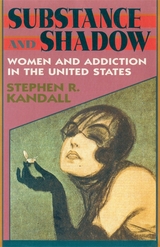
In 1989 Jennifer Johnson was convicted of delivering a controlled substance to a minor. That the minor happened to be Johnson's unborn child made her case all the more complex, controversial, and ultimately, historical. Stephen R. Kandall, a neonatologist and pediatrician, testified as an expert witness on Johnson's behalf. The experience caused him to wonder how one disadvantaged black woman's case became a prosecutorial battlefield in the war on drugs. This book is the product of Kandall's search through the annals of medicine and history to learn how women have fared in this conflict and how drug-dependent women have been treated for the past century and a half.
Kandall's sleuthing uncovers an intriguing and troubling story. Opium, laudanum, and morphine were primary ingredients in the curative "powders" and strengthening "tonics" that physicians freely prescribed and pharmacists dispensed to women a hundred and fifty years ago. Or a woman could easily dose herself with narcotics and alcohol in the readily available form of "patent" medicines sold in every town and touted in popular magazines ("Over a million bottles sold and in every one a cure!"). For the most part unaware of their dangers, women turned to these remedies for "female complaints," such as "womb disease" and "congestion of the ovaries," as well as for "neurasthenia," a widespread but vague nervous malady attributed to women's weaker, more sensitive natures. Not surprisingly, by the latter half of the nineteenth century the majority of America's opiate addicts were women.
The more things change, the more they remain the same: Substance and Shadow shows how, though attitudes and drugs may vary over time--from the laudanum of yesteryear to the heroin of the thirties and forties, the tranquilizers of the fifties, the consciousness-raising or prescription drugs of the sixties, and the ascendance of crack use in the eighties--dependency remains an issue for women. Kandall traces the history of questionable treatment that has followed this trend. From the maintenance clinics of the early twenties to the "federal farms" of mid-century to the detoxification efforts and methadone maintenance that flourished in the wake of the Women's Movement, attempts to treat drug-dependent women have been far from adequate. As he describes current policies that put money into drug interdiction and prisons, but offer little in the way of treatment or hope for women like Jennifer Johnson, Kandall calls our attention to the social and personal costs of demonizing and punishing women addicts rather than trying to improve their circumstances and give them genuine help.
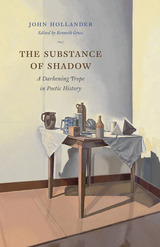
Shadow shows itself here in myriad literary identities, revealing its force as a way of seeing and a form of knowing, as material for fable and parable. Taking up a vast range of texts—from the Bible, Dante, Shakespeare, and Milton to Poe, Dickinson, Eliot, and Stevens—Hollander describes how metaphors of shadow influence our ideas of dreaming, desire, doubt, and death. These shadows of poetry and prose fiction point to unknown, often fearful domains of human experience, showing us concealed shapes of truth and possibility. Crucially, Hollander explores how shadows in poetic history become things with a strange substance and life of their own: they acquire the power to console, haunt, stalk, wander, threaten, command, and destroy. Shadow speaks, even sings, revealing to us the lost as much as the hidden self.
An extraordinary blend of literary analysis and speculative thought, Hollander’s account of the substance of shadow lays bare the substance of poetry itself.
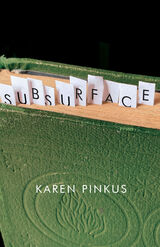
A bold new consideration of climate change between narratives of the Earth’s layers and policy of the present
Long seen as a realm of mystery and possibility, the subsurface beneath our feet has taken on all-too-real import in the era of climate change. Can reading narratives of the past that take imaginative leaps under the surface better attune us to our present knowledge of a warming planet?
In Subsurface, Karen Pinkus looks below the surface of texts by Edgar Allan Poe, Arthur Conan Doyle, George Sand, E. T. A. Hoffmann, and Jules Verne to find the buried origins of capitalist fantasies in which humans take what they want from the earth. Putting such texts into conversation with narrative theory, critical theory, geology, and climate policy, she shows that the subsurface has been, in our past, a place of myth and stories of male voyages down to gain knowledge—but it is also now the realm of fossil fuels. How do these two modes intertwine?
A highly original take on evocative terms such as extraction, burial, fossils, deep time, and speculative futurity, Subsurface questions the certainty of comfortable narrative arcs. It asks us to read literature with and against the figure of the geological column, with and against fossil fuels and the emissions warming our planet. As we see our former selves move into the distance, what new modes of imagination might we summon?
The Subtlety of the Street examines the effects of small, seemingly mundane words that occur in conversations between street-level workers and those they serve. Combining discourse analysis, public policy studies, and higher education and social work research, M Peregrine Balmat examines data from two distinct ethnographies that comprise over 1100 pages of transcribed social interaction and 24 months of participant observation fieldwork. Balmat uses Interactional Linguistics to examine how responsibility is constructed over time in social work (homeless shelter) and higher education (community college) contexts, bringing to light systemic issues that face street-level disciplines. Analyzing constellations of words—personal pronouns, terms referring to performance benchmarks and assessments, and cultural mythologies—the author shows that clusters of seemingly generic phrases street-level workers use to communicate responsibility can function, in concert, as racialized microaggressions —termed the Gestalt of Responsibility.
These problematic linguistic choices can accumulate over a student’s time in the classroom or over a person’s time in shelter. They shift in response to performance assessments and measurements, increasing in unfriendly, morally-loaded constructions of responsibility as testing days and shelter restrictions approach. While street-level research suggests that strategies like these are utilized because workers believe those discourse practices work, the phrases reflect historical English Poor Laws and racialized ideologies leveled against enslaved Black people as well as more modern neoliberal welfare state and education politics where such ideologies persist. The Subtlety of the Street offers recommendations for street-level workers’ collaborative professional development and implications for street-level approaches to pedagogy and practice.

Irr highlights works by Richard Wright, John Dos Passos, Nathanael West, and others to uncover the complex relationship between American anti-communism and communist anti-Americanism. In an unprecedented move, she extends her inquiry to the work of Canadian intellectuals such as Dorothy Livesay and Hugh MacLennan to reveal the important yet overlooked fact that the territory at the border of the United States and Canada provided a vital contact zone and transnational “home” for leftist thinkers. Attending to intersections of race, ethnicity, and gender, Irr illustrates the ways dissenting writers made culture actively respond to the political crises of the Great Depression and questioned the nature of what it means to be “American.”
Drawing on insights from postcolonial and American studies and taking into account the intellectual and cultural dimensions of leftist politics, The Suburb of Dissent is the first study of the 1930s to bring together U.S. and Canadian writings. In doing so, it reveals how the unique culture of the left contributed to North American history at this critical juncture and beyond.
In this lively and original book, the distinguished Polish historian Jerzy Jedlicki tells the story of a century-long Polish dispute over the merits and demerits of the Western model of liberal progress and industrial civilization.
As in several countries of Europe, also in Poland, intellectuals--conservatives, liberals, and (later) socialists--quarrelled about whether such a model would suit and benefit their nation, or whether it would spell the ruin of its distinctive cultural features.
This heated debate revolved around several pairs of opposing ideas: native cultures v. cosmopolitan civilization; natural v. artificial ways of economic development; Christian morals v. capitalist laissez-faire; traditional customs v. mobile society; romanticism v. scientism, and so on. It is these various aspects of the main issue which the author analyzes and links together here. He describes how difficult and painful the process of modernization was in a nation deprived of its political independence and cultural autonomy.

Explores how the suburban imaginary, composed of the built environment and imaginative texts, functions as a resource for living out the “good life”
Starting with the premise that suburban films, residential neighborhoods, chain restaurants, malls, and megachurches are compelling forms (topos) that shape and materialize the everyday lives of residents and visitors, Greg Dickinson’s Suburban Dreams offers a rhetorically attuned critical analysis of contemporary American suburbs and the “good life” their residents pursue.
Dickinson’s analysis suggests that the good life is rooted in memory and locality, both of which are foundations for creating a sense of safety central to the success of suburbs. His argument is situated first in a discussion of the intersections among buildings, cities, and the good life and the challenges to these relationships wrought by the twentieth and twenty-first centuries. The argument then turns to rich, fully-embodied analyses of suburban films and a series of archetypal suburban landscapes to explore how memory, locality, and safety interact in constructing the suburban imaginary. Moving from the pastoralism of residential neighborhoods and chain restaurants like Olive Garden and Macaroni Grill, through the megachurch’s veneration of suburban malls to the mixed-use lifestyle center’s nostalgic invocation of urban downtowns, Dickinson complicates traditional understandings of the ways suburbs situate residents and visitors in time and place.
The analysis suggests that the suburban good life is devoted to family. Framed by the discourses of consumer culture, the suburbs often privilege walls and roots to an expansive vision of worldliness. At the same time, developments such as farmers markets suggest a continued striving by suburbanites to form relationships in a richer, more organic fashion.
Dickinson’s work eschews casually dismissive attitudes toward the suburbs and the pursuit of the good life. Rather, he succeeds in showing how by identifying the positive rhetorical resources the suburbs supply, it is in fact possible to engage with the suburbs intentionally, thoughtfully, and rigorously. Beyond an analysis of the suburban imaginary, Suburban Dreams demonstrates how a critical engagement with everyday places can enrich daily life. The book provides much of interest to students and scholars of rhetoric, communication studies, public memory, American studies, architecture, and urban planning.
In Suburban Plots, Maura D'Amore explores how Henry David Thoreau, Henry Ward Beecher, Donald Grant Mitchell, Nathaniel Hawthorne, Nathaniel Parker Willis, and others utilized the pen to plot opportunities for a new sort of male agency grounded, literarily and spatially, in a suburbanized domestic landscape. D'Amore uncovers surprising narratives that do not fit easily into standard critical accounts of midcentury home life. Taking men out of work spaces and locating them in the domestic sphere, these writers were involved in a complex process of portraying men struggling to fulfill fantasies outside of their professional lives, in newly emerging communities. These representations established the groundwork for popular conceptions of suburban domestic life that remain today.


Suburban Remix brings together experts in planning, urban design, real estate development, and urban policy to demonstrate how suburbs can use growing demand for urban living to renew their appeal as places to live, work, play, and invest. The case studies and analyses show how compact new urban places are already being created in suburbs to produce health, economic, and environmental benefits, and contribute to solving a growing equity crisis.
Above all, Suburban Remix shows that suburbs can evolve and thrive by investing in the methods and approaches used successfully in cities. Whether next-generation suburbs grow from historic village centers (Dublin, Ohio) or emerge de novo in communities with no historic center (Tysons, Virginia), the stage is set for a new chapter of development—suburbs whose proudest feature is not a new mall but a more human-scale feel and form.
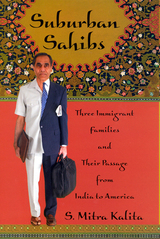
In this updated edition, journalist S. Mitra Kalita shows that although the reception from long-time residents has not been entirely welcoming, Indians have come to achieve economic success and their desire for political and social parity continues to grow stronger. She traces the evolution of the suburb from a destination for new arrivals to a launching pad for them.
In the late nineteenth century, tourists descended upon Edison to gawk at its Christmas lights displays. Today, thousands of Indians from all over the United States arrive in the same bedroom community to celebrate their own festivals of lights and colors. Suburban Sahibs attempts to answer the question of how and why they arrived, and offers a window into what America has become: a nation of suburbs as well as a nation of immigrants.
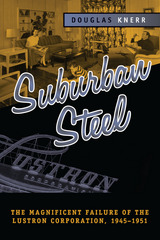
Suburban Steel chronicles the rise and fall of the Lustron Corporation, once the largest and most completely industrialized housing company in U.S. history. Beginning in 1947, Lustron manufactured porcelain-enameled steel houses in a one-million-square-foot plant in Columbus, Ohio. With forty million dollars in federal funds and support from the highest levels of the Truman administration, the company planned to produce one hundred houses per day, each neatly arranged on specially designed tractor-trailers for delivery throughout the country. Lustron’s unprecedented size and scope of operations attracted intense scrutiny. The efficiencies of uninterrupted production, integrated manufacturing, and economies of scale promised to lead the American housing industry away from its decentralized, undercapitalized, and inefficient past toward a level of rationalization and organization found in other sectors of the industrial economy.
The company’s failure marked a watershed in the history of the American housing industry. Although people did not quit talking about industrialized housing, enthusiasm for its role in the transformation of the housing industry at large markedly waned. Suburban Steel considers Lustron’s magnificent failure in the context of historical approaches to the nation’s perpetual shortage of affordable housing, arguing that had Lustron’s path not been interrupted, affordable and desirable housing for America’s masses would be far more prevalent today.

Jorge Bonilla is hospitalized with pneumonia from sleeping at the restaurant where he works, unable to afford rent on wages of thirty cents an hour. Domestic worker Yanira Juarez discovers she has labored for six months with no wages at all; her employer lied about establishing a savings account for her. We live in an era of the sweatshop reborn.
In 1992 Jennifer Gordon founded the Workplace Project to help immigrant workers in the underground suburban economy of Long Island, New York. In a story of gritty determination and surprising hope, she weaves together Latino immigrant life and legal activism to tell the unexpected tale of how the most vulnerable workers in society came together to demand fair wages, safe working conditions, and respect from employers. Immigrant workers--many undocumented--won a series of remarkable victories, including a raise of thirty percent for day laborers and a domestic workers' bill of rights. In the process, they transformed themselves into effective political participants.
Gordon neither ignores the obstacles faced by such grassroots organizations nor underestimates their very real potential for fundamental change. This revelatory work challenges widely held beliefs about the powerlessness of immigrant workers, what a union should be, and what constitutes effective lawyering. It opens up exciting new possibilities for labor organizing, community building, participatory democracy, legal strategies, and social justice.

This book seeks to explore how Barbara Pym subverts the discourse of the romance novel through her use of food, clothes, heroine and hero characterizations, and marriage customs.

Since the 1960s, theory, the arts, and political activism have increasingly rejected the notion of resistance through negation, raising such arguments as: Doesn’t a critique based on negation make itself dependent on the very system it wants to overcome? Does it not remain trapped in a thinking of oppositions? Although coming from radically different angles, the formulation of concepts like subversive affirmation, hyperaffirmation, overidentification, paradoxical intervention, revolution of the yes, and affirmative sabotage all reflect the emergence of an affirmative critique that overcomes this negation while also making us aware of the difference between conscious consent and conformity, capitulation, indifference, or pragmatism. In her new book, Sylvia Sasse explores and analyzes subversive affirmation as a critical practice in different political systems. She examines the effectiveness of such criticism and its relevance at a time when various political actors have begun appropriating subversive affirmation and are no longer using it as a method of criticism.

This book gives light to the multiple artistic expressions of Great Gatsby-writer’s wife as modernist vanguard.
Known as an icon of the Jazz Age, a flamboyant socialite, and the mad wife of F. Scott, Zelda Fitzgerald has inspired studies of her life and work which focus on her earlier years, and on the myth of the glorious-but-doomed woman. As an unprecedented study of the totality Zelda Fitzgerald’s creative work, this book makes an important contribution to the history of women’s art with new perspectives on women and modernity, plagiarism, creative partnership, and the nature of mental illness.
Zelda Fitzgerald’s creative output was astonishing, considering the conditions under which she lived, and the brevity of her life: she wrote dozens of short stories, several journalistic pieces, a play, two novels, hundreds of letters, kept diaries and produced hundreds of artworks. Employing a new mode of literary analysis that draws upon critics, theorists, and historians to situate her work in its context, The Subversive Art of Zelda Fitzgerald rehabilitates the literary and artistic status of Zelda Fitzgerald by reassessing her life and writings in the light of archival sources. Such materials include medical and psychiatric documents; her unpublished novel; an artistic and spiritual diary; and over one hundred letters written from asylums.
While much of her writing can be read as a tactical response to her husband’s injunctions against her creativity, it can also be read as brilliant work in its own right. Far from imitating Scott’s style, Zelda Fitzgerald’s artistic output is vibrantly alive and utterly her own.
Each year writers and editors submit over three thousand grammar and style questions to the Q&A page at The Chicago Manual of Style Online. Some are arcane, some simply hilarious—and one editor, Carol Fisher Saller, reads every single one of them. All too often she notes a classic author-editor standoff, wherein both parties refuse to compromise on the "rights" and "wrongs" of prose styling: "This author is giving me a fit." "I wish that I could just DEMAND the use of the serial comma at all times." "My author wants his preface to come at the end of the book. This just seems ridiculous to me. I mean, it’s not a post-face."
In The Subversive Copy Editor, Saller casts aside this adversarial view and suggests new strategies for keeping the peace. Emphasizing habits of carefulness, transparency, and flexibility, she shows copy editors how to build an environment of trust and cooperation. One chapter takes on the difficult author; another speaks to writers themselves. Throughout, the focus is on serving the reader, even if it means breaking "rules" along the way. Saller’s own foibles and misadventures provide ample material: "I mess up all the time," she confesses. "It’s how I know things."
Writers, Saller acknowledges, are only half the challenge, as copy editors can also make trouble for themselves. (Does any other book have an index entry that says "terrorists. See copy editors"?) The book includes helpful sections on e-mail etiquette, work-flow management, prioritizing, and organizing computer files. One chapter even addresses the special concerns of freelance editors.
Saller’s emphasis on negotiation and flexibility will surprise many copy editors who have absorbed, along with the dos and don’ts of their stylebooks, an attitude that their way is the right way. In encouraging copy editors to banish their ignorance and disorganization, insecurities and compulsions, the Chicago Q&A presents itself as a kind of alter ego to the comparatively staid Manual of Style. In The Subversive Copy Editor, Saller continues her mission with audacity and good humor.
In this second edition, Saller adds new chapters, on the dangers of allegiance to outdated grammar and style rules and on ways to stay current in language and technology. She expands her advice for writers on formatting manuscripts for publication, on self-editing, and on how not to be “difficult.” Saller’s own gaffes provide firsthand (and sometimes humorous) examples of exactly what not to do. The revised content reflects today’s publishing practices while retaining the self-deprecating tone and sharp humor that helped make the first edition so popular. Saller maintains that through carefulness, transparency, and flexibility, editors can build trust and cooperation with writers.
The Subversive Copy Editor brings a refreshingly levelheaded approach to the classic battle between writers and editors. This sage advice will prove useful and entertaining to anyone charged with the sometimes perilous task of improving the writing of others.
With this important new book, Susan Suleiman lays the foundation for a postmodern feminist poetics and theory of the avant-garde. She shows how the figure of Woman, as fantasy, myth, or metaphor, has functioned in the work of male avant-garde writers and artists of this century. Focusing also on women's avant-garde artistic practices, Suleiman demonstrates how to read difficult modern works in a way that reveals their political as well as their aesthetic impact.
Suleiman directly addresses the subversive intent of avant-garde movements from Surrealism to postmodernism. Through her detailed readings of provocatively transgressive works by André Breton, Georges Bataille, Roland Barthes, Alain Robbe-Grillet, Marcel Duchamp, Max Ernst, and others, Suleiman demonstrates the central role of the female body in the male erotic imagination and illuminates the extent to which masculinist assumptions have influenced modern art and theory. By examining the work of contemporary women avantgarde artists and theorists--including Hélène Cixous, Marguerite Duras, Monique Wittig, Luce Irigaray, Angela Carter, Jeanette Winterson, Leonora Carrington, Barbara Kruger, Jenny Holzer, and Cindy Sherman--Suleiman shows the political power of feminist critiques of patriarchal ideology, and especially emphasizes the power of feminist humor and parody.
Central to Suleiman's revisionary theory of the avant-garde is the figure of the playful, laughing mother. True to the radically irreverent spirit of the historical avant-gardes and their postmodernist successors, Suleiman's laughing mother embodies the need for a link between symbolic innovation and political and social change.
From the 1960s to the 1990s, seven members of the Quimpo family dedicated themselves to the anti-Marcos resistance in the Philippines, sometimes at profound personal cost. In this unprecedented memoir, eight siblings (plus one by marriage) tell their remarkable stories in individually authored chapters that comprise a family saga of revolution, persistence, and, ultimately, vindication, even as easy resolution eluded their struggles.
Subversive Lives tells of attempts to smuggle weapons for the New People’s Army (the armed branch of the Communist Party of the Philippines); of heady times organizing uprisings and strikes; of the cruel discovery of one brother’s death and the inexplicable disappearance of another (now believed to be dead); and of imprisonment and torture by the military. These stories show the sacrifices and daily heroism of those in the movement. But they also reveal its messy legacies: sons alienated from their father; daughters abused by the military; friends betrayed; and revolutionary affection soured by intractable ideological differences.
The rich and distinctive contributions span the martial law years of Ferdinand Marcos’s rule. Subversive Lives is a riveting and accessible primer for those unfamiliar with the era, and a resonant history for those with a personal connection to what it meant to be Filipino at that time, or for anyone who has fought political repression.
Though Weil published little during her life, after her death, thanks largely to the efforts of Albert Camus, hundreds of pages of her manuscripts were published to critical and popular acclaim. While many seekers have been attracted to Weil’s religious thought, Robert Zaretsky gives us a different Weil, exploring her insights into politics and ethics, and showing us a new side of Weil that balances her contradictions—the rigorous rationalist who also had her own brand of Catholic mysticism; the revolutionary with a soft spot for anarchism yet who believed in the hierarchy of labor; and the humanitarian who emphasized human needs and obligations over human rights. Reflecting on the relationship between thought and action in Weil’s life, The Subversive Simone Weil honors the complexity of Weil’s thought and speaks to why it matters and continues to fascinate readers today.
Subversive Sounds probes New Orleans’s history, uncovering a web of racial interconnections and animosities that was instrumental to the creation of a vital American art form—jazz. Drawing on oral histories, police reports, newspaper accounts, and vintage recordings, Charles Hersch brings to vivid life the neighborhoods and nightspots where jazz was born.
This volume shows how musicians such as Jelly Roll Morton, Nick La Rocca, and Louis Armstrong negotiated New Orleans’s complex racial rules to pursue their craft and how, in order to widen their audiences, they became fluent in a variety of musical traditions from diverse ethnic sources. These encounters with other music and races subverted their own racial identities and changed the way they played—a musical miscegenation that, in the shadow of Jim Crow, undermined the pursuit of racial purity and indelibly transformed American culture.
“More than timely . . . Hersch orchestrates voices of musicians on both sides of the racial divide in underscoring how porous the music made the boundaries of race and class.”—New Orleans Times-Picayune

READERS
Browse our collection.
PUBLISHERS
See BiblioVault's publisher services.
STUDENT SERVICES
Files for college accessibility offices.
RECENTLY PUBLISHED


UChicago Accessibility Resources
home | accessibility | search | about | contact us
BiblioVault ® 2001 - 2025
The University of Chicago Press