
 A SCHOLARLY BOOK REPOSITORY
258 start with S start with S
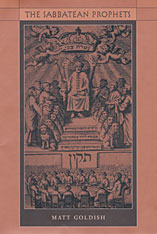
In the mid-seventeenth century, Shabbatai Zvi, a rabbi from Izmir, claimed to be the Jewish messiah, and convinced a great many Jews to believe him. The movement surrounding this messianic pretender was enormous, and Shabbatai's mission seemed to be affirmed by the numerous supporting prophecies of believers. The story of Shabbatai and his prophets has mainly been explored by specialists in Jewish mysticism. Only a few scholars have placed this large-scale movement in its social and historical context.
Matt Goldish shifts the focus of Sabbatean studies from the theology of Lurianic Kabbalah to the widespread seventeenth-century belief in latter-day prophecy. The intense expectations of the messiah in Christianity, Judaism, and Islam form the necessary backdrop for understanding the success of Sabbateanism. The seventeenth century was a time of deep intellectual and political ferment as Europe moved into the modern era. The strains of the Jewish mysticism, Christian millenarianism, scientific innovation, and political transformation all contributed to the development of the Sabbatean movement.
By placing Sabbateanism in this broad cultural context, Goldish integrates this Jewish messianic movement into the early modern world, making its story accessible to scholars and students alike.

Fascism was the first and prime instance of a modern political religion. Rereading signs, symbols, cults, and myths, Italy's leading scholar of Fascism offers a new history of Italian nationalism as a civic religion, albeit in its extreme form, and of Italian Fascism as a vital catalyst for contemporary mass politics. Emilio Gentile decodes Italy culturally, going beyond political and social dimensions that explain Italy's Fascist past in terms of class, or the cynicism of its leaders, or modernizing and expansionist ambitions.
By looking back at the Risorgimento's civic and moral renewal of the Italians as a free people educated in the faith and worship of a "national religion," at the jarring countereffects of the secularized nation-state not trusting mass political mobilization, and at Fascism's retrieval of history from Rome, the French Revolution, and Romanticism, Gentile reconstructs the cultural configurations of a sacred politics. He shows how Mussolini used the concept of propaganda as a project in civic pedagogy, and how the Fascists thus cultivated a new consciousness that filled the void left by the decline of traditional religion. Fascism mobilized the masses through spectacle and public ceremony in an effort to conquer and shape the mentality and customs of a still emerging nation.

Written a generation apart and rarely treated together by scholars, Little Women (1868) and The House of Mirth (1905) share a deep concern with materialism, moral development, and self-construction. The heroines in both grapple with conspicuous consumption, an aspect of modernity that challenges older beliefs about ethical behavior and core identity.
Placing both novels at the historical intersection of modern consumer culture and older religious discourse on materialism and identity, Sarah Way Sherman analyzes how Alcott and Wharton rework traditional Protestant discourse to interpret their heroines' struggle with modern consumerism. Her conclusion reveals how Little Women's optimism, still buoyed by otherworldly justice, providential interventions, and the notion of essential identity, ultimately gives way to the much darker vision of modern materialistic culture in The House of Mirth.
The definitive biography of Hideki Tojo, the controversial general who redefined military leadership in Shōwa-era Japan before his downfall during World War II.
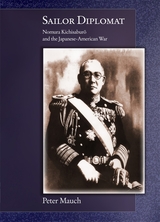
As Japan’s pre–Pearl Harbor ambassador to the United States, Admiral Nomura Kichisaburō (1877–1964) played a significant role in a tense and turbulent period in Japanese–U.S. relations. Scholars tend to view his actions and missteps as ambassador as representing the failure of diplomacy to avert the outbreak of hostilities between the two paramount Pacific powers.
This extensively researched biography casts new light on the life and career of this important figure. Connecting his experiences as a naval officer to his service as foreign minister and ambassador, and later as “father” of Japan’s Maritime Self Defense Forces and proponent of the U.S.–Japanese alliance, this study reassesses Nomura’s contributions as a hard-nosed realist whose grasp of the underlying realities of Japanese–U.S. relations went largely unappreciated by the Japanese political and military establishment.
In highlighting the complexities and conundrums of Nomura’s position, as well as the role of the Imperial Navy in the formulation of Japan’s foreign policy, Peter Mauch draws upon rarely accessed materials from naval and diplomatic archives in Japan as well as various collections of personal papers, including Nomura’s, which Mauch discovered in 2005 and which are now housed in the National Diet Library.
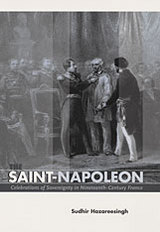
In 1852, President Louis Napoleon of France declared that August 15--Napoleon Bonaparte's birthday--would be celebrated as France's national day. Leading up to the creation of the Second Empire, this was the first in a series of attempts to "Bonapartize" his regime and strengthen its popular legitimacy. Across France, public institutions sought to draw local citizens together to celebrate civic ideals of unity, order, and patriotism. But the new sense of French togetherness was fraught with tensions.
Drawing on a wealth of archival evidence, Sudhir Hazareesingh vividly reconstructs the symbolic richness and political complexity of the Saint-Napoleon festivities in a work that opens up broader questions about the nature of the French state, unity and lines of fracture in society, changing boundaries between public and private spheres, and the role of myth and memory in constructing nationhood. The state's Bonapartist identity was at times vigorously contested by local social, political, and religious groups. In various regions, people used the national day to celebrate their own communities and to honor their hometown veterans; but elsewhere, the revival of republican sentiment clashed sharply with imperial attitudes.
Sophisticated and gracefully written, this book offers rich insights into modern French history and culture.
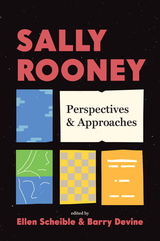
Bestselling Irish novelist Sally Rooney has emerged as the defining voice of a generation, a cultural phenomenon whose spare, intelligent prose and sharp social insight have reshaped contemporary fiction and sparked a global conversation about intimacy, politics, and the millennial condition. This new collection brings together contributors from a wide range of disciplines to offer fresh critical readings of Rooney’s influential novels, alongside adaptable strategies for teaching her work in today’s undergraduate and graduate classrooms. The essays situate Rooney within literary traditions from Romantic poetry to the bildungsroman and the contemporary campus novel, while engaging with contemporary topics such as gender politics, late capitalism, and media adaptation. Providing accessible yet rigorous frameworks for exploring Rooney’s fiction, this volume confirms her significance not only within contemporary literary studies but also as a cultural force whose work reaffirms the relevance of the humanities in the twenty-first-century classroom.
Published by Bucknell University Press. Distributed worldwide by Rutgers University Press.
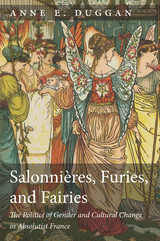

Bewigged, muscular and for his day unusually tall, adorned in soiled, rumpled clothes, beset by involuntary tics, opinionated, powered in his conversation by a prodigious memory and intellect, Samuel Johnson (1709–1784) was in his life a literary and social icon as no other age has produced. “Johnsonianissimus,” as Boswell called him, became in the hands of his first biographers the rationalist epitome and sage of Enlightenment. These clichés—though they contain elements of truth—distort the complexity of the public and private Johnson. Peter Martin portrays a Johnson wracked by recriminations, self-doubt, and depression—a man whose religious faith seems only to have deepened his fears. His essays, scholarship, biography, journalism, travel writing, sermons, fables, as well as other forms of prose and poetry in which he probed himself and the world around him, Martin shows, constituted rational triumphs against despair and depression. It is precisely the combination of enormous intelligence and frank personal weakness that makes Johnson’s writing so compelling.
Benefiting from recent critical scholarship that has explored new attitudes toward Johnson, Martin’s biography gives us a human and sympathetic portrait of Dr. Johnson. Johnson’s criticism of colonial expansion, his advocacy for the abolition of slavery, his encouragement of women writers, his treatment of his female friends as equals, and his concern for the underprivileged and poor make him a very “modern” figure. The Johnson that emerges from this enthralling biography, published for the tercentenary of Johnson’s birth, is still the foremost figure of his age but a more rebellious, unpredictable, flawed, and sympathetic figure than has been previously known.
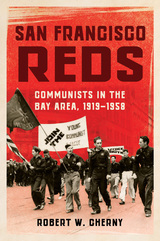
Founded in 1919, the Communist Party (CP) in San Francisco survived an ineffectual early period to become a force in the trade union heyday of the 1930s. Robert Cherny uses the lives and careers of more than fifty members to tell the story of the city’s CP from its founding through 1958.
Cherny draws on FBI files, the records of the CP at the Russian State Archive for Social and Political History, interviews, and memoirs to follow male and female party and union leaders, rank-and-file members, and others. His history reveals why people joined the CP while charting the frequent changes in policy, constant member turnover, and disruptive factionalism that limited party aims and successes. Cherny also follows his subjects through their resignations, expulsions, or other reasons for departure and looks at the CP’s influence on their lives in subsequent years.
Vivid and exhaustively researched, San Francisco Reds is a long view account of the personal motivations and activism of an Old Left generation in a West Coast city.
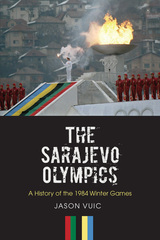
To most observers, the 1984 Winter Olympics in Sarajevo, Yugoslavia, were an unmitigated success. That year, the unlikeliest of candidate cities in the unlikeliest of candidate countries did what many had thought impossible: it hosted an international sports competition at the highest level, housing and feeding hundreds of athletes and thousands of tourists while broadcasting a positive image of socialist Yugoslavia to the world.
The first Winter Games held in a communist country, Sarajevo also marked the first Olympic confrontation of Soviet and American athletes since the U.S. boycott of the 1980 Moscow Summer Games. And the competitions themselves were spectacular and memorable. This was the Olympics of British ice dancers Jayne Torvill and Christopher Dean, American skiers “Wild Bill” Johnson and Debbie Armstrong, and East German skaters Katarina Witt and Karin Enke, not to mention a Soviet hockey team that rebounded from its stunning loss to the Americans at Lake Placid four years earlier to win all seven of its matches.
Yet The Sarajevo Olympics is more than just a history of sport. Jason Vuic also retraces the history of the Olympic movement, analyzes the inner workings of the International Olympic Committee during the troubled 1970s and 1980s, and places the 1984 Winter Games in the context of Cold War geopolitics. The book begins and ends by reminding readers that less than a decade after it hosted the Olympics, the Bosnian city of Sarajevo found itself at the vortex of a bloody and brutal civil war that would end with the dissolution of the multiethnic Yugoslavian state.

The study begins with an examination of the uses of "responsibility" in Being and Nothingness and in several postwar essays. Flynn then concentrates on the Critique of Dialectical Reason, offering a thorough analysis of the remarkable social theory Sartre constructs there. A masterful contribution to Sartre scholarship, Sartre and Marxist Existentialism will be of great interest to social and political philosophers involved in the debate over collective responsibility.
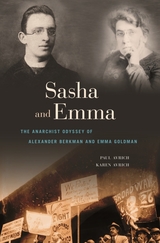
In 1889 two Russian immigrants, Emma Goldman and Alexander Berkman, met in a coffee shop on the Lower East Side. Over the next fifty years Emma and Sasha would be fast friends, fleeting lovers, and loyal comrades. This dual biography offers an unprecedented glimpse into their intertwined lives, the lasting influence of the anarchist movement they shaped, and their unyielding commitment to equality and justice.
Berkman shocked the country in 1892 with "the first terrorist act in America," the failed assassination of the industrialist Henry Clay Frick for his crimes against workers. Passionate and pitiless, gloomy yet gentle, Berkman remained Goldman's closest confidant though the two were often separated-by his fourteen-year imprisonment and by Emma's growing fame as the champion of a multitude of causes, from sexual liberation to freedom of speech. The blazing sun to Sasha's morose moon, Emma became known as "the most dangerous woman in America." Through an attempted prison breakout, multiple bombing plots, and a dramatic deportation from America, these two unrelenting activists insisted on the improbable ideal of a socially just, self-governing utopia, a vision that has shaped movements across the past century, most recently Occupy Wall Street.
Sasha and Emma is the culminating work of acclaimed historian of anarchism Paul Avrich. Before his death, Avrich asked his daughter to complete his magnum opus. The resulting collaboration, epic in scope, intimate in detail, examines the possibilities and perils of political faith and protest, through a pair who both terrified and dazzled the world.
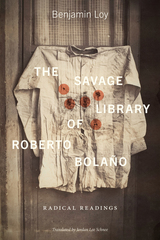
Visionary Chilean writer Roberto Bolaño was known for his darkly poetic prose and postmodern narratives, exemplified in his novel The Savage Detectives. His work is also deeply infused with references to the Western literary canon—from French and Spanish baroque texts to American and German modernism, as well as postmodern literature from Latin America and France. Taking Bolaño’s notion of “savage” reading as a point of departure, this study explores the key authors and literary traditions that underpin his oeuvre. Blending close textual analysis with insights from the history of literature and ideas, Loy offers fresh perspectives on some of Bolaño’s most significant works, including Distant Star, By Night in Chile, and 2666. The intertextual dialogues Loy traces—with figures such as Blaise Pascal, Sor Juana Inés de la Cruz, Charles Baudelaire, William Carlos Williams, Ernst Jünger, Nicanor Parra, and Georges Perec—illuminate the aesthetic universe of an author now regarded as a central figure in twenty-first-century world literature.
Published by Bucknell University Press. Distributed worldwide by Rutgers University Press.
Scale and Scope is Alfred Chandler’s first major work since his Pulitzer Prize–winning The Visible Hand. Representing ten years of research into the history of the managerial business system, this book concentrates on patterns of growth and competitiveness in the United States, Germany, and Great Britain, tracing the evolution of large firms into multinational giants and orienting the late twentieth century’s most important developments.
This edition includes the entire hardcover edition with the exception of the Appendix Tables.

First published posthumously in 1623, Scanderbeide reemerges here in an adroit English prose translation that maintains the suspense of the original text and gives ample context to its rich cultural implications.

A sweeping intellectual history of the concept of economic scarcity—its development across five hundred years of European thought and its decisive role in fostering the climate crisis.
Modern economics presumes a particular view of scarcity, in which human beings are innately possessed of infinite desires and society must therefore facilitate endless growth and consumption irrespective of nature’s limits. Yet as Fredrik Albritton Jonsson and Carl Wennerlind show, this vision of scarcity is historically novel and was not inevitable even in the age of capitalism. Rather, it reflects the costly triumph of infinite-growth ideologies across centuries of European economic thought—at the expense of traditions that sought to live within nature’s constraints.
The dominant conception of scarcity today holds that, rather than master our desires, humans must master nature to meet those desires. Albritton Jonsson and Wennerlind argue that this idea was developed by thinkers such as Francis Bacon, Samuel Hartlib, Alfred Marshall, and Paul Samuelson, who laid the groundwork for today’s hegemonic politics of growth. Yet proponents of infinite growth have long faced resistance from agrarian radicals, romantic poets, revolutionary socialists, ecofeminists, and others. These critics—including the likes of Gerrard Winstanley, Dorothy Wordsworth, Karl Marx, and Hannah Arendt—embraced conceptions of scarcity in which our desires, rather than nature, must be mastered to achieve the social good. In so doing, they dramatically reenvisioned how humans might interact with both nature and the economy.
Following these conflicts into the twenty-first century, Albritton Jonsson and Wennerlind insist that we need new, sustainable models of economic thinking to address the climate crisis. Scarcity is not only a critique of infinite growth, but also a timely invitation to imagine alternative ways of flourishing on Earth.

The author situates the emergence of professional philosophy in the context of the professionalization of American higher education and articulates, in the case of philosophy, the structures and values of a professional discipline. One of the most important consequences of this transformation was a new emphasis on communal theories of truth. Peirce, Dewey, and Royce all developed sophisticated and important theories of community as they were engaged in reshaping and redefining the limits of philosophy. This book will be of great importance for those interested in the history of philosophy, the rise of professions, and American intellectual and educational history, and to all those seeking to understand the contemporary revival of pragmatic thought and theories of community.
In 1843, the Victorian philosopher John Stuart Mill called for the establishment of a new science, “the science of the formation of character.” Although Mill’s proposal failed as scientific practice, S. Pearl Brilmyer maintains that it found its true home in realist fiction of the period, which employed the literary figure of character to investigate the nature of embodied experience. Bringing to life Mill’s unrealized dream of a science of character, novelists such as George Eliot, Thomas Hardy, and Olive Schreiner turned to narrative to explore how traits and behaviors in organisms emerge and develop, and how aesthetic features—shapes, colors, and gestures—come to take on cultural meaning through certain categories, such as race and sex. Engaged with materialist science and philosophy, these authors transformed character from the liberal notion of the inner truth of an individual into a materially determined figuration produced through shifts in the boundaries between the body’s inside and outside. In their hands, Brilmyer argues, literature became a science, not in the sense that its claims were falsifiable or even systematically articulated, but in its commitment to uncovering, through a fictional staging of realistic events, the laws governing physical and affective life. The Science of Character redraws late Victorian literary history to show how women and feminist novelists pushed realism to its aesthetic and philosophical limits in the crucial span between 1870 and 1920.

In the late 1770s, as a wave of revolution and republican unrest swept across Europe, scholars looked with urgency on the progress of European civilization. The question of social development was addressed from Edinburgh to St. Petersburg, with German scholars, including C. G. Heyne, Christoph Meiners, and J. G. Eichhorn, at the center of the discussion.
Michael Carhart examines their approaches to understanding human development by investigating the invention of a new analytic category, "culture." In an effort to define human nature and culture, scholars analyzed ancient texts for insights into language and the human mind in its early stages, together with writings from modern travelers, who provided data about various primitive societies. Some scholars began to doubt the existence of any essential human nature, arguing instead for human culture. If language was the vehicle of reason, what did it mean that all languages were different? Were rationality and virtue universal or unique to a given nation?
In this scholarship lie the roots of anthropology, sociology, and classical philology. Dissecting the debates over nature versus culture in Enlightenment Europe, Carhart offers a valuable contribution to cultural and intellectual history and the history of the human sciences.
Reading is perhaps the essential practice of modern civilization. For centuries, it has been seen as key to both personal fulfillment and social progress, and millions today depend on it to participate fully in our society. Yet, at its heart, reading is a surprisingly elusive practice. This book tells for the first time the story of how American scientists and others have sought to understand reading, and, by understanding it, to improve how people do it.
Starting around 1900, researchers—convinced of the urgent need to comprehend a practice central to industrial democracy—began to devise instruments and experiments to investigate what happened to people when they read. They traced how a good reader’s eyes moved across a page of printed characters, and they asked how their mind apprehended meanings as they did so. In schools across the country, millions of Americans learned to read through the application of this science of reading. At the same time, workers fanned out across the land to extend the science of reading into the social realm, mapping the very geography of information for the first time. Their pioneering efforts revealed that the nation’s most pressing problems were rooted in drastic informational inequities, between North and South, city and country, and white and Black—and they suggested ways to tackle those problems.
Today, much of how we experience our information society reflects the influence of these enterprises. This book explains both how the science of reading shaped our age and why, with so-called reading wars still plaguing schools across the nation, it remains bitterly contested.

For the first time, the story of how and why we have plumbed the mysteries of reading, and why it matters today.
Reading is perhaps the essential practice of modern civilization. For centuries, it has been seen as key to both personal fulfillment and social progress, and millions today depend on it to participate fully in our society. Yet, at its heart, reading is a surprisingly elusive practice. This book tells for the first time the story of how American scientists and others have sought to understand reading, and, by understanding it, to improve how people do it.
Starting around 1900, researchers—convinced of the urgent need to comprehend a practice central to industrial democracy—began to devise instruments and experiments to investigate what happened to people when they read. They traced how a good reader’s eyes moved across a page of printed characters, and they asked how their mind apprehended meanings as they did so. In schools across the country, millions of Americans learned to read through the application of this science of reading. At the same time, workers fanned out across the land to extend the science of reading into the social realm, mapping the very geography of information for the first time. Their pioneering efforts revealed that the nation’s most pressing problems were rooted in drastic informational inequities, between North and South, city and country, and white and Black—and they suggested ways to tackle those problems.
Today, much of how we experience our information society reflects the influence of these enterprises. This book explains both how the science of reading shaped our age and why, with so-called reading wars still plaguing schools across the nation, it remains bitterly contested.

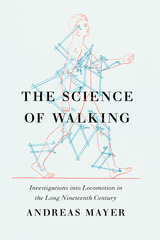
Looking back at more than a century of locomotion research, Mayer charts, for the first time, the rise of scientific endeavors to control and codify locomotion and analyzes their social, political, and aesthetic ramifications throughout the long nineteenth century. In an engaging narrative that weaves together science and history, Mayer sets the work of the most important representatives of the physiology of locomotion—including Wilhelm and Eduard Weber and Étienne-Jules Marey—in their proper medical, political, and artistic contexts. In tracing the effects of locomotion studies across other cultural domains, Mayer reframes the history of the science of walking and gives us a deeper understanding of human movement.

This trenchant study analyzes the rise and decline in the quality and format of science in America since World War II.
During the Cold War, the U.S. government amply funded basic research in science and medicine. Starting in the 1980s, however, this support began to decline and for-profit corporations became the largest funders of research. Philip Mirowski argues that a powerful neoliberal ideology promoted a radically different view of knowledge and discovery: the fruits of scientific investigation are not a public good that should be freely available to all, but are commodities that could be monetized.
Consequently, patent and intellectual property laws were greatly strengthened, universities demanded patents on the discoveries of their faculty, information sharing among researchers was impeded, and the line between universities and corporations began to blur. At the same time, corporations shed their in-house research laboratories, contracting with independent firms both in the States and abroad to supply new products. Among such firms were AT&T and IBM, whose outstanding research laboratories during much of the twentieth century produced Nobel Prize–winning work in chemistry and physics, ranging from the transistor to superconductivity.
Science-Mart offers a provocative, learned, and timely critique, of interest to anyone concerned that American science—once the envy of the world—must be more than just another way to make money.
Describing the work of the post-Kuhnian science studies scholars Bruno Latour, Ulrich Beck, and the team of Michael Gibbons, Helga Nowtony, and Peter Scott, Harding reveals how, from different perspectives, they provide useful resources for rethinking the modernity versus tradition binary and its effects on the production of scientific knowledge. Yet, for the most part, they do not take feminist or postcolonial critiques into account. As Harding demonstrates, feminist science studies and postcolonial science studies have vital contributions to make; they bring to light not only the male supremacist investments in the Western conception of modernity and the historical and epistemological bases of Western science but also the empirical knowledge traditions of the global South. Sciences from Below is a clear and compelling argument that modernity studies and post-Kuhnian, feminist, and postcolonial sciences studies each have something important, and necessary, to offer to those formulating socially progressive scientific research and policy.
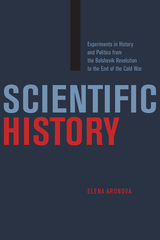
The book explores the intertwined trajectories of six intellectuals and the larger programs they set in motion: Henri Berr (1863–1954), Nikolai Bukharin (1888–1938), Lucien Febvre (1878–1956), Nikolai Vavilov (1887–1943), Julian Huxley (1887–1975), and John Desmond Bernal (1901–1971). Though they held different political views, spoke different languages, and pursued different goals, these thinkers are representative of a larger motley crew who joined the techniques, approaches, and values of science with the writing of history, and who created powerful institutions and networks to support their projects.
In tracing these submerged stories, Aronova reveals encounters that profoundly shaped our knowledge of the past, reminding us that it is often the forgotten parts of history that are the most revealing.
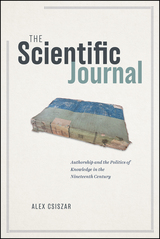
The Scientific Journal tells the story of how that changed. Alex Csiszar takes readers deep into nineteenth-century London and Paris, where savants struggled to reshape scientific life in the light of rapidly changing political mores and the growing importance of the press in public life. The scientific journal did not arise as a natural solution to the problem of communicating scientific discoveries. Rather, as Csiszar shows, its dominance was a hard-won compromise born of political exigencies, shifting epistemic values, intellectual property debates, and the demands of commerce. Many of the tensions and problems that plague scholarly publishing today are rooted in these tangled beginnings. As we seek to make sense of our own moment of intense experimentation in publishing platforms, peer review, and information curation, Csiszar argues powerfully that a better understanding of the journal’s past will be crucial to imagining future forms for the expression and organization of knowledge.
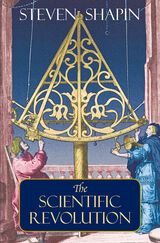
"Shapin's account is informed, nuanced, and articulated with clarity. . . . This is not to attack or devalue science but to reveal its richness as the human endeavor that it most surely is. . . .Shapin's book is an impressive achievement."—David C. Lindberg, Science
"Shapin has used the crucial 17th century as a platform for presenting the power of science-studies approaches. At the same time, he has presented the period in fresh perspective."—Chronicle of Higher Education
"Timely and highly readable . . . A book which every scientist curious about our predecessors should read."—Trevor Pinch, New Scientist
"It's hard to believe that there could be a more accessible, informed or concise account of how it [the scientific revolution], and we have come to this. The Scientific Revolution should be a set text in all the disciplines. And in all the indisciplines, too."—Adam Phillips, London Review of Books
"Shapin's treatise on the currents that engendered modern science is a combination of history and philosophy of science for the interested and educated layperson."—Publishers Weekly
"Superlative, accessible, and engaging. . . . Absolute must-reading."—Robert S. Frey, Bridges
"This vibrant historical exploration of the origins of modern science argues that in the 1600s science emerged from a variety of beliefs, practices, and influences. . . . This history reminds us that diversity is part of any intellectual endeavor."—Choice
"Most readers will conclude that there was indeed something dramatic enough to be called the Scientific Revolution going on, and that this is an excellent book about it."—Anthony Gottlieb, The New York Times Book Review

These include philosophical texts drawn from a constellation of historical topoi at the critical moments of their encounter with the maritime: Plato and Euripedes’s work from fifth-century Athens; Augustus and Plautus’s writings from republican and early imperial Rome; Shakespeare’s creations from Elizabethan England; Kant and Rousseau’s texts from enlightenment continental Europe; and the thinking of Husserl and Heidegger from interwar Germany of the twentieth century. For each historical topos, Yi juxtaposes different representations of and responses to the maritime through the reading of a philosophical text vis-à-vis the reading of a literary text. In so doing, she lays bare the deep political and moral ambiguity attributed to the ocean in Western philosophical and literary imaginaries.
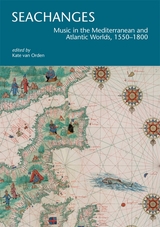
Seachanges brings together original essays examining human and cultural mobility from a musical perspective. Musicians have always been migratory frontrunners, and musical encounters have always generated nodes of cultural complexity. But hearing past musicking that took place in diaspora and foreign lands requires new methodologies designed to center unsettled lives and ephemeral practices in history.
Employing interpretive strategies from musicology, ethnomusicology, historical performance practice, sociolinguistics, and cultural history, the contributors intentionally complicate national and regional accounts of music from 1550 to 1800. Repertorial subjects include Spanish guitar music in Italy, Italian songs in Bohemia, Turkish songs in France, Jewish rituals on Corfu, Jesuit hymns in the Greek Archipelago, and Ottoman court music; further chapters recover the experiences of Indigenous musicians in colonial Latin America, the diaspora of Neapolitan singers, fictional cartographies of Baroque opera, and the careers of enslaved Black musicians in Venice and pre-revolutionary Haiti. They promote a new theoretical vocabulary that coalesces around orality, voice, performers, and performance as matters to foreground in mobility studies.
Seachanges illustrates how musical microhistories can address mobility at the macro level of Mediterranean and Atlantic Studies while respecting the tempo of individual human lives and musical timeframes.

“The most astute and eloquent critic of poetry at work today.”
—Michiko Kakutani, New York Times
A renowned American critic charts the creative evolution of the greatest Irish poet since Yeats.
If other books on Nobel laureate Seamus Heaney have dwelled on the biographical, geographical, and political aspects of his writing, Helen Vendler looks squarely and deeply at his poetic art. Tracing the eminent poet’s development from his beginnings in Death of a Naturalist (1966) through The Spirit Level (1996), Seamus Heaney is an inspired and nuanced portrait of an Irish chronicler of public as well as private life, whose work has given voice to his troubled times.
With characteristic discernment and eloquence, Vendler considers an often neglected but crucial part of Heaney’s evolving talent: self-revision. Here we see how later poems return to the themes or genres of the earlier works and reconceive them in light of the poet’s later attitudes or techniques. Vendler surveys all of Heaney’s efforts in the classical forms—genre scene, elegy, sonnet, parable, confessional poem, poem of perception—and brings to light his aesthetic and moral attitudes.
Seamus Heaney’s development as a poet is inextricably connected to the violent struggle that racked Northern Ireland during his lifetime. Vendler shows how, in each volume, Heaney strived to find a precise language for the turbulence he was living through—“symbols adequate for our predicament,” as he once said. The worldwide response to those discovered symbols suggests that their relevance extends far beyond their original context.
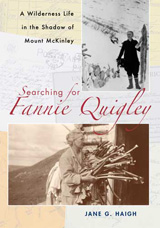
At the age of 27, Fannie Sedlacek left her Bohemian homestead in Nebraska to join the gold rush to the Klondike. From the Klondike to the Tanana, Fannie continued north, finally settling in Katishna near Mount McKinley. This woman, later known as Fannie Quigley, became a prospector who staked her own claims and a cook who ran a roadhouse. She hunted and trapped and thrived for nearly forty years in an environment that others found unbearable.
Her wilderness lifestyle inspired many of those who met her to record their impressions of this self-sufficient woman, who died in 1944. To many of the 700,000 annual visitors to Denali National Park she is a symbol of the enduring spirit of the original pioneers.
Searching for Fannie Quigley: A Wilderness Life in the Shadow of Mount McKinley goes beyond the mere biographical facts of this unique woman’s journey. It also tells historian Jane G. Haigh’s own story of tracking and tracing the many paths that Fannie Quigley’s intriguing life took. Uncovering remote clues, digging through archives, and listening to oral accounts from a wide array of sources, Haigh has fashioned this rich lode into a compelling narrative.
In Searching for Fannie Quigley, Haigh separates fact from fiction to reveal the true story of this highly mythologized pioneer woman.
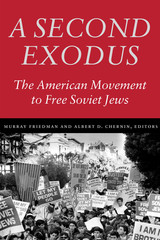

Ramzy Baroud is a veteran journalist and former producer for Al-Jazeera TV. This is his comprehensive account of the momentous events of the last five years which shaped the political landscape not only of Palestine and Israel but of the entire Middle East region.
Addressing the most controversial issues, including the alarming escalation in suicide bombings, and the construction of the Separation Wall, he reports on the huge rate of unemployment and hunger in the Occupied Territories -- statistics so critical that NGOs compare their magnitude to African nations such as the Congo. From the brutality of the Israeli army to the ever-compromising nature of the Palestinian Authority, few are spared Baroud’s thoughtful critique.
The book is clear and concise, with one chapter dedicated to the major events of each year, and includes a comprehensive timeline.
The Second World War casts a long shadow, portrayed as a necessary and paradigmatic war that defeated fascism. During recent wars in Iraq, Afghanistan and elsewhere, US presidents and British prime ministers have tried to claim they were following in the footsteps of Winston Churchill by standing up to dictators.
In The Second World War Chris Bambery tests this position in a thorough account of the war and tries to understand why it still dominates TV history channels and school history books.
Bambery argues that the conflict ultimately was about a division of the world between the great powers, as well as a rising of ordinary people against fascism. He offers a complex and radical analysis, that is unique when compared to many modern and conventional histories of the war.
Uncovering an eclectic and surprising archive, Prado-Fonts draws on diverse cultural artifacts from popular literature, journalism, and early cinema to offer a rich account of how China was seen across the West between 1880 and 1930. Enrique Gaspar, Luis de Oteyza, Vicente Blasco Ibáñez, and lesser-known authors writing in Spanish and Catalan put themselves in dialogue with Leo Tolstoy, John Dewey, W. Somerset Maugham, Bertrand Russell, Pearl Buck, and André Malraux, as well as stereotypical figures from popular culture like Fu Manchu and Charlie Chan. Throughout, Prado-Fonts exposes translation as a technology of cultural hegemony and China as an appealing object for representation. A timely contribution to our understanding of how we create and consume knowledge about the world, Secondhand China is essential reading for scholars and students of Orientalism, postcolonial studies, translation studies, comparative literature, and cultural studies.
A bold rethinking of the Haitian Revolution reveals the roots of the only successful slave uprising in the modern world.
Unearthing the progenitors of the Haitian Revolution has been a historical project of two hundred years. In A Secret among the Blacks, John D. Garrigus introduces two dozen Black men and women and their communities whose decades of resistance to deadly environmental and political threats preceded and shaped the 1791 revolt.
In the twenty-five miles surrounding the revolt’s first fires, enslaved people of diverse origins lived in a crucible of forces that arose from the French colonial project. When a combination of drought, trade blockade, and deadly anthrax bacteria caused waves of death among the enslaved in the 1750s, poison investigations spiraled across plantations. Planters accused, tortured, and killed enslaved healers, survivors, and community leaders for deaths the French regime had caused. Facing inquisition, exploitation, starvation, and disease, enslaved people devised resistance strategies that they practiced for decades. Enslaved men and women organized labor stoppages and allied with free Blacks to force the French into negotiations. They sought enforcement of freedom promises and legal protection from abuse. Some killed their abusers.
Through remarkable archival discoveries and creative interpretations of the worlds endured by the enslaved, A Secret among the Blacks reveals the range of complex, long-term political visions pursued by enslaved people who organized across plantations located in the seedbed of the Haitian Revolution. When the call to rebellion came, these men and women were prepared to answer.

Published by Bucknell University Press.
Distributed worldwide by Rutgers University Press.
From the moment of the secret protocol’s inception—and the near-instantaneous rumors of its existence—it generated friction and competing narratives. The document became public during the Nuremberg trials, but the USSR declared it a fabrication evidencing the West’s willingness to falsify history. It continues to be relevant to the reconfiguration of history currently advanced by Vladimir Putin. By centering the rumors, accusations, and propaganda the pact precipitated, Salomoni illuminates how political actors can use and abuse history, how they create and disseminate truths and falsehoods, and how they can blur the boundary between facts and fictions even in the glaring face of black-and-white documentation.



Seeing to See focuses on two American authors who are notoriously hard to classify: Emily Dickinson and Henry David Thoreau. Dickinson proves challenging due to her short and obscure poems and Thoreau due to his insistence on capturing even the most seemingly mundane information. Daniel A. Nelson uncovers evidence that the works of these authors are often intentionally and painstakingly without aim or purpose. He argues that in their texts there is in fact an avoidance of teleological structures of writing and thinking, whereby a thing’s—or a word’s, or a text’s—value hinges on its relation to the world or other contexts.
In Nelson’s reading, Thoreau and Dickinson seem to be able to set aside all thought of distinct personal and professional goals, through which readers typically try to make an overarching sense out of, and to derive some form of profit from, disparate experiences, events, actions, and feelings. Further, both authors seem to be able to get outside of the worldview according to which the value and meaning of something, be it a natural object, a word, or an experience, is a function of its participation in a larger system. Examples of such systems include an ecosystem, taxonomic system, or syntactic system; a writer’s career, or life, or philosophy; even a single poem or journal entry. In the absence of such connections to broader categorical spheres, both writers force readers to contemplate the ineffable, constantly changing relation between words and the natural world. This contemporary reading of two iconic writers reframes their work and how readers think of nature, accepting, as these authors did, the potential freedom of the unknown.
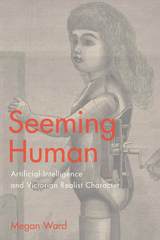
In Seeming Human, Megan Ward contends that mid-twentieth-century versions of artificial intelligence (AI) offer a theory of verisimilitude omitted by traditional histories of character, which often focus on the development of interiority and the shift from “flat” to “round” characters in the Victorian era. Instead, by reading character through AI, Megan Ward’s Seeming Human argues that routinization, predictability, automation, and even flatness are all features of realist characters.
Early artificial intelligence movements such as cybernetics, information theory, and the Turing test define ways of seeming—rather than being—human. Using these theories of verisimilitude to read Victorian novelists such as Elizabeth Gaskell, Margaret Oliphant, Anthony Trollope, Thomas Hardy, and Henry James, Seeming Human argues that mechanicity has been perceived as anti-realist because it is the element that we least want to identify as human. Because AI produces human-like intelligence, it makes clear that we must actually turn to machines in order to understand what makes realist characters seem so human.
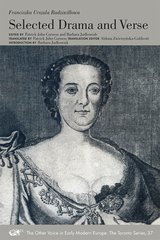

Isabella d’Este (1474–1539), daughter of the Este dukes of Ferrara and wife of Marchese Francesco II Gonzaga of Mantua, co-regent of the Gonzaga state, art collector, musician, diplomat, dynastic mother, traveler, reader, gardener, fashion innovator, and consummate politician, was also, as this volume attests, a prolific letter writer with a highly developed epistolary network. Presented here for the first time in any language is a representative selection from over 16,000 letters sent by Isabella to addressees across a wide social spectrum. Together, they paint a nuanced and colorful portrait of a brilliant and influential female protagonist of early modern European society.
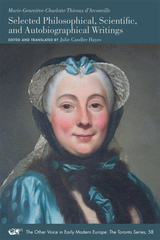
Edited and translated by Julie Candler Hayes
The Other Voice in Early Modern Europe: The Toronto Series, volume 58
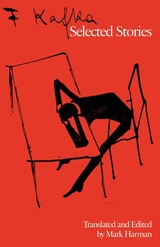
A Spectator Best Book of the Year
“It’s an extremely handsome, well-designed book, and you couldn’t ask for a better introduction to Kafka…If you’ve never read Kafka before or if you already love him, you’ll still want Harman’s Selected Stories.”
—Michael Dirda, The Washington Post
A superb new translation of Kafka’s classic stories, authoritatively annotated and beautifully illustrated.
Selected Stories presents new, exquisite renderings of short works by one of the indisputable masters of the form. Award-winning translator and scholar Mark Harman offers the most sensitive English rendering yet of Franz Kafka’s unique German prose—terse, witty, laden with ambiguities and double meanings. With his in-depth biographical introduction and notes illuminating the stories and placing them in context, Harman breathes new life into masterpieces that have often been misunderstood.
Included are sixteen stories, arranged chronologically to convey a sense of Kafka’s artistic development. Some, like “The Judgment,” “In the Penal Colony,” “A Hunger Artist,” and “The Transformation” (usually, though misleadingly, translated as “The Metamorphosis”), represent the pinnacle of Kafka’s achievement. Accompanying annotations highlight the wordplay and cultural allusions of the original German, pregnant with irony and humor that English readers have often missed.
Although Kafka has frequently been cast as a loner, in part because of his quintessential depictions of modern alienation, he had a number of close companions. Harman draws on Kafka’s diaries, extensive correspondence, and engagement with early twentieth-century debates about Darwinism, psychoanalysis, and Zionism to construct a rich portrait of Kafka in his world. A work of both art and scholarship, Selected Stories transforms our understanding and appreciation of a singular imagination.
Philosophy, Science, and Culture covers topics that range from philosophic semantics to the processes of the sciences to the forms of human rights. This collection makes McKeon's mission as a philosopher unmistakable. He characterized himself as a philosophic pluralist; he was an American philosopher in the tradition of the pragmatists, one whose philosophy subtly resonates with C. S. Peirce and John Dewey. McKeon also explored the themes of deconstructionism and other late-twentieth-century philosophies decades before their popular emergence—but, in generating a matrix of possibilities for productive debate, he avoided both relativism and the entrapments of dogmatism.
An important collection of his writings, this series will establish Richard McKeon as one of the foremost philosophers of the twentieth century.
Richard McKeon (1900-1985) taught philosophy at the University of Chicago from 1935 to 1973, and at the time of his death had published eleven books and 158 articles on an extraordinary array of topics and cultures. Among his many national and international distinctions, he was awarded the highest honor of the American Philosophical Association when he was invited to give the Paul Carus Lectures in New York in 1965.
Rita Felski’s new work brings literary studies into conversation with more affirmative and democratic forms of critical theory.
Literary critics associate the phrase “Frankfurt School” with early twentieth-century thinkers like Adorno or Benjamin, but contemporary German critical theory remains largely unknown. In this new book, Rita Felski draws on the work of a group of important philosophers and social theorists to offer fresh readings of literary texts by Robert Walser, Didier Eribon, Zadie Smith, Magda Szabo, John Williams, and Dionne Brand.
Through five key concepts derived from her reading of German theory—disclosure, recognition, self-realization, resonance, and lifeworld—Selective Affinities asks how these literary texts articulate the relationship between intellectuals and others. Contrary to critical theories that discount everyday experience, new German thought reveals the ethical, existential, and political richness of such experience. Through this framework, Felski shows that literature, theory, and experience are not opposed but mutually constitutive.

Discusses the process of the economic annihilation of the Jews in Hungary, who– from the economic point of view – were more influential than any other Jewish community in Europe. Following the German occupation in March 1944 the collaborating Hungarian government attempted to assert its claim concerning the complete confiscation of Jewish assets at all stages of the road leading to the extermination camps. The cooperation with the Germans proved to be the most problematic in this area.
The story of the Jewish Gold Train is a relatively small but all the more emblematic chapter of the economic annihilation. The circumstances of the freight’s assembling, the German-Hungarian conflicts concerning the train, the looting attempts, the fate of the assets seized by the Allies (double victimization of the survivors) provide the reader with an insight into the history of the repeated looting of the Hungarian Jewry
The book analyzes the role played by SS-Obersturmbannführer Kurt Becher, one of the most controversial and mysterious figures in the Hungarian and universal history of the Holocaust. Becher, delegated to Hungary by Himmler, administered and benefited from the confiscation of an enormous amount of Jewish assets.
Using Ukraine as a case-in-point, Svitlana Krasynska engages diverse bodies of literature and rich empirical data to reveal the vital role and unique potential of below-the-radar civic engagement in contexts where informal practices abound—a phenomenon largely neglected by scholars of civil society who traditionally focus on formal civic organizations.
Civil society in Eastern Europe has long been labeled weak based on a general lack of citizen participation in formal civil society organizations—a key criterion for assessing civic engagement in comparative studies. However, such assessment of civil society fails to recognize the role and impact of informal civic engagement in contexts where informality permeates economic, political, and social spheres. Ukraine offers a valuable counterargument of the importance of informal civil society in Eastern Europe, especially in the post-Soviet countries.
Krasynska convincingly shows that informality constitutes an essential component of civil society, shaping popular approaches to addressing social, economic, and political issues. The trailblazing findings in Self-Organization will be of interest to scholars of democratization, informality, and area studies, and they will aid development practitioners and policy makers in determining a more effective approach to helping fledgling democracies around the world.
In 1871 Paris was a city in crisis. Besieged during the Franco-Prussian War, its buildings and boulevards were damaged, its finances mired in debt, and its new government untested. But if Parisian authorities balked at the challenges facing them, entrepreneurs and businessmen did not. Selling Paris chronicles the people, practices, and politics that spurred the largest building boom of the nineteenth century, turning city-making into big business in the French capital.
Alexia Yates traces the emergence of a commercial Parisian housing market, as private property owners, architects, speculative developers, and credit-lending institutions combined to finance, build, and sell apartments and buildings. Real estate agents and their innovative advertising strategies fed these new residential spaces into a burgeoning marketplace. Corporations built empires with tens of thousands of apartments under management for the benefit of shareholders. By the end of the nineteenth century, the Parisian housing market caught the attention of the wider public as newspapers began reporting its ups and downs.
The forces that underwrote Paris’s creation as the quintessentially modern metropolis were not only state-centered or state-directed but also grew out of the uncoordinated efforts of private actors and networks. Revealing the ways housing and property became commodities during a crucial period of urbanization, Selling Paris is an urban history of business and a business history of a city that transforms our understanding of both.

A literary scholar and investment banker applies economic criticism to canonical novels, dramatically changing the way we read these classics and proposing a new model for how economics can inform literary analysis.
Every writer is a player in the marketplace for literature. Jonathan Paine locates the economics ingrained within the stories themselves, revealing how a text provides a record of its author’s attempt to sell the story to his or her readers.
An unusual literary scholar with a background in finance, Paine mines stories for evidence of the conditions of their production. Through his wholly original reading, Balzac’s The Splendors and Miseries of Courtesans becomes a secret diary of its author’s struggles to cope with the commercializing influence of serial publication in newspapers. The Brothers Karamazov transforms into a story of Dostoevsky’s sequential bets with his readers, present and future, about how to write a novel. Zola’s Money documents the rise of big business and is itself a product of Zola’s own big business, his factory of novels.
Combining close readings with detailed analyses of the nineteenth-century publishing contexts in which prose fiction first became a product, Selling the Story shows how the business of literature affects even literary devices such as genre, plot, and repetition. Paine argues that no book can be properly understood without reference to its point of sale: the author’s knowledge of the market, of reader expectations, and of his or her own efforts to define and achieve literary value.
A Sense of Place examines the vast Kanto region as a locus of cultural identity and an object of familial attachment during the political and military turmoil of the late fifteenth and early sixteenth centuries in Japan. Through analysis of memoirs, letters, chronicles, poetry, travelogues, lawsuits, land registers, and archeological reports, David Spafford explores the relationships of the eastern elites to the space they inhabited: he considers the region both as a whole, in its literary representations and political and administrative dimensions, and as an aggregation of discrete locales, where struggles over land rights played out alongside debates about the meaning of ties between families and their holdings. Spafford also provides the first historical account in English of medieval castle building and the castellan revolution of the late fifteenth century, which militarized the countryside and radically transformed the exercise of authority over territory.
Simultaneously, the book reinforces a sense of the eastern elite's anxieties and priorities, detailing how, in their relation to land and place, local elites displayed a preference for past precedent and inherited wisdom. Even amidst the changes wrought by war, this inclination, although quite at odds with their conventional reputation for ruthless pragmatism and forward thinking, prevailed.

In extended commentaries on Gadamer, the Gadamer/Habermas debate, and Derrida, Schaeffer shows that Vico offers the possibility of analyzing social phenomena and constellations of power from within the humanist rhetorical tradition. Vico’s achievements have powerful implications for relating ethics and hermeneutics to the world of concrete social practice, particularly in an age in which the electronic media have replaced print as the primary means of communication and in which a “secondary orality” (a cast of mind similar to that of nonliterate peoples) is appearing within our literate civilization.

How does emotion shape the landscape of public intellectual debate? In Sentimental Republic, Hang Tu proposes emotion as a new critical framework to approach a post-Mao cultural controversy. As it entered a period of market reform, China did not turn away from revolutionary sentiments. Rather, the post-Mao period experienced a surge of emotionally charged debates about red legacies, ranging from the anguished denunciations of Maoist violence to the elegiac remembrances of socialist egalitarianism.
Sentimental Republic chronicles forty years (1978–2018) of bitter cultural wars about the Maoist past. It analyzes how the four major intellectual clusters in contemporary China—liberals, the Left, cultural conservatives, and nationalists—debated Mao’s revolutionary legacies in light of the postsocialist transition. Should the Chinese condemn revolutionary violence and “bid farewell to socialism”? Or would a return to revolution foster alternative visions of China’s future path? Tu probes the nexus of literature, thought, and memory, bringing to light the dynamic moral sentiments and emotional excess at work in these post-Mao ideological contentions. By analyzing how rival intellectual camps stirred up melancholy, guilt, anger, and resentment, Tu argues that the polemics surrounding the country’s past cannot be properly understood without reading the emotional trajectories of the post-Mao intelligentsia.
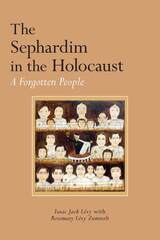
The Sephardim suffered devastation during the Holocaust, but this facet of history is poorly documented. What literature exists on the Sephardim in the Holocaust focuses on specific countries, such as Yugoslavia and Greece, or on specific cities, such as Salonika, and many of these works are not available in English.
The Sephardim in the Holocaust: A Forgotten People embraces the Sephardim of all the countries shattered by the Holocaust and pays tribute to the memory of the more than 160,000 Sephardim who perished. Isaac Jack Lévy and Rosemary Lévy Zumwalt draw on a wealth of archival sources, family history (Isaac and his family were expelled from Rhodes in 1938), and more than 150 interviews conducted with survivors during research trips to Belgium, Canada, France, Greece, Israel, Mexico, the Netherlands, the former Yugoslavia, and the United States. Lévy follows the Sephardim from Athens, Corfu, Cos, Macedonia, Rhodes, Salonika, and the former Yugoslavia to Auschwitz.
The authors chronicle the interminable cruelty of the camps, from the initial selections to the grisly work of the Sonderkommandos inside the crematoria, detailing the distinctive challenges the Sephardim faced, with their differences in language, physical appearance, and pronunciation of Hebrew, all of which set them apart from the Ashkenazim. They document courageous Sephardic revolts, especially those by Greek Jews, which involved intricate planning, sequestering of gunpowder, and complex coordination and communication between Ashkenazi and Sephardic inmates—all done in the strictest of secrecy. And they follow a number of Sephardic survivors who took refuge in Albania with the benevolent assistance of Muslims and Christians who opened their doors to give sanctuary, and traces the fate of the approximately 430,000 Jews from Morocco, Algiers, Tunisia, and Libya from 1939 through the end of the war.
The author’s intention is to include the Sephardim in the shared tragedy with the Ashkenazim and others. The result is a much needed, accessible, and viscerally moving account of the Sephardim’s unique experience of the Holocaust.

From their founding, land-grant schools have provided educational opportunities to millions, producing many of the nation’s scientific, technical, and agricultural leaders and spawning countless technological and agricultural innovations. Nevertheless, their history has not always been smooth or without controversy or setbacks. These vital centers of learning and research have in fact been redefined and reconceptualized many times and today bear only a cursory resemblance to their original incarnations.
The thirteen essays in this collection explore such themes as the emphasis on food science and home economics, the country life movement, the evolution of a public research system, the rise of aerospace engineering, the effects of the GI Bill, the teaching of military science, the sustainable agriculture movement, and the development of golf-turf science. Woven together, these expertly curated scenes, vignettes, and episodes powerfully illustrate these institutions’ ability to flex and adapt to serve the educational needs of an ever-changing American citizenry.
By dint of their mission to remedy social, economic, and technical problems; to improve standards of living; and to enhance the quality of life, land-grant universities are destined and intended to be agents of change—a role that finds them at times both celebrated and hotly contested, even vilified. A readable and fascinating exploration of land-grant universities, Service as Mandate offers a vital exploration of these dynamic institutions to educators, policy makers, students, and the wider communities that land-grant universities serve.

Presented for the first time in English, the recently discovered early manuscripts of the twentieth century’s most towering literary figure offer uncanny glimpses of his emerging genius and the creation of his masterpiece.
One of the most significant literary events of the century, the discovery of manuscript pages containing early drafts of Marcel Proust’s In Search of Lost Time put an end to a decades-long search for the Proustian grail. The Paris publisher Bernard de Fallois claimed to have viewed the folios, but doubts about their existence emerged when none appeared in the Proust manuscripts bequeathed to the Bibliothèque Nationale in 1962. The texts had in fact been hidden among Fallois’s private papers, where they were found upon his death in 2018. The Seventy-Five Folios and Other Unpublished Manuscripts presents these folios here for the first time in English, along with seventeen other brief unpublished texts. Extensive commentary and notes by the Proust scholar Nathalie Mauriac Dyer offer insightful critical analysis.
Characterized by Fallois as the “precious guide” to understanding Proust’s masterpiece, the folios contain early versions of six episodes included in the novel. Readers glimpse what Proust’s biographer Jean-Yves Tadié describes as the “sacred moment” when the great work burst forth for the first time. The folios reveal the autobiographical extent of Proust’s writing, with traces of his family life scattered throughout. Before the existence of Charles Swann, for example, we find a narrator named Marcel, a testament to what one scholar has called “the gradual transformation of lived experience into (auto)fiction in Proust’s elaboration of the novel.”
Like a painter’s sketches and a composer’s holographs, Proust’s folios tell a story of artistic evolution. A “dream of a book, a book of a dream,” Fallois called them. Here is a literary magnum opus finding its final form.
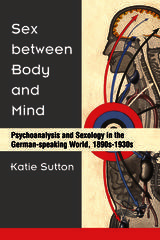
This is the first book to closely examine vital encounters among this era’s German-speaking researchers across their emerging professional and disciplinary boundaries. Although psychoanalysis was often considered part of a broader “sexual science,” sexologists increasingly distanced themselves from its mysterious concepts and clinical methods. Instead, they turned to more pragmatic, interventionist therapies—in particular, to the burgeoning field of hormone research, which they saw as crucial to establishing their own professional relevance. As sexology and psychoanalysis diverged, heated debates arose around concerns such as the sexual life of the child, the origins and treatment of homosexuality and transgender phenomena, and female frigidity. This new story of the emergence of two separate approaches to the study of sex demonstrates that the distinctions between them were always part of a dialogic and competitive process. It fundamentally revises our understanding of the production of modern sexual subjects.
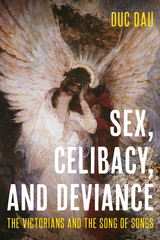
Sex, Celibacy, and Deviance is the first major study to explore the Song of Songs (or Song of Solomon) in Victorian literature and art. As the Bible’s only erotic poem, the Song of Songs is the canonical Judeo-Christian book about love, furnishing the Victorians with an authoritative and literary language for love, marriage, sex, mourning, and religious celibacy.
Duc Dau adopts a queer and feminist lens to consider how Victorians employed and interpreted the Song of Songs in their work. How did writers and artists fashion and, most importantly, challenge the norms of gender, romantic love, and marriage? Spanning the early Victorian era through the first two decades of the twentieth century, Sex, Celibacy, and Deviance considers the works of Charlotte Brontë, Thomas Hardy, Christina Rossetti, John Gray, Michael Field, Edward Burne-Jones, and Simeon Solomon alongside two lesser-known figures: Irish-born Scottish artist Phoebe Anna Traquair and the Catholic religious leader Augusta Theodosia Drane. By addressing the relevance of the Song of Songs in light of shifting and conflicting religious and social contexts, Dau provides a fresh perspective on Victorian literature, religion, and culture.
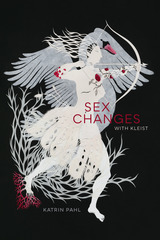
Focusing on the theatricality of Kleist’s interventions in the performance of gender, sexuality, and emotion and examining how his dramatic texts unhinge major tenets of classical European theater, Sex Changes with Kleist is vital reading for anyone interested in queer studies, feminist studies, performance studies, literary studies, or emotion studies. This book changes our understanding of Kleist and breathes new life into queer thought.

Best Nineteenth-Century Book Award, Latin American Studies Association Nineteenth-Century Section, 2021
Analyzing a wide variety of late-nineteenth-century sources, Sex, Skulls, and Citizens argues that Argentine scientific projects of the era were not just racial encounters, but were also conditioned by sexual relationships in all their messy, physical reality.
The writers studied here (an eclectic group of scientists, anthropologists, and novelists, including Estanislao Zeballos, Lucio and Eduarda Mansilla, Ramón Lista, and Florence Dixie) reflect on Indigenous sexual practices, analyze the advisability and effects of interracial sex, and use the language of desire to narrate encounters with Indigenous peoples as they try to scientifically pinpoint Argentina's racial identity and future potential.
Kerr's reach extends into history of science, literary studies, and history of anthropology, illuminating a scholarly time and place in which the lines betwixt were much blurrier, if they existed at all.
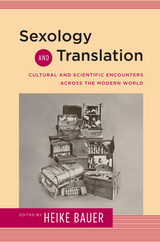
Sexology and Translation is the first study of the contemporaneous emergence of sexology in Europe, Asia, and the Middle East. Heike Bauer and her contributors—historians, literary and cultural critics, and translation scholars—address the intersections between sexuality and modernity in a range of contexts during the period from the 1880s to the 1930s.
From feminist sexualities in modern Japan to Magnus Hirschfeld’s affective sexology, this book offers compelling new insights into how sexual ideas were formed in different contexts via a complex process of cultural negotiation. By focusing on issues of translation—the dynamic process by which ideas are produced and transmitted—the essays in Sexology and Translation provide an important corrective to the pervasive idea that sexuality is a “Western” construct that was transmitted around the world.
This volume deepens understanding of how the intersections between national and transnational contexts, between science and culture, and between discourse and experience, shaped modern sexuality.
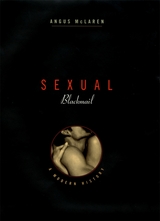
Sexual blackmail first reached public notice in the late eighteenth century when laws against sodomy were exploited by the unscrupulous to extort money from those they could entrap. Angus McLaren chronicles this parasitic crime, tracing its expansion in England and the United States through the Victorian era and into the first half of the twentieth century. The labeling of certain sexual acts as disreputable, if not actually criminal--abortion, infidelity, prostitution, and homosexuality--armed would-be blackmailers and led to a crescendo of court cases and public scandals in the 1920s and 1930s. As the importance of sexual respectability was inflated, so too was the spectacle of its loss.
Charting the rise and fall of sexual taboos and the shifting tides of shame, McLaren enables us to survey evolving sexual practices and discussions. He has mined the archives to tell his story through a host of fascinating characters and cases, from male bounders to designing women, from badger games to gold diggers, from victimless crimes to homosexual outing. He shows how these stories shocked, educated, entertained, and destroyed the lives of their victims. He also demonstrates how muckraking journalists, con men, and vengeful women determined the boundaries of sexual respectability and damned those considered deviant. Ultimately, the sexual revolution of the 1960s blurred the long-rigid lines of respectability, leading to a rapid decline of blackmail fears. This fascinating view of the impact of regulating sexuality from the late Victorian Age to our own time demonstrates the centrality of blackmail to sexual practices, deviance, and the law.
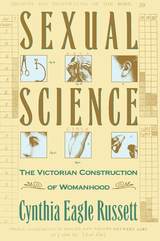
One scarcely knows whether to laugh or cry. The spectacle presented, in Cynthia Russett's splendid book, of nineteenth-century white male scientists and thinkers earnestly trying to prove women inferior to men--thereby providing, along with "savages" and "idiots," an evolutionary buffer between men and animals--is by turns appalling, amusing, and saddening. Surveying the work of real scientists as well as the products of more dubious minds, Russett has produced a learned yet immensely enjoyable chapter in the annals of human folly.
At the turn of the century science was successfully challenging the social authority of religion; scientists wielded a power no other group commanded. Unfortunately, as Russett demonstrates, in Victorian sexual science, empiricism tangled with prior belief, and scientists' delineation of the mental and physical differences between men and women was directed to show how and why women were inferior to men. These men were not necessarily misogynists. This was an unsettling time, when the social order was threatened by wars, fierce economic competition, racial and industrial conflict, and the failure of society to ameliorate poverty, vice, crime, illnesses. Just when men needed the psychic lift an adoring dependent woman could give, she was demanding the vote, higher education, and the opportunity to become a wage earner!
No other work has treated this provocative topic so completely, nor have the various scientific theories used to marshal evidence of women's inferiority been so thoroughly delineated and debunked. Erudite enough for scholars in the history of science, intellectual history, and the history of women, this book with its stylish presentation will also attract a large nonspecialist audience.
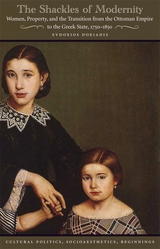
This book explores the relationship between women and property in the Greek lands and their broader social position in the century that culminated with the establishment of the national Greek state (1750–1850). Evdoxios Doxiadis focuses on the status and rights of Greek women in the later Ottoman period, the decade-long Greek War of Independence, and the first decades of the Greek state, seeking to reveal the impact that the pursuit of modernization by the early Greek governments had on women. Through the systematic examination of numerous legal documents in notarial archives from four distinct regions (Naxos, Mykonos, Athens, and Leonidio), the position of women in Greek societies of the period is illuminated in all its complexity and regional diversity. Special emphasis is placed on women’s ability in some areas to defend their property rights and be active economic agents.
Although the Greek revolutionaries and the Greek state did not curtail the rights of women with respect to property, the very institutions that were fundamental in the creation of the Greek state transformed the established relationship between women and property. Doxiadis shows that modernization proved to be an oppressive force for Greek women—though in a much more clandestine fashion than perhaps expected in other European states.

Was the 1641 rebellion a justified response to dispossession and repression? Or was it an unprovoked attempt at sectarian genocide? John Gibney comprehensively examines three centuries of this debate. The struggle to establish and interpret the facts of the past was also a struggle over the present: if Protestants had been slaughtered by vicious Catholics, this provided an ideal justification for maintaining Protestant privilege. If, on the other hand, Protestant propaganda had inflated a few deaths into a vast and brutal “massacre,” this justification was groundless.
Gibney shows how politicians, historians, and polemicists have represented (and misrepresented) 1641 over the centuries, making a sectarian understanding of Irish history the dominant paradigm in the consciousness of the Irish Protestant and Catholic communities alike.
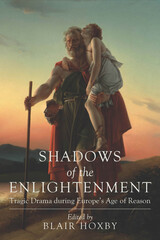

will move and inform generations. As we lose eyewitnesses to this ultimate
horror, the Kuperhands present us with an elegantly restrained, yet hard-hitting,
Kaddish to Polish Jewry.
Miriam was the daughter of a prosperous furrier; Saul was the son of
a poor shoemaker. Miriam was sixteen when she and her brother roamed the
wild countryside of Poland, searching for food and shelter--and for their
parents. Saul was only a few years older when he watched the smoke rising
from the crematoria and knew that his parents, sister, and eight brothers
were gone forever. Miriam lived by hiding; Saul lived by escaping from
the camp.
The authors emphasize the essential role that Polish Christians played
in their survival and stress that wit, courage, faith, luck, and even
a strong will to live were worthless without their help.
The travail of their survival is wrenching yet comforting, tragic yet
upbeat, cinematic yet intimate. Shadows of Treblinka will haunt
and inspire its readers.
In the first book to use fiction as theory, Barbara L. Estrin reverses chronological direction, beginning with contemporary novels to arrive at a re-visioned Shakespeare, uncovering a telling difference in the stories that script us and that influence our political unconscious in ways that have never been explored in literary-critical interpretations. Describing the animus against foreign blood, central to the dynamic of the foundling and lyric plots that form the nexus of her study, Estrin describes how late modern writers change those plots. Reading backward through the theoretical lens of their revisions allows us to rethink the Shakespeare we thought we knew. That innovative methodology, in turn, encourages us to read forward again with different tellings, ones that challenge the mythological homogeneity of the traditional classifications and that suggest new formulaic paradigms.
With close readings of four contemporary novels and three Shakespeare plays, Estrin identifies the cultural walls that contribute to political gate-keeping as she chronicles the connection between plot variations and gender revisionism in the work of Caryl Phillips, Liz Jensen, Anne Michaels, and W.G. Sebald, as well as two film-makers (Mona Hatoum and Mieke Bal) who demonstrate an understanding that mythical repercussions prove dangerous in the twentieth and twenty-first centuries even as they suggest how the heritage shaping their work, and to which they are themselves drawn, in turn proposes an alternative Shakespeare, one who frees us to ask other questions: At the time that the nation state was beginning to coalesce, what does Shakespeare’s frequent use of the foundling plot and his significant variations portend? How does his infusion of a revised lyric dynamic in The Merchant of Venice, Othello and The Winter’s Tale change our reading of plays where the two plots coalesce as they do in the contemporary novels that shape Estrin’s late modern interpretations? All the works in this study share the underlying premise that the connection between cultural origins and political destinies is reciprocal and that it is necessary and possible to transform the constructs—in memory and imagination—that continue to shape our lives.
Published by University of Delaware Press. Distributed worldwide by Rutgers University Press.

Published by University of Delaware Press. Distributed worldwide by Rutgers University Press.
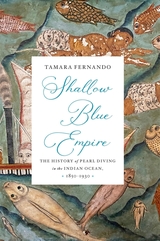
A nuanced history of seafaring communities in the Indian Ocean, where the force of British imperial power depended on the expertise of local divers and sailors to feed a global demand for pearls.
In the late nineteenth century, thousands of men and boys across the northern rim of the Indian Ocean dove daily to the ocean floor in search of pearl-bearing oysters. It was the height of the so-called global pearl boom, driven by enormous demand for pearls in Europe and North America. Far removed from the showrooms of New York, London, and Paris, these divers drew on skills and expertise handed down across generations to conduct the dangerous work of hauling oysters up from the warm shallows. But they also faced a new challenge: the rise of British power in the Indian Ocean, where colonial officials relied heavily on local knowledge and labor to feed the lucrative pearling industry.
Tamara Fernando examines the transformations wrought by colonial extraction across the three primary sites that fed the pearl boom between 1850 and 1930: the Persian Gulf, the Gulf of Mannar near Sri Lanka, and the Mergui Archipelago in Myanmar. British oversight transformed migration patterns and the dynamics of race and caste among divers, while imperial scientists regularly tested new technologies and techniques intended to improve oyster hauls. Yet even as the positions of local divers and sailors changed dramatically, their expertise remained paramount to the industry—until, in the 1930s, the depletion of oyster beds and the rise of lab-grown alternatives shuttered the market for natural pearls altogether.
A vivid account of how seafaring communities navigated these shifting tides, Shallow Blue Empire fundamentally recenters the human labor, animal lives, and environmental conditions that sustained a global obsession with pearls.

A gripping account of how the Shan rebellion influenced the colonial struggle between Siam, Britain, and France to expand their power in northern Thailand.
Moving beyond the familiar story of Siam fending off European colonialism, TheShan Rebellion reveals a new historical subject: Siam as colonizer. As European powers expanded their presence in Southeast Asia at the end of the nineteenth century, Siam launched its own colonial project to assert control over tributary states that lay outside the Siamese heartland. Most important was Lanna (now northern Thailand), a region where Siamese, British, and French colonial ambitions intersected. The outbreak of the Shan Rebellion in 1902 began with the violent dismantling of the Siamese colonial administration in Phrae, one of Lanna’s principal towns. As the rebels began moving towards other centers, they tested the limits of Siamese power in Lanna. With the British having valuable commercial interests to protect and the French itching for an opportunity to expand their reach, Siam’s colonial project faced a dangerous moment. Drawing on rich archival sources from Thailand, Burma, India, France, and England, this outstanding study provides the first detailed account of the rebellion and its impact on competitive colonialism in mainland Southeast Asia.
A common generalization about the Nationalist Government in China during the 1927-1937 decade has been that Chiang Kai-shek's regime was closely allied with the capitalists in Shanghai. This book brings to light a different picture--that Nanking sought to control the capitalists politically, to prevent them from having a voice in the political structure, and to milk the wealth of the urban economy for government coffers. This study documents major political conflicts between the capitalists and the government and demonstrates that the regime gradually suppressed the main organizations of the capitalists and gained control of many of their financial and industrial enterprises.
This is the first systematic examination of the political role of the Shanghai capitalists during the Nanking decade. A number of related issues--the operation of the government bond market, the role of the Shanghai underworld and its ties to Chiang Kai-shek, the personalities and policies of key government officials such as TV. Soong and H.H. Kung, the Japanese attempt to control the economic policies of the Nanking government, and the growth of "bureaucratic capitalism"--are brought into focus.
A common generalization about the Nationalist Government in China during the 1927-1937 decade has been that Chiang Kai-shek's regime was closely allied with the capitalists in Shanghai. This book brings to light a different picture--that Nanking sought to control the capitalists politically, to prevent them from having a voice in the political structure, and to milk the wealth of the urban economy for government coffers. This study documents major political conflicts between the capitalists and the government and demonstrates that the regime gradually suppressed the main organizations of the capitalists and gained control of many of their financial and industrial enterprises.
This is the first systematic examination of the political role of the Shanghai capitalists during the Nanking decade. A number of related issues--the operation of the government bond market, the role of the Shanghai underworld and its ties to Chiang Kai-shek, the personalities and policies of key government officials such as TV. Soong and H.H. Kung, the Japanese attempt to control the economic policies of the Nanking government, and the growth of "bureaucratic capitalism"--are brought into focus.

In the midst of China’s wild rush to modernize, a surprising note of reality arises: Shanghai, it seems, was once modern indeed, a pulsing center of commerce and art in the heart of the twentieth century. This book immerses us in the golden age of Shanghai urban culture, a modernity at once intrinsically Chinese and profoundly anomalous, blending new and indigenous ideas with those flooding into this “treaty port” from the Western world.
A preeminent specialist in Chinese studies, Leo Ou-fan Lee gives us a rare wide-angle view of Shanghai culture in the making. He shows us the architecture and urban spaces in which the new commercial culture flourished, then guides us through the publishing and filmmaking industries that nurtured a whole generation of artists and established a bold new style in urban life known as modeng. In the work of six writers of the time, particularly Shi Zhecun, Mu Shiying, and Eileen Chang, Lee discloses the reflection of Shanghai’s urban landscape—foreign and familiar, oppressive and seductive, traditional and innovative. This work acquires a broader historical and cosmopolitan context with a look at the cultural links between Shanghai and Hong Kong, a virtual genealogy of Chinese modernity from the 1930s to the present day.
The dean of business historians continues his masterful chronicle of the transforming revolutions of the twentieth century begun in Inventing the Electronic Century.
Alfred Chandler argues that only with consistent attention to research and development and an emphasis on long-term corporate strategies could firms remain successful over time. He details these processes for nearly every major chemical and pharmaceutical firm, demonstrating why some companies forged ahead while others failed.
By the end of World War II, the chemical and pharmaceutical industries were transformed by the commercializing of new learning, the petrochemical and the antibiotic revolutions. But by the 1970s, chemical science was no longer providing the new learning necessary to commercialize more products, although new directions flourished in the pharmaceutical industries. In the 1980s, major drug companies, including Eli Lilly, Merck, and Schering Plough, commercialized the first biotechnology products, and as the twenty-first century began, the infrastructure of this biotechnology revolution was comparable to that of the second industrial revolution just before World War I and the information revolution of the 1960s. Shaping the Industrial Century is a major contribution to our understanding of the most dynamic industries of the modern era.
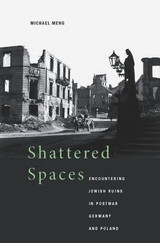
After the Holocaust, the empty, silent spaces of bombed-out synagogues, cemeteries, and Jewish districts were all that was left in many German and Polish cities with prewar histories rich in the sights and sounds of Jewish life. What happened to this scarred landscape after the war, and how have Germans, Poles, and Jews encountered these ruins over the past sixty years?
In the postwar period, city officials swept away many sites, despite protests from Jewish leaders. But in the late 1970s church groups, local residents, political dissidents, and tourists demanded the preservation of the few ruins still standing. Since the collapse of the Soviet Union in 1989, this desire to preserve and restore has grown stronger. In one of the most striking and little-studied shifts in postwar European history, the traces of a long-neglected Jewish past have gradually been recovered, thanks to the rise of heritage tourism, nostalgia for ruins, international discussions about the Holocaust, and a pervasive longing for cosmopolitanism in a globalizing world.
Examining this transformation from both sides of the Iron Curtain, Michael Meng finds no divided memory along West–East lines, but rather a shared memory of tensions and paradoxes that crosses borders throughout Central Europe. His narrative reveals the changing dynamics of the local and the transnational, as Germans, Poles, Americans, and Israelis confront a built environment that is inevitably altered with the passage of time. Shattered Spaces exemplifies urban history at its best, uncovering a surprising and moving postwar story of broad contemporary interest.

Rejecting the ideals of stability and sexual mastery demanded of masculine subjects, early modern English poets threw the limits of bodies and selves into question to embrace erotic experiences of genderqueer and transspecies embodiment and affiliation. Through close readings of still-canonical and lesser-read writers including William Shakespeare, John Donne, and Thomas Traherne, Gina Filo shows how these experimental encounters at the limits of the human were inextricable parts of the early modern literary and sexual imaginaries.
In its exploration of nonnormative forms of erotic attachment and embodiment, Shattering the Self in Early Modern English Verse: Gender, Sex, and Queerness Beyond the Human contributes to the burgeoning fields of early modern trans and ecocritical studies while also drawing on contemporary queer theory. Filo neither seeks to naively recuperate a fantasized past nor cedes relationality, sociality, or generativity to the normative. Instead, she shows how the embrace of erotic possibility, flexible, unstable subjectivities, and querying of the limits of “the human” were core features of early modern poetics, reconfiguring our understanding of English literary history and queer relationality today.
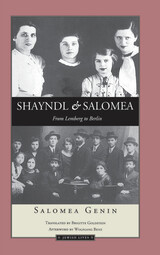
Genin's richly detailed portrait shows the effects of a family's struggle—personal, religious, social, and for their very survival—against the shadow of the Nazi rise to power.

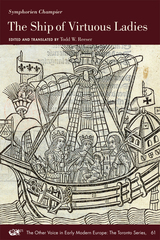
Arai Hakuseki, advisor to the sixth and seventh Tokugawa shogun, played an important role in politics between 1709 and 1716, during an era of large changes in the bakufu. He participated in major policy decisions on currency, foreign trade, and local administration, while simultaneously trying to enhance the shogun's authority both within the bakufu and as a national ruler. The following shogun retained Hakuseki's fiscal and trade policies, but promptly reversed those measures designed to make the shogun a king-like figure.
Nakai examines these successes and failures against the background of the time, especially the bifurcated and ambiguous distribution of authority between the Tokugawa shogun and the tenno in Kyoto. She also traces the influence of Confucian political theory on Hakuseki's program and on his defense of that program in the face of criticism. Nakai draws upon Hakuseki's autobiography anddiary and the reportorial letters of a contemporary for Hakuseki's political activities, and on Hakuseki's historical works and memorials for the theoretical basis for his programs, rooted in Confucianism.
Illustrative and lively translations from Hakuseki enrich the book, helping to portray a multi-faceted personality who managed to blend practical politics and Confucian idealism within the complicated and dynamic environment of the early-eighteenth-century bakufu.
The historian John Lukacs offers a concise history of the twentieth century—its two world wars and cold war, its nations and leaders. The great themes woven through this spirited narrative are inseparable from the author’s own intellectual preoccupations: the fading of liberalism, the rise of populism and nationalism, the achievements and dangers of technology, and the continuing democratization of the globe.
The historical twentieth century began with the First World War in 1914 and ended seventy-five years later with the collapse of the Soviet Empire in 1989. The short century saw the end of European dominance and the rise of American power and influence throughout the world. The twentieth century was an American century—perhaps the American century. Lukacs explores in detail the phenomenon of national socialism (national socialist parties, he reminds us, have outlived the century), Hitler’s sole responsibility for the Second World War, and the crucial roles played by his determined opponents Churchill and Roosevelt. Between 1939 and 1942 Germany came closer to winning than many people suppose.
Lukacs casts a hard eye at the consequences of the Second World War—the often misunderstood Soviet-American cold war—and at the shifting social and political developments in the Far and Middle East and elsewhere. In an eloquent closing meditation on the passing of the twentieth century, he reflects on the advance of democracy throughout the world and the limitations of human knowledge.

In this compact history, Jonathan Clements traces Tokyo’s fascinating story from the first forest clearances and the samurai wars to the hedonistic “floating world” of the last years of the Shogunate. He illuminates the Tokyo of the twentieth century with its destruction and redevelopment, boom and bust without forgoing the thousand years of history that have led to the Eastern Capital as we know it. Tokyo is so entwined with the history of Japan that it can be hard to separate them, and A Short History of Tokyo tells both the story of the city itself and offers insight into Tokyo’s position at the nexus of power and people that has made the city crucial to the events of the whole country.
READERS
Browse our collection.
PUBLISHERS
See BiblioVault's publisher services.
STUDENT SERVICES
Files for college accessibility offices.
RECENTLY PUBLISHED






UChicago Accessibility Resources
home | accessibility | search | about | contact us
BiblioVault ® 2001 - 2026
The University of Chicago Press