


A transformative study by Daniel S. Cozart, Afro-Peruvian Mestizos redefines the narrative of mestizaje in post-abolition Peru, uncovering the hidden histories and enduring strength of Afro-Peruvian communities.
Afro-Peruvian Mestizos: The Invisibility of Blackness in Post-Abolition Peru by Daniel S. Cozart investigates the ideologies of mestizaje, or racial mixing, that Latin American elites used to construct modern national identities during the nineteenth and twentieth centuries. Through close reading of archival records, legal documents, and literary works, Cozart uncovers the systematic exclusion of Afro-Peruvians from the nation's narrative of progress, revealing how their presence was deliberately omitted from official histories and censuses. The abolition of slavery in 1855 marked the beginning of a process where Afro-Peruvians were marginalized, their identities overshadowed by a national narrative that prioritized Indigenous heritage and whiteness.
Drawing on Michel-Rolph Trouillot's framework of historical production, the book traces the contradictions inherent in liberal and positivist ideologies that sought to forge a "raceless" society, all while silencing Afro-Peruvian voices and erasing their history. The conclusion reflects on the significance of erasure for Afro-Peruvians in the twentieth and twenty-first centuries, as they now demand to be seen. This book is a powerful examination of historical silences and the ongoing struggle for recognition in the face of systemic racism.
A trenchant critique of failure and opportunism across the political spectrum, American Idyll argues that social mobility, once a revered hallmark of American society, has ebbed, as higher education has become a mechanistic process for efficient sorting that has more to do with class formation than anything else. Academic freedom and aesthetic education are reserved for high-scoring, privileged students and vocational education is the only option for economically marginal ones.
Throughout most of American history, antielitist sentiment was reserved for attacks against an entrenched aristocracy or rapacious plutocracy, but it has now become a revolt against meritocracy itself, directed against what insurgents see as a ruling class of credentialed elites with degrees from exclusive academic institutions. Catherine Liu reveals that, within the academy and stemming from the relatively new discipline of cultural studies, animosity against expertise has animated much of the Left’s cultural criticism.
By unpacking the disciplinary formation and academic ambitions of American cultural studies, Liu uncovers the genealogy of the current antielitism, placing the populism that dominates headlines within a broad historical context. In the process, she emphasizes the relevance of the historical origins of populist revolt against finance capital and its political influence. American Idyll reveals the unlikely alliance between American pragmatism and proponents of the Frankfurt School and argues for the importance of broad frames of historical thinking in encouraging robust academic debate within democratic institutions. In a bold thought experiment that revives and defends Richard Hofstadter’s theories of anti-intellectualism in American life, Liu asks, What if cultural populism had been the consensus politics of the past three decades?
American Idyll shows that recent antielitism does nothing to redress the source of its discontent—namely, growing economic inequality and diminishing social mobility. Instead, pseudopopulist rage, in conservative and countercultural forms alike, has been transformed into resentment, content merely to take down allegedly elitist cultural forms without questioning the real political and economic consolidation of powers that has taken place in America during the past thirty years.
A highly readable introduction to and overview of the postwar social sciences in the United States, The Americanization of Social Science explores a critical period in the evolution of American sociology’s professional identity from the late 1940s through the early 1960s. David Paul Haney contends that during this time leading sociologists encouraged a professional secession from public engagement in the name of establishing the discipline’s scientific integrity.
According to Haney, influential practitioners encouraged a willful withdrawal from public sociology by separating their professional work from public life. He argues that this separation diminished sociologists’ capacity for conveying their findings to wider publics, especially given their ambivalence towards the mass media, as witnessed by the professional estrangement that scholars like David Riesman and C. Wright Mills experienced as their writing found receptive lay audiences. He argues further that this sense of professional insularity has inhibited sociology’s participation in the national discussion about social issues to the present day.
As part of his investigation of intellectuals’ self-conceptions and their roles in society, Michael concentrates on several well-known contemporary African American intellectuals, including Henry Louis Gates Jr. and Cornel West. To illuminate public debates over pedagogy and the role of university, he turns to the work of Todd Gitlin, Michael Bérubé, and Allan Bloom. Stanley Fish’s pragmatic tome, Doing What Comes Naturally, along with a juxtaposition of Fredric Jameson and Samuel Huntington’s work, proves fertile ground for Michael’s argument that democratic politics without intellectuals is not possible. In the second half of Anxious Intellects, Michael relies on three popular conceptions of the intellectual—as critic, scientist, and professional—to discuss the work of scholars Constance Penley, Henry Jenkins, the celebrated physicist Stephen Hawking, and others, insisting that ambivalence, anxiety, projection, identification, hybridity, and various forms of psychosocial complexity constitute the real meaning of Enlightenment intellectuality. As a new and refreshing contribution to the recently emergent culture and science wars, Michael’s take on contemporary intellectuals and their place in society will enliven and redirect these ongoing debates.
What is an Arab? Though many in the West would answer that question with simplistic stereotypes, the reality is far more complex and interesting. Arabs themselves have been debating Arab identity since pre-Islamic times, coming to a variety of conclusions about the nature and extent of their “Arabness.” Likewise, Westerners and others have attempted to analyze Arab identity, reaching mostly negative conclusions about Arab culture and capacity for self-government.
To bring new perspectives to the question of Arab identity, Iraqi-born scholar Nissim Rejwan has assembled this fascinating collection of writings by Arab and Western intellectuals, who try to define what it means to be Arab. He begins with pre-Islamic times and continues to the last decades of the twentieth century, quoting thinkers ranging from Ibn Khaldun to modern writers such as al-Ansari, Haykal, Ahmad Amin, al-'Azm, and Said. Through their works, Rejwan shows how Arabs have grappled with such significant issues as the influence of Islam, the rise of nationalism, the quest for democracy, women's status, the younger generation, Egypt's place in the Arab world, Israel's role in Middle Eastern conflict, and the West's "cultural invasion."
By letting Arabs speak for themselves, Arabs in the Mirror refutes a prominent Western stereotype—that Arabs are incapable of self-reflection or self-government. On the contrary, it reveals a rich tradition of self-criticism and self-knowledge in the Arab world.
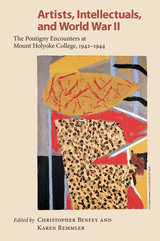
Sixty years ago, at the height of World War II, an extraordinary series of gatherings took place at Mount Holyoke College in western Massachusetts. During the summers of 1942–1944, leading European figures in the arts and sciences met at the college with their American counterparts for urgent conversations about the future of human civilization in a precarious world.
Two Sorbonne professors, the distinguished medievalist Gustave Cohen and the existentialist philosopher Jean Wahl, organized these “Pontigny” sessions, named after an abbey in Burgundy where similar symposia had been held in the decades before the war. Among the participants—many of whom were Jewish or had Jewish backgrounds—were the philosophers Hannah Arendt and Rachel Bespaloff, the poets Marianne Moore and Wallace Stevens, the anthropologist Claude Lévi-Strauss and the linguist Roman Jakobson, and the painters Marc Chagall and Robert Motherwell.
In this collection of original essays, Stanley Cavell and Jacques Derrida lead an international group of scholars—including Jed Perl, Mary Ann Caws, Jeffrey Mehlman, and Elisabeth Young-Bruehl—in assessing the lasting impact and contemporary significance of Pontigny-en- Amérique. Rachel Bespaloff, a tragic figure who wrote a major work on the Iliad, is restored to her rightful place beside Arendt and Simone Weil. Anyone interested in the “intellectual resistance” of Francophone intellectuals and artists, and the inspiring support from such American figures as Stevens and Moore, will want to read this pioneering work of scholarship and historical re-creation.
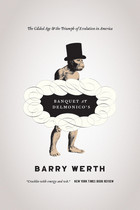
In Banquet at Delmonico’s, Barry Werth draws readers inside the circle of intellectuals, scientists, politicians, businessmen, and clergymen who brought Charles Darwin’s controversial ideas to post-Civil-War America. Each chapter is dedicated to a crucial intellectual encounter, culminating with an exclusive farewell dinner held in English philosopher Herbert Spencer’s honor at the venerable New York restaurant Delmonico’s in 1882. In this thought-provoking and nuanced account, Werth firmly situates social Darwinism in the context of the Gilded Age. Banquet at Delmonico’s is social history at its finest.
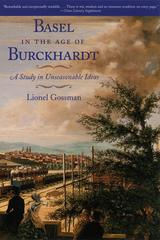
"Remarkable and exceptionally readable . . . There is wit, wisdom and an immense erudition on every page."—Jonathan Steinberg, Times Literary Supplement
"Gossman's book, a product of many years of active contemplation, is a tour de force. It is at once an intellectual history, a cultural history of Basel and Europe, and an important contribution to the study of nineteenth-century historiography. Written with a grace and elegance that many aspire to, few seldom achieve, this is model scholarship."—John R. Hinde, American Historical Review
Through the prism of the lives of Leon Blum, Albert Camus, and Raymond Aron, Judt examines pivotal issues in the history of contemporary French society—antisemitism and the dilemma of Jewish identity, political and moral idealism in public life, the Marxist moment in French thought, the traumas of decolonization, the disaffection of the intelligentsia, and the insidious quarrels rending Right and Left. Judt focuses particularly on Blum's leadership of the Popular Front and his stern defiance of the Vichy governments, on Camus's part in the Resistance and Algerian War, and on Aron's cultural commentary and opposition to the facile acceptance by many French intellectuals of communism's utopian promise. Severely maligned by powerful critics and rivals, each of these exemplary figures stood fast in their principles and eventually won some measure of personal and public redemption.
Judt constructs a compelling portrait of modern French intellectual life and politics. He challenges the conventional account of the role of intellectuals precisely because they mattered in France, because they could shape public opinion and influence policy. In Blum, Camus, and Aron, Judt finds three very different men who did not simply play the role, but evinced a courage and a responsibility in public life that far outshone their contemporaries.
"An eloquent and instructive study of intellectual courage in the face of what the author persuasively describes as intellectual irresponsibility."—Richard Bernstein, New York Times
When Mrázek began his interviews, he expected to discuss phenomena such as the transition from colonialism to postcolonialism. His interviewees, however, wanted to share more personal recollections. Mrázek illuminates their stories of the past with evocative depictions of their late-twentieth-century surroundings. He brings to bear insights from thinkers including Walter Benjamin, Bertold Brecht, Le Corbusier, and Marcel Proust, and from his youth in Prague, another metropolis with its own experience of passages and revolution. Architectural and spatial tropes organize the book. Thresholds, windowsills, and sidewalks come to seem more apt as descriptors of historical transitions than colonial and postcolonial, or modern and postmodern. Asphalt roads, homes, classrooms, fences, and windows organize movement, perceptions, and selves in relation to others. A Certain Age is a portal into questions about how the past informs the present and how historical accounts are inevitably partial and incomplete.
Was Brasillach in fact guilty of treason? Was he condemned for his denunciations of the resistance, or singled out as a suspected homosexual? Was it right that he was executed when others, who were directly responsible for the murder of thousands, were set free? Kaplan's meticulous reconstruction of Brasillach's life and trial skirts none of these ethical subtleties: a detective story, a cautionary tale, and a meditation on the disturbing workings of justice and memory, The Collaborator will stand as the definitive account of Brasillach's crime and punishment.
A National Book Award Finalist
A National Book Critics Circle Award Finalist
"A well-researched and vivid account."—John Weightman, New York Review of Books
"A gripping reconstruction of [Brasillach's] trial."—The New Yorker
"Readers of this disturbing book will want to find moral touchstones of their own. They're going to need them. This is one of the few works on Nazism that forces us to experience how complex the situation really was, and answers won't come easily."—Daniel Blue, San Francisco Chronicle Book Review
"The Collaborator is one of the best-written, most absorbing pieces of literary history in years."—David A. Bell, New York Times Book Review
"Alice Kaplan's clear-headed study of the case of Robert Brasillach in France has a good deal of current-day relevance. . . . Kaplan's fine book . . . shows that the passage of time illuminates different understandings, and she leaves it to us to reflect on which understanding is better."—Richard Bernstein, The New York Times
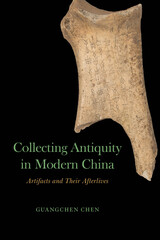
In this book, Guangchen Chen argues that discerning collectors used antiquities to upend dominant discourses on history and cultural memory in twentieth-century China. Examining four categories of ancient artifacts—“carving” (oracle bones), “rubbing” (imprints of inscriptions and books), “brushing” (calligraphy), and “weaving” (textiles and costumes)—Chen explains how their modern (re)emergences changed our understanding of the relationship between tradition and modernity, textuality and materiality, and the very meaning of “Chineseness.”
Chen considers intellectuals such as Wang Yirong, Liu E, Luo Zhenyu, Wang Guowei, and Chen Mengjia, who played a pivotal role in the oracle bones’ modern reception. He also looks to major literary figures including Lu Xun, whose engagements with textual remnants of the past inspired his critique of Chinese culture; Guo Moruo, whose work on the calligraphic masterpiece Lantingxu contributed to the cultural-political climate that sparked the Cultural Revolution; Shi Zhecun, whose interest in inscriptions on ancient stelae helped him to hold fast to intellectual integrity in the face of political pressure; and Shen Congwen, whose obsession with ancient textiles saved him from committing suicide after his writing fell out of favor. These antiquarians used their collections as a strategy to synchronize historical time and to challenge two dominant yet contrasting ideologies in modern China: a regressive idealization of antiquity and an unquestioning trust in linear progress. During this turbulent period, long-lost artifacts came to function as omens, warnings, and revelations from another time, generating new meanings that were uniquely relevant to the present.
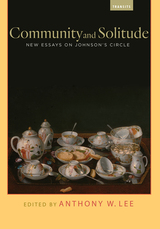
Contributors: Christopher Catanese, James Caudle, Marilyn Francus, Christine Jackson-Holzberg, Claudia Thomas Kairoff, Elizabeth Lambert, Anthony W. Lee, James E. May, John Radner, and Lance Wilcox.
Published by Bucknell University Press. Distributed worldwide by Rutgers University Press.
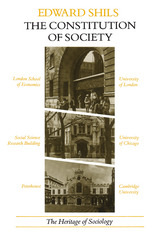
Professor Shils has attempted to develop a theory that has a place for more than those parts of society that are generated from the biological nature of human beings and those parts that are engendered by the desires of individuals, acting for themselves or for groups and categories of individuals, to maintain and increase their power over other human beings and to secure material goods and services for themselves. He has argued that there are constituents of society in which human beings seek and cultivate connections with objects that transcend those needed to satisfy biological necessity and the desire for material objects and power over others. This third stratum of social existence, he concludes, cannot be reduced to the other two and cannot be disregarded in any serious attempt to understand the function of any society. Thus Edward Shils, without disregarding its many valuable achievements, has nevertheless parted ways with much of modern sociology.
For this collection of papers the author has written an introductory intellectual autobiography that places each essay in the setting of the development of his thought and that connects it with his other writings.
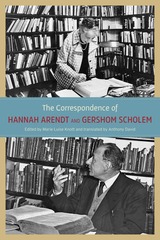
Arendt and Scholem met in 1932 in Berlin and quickly bonded over their mutual admiration for and friendship with Walter Benjamin. They began exchanging letters in 1939, and their lively correspondence continued until 1963, when Scholem’s vehement disagreement with Arendt’s Eichmann in Jerusalem led to a rupture that would last until Arendt’s death a dozen years later. The years of their friendship, however, yielded a remarkably rich bounty of letters: together, they try to come to terms with being both German and Jewish, the place and legacy of Germany before and after the Holocaust, the question of what it means to be Jewish in a post-Holocaust world, and more. Walter Benjamin is a constant presence, as his life and tragic death are emblematic of the very questions that preoccupied the pair. Like any collection of letters, however, the book also has its share of lighter moments: accounts of travels, gossipy dinner parties, and the quotidian details that make up life even in the shadow of war and loss.
In a world that continues to struggle with questions of nationalism, identity, and difference, Arendt and Scholem remain crucial thinkers. This volume offers us a way to see them, and the development of their thought, anew.
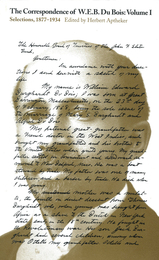
Scholar, author, editor, teacher, reformer, and civil rights leader, W.E.B. Du Bois (1868–1963) was a major figure in American life and one of the earliest proponents of equality for Black Americans. He was a founder and leader of the Niagara Movement, the NAACP, and the Pan-African Movement; a progenitor of the 1920s Harlem Renaissance; an advocate of anticolonialism, anti-imperialism, unionism, and equality for women; and a champion of the rights of oppressed people around the world.
The three-volume Correspondence of W.E.B. Du Bois offers a unique perspective on Du Bois's experiences and views. In recognition of the significance of the Correspondence, the final volume was named a Best Book of the Year by the New York Times Book Review.
Herbert Aptheker has provided an introduction and notes to each volume, illuminating the circumstances and identifying the personalities involved in the correspondence. A long time friend and colleague of Du Bois, Aptheker is a well-known historian of the African American experience. In 1939 and again in 1969, he won the history award given by the Association for the Study of Negro Life and History. Among his most prominent works are American Negro Slave Revolts and the three-volume Documentary History of the Negro People in the United States.
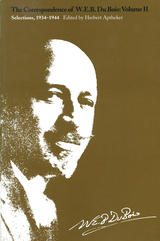
Scholar, author, editor, teacher, reformer, and civil rights leader, W.E.B. Du Bois (1868–1963) was a major figure in American life and one of the earliest proponents of equality for black Americans. He was a founder and leader of the Niagara Movement, the NAACP, and the Pan-African Movement; a progenitor of the 1920s Harlem Renaissance; an advocate of anticolonialism, anti-imperialism, unionism, and equality for women; and a champion of the rights of oppressed people around the world.
The three-volume Correspondence of W.E.B. Du Bois offers a unique perspective on Du Bois's experiences and views. In recognition of the significance of the Correspondence, the final volume was named a Best Book of the Year by the New York Times Book Review.
Herbert Aptheker has provided an introduction and notes to each volume, illuminating the circumstances and identifying the personalities involved in the correspondence. A long time friend and colleague of Du Bois, Aptheker is a well-known historian of the African American experience. In 1939 and again in 1969, he won the history award given by the Association for the Study of Negro Life and History. Among his most prominent works are American Negro Slave Revolts and the three-volume Documentary History of the Negro People in the United States.
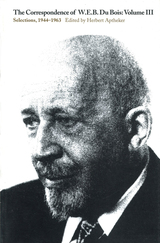
Scholar, author, editor, teacher, reformer, and civil rights leader, W.E.B. Du Bois (1868–1963) was a major figure in American life and one of the earliest proponents of equality for black Americans. He was a founder and leader of the Niagara Movement, the NAACP, and the Pan-African Movement; a progenitor of the 1920s Harlem Renaissance; an advocate of anticolonialism, anti-imperialism, unionism, and equality for women; and a champion of the rights of oppressed people around the world.
The three-volume Correspondence of W.E.B. Du Bois offers a unique perspective on Du Bois's experiences and views. In recognition of the significance of the Correspondence, the final volume was named a Best Book of the Year by the New York Times Book Review.
Herbert Aptheker has provided an introduction and notes to each volume, illuminating the circumstances and identifying the personalities involved in the correspondence. A long time friend and colleague of Du Bois, Aptheker is a well-known historian of the African American experience. In 1939 and again in 1969, he won the history award given by the Association for the Study of Negro Life and History. Among his most prominent works are American Negro Slave Revolts and the three-volume Documentary History of the Negro People in the United States.
In Mexico, as elsewhere, the national space, that network of places where the people interact with state institutions, is constantly changing. How it does so, how it develops, is a historical process-a process that Claudio Lomnitz exposes and investigates in this book, which develops a distinct view of the cultural politics of nation building in Mexico. Lomnitz highlights the varied, evolving, and often conflicting efforts that have been made by Mexicans over the past two centuries to imagine, organize, represent, and know their country, its relations with the wider world, and its internal differences and inequalities. Firmly based on particulars and committed to the specificity of such thinking, this book also has broad implications for how a theoretically informed history can and should be done.
An exploration of Mexican national space by way of an analysis of nationalism, the public sphere, and knowledge production, Deep Mexico, Silent Mexico brings an original perspective to the dynamics of national cultural production on the periphery. Its blending of theoretical innovation, historical inquiry, and critical engagement provides a new model for the writing of history and anthropology in contemporary Mexico and beyond.
Public Worlds Series, volume 9
Doubly Chosen provides the first detailed study of a unique cultural and religious phenomenon in post-Stalinist Russia—the conversion of thousands of Russian Jewish intellectuals to Orthodox Christianity, first in the 1960s and later in the 1980s. These time periods correspond to the decades before and after the great exodus of Jews from the Soviet Union. Judith Deutsch Kornblatt contends that the choice of baptism into the Church was an act of moral courage in the face of Soviet persecution, motivated by solidarity with the values espoused by Russian Christian dissidents and intellectuals. Oddly, as Kornblatt shows, these converts to Russian Orthodoxy began to experience their Jewishness in a new and positive way.
Working primarily from oral interviews conducted in Russia, Israel, and the United States, Kornblatt underscores the conditions of Soviet life that spurred these conversions: the virtual elimination of Judaism as a viable, widely practiced religion; the transformation of Jews from a religious community to an ethnic one; a longing for spiritual values; the role of the Russian Orthodox Church as a symbol of Russian national culture; and the forging of a new Jewish identity within the context of the Soviet dissident movement.
The autocratic rule of both tsar and church in imperial Russia gave rise not only to a revolutionary movement in the nineteenth century but also to a crisis of meaning among members of the intelligentsia. Personal faith became the subject of intense scrutiny as individuals debated the existence of God and the immortality of the soul, debates reflected in the best-known novels of the day. Friendships were formed and broken in exchanges over the status of the eternal. The salvation of the entire country, not just of each individual, seemed to depend on the answers to questions about belief.
Victoria Frede looks at how and why atheism took on such importance among several generations of Russian intellectuals from the 1820s to the 1860s, drawing on meticulous and extensive research of both published and archival documents, including letters, poetry, philosophical tracts, police files, fiction, and literary criticism. She argues that young Russians were less concerned about theology and the Bible than they were about the moral, political, and social status of the individual person. They sought to maintain their integrity against the pressures exerted by an autocratic state and rigidly hierarchical society. As individuals sought to shape their own destinies and searched for truths that would give meaning to their lives, they came to question the legitimacy both of the tsar and of Russia’s highest authority, God.
“I went to Nicaragua with nothing but a tourist visa, $1,500 in cash, the name of someone at the Agrarian Reform Ministry, and the idea of being a revolutionary intellectual. . . . The idea took hold in a simple character flaw: wanting to believe that I knew better than everyone else.” —From the preface
When Michael Johns joined a Sandinista militia in 1983, a fellow revolutionary dubbed him a rábano, a radish: red on the outside but white on the inside. Now, more than twenty-five years later, Johns appreciates the wisdom of that label as he revisits the questions of identity he tried to resolve by working with the Sandinistas at that point in his life. In The Education of a Radical, Johns recounts his immersion in Marxism and the Nicaraguan sojourn it led to, with a painful maturation process along the way.
His conversion began in college, where he joined a student group called the Latin American Solidarity Association and traveled to Chiapas, Mexico, for research on his senior thesis. Overwhelmed by the poverty he witnessed (and fascinated by a new friend named Maricela who was trying to turn peasants into revolutionaries and who carried a heavily highlighted copy of Late Capitalism), he experienced an ideological transformation. When a Marxist professor later encouraged him to travel to Nicaragua, the real internal battle began for him, a battle that was intensified by the U.S. invasion of Grenada and its effect on the Sandinistas, who believed they were the next target for an imminent American invasion. Before he knew it, Johns was digging trenches and learning how to use an AK-47. His intellectual ideals came face-to-face with revolutionary facts, and the results would perplex him for years to come.
Bringing to life a vivid portrait of the sometimes painful process of reconciling reality with romanticized principles, The Education of a Radical encapsulates a trove of truths about humanity, economics, and politics in one man’s memorable journey.
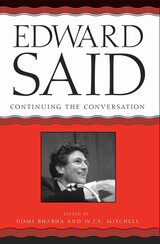
The essays, imagining and recalling the cadences of Said's conversation, take various forms, including elaborations on his ideas, applications of his thought to new problems, and recollections of the indescribable electricity that made conversation with him intense and memorable. This lively, personal tone is a direct result of editors Homi Bhabha and W. J. T. Mitchell urging contributors to write in the spirit of a conversation interrupted, a call on hold, a letter waiting for a reply, a question hanging in the air. This is a work of immense imaginative and intellectual force and compelling candor, honoring Said's legacy as an activist intellectual.
This collection includes essays by Lila Abu-Lughod, Daniel Barenboim, Akeel Bilgrami, Paul Bové, Timothy Brennan, Noam Chomsky, Ranajit Guha, Harry Harootunian, Saree Makdisi, Aamir Mufti, Roger Owen, Gyan Prakash, Dan Rabinowitz, Jacqueline Rose, and Gayatri Spivak.
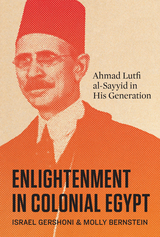
A study of Ahmad Lutfi al-Sayyid, widely recognized as the creator of Egyptian nationalism, and his impact on Egyptian culture and history.
Ahmad Lutfi al-Sayyid (1872–1963) stands among the most creative, impactful intellectuals of modern Egypt and the Middle East. While best known as the architect of Egyptian nationalism, his nationalist endeavor was in fact part of his broader project to bring enlightenment to Egypt under the yoke of British colonialism. Through his articles, editorials, and mentoring, his newspaper al-Jarida became a key forum for the lively debates of the time, ranging from the role of Islam in society to women's inclusion, all toward shaping a unique colonial modernity for his country.
The most comprehensive study of Lutfi, his writing, and his impact, Enlightenment in Colonial Egypt deconstructs the view that he was a covert apologist for empire out of admiration for the liberal aspects of European enlightenment. Lutfi faced this duality head on: He believed it essential to embrace parts of the West’s enlightenment values and to decolonize and Egyptianize them in order to establish an authentic, indigenous, Egyptian civilization, appropriate for modernity. Israel Gershoni and Molly Bernstein argue that Lutfi successfully engaged with these most difficult challenges, shaping a detailed plan to implement enlightenment in the Egyptian national context.
This new edition, with additional interviews and a new introduction, illuminates the dangers of the rise of right-wing nationalist revisionism by using Spain as a case study for how nations face, or don't face, difficult questions about their past.

The first study of its kind to place the exiles' ideological evolution in a broad historical context, Exile and Cultural Hegemony takes into account developments in both Spanish and Mexican politics from the early 1930s through the 1970s. Faber pays particular attention to the intellectuals' persistent nationalism and misplaced illusions of pan-Hispanist grandeur, which included awkward and ironic overlaps with the rhetoric employed by their enemies on the Francoist right. This embrace of nationalism, together with the intellectuals' dependence on the increasingly authoritarian Mexican regime and the international climate of the Cold War, eventually caused them to abandon the Gramscian ideal of the intellectual as political activist in favor of a more liberal, apolitical stance preferred by, among others, the Spanish philosopher Jose Ortega y Gasset.
With its comprehensive approach to topics integral to Spanish culture, both students of and those with a general interest in twentieth-century Spanish literature, history, or culture will find Exile and Cultural Hegemony a fascinating and groundbreaking work.
Exploring the Roots of Digital and Media Literacy through Personal Narrative provides a wide-ranging look at the origins, concepts, theories, and practices of the field. This unique, exciting collection of essays by a range of distinguished scholars and practitioners offers insights into the scholars and thinkers who fertilized the minds of those who helped shape the theory and practice of digital and media literacy education.
Each chapter describes an individual whom the author considers to be a type of “grandparent.” By weaving together two sets of personal stories—that of the contributing author and that of the key ideas and life history of the historical figure under their scrutiny—major concepts of digital media and learning emerge.
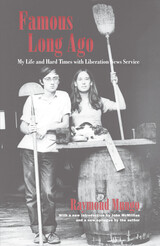
Originally published in 1970, Raymond Mungo's picaresque account of his adventures with Liberation News Service in the wild years of 1967 and 1968 has been variously described as youthful, passionate, lyrical, demented, and an iconic symbol of the sixties counterculture. A review in The Nation described it as “hip Huck Finn.”
A college editor at the height of the Vietnam War, Mungo found himself smack in the middle of a mad swirl of activism and dissent, vigorously protesting everything from the draft to abortion laws to the university itself. Then he connected with Marshall Bloom to cofound LNS in Washington, D.C., as a news service catering to the burgeoning underground press. One thing led to another, until LNS, like so many other radical organizations, eventually disintegrated into violently warring factions. Mungo's memoir tracks its development and destruction with wicked humor and literary panache.
In an introduction to this new edition, John McMillian discusses the enduring appeal of Famous Long Ago and situates it within its broader historical context, while the author provides his own retrospective take in a new afterword.
The search for belief and meaning among nineteenth-century intellectuals
The nineteenth century’s explosion of scientific theories and new technologies undermined many deep-seated beliefs that had long formed the basis of Western society, making it impossible for many to retain the unconditional faith of their forebears. A myriad of discoveries—including Faraday’s electromagnetic induction, Joule’s law of conservation of energy, Pasteur’s germ theory, Darwin’s and Wallace’s theories of evolution by natural selection, and Planck’s work on quantum theory—shattered conventional understandings of the world that had been dictated by traditional religious teachings and philosophical systems for centuries.
Fictions of Certitude: Science, Faith, and the Search for Meaning, 1840–1920 investigates the fin de siècle search for truth and meaning in a world that had been radically transformed. John S. Haller Jr. examines the moral and philosophical journeys of nine European and American intellectuals who sought deeper understanding amid such paradigmatic upheaval. Auguste Comte, John Henry Newman, Herbert Spencer, Alfred Russel Wallace, Thomas Henry Huxley, John Fiske, William James, Lester Frank Ward, and Paul Carus all belonged to an age in which one world was passing while another world that was both astounding and threatening was rising to take its place.
For Haller, what makes the work of these nine thinkers worthy of examination is how they strove in different ways to find certitude and belief in the face of an epochal sea change. Some found ways to reconceptualize a world in which God and nature coexist. For others, the challenge was to discern meaning in a world in which no higher power or purpose can be found. As explained by D. H. Meyer, “The later Victorians were perhaps the last generation among English-speaking intellectuals able to believe that man was capable of understanding his universe, just as they were the first generation collectively to suspect that he never would.”
The ‘unbearable 80s’, as the last decade of the Ceauşescu era has been called in Romania, are in the focus of this quasi-autobiographical work. The book vividly portrays the difficulties encountered by a young intellectual trying to shape himself under the oppressive regime and provides a stark depiction of a man’s intellectual suffocation under hard-line socialist rule.

With FranzFanon, Peter Hudis presents a penetrating critical biography of the activist’s life and work. Countering the prevailing belief that Fanon’s contributions to modern thought can be wholly defined by an advocacy of violence, Hudis presents his work instead as an integrated whole, showing that its nuances—and thus its importance—can only be appreciated in light of Fanon’s efforts to fuse philosophical theory and actual practice. By taking seriously Fanon’s philosophical and psychological contributions, as well as his political activism, Hudis presents a powerful and perceptive new view of the man and his achievement.
This brief, richly perceptive introduction to Fanon will give new force to his ideas, his life, and his example for people engaged in radical political theory and taking action against oppression around the world today.

While public intellectuals are typically thought of as inherently nonconformist and critical of established power, in practice many adapt themselves to the views of the majority—particularly in the context of repressive governments and dictatorships. When the political winds change, such figures often refashion themselves to fit the new paradigm. Ghosts of Fascism follows the trajectories of four major Italian intellectuals who, despite their passivity and at times collaboration with Fascist institutions, became some of postwar Italy’s iconic anti-Fascists: Federico Chabod, a prominent historian who would join the Resistance; the jurist Piero Calamandrei, who later participated in drafting the Italian democratic constitution; the influential literary critic Luigi Russo, who presided over the prestigious Scuola Normale Superiore in Pisa; and Alberto Moravia, the internationally renowned novelist. Simon Levis Sullam weaves together their histories to show how postwar Italian intellectuals quietly revised their previous political positions, redefining themselves—and their recent pasts, together with that of the entire nation—as consistently anti-Fascist.
Nixon’s life offers insight into one southerner’s efforts to comprehend and interpret the conflict and change of his time and illuminates for contemporary Americans a classical view of life—one lived fully, right in strength, beauty, courage, compassion, adventure, and thought.
Clarence Nixon was first and foremost a Southern intellectual, deeply involved in the region’s cultural renaissance, and his life reveals an intellectual odyssey from Victorianism to Modernism. As his personality, ideology, and social environment interacted, a new world view emerged. But he was an ambivalent modernist, like many intellectuals who were reared in the nineteenth-century South, he never abandoned certain Victorian ideals and values.

Ivan T. Berend is Distinguished Professor at the University of California Los Angeles, Director of the European Studies Program. He was one of the masterminds of regime change in Hungary. He made a career in Hungary as a university professor, Rector of the University of Economics (1973–79), and President of the Hungarian Academy of Sciences (1985–90). He was President of the International Committee of Historical Sciences (1995–2000), and Vice-President of the International Economic History Association (1986–1994). His research interests are the complex economic, social, ideological, and cultural history of Central and Eastern Europe in the 19th–20th century; economic modernization; problems of European backwardness; transition from state socialism to capitalism. He published and 26 books and more than 120 studies.
Before he became a professor at UCLA, Ivan Berend had survived five regime changes and two revolutions in Hungary, had been in prison and German concentration camp in 1944–45.
His memoir offers an interesting case study, a subjective addition to the “objective” historical works on Central and Eastern European state socialism. It describes the hard choices of intellectuals in a dictatorial state: 1. remain in isolation, concentrate on scholarly works, and exclude politics in your personal life; 2. be in opposition, criticize and unveil the regime, accept discrimination and exclusion; 3. remain within the establishment and work for reforming the country using legal possibilities to criticize the regime and to achieve changes from within.
Berend’s book raises basic historical questions and debates, compares East European and American higher education systems, and presents an eyewitness’ insights on life in the United States.
Intellectuals “have been both rallying points and railed against in American politics, vessels of hope and targets of scorn,” writes Michael J. Brown as he invigorates a recurrent debate in American life: Are intellectual public figures essential voices of knowledge and wisdom, or out-of-touch elites? Hope and Scorn investigates the role of high-profile experts and thinkers in American life and their ever-fluctuating relationship with the political and public spheres.
From Eisenhower’s era to Obama’s, the intellectual’s role in modern democracy has been up for debate. What makes an intellectual, and who can claim that privileged title? What are intellectuals’ obligations to society, and how, if at all, are their contributions compatible with democracy? For some, intellectuals were models of civic engagement. For others, the rise of the intellectual signaled the fall of the citizen. Carrying us through six key moments in this debate, Brown expertly untangles the shifting anxieties and aspirations for democracy in America in the second half of the twentieth century and beyond. Hope and Scorn begins with “egghead” politicians like Adlai Stevenson; profiles scholars like Richard Hofstadter and scholars-turned-politicians like H. Stuart Hughes; and ends with the rise of public intellectuals such as bell hooks and Cornel West. In clear and unburdened prose, Brown explicates issues of power, authority, political backlash, and more. Hope and Scorn is an essential guide to American concerns about intellectuals, their myriad shortcomings, and their formidable abilities.
This revised edition corrects several erroneous and insufficient references in the first edition of this book.
Slovenian philosopher bad boy Slavoj Žižek is one of the most famous intellectuals of our time, publishing at a breakneck speed and lecturing around the world. With his unmistakable speaking style and set of mannerisms that have made him ripe material for internet humor and meme culture, he is recognizable to a wide spectrum of fans and detractors. But how did an intellectual from a small Eastern European country come to such popular notoriety? In How Slavoj Became Žižek, sociologist Eliran Bar-El plumbs the emergence, popularization, and development of the phenomenon called “Žižek.”
Beginning with Žižek’s early years as a thinker and political figure in Slovenian civil society, Bar-El traces Žižek’s rise from Marxist philosopher to political candidate to eventual intellectual celebrity, as Žižek perfected his unique performative style and a rhetorical arsenal of “Hegelacanese.” Following 9/11, Žižek’s career as a global op-ed writer and TV commentator married his rhetoric with global events such as the war on terror, the financial crisis of 2008, and the Arab Spring of 2011. Yet, at the same time, this mainstream popularity, as well as a series of politically incorrect views, almost entirely estranged the Slovenian from the normal workings of academia. Ultimately, this account shows how Žižek has harnessed the power of the digital era in his own self-fashioning as a public intellectual.
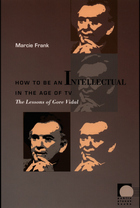
Frank highlights the connections between Vidal’s attitudes toward TV, sex, and American politics as they have informed his literary and political writings and screen appearances. She deftly situates his public persona in relation to those of Andy Warhol, Jacqueline Susann, Mary McCarthy, Susan Sontag, and others. By describing Vidal’s shrewd maneuvering between different media, Frank suggests that his career offers a model to aspiring public intellectuals and a refutation to those who argue that electronic media have eviscerated public discourse.
This volume gathers authors who wrote important works in the fields of the history of ideologies, the comparative study of dictatorships, and intellectual history. The book is a state of the art reassessment and analysis of the ideological commitments of intellectuals and their relationships with dictatorships during the twentieth century. The contributions focus on turning points or moments of breakage as well as on the continuities. Though its focus is on an East–West comparison in Europe, there are texts also dealing with Latin America, China, and the Middle East giving the book a global outlook.
The first part of the book deals with intellectuals' involvement with communist regimes or parties; the second looks at the persistence of utopianism in the trajectory of intellectuals who had been associated earlier in their lives with either communism or fascism; the third tackles intellectuals' role in national imaginations from either the left or the right; and, the fourth ties late twentieth century phenomena to current phenomena such as the persistence of anti-Semitism in the West, the slow erosion of the values upon which the EU is built, the quagmire in Iraq, and China's rise in the post-Cold War era. The collection provides a comprehensive big-picture of intellectual genealogies and dictatorial developments.
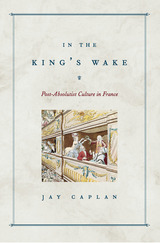
While absolutist culture had focused on value directly represented in people (e.g., those of noble blood) and things (e.g., coins made of precious metals), post-absolutist culture instead explored the capacity of signs to stand for something real (e.g., John Law's banknotes or Marivaux's plays in which actions rather than birth signify nobility). Between the image of the Sun King and visions of the godlike Romantic self, Caplan discovers a post-absolutist France wracked by surprisingly modern conflicts over the true sources of value and legitimacy.

In developing countries, the extent to which intellectuals disengage themselves in state activities has widespread consequences for the social, political, and economic development of those societies. Roderic Camps’ examination of intellectuals in Mexico is the first study of a Latin American country to detail the structure of intellectual life, rather than merely considering intellectual ideas. Camp has used original sources, including extensive interviews, to provide new data about the evolution of leading Mexican intellectuals and their relationship to politics and politicians since 1920.

Intellectuals, Socialism, and Dissent was first published in 1995. Minnesota Archive Editions uses digital technology to make long-unavailable books once again accessible, and are published unaltered from the original University of Minnesota Press editions.
Once the Berlin Wall fell in 1989, the people of East Germany had little use for the dissident intellectuals who had helped bring it down. Intellectuals, Socialism, and Dissent offers a penetrating look into the circumstances of this fall from grace, unique among the former Communist states.
John Torpey traces the dissident intellectuals' fate to the peculiar situation of the East German regime, which sought to build "socialism in a quarter of a country" on the anti-fascist foundations of Communist opposition to Nazism. He shows how the regime's unusual history and subnational status helped sustain the East German intelligentsia's conviction that socialism could be reformed and humane-that there was a "third way" between Soviet-style socialism and the capitalism that took root in West Germany. How the pursuit of this third way both supported and undermined the regime, and both galvanized and alienated the East German people, becomes clear in Torpey's nuanced analysis. His book makes a powerful contribution to our understanding of the politics of intellectuals during one of the most painful chapters in modern German history.
John C. Torpey is currently a Jean Monnet Fellow at the European University Institute in Florence.
Since the middle of the nineteenth century, Iranian intellectuals have been preoccupied by issues of political and social reform, Iran's relation with the modern West, and autocracy, or arbitrary rule. Drawing from a close reading of a broad array of primary sources, this book offers a thematic account of the Iranian intelligentsia from the Constitutional movement of 1905 to the post-1979 revolution.
Ali Gheissari shows how in Iran, as in many other countries, intellectuals have been the prime mediators between the forces of tradition and modernity and have contributed significantly to the formation of the modern Iranian self image. His analysis of intellectuals' response to a number of fundamental questions, such as nationalism, identity, and the relation between Islam and modern politics, sheds new light on the factors that led to the Iranian Revolution—the twentieth century's first major departure from Western political ideals—and helps explain the complexities surrounding the reception of Western ideologies in the Middle East.
The visionary voice who helped shape American Judaism—and Charleston’s cultural soul.
Isaac Harby of Charleston, 1788–1828 is a richly detailed biography that brings to life one of early America’s most fascinating and underappreciated Jewish intellectuals. Gary Phillip Zola offers a compelling portrait of Harby—a playwright, newspaper editor, drama critic, educator, and religious reformer—who emerged as a central figure in Charleston’s vibrant cultural scene during the early 19th century. At a time when Charleston was experiencing both economic prosperity and cultural efflorescence, Harby stood at the crossroads of literary ambition and religious innovation.
A descendant of Sephardic Jews, Harby was deeply engaged in the intellectual and civic life of his city. He founded a literary journal at just eighteen, established a private academy, and wrote prolifically on politics, education, and religion. But his most enduring legacy lies in his role as a pioneer of Reform Judaism in America. As a founding member of the Reformed Society of Israelites in 1825, Harby advocated for a rational, modernized approach to Jewish worship—one that emphasized universal ethics and intellectual engagement over ritual formalism. His efforts, though controversial in his time, laid the groundwork for the broader Reform movement that would flourish later in the century.
Drawing on newly uncovered archival materials, including Harby’s personal library and writings, Zola’s biography not only illuminates Harby’s life and thought but also offers a window into the broader cultural, religious, and political transformations of the early American republic. This book is essential reading for anyone interested in American Jewish history, Southern intellectual life, and the roots of religious reform in the United States.
John Aubrey (1626–97) was one of the best-connected scholars and antiquaries in the great decades of the British scientific revolution. He is remembered as a pioneer historian and the father of English life-writing, whose Brief Lives remains a lasting portrait of a generation of eminent thinkers and nobles. But Aubrey’s intellectual interests were much broader. He was one of the first Fellows of the Royal Society, and he was acquainted with leading scientists of the generation of Robert Hooke and Isaac Newton. Aubrey championed Hooke’s geological theories, radical for the time, that proposed the organic origin of fossils. In addition, Aubrey was a keen mathematician and an early donor to the Ashmolean Museum of Art and Archaeology and the Bodleian Library. Extensively illustrated, John Aubrey and the Advancement of Learning presents all of Aubrey’s varied interests and pursuits in their intellectual milieu. Published to celebrate the 350th anniversary of the Royal Society, this is the first accessible and illustrated guide to Aubrey’s many diverse achievements as a biographer, natural philosopher and scientist, and antiquary.
Trained in physics and astronomy, Feyerabend was best known as a philosopher of science. But he emphatically was not a builder of theories or a writer of rules. Rather, his fame was in powerful, plain-spoken critiques of "big" science and "big" philosophy. Feyerabend gave voice to a radically democratic "epistemological anarchism:" he argued forcefully that there is not one way to knowledge, but many principled paths; not one truth or one rationality but different, competing pictures of the workings of the world. "Anything goes," he said about the ways of science in his most famous book, Against Method. And he meant it.
Here, for the first time, Feyerabend traces the trajectory that led him from an isolated, lower-middle-class childhood in Vienna to the height of international academic success. He writes of his experience in the German army on the Russian front, where three bullets left him crippled, impotent, and in lifelong pain. He recalls his promising talent as an operatic tenor (a lifelong passion), his encounters with everyone from Martin Buber to Bertolt Brecht, innumerable love affairs, four marriages, and a career so rich he once held tenured positions at four universities at the same time.
Although not written as an intellectual autobiography, Killing Time sketches the people, ideas, and conflicts of sixty years. Feyerabend writes frankly of complicated relationships with his mentor Karl Popper and his friend and frequent opponent Imre Lakatos, and his reactions to a growing reputation as the "worst enemy of science."
Leaders of the Mexican American Generation explores the lives of a wide range of influential members of the US Mexican American community between 1920 and 1965 who paved the way for major changes in their social, political, and economic status within the United States.
Including feminist Alice Dickerson Montemayor, to San Antonio attorney Gus García, and labor activist and scholar Ernesto Galarza, the subjects of these biographies include some of the most prominent idealists and actors of the time. Whether debating in a court of law, writing for a major newspaper, producing reports for governmental agencies, organizing workers, holding public office, or otherwise shaping space for the Mexican American identity in the United States, these subjects embody the core values and diversity of their generation.
More than a chronicle of personalities who left their mark on Mexican American history, Leaders of the Mexican American Generation cements these individuals as major players in the history of activism and civil rights in the United States. It is a rich collection of historical biographies that will enlighten and enliven our understanding of Mexican American history.
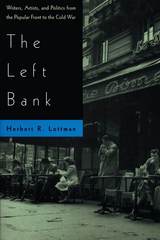
"Surprisingly fresh and intense. . . . A retrospective travelogue of the Left Bank in the days when it was the setting for almost all French intellectual activity. . . . Absorbing."—Naomi Bliven, New Yorker
"As an introduction to a period in French history already legendary, The Left Bank is superb."—Michael Dirda, Washington Post Book World
"An intellectual history. A history of the interaction between politics and letters. And a rumination on the limitless credulity of intellectuals."—Christopher Hitchens, New Statesman
Duke University Press Scholars of Color First Book Award recipient
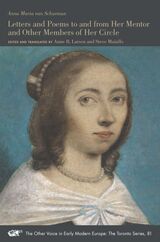
This volume presents in translation a remarkable collection of her letters and poems—many of which were previously unpublished—that span almost four decades of her life, from 1631 to 1669.
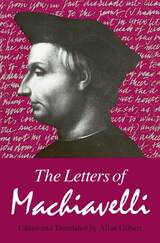

In 1890 Salt published the initial version of Thoreau's Life. With the help of American friends, he revised the book and published it anew six years later. The present volume is the third version of the biography, completed in 1908 but never published in Salt's lifetime.
Combining a concise narrative of Thoreau's life with a perceptive treatment of his ideas and writings, it stands as a penetrating study of Thoreau, stressing his distinctive individuality. Through an astute analysis of the text and a concise biography, the editors illustrate Salt's growth as a scholar and his changing views on Thoreau and Thoreau's philosophy.

What drove leading thinkers, including those of the avant-garde who publicly embraced intellectual freedom, to serve as government informants? Why were they content to work within a repressive system rather than challenging it outright? This collection of interviews with more than two dozen writers and literary scholars, including several Stasi informants, provides a gripping, often dismaying picture of the motivations, compromises, and illusions of East German intellectual life.
In conversations with Robert von Hallberg, writers such as best-selling novelist Hermann Kant, playwright Christoph Hein, and avant-garde poet-publisher Sascha Anderson talk about their lives and work before the fall of the wall in 1989—about the constraints and privileges of Communist Party membership, experiences of government censorship and self-censorship, and relations with their readers. They reflect on why the possibilities of opposition to the state seemed so limited, and on how they might have found ways to resist more aggressively. Turning to the controversies that have emerged since reunification, including the Stasi scandals involving Anderson and Christa Wolf, they discuss their feelings of complicity and the need for further self-examination. Two interviews with Anderson—one conducted before he was exposed as a Stasi collaborator and one conducted afterward—offer unique insight into the double life led by many writers and scholars in the German Democratic Republic.
Judy Kutulas takes us into the debates and outright fights between and within the ranks of organizations such as the League of American Writers, the John Reed Clubs, the Committee for Cultural Freedom, the American Civil Liberties Union, and the National Committee for the Defense of Political Prisoners. Showing how extremist views about the nature and value of communism triumphed over more moderate ones, she traces the transfer of the left’s leadership from one generation to the next. She describes how supporters of the People’s Front were discredited by the time of the Nazi-Soviet Pact and how this opened the way for a new generation of leaders better known as the New York intellectuals. In this shift, Kutulas identifies the beginnings of the liberal anti-communism that would follow World War II.
A book for students and scholars of the intersection of politics and culture, The Long War offers a new, informed perspective on the intellectual maneuvers of the American left of the 1930s and leads to a reinterpretation of the time and its complex legacy.
Intellectuals such as William James, John Dewey, Jane Addams, Eugene V. Debs, and W. E. B. Du Bois repudiated liberalism's association with acquisitive individualism and laissez-faire economics, advocating a model of liberal citizenship whose virtues and commitments amount to what Hansen calls cosmopolitan patriotism. Rooted not in war but in dedication to social equity, cosmopolitan patriotism favored the fight against sexism, racism, and political corruption in the United States over battles against foreign foes. Its adherents held the domestic and foreign policy of the United States to its own democratic ideals and maintained that promoting democracy universally constituted the ultimate form of self-defense. Perhaps most important, the cosmopolitan patriots regarded critical engagement with one's country as the essence of patriotism, thereby justifying scrutiny of American militarism in wartime.
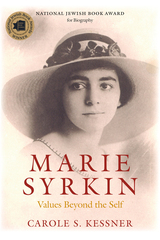
Marie Syrkin’s life spanned ninety years of the twentieth century, 1899–1989. As a polemical journalist, socialist Zionist, poet, educator, literary critic, translator, and idiosyncratic feminist, she was an eyewitness to and reporter on most of the major events in America, Israel, and Europe. Beautiful as well as brilliant, she had a rich personal life as a lover, wife, mother, and friend. During her lifetime Syrkin’s name was widely recognized in the world of Jewish life and letters. Yet, since Syrkin’s death, recognition of her name is no longer quite so immediate. Carole S. Kessner’s biography restores Syrkin’s fascinating life and legacy for a new generation.

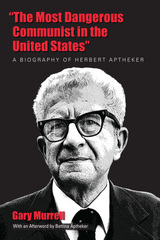
When J. Edgar Hoover declared Herbert Aptheker “the most dangerous Communist in the United States,” the notorious FBI director misconstrued his true significance. In this first book-length biography of Aptheker (1915–2003), Gary Murrell provides a balanced yet unflinching assessment of the controversial figure who was at once a leading historian of African America, radical political activist, literary executor of W. E. B. Du Bois, and lifelong member of the American Communist Party. Although blacklisted at U.S. universities, Aptheker published dozens of books, including the groundbreaking American Negro Slave Revolts (1943) and the monumental seven-volume Documentary History of the Negro People (1951–1994). He also edited four volumes of the correspondence and unpublished writings of Du Bois, an achievement that Eric Foner, writing in the New York Times Book Review, called “a milestone in the coming of age of Afro-American history.”
As Murrell shows, Aptheker the historian was inseparable from Aptheker the leading Communist Party intellectual, polemicist, and agitator. During the 1960s, his ability to rouse and inspire both black and white student radicals made him one of the few Old Leftists accepted by the New Left. Aptheker had joined the CPUSA during its heyday in the 1930s, convinced that only through the party's leadership could fascism be defeated and true liberation be achieved: he ended his affiliation five decades later in 1991 after the collapse of socialism in the Soviet Union and Eastern Europe.
In an afterword, Bettina Aptheker adds to Murrell's narrative by illuminating her mother Fay's vital contributions to her father's work and by affirming the particularly devastating challenges of life in a family dedicated to radical political and social change.


An analysis of the growing visibility of nonreligion in Egypt.
Egypt's 2011 Uprising, while often perceived as a failed revolution, nonetheless nonetheless had durable social effects. Among these has been a rise in expressing atheism and agnosticism, especially among educated and affluent youth—the country’s future leaders.
An intimate ethnography, Nonreligious Lifeworlds in Egypt explores the intellectual and emotional transformations of atheists and agnostics inspired by the aspirational freedom-seeking of the Arab Spring. Rejecting both of Egypt’s dominant religious traditions, Islam and Coptic Christianity, nonreligious people are widely viewed as agents of moral outrage. Amid media-driven panics, their sanity is often questioned by their own families as they experiment with new ways of living and relating. Drawing from in-depth fieldwork, interviews, and social media analysis, Karin van Nieuwkerk reveals her interlocutors’ changing perspectives on sex and gender, eating and drinking, and life and death. Above all, she emphasizes the affective experiences of renouncing religion, marked by anxiety and regret—but also liberation and relief. With rigor and compassion, Van Nieuwkerk opens our minds to the arduous process of exchanging established norms for self-determination.
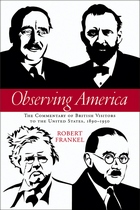
Robert Frankel examines the New World experiences of these commentators and the books they wrote about America. He also probes similar writings by other prominent observers from the British Isles, including Beatrice Webb, Rudyard Kipling, and George Bernard Shaw. The result is a book that offers keen insights into America’s national identity in a time of vast political and cultural change.
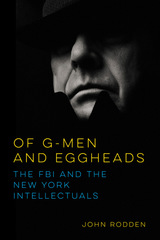
John Rodden cuts this tall tale down to its authentic pint size, refusing to indulge the public relations myth promoted by J. Edgar Hoover's FBI. In Of G-Men and Eggheads, Rodden portrays federal agents’ hilarious obsession with monitoring that ever-present threat to national security, the American literary intellectual. Drawing on government dossiers and archives, Rodden focuses on the onetime members of a radical political sect of ex-Trotskyists (barely numbering a thousand at its height), the so-called New York intellectuals. He describes the nonsensical decades-long pursuit of this group of intellectuals, especially Lionel Trilling, Dwight Macdonald, and Irving Howe. The Keystone Cops style of numerous FBI agents is documented carefully in Rodden's meticulous case studies of how Hoover's men recruited informants to snoop on the "Commies," opened their personal mail, tracked their movements, and reported on their wives and friends.
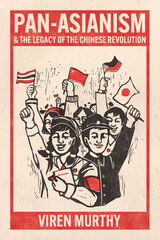
Recent proposals to revive the ancient Silk Road for the contemporary era and ongoing Western interest in China’s growth and development have led to increased attention to the concept of pan-Asianism. Most of that discussion, however, lacks any historical grounding in the thought of influential twentieth-century pan-Asianists. In this book, Viren Murthy offers an intellectual history of the writings of theorists, intellectuals, and activists—spanning leftist, conservative, and right-wing thinkers—who proposed new ways of thinking about Asia in their own historical and political contexts. Tracing pan-Asianist discourse across the twentieth century, Murthy reveals a stronger tradition of resistance and alternative visions than the contemporary discourse on pan-Asianism would suggest. At the heart of pan-Asianist thinking, Murthy shows, were the notions of a unity of Asian nations, of weak nations becoming powerful, and of the Third World confronting the “advanced world” on equal terms—an idea that grew to include non-Asian countries into the global community of Asian nations. But pan-Asianists also had larger aims, imagining a future beyond both imperialism and capitalism. The fact that the resurgence of pan-Asianist discourse has emerged alongside the dominance of capitalism, Murthy argues, signals a profound misunderstanding of its roots, history, and potential.
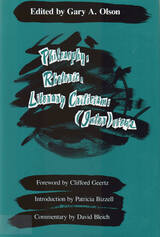
Susan Wells and Reed Way Dasenbrock provide distinctly divergent assessments of the application of Donald Davidson’ s language theory to rhetoric and composition, and especially to writing pedagogy. Patricia Bizzell and John Trimbur explore how Stanley Fish’ s neopragmatism might be useful both to composition theory and to literacy education. And Joyce Irene Middleton and Tom Fox discuss bell hooks’ s notions of how race and gender affect pedagogy. In two frank and sometimes angry responses, Patricia Harkin and Jasper Neel take J. Hillis Miller to task for seeming to support rhetoric and composition while continuing to maintain the political status quo. Similarly, Susan C. Jarratt and Elizabeth A. Flynn express skepticism about Jane Tompkins’ s vocal support of composition and of radical pedagogy particularly. And Arabella Lyon and C. Jan Swearingen analyze Stephen Toulmin’ s thoughts on argumentation and postmodernism.
Internationally respected anthropologist Clifford Geertz provides a foreword; literacy expert Patricia Bizzell contributes an introduction to the text; and noted reader-response critic David Bleich supplies critical commentary.
This book is a follow-up to the editor’ s (Inter)views: Cross-Disciplinary Perspectives on Rhetoric and Literacy, already a major work of scholarship in the field.

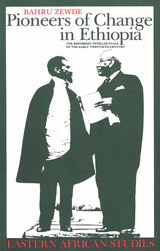
In this exciting new study, Bahru Zewde, one of the foremost historians of modern Ethiopia, has constructed a collective biography of a remarkable group of men and women in a formative period of their country’s history. Ethiopia’s political independence at the end of the nineteenth century put this new African state in a position to determine its own levels of engagement with the West. Ethiopians went to study in universities around the world. They returned with the skills of their education acquired in Europe and America, and at home began to lay the foundations of a new literature and political philosophy. Pioneers of Change in Ethiopia describes the role of these men and women of ideas in the social and political transformation of the young nation and later in the administration of Haile Selassie.
Highlights include an affectionate treatment of Leo Szilard, the physicist whose involvement with the development of the atomic bomb led him to work ceaselessly to address its social consequences; a discussion of the educational philosophy of Robert Maynard Hutchins, the University of Chicago's fifth and most controversial president; an appreciative account of the Polish emigré Leopold Labedz's well-informed and outspoken resistance to Communism; and an essay about the extraordinary Indian writer Nirad Chaudhuri.
Many of these essays have appeared in The American Scholar, edited by Joseph Epstein, who introduces this volume with his own portrait of Edward Shils.
"Though professionally a sociologist, Edward Shils was a man of wide cosmopolitan culture and experience, greatly concerned with the public problems of his time: in particular with those created by the rise of new and dangerous ideologies, the frightening possibilities of science, and the apparent abrogation of public responsibility by many Western intellectuals."—Hugh Trevor-Roper
The late Edward Shils was a member of the University of Chicago's Committee on Social Thought for forty-five years and a fellow of Peterhouse, Cambridge University. His many books include The Calling of Sociology and The Intellectuals and the Powers, both published by the University of Chicago Press.
This new collection of essays considers the demise of the GDR and its impact on the place of intellectuals in Germany today. Distinguished contributors from Germany, Austria, and the United States survey aspects of high and low culture, including the current nostalgia for East German film, the demise of the GDR rock scene, the pivotal role of East German poets, the consolidation and privatization of German media, and the frightening new resurgence of right-wing violence. The result is a timely volume that charts Germany's rocky transition from one world to another.
Contributors:
Mitchell G. Ash
Simone Barck
David Bathrick
John Borneman
Dorothea Dornhof
Michael Geyer
Andreas Graf
Dietrich Hohmann
Andreas Huyssen
Konrad Jarausch
Alexander Kluge
Loren Kruger
Martina Langermann
Siegfried Lokatis
Patricia Anne Simpson
Frank Trommler
Katie Trumpener
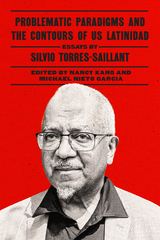
Silvio Torres-Saillant’s collected writings examine political contradictions within Latinx identity in the United States.
Since the 1990s Silvio Torres-Saillant’s work has questioned the notion of Latinidad, challenging presumptions of panethnic unity within the US Hispanic population and assessing dominant modes of Latinx representation. The essays in Problematic Paradigms and the Contours of US Latinidad examine the dynamics of a diverse collective of over 65 million people whose cultural heritage, ancestral origins, and belief systems arguably differ as much as they resemble one another. The volume dissects prevailing assumptions, namely the essentializing sense of homogeneity in the Latinx “community,” which mask important nuances and fascinating contradictions. Torres-Saillant also targets the role of marketing and mass communications in shaping popular perceptions of ethnic groups, thereby tracing connections between media rhetoric and the language of scholarship.
Newly revised by editors Nancy Kang and Michael Nieto Garcia, this collection curates Torres-Saillant’s core contributions to Latinx studies over the last two decades and underscores the veteran scholar’s evolving thoughts on key conversations in the field. The epilogue narrates his beginnings in Caribbean studies, acknowledges his ongoing analysis of Dominican blackness, and discourages uncritical views of cultural heritage.
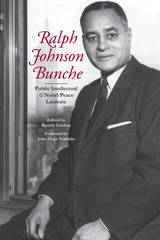
Nobel Peace Prize winner Ralph Johnson Bunche (1904-71) was one of the twentieth century’s foremost diplomats and intellectuals. In the wake of centennial celebrations of his birth, leading scholars and diplomats assess Bunche’s historical importance and enduring impact on higher education, public policy, and international politics. Their essays reveal not only the breadth of Bunche’s influence, such as his United Nations work to broker peace during times of civil war in Africa, the Middle East, and Asia, but also the depth of his intellectual perspectives on race, civil rights, higher education, and international law. Probing his publications, speeches, and public policy initiatives, the volume offers telling insights into the critical roles of universities, public intellectuals, and diplomats in working together to find solutions to domestic and international problems through public and scholarly engagement. In this way, the volume highlights the very connections that Bunche exhibited as an academic, intellectual, and diplomat.
Contributors include Lorenzo DuBois Baber, John Hope Franklin, Jonathan Scott Holloway, Charles P. Henry, Ben Keppel, Beverly Lindsay, Princeton Lyman, Edwin Smith, and Hanes Walton Jr.

This compelling and often traumatic book is the memoir of one of the most important figures in modern Russian history, Dmitry S. Likhachev, revered as ‘a guardian of national culture’. Reflections on the Russian Soul is an incredible account of an intellectual’s turbulent journey through twentieth century Russia. Likhachev re-counts the fortunes of people with whom he came into contact and reproduces the air of passed years in Russia.
Likhachev vividly portrays his childhood years in St. Petersburg and continues into his student life at Leningrad University that led to an agonizing period of imprisonment and near death. He describes how a harmless prank caught the attention of the Secret Police, resulting in his exile and confinement within the infamous prison island of Solovki. He describes his first-hand experience of brutality in prison during the early Stalin years and the incident that not only saved him but also haunted him for the rest of his life.
He reflects on the years after his release from prison and the events leading up to the Second World War. His powerful recollection of the blockade of Leningrad provides the reader with a horrific insight into the harsh effects of war, hunger and survival. Lichachev goes on to describe post-war Russia and how his own livelihood developed from literary editor to a return to Leningrad University as Professor of History. This compelling autobiography finishes with Likhachev’s poignant return to Solovki as a free man.
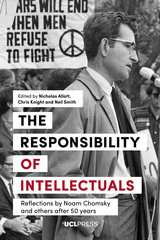
This book revisits “The Responsibility of Intellectuals” half a century later. It includes six new essays written to celebrate Chomsky’s famous intervention and explore its relevance in today’s world. Nicholas Allott, Chris Knight, Milan Rai, and Neil Smith have studied and written about Chomsky’s thought for many years, while Craig Murray and Jackie Walker describe the personal price they have paid for speaking out. The book concludes with Chomsky’s recollections of the background to the original publication of his essay, followed by extensive commentary from him on its fiftieth anniversary.

Covering from 1915 to the present, this book deals with the role that artists and intellectuals have played regarding projects of European integration. Consciously or not, they partake of a tradition of Euroskepticism. Because Euroskepticism is often associated with the discourse of political elites, its literary and artistic expressions have gone largely unnoticed. This book addresses that gap.
Taking Spain as a case study, author Luis Martín-Estudillo analyzes its conflict over its own Europeanness or exceptionalism, as well as the European view of Spain. He ranges from canonical writers like Unamuno, Ortega y Gasset, and Zambrano to new media artists like Valeriano López, Carlos Spottorno, and Santiago Sierra. Martín-Estudillo provides a new context for the current refugee crisis, the North-South divide among EU countries, and the generalized disaffection toward the project of European integration.
The eclipsed critical tradition he discusses contributes to a deeper understanding of the notion of Europe and its institutional embodiments. It gives resonance to the intellectual and cultural history of Europe's "peripheries" and re-evaluates Euroskeptic contributions as one of the few hopes left to imagine ways to renew the promise of a union of the European nations.
Cosmopolitan visions
Terry A. Cooney traces the evolution of the Partisan Review—often considered to be the most influential little magazine ever published in America—during its formative years, giving a lucid and dispassionate view of the magazine and its luminaries who played a leading role in shaping the public discourse of American intellectuals. Included are Lionel Trilling, Philip Rahv, William Phillips, Dwight Macdonald, F. W. Dupee, Mary McCarthy, Sidney Hook, Harold Rosenberg, and Delmore Schwartz, among others.
“An excellent book, which works at each level on which it operates. It succeeds as a straightforward narrative account of the Partisan Review in the 1930s and 1940s. The magazine’s leading voices—William Phillips, Philip Rahv, Dwight MacDonald, Lionel Trilling, and all the rest—receive their due. . . . Among the themes that engage Cooney. . . . are: how they dealt with ‘modernism’ in culture and radicalism in politics, each on its own and in combination; how Jewishness played a complex and fascinating role in many of the thinkers’ lives; and, especially, how ‘cosmopolitanism’ best explains what the Partisan Review was all about.”—Robert Booth Fowler, Journal of American History

Utilizing a new and original framework for examining the role of intellectuals in countries transitioning to democracy, Bozóki analyses the rise and fall of dissident intellectuals in Hungary in the late 20th century. He shows how that framework is applicable to other countries too as he forensically examines their activities.
Bozóki argues that the Hungarian intellectuals did not become a ‘New Class’. By rolling transition, he means an incremental, non-violent, elite driven political transformation which is based on the rotation of agency, and it results in a new regime. This is led mainly by different groups of intellectuals who do not construct a vanguard movement but create an open network which might transform itself into different political parties. Their roles changed from dissidents to reformers, to movement organizers and negotiators through the periods of dissidence, open network building, roundtable negotiations, parliamentary activities, and new movement politics.
Through the prism of political sociology, the author focuses on the following questions: Who were the dissident intellectuals and what did they want? Under what conditions do intellectuals rebel and what are the patterns of their protest? This book will be of interest to students, researchers, and public intellectuals around the world aiming to promote human rights and democracy.
The Midwest has been characterized as a fertile seedbed for the germination of great thinkers, but a wasteland for their further growth. The Sower and the Seer reveals that representation to be false. In fact, the region has sustained many innovative minds and been the locus of extraordinary intellectualism. It has also been the site of shifting interpretations—to some a frontier, to others a colonized space, a breadbasket, a crossroads, a heartland. As agrarian reformed (and Michigander) Liberty Hyde Bailey expressed in his 1916 poem “Sower and Seer,” the Midwestern landscape has given rise to significant visionaries, just as their knowledge has nourished and shaped the region.
The essays gathered for this collection examine individual thinkers, writers, and leaders, as well as movements and ideas that shaped the Midwest, including rural school consolidation, women’s literary societies, Progressive-era urban planning, and Midwestern radical liberalism. While disparate in subject and style, these essays taken together establish the irrefutable significance of the intellectual history of the American Midwest.
Boyer analyzes the creation and mediation of the social knowledge of "German-ness" from nineteenth-century university culture and its philosophies of history, to the media systems and redemptive public cultures of the Third Reich and the German Democratic Republic, to the present-day experiences of former East German journalists seeking to explain life in post-unification Germany. Throughout this study, Boyer reveals how dialectical knowledge of "German-ness"—that is, knowledge that emphasizes a cultural tension between an inner "spirit" and an external "system" of social life —is modeled unconsciously upon intellectuals' self-knowledge as it tracks their fluctuation between alienation and utopianism in their interpretations of nation and modernity.
Born into a tumultuous family, Fish survived life with an emotionally absent father and a headstrong mother through street sports and troublemaking as much as through his success at a rigorous prep school. As Olson shows, Fish’s escape from the working-class neighborhoods of 1940s and 1950s Providence, Rhode Island, came with his departure for the university life at the University of Pennsylvania and then Yale. His meteoric rise through the academic ranks at a troubled Vietnam-era UC-Berkeley was complemented by a 1966 romp through Europe that included drag racing through the streets of Seville in his Alfa Romeo. He went on to become an internationally prominent scholar at Johns Hopkins before moving to Duke, where he built a star-studded academic department that became a key site in the culture and theory wars of the 1980s and 1990s. Olson discusses Fish’s tenure as a highly visible dean at the University of Illinois at Chicago who clashed publicly with the state legislature. He also covers Fish’s most remarkable and controversial books, including Fish’s masterpiece, Surprised by Sin: The Reader in "Paradise Lost," which was a critical sensation and forever changed the craft of literary criticism, as well as Professional Correctness and Save the World on Your Own Time, two books that alienated Fish from most liberal-minded professors in English studies.
Olson concludes his biography of Fish with an in-depth analysis of the contradictions between Fish’s public persona and his private personality, examining how impulses and events from Fish’s childhood shaped his lifelong practices and personality traits. Also included are a chronology of the major events of Fish’s life and never-before-published photos.
Based on hundreds of hours of recorded interviews with friends, enemies, colleagues, former students, family members, and Fish himself, along with material from the Stanley Fish archive, Stanley Fish, America’s Enfant Terrible is a clearly written narrative of the life of an important and controversial scholar.
Would the most recognizable ideas in the French social sciences have developed without the influence of Brazilian intellectuals? While any study of Brazilian social sciences acknowledges the influence of French scholars, Ian Merkel argues the reverse is also true: the “French” social sciences were profoundly marked by Brazilian intellectual thought, particularly through the University of São Paulo. Through the idea of the “cluster,” Merkel traces the intertwined networks of Claude Lévi-Strauss, Fernand Braudel, Roger Bastide, and Pierre Monbeig as they overlapped at USP and engaged with Brazilian scholars such as Mário de Andrade, Gilberto Freyre, and Caio Prado Jr..
Through this collective intellectual biography of Brazilian and French social sciences, Terms of Exchange reveals connections that shed new light on the Annales school, structuralism, and racial democracy, even as it prompts us to revisit established thinking on the process of knowledge formation through fieldwork and intellectual exchange. At a time when canons are being rewritten, this book reframes the history of modern social scientific thought.
Demonstrates the centrality of thinking about intellectual class formation to social theory
Old as the notion of the “New Class” is (the term was coined by anarchist Mikhail Bakunin around 1870), the idea of the ascendancy of an intellectual elite continues to engage, and perplex, social theorists. In Theories of the New Class, Iván Szelényi, one of the most incisive and respected analysts of the intellectual class, and his colleague Lawrence King put New Class theories into a broad historical framework for the first time.
Addressing the intellectual history of Marxism and socialism, theories of the increasing role of the state and technocratic elites in capitalism, and theories of contemporary social change, King and Szelényi’s work clearly links the centrality of thinking about intellectual class formation to a variety of theoretical and political projects that have shaped social theory and influenced political realities over the past century.King and Szelényi show that the idea of the New Class has stubbornly entered and reentered the agenda of critical social theorizing throughout the last century. Indeed, they interpret that the last century as a history of projects by different groups of the highly educated—factions of intellectuals, bureaucrats, technocrats, managers, and the left-wing humanistic intelligentsia—to gain ultimate power. A rare empirical discussion of theory, Theories of the New Class invigorates class theories by grounding them in contemporary issues; at the same time, it uses modern polemics to revitalize historical debates on the origins of capitalism.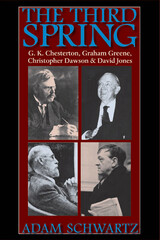
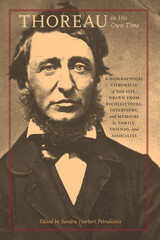
The forty-nine recollections gathered in Thoreau in His Own Time demonstrate that it was those who knew him personally, rather than his contemporary literati, who most prized Thoreau’s message, but even those who disparaged him respected his unabashed example of an unconventional life. Included are comments by Ralph Waldo Emerson—friend, mentor, Walden landlord, and progenitor of the spin on Thoreau’s posthumous reputation; Nathaniel Hawthorne, who could not compliment Thoreau without simultaneously denigrating him; and John Weiss, whose extended commentary on Thoreau’s spirituality reflects unusual tolerance. Selections from the correspondence of Caroline Healey Dall, Maria Thoreau, Sophia Hawthorne, Sarah Alden Bradford Ripley, and Amanda Mather amplify our understanding of the ways in which nineteenth-century women viewed Thoreau. An excerpt by John Burroughs, who alternately honored and condemned Thoreau, asserts his view that Thoreau was ever searching for the unattainable.
The dozens of primary sources in this crisply edited collection illustrate the complexity of Thoreau’s iconoclastic singularity in a way that no one biographer could. Each entry is introduced by a headnote that places the selection in historical and cultural context. Petrulionis’s comprehensive introduction and her detailed chronology of personal and literary events in Thoreau’s life provide a lively and informative gateway to the entries themselves. The collaborative biography that Petrulionis creates in Thoreau in His Own Time contextualizes the strikingly divergent views held by his contemporaries and highlights the reasons behind his profound legacy.
Vienna in the Age of Uncertainty traces the vital and varied roles of science through the story of three generations of the eminent Exner family, whose members included Nobel Prize–winning biologist Karl Frisch, the teachers of Freud and of physicist Erwin Schrödinger, artists of the Vienna Secession, and a leader of Vienna’s women’s movement. Training her critical eye on the Exners through the rise and fall of Austrian liberalism and into the rise of the Third Reich, Deborah R. Coen demonstrates the interdependence of the family’s scientific and domestic lives, exploring the ways in which public notions of rationality, objectivity, and autonomy were formed in the private sphere. Vienna in the Age of Uncertainty presents the story of the Exners as a microcosm of the larger achievements and tragedies of Austrian political and scientific life in the late nineteenth and early twentieth centuries.

Whom does society consider an intellectual and on what grounds? Antonio Gramsci’s democratic vision of intelligence famously suggested that “all men are intellectuals,” yet within academic circles and among the general public, intellectuals continue to be defined by narrow, elite criteria.
In this study of four celebrated citizens of the African diaspora—American boxer Muhammad Ali, West Indian Marxist critic C. L. R. James, British cultural theorist Stuart Hall, and Jamaican musician Bob Marley—Grant Farred develops a new category of engaged thinker: the vernacular intellectual. Extending Gramsci’s concept of the organic intellectual, Farred conceives of vernacular intellectuals as individuals who challenge social injustice from inside and outside traditional academic or political spheres. Muhammad Ali, for example, is celebrated as much for his dazzling verbal skills and courageous political stands as for his pugilistic talents; Bob Marley’s messages of liberation are as central to his popularity as his lyrical and melodic sophistication. Neither man is described as an intellectual, yet both perform crucial intellectual functions: shaping how people see the world, oppose hegemony, and understand their own history. In contrast, the careers of C. L. R. James and Stuart Hall reflect a dynamic blend of the traditional and the vernacular. Conventionally trained and situated, James and Hall examine racism, history, and the lasting impact of colonialism in ways that draw on both established scholarship and more popular cultural experiences.
Challenging existing paradigms, What’s My Name offers an expansive and inclusive vision of intellectual activity that is as valid and meaningful in the boxing ring, the press conference, and the concert hall as in academia.
In Where Is Juliet Stuart Poyntz?, Denise M. Lynn argues that Poyntz's sudden disappearance was the final straw for many on the American political left, who then abandoned Marxism and began to embrace anti-communism. In the years to follow, the left crafted narratives of her disappearance that became central to the Cold War. While scholars have thoroughly analyzed the influence of the political right in the anti-communism of this era, this captivating and compelling study is unique in exploring the influence of the political left.
READERS
Browse our collection.
PUBLISHERS
See BiblioVault's publisher services.
STUDENT SERVICES
Files for college accessibility offices.
RECENTLY PUBLISHED


UChicago Accessibility Resources
home | accessibility | search | about | contact us
BiblioVault ® 2001 - 2026
The University of Chicago Press