
 A SCHOLARLY BOOK REPOSITORY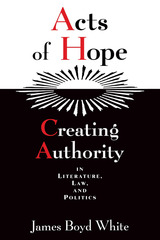
In this book, James Boyd White shows how texts by some of our most important thinkers and writers—including Plato, Shakespeare, Dickinson, Mandela, and Lincoln—answer these questions, not in the abstract, but in the way they wrestle with the claims of the world and self in particular historical and cultural contexts. As they define afresh the institutions or practices for which they claim (or resist) authority, they create authorities of their own, in the very modes of thought and expression they employ. They imagine their world anew and transform the languages that give it meaning.
In so doing, White maintains, these works teach us about how to read and judge claims of authority made by others upon us; how to decide to which institutions and practices we should grant authority; and how to create authorities of our own through our thoughts and arguments. Elegant and accessible, this book will appeal to anyone wanting to better understand one of the primary processes of our social and political lives.
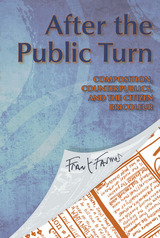
Farmer examines two very different kinds of publics, cultural and disciplinary, and discusses two counterpublics within those broad categories: zine discourses and certain academic discourses. By juxtaposing these two significantly different kinds of publics, Farmer suggests that each discursive world can be seen, in its own distinct way, as a counterpublic, an oppositional social formation that has a stake in widening or altering public life as we know it.
Drawing on major figures in rhetoric and cultural theory, Farmer builds his argument about composition teaching and its relation to the public sphere, leading to a more sophisticated understanding of public life and a deeper sense of what democratic citizenship means for our time.

In the last quarter of the twentieth century, the ideas that most Americans lived by started to fragment. Mid-century concepts of national consensus, managed markets, gender and racial identities, citizen obligation, and historical memory became more fluid. Flexible markets pushed aside Keynesian macroeconomic structures. Racial and gender solidarity divided into multiple identities; community responsibility shrank to smaller circles. In this wide-ranging narrative, Daniel T. Rodgers shows how the collective purposes and meanings that had framed social debate became unhinged and uncertain.
Age of Fracture offers a powerful reinterpretation of the ways in which the decades surrounding the 1980s changed America. Through a contagion of visions and metaphors, on both the intellectual right and the intellectual left, earlier notions of history and society that stressed solidity, collective institutions, and social circumstances gave way to a more individualized human nature that emphasized choice, agency, performance, and desire. On a broad canvas that includes Michel Foucault, Ronald Reagan, Judith Butler, Charles Murray, Jeffrey Sachs, and many more, Rodgers explains how structures of power came to seem less important than market choice and fluid selves.
Cutting across the social and political arenas of late-twentieth-century life and thought, from economic theory and the culture wars to disputes over poverty, color-blindness, and sisterhood, Rodgers reveals how our categories of social reality have been fractured and destabilized. As we survey the intellectual wreckage of this war of ideas, we better understand the emergence of our present age of uncertainty.

In exploring the origins and character of the American liberal tradition, Myra Jehlen begins with the proposition that the decisive factor that shaped the European settlers’ idea of “America” or the “American” was material rather than conceptual—it was the physical fact of the land. European settlers came to a continent on which they had no history, bringing the ideology of liberal individualism, which they projected onto the land itself. They believed the continent proclaimed that individuals were born in nature and freely made their own society. An insurgent ideology in Europe, this idea worked in America paradoxically to empower the individual and to restrict social change.
Jehlen sketches the evolution of the concept of incarnation through comparisons of American and European eighteenth-century naturalist writings, particularly Emerson’s Nature. She then explores the way incarnation functions ideologically—to both enable and curtail action—in the writing of fiction. Her examination of Hawthorne and Melville shows how the myth of the New World both licensed and limited American writers who set out to create their own worlds in fiction. She examines conflicts between the exigencies of narrative form and the imperatives of ideology in the writings of Franklin, Jefferson, Emerson, and others. Jehlen concludes with a speculation on the implication of this original construction of “America” for the United States today, when such imperial concepts have been called into question.


The Reagan and Bush years have left us with a troublesome dilemma: how to balance our budget deficit against our social deficit. This book takes up the urgent question of how, in a time of economic crisis and constraint, we can meet the pent-up demand for spending on our nation’s neglected poor, infirm, and disadvantaged, old and young. Michael Piore’s ambitious response is to develop a new social theory that balances individual preferences against the claims and responsibilities of the community. By explaining the role of groups in economic and social life, this theory makes sense of a host of perplexing social phenomena and policy issues, from equal employment opportunity to international competitiveness to the decline of organized labor, from multicultural education to health insurance to the underclass.
Piore traces our difficulties in addressing these issues to the limits of liberal social theory, particularly its sharp distinctions between individuality and community. He offers an alternative view of individuality as emerging through the discussions and debates conducted among a community’s members. These discussions, Piore suggests, have turned inward, away from the borderlands where social groups and economic organizations meet—and therein lies the crux of some of the country’s deepest political and economic problems. His book points beyond the liberal conception of politics as a negotiation among competing interests and of policymaking as technical decisionmaking. Instead, it prescribes a politics focused on the process of discussion and debate itself, a politics that enlarges the borderlands by broadening the range of people who talk to one another and the range of topics they address.
Why hasn’t democracy been embraced worldwide as the best form of government?
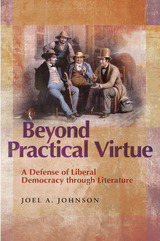
Aesthetic critics of democracy such as Carlyle and Nietzsche have argued that modern democracy, by removing the hierarchical institutions that once elevated society’s character, turns citizens into bland, mediocre souls. Joel A. Johnson now offers a rebuttal to these critics, drawing surprising inspiration from American literary classics.
Addressing the question from a new perspective, Johnson takes a fresh look at the worth of liberal democracy in these uncertain times and tackles head-on the thorny question of cultural development. Examining the novels of James Fenimore Cooper, Mark Twain, and William Dean Howells, he shows that through their fiction we can gain a better appreciation of the rich detail of everyday life, making the debate relevant to contemporary discussions of liberal democracy.
Johnson focuses on an issue that liberals have inadequately addressed: whether people tend to develop fully as individuals under liberal democracy when such a regime does little formally to encourage their development. He argues that, though the liberal fear of state-guided culture is well founded, it should not prevent us from evaluating liberalism’s effect on individual flourishing. By extending the debate over the worthiness of liberal democracy to include democracy’s effect on individual development, he contends that the democratic experience is much fuller than the aristocratic one and thus expands the faculties of its citizens.
Critics of American democracy such as John Rawls have sought to transform it into a social or egalitarian democracy in the European style. Johnson shows that neither the debate between Rawls and his communitarian critics nor the ongoing discussion of the globalization of American values adequately addresses the fundamental critique of democratic culture advanced by the aesthetic critics. Johnson’s cogent analysis reaches out to those readers who are ready for a more comprehensive evaluation of liberal democracy, offering new insight into the relationship between the state and the individual while blazing new trails in the intersection of politics and literature.

Common Ground explores the philosophical relationship between collectivity, individuality, affect and agency in the neoliberal era. Jeremy Gilbert argues that individualism is forced upon us by neoliberal culture, fatally limiting our capacity to escape the current crisis of democratic politics.
The book asks how forces and ideas opposed to neoliberal hegemony, and to the individualist tradition in Western thought, might serve to protect some form of communality, and how far we must accept assumptions about the nature of individuality and collectivity which are the legacy of an elitist tradition. Along the way it examines different ideas and practices of collectivity, from conservative notions of hierarchical and patriarchal communities to the politics of ‘horizontality’ and ‘the commons’ which are at the heart of radical movements today.
Exploring this fundamental faultline in contemporary political struggle, Common Ground proposes a radically non-individualist mode of imagining social life, collective creativity and democratic possibility.
Now available in paperback with a new preface by the author, this award-winning book breaks new ground by challenging traditional concepts of community in political theory. William Corlett brings the diverse (and sometimes contradictory) work of Foucault and Derrida to bear on the thought of Pocock, Burke, Lincoln, and McIntyre, among others, to move beyond the conventional dichotomy of "individual vs. community," arguing instead that community is best advanced within a politics of difference.

How West Texas business and culture molded the rise of conservatism in the United States.
Much of what we understand as modern American political conservatism was born in West Texas, where today it predominates. How did the people of such a vast region—larger than New England and encompassing big cities like Lubbock and Amarillo, as well as tiny towns from Anson to Dalhart—develop such a uniform political culture? And why and how did it go national?
Jeff Roche finds answers in the history of what he calls cowboy conservatism. Political power players matter in this story, but so do football coaches, newspaper editors, and a breakfast cereal tycoon who founded a capitalist utopia. The Conservative Frontier follows these and other figures as they promoted an ideology grounded in the entrepreneurial and proto-libertarian attitudes of nineteenth-century Texas ranchers, including a fierce devotion to both individualism and small-town notions of community responsibility. This political sensibility was in turn popularized by its association with the mythology and iconography of the cowboy as imagined in twentieth-century mass media. By the 1970s and the rise of Ronald Reagan, Roche shows, it was clear that the cowboy conservatism of West Texas had set the stage for the emergence of the New Right—the more professionalized and tech-savvy operation that dominated national conservative politics for the next quarter century.

Consider this paradox: Ecologists estimate that it would take three planets Earth to provide an American standard of living to the entire world. Yet it is that standard of living to which the whole world aspires.
In Consuming Desires, award-winning writer and social commentator Roger Rosenblatt brings together a brilliant collection of thinkers and writers to shed light on the triumphs and tragedies of that disturbing paradox. The book represents a captivating salon, offering a rich and varied dialogue on the underlying roots of consumer culture and its pervasive impact on ourselves and the world around us. Each author offers a unique perspective, their layers of thoughts and insights building together to create a striking, multifaceted picture of our society and culture.
Jane Smiley probes the roots of consumerism in the emancipation of women from household drudgery afforded by labor-saving devices and technological innovation; Alex Kotlowitz describes the mutual reinforcement of fashion trends as poor inner-city kids and rich suburban kids strive to imitate each other; Bill McKibben discusses the significance, and the irony, of defining yourself not by what you buy, but by what you don't buy.
The essays range widely, but two ideas are central to nearly all of them: that consumption is driven by yearning and desire -- often unspoken, seemingly insatiable -- and that what prevents us from keeping our consumptive impulse in check is the western concept of self, the solitary and restless self, entitled to all it can pay for.
As Rosenblatt explains in his insightful introduction: "Individualism and desire are what makes us great and what makes us small. Freedom is our dream and our enemy. The essays touch on these paradoxes, and while all are too nuanced and graceful to preach easy reform, they give an idea of what reform means, where it is possible, and, in some cases, where it may not be as desirable as it appears."

Nobel Laureate Edmund Phelps and an international group of economists argue that economic health depends on the widespread presence of certain values, in particular individualism and self-expression.
Nobel Laureate Edmund Phelps has long argued that the high level of innovation in the lead nations of the West was never a result of scientific discoveries plus entrepreneurship, as Schumpeter thought. Rather, modern values—particularly the individualism, vitalism, and self-expression prevailing among the people—fueled the dynamism needed for widespread, indigenous innovation. Yet finding links between nations’ values and their dynamism was a daunting task. Now, in Dynamism, Phelps and a trio of coauthors take it on.
Phelps, Raicho Bojilov, Hian Teck Hoon, and Gylfi Zoega find evidence that differences in nations’ values matter—and quite a lot. It is no accident that the most innovative countries in the West were rich in values fueling dynamism. Nor is it an accident that economic dynamism in the United States, Britain, and France has suffered as state-centered and communitarian values have moved to the fore.
The authors lay out their argument in three parts. In the first two, they extract from productivity data time series on indigenous innovation, then test the thesis on the link between values and innovation to find which values are positively and which are negatively linked. In the third part, they consider the effects of robots on innovation and wages, arguing that, even though many workers may be replaced rather than helped by robots, the long-term effects may be better than we have feared. Itself a significant display of creativity and innovation, Dynamism will stand as a key statement of the cultural preconditions for a healthy society and rewarding work.
Christopher Newfield analyzes the interplay of liberal and authoritarian impulses in Emerson's work in various domains: domestic life, the changing New England economy, theories of poetic language, homoerotic friendship, and racial hierarchy. Focusing on neglected later writings, Newfield shows how Emerson explored the tensions between autonomy and community—and consistently resolved these tensions by "abandoning crucial elements of both" and redefining autonomy as a kind of liberating subjection. He argues that in Emersonian individualism, self-determination is accompanied by submission to authority, and examines the influence of this submissive individualism on the history of American liberalism. In a provocative reading of Emerson's early and neglected later works, Newfield analyzes Emerson's emphasis on collective, or "corporate", world-building, rather than private possession. Tracing the development of this corporate individualism, he illuminates contradictions in Emerson's political outlook, and the conjunctions of liberal and authoritarian ideology they produced.
In Freedom Beyond Sovereignty, Sharon R. Krause shows that individual agency is best conceived as a non-sovereign experience because our ability to act and affect the world depends on how other people interpret and respond to what we do. The intersubjective character of agency makes it vulnerable to the effects of social inequality, but it is never in a strict sense socially determined. The agency of the oppressed sometimes surprises us with its vitality. Only by understanding the deep dynamics of agency as simultaneously non-sovereign and robust can we remediate the failed freedom of those on the losing end of persistent inequalities and grasp the scope of our own responsibility for social change. Freedom Beyond Sovereignty brings the experiences of the oppressed to the center of political theory and the study of freedom. It fundamentally reconstructs liberal individualism and enables us to see human action, personal responsibility, and the meaning of liberty in a totally new light.
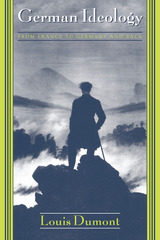
Anyone interested in the fate of national ideology and the concept of the individual will benefit from this radical reinterpretation of modern values and the place of modernity in history.
"What François Furet did for French history, Dumont did for anthropology, turning it away from engaged politics and towards the sober study of the modern age." —Mark Lilla, London Review of Books
"There are many fine things in Dumont's study. Beyond any doubt, his cultural anthropology of the modern spirit highlights some of the key energies of the of the last two centuries. . . . [An] impressive . . . detailed analysis." —Martin Swales, Times Higher Education Supplement
"[An] unsettling, rich, demanding, profound study." —Publishers Weekly

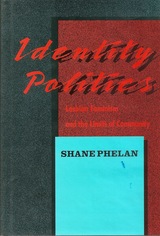
"Lesbian feminism began and has fueled itself with the rejection of liberalism.... In this rejection, lesbian feminists were not alone. They were joined by the New Left, by many blacks in the civil rights movement, by male academic theorists.... What all these groups shared was an intense awareness of the ways in which liberalism fails to account for the social reality of the world, through a reliance upon law and legal structure to define membership, through individualism, through its basis in a particular conception of rationality."
In tracing how lesbian feminism came to be defined in uneasy relationships with the Women’s Movement and gay rights groups, Shane Phelan explores the tension between liberal ideals of individual rights and tolerance and communitarian ideals of solidarity. The debate over lesbian sado-masochism—an expression of individual choice or pornographic, anti-feminist behavior?—is considered as a test case.
Phelan addresses the problems faced by "the woman-identified woman" in a liberal society that presumes heterosexuality as the biological, psychological, and moral standard. Often silenced by laws defining their sexual behavior as criminal and censured by a medical establishment that persists in defining homosexuality as perversion, lesbians, like blacks and other groups, have fought to have the same rights as others in their communities and even in their own homes. Lesbian feminists have also sought to define themselves as a community that would be distinctly different, a community that would disavow the traditional American obsession with individual advancement in the world as it is.
In this controversial study of political philosophy and the women’s movement, Phelan argues that "the failure to date to produce a satisfying theory and program for lesbian action is reflective of the failure of modern political thinking to produce a compelling, nonsuspect alternative to liberalism."
In the series Women in the Political Economy, edited by Ronnie J. Steinberg.

Zoran Terzić’s wide-ranging essay takes up the figure of the idiot and follows its numerous appearances throughout intellectual history in an examination of the “art of the idiotic” that both reflects and transcends the freneticism of the present.
Constructing a new vocabulary with which to understand contemporary society, Curtis examines 'idiotism' across the spheres of economics, politics and culture, drawing on the philosophy and political theories of Martin Heidegger, Louis Althusser, Franco Berardi, Jacques Rancière and Cornelius Castoriadis.
Idiotism recasts our conception of the new neoliberal 'common sense', presenting it as not simply a case of false consciousness, but an ontological problem related to our being-in-the-world.

This provocative volume, one of the most important interpretive works on the philosophical thought of the Renaissance, has long been regarded as a classic in its field. Ernst Cassirer here examines the changes brewing in the early stages of the Renaissance, tracing the interdependence of philosophy, language, art, and science; the newfound recognition of individual consciousness; and the great thinkers of the period—from da Vinci and Galileo to Pico della Mirandola and Giordano Bruno. The Individual and the Cosmos in Renaissance Philosophy discusses the importance of fifteenth-century philosopher Nicholas Cusanus, the concepts of freedom and necessity, and the subject-object problem in Renaissance thought.
“This fluent translation of a scholarly and penetrating original leaves little impression of an attempt to show that a ‘spirit of the age’ or ‘spiritual essence of the time’ unifies and expresses itself in all aspects of society or culture.”—Philosophy
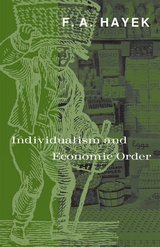
In this influential collection of writings, Nobel laureate Friedrich A. Hayek discusses topics from moral philosophy and the methods of the social sciences to economic theory as different aspects of the same central issue: free markets versus socialist planned economies. First published in the 1930s and '40s, these essays continue to illuminate the problems faced by economists, planners, government officials, and citizens in the changing, globalized economy of today.

In this collection of writings, Nobel laureate Friedrich A. Hayek discusses topics from moral philosophy and the methods of the social sciences to economic theory as different aspects of the same central issue: free markets versus socialist planned economies. First published in the 1930s and 40s, these essays continue to illuminate the problems faced by developing and formerly socialist countries.
F. A. Hayek, recipient of the Medal of Freedom in 1991 and winner of the Nobel Memorial Prize in Economics in 1974, taught at the University of Chicago, the University of London, and the University of Freiburg. Among his other works published by the University of Chicago Press is The Road to Serfdom, now available in a special fiftieth anniversary edition.
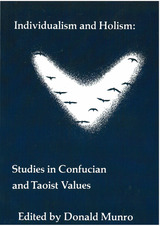
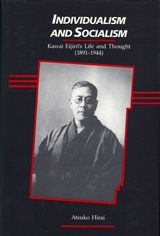
Kawai Eijirō was a controversial figure in Japan during the interwar years. Dedicated to the idea that the socialist aspiration for economic equality could be combined with a classical liberal commitment to individual political and civil rights, he antagonized both Marxists and Japanese nationalists. He was hounded by the government as a leftist and brought to trial during World War II.
This is the first study of Kawai in English. Atsuko Hirai examines the family and school influences that contributed to the development of Kawai’s thought, and analyzes the manner in which the ideas of such Western philosophers as Kant, Hegel, John Stuart Mill, Marx, T. H. Green, and the British labor ideologues were absorbed into a receptive and creative East Asian mind. The events of Kawai’s life are intertwined with the development of his idealist political philosophy, all culminating in a trial of unprecedented scale.
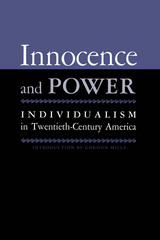
America believes in individualism—but what is individualism? This question leads into unexpected areas of life and thought. It touches upon almost every intellectual discipline concerned with human life. Any answer, to be taken seriously, must recognize this complexity. A broad understanding of the meaning of individualism can be reached only through the insight of many workers in many different fields.
This volume brings together seven of the United States' most distinguished scholars, representing the fields of anthropology, economics, government, history, literature, and philosophy. The trend of their thinking can be suggested by a few excerpts from their essays:
• "An individual divorced from a cultural milieu would not be a human being; he would be a mere hominid."—Leslie A. White
• "The trouble is that 'individual' is a stop-thought word. It numbs the mind, so that once it has been uttered, inquiry stops."—Clarence E. Ayres
• "Not even an individual's perfections are his alone; like his imperfections, they are group-made."— Paul A. Samuelson
• "The twentieth century has witnessed the emergence of a new kind of American individualism, the individualism of nonconformity, which actually challenges the compulsive democracy of the Lockean individualism by which the nation has centrally and historically lived."—Louis Hartz
• "The individualism of the American frontier was an individualism of personal self-reliance and of hardihood and stamina rather than an individualism of intellectual independence and personal self-expression."—David M. Potter
• "The present conditions in which the self must be preserved are radically different from those of a generation, even a decade ago. . . . The dogmatics of present self-assertion are defined and pursued in an existential circumstance."—Frederick J. Hoffman
• "Individuality means creativity, and 'laws of creativity,' other than statistical ones, are, I hold, a contradiction in terms."—Charles Hartshorne
“A magnificent work of intellectual, psychological, and spiritual history. It is hard to decide which is more remarkable: the breadth of learning displayed on almost every page, the infectious enthusiasm that suffuses the whole book, the riveting originality of the central argument, or the emotional power and force with which it is deployed.” —David Marquand, New Republic
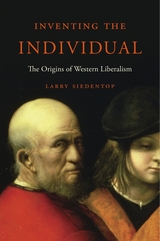
Here, in a grand narrative spanning 1,800 years of European history, a distinguished political philosopher firmly rejects Western liberalism’s usual account of itself: its emergence in opposition to religion in the early modern era. Larry Siedentop argues instead that liberal thought is, in its underlying assumptions, the offspring of the Church.
“Larry Siedentop has written a philosophical history in the spirit of Voltaire, Condorcet, Hegel, and Guizot…At a time when we on the left need to be stirred from our dogmatic slumbers, Inventing the Individual is a reminder of some core values that are pretty widely shared.”
—James Miller, The Nation
“In this learned, subtle, enjoyable and digestible work [Siedentop] has offered back to us a proper version of ourselves. He has explained us to ourselves…[A] magisterial, timeless yet timely work.”
—Douglas Murray, The Spectator
“Like the best books, Inventing the Individual both teaches you something new and makes you want to argue with it.”
—Kenan Malik, The Independent
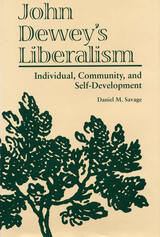
John Dewey's classical pragmatism, Daniel M. Savage asserts, can be used to provide a self-development-based justification of liberal democracy that shows the current debate between liberal individualism and republican communitarianism to be based largely on a set of pseudoproblems.
From Dewey's classical pragmatism, Savage derives a conception of individual autonomy that, while meeting all of the criteria for a conception of autonomy, does not, as the dominant Kantian variant does, require transcendence from any particular language community. The Deweyan conception of autonomy that Savage derived from classical pragmatism, in fact, requires that the individual be situated within a context of cultural beliefs. Savage argues that this particular conception of autonomy is necessary if one wants to conceive of life, as communitarians do, as a quest for the good life within a social context.
Thus, Savage constructs a conception of autonomy that consists of a set of intellectual virtues, each of which can be understood, like Aristotle's moral virtues, as a mean between two extremes (or vices). The virtue of critical reflection is the mean between the vices of dogmatism on the one hand and philosophical skepticism on the other. The virtue of creative individuality is the mean between the opposing vices of conformity and eccentricity. Finally, the virtue of sociability is the mean between the extremes of docility and rebelliousness.
The three virtues together provide a natural method of adapting to change. The method is natural because it is in accord with a continuous cycle of activity—tension/movement/harmony—that is generic to all living things, Dewey's method of adapting to change requires, in both the individual and in the community, the synthesis of integrating and differentiating forces.
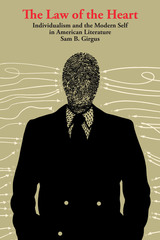
The Law of the Heart is a vigorous challenge to the prevailing concept of the “antidemocratic” image of the self in the American literary and cultural tradition. Sam B. Girgus counters this interpretation and attempts to develop a new understanding of democratic individualism and liberal humanism in American literature under the rubric of literary modernism.
The image of the individual self who retreats inward, conforming to a distorted “law of the heart,” emerges from the works of such writers as Cooper and Poe and composer Charles Ives. Yet, as Girgus shows, other American writers relate the idea of the self to reality and culture in a more complex way: the self confronts and is reconciled to the paradox of history and reality.
In Girgus’ view, the tradition of pragmatic, humanistic individualism provides a foundation for a future where individual liberty is a major priority. He uses literary modernism as a bridge for relating contemporary social conditions to crises of the American self and culture as seen in the works of writers including Emerson, Howells, Whitman, Henry James, William James, Fitzgerald, Bellow, and McLuhan.
Perelman describes the manufacture of unhappiness—the continual generation of dissatisfaction with products people are encouraged to purchase and quickly discard—and the complex techniques corporations employ to avoid responsibility and accountability to their workers, consumers and the environment. He outlines ways in which individuals can surpass individualism and instead work together to check the growing power of corporations.
While other books have surveyed the corporate landscape, or decried modern consumerism, Perelman, a professor of economics, places these ideas within a proper economic and historical context. He explores the limits of corporate accountability and responsibility, and investigates the relation between a wide range of phenomena such as food, fear and terrorism. Highly readable, Manufacturing Discontent will appeal to anyone with an interest in the way society works—and what really determines the rights of individuals in a corporate society.
Michael Perelman, Professor of Economics at California State University, Chico, received his Ph.D. from the University of California, Berkeley. He is the author of several books on economics and economic thought, including Railroading Economics (Routledge, 2006); Class Warfare in the Information Age (Palgrave Macmillan, 2000); The Invention of Capitalism (Duke University Press, 2000) and The Perverse Economy (Palgrave Macmillan, 2003).
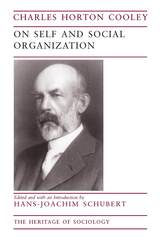
Cooley's work relating self and community is now more relevant than ever to the problems of understanding and directing modern democratic societies. Cooley applied the ideas of pragmatism to developing a systematic way of approaching social action, social change, and social order; he used these interrelated theories to analyze the social problems and cultural crises of the age. According to Cooley, social change is a fragile, interactive process that, due to constantly arising problems of action, requires ongoing scrutiny by the public. This collection of Cooley's best work is an important contribution not only to the history of ideas—especially to the origin of modern sociological theory— but also to the current public debate on civil society, community, and democracy.
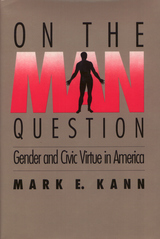
Focusing on Seventeenth-Century English political philosophy and Nineteenth-Century American culture, Mark Kann challenges the widely-held view that American political institutions are grounded in the primacy of individualism. Liberal thinkers have long been concerned that men are too passionate and selfish to exercise individual rights without causing social chaos. Kann demonstrates how a desperate search to answer the man question began to revolutionize gender relations He examines "the other liberal tradition in America" which downplays the value of individualism, elevates the ongoing significance of an "engendered civic virtue," and incorporates classical republicanism into the fabric of modern political discourse.
The author traces the cultural conditioning of the white middle class that produced the ideal of self-sacrificing wives whose lives were devoted to creating a haven for their husbands and a school of virtue for their sons. Upon leaving home, these young men were to be schooled in manliness in the military in order to be capable of assuming positions of power as they were vacated by their fathers’ generation. Thus, in the norms of fatherhood, fraternity, womanhood, and militarism, the male’s individualism was conditioned with a strong dose of civic virtue.
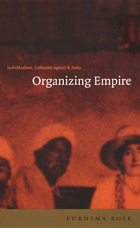
From a historically grounded, feminist perspective, Bose offers four case studies, each of which illuminates a distinct individualizing rhetorical strategy. She looks at the parliamentary debates on the Amritsar Massacre of 1919, in which several hundred unarmed Indian protesters were killed; Margaret Cousins’s firsthand account of feminist organizing in Ireland and India; Kalpana Dutt’s memoir of the Bengali terrorist movement of the 1930s, which was modeled in part on Irish anticolonial activity; and the popular histories generated by ex-colonial officials and their wives. Bringing to the fore the constraints that colonial domination placed upon agency and activism, Organizing Empire highlights the complexity of the multiple narratives that constitute British colonial history.

Paternalism was first published in 1984. Minnesota Archive Editions uses digital technology to make long-unavailable books once again accessible, and are published unaltered from the original University of Minnesota Press editions.
Over a hundred years of controversy have established that the antipaternalistic principle so passionately argued by Mill in On Liberty is anything but simple. There are difficulties in interpreting the principle, in reconciling it with Mill's general utilitarian position, and defending it under any particular interpretation. The fourteen essays collected in Paternalism represent the shape philosophical discussions have taken in the past decade and include the classical contemporary statements as well as important new work. This book will provide philosophers, policymakers, doctors, lawyers, and students with all the major arguments that are part of the current controversy.

Modern psychological and political theory meet head-on in this powerful re-evaluation of America's contradictory and sometimes dangerous addiction to individualism. Best-selling author Gaylin and co-author Jennings investigate the contentious intersections of interdependence and autonomy, rights and public responsibility. They examine the painful abrasion occurring between America's tradition of personal freedom and privacy, as it rubs against the still valuable if almost vanishing ideals of sacrifice and social order.
Our current culture of autonomy—championed by both liberals on the left and libertarians on the right—is based on the idea of rationality as the motivation for human conduct. But, as the authors remind us, people are not simply rational creatures—appeals to emotions are always far more effective than logical argument in changing our behavior.
This timely edition includes a new preface; updated examples and illustrations throughout; and new coverage of contemporary social critics and their work since the publication of the first edition. Two essential new chapters, one on the movement to forgo life-sustaining treatment and the other on physician-assisted suicide, particularly clarify the authors' arguments. Drawing on these and numerous other illustrations—with significant emphasis on the state of American health care—Gaylin and Jennings demonstrate that society has not just the right but the duty to occasionally invoke fear, shame, and guilt in order to motivate humane behavior.
As cases of AIDS are once again on the upswing, as the dangerously mentally ill are allowed to wander free and untreated, as starvation and poverty still hold too many in its grip in the richest nation on the planet, this controversial book, considerably revised and expanded, is needed more than ever. If we are to indeed preserve and nurture a genuinely free—and liberal—society, the authors suggest that these "coercions" may be essential for the health and the maturity of a nation where we all too often avert our eyes, not seeing that our neighbor is in pain or trouble and needs our help.

In this imaginative exploration of modern legal culture, Lawrence Friedman addresses how the contemporary idea of individual rights has altered the legal systems and authority structures of Western societies. Every aspect of law, he argues--from civil rights to personal-injury litigation to divorce law--has been profoundly reshaped, reflecting the power of this concept.
The new individualism is quite different from that of the nineteenth century, which stressed self-control, discipline, and traditional group values. Modern individualism focuses on the individual as the starting and ending point of life and assumes a wide zone of choice. Choice is vital, fundamental: the right to develop oneself, to build up a life uniquely suited to oneself through free, open selection among forms, models, and lifestyles. With striking clarity and force, Friedman demonstrates how the new individualism results from changes in the technological and social framework of society. Loose, unconnected, free-floating, mobile: this is the modern individual, at least in comparison with the immediate past.
Written for the general reader as well as lawyers and legal scholars, The Republic of Choice offers keen and original observations about legal culture and the public consciousness that informs and expresses it.
As members of various and often conflicting communities, how do we reconcile what we have come to understand as our human rights with our responsibilities toward one another? With the bright thread of individualism woven through the American psyche, where can our sense of duty toward others be found? What has happened to our love—even our concern—for our neighbor?
In this revised edition of his magisterial exploration of these critical questions, renowned ethicist Arthur Dyck revisits and profoundly hones his call for the moral bonds of community. In all areas of contemporary life, be it in business, politics, health care, religion—and even in family relationships—the "right" of individuals to consider themselves first has taken precedence over our responsibilities toward others. Dyck contends that we must recast the language of rights to take into account our once natural obligations to all the communities of which we are a part.
Rethinking Rights and Responsibilities, at the nexus of ethics, political theory, public policy, and law, traces how the peculiarly American formulations of the rights of the individual have assaulted our connections with, and responsibilities for, those around us. Dyck critically examines contemporary society and the relationship between responsibilities and rights, particularly as they are expressed in medicine and health care, to maintain that while indeed rights and responsibilities form the moral bonds of community, we must begin with the rudimentary task of taking better care of one another.


The great American thinker Ralph Waldo Emerson and the influential German philosopher Friedrich Nietzsche, though writing in different eras and ultimately developing significantly different philosophies, both praised the individual’s wish to be transformed, to be fully created for the first time. Emerson and Nietzsche challenge us to undertake the task of identity on our own, in order to see (in Nietzsche’s phrase) “how one becomes what one is.”
David Mikics’s The Romance of Individualism in Emerson and Nietzsche examines the argument, as well as the affinity, between these two philosophers. Nietzsche was an enthusiastic reader of Emerson and inherited from him an interest in provocation as a means of instruction, an understanding of the permanent importance of moods and transitory moments in our lives, and a sense of the revolutionary character of impulse. Both were deliberately outrageous thinkers, striving to shake us out of our complacency.
Rather than choosing between Emerson and Nietzsche, Professor Mikics attends to Nietzsche’s struggle with Emerson’s example and influence. Elegant in its delivery, The Romance of Individualism in Emerson and Nietzsche offers a significant commentary on the visions of several contemporary theorists whose interests intersect with those of Emerson and Nietzsche, especially Stanley Cavell, Jacques Lacan, Slavoj Zizek, and Harold Bloom.
In a new work anticipating the bicentennial of the French Revolution, Patrice Higonnet demonstrates why the American and French Revolutions, although roughly contemporaneous and inspired by many of the same ideals, followed utterly different trajectories: the Americans proceeded to stabilize and build upon their revolution, while the French stumbled from bloodbath to republic to empire to monarchy again.
Eighteenth-century American society, individualistic to a degree, nevertheless managed to ground its politics in communitarian philosophy and to deny the existence of social cleavages, thus creating a pluralist ideology that successfully balanced the two strains. In contrast, argues Higonnet, individualistic politics in France collapsed in 1791 for lack of a foundation, and French society drifted toward terrorism as the rival claims of libertarian and communitarian principles struggled on the national scene. Higonnet works out these ideas in a learned and persuasive new perspective on the two major democratic revolutions of the eighteenth century.
This is a book for serious readers of history that can also refresh college courses in American history, French history, the history of revolutions, comparative studies, intellectual history, and the history of the eighteenth century in the Western world.

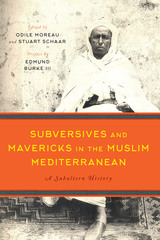
Subaltern studies, the study of non-elite or underrepresented people, have revolutionized the writing of Middle Eastern history. Subversives and Mavericks in the Muslim Mediterranean represents the next step in this transformation. The book explores the lives of eleven nonconformists who became agents of political and social change, actively organizing new forms of resistance—against either colonial European regimes or the traditional societies in which they lived—that disrupted the status quo, in some cases, with dramatic results. These case studies highlight cross-border connections in the Mediterranean world, exploring how these channels were navigated.
Chapters in the book examine the lives of subversives and mavericks, such as Tawhida ben Shaykh, the first Arab woman to receive a medical degree; Mokhtar al-Ayari, a radical Tunisian labor leader; Nazli Hanem, Kmar Bayya, and Khiriya bin Ayyad, three aristocractic women who resisted the patriarchal structures of their societies by organizing and participating in intellectual salons for men and women and advocating social reform; Qaid Najim al-Akhsassi, an ex-slave and military officer, who fought against French and Spanish colonial expansion; and Boubeker al-Ghandjawi, a nearly illiterate trader who succeeded, though his diverse connections, in establishing important relations between the Moroccan sultan and the representative of the British government. Although based on individual and local perspectives, Subversives and Mavericks in the Muslim Mediterranean reveals new and unrecognized trans-local connections across the Muslim world, illuminating our understanding of these societies beyond narrow elite circles.
READERS
Browse our collection.
PUBLISHERS
See BiblioVault's publisher services.
STUDENT SERVICES
Files for college accessibility offices.
RECENTLY PUBLISHED





UChicago Accessibility Resources
home | accessibility | search | about | contact us
BiblioVault ® 2001 - 2025
The University of Chicago Press