
 A SCHOLARLY BOOK REPOSITORY
55 start with A start with A
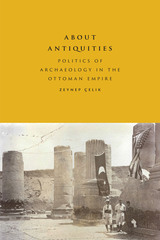
Antiquities have been pawns in empire-building and global rivalries; power struggles; assertions of national and cultural identities; and cross-cultural exchanges, cooperation, abuses, and misunderstandings—all with the underlying element of financial gain. Indeed, “who owns antiquity?” is a contentious question in many of today’s international conflicts.
About Antiquities offers an interdisciplinary study of the relationship between archaeology and empire-building around the turn of the twentieth century. Starting at Istanbul and focusing on antiquities from the Ottoman territories, Zeynep Çelik examines the popular discourse surrounding claims to the past in London, Paris, Berlin, and New York. She compares and contrasts the experiences of two museums—Istanbul’s Imperial Museum and the Metropolitan Museum of Art—that aspired to emulate European collections and gain the prestige and power of owning the material fragments of ancient history. Going beyond institutions, Çelik also unravels the complicated interactions among individuals—Westerners, Ottoman decision makers and officials, and local laborers—and their competing stakes in antiquities from such legendary sites as Ephesus, Pergamon, and Babylon.
Recovering perspectives that have been lost in histories of archaeology, particularly those of the excavation laborers whose voices have never been heard, About Antiquities provides important historical context for current controversies surrounding nation-building and the ownership of the past.
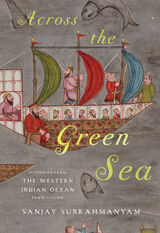
A history of two centuries of interactions among the areas bordering the western Indian Ocean, including India, Iran, and Africa.
Beginning in the mid-fifteenth century, the regions bordering the western Indian Ocean—“the green sea,” as it was known to Arabic speakers—had increasing contact through commerce, including a slave trade, and underwent cultural exchange and transformation. Using a variety of texts and documents in multiple Asian and European languages, Across the Green Sea looks at the history of the ocean from a variety of shifting viewpoints: western India; the Red Sea and Mecca; the Persian Gulf; East Africa; and Kerala.
Sanjay Subrahmanyam sets the scene for this region starting with the withdrawal of China's Ming Dynasty and explores how the western Indian Ocean was transformed by the growth and increasing prominence of the Ottoman Empire and the continued spread of Islam into East Africa. He examines how several cities, including Mecca and the vital Indian port of Surat, grew and changed during these centuries, when various powers interacted until famines and other disturbances upended the region in the seventeenth century. Rather than proposing an artificial model of a dominant center and its dominated peripheries, Across the Green Sea demonstrates the complexity of a truly dynamic and polycentric system through the use of connected histories, a method pioneered by Subrahmanyam himself.
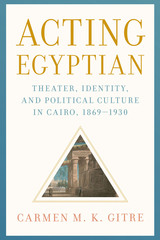
In the late nineteenth and early twentieth centuries, during the “protectorate” period of British occupation in Egypt—theaters and other performance sites were vital for imagining, mirroring, debating, and shaping competing conceptions of modern Egyptian identity. Central figures in this diverse spectrum were the effendis, an emerging class of urban, male, anticolonial professionals whose role would ultimately become dominant. Acting Egyptian argues that performance themes, spaces, actors, and audiences allowed pluralism to take center stage while simultaneously consolidating effendi voices.
From the world premiere of Verdi’s Aida at Cairo’s Khedivial Opera House in 1871 to the theatrical rhetoric surrounding the revolution of 1919, which gave women an opportunity to link their visibility to the well-being of the nation, Acting Egyptian examines the ways in which elites and effendis, men and women, used newly built performance spaces to debate morality, politics, and the implications of modernity. Drawing on scripts, playbills, ads, and numerous other sources, the book brings to life provocative debates that fostered a new image of national culture and performances that echoed the events of urban life in the struggle for independence.
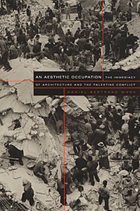
In An Aesthetic Occupation Daniel Bertrand Monk unearths the history of the unquestioned political immediacy of “sacred” architecture in the conflict between Palestinians and Israelis. Monk combines groundbreaking archival research with theoretical insights to examine in particular the Mandate era—the period in the first half of the twentieth century when Britain held sovereignty over Palestine. While examining the relation between monuments and mass violence in this context, he documents Palestinian, Zionist, and British attempts to advance competing arguments concerning architecture’s utility to politics.
Succumbing neither to the view that monuments are autonomous figures onto which political meaning has been projected, nor to the obverse claim that in Jerusalem shrines are immediate manifestations of the political, Monk traces the reciprocal history of both these positions as well as describes how opponents in the conflict debated and theorized their own participation in its self-representation. Analyzing controversies over the authenticity of holy sites, the restorations of the Dome of the Rock, and the discourse of accusation following the Buraq, or Wailing Wall, riots of 1929, Monk discloses for the first time that, as combatants looked to architecture and invoked the transparency of their own historical situation, they simultaneously advanced—and normalized—the conflict’s inability to account for itself.
This balanced and unique study will appeal to anyone interested in Israel or Zionism, the Palestinians, the Middle East conflict, Jerusalem, or its monuments. Scholars of architecture, political theory, and religion, as well as cultural and critical studies will also be informed by its arguments.
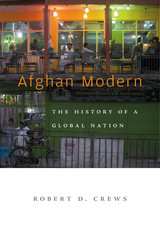
Rugged, remote, riven by tribal rivalries and religious violence, Afghanistan seems to many a country frozen in time and forsaken by the world. Afghan Modern presents a bold challenge to these misperceptions, revealing how Afghans, over the course of their history, have engaged and connected with a wider world and come to share in our modern globalized age.
Always a mobile people, Afghan travelers, traders, pilgrims, scholars, and artists have ventured abroad for centuries, their cosmopolitan sensibilities providing a compass for navigating a constantly changing world. Robert Crews traces the roots of Afghan globalism to the early modern period, when, as the subjects of sprawling empires, the residents of Kabul, Kandahar, and other urban centers forged linkages with far-flung imperial centers throughout the Middle East and Asia. Focusing on the emergence of an Afghan state out of this imperial milieu, he shows how Afghan nation-making was part of a series of global processes, refuting the usual portrayal of Afghans as pawns in the “Great Game” of European powers and of Afghanistan as a “hermit kingdom.”
In the twentieth century, the pace of Afghan interaction with the rest of the world dramatically increased, and many Afghan men and women came to see themselves at the center of ideological struggles that spanned the globe. Through revolution, war, and foreign occupations, Afghanistan became even more enmeshed in the global circulation of modern politics, occupying a pivotal position in the Cold War and the tumultuous decades that followed.
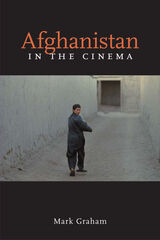
The book considers a range of films, beginning with the 1970s epics The Man Who Would Become King and The Horsemen and following the shifts in representation of the Muslim world during the Russian War in films such as The Beast and Rambo III. Graham then moves on to Taliban-era films such as Kandahar, Osama, and Ellipsis, the first Afghan film directed by a woman. Lastly, the book discusses imperialist nostalgia in films such as Charlie Wilson's War and destabilizing visions represented in contemporary works such as The Kite Runner.
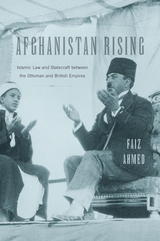
Debunking conventional narratives of Afghanistan as a perennial war zone or marginal frontier, Faiz Ahmed presents a vibrant account of the first Muslim-majority country to gain independence from the British Empire, form a fully sovereign government, and promulgate an original constitution after the fall of the Ottoman Empire.
Far from a landlocked wilderness, turn-of-the-twentieth-century Afghanistan was a magnet for itinerant scholars and emissaries shuttling between Ottoman and British imperial domains. Tracing Afghans’ longstanding but seldom examined scholastic ties to Istanbul, Damascus, and Baghdad, as well as greater Delhi and Lahore, Ahmed vividly describes how the Kabul court recruited jurists to craft a modern state within the interpretive traditions of Islamic law and ethics, or shariʿa, and international legal norms. Beginning with the first Ottoman mission to Kabul in 1877, and culminating with parallel independence struggles in Afghanistan, India, and Turkey after World War I, this rich narrative explores encounters between diverse streams of Muslim thought and politics—from Young Turk lawyers to Pashtun clerics; Ottoman Arab officers to British Raj bureaucrats; and the last caliphs to a remarkable dynasty of Afghan kings and queens.
By unearthing a lost history behind Afghanistan’s independence and first constitution, Ahmed shows how debates today on Islam, governance, and the rule of law have deep roots in a beleaguered land. Based on research in six countries and as many languages, Afghanistan Rising rediscovers a time when Kabul stood proudly for anticolonial coalitions, self-determination, and contested visions of reform in the Global South and Islamicate world.
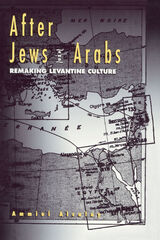
By exposing the rich and diverse textual and cultural legacy of this time and space, Alcalay reassesses the exclusion of Semitic culture in Europe from the perspective of contemporary Arabic culture and opposing images of the Israeli-Palestinian conflict. This book will compel a revision of Jewish studies by placing contemporary Israeli culture within its Middle Eastern context and the terms of colonial, postcolonial, and multicultural discourse.
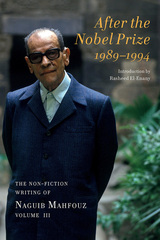
In carefully crafted short texts, his social conscience is revealed as he highlights political shortcomings, economic injustice, and corruption in Egypt and the wider Arab world. His philosophical sensitivity comes to the fore as he contemplates the meaning of a historic events, contributions of an influential people, and what is required to lead a good life. The collapse of the Soviet Union, the Oslo peace accords, the spread of terrorism, the Cairo earthquake, the passing of Louis Awad, Yusuf Idris, Yahya Hakki, the third term of Hosni Mubarak, climate change, and more come under Naguib Mahfouz’s fine scrutiny. For any fan of Mahfouz’s fiction, this collection opens a window on a different side of his intellect, and it offers insights from one of the region’s greatest modern minds.
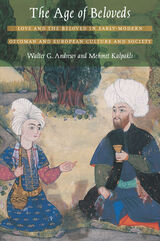
The authors show that the “age of beloveds” was not just an Ottoman, eastern European, or Islamic phenomenon. It extended into western Europe as well, pervading the cultures of Venice, Florence, Rome, and London during the same period. Andrews and Kalpakli contend that in an age dominated by absolute rulers and troubled by war, cultural change, and religious upheaval, the attachments of dependent courtiers and the longings of anxious commoners aroused an intense interest in love and the beloved. The Age of Beloveds reveals new commonalities in the cultural history of two worlds long seen as radically different.

Despite the frequent appearances of Osama Bin Laden and Ayman al-Zawahiri on television screens worldwide, Al Qaeda remains an elusive entity. As the world has grown increasingly familiar with the spectacle of Islamist terrorism, Al Qaeda’s essential worldview has remained bewilderingly opaque. To reveal its inner workings, Gilles Kepel and his collaborators, all scholars of Arabic and Islam, have collected and brilliantly annotated key texts of the major figures from whom the movement has drawn its beliefs and direction. The resulting volume offers an unprecedented glimpse into the assumptions of the salafist jihadists who have reshaped political life at the beginning of the third millennium.
Excerpts from the work of Azzabdallah Azzam, Ayman al-Zawahiri, Osama Bin Laden, and Abu Musab al-Zarqawi—drawn from speeches, internet postings, and published writings—tell the story of Al Qaeda’s evolution, from its origins in the Afghan war through the war in Iraq. These texts reveal the rational, discursive mode used to persuade and to justify violent armed struggle in a universe defined by militant Islam. Substantial interpretive introductions to each leader’s work and extensive critical commentary provide unparalleled access to the intellectual and doctrinal context of Al Qaeda in which these radical ideas have taken shape.
By viewing Al Qaeda from within, this indispensable volume reveals the terrorist network’s insidious role in the global web culture of today and the full dimensions of its frightening threat to world stability and security.
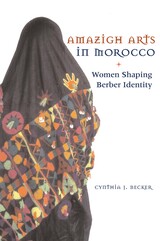
In southeastern Morocco, around the oasis of Tafilalet, the Ait Khabbash people weave brightly colored carpets, embroider indigo head coverings, paint their faces with saffron, and wear ornate jewelry. Their extraordinarily detailed arts are rich in cultural symbolism; they are always breathtakingly beautiful—and they are typically made by women. Like other Amazigh (Berber) groups (but in contrast to the Arab societies of North Africa), the Ait Khabbash have entrusted their artistic responsibilities to women. Cynthia Becker spent years in Morocco living among these women and, through family connections and female fellowship, achieved unprecedented access to the artistic rituals of the Ait Khabbash. The result is more than a stunning examination of the arts themselves, it is also an illumination of women's roles in Islamic North Africa and the many ways in which women negotiate complex social and religious issues.
One of the reasons Amazigh women are artists is that the arts are expressions of ethnic identity, and it follows that the guardians of Amazigh identity ought to be those who literally ensure its continuation from generation to generation, the Amazigh women. Not surprisingly, the arts are visual expressions of womanhood, and fertility symbols are prevalent. Controlling the visual symbols of Amazigh identity has given these women power and prestige. Their clothing, tattoos, and jewelry are public identity statements; such public artistic expressions contrast with the stereotype that women in the Islamic world are secluded and veiled. But their role as public identity symbols can also be restrictive, and history (French colonialism, the subsequent rise of an Arab-dominated government in Morocco, and the recent emergence of a transnational Berber movement) has forced Ait Khabbash women to adapt their arts as their people adapt to the contemporary world. By framing Amazigh arts with historical and cultural context, Cynthia Becker allows the reader to see the full measure of these fascinating artworks.
On television, the Arab Spring took place in Cairo, Tunis, and the city-states of the Persian Gulf. Yet the drama of 2010, and the decade of subsequent activism, extended beyond the cities—indeed, beyond Arabs. Bruce Maddy-Weitzman brings to light the sustained post–Arab Spring political movement of North Africa’s Amazigh people.
The Amazigh movement did not begin with the Arab Spring, but it has changed significantly since then. Amazigh Politics in the Wake of the Arab Spring details the increasingly material goals of Amazigh activism, as protest has shifted from the arena of ethnocultural recognition to that of legal and socioeconomic equality. Amazigh communities responded to the struggles for freedom around them by pressing territorial and constitutional claims while rejecting official discrimination and neglect. Arab activists, steeped in postcolonial nationalism and protective of their hegemonic position, largely refused their support, yet flailing regimes were forced to respond to sharpening Amazigh demands or else jeopardize their threadbare legitimacy. Today the Amazigh question looms larger than ever, as North African governments find they can no longer ignore the movement’s interests.
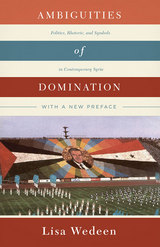
Wedeen shows how such flagrantly fictitious claims were able to produce a politics of public dissimulation in which citizens acted as if they revered the leader. By inundating daily life with tired symbolism, the regime exercised a subtle, yet effective form of power. The cult worked to enforce obedience, induce complicity, isolate Syrians from one another, and set guidelines for public speech and behavior. Wedeen‘s ethnographic research demonstrates how Syrians recognized the disciplinary aspects of the cult and sought to undermine them. In a new preface, Wedeen discusses the uprising against the Syrian regime that began in 2011 and questions the usefulness of the concept of legitimacy in trying to analyze and understand authoritarian regimes.
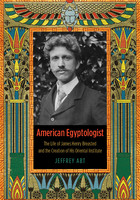
James Henry Breasted (1865–1935) had a career that epitomizes our popular image of the archaeologist. Daring, handsome, and charismatic, he traveled on expeditions to remote and politically unstable corners of the Middle East, helped identify the tomb of King Tut, and was on the cover of Time magazine. But Breasted was more than an Indiana Jones—he was an accomplished scholar, academic entrepreneur, and talented author who brought ancient history to life not just for students but for such notables as Teddy Roosevelt and Sigmund Freud.

American Interests and Policies in the Middle East, 1900-1939 was first published in
1963. Minnesota Archive Editions uses digital technology to make long-unavailable books once again accessible, and are published unaltered from the original University of Minnesota Press editions.Scholars concerned with the diplomatic history of the United States have largely neglected the subject of American relations with the Middle East during the four decades before World War I. With this study, Professor DeNovo fills the gap by describing and assessing the United States' cultural, economic, and diplomatic relations with Turkey, Persia, and the Arab East in that period. He traces, chronologically and topically, the activities of such American interest groups as Protestant missionaries, educators, philanthropists, archaeologists, businessmen, and technical advisers, as well as the official actions of their government.
The account falls roughly into three chronological periods. The first section traces the interest groups through the pre-World War I years of political and cultural stirring in the Ottoman Empire and Persia. Special attention is given to the Chester Project for railroad development in Turkey. The second part deals with the upheavals accompanying World War I and the tasks of peacemaking from the Mudros armistice through the Lausanne settlement of 1923. The latter chapters detail the rise of the Turkish national movement, the deepening Persian and Arab nationalism, and the accommodation of American cultural and economic groups to these conditions. The author points out that before World War II began, Americans had acquired a significant interest in Middle Eastern oil and had become emotionally involved in the Arab-Zionist tension. In 1939 the United States was on the verge of a new phase in its Middle Eastern relations when that region would become more intimately linked to America's national security.
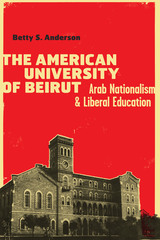
Since the American University of Beirut opened its doors in 1866, the campus has stood at the intersection of a rapidly changing American educational project for the Middle East and an ongoing student quest for Arab national identity and empowerment. Betty S. Anderson provides a unique and comprehensive analysis of how the school shifted from a missionary institution providing a curriculum in Arabic to one offering an English-language American liberal education extolling freedom of speech and analytical discovery.
Anderson discusses how generations of students demanded that they be considered legitimate voices of authority over their own education; increasingly, these students sought to introduce into their classrooms the real-life political issues raging in the Arab world. The Darwin Affair of 1882, the introduction of coeducation in the 1920s, the Arab nationalist protests of the late 1940s and early 1950s, and the even larger protests of the 1970s all challenged the Americans and Arabs to fashion an educational program relevant to a student body constantly bombarded with political and social change. Anderson reveals that the two groups chose to develop a program that combined American goals for liberal education with an Arab student demand that the educational experience remain relevant to their lives outside the school's walls. As a result, in eras of both cooperation and conflict, the American leaders and the students at the school have made this American institution of the Arab world and of Beirut.
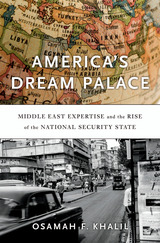
In T. E. Lawrence’s classic memoir Seven Pillars of Wisdom, Lawrence of Arabia claimed that he inspired a “dream palace” of Arab nationalism. What he really inspired, however, was an American idea of the area now called the Middle East that has shaped U.S. interventions over the course of a century, with sometimes tragic consequences. America’s Dream Palace brings into sharp focus the ways U.S. foreign policy has shaped the emergence of expertise concerning this crucial, often turbulent, and misunderstood part of the world.
America’s growing stature as a global power created a need for expert knowledge about different regions. When it came to the Middle East, the U.S. government was initially content to rely on Christian missionaries and Orientalist scholars. After World War II, however, as Washington’s national security establishment required professional expertise in Middle Eastern affairs, it began to cultivate a mutually beneficial relationship with academic institutions. Newly created programs at Harvard, Princeton, and other universities became integral to Washington’s policymaking in the region. The National Defense Education Act of 1958, which aligned America’s educational goals with Cold War security concerns, proved a boon for Middle Eastern studies.
But charges of anti-Americanism within the academy soon strained this cozy relationship. Federal funding for area studies declined, while independent think tanks with ties to the government flourished. By the time the Bush administration declared its Global War on Terror, Osamah Khalil writes, think tanks that actively pursued agendas aligned with neoconservative goals were the drivers of America’s foreign policy.
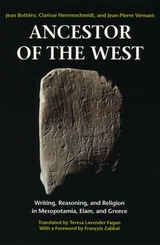
"Full of matter for anyone interested in language, religion, and politics in the ancient world."—R. T. Ridley, Journal of Religious History
"In this accessible introduction to the ancient world, three leading French scholars explore the emergence of rationality and writing in the West, tracing its development and its survival in our own traditions. . . . Jean Bottero focuses on writing and religion in ancient Mesopotamia, Clarisse Herrenschmidt considers a broader history of ancient writing, and Jean-Pierre Vernant examines classical Greek civilization in the context of Near Eastern history."—Translation Review

Breasted's monumental work, originally published from 1906 to 1907, encompasses twenty-six dynasties spanning more than three millennia: from ca. 3050 B.C. to 525 B.C. For each document, Breasted provides information on location, condition, historical significance, and content. Beginning with the earliest known official annals of Egypt, the Palermo Stone, Breasted catalogs the realm's official activities, including royal succession, temple construction, property distribution, and foreign conquest. He tracks the careers of scores of kings, queens, government officials, military leaders, powerful statesmen, and influential courtiers, reproducing their autobiographies, letters of favor, paeans, mortuary gifts, and tomb inscriptions. Clearly annotated for the lay reader, the documents provide copious evidence of trade relations, construction activities, diplomatic envoys, foreign expeditions, and other aspects of a vigorous, highly organized, and centrally controlled society.
Breasted's commentary is both rigorously documented and accessible, suffused with a contagious fascination for the events, the personalities, the cultural practices, and the sophistication these records indicate. A herculean assemblage of primary documents, many of which have deteriorated to illegibility in the intervening century, Ancient Records of Egypt illuminates both the incredible complexity of Egyptian society and the almost insuperable difficulties of reconstructing a lost civilization.
This first paperback edition of Ancient Records of Egypt features a new introduction and supplementary bibliographies by Peter A. Piccione. Setting Breasted's work in the context of the development of American Egyptology, Piccione discusses Breasted's establishment of the Oriental Institute of the University of Chicago, with corporate support by John D. Rockefeller and other benefactors, and surveys the ambitious body of publications with which Breasted laid the foundation for future Egyptian studies.
The Eighteenth Dynasty saw the consolidation of the cult of Amun and the expansion of the temple of Amun-Re at Karnak, as well as a religious revolution under King Akhenaten that involved abandoning Thebes as a religious capital and royal residence and founding a new city devoted to the service of the new solar god, Aten. Breasted presents records of the biography and coronation of Queen Hatshepsut, including reliefs that depict the queen's expedition to the land of Punt. Also in this volume are the annals of Thutmose III, providing the most complete account of the military achievements of any Egyptian king; scenes representing the supernatural birth and coronation by the gods of his son, Amenhotep II; and inscriptions from the tomb of Rekhmire, prime minister or vizier under Thutmose III, that include a listing of taxes paid to the temple and foreign tribute proceeding from the king's two decades of military activity in Asia.
A herculean assemblage of primary documents, many of which have deteriorated to illegibility since its original publication, Ancient Records of Egypt illuminates both the incredible complexity of Egyptian society and the almost insuperable difficulties of reconstructing a lost civilization.
In the context of a long history of mutilating and altering reliefs for political purposes, Breasted discusses the insertion into a relief of the figure of Ramesses II in order to reinforce his claim to the throne. This volume also includes the treaty of alliance that sealed peace with the Hittites under Ramesses II; a series of documents that record the invasion of Libyans and Mediterranean Sea people during the reign of Merneptah; and the Great Temple of Abu Simbel, the most remarkable of the rock-cut temples of Egypt.
This first complete paperback edition of Breasted's five-volume Ancient Records of Egypt makes available to a new audience a milestone in Egyptology and in the compilation of documentary histories. Clearly annotated for the lay reader, the documents provide copious evidence of trade relations, construction activities, diplomatic envoys, foreign expeditions, and other aspects of a vigorous, highly organized, and centrally controlled society. Breasted's commentary is both rigorously documented and accessible, suffused with a contagious fascination for the events, the personalities, the cultural practices, and the sophistication these records indicate
Volume 4 includes intriguing records of the harem conspiracy and legal documents that indicate the extent of robberies of royal tombs. Records of the Nile levels at Karnak provide important chronological landmarks, while the Stela of Piye (Piankhi), which documents the Nubian kingdom already in existence as a full-fledged power, provides information on the internal political climate of Egypt during a time when no aggressive monarch controlled the whole country. Breasted also notes where these ancient Egyptian records intersect with accounts of the same events from other sources, such as the mutiny of Psamtik I's troops as inscribed on the alabaster statue of Nesuhor and as narrated by Herodotus.
In effect, Ancient Records of Egypt offers a valuable dual record. On the one hand, Breasted presents the events and personages of ancient Egypt as recorded in the documents. On the other hand, he presents a history of the documents themselves. Fragmentary or partially destroyed, carved on temple and tomb walls or written on fragile scrolls of leather or papyrus, even inscribed on the coffins and temple linens of the royal and priestly mummy wrappings, these records offer an irreplaceable primary source on a fascinating civilization.
An indispensable companion to any of the other volumes of Ancient Records of Egypt, the Supplementary Bibliographies and Indices facilitates direct access to specific information on the people, places, and inscriptions catalogued by James Henry Breasted. Exhaustively compiled and intelligently arranged, these indices include the kings and queens, temples and geographical locations, divine names, and titles and ranks encompassed by three thousand years of Egyptian history. Also provided are indices of all Egyptian, Hebrew, and Arabic terms mentioned in the texts, as well as a complete listing of the records with their location in Lepsius's Denkmäler.
This first paperback edition of Ancient Records of Egypt features the important addition of bibliographies by Peter A. Piccione, together with an introduction that puts Breasted's historical commentaries into modern perspective. These bibliographies offer valuable guidance on new translations and modern treatments of the inscriptions included in Ancient Records of Egypt. Professor Piccione points the reader toward recent studies of Egyptian chronology and modern scholarship on Egyptian and Nubian history. He also provides information on anthologies of Egyptian texts in translation and topographical bibliographies that suggest further reading on specific ancient Egyptian monuments, texts, and reliefs.
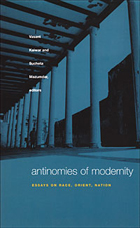
Drawing on archival sources and fieldwork, the contributors explore aspects of modernity within societies of South Asia, the Middle East, and Africa. Whether considering how European ideas of Orientalism became foundational myths of Indian nationalism; how racial caste systems between blacks, South Asians, and whites operate in post-apartheid South Africa; or how Indian immigrants to the United States negotiate their identities, these essays demonstrate that the contours of cultural and identity politics did not simply originate in metropolitan centers and get adopted wholesale in the colonies. Colonial and postcolonial modernisms have emerged via the active appropriation of, or resistance to, far-reaching European ideas. Over time, Orientalism and nationalist and racialized knowledges become indigenized and acquire, for all practical purposes, a completely "Third World" patina. Antinomies of Modernity shows that people do make history, constrained in part by political-economic realities and in part by the categories they marshal in doing so.
Contributors. Neville Alexander, Andrew Barnes, Vasant Kaiwar, Sucheta Mazumdar, Minoo Moallem, Mohamad Tavakoli-Targhi, A. R. Venkatachalapathy, Michael O. West
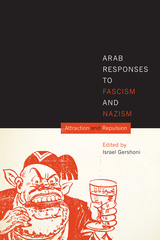
The first book to present an analysis of Arab response to fascism and Nazism from the perspectives of both individual countries and the Arab world at large, this collection problematizes and ultimately deconstructs the established narratives that assume most Arabs supported fascism and Nazism leading up to and during World War II. Using new source materials taken largely from Arab memoirs, archives, and print media, the articles reexamine Egyptian, Syrian, Lebanese, Palestinian, and Iraqi responses in the 1930s and throughout the war.
While acknowledging the individuals, forces, and organizations that did support and collaborate with Nazi Germany and fascist Italy, Arab Responses to Fascism and Nazism focuses on the many other Arab voices that identified with Britain and France and with the Allied cause during the war. The authors argue that many groups within Arab societies—elites and non-elites, governing forces, and civilians—rejected Nazism and fascism as totalitarian, racist, and, most important, as new, more oppressive forms of European imperialism. The essays in this volume argue that, in contrast to prevailing beliefs that Arabs were de facto supporters of Italy and Germany—since “the enemy of my enemy is my friend”—mainstream Arab forces and currents opposed the Axis powers and supported the Allies during the war. They played a significant role in the battles for control over the Middle East.
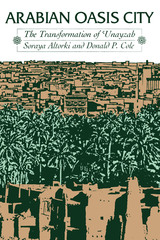
Vast social change has occurred in the Middle East since the oil boom of the mid-1970s. As the first anthropological study of an urban community in Saudi Arabia since that oil boom, Arabian Oasis City is also the first to document those changes.
Based on extensive interviews and participant observation with both men and women, the authors record and analyze the transformation that has occurred in this ancient oasis city throughout the twentieth century: the creation of the present Saudi Arabian state and of a new national economy based on the export of oil and the economic boom brought about by the dramatic increases in the price of oil following the October 1973 Arab-Israeli War. In addition, the authors reveal the changes brought about by the fall in the price of oil beginning in 1982 and analyze the problems confronting ‘Unayzah in its aftermath.
By demonstrating that the area was not exclusively dominated by tribalism and Bedouin nomads, this empirical case study destroys stereotypical views about Saudi Arabia. Indeed, it proves the existence—prior to the coming of the modern Saudi Arabian state— of surplus agricultural and craft production and the full development of local, regional, and long-distance trade networks. It shows that women, although veiled, played active roles in work outside the household. The social impact of change over the years is, however, profound—especially the gradual replacement of the extended family by the nuclear family, changing patterns of husband-wife relationships, the impact of self-earned income on the status of women, and the emergence of a new middle class of employees and entrepreneurs. Because of the high degree of gender segregation in this area of research, Altorki and Cole give us a fortunate collaboration between a Saudi Arabian female scholar and an American male scholar experienced in research in the Middle East.
This introduction to major topics in the field of Arabic sociolinguistics examines key issues in diglossia, code-switching, gendered discourse, language variation and change, and language policies. It introduces and evaluates various theoretical approaches and models, and it illustrates the usefulness and limitations of these approaches to Arabic with empirical data. Reem Bassiouney explores how current sociolinguistic theories can be applied to Arabic and, conversely, what the study of Arabic can contribute to our understanding of the function of language in society.
Graduate students of Arabic language and linguistics as well as students of sociolinguistics with no knowledge of Arabic will find this volume to be an indispensable resource.
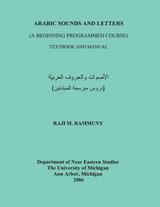
The textbook includes twenty lessons aimed at introducing Arabic sounds and writing system in a programmed method of instruction, supported by images and audio tapes*. The Manual consists of two parts. Part One includes a suggested methodology to guide teachers and students and Part Two contains basic communication needs in both Arabic script and transliteration to create a climate of enjoyable learning while students are acquiring the sounds and letters.
Raji M. Rammuny is Professor of Arabic Studies, Department of Near Eastern Studies, University of Michigan. He is the author of numerous books, including Advanced Standard Arabic through Authentic Texts and Audiovisual Materials, Parts 1 and 2, also published by the University of Michigan Press.
*The CD accompanying Arabic Sounds and Letters can be obtained from the UM Language Resource Center. Contact them by email at flacs@umich.edu or by phone at 734-764-3521.
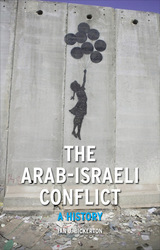
Though more than sixty years have passed since the signing of the proclamation of the State of Israel, the impact of that epochal event continues to shape the political policies and public opinion of not only the Middle East but much of the world. The consequent conflict between Arabs and Israelis for sovereignty over the land of Palestine has been one of the most bloody, intractable, and drawn-out of modern times. It continues today in cycles of aggressive violence followed by temporary, tenuous ceasefires that are marked and complicated by resolute opinions and fractious religious ideologies. In this timely volume, noted military historian Ian J. Bickerton cuts through the complex perspectives in order to explain this struggle in objective detail, describing its history from the dissolution of the Ottoman Empire following World War I to the present day.
In concise and clear prose, Bickerton argues that the present problem can be traced to the fact that each side is trapped by a conception of their past from which they seem unable to break free. This attachment and reaction to history has had a negative influence on the decision-making of Arabs and Israelis since 1948. Ultimately, Bickerton maintains that the use of armed force has not, and will not, resolve the issues that have divided Israelis and Arabs.
The Arab-Israeli Conflict is a plea for reasoned diplomacy in a situation that has been dominated by extreme violence. This book will appeal to a wide general audience seeking a balanced understanding of this enduring struggle that still dominates headlines.
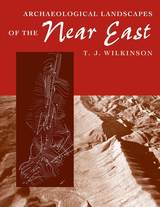
Many fundamental studies of the origins of states have built upon landscape data, but an overall study of the Near Eastern landscape itself has never been attempted. Spanning thousands of years of history, the ancient Near East presents a bewildering range of landscapes, the understanding of which can greatly enhance our ability to infer past political and social systems.
Tony Wilkinson now shows that throughout the Holocene humans altered the Near Eastern environment so thoroughly that the land has become a human artifact, albeit one that retains the power to shape human societies. In this trailblazing book—the first to describe and explain the development of the Near Eastern landscape using archaeological data—Wilkinson identifies specific landscape signatures for various regions and periods, from the early stages of complex societies in the fifth to sixth millennium B.C. to the close of the Early Islamic period around the tenth century A.D.
From Bronze Age city-states to colonized steppes, these signature landscapes of irrigation systems, tells, and other features changed through time along with changes in social, economic, political, and environmental conditions. By weaving together the record of the human landscape with evidence of settlement, the environment, and social and economic conditions, Wilkinson provides a holistic view of the ancient Near East that complements archaeological excavations, cuneiform texts, and other conventional sources.
Through this overview, culled from thirty years' research, Wilkinson establishes a new framework for understanding the economic and physical infrastructure of the region. By describing the basic attributes of the ancient cultural landscape and placing their development within the context of a dynamic environment, he breaks new ground in landscape archaeology and offers a new context for understanding the ancient Near East.
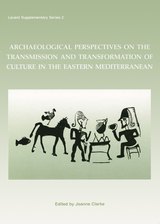
When did Israel begin? The origins of ancient Israel are shrouded in mystery, and those hoping to explore the issue must utilize resources from three different fields—archaeology, epigraphy, and biblical texts—and then examine their interrelations while keeping in mind that the name Israel was not used to describe just one state but referred to numerous entities at different times.
Archaeology, History, and Formation of Identity in Ancient Israel provides a critical reading of Israel’s history. It is neither a harmonizing reading, which takes the picture painted by texts as a given fact, nor a reading supporting biblical texts with archaeological and epigraphic data; instead, it offers the reader multiple options to understand biblical narratives on a historical and theological level. In addition to presenting the main currents in the field, the book draws upon the latest discoveries from Czech-Israeli excavations to offer new hypotheses and reconstructions based on the interdisciplinary dialogue between biblical studies, archaeology, and history.
Ewing critiques Eurocentric cultural theorists and Orientalist discourse while also taking issue with expatriate postcolonial thinkers Homi Bhabha and Gayatri Spivak. She challenges the notion of a monolithic Islamic modernity in order to explore the lived realities of individuals, particularly those of Pakistani saints and their followers. By examining the continuities between current Sufi practices and earlier popular practices in the Muslim world, Ewing identifies in the Sufi tradition a reflexive, critical consciousness that has usually been associated with the modern subject. Drawing on her training in clinical and theoretical psychoanalysis as well as her anthropological fieldwork in Lahore, Pakistan, Ewing argues for the value of Lacan in anthropology as she provides the basis for retheorizing postcolonial studies.

This is the first publication of inscriptions left in the Sinai desert by medieval Armenian and Georgian pilgrims to the Holy Land. The book contains the evidence discovered in 1979 and 1980 on the routes leading to Mount Sinai (Uebel Musa) from East and West.
The Armenian and Georgian inscriptions, which date from the seventh to later than the fifteenth century, are of prime importance for historical and paleographical studies. This edition gives original photographs of the inscriptions, transcriptions with transliteration and English translation, and elaborate notes on the paleography. The Introduction deals in a fully comparative manner with the epigraphic evidence, and studies the itineraries of the pilgrims through the Sinai peninsula.
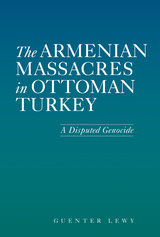
In 1915, the Ottoman government, then run by the Young Turks, deported most of its Armenian citizens from their eastern Anatolian lands. According to reliable estimates, close to forty percent of the prewar population perished, many in brutal massacres. Armenians call it the first genocide of the twentieth century. Turks speak of an instance of intercommunal warfare and wartime relocation made necessary by the treasonous conduct of their Armenian minority.
The voluminous literature on this tragic episode of World War I is characterized by acrimony and distortion in which both sides have simplified a complex historical reality and have resorted to partisan special pleading.
The Armenian Massacres in Ottoman Turkey examines the rich historical evidence without political preconceptions. Relying on archival materials as well as eye-witness testimony, Guenter Lewy avoids the sterile “was-it-genocide-or-not” debate and presents a detailed account of what actually happened. The result is a book that will open a new chapter in this contentious controversy and may help achieve a long-overdue reconciliation of Armenians and Turks.
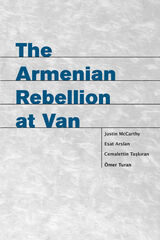
Before World War I, the ancient city of Van in southeastern Anatolia had a population of approximately 100,000 people, while the population of Van Province was about 500,000. Armenians formed a large minority, with Kurdish tribes and Turks in the majority.
The Armenian Rebellion at Van presents a long-overdue examination of Van from the 1870s to 1919. As the authors state, "The Armenian Revolt was an integral part of the great disaster that overcame the people of the Ottoman East. The slaughter of Muslims that accompanied the Armenian revolt in Van Province inexorably led first to Kurdish reprisals on the Armenians, then to a general and mutual massacre of the people of the East."
The actions at Van offer a window into the far-reaching events that soon followed in other parts of Anatolia.
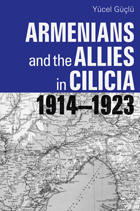
Güçlü bases his claim largely on evidence from state and military archives in Turkey, Britain, France, and the United States that look specifically into the Ottoman version of history, placing the whole question of forced population displacements in a wider and more nuanced perspective than that in which it is usually depicted. According to the author, revolutionary Armenian forces were threatening the Ottoman Empire from within as it was simultaneously threatened by external forces. Armenians were also actively involved with Allied forces throughout World War I. In response, the Ottoman government ordered the movement of the Armenian population away from protected and sensitive war zones. The actions taken by the Ottoman Empire to control the Armenian population were those of relocation, not extermination.
Working to explain why the Armenian conflict emerged and how it was eventually resolved, this book discusses the Armenian revolutionary and separatist movements, Turkish measures of self defense, and Allied schemes regarding the region during the period. It places special emphasis on the influence of Allied forces on the actions of Armenians in Cilicia.
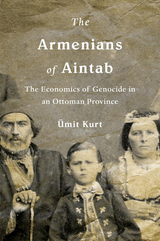
A Turk’s discovery that Armenians once thrived in his hometown leads to a groundbreaking investigation into the local dynamics of genocide.
Ümit Kurt, born and raised in Gaziantep, Turkey, was astonished to learn that his hometown once had a large and active Armenian community. The Armenian presence in Aintab, the city’s name during the Ottoman period, had not only been destroyed—it had been replaced. To every appearance, Gaziantep was a typical Turkish city.
Kurt digs into the details of the Armenian dispossession that produced the homogeneously Turkish city in which he grew up. In particular, he examines the population that gained from ethnic cleansing. Records of land confiscation and population transfer demonstrate just how much new wealth became available when the prosperous Armenians—who were active in manufacturing, agricultural production, and trade—were ejected. Although the official rationale for the removal of the Armenians was that the group posed a threat of rebellion, Kurt shows that the prospect of material gain was a key motivator of support for the Armenian genocide among the local Muslim gentry and the Turkish public. Those who benefited most—provincial elites, wealthy landowners, state officials, and merchants who accumulated Armenian capital—in turn financed the nationalist movement that brought the modern Turkish republic into being. The economic elite of Aintab was thus reconstituted along both ethnic and political lines.
The Armenians of Aintab draws on primary sources from Armenian, Ottoman, Turkish, British, and French archives, as well as memoirs, personal papers, oral accounts, and newly discovered property-liquidation records. Together they provide an invaluable account of genocide at ground level.
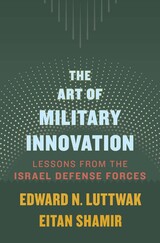
A world-leading military strategist and an IDF insider explain the improbable success of the Israeli armed forces.
When the Israel Defense Forces was established in May 1948, it was small, poorly equipped, and already at war. Lacking sufficient weaponry or the domestic industrial base to produce it, the newborn military was forced to make do with whatever it could get its hands on. That spirit of improvisation carried the IDF to a decisive victory in the First Arab-Israeli War.
Today the same spirit has made the IDF the most powerful military in the Middle East and among the most capable in the world. In The Art of Military Innovation, Edward N. Luttwak and Eitan Shamir trace the roots of this astounding success. What sets the IDF apart, they argue, is its singular organizational structure. From its inception, it has been the world’s only one-service military, encompassing air, naval, and land forces in a single institutional body. This unique structure, coupled with a young officer corps, allows for initiative from below. The result is a nimble organization inclined toward change rather than beholden to tradition.
The IDF has fostered some of the most significant advances in military technology of the past seventy years, from the first wartime use of drones to the famed Iron Dome missile defense system, and now the first laser weapon, Iron Beam. Less-heralded innovations in training, logistics, and human resources have been equally important. Sharing rich insights and compelling stories, Luttwak and Shamir reveal just what makes the IDF so agile and effective.
Many spectacular examples of Persianate art survive to the present day, safeguarded in Istanbul and beyond—celebrating the glory of the Persian Empire (and, later, the Ottoman Empire). These include illustrated books, featuring exquisitely painted miniatures artfully embedded in the texts of literary masterpieces, as well as tile decorations in medieval Anatolian architecture.
Because of their beauty, many Persianate books were deliberately disassembled, their illustrations re-used in newer books or possessed as isolated art objects. As fragments found their way to collections around the world, the essential integration of text and image in the original books was lost. Six art historians and a literary historian—instrumental in reconstruction efforts—trace the long journey from the destructive dispersal of fragments to the joys of restoration.
Aspects of History and Epic in Ancient Iran focuses on the content of one of the most important inscriptions of the Ancient Near East: the Bisotun inscription of the Achaemenid king Darius I (6th century BCE), which in essence reports on a suspicious fratricide and subsequent coup d’état. Moreover, the study shows how the inscription’s narrative would decisively influence the Iranian epic, epigraphic, and historiographical traditions well into the Sasanian and early Islamic periods.
Intriguingly, our assessment of the impact of the Bisotun narrative on later literary traditions—in particular, the inscription of the Sasanian king Narseh at Paikuli (3rd–4th centuries CE)—necessarily relies on the reception of the oral rendition of the Bisotun story captured by Greek historians. As Rahim Shayegan argues, this oral tradition had an immeasurable impact upon the historiographical writings and epic compositions of later Iranian empires. It would have otherwise remained unknown to modern scholars, had it not been partially preserved and recorded by Hellanicus of Lesbos, Herodotus, Ctesias, and other Greek authors. The elucidation of Bisotun’s thematic composition therefore not only allows us to solve an ancient murder but also to reevaluate pre-Thucydidean Greek historiography as one of the most important repositories of Iranian epic themes.
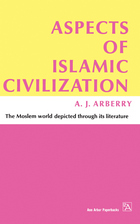
Islamic literature is rich, varied, and abundant, as befits the literature of a civilization which once controlled an empire as great as that of the Romans. In Aspects of Islamic Civilization, A. J. Arberry has chosen and translated passages from the most highly regarded works of Islamic literature in order to illustrate the development of Islamic civilization from its origins in the sixth century to the present.
This anthology is made up of selections from Arabic and Persian writers who have given world renown to Islamic literature—such as Hafiz, Sa'di, Jalal al-Din Rumi, Omar Khayyam, Ibn al-Farid, Avicenna, Ibn Hazm—and from such works as the Koran, the Masnavi, and the Moorish Anthology. It is an invaluable collection of sources for anyone interested in the Moslem world and a fascinating volume to browse in.
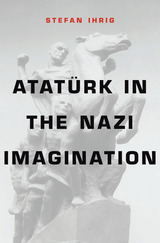
Early in his career, Adolf Hitler took inspiration from Benito Mussolini, his senior colleague in fascism—this fact is widely known. But an equally important role model for Hitler and the Nazis has been almost entirely neglected: Mustafa Kemal Atatürk, the founder of modern Turkey. Stefan Ihrig’s compelling presentation of this untold story promises to rewrite our understanding of the roots of Nazi ideology and strategy.
Hitler was deeply interested in Turkish affairs after 1919. He not only admired but also sought to imitate Atatürk’s radical construction of a new nation from the ashes of defeat in World War I. Hitler and the Nazis watched closely as Atatürk defied the Western powers to seize government, and they modeled the Munich Putsch to a large degree on Atatürk’s rebellion in Ankara. Hitler later remarked that in the political aftermath of the Great War, Atatürk was his master, he and Mussolini his students.
This was no fading fascination. As the Nazis struggled through the 1920s, Atatürk remained Hitler’s “star in the darkness,” his inspiration for remaking Germany along nationalist, secular, totalitarian, and ethnically exclusive lines. Nor did it escape Hitler’s notice how ruthlessly Turkish governments had dealt with Armenian and Greek minorities, whom influential Nazis directly compared with German Jews. The New Turkey, or at least those aspects of it that the Nazis chose to see, became a model for Hitler’s plans and dreams in the years leading up to the invasion of Poland.
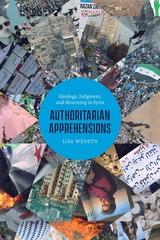
Drawing on extensive fieldwork and a variety of Syrian artistic practices, Wedeen lays bare the ideological investments that sustain ambivalent attachments to established organizations of power and contribute to the ongoing challenge of pursuing political change. This masterful book is a testament to Wedeen’s deep engagement with some of the most troubling concerns of our political present and future.
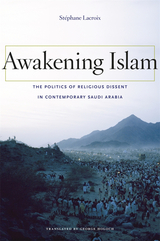
Amidst the roil of war and instability across the Middle East, the West is still searching for ways to understand the Islamic world. Stéphane Lacroix has now given us a penetrating look at the political dynamics of Saudi Arabia, one of the most opaque of Muslim countries and the place that gave birth to Osama bin Laden.
The result is a history that has never been told before. Lacroix shows how thousands of Islamist militants from Egypt, Syria, and other Middle Eastern countries, starting in the 1950s, escaped persecution and found refuge in Saudi Arabia, where they were integrated into the core of key state institutions and society. The transformative result was the Sahwa, or “Islamic Awakening,” an indigenous social movement that blended political activism with local religious ideas. Awakening Islam offers a pioneering analysis of how the movement became an essential element of Saudi society, and why, in the late 1980s, it turned against the very state that had nurtured it. Though the “Sahwa Insurrection” failed, it has bequeathed the world two very different, and very determined, heirs: the Islamo-liberals, who seek an Islamic constitutional monarchy through peaceful activism, and the neo-jihadis, supporters of bin Laden's violent campaign.
Awakening Islam is built upon seldom-seen documents in Arabic, numerous travels through the country, and interviews with an unprecedented number of Saudi Islamists across the ranks of today’s movement. The result affords unique insight into a closed culture and its potent brand of Islam, which has been exported across the world and which remains dangerously misunderstood.
READERS
Browse our collection.
PUBLISHERS
See BiblioVault's publisher services.
STUDENT SERVICES
Files for college accessibility offices.
RECENTLY PUBLISHED





UChicago Accessibility Resources
home | accessibility | search | about | contact us
BiblioVault ® 2001 - 2024
The University of Chicago Press