Results by title
1427 books match the query 'Politics' and 94 start with a
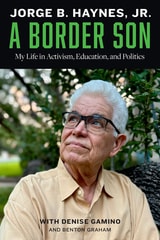
A Border Son
My Life in Activism, Education, and PoliticsJorge B. Haynes, Jr.with Denise Gamino and Benton Graham
University of Texas Press, 2026
Behind the success of every great politician, inspiring activist, or business titan, there is a staffer; Jorge B. Haynes was that staffer for some of the most influential leaders in Texas, Florida, and California.
Jorge B. Haynes had a knack for finding his way into the rooms where history was being made. From his work boycotting farmworker conditions alongside Cesar Chavez and Dolores Huerta as a young man in California to his role in President Bill Clinton’s NAFTA war room in the 1990s, he was the man advising some of the country’s most influential leaders and he left an imprint on the monumental moments that defined their time. His career spanned almost five decades, beginning with his decision to leave home in Laredo to serve in the US Air Force. But his service to the country took many different forms. Haynes worked for the Bureau of the Census the first year Latinos were allowed to declare their Hispanic heritage. He wrote speeches and orchestrated pivotal meetings for top political leadership in Texas and later Florida. In the final years of his career, he fought to make college a more accessible path for under-represented students in California.
As his paternal grandmother used to say, “Cuando vas a un lugar donde nunca has estado, finge que has estado allí,” which means, “When you go somewhere that you've never been, pretend like you've been there before.” By the end of his career, there weren’t many places that Haynes hadn’t been.
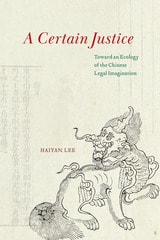
A Certain Justice
Toward an Ecology of the Chinese Legal ImaginationHaiyan Lee
University of Chicago Press, 2023
To many outsiders, China has an image as a realm of Oriental despotism where law is at best window dressing and at worst an instrument of coercion and tyranny. In this highly original contribution to the interdisciplinary field of law and humanities, Haiyan Lee contends that this image arises from a skewed understanding of China’s political-legal culture, particularly the failure to distinguish what she calls high justice and low justice.
In the Chinese legal imagination, Lee shows, justice is a vertical concept, with low justice between individuals firmly subordinated to the high justice of the state. China’s political-legal culture is marked by a mistrust of law’s powers, and as a result, it privileges substantive over procedural justice. Calling on a wide array of narratives—stories of crime and punishment, subterfuge and exposé, guilt and redemption—A Certain Justice helps us recognize the fight for justice outside the familiar arenas of liberal democracy and the rule of law.
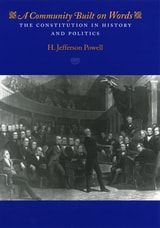
A Community Built on Words
The Constitution in History and PoliticsH. Jefferson Powell
University of Chicago Press, 2002
Combining history and theory, Powell analyzes a series of constitutional controversies from 1790 to 1944 to demonstrate that constitutional law from its very beginning has involved politically charged and ideologically divisive arguments. Nowhere in our past can one find the golden age of apolitical constitutional thinking that a great deal of contemporary scholarship seeks or presupposes. Viewed over time, American constitutional law is a history of political dispute couched in constitutional terms.
Powell then takes his conclusions one step further, claiming that it is precisely this historical tradition of argument that has given American constitutional law a remarkable coherence and integrity over time. No matter what the particular political disputes of the day might be, constitutional argument has provided a shared language through which our political community has been able to fight out its battles without ultimately fracturing.
A Community Built on Words will be must reading for any student of constitutional history, theory, or law.
A Contest of Ideas
Capital, Politics and LaborNelson Lictenstein
University of Illinois Press, 2013
These incisive writings link the fate of the labor movement to the transformations in the shape of world capitalism, to the rise of the civil rights movement, and to the activists and intellectuals who have played such important roles. Tracing broad patterns of political thought, Lichtenstein offers important perspectives on the relationship of labor and the state, the tensions that sometimes exist between a culture of rights and the idea of solidarity, and the rise of conservatism in politics, law, and intellectual life. The volume closes with portraits of five activist intellectuals whose work has been vital to the conflicts that engage the labor movement, public policy, and political culture.

A Death of One's Own
Literature, Law, and the Right to DieJared Stark
Northwestern University Press, 2018
More than a survey or work of advocacy, A Death of One’s Own examines the consequences and limits of the three reasons most often cited for supporting a person’s right to die: that it is justified as an expression of personal autonomy or self-ownership; that it constitutes an act of self-authorship, of “choosing a final chapter” in one’s life; and that it enables what has come to be called “death with dignity.” Probing the intersections of law and literature, Stark interweaves close discussion of major legal, political, and philosophical arguments with revealing readings of literary and testimonial texts by writers including Balzac, Melville, Benjamin, and Améry.
A thought-provoking work that will be of interest to those concerned with law and humanities, biomedical ethics, cultural history, and human rights, A Death of One’s Own opens new and suggestive paths for thinking about the history of modern death as well as the unsettled future of the right to die.
A Decade of Negative Thinking
Essays on Art, Politics, and Daily LifeMira Schor
Duke University Press, 2009
In essays such as “The ism that dare not speak its name,” “Generation 2.5,” “Like a Veneer,” “Modest Painting,” “Blurring Richter,” and “Trite Tropes, Clichés, or the Persistence of Styles,” Schor considers how artists relate to and represent the past and how the art market influences their choices: whether or not to disavow a social movement, to explicitly compare their work to that of a canonical artist, or to take up an exhausted style. She places her writings in the rich transitory space between the near past and the “nextmodern.” Witty, brave, rigorous, and heartfelt, Schor’s essays are impassioned reflections on art, politics, and criticism.
A Flock Divided
Race, Religion, and Politics in Mexico, 1749–1857Matthew D. O Hara
Duke University Press, 2010
O’Hara focuses on interactions between church authorities and parishioners from the late-colonial era into the early-national period, first in Mexico City and later in the surrounding countryside. Paying particular attention to disputes regarding caste status, the category of “Indian,” and the ownership of property, he demonstrates that religious collectivities from neighborhood parishes to informal devotions served as complex but effective means of political organization for plebeians and peasants. At the same time, longstanding religious practices and ideas made colonial social identities linger into the decades following independence, well after republican leaders formally abolished the caste system that classified individuals according to racial and ethnic criteria. These institutional and cultural legacies would be profound, since they raised fundamental questions about political inclusion and exclusion precisely when Mexico was trying to envision and realize new forms of political community. The modes of belonging and organizing created by colonialism provided openings for popular mobilization, but they were always stalked by their origins as tools of hierarchy and marginalization.
A Good Place to Do Business
The Politics of Downtown Renewal since 1945Roger Biles and Mark H. Rose
Temple University Press, 2022
The “Pittsburgh Renaissance,” an urban renewal effort launched in the late 1940s, transformed the smoky rust belt city’s downtown. Working-class residents and people of color saw their neighborhoods cleared and replaced with upscale, white residents and with large corporations housed in massive skyscrapers. Pittsburgh’s Renaissance’s apparent success quickly became a model for several struggling industrial cities, including St. Louis, Cleveland, Detroit, Chicago, and Philadelphia.
In A Good Place to Do Business, Roger Biles and Mark Rose chronicle these urban “makeovers” which promised increased tourism and fashionable shopping as well as the development of sports stadiums, convention centers, downtown parks, and more. They examine the politics of these government-funded redevelopment programs and show how city politics (and policymakers) often dictated the level of success.
As city officials and business elites determined to reorganize their downtowns, a deeply racialized politics sacrificed neighborhoods and the livelihoods of those pushed out. Yet, as A Good Place to Do Business demonstrates, more often than not, costly efforts to bring about the hoped-for improvements failed to revitalize those cities, or even their downtowns.
A Great Restlessness
The Life and Politics of Dorise NielsenFaith Johnston
University of Manitoba Press, 2006
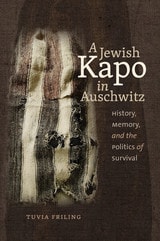
A Jewish Kapo in Auschwitz
History, Memory, and the Politics of SurvivalTuvia Friling
Brandeis University Press, 2014
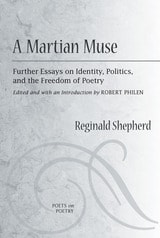
A Martian Muse
Further Essays on Identity, Politics, and the Freedom of PoetryReginald Shepherd
University of Michigan Press, 2010
Those who have read Orpheus in the Bronx, Reginald Shepherd's previous collection of essays about the act of creating poetry, and those who take on the task, can immediately understand why it was a national finalist for a prestigious National Book Critics Circle Award. Shepherd was candid and disarming, practical and funny, able to mix thoughts about the Transformers with meditations on the realities of growing up poor.
This is Reginald Shepherd's final opportunity to speak his mind about the craft he loved, the art of using words to express the soul and the wit of every person's experience. Edited by Shepherd's longtime partner and intellectual confidant, Robert Philen, A Martian Muse stands as a final monument to a master in the craft, but is also a readable, important work in its own right.
"Reginald Shepherd died September 10, 2008, after a hard struggle with cancer. While he had completed the essays presented here and had selected them from his available essays to form a collection, he didn't have time to organize the presentation of the essays within the collection.
"The task of editing this collection has been a daunting challenge as I struggle to live up to the level of intellectual engagement, clarity, and coherence that Reginald always expected. While daunting, it has also been a labor of love and a compulsion for me, based on the many years I spent with him as a partner, friend, lover, intellectual companion, and sharer of common passions."
---Robert Philen, from the Introduction
Reginald Shepherd was the editor of The Iowa Anthology of New American Poetries and Lyric Postmodernisms: An Anthology of Contemporary Innovative Poetries and the author of five books of poetry. He was a finalist for the 2009 National Book Critics Circle Award and was the recipient of grants from the NEA, the Illinois Arts Council, the Saltonstall Foundation, the Florida Arts Council, and the Vogelstein Foundation, among many other awards and honors.
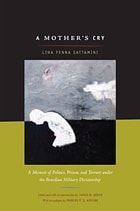
A Mother's Cry
A Memoir of Politics, Prison, and Torture under the Brazilian Military DictatorshipLina Penna Sattamini
Duke University Press, 2010
Lina Penna Sattamini describes her son’s tribulations through letters exchanged among family members, including Marcos, during the year that he was imprisoned. Her narrative is enhanced by Marcos’s account of his arrest, imprisonment, and torture. James N. Green’s introduction provides an overview of the political situation in Brazil, and Latin America more broadly, during that tumultuous era. In the 1990s, some Brazilians began to suggest that it would be best to forget the trauma of that era and move on. Lina Penna Sattamini wrote her memoir as a protest against historical amnesia. First published in Brazil in 2000, A Mother’s Cry is testimonial literature at its best. It conveys the experiences of a family united by love and determination during years of political repression.

A New Green Order?
The World Bank and the Politics of the Global Environment FacilityZoe Young
Pluto Press, 2002
Investigating the workings of this little known aid fund, Zoe Young takes a critical look at the conflicts involved, focusing on how the GEF's agenda relates to questions of globalisation, knowledge and accountability in the United States and the World Bank.
As our landscapes, fertility, cultures and ecosystems are being destroyed every day, Zoe Young gives a disturbing account of the complex issues that must be addressed before the world's environment can be managed more democratically - and effectively.
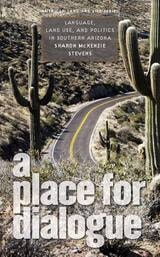
A Place for Dialogue
Language, Land Use, and Politics in Southern ArizonaSharon McKenzie Stevens
University of Iowa Press, 2007
In A Place for Dialogue, Sharon McKenzie Stevens views the contradictions and collaborations involved in the management of public land in southern Arizona—and by extension the entire arid West—through the lens of political rhetoric. Revealing the socioecological relationships among cattlemen and environmentalists as well as developers and recreationists, she analyzes the ways that language shapes landscape by shaping decisions about land use.
Stevens focuses on the collaborative Sonoran Desert Conservation Plan initiated by Pima County, Arizona, the ubiquitous use of scientific argument to defend contradictory practices, and the construction and negotiation of rancher/environmentalist identities to illuminate both literally and metaphorically the dynamics of land use politics. Drawing specifically upon extensive interviews with a diverse array of agents on all sides of the debate—ranchers, environmentalists, scientists, land managers, government officials—on historical narratives, and on her own conflicting experiences as someone who grew up with those who work the western lands, she demonstrates that it is possible to use differences to solve, rather than to aggravate, the entrenched problems that bridge land and language.
By integrating her richly textured case study of a fragile region with rhetorical approaches to narrative, science-based argument, and collective identities, Stevens makes a significant contribution to the fields of rhetoric, land management, and cultural studies.
A Place in Politics
São Paulo, Brazil, from Seigneurial Republicanism to Regionalist RevoltJames P. Woodard
Duke University Press, 2009
Woodard’s fine-grained political history proceeds chronologically from the final years of the nineteenth century, when São Paulo’s leaders enjoyed political preeminence within the federal system codified by the Constitution of 1891, through the mass mobilization of 1931–32, in which São Paulo’s people marched, rioted, and eventually took up arms against the national government in what was to be Brazil’s last great regionalist revolt. In taking to the streets in the name of their state, constitutionalism, and the “civilization” that they identified with both, the people of São Paulo were at once expressing their allegiance to elements of a regionally distinct political culture and converging on a broader, more participatory public sphere that had arisen amid the political conflicts of the preceding decades.

A Poetic Genealogy of North African Literature
Thomas C. Connolly
Northwestern University Press, 2025
Engaging the poetic to expand our imagination of Maghrebi literature in French
Poetry, as the Moroccan writer Abdelkébir Khatibi describes it, is a form of dissymmetry that exposes readers to the unexpected, and to the possibility of a transformative encounter with the text. Drawing on literary, philosophical, theoretical, and theological texts in multiple languages and scripts, as well as on the visual arts, Thomas C. Connolly delves into the poetic works of Khatibi and six other major Maghrebi authors—Jean Amrouche, Tahar Djaout, Nabile Farès, Mohammed Khaïr-Eddine, Abdelwahab Meddeb, and Jean Sénac—as well as the French poet Arthur Rimbaud, to think anew about the origins and legacy of Francophone poetry in the Maghreb. Instead of turning away from the poetic when it becomes indecipherable, A Poetic Genealogy of North African Literature engages poetic texts on their own terms, allowing them to dictate the search for meaning, thereby expanding our understanding of what Maghrebi literature in French was, is, and might become.

A Police State
Politics and Public Safety in Minneapolis, 1945–2020Michael J. Lansing
University of Chicago Press, 2027
How the police in Minneapolis used electoral politics to accrue power and avoid accountability.
The 2020 murder of George Floyd made Minneapolis synonymous with unjust policing and the pain and outrage left in its wake. The city became ground zero for police reform in the United States—even though liberal politicians in Minnesota had promised, and delivered, police reforms for decades. Centered on professionalization, these changes inadvertently exacerbated injustice. Better training and higher standards broadened the influence of the police, who then claimed expertise in public safety. They deployed it to bargain for governmental support, even when they treated residents unfairly. Though Black, Indigenous, and gay residents resisted, the political power amassed by the police rendered real change almost impossible.
In A Police State, historian and fourth-generation Minneapolis resident Michael J. Lansing chronicles how the police became a political force in one of the nation’s most liberal cities. Lansing shows how, in the years after World War II, public safety policies that appealed to voters in the overwhelmingly white city protected and expanded police discretion. As union members, administrators, and citizens, officers shaped these policies to shield themselves and their violent actions from scrutiny. They campaigned for better wages, secured legal safeguards, resisted race-neutral policing, and elected one of their own to the mayor’s office. Ultimately, they used democratic institutions to cultivate and sustain a police state that protected white people and harmed people of color. Lansing uncovers this dysfunctional relationship between a city and its cops while illuminating a larger American story about reform, resistance, and democracy.
A significant exploration of policing politics, this book helps us understand the history that led to George Floyd’s murder—and insists that the future of community safety depends on reenvisioning the role of police in our society.
A Politics of Virtue
Hinduism, Sexuality, and Countercolonial Discourse in FijiJohn D. Kelly
University of Chicago Press, 1991
changing conditions of political possibility by examining the
connection between politics and sexual morality in the British
colony of Fiji from 1929 to 1932.

A Quiet Challenge
Edward W. Brooke and the Politics of Civil RightsJordan O'Neal Alexander
University of Massachusetts Press, 2026
The first full-length biography of a consequential figure in twentieth-century American politics
In 1962, Edward W. Brooke (1919–2015) upended political convention by becoming the first popularly elected African American attorney general of Massachusetts. His victory was striking not only because Massachusetts was an overwhelmingly white state with a small Black population, but also because Brooke was a Republican and an Episcopalian in a deeply Democratic, Irish Catholic political culture. Navigating these contradictions, Brooke crafted a distinctive political style—measured, pragmatic, and quietly transformative—that reshaped civil rights politics in the North. In A Quiet Challenge, Jordan O’Neal Alexander offers the first full-length biography of Brooke, revealing him as a Black Republican whose carefully calibrated approach to race, law, and governance won broad white support while often distancing him from Boston’s Black community.
As attorney general, Brooke sought to uphold the rule of law while advancing principles of fairness, equality, and public safety, an approach that reflected both political constraint and moral resolve. Brooke again defied expectations in 1966 when he won election to the United States Senate, becoming the first popularly elected African American senator since Reconstruction. Serving two terms during the height of the civil rights movement, he emerged as a powerful national voice on issues of racial justice. He played a key role in blocking two Supreme Court nominees aligned with President Richard Nixon’s “southern strategy,” even as his support for school desegregation and busing during the Boston Busing Crisis contributed to his eventual political decline. Throughout his career, Brooke remained committed to building a society in which Black Americans—and all Americans—could fully participate and prosper. This volume demonstrates how Brooke’s restrained, yet persistent political strategy helped expand the possibilities for Black leadership within mainstream American politics.
A Rebellious People
Basques, Protests, And PoliticsCyrus Ernesto Zirakzadeh
University of Nevada Press, 1991
In this scholarly work, Zirakzadeh argues that there is a calculated reasoning behind ETA's political violence that is often overlooked by researchers. His book is a comprehensive account of the Basque region's grassroots politics.
A Righteous Smokescreen
Postwar America and the Politics of Cultural GlobalizationSam Lebovic
University of Chicago Press, 2022
When the dust settled after World War II, the United States stood as the world’s unquestionably pre-eminent military and economic power. In the decades that followed, the country exerted its dominant force in less visible but equally powerful ways, too, spreading its trade protocols, its media, and—perhaps most importantly—its alleged values. In A Righteous Smokescreen, Sam Lebovic homes in on one of the most prominent, yet ethereal, of those professed values: the free flow of information. This trope was seen as capturing what was most liberal about America’s self-declared leadership of the free world. But as Lebovic makes clear, even though diplomats and public figures trumpeted the importance of widespread cultural exchange, these transmissions flowed in only one direction: outward from the United States. Though other countries did try to promote their own cultural visions, Lebovic shows that the US moved to marginalize or block those visions outright, highlighting the shallowness of American commitments to multilateral institutions, the depth of its unstated devotion to cultural and economic supremacy, and its surprising hostility to importing foreign cultures. His book uncovers the unexpectedly profound global consequences buried in such ostensibly mundane matters as visa and passport policy, international educational funding, and land purchases for embassies. Even more crucially, A Righteous Smokescreen does nothing less than reveal that globalization was not the inevitable consequence of cultural convergence or the natural outcome of putatively free flows of information—it was always political to its core.
A Slaveholders' Union
Slavery, Politics, and the Constitution in the Early American RepublicGeorge William Van Cleve
University of Chicago Press, 2010
After its early introduction into the English colonies in North America, slavery in the United States lasted as a legal institution until the passage of the Thirteenth Amendment to the Constitution in 1865. But increasingly during the contested politics of the early republic, abolitionists cried out that the Constitution itself was a slaveowners’ document, produced to protect and further their rights. A Slaveholders’ Union furthers this unsettling claim by demonstrating once and for all that slavery was indeed an essential part of the foundation of the nascent republic.
In this powerful book, George William Van Cleve demonstrates that the Constitution was pro-slavery in its politics, its economics, and its law. He convincingly shows that the Constitutional provisions protecting slavery were much more than mere “political” compromises—they were integral to the principles of the new nation. By the late 1780s, a majority of Americans wanted to create a strong federal republic that would be capable of expanding into a continental empire. In order for America to become an empire on such a scale, Van Cleve argues, the Southern states had to be willing partners in the endeavor, and the cost of their allegiance was the deliberate long-term protection of slavery by America’s leaders through the nation’s early expansion. Reconsidering the role played by the gradual abolition of slavery in the North, Van Cleve also shows that abolition there was much less progressive in its origins—and had much less influence on slavery’s expansion—than previously thought.
Deftly interweaving historical and political analyses, A Slaveholders’ Union will likely become the definitive explanation of slavery’s persistence and growth—and of its influence on American constitutional development—from the Revolutionary War through the Missouri Compromise of 1821.
A Tribal Order
Politics and Law in the Mountains of YemenBy Shelagh Weir
University of Texas Press, 2006
2008 — British-Kuwait Friendship Prize in Middle Eastern Studies – British Society for Middle Eastern Studies
A Tribal Order describes the politico-legal system of Jabal Razih, a remote massif in northern Yemen inhabited by farmers and traders. Contrary to the popular image of Middle Eastern tribes as warlike, lawless, and invariably opposed to states, the tribes of Razih have stable structures of governance and elaborate laws and procedures for maintaining order and resolving conflicts with a minimum of physical violence. Razihi leaders also historically cooperated with states, provided the latter respected their customs, ideals, and interests. Weir considers this system in the context of the rugged environment and productive agricultural economy of Razih, and of centuries of continuous rule by Zaydi Muslim regimes and (latterly) the republican governments of Yemen.
The book is based on Weir's extended anthropological fieldwork on Jabal Razih, and on her detailed study of hundreds of handwritten contracts and treaties among and between the tribes and rulers of Razih. These documents provide a fascinating insight into tribal politics and law, as well as state-tribe relations, from the early seventeenth to the late twentieth century. A Tribal Order is also enriched by case histories that vividly illuminate tribal practices. Overall, this unusually wide-ranging work provides an accessible account of a remarkable Arabian society through time.
A World Transformed
The Politics of Culture in Revolutionary Vietnam, 1945-1965Kim N. B. Ninh
University of Michigan Press, 2002
The study covers the period from the Vietnamese communists' initial ascent to power in 1945 to the beginning of the escalation of the American involvement in the country's conflict in 1965, by which time a full-fledged socialist state had been in place in North Vietnam for eleven years. Through a nuanced examination of critical intellectual works, A World Transformed presents a complex view of a period fraught with contradictory possibilities and tensions that continue to resonate in Vietnam today. The extensive use of Vietnamese-language materials, access to archival data never before available, and innovative incorporation of literary and historical sources combine to make this study an invaluable depiction of the Vietnamese revolution.
Kim N. B. Ninh is Assistant Director of the Governance, Law, and Civil Society Programs, The Asia Foundation, San Francisco.

AIDS in Industrialized Democracies
Passions, Politics, and PoliciesBayer, Ronald
Rutgers University Press, 1992
In the ten years since the first cases of AIDS were reported, the disease has spread around the world. Every country has had to come up with policies suited to its own conditions, economy, culture, and institutions. The differences among their approaches are striking. This volume, the first international comprehensive comparison of responses to AIDS, is a unique guide to the world's most urgent public health crisis.
Sixteen leading experts in public health, social science, government, and public policy from USA, Canada, Germany, Australia, Spain, Britain, France, the Netherlands, Denmark, Sweden, and Japan candidly recount and analyze the responses of their own nations and comment on the lessons that can be drawn from each country's experience. For each country, they look critically at the tragic statistics of AIDS incidence; the circumstances of AIDS's first appearance; public health traditions of mandatory screening, contact tracing, and quarantine; attitudes toward drug abuse, homosexuality, sex education; publicity about AIDS; legal and customary protections of civil rights, minority groups, medical confidentiality; access to health care and insurance; and the interplay of formal and informal interest groups in shaping policy. The spectrum of AIDS policy ranges from severe "contain-and-control" programs to much more liberal plans based on education, cooperation, and inclusion.
No matter what policy a nation has constructed to deal with AIDS, the coming decade will test how well that policy conforms to democratic ideals. By scrutinizing the responses to AIDS so far, this book aims to give countries around the world a chance to learn from each others' mistakes and triumphs. It will be essential reading for all students and professionals in public health and public policy.
Abjection Incorporated
Mediating the Politics of Pleasure and ViolenceMargaret Hennefeld and Nicholas Sammond, editors
Duke University Press, 2019
Contributors. Meredith Bak, Eugenie Brinkema, James Leo Cahill, Michelle Cho, Maggie Hennefeld, Rob King, Thomas Lamarre, Sylvère Lotringer, Rijuta Mehta, Mark Mulroney, Nicholas Sammond, Yiman Wang, Rebecca Wanzo

Abortion Pills
US History and PoliticsCarrie Baker
Amherst College Press, 2024
This is the first book to offer a comprehensive history of abortion pills in the United States. Public intellectual and lawyer Carrie N. Baker shows how courageous activists waged a decades-long campaign to establish, expand, and maintain access to abortion pills. Weaving their voices throughout her book, Baker recounts both dramatic and everyday acts of their resistance. These activists battled anti-abortion forces, overly cautious policymakers, medical gatekeepers, and fearful allies in their four-decade-long fight to free abortion pills. In post-Roe America, abortion pills are currently playing a critically important role in providing safe abortion access to tens of thousands of people living in states that now ban and restrict abortion. Understanding this struggle will help to ensure continued access into the future.
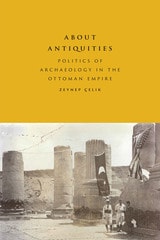
About Antiquities
Politics of Archaeology in the Ottoman EmpireBy Zeynep Çelik
University of Texas Press, 2016
Antiquities have been pawns in empire-building and global rivalries; power struggles; assertions of national and cultural identities; and cross-cultural exchanges, cooperation, abuses, and misunderstandings—all with the underlying element of financial gain. Indeed, “who owns antiquity?” is a contentious question in many of today’s international conflicts.
About Antiquities offers an interdisciplinary study of the relationship between archaeology and empire-building around the turn of the twentieth century. Starting at Istanbul and focusing on antiquities from the Ottoman territories, Zeynep Çelik examines the popular discourse surrounding claims to the past in London, Paris, Berlin, and New York. She compares and contrasts the experiences of two museums—Istanbul’s Imperial Museum and the Metropolitan Museum of Art—that aspired to emulate European collections and gain the prestige and power of owning the material fragments of ancient history. Going beyond institutions, Çelik also unravels the complicated interactions among individuals—Westerners, Ottoman decision makers and officials, and local laborers—and their competing stakes in antiquities from such legendary sites as Ephesus, Pergamon, and Babylon.
Recovering perspectives that have been lost in histories of archaeology, particularly those of the excavation laborers whose voices have never been heard, About Antiquities provides important historical context for current controversies surrounding nation-building and the ownership of the past.
Acceptable Risks
Politics, Policy, and Risky TechnologiesC. F. Larry Heimann
University of Michigan Press, 1998
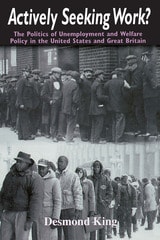
Actively Seeking Work?
The Politics of Unemployment and Welfare Policy in the United States and Great BritainDesmond King
University of Chicago Press, 1995
The goal of work-welfare policy in both countries has been to provide financial aid, training, and placement services for the unemployed. In order to muster support for these programs, however, work-welfare programs had to incorporate liberal requirements that they not interfere with private market forces, and that they prevent the "undeserving" from obtaining benefits. For King, the attempt to integrate these incompatible functions is the defining feature of British and American policies as well as the cause of their failure.

Activist Biology
The National Museum, Politics, and Nation Building in BrazilRegina Horta Duarte
University of Arizona Press, 2016
For the first time in English, Brazil’s leading environmental historian, Regina Horta Duarte, brings us a nuanced analysis of the National Museum of Brazil’s contribution to that country’s formation and history. In Activist Biology, Duarte explores the careers of three of these scientists as they leveraged biology as a strategy for change. Devoted to educational initiatives, they organized exhibits, promoted educational film and radio, wrote books, published science communication magazines, fostered school museums, and authored textbooks for young people. Their approach was transdisciplinary, and their reliance on multimedia formats was pioneering.
Capturing a crucial period in Brazil’s history, this portrait of science as a creative and potentially transformative pathway will intrigue anyone fascinated by environmental history, museums, and the history of science. Duarte skillfully shows how Brazilian science furthered global scientific knowledge in ways that are relevant now more than ever.
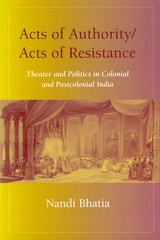
Acts of Authority/Acts of Resistance
Theater and Politics in Colonial and Postcolonial IndiaNandi Bhatia
University of Michigan Press, 2004
Nandi Bhatia argues that Indian theater was a significant force in the struggle against oppressive colonial and postcolonial structures, as it sought to undo various schemes of political and cultural power through its engagement with subjects derived from mythology, history, and available colonial models such as Shakespeare. Bhatia's attention to local histories within a postcolonial framework places performance in a global and transcultural context. Drawing connections between art and politics, between performance and everyday experience, Bhatia shows how performance often intervened in political debates and even changed the course of politics.
One of the first Western studies of Indian theater to link the aesthetics and the politics of that theater, Acts of Authority/Acts of Resistance combines in-depth archival research with close readings of dramatic texts performed at critical moments in history. Each chapter amplifies its themes against the backdrop of specific social conditions as it examines particular dramatic productions, from The Indigo Mirror to adaptations of Shakespeare plays by Indian theater companies, illustrating the role of theater in bringing nationalist, anticolonial, and gendered struggles into the public sphere.
Nandi Bhatia is Associate Professor of English at the University of Western Ontario.
Acts of Hope
Creating Authority in Literature, Law, and PoliticsJames Boyd White
University of Chicago Press, 1994
In this book, James Boyd White shows how texts by some of our most important thinkers and writers—including Plato, Shakespeare, Dickinson, Mandela, and Lincoln—answer these questions, not in the abstract, but in the way they wrestle with the claims of the world and self in particular historical and cultural contexts. As they define afresh the institutions or practices for which they claim (or resist) authority, they create authorities of their own, in the very modes of thought and expression they employ. They imagine their world anew and transform the languages that give it meaning.
In so doing, White maintains, these works teach us about how to read and judge claims of authority made by others upon us; how to decide to which institutions and practices we should grant authority; and how to create authorities of our own through our thoughts and arguments. Elegant and accessible, this book will appeal to anyone wanting to better understand one of the primary processes of our social and political lives.
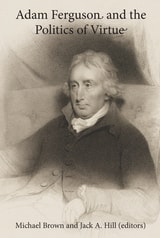
Adam Ferguson and the Politics of Virtue
Jack A. Hill and Michael Brown
Aberdeen University Press, 2023
Adopted Territory
Transnational Korean Adoptees and the Politics of BelongingEleana J. Kim
Duke University Press, 2010
Affective Communities
Anticolonial Thought, Fin-de-Siecle Radicalism, and the Politics of FriendshipLeela Gandhi
Duke University Press, 2006
Gandhi weaves together the stories of a number of South Asian and European friendships that flourished between 1878 and 1914, tracing the complex historical networks connecting figures like the English socialist and homosexual reformer Edward Carpenter and the young Indian barrister M. K. Gandhi, or the Jewish French mystic Mirra Alfassa and the Cambridge-educated Indian yogi and extremist Sri Aurobindo. In a global milieu where the battle lines of empire are reemerging in newer and more pernicious configurations, Affective Communities challenges homogeneous portrayals of “the West” and its role in relation to anticolonial struggles. Drawing on Derrida’s theory of friendship, Gandhi puts forth a powerful new model of the political: one that finds in friendship a crucial resource for anti-imperialism and transnational collaboration.
Afflicting the Comfortable
Journalism and Politics in West VirginiaThomas F. Stafford
West Virginia University Press, 2011
"Government corruption was not invented in West Virginia. But there are people who contend that West Virginia officials have done more than their share over the years to develop state-of-the-art techniques in vote theft, contract kickbacks, influence peddling and good old-fashioned bribery, extortion, fraud, tax evasion and outright stealing." New York Times
While investigating the Invest Right scandal, Thomas Stafford, a former journalist for the Charleston Gazette, found himself in a very precarious position. As a reporter he felt obligated to tell the whole truth, and he believed in the need to serve the public and those West Virginians who were being abused by a political machine. In Afflicting the Comfortable, Stafford relates such tales of the responsibility of journalism and politics in coordination with scandals that have unsettled the Mountain State over the past few decades. His probing would take him from the halls of Charleston to the center of our nation's ruling elite. Guided by his senses of duty, right, and fairness, he plunged head first into the misdeeds of West Virginia's politicians. His investigations would preface the downfall of a governor and an adminstration that robbed the state and the citizens of West Virginia for many years.
Africa in the Indian Imagination
Race and the Politics of Postcolonial CitationAntoinette Burton
Duke University Press, 2016
African Democracies and African Politics
M. A. Mohamed Salih
Pluto Press, 2001

African Luxury
Aesthetics and PoliticsEdited by Mehita Iqani and Simidele Dosekun
Intellect Books, 2019
African-American Mayors
Race, Politics, and the American CityEdited by David R. Colburn and Jeffrey S. Adler
University of Illinois Press, 2001
Once in office, African-American mayors faced vexing challenges. In large and small cities from the Sunbelt to the Rustbelt, black mayors assumed office during economic downturns and confronted the intractable problems of decaying inner cities, white flight, a dwindling tax base, violent crime, and diminishing federal support for social programs. Many encountered hostility from their own parties, city councils, and police departments; others worked against long-established power structures dominated by local business owners or politicians. Still others, while trying to respond to multiple demands from a diverse constituency, were viewed as traitors by blacks expecting special attention from a leader of their own race. All struggled with the contradictory mandate of meeting the increasing needs of poor inner-city residents while keeping white businesses from fleeing to the suburbs.
This is the first comprehensive treatment of the complex phenomenon of African-American mayors in the nation's major urban centers. Offering a diverse portrait of leadership, conflict, and almost insurmountable obstacles, this volume assesses the political alliances that brought black mayors to office as well as their accomplishments--notably, increased minority hiring and funding for minority businesses--and the challenges that marked their careers. Mayors profiled include Carl B. Stokes (Cleveland), Richard G. Hatcher (Gary), "Dutch" Morial (New Orleans), Harold Washington (Chicago), Tom Bradley (Los Angeles), Marion Barry (Washington, D.C.), David Dinkins (New York City), Coleman Young (Detroit), and a succession of black mayors in Atlanta (Maynard Jackson, Andrew Young, and Bill Campbell).Probing the elusive economic dimension of black power, African-American Mayors demonstrates how the same circumstances that set the stage for the victories of black mayors exaggerated the obstacles they faced.
After the Rubicon
Congress, Presidents, and the Politics of Waging WarDouglas L. Kriner
University of Chicago Press, 2010
When the United States goes to war, the nation’s attention focuses on the president. As commander in chief, a president reaches the zenith of power, while Congress is supposedly shunted to the sidelines once troops have been deployed abroad. Because of Congress’s repeated failure to exercise its legislative powers to rein in presidents, many have proclaimed its irrelevance in military matters.
After the Rubicon challenges this conventional wisdom by illuminating the diverse ways in which legislators influence the conduct of military affairs. Douglas L. Kriner reveals that even in politically sensitive wartime environments, individual members of Congress frequently propose legislation, hold investigative hearings, and engage in national policy debates in the public sphere. These actions influence the president’s strategic decisions as he weighs the political costs of pursuing his preferred military course.
Marshalling a wealth of quantitative and historical evidence, Kriner expertly demonstrates the full extent to which Congress materially shapes the initiation, scope, and duration of major military actions and sheds new light on the timely issue of interbranch relations.
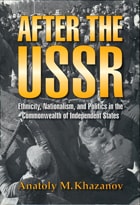
After the USSR
Ethnicity, Nationalism, and Politics in the Commonwealth of Independent StatesAnatoly M. Khazanov
University of Wisconsin Press, 1996
A world-renowned anthropologist, Anatoly M. Khazanov offers a witty, insightful, and cautionary analysis of ethnic nationalism and its pivotal role in the collapse of the Soviet empire.
“Khazanov’s encyclopedic knowledge of the history and culture of post-Soviet societies, combined with field research there since the 1960s, informs the case studies with a singular authoritative voice. This volume is destined to be an absolutely necessary reference for the understanding of ethnic relations and the politics of minorities in the ex-USSR into the next century.”—Leonard Plotnicov, editor of Ethnology
First Paperback Edition
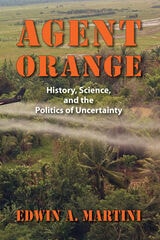
Agent Orange
History, Science, and the Politics of UncertaintyEdwin A. Martini
University of Massachusetts Press, 2012
Taking on what one former U.S. ambassador called “the last ghost of the Vietnam War,” this book examines the far-reaching impact of Agent Orange, the most infamous of the dioxin-contaminated herbicides used by American forces in Southeast Asia. Edwin A. Martini's aim is not simply to reconstruct the history of the “chemical war” but to investigate the ongoing controversy over the short- and long-term effects of weaponized defoliants on the environment of Vietnam, on the civilian population, and on the troops who fought on both sides.
Beginning in the early 1960s, when Agent Orange was first deployed in Vietnam, Martini follows the story across geographical and disciplinary boundaries, looking for answers to a host of still unresolved questions. What did chemical manufacturers and American policymakers know about the effects of dioxin on human beings, and when did they know it? How much do scientists and doctors know even today? Should the use of Agent Orange be considered a form of chemical warfare? What can, and should, be done for U.S. veterans, Vietnamese victims, and others around the world who believe they have medical problems caused by Agent Orange?
Martini draws on military records, government reports, scientific research, visits to contaminated sites, and interviews to disentangle conflicting claims and evaluate often ambiguous evidence. He shows that the impact of Agent Orange has been global in its reach affecting individuals and communities in New Zealand, Australia, Korea, and Canada as well as Vietnam and the United States. Yet for all the answers it provides, this book also reveals how much uncertainty—scientific, medical, legal, and political—continues to surround the legacy of Agent Orange.

Alchemy in the Rain Forest
Politics, Ecology, and Resilience in a New Guinea Mining AreaJerry K. Jacka
Duke University Press, 2015
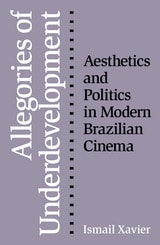
Allegories Of Underdevelopment
Aesthetics and Politics in Modern Brazilian CinemaIsmail Xavier
University of Minnesota Press, 1997
Examines the centrality of Cinema Novo to filmmaking in Brazil.
“A camera in the hand and ideas in the head” was the primary axiom of the young originators of Brazil’s Cinema Novo. This movement of the 1960s and early 1970s overcame technical constraints and produced films on minimal budgets. In Allegories of Underdevelopment, Ismail Xavier examines a number of these films, arguing that they served to represent a nation undergoing a political and social transformation into modernity.
Its best-known voice, filmmaker Glauber Rocha claimed that Cinema Novo was driven by an “aesthetics of hunger.” This scarcity of means demanded new cinematic approaches that eventually gave rise to a legitimate and unique Third World cinema. Xavier stands in the vanguard of scholars presenting and interpreting these revolutionary films—from the masterworks of Rocha to the groundbreaking experiments of Julio Bressane, Rogério Sganzerla, Andrea Tonacci and Arthur Omar—to an English-speaking audience. Focusing on each filmmaker’s use of narrative allegories for the “conservative modernization” Brazil and other nations underwent in the 1960s and 1970s, Xavier asks questions relating to the connection between film and history. He examines the way Cinema Novo transformed Brazil’s cultural memory and charts the controversial roles that Marginal Cinema and Tropicalism played in this process. Among the films he discusses are Black God, White Devil, Land in Anguish, Red Light Bandit, Macunaíma, Antônio das Mortes, The Angel Is Born, and Killed the Family and Went to the Movies.A compelling chronicle of the history of modern Brazilian cinema, Allegories of Underdevelopment brings to light the work of many filmmakers who are virtually unknown in the English-speaking world.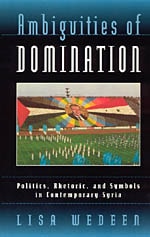
Ambiguities of Domination
Politics, Rhetoric, and Symbols in Contemporary SyriaLisa Wedeen
University of Chicago Press, 1999
Wedeen concludes that Asad's cult acts as a disciplinary device, generating a politics of public dissimulation in which citizens act as if they revered their leader. By inundating daily life with tired symbolism, the regime exercises a subtle, yet effective form of power. The cult works to enforce obedience, induce complicity, isolate Syrians from one another, and set guidelines for public speech and behavior. Wedeen's ethnographic research demonstrates how Syrians recognize the disciplinary aspects of the cult and seek to undermine them. Provocative and original, Ambiguities of Domination is a significant contribution to comparative politics, political theory, and cultural studies.
Ambiguities of Domination
Politics, Rhetoric, and Symbols in Contemporary SyriaLisa Wedeen
University of Chicago Press, 2015
Wedeen shows how such flagrantly fictitious claims were able to produce a politics of public dissimulation in which citizens acted as if they revered the leader. By inundating daily life with tired symbolism, the regime exercised a subtle, yet effective form of power. The cult worked to enforce obedience, induce complicity, isolate Syrians from one another, and set guidelines for public speech and behavior. Wedeen‘s ethnographic research demonstrates how Syrians recognized the disciplinary aspects of the cult and sought to undermine them. In a new preface, Wedeen discusses the uprising against the Syrian regime that began in 2011 and questions the usefulness of the concept of legitimacy in trying to analyze and understand authoritarian regimes.
Ambition, Competition, and Electoral Reform
The Politics of Congressional Elections Across TimeJamie L. Carson and Jason M. Roberts
University of Michigan Press, 2013
In Ambition, Competition, and Electoral Reform, Jamie L. Carson and Jason M. Roberts present an original study of U.S. congressional elections and electoral institutions for 1872-1944 from a contemporary political science perspective. Using data on late nineteenth and early twentieth century congressional elections, the authors test the applicability in a historical context of modern political science theories, assess the effects of institutional reforms, and identify the factors that shape the competitiveness of elections. They present several key findings: the strategic politicians theory is applicable in an era without candidate-centered campaigns; there was an incumbency advantage prior to the full development of candidate-centered campaigns; institutional reforms have had a significant effect on elections; and the degree of electoral competition frequently correlates with elected officials' responsiveness to citizens.

America's Americans
Population Issues in U.S. Society and PoliticsEdited by Philip D. Davies
University of London Press, 2007
Topics include:
Latino immigrant incorporation
- racial and ethnic integration in metropolitan contexts
- population self-determination, and Native Americans
- public policy issues relating to immigration
- growth of the U.S. prison population
- changing nature of poverty in the United States
- politics of demographic and social change at national and local levels
- historical change in the labor force participation of women