Results by title
5159 books match the query 'Biography' and 527 start with a

AntoloGaia
Queering the Seventies, A Radical Trans MemoirPorpora Marcasciano
Rutgers University Press, 2024
In this stirring memoir by a member of the first generation of LGBTQ+ activists in Italy, Porpora Marcasciano tells her story and shares the struggles and accomplishments of her fellow activists who achieved so much in the 1970s yet suffered devastating losses during the AIDS epidemic of the 1980s. AntoloGaia offers an insider’s look at the beginnings of the gay liberation movement in Italy and reveals how it was intimately intertwined with other forms of left-wing activism. At the same time, it powerfully conveys the queer joy of a young person from a small village first encountering the vibrant sexual minority communities of Naples, Bologna, and Rome. As Marcasciano starts to embrace her trans identity, she meets the famous anthropologist Pino Simonelli, who introduces her to Naples’s unique femminielli subculture and gives her the name Porporino, which she later shortens to Porpora. In keeping with this story of gender, sexual, and political discovery, AntoloGaia is the first piece of Italian life-writing to use gender-neutral and mixed-gender language.
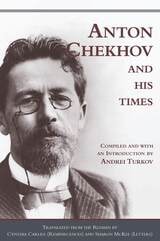
Anton Chekhov and his Times
Andrei Turkov
University of Arkansas Press, 1995
This anthology comprises reminiscences by a number of Anton Pavlovich Chekhov’s contemporaries, including the artist Konstantin Korovin, the writer Maxim Gorky, and Chekhov’s wife, Olga Knipper-Chekhova, and numerous letters written by Chekhov to his fellow writers and artists, family, publishers, and others.
Now available for the first time in English in America, these sixty-eight letters and ten essay-length reminiscences trace the development of Chekhov’s personality and talent, opening a window into the life and times of one of the world’s greatest short-story writers and playwrights. These perspectives on his family life and marriage, his early works, the stage productions of his plays, his literary successes, and the philosophies behind his writing create a rich biography of Chekhov that will reward writers, scholars, and all lovers of literature.

Anyplace But Here
Arna Bontemps & Jack Conroy
University of Missouri Press, 1997
Originally published in 1945 as They Seek a City, this classic was revised and expanded in 1966 to include chapters on Marcus Garvey, the Black Muslims, Malcolm X, and the racial disturbances in Detroit, Chicago, and Watts. Filled with stories about real men and women who sought a new life in the North, Anyplace But Here depicts the theme of hope, undercut by disappointment, and hope renewed as it details the African American's search for a home.

Apology to Apostrophe
Autobiography and the Rhetoric of Self-Representation in SpainJames D. Fernandez
Duke University Press, 1992
As Fernández demonstrates, recent developments in critical theory provide new and fruitful approaches to autobiographical works that have long been neglected, misunderstood, or, in some cases, virtually unknown. Focusing primarily but not exclusively on nineteenth-century Spain, Fernández exposes a rhetorical tension that often occurs in autobiographical discourse, between self-justification, or "apology," and the transcendence of this worldly impulse, or "apostrophe." This tension, he argues, is of particular interest in the case of Spain, but not peculiar to that nation, and his attention to the theoretical nature of autobiography leads to insightfl considerations of many canonical European autobiographies, including those of Saint Augustine, Rousseau, Saint Teresa, and Cardinal Newman.
Considering Spanish autobiography in the context of first-person narrative in Europe and in the terms of current debates on the relationship between writing and selfhood, Apology to Apostrophe marks a significant advance in our historical understanding and critical discussion of the genre. The book will be of great value not only to Hispanists but also to those interested in autobiography and cultural history.
Apostate Englishman
Grey Owl the Writer and the MythsAlbert Braz
University of Manitoba Press, 2015
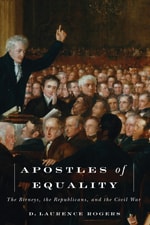
Apostles of Equality
The Birneys, the Republicans, and the Civil WarD. Laurence Rogers
Michigan State University Press, 2011
The first biographical account of the life of James Gillespie Birney in more than fifty years, this fabulously insightful history illuminates and elevates an all-but-forgotten figure whose political career contributed mightily to the American political fabric. Birney was a southern-born politician at the heart of the antislavery movement, with two southern-born sons who were major generals involved in key Union Army activities, including the leadership of the black troops. The interaction of the Birneys with historical figures (Abraham Lincoln, Harriet Beecher Stowe, and Henry Clay) highlights the significance of the family’s activities in politics and war. D. Laurence Rogers offers a unique historiography of the abolition movement, the Civil War, and Reconstruction through the experiences of one family navigating momentous developments from the founding of the Republic until the late 19th century.
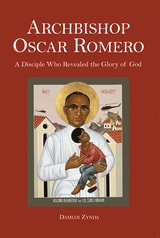
Archbishop Oscar Romero
A Disciple Who Revealed the Glory of GodDamian Zynda
University of Scranton Press, 2010
During his lifetime, Archbishop Oscar Romero chose to live the Christian Gospel in a radical way, defending, supporting, and serving the poor, and confronting the oppressive and murderous violence of the Salvadoran dictatorship. As a result, in March 1980, while celebrating Mass in a small chapel in El Salvador, he was assassinated.
With Archbishop Oscar Romero, Damian Zynda offers a compelling examination of the bishop’s eventful life. Zynda delves into the psychological and spiritual depths of Romero’s faith, tracing its progression from age thirteen up to the episcopacy and his prophetic stand against the government.
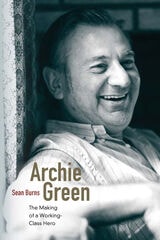
Archie Green
The Making of a Working-Class HeroSean Burns
University of Illinois Press, 2011
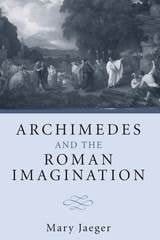
Archimedes and the Roman Imagination
Mary Jaeger
University of Michigan Press, 2013
The great mathematician Archimedes, a Sicilian Greek whose machines defended Syracuse against the Romans during the Second Punic War, was killed by a Roman after the city fell, yet it is largely Roman sources, and Greek texts aimed at Roman audiences, that preserve the stories about him. Archimedes' story, Mary Jaeger argues, thus becomes a locus where writers explore the intersection of Greek and Roman culture, and as such it plays an important role in Roman self-definition. Jaeger uses the biography of Archimedes as a hermeneutic tool, providing insight into the construction of the traditional historical narrative about the Roman conquest of the Greek world and the Greek cultural invasion of Rome.
By breaking down the narrative of Archimedes' life and examining how the various anecdotes that comprise it are embedded in their contexts, the book offers fresh readings of passages from both well-known and less-studied authors, including Polybius, Cicero, Livy, Vitruvius, Plutarch, Silius Italicus, Valerius Maximus, Johannes Tzetzes, and Petrarch.
---Helen King, Times Literary Supplement
"An absolutely wonderful book on a truly original and important topic. As Jaeger explores neglected texts that together tell an important story about the Romans' views of empire and their relationship to Greek cultural accomplishments, so she has written an important new chapter in the history of science. A genuine pleasure to read, from first page to last."
---Andrew Feldherr, Associate Professor of Classics, Princeton University
"This elegantly written and convincingly argued project analyzes Archimedes as a vehicle for reception of the Classics, as a figure for loss and recovery of cultural memory, and as a metaphorical representation of the development of Roman identity. Jaeger's fastening on the still relatively obscure figure of the greatest ancient mathematician as a way of understanding cultural liminality in the ancient world is nothing short of a stroke of genius."
---Christina S. Kraus, Professor and Chair of Classics, Yale University
"Archimedes and the Roman Imagination forms a useful addition to our understanding of Roman culture as well as of the reception of science in antiquity. It will make a genuine contribution to the discipline, not only in terms of its original interpretative claims but also as a fascinating example of how we may follow the cultural reception of historical figures."
---Reviel Netz, Professor of Classics, Stanford University
Cover art: Benjamin West. Cicero Discovering the Tomb of Archimedes. Yale University Art Gallery. John Hill Morgan, B.A. 1893, LL.B. 1898, M.A. (Hon.) 1929, Fund.

Architects of Little Rock
1833-1950Charles Witsell
University of Arkansas Press, 2014
Published in collaboration with the Fay Jones School of Architecture.

Archive Activism
Memoir of a "Uniquely Nasty" JourneyCharles Francis
University of North Texas Press, 2023

Arctic Madness
The Anthropology of a DelusionPierre Déléage
HAU, 2020

Are You Two Sisters?
The Journey of a Lesbian CoupleSusan Krieger
Temple University Press, 2022
Authored by one of the most respected figures in the field of personal ethnographic narrative, this book serves as both a memoir and a sociological study, telling the story of one lesbian couple’s lifelong journey together.
Are You Two Sisters? is Susan Krieger’s candid, revealing, and engrossing memoir about the intimacies of a lesbian couple. Krieger explores how she and her partner confront both the inner challenges of their relationship and the invisibility of lesbian identity in the larger world.
Using a lively novelistic and autoethnographic approach that toggles back and forth in time, Krieger reflects on the evolution of her forty-year relationship. She describes building a life together, from sharing pets and travels to getting married. Are You Two Sisters? addresses not only questions of gender and sexuality, but also of disability, as Krieger explores how the couple adapts to her increasing blindness.
Krieger’s title comes from a question asked by a stranger outside a remote desert bar as she and her partner traveled in the Southwest. Her apprehension about answering that question suggests how, even after the legalization of gay marriage, lesbianism often remains hidden—an observation that makes Krieger’s poignant narrative all the more moving.
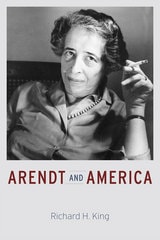
Arendt and America
Richard H. King
University of Chicago Press, 2015
Situating Arendt within the context of U.S. intellectual, political, and social history, King reveals how Arendt developed a fascination with the political thought of the Founding Fathers. King also re-creates her intellectual exchanges with American friends and colleagues, such as Dwight Macdonald and Mary McCarthy, and shows how her lively correspondence with sociologist David Riesman helped her understand modern American culture and society. In the last section of Arendt and America, King sets out the context in which the Eichmann controversy took place and follows the debate about “the banality of evil” that has continued ever since. As King shows, Arendt’s work, regardless of focus, was shaped by postwar American thought, culture, and politics, including the Civil Rights Movement and the Cold War.
For Arendt, the United States was much more than a refuge from Nazi Germany; it was a stimulus to rethink the political, ethical, and historical traditions of human culture. This authoritative combination of intellectual history and biography offers a unique approach for thinking about the influence of America on Arendt’s ideas and also the effect of her ideas on American thought.
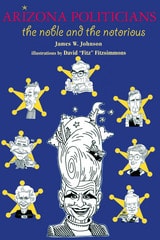
Arizona Politicians
The Noble and the NotoriousJames W. Johnson; Illustrations by David "Fitz" Fitzsimmons
University of Arizona Press, 2002
—A car dealer who propelled himself to the governor's mansion with the help of public recognition of his TV commercials
—An Arizonan who served not only as governor and chief justice of the Arizona Supreme Court, but also as the Majority Leader of the U.S. Senate and chief sponsor of the GI Bill
—A cowboy who delivered speeches to ranchhands and went on to become a U.S. senator known as one of the great orators of the twentieth century
—One of four Arizonans who lost a bid for the presidency yet made the Gallup Poll as one of the ten most admired men in the world
—A secretary who became the first woman in the nation to sit on a state supreme court
Journalist James Johnson has written profiles of 21 men and women from Arizona who have made their mark in the political arena. Chosen for their contributions to the state, their national prominence, their colorful personalities, and in some cases their notoriety, these prominent public servants—from first governor George W. P. Hunt to current senior senator McCain—all have been major participants in state or national affairs. Congressman Mo Udall once commented on Arizona's "civilized brand of politics," in which Republicans and Democrats, conservatives and liberals, treated one another with mutual respect. Johnson conveys both the spirit and spiritedness of Arizona politics and reveals how in many cases these politicians and their family members found their lives and careers overlapping. He tells their stories with humor and objectivity, while political cartoonist David Fitzsimmons captures their trademark styles in original drawings.
Although the individuals may speak from different platforms, all have been proud to call themselves Arizonans and proud to serve their state. This book shares their accomplishments and shows how, for better or worse, they've helped put Arizona in the spotlight.
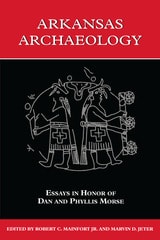
Arkansas Archaeology
Essays in Honor of Dan and Phyllis MorseRobert C. Mainfort
University of Arkansas Press, 1999
Arkansas Biography
A Collection of Notable LivesNancy Williams
University of Arkansas Press, 2000
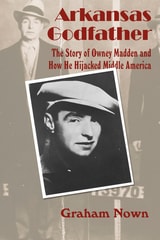
Arkansas Godfather
The Story of Owney Madden and How He Hijacked Middle AmericaGraham Nown
Butler Center for Arkansas Studies, 2013
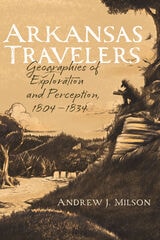
Arkansas Travelers
Geographies of Exploration and Perception, 1804-1834Andrew J. Milson
University of Arkansas Press, 2023
“I reckon stranger you have not been used much to traveling in the woods,” a hunter remarked to Henry Rowe Schoolcraft as he trekked through the Ozark backcountry in late 1818. The ensuing exchange is one of many compelling encounters between Arkansas travelers and settlers depicted in Arkansas Travelers: Geographies of Exploration and Perception, 1804–1834. This book is the first to integrate the stories of four travelers who explored Arkansas during the transformative period between the Louisiana Purchase of 1803 and statehood in 1836: William Dunbar, Thomas Nuttall, Henry Rowe Schoolcraft, and George William Featherstonhaugh.
In addition to gathering their tales of treacherous rivers, drunken scoundrels, and repulsive food, historian and geographer Andrew J. Milson explores the impact such travel narratives have had on geographical understandings of Arkansas places. Using the language in each traveler’s narrative, Milson suggests, and the book includes, new maps that trace these perceptions, illustrating not just the lands traversed, but the way travelers experienced and perceived place. By taking a geographical approach to the history of these spaces, Arkansas Travelers offers a deeper understanding—a deeper map—of Arkansas.
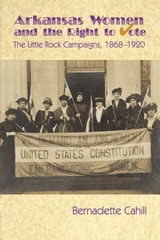
Arkansas Women and the Right to Vote
The Little Rock Campaigns: 1868-1920Bernadette Cahill
Butler Center for Arkansas Studies, 2015

Arkansas/Arkansaw
How Bear Hunters, Hillbillies, and Good Ol' Boys Defined a StateBrooks Blevins
University of Arkansas Press, 2009
Winner, 2011 Ragsdale Award
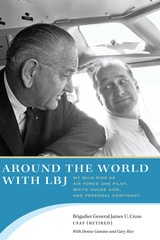
Around the World with LBJ
My Wild Ride as Air Force One Pilot, White House Aide, and Personal ConfidantBy Brigadier General James U. Cross, USAF (retired), with Denise Gamino and Gary Rice
University of Texas Press, 2008
When Lyndon Baines Johnson wanted to go somewhere, there was no stopping him. This dynamic president called for Air Force One as others summon a taxi—at a moment's notice, whatever the hour or the weather. And the man who made sure that LBJ got his ride was General James U. Cross, the president's hand-picked pilot, top military assistant, and personal confidante. One of the few Air Force One pilots to have a position, simultaneously, in the White House, General Cross is also the only member of LBJ's inner circle who has not publicly offered his recollections of the president. In this book, he goes on the record, creating a fascinating, behind-the-scenes portrait of America's complex, often contradictory, always larger-than-life thirty-sixth president.
General Cross tells an engrossing story. In addition to piloting Air Force One around the globe, he served President Johnson in multiple capacities, including directing the Military Office in the White House; managing a secret two-million-dollar presidential emergency fund; supervising the presidential retreat at Camp David, the president's entire transportation fleet, and the presidential bomb shelters; running the White House Mess; hiring White House social aides, including the president's future son-in-law, Charles Robb; and writing condolence letters to the families of soldiers killed in Vietnam. This wide-ranging, around-the-clock access to President Johnson allowed Cross to witness events and share moments that add color and depth to our understanding of America's arguably most demanding and unpredictable president.
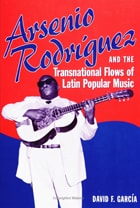
Arsenio Rodríguez and the Transnational Flows of Latin Popular Music
David F. García
Temple University Press, 2006
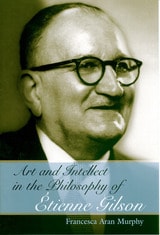
Art and Intellect in the Philosophy of Étienne Gilson
Francesca Aran Murphy
University of Missouri Press, 2004
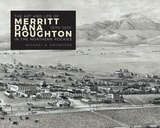
Art and Life of Merritt Dana Houghton in the Northern Rockies, 1878-1919
by Michael A. Amundson
University of Wyoming Press, 2022
This lavishly illustrated biography details Houghton’s life and work from his birth in Michigan in 1846 to his death in 1919 in Spokane through extensive genealogical records, newspaper accounts, and his illustrations—including historic ranches and bird’s-eye views of Fort Collins, Colorado; Dillon, Montana; and Spokane, Washington and the only known illustrations of long-lost places like Pearl, Colorado, and Rambler, Wyoming. Also included is reproduction of a four-foot-by-eight-foot view of Sheridan, Wyoming and a sixty-image sample portfolio of his best-preserved illustrations organized by type.
Houghton’s work depicts the infrastructure of the new settler society that was remaking the West in the late nineteenth century and early twentieth century, and Amundson demonstrates how Houghton’s vision of the American West remains active today.
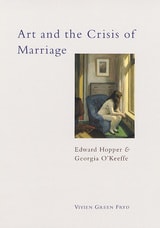
Art and the Crisis of Marriage
Edward Hopper and Georgia O'KeeffeVivien Green Fryd
University of Chicago Press, 2002
Vivien Green Fryd argues that this crisis played a crucial role in the lives and works of two of America's most familiar and beloved artists, Georgia O'Keeffe (1887-1986) and Edward Hopper (1882-1967). Combining biographical study of their marriages with formal and iconographical analysis of their works, Fryd shows how both artists expressed the pleasures and perils of their relationships in their paintings. Hopper's many representations of Victorian homes in sunny, tranquil landscapes, for instance, take on new meanings when viewed in the context of the artist's own tumultuous marriage with Jo and the widespread middle-class fears that the new urban, multidwelling homes would contribute to the breakdown of the family. Fryd also persuasively interprets the many paintings of skulls and crosses that O'Keeffe produced in New Mexico as embodying themes of death and rebirth in response to her husband Alfred Stieglitz's long-term affair with Dorothy Norman.
Art and the Crisis of Marriage provides both a penetrating reappraisal of the interconnections between Georgia O'Keeffe's and Edward Hopper's lives and works, as well as a vivid portrait of how new understandings of family, gender, and sexuality transformed American society between the wars in ways that continue to shape it today.

Artful Lives
The Francis Watts Lee Family and Their TimesPatricia J. Fanning
University of Massachusetts Press, 2016
Francis Watts Lee and his family hold a special place in the history of American photography. F. Holland Day completed a series of remarkable photographs of Lee's daughter Peggy, and the striking portrait of the child and her mother titled Blessed Art Thou among Women is one of Gertrude Käsebier's most iconic compositions. In Artful Lives, Patricia J. Fanning uses these and other significant images as guideposts to explore the Lee family and the art and culture of their age.
A social reform advocate, Francis Watts Lee was an artistic photographer and a talented printer, part of the circle of avant-garde artists and intellectuals who formed Boston's bohemia. He married twice, first Agnes Rand, an award-winning poet and children's book author, and later, after their divorce, Marion Lewis Chamberlain, a librarian and MIT-trained architect. Francis and Agnes's eldest daughter, Peggy, who was so integral to the work of pioneer Pictorialists, died at age seven of juvenile diabetes. Her sister, Alice, who lost her hearing in infancy, became a wood carver and sculptor.
Utilizing previously unknown family archives and institutional sources, Fanning traces the Lee family's story in the context of major artistic, political, social, and religious trends, including the Arts and Crafts movement, Christian Socialism, and Aestheticism, while also showing how their experiences reflected the national culture's evolving conceptions of family, gender, childhood, medicine, deaf education, and mourning. This richly drawn and gracefully written account of one family informs our understanding of this vibrant era, in Boston and well beyond.
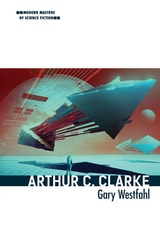
Arthur C. Clarke
Gary Westfahl
University of Illinois Press, 2018
Gary Westfahl closely examines Clarke's remarkable career, ranging from his forgotten juvenilia to the passages he completed for a final novel, The Last Theorem. As Westfahl explains, Clarke’s science fiction offered original perspectives on subjects like new inventions, space travel, humanity’s destiny, alien encounters, the undersea world, and religion. While not inclined to mysticism, Clarke necessarily employed mystical language to describe the fantastic achievements of advanced aliens and future humans. Westfahl also contradicts the common perception that Clarke’s characters were bland and underdeveloped, arguing that these reticent, solitary individuals, who avoid conventional relationships, represent his most significant prediction of the future, as they embody the increasingly common lifestyle of people in the twenty-first century.
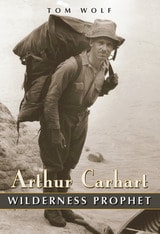
Arthur Carhart
Wilderness ProphetTom Wolf
University Press of Colorado, 2025
Arthur Carhart (1892-1978), America's first champion of wilderness, the first Forest Service landscape architect, and the most popular conservation writer of mid-century America, never won the titan status of his contemporary, Aldo Leopold. A political maverick, he refused to side with any major advocacy group and none has made him its saint. Carhart was a grassroots thinker in a top-down era.
Arthur Carhart, the first biography of this Republican environmentalist and major American thinker, writer, and activist, reveals the currency of his ideas. Tom Wolf elucidates Carhart 's vision of conservation as "a job for all of us," with citizens, municipal authorities, and national leaders all responsible for the environmental effects of their decisions. Carhart loved the local and decried interest groups—from stockmens' associations to wilderness lobbies—as cliques attempting blanket control. He pressured land management agencies to base decisions on local ecology and local partnerships. A lifelong wilderness advocate who proposed the first wilderness preserve at Trappers Lake, Colorado, in 1919, Carhart chose to oppose the Wilderness Act, heartsick at its compromises with lobbies.
Because he shifted his stance and changed his views in response to new information, Carhart is not an easy subject for a biography. Wolf traces Carhart's twists and turns to show a man whose voice was distinctive and contrary and who spoke from a passionate concern for the land and couldn't be counted on for anything else. Readers of American history and outdoor writing will enjoy this portrait of a historic era in conservation politics and the man who so often eschewed politics in favor of the land and people he loved.
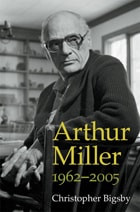
Arthur Miller
1962-2005Christopher Bigsby
University of Michigan Press, 2013
Christopher Bigsby's masterful two-volume biography of Arthur Miller sheds new light on one of the twentieth century's most acclaimed literary figures. Plays such as Death of a Salesman, A View from the Bridge, and The Crucible brought Miller an international following, and events such as his refusal to provide information to the House Un-American Activities Committee and his marriage to Marilyn Monroe kept him in the public eye. The second half of his life, the focus of this volume, proved no less fascinating. In 1962, Monroe died, and he married photographer Inge Morath, a relationship that transformed him as a writer and as a person. His activism in support of political and social causes only increased during the period, including criticism of U.S. foreign policy in Vietnam and contemporary conflicts in the Middle East. In this period of his life, he also became renowned for his work in support of dissident writers in Russia, Czechoslovakia, China, and elsewhere.
The second volume of this magisterial biography offers a compelling narrative of a singular American life, a life story enriched by the biographer's uncommon access to Miller and his unpublished papers while researching this book. The result is an authoritative biography that provides illuminating detail and invaluable insights into the Miller the artist and Miller the man.

Arthur Vandenberg
The Man in the Middle of the American CenturyHendrik Meijer
University of Chicago Press, 2017
Originally the editor and publisher of the Grand Rapids Herald, Vandenberg was appointed and later elected to the Senate in 1928, where he became an outspoken opponent of the New Deal and a leader among the isolationists who resisted FDR’s efforts to aid European allies at the onset of World War II. But Vandenberg soon recognized the need for unity at the dawn of a new world order; and as a Republican leader, he worked closely with Democratic administrations to build the strong bipartisan consensus that established the Marshall Plan, the United Nations, and NATO. Vandenberg, as Meijer reveals, was instrumental in organizing Congressional support for these monumental twentieth-century foreign policy decisions.
Vandenberg’s life and career offer powerful lessons for today, and Meijer has given us a story that suggests an antidote to our current democratic challenges. After reading this poignant biography, many will ask: Where is the Vandenberg of today?

Artificial Southerner
Equivocations and Love SongsPhilip Martin
University of Arkansas Press, 2001
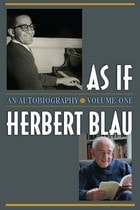
As If
An AutobiographyHerbert Blau
University of Michigan Press, 2012
As If: An Autobiography traces the complex life and career of director, scholar, and theorist Herbert Blau, one of the most innovative voices in the American theater. From his earliest years on the streets of Brooklyn, with gang wars there, to the often embattled, now-legendary Actor's Workshop of San Francisco, the powerfully told story of Blau's first four decades is also a social history, moving from the Great Depression to the cold war, with fallout from "the balance of terror" on what he once described in an incendiary manifesto as The Impossible Theater.
Blau has always forged his own path, from his activist resistance to the McCarthy witch hunts to his emergence as a revolutionary director whose work included the controversial years at The Workshop, which introduced American audiences to major playwrights of the European avant-garde, including Brecht, Beckett, Genet, and Pinter. There is also an account here of that notorious production of Waiting for Godot at the maximum-security prison at San Quentin, which became the insignia of the Theater of the Absurd.
Blau went on from The Workshop to become codirector of the Repertory Theater of Lincoln Center, and then founding provost of California Institute of the Arts, where he developed and became artistic director of the experimental group KRAKEN. Currently Byron W. and Alice L. Lockwood Professor of the Humanities at the University of Washington, Blau has been visionary in the passage from theater to theory, and his many influential and award-winning books include The Dubious Spectacle: Extremities of Theater, 1976–2000; Sails of the Herring Fleet: Essays on Beckett; Nothing in Itself: Complexions of Fashion; To All Appearances: Ideology and Performance; The Audience; The Eye of Prey: Subversions of the Postmodern; and Take Up the Bodies: Theater at the Vanishing Point.
This richly evocative book includes never-before-published photographs of the author, his family and friends, collaborators in the theater, and theater productions.
As Told By Herself
Women’s Childhood Autobiography, 1845-1969Lorna Martens
University of Wisconsin Press, 2022
Stopping just before second-wave feminism brought an explosion in women's childhood autobiographical writing, As Told by Herself explores the genre's roots and development from the mid-nineteenth century, and recovers many works that have been neglected or forgotten. The result illustrates how previous generations of women—in a variety of places and circumstances—understood themselves and their upbringing, and how they thought to present themselves to contemporary and future readers.
As the Twig Is Bent
A MemoirWallace Byron Grange, Edited by Joseph L. Breitenstein and Richard P. Thiel
University of Wisconsin Press, 2020
Written when Grange was in his sixties, As the Twig Is Bent conveys how a leading conservationist was formed through his early relationship to nature. In beautifully composed vignettes, he details encounters both profound and minute, from the white-footed mice attracted by cookie crumbs in his boyhood clubhouse to the sounds of great horned owls echoing through the wintry woods. As he develops his own understanding of the natural world, he comes to an awareness of the dramatic and devastating role of humankind on ecosystems. Grange’s poignant observations still resonate today amid global conversations about the fate of our natural resources and climate change.
Asian American X
An Intersection of Twenty-First Century Asian American VoicesArar Han and John Y. Hsu, Editors
University of Michigan Press, 2004
-Eric Liu, author of The Accidental Asian
"There's fury, dignity, and self-awareness in these essays. I found the voices to be energetic and the ideas exciting."
-Diana Son, playwright (Stop Kiss) and co-producer (Law & Order: Criminal Intent)
This refreshing and timely collection of coming-of-age essays, edited and written by young Asian Americans, powerfully captures the joys and struggles of their evolving identities as one of the fastest-growing groups in the nation and poignantly depicts the many oft-conflicting ties they feel to both American and Asian cultures. The essays also highlight the vast cultural diversity within the category of Asian American, yet ultimately reveal how these young people are truly American in their ideals and dreams.
Asian American X is more than a book on identity; it is required reading both for young Asian Americans who seek to understand themselves and their social group, and for all who are interested in keeping abreast of the changing American social terrain.

Asmahan's Secrets
Woman, War, and SongBy Sherifa Zuhur
University of Texas Press, 2001
The great Arab singer Asmahan was the toast of Cairo song and cinema in the late 1930s and early 1940s, as World War II approached. She remained a figure of glamour and intrigue throughout her life and lives on today in legend as one of the shaping forces in the development of Egyptian popular culture. In this biography, author Sherifa Zuhur does a thorough study of the music and film of Asmahan and her historical setting.
A Druze princess actually named Amal al-Atrash, Asmahan came from an important clan in the mountains of Syria but broke free from her traditional family background, left her husband, and became a public performer, a role frowned upon for women of the time.
This unique biography of the controversial Asmahan focuses on her public as well as her private life. She was a much sought-after guest in the homes of Egypt's rich and famous, but she was also rumored to be an agent for the Allied forces during World War II.
Through the story of Asmahan, the reader glimpses not only aspects of the cultural and political history of Egypt and Syria between the two world wars, but also the change in attitude in the Arab world toward women as public performers on stage. Life in wartime Cairo comes alive in this illustrated account of one of the great singers of the Arab world, a woman who played an important role in history.
Asquith
Stephen Bates
Haus Publishing, 2006
Assassin of Youth
A Kaleidoscopic History of Harry J. Anslinger’s War on DrugsAlexandra Chasin
University of Chicago Press, 2016
In Assassin of Youth, Alexandra Chasin gives us a lyrical, digressive, funny, and ultimately riveting quasi-biography of Anslinger. Her treatment of the man, his times, and the world that arose around and through him is part cultural history, part kaleidoscopic meditation. Each of the short chapters is anchored in a historical document—the court decision in Webb v. US (1925), a 1935 map of East Harlem, FBN training materials from the 1950s, a personal letter from the Treasury Department in 1985—each of which opens onto Anslinger and his context. From the Pharmacopeia of 1820 to death of Sandra Bland in 2015, from the Pennsylvania Railroad to the last passenger pigeon, and with forays into gangster lives, CIA operatives, and popular detective stories, Chasin covers impressive ground. Assassin of Youth is as riotous and loose a history of drug laws as can be imagined—and yet it culminates in an arresting and precise revision of the emergence of drug prohibition.
Today, even as marijuana is slowly being legalized, we still have not fully reckoned with the racist and xenophobic foundations of our cultural appetite for the severe punishment of drug offenders. In Assassin of Youth, Chasin shows us the deep, twisted roots of both our love and our hatred for drug prohibition.
Assassination of a Michigan King
The Life of James Jesse StrangRoger Van Noord
University of Michigan Press, 1997
As a young man, Strang was a dreamer of grandiose dreams--dreams of power, of royalty, and of fame. For him, the dreams came true. But in his pursuit of those dreams, Strang walked a tightrope to avoid ever-impending doom. Strang's kingdom flourished despite perennial conflicts with non-Mormons, including a gun battle with mainlanders, and despite a major prosecution by the federal government. His kingdom was designed to be totally independent of the state and nation. And yet, he was a shrewd political tactician who took advantage of Michigan law to be twice elected to the state legislature and become what one Detroit newspaper called the most powerful politician in the state.
Here is Strang the man of contrasts and contradictions, the strident opponent of polygamy and the husband of five wives, the astute editor and the incendiary propagandist, the prophet and the scoundrel, the man who through the sheer force of his personality made his followers a group to be feared in his region.
Vast amount of fresh information, including contemporary journals, documents, and letters never before used by biographers help draw a portrait of one of the most complex and resourceful leaders in American history.

Asylum, Prison, and Poorhouse
The Writings and Reform Work of Dorothea Dix in IllinoisDavid L. Lightner
Southern Illinois University Press, 1999
This illustrated collection of annotated newspaper articles and memorials by Dorothea Dix provides a forum for the great mid-nineteenth-century humanitarian and reformer to speak for herself.
Dorothea Lynde Dix (1802–87) was perhaps the most famous and admired woman in America for much of the nineteenth century. Beginning in the early 1840s, she launched a personal crusade to persuade the various states to provide humane care and effective treatment for the mentally ill by funding specialized hospitals for that purpose. The appalling conditions endured by most mentally ill inmates in prisons, jails, and poorhouses led her to take an active interest also in prison reform and in efforts to ameliorate poverty.
In 1846–47 Dix brought her crusade to Illinois. She presented two lengthy memorials to the legislature, the first describing conditions at the state penitentiary at Alton and the second discussing the sufferings of the insane and urging the establishment of a state hospital for their care. She also wrote a series of newspaper articles detailing conditions in the jails and poorhouses of many Illinois communities.
These long-forgotten documents, which appear in unabridged form in this book, contain a wealth of information on the living conditions of some of the most unfortunate inhabitants of Illinois. In his preface, David L. Lightner describes some of the vivid images that emerge from Dorothea Dix's descriptions of social conditions in Illinois a century and a half ago: "A helpless maniac confined throughout the bitter cold of winter to a dark and filthy pit. Prison inmates chained in hallways and cellars because no more men can be squeezed into the dank and airless cells. Aged paupers auctioned off by county officers to whoever will maintain them at the lowest cost."
Lightner provides an introduction to every document, placing each memorial and newspaper article in its proper social and historical context. He also furnishes detailed notes, making these documents readily accessible to readers a century and a half later. In his final chapter, Lightner assesses both the immediate and the continuing impact of Dix's work.

At Home with André and Simone Weil
Sylvie Weil, translated from the French by Benjamin Ivry
Northwestern University Press, 2010
“It is quite incorrect to believe that the dead are gone forever and never return to speak to the living. They return to speak to the living all the time; indeed, it is their main activity.” Thus writes Sylvie Weil in this illuminating memoir, in which contemporary readers can hear the voices of her famed philosopher aunt Simone and mathematician father André.
Born into a freethinking Jewish family in France in 1909, Simone Weil was one of the twentieth century’s most original philosophers, influencing Albert Camus, T. S. Eliot, Simone de Beauvoir, Pope John XXIII, Czesław Miłosz, and Susan Sontag. She fought for workers’ rights and, later, the Spanish Republican cause. Before her death at age thirty-four, Simone Weil turned increasingly to mysticism and religion, especially Roman Catholicism, exploring themes of sacrifice, asceticism, and the virtues of manual labor. She never converted, however, and Sylvie Weil writes from a Jewish perspective, emphasizing Simone’s Jewish heritage.
Using previously unpublished family correspondence and conversations, Sylvie Weil paints the most vivid, private portrait of her aunt in print. The book illuminates Simone’s relationship with others, especially with her brother, André. Loving and unsparing, affectionate and incisive, At Home with André and Simone Weil is an insightful memoir about a family of intellectual luminaries.
At Home
Historic Houses of Eastern MassachusettsBeth Luey
University of Massachusetts Press, 2019
In At Home: Historic Houses of Eastern Massachusetts, Beth Luey uses architectural and genealogical texts, wills, correspondences, and diaries to craft delightful narratives of these notable abodes and the people who variously built, acquired, or renovated them. Filled with vivid details and fresh perspectives that will surprise even the most knowledgeable aficionados, each chapter is short enough to serve as an introduction for a visit to its house. All the homes are open to the public.
At Lincoln's Side
John Hay's Civil War Correspondence and Selected WritingsEdited by Michael Burlingame
Southern Illinois University Press, 2006
John Hay believed that “real history is told in private letters,” and the more than 220 surviving letters and telegrams from his Civil War days prove that to be true, showing Abraham Lincoln in action: “The Tycoon is in fine whack. I have rarely seen him more serene & busy. He is managing this war, the draft, foreign relations, and planning a reconstruction of the Union, all at once. I never knew with what tyrannous authority he rules the Cabinet, till now. The most important things he decides & there is no cavil.”
Along with Hay’s personal correspondence, Burlingame includes his surviving official letters. Though lacking the “literary brilliance of [Hay’s] personal letters,” Burlingame explains, “they help flesh out the historical record.” Burlingame also includes some of the letters Hay composed for Lincoln’s signature, including the celebrated letter of condolence to the Widow Bixby.
More than an inside glimpse of the Civil War White House, Hay’s surviving correspondence provides a window on the world of nineteenth-century Washington, D.C.

At the Edge of the Abyss
A Concentration Camp Diary, 1943-1944David Koker; Edited by Robert Jan van Pelt; Translated from the Dutch by Michiel Horn and John Irons
Northwestern University Press, 2012
Finalist for 2012 National Jewish Book Award in the Holocaust category
David Koker's diary is one of the most notable accounts of life in a German concentration camp written by a Jew during the years of the Holocaust. First brought to attention when the Dutch historian Jacob Presser-Koker's history teacher in high school-quoted from Koker's diary in his monumental history, published in English as The Destruction of the Dutch Jews (1968), the diary itself became a part of the Dutch literary canon when it was published in 1977 as Dagboek geschreven in Vught (Diary Written in Vught). It has remained in print ever since, and is notable for its literary qualities, weaving poetry and powerful observations of the emotional life of a camp prisoner, including reflections after an in-person visit by Heinrich Himmler. Surprisingly, the book has never before been translated into English.
During his time in the Vught concentration camp, the 21-year-old David recorded on an almost daily basis his observations, thoughts, and feelings. He mercilessly probed the abyss that opened around him and, at times, within himself. David's diary covers almost a year, both charting his daily life in Vught as it developed over time and tracing his spiritual evolution as a writer. Until early February 1944, David was able to smuggle some 73,000 words from the camp to his best friend Karel van het Reve, a non-Jew.
With an informative introduction, annotation, and list of dramatis personae by Robert Jan van Pelt, At the Edge of the Abyss offers an immediate and wholly original look into the life of a concentration camp prisoner.
At the Heart of It
Ordinary People, Extraordinary LivesWalt Harrington
University of Missouri Press, 1996
Delving into the everyday lives of real, everyday people, Walt Harrington skillfully draws the reader into an intimate relationship with the men and women profiled in this powerful collection of stories--people like V. I. Smith, a homicide detective; Deane Guy, a stock car racer; Jackie Jordan, a social worker in family services; and Sheri D'Amato, a girls' soccer coach.
Originally appearing in the Washington Post Magazine, these stories, which capture a cross section of Americans, stand out in the field of journalism because of the unique way in which Walt Harrington uses unheralded, individual lives to elaborate on the great human issues of the day. In "Mothers and Daughters" three generations of women discuss how society affected the choices they made and who they became. "The Mystery of Goodness" follows a Harvard-educated lawyer who handles death-row cases for very little money because he feels the system is unfair to African Americans. In "To Have and Have Not" a young couple with two small children struggle to make ends meet. Harrington describes in detail the creation of a poem by Rita Dove, then United States Poet Laureate, in "The Shape of Her Dreaming."
Harrington has adeptly combined sociology and journalism into beautiful prose. As "literary journalism," the stories employ scene, dialogue, and physical description within a narrative framework. At the same time, they also adhere to all the traditional journalistic standards of accuracy, fairness, and balance. As a result, At the Heart of It represents a subgenre that is rarely practiced and seldom understood even within the profession of journalism.
All of these stories are snapshots, pieces of everyday life in America that are intended to be a mirror held to the lives of readers. These are not stories about which you can remain neutral; even the most casual readers will be moved by the glimpses Walt Harrington provides us of ourselves.

Athens, Ohio
The Village YearsRobert L. Daniel
Ohio University Press, 1997
Two hundred years ago, Rufus Putnam, leader of the Ohio Company, sent eleven men west into the Ohio Country to found what is now the City of Athens. As one of the oldest communities in Ohio, Athens has a heritage rich in history and lore. Now, as Athens looks ahead to its third century, historian and raconteur Robert L. Daniel provides a timely assessment of the community’s past.
Drawing on reminiscences by Athens residents over the past two centuries, and on newspaper accounts, institutional archives, census records, and a host of historic photographs and drawings, Daniel illustrates how the Athens community grew, how it changed over the years, and what it was like to have lived in Athens in the past, from the times before white settlement to 1920. He identifies the problems the community faced and how it went about resolving them—its efforts to provide local government, the changing ways its people earned a living, the ways they worshipped, their efforts to establish Ohio University, how they coped during times of war, and what they did to amuse themselves.
In a lively style peppered with firsthand accounts by the people who made Athens, Daniel narrates his tale with wry humor and a sharp eye for detail. Always focusing on the people who lived there, he brings Athens to life during its village years.
Atlantis, an Autoanthropology
Nathaniel Tarn
Duke University Press, 2022

Atoms in the Family
My Life with Enrico FermiLaura Fermi
University of Chicago Press, 1995