Results by title
4917 books match the query 'Philosophy' and 406 start with a
An Ethics of Remembering
History, Heterology, and the Nameless OthersEdith Wyschogrod
University of Chicago Press, 1998
Edith Wyschogrod animates such questions through the passionate figure of the "heterological historian." Realizing the philosophical impossibility of ever recovering "what really happened," this historian nevertheless acknowledges a moral imperative to speak for those who have been rendered voiceless, to give countenance to those who have become faceless, and hope to the desolate. Wyschogrod also weighs the impact of modern archival methods, such as photographs, film, and the Internet, which bring with them new constraints on the writing of history and which mandate a new vision of community. Drawing on the works of continental philosophers, historiographers, cognitive scientists, and filmmakers, Wyschogrod creates a powerful new framework for the understanding of history and the ethical duties of the historian.
An Imaginative Whig
Reassessing the Life and Thought of Edmund BurkeEdited & Intro by Ian Crowe
University of Missouri Press, 2005

An Innocent Abroad
Lectures in ChinaJ. Hillis Miller
Northwestern University Press, 2015
Since 1988, J. Hillis Miller has traveled to China to lecture on literary theory, especially the role of globalization in literary theory. Over time, he has assisted in the development of distinctively Chinese forms of literary theory, Comparative Literature, and World Literature. The fifteen lectures gathered in An Innocent Abroad span both time and geographic location, reflecting his work at universities across China for more than twenty-five years. More important, they reflect the evolution of Miller’s thinking and of the lectures’ contexts in China as these have markedly changed over the years, especially on either side of Tiananmen Square and in light of China’s economic growth and technological change. A foreword by the leading theorist Fredric Jameson provides additional context.

An Introduction To Hegel
The Stages of Modern PhilosophyHoward P. Kainz
Ohio University Press, 1996
In a sense it would be inappropriate to speak of “Hegel’s system of philosophy,” because Hegel thought that in the strict sense there is only one system of philosophy evolving in the Western world. In Hegel’s view, although at times philosophy’s history seems to be a chaotic series of crisscrossing interpretations of meanings and values, with no consensus, there has been a teleological development and consistent progress in philosophy and philosophizing from the beginning; Hegel held that his own version of “German idealism” was simply bringing to final expression the latest refinements of an ongoing, perennial system.
If we take Hegel at his word, then one of the best entries into his system would be through the history of philosophy, showing how systems and schools of thought prior to Hegel led up to his system. The most important currents to focus on, however, would be in modern philosophy, in which especially intensive changes led ultimately to German idealism and Hegel’s immediate predecessors.
Fortunately, Hegel lectured extensively on the history of modern philosophy and structured his lectures in such a way as to throw light on the status of the “one system” of Western philosophy at the time — the status to which Hegel felt he had been contributing and was continuing to contribute. These lectures are of interest, first of all, as a systematic chronicle of philosophical positions in the heyday of modern philosophy, from Bacon to Hegel. Second, they are interesting because Hegel’s critical comments on his predecessors clarify his own positions: for example, the dialectic method and the importance of triplicity, the relationship of philosophy to the scientific method, the necessity for avoidance of the extremes of empiricism and of idealism, the subject/object problematic, the “identity” of rationality and reality, and the technical meaning in Hegel’s philosophy of “absolute,” “infinity,” and the “idea.”
An Orderly Mess
Helga Nowotny
Central European University Press, 2017
An Unnatural Attitude
Phenomenology in Weimar Musical ThoughtBenjamin Steege
University of Chicago Press, 2021
An Unnatural Attitude traces a style of musical thought that coalesced in the intellectual milieu of the Weimar Republic—a phenomenological style that sought to renew contact with music as a worldly circumstance. Deeply critical of the influence of naturalism in aesthetics and ethics, proponents of this new style argued for the description of music as something accessible neither through introspection nor through experimental research, but rather in an attitude of outward, open orientation toward the world. With this approach, music acquires meaning in particular when the act of listening is understood to be shared with others.
Benjamin Steege interprets this discourse as the response of a young, post–World War I generation amid a virtually uninterrupted experience of war, actual or imminent—a cohort for whom disenchantment with scientific achievement was to be answered by reasserting the value of imaginative thought. Steege draws on a wide range of published and unpublished texts from music theory, pedagogy, criticism, and philosophy of music, some of which appear for the first time in English translation in the book’s appendixes. An Unnatural Attitude considers the question: What are we thinking about when we think about music in non-naturalistic terms?
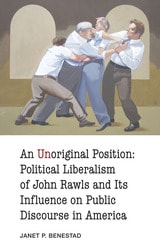
An Unoriginal Position
Political Liberalism of John Rawls and Its Influence on Public Discourse in AmericaJanet P. Benestad
St. Augustine's Press, 2026
An Utterly Dark Spot
Gaze and Body in Early Modern PhilosophyMiran Bozovic
University of Michigan Press, 2000
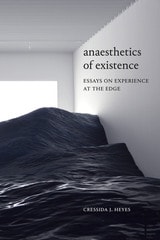
Anaesthetics of Existence
Essays on Experience at the EdgeCressida J. Heyes
Duke University Press, 2020
“Experience” is a thoroughly political category, a social and historical product not authored by any individual. At the same time, “the personal is political,” and one's own lived experience is an important epistemic resource. In Anaesthetics of Existence Cressida J. Heyes reconciles these two positions, drawing on examples of things that happen to us but are nonetheless excluded from experience. If for Foucault an “aesthetics of existence” was a project of making one's life a work of art, Heyes's “anaesthetics of existence” describes antiprojects that are tacitly excluded from life—but should be brought back in. Drawing on critical phenomenology, genealogy, and feminist theory, Heyes shows how and why experience has edges, and she analyzes phenomena that press against those edges. Essays on sexual violence against unconscious victims, the temporality of drug use, and childbirth as a limit-experience build a politics of experience while showcasing Heyes's much-needed new philosophical method.

Analogy after Aquinas
Domenic D'Ettore
Catholic University of America Press, 2018
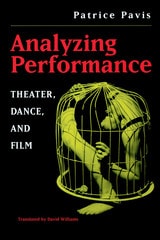
Analyzing Performance
Theater, Dance, and FilmPatrice Pavis
University of Michigan Press, 2003
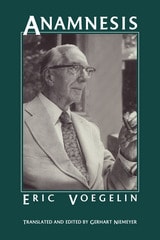
Anamnesis
On the Theory of History and PoliticsEric Voegelin, Edited & Translated by Gerhart Niemeyer
University of Missouri Press, 1990
Anamnesis pulls together those materials that focus most sharply upon the development of Eric Voegelin's philosophy of consciousness. Voegelin is considered one of the most influential and profound philosophers of our time and has had an enormous impact on contemporary intellectual life.
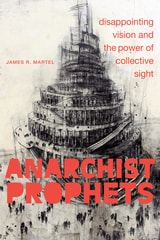
Anarchist Prophets
Disappointing Vision and the Power of Collective SightJames R. Martel
Duke University Press, 2022
Anarchy, Order and Integration
How to Manage InterdependenceHarvey Starr
University of Michigan Press, 2000
Anarchy—In a Manner of Speaking
Conversations with Mehdi Belhaj Kacem, Nika Dubrovsky, and Assia Turquier-ZaubermanDavid Graeber
Diaphanes, 2020
Graeber has offered up perhaps the most credible path for exiting capitalism—as much through his writing about debt, bureaucracy, or “bullshit jobs” as through his crucial involvement in the Occupy Wall Street movement, which led to his more-or-less involuntary exile from the American academy. In short, Anarchy—In a Manner of Speaking presents a series of interviews with a first-rate intellectual, a veritable modern hero on the order of Julian Assange, Edward Snowden, Linus Torvald, Aaron Swartz, and Elon Musk.
Interviewers Mehdi Belhaj Kacem and Assia Turquier-Zauberman asked Graeber not only about the history of anarchy, but also about its contemporary relevance and future. Their conversation also explores the ties between anthropology and anarchism, and the traces of its DNA in the Occupy Wall Street and Yellow Vest movements. Finally, Graeber discussed the meaning of anarchist ethics—not only in the political realm, but also in terms of art, love, sexuality, and more. With astonishing humor, verve, and erudition, this book redefines the contours of what could be (in the words of Peter Kropotkin) “anarchist morality” today.
Anaximander
Carlo Rovelli
Westholme Publishing, 2011
THIS EBOOK IS NO LONGER AVAILABLE.
Anchors in the Heavens
The Metaphysical Infrastructure of Human LifeRémi Brague
St. Augustine's Press, 2017
Our own world is more like this scenario than we at first may be inclined to admit, not least in the fact that, mutatis mutandis, we seem to be struggling to come up with a good answer. The problem, says Rémi Brague, is fundamentally a metaphysical one. Now, mention of ‘metaphysics’ in decent society these days is likely to elicit a smile or an unimpressed shrug. If there is a shelf with that label on it in your typical bookstore you are as likely to find guides to crystals, chakras, or hemp care there as you are treatises by Aristotle, Aquinas, or Kant. And, in spite of the ongoing revival of academic interest in metaphysics, it remains a rather specialist domain, a marginal sub-discipline in departments of philosophy, be they analytical or continental in cast. If you should take it too seriously, you’ll lose your bearings in the real world, and you’ll go adrift in some ethereal sea of dreams.
It is, in a word, irrelevant – right?
Wrong, Brague writes. Sustained reflection on the nature of being, undertaken in the hope that something can indeed be said about it, was for millennia considered to be among the most important of intellectual pursuits, and not without reason. With his characteristic combination of erudition and wit, Brague takes us on a sweeping tour of the discipline’s varying fortunes, from its early Athenian practitioners through its Jewish, Muslim, and Christian heirs, to the chorus of critics who in the last few centuries succeeded in putting an end to its dominance.
But the questions that metaphysics was asking, Brague shows, did not disappear with its demise, and so, whether implicitly or explicitly, metaphysics itself has resisted relegation to the history books. For the nature of being, and especially our relationship to it, has continued to haunt its triumphant critics. One quintessentially metaphysical claim above all, as Brague suggests, seems to have horrified them: the doctrine that all that is, insofar as it is, is good. And yet, in rejecting the “convertibility” of the “transcendentals” of being and goodness, critics of the old metaphysics – Voltaire, Kant, Schopenhauer, Nietzsche, Heidegger, Carnap, and Levinas among them – in their own ways offered metaphysical counter-claims, even as they turned increasingly anthropological in their interests.
They also raised the stakes. For, whether the denial of the goodness of being can legitimately be attributed some causal responsibility for a world in which our species could rapidly and deliberately ensure its own extinction, this is the world we live in, and that denial does form the basis of the intellectual background from which we tend to begin our speculations. If we need to be able to articulate reasons for our project not to end, then we also need to rethink the rejection that we have come to take for granted.
What Brague offers us here is not a narrative of decline, not a Jeremiad, not a nostalgic lament for the thought-world of a bygone era, but a sympathetic outline of some of the major tensions in the philosophical underpinnings of the modernity that we all inhabit. As such, it forms a part of his ongoing effort take modernity “more seriously than it takes itself”, to expose its hidden foundations, and to push it to its logical conclusions. In so doing, he hopes to help clarify where it is that we are going as a species, and to ensure that wherever it is, there is room for us humans in it.
Ancient Muses
Archaeology and the ArtsEdited by John H. Jameson Jr., John E. Ehrenhard, and Christine A. Finn
University of Alabama Press, 2003
Known widely in Europe as “interpretive narrative archaeology,” the practice of using creative methods to interpret and present current knowledge of the past is gaining popularity in North America. This book is the first compilation of international case studies of the various artistic methods used in this new form of education—one that makes archaeology “come alive” for the nonprofessional. Plays, opera, visual art, stories, poetry, performance dance, music, sculpture, digital imagery—all can effectively communicate archaeological processes and cultural values to public audiences.
The contributors to this volume are a diverse group of archaeologists, educators, and artisans who have direct experience in schools, museums, and at archaeological sites. Citing specific examples, such as the film The English Patient, science fiction mysteries, and hypertext environments, they explain how creative imagination and the power of visual and audio media can personalize, contextualize, and demystify the research process. A 16-page color section illuminates their examples, and an accompanying CD includes relevant videos, music, web sites, and additional color images.
*
Ancients and Moderns
John K. Ryan
Catholic University of America Press, 2018

Andre Gorz
A Critical IntroductionConrad Lodziak and Jeremy Tatman
Pluto Press, 1997
In the first accessible introduction to his work in English, Lodziak and Tatman trace the development of Gorz's political and philosophical theory over a period of more than four decades. Gorz's influence on European intellectual and political culture is examined, as is Gorz's own formative influences.
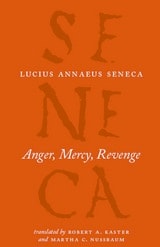
Anger, Mercy, Revenge
Lucius Annaeus Seneca
University of Chicago Press, 2010
Lucius Annaeus Seneca (4 BCE–65 CE) was a Roman Stoic philosopher, dramatist, statesman, and adviser to the emperor Nero, all during the Silver Age of Latin literature. The Complete Works of Lucius Annaeus Seneca is a fresh and compelling series of new English-language translations of his works in seven accessible volumes. Edited by world-renowned classicists Elizabeth Asmis, Shadi Bartsch, and Martha C. Nussbaum, this engaging collection restores Seneca—whose works have been highly praised by modern authors from Desiderius Erasmus to Ralph Waldo Emerson—to his rightful place among the classical writers most widely studied in the humanities.
Anger, Mercy, Revenge comprises three key writings: the moral essays On Anger and On Clemency—which were penned as advice for the then young emperor, Nero—and the Apocolocyntosis, a brilliant satire lampooning the end of the reign of Claudius. Friend and tutor, as well as philosopher, Seneca welcomed the age of Nero in tones alternately serious, poetic, and comic—making Anger, Mercy, Revenge a work just as complicated, astute, and ambitious as its author.
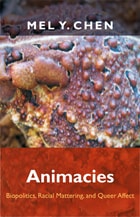
Animacies
Biopolitics, Racial Mattering, and Queer AffectMel Y. Chen
Duke University Press, 2012
Chen's book is the first to bring the concept of animacy together with queer of color scholarship, critical animal studies, and disability theory. Through analyses of dehumanizing insults, the meanings of queerness, animal protagonists in recent Asian/American art and film, the lead in toys panic in 2007, and the social lives of environmental illness, Animacies illuminates a hierarchical politics infused by race, sexuality, and ability. In this groundbreaking book, Chen rethinks the criteria governing agency and receptivity, health and toxicity, productivity and stillness—and demonstrates how attention to the affective charge of matter challenges commonsense orderings of the world.
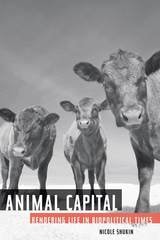
Animal Capital
Rendering Life in Biopolitical TimesNicole Shukin
University of Minnesota Press, 2009
Illuminates the profound contingency of market life on animal figures and flesh
The juxtaposition of biopolitical critique and animal studies—two subjects seldom theorized together—signals the double-edged intervention of Animal Capital. Nicole Shukin pursues a resolutely materialist engagement with the “question of the animal,” challenging the philosophical idealism that has dogged the question by tracing how the politics of capital and of animal life impinge on one another in market cultures of the twentieth and early twenty-first centuries.
Shukin argues that an analysis of capital’s incarnations in animal figures and flesh is pivotal to extending the examination of biopower beyond its effects on humans. “Rendering” refers simultaneously to cultural technologies and economies of mimesis and to the carnal business of boiling down and recycling animal remains. Rendering’s accommodation of these discrepant logics, she contends, suggests a rubric for the critical task of tracking the biopolitical conditions and contradictions of animal capital across the spaces of culture and economy.From the animal capital of abattoirs and automobiles, films and mobile phones, to pandemic fear of species-leaping diseases such as avian influenza and mad cow, Shukin makes startling linkages between visceral and virtual currencies in animal life, illuminating entanglements of species, race, and labor in the conditions of capitalism. In reckoning with the violent histories and intensifying contradictions of animal rendering, Animal Capital raises provocative and pressing questions about the cultural politics of nature.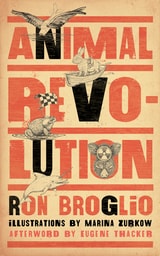
Animal Revolution
Ron Broglio
University of Minnesota Press, 2022
Why our failure to consider the power of animals is to our deep detriment
Animals are staging a revolution—they’re just not telling us. From radioactive boar invading towns to jellyfish disarming battleships, this book threads together news accounts and more in a powerful and timely work of creative, speculative nonfiction that imagines a revolution stirring and asks how humans can be a part of it. If the coronavirus pandemic has taught us anything, it is that we should pay attention to how we bump up against animal worlds and how animals will push back. Animal Revolution is a passionate, provocative, cogent call for us to do so.
Ron Broglio reveals how fur and claw and feather and fin are jamming the gears of our social machine. We can try to frame such disruptions as environmental intervention or through the lens of philosophy or biopolitics, but regardless the animals persist beyond our comprehension in reminding us that we too are part of an animal world. Animals see our technologies and machines as invasive beings and, in a nonlinguistic but nonetheless intensive mode of communicating with us, resist our attempts to control them and diminish their habitats. In doing so, they expose the environmental injustices and vulnerabilities in our systems.
A witty, informative, and captivating work—at the juncture of posthumanism, animal studies, phenomenology, and environmental studies—Broglio reminds us of our inadequacy as humans, not our exceptionalism.
Animal Rights
History and Scope of a Radical Social MovementHarold D. Guither
Southern Illinois University Press, 1998
In the past decade, philosopher Bernard Rollin points out, we have "witnessed a major revolution in social concern with animal welfare and the moral status of animals." Adopting the stance of a moderate, Harold Guither attempts to provide an unbiased examination of the paths and goals of the members of the animal rights movement and of its detractors.
Given the level of confusion, suspicion, misunderstanding, and mistrust between the two sides, Guither admits the difficulty in locating, much less staying in, the middle of the road. The philosophical conflict, however, is fairly clear: those who resist reform, fearing that radical change in the treatment of animals will infringe on their business and property rights, versus the new activists who espouse a different set of moral and ethical obligations toward animals.
From his position as a moderate, Guither presents a brief history of animal protection and the emergence of animal rights, describes the scope of the movement, and identifies major players such as Paul and Linda McCartney and organizations such as People for the Ethical Treatment of Animals that are actively involved in the movement. He concentrates on what is actually happening in the 1990s, discussing in detail the possible consequences of the current debate for those who own, use, or enjoy animals in entertainment and leisure pursuits. A reference work for students in animal sciences and veterinary medicine, the book also poses questions for philosophers, sociologists, and public policymakers as well as animal owners, animal and biomedical researchers, and manufacturers and distributors of animal equipment and supplies.
Animal Rites
American Culture, the Discourse of Species, and Posthumanist TheoryCary Wolfe
University of Chicago Press, 2002
Animal Sacrifices
edited by Tom Regan, introduction by John Bowker
Temple University Press, 1987
The issues of animal rights and the use of animals in scientific experimentation are fraught with controversy. In an effort to define the bases of such strong emotional response towards an ethical issue, this book presents the teachings of the major religions of the world concerning animals and, more specifically, their use in science. Judaism, Christianity, Islam, Hinduism, Jainism, Buddhism, and Confucianism are represented in this collection of eight essays by religious authorities.
Scriptural writings, written and oral tradition, law, religious parables, and even folklore are used to illustrate the position of each religion on this question. When there are no specific teachings regarding the relatively recent use of animals in scientific research, conclusions are derived from the view of man’s relations with the rest of the world.
In addition to the essays dealing with specific religions, there is also a chapter detailing recent uses of animals in scientific research throughout the world. It is estimated that 500 million animals a year are sacrificed to science. This volume attempts to find out for what purposes they are used, under what conditions, and with what legal protection.
Based on a conference which explored the views of religion toward scientific experimentation on animals, this collection of essays addresses an explosive issue from a number of different perspectives. Animal Sacrifices is a fair-minded and informative discussion of a contemporary ethical dilemma.
Contributors: John Bowker, Sidney Gendin, Rabbi Dr. J. David Bleich, Andrew Linzey, James Gaffney, Al-Hafiz, B. Z. Masri, Basant K. Lal, Christopher Chapple, Rodney L. Taylor, and the editor.
Animal, Vegetable, Digital
Experiments in New Media Aesthetics and Environmental PoeticsElizabeth Swanstrom
University of Alabama Press, 2016
An audacious, interdisciplinary study that combines the burgeoning fields of digital aesthetics and eco-criticism
In Animal, Vegetable, Digital, Elizabeth Swanstrom makes a confident and spirited argument for the use of digital art in support of ameliorating human engagement with the environment and suggests a four-part framework for analyzing and discussing such applications.
Through close readings of a panoply of texts, artworks, and cultural artifacts, Swanstrom demonstrates that the division popular culture has for decades observed between nature and technology is artificial. Not only is digital technology not necessarily a brick in the road to a dystopian future of environmental disaster, but digital art forms can be a revivifying bridge that returns people to a more immediate relationship to nature as well as their own embodied selves.
To analyze and understand the intersection of digital art and nature, Animal, Vegetable, Digital explores four aesthetic techniques: coding, collapsing, corresponding, and conserving. “Coding” denotes the way artists use operational computer code to blur distinctions between the reader and text, and, hence, the world. Inviting a fluid conception of the boundary between human and technology, “collapsing” voids simplistic assumptions about the human body’s innate perimeter. The process of translation between natural and human-readable signs that enables communication is described as “corresponding.” “Conserving” is the application of digital art by artists to democratize large- and small-scale preservation efforts.
A fascinating synthesis of literary criticism, communications and journalism, science and technology, and rhetoric that draws on such disparate phenomena as simulated environments, video games, and popular culture, Animal, Vegetable, Digital posits that partnerships between digital aesthetics and environmental criticism are possible that reconnect humankind to nature and reaffirm its kinship with other living and nonliving things.
Animals and Death
Hunting, Modernity, and the Crisis of the WildCharles Stépanoff
HAU, 2026

Animals' Best Friends
Putting Compassion to Work for Animals in Captivity and in the WildBarbara J. King
University of Chicago Press, 2021
Finalist for the 2021 Siskiyou Prize for New Environmental Literature
As people come to understand more about animals’ inner lives—the intricacies of their thoughts and the emotions that are expressed every day by whales and cows, octopus and mice, even bees—we feel a growing compassion, a desire to better their lives. But how do we translate this compassion into helping other creatures, both those that are and are not our pets? Bringing together the latest science with heartfelt storytelling, Animals’ Best Friends reveals the opportunities we have in everyday life to help animals in our homes, in the wild, in zoos, and in science labs, as well as those considered to be food.
Barbara J. King, an expert on animal cognition and emotion, guides us on a journey both animal and deeply human. We meet cows living relaxed lives in an animal sanctuary—and cows with plastic portals in their sides at a university research station. We observe bison free-roaming at Yellowstone National Park and chimpanzees confined to zoos. We learn with King how to negotiate vegetarian preferences in omnivore restaurants. We experience the touch of a giant Pacific octopus tasting King’s skin with one of his long, neuron-rich arms. We reflect on animal testing as King shares her own experience as the survivor of a particularly nasty cancer. And in a moment all too familiar to many of us, we recover from a close encounter with two spiders in the home.
This is a book not of shaming and limitation, but of uplift and expansion. Throughout this journey, King makes no claims of personal perfection. Though an animal expert, she is just like the rest of us: on a journey still, learning each day how to be better, and do better, for animals. But as Animals’ Best Friends makes clear, challenging choices can bring deep rewards. By turning compassion into action on behalf of animals, we not only improve animals’ lives—we also immeasurably enrich our own.
Animals, Mind, and Matter
The Inside StoryJosephine Donovan
Michigan State University Press, 2022
Annotations
On the Early Thought of W. E. B. Du BoisNahum Dimitri Chandler
Duke University Press, 2022
Anorexia and Mimetic Desire
René Girard
Michigan State University Press, 2008
Another Freedom
The Alternative History of an IdeaSvetlana Boym
University of Chicago Press, 2010
By offering a fresh look at the strange history of this idea, Another Freedom delivers a nuanced portrait of freedom, one whose repercussions will be felt well into the future.
Another Mother
Diotima and the Symbolic Order of Italian FeminismCesare Casarino
University of Minnesota Press, 2018
A groundbreaking volume introduces the unique feminist thought of the longstanding Italian group known as Diotima
Introducing Anglophone readers to a potent strain of Italian feminism known to French, Spanish, and German audiences but as yet unavailable in English, Another Mother argues that the question of the mother is essential to comprehend the matrix of contemporary culture and society and to pursue feminist political projects.
Focusing on Diotima, a community of women philosophers deeply involved in feminist politics since the 1960s, this volume provides a multifaceted panorama of its engagement with currents of thought including structuralism, psychoanalysis, linguistics, and Marxism. Starting from the simple insight that the mother is the one who gives us both life and language, these thinkers develop concepts of the mother and sexual difference in contemporary society that differ in crucial ways from both French and U.S. feminisms.
Arguing that Diotima anticipates many of the themes in contemporary philosophical discourses of biopolitics—exemplified by thinkers such as Giorgio Agamben, Antonio Negri, and Roberto Esposito—Another Mother opens an important space for reflections on the past history of feminism and on feminism’s future.
Contributors: Anne Emmanuelle Berger, Paris 8 U–Vincennes Saint-Denis; Ida Dominijanni; Luisa Muraro; Diana Sartori, U of Verona; Chiara Zamboni, U of Verona.

Anselm of Canterbury and the Desire for the Word
Eileen C. Sweeney
Catholic University of America Press, 2012
Anthropocene Feminism
Richard Grusin
University of Minnesota Press, 2017
What does feminism have to say to the Anthropocene? How does the concept of the Anthropocene impact feminism? This book is a daring and provocative response to the masculinist and techno-normative approach to the Anthropocene so often taken by technoscientists, artists, humanists, and social scientists. By coining and, for the first time, fully exploring the concept of “anthropocene feminism,” it highlights the alternatives feminism and queer theory can offer for thinking about the Anthropocene.
Feminist theory has long been concerned with the anthropogenic impact of humans, particularly men, on nature. Consequently, the contributors to this volume explore not only what current interest in the Anthropocene might mean for feminism but also what it is that feminist theory can contribute to technoscientific understandings of the Anthropocene. With essays from prominent environmental and feminist scholars on topics ranging from Hawaiian poetry to Foucault to shelled creatures to hypomodernity to posthuman feminism, this book highlights both why we need an anthropocene feminism and why thinking about the Anthropocene must come from feminism.
Contributors: Stacy Alaimo, U of Texas at Arlington; Rosi Braidotti, Utrecht U; Joshua Clover, U of California, Davis; Claire Colebrook, Pennsylvania State U; Dehlia Hannah, Arizona State U; Myra J. Hird, Queen’s U; Lynne Huffer, Emory U; Natalie Jeremijenko, New York U; Elizabeth A. Povinelli, Columbia U; Jill S. Schneiderman, Vassar College; Juliana Spahr, Mills College; Alexander Zahara, Queen’s U.
Anthropocene Islands
Entangled WorldsJonathan Pugh and David Chandler
University of Westminster Press, 2021
‘Ambitious, sophisticated, timely and downright inspirational.’ – Philip Hayward, University of Technology Sydney, Okinawan Journal of Island Studies
'A must read … a new analytical agenda for the Anthropocene, coherently drawing out the power of thinking with islands.' – Elena Burgos Martinez, Leiden University
‘This is an essential book. [The] analytics they propose … offer both a critical agenda for island studies and compass points through which to navigate the haunting past, troubling present, and precarious future.’ – Craig Santos Perez, University of Hawai’i, Manoa
‘All academic books should be like this: hard to put down. Informative, careful, sometimes devasting, yet absolutely necessary - if you read one book about the Anthropocene let it be this. You will never think of islands in the same way again.’ – Kimberley Peters, University of Oldenburg
‘ … a unique journey into the Anthropocene. Critical, generous and compelling’. — Nigel Clark, Lancaster University
The island has become a key figure of the Anthropocene – an epoch in which human entanglements with nature come increasingly to the fore. For a long time, islands were romanticised or marginalised, seen as lacking modernity’s capacities for progress, vulnerable to the effects of catastrophic climate change and the afterlives of empire and coloniality. Today, however, the island is increasingly important for both policy-oriented and critical imaginaries that seek, more positively, to draw upon the island’s liminal and disruptive capacities, especially the relational entanglements and sensitivities its peoples and modes of life are said to exhibit.
Anthropocene Islands: Entangled Worlds explores the significant and widespread shift to working with islands for the generation of new or alternative approaches to knowledge, critique and policy practices. It explains how contemporary Anthropocene thinking takes a particular interest in islands as ‘entangled worlds’, which break down the human/nature divide of modernity and enable the generation of new or alternative approaches to ways of being (ontology) and knowing (epistemology). The book draws out core analytics which have risen to prominence (Resilience, Patchworks, Correlation and Storiation) as contemporary policy makers, scholars, critical theorists, artists, poets and activists work with islands to move beyond the constraints of modern approaches. In doing so, it argues that engaging with islands has become increasingly important for the generation of some of the core frameworks of contemporary thinking and concludes with a new critical agenda for the Anthropocene.
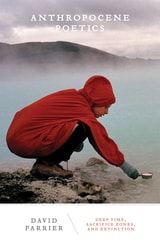
Anthropocene Poetics
Deep Time, Sacrifice Zones, and ExtinctionDavid Farrier
University of Minnesota Press, 2019
How poetry can help us think about and live in the Anthropocene by reframing our intimate relationship with geological time
The Anthropocene describes how humanity has radically intruded into deep time, the vast timescales that shape the Earth system and all life-forms that it supports. The challenge it poses—how to live in our present moment alongside deep pasts and futures—brings into sharp focus the importance of grasping the nature of our intimate relationship with geological time. In Anthropocene Poetics, David Farrier shows how contemporary poetry by Elizabeth Bishop, Seamus Heaney, Evelyn Reilly, and Christian Bök, among others, provides us with frameworks for thinking about this uncanny sense of time.
Looking at a diverse array of lyric and avant-garde poetry from three interrelated perspectives—the Anthropocene and the “material turn” in environmental philosophy; the Plantationocene and the role of global capitalism in environmental crisis; and the emergence of multispecies ethics and extinction studies—Farrier rethinks the environmental humanities from a literary critical perspective. Anthropocene Poetics puts a concern with deep time at the center, defining a new poetics for thinking through humanity’s role as geological agents, the devastation caused by resource extraction, and the looming extinction crisis.
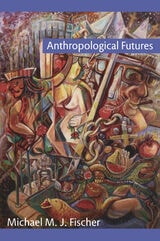
Anthropological Futures
Michael M. J. Fischer
Duke University Press, 2009
Fischer is particularly concerned with cultural anthropology’s interactions with science studies, and throughout the book he investigates how emerging knowledge formations in molecular biology, environmental studies, computer science, and bioengineering are transforming some of anthropology’s key concepts including nature, culture, personhood, and the body. In an essay on culture, he uses the science studies paradigm of “experimental systems” to consider how the social scientific notion of culture has evolved as an analytical tool since the nineteenth century. Charting anthropology’s role in understanding and analyzing the production of knowledge within the sciences since the 1990s, he highlights anthropology’s aptitude for tracing the transnational collaborations and multi-sited networks that constitute contemporary scientific practice. Fischer investigates changing ideas about cultural inscription on the human body in a world where genetic engineering, robotics, and cybernetics are constantly redefining our understanding of biology. In the final essay, Fischer turns to Kant’s philosophical anthropology to reassess the object of study for contemporary anthropology and to reassert the field’s primacy for answering the largest questions about human beings, societies, culture, and our interactions with the world around us. In Anthropological Futures, Fischer continues to advance what Clifford Geertz, in reviewing Fischer’s earlier book Emergent Forms of Life and the Anthropological Voice, called “a broad new agenda for cultural description and political critique.”
Anthropologies and Histories
Essays in Culture, History, and Political EconomyRoseberry, William
Rutgers University Press, 1989
"An extremely stimulating volume . . . rich and provocative, and codifies a new depature point."--Choice
"As a critic . . . Roseberry writes with sustained force and clarity. . . . his principal points emerge with a directness that will make this book attractive to a wide range of readers."--American Anthropologist
"Roseberry in among the most astute, careful, and theoretically cogent of the anthropologists of his generation. . . . [This book] illustrates well the breadth and coherence of his thinking and guides the reader through the complicated intersections of anthropology with history, political economy, Marxism, and Latin American studies."--Jane Schneider, CUNY In Anthropologies and Histories,
William Roseberry explores some of the cultural and political implications of an anthropological political economy. In his view, too few of these implications have been explored by authors who dismiss the very possibility of a political economic understanding of culture. Within political economy, readers are offered sophisticated treatments of uneven development, but when authors turn to culture and politics, they place contradictory social experiences within simplistic class or epochal labels. Within cultural anthropology, history is often little more than new terrain for extending anthropological practice. Roseberry places culture and history in relation to each other, in the context of a reflection on the political economy of uneven development. In the first half of this books, he looks at and critiques a variety of anthropological understandings of culture, arguing for an approach that sees culture as socially constituted and socially constitutive. Beginning with a commentary on Clifford Geertz's seminal essay on the Balinese cockfight, Roseberry argues that Geertz and his followers pay insufficient attention to cultural differentiation, to social and political inequalities that affect actors' different understandings of the world, other people, and of themselves. Sufficient attention to such questions, Roseberry argues, requires a concern for political economy. In the second half of the book, Roseberry explores the assumptions and practices of political economy, indicates the kind of problems that should be central to such an approach, and reviews some of the inadequacies of anthropological studies. William Roseberry is a professor of anthropology at the New School for Social Research.
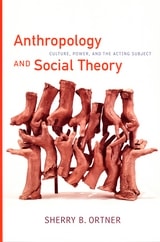
Anthropology and Social Theory
Culture, Power, and the Acting SubjectSherry B. Ortner
Duke University Press, 2006
Some of the essays reflect explicitly on theoretical concerns: the relationship between agency and power, the problematic quality of ethnographic studies of resistance, and the possibility of producing an anthropology of subjectivity. Others are ethnographic studies that apply Ortner’s theoretical framework. In these, she investigates aspects of social class, looking at the relationship between race and middle-class identity in the United States, the often invisible nature of class as a cultural identity and as an analytical category in social inquiry, and the role that public culture and media play in the creation of the class anxieties of Generation X. Written with Ortner’s characteristic lucidity, these essays constitute a major statement about the future of social theory from one of the leading anthropologists of our time.
Anthropology and the Politics of Representation
Gabriela Vargas-Cetina
University of Alabama Press, 2013
In Anthropology and the Politics of Representation volume editor Gabriela Vargas-Cetina brings together a group of international scholars who, through their fieldwork experiences, reflect on the epistemological, political, and personal implications of their own work. To do so, they focus on such topics as ethnography, anthropologists’ engagement in identity politics, representational practices, the contexts of anthropological research and work, and the effects of personal choices regarding self-involvement in local causes that may extend beyond purely ethnographic goals.
Such reflections raise a number of ethnographic questions: What are ethnographic goals? Who sets the agenda for ethnographic writing? How does fieldwork change the anthropologist’s identity? Do ethnography and ethnographers have an impact on local lives and self-representation? How do anthropologists balance long-held respect for cultural diversity with advocacy for local people? How does an author choose what to say and write, and what not to disclose? Should anthropologists support causes that may require going against their informed knowledge of local lives?
Anthropology and the Will to Meaning
A Postcolonial CritiqueVassos Argyrou
Pluto Press, 2002
Anthropology from a Pragmatic Point of View
Immanuel Kant. Translated by Victor Lyle Dowdell. Revised and Edited by Hans H. Rudnick
Southern Illinois University Press, 1996
In the fall semester of 1772/73 at the Albertus University of Königsberg, Immanuel Kant, metaphysician and professor of logic and metaphysics, began lectures on anthropology, which he continued until 1776, shortly before his retirement from public life. His lecture notes and papers were first published in 1798, eight years after the publication of the Critique of Judgment, the third of his famous Critiques. The present edition of the Anthropology is a translation of the text found in volume 7 of Kants gesammelte Schriften, edited by Oswald Külpe.
Kant describes the Anthropology as a systematic doctrine of the knowledge of humankind. (He does not yet distinguish between the academic discipline of anthropology as we understand it today and the philosophical.) Kant’s lectures stressed the "pragmatic" approach to the subject because he intended to establish pragmatic anthropology as a regular academic discipline. He differentiates the physiological knowledge of the human race—the investigation of "what Nature makes of man"—from the pragmatic—"what man as a free being makes of himself, what he can make of himself, and what he ought to make of himself." Kant believed that anthropology teaches the knowledge of humankind and makes us familiar with what is pragmatic, not speculative, in relation to humanity. He shows us as world citizens within the context of the cosmos.
Summarizing the cloth edition of the Anthropology, Library Journal concludes: "Kant’s allusions to such issues as sensation, imagination, judgment, (aesthetic) taste, emotion, passion, moral character, and the character of the human species in regard to the ideal of a cosmopolitan society make this work an important resource for English readers who seek to grasp the connections among Kant’s metaphysics of nature, metaphysics of morals, and political theory. The notes of the editor and translator, which incorporate material from Ernst Cassirer’s edition and from Kant’s marginalia in the original manuscript, shed considerable light on the text."
Anthropology
A Continental PerspectiveChristoph Wulf
University of Chicago Press, 2013
Anti-Oedipus
Capitalism and SchizophreniaGilles Deleuze
University of Minnesota Press, 1983
Antifoundationalism
edited by Tom Rockmore and Beth J. Singer
Temple University Press, 1991
Antigone as Political Philosophy
Gregor Moder, Tanja Dominko
Northwestern University Press, 2026
Offering a new perspective on Sophocles’s Antigone as a model for reimagining humanity’s future—and its end
Why read Antigone today? The premise of this accessible, essayistic work is that humanity finds itself at a crossroads, where it must reinvent itself or perish—a condition similar to Antigone’s own. Rereading Antigone via Hegel’s engagement with the text can help us understand what it means for a human age to come to an end: that is, to think of our age as an episode whose collapse is also an engine of historical change.
Gregor Moder argues that the task of humanity today may not be to defend the minimal remnants of our civilization but to say farewell to it—to give it a proper burial. As Moder explicates, the central problem of this foundational tragedy lies in the positions of brother and sister, man and woman, representing human and divine law and the institutions of the state and the family. Through a fresh reading of both Sophocles’s play and Hegel’s productive reworking of the Greek myth, Moder’s analysis shows that sometimes the only way through deep social contradictions is in unraveling the framework that has constructed them.
Aníbal Quijano
Foundational Essays on the Coloniality of PowerAnibal Quijano. Edited by Walter D. Mignolo, Rita Segato, and Catherine E. Walsh
Duke University Press, 2024