Results by title
3576 books match the query 'American' and 147 start with b
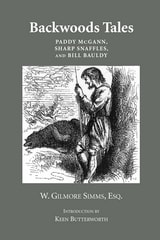
Backwoods Tales
Paddy McGann, Sharp Snaffles, and Bill BauldyWilliam Gilmore Simms
University of Arkansas Press, 2010
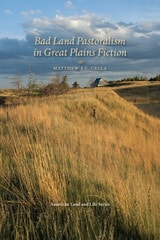
Bad Land Pastoralism in Great Plains Fiction
Matthew J. C. Cella
University of Iowa Press, 2010
At the core of this nuanced book is the question that ecocritics have been debating for decades: what is the relationship between aesthetics and activism, between art and community? By using a pastoral lens to examine ten fictional narratives that chronicle the dialogue between human culture and nonhuman nature on the Great Plains, Matthew Cella explores literary treatments of a succession of abrupt cultural transitions from the Euroamerican conquest of the “Indian wilderness” in the nineteenth century to the Buffalo Commons phenomenon in the twentieth. By charting the shifting meaning of land use and biocultural change in the region, he posits this bad land—the arid West—as a crucible for the development of the human imagination.
Each chapter deals closely with two novels that chronicle the same crisis within the Plains community. Cella highlights, for example, how Willa Cather reconciles her persistent romanticism with a growing disillusionment about the future of rural Nebraska, how Tillie Olsen and Frederick Manfred approach the tragedy of the Dust Bowl with strikingly similar visions, and how Annie Proulx and Thomas King use the return of the buffalo as the centerpiece of a revised mythology of the Plains as a palimpsest defined by layers of change and response. By illuminating these fictional quests for wholeness on the Great Plains, Cella leads us to understand the intricate interdependency of people and the places they inhabit.
Cella uses the term “pastoralism” in its broadest sense to mean a mode of thinking that probes the relationship between nature and culture: a discourse concerned with human engagement—material and nonmaterial—with the nonhuman community. In all ten novels discussed in this book, pastoral experience—the encounter with the Beautiful—leads to a renewed understanding of the integral connection between human and nonhuman communities. Propelling this tradition of bad land pastoralism are an underlying faith in the beauty of wholeness that comes from inhabiting a continuously changing biocultural landscape and a recognition of the inevitability of change. The power of story and language to shape the direction of that change gives literary pastoralism the potential to support an alternative series of ideals based not on escape but on stewardship: community, continuity, and commitment.
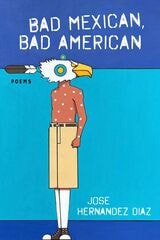
Bad Mexican, Bad American
PoemsJose Hernandez Diaz
Acre Books, 2024
In Bad Mexican, Bad American, the minimalist, working-class aesthetic of a “disadvantaged Brown kid” takes wing in prose poems that recall and celebrate that form’s ties to Surrealism. With influences like Alberto Ríos and Ray Gonzalez on one hand, and James Tate and Charles Baudelaire on the other, the collection spectacularly combines “high” art and folk art in a way that collapses those distinctions, as in the poem “My Date with Frida Kahlo”: “Frida and I had Cuban coffee and then vegetarian tacos. We sipped on mescal and black tea. At the end of the night, following an awkward silence during a conversation on Cubism, we kissed for about thirty minutes beneath a protest mural by David Alfaro Siqueiros.”
Bad Mexican, Bad American demonstrates how having roots in more than one culture can be both unsettling and rich: van Gogh and Beethoven share the page with tattoos, graffiti, and rancheras; Quetzalcoatl shows up at Panda Express; a Mexican American child who has never had a Mexican American teacher may become that teacher; a parent’s “broken” English is beautiful and masterful. Blending reality with dream and humility with hope, Hernandez Diaz contributes a singing strand to the complex cultural weave that is twenty-first-century poetry.
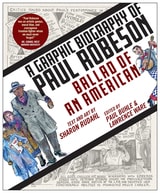
Ballad of an American
A Graphic Biography of Paul RobesonSharon Rudahl
Rutgers University Press, 2021
The first-ever graphic biography of Paul Robeson, Ballad of an American, charts Robeson’s career as a singer, actor, scholar, athlete, and activist who achieved global fame. Through his films, concerts, and records, he became a potent symbol representing the promise of a multicultural, multiracial American democracy at a time when, despite his stardom, he was denied personal access to his many audiences.
Robeson was a major figure in the rise of anti-colonialism in Africa and elsewhere, and a tireless campaigner for internationalism, peace, and human rights. Later in life, he embraced the civil rights and antiwar movements with the hope that new generations would attain his ideals of a peaceful and abundant world. Ballad of an American features beautifully drawn chapters by artist Sharon Rudahl, a compelling narrative about his life, and an afterword on the lasting impact of Robeson’s work in both the arts and politics. This graphic biography will enable all kinds of readers—especially newer generations who may be unfamiliar with him—to understand his life’s story and everlasting global significance.
Ballad of an American: A Graphic Biography of Paul Robeson is published in conjunction with Rutgers University’s centennial commemoration of Robeson’s 1919 graduation from the university.
Study guide for Ballad of an American: A Graphic Biography of Paul Robeson (https://d3tto5i5w9ogdd.cloudfront.net/wp-content/uploads/2021/05/10201015/YA_Adult-Study-Guide-for-A-Graphic-Biography-of-Paul-Robeson.pdf).
View the blad for Ballad of an American.
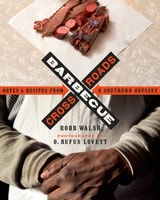
Barbecue Crossroads
Notes and Recipes from a Southern OdysseyBy Robb Walsh
University of Texas Press, 2013
In stories, recipes, and photographs, James Beard Award–winning writer Robb Walsh and acclaimed documentary photographer O. Rufus Lovett take us on a barbecue odyssey from East Texas to the Carolinas and back. In Barbecue Crossroads, we meet the pitmasters who still use old-fashioned wood-fired pits, and we sample some of their succulent pork shoulders, whole hogs, savory beef, sausage, mutton, and even some barbecued baloney. Recipes for these and the side dishes, sauces, and desserts that come with them are painstakingly recorded and tested.
But Barbecue Crossroads is more than a cookbook; it is a trip back to the roots of our oldest artisan food tradition and a look at how Southern culture is changing. Walsh and Lovett trace the lineage of Southern barbecue backwards through time as they travel across a part of the country where slow-cooked meat has long been part of everyday life. What they find is not one story, but many. They visit legendary joints that don’t live up to their reputations—and discover unknown places that deserve more attention. They tell us why the corporatizing of agriculture is making it difficult for pitmasters to afford hickory wood or find whole hogs that fit on a pit.
Walsh and Lovett also remind us of myriad ways that race weaves in and out of the barbecue story, from African American cooking techniques and recipes to the tastes of migrant farmworkers who ate their barbecue in meat markets, gas stations, and convenience stores because they weren’t welcome in restaurants. The authors also expose the ways that barbecue competitions and TV shows are undermining traditional barbecue culture. And they predict that the revival of the community barbecue tradition may well be its salvation.
Barbecue
The History of an American Institution, Revised and Expanded Second EditionRobert F. Moss
University of Alabama Press, 2020
The definitive history of an iconic American food, with new chapters, sidebars, and updated historical accounts.
Expert Robert F. Moss researched hundreds of sources—newspapers, letters, journals, diaries, and travel narratives—to document the origins and evolution of barbecue from its origins among Native Americans to its present status as an icon of American culture. In this definitive guide, he maps out the development of the rich array of regional barbecue styles, chronicles the rise of barbecue restaurants, and profiles the famed pitmasters who made the tradition what it is today.
Barbecue is the story not just of a dish but also of a social institution that helped shape many regional cultures of the United States. The history begins with British colonists’ adoption of barbecuing techniques from Native Americans in the 17th and 18th centuries, moves to barbecue’s establishment as the preeminent form of public celebration in the 19th century, and is carried through to barbecue’s ubiquitous standing today.
From the very beginning, barbecues were powerful social magnets, drawing together people from a wide range of classes and geographic backgrounds. Barbecue played a key role in three centuries of American history, both reflecting and influencing the direction of an evolving society. By tracing the story of barbecue from its origins to today, Barbecue: The History of an American Institution traces the very thread of American social history.
Moss has made significant updates in this new edition, offering a wealth of new historical research, sources, illustrations, and anecdotes.
Bardic Deadlines
Reviewing Poetry, 1984-95Geoffrey O'Brien
University of Michigan Press, 1998
In Bardic Deadlines, writer and editor Geoffrey O'Brien collects twenty of his essays on poetry that originally appeared in the Voice Literary Supplement and the New York Review of Books. O'Brien surveys an array of some of the most striking and innovative poets to emerge in recent decades, including Susan Howe, August Kleinzahler, Clark Coolidge, Nathaniel Mackey, Gustaf Sobin, and Michael O'Brien. Discussions of contemporary work are juxtaposed with considerations of other traditions going as far back as the second-century Chinese anthology The Songs of the South and the Sanskrit master Kalidasa, traditions considered highly relevant to current practice. There are engaging, in-depth portraits of the work of poets John Clare, Hugh MacDiarmid, Emily Brontë, Kenji Miyazawa, and Frank O'Hara, among others. There is also an exploration of the poetics of Walt Whitman that highlights themes addressed throughout the collection: the physicality and musicality of language, the spatial dimension of poetry, the intimate bond between poet and reader, and the secret and often obsessive strategies by which the poet hides secrets in plain sight and enlists the reader in the making of the poem. Each essay focuses on poetry as an experience that impinges on basic questions of identity and being.
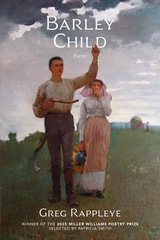
Barley Child
Greg Rappleye
University of Arkansas Press, 2025
Winner, 2026 Society of Midland Authors Book Award
Finalist, 2026 Kingsley Tufts Poetry Award
Finalist, 2026 Griffin Poetry Prize
Barley Child, Greg Rappleye’s fifth collection, draws from family legends, whispered stories, and sworn denials across four generations of Irish American lives—recalled, imagined, and reconstructed from census records, old letters, church registries, yellowed newspaper clippings, and a few odd photographs in which the human figures are often unnamed. The sum of these affidavits, arrayed across the lyric and narrative lines of these poems, is an electrifying human choir—male and female, child and adult, Irish and American—their voices rising out of shame, poverty, absurdity, violence, a strained Catholic faith, and a virulent legacy of madness and alcoholism.
Free of nostalgia and cant, with a sharp Irish wit that often braves nearly monstrous subject matter, and reported with eyes that seldom mist over, Barley Child is a volume that once again confirms Greg Rappleye as a poet of witness.
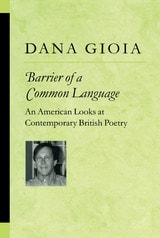
Barrier of a Common Language
An American Looks at Contemporary British PoetryDana Gioia
University of Michigan Press, 2003
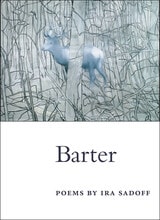
Barter
POEMSIra Sadoff
University of Illinois Press, 2003
Rooted firmly in the “fleeting world,” Sadoff’s poems find epiphanies of meaning in unexpected and even unpleasant experiences and emotions. The poems in Barter delve deeply into the past, the personal past of regret, travel, love, divorce, and bereavement, as well as the global past of Beethoven, Vietnam, and the fall of communism. Each poem is offered up by Sadoff as a barter, something to be traded for a little more time, a little more understanding.
The poems in Barter comment on the power of culture to interject itself into our desire for an idealized self, the way our inner and outer lives lack correspondence, harmony, and integration. They also talk about commerce, the trading of bodies, the way we as a nation “use” and exchange and appropriate -- and like Tolstoy’s Ivan Ilyich, try to bargain with and evade the urgency of our time on earth.
In the poem “Self-Portrait with a Critic,” Sadoff makes what could be a succinct statement of purpose: “And inside, let’s not make it pretty, / let’s save the off-rhyme and onomatopoeia / / for the concert hall, let’s go to the wormy place / where the problematic stirs inside his head.”
Bat Ode
Jeredith Merrin
University of Chicago Press, 2001
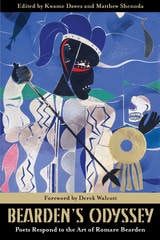
Bearden's Odyssey
Poets Respond to the Art of Romare BeardenEdited by Kwame Dawes and Matthew Shenoda, Foreword by Derek Walcott
Northwestern University Press, 2017
Borrowing from Romare Bearden’s aesthetic palette and inspired by his Odysseus series, Bearden’s Odyssey gathers, for the first time, poems from thirty-five of the most revered African diaspora poets in the United States. Poetic echoes come forth in themes of inspiration with historical intersections of one of the greatest visual artists of the twentieth century.
The award-winning editors, Kwame Dawes and Matthew Shenoda, assemble an esteemed literary congregation, with original poems by Chris Abani, Rita Dove, Lyrae Van Clief-Stefanon, Ed Roberson, Aracelis Girmay, Yusef Komunyakaa, and more. With a powerful foreword by Nobel laureate Derek Walcott and stunning visual reproductions of select Bearden masterpieces, this anthology fuses art and literature, standing as a testament to Romare Bearden’s power and influence in the contemporary artistic world.

Bearing the Bad News
Contemporary American Literature and CultureSanford Pinsker
University of Iowa Press, 1990
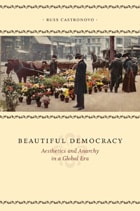
Beautiful Democracy
Aesthetics and Anarchy in a Global EraRuss Castronovo
University of Chicago Press, 2007
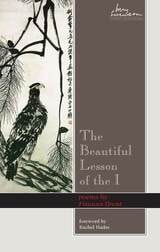
Beautiful Lesson of the I
poemsFrances Brent
Utah State University Press, 2005
The Beautiful Lesson of the I is a collection of finely made poems by an accomplished poet. It will reward the scholar and the student of poetry, as well as the reader looking for the simple pleasures of poetic insight authentically felt. Winner of the Swenson Poetry Award 2005. Now in paperback.
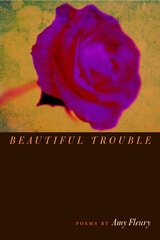
Beautiful Trouble
Amy Fleury
Southern Illinois University Press, 2004
In her first collection of poems, Kansas native Amy Fleury captures images of dragging clotheslines, baked lawns, and sweet potato babies, inserting them with an earnest dignity into her stories of midwestern life. Beautiful Trouble explores the subtleties of landscape, place, families, girlhood, womanhood, and everyday existence on the prairie. Fleury writes of the Midwest with authenticity, speaks of romance with delicate allure, and recalls the heartbreak of childhood without self-pity. In meditations on resilience and life’s contradictions, Fleury engages her characters fully and paints their souls and sensations evenly in language both rare and beautiful. She is a poet in love with sound and its power to summon majesty from quotidian scenes. Her poems are brief and striking, depending on exquisite word choice and balance to achieve a simple order on the page.
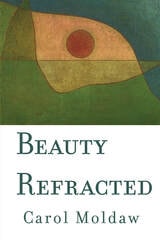
Beauty Refracted
Carol Moldaw
Four Way Books, 2018
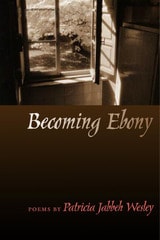
Becoming Ebony
Patricia Jabbeh Wesley
Southern Illinois University Press, 2003
Recapturing the celebratory voice of Africa in poems that are both contemporary and traditional, Liberian-born Patricia Jabbeh Wesley weaves lyrical storytelling with oral history and images of Africa and America, revealing powerful insights about the relationship between strength and tragedy—and finding reason to celebrate even in the presence of war, difficulties, and death. Rooted in myths that can be traced to the Grebo tradition, Becoming Ebony portrays Liberian-born Wesley’s experiences of village talk and civil war as well as her experiences of the pain of her mother’s death and the difficulties of rearing a family away from home in the United States, and explores the questions of living in the African Diaspora. Turning on the African proverb of “the wandering child” and the metaphor of the ebony tree—which is beautiful in life and death— these poems delve into issues of human suffering and survival, plainly and beautifully chronicling what happens “after the sap is gone.”
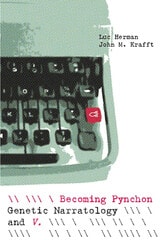
Becoming Pynchon
Genetic Narratology and V.Luc Herman and John M. Krafft
The Ohio State University Press, 2023
The 1963 publication of Thomas Pynchon’s V. changed the landscape of American fiction. Becoming Pynchon: Genetic Narratology and V. offers a detailed examination of the dramatic transformations that took place as Pynchon’s foundational novel went from typescript to published work. Luc Herman and John M. Krafft develop and deploy a rich theory of genetic narratology to examine the performance of genre in the novel. Pushing back against the current dominance of cognitive narratology, they discuss focalization, character construction, and evocation of consciousness as clues to Pynchon’s developing narratology of historical fiction. Their theoretical interventions offer an important and timely corrective to the field of narratology with a method that brings the author back into the analytical frame.
Herman and Krafft use as their guide the typescript of V. that surfaced in 2001, when it was acquired by the Harry Ransom Humanities Research Center, as well as Pynchon’s editorial correspondence with Corlies Smith, his first editor at J. B. Lippincott. Becoming Pynchon assembles a comprehensive and unequaled picture of Pynchon’s writing process that will appeal both to Pynchonians and to postmodernism scholars more broadly.
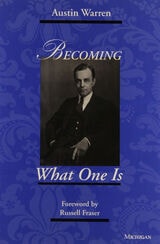
Becoming What One Is
Austin Warren
University of Michigan Press, 1995
The late Austin Warren was one of the most distinguished literary scholars of the twentieth century, well known as a biographer, literary critic, and teacher. He retired from the University of Michigan English Department in 1968 after twenty years on the faculty. Warren's memoir ends at age forty, because, as he explains in the preface, the most interesting part of anyone's life is the formative years.
He begins with his childhood in Massachusetts and education at Wesleyan, Harvard, and Princeton, and ends with reflections on the problems of integrating his profession, teaching, with his vocation, writing. The journey in between is extraordinary, a re-creation of the scholar's search for identity, religion, wisdom, and a new vision of the role of a teacher.
Warren "forged his soul when others weren't looking," writes Russell Fraser in his foreword to the book. He grew up on a lonely New England farm, went to a school where he learned to hate even Shakespeare, and entered college without enthusiasm. But the history of his education, as is often the case, was one first of rescue by inspiring mentors, then of outgrowing those mentors, and finally of forging a vision of his own. By the 1930s he had shaken up classrooms by abandoning formal lectures and become an inspiration in his own right.
A singular personality who never stopped searching for meaningful spirituality and a wider intellectual world, Austin Warren was among the most important scholars of the twentieth century. His memoirs of "becoming" are an elegant and absorbing chronicle.

Becoming a Poet
Elizabeth Bishop with Marianne Moore and Robert LowellDavid Kalstone
University of Michigan Press, 2001
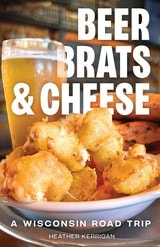
Beer, Brats, and Cheese
A Wisconsin Road TripHeather Kerrigan
University of Wisconsin Press, 2025
To thoroughly research this book, Heather Kerrigan undertook a twenty-six-hundred-mile road trip crisscrossing the Badger State, seeking the hidden gems that locals frequent. She visited Wisconsin’s best restaurants, creameries, breweries, butcher shops, and cheesemongers. In Beer, Brats, and Cheese, Kerrigan highlights the innovative flavors and unexpected delights found in these spots. Great beer isn’t made only in Milwaukee, Sheboygan doesn’t have a lock on the best bratwurst, and excellent cheeses don’t just come from Monroe County. In fact, there are towns large and small, from the far north to the Illinois border, from Door County to the Mississippi River, that contribute to the state’s amazing culinary experiences.
Whether you’re planning a bite-by-bite day trip or simply looking for a great place to eat or drink near home, this guide has you covered.
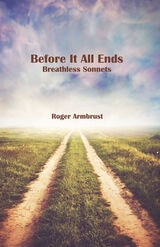
Before It All Ends
Breathless SonnetsRoger Armbrust
Parkhurst Brothers, Inc., 2022
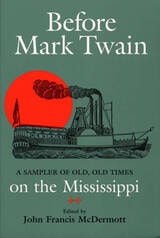
Before Mark Twain
A Sampler of Old, Old Times on the MississippiEdited by John Francis McDermott
Southern Illinois University Press, 1998
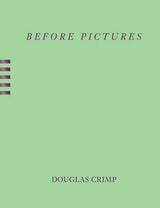
Before Pictures
Douglas Crimp
University of Chicago Press, 2016
Before Pictures tells the story of Crimp’s life as a young gay man and art critic in New York City during the late 1960s through the turbulent 1970s. Crimp participated in all of what made the city so stimulating in that vibrant decade. The details of his professional and personal life are interwoven with this the particularly rich history of New York City at that time, producing a vivid portrait of both the critic and his adopted city. The book begins with his escape from his hometown in Idaho, and we quickly find Crimp writing criticism for ArtNews while working at the Guggenheim—where, as a young curatorial assistant, he was one of the few to see Daniel Buren’s Peinture-Sculpture before it was removed amid cries of institutional censorship. We also travel to the Chelsea Hotel (where Crimp helped the down-on-his-luck couturier Charles James organize his papers) through to his days as a cinephile and balletomane to the founding of the art journal October, where he remained a central figure for many years. As he was developing his reputation as a critic, he was also partaking of the New York night life, from drugs and late nights alongside the Warhol crowd at the Max’s Kansas City to discos, roller-skating, and casual sex with famous (and not-so-famous) men. As AIDS began to ravage the closely linked art and gay communities, Crimp eventually turned his attention to activism dedicated to rethinking AIDS.
Part biography and part cultural history, Before Pictures is a courageous account of an exceptional period in both Crimp’s life and the life of New York City. At the same time, it offers a deeply personal and engaging point of entry into important issues in contemporary art.
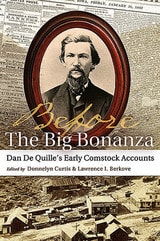
Before THE BIG BONANZA
Dan De Quille's Early Comstock AccountsEdited by Donnelyn Curtis and Lawrence I. Berkove
University of Missouri Press, 2015
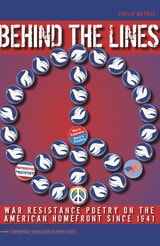
Behind the Lines
War Resistance Poetry on the American Home Front since 1941Philip Metres
University of Iowa Press, 2007
Behind the Lines investigates American war resistance poetry from the Second World War through the Iraq wars. Rather than simply chronicling the genre, Philip Metres argues that this poetry gets to the heart of who is authorized to speak about war and how it can be represented. As such, he explores a largely neglected area of scholarship: the poet’s relationship to dissenting political movements and the nation.
In his elegant study, Metres examines the ways in which war resistance is registered not only in terms of its content but also at the level of the lyric. He proposes that protest poetry constitutes a subgenre that—by virtue of its preoccupation with politics, history, and trauma—probes the limits of American lyric poetry. Thus, war resistance poetry—and the role of what Shelley calls unacknowledged legislators—is a crucial, though largely unexamined, body of writing that stands at the center of dissident political movements.
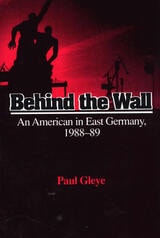
Behind the Wall
An American in East Germany, 1988-89Paul Gleye
Southern Illinois University Press, 1991
Standing in long lines in the shops, coaxing clean laundry from an outdated washing machine, traveling despite unpredictable train schedules, and being without hot water, fruit, and vegetables through the gray winter months failed to dull Paul Gleye’s perceptions during the year he lived in Weimar, East Germany. Day by day Gleye documented his varied observations and experiences, unaware that they would prove a unique record of what would soon be an extinct society.
Gleye was in East Germany as a Fulbright lecturer. Living beyond the capital city of East Berlin and traveling and conversing freely, Gleye gained access to people and places that had been almost completely closed to Americans and other Westerners for decades.
Beleaguered Poets and Leftist Critics
Stevens, Cummings, Frost, and Williams in the 1930sMilton A. Cohen
University of Alabama Press, 2011
A critical examination of modernist poetry and the demands of leftist literary theory.
Different as they were as poets, Wallace Stevens, E. E. Cummings, Robert Frost, and William Carlos Williams grappled with the highly charged literary politics of the 1930s in comparable ways. As other writers moved sharply to the Left, and as leftist critics promulgated a proletarian aesthetics, these modernist poets keenly felt the pressure of the times and politicized literary scene. All four poets saw their reputations critically challenged in these years and felt compelled to respond to the new politics, literary and national, in distinct ways, ranging from rejection to involvement.
Beleaguered Poets and Leftist Critics closely examines the dynamics of these responses: what these four poets wrote—in letters, essays, lectures, fiction (for Williams), and most importantly, in their poems; what they believed politically and aesthetically; how critics, particularly leftist critics, reviewed their work; how these poets reacted to that criticism and to the broader milieu of leftism. Each poet’s response and its subsequent impact on his poetic output is a unique case study of the conflicting demands of art and politics in a time of great social change.
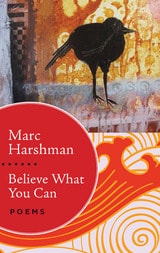
Believe What You Can
PoemsMarc Harshman
West Virginia University Press, 2016
These difficulties come “not quite haphazardly” and not without a “last light”—something “beyond” and as “sweet as apples.” With these moments of grace, Harshman taps into the satisfying richness that comes from unexpected revelations, helping us rise above the fragile recesses of life and death, all while portraying the lost rural worlds of the Midwest and Appalachia in ways untouched by sentiment or nostalgia.

Below Grass Roots
A NovelFrank Waters
Ohio University Press, 2002
In Below Grass Roots, the second book in Frank Waters’s Pikes Peak saga, turn-of-the-century Colorado Springs is prospering with the mining boom and a growing tourist industry. Patriarch Joseph Rogier becomes ever more obsessed with the treasures of the towering mountain and tries to enlist his son-in-law Jonathan Cable in his mining schemes. Cable instead leaves for Navajo country with his young son. Rogier, convinced that new wealth lies deep within the mountain, below grass roots, sinks his mines and what remains of his fortune ever deeper into the mountain’s granite.
As in the other two novels in this semiautobiographical saga, Waters’s masterful narrative draws on his own keen perception of the human condition to bring us this compelling tale of struggle and hope in the American West.
Pike’s Peak is composed of three condensed novels: The Wild Earth’s Nobility, Below Grass Roots, and The Dust within the Rock.
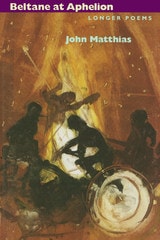
Beltane At Aphelion
Longer PoemsJohn Matthias
Ohio University Press, 1995
Beltane at Aphelion collects all of John Matthias’s longer poems and is published simultaneously with Swimming at Midnight, which collects his shorter poems. The volume includes his exuberant experiments from the 1960s, Poem in Three Parts and Bucyrus, followed by The Stefan Bathory & Mihail Lermontov Poems, his comedic diptych from the 1970s set on a Polish and a Russian ocean liner, and by Northern Summer, his meditation on history and language set in Scotland. It concludes with the three long poems first published in A Gathering of Ways which explore ancient paths and river routes in the East Anglian region of Britain and the American Midwest, and, in the most ambitious poem he has yet written, the famous pilgrim trails to Santiago de Compostela in Spain. About the books in which these poems originally appeared, critics and poets have written with enthusiasm.
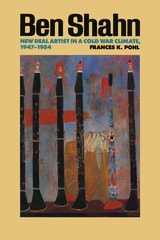
Ben Shahn
New Deal Artist in a Cold War Climate, 1947-1954By Frances Pohl
University of Texas Press, 1989
In the first, most intense years of the Cold War (1947–1954), New Deal liberals often found themselves in great disfavor. Ben Shahn's experience presents something of a paradox, however, since his paintings appealed in different ways to both liberals and conservatives. Blacklisted by CBS during the McCarthy era and yet, ironically, incorporated into presidential "campaigns of truth" aimed at improving the U.S. image abroad, Ben Shahn is a pivotal figure, revealing the complexities and contradictions inherent in this highly polarized moment in American history.
In this pathbreaking study, Frances Pohl traces the political and artistic struggles Ben Shahn became embroiled in as he tried to remain a socially concerned artist during the early Cold War period. She shows how he rejected the argument, voiced by many Abstract Expressionists, that art and politics should not mix, yet at the same time searched for a way to depict, in universal and allegorical terms, the broad human condition rather than simply specific instances of injustice. Perhaps most important, she makes critical connections between U.S. social and political history and the art it provoked, thus illuminating both the later career of Ben Shahn and the Cold War era in American cultural history.
Bending into the Light
Alice Attie
Seagull Books, 2023
The poems in Alice Attie’s new volume, Bending into the Light, are poised on an ever-shifting threshold where words “up and down, side to side” appear as “figures in the distance approaching, each a declaration, each persisting”. Beings, things, ideas, present or vanishing, flow through the vessel of language wherein each exudes “its own aura, its own being, its own disappearance.” Attie’s voice is intricate and intimate, shaping and reshaping the space of being and the space of non-being. These contemplative poems, interspersed with a few haunting photographs and artworks, extol, and mourn, melding the quotidian with the philosophical where we are formed and transformed in the profound knowledge that “the voice has no center.”
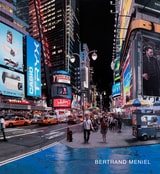
Bertrand Meniel
Paintings, 1996-2024Bertrand Meniel
The Artist Book Foundation, 2024
Using composite digital photography, self-taught artist Bertrand Meniel incorporates more detail into each of his cityscapes than any other Photorealist to date.
Photorealism is a genre of painting that developed in the United States and Europe using high-resolution photography as its primary source material. Embracing digital photography perhaps more than any other artist working in this genre, Bertrand Meniel is able to incorporate an astonishing amount of detail into his renderings of cityscapes in New York City, Miami, and Paris. Using a variety of photographs of his chosen subject, he manipulates an image to perfection, focusing simultaneously on the foreground and background by combining hundreds of shots on a computer screen.
His choice to depict iconic American scenes in his paintings, particularly those associated with the “American Way of Life,” reflects not just a technical mastery of Photorealism but a deep emotional connection to the culture that captivated him during his youth. His unique perspective, influenced by French artistic traditions and shaped by exposure to American pop culture, allows him to capture in his art the essence of what may be best described as the “New York State of Mind."
Beso the Donkey
Richard Jarrette
Michigan State University Press, 2010
Beso the Donkey is a poetry cycle about a wounded, neglected, and abandoned jackass. In sparklingly clear and luminous poems, Richard Jarrette tells the story of Beso and of his caregiver's attempts to understand and heal him—an endeavor that teaches the man much about the meaning of life, death, peace, and acceptance. With undertones of Buddhist, Christian, Taoist, and Islamic faiths, Beso the Donkey incorporates elements of philosophy, ethics, religion, and morality.
As the book progresses, we sense the poet’s growing acceptance of life’s passing. Along with the author, we feel a deeper peace blossoming as Beso’s life is ending (which is itself a beginning). This is a lyrical story of loss and acceptance.
Best of the Wurst
Weird and Wonderful Stories of Wisconsin SausageJesse Brookstein
Wisconsin Historical Society Press, 2026
Sink your teeth into a big, bold, and unabashed celebration of a quintessential Wisconsin food.
Wisconsin is famous for its world-class cheeses and its “beer state” moniker. But every Wisconsinite knows that no tailgate party or backyard barbecue is complete without a grill full of sizzling hot brats. Or Polish sausages. Or good ol’ Oscar Mayer wieners. From charcuterie boards to chorizo, sausage is an essential ingredient in the state’s cultural identity. In this lively, comprehensive ode to the link, writer and storyteller Jesse Brookstein embarks on a quest to show why Wisconsin is the sausage maker to the world.
Best of the Wurst traces the long arc of sausage making in the state, starting with First Nations communities who used pemmican as a staple food source. It features subsequent immigrant groups—German, Polish, Italian, Thai, Mexican, and more—who brought their own sausage recipes and traditions, and lands squarely on today’s bustling sausage scene. A final chapter, “The Future of Sausage,” explores emerging trends, tastes, and technologies—offering a peek at what’s next for Wisconsin’s revered food.
Brookstein travels the state to meet the people behind the links and captures the culture, craft, and quirks that make Wisconsin sausages unlike those found anywhere else. Profiles of standout producers are threaded throughout, from household names like Usinger’s and Johnsonville to family-run shops that have fed communities for generations. Brookstein also highlights the professionals shaping the field today, including graduates of UW–Madison’s Master Meat Crafter Program and chefs who feature local sausage in their menus with pride.
Readers will get insights from master butchers, small-town sausage savants, big-name producers, and superfans reflecting on hotly debated topics like seasonings, casings, and the eternal question: “Should you parboil?” And memorable traditions—such as Sheboygan’s double brat on a hard roll, the ceremonial slicing of La Crosse’s Golden Brat, Madison’s world’s largest Brat Fest, and the show-stealing Milwaukee Brewers’ Famous Racing Sausages—showcase the sausage’s indelible mark on the state.
Featuring 150 color photos and packed with humor and an insider’s appreciation for the art of stuffing a perfect link, Best of the Wurst encases these stories, people, and places in a perfect blend of history and heart. Wisconsinites love eating sausages—and now you can enjoy reading about them too.
Bethany
A PlayLaura Marks
Northwestern University Press, 2014
Better than Laughter
Mildred Boie
University of Minnesota Press, 1946
Between City and Country
Brookline, Massachusetts, and the Origins of SuburbiaRonald Dale Karr
University of Massachusetts Press, 2018
Already a fashionable retreat for wealthy Bostonians, Brookline began to suburbanize in the 1840s with the arrival of hundreds of commuter families—and significant numbers of Irish Catholic immigrants drawn by opportunities to work as laborers and servants. In Brookline the poor were segregated but not excluded altogether, as they would be from twentieth-century elite suburbs. A half century later, a distinct suburban way of life developed that combined rural activities with urban pastimes, and a political consensus emerged that sought efficient government and large expenditures on education and public works. Brookline had created the template for the concept of suburbia, not just in wealthy communities but in the less affluent communities of postwar America.
Between History And Poetry
H.D. And Norman Holmes PearsonDonna Krolik Hollenberg
University of Iowa Press, 1997
Between Lakes
Jeffrey Harrison
Four Way Books, 2020
Between My Eye and the Light
PoemsPaul Breslin
Northwestern University Press, 2015
“Hole torn in the language, / How shall we speak?” The first lines of the first poem in Paul Breslin’s artful second collection of poetry demand an answer, of both poet and reader, to the seemingly unspeakable tragedies of modern life. Between My Eye and the Light forms a beautifully insistent exercise in the power of language to engage experiences both mundane and profound. Breslin queries far-flung corners of experience for answers, engaging childhood, his longtime home of Chicago, small moments of life, and encounters with artists such Rainer Maria Rilke and Derek Walcott. The poems even query the volume’s opening question, How shall we speak? While pat answers elude us, poetry acts as a bulwark against cliché and cynicism, strengthening those who have the courage to question and explore.
Between Pen and Pixel
Comics, Materiality, and the Book of the FutureAaron Jacob Kashtan
The Ohio State University Press, 2018
In Between Pen and Pixel: Comics, Materiality, and the Book of the Future, Aaron Kashtan argues that paying attention to comics helps us understand the future of the book. Debates over the future of the book tend to focus on text-based literature, particularly fiction. However, because comics make the effects of materiality visible, they offer a clearer demonstration than prose fiction of how the rise of digital reading platforms transforms the reading experience. Comics help us see the effects of alterations in features such as publication design and typography, whereas in print literature, such transformations often go unnoticed.
With case studies of the work of Alison Bechdel, Matt Kindt, Lynda Barry, Carla Speed McNeil, Chris Ware, and Randall Munroe, Kashtan examines print comics that critique digital technology, comics that are remediated from print to digital and vice versa, and comics that combine print and digital functionality. Kashtan argues that comics are adapting to the rise of digital reading technologies more effectively than print literature has yet done. Therefore, looking at comics gives us a preview of what the future of the book looks like. Ultimately, Between Pen and Pixel argues that as print literature becomes more sensitive to issues of materiality and mediacy, print books will increasingly start to resemble to comic books.
Between Silences
A Voice from ChinaHa Jin
University of Chicago Press, 1990
"In these poems Ha Jin gives voice to the millions whose lives were altered and whose tongues were silenced by the Cultural Revolution. . . .If Ha Jin speaks in tongues in these poems, we feel him behind those voices—the hidden director behind the scenes—never as a presence filled with stridency and self-congratulation; he brings a great empathy and compassion to his depiction of the fallible men and women whose acts and attitudes together make up history."—Roger Gilbert, Hungry Mind Review
Between You and Me
Queer Disclosures in the New York Art World, 1948-1963Gavin Butt
Duke University Press, 2005
Focusing on the period from 1948 to 1963, Butt draws on the accusations and denials of homosexuality that appeared in the popular press, on early homophile publications such as One and the Mattachine Review, and on biographies, autobiographies, and interviews. In a stunning exposition of Larry Rivers’s work, he shows how Rivers incorporated gossip into his paintings, just as his friend and lover Frank O’Hara worked it into his poetry. He describes how the stories about Andy Warhol being too “swish” to be taken seriously as an artist changed following his breakthrough success, reconstructing him as an asexual dandy. Butt also speculates on the meanings surrounding a MoMA curator’s refusal in 1958 to buy Jasper Johns’s Target with Plaster Casts on the grounds that it was too scandalous for the museum to acquire. Between You and Me sheds new light on a pivotal moment in American cultural production as it signals new directions for art history.
Between the Chains
Turner Cassity
University of Chicago Press, 1991
"Turner Cassity's excellent work is like no one else's. It is funny, at times perverse, and wickedly serious. In this present collection, such poems as 'When in Doubt, Remain in Doubt,' 'Acid Rain on Sherwood Forest,' and 'How Jazz Came up the Elbe' show one of our finest poets at the top of his game."—Timothy Steele
"Cassity thinks on his feet, agile and fierce—funny too."—Thom Gunn
"At a time when most poems seem a commodity, quickly written, quickly read and easily thrown away, Turner Cassity's poems seem even more astonishing examples of good writing and reading, exceptions to be admired and kept."—Edgar Bowers
Between the Heartbeats
Poetry and Prose by NursesCortney Davis
University of Iowa Press, 1995
Between the Iceberg and the Ship
Selected EssaysAnne Stevenson
University of Michigan Press, 1998
Feminist critics will find much to invigorate and infuriate them in these essays. Stevenson believes that the "takeover" of poetry by critical theorists has, in recent years, all but brought about its demise in England and America. But she also fears that the media's doctrine of mass marketability may have a detrimental effect on the future of poetry. Her essays on Plath, Bishop, Irish poetry, and other subjects are as witty as they are challenging, upsetting many of the easy assumptions of our putatively "postmodern" era.
Anne Stevenson is the author of numerous books, including Bitter Fame: A Life of Sylvia Plath, The Other House, Four and a Half Dancing Men, and most recently, Collected Poems 1955- 1995.
Bewilderment
New Poems and TranslationsDavid Ferry
University of Chicago Press, 2012
Winner of the 2012 National Book Award for Poetry.
To read David Ferry’s Bewilderment is to be reminded that poetry of the highest order can be made by the subtlest of means. The passionate nature and originality of Ferry’s prosodic daring works astonishing transformations that take your breath away. In poem after poem, his diction modulates beautifully between plainspoken high eloquence and colloquial vigor, making his distinctive speech one of the most interesting and ravishing achievements of the past half century. Ferry has fully realized both the potential for vocal expressiveness in his phrasing and the way his phrasing plays against—and with—his genius for metrical variation. His vocal phrasing thus becomes an amazingly flexible instrument of psychological and spiritual inquiry. Most poets write inside a very narrow range of experience and feeling, whether in free or metered verse. But Ferry’s use of meter tends to enhance the colloquial nature of his writing, while giving him access to an immense variety of feeling. Sometimes that feeling is so powerful it’s like witnessing a volcanologist taking measurements in the midst of an eruption.
From Bewilderment:
October
The day was hot, and entirely breathless, so
The remarkably quiet remarkably steady leaf fall
Seemed as if it had no cause at all.
The ticking sound of falling leaves was like
The ticking sound of gentle rainfall as
They gently fell on leaves already fallen,
Or as, when as they passed them in their falling,
Now and again it happened that one of them touched
One or another leaf as yet not falling,
Still clinging to the idea of being summer:
As if the leaves that were falling, but not the day,
Had read, and understood, the calendar.