Results by title
3745 books match the query 'Europe' and 155 start with b

Bach Perspectives, Volume 9
J.S. Bach and His Contemporaries in GermanyEdited by Andrew Talle
University of Illinois Press, 2013
In this volume, Wolfgang Hirschmann proposes an ethnographic approach that contextualizes Bach's works, addressing the aesthetic paths he took as well as those he did not pursue. Steven Zohn's essay considers Telemann's contribution to the orchestral Ouverture genre, observering how Telemann's approach to integrating the national styles of his time was quite different from, but no less rich than, Bach's. Andrew Talle compares settings and strategies of Vergnügte Ruh, beliebte Seelenlust by Bach and Graupner. Alison Dunlop presents valuable primary research on Muffat, the most commonly cited keyboard music composer in Vienna during Bach's lifetime. Finally, Michael Maul sheds new light on the Scheibe-Birnbaum controversy, contextualizing the most famous critique of J. S. Bach's compositional style by discussing the other composers that Scheibe critiqued.

Back to Bizkaia
A Basque-American MemoirVince J. Juaristi
University of Nevada Press, 2011
Nevada sheep rancher Joe Juaristi spoke for years about making a trip back to the Spanish Basque Country that he left sixty years earlier, but each time the subject came up the discussion evolved into a family debate about the scope and members of the journey. Finally Joe's son, Vince, secretly resolved to organize the trip that his father wanted and needed--the two of them, traveling alone, making a quiet reunion with Joe's twin sister, who suffers from Alzheimer's, visiting other aging siblings and friends, and recounting the places that formed Joe's memories of his youth.
Back to Bizkaia is part travel book, part memoir of two men exploring their mutual roots and their unique father-son bond. The narrative intertwines an engaging account of the contemporary Basque Country with Joe's experiences as an immigrant making his way in a new country and Vince's memories of growing up in a close Basque-American community in the American West. This is a book about Basques and their American families, but on another level it is every immigrant's story of return to a beloved homeland.
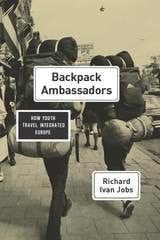
Backpack Ambassadors
How Youth Travel Integrated EuropeRichard Ivan Jobs
University of Chicago Press, 2017
From the Berlin Wall to the beaches of Spain, the Spanish Steps in Rome to the Pudding Shop in Istanbul, Jobs tells the stories of backpackers whose personal desire for freedom of movement brought the people and places of Europe into ever-closer contact. As greater and greater numbers of young people trekked around the continent, and a truly international youth culture began to emerge, the result was a Europe that, even in the midst of Cold War tensions, found its people more and more connected, their lives more and more integrated. Drawing on archival work in eight countries and five languages, and featuring trenchant commentary on the relevance of this period for contemporary concerns about borders and migration, Backpack Ambassadors brilliantly recreates a movement that was far more influential and important than its footsore travelers could ever have realized.
Bad Chaucer
The Great Poet’s Greatest Mistakes in the Canterbury TalesTison Pugh
University of Michigan Press, 2024
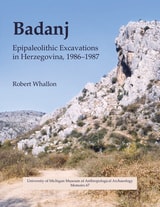
Badanj
Epipaleolithic Excavations in Herzegovina, 1986-1987Robert Whallon
University of Michigan Press, 2025
The purpose of the 1986-1987 excavations was to provide a more detailed picture of the individual occupation and other layers at Badanj, to define the faunal assemblages of these layers as indicators of the changing ecology of the site, and to place the site within its regional cultural context. The excavations exposed a sequence of some ten occupation levels, seven activity or refuse levels, covering a period from approximately 16,000 to 13,000 cal BP, from the latter part of the Oldest Dryas to the end of the Bølling-Allerød late glacial climatic phases.
Over this period, two phases of lithic typology were identified, as well as parallel changes in a specific kind of decorative beads. In terms of ecology, red deer (Cervus elaphus) consistently provided by far the majority of the meat consumed at the site, but secondary fauna shows a clear, gradual replacement of colder-climate species such as ibex and chamois by warmer-climate roe deer and wild pig. Combining both qualitative and quantitative aspects of lithic technology and typology, the reconstruction of the potential foraging areas around Badanj, and estimates of supportable population allows the site to be placed in a clear regional context, which can be extended to suggest a hypothetical regional organization of similar sites over the eastern coast of the Adriatic Sea.
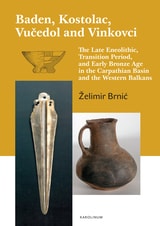
Baden, Kostolac, Vucedol and Vinkovci
The Late Eneolithic, Transition Period, and Early Bronze Age in the Carpathian Basin and the Western BalkansŽelimir Brnic
Karolinum Press, 2024
Baden, Kostolac, Vucedol and Vinkovci uses archaeology and genetics to create a novel cultural and historical interpretation of the Carpathian Basin during the Late Eneolithic period. The author traces the linear development of indigenous cultures from the Baden Culture through the Kostolac Culture to the Vucedol Culture, before positing that certain qualitative and quantitative shifts were driven by the entry of foreign populations—the Pit Grave Culture and the Bell Beaker Culture—into the Carpathian Basin.
The book also analyzes the emergence of the Early Bronze Age, establishing an absolute chronology, and examines the Vucedol Culture’s influence on geographically distant Bronze Age groups. An appendix also includes a discussion of findings that, while outside the Carpathian Basin, are part of its cultural sphere.
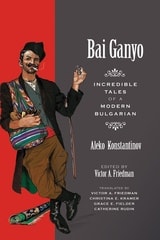
Bai Ganyo
Incredible Tales of a Modern BulgarianAleko Konstantinov
University of Wisconsin Press, 2010
Bai Ganyo has been translated into most European languages, but now Victor Friedman and his fellow translators have finally brought this Balkan masterpiece to English-speaking readers, accompanied by a helpful introduction, glossary, and notes.
Balkan Family Structure and the European Pattern
Demographic Developments in Ottoman BulgariaMaria Todorova
Central European University Press, 2006
Ballads Beyond Borders
How the Irish Diaspora Shaped Music in the Nineteenth-Century United StatesSarah Gerk
University of Illinois Press, 2026
Gerk opens by considering the popularity of Thomas Moore’s iconic collection Irish Melodies in relation to the history of British colonization shared by the US and Ireland, arguing that these songs modeled what the music of an Anglo-Celtic republic could sound like. She considers blackface minstrelsy’s complicated relationship with both Irish-American performers and theatrical stereotypes of Irish people, and positions Irish-American performers and audiences as a primary driving force in new musical styles in 1840s sheet music, in which minstrelsy’s resemblances to Anglo-Celtic traditional music disappeared. She examines the legacy of the Great Famine in music of the US Civil War, considering how that music’s role in emotional life offers robust source material for understanding famine memory. She explores the increasingly elaborate sketches in the 1870s and 1880s of the variety duo Harrigan and Hart, highlighting ways in which violent conflict between the Black community and the Irish lies at the very heart of the Mulligan entertainments. Finally, she contextualizes the work of Irish-American tenor Chauncey Olcott, showing how a number of confluent trends—the growing wealth and social status of Irish-American middle classes, the Gaelic revival, new immigration patterns, and the consolidation of the US’s sheet music industry—allowed Olcott to perform an elevated version of Irish-American musical culture, influenced by superficial elements of Italian operatic music.
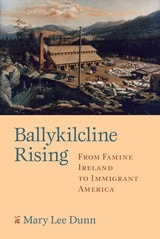
Ballykilcline Rising
From Famine Ireland to Immigrant AmericaMary Lee Dunn Maguire
University of Massachusetts Press, 2008
In 1847, in the third year of Ireland's Great Famine and the thirteenth year of their rent strike against the Crown, hundreds of tenant farmers in Ballykilcline, County Roscommon, were evicted by the Queen's agents and shipped to New York. Mary Lee Dunn tells their story in this meticulously researched book. Using numerous Irish and U.S. sources and with descendants' help, she traces dozens of the evictees to Rutland, Vermont, as railroads and marble quarries transformed the local economy. She follows the immigrants up to 1870 and learns not only what happened to them but also what light American experience and records cast on their Irish “rebellion.”
Dunn begins with Ireland's pre-Famine social and political landscape as context for the Ballykilcline strike. The tenants had rented earlier from the Mahons of Strokestown, whose former property now houses Ireland's Famine Museum. In 1847, landlord Denis Mahon evicted and sent nearly a thousand tenants to Quebec, where half died before or just after reaching the Grosse Ile quarantine station. Mahon was gunned down months later. His murder provoked an international controversy involving the Vatican. An early suspect in the case was a man from Ballykilcline.
In the United States, many of the immigrants resettled in clusters in several locations, including Vermont, Illinois, Iowa, Maryland, and New York. In Vermont they found jobs in the marble quarries, but some of them lost their homes again in quarry labor actions after 1859. Others prospered in their new lives. A number of Ballykilcline families who stopped in Rutland later moved west; one had a son kidnapped by Indians in Minnesota. Readers who have Irish Famine roots will gain a sense of their own “back story” from this account of Ireland and the native Irish, and scholars in the field of immigration studies will find it particularly useful.
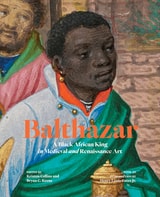
Balthazar
A Black African King in Medieval and Renaissance ArtKristen Collins
J. Paul Getty Trust, The, 0
According to the Gospel of Matthew, magi from the East, following a star, traveled to Jerusalem bearing precious gifts for the infant Jesus. The magi were revered as wise men and later as kings. Over time, one of the three came to be known as Balthazar and to be depicted as a Black man.
Balthazar was familiar to medieval Europeans, appearing in paintings, manuscript illuminations, mosaics, carved ivories, and jewelry. But the origin story of this fascinating character uncovers intricate ties between Europe and Africa, including trade and diplomacy as well as colonization and enslavement.
In this book, experts in the fields of Ethiopian, West African, Nubian, and Western European art explore the representation of Balthazar as a Black African king. They examine exceptional art that portrays the European fantasy of the Black magus while offering clues about the very real Africans who may have inspired these images. Along the way, the authors chronicle the Black presence in premodern Europe, where free and enslaved Black people moved through public spaces and courtly circles. The volume’s lavish illustrations include selected works by contemporary artists who creatively challenge traditional depictions of Black history.
Barbaric Intercourse
Caricature and the Culture of Conduct, 1841-1936Martha Banta
University of Chicago Press, 2003
Banta also deals extensively with London's Punch, a sharp critic of American nationalism, and draws from images and writings in magazines as diverse as Puck,The Crisis,Harper's Weekly, and The International Socialist Review. Orchestrating a wealth of material, including reproductions of rarely seen political cartoons, she offers a richly layered account of the cultural struggles of the age, from contests over immigration and the role of the New Negro in American society, to debates over Wall Street greed, women's suffrage, and the moral consequences of Western expansionism.
Barnaby Rich
A Short BiographyBy Thomas Mabry Cranfill and Dorothy Hart Bruce
University of Texas Press, 1953
Soldier, sea captain, freebooter, courtier, writer, reformer, and informer, Barnaby Rich was a man of his time. In the service of Queen Elizabeth, Rich took part in numerous campaigns fraught with hardship and disaster in France, the Low Countries, and Ireland. After twenty years of soldiering, he wrote Riche His Farewell to Militarie Profession, which attracted the attention of the Queen herself, as well as William Shakespeare and many of the lesser among his contemporaries.
"I have preferred to be rich rather than to be called so," punned the Captain ruefully on his title pages, for he was usually in want and as often in trouble. The source of both misfortunes was his disdain for dodging a fight, and much that is known of his life comes from unpublished records of legal actions in which he was involved. Rich directed his satire primarily against the sinecures of the Anglican clergy in Ireland and against the papacy. "Sworne man" of both Elizabeth and James, he protested near the end of his life that his assaults with pike and pen were but the promptings of a "true harted subjecte."
Born in an age bright with stars, Rich must be considered a "minor" Elizabethan. Therein lies the novelty of this study: it treats the not-so-great, using unpublished court records to enrich our knowledge of Great Britain's grandest era. But the story of the man is not lost in the background of the period. With freshness and charm the present volume disinters Barnaby Rich from the footnote crediting him as Shakespeare's source for the plot of Twelfth Night and fleshes him forth a live Elizabethan.
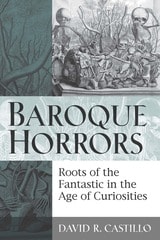
Baroque Horrors
Roots of the Fantastic in the Age of CuriositiesDavid R. Castillo
University of Michigan Press, 2011
"David Castillo takes us on a tour of some horrific materials that have rarely been considered together. He sheds a fantastical new light on the baroque."
---Anthony J. Cascardi, University of California Berkeley
"Baroque Horrors is a textual archeologist's dream, scavenged from obscure chronicles, manuals, minor histories, and lesser-known works of major artists. Castillo finds tales of mutilation, mutation, monstrosity, murder, and mayhem, and delivers them to us with an inimitable flair for the sensational that nonetheless rejects sensationalism because it remains so grounded in historical fact."
---William Egginton, Johns Hopkins University
"Baroque Horrors is a major contribution to baroque ideology, as well as an exploration of the grotesque, the horrible, the fantastic. Castillo organizes his monograph around the motif of curiosity, refuting the belief that Spain is a country incapable of organized scientific inquiry."
---David Foster, Arizona State University
Baroque Horrors turns the current cultural and political conversation from the familiar narrative patterns and self-justifying allegories of abjection to a dialogue on the history of our modern fears and their monstrous offspring. When life and death are severed from nature and history, "reality" and "authenticity" may be experienced as spectator sports and staged attractions, as in the "real lives" captured by reality TV and the "authentic cadavers" displayed around the world in the Body Worlds exhibitions. Rather than thinking of virtual reality and staged authenticity as recent developments of the postmodern age, Castillo looks back to the Spanish baroque period in search for the roots of the commodification of nature and the horror vacui that accompanies it. Aimed at specialists, students, and readers of early modern literature and culture in the Spanish and Anglophone traditions as well as anyone interested in horror fantasy, Baroque Horrors offers new ways to rethink broad questions of intellectual and political history and relate them to the modern age.
David Castillo is Associate Professor and Director of Graduate Studies in the Department of Romance Languages and Literatures at the University at Buffalo, SUNY.
Jacket art: Frederick Ruysch's anatomical diorama. Engraving reproduction "drawn from life" by Cornelius Huyberts. Image from the Zymoglyphic Museum.

Baroque Personae
Edited by Rosario Villari
University of Chicago Press, 1995
Studying the statesman, soldier, financier, secretary, rebel, preacher, missionary, nun, witch, scientist, artist, and bourgeois, the essays depart dramatically from traditional accounts of this era. The statesman, for example, is seen here as the exact opposite of a benevolent man working for the common good; and the soldier is depicted as part of an institution that could be savage and destructive but that also, by the end of the Baroque age, helped shape a more rational relationship with the military and civil society.
The contributors are Rosario Villari, Henry Kamen, Geoffrey Parker, Daniel Dessert, Salvatore S. Nigro, Manuel Morán, José Andrés-Gallego, Adriano Prosperi, Mario Rosa, Brian P. Levack, Paolo Rossi, Giovanni Careri, and James S. Amelang.
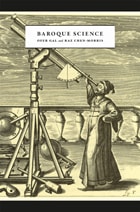
Baroque Science
Ofer Gal and Raz Chen-Morris
University of Chicago Press, 2013
Gal and Chen-Morris show how the protagonists of the new mathematical natural philosophy grasped at the very far and very small by entrusting observation to the mediation of artificial instruments, and how they justified this mediation by naturalizing and denigrating the human senses. They show how the physical-mathematical ordering of heavens and earth demanded obscure and spurious mathematical procedures, replacing the divine harmonies of the late Renaissance with an assemblage of isolated, contingent laws and approximated constants. Finally, they show how the new savants, forced to contend that reason is hopelessly estranged from its surrounding world and that nature is irreducibly complex, turned to the passions to provide an alternative, naturalized foundation for their epistemology and ethics.
Enforcing order in the face of threatening chaos, blurring the boundaries of the natural and the artificial, and mobilizing the passions in the service of objective knowledge, the New Science, Gal and Chen-Morris reveal, is a Baroque phenomenon: deeply entrenched in and crucially formative of the culture of its time.
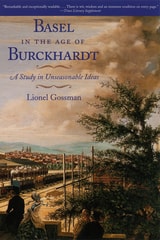
Basel in the Age of Burckhardt
A Study in Unseasonable IdeasLionel Gossman
University of Chicago Press, 2000
"Remarkable and exceptionally readable . . . There is wit, wisdom and an immense erudition on every page."—Jonathan Steinberg, Times Literary Supplement
"Gossman's book, a product of many years of active contemplation, is a tour de force. It is at once an intellectual history, a cultural history of Basel and Europe, and an important contribution to the study of nineteenth-century historiography. Written with a grace and elegance that many aspire to, few seldom achieve, this is model scholarship."—John R. Hinde, American Historical Review
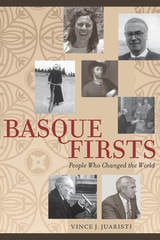
Basque Firsts
People Who Changed the WorldVince J. Juaristi
University of Nevada Press, 2016
The profiles use primary sources to tell fresh stories and offer a wonderful variety, showing the astonishing breadth of Basque contributions. They include Juan Sebastían Elcano, the first person to circumnavigate the earth; St. Ignatius of Loyola, the first Jesuit to seed a worldwide movement in education; Santiago Ramón y Cajal, the Father of Neurology and a Nobel laureate; Cristóbal Balenciaga, the king of haute couture; Paul Laxalt, one of Ronald Reagan’s closest friends in politics; and Edurne Pasaban, the first woman to climb the world’s fourteen tallest mountains.
Basque Firsts provides a rare look at a culture’s people, revealing the significant contributions they have shared.
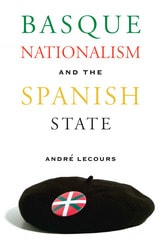
Basque Nationalism and the Spanish State
Andre Lecours
University of Nevada Press, 2016
An examination of Basque nationalism from a historical perspective. Basque nationalism has been extensively examined from the perspectives of Basque culture and internal conditions in the Basque Country, but André Lecours is among the first to demonstrate how Basque nationalism was shaped by the many forms and historical phases of the Spanish state. His discussion employs one of the most debated approaches in the social sciences—historical institutionalism—and it includes an up-to-date examination of the circumstances for, and consequences of, recent events such as ETA's announcement in 2006 of a permanent cease-fire. Lecours also analyzes other aspects of Basque nationalism, including the international relations of the Basque Autonomous Government, as well as the responses of the contemporary Spanish state and how it deploys its own brand of nationalism. Finally, the book offers a comparative discussion of Basque, Catalan, Scottish, Flemish, and Quebecois nationalist movements, suggesting that nationalism in the Basque Country, despite the historical presence of violence, is in many ways similar to nationalism in other industrialized democracies. Basque Nationalism and the Spanish State is an original and provocative discussion that is essential reading for anyone interested in the Basques or in the development of modern nationalist movements.
Battling over the Balkans
Historiographical Questions and ControversiesJohn R. Lampe
Central European University Press, 2020

Bazhanov and the Damnation of Stalin
Boris Bazhanov
Ohio University Press, 1990
Beards and Texts
Images of Masculinity in Medieval German LiteratureSebastian Coxon
University College London, 2021
Beards make frequent appearances in medieval German poetry—as esteemed markers of majestic wisdom or as hilarious props for undignified manhandling. In Beards and Texts, Sebastian Coxon traces this preeminent symbol of masculinity through four major poetic traditions across the twelfth and sixteenth centuries—Pfaffe Konrad’s Rolandslied, Wolfram von Eschenbach’s Willehalm, ‘Sangspruchdichtung’, and Heinrich Wittenwiler’s Ring. By attending to this hairy trope, Beards and Texts sheds new light on the construction of both poetic form and masculinity in the Middle Ages.
Beauty's Rigor
Patterns of Production in the Work of Pier Luigi NerviThomas Leslie
University of Illinois Press, 2017
Beauty's Rigor offers a comprehensive overview of Nervi's long career. Drawing on the Nervi archives and a wealth of photographs and architectural drawings, Thomas Leslie explores celebrated buildings like Palazetto dello Sport built for the 1960 Rome Olympics, St. Mary's Cathedral in San Francisco, and the UNESCO headquarters in Paris. He also sheds new light on unbuilt projects such as the Pavilion of Italian Civilization for the Universal Exposition of Rome E42. What emerges is the first complete account of Nervi's contributions to modern architecture and his essential role in a revolution that realized concrete's potential to match grace with strength.
Beauvoir and Her Sisters
The Politics of Women's Bodies in FranceSandra Reineke
University of Illinois Press, 2011
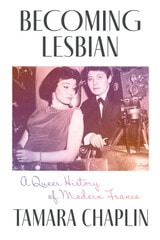
Becoming Lesbian
A Queer History of Modern FranceTamara Chaplin
University of Chicago Press, 2024
In Becoming Lesbian, historian Tamara Chaplin argues that the history of female same-sex intimacy is central to understanding the struggle to control the public sphere. This monumental study draws on undiscovered sources culled from cabaret culture, sexology, police files, radio, TV, photography, the Minitel (an early form of internet), and private letters, as well as over one hundred interviews filmed by the author. Becoming Lesbian demonstrates how women of diverse classes and races came to define themselves as lesbian and used public spaces and public media to exert claims on the world around them in ways that made possible new forms of gendered and sexual citizenship. Chaplin begins in the sapphic cabarets of interwar Paris. These venues, she shows, exploited female same-sex desire for profit while simultaneously launching an incipient queer female counterpublic. Refuting claims that World War II destroyed this female world, Chaplin reveals instead how prewar sapphic subcultures flourished in the postwar period, laying crucial groundwork for the politicization of lesbian identity into the twenty-first century.
Becoming Lesbian is filled with colorful vignettes about female cabaret owners, singers, TV personalities, writers, and activists, all brought to life to make larger points about rights, belonging, and citizenship. As a history of lesbianism, this book represents a major contribution to modern French history, queer studies, and genealogies of the media and its publics.
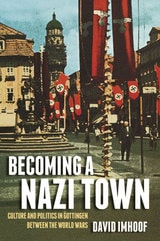
Becoming a Nazi Town
Culture and Politics in Göttingen between the World WarsDavid Imhoof
University of Michigan Press, 2013
Becoming a Nazi Townreveals the ways in which ordinary Germans changed their cultural lives and their politics from the mid-1920s to the mid-1930s. Casting the origins of Nazism in a new light, David Imhoof charts the process by which Weimar and Nazi culture flowed into each other. He analyzes this dramatic transition by looking closely at three examples of everyday cultural life in the mid-sized German city of Göttingen: sharpshooting, an opera festival, and cinema.
Imhoof draws on individual and community experiences over a series of interwar periods to highlight and connect shifts in culture, politics, and everyday life. He demonstrates how Nazi leaders crafted cultural policies based in part on homegrown cultural practices of the 1920s and argues that overdrawn distinctions between “Weimar” and “Nazi” culture did not always conform to most Germans’ daily lives. Further, Imhoof presents experiences in Göttingen as a reflection of the common reality of many German towns beyond the capital city of Berlin.
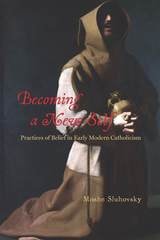
Becoming a New Self
Practices of Belief in Early Modern CatholicismMoshe Sluhovsky
University of Chicago Press, 2017
Practices such as the examination of conscience, general confession, and spiritual exercises, which until the 1400s had been restricted to monastic elites, breached the walls of monasteries in the period that followed. Thanks in large part to Franciscans and Jesuits, lay urban elites—both men and women—gained access to spiritual practices whose goal was to enhance belief and create new selves. Using Michel Foucault’s writing on the hermeneutics of the self, and the French philosopher’s intuition that the early modern period was a moment of transition in the configurations of the self, Sluhovsky offers a broad panorama of spiritual and devotional techniques of self-formation and subjectivation.
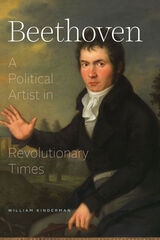
Beethoven
A Political Artist in Revolutionary TimesWilliam Kinderman
University of Chicago Press, 2021
William Kinderman presents Beethoven as a civically engaged thinker faced with severe challenges. The composer lived through many tumultuous events—the French Revolution, the rise and fall of Napoleon Bonaparte, and the Congress of Vienna among them. Previous studies of Beethoven have emphasized the importance of his personal suffering and inner struggles; Kinderman instead establishes that musical tensions in works such as the Eroica, the Appassionata, and his final piano sonata in C minor reflect Beethoven’s attitudes toward the political turbulence of the era. Written for the 250th anniversary of his birth, Beethoven takes stock of the composer’s legacy, showing how his idealism and zeal for resistance have ensured that masterpieces such as the Ninth Symphony continue to inspire activists around the globe. Kinderman considers how the Fifth Symphony helped galvanize resistance to fascism, how the Sixth has energized the environmental movement, and how Beethoven’s civic engagement continues to inspire in politically perilous times. Uncertain times call for ardent responses, and, as Kinderman convincingly affirms, Beethoven’s music is more relevant today than ever before.
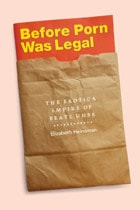
Before Porn Was Legal
The Erotica Empire of Beate UhseElizabeth Heineman
University of Chicago Press, 2011
Struggling to survive in post–World War II Germany, Beate Uhse (1919–2001)—a former Luftwaffe pilot, war widow, and young mother—turned to selling goods on the black market. A self-penned guide to the rhythm method found eager buyers and started Uhse on her path to becoming the world’s largest erotica entrepreneur. Battling restrictive legislation, powerful churches, and conservative social mores, she built a mail-order business in the 1950s that sold condoms, sex aids, self-help books, and more. The following decades brought the world’s first erotica shop, the legalization of pornography, the expansion of her business into eastern Germany, and web-based commerce.
Uhse was only one of many erotica entrepreneurs who played a role in the social and sexual revolution accompanying Germany’s transition from Nazism to liberal democracy. Tracing the activities of entrepreneurs, customers, government officials, and citizen-activists, Before Porn Was Legal brings to light the profound social, legal, and cultural changes that attended the growth of the erotica sector. Heineman’s innovative readings of governmental and industry records, oral histories, and the erotica industry’s products uncover the roots of today’s sexual marketplace and reveal the indelible ways in which sexual expression and consumption have become intertwined.
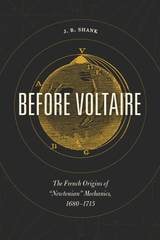
Before Voltaire
The French Origins of “Newtonian” Mechanics, 1680-1715J.B. Shank
University of Chicago Press, 2017
Before Voltaire explores how Newton’s ideas made their way not just through the realm of French science, but into the larger world of society and culture of which Principia was an intertwined part. Shank also details a history of the beginnings of calculus-based mathematical physics that integrates it into the larger intellectual currents in France at the time, including the Battle of the Ancients and the Moderns, the emergence of wider audiences for science, and the role of the newly reorganized Royal Academy of Sciences. The resulting book offers an unprecedented cultural history of one the most important and influential elements of Enlightenment science.
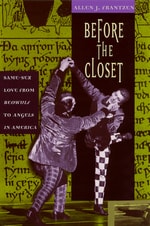
Before the Closet
Same-Sex Love from "Beowulf" to "Angels in America"Allen J. Frantzen
University of Chicago Press, 1998
With its ambitious scope and elegant style, Before the Closet sets same-sex relations in Anglo-Saxon sources in relation to the sexual themes of contemporary opera, dance, and theatre. Frantzen offers a comprehensive analysis of sources from the seventh to the twelfth century and traces Anglo-Saxon same-sex behavior through the age of Chaucer and into the Renaissance.
"Frantzen's marvelous book . . . opens up a world most readers will never have even known was there. It's a difficult topic, but Frantzen's comprehensive, readable and even wryly funny treatment makes this an unexpected pleasure."—Publishers Weekly, starred review
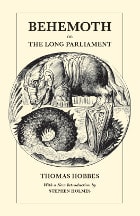
Behemoth or The Long Parliament
Thomas Hobbes
University of Chicago Press, 1990
In his insightful and substantial Introduction, Stephen Holmes examines the major themes and implications of Behemoth in Hobbes's system of thought. Holmes notes that a fresh consideration of Behemoth dispels persistent misreadings of Hobbes, including the idea that man is motivated solely by a desire for self-preservation. Behemoth, which is cast as a series of dialogues between a teacher and his pupil, locates the principal cause of the Civil War less in economic interests than in the stubborn irrationality of key actors. It also shows more vividly than any of Hobbe's other works the importance of religion in his theories of human nature and behavior.

Behind the Wall
An American in East Germany, 1988-89Paul Gleye
Southern Illinois University Press, 1991
Standing in long lines in the shops, coaxing clean laundry from an outdated washing machine, traveling despite unpredictable train schedules, and being without hot water, fruit, and vegetables through the gray winter months failed to dull Paul Gleye’s perceptions during the year he lived in Weimar, East Germany. Day by day Gleye documented his varied observations and experiences, unaware that they would prove a unique record of what would soon be an extinct society.
Gleye was in East Germany as a Fulbright lecturer. Living beyond the capital city of East Berlin and traveling and conversing freely, Gleye gained access to people and places that had been almost completely closed to Americans and other Westerners for decades.
Beholding Disability in Renaissance England
Allison P. Hobgood
University of Michigan Press, 2021
Beholding Disability also uncovers crucial counterdiscourses circulating in the English Renaissance that opposed cultural fantasies of ability and had a keen sensibility toward non-normative embodiments. Hobgood reads impairments as varied as epilepsy, stuttering, disfigurement, deafness, chronic pain, blindness, and castration in order to understand not just powerful fictions of ability present during the Renaissance but also the somewhat paradoxical, surprising ways these ableist ideals provided creative fodder for many Renaissance writers and thinkers. Ultimately, Beholding Disability asks us to reconsider what we think we know about being human both in early modernity, and today.
Being Elsewhere
Tourism, Consumer Culture, and Identity in Modern Europe and North AmericaShelley Baranowski and Ellen Furlough, Editors
University of Michigan Press, 2001
The essays focus on the ways in which tourism and vacations have been historically constitutive of class, social status, and collective identities. Explorations into the history of tourism and vacations reveal their importance for constructing modern cultural meanings of experience, desire, visuality, mobility, and the care of the self, as well as for representing the "good life" and the benefits of consumerism. A major contribution of this book is to demonstrate tourism's importance for nation-building, whether by mobilizing mass consent through state-sponsored leisure organizations, granting paid vacations as a right of citizenship, or creating new tourist sites meant to signify the "essence" of the nation.
Providing historical context and geographical specificity to a subject that has long engaged sociologists, anthropologists, geographers, and literary theorists, but rarely historians, Being Elsewhere is exactly the collection to interest historians, social scientists, and scholars of literary and cultural studies.
Shelley Baranowski is Professor of History, University of Akron. Ellen Furlough is Associate Professor of History, University of Kentucky.
Belarusian Nation-Building in Times of War and Revolution
Lizaveta Kasmach
Central European University Press, 2023
The proclamation of Belarusian independence on March 25, 1918, and the rival establishment of the Soviet Belarusian state on January 1, 1919, created two distinct and mutually exclusive national myths, which continue to define contemporary Belarusian society. This book examines the processes that resulted in this dual resolution in the context of World War I and the subsequent Russian Revolutions.
Based on original archival material, Lizaveta Kasmach scrutinizes the development of competing concepts of Belarusian nationhood in the context of rivaling national aspirations and imperial policies. The analysis convincingly demonstrates the divisions within the nationalist movement, both politically between the moderates and socialists, and geographically between German-occupied territory with Vilna as a center versus Russian-controlled territory around Minsk. Besides the case study of Belarusian nation-building efforts, the book is a contribution to the study of the First World War in East Central Europe, approaching the war and its aftermath as a mobilizational moment in the region.
Belated Travelers
Orientalism in the Age of Colonial DissolutionAli Behdad
Duke University Press, 1994
Through readings of Flaubert, Nerval, Kipling, Blunt, and Eberhardt, and following the transition in travel literature from travelog to tourist guide, Belated Travelers addresses the specific historical conditions of late nineteenth-century orientalism implicated in the discourses of desire and power. Behdad also views a broad range of issues in addition to nostalgia and tourism, including transvestism and melancholia, to specifically demonstrate the ways in which the heterogeneity of orientalism and the plurality of its practice is an enabling force in the production and transformation of colonial power.
An exceptional work that provides an important critique of issues at the forefront of critical practice today, Belated Travelers will be eagerly awaited by specialists in nineteenth-century British and French literatures, and all concerned with colonial and postcolonial discourse.
Believe Not Every Spirit
Possession, Mysticism, & Discernment in Early Modern CatholicismMoshe Sluhovsky
University of Chicago Press, 2007
From 1400 through 1700, the number of reports of demonic possessions among European women was extraordinarily high. During the same period, a new type of mysticism—popular with women—emerged that greatly affected the risk of possession and, as a result, the practice of exorcism. Many feared that in moments of rapture, women, who had surrendered their souls to divine love, were not experiencing the work of angels, but rather the ravages of demons in disguise. So how then, asks Moshe Sluhovsky, were practitioners of exorcism to distinguish demonic from divine possessions?
Drawing on unexplored accounts of mystical schools and spiritual techniques, testimonies of the possessed, and exorcism manuals, Believe Not Every Spirit examines how early modern Europeans dealt with this dilemma. The personal experiences of practitioners, Sluhovsky shows, trumped theological knowledge. Worried that this could lead to a rejection of Catholic rituals, the church reshaped the meaning and practices of exorcism, transforming this healing rite into a means of spiritual interrogation. In its efforts to distinguish between good and evil, the church developed important new explanatory frameworks for the relations between body and soul, interiority and exteriority, and the natural and supernatural.
Believing and Seeing
The Art of Gothic CathedralsRoland Recht
University of Chicago Press, 2008
In addition to the great cathedrals of France, Recht explores key religious buildings throughout Europe to reveal how their grand designs supported this profusion of images that made visible the signs of scripture. Metalworkers, for example, fashioned intricate monstrances and reliquaries for the presentation of sacred articles, and technical advances in stained glass production allowed for more expressive renderings of holy objects. Sculptors, meanwhile, created increasingly naturalistic works and painters used multihued palettes to enhance their subjects’ lifelike qualities. Reimagining these works as a link between devotional practices in the late Middle Ages and contemporaneous theories that deemed vision the basis of empirical truth, Recht provides students and scholars with a new and powerful lens through which to view Gothic art and architecture.
Belisarius
The Last Roman GeneralIan Hughes
Westholme Publishing, 2009
Hughes has written a lively and detailed account of Belisarius’s remarkable career.” - Adrian Goldsworthy, author of The Complete Roman Army
Belisarius (c. 505–565 AD) was the greatest general of the Eastern Roman Empire and is among history’s most notable military personalities. At the age of 29, he twice defeated the Persians and reconquered North Africa from the Vandals, before going on to regain the Italian peninsula from the Ostrogoths, including the Eternal City, Rome. Fighting in the name of Justinian I, Belisarius recaptured large portions of the original territory of the ancient Roman Empire. However, Byzantium was both unwilling and incapable of retaining much of Belisarius’s hard-won advances, and soon after his death, the empire once again retracted.
In Belisarius: The Last Roman General, historian Ian Hughes recounts the life of this great soldier. In addition, he explains the evolution of classical Roman armies and systems of warfare into those of the Byzantine Empire, as well as those of their chief enemies, the Persians, Goths, and Vandals. Based on ancient source and drawing on a wealth of modern research, Belisarius’s career is set in the context of the turbulent times in which he lived and his reputation is reassessed to give a balanced portrait of this neglected giant among ancient commanders.
Belonging and Betrayal
How Jews Made the Art World ModernCharles Dellheim
Brandeis University Press, 2021
The story of dealers of Old Masters, champions of modern art, and victims of Nazi plunder.
Since the late 1990s, the fate of Nazi-stolen art has become a cause célèbre. In Belonging and Betrayal, Charles Dellheim turns this story on its head by revealing how certain Jewish outsiders came to acquire so many old and modern masterpieces in the first place—and what this reveals about Jews, art, and modernity. This book tells the epic story of the fortunes and misfortunes of a small number of eminent art dealers and collectors who, against the odds, played a pivotal role in the migration of works of art from Europe to the United States and in the triumph of modern art.
Beautifully written and compellingly told, this story spans both sides of the Atlantic from the late nineteenth century to the present. It is set against the backdrop of critical transformations, among them the gradual opening of European high culture, the ambiguities of Jewish acculturation, the massive sell-off of aristocratic family art collections, the emergence of different schools of modern art, the cultural impact of World War I, and the Nazi war against the Jews.
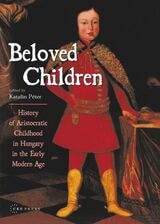
Beloved Children
History of Aristocratic Childhood in Hungary in the Early Modern AgeKatalin Peter
Central European University Press, 2001
Drawing on evidence from a wide collection of surviving family papers, Beloved Children is a valuable contribution to literature available concerning childhood history in pre-industrial Central Europe.
With the aid of detailed case studies, the volume illustrates every aspect of Hungarian childhood in the early modern age from a variety of contrasting perspectives—birth, care, education, marriage, orphanhood and death. The book also includes a unique portrayal of family life in the Hungarian aristocracy.
Beloved Children is a comprehensive study examining topics such as family intimacy, paternal and maternal attitudes, providing the reader with a valuable insight into a child’s life in Hungary during the sixteenth and seventeenth centuries.
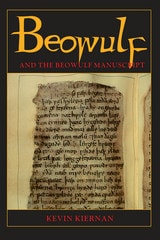
Beowulf and the Beowulf Manuscript
Kevin S. Kiernan
University of Michigan Press, 1997
Kevin S. Kiernan, one of the world's foremost Beowulf scholars, has studied the manuscript extensively with the most up-to-date methods, including fiber-optic backlighting and computer digitization. This volume reprints Kiernan's earlier study of the manuscript, in which he presented his novel conclusions about the date of Beowulf. It also offers a new Introduction in which the author describes the value of electronic study of Beowulf, and a new Appendix that lists all the letters and parts of letters revealed by backlighting.
This important volume will be a must-read not only for the scholar of early English history and literature, but for all those who are interested in practical applications of the new technologies.

Bergeners
Tomas Espedal
Seagull Books, 2017
Using James Joyce’s Dubliners as a discrete guide, celebrated Norwegian writer Tomas Espedal wanders the streets of his hometown. On the journey, he takes notes, reflects, writes a diary, and draws portraits of the city and its inhabitants. Espedal writes tales and short stories, meets fellow writers, and listens to their anecdotes. In a way that anyone from a small town can relate to, he is drawn away from Bergen but at the same time he can’t seem to stay away. Espedal’s Bergeners is a book not just about Bergen, but about life—in a way no one else could have captured.

Berlin and the Cold War
Seth Givens; Ingo Trauschweizer
Ohio University Press, 2024
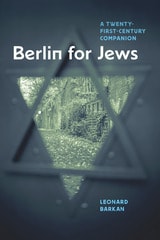
Berlin for Jews
A Twenty-First-Century CompanionLeonard Barkan
University of Chicago Press, 2016
Barkan, voraciously curious and witty, offers a self-deprecating guide to the history of Jewish life in Berlin, revealing how, beginning in the early nineteenth century, Jews became prominent in the arts, the sciences, and the city’s public life. With him, we tour the ivy-covered confines of the Schönhauser Allee cemetery, where many distinguished Jewish Berliners have been buried, and we stroll through Bayerisches Viertel, an elegant neighborhood created by a Jewish developer and that came to be called Berlin’s “Jewish Switzerland.” We travel back to the early nineteenth century to the salon of Rahel Varnhagen, a Jewish society doyenne, who frequently hosted famous artists, writers, politicians, and the occasional royal. Barkan also introduces us to James Simon, a turn-of-the-century philanthropist and art collector, and we explore the life of Walter Benjamin, who wrote a memoir of his childhood in Berlin as a member of the assimilated Jewish upper-middle class. Throughout, Barkan muses about his own Jewishness, while celebrating the rich Jewish culture on view in today’s Berlin.
A winning, idiosyncratic travel companion, Berlin for Jews offers a way to engage with German history, to acknowledge the unspeakable while extolling the indelible influence of Jewish culture.
Berlin
Culture and MetropolisCharles Haxthausen
University of Minnesota Press, 1991

Berliner Chic
A Locational History of Berlin FashionSusan Ingram and Katrina Sark
Intellect Books, 2011
Since becoming the capital of reunited Germany, Berlin has had a dose of global money and international style added to its already impressive cultural veneer. Once home to emperors and dictators, peddlers and spies, it is now a fashion showplace that attracts the young and hip. Moving beyond descriptions of Berlin's fashion industry and its ready-to-wear clothing, Berliner Chic charts the turbulent stories of entrepreneurially-savvy manufacturers and cultural workers striving to establish their city as a fashion capital, and being repeatedly interrupted by politics, ideology, and war. There are many stories to tell about Berlin's fashion industry and Berliner Chic tells them all with considerable expertise.
Berlioz and His Century
An Introduction to the Age of RomanticismJacques Barzun
University of Chicago Press, 1982
Bernini
His Life and His RomeFranco Mormando
University of Chicago Press, 2011
Sculptor, architect, painter, playwright, and scenographer, Gian Lorenzo Bernini (1598–1680) was the last of the great universal artistic geniuses of early modern Italy, placed by both contemporaries and posterity in the same exalted company as Leonardo, Raphael, and Michelangelo. And his artistic vision remains palpably present today, through the countless statues, fountains, and buildings that transformed Rome into the Baroque theater that continues to enthrall tourists today.