Results by title
8113 books match the query 'Literary Criticism' and 307 start with b
BASTARDS AND FOUNDLINGS
ILLEGITIMACY IN EIGHTEENTH-CENTURY ENGLANDLisa Zunshine
The Ohio State University Press, 2005
Back to Black
Jules Feiffer’s Noir TrilogyFabrice Leroy
Rutgers University Press, 2025
Named the Best Academic Work of 2025 by The Comics Journal
The legendary American cartoonist and author Jules Feiffer has enjoyed a long and varied career, working on everything from illustrating The Phantom Tollbooth to writing the screenplay for the film Popeye. But some of his most innovative work came very late in his career, with a trio of graphic novels he composed in his eighties: Kill My Mother (2014), Cousin Joseph (2016), and The Ghost Script (2018).
Back to Black provides the first full-length critical analysis of this trilogy, exploring how it pays homage to the iconography and themes of film noir through constant graphic experimentation and a striking reinvention of Feiffer’s distinctive style. Fabrice Leroy shows how Feiffer deftly alternates between dramatic and satirical tones as he plays with the conventions of noir to provide a caustic yet moving commentary on mid-twentieth-century American life. Through close readings of each novel in the trilogy, he examines Feiffer’s singular depiction of the central political issues in the United States from the Great Depression to the 1950s, which still resonate today: unionization struggles, cinematic propaganda, McCarthyism, the American Dream, immigration, antisemitism, civil rights, and gender discrimination. Placing the noir trilogy into the context of Feiffer’s long career, Back to Black demonstrates how he offers a loving pastiche of the genre without losing his unique voice or critical edge.

Background of Thomson’s Seasons
Alan Dugald McKillop
University of Minnesota Press, 1942
Background of Thomson's Seasons was first published in 1942. Minnesota Archive Editions uses digital technology to make long-unavailable books once again accessible, and are published unaltered from the original University of Minnesota Press editions.
There have been many valuable scattered studies of James Thomson's famous Seasons,but this is the first comprehensive book on the subject to be published in this country. This most popular long poem published in England in the eighteenth century well deserves reexamination. It is interesting not only to students of literature but also to those concerned with the history of ideas and the relationship of the fields of human knowledge.
Thomson's Seasons reflects the trends of his time in literature, philosophy, science, history, and religion. Professor McKillop presents an illuminating and systematic analysis of the general philosophic and literary situation in which Thomson worked. Then he discusses Thomson's use of the natural sciences and of the literature of history, geography, and travel. He shows that the poet was also concerned with the patterns of human society, both primitive and civilized.
The author reveals clearly how Thomson was indebted to the classical tradition; to the literary inspiration of Milton; to the scientific discussions and theories of Newton, Halley, Burnet, and the writers of popular physico-theological manuals; to the philosophical discussions of Shaftesbury and Locke; to the contemporary periodical essay; to the religious works of Blackmore and Hill; to the descriptions of remote regions and peoples in such writers as Scheffer, Varenius, and Maupertuis. All Thomson's borrowings and characteristic ideas fall into the framework of his poem.
As this book was leaving the bindery, discovery was made in Glasgow of a catalogue of Thomson's library. The document substantiates many of Professor McKillop's deductions.
Backgrounds of English Literature, 1700-1760
Cecil Moore
University of Minnesota Press, 1953

Bad Books
Rétif de la Bretonne, Sexuality, and PornographyAmy S. Wyngaard
University of Delaware Press, 2013
Published by University of Delaware Press. Distributed worldwide by Rutgers University Press.
Bad Chaucer
The Great Poet’s Greatest Mistakes in the Canterbury TalesTison Pugh
University of Michigan Press, 2024
Bad Education
Why Queer Theory Teaches Us NothingLee Edelman
Duke University Press, 2022
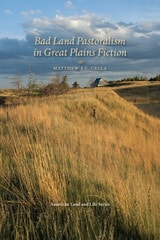
Bad Land Pastoralism in Great Plains Fiction
Matthew J. C. Cella
University of Iowa Press, 2010
At the core of this nuanced book is the question that ecocritics have been debating for decades: what is the relationship between aesthetics and activism, between art and community? By using a pastoral lens to examine ten fictional narratives that chronicle the dialogue between human culture and nonhuman nature on the Great Plains, Matthew Cella explores literary treatments of a succession of abrupt cultural transitions from the Euroamerican conquest of the “Indian wilderness” in the nineteenth century to the Buffalo Commons phenomenon in the twentieth. By charting the shifting meaning of land use and biocultural change in the region, he posits this bad land—the arid West—as a crucible for the development of the human imagination.
Each chapter deals closely with two novels that chronicle the same crisis within the Plains community. Cella highlights, for example, how Willa Cather reconciles her persistent romanticism with a growing disillusionment about the future of rural Nebraska, how Tillie Olsen and Frederick Manfred approach the tragedy of the Dust Bowl with strikingly similar visions, and how Annie Proulx and Thomas King use the return of the buffalo as the centerpiece of a revised mythology of the Plains as a palimpsest defined by layers of change and response. By illuminating these fictional quests for wholeness on the Great Plains, Cella leads us to understand the intricate interdependency of people and the places they inhabit.
Cella uses the term “pastoralism” in its broadest sense to mean a mode of thinking that probes the relationship between nature and culture: a discourse concerned with human engagement—material and nonmaterial—with the nonhuman community. In all ten novels discussed in this book, pastoral experience—the encounter with the Beautiful—leads to a renewed understanding of the integral connection between human and nonhuman communities. Propelling this tradition of bad land pastoralism are an underlying faith in the beauty of wholeness that comes from inhabiting a continuously changing biocultural landscape and a recognition of the inevitability of change. The power of story and language to shape the direction of that change gives literary pastoralism the potential to support an alternative series of ideals based not on escape but on stewardship: community, continuity, and commitment.
Bad Modernisms
Douglas Mao and Rebecca L. Walkowitz, eds.
Duke University Press, 2006
Bad Modernisms thus builds on and extends the “new modernist studies,” recent work marked by the application of diverse methods and attention to texts and artists not usually labeled as modernist. In this collection, these developments are exemplified by essays ranging from a reading of dandyism in 1920s Harlem as a performance of a “bad” black modernist imaginary to a consideration of Filipino American modernism in the context of anticolonialism. The contributors reconsider familiar figures—such as Virginia Woolf, D. H. Lawrence, Josef von Sternberg, Ludwig Wittgenstein, W. H. Auden, and Wyndham Lewis—and bring to light the work of lesser-known artists, including the writer Carlos Bulosan and the experimental filmmaker Len Lye. Examining cultural artifacts ranging from novels to manifestos, from philosophical treatises to movie musicals, and from anthropological essays to advertising campaigns, these essays signal the capaciousness and energy galvanizing the new modernist studies.
Contributors. Lisa Fluet, Laura Frost, Michael LeMahieu, Heather K. Love, Douglas Mao, Jesse Matz, Joshua L. Miller, Monica L. Miller, Sianne Ngai, Martin Puchner, Rebecca L. Walkowitz
Badass Feminist Politics
Exploring Radical Edges of Feminist Theory, Communication, and ActivismSarah Jane Blithe
Rutgers University Press, 2022
Badass Feminist Politics includes a diverse range of engaging feminist political projects to not only analyze the work being done on the ground but provide an overview for action that can be taken on by those seeking to engage in feminist activism in their own communities. Contributors included here are working for equality and equity and resisting violent, racist, homophobic, transphobic, xenophobic, and sexist language and action during this tension-filled political moment. Collectively, the book explores what it means to live and communicate feminist politics in everyday choices and actions, and how we can facilitate learning by analyzing these examples. Taking up current issues and new theoretical perspectives, the authors offer novel perspectives into what it means to live feminist politics. This book is a testament to resilience, resistance, communication, and forward thinking about what these themes all mean for new feminist agendas. Learning how to resist oppressive structures through words and actions is particularly important for students. Badass Feminist Politics features scholars from non-dominant groups taking up issues of marginalization and oppression, which can help people accomplish their social justice goals of inclusivity on the ground and in the classroom.
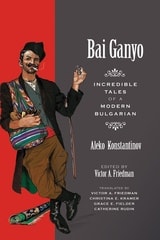
Bai Ganyo
Incredible Tales of a Modern BulgarianAleko Konstantinov
University of Wisconsin Press, 2010
Bai Ganyo has been translated into most European languages, but now Victor Friedman and his fellow translators have finally brought this Balkan masterpiece to English-speaking readers, accompanied by a helpful introduction, glossary, and notes.
Bakhtin and Religion
A Feeling for FaithSusan M. Felch and Paul J. Contino
Northwestern University Press, 2001
These essays provide an overview of Bakhtin's attitude toward religion in general and Russian Orthodoxy in particular, addressing topics ranging from how Bakhtin's religious ideas informed his linguistic and aesthetic theories to the idea of love in his secular and religious thought and to the religious component of Bakhtin's theory of laughter.
Bakhtin and the Classics
R. Bracht Branham
Northwestern University Press, 2001
The authors, eminent classicists and distinguished critics of Bakhtin, put Bakhtin into dialogue with the classics--and classicists into dialogue with Bakhtin. Each essay offers a critical account of an important aspect of Bakhtin's thought and examines the value of his approach in the context of literary or cultural history. Beginning with an overview of Bakhtin's notion of carnival laughter, perhaps his central critical concept, the volume explores Bakhtin's thought and writing in relation to Homer's epic verse. Catullus's lyric poetry, ancient Roman novels, and Greek philosophy from Aristotle's theory of narrative to the work of Antiphon the Sophist. The results are of interest and importance to Bakhtinians, theorists, and classicists.
Bakhtin in Contexts
Across the DisciplinesAmy Mandelker
Northwestern University Press, 1995
Bakhtin/ Bakhtin
The Archives and Beyond, Volume 97Peter Hitchcock
Duke University Press, 0
Exploring both the dynamism of Bakhtin versus “Bakhtin” and the dynamics of “possible Bakhtins,” the contributors tackle this theorist’s range of shifting shapes, from the carnival-messianistic and the chronotopic, through the philosophic and the ideologic, to the “applied Bakhtin” of the social sciences. Bakhtin’s texts are examined in the context of work by such disparate figures as Ernst Cassirer and Rudolph Rocker, while various aspects of the academic “Bakhtin industry” are examined, including the “will to mythology by anthology” and the inequities of a world market in ideas exemplified by the resource gap between Russian and Western scholarship. The “state of the archive” is assessed by both UK Bakhtin Centre Director David Shepherd and Russian Bakhtin Archivist Nikolai Pan’kov. Throughout the issue, which is framed by Peter Hitchcock’s introductory polemics and Michael Holquist’s afterword, author and archive are continually deconstructed and reconstructed.
Contributors. Robert Barsky, Rachel Falconer, Maroussia Hadjukowski-Ahmed, Ken Hirschkop, Peter Hitchcock, Michael Holquist, Vitaly Makhlin, Nikolai Pan’kov, Brian Poole, David Shepherd, Galin Tihanov, Anthony Wall
Bakhtin
Essays and Dialogues on His WorkEdited by Gary Saul Morson
University of Chicago Press, 1986
A groundbreaking collection of essays on the influential critic and philosopher
Mikhail Bakhtin (1895-1975) was a Russian philosopher and literary critic whose influence on a wide range of intellectual fields has only grown since his death, with his emphasis on dialogue and suspicion of systems having particularly resonance in literary studies and linguistics. This collection of essays, all originally published in the the journal Critical Inquiry, explores his literary and linguistic theory and its implications for theory in general and critical practice.
In addition to the critical essays, this book includes previously untranslated excerpts from Bakhtin's essays and notebooks.
Bakhtin’s Adventure
An Essay on Life without MeaningBenjamin Paloff
Northwestern University Press, 2025
A century after Mikhail Bakhtin first began formulating his now-canonical reflections on freedom and literary representation, we often seem as confused as ever about the relationship between narrative form and what it means to live ethically. Focusing on the throughline of adventure in Bakhtin’s thought, we find a peculiar, yet no less ethically urgent challenge: not to imagine the literary hero as if they were a real person but to recognize how we are always imagining real people as if they were literary characters. This is a provocation with far-reaching consequences for how we understand ourselves, each other, and our situatedness in space and time.
In Bakhtin’s Adventure: An Essay on Life without Meaning, Benjamin Paloff argues that the major aesthetic, ethical, and sociological threads of Bakhtin’s thought intersect in his concept of adventure. Reading across a wide variety of media, from classic literature to contemporary film, Paloff demonstrates how, for Bakhtin and his interlocutors, the test of human freedom is whether narrative means nothing beyond its own adventure. Reframed in this light, Bakhtin’s most influential ideas (eventness, chronotope, heteroglossia, polyphony, carnival) form a cohesive model for how to maintain ethical relations in a world where we can never really know each other the way we know ourselves.

Ballad Hunting with Max Hunter
Stories of an Ozark Folksong CollectorSarah Jane Nelson; Foreword by Robert Cochran
University of Illinois Press, 2023
Sarah Jane Nelson chronicles Hunter’s song collecting adventures alongside portraits of the singers and mentors he met along the way. The guitar-strumming Hunter picked up the recording habit to expand his repertoire but almost immediately embraced the role of song preservationist. Being a local allowed Hunter to merge his native Ozark earthiness with sharp observational skills to connect--often more than once--with his singers. Hunter’s own ability to be present added to that sense of connection. Despite his painstaking approach, ballad collecting was also a source of pleasure for Hunter. Ultimately, his dedication to capturing Ozarks song culture in its natural state brought Hunter into contact with people like Vance Randolph, Mary Parler, and non-academic folklorists who shared his values.
Baltimore's Black Arts Then & Now
Behind the Scenes of a Collaborative Public Humanities ProjectMary Rizzo
University of Iowa Press, 2026
Since 2017, a group of former Chicory editors, scholars, librarians, poets, teachers, and young writers have collaborated to use Chicory as a catalyst for intergenerational dialogue on social justice, race, and place. Baltimore’s Black Arts Then & Now documents this joint effort, offering valuable insights for public historians, educators, and humanists.
Barbarous Play
Race on the English Renaissance StageLara Bovilsky
University of Minnesota Press, 2008
Like our own, early modern beliefs about race depended on metaphorical, selective, and contradictory understandings of how membership in groups is determined. Although race took distinctive forms in the past, the fallacies that underlie early modern racial experience generally are precisely-and surprisingly-the same as those in contemporary culture.
Exploring the similar underpinnings of early modern and contemporary ideas of difference, Barbarous Play examines English Renaissance understandings of race as depicted in drama. Reading plays by Shakespeare, Marlowe, Webster, and Middleton, Bovilsky offers case studies of how racial meanings are generated by narratives of boundary crossing-especially miscegenation, religious conversion, class transgression, and moral and physical degeneracy. In the process, she reveals deep parallels between the period’s conceptions of race and gender.
Barbarous Play contests the widely held view that race and racism depend on modern science for their existence and argues that understanding just what is false and figurative in past depictions of race, such as those found in Othello, The Merchant of Venice, The White Devil, and The Changeling, can clarify the illogic of present-day racism.
Lara Bovilsky is assistant professor of English at Washington University in St. Louis.
Bard of Iceland
Jonas Hallgrimsson, Poet and ScientistRichard Ringler
University of Wisconsin Press, 2002
Bard of Iceland makes available for the first time in any language other than Icelandic an extensive selection of works by Jónas Hallgrímsson (1807–1845), the most important poet of modern Iceland. Jónas was also Iceland’s first professionally trained geologist and an active contributor in a number of other scientific fields: geography, botany, zoology, and archaeology. He played a key role as well in Iceland’s struggle to gain independence from Denmark. "Descriptive power and fullness of spirit were the hallmarks of his soul," wrote a contemporary admirer.
Dick Ringler, one of the premier scholars of Icelandic literature in the world, offers a substantial biography of Jónas, a representative selection of his most important poems, and some of his prose work in science and belles lettres. Ringler also provides extended commentaries and an essay on Icelandic prosody.
The poems are translated into English equivalents of their original complex meters in Icelandic and Danish. As a poet Jónas was intimately familiar with his nation’s medieval literary inheritance—the sagas and eddas—and also with the groundbreaking work of contemporary German and Danish Romanticism (Chamisso, Heine, Oehlenschläger). A master of poetic form, Jónas not only exploited and enlarged the possibilities of traditional eddic and skaldic meters, but introduced the sonnet, triolet stanza, terza and ottava rima, and blank verse into the Icelandic metrical repertory.
Bardic Deadlines
Reviewing Poetry, 1984-95Geoffrey O'Brien
University of Michigan Press, 1998
In Bardic Deadlines, writer and editor Geoffrey O'Brien collects twenty of his essays on poetry that originally appeared in the Voice Literary Supplement and the New York Review of Books. O'Brien surveys an array of some of the most striking and innovative poets to emerge in recent decades, including Susan Howe, August Kleinzahler, Clark Coolidge, Nathaniel Mackey, Gustaf Sobin, and Michael O'Brien. Discussions of contemporary work are juxtaposed with considerations of other traditions going as far back as the second-century Chinese anthology The Songs of the South and the Sanskrit master Kalidasa, traditions considered highly relevant to current practice. There are engaging, in-depth portraits of the work of poets John Clare, Hugh MacDiarmid, Emily Brontë, Kenji Miyazawa, and Frank O'Hara, among others. There is also an exploration of the poetics of Walt Whitman that highlights themes addressed throughout the collection: the physicality and musicality of language, the spatial dimension of poetry, the intimate bond between poet and reader, and the secret and often obsessive strategies by which the poet hides secrets in plain sight and enlists the reader in the making of the poem. Each essay focuses on poetry as an experience that impinges on basic questions of identity and being.
Bareface
A Guide to C.S. Lewis's Last NovelDoris T. Myers
University of Missouri Press, 2004
Baroque New Worlds
Representation, Transculturation, CounterconquestLois Parkinson Zamora and Monika Kaup, eds.
Duke University Press, 2010
Since Neobaroque reconstitutions necessarily reference the European Baroque, this volume begins with the reevaluation of the Baroque that evolved in Europe during the late nineteenth century and the early twentieth. Foundational essays by Friedrich Nietzsche, Heinrich Wölfflin, Walter Benjamin, Eugenio d’Ors, René Wellek, and Mario Praz recuperate and redefine the historical Baroque. Their essays lay the groundwork for the revisionist Latin American essays, many of which have not been translated into English until now. Authors including Alejo Carpentier, José Lezama Lima, Severo Sarduy, Édouard Glissant, Haroldo de Campos, and Carlos Fuentes understand the New World Baroque and Neobaroque as decolonizing strategies in Latin America and other postcolonial contexts. This collection moves between art history and literary criticism to provide a rich interdisciplinary discussion of the transcultural forms and functions of the Baroque.
Contributors. Dorothy Z. Baker, Walter Benjamin, Christine Buci-Glucksmann, José Pascual Buxó, Leo Cabranes-Grant, Haroldo de Campos, Alejo Carpentier, Irlemar Chiampi, William Childers, Gonzalo Celorio, Eugenio d’Ors, Jorge Ruedas de la Serna, Carlos Fuentes, Édouard Glissant, Roberto González Echevarría, Ángel Guido, Monika Kaup, José Lezama Lima, Friedrich Nietzsche, Mario Praz, Timothy J. Reiss, Alfonso Reyes, Severo Sarduy, Pedro Henríquez Ureña, Maarten van Delden, René Wellek, Christopher Winks, Heinrich Wölfflin, Lois Parkinson Zamora
Barrier of a Common Language
An American Looks at Contemporary British PoetryDana Gioia
University of Michigan Press, 2003
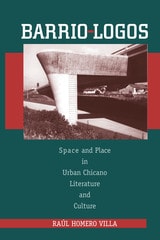
Barrio-Logos
Space and Place in Urban Chicano Literature and CultureBy Raúl Homero Villa
University of Texas Press, 2000
Struggles over space and resistance to geographic displacement gave birth to much of Chicano history and culture. In this pathfinding book, Raúl Villa explores how California Chicano/a activists, journalists, writers, artists, and musicians have used expressive culture to oppose the community-destroying forces of urban renewal programs and massive freeway development and to create and defend a sense of Chicano place-identity.
Villa opens with a historical overview that shows how Chicano communities and culture have grown in response to conflicts over space ever since the United States' annexation of Mexican territory in the 1840s. Then, turning to the work of contemporary members of the Chicano intelligentsia such as Helena Maria Viramontes, Ron Arias, and Lorna Dee Cervantes, Villa demonstrates how their expressive practices re-imagine and re-create the dominant urban space as a community enabling place. In doing so, he illuminates the endless interplay in which cultural texts and practices are shaped by and act upon their social and political contexts.

Baudelaire and the Poetics of Modernity
Patricia A. Ward
Vanderbilt University Press, 2000
Charles Baudelaire, possibly the most influential author of nineteenth-century France, created a poetics of modernity and a thematics of the city; he transcended genre by moving between poetry and prose. He is also the most accessible of modern French poets to an American readership. These essays examine Baudelaire's poetics and the complex relationship between the poet and his twentieth-century literary heirs, including Rene Char, Yves Bonnefoy, and Michel Deguy.
The contributors, who include Deguy and Bonnefoy, are all distinguished writers or critics noted for their own poetry or for their scholarship on Baudelaire and in French studies. Their essays go to the heart of what makes Baudelaire so important: his modernity and his influence from the very beginning on other poets, including those outside of France. The essays are written in English, with citations from Baudelaire and other sources in both French and English.
Bawaajimo
A Dialect of Dreams in Anishinaabe Language and LiteratureMargaret Noodin
Michigan State University Press, 2014
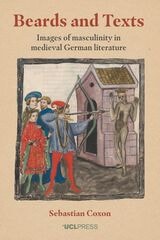
Beards and Texts
Images of Masculinity in Medieval German LiteratureSebastian Coxon
University College London, 2021
Beards make frequent appearances in medieval German poetry—as esteemed markers of majestic wisdom or as hilarious props for undignified manhandling. In Beards and Texts, Sebastian Coxon traces this preeminent symbol of masculinity through four major poetic traditions across the twelfth and sixteenth centuries—Pfaffe Konrad’s Rolandslied, Wolfram von Eschenbach’s Willehalm, ‘Sangspruchdichtung’, and Heinrich Wittenwiler’s Ring. By attending to this hairy trope, Beards and Texts sheds new light on the construction of both poetic form and masculinity in the Middle Ages.

Bearing the Bad News
Contemporary American Literature and CultureSanford Pinsker
University of Iowa Press, 1990
Beasts at Bedtime
Revealing the Environmental Wisdom in Children’s LiteratureLiam Heneghan
University of Chicago Press, 2018
In Beasts at Bedtime, scientist (and father) Liam Heneghan examines the environmental underpinnings of children’s stories. From Beatrix Potter to Harry Potter, Heneghan unearths the universal insights into our inextricable relationship with nature that underlie so many classic children’s stories. Some of the largest environmental challenges in coming years—from climate instability, the extinction crisis, freshwater depletion, and deforestation—are likely to become even more severe as this generation of children grows up. Though today’s young readers will bear the brunt of these environmental calamities, they will also be able to contribute to environmental solutions if prepared properly. And all it takes is an attentive eye: Heneghan shows how the nature curriculum is already embedded in bedtime stories, from the earliest board books like The Rainbow Fish to contemporary young adult classics like The Hunger Games.
Beasts at Bedtime is an awakening to the vital environmental education children’s stories can provide—from the misadventures of The Runaway Bunny to more overt tales like The Lorax. Heneghan serves as our guide, drawing richly upon his own adolescent and parental experiences, as well as his travels in landscapes both experienced and imagined. Organized into thematic sections, the work winds its way through literary forests, colorful characters, and global environments.
This book enthralls as it engages. Heneghan as a guide is as charming as he is insightful, showing how kids (and adults) can start to experience the natural world in incredible ways from the comfort of their own rooms. Beasts at Bedtime will help parents, teachers, and guardians extend those cozy times curled up together with a good book into a lifetime of caring for our planet.
Beautiful Democracy
Aesthetics and Anarchy in a Global EraRuss Castronovo
University of Chicago Press, 2007

Beautiful Fighting Girl
Saito Tamaki
University of Minnesota Press, 2010
In Beautiful Fighting Girl, Saito Tamaki offers a far more sophisticated and convincing interpretation of this alluring and capable figure. For Saito, the beautiful fighting girl is a complex sexual fantasy that paradoxically lends reality to the fictional spaces she inhabits. As an object of desire for male otaku (obsessive fans of anime and manga), she saturates these worlds with meaning even as her fictional status demands her ceaseless proliferation and reproduction. Rejecting simplistic moralizing, Saito understands the otaku’s ability to eroticize and even fall in love with the beautiful fighting girl not as a sign of immaturity or maladaptation but as a result of a heightened sensitivity to the multiple layers of mediation and fictional context that constitute life in our hypermediated world—a logical outcome of the media they consume.
Featuring extensive interviews with Japanese and American otaku, a comprehensive genealogy of the beautiful fighting girl, and an analysis of the American outsider artist Henry Darger, whose baroque imagination Saito sees as an important antecedent of otaku culture, Beautiful Fighting Girl was hugely influential when first published in Japan, and it remains a key text in the study of manga, anime, and otaku culture. Now available in English for the first time, this book will spark new debates about the role played by desire in the production and consumption of popular culture.
Beautiful War
Studies in a Dreadful FascinationPhilip D. Beidler
University of Alabama Press, 2016
Beautiful War: Studies in a Dreadful Fascination is a wide-ranging exploration of armed conflict as depicted in art that illustrates the constant presence of war in our everyday lives. Philip D. Beidler investigates the unending assimilation and pervasive presence of the idea of war in popular culture, the impulses behind the making of art out of war, and the unending and debatably aimless trajectories of war itself.
Beidler’s critical scope spans from Shakespeare’s plays, through the Victorian battle paintings of Lady Butler, into the post-World War I writings of F. Scott Fitzgerald and Virginia Woolf, and up to twenty-first-century films such as The Hurt Locker and Extremely Loud and Incredibly Close. As these works of art have become ubiquitous in contemporary culture, the many faces of war clearly spill over into our art and media, and Beidler argues that these portrayals in turn shift the perception of war from a savage truth to a concept.
Beautiful War argues that the representation of war in the arts has always been, and continues to be, an incredibly powerful force. Incorporating painting, music, photography, literature, and film, Beidler traces a disturbing but fundamental truth: that war has always provided an aesthetic inspiration while serving ends as various and complex as ideological or geopolitical history, public memory, and mass entertainment.
Beautiful War is a bold and vivid account of the role of war and military conflict as a subject of art that offers much of value to literary and cultural critics, historians, veterans, students of art history and communication studies, and those interested in expanding their understanding of art and media’s influence on contemporary values and memories of the past.
Beauty and the Beast
The Original StoryGabrielle-Suzanne Barbot de Villeneuve
Iter Press, 2020
The Other Voice in Early Modern Europe: The Toronto Series volume 74
Beckett after Wittgenstein
Andre Furlani
Northwestern University Press, 2015
Among the best-represented authors in Samuel Beckett’s library was Ludwig Wittgenstein, yet the philosopher’s relevance to the Nobel laureate’s work is scarcely acknowledged and seldom elucidated. Beckett after Wittgenstein is the first book to examine Beckett’s formative encounters with, and profound affinities to, Wittgenstein’s thought, style, and character.
While a number of influential critics, including the philosopher Alain Badiou, have discerned a transition in Beckett’s work beginning in the late 1950s, Furlani is the first to identify and clarify how this change occurs in conjunction with the writer’s sustained engagement with Wittgenstein’s thought on, for example, language, cognition, subjectivity, alterity, temporality, belief, hermeneutics, logic, and perception. Drawing on a wealth of Beckett’s archival materials, much of it unpublished, Furlani’s study reveals the extent to which Wittgenstein fostered Beckett’s views and emboldened his purposes.
Beckett’s Happy Days
A Manuscript StudyS. E. Gontarski
The Ohio State University Press, 2017
The current reissue of Beckett’s Happy Days comes at a timely moment not only in Beckett studies but also in the general growth in programs of book history and digital humanities. Gontarski’s study is not just a look back to origins. It traces an arc of research that developed over forty years as the Samuel Beckett archive at the University of Reading matured, as the fields of genetic and textual research grew, and as book history reemerged on a grand, international scale. In this timeframe, the Beckett Digital Manuscript and Library Projects responded to interest in Beckett studies and archival studies, taking textual production, genetic study, and book history into the twenty-first century with their emphasis on electronic access and digital collation. At The Ohio State University, the Rare Books and Manuscripts archive held papers central to Gontarski’s study. Beckett’s Happy Days is thus a fundamental, even seminal, part of that forty-year scholarly trajectory, and in its current edition, is readily accessible to individual students and scholars alike.
Becoming Beside Ourselves
The Alphabet, Ghosts, and Distributed Human BeingBrian Rotman
Duke University Press, 2008
Alphabetic texts do not convey the bodily gestures of human speech: the hesitations, silences, and changes of pitch that infuse spoken language with affect. Rotman suggests that by removing the body from communication, alphabetic texts enable belief in singular, disembodied, authoritative forms of being such as God and the psyche. He argues that while disembodied agencies are credible and real to “lettered selves,” they are increasingly incompatible with selves and subjectivities formed in relation to new virtual technologies and networked media. Digital motion-capture technologies are restoring gesture and even touch to a prominent role in communication. Parallel computing is challenging the linear thought patterns and ideas of singularity facilitated by alphabetic language. Barriers between self and other are breaking down as the networked self is traversed by other selves to become multiple and distributed, formed through many actions and perceptions at once. The digital self is going plural, becoming beside itself.
Becoming Black
Creating Identity in the African DiasporaMichelle M. Wright
Duke University Press, 2004
Wright argues that three nineteenth-century American and European works addressing race—Thomas Jefferson’s Notes on the State of Virginia, G. W. F. Hegel’s Philosophy of History, and Count Arthur de Gobineau’s Essay on the Inequality of the Human Races—were particularly influential in shaping twentieth-century ideas about Black subjectivity. She considers these treatises in depth and describes how the revolutionary Black thinkers W. E. B. Du Bois, Aimé Césaire, Léopold Sédar Senghor, and Frantz Fanon countered the theories they promulgated. She explains that while Du Bois, Césaire, Senghor, and Fanon rejected the racist ideologies of Jefferson, Hegel, and Gobineau, for the most part they did so within what remained a nationalist, patriarchal framework. Such persistent nationalist and sexist ideologies were later subverted, Wright shows, in the work of Black women writers including Carolyn Rodgers and Audre Lorde and, more recently, the British novelists Joan Riley, Naomi King, Jo Hodges, and Andrea Levy. By considering diasporic writing ranging from Du Bois to Lorde to the contemporary African novelists Simon Njami and Daniel Biyaoula, Wright reveals Black subjectivity as rich, varied, and always evolving.
Becoming French
Mapping the Geographies of French Identity, 1871-1914Dana Kristofor Lindaman
Northwestern University Press, 2016

Becoming Hybrid
J. Mae Barizo
University of Michigan Press, 2027
Becoming Hybrid offers an intimate exploration of creative process and hybrid poetics. Weaving together essays, interviews, personal narrative, and pedagogical reflections, this book explores what it means to be “hybrid” in the twenty-first century, as artists increasingly produce work that challenges traditional formal boundaries. The book examines the transdisciplinary practice of artists like Cecilia Vicuña, Don Mee Choi, and Claudia Rankine, many of whom write from diasporic experience or from identities historically pushed to the margins. Emerging from Barizo’s lifelong engagements with music, philosophy, art, and literature, the book illuminates the idiosyncratic pathways she has taken to unsettle disciplinary boundaries as an author, artist, and performer. Becoming Hybrid traces how disciplinary and genre-bound conventions have shifted and dissolved across time, offering tools for decolonial pedagogy and collaborative writing workshops that honor multiple voices, lived experiences, and cultural traditions. Accessible yet intellectually rigorous, the book opens up a conversation about hybridity and creativity, making it an essential guide for anyone interested in how contemporary art and literature are reshaping the ways we think, write, and create today.
Becoming Julia de Burgos
The Making of a Puerto Rican IconVanessa Perez Rosario
University of Illinois Press, 2014
In the first book-length study written in English, Vanessa Pérez-Rosario examines poet and political activist Julia de Burgos's development as a writer, her experience of migration, and her legacy in New York City, the poet's home after 1940. Pérez-Rosario situates Julia de Burgos as part of a transitional generation that helps to bridge the historical divide between Puerto Rican nationalist writers of the 1930s and the Nuyorican writers of the 1970s. Becoming Julia de Burgos departs from the prevailing emphasis on the poet and intellectual as a nationalist writer to focus on her contributions to New York Latino/a literary and visual culture. It moves beyond the standard tragedy-centered narratives of de Burgos's life to place her within a nuanced historical understanding of Puerto Rico's peoples and culture to consider more carefully the complex history of the island and the diaspora. Pérez-Rosario unravels the cultural and political dynamics at work when contemporary Latina/o writers and artists in New York revise, reinvent, and riff off of Julia de Burgos as they imagine new possibilities for themselves and their communities.
Becoming Mikhail Lermontov
The Ironies of Romantic Individualism in Nicholas I's RussiaDavid Powelstock
Northwestern University Press, 2011
By bringing to light Lermontov's operative version of Romantic individualism, Powelstock is able to make sense of the poet's relationship to "romantic irony," his highly modern concept of the reader (both real, and implied in the text), and his vexed passion for his predecessor Alexander Pushkin--a relationship that is almost always treated sentimentally, but is here given its true competitive edge. Furthermore, Powelstock offers the most persuasive account ever given of Lermontov's exceptionally odd treatment of, and success with, women--both in real life and in fiction--and of his cruel overlapping of these two planes.
Clarifying what has remained perplexing for so long, and correcting what has been misinterpreted, Powelstock's work illuminates Lermontov's views of dignity, death, love, nature, society, and ethics--and, finally, gives us an intellectual biography that is deeper and more subtle than any written before.
Becoming Pynchon
Genetic Narratology and V.Luc Herman and John M. Krafft
The Ohio State University Press, 2023
The 1963 publication of Thomas Pynchon’s V. changed the landscape of American fiction. Becoming Pynchon: Genetic Narratology and V. offers a detailed examination of the dramatic transformations that took place as Pynchon’s foundational novel went from typescript to published work. Luc Herman and John M. Krafft develop and deploy a rich theory of genetic narratology to examine the performance of genre in the novel. Pushing back against the current dominance of cognitive narratology, they discuss focalization, character construction, and evocation of consciousness as clues to Pynchon’s developing narratology of historical fiction. Their theoretical interventions offer an important and timely corrective to the field of narratology with a method that brings the author back into the analytical frame.
Herman and Krafft use as their guide the typescript of V. that surfaced in 2001, when it was acquired by the Harry Ransom Humanities Research Center, as well as Pynchon’s editorial correspondence with Corlies Smith, his first editor at J. B. Lippincott. Becoming Pynchon assembles a comprehensive and unequaled picture of Pynchon’s writing process that will appeal both to Pynchonians and to postmodernism scholars more broadly.
Becoming Reinaldo Arenas
Family, Sexuality, and The Cuban RevolutionJorge Olivares
Duke University Press, 2013
Through insightful close readings of a selection of Arenas's works, including unpublished manuscripts and correspondence, Olivares examines the writer's personal, political, and artistic trajectory, focusing on his portrayals of family, sexuality, exile, and nostalgia. He documents Arenas's critical engagement with cultural and political developments in revolutionary Cuba and investigates the ways in which Arenas challenged literary and national norms. Olivares's analysis shows how Arenas drew on his life experiences to offer revealing perspectives on the Cuban Revolution, the struggles of Cuban exiles, and the politics of sexuality.
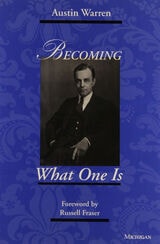
Becoming What One Is
Austin Warren
University of Michigan Press, 1995
The late Austin Warren was one of the most distinguished literary scholars of the twentieth century, well known as a biographer, literary critic, and teacher. He retired from the University of Michigan English Department in 1968 after twenty years on the faculty. Warren's memoir ends at age forty, because, as he explains in the preface, the most interesting part of anyone's life is the formative years.
He begins with his childhood in Massachusetts and education at Wesleyan, Harvard, and Princeton, and ends with reflections on the problems of integrating his profession, teaching, with his vocation, writing. The journey in between is extraordinary, a re-creation of the scholar's search for identity, religion, wisdom, and a new vision of the role of a teacher.
Warren "forged his soul when others weren't looking," writes Russell Fraser in his foreword to the book. He grew up on a lonely New England farm, went to a school where he learned to hate even Shakespeare, and entered college without enthusiasm. But the history of his education, as is often the case, was one first of rescue by inspiring mentors, then of outgrowing those mentors, and finally of forging a vision of his own. By the 1930s he had shaken up classrooms by abandoning formal lectures and become an inspiration in his own right.
A singular personality who never stopped searching for meaningful spirituality and a wider intellectual world, Austin Warren was among the most important scholars of the twentieth century. His memoirs of "becoming" are an elegant and absorbing chronicle.
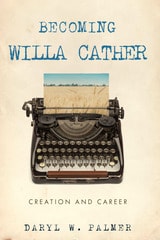
Becoming Willa Cather
Creation and CareerDaryl W. Palmer
University of Nevada Press, 2019
Willa Cather has long been admired for O Pioneers! (1913), Song of the Lark (1915), and My Ántonia (1918)—the “prairie novels” about the lives of early Nebraska pioneers that launched her career. Thanks in part to these masterpieces, she is often viewed as a representative of pioneer life on the Great Plains, a controversial innovator in American modernism, and a compelling figure in the literary history of LGBTQ America. A century later, scholars acknowledge Cather’s place in the canon of American literature and continue to explore her relationship with the West.
Drawing on original archival research and paying unprecedented attention to Cather’s early short stories, Palmer demonstrates that the relationship with Nebraska in the years leading up to O Pioneers! is more dynamic than critics and scholars thought. Readers will encounter a surprisingly bold young author whose youth in Nebraska served as a kind of laboratory for her future writing career. Becoming Willa Cather changes the way we think about Cather, a brilliant and ambitious author who embraced experimentation in life and art, intent on reimagining the American West.
Becoming a Poet
Elizabeth Bishop with Marianne Moore and Robert LowellDavid Kalstone
University of Michigan Press, 2001
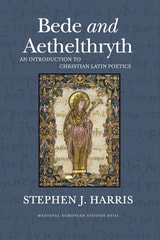
Bede and Aethelthryth
An Introduction to Christian Latin PoeticsStephen J. Harris
West Virginia University Press, 2016
Bede and Aethelthryth asks why Christians in Britain around the year 700 enjoyed Latin poetry. What did they see in it? What did they get from it? This book attempts to reconstruct the horizon of expectation of a highly learned, Latin-speaking nun as she encounters a fifty-line poem by the Venerable Bede, the Hymn to Aethelthryth.
The reconstruction is hypothetical and derived from grammatical manuals, learned commentaries from the early medieval period (especially Servius’s commentary on Virgil), and a wide variety of aesthetic observations by classical and medieval readers. The first four chapters describe basic expectations of a reader of Christian Latin poetry. The fifth chapter places the Hymn in its context within Bede’s Ecclesiastical History. A few pages after Bede records his hymn, Caedmon will recite his own hymn under the watchful eye of Whitby’s Abbess Hild, who was a friend of Aethelthryth.
Both hymns are attempts to reform the lyric traditions of pagan Rome and pagan Anglo-Saxon England in the light of Christian teaching. The last three chapters contain a line-by-line commentary on Bede’s alphabetic, epanaleptic elegy.
Before Intimacy
Asocial Sexuality in Early Modern EnglandDaniel Juan Gil
University of Minnesota Press, 2006
Engaging the poems of Wyatt, Sidney’s Astrophil and Stella, Spenser’s Amoretti and The Faerie Queene, and Shakespeare’s Troilus and Cressida and the Sonnets, Gil demonstrates how sexuality was conceived as a relationship system inhabited by men and women interchangeably—set apart from the “norm” and not institutionalized in a private or domestic realm. Going beyond the sodomy-as-transgression analytic, he asserts the existence of socially inconsequential sexual bonds while recognizing the pleasurable effects of violating the supposed traditional modes of bonding and ideals of universal humanity and social hierarchy.
Celebrating the ability of corporeal emotions to interpret connections between people who share nothing in terms of societal structure, Before Intimacy shows how these works of early modern literature provide a discourse of sexuality that strives to understand status differences in erotic contexts and thereby question key assumptions of modernity.
Daniel Juan Gil is assistant professor of English at TCU.