Results by title
4917 books match the query 'Philosophy' and 177 start with d
Deities and Divas
Queer Ritual Specialists in Myanmar, Thailand and BeyondEdited by Peter A. Jackson and Benjamin Baumann
National University of Singapore Press, 2022

Deja Vu
Aberrations Of Cultural MemoryPeter Krapp
University of Minnesota Press, 2004
The pitfalls of cultural memory and forgetting, understood through the genealogy of the phenomenon called déjà vu
Referring to a past that never was, déjà vu shares a structure not only with fiction, but also with the ever more sophisticated effects of media technology. Tracing the term from the end of the nineteenth century, when it was first popularized in the pages of the Revue philosophique, Peter Krapp examines the genealogy and history of the singular and unrepeatable experience of déjà vu. This provocative book offers a refreshing counterpoint to the clichéd celebrations of cultural memory and forces us do a double take on the sanctimonious warnings against forgetting so common in our time.
Disturbances of cultural memory—screen memories, false recognitions, premonitions—disrupt the comfort zone of memorial culture: strictly speaking, déjà vu is neither a failure of memory nor a form of forgetting. Krapp’s analysis of such disturbances in literature, art, and mass media introduces, historicizes, and theorizes what it means to speak of an economy of attention or distraction. Reaching from the early psychoanalytic texts of Sigmund Freud to the plays of Heiner Müller, this exploration of the effects of déjà vu pivots around the work of Walter Benjamin and includes readings of kitsch and aura in Andy Warhol’s work, of cinematic violence and certain exaggerated claims about shooting and cutting, of the memorial character of architecture, and of the high expectations raised by the Internet.
Deleuze
The Clamor of BeingAlain Badiou
University of Minnesota Press, 1999
Deleuzism
A MetacommentaryIan Buchanan
Duke University Press, 2000
To show us how Deleuze’s philosophy works, Buchanan begins with Melville’s notion that “a great book is always the inverse of another book that could only be written in the soul, with silence and blood.” Buchanan demonstrates that the figure of two books—one written in ink and the other written in blood—lies at the center of Deleuze’s hermeneutics and that a special relation must be established in order to read the second book from the first. This relation is Deleuzism. By explicating elemental concepts in Deleuze—desire, flow, the nomad—Buchanan finds that, despite Deleuze’s self-declared moratorium on dialectics, he was in several important respects a dialectician. In essays that address the “prehistory” of Deleuze’s philosophy, his methodology, and the utopic dimensions of his thought, Buchanan extracts an apparatus of social critique that arises from the philosopher’s utopian impulse.
Deleuzism is a work that will engage all those with an interest in the twentieth-century’s most original philosopher.
Demarcating the Disciplines
Philosophy, Literature, ArtSamuel Weber, Henry Sussman, and Wlad Godzich, Editors
University of Minnesota Press, 1986
Demarcating the Disciplines was first published in 1986. Minnesota Archive Editions uses digital technology to make long-unavailable books once again accessible, and are published unaltered from the original University of Minnesota Press editions.
With publication of this volume, Glyph begins a new stage in its existence: the move from Johns Hopkins University Press to the University of Minnesota Press is accompanied by a change in focus. In its first incarnation Glyph provided a forum in which established notions of reading, writing, and criticism could be questioned and explored. Since then, the greater currency of such concerns has brought with it new problems and priorities. Setting aside the battles of the past, the new Glyph looks ahead - to confront historical issues and to address the institutional and pedagogical questions emerging from the contemporary critical landscape.
Each volume in the new Glyph series is organized around a specific issue. The essays in this first volume explore the relations between the practice of reading and writing and the operations of the institution. Though their approaches differ from one another, the authors of these essays all recognize that the questions of the institution - most notably the university - points toward a series of constraints that define, albeit negatively, the possibilities for change.
The contributors: Samuel Weber, Jacques Derrida, Tom Conley, Malcolm Evans, Ruth Salvaggio, Robert Young, Henry Sussman, Peter Middleton, David Punter, and Donald Preziosi.
Democracy Ancient and Modern
Finley, M. I.
Rutgers University Press, 2019
This classic study of democratic principles is thus now more relevant than ever. A renowned historian of antiquity and political philosophy, Sir M.I. Finley offers a comparative analysis of Greek and modern conceptions of democracy. As he puts the ancient Greeks in dialogue with their contemporary counterparts, Finley tackles some of the most pressing issues of our day, including public apathy, partisanship, consensus politics, distrust of professional politicians, and the limits of free speech.
Including three lectures that Finley delivered at Rutgers University, plus two additional essays that further illuminate his thinking, Democracy Ancient and Modern explores the dramatic differences between the close-knit civil society of the ancient Greeks and our own atomized mass societies. By mapping out democracy’s past and its present manifestations, this book helps us plot a course for democracy’s future.
Democracy and Higher Education
Traditions and Stories of Civic EngagementScott J. Peters
Michigan State University Press, 2010
How are we to understand the nature and value of higher education's public purposes, mission, and work in a democratic society? How do-and how should-academic professionals contribute to and participate in civic life in their practices as scholars, scientists, and educators?
Democracy and Higher Education addresses these questions by combining an examination of several normative traditions of civic engagement in American higher education with the presentation and interpretation of a dozen oral history profiles of contemporary practitioners. In his analysis of these profiles, Scott Peters reveals and interprets a democratic-minded civic professionalism that includes and interweaves expert, social critic, responsive service, and proactive leadership roles.
Democracy and Higher Education contributes to a new line of research on the critically important task of strengthening and defending higher education's positive roles in and for a democratic society.

Democracy and Imperialism
Irving Babbitt and Warlike DemocraciesWilliam S. Smith
University of Michigan Press, 2019
Following costly U.S. engagement in two wars in the Middle East, questions about the appropriateness of American military interventions dominate foreign policy debates. Is an interventionist foreign policy compatible with the American constitutional tradition?
This book examines critic Irving Babbitt’s (1865–1933) unique contribution to understanding the quality of foreign policy leadership in a democracy. Babbitt explored how a democratic nation’s foreign policy is a product of the moral and cultural tendencies of the nation’s leaders, arguing that the substitution of expansive, sentimental Romanticism for the religious and ethical traditions of the West would lead to imperialism.
The United States’ move away from the restraint and order of sound constitutionalism to involve itself in the affairs of other nations will inevitably cause a clash with the “civilizational” regions that have emerged in recent decades. Democracy and Imperialism uses the question of soul types to address issues of foreign policy leadership, and discusses the leadership qualities that are necessary for sound foreign policy.

Democracy and Social Ethics
Jane Addams
University of Illinois Press, 2001
In this, Addams's earliest book on ethics--presented here with a substantial introduction by Charlene Haddock Seigfried--she reflects on the factors that hinder the ability of all members of society to determine their own well-being. Observing relationships between charitable workers and their clients, between factory owners and their employers, and between household employers and their servants, she identifies sources of friction and shows how conceiving of democracy as a social obligation can lead to new, mutually beneficial lines of conduct. She also considers the proper education of workers, struggles between parents and their adult daughters over conflicting family and social claims, and the merging of politics with the daily lives of constituents.
"The sphere of morals is the sphere of action," Addams proclaims. It is not enough to believe passively in the innate dignity of all human beings. Rather, one must work daily to root out racial, gender, class, and other prejudices from personal relationships.

Democracy and the Ethical Life
A Philosophy of Politics and Community (Second Edition, Expanded)Claes G. Ryn
Catholic University of America Press, 1990
Derivatives and the Wealth of Societies
Edited by Benjamin Lee and Randy Martin
University of Chicago Press, 2016
To answer that question, the contributors to this book draw upon their deep backgrounds in finance, social science, art, and the humanities to create a new way of understanding derivative finance that does justice to its social and cultural dimensions. They offer a two-pronged analysis. First, they develop a social understanding of the derivative that casts it in the light of anthropological concepts such as the gift, ritual, play, dividuality, and performativity. Second, they develop a derivative understanding of the social, using financial concepts such as risk, hedging, optionality, and arbitrage to uncover new dimensions of contemporary social reality. In doing so, they construct a necessary, renewed vision of derivative finance as a deeply embedded aspect not just of our economics but our culture.
Derrida and Differance
David Wood and Robert Bernasconi
Northwestern University Press, 1988
Derrida's Gift, Volume 16
Elizabeth Weed and Ellen Rooney, eds.
Duke University Press, 0
In bringing together major feminist critics whose work has been touched by the writings of Derrida, this issue both pays tribute to and reflects upon Derrida’s ideas. Among the essayists included, Jane Gallop considers Derrida’s writings on Levinas; Judith Butler reads Derrida’s final interview in Le Monde in 2004; Elizabeth Grosz signals Derrida as a rare philosopher for whom sexual difference was crucial; Gayatri Chakravorty Spivak explores the figure of the mother’s child in Derrida, focusing on the critique of reproductive heteronormativity and the question of agency in feminism; and Joan Wallach Scott argues for the importance of critique in the academy. The issue also includes an edited transcription of a vibrant discussion between feminist theorists and Derrida called “Women in the Beehive: A Seminar with Jacques Derrida,” which took place at Brown University’s Pembroke Center for Teaching and Research on Women in 1984.
Contributors. Fran Bartkowski, Anne-Emmanuelle Berger, Susan Bernstein, Judith Butler, Pheng Cheah, Drucilla Cornell, Jane Gallop, Elizabeth Grosz, Peggy Kamuf, Christie McDonald, Joan Wallach Scott, Gayatri Chakravorty Spivak

Des hégémonies brisée
Reiner Schürmann
Diaphanes, 2017
Il s’agira donc de retracer une histoire de soumissions par nous-mêmes encourues.

Descartes and His Contemporaries
Meditations, Objections, and RepliesEdited by Roger Ariew and Marjorie Grene
University of Chicago Press, 1995
Descartes and his Contemporaries recreates the tumultuous intellectual community of seventeenth-century Europe and provides a detailed, modern analysis of the Meditations in its historical context. The book's chapters examine the arguments and positions of each of the objectors—Hobbes, Gassendi, Arnauld, Morin, Caterus, Bourdin, and others whose views were compiled by Mersenne. They illuminate Descartes' relationships to the scholastics and particularly the Jesuits, to Mersenne's circle with its debates about the natural sciences, to the Epicurean movements of his day, and to the Augustinian tradition. Providing a glimpse of the interactions among leading 17th-century intellectuals as they grappled with major philosophical issues, this book sheds light on how Descartes' thought developed and was articulated in opposition to the ideas of his contemporaries.
Descartes and the Resilience of Rhetoric
Varieties of Cartesian Rhetorical TheoryThomas M. Carr, Jr.
Southern Illinois University Press, 2009
A careful analysis of the rhetorical thought of René Descartes and of a distinguished group of post-Cartesians. Covering a unique range of authors, including Bernard Lamy and Nicolas Malebranche, Carr attacks the idea, which has become commonplace in contemporary criticism, that the Cartesian system is incompatible with rhetoric.
Carr analyzes the writings of Balzac, the Port-Royalists Arnauld and Nicole, Malebranche, and Lamy, exploring the evolution of Descartes’ thought into their different theories of rhetoric. He constructs his arguments, probing each author’s writings on rhetoric, persuasion, and attention, to demonstrate the basis for rhetorical thought present in Descartes’ theory of persuasion when it is combined with his psychophysiology of attention.

Descartes' Metaphysical Physics
Daniel Garber
University of Chicago Press, 1992
Garber achieves a philosophically rigorous reading of Descartes that is sensitive to the historical and intellectual context in which he wrote. What emerges is a novel view of this familiar figure, at once unexpected and truer to the historical Descartes.
The book begins with a discussion of Descartes' intellectual development and the larger project that frames his natural philosophy, the complete reform of all the sciences. After this introduction Garber thoroughly examines various aspects of Descartes' physics: the notion of body and its identification with extension; Descartes' rejection of the substantial forms of the scholastics; his relation to the atomistic tradition of atoms and the void; the concept of motion and the laws of motion, including Descartes' conservation principle, his laws of the persistence of motion, and his collision law; and the grounding of his laws in God.
Descartes's Grey Ontology
Cartesian Science and Aristotelian Thought in the RegulaeJean-Luc Marion
St. Augustine's Press, 2022

Desert Dreamers
Barbara Glowczewski
University of Minnesota Press, 2016
In the heart of Australia, on the cracked red earth, among wild vegetation, weathered bush, and dried-up creeks, hundreds of invisible pathways exist that become entangled on the earth's surface, underground, and in the sky, clouds, and wind. The Aboriginal people call them Jukurrpa: “the Dreamings.” This web is the Warlpiri land. Practicing the Dreaming, by ritual art, is for the Warlpiri a way to reactivate their ancestral traditions to connect with the cosmos and respond to current social and political issues.
In 1979, anthropologist Barbara Glowczewski embarked on a journey to study the Warlpiri in the Australian outback. Struggling at once to maintain their traditions and cultural heritage as well as adapting to the continuing secularization and techno-progress of their European Australian counterparts, she takes us into the landscape, artistic rituals, and turmoil of the Warlpiri over three decades. Becoming accepted among Aboriginal families as a translator, and at the same time a negotiator of two vastly different visions of the earth, contemporary Western culture and the ancient indigenous dreaming culture, Glowczewski created a singular document of ethnological fieldwork and of self-transformation and discovery.

Designs on the Contemporary
Anthropological TestsPaul Rabinow and Anthony Stavrianakis
University of Chicago Press, 2014
The authors continue their prior explorations of the contemporary in past works: How to conceptualize, test, and give form to breakdowns of truth and conduct, as well as how to open up possibilities for the remediation of such breakdowns. They offer a surprising and contrasting pair of case studies of two figures who engaged with contemporary breakdowns: Salman Rushdie and Gerhard Richter. Approaching Richter’s artistic struggles with form and technique in the long wake of modernism and Rushdie’s struggles to find a narrative form—as well as a form for living—to respond to the Iranian fatwa issued against him, they show how both men formulated different new approaches to anthropology for the twenty-first century.

Desire and Imitation in International Politics
Jodok Troy
Michigan State University Press, 2021
Desperately Seeking Certainty
The Misguided Quest for Constitutional FoundationsDaniel A. Farber and Suzanna Sherry
University of Chicago Press, 2002

Destined for Liberty
The Human Person in the Philosophy of Karol Wojtyla/John Paul IIJaroslaw Kupczak, O.P.
Catholic University of America Press, 2000
Deviant Logic, Fuzzy Logic
Beyond the FormalismSusan Haack
University of Chicago Press, 1996
Susan Haack's Deviant Logic provided the first extended examination of the philosophical consequences of alternative logics. In this new volume, Haack includes the complete text of Deviant Logic, as well as five additional papers that expand and update it. Two of these essays critique fuzzy logic, while three augment Deviant Logic's treatment of deduction and logical truth. Haack also provides an extensive new foreword, brief introductions to the new essays, and an updated bibliography of recent work in these areas.
Deviant Logic, Fuzzy Logic will be indispensable to students of philosophy, philosophy of science, linguistics, mathematics, and computer science, and will also prove invaluable to experienced scholars working in these fields.
Devotion
Three Inquiries in Religion, Literature, and Political ImaginationConstance M. Furey, Sarah Hammerschlag, and Amy Hollywood
University of Chicago Press, 2021
We are living in a time of radical uncertainty, faced with serious political, ecological, economic, epidemiological, and social problems. Scholars of religion Constance M. Furey, Sarah Hammerschlag, and Amy Hollywood come together in this volume with a shared conviction that what and how we read opens new ways of imagining our political futures and our lives.
Each essay in this book suggests different ways to characterize the object of devotion and the stance of the devout subject before it. Furey writes about devotion in terms of vivification, energy, and artifice; Hammerschlag in terms of commentary, mimicry, and fetishism; and Hollywood in terms of anarchy, antinomianism, and atopia. They are interested in literature not as providing models for ethical, political, or religious life, but as creating the site in which the possible—and the impossible—transport the reader, enabling new forms of thought, habits of mind, and ways of life. Ranging from German theologian Martin Luther to French-Jewish philosopher Sarah Kofman to American poet Susan Howe, this volume is not just a reflection on forms of devotion and their critical and creative import but also a powerful enactment of devotion itself.

Devotions Upon Emergent Occasions
Together with Death's DuelJohn Donne
University of Michigan Press, 1959
Devouring One's Own Tail
Autopoiesis in PerspectiveEdited by Vojtech Kolman and Tomáš Murár
Karolinum Press, 2022
Inspired by Niklas Luhmann’s theories on social systems, this book examines the concept of autopoiesis, or self-creation, as it relates to society and culture. Approaching the concept from a variety of fields—philosophy, philology, aesthetics, linguistics, archaeology, and religious and media studies—the contributors present the products of humanity as self-referential, self-sustaining, and self-creating systems. Through four sections, the book addresses the philosophical concept of autopoiesis and its relations to creativity, destruction, and self-organization; autopoiesis in literature and art history; autopoiesis in religion; and autopoiesis in historiography, cognitive linguistics, and social media. Whether exploring Hegel’s theory of knowledge or the viral spread of conspiracy theories on the internet, the authors concentrate on the ouroboros-like nature of their subjects in the ways they feed off of themselves.
Dewey for Artists
Mary Jane Jacob
University of Chicago Press, 2018
Dewey argued that there is strong social value to be found in art, and it is artists who often most challenge our preconceived notions. Dewey for Artists shows us how Dewey advocated for an “art of democracy.” Identifying the audience as co-creator of a work of art by virtue of their experience, he made space for public participation. Moreover, he believed that societies only become—and remain—truly democratic if its citizens embrace democracy itself as a creative act, and in this he advocated for the social participation of artists.
Throughout the book, Mary Jane Jacob draws on the experiences of contemporary artists who have modeled Dewey’s principles within their practices. We see how their work springs from deeply held values. We see, too, how carefully considered curatorial practice can address the manifold ways in which aesthetic experience happens and, thus, enable viewers to find greater meaning and purpose. And it is this potential of art for self and social realization, Jacob helps us understand, that further ensures Dewey’s legacy—and the culture we live in.
Dewey's Dream
Universities and Democracies in an Age of Education ReformLee Benson
Temple University Press, 2007
This timely, persuasive, and hopeful book reexamines John Dewey's idea of schools, specifically community schools, as the best places to grow a democratic society that is based on racial, social, and economic justice. The authors assert that American colleges and universities bear a responsibility for-and would benefit substantially from-working with schools to develop democratic schools and communities.
Dewey's Dream opens with a reappraisal of Dewey's philosophy and an argument for its continued relevance today. The authors-all well-known in education circles-use illustrations from over 20 years of experience working with public schools in the University of Pennsylvania's local ecological community of West Philadelphia, to demonstrate how their ideas can be put into action. By emphasizing problem-solving as the foundation of education, their work has awakened university students to their social responsibilities. And while the project is still young, it demonstrates that Dewey's "Utopian ends" of creating optimally participatory democratic societies can lead to practical, constructive school, higher education and community change, development, and improvement.

Dewey's Empirical Theory of Knowledge and Reality
John R. Shook
Vanderbilt University Press, 2000
that Dewey's metaphysical empiricism remained more indebted to Kant and Hegel than is commonly supposed;
that Dewey owed more to the influence of Wundt than is commonly believed;
that the influence of Peirce and James was not as significant for the development of Dewey's theories of mind and truth as has been argued in the past;
and that Dewey's pragmatic theory of knowledge never really abandoned idealism.
Shook's exposition of the unity of Dewey's thought challenges a large scholarly industry devoted to suppressing or explaining away the consistency between Dewey's early thought and his later work. In every respect, Dewey's Empirical Theory of Knowledge and Reality is a provocative and engaging study that will occupy a unique niche in this field. It is certain to stimulate discussion and controversy, forcing Dewey traditionalists out of habitual modes of thought and transforming our conventional understanding of the development of classical American philosophy.
Dewey's Logical Theory
New Studies and InterpretationsF. Thomas Burke
Vanderbilt University Press, 2002
This collection breaks new ground in its relevance to contemporary philosophy of logic and epistemology and pays special attention to applications in ethics and moral philosophy.
Dewey's New Logic
A Reply to RussellTom Burke
University of Chicago Press, 1994
Burke demonstrates that Russell misunderstood crucial aspects of Dewey's theory and contends that logic today has progressed beyond Russell and is approaching Dewey's broader perspective.
"[This] book should be of substantial interest not only to Dewey scholars and other historians of twentieth-century philosophy, but also to devotees of situation theory, formal semantics, philosophy of mind, cognitive science, and Artificial Intelligence."—Georges Dicker, Transactions of the C.S. Peirce Society
"No scholar, thus far, has offered such a sophisticated and detailed version of central themes and contentions in Dewey's Logic. This is a pathbreaking study."—John J. McDermott, editor of The Philosophy of John Dewey
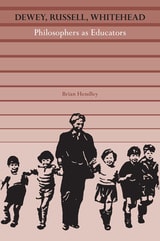
Dewey, Russell, Whitehead
Philosophers as EducatorsBrian Patrick Hendley
Southern Illinois University Press, 1986
In Philosophers as Educators Brian Patrick Hendley argues that philosophers of education should reject their preoccupation with defining terms and analyzing concepts and embrace the philosophical task of constructing general theories of education. Hendley discusses in detail the educational philosophies of John Dewey, Bertrand Russell, and Alfred North Whitehead. He sees in these men excellent role models that contemporary philosophers might well follow. Hendley believes that, like these mentors, philosophers should take a more active, practical role in education. Dewey and Russell ran their own schools, and Whitehead served as a university administrator and as a member of many committees created to study education.
Dialectic and Dialogue
Plato's Practice of Philosophical InquiryFrancisco J. Gonzalez
Northwestern University Press, 1998
Dialectical Materialism
Henri Lefebvre
University of Minnesota Press, 2009
This edition contains a new introduction by Stefan Kipfer, explaining the book’s contemporary ramifications in the ever-expanding reach of the urban in the twentieth-century Western world.

Dialogue on the Infinity of Love
Tullia d'Aragona
University of Chicago Press, 1997
Sexually liberated and financially independent, Tullia d'Aragona dared to argue that the only moral form of love between woman and man is one that recognizes both the sensual and the spiritual needs of humankind. Declaring sexual drives to be fundamentally irrepressible and blameless, she challenged the Platonic and religious orthodoxy of her time, which condemned all forms of sensual experience, denied the rationality of women, and relegated femininity to the realm of physicality and sin. Human beings, she argued, consist of body and soul, sense and intellect, and honorable love must be based on this real nature.
By exposing the intrinsic misogyny of prevailing theories of love, Aragona vindicates all women, proposing a morality of love that restores them to intellectual and sexual parity with men. Through Aragona's sharp reasoning, her sense of irony and humor, and her renowned linguistic skill, a rare picture unfolds of an intelligent and thoughtful woman fighting sixteenth-century stereotypes of women and sexuality.
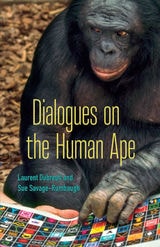
Dialogues on the Human Ape
Laurent Dubreuil
University of Minnesota Press, 2018
A primatologist and a humanist together explore the meaning of being a “human animal”
Humanness is typically defined by our capacity for language and abstract thinking. Yet decades of research led by the primatologist Sue Savage-Rumbaugh has shown that chimpanzees and bonobos can acquire human language through signing and technology.
Drawing on this research, Dialogues of the Human Ape brings Savage-Rumbaugh into conversation with the philosopher Laurent Dubreuil to explore the theoretical and practical dimensions of what being a “human animal” means. In their use of dialogue as the primary mode of philosophical and scientific inquiry, the authors transcend the rigidity of scientific and humanist discourses, offering a powerful model for the dissemination of speculative hypotheses and open-ended debates grounded in scientific research.
Arguing that being human is an epigenetically driven process rather than a fixed characteristic rooted in genetics or culture, this book suggests that while humanness may not be possible in every species, it can emerge in certain supposedly nonhuman species. Moving beyond irrational critiques of ape consciousness that are motivated by arrogant, anthropocentric views, Dialogues on the Human Ape instead takes seriously the continuities between the ape mind and the human mind, addressing why language matters to consciousness, free will, and the formation of the “human animal” self.

Diary of a Philosophy Student
Volume 2, 1928-29Simone de Beauvoir; Translation by Barbara Klaw; Edited by Barbara Klaw, Sylvie Le Bon de Beauvoir, Margaret A. Simons, and Marybeth Timmermann
University of Illinois Press, 2021
Presented for the first time in translation, this fully annotated first volume of the Diary includes essays from Barbara Klaw and Margaret A. Simons that address its philosophical, historical, and literary significance. It remains an invaluable resource for tracing the development of Beauvoir’s independent thinking and her influence on philosophy, feminism, and the world.

Diary of a Philosophy Student
Volume 3, 1926-30Simone de Beauvoir. Translation by Barbara Klaw. Edited by Barbara Klaw, Sylvie Le Bon de Beauvoir, and Margaret A. Simons with Marybeth Timmermann. Foreword by Sylvie Le Bon de Beauvoir
University of Illinois Press, 2024
In addition, the editors include a wealth of important supplementary material. Barbara Klaw provides a detailed consideration of the Diary’s role in the development of Beauvoir’s writing style by exploring her use of metanarrative and other literary techniques, part of a process of literary creation that saw Beauvoir use the notebooks to cultivate her talent. Margaret A. Simons’s essay places the assault by Sartre within an appraisal of Beauvoir’s complicated legacy for #MeToo while suggesting readers engage with the diary through the lens of trauma.

Diaspora-in-Place
Grant Farred
Temple University Press, 2027
“I was gone before I left,” writes Grant Farred in his compelling philosophical meditation, Diaspora-in-Place. Building on a concept he introduced in his critique The Perversity of Gratitude, Farred rethinks diaspora as not just physical deracination and relocation, but also a state of being in exile at home while remaining, visibly, in place. Partially the consequence of growing up in South Africa during apartheid, Farred extends the concept to “the Palestinian condition” of living in/out of place in Gaza.
Divided into a series of witty fragments, evocative epigrams, and sobering aphorisms, Diaspora-in-Place builds on thinkers ranging from Edward Said and Jacques Derrida, to the poetry of Olivia Elias, to musicians Bob Dylan, Miles Davis, and John Coltrane to examine how individuals process their national identity and subjecthood in a place where they feel out of place.
Farred writes eloquently about this expansive but not universal contradiction as being “a mobile immobility” or “an immobile mobility.” In doing so, he offers an entirely new and provocative way of conceiving how we understand diaspora.

Dictionary of Non-Philosophy
François Laruelle
University of Minnesota Press, 2013
In The Dictionary of Non-Philosophy, the French thinker François Laruelle does something unprecedented for philosophers: he provides an enormous dictionary with a theoretical introduction, carefully crafting his thoughts to explain the numerous terms and neologisms that he deems necessary for the project of non-philosophy. With a collective of thinkers also interested in the project, Laruelle has taken up the difficult task of creating an essential guide for entering into his non-standard, non-philosophical terrain. And for Laruelle, even the idea of a dictionary and what a dictionary is become material for his non-philosophical inquiries. As his opening note begins, “Thus on the surface and within the philosophical folds of the dictionary, identity and its effect upon meaning are what is at stake.”
Didactic Poetries
Philippe Beck
University of Minnesota Press, 2016
Complex, haunting, imaginative and profoundly literary, Didactic Poetries is Beck’s response to Schiller’s statement: “We are still waiting for a didactic poem where thought itself would be and would remain poetic,” and Hegel’s claim that, “strictly speaking, didactic poetry isn’t poetry.”
For the acclaimed French poet, Philippe Beck, Schiller’s task of attempting a didactic poetry remains as vital today as it was for Schiller’s time. Is there a way to construct a poetry built and chiseled, hammered and stitched, from out of past narratives and poetries, condensed in such a manner as to make new poetic verses sing new truths? Forging a singular attempt to echo the poets and tales of a bygone age, Beck’s didactic poetries perhaps carve out the path for renewing a poetic thought as a quasi-musical atmosphere where the reader can glimpse “A small country “sculpted” as spiritual, supposed to be so at home in the Bygone Country. Alluvial layers so light, that weather disappeared, weary of variety a priori.” Beck’s deftly textured poems interweave contemporary commentary with cultural, historical, literary, and philosophical allusions, drawing the reader into a world of lived poetic experience.

Dies Irae
Jean-Luc Nancy
University of Westminster Press, 2019
Edited by Angela Condello, Carlo Grassi and Andreas Philippopoulos-Mihalopoulos
With an introduction by Carlo Grassi
Translated by Cadenza Academic Translations and Angela Condello
What does it mean to judge when there is no general and universal norm to define what is right and what is wrong? Can laws be absent and is law always necessary?
This is the first English translation published of Jean- Luc Nancy’s acclaimed consideration of the law’s most pervasive principles in the context of actual systems and contemporary institutions, power, norms, laws. In a world where it is impossible to imagine the realisation of an ideal of justice that corresponds to every person’s ideal of justice, Nancy probes the limits of legal normativity. Moreover, the question is asked: how can legal normativity be legitimised? A legal order based on performativity and formal validity is questionable and other forces than juridical normativity are at the heart of Dies Irae. Such leads inevitably to the processes of inclusion and exclusion that characterise contemporary juridical systems and those issues of identity, hostility and self-representation central to contemporary political and legal debates
Difference and Givenness
Deleuze's Transcendental Empiricism and the Ontology of ImmanenceLevi R Bryant
Northwestern University Press, 2008
From one end of his philosophical work to the other, Gilles Deleuze consistently described his position as a transcendental empiricism. But just what is transcendental about Deleuze’s transcendental empiricism? And how does his position fit with the traditional empiricism articulated by Hume? In Difference and Givenness, Levi Bryant addresses these long-neglected questions so critical to an understanding of Deleuze’s thinking. Through a close examination of Deleuze’s independent work--focusing especially on Difference and Repetition--as well as his engagement with thinkers such as Kant, Maïmon, Bergson, and Simondon, Bryant sets out to unearth Deleuze’s transcendental empiricism and to show how it differs from transcendental idealism, absolute idealism, and traditional empiricism.
What emerges from these efforts is a metaphysics that strives to articulate the conditions for real existence, capable of accounting for the individual itself without falling into conceptual or essentialist abstraction. In Bryant’s analysis, Deleuze’s metaphysics articulates an account of being as process or creative individuation based on difference, as well as a challenging critique--and explanation--of essentialist substance ontologies. A clear and powerful discussion of how Deleuze’s project relates to two of the most influential strains in the history of philosophy, this book will prove essential to anyone seeking to understand Deleuze’s thought and its specific contribution to metaphysics and epistemology.
Differences in Medicine
Unraveling Practices, Techniques, and BodiesMarc Berg and Annemarie Mol, eds.
Duke University Press, 1998
Combining theoretical work with interviews and direct observation of the activities and interactions of doctors, nurses, technicians, and patients, the contributors to this volume provide comparative studies of specific cases. Individual chapters explore topics such as the contested domain of fetal surgery in a California hospital, the construction of gender identity before transsexual surgery in Germany, and differences in the treatment and definition of pain by two clinics in France. Differences in Medicine advances earlier studies on medicine’s social diversity and regional variations to expose significant differences in the presumptions and decisions that affect patients’ lives, and marks a dramatic development in both the study of medicine and in science studies generally.
Revealing the ways in which the bodies and lives of people are constructed as medical objects by practitioners, technologies, and textbooks, this collection calls for and initiates new, more textured investigations and theories of the body in medicine and the practice of science. It will open new discussions among medical and healthcare professionals as well as scholars in medical anthropology, science studies, sociology, philosophy, and the history of medicine.
Contributors. Isabelle Baszanger, Marc Berg, Geoffrey C. Bowker, Monica J. Casper, Charis M. Cussins, Nicolas Dodier, Stefan Hirschauer, Annemarie Mol, Vicky Singleton, Susan Leigh Star, Stefan Timmermans, Dick Willems

Differend
Phrases in DisputeJean-Francois Lyotard
University of Minnesota Press, 1989
Digital Detroit
Rhetoric and Space in the Age of the NetworkJeff Rice
Southern Illinois University Press, 2012
Since the 1967 riots that ripped apart the city, Detroit has traditionally been viewed either as a place in ruins or a metropolis on the verge of rejuvenation. In Digital Detroit: Rhetoric and Space in the Age of the Network, author Jeff Rice goes beyond the notion of Detroit as simply a city of two ideas. Instead he explores the city as a web of multiple meanings which, in the digital age, come together in the city’s spaces to form a network that shapes the writing, the activity, and the very thinking of those around it.
Rice focuses his study on four of Detroit’s most iconic places—Woodward Avenue, the Maccabees Building, Michigan Central Station, and 8 Mile—covering each in a separate chapter. Each of these chapters explains one of the four features of network rhetoric: folksono(me), the affective interface, response, and decision making. As these rhetorical features connect, they form the overall network called Digital Detroit. Rice demonstrates how new media, such as podcasts, wikis, blogs, interactive maps, and the Internet in general, knit together Detroit into a digital network whose identity is fluid and ever-changing. In telling Detroit’s spatial story, Rice deftly illustrates how this new media, as a rhetorical practice, ultimately shapes understandings of space in ways that computer applications and city planning often cannot. The result is a model for a new way of thinking and interacting with space and the imagination, and for a better understanding of the challenges network rhetorics pose for writing.

Digital Energetics
Anne Pasek
University of Minnesota Press, 2023
Exploring the connections between energy and media—and what those connections mean for our current moment
Energy and media are the entangled middles of social life—and also of each other. This volume traces the contours of both a media analytic of energy and an energy analytic of media across the cultural, environmental, and economic relations they undergird. Digital Energetics argues that media and energy require joint theorization—not only in their potential to universalize but also in the many contingent and intermeshed relations that they bind together across contemporary informational and fossil regimes. Focusing specifically on digital operations, the coauthors analyze how data and energy have jointly modulated the character of the materiality and labor of digital systems in a warming world.
Anne Pasek provides a brief energy history of the bit, tracing how the electrification and digitization of American computing propelled a turn toward efficiency as both a solution and instigator of parallel crises in the workforce and the climate. Zane Griffin Talley Cooper traces these concerns within cryptographic proof-of-work systems and the heat they necessarily produce and seek to manage. Following heat through the twinned histories of thermodynamics and information theory, he argues that such systems are best approached as a paradigmatic, rather than exceptional, example of computing infrastructures. Cindy Kaiying Lin focuses on the practical and political frictions created as database and management designs move from the Global North to South, illustrating how the energy constraints and software cultures of Indonesia open new spaces of autonomy within environmental governance. Finally, Jordan B. Kinder offers a theorization of “platform energetics,” demonstrating how public energy discourses and settler land claims are entangled in the digital infrastructures of data colonialism in Canada.
Digital Memory and the Archive
Wolfgang Ernst
University of Minnesota Press, 2012
In the popular imagination, archives are remote, largely obsolete institutions: either antiquated, inevitably dusty libraries or sinister repositories of personal secrets maintained by police states. Yet the archive is now a ubiquitous feature of digital life. Rather than being deleted, e-mails and other computer files are archived. Media software and cloud storage allow for the instantaneous cataloging and preservation of data, from music, photographs, and videos to personal information gathered by social media sites.
In this digital landscape, the archival-oriented media theories of Wolfgang Ernst are particularly relevant. Digital Memory and the Archive, the first English-language collection of the German media theorist’s work, brings together essays that present Ernst’s controversial materialist approach to media theory and history. His insights are central to the emerging field of media archaeology, which uncovers the role of specific technologies and mechanisms, rather than content, in shaping contemporary culture and society.
Ernst’s interrelated ideas on the archive, machine time and microtemporality, and the new regimes of memory offer a new perspective on both current digital culture and the infrastructure of media historical knowledge. For Ernst, different forms of media systems—from library catalogs to sound recordings—have influenced the content and understanding of the archive and other institutions of memory. At the same time, digital archiving has become a contested site that is highly resistant to curation, thus complicating the creation and preservation of cultural memory and history.

Digital Stockholm Syndrome in the Post-Ontological Age
Mark Jarzombek
University of Minnesota Press, 2016
Once, humans were what they believed. Now, the modern person is determined by data exhaust—an invisible anthropocentric ether of ones and zeros that is a product of our digitally monitored age. Author Mark Jarzombek argues that the world has become redesigned to fuse the algorithmic with the ontological, and the discussion of ontology must be updated to rethink the question of Being. In Digital Stockholm Syndrome in the Post-Ontological Age, Jarzombek provocatively studies the new interrelationship between human and algorithm.
Forerunners is a thought-in-process series of breakthrough digital works. Written between fresh ideas and finished books, Forerunners draws on scholarly work initiated in notable blogs, social media, conference plenaries, journal articles, and the synergy of academic exchange. This is gray literature publishing: where intense thinking, change, and speculation take place in scholarship.