Results by title
836 books match the query 'France' and 46 start with f
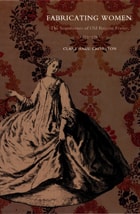
Fabricating Women
The Seamstresses of Old Regime France, 1675–1791Clare Haru Crowston
Duke University Press, 2001
Fabricating Women examines the social institution of the seamstresses’ guild in France from the time of Louis XIV to the Revolution. In contrast with previous scholarship on women and gender in the early modern period, Clare Haru Crowston asserts that the rise of the absolute state, with its centralizing and unifying tendencies, could actually increase women’s economic, social, and legal opportunities and allow them to thrive in corporate organizations such as the guild. Yet Crowston also reveals paradoxical consequences of the guild’s success, such as how its growing membership and visibility ultimately fostered an essentialized femininity that was tied to fashion and appearances.
Situating the seamstresses’ guild as both an economic and political institution, Crowston explores in particular its relationship with the all-male tailors’ guild, which had dominated the clothing fabrication trade in France until women challenged this monopoly during the seventeenth century. Combining archival evidence with visual images, technical literature, philosophical treatises, and fashion journals, she also investigates the techniques the seamstresses used to make and sell clothing, how the garments reflected and shaped modern conceptions of femininity, and guild officials’ interactions with royal and municipal authorities. Finally, by offering a revealing portrait of these women’s private lives—explaining, for instance, how many seamstresses went beyond traditional female boundaries by choosing to remain single and establish their own households—Crowston challenges existing ideas about women’s work and family in early modern Europe.
Although clothing lay at the heart of French economic production, social distinction, and cultural identity, Fabricating Women is the first book to investigate this immense and archetypal female guild in depth. It will be welcomed by students and scholars of French and European history, women’s and labor history, fashion and technology, and early modern political economy.

Far Afield
French Anthropology between Science and LiteratureVincent Debaene
University of Chicago Press, 2014
The relationship between anthropology and literature in France is one of careful curiosity. Literary writers are wary about anthropologists’ scientific austerity but intrigued by the objects they collect and the issues they raise, while anthropologists claim to be scientists but at the same time are deeply concerned with writing and representational practices. Debaene elucidates the richness that this curiosity fosters and the diverse range of writings it has produced, from Proustian memoirs to proto-surrealist diaries. In the end he offers a fascinating intellectual history, one that is itself located precisely where science and literature meet.
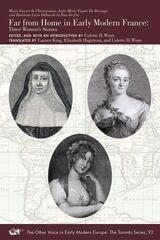
Far from Home in Early Modern France
Three Women’s StoriesMarie Guyart de l’Incarnation, Anne-Marie Fiquet du Boccage, and Henriette-Lucie Dillon de la Tour du Pin
Iter Press, 2022
This book showcases three Frenchwomen who ventured far from home at a time when such traveling was rare. In 1639, Marie de l’Incarnation embarked for New France where she founded the first Ursuline monastery in present-day Canada. In 1750, Madame du Boccage set out at the age of forty on her first “grand tour.” She visited England, the Netherlands, and Italy where she experienced firsthand the intellectual liberty offered there to educated women. As the Reign of Terror gripped France, the Marquise de la Tour du Pin fled to America with her husband and their two young children, where they ran a farm from 1794 to 1796. The writings these women left behind detailing their respective journeys abroad represent significant contributions to early modern travel literature. This book makes available to anglophone readers three texts that are rich in both historical and literary terms.

Farewell Tangier
Salma El Moumni
Seagull Books, 2026
For Alia, being a teenager in Tangier means constantly facing a gauntlet of unwanted encounters by men in the streets who look her over, grab her, or make comments about her body. At night, in the privacy of her bedroom, Alia begins to take photos of her body in order to understand what those men see when they look at her, becoming her own voyeur. When Alia’s photos somehow end up on the internet, she decides to flee the country, as the photos violate Moroccan law. She seeks refuge in Lyon, France, but is unable to escape the past.
Farewell Tangier is a searing exploration of the male gaze and its potential to shatter a young woman’s life, exploring themes of desire, dissociation, and exile. It is both a feminist critique of the policing of female bodies and an affecting narrative of one young woman’s struggle with her identity.

Fatal Isolation
The Devastating Paris Heat Wave of 2003Richard C. Keller
University of Chicago Press, 2015
Fatal Isolation tells the stories of these victims and the catastrophe that took their lives. It explores the multiple narratives of disaster--the official story of the crisis and its aftermath, as presented by the media and the state; the life stories of the individual victims, which both illuminate and challenge the ways we typically perceive natural disasters; and the scientific understandings of disaster and its management. Fatal Isolation is both a social history of risk and vulnerability in the urban landscape and a story of how a city copes with emerging threats and sudden, dramatic change.

Fathers of Botany
The Discovery of Chinese Plants by European MissionariesJane Kilpatrick
Royal Botanic Gardens, Kew, 2014
But as Jane Kilpatrick shows in Fathers of Botany, the first Westerners to come upon and document this bounty were in fact cut from a different cloth: the clergy. Following the Opium Wars, European missionaries were the first explorers to dig further into the Chinese interior and send home evidence of one of the richest and most varied floras ever seen, and it was their discoveries that caused a sensation among Western plantsmen. Both men of faith and talented botanists alike, these missionaries lent their names to many of the plants they discovered, but their own stories disappeared into the leaf litter of history. Drawing on their letters and contemporary accounts, Kilpatrick focuses on the lives of four great French missionary botanists—Pères Armand David (of Davidia involucrata—the dove tree—and discoverer of the giant panda), Jean Marie Delavay, Paul Guillaume Farges, and Jean André Soulié—as well as a group of other French priests, Franciscan missionaries, and a single German Protestant pastor who all amassed significant plant collections, as she unearths a lost chapter of botanical history. In so doing, she reminds today’s gardeners and botanists—and any of us who stop to smell the roses—of the enormous debt owed to these obscure fathers of botany.

Fiction Rivals Science
The French Novel from Balzac to ProustAllen Thiher
University of Missouri Press, 2001
In Fiction Rivals Science, Allen Thiher describes the epistemic rivalry that the major nineteenth-century French novelists felt in dealing with science. After brief considerations of Stendhal, Thiher focuses on the four most important "realist" novelists in France: Balzac, Flaubert, Zola, and, going into the twentieth century, Proust. According to Thiher, each of these novelists considered himself to be in competition with science to make the novel an instrument for knowledge.
The first chapter sets forth the understanding of science that dominated the early nineteenth century in order to make it plausible that literary minds, throughout the nineteenth century, thought that they could not only rival science, but even make positive contributions to knowledge. The Newtonian paradigm that had dominated the Enlightenment was slowly being challenged by new developments both in physics and in nonphysical sciences such as biology. Especially in biology the development of a scientific discourse using narrative temporality favored the idea that novelists could also use fiction to construct discourses that advanced knowledge.
Balzac wanted to construct a natural history of society and correct the chemical theory of his time. Flaubert drew upon medicine and physiology for the rhetoric of his realist fiction. Zola used unsuccessful medical paradigms for his doctrine of heredity, and models drawn from thermodynamics to describe the relation of the individual to societal forces. Finally, Proust drew upon thinkers such as Poincar‚ to elaborate an epistemology that put an end to the rivalry novelists might feel with scientists. Proust located certain knowledge within the realm of human subjectivity while granting the power of laws to rule over the contingent realm of physical reality, in which, after Poincar‚, neither mathematics nor Newton was any longer a source of absolute certainty. Proust's novel is thus the last great realist work of the nineteenth century and the first modernist work of consciousness taking itself as the object of knowledge.
By demonstrating that the great French realist novelists dealt with many of the same problems as did the scientists of the nineteenth century, Fiction Rivals Science attempts to show how culture unites literary and scientific inquiry into knowledge. Providing a new interpretation of the development of literary realism, this important new work will be welcomed not only by literary scholars, but by historians of science and culture as well.

Field Guide to the Wild Flowers of the Western Alps
France, Italy and SwitzerlandChristopher Grey-Wilson
Royal Botanic Gardens, Kew, 2025
The Western Alps, a large region of dramatic scenery and varied habitats, is noted for its biodiversity and beauty. From woodlands and forests, through colorful hay meadows, to the higher alpine elevations, the region boasts one of the most diverse and colorful mountain floras found anywhere on earth. This book is a celebration of the great biological diversity found in one of the most beautiful and inviting regions of Europe.
This comprehensive guide features the fascinating flora to be found across the region in the French Alps, the Massif Central and Cevennes, the Swiss Jura Mountains and the Italian Alps east to Como and Bergamo. Illustrated throughout with over 2000 photographs, each species profile includes nomenclature, description, dimensions, habitat, flowering times, and distribution.

Fifty Fables of La Fontaine
Jean de La Fontaine. Translated by Norman R. Shapiro. Illustrated by Alan James Robinson
University of Illinois Press, 1988

Figurations of France
Literary Nation-Building in Times of Crisis (1550-1650)Marcus Keller
University of Delaware Press, 2011
In Figurations of France: Literary Nation-Building in Times of Crisis (1550-1650), Marcus Keller explores the often indirect and subtle ways in which key texts of early modern French literature, from Joachim Du Bellay’s Défense et illustration de la langue française to Corneille’s Le Cid, contribute to the fiction of France as a nation. Through his fresh take on these and other classics, he shows that they not only create the French as an imaginary community but also provide venues for an incisive critique of the political and cultural construct that underpins the modern nation-state.
Current theories of nationhood, in particular the concepts of the nation form and fictive ethnicity (Étienne Balibar), inform the close readings of Du Bellay’s Défense, Ronsard’s Discours, d’Aubigné’s Tragiques, Montaigne’s Essays, Malherbe’s odes, and Corneille’s Le Cid and Horace. They reveal the imaginary power and unifying force of early modern figurations of France that come to bear in this heteregoneous corpus of French literature, with texts ranging from manifesto and epic poem to essay and tragedy. Situating each author and text in their particular historical context, the study suggests that the literary invention of France in the sixteenth and seventeenth centuries is as abundant as it is conceptually innovative: Du Bellay, for example, develops an idea of France by portraying the French language as a pruned and grafted tree while d’Aubigné proposes to think of the French as a nuclear but fatherless family. Blood functions as a highly charged metaphor of nationhood in all texts.
Opening up new perspectives on these canonical works, the focus on literary nation-building also puts them into unexpected and thought-provoking relationships to each other. Figurations of France deliberately crosses the fictive boundary between the sixteenth and the seventeenth centuries and argues that, in terms of imaginary nation-building, the contours that delineate the early modern period and separate it from what we call the modern era quickly begin to dissolve. Ultimately, the book makes the case for early modern literature as a creative and critical discourse, able to nourish and nuance our thinking about the nation as the postmodern nation-state is increasingly called into question by the economical, political, and cultural effects of globalization.
Published by University of Delaware Press. Distributed worldwide by Rutgers University Press.
Filth
Dirt, Digust, and Modern LifeWilliam A. Cohen
University of Minnesota Press, 2004
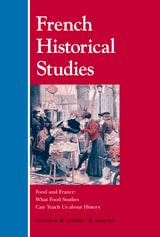
Food and France
What Food Studies Can Teach Us about HistoryErica J. Peters and Bertram M. Gordon, editors
Duke University Press, 0
This special issue offers a broad range of social and cultural insights into the history of French gastronomy. At a moment when French cuisine no longer dominates the world of fine dining, the history of French food has drawn increasing attention in the academic world. The contributors address topics spanning the seventeenth to the twentieth centuries, such as coffee’s relationship to slavery and exoticism; the promotion of terroir to an aspiring middle class; the contrast between the romanticized images of Parisian shop girls and their efforts to survive on street food in the early twentieth century; the "standard meal" imagined by nineteenth-century nutritionists and the divergent reality of meager lunches for the working class; and the inequitable experience of wartime deprivation. The articles in this issue both model how the study of the culture of food can ground our understanding of France’s place in the world and illuminate questions of nationalism, global networks, gender, race, ethnicity, and class.
Contributors: Martin Bruegel, Bertram M. Gordon, Julia Landweber, Philippe Meyzie, Kenneth Mouré, Erica J. Peters, Patricia A. Tilburg
Food, Farms, and Solidarity
French Farmers Challenge Industrial Agriculture and Genetically Modified CropsChaia Heller
Duke University Press, 2012

For Fear of the Fire
Joan of Arc and the Limits of SubjectivityFrançoise Meltzer
University of Chicago Press, 2001
Engaging a number of theorists, and alternating between Joan's historical and cultural context, Meltzer also explores the ways in which postmodern thinkers question subjectivity. She argues that the way masculine subjects imagine Joan betrays their fear of death and necessitates the role of women as cultural others: enigmatic, mysterious, dark, and impossible. As such, Joan serves as a useful model of the limits and risks of subjectivity. For Meltzer, she is both the first modern and the last medieval figure. From the ecclesial jury that burned her, to the theorists of today who deny their attraction to the supernatural, the philosophical assumptions that inform Joan's story, as Meltzer ultimately shows, have changed very little.

Forging Deaf Education in Nineteenth-Century France
Biographical Sketches of Bébian, Sicard, Massieu, and ClercFerdinand Berthier
Gallaudet University Press, 2009
In 1811, deaf student Ferdinand Berthier commenced his education at the National Institute for the Deaf in Paris under its director Abbé Sicard and his teachers Auguste Bébian, Jean Massieu, and Laurent Clerc. Their tutelage eventually led Berthier to join the faculty at the Institute and become a life-long proponent of sign language and Deaf culture. Berthier earned fame for instituting the famous silent banquets in Paris in 1834. He also learned to advance his agenda by writing biographies of important figures who advocated sign over oralism to educate deaf French students. Forging Deaf Education in Nineteenth-Century France offers the first translation of Berthier’s biographical sketches of the four men above who influenced him most.
Berthier wrote first about Bébian in 1839, timed to advocate sign language for teaching deaf students after the death of the pro-oralism Institute Director Désiré Ordinaire. Berthier extolled Bébian’s linguistic acumen and his educational philosophy. In later sketches, however, he described Sicard and Massieu in positive terms, but also criticized them for supporting “methodical” signing that conformed to spoken language conventions. In contrast, he lauded Clerc in his portrayal for using “natural” signing to teach deaf students. The clarity of these translations will introduce a brand new audience to Berthier’s biographies shaped by his unswerving beliefs about Deaf French education.
Forms of Blackness
Race and Visibility in the French-Speaking WorldCécile Bishop
Duke University Press, 2025
Considering race as form across literature, theory, painting, and photography, Cécile Bishop’s Forms of Blackness explores the formal devices that make blackness both visible and recognizable. In keeping with black Francophone theorists like Édouard Glissant and Frantz Fanon, Bishop uses the ambiguities these aesthetic forms carry to explore a range of identity concepts like opacity, formlessness, and doubleness. Bishop puts blackness-as-race and blackness-as-form in dialogue, showing how race disrupts the concept of artistic autonomy and how the aesthetic challenges race as a self-evident visual phenomenon. When thought together, form does not isolate blackness from race but rather calls attention to the material substrate that turns race into a phenomenon that can be experienced through sense perception. Moving between careful analysis and experimental modes of critique, Forms of Blackness offers a new way of thinking about the politics of visibility and offers a pressing invitation to question the ways we interpret what we see.

Fragments of a World
William of Auvergne and His Medieval LifeLesley Smith
University of Chicago Press, 2023
Today, William of Auvergne (1180?–1249) is remembered for his scholarship about the afterlife as well as the so-called Trial of the Talmud. But the medieval bishop of Paris also left behind nearly 600 sermons delivered to all manner of people—from the royal court to the poorest in his care. In Fragments of a World, Lesley Smith uses these sermons to paint a vivid picture of this extraordinary cleric, his parishioners, and their bustling world. The first modern biography of the influential teacher, bishop, and theologian, Fragments of a World casts a new image of William of Auvergne for our times—deeply attuned to both the spiritual and material needs of an ever-changing populace in the medieval city.

Fragonard
Art and EroticismMary D. Sheriff
University of Chicago Press, 1990
Sheriff begins her inquiry with an appraisal of Fragonard criticism, followed by an extensive and thoroughly original reading of selected works by Fragonard and of the eroticism encoded in them. Art and eroticism converge in a discussion of execution, in which Sheriff explores the changing conception of execution and elucidates its complex rhetorical and cultural underpinnings. Drawing on analytic methods from contemporary critical theory and an understanding of each work's cultural milieu, Sheriff pays particular attention throughout to the relation between beholder and work of art, which she views as manifest in the artist's preoccupation with the play between the real and the fictive. Scholars and students of art history, eighteenth-century culture and history, critical theory, literary criticism, and all those drawn to the work of this great French painter will find this work essential reading.
France and Algeria
A History of Decolonization and TransformationPhillip Naylor
University of Texas Press, 2024
An examination of the complicated history between France and Algeria since the latter’s independence.
While most related studies concentrate on the colonial era and Algeria's War of Independence, France and Algeria details the nations' postcolonial relationship. Phillip Naylor provides a philosophical approach, contending that France reformulated, rather than repudiated, “essential” strategic values during decolonization. It thus continued to pursue grandeur and independence, especially with regard to the Third World and Algeria, an essentialism that expedited France’s postcolonial transformation. But as a new nation, Algeria needed to pursue the “existential” project of self-definition. It became involved in state-building while also promulgating socialism, and it recognized how French oil concessions in the Sahara impeded its independence, leading to the industry's postcolonial decolonization. Finally, the postcolonial relationship has featured a human dimension involving immigrants, pieds-noirs (colonial settlers), and harkis (Algerian soldiers loyal to France), all of them central to bilateral relations.
In this revised and updated edition of his seminal work, first published over twenty years ago, Naylor expands his coverage of the decolonization era, drawing on new information while continuing to study the ever-evolving relationship between the two countries. These new additions expose the continually shifting relations of power, perception, and identity between the two states.

France and Islam, Volume 30
Patricia Lorcin and Paula Sanders
Duke University Press, 0

France and her Eastern Allies, 1919-1925
French-Czechoslovak-Polish Relations from the Paris Peace Conference in LocarnoPiotr S. Wandycz
University of Minnesota Press, 1962
France and her Eastern Allies, 1919–1925 was first published in 1962. Minnesota Archive Editions uses digital technology to make long-unavailable books once again accessible, and are published unaltered from the original University of Minnesota Press editions.
Relations between France, Czechoslovakia, and Poland occupied an important position in European diplomacy in the years between World War I and World War II. Beginning with the breakdown of the old political, social, and economic order on the Continent during the first World War, these relations went through many changes. This book deals with the crucial period from the Paris Peace Conference of 1919 to the signing of the Locarno Pact in 1925. During this time France attempted to establish an eastern barrier of buffer states with Poland and Czechoslovakia at the core, with the aim of keeping Germany and Bolshevik Russia apart. This, France hoped, would guarantee European peace and security. Although an effective eastern barrier was never realized, the attempt to create one was a worthy and important undertaking.
Professor Wandycz considers in detail the various aspects of the complex relationship between France and the two western Slav states — geographic, economic, social, and political. In addition, he provides a clear and interesting picture of some of the personalities involved. Through the use of hitherto unpublished source material, he throws new light on many events of general European diplomatic history as well as on Polish, French, and Czechoslovak foreign policy in particular.
France at the Polls, 1981 and 1986
Howard R. Penniman, ed.
Duke University Press, 1988

Francois Mauriac on Race, War, Politics and Religion
Nathan Bracher
Catholic University of America Press, 2016

Francophonie and the Orient
French-Asian Transcultural Crossings (1840-1940)Mathilde Kang
Amsterdam University Press, 2018

Fraternal Critique
The Politics of Muslim Community in FranceKirsten Wesselhoeft
University of Chicago Press, 2025
The conversation about Islam in France is framed by the presumption that Muslim communities are a threat to secular solidarity or fraternité. In the face of state repression, French Muslims have not closed ranks around a narrow range of voices; instead, Kirsten Wesselhoeft finds that young Muslim activists have continued to purposefully spark debate about the values that anchor community life. Wesselhoeft argues that such disagreements, far from dividing communities, actually constitute a form of belonging. Some activists call this ethic “fraternal critique,” and Wesselhoeft finds in it profound insights about the place for critique in civic life. The French state has reacted to Muslim solidarity with repression, but Wesselhoeft argues that unity need not come at the expense of dissent. Instead, fraternal critique can teach us how to build communities that are worth fighting over and fighting for.
Free as Gods
How the Jazz Age Reinvented ModernismCharles A. Riley
University Press of New England, 2017

Freedom Time
Negritude, Decolonization, and the Future of the WorldGary Wilder
Duke University Press, 2015
Freedom's Moment
An Essay on the French Idea of Liberty from Rousseau to FoucaultPaul M. Cohen
University of Chicago Press, 1997
Arranged not according to the lives and times of its protagonists but to the narrative themes and structures they held in common, Cohen’s study discerns a single master narrative of liberty in modern France. He captures these radicals, whose tradition bids them to resist the authority of power structures and public opinion. They denounce bourgeois and utilitarian values, the power of Church and State, and the corrupting influence of everyday politics, and they dream of a revolutionary rupture, a fleeting instant of sometimes violent but always meaningful transgression.
An eloquent and insightful work on French political culture, Freedom's Moment also helps explain how France, even as it has oscillated between political stagnation and crisis, has held onto its faith that liberty, equality, and fraternity remain within its grasp.
Examines the ideas of Rousseau, Robespierre, Stendahl, Michelet, Bergson, Peguy, Sartre, and Foucault.
French Colonial Documentary
Mythologies of HumanitarianismPeter J. Bloom
University of Minnesota Press, 2008
Despite altruistic goals, humanitarianism often propagates foreign, and sometimes unjust, power structures where it is employed. Tracing the visual rhetoric of French colonial humanitarianism, Peter J. Bloom’s unexpected analysis reveals how the project of remaking the colonies in the image of France was integral to its national identity.
French Colonial Documentary investigates how the promise of universal citizenship rights in France was projected onto the colonies as a form of evolutionary interventionism. Bloom focuses on the promotion of French education efforts, hygienic reform, and new agricultural techniques in the colonies as a means of renegotiating the social contract between citizens and the state on an international scale. Bloom’s insightful readings disclose the pervasiveness of colonial iconography, including the relationship between “natural man” and colonial subjectivity; representations of the Senegalese Sharpshooters as obedient, brave, and sexualized colonial subjects; and the appeal of exotic adventure narratives in the trans-Saharan film genre.
Examining the interconnection between French documentary realism and the colonial enterprise, Bloom demonstrates how the colonial archive is crucial to contemporary debates about multiculturalism in France.
Peter J. Bloom is associate professor of film and media studies at the University of California-Santa Barbara.y debates about multiculturalism in France.

French DNA
Trouble in PurgatoryPaul Rabinow
University of Chicago Press, 1999
French Daguerreotypes
Janet E. Buerger
University of Chicago Press, 1989
Lavishly illustrated, this volume is the first complete catalog of the French daguerreotype collection of the International Museum of Photography at George Eastman House. Janet E. Buerger uses this remarkable collection of images to produce a cultural history of the daguerreotype's most learned following—an elite group of mid-nineteenth-century intellectuals who sought to understand and develop the usefulness, potential, and beauty of this camera image. This varied group, including entrepreneurs, painters, scientists, and historians, enables Buerger to trace the influence of photography into virtually every area of nineteenth-century European intellectual life.
French Film History, 1895–1946
Richard Neupert
University of Wisconsin Press, 2022
Neupert explains the contexts behind the rise of cinema in France, including groundbreaking work by the Lumière family, Georges Méliès, and Alice Guy; the powerhouse studios of Pathé and Gaumont; directors such as René Clair, Germaine Dulac, Marcel Pagnol, and Jean Renoir; and an array of stars, including Max Linder, Jean Gabin, Josephine Baker, and Michèle Morgan. The first fifty years of French film practice established cinema’s cultural and artistic potential, setting the stage for the global post–World War II explosion in commercial movies and art cinema alike. French film and its rich history remain at the heart of cinematic storytelling and our moviegoing pleasure.
French Gastronomy and the Magic of Americanism
Rick Fantasia
Temple University Press, 2019
A tectonic shift has occurred in the gastronomic field in France, upsetting the cultural imagination. In a European country captivated by a high-stakes power struggle between chefs and restaurants in the culinary field, the mass marketing of factory-processed industrial cuisine and fast foods has created shock waves in French society, culture, and the economy.
In this insightful book, French Gastronomy and the Magic of Americanism, Rick Fantasia examines how national identity and the dynamics of cultural meaning-making within gastronomy have changed during a crucial period of transformation, from the 1970s through the 1990s. He illuminates the tensions and surprising points of cooperation between the skill, expertise, tradition, artistry, and authenticity of grand chefs and the industrial practices of food production, preparation, and distribution.
Fantasia examines the institutions and beliefs that have reinforced notions of French cultural supremacy—such as the rise and reverence of local cuisine—as well as the factors that subvert those notions, such as when famous French chefs lend their names to processed, frozen, and pre-packaged foods available at the supermarket. Ultimately, French Gastronomy and the Magic of Americanism shows what happens to a cultural field, like French gastronomy, when the logic and power of the economic field imposes itself upon it.
French Modern
Norms and Forms of the Social EnvironmentPaul Rabinow
University of Chicago Press, 1995
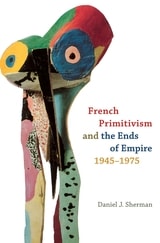
French Primitivism and the Ends of Empire, 1945-1975
Daniel J. Sherman
University of Chicago Press, 2011
For over a century, the idea of primitivism has motivated artistic modernism. Focusing on the three decades after World War II, known in France as “les trentes glorieuses” despite the loss of most of the country’s colonial empire, this probing and expansive book argues that primitivism played a key role in a French society marked by both economic growth and political turmoil.
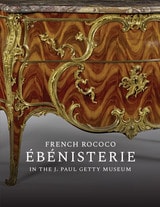
French Rococo Ébénisterie in the J. Paul Getty Museum
Gillian Wilson
J. Paul Getty Trust, The, 2021
The first comprehensive catalogue of the Getty Museum’s significant collection of French Rococo ébénisterie furniture.
This catalogue focuses on French ébénisterie furniture in the Rococo style dating from 1735 to 1760. These splendid objects directly reflect the tastes of the Museum’s founder, J. Paul Getty, who started collecting in this area in 1938 and continued until his death in 1976.
The Museum’s collection is particularly rich in examples created by the most talented cabinet masters then active in Paris, including Bernard van Risenburgh II (after 1696–ca. 1766), Jacques Dubois (1694–1763), and Jean-François Oeben (1721–1763). Working for members of the French royal family and aristocracy, these craftsmen excelled at producing veneered and marquetried pieces of furniture (tables, cabinets, and chests of drawers) fashionable for their lavish surfaces, refined gilt-bronze mounts, and elaborate design. These objects were renowned throughout Europe at a time when Paris was considered the capital of good taste.
The entry on each work comprises both a curatorial section, with description and commentary, and a conservation report, with construction diagrams. An introduction by Anne-Lise Desmas traces the collection’s acquisition history, and two technical essays by Arlen Heginbotham present methodologies and findings on the analysis of gilt-bronze mounts and lacquer.
The free online edition of this open-access publication is available at www.getty.edu/publications/rococo/ and includes zoomable, high-resolution photography. Also available are free PDF, EPUB, and Kindle/MOBI downloads of the book, and JPG downloads of the main catalogue images.
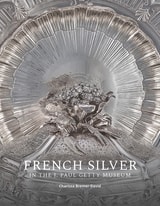
French Silver in the J. Paul Getty Museum
Charissa Bremer-David
J. Paul Getty Trust, The, 2023
The collection of seventeenth- and eighteenth-century French silver at the J. Paul Getty Museum is of exceptional quality and state of preservation. Each piece is remarkable for its beauty, inventive form, skillful execution, illustrious provenance, and the renown of its maker. This volume is the first complete study of these exquisite objects, with more than 250 color photographs bringing into focus extraordinary details such as minuscule makers’ marks, inscriptions, and heraldic armorials.
The publication details the formation of the Museum’s collection of French silver, several pieces of which were selected by J. Paul Getty himself, and discusses the regulations of the historic Parisian guild of gold- and silversmiths that set quality controls and consumer protections. Comprehensive entries catalogue a total of thirty-three pieces with descriptions, provenance, exhibition history, and technical information. The related commentaries shed light on the function of these objects and the roles they played in the daily lives of their prosperous owners. The book also includes maker biographies and a full bibliography.
The free online edition of this open-access publication is available at getty.edu/publications/french-silver/ and includes 360-degree views and zoomable high-resolution photography. Also available are free PDF and EPUB downloads of the book, and JPG downloads of the main catalogue images.

French Theatre Today
The View from New York, Paris, and AvignonTurk, Edward B.
University of Iowa Press, 2011
@font-face { font-family: "Times";}@font-face { font-family: "Palatino";}p.MsoNormal, li.MsoNormal, div.MsoNormal { margin: 0in 0in 0.0001pt; font-size: 12pt; font-family: "Times New Roman"; }div.Section1 { page: Section1; }
In 2005 literary and film critic Edward Turk immersed himself in New York City’s ACT FRENCH festival, a bold effort to enhance American contact with the contemporary French stage. This dizzying crash course on numerous aspects of current French theatre paved the way for six months of theatregoing in Paris and a month’s sojourn at the 2006 Avignon Festival. In French Theatre Today he turns his yearlong involvement with this rich topic into an accessible, intelligent, and comprehensive overview of contemporary French theatre. Situating many of the nearly 150 stage pieces he attended within contexts and timeframes that stretch backward and forward over a number of years, he reveals French theatre during the first decade of the twenty-first century to be remarkably vital, inclined toward both innovation and concern for its audience, and as open to international influence as it is respectful of national tradition.
French Theatre Today provides a seamless mix of critical analysis with lively description, theoretical considerations with reflexive remarks by the theatremakers themselves, and matters of current French and American cultural politics. In the first part, “New York,” Turk offers close-ups of French theatre works singled out during the ACT FRENCH festival for their presumed attractiveness to American audiences and critics. The second part, “Paris,” depicts a more expansive range of French theatre pieces as they play out on their own soil. In the third part, “Avignon,” Turk captures the subject within a more fluid context that is, most interestingly, both eminently French and resolutely international. The Paris and Avignon chapters contain valuable and well-informed contextual and background information as well as descriptions of the milieus of the Avignon Festival and the various neighborhoods in Paris where he attended performances, information that readers cannot find easily elsewhere. Finally, in the spirit of inclusiveness that characterizes so much new French theatre and to give a representative account of his own experiences as a spectator, Turk rounds out his survey with observations on Paris’s lively opera scene and France’s wealth of circus entertainments, both traditional and newly envisioned
With his shrewd assessments of contemporary French theatre, Turk conveys an excitement and an affection for his topic destined to arouse similar responses in his readers. His book’s freshness and openness will reward theatre enthusiasts who are curious about an aspect of French culture that is inadequately known in this country, veteran scholars and students of contemporary world theatre, and those American theatre professionals who have the ultimate authority and good fortune to determine which new French works will reach audie
French Theory
How Foucault, Derrida, Deleuze, & Co. Transformed the Intellectual Life of the United StatesFrancois Cusset
University of Minnesota Press, 2008
“A great story, full of twists and turns. . . . Careers made and ruined, departments torn apart, writing programs turned into sensitivity seminars, political witch hunts, public opprobrium, ignorant media attacks, the whole ball of wax. Read it and laugh or read it and weep. I can hardly wait for the movie.” —Stanley Fish, Think Again, New York Times
“In such a difficult genre, full of traps and obstacles, French Theory is a success and a remarkable book in every respect: it is fair, balanced, and informed. I am sure this book will become the reference on both sides of the Atlantic.” —Jacques Derrida
“The Atlantic Ocean has two sides, and so does French Theory. Reinvented in America and betrayed in its own country, it has become the most radical intellectual movement in the West with global reach, rewriting Marx in light of late capitalism. Breathtakingly moving back and forth between the two cultures, Francois Cusset takes us through a dazzling intellectual adventure that illuminates the past thirty years, and many more decades to come.” —Sylvere Lotringer
During the last three decades of the twentieth century, a disparate group of radical French thinkers achieved an improbable level of influence and fame in the United States. Compared by at least one journalist to the British rock ‘n’ roll invasion, the arrival of works by Michel Foucault, Jacques Derrida, Jean-François Lyotard, Jean Baudrillard, Gilles Deleuze, and Félix Guattari on American shores in the late 1970s and 1980s caused a sensation.
Outside the academy, “French theory” had a profound impact on the era’s emerging identity politics while also becoming, in the 1980s, the target of right-wing propagandists. At the same time in academic departments across the country, their poststructuralist form of radical suspicion transformed disciplines from literature to anthropology to architecture. By the 1990s, French theory was woven deeply into America’s cultural and intellectual fabric.
French Theory is the first comprehensive account of the American fortunes of these unlikely philosophical celebrities. François Cusset looks at why America proved to be such fertile ground for French theory, how such demanding writings could become so widely influential, and the peculiarly American readings of these works. Reveling in the gossipy history, Cusset also provides a lively exploration of the many provocative critical practices inspired by French theory. Ultimately, he dares to shine a bright light on the exultation of these thinkers to assess the relevance of critical theory to social and political activism today-showing, finally, how French theory has become inextricably bound with American life.
François Cusset, a writer and intellectual historian, teaches contemporary French thought in Paris at the Institut d’Etudes Politiques and at Columbia University’s Reid Hall. His books include Queer Critics and La Décennie.
Jeff Fort is assistant professor of French at the University of California, Davis. He has translated works by Maurice Blanchot, Jean Genet, and Jean-Luc Nancy.
French Thinking about Animals
Louisa Mackenzie
Michigan State University Press, 2015

French and Germans, Germans and French
A Personal Interpretation of France under Two Occupations, 1914–1918/1940–1944Richard Cobb
Brandeis University Press, 2018

From North Africa to France
Family Migration in Text and FilmIsabel Hollis-Touré
University of London Press, 2015
From Plantation to Paradise?
Cultural Politics and Musical Theatre in French Slave Colonies, 1764–1789David M. Powers
Michigan State University Press, 2014
From Revolutionaries to Citizens
Antimilitarism in France, 1870–1914Paul B. Miller
Duke University Press, 2002
Although more general accounts of the Left’s “failure” to halt international war in August 1914 focus on its lack of unity or the decline of trade unionism, Miller contends that these explanations barely scratch the surface when it comes to interpreting the Left’s overwhelming acceptance of the war. By embedding his cultural analysis of antimilitarist propaganda into the larger political and diplomatic history of prewar Europe, he reveals the Left’s seemingly sudden transformation “from revolutionaries to citizens” as less a failure of resolve than a confession of commonality with the broader ideals of republican France. Examining sources ranging from police files and court records to German and British foreign office memos, Miller emphasizes the success of antimilitarism as a rallying cry against social and political inequities on behalf of ordinary citizens. Despite their keen awareness of the bloodletting that awaited Europe, he claims, antimilitarists ultimately accepted the war with Germany for the same reason they had pursued their own struggle within France: to address injustices and defend the rights of citizens in a democratic society.
From Yorktown to Valmy
The Transformation of the French Army in an Age of RevolutionSamuel F. Scott
University Press of Colorado, 1998
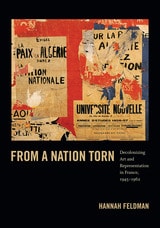
From a Nation Torn
Decolonizing Art and Representation in France, 1945-1962Hannah Feldman
Duke University Press, 2014