Results by title
4413 books match the query 'Anthropology' and 127 start with g
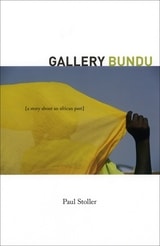
Gallery Bundu
A Story about an African PastPaul Stoller
University of Chicago Press, 2005
In Paul Stoller's work of fiction framed by African storytelling, David is the 52-year-old co-owner of Gallery Bundu, an African art shop in New York City. As a young man in the late 1960s, he joined the Peace Corps to avoid the draft. Assigned to teach English in Niger, he was eager to seek out adventure, and he found it—from drugged-out American expatriates and mamba-filled forests to seductive African women. In the course of his stay in Niger, David meets and falls in love with Zeinabou, a strikingly beautiful woman who professes her love to him, though David believes that he is not the only man she dates. Two weeks before his anticipated return to the United States, Zeinabou informs David that she is pregnant with what she believes is his child. Not knowing how to react, David flees Niger and returns to America ridden with guilt. The hastiness of David's decision will shadow his every move for the rest of his life and will lead him to eventually return to Niger and try to make amends.
Beautifully written and deeply felt, Gallery Bundu is a cautionary tale about the impulses of youth and the unyielding grip of regret. Stoller's vivid language and style allow readers, through David's recollections, to touch, taste, and smell the sensations of West Africa—the tasty aroma of a traditional African fish stew, the spectacle of witches, and the humorous and often frightening experiences of traveling in the bush. A lyrical novel of decisions and destiny, Gallery Bundu is rich in character and detail, bringing anthropology to a new literary height.

Gambling Debt
Iceland's Rise and Fall in the Global EconomyE. Paul Durrenberger
University Press of Colorado, 2014
Gambling Debt is a game-changing contribution to the discussion of economic crises and neoliberal financial systems and strategies. Iceland’s 2008 financial collapse was the first case in a series of meltdowns, a warning of danger in the global order. This full-scale anthropology of financialization and the economic crisis broadly discusses this momentous bubble and burst and places it in theoretical, anthropological, and global historical context through descriptions of the complex developments leading to it and the larger social and cultural implications and consequences.
Chapters from anthropologists, sociologists, historians, economists, and key local participants focus on the neoliberal policies—mainly the privatization of banks and fishery resources—that concentrated wealth among a select few, skewed the distribution of capital in a way that Iceland had never experienced before, and plunged the country into a full-scale economic crisis. Gambling Debt significantly raises the level of understanding and debate on the issues relevant to financial crises, painting a portrait of the meltdown from many points of view—from bankers to schoolchildren, from fishers in coastal villages to the urban poor and immigrants, and from artists to philosophers and other intellectuals.
This book is for anyone interested in financial troubles and neoliberal politics as well as students and scholars of anthropology, sociology, economics, philosophy, political science, business, and ethics.
Publication supported in part by the National Science Foundation.
Contributors:
Vilhjálmur Árnason, Ásmundur Ásmundsson, Jón Gunnar Bernburg, James Carrier, Sigurlína Davíðsdóttir, Dimitra Doukas, Níels Einarsson, Einar Mar Guðmundsson, Tinna Grétarsdóttir, Birna Gunnlaugsdóttir, Guðný S. Guðbjörnsdóttir, Pamela Joan Innes, Guðni Th. Jóhannesson, Örn D. Jónsson, Hannes Lárusson, Kristín Loftsdóttir, James Maguire, Már Wolfgang Mixa, Evelyn Pinkerton, Hulda Proppé, James G. Rice, Rögnvaldur J. Sæmundsson, Unnur Dís Skaptadóttir, Margaret Willson
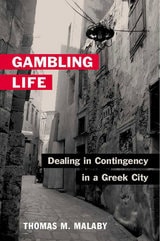
Gambling Life
DEALING IN CONTINGENCY IN A GREEK CITYThomas M. Malaby
University of Illinois Press, 2003
Backgammon cafés, card clubs, and hidden gambling rooms in the city of Chania provide the context for Thomas M. Malaby to examine the ways in which people confront uncertainty in their lives. He shows how the dynamics of gambling -- risk, fate, uncertainty, and luck -- are reflected in other aspects of gamblers’ lives from courtship and mortality to state bureaucracy and national identity.
By moving beyond risk and fate as unexamined analytical categories, Malaby presents a new model for research concerning indeterminacy, seeing it as arising from stochastic, performative, and other sources. Gambling Life questions the longstanding valorization of order and pattern in the social sciences.
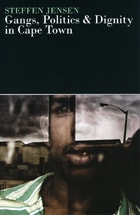
Gangs, Politics and Dignity in Cape Town
Steffen Jensen
University of Chicago Press, 2008
After nearly fifty years of rigid segregation, the demise of the apartheid regime in South Africa and the African National Congress’s relatively peaceful assumption of power in 1994 were hailed as a miracle. But a few years into the transition, this miracle appeared increasingly threatened by crime and violence. In this compelling ethnography, Steffen Jensen focuses on a single township in Cape Town in order to explore how residents have negotiated the intersecting forces of political change and violent crime.
Jensen spent years closely observing the actions of residents both male and female, young and old, as well as gang members, police officers, and local government officials. The poisonous legacy of apartheid also comes under Jensen’s lens, as he examines the lasting effects that an official policy of racist stereotyping has had on the residents’ conceptions of themselves and their neighbors. While Gangs, Politics, and Dignity in Cape Town brims with insights into ongoing debates over policing, gangs, and local politics, Jensen also shows how people in the townships maintain their dignity in the face of hardship and danger.
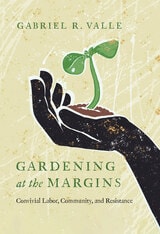
Gardening at the Margins
Convivial Labor, Community, and ResistanceGabriel R. Valle
University of Arizona Press, 2022
Participants in La Mesa Verde home garden program engage in the practices of growing and sharing food to envision and continuously work to enact alternative food systems that connect people to their food and communities. They are building on ancestral knowledge, as well as learning new forms of farming, gardening, and healing through convivial acts of sharing.
The individuals featured in the book are imagining and building alternative worlds and futures amid the very real challenges they embody and endure. Climate change, for example, is forcing thousands of migrants to urban areas, which means recent immigrants’ traditional environmental, nutritional, and healing knowledge will continue to be threatened by the pervasiveness of modernity and the homogenization of global capitalism. Moreover, once rural people migrate to urban areas, their ability to retain traditional foodways will remain difficult without spaces of autonomy. The stories in this book reveal how people create the physical space to grow food and the political space to enact autonomy to revive and restore agroecological knowledge needed for an uncertain future.
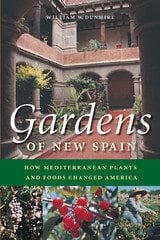
Gardens of New Spain
How Mediterranean Plants and Foods Changed AmericaBy William W. Dunmire
University of Texas Press, 2004
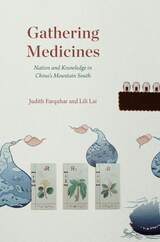
Gathering Medicines
Nation and Knowledge in China’s Mountain SouthJudith Farquhar and Lili Lai
University of Chicago Press, 2021
Over a period of six years, Judith Farquhar and Lili Lai worked with seven minority nationality groups in China’s southern mountains, observing how medicines were gathered and local healing systems codified. Gathering Medicines shares their intimate view of how people understand ethnicity, locality, the body, and nature. This ethnography of knowledge diversities in multiethnic China is a testament to the rural wisdom of mountain healers, one that theorizes, from the ground up, the dynamic encounters between formal statist knowledge and the popular authority of the wild.
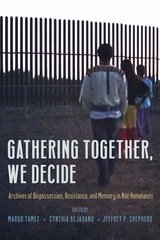
Gathering Together, We Decide
Archives of Dispossession, Resistance, and Memory in Ndé HomelandsEdited by Margo Tamez, Cynthia Bejarano, and Jeffrey P. Shepherd
University of Arizona Press, 2025
In response, Dr. Eloisa Tamez and her daughter, Dr. Margo Tamez, organized a gathering of Lipan tribal members, activists, lawyers, and allies to meet in El Calaboz, South Texas. This gathering was a response to the appropriation of the Tamez family land, but it also provided an international platform to dispute the militarization of Indigenous territory throughout the U.S.-Mexico bordered lands. The gathering and years of ensuing resistance and activism produced an archive of scholarly analyses, testimonios, artwork, legal briefs, poetry, and other cultural productions.
This unique collection spotlights powerful voices and perspectives from Ndé leaders, Indigenous elders, settler-allies, Native youth, and others associated with the Tamez family, the Ndé defiance, and the larger Indigenous rights movement to document their resistance; expose, confront, and end racism and militarization; and to foreground Indigenous women–led struggles for justice.
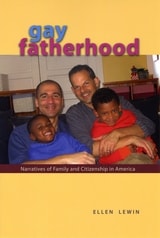
Gay Fatherhood
Narratives of Family and Citizenship in AmericaEllen Lewin
University of Chicago Press, 2009
Men are often thought to have less interest in parenting than women, and gay men are generally assumed to prefer pleasure over responsibility. The toxic combination of these two stereotypical views has led to a lack of serious attention being paid to the experiences of gay fathers. But the truth is that more and more gay men are setting out to become parents and succeeding—and Gay Fatherhood aims to tell their stories.
Ellen Lewin takes as her focus people who undertake the difficult process of becoming fathers as gay men, rather than having become fathers while married to women. These men face unique challenges in their quest for fatherhood, negotiating specific bureaucratic and financial conditions as they pursue adoption or surrogacy and juggling questions about their future child’s race, age, sex, and health. Gay Fatherhood chronicles the lives of these men, exploring how they cope with political attacks from both the "family values" right and the "radical queer" left—while also shedding light on the evolving meanings of family in twenty-first-century America.

Gay, Inc.
The Nonprofitization of Queer PoliticsMyrl Beam
University of Minnesota Press, 2018
A bold and provocative look at how the nonprofit sphere’s expansion has helped—and hindered—the LGBT cause
What if the very structure on which social movements rely, the nonprofit system, is reinforcing the inequalities activists seek to eliminate? That is the question at the heart of this bold reassessment of the system’s massive expansion since the mid-1960s. Focusing on the LGBT movement, Myrl Beam argues that the conservative turn in queer movement politics, as exemplified by the shift toward marriage and legal equality, is due mostly to the movement’s embrace of the nonprofit structure.
Based on oral histories as well as archival research, and drawing on the author’s own extensive activist work, Gay, Inc. presents four compelling case studies. Beam looks at how people at LGBT nonprofits in Minneapolis and Chicago grapple with the contradictions between radical queer social movements and their institutionalized iterations. Through interview subjects’ incisive, funny, and heartbreaking commentaries, Beam exposes a complex world of committed people doing the best they can to effect change, and the flawed structures in which they participate, rail against, ignore, and make do.
Providing a critical look at a social formation whose sanctified place in the national imagination has for too long gone unquestioned, Gay, Inc. marks a significant contribution to scholarship on sexuality, neoliberalism, and social movements.
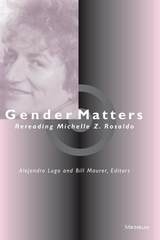
Gender Matters
Rereading Michelle Z. RosaldoAlejandro Lugo and Bill Maurer, Editors
University of Michigan Press, 2000
With the publication of Woman, Culture, and Society in 1974, Michelle Rosaldo initiated nothing less than a reconstruction of anthropology that placed feminist analysis at the center of the discipline. Through a rereading of Rosaldo's ideas and arguments, this collection provides in-depth analysis of Rosaldo's many contributions to anthropology and feminism. Each of the essays derives theoretically and politically useful insights from Rosaldo's work and sets them in motion for new intellectual and political practices. The authors do not always share Rosaldo's perspectives, nor do they necessarily agree with each other. But, together, they point to exciting syntheses of old and new feminist theory and practice.
Alejandro Lugo is Assistant Professor of Anthropology and Latina/o Studies, University of Illinois at Urbana-Champaign. Bill Maurer is Assistant Professor of Anthropology, University of California at Irvine.
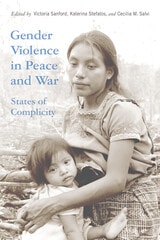
Gender Violence in Peace and War
States of ComplicitySanford, Victoria
Rutgers University Press, 2016
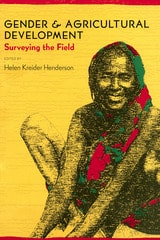
Gender and Agricultural Development
Surveying the FieldEdited by Helen K. Henderson
University of Arizona Press, 1995
This book is both a resource guide and a review of major issues in gender and agriculture which demonstrates that recognizing the contribution of women to agricultural production is a necessary step in development planning. It presents relevant information and research literature regarding women's roles in agriculture in a consolidated and accessible format, offering insights into how the inclusion or exclusion of appropriate information at the planning stage can have an impact during implementation. It also provides guidelines for locating information on gender-related agricultural issues and incorporating it into development planning, research, and training. The literature reviewed not only calls attention to the work women do in order to improve their access to technology and training but also challenges existing development paradigms. The issues discussed present women's experiences and local knowledge and allude to gender and class inequities that farming women face. Each chapter is intended to help the reader address major gender issues in a specific subject in order to access relevant information and thereby better design and implement appropriate agricultural planning and policies.
By synthesizing twenty years of international research, Gender and Agricultural Development provides an effective tool for development practitioners to use in training programs or surveys in order to ensure the appropriate collection of gender disaggregated data and for educators to integrate gender issues into courses dealing with social aspects of agricultural systems. Its findings are presented in such a way as to allow them to be easily incorporated into innovative planning for more sustainable and equitable agricultural policies.
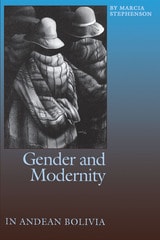
Gender and Modernity in Andean Bolivia
By Marcia Stephenson
University of Texas Press, 1999
In Andean Bolivia, racial and cultural differences are most visibly marked on women, who often still wear native dress and speak an indigenous language rather than Spanish. In this study of modernity in Bolivia, Marcia Stephenson explores how the state's desire for a racially and culturally homogenous society has been deployed through images of womanhood that promote the notion of an idealized, acculturated female body.
Stephenson engages a variety of texts—critical essays, novels, indigenous testimonials, education manuals, self-help pamphlets, and position papers of diverse women's organizations—to analyze how the interlocking tropes of fashion, motherhood, domestication, hygiene, and hunger are used as tools for the production of dominant, racialized ideologies of womanhood. At the same time, she also uncovers long-standing patterns of resistance to the modernizing impulse, especially in the large-scale mobilization of indigenous peoples who have made it clear that they will negotiate the terms of modernity, but always "as Indians."
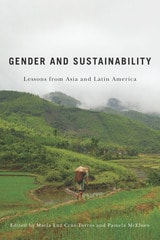
Gender and Sustainability
Lessons from Asia and Latin AmericaEdited by María Luz Cruz-Torres and Pamela McElwee
University of Arizona Press, 2012
Bringing together case studies from Asia and Latin America, this valuable collection adds new knowledge to our understanding of the interplay between local and global processes. Organized broadly by three major issues—forests, water, and fisheries—the scholarship ranges widely: the gender dimensions of the illegal trade in wildlife in Vietnam; women and development issues along the Ganges River; the role of gender in sustainable fishing in the Philippines; women’s inclusion in community forestry in India; gender-based confrontations and resistance in Mexican fisheries; environmentalism and gender in Ecuador; and women’s roles in managing water scarcity in Bolivia and addressing sustainability in shrimp farming in the Mekong Delta.
Together these chapters show why gender issues are important for understanding how communities and populations deal daily with the challenges of globalization and environmental change. Through their rich ethnographic research, the contributors demonstrate that gender analysis offers useful insights into how a more sustainable world can be negotiated—one household and one community at a time.
Contributors
Stephanie Buechler
María Luz Cruz-Torres
Linda D’Amico
Georgina Drew
James Eder
Lisa L. Gezon
Pamela McElwee
Neera Singh
Hong Anh Vu
Amber Wutich
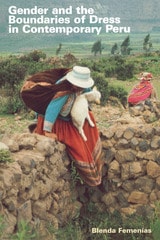
Gender and the Boundaries of Dress in Contemporary Peru
By Blenda Femenías
University of Texas Press, 2005
Set in Arequipa during Peru's recent years of crisis, this ethnography reveals how dress creates gendered bodies. It explores why people wear clothes, why people make art, and why those things matter in a war-torn land. Blenda Femenías argues that women's clothes are key symbols of gender identity and resistance to racism.
Moving between metropolitan Arequipa and rural Caylloma Province, the central characters are the Quechua- and Spanish-speaking maize farmers and alpaca herders of the Colca Valley. Their identification as Indians, whites, and mestizos emerges through locally produced garments called bordados. Because the artists who create these beautiful objects are also producers who carve an economic foothold, family workshops are vital in a nation where jobs are as scarce as peace. But ambiguity permeates all practices shaping bordados' significance. Femenías traces contemporary political and ritual applications, not only Caylloma's long-standing and violent ethnic conflicts, to the historical importance of cloth since Inca times.
This is the only book about expressive culture in an Andean nation that centers on gender. In this feminist contribution to ethnography, based on twenty years' experience with Peru, including two years of intensive fieldwork, Femenías reflects on the ways gender shapes relationships among subjects, research, and representation.
Gender, Law, and Resistance in India
Erin P. Moore
University of Arizona Press, 1988
Gendered Fortunes
Divination, Precarity, and Affect in Postsecular TurkeyZeynep K. Korkman
Duke University Press, 2023
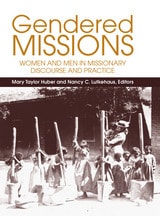
Gendered Missions
Women and Men in Missionary Discourse and PracticeMary Taylor Huber and Nancy C. Lutkehaus, Editors
University of Michigan Press, 1999
Missionary groups thus faced more immediately the destabilizing challenges that colonial experience posed to their own ways of organizing relations between women and men. Examining the changing prospects for professional women in the missions, the contributors to Gendered Missions ask how these shaped, and were shaped by, crucial practical, political, and religious developments at home and abroad. While the focus is on the tumultuous period that historian Eric Hobsbawm calls "The Age of Empire" (1875-1914), attention also is paid to how gender has been debated in later colonial and post-colonial missions.
Scholars from any field concerned with colonial and postcolonial societies or with gender and women's history should find this book of special interest. In addition, Gendered Missions should appeal to readers in church history, mission studies, and the sociology of religion.
Mary Taylor Huber is Senior Scholar, The Carnegie Foundation for the Advancement of Teaching. Nancy C. Lutkehaus is Associate Professor of Anthropology, University of Southern California.
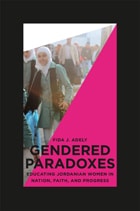
Gendered Paradoxes
Educating Jordanian Women in Nation, Faith, and ProgressFida Adely
University of Chicago Press, 2012
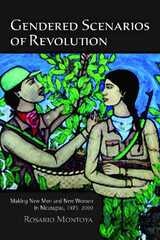
Gendered Scenarios of Revolution
Making New Men and New Women in Nicaragua, 1975–2000Rosario Montoya
University of Arizona Press, 2012
In 1979, toward the end of the Cold War era, Nicaragua's Sandinista movement emerged on the world stage claiming to represent a new form of socialism. Gendered Scenarios of Revolution is a historical ethnography of Sandinista state formation from the perspective of El Tule-a peasant village that was itself thrust onto a national and international stage as a "model" Sandinista community. This book follows the villagers´ story as they joined the Sandinista movement, performed revolution before a world audience, and grappled with the lessons of this experience in the neoliberal aftermath.
Employing an approach that combines political economy and cultural analysis, Montoya argues that the Sandinistas collapsed gender contradictions into class ones, and that as the Contra War exacerbated political and economic crises in the country, the Sandinistas increasingly ruled by mandate as vanguard party instead of creating the participatory democracy that they professed to work toward. In El Tule this meant that even though the Sandinistas created new roles and possibilities for women and men, over time they upheld pre-revolutionary patriarchal social structures. Yet in showing how the revolution created opportunities for Tuleños to assert their agency and advance their interests, even against the Sandinistas´ own interests, this book offers a reinterpretation of the revolution´s supposed failure.
Examining this community’s experience in the Sandinista and post-Sandinista periods offers perspective on both processes of revolutionary transformation and their legacies in the neoliberal era. Gendered Scenarios of Revolution will engage graduate and undergraduate students and scholars in anthropology, sociology, history, and women’s and gender studies, and appeal to anyone interested in modern revolution and its aftermath.

Gendering the Fair
Histories of Women and Gender at World's FairsEdited by TJ Boisseau and Abigail M. Markwyn
University of Illinois Press, 2010
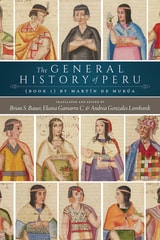
General History of Peru
Book 1Martín de Murúa
University Press of Colorado, 2024
Book 1 covers both the history of the Inca Empire and the first forty years of the Spanish occupation, up to and including the fall of Vilcabamba in 1572. While the J. Paul Getty Museum produced a digital facsimile of Murúa’s full Historia in 2008, it remained underused and, until now, untranslated. This translation revitalizes the momentous early volume with an introduction offering a window into Murúa’s life and the writing of his Historia, and extensive footnotes that provide the scholarly context of Murúa’s work.
This edition of The General History of Peru: Book 1 provides long-awaited access to Murúa’s contribution to Indigenous Andean history and early colonial Peru. The book is valuable for English-speaking students and scholars of pre-Hispanic Andean history, especially those interested in the ancient Andean world and colonial Peru’s literary production.
Genetic Afterlives
Black Jewish Indigeneity in South AfricaNoah Tamarkin
Duke University Press, 2020
Genii of the River Niger
Jean-Marie Gibbal
University of Chicago Press, 1993
Gibbal portrays the river as the dominant, cohesive force among people in the face of social and environmental strife. He focuses on the Ghimbala healing cult, which centers on the river, and how the cult structures social relations in the region. Gibbal vividly recreations the Ghimbala rites, nocturnal ceremonies of spirit possession and seance which animate the water spirits, or genii, that inhabit the river. The genii, he finds, provide the strength of social identity in a world where famine and competing versions of Islam threaten to overpower traditional culture.
In its original French publication, The Genii of the River Niger was honored with an Alexandra David-Neel literary prize in 1989. Its powerful lyricism, combined with fascinating ethnographic depth, will delight general readers and specialists alike and will stir debates among specialists in African studies, the anthropology of religion, and literature.
Genocide
Truth, Memory, and RepresentationAlexander Laban Hinton and Kevin Lewis O Neill, eds.
Duke University Press, 2009
Specialists on the societies about which they write, these anthropologists draw on ethnographic research to provide on-the-ground analyses of communities in the wake of mass brutality. They investigate how mass violence is described or remembered, and how those representations are altered by the attempts of others, from NGOs to governments, to assert “the truth” about outbreaks of violence. One contributor questions the neutrality of an international group monitoring violence in Sudan and the assumption that such groups are, at worst, benign. Another examines the consequences of how events, victims, and perpetrators are portrayed by the Rwandan government during the annual commemoration of that country’s genocide in 1994. Still another explores the silence around the deaths of between eighty and one hundred thousand people on Bali during Indonesia’s state-sponsored anticommunist violence of 1965–1966, a genocidal period that until recently was rarely referenced in tourist guidebooks, anthropological studies on Bali, or even among the Balinese themselves. Other contributors consider issues of political identity and legitimacy, coping, the media, and “ethnic cleansing.” Genocide: Truth, Memory, and Representation reveals the major contribution that cultural anthropologists can make to the study of genocide.
Contributors. Pamela Ballinger, Jennie E. Burnet, Conerly Casey, Elizabeth Drexler, Leslie Dwyer, Alexander Laban Hinton, Sharon E. Hutchinson, Uli Linke, Kevin Lewis O’Neill, Antonius C. G. M. Robben, Debra Rodman, Victoria Sanford
Genomics with Care
Minding the Double Binds of ScienceMike Fortun
Duke University Press, 2023

Genres of Listening
An Ethnography of Psychoanalysis in Buenos AiresXochitl Marsilli-Vargas
Duke University Press, 2022
Geologic Life
Inhuman Intimacies and the Geophysics of RaceKathryn Yusoff
Duke University Press, 2024
Geontologies
A Requiem to Late LiberalismElizabeth A. Povinelli
Duke University Press, 2016
George Washington Written Upon the Land
Nature, Memory, Myth, and LandscapePhilip Levy
West Virginia University Press, 2015
George Washington’s childhood is famously the most elusive part of his life story. For centuries biographers have struggled with a lack of period documentation and an absence of late-in-life reflection in trying to imagine Washington’s formative years.
In George Washington Written upon the Land, Philip Levy explores this most famous of American childhoods through its relationship to the Virginia farm where much of it took place. Using approaches from biography, archaeology, folklore, and studies of landscape and material culture, Levy focuses on how different ideas about Washington’s childhood functioned—what sorts of lessons they sought to teach and how different epochs and writers understood the man and the past itself.
In a suggestive and far-reaching final chapter, Levy argues that Washington was present at the onset of the Anthropocene—the geologic era when human activity began to have a significant impact on world ecosystems. Interpreting Washington’s childhood farm through the lens of “big” history, he encourages scholars to break down boundaries between science and social science and between human and nonhuman.

Georges Woke Up Laughing
Long-Distance Nationalism and the Search for HomeNina Glick Schiller and Georges Eugene Fouron
Duke University Press, 2001
According to a long-standing myth, once emigrants leave their homelands—particularly if they emigrate to the United States—they sever old nationalistic ties, assimilate, and happily live the American dream. In fact, many migrants remain intimately and integrally tied to their ancestral homeland, sometimes even after they become legal citizens of another country. In Georges Woke Up Laughing the authors reveal the realities and dilemmas that underlie the efforts of long-distance nationalists to redefine citizenship, race, nationality, and political loyalty. Through discussions of the history and economics that link the United States with countries around the world, Glick Schiller and Fouron highlight the forces that shape emigrants’ experiences of government and citizenship and create a transborder citizenry. Arguing that governments of many countries today have almost no power to implement policies that will assist their citizens, the authors provide insights into the ongoing sociological, anthropological, and political effects of globalization.
Georges Woke up Laughing will entertain and inform those who are concerned about the rights of people and the power of their governments within the globalizing economy.
“In my dream I was young and in Haiti with my friends, laughing, joking, and having a wonderful time. I was walking down the main street of my hometown of Aux Cayes. The sun was shining, the streets were clean, and the port was bustling with ships. At first I was laughing because of the feeling of happiness that stayed with me, even after I woke up. I tried to explain my wonderful dream to my wife, Rolande. Then I laughed again but this time not from joy. I had been dreaming of a Haiti that never was.”—from Georges Woke Up Laughing

German Ideology
From France to Germany and BackLouis Dumont
University of Chicago Press, 1995
Anyone interested in the fate of national ideology and the concept of the individual will benefit from this radical reinterpretation of modern values and the place of modernity in history.
"What François Furet did for French history, Dumont did for anthropology, turning it away from engaged politics and towards the sober study of the modern age." —Mark Lilla, London Review of Books
"There are many fine things in Dumont's study. Beyond any doubt, his cultural anthropology of the modern spirit highlights some of the key energies of the of the last two centuries. . . . [An] impressive . . . detailed analysis." —Martin Swales, Times Higher Education Supplement
"[An] unsettling, rich, demanding, profound study." —Publishers Weekly
German Seed in Texas Soil
Immigrant Farmers in Nineteenth-Century TexasBy Terry G. Jordan
University of Texas Press, 1966
Terry Jordan explores how German immigrants in the nineteenth century influenced and were influenced by the agricultural life in the areas of Texas where they settled. His findings both support the notion of ethnic distinctiveness and reveal the extent to which German Texans adopted the farming techniques of their Southern Anglo neighbors.
Germans and Texans
Commerce, Migration, and Culture in the Days of the Lone Star RepublicBy Walter Struve
University of Texas Press, 1996
During the brief history of the Republic of Texas (1836-1845), over 10,000 Germans emigrated to Texas. Perhaps best remembered today are the farmers who settled the Texas Hill Country, yet many of the German immigrants were merchants and businesspeople who helped make Galveston a thriving international port and Houston an early Texas business center. This book tells their story.
Drawing on extensive research on both sides of the Atlantic, Walter Struve explores the conditions that led nineteenth-century Europeans to establish themselves on the North American frontier. In particular, he traces the similarity in social, economic, and cultural conditions in Germany and the Republic of Texas and shows how these similarities encouraged German emigration and allowed some immigrants to prosper in their new home. Particularly interesting is the translation of a collection of letters from Charles Giesecke to his brother in Germany which provide insight into the business and familial concerns of a German merchant and farmer.
This wealth of information illuminates previously neglected aspects of intercontinental migration in the nineteenth century. The book will be important reading for a wide public and scholarly audience.
Gesture and Power
Religion, Nationalism, and Everyday Performance in CongoYolanda Covington-Ward
Duke University Press, 2016

Getting Away from It All
Vacations and IdentityKaren Stein
Temple University Press, 2019
Vacations are a delimited period during which social rules and responsibilities are eased, removed, or shifted, and people have increased autonomy over what they choose to do. Recent trends in the travel industry emphasize the appeal of vacations for voluntary identity changes—when bankers can become bikers for a week or when “Momcations” allow mothers to leave their families behind. But how do our vacations allow us to shape our identity?
Getting Away from It All is a study of individuality and flexibility and the intersection of self-definition and social constraint. Karen Stein interviews vacationers about their travels and down time, focusing on “identity transitions.” She shows how objects, settings, temporal environments and social interactions limit or facilitate identity shifts, and how we arrange our vacations to achieve the shifts we desire. Stein also looks at the behavior, values, attitudes, and worldview of individuals to illuminate how people engage in either identity work or identity play.
Vacations say a lot about individuals. They signal class and economic standing and reveal aspirations and goals. Getting Away from It All insists that vacations are about more than just taking time off to relax and rejuvenate—they are about having some time to work on the person one wants to be.
Getting Justice and Getting Even
Legal Consciousness among Working-Class AmericansSally Engle Merry
University of Chicago Press, 1990
Getting Justice and Getting Even concerns the legal consciousness of working class Americans and their experiences with court and mediation. Following cases into and through the courts, Sally Engle Merry provides an ethnographic study of local law and of the people who use it in a New England city. The litigants, primarily white, native-born, and working class, go to court because as part of mainstream America they feel entitled to use its legal system. Although neither powerful nor highly educated, they expect the law's support when they face intolerable infringements of their rights, privacy, and safety. Yet as personal problems enter the legal system and move through mediation sessions, clerk's hearings, and prosecutor's conferences, the citizen plaintiff rapidly loses control of the process. Court officials and mediators interpret and characterize the meaning of these experiences, reframing and categorizing them in different discourses. Some plaintiffs yield to these interpretations, but others resist, struggling to assert their own version of the problem.
Ultimately, Merry exposes the paradox of legal entitlement. While going to court allows an individual to dominate domestic relationships, the litigant must increasingly yield control of the situation to the court that supplies that power.

Gettysburg, Time and Again
Restaging America and Its Civil Wars TodayMads Daugbjerg
University of Massachusetts Press, 2027
Tracing how the Civil War continues to shape the landscapes, politics, and culture of today
Every year, thousands of Americans don Civil War uniforms and restage the bloodiest battle ever fought on American soil. In Gettysburg, Time and Again, Mads Daugbjerg explores how the Civil War continues to inhabit the present. Bringing together reenactors, National Park Service rangers, ghost hunters, tourists, and local residents, this study examines how Americans across social and political divides engage the past through the landscapes, institutions, and everyday practices of public history.
At once historically grounded and urgently contemporary, this book speaks directly to current struggles over the meaning of America and its values. Rather than treating time and history as abstract concepts, Daugbjerg approaches them as lived, material forces produced through commemorative landscapes, interpretive labor, and the relentless restaging of 1863 for contemporary audiences. Studying reenactment illuminates not only a distinctive cultural practice but also the broader processes through which the past is continuously reshaped, repeated, and felt in the present. He argues that present-day American unrest can be understood, in part, as a conflict over how the past is curated. He further suggests that Americans today often occupy profoundly different temporal worlds.
Daugbjerg traces these tensions through landscapes, material culture, tourism infrastructures, and social life at Gettysburg. Challenging the commonsense notion of history as linear progression, Gettysburg, Time and Again reveals repetition as a defining feature of American historical experience. By offering a finely grained anthropology of the “present past,” Daugbjerg shows how history’s afterlives remain powerfully out of sync and why those temporal disjunctions matter now.
Ghetto at the Center of the World
Chungking Mansions, Hong KongGordon Mathews
University of Chicago Press, 2011
But as Ghetto at the Center of the World shows us, a trip to Chungking Mansions reveals a far less glamorous side of globalization. A world away from the gleaming headquarters of multinational corporations, Chungking Mansions is emblematic of the way globalization actually works for most of the world’s people. Gordon Mathews’s intimate portrayal of the building’s polyethnic residents lays bare their intricate connections to the international circulation of goods, money, and ideas. We come to understand the day-to-day realities of globalization through the stories of entrepreneurs from Africa carting cell phones in their luggage to sell back home and temporary workers from South Asia struggling to earn money to bring to their families. And we see that this so-called ghetto—which inspires fear in many of Hong Kong’s other residents, despite its low crime rate—is not a place of darkness and desperation but a beacon of hope.
Gordon Mathews’s compendium of riveting stories enthralls and instructs in equal measure, making Ghetto at the Center of the World not just a fascinating tour of a singular place but also a peek into the future of life on our shrinking planet.
Ghost Protocol
Development and Displacement in Global ChinaCarlos Rojas and Ralph A. Litzinger, editors
Duke University Press, 2016
Contributors. Yomi Braester, Alexander Des Forges, Kabzung, Rachel Leng, Ralph A. Litzinger, Lisa Rofel, Carlos Rojas, Bryan Tilt, Robin Visser, Biao Xiang, Emily T. Yeh

Ghostly Communion
Cross-Cultural Spiritualism in Nineteenth-Century American LiteratureJohn J. Kucich
Dartmouth College Press, 2015

Ghostly Encounters
The Hauntings of Everyday LifeDennis Waskul
Temple University Press, 2016
“In the top corner of the window a pale, milky-white wisp is rising almost to the top of our ten-foot ceiling…. I am startled but not afraid…. Mostly, I am engrossed; I have never seen anything like this before (or since) and it fascinates me.”
Dennis Waskul writes these lines—about his first-hand experience with the supernatural—in the introduction to his beguiling book Ghostly Encounters. Based on two years of fieldwork and interviews with 71 midwestern Americans, the Waskuls’ book is a reflexive ethnography that examines how people experience ghosts and hauntings in everyday life. The authors explore how uncanny happenings become ghosts, and the reasons people struggle with or against a will to believe. They present the variety and character of hauntings and ghostly encounters, outcomes of people telling haunted legends, and the nested consequences of ghostly experiences.
Through these stories, Ghostly Encounters seeks to understand the persistence of uncanny experiences and beliefs in ghosts in an age of reason, science, education, and technology—as well as how those beliefs and experiences both reflect and serve important social and cultural functions.
Ghostly Matters
Haunting and the Sociological ImaginationAvery F. Gordon
University of Minnesota Press, 2008
“Avery Gordon’s stunningly original and provocatively imaginative book explores the connections linking horror, history, and haunting. ” —George Lipsitz
“The text is of great value to anyone working on issues pertaining to the fantastic and the uncanny.” —American Studies International
“Ghostly Matters immediately establishes Avery Gordon as a leader among her generation of social and cultural theorists in all fields. The sheer beauty of her language enhances an intellectual brilliance so daunting that some readers will mark the day they first read this book. One must go back many more years than most of us can remember to find a more important book.” —Charles Lemert
Drawing on a range of sources, including the fiction of Toni Morrison and Luisa Valenzuela (He Who Searches), Avery Gordon demonstrates that past or haunting social forces control present life in different and more complicated ways than most social analysts presume. Written with a power to match its subject, Ghostly Matters has advanced the way we look at the complex intersections of race, gender, and class as they traverse our lives in sharp relief and shadowy manifestations.
Avery F. Gordon is professor of sociology at the University of California, Santa Barbara.
Janice Radway is professor of literature at Duke University.
Gifts and Commodities
C. A. Gregory
HAU, 2015
Christopher A. Gregory’s Gifts and Commodities is one of the undisputed classics of economic anthropology. On its publication in 1982, it spurred intense, ongoing debates about gifts and gifting, value, exchange, and the place of political economy in anthropology.
Gifts and Commodities is, at once, a critique of neoclassical economics and development theory, a critical history of colonial Papua New Guinea, and a comparative ethnography of exchange in Melanesian societies. This new edition includes a foreword by anthropologist Marilyn Strathern and a new preface by the author that discusses the ongoing response to the book and the debates it has engendered, debates that have become more salient in our evermore neoliberal and globalized era.
Gifts in the Age of Empire
Ottoman-Safavid Cultural Exchange, 1500–1639Sinem Arcak Casale
University of Chicago Press, 2023
When the Safavid dynasty, founded in 1501, built a state that championed Iranian identity and Twelver Shi'ism, it prompted the more established Ottoman Empire to align itself definitively with Sunni legalism. The political, religious, and military conflicts that arose have since been widely studied, but little attention has been paid to their diplomatic relationship. Sinem Arcak Casale here sets out to explore these two major Muslim empires through a surprising lens: gifts. Countless treasures—such as intricate carpets, gilded silver cups, and ivory-tusk knives—flowed from the Safavid to the Ottoman Empire throughout the sixteenth century. While only a handful now survive, records of these gifts exist in court chronicles, treasury records, poems, epistolary documents, ambassadorial reports, and travel narratives. Tracing this elaborate archive, Casale treats gifts as representative of the complicated Ottoman-Safavid coexistence, demonstrating how their rivalry was shaped as much by culture and aesthetics as it was by religious or military conflict. Gifts in the Age of Empire explores how gifts were no mere accessories to diplomacy but functioned as a mechanism of competitive interaction between these early modern Muslim courts.

Gilles Deleuze
Vitalism and MultiplicityJohn Marks
Pluto Press, 1998
In the first comprehensive English-language introduction to Deleuze, John Marks offers a lucid reading of a complex, abstract and often perplexing body of work. Marks examines Deleuze’s philosophical writings – as well as the political and aesthetic preoccupations which underpinned his thinking – and provides a rigorous and illuminating reading of Deleuze’s early studies of Hume, Nietzsche, Kant, Bergson and Spinoza, his collaborations with Felix Guattari, and the development of a distinctively ‘Deleuzian’ conceptual framework. Marks focuses on the philosophical friendship that developed between Deleuze and Foucault and considers the full range of Deleuze’s fascinating writings on literature, art and cinema. This is a clear and concise guide to the work of one of the twentieth century’s most influential thinkers.
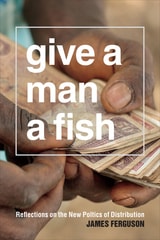
Give a Man a Fish
Reflections on the New Politics of DistributionJames Ferguson
Duke University Press, 2015
Given World and Time
Temporalities in ContextTyrus Miller
Central European University Press, 2008
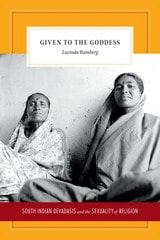
Given to the Goddess
South Indian Devadasis and the Sexuality of ReligionLucinda Ramberg
Duke University Press, 2014