Results by title
1066 books match the query 'Political' and 48 start with h
Hadassah
An American StoryHadassah Lieberman
Brandeis University Press, 2021
Born in Prague to Holocaust survivors, Hadassah Lieberman and her family immigrated in 1949 to the United States. She went on to earn a BA from Boston University in government and dramatics and an MA in international relations and American government from Northeastern University. She built a career devoted largely to public health that has included positions at Lehman Brothers, Pfizer, and the National Research Council. After her first marriage ended in divorce, she married Joe Lieberman, a US senator from Connecticut who was the Democratic nominee for vice president with Al Gore and would go on to run for president.
In Hadassah, Lieberman pens the compelling story of her extraordinary life: from her family's experience in Eastern Europe to their move to Gardner, Massachusetts; forging her career; experiencing divorce; and, following her remarriage, her life on the national political stage. By offering insight into her identity as an immigrant, an American Jew, a working woman, and a wife, mother, and grandmother, Lieberman’s moving memoir speaks to many of the major issues of our time, from immigration to gender politics. Featuring an introduction by Joe Lieberman and an afterword by Megan McCain, it is a true American story.

Hafa Adai
A NovelE. E. Hussey
Northwestern University Press, 2027
A tale of two sisters braving the current of global tremors, mysterious beings, and their own past
Amihan is a respected and talented wildlife researcher on a small Pacific island in the US Commonwealth of the Northern Mariana Islands, where the land has undergone centuries of occupation. Offshore military testing, shifting climates, and tourists threaten the local ecosystem, making Amihan’s job harder than ever. As she braves knotty forests and watery caves in search of the elusive rufous fantail, her expedition takes her to the suicide cliffs . . . and over them. Amihan plummets into another realm, a purgatory of colonial violence and Filipino folklore.
Ligaya, Amihan’s sister, is back in Osaka and in between research positions when she is called to the island to search for her itinerant and reclusive sister. But when her search uncovers a stowaway, Ligaya's path takes an unexpected turn. Traveling along with her is a ghost with an omikuji tongue—a ghost that delights in spitting fortunes and mining memories. As Ligaya searches and Amihan wanders, it becomes clear that there is more to confront between these sisters than their whereabouts. On an island shuddering under the weight of global crises, can Ligaya make it to Amihan, or has her sister wandered too far?

Haiti Fights Back
The Life and Legacy of Charlemagne PéralteYveline Alexis
Rutgers University Press, 2021
Haiti Fights Back: The Life and Legacy of Charlemagne Péralte is the first US scholarly examination of the politician and caco leader (guerrilla fighter) who fought against the US military occupation of Haiti. The occupation lasted close to two decades, from 1915-1934. Alexis argues for the importance of documenting resistance while exploring the occupation’s mechanics and its imperialism. She takes us to Haiti, exploring the sites of what she labels as resistance zones, including Péralte’s hometown of Hinche and the nation’s large port areas--Port-au-Prince and Cap-Haïtien. Alexis offers a new reading of U.S. military archival sources that record Haitian protests as banditry. Haiti Fights Back illuminates how Péralte launched a political movement, and meticulously captures how Haitian women and men resisted occupation through silence, military battles, and writings. She locates and assembles rare, multilingual primary sources from traditional repositories, living archives (oral stories), and artistic representations in Haiti and the United States. The interdisciplinary work draws on legislation, cacos’ letters, newspapers, and murals, offering a unique examination of Péralte’s life (1885-1919) and the significance of his legacy through the twenty-first century. Haiti Fights Back offers a new approach to the study of the U.S. invasion of the Americas by chronicling how Caribbean people fought back.
Hannah Arendt and the Meaning of Politics
Craig Calhoun
University of Minnesota Press, 1997
Eminent contributors consider what Hannah Arendt means in today’s public debates.
Is politics really nothing more than power relations, competing interests and claims for recognition, conflicting assertions of “simple” truths? No thinker has argued more passionately against this narrow view than Hannah Arendt, and no one has more to say to those who bring questions of meaning, identity, value, and transcendence to our impoverished public life. This volume brings leading figures in philosophy, political theory, intellectual history, and literary theory into a dialogue about Arendt’s work and its significance for today’s fractious identity politics, public ethics, and civic life.
For each essay—on the fate of politics in a postmodern, post-Marxist era; on the connection of nonfoundationalist ethics and epistemology to democracy; on the conditions conducive to a vital public sphere; on the recalcitrant problems of violence and evil—the volume includes extended responses, and a concluding essay by Martin Jay responding to all the others. Ranging from feminism to aesthetics to the discourse of democracy, the essays explore how an encounter with Arendt reconfigures, disrupts, and revitalizes what passes for public debate in our day. Together they forcefully demonstrate the power of Arendt’s work as a splendid provocation and a living resource.Contributors: Richard Bernstein, New School; Anthony Cascardi, U of California, Berkeley; Susan Bickford, U of North Carolina; Kim Curtis, Duke U; Lisa Disch, U of Minnesota; Nancy Fraser, New School; Martin Jay; U of California, Berkeley, Steven Leonard, U of North Carolina; Kirstie McClure, Johns Hopkins U; Dana Villa, Amherst College; and Eli Zaretsky, U of Missouri.
Hannah Arendt
A Critical IntroductionFinn Bowring
Pluto Press, 2011
Hannah Arendt is one of the most famous political theorists of the twentieth century, yet in the social sciences her work has rarely been given the attention it deserves. This careful and comprehensive study introduces Arendt to a wider audience.
Finn Bowring shows how Arendt's writings have engaged with and influenced prominent figures in the sociological canon, and how her ideas may shed light on some of the most pressing social and political problems of today. He explores her critique of Marx, her relationship to Weber, the influence of her work on Habermas and the parallels and discrepancies between her and Foucault. This is a clearly written and scholarly text which surveys the leading debates over Arendt’s work, including discussions of totalitarianism, the public sphere and the nature of political responsibility.
This book will bring new perspectives to students and lecturers in sociology and politics.
Hans Jonas
The Integrity of ThinkingDavid J. Levy
University of Missouri Press, 2002
Hawai'i
Eight Hundred Years of Political and Economic ChangeSumner La Croix
University of Chicago Press, 2019
Building on new archaeological and historical research, Sumner La Croix assembles here the economic history of Hawai‘i from the first Polynesian settlements in 1200 through US colonization, the formation of statehood, and to the present day. He shows how the political and economic institutions that emerged and evolved in Hawai‘i during its three centuries of global isolation allowed an economically and culturally rich society to emerge, flourish, and ultimately survive annexation and colonization by the United States. The story of a small, open economy struggling to adapt its institutions to changes in the global economy, Hawai‘i offers broadly instructive conclusions about economic evolution and development, political institutions, and native Hawaiian rights.
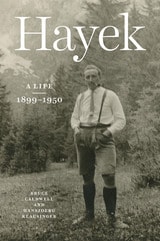
Hayek
A Life, 1899–1950Bruce Caldwell and Hansjoerg Klausinger
University of Chicago Press, 2022
The definitive account of the distinguished economist’s formative years.
Few twentieth-century figures have been lionized and vilified in such equal measure as Friedrich Hayek—economist, social theorist, leader of the Austrian school of economics, and champion of classical liberalism. Hayek’s erudite arguments in support of individualism and the market economy have attracted a devout following, including many at the levers of power in business and government. Critics, meanwhile, cast Hayek as the intellectual forefather of “neoliberalism” and of all the evils they associate with that pernicious doctrine.
In Hayek: A Life, historians of economics Bruce Caldwell and Hansjörg Klausinger draw on never-before-seen archival and family material to produce an authoritative account of the influential economist’s first five decades. This includes portrayals of his early career in Vienna; his relationships in London and Cambridge; his family disputes; and definitive accounts of the creation of The Road to Serfdom and of the founding meeting of the Mont Pèlerin Society.
A landmark work of history and biography, Hayek: A Life is a major contribution both to our cultural accounting of a towering figure and to intellectual history itself.
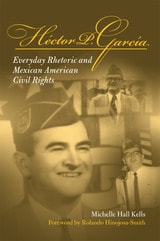
Hector P Garcia
Everyday Rhetoric and Mexican American Civil RightsMichelle Hall Kells. Foreword by Rolando Hinojosa-Smith
Southern Illinois University Press, 2006
Examining the Mexican American civil rights movement through the public rhetoric of a veteran activist
Héctor P. García: Everyday Rhetoric and Mexican American Civil Rights examines the transition of Mexican Americans from political and social marginalization to civic inclusion after World War II. Focusing on the public rhetoric of veteran rights activist and physician Dr. Héctor P. García, a Mexican immigrant who achieved unprecedented influence within the U.S. political system, author Michelle Hall Kells provides an important case study in the exercise of influence, the formation of civic identity, and the acquisition of social power among this underrepresented group.
As a major influence in national twentieth-century civil rights reform, García effectively operated between Anglo and Mexican American sociopolitical structures. The volume illustrates how García, a decorated World War II veteran and founder of the American GI Forum in Texas in 1948, successfully engendered a discourse that crossed geographical, political, and cultural borders, forming associations with the working poor as well as with prominent national figures such as John F. Kennedy and Lyndon B. Johnson. Through his rhetoric and action, García publicly revealed the plight of Mexican Americans, crossing class, regional, and racial lines to improve socioeconomic conditions for his people.
Héctor P. García, which is enhanced by sixteen illustrations, contributes to rhetorical, cultural, and historical studies and offers new scholarship establishing García’s role on the national front, effectively tracing Garcia’s legacy of resistance, the process of achieving enfranchisement, and the role of racism in the evolution from social marginalization to national influence.
Hegel, Heidegger, and the Ground of History
Michael Allen Gillespie
University of Chicago Press, 1984
Hegel, Marx, and the Laughing Matter of Spirit
R. A. Aumiller
Northwestern University Press, 2026
What happens when those who have been denied political subjectivity fully play out their negative role in a historical drama that damned them from the beginning? Hegel, Marx, and the Laughing Matter of Spirit locates the eruption of revolutionary laughter in historical cracks across nineteenth- and twentieth-century Europe, where exiled philosophers, partisan fighters, and artists framed their political resistance as a historical comedy. Hegelian comedy fuels the Young Hegelian critique of Prussian censorship, Walter Benjamin’s staging of the anti-fascist resistance, and the Yugoslavian partisan attempt to begin again in fascism’s aftermath. Revolution erupts from a historical stage that can no longer look on its own contradictions with a straight face. Drawing on the defiant spirit of comedy, this Hegelian feminist manifesto defies political despair, overturning the perception that history tragically repeats itself. Invoking the phrase “Nothing changes” as a mantra, R. A. Aumiller turns a concession of defeat into a battle cry for political resistance.
Hegel’s Theory of Normativity
The Systematic Foundations of the Philosophical Science of RightKevin Thompson
Northwestern University Press, 2019
Heidegger and the Myth of a Jewish World Conspiracy
Peter Trawny
University of Chicago Press, 2015
While Heidegger’s affiliation with National Socialism is well known, the anti-Semitic dimension of that engagement could not be fully told until now. Trawny traces Heidegger’s development of a grand “narrative” of the history of being, the “being-historical thinking” at the center of Heidegger’s work after Being and Time. Two of the protagonists of this narrative are well known to Heidegger’s readers: the Greeks and the Germans. The world-historical antagonist of this narrative, however, has remained hitherto undisclosed: the Jews, or, more specifically, “world Judaism.” As Trawny shows, world Judaism emerges as a racialized, destructive, and technological threat to the German homeland, indeed, to any homeland whatsoever. Trawny pinpoints recurrent, anti-Semitic themes in the Notebooks, including Heidegger’s adoption of crude cultural stereotypes, his assigning of racial reasons to philosophical decisions (even undermining his Jewish teacher, Edmund Husserl), his endorsement of a Jewish “world conspiracy,” and his first published remarks on the extermination camps and gas chambers (under the troubling aegis of a Jewish “self-annihilation”). Trawny concludes with a thoughtful meditation on how Heidegger’s achievements might still be valued despite these horrifying facets. Unflinching and systematic, this is one of the most important assessments of one of the most important philosophers in our history.
Heidegger, Strauss, and the Premises of Philosophy
On Original ForgettingRichard L. Velkley
University of Chicago Press, 2011
Heidegger
Phenomenology, Ecology, PoliticsMichael Marder
University of Minnesota Press, 2018
Understanding the political and ecological implications of Heidegger’s work without ignoring his noxious public engagements
The most controversial philosopher of the twentieth century, Martin Heidegger has influenced generations of intellectuals even as his involvement with Nazism and blatant anti-Semitism, made even clearer after the publication of his Black Notebooks, have recently prompted some to discard his contributions entirely. For Michael Marder, Heidegger’s thought remains critical for interpretations of contemporary politics and our relation to the natural environment.
Bringing together and reframing more than a decade of Marder’s work on Heidegger, this volume questions the wholesale rejection of Heidegger, arguing that dismissive readings of his project overlook the fact that it is impossible to grasp without appreciating his lifelong commitment to phenomenology and that Heidegger’s anti-Semitism is an aberration in his still-relevant ecological and political thought, rather than a defining characteristic. Through close readings of Heidegger’s books and seminars, along with writings by other key phenomenologists and political philosophers, Marder contends that neither Heidegger’s politics nor his reflections on ecology should be considered in isolation from his phenomenology. By demonstrating the codetermination of his phenomenological, ecological, and political thinking, Marder accounts for Heidegger’s failures without either justifying them or suggesting that they invalidate his philosophical endeavor as a whole.

Helen Ring Robinson
Colorado Senator and SuffragistPat Pascoe
University Press of Colorado, 2011
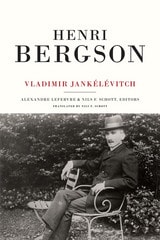
Henri Bergson
Vladimir Jankélévitch
Duke University Press, 2015
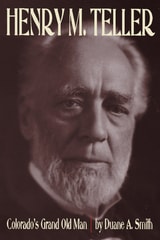
Henry M. Teller
Colorado's Grand Old ManDuane A. Smith
University Press of Colorado, 2002
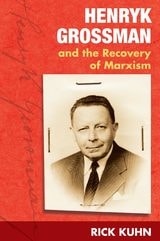
Henryk Grossman and the Recovery of Marxism
Rick Kuhn
University of Illinois Press, 2006
Rick Kuhn’s Henryk Grossman and the Recovery of Marxism is the definitive study of the life and work of this renowned economist, activist, and intellectual. As a young man, Grossman joined the socialist movement and participated in Jewish workers' strikes and demonstrations, as well as in boycotts against employers and the Austro-Hungarian state. He moved to Vienna, but was driven back to Poland by the Austrian state's racist citizenship policies. A member of the illegal Polish Communist Party, Grossman was frequently arrested and jailed, finally leaving Poland for a post at the Institute for Social Research in Frankfurt am Main, which gave rise to the famous 'Frankfurt School'.
Grossman published his best known work in Frankfurt, including studies of Marx's method in Capital and theories of economic crisis that remain influential today. In tracing Grossman's experiences, from Kraków to New York, and offering a detailed account of his ideas, the biography provides an intimate account of key events in twentieth century history, including the politicization of east European Jewry, the World Wars, the rise of Stalinism and Nazism, and the cold war.

Hillary and Bill
The Clintons and the Politics of the PersonalWilliam H. Chafe
Duke University Press, 2016
History and Utopia
E. M. Cioran
University of Chicago Press, 1998
"A small masterwork . . . a stringent examination of some persistent and murky notions in human history. . . . It is best to read Cioran while sitting. The impact upon the intellect can be temporarily stunning, and motor systems may give way under the assault."—Joseph Patrick Kennedy, Houston Chronicle
"Cioran has a claim to be regarded as among the handful of original minds . . . writing today."—New York Times
"A sort of final philosopher of the Western world. [Cioran's] statements have the compression of poetry and the audacity of cosmic clowning."—Washington Post
E. M. Cioran (1911-1995) was born and educated in Romania and lived in Paris from 1937 until his death. He is the author of numerous works, including On the Heights of Despair, also available from the University of Chicago Press.
History of Political Ideas, Volume 1 (CW19)
Hellenism, Rome, and Early ChristianityEric Voegelin, Edited & Intro by Athanasios Moulakis
University of Missouri Press, 1997
Reaching from the decline of the Greek Polis to Saint Augustine, this first volume of Eric Voegelin's eagerly anticipated History of Political Ideas fills the gap left between volumes 3 and 4 of Order and History. The heart of the book is the powerful account of Apostolic Christianity's political implications and the work of the early church fathers. Voegelin's consideration of the political philosophy of Rome and his unique analysis of Greek and early Roman law are of particular interest.
Although History of Political Ideas was begun as a textbook for Macmillan, Voegelin never intended it to be a conventional "synthesis." He sought instead an original comprehensive interpretation, founded on primary materials and taking into account the most advanced specialist scholarship—or science as he called it—available to him. Because of this, the book grew well beyond the confines of an easily marketable college survey and until now remained unpublished.
In the process of writing it, Voegelin himself outgrew the conceptual frame of a "History of Political Ideas," turning to compose Order and History and the other works of his maturity. History of Political Ideas became the ordered collection of materials from which much of Voegelin's later theoretical elaboration grew, structured in a manner that reveals the conceptual intimations of his later thought. As such, it provides an unparalleled opportunity to observe the working methods and the intellectual evolution of one of our century's leading political thinkers. In its embracing scope, History of Political Ideas contains both analyses of themes Voegelin developed in his later works and discussions of authors and ideas to which he did not return or which he later approached from a different angle and with a different emphasis.
In Hellenism, Rome, and Early Christianity, Voegelin demonstrates that the "spiritual disintegration" of the Hellenic world inaugurated a long process of transition in the self- understanding of Mediterranean and European man. The reflections that emerge remain universal concerns regarding the order of human existence in society and history. Although one may come to different conclusions, Voegelin's responses to the problems of the period suggest avenues of investigation that are still little traveled.
History of Political Ideas, Volume 2 (CW20)
The Middle Ages to AquinasEric Voegelin, Edited & Intro by Peter von Sivers
University of Missouri Press, 1997
Voegelin's magisterial account of medieval political thought opens with a survey of the structure of the period and continues with an analysis of the Germanic invasions, the fall of Rome, and the rise of empire and monastic Christianity. The political implications of Christianity and philosophy in the period are elaborated in chapters devoted to John of Salisbury, Joachim of Flora (Fiore), Frederick II, Siger de Brabant, Francis of Assisi, Roman law, and climaxing in a remarkable study of Saint Thomas Aquinas's mighty thirteenth-century synthesis.
Although History of Political Ideas was begun as a textbook for Macmillan, Voegelin never intended it to be a conventional chronological account. He sought instead an original comprehensive interpretation, founded on primary materials and taking into account the most advanced specialist scholarship—or science as he called it—available to him. Because of this, the book grew well beyond the confines of an easily marketable college survey and until now remained unpublished.
In the process of writing it, Voegelin himself outgrew the conceptual frame of a "History of Political Ideas," turning to compose Order and History and the other works of his maturity. History of Political Ideas became the ordered collection of materials from which much of Voegelin's later theoretical elaboration grew, structured in a manner that reveals the conceptual intimations of his later thought. As such, it provides an unparalleled opportunity to observe the working methods and the intellectual evolution of one of our century's leading political thinkers. In its embracing scope, History of Political Ideas contains both analyses of themes Voegelin developed in his later works and discussions of authors and ideas to which he did not return or which he later approached from a different angle and with a different emphasis.
The Middle Ages to Aquinas has withstood the test of time. What makes it still highly valuable is its thoroughly revisionist approach, cutting through all the convenient clichés and generalizations and seeking to establish the experiential underpinnings that typified the medieval period.
History of Political Ideas, Volume 3 (CW21)
The Later Middle AgesEric Voegelin, Edited & Intro by David Walsh
University of Missouri Press, 1998
In The Later Middle Ages, the third volume of his monumental History of Political Ideas, Eric Voegelin continues his exploration of one of the most crucial periods in the history of political thought. Illuminating the great figures of the high Middle Ages, Voegelin traces the historical momentum of our modern world in the core evocative symbols that constituted medieval civilization. These symbols revolved around the enduring aspiration for the sacrum imperium, the one order capable of embracing the transcendent and immanent, the ecclesiastical and political, the divine and human. The story of the later Middle Ages is that of the "civilizational schism"—the movement in which not only the reality but the aspiration for the sacrum imperium gradually disappeared and the unification of faith and reason dissolved.
His recognition of this civilizational schism provides Voegelin with a unique perspective on medieval society. William of Ockham, Dante, Giles of Rome, and Marsilius of Padua all emerge in Voegelin's study as predecessors to modern thought; each turns to personal authority and intellectual analysis in an attempt to comprehend the loss of the sacrum imperium as an authoritative ideal. Voegelin is further drawn into investigations that, despite insufficient attention by scholars, still bear relevance to the study of the later Middle Ages. The mysticism apparent in Piers Plowman and the apocalyptic revolt of Cola di Rienzo are merely two reactions to the disintegration of wholeness.
Yet the story of the later Middle Ages does not merely revolve around disintegration. Voegelin recognizes the emergence of the constitutional political tradition as the most positive development of this period. He is at his best when explaining the difference between the presence of a representative institution and the growth of communal consciousness. Voegelin's study of the English political pattern is matched only by his unique perspective on the German imperial zone, culminating in a fitting conclusion on Nicholas of Cusa—the one political thinker with the ability to evoke the unity of mankind beyond fragmentation.
The Later Middle Ages is at once a brilliant examination of the symbols that characterized medieval society and a remarkable predecessor to Voegelin's study of the modern world, beginning with the Renaissance and the Reformation.
History of Political Ideas, Volume 4 (CW22)
Renaissance and ReformationEric Voegelin, Edited & Intro by David L. Morse & William M. Thompson
University of Missouri Press, 1998
By closely examining the sources, movements, and persons of the Renaissance and the Reformation, Voegelin reveals the roots of today's political ideologies in this fourth volume of his History of Political Ideas. This insightful study lays the groundwork for Voegelin's critique of the modern period and is essential to an understanding of his later analysis.
Voegelin identifies not one but two distinct beginnings of the movement toward modern political consciousness: the Renaissance and the Reformation. Historically, however, the powerful effects of the second have overshadowed the first. In this book, Voegelin carefully examines both periods and their presence in modern thought.
The Renaissance, represented by the works of Niccolò Machiavelli, Desiderius Erasmus, and Thomas More, is characterized by a struggle for balance. Machiavelli and Erasmus both looked to a virtuous prince to achieve order, one calling for brute force and the other for Christian spirituality to reach their goal. Also a participant in the first beginning of modernity, More was a complex thinker identified as a saint both of the church and of the communist movement. The issues he explored in Utopia, as Voegelin demonstrates, indirectly gave rise to concepts that have profoundly affected Western history: colonization, imperialism, national socialism, and communism.
Exploring the transition from the Renaissance to the Reformation is a brilliant chapter, "The People of God," which examines the sectarian movement. These pages contain the rich historical background that led to Voegelin's later conclusions about Gnosticism and its modern influences.
Voegelin offers a controversial view of the Reformation as well as the political and religious situation directly preceding it. Yet he sheds light on the strengths and inadequacies of its key figures, Martin Luther and John Calvin. The driving force behind the Reformation stemmed solely from the powerful personality of Luther. What began as an abstract, purely technical discussion developed into a full-blown revolt. Later in the period, Calvin confronted the problems left behind by Luther and endeavored to create his own universal church to supplant the Catholic Church. His theory of a new elite would have a distinct impact on history.
By examining the political ideas that first emerged during the Renaissance and Reformation, this fascinating volume provides a foundation for understanding the events of centuries to follow.
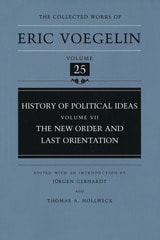
History of Political Ideas, Volume 7 (CW25)
The New Order and Last OrientationEric Voegelin, Edited & Intro by Jurgen Gebhardt & Thomas A. Hollweck
University of Missouri Press, 1999
In The New Order and Last Orientation, Eric Voegelin explores two distinctly different yet equally important aspects of modernity. He begins by offering a vivid account of the political situation in seventeenth-century Europe after the decline of the church and the passing of the empire. Voegelin shows how the intellectual and political disorder of the period was met by such seemingly disparate responses as Grotius's theory of natural right, Hobbes's Leviathan, the role of the Fronde in the formation of the French national state, Spinoza's Tractatus Theologico-Politicus, and Locke's Second Treatise, the blueprint of a modern middle-class society. By putting these responses and the thought of Montesquieu, Hume, and others in the context of the birth pains of the national state and the emergence of a new self-understanding of man, Voegelin achieves a brilliant mixture of political history and profound philosophical analysis.
Voegelin's verdict of modernity is pronounced most powerfully in the opening part of "Last Orientation," in the chapter entitled "Phenomenalism." His discussion of the intellectual confusion underlying the modern project of scientistic phenomenalism is the most original criticism leveled against modernity to date. It is at the same time the first step toward a recovery of reality through philosophy conceived as a science of substance in the spirit of Giordano Bruno. Voegelin's first example of such an effort at recovering reality is the chapter on Schelling, one of the spiritual realists who has not been affected by the prevailing rationalist or reductionist creeds that are part of the modern disorder. Schelling's indirect yet powerful influence on Schopenhauer, Nietzsche, and Freud more than justifies Voegelin's interest in his philosophy and character, even though Voegelin would later distance himself from some of Schelling's positions.
The volume's concluding chapter, "Nietzsche and Pascal," applies the understanding gained from the study of Schelling to the thought of the most powerful critic of the age, Nietzsche. Nietzsche's self-avowed affinity with Pascal provides the key to an analysis of the strengths and weaknesses of his thought and reaffirms the connection that links the beginning of modernity with its most recent crises and the efforts to overcome them.
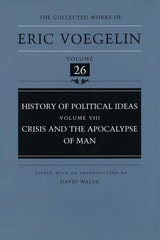
History of Political Ideas, Volume 8 (CW26)
Crisis and the Apocalypse of ManEric Voegelin, Edited & Intro by David Walsh.
University of Missouri Press, 1999
Reaching into our own time, Crisis and the Apocalypse of Man confronts the disintegration of traditional sources of meaning and the correlative attempt to generate new sources of order from within the self. Voegelin allows us to contemplate the crisis in its starkest terms as the apocalypse of man that now seeks to replace the apocalypse of God. The totalitarian upheaval that convulsed Voegelin's world, and whose aftermath still defines ours, is only the external manifestation of an inner spiritual turmoil. Its roots have been probed throughout the eight volumes of History of Political Ideas, but its emergence is marked by the age of Enlightenment.
In our postmodern era, discussions of the collapse of the "enlightenment project" have become commonplace. Voegelin compels us to follow the great-souled individuals who sought to go from disintegration of the present toward evocations of order for the future. Such thinkers as Comte, Bakunin, and Marx suffered through the crisis and fully understood the need for a new outpouring of the spirit. They resolved to supply the deficiency themselves. As a consequence they launched us irrevocably on the path of the apocalypse of man.
One of the great merits of Voegelin's analysis is his exposition of the pervasive character of this crisis. It is not confined to the megalomaniacal dreamers of a revolutionary apocalypse; rather, echoes of it are found in the more moderate Enlightenment preoccupation with progress to be attained through application of the scientific method. Faith in the capacity of instrumental reason to answer the ultimate questions of human existence defined men such as Voltaire, Helvétius, Diderot, D'Alembert, and Condorcet. It remains the authoritative faith of our world today, Voegelin argues, demonstrated by our continuing inability to step outside the parameters of the Enlightenment. Are we condemned, then, to oscillate between the rational incoherence of a science that never delivers on its promises and a now discredited revolutionary idealism that wreaks havoc in practice? This is the question toward which Voegelin's final volume points. While not direct, his response is evident everywhere. Crisis and the Apocalypse of Man could have been written only by a man who had reached his own resolution of the crisis.
History of Political Philosophy
Edited by Leo Strauss and Joseph Cropsey
University of Chicago Press, 2001
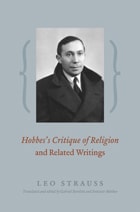
Hobbes's Critique of Religion and Related Writings
Leo Strauss
University of Chicago Press, 2011
Leo Strauss’s The Political Philosophy of Hobbes deservedly ranks among his most widely acclaimed works. In it Strauss argues that the basis for Hobbes’s natural and political science is his interest in “self-knowledge of man as he really is.” The writings collected in this book, each written prior to that classic volume, complement that account. Thus at long last, this book allows us to have a complete picture of Strauss’s interpretation of Hobbes, the thinker pivotal to the fundamental theme of his life’s work: the conflicting demands of philosophy and revelation, or as he termed it, “the theologico-political problem.”
It is no exaggeration to say that Strauss’s work on Hobbes’s critique of religion is essential to his analysis of Hobbes’s political philosophy, and vice versa. This volume will spark new interest in Hobbes’s explication of the Bible and in his understanding of religion by revealing previously neglected dimensions and motives of Hobbes’s “theology.” At the same time, scholars interested in the intellectual development of Leo Strauss will find in these writings the missing link, as it were, between his two early books,Spinoza’s Critique of Religion and The Political Philosophy of Hobbes.
In addition, this volume makes available for the first time in English a letter, a book outline, an extended review, an engagement with legal positivism, and an account of Strauss’s work on Hobbes by Heinrich Meier, all of which shed light on Strauss’s concerns and his approach to Hobbes in particular, as well as to modern political thought and life.
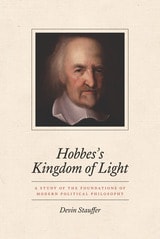
Hobbes's Kingdom of Light
A Study of the Foundations of Modern Political PhilosophyDevin Stauffer
University of Chicago Press, 2018
In Hobbes’s Kingdom of Light, Stauffer argues that Hobbes was engaged in a struggle on multiple fronts against forces, both philosophic and religious, that he thought had long distorted philosophy and destroyed the prospects of a lasting peace in politics. By exploring the twists and turns of Hobbes’s arguments, not only in his famous Leviathan but throughout his corpus, Stauffer uncovers the details of Hobbes’s critique of an older outlook, rooted in classical philosophy and Christian theology, and reveals the complexity of Hobbes’s war against the “Kingdom of Darkness.” He also describes the key features of the new outlook—the “Kingdom of Light”—that Hobbes sought to put in its place. Hobbes’s venture helped to prepare the way for the later emergence of modern liberalism and modern secularism. Hobbes’s Kingdom of Light is a wide-ranging and ambitious exploration of Hobbes’s thought.
Hobsbawm
History and PoliticsGregory Elliott
Pluto Press, 2010
Historian Eric Hobsbawm is possibly the foremost chronicler of the modern age. His panoramic studies of the nineteenth and twentieth centuries, stretching from the French Revolution to the fall of Soviet communism, have informed the historical consciousness of scholars and general readers alike. At the same time, his writings on labour movements and socialist politics have occupied a central place in left-wing debates. Despite this, no extended study of Hobsbawm's work has yet been attempted Gregory Elliott fills this gap in exemplary fashion.
Elliott analyses both the scholarly record of Hobsbawm and the intellectual and political journey that his life represents. In doing so, he seeks to situate Hobsbawm's thought within the context of a generalised crisis of confidence on the Left after the fall of the Berlin Wall.
Rich in content and written in Elliott's authoritative and highly readable style, this book is a must for anyone with an interest in Hobsbawm and the crisis of the Left.
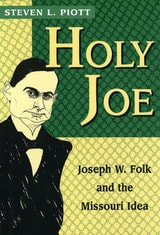
Holy Joe
Joseph W. Folk and the Missouri IdeaSteven L. Piott
University of Missouri Press, 1997
One of Missouri's best-known leaders of the Progressive Era, Joseph W. Folk epitomized the moral reformer in politics. As a crusading district attorney in St. Louis, Folk won national acclaim for his investigations of wrongdoing in municipal government. With the help of muckraking journalist Lincoln Steffens, Folk revealed for the first time the extent of political corruption then plaguing America's cities and helped bring about a popular demand for the regeneration of municipal government nationwide.
A firm believer that the law was a weapon with which to check political corruption and restrain powerful special interests, Folk popularized the "Missouri Idea," the doctrine that public office is a public trust, not merely an opportunity for private gain. Elected as governor of Missouri in 1904, Folk orchestrated a remarkable record of legislative accomplishment. He established himself as one of Missouri's outstanding governors and one of the nation's leading progressive reformers.
In asserting that traditional moral values could be applied to politics, Folk became known among friends and enemies as Holy Joe. His refusal to make any distinction between public and private morality, however, alienated some Missourians, while his disregard for party organization angered politicians. His idealism cost him political advancement and ultimately a place in national politics.
Whereas some studies of the Progressive Era have minimized the moral dimension of Progressivism and downplayed the importance of reformers like Joseph W. Folk, Holy Joe establishes him as a major leader of the Progressive movement. This biography will be a welcome addition to the literature on the subject.
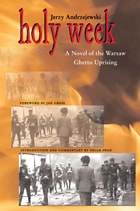
Holy Week
A Novel of the Warsaw Ghetto UprisingJerzy Andrzejewski
Ohio University Press, 2006
At the height of the Nazi extermination campaign in the Warsaw Ghetto, a young Jewish woman, Irena, seeks the protection of her former lover, a young architect, Jan Malecki. By taking her in, he puts his own life and the safety of his family at risk. Over a four-day period, Tuesday through Friday of Holy Week 1943, as Irena becomes increasingly traumatized by her situation, Malecki questions his decision to shelter Irena in the apartment where Malecki, his pregnant wife, and his younger brother reside. Added to his dilemma is the broader context of Poles’ attitudes toward the “Jewish question” and the plight of the Jews locked in the ghetto during the final moments of its existence.
Few fictional works dealing with the war have been written so close in time to the events that inspired them. No other Polish novel treats the range of Polish attitudes toward the Jews with such unflinching honesty.
Jerzy Andrzejewski’s Holy Week (Wielki Tydzien, 1945), one of the significant literary works to be published immediately following the Second World War, now appears in English for the first time.
This translation of Andrzejewski’s Holy Week began as a group project in an advanced Polish language course at the University of Pittsburgh. Class members Daniel M. Pennell, Anna M. Poukish, and Matthew J. Russin contributed to the translation; the instructor, Oscar E. Swan, was responsible for the overall accuracy and stylistic unity of the translation as well as for the biographical and critical notes and essays.
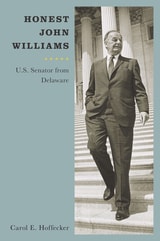
Honest John Williams
U.S. Senator from DelawareCarol E. Hoffecker
University of Delaware Press, 2024

Hope and Hard Truth
A Life in Texas PoliticsMary Beth Rogers
University of Texas Press, 2022
Mary Beth Rogers has led an eventful life rooted in the weeds of Texas politics, occasionally savoring a few victories—particularly the 1990 governor’s race when, as campaign manager for Ann Richards, she did the impossible and put a Democratic woman in office. She also learned to absorb her losses—after all, she was a liberal feminist in America’s most aggressively conservative state.
Rogers’s road to a political life was complex. Candidly and vulnerably, she shares both public and private memories of how she tried to maintain a rich family life with growing children and a husband with a debilitating illness. She goes on to provide an insider’s account of her experiences as Richards’s first chief of staff while weaving her way through the highs and lows of political intrigue and legislative maneuvering.
Reflecting on her family heritage and nascent spiritual quest, Rogers discovers a reality at once sobering and invigorating: nothing is ever completely lost or completely won. It is a constant struggle to create humane public policies built on a foundation of fairness and justice—particularly in her beloved Texas.
Hope in Hopeless Times
John Holloway
Pluto Press, 2022
Hope lies in our richness, in the joy of our collective creativity. But that richness exists in the peculiar form of money. The fact that we relate to one another through money causes tremendous social pain and destruction and is dragging us through pandemics and war towards extinction.
Richness against money: this battle will decide the future of humanity. If we cannot emancipate richness from money-capital profit, there is probably no hope. Money seems invincible but the constant expansion of debt shows that its rule is fragile. The fictitious expansion of money through debt is driven by fear, fear of us, fear of the rabble. Money contains, but richness overflows.
Horace Tabor
His Life and the LegendDuane A. Smith
University Press of Colorado, 1989
An 1858er who had spent nearly two decades following the will-o-the-wisp Colorado mining frontier, in 1876 Tabor was then living and working in out-of-the-way Oro City, near where Leadville would be one day. Soon thereafter came the Little Pittsburg silver strike, and Tabor's fortune took flight. Very quickly, Colorado - and the rest of the nation - was hearing about Horace Tabor. "Denver's lucky star was on high when Governor Tabor decided to spend his fortune here," praised the Denver Tribune in 1881. The Leadville Daily Herald (July 8, 1882) also understood his contribution: "Colorado has produced fortunes for many men, but no man who has met with success has so freely made investments in this state, as has Governor Tabor."
The events that followed that amazing silver discovery on Fryer Hill, May 1878 unfolded like a classic Greek tragedy. Tabor weathered them all, and his name has resounded through the succeeding decades. No other Coloradan of his generation is so well remembered, nor does anyone else so typify the tempo of this legendary mining era.
Hospitality, Volume I
Jacques Derrida
University of Chicago Press, 2023
Hospitality reproduces a two-year seminar series delivered by Jacques Derrida at the École des hautes études en sciences sociales in Paris between 1995 and 1997. In these lectures, Derrida asks a series of related questions about responsibility and “the foreigner”: How do we welcome or turn away the foreigner? What does the idea of the foreigner reveal about kinship and the state, particularly in relation to friendship, citizenship, migration, asylum, assimilation, and xenophobia? Derrida approaches these questions through readings of several classical texts as well as modern texts by Heidegger, Arendt, Camus, and others. Central to his project is a rigorous distinction between conventional, finite hospitality, with its many conditions, and the aspirational idea of hospitality as something offered unconditionally to the stranger. This volume collects the first year of the seminar.
Hospitality, Volume II
Jacques Derrida
University of Chicago Press, 2024
Hospitality reproduces a two-year seminar series delivered by Jacques Derrida at the École des hautes études en sciences sociales in Paris between 1995 and 1997. In these lectures, Derrida asks a series of related questions about responsibility and “the foreigner”: How do we welcome or turn away the foreigner? What does the idea of the foreigner reveal about kinship and the state, particularly in relation to friendship, citizenship, migration, asylum, assimilation, and xenophobia? Central to his project is a rigorous distinction between conventional, finite hospitality, with its many conditions, and the aspirational idea of hospitality as something offered unconditionally to the stranger. This volume collects the second year of the seminar, which considers an Islamic problematic of hospitality, the relevance of forgiveness, and the work of Emmanuel Levinas.
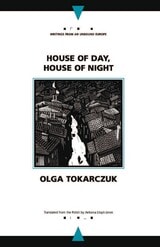
House of Day, House of Night
Olga Tokarczuk
Northwestern University Press, 2003
Winner of the Gunter Grass Prize
Nowa Ruda is a small town in Silesia, an area that has been a part of Poland, Germany, and the former Czechoslovakia in the past. When the narrator moves into the area, she and discovers everyone-and everything-has its own story. With the help of Marta, her enigmatic neighbor, the narrator accumulates these stories, tracing the history of Nowa Ruda from the founding of the town to the lives of its saints, from the caller who wins the radio quiz every day to the tale of the man who causes international tension when he dies on the border, one leg on the Polish side, the other on the Czech side. Each of the stories represents a brick and they interlock to reveal the immense monument that is the town. What emerges is the message that the history of any place--no matter how humble--is limitless, that by describing or digging at the roots of a life, a house, or a neighborhood, one can see all the connections, not only with one's self and one's dreams but also with all of the universe.
Richly imagined, weaving in anecdote with recipes and gossip, Tokarczuk's novel is an epic of a small place. Since its original publication in 1998 it has remained a bestseller in Poland. House of Day, House of Night is the English-language debut of one of Europe's best young writers.
How Fire Runs
A NovelCharles Dodd White
Ohio University Press, 2020
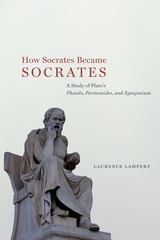
How Socrates Became Socrates
A Study of Plato’s “Phaedo,” “Parmenides,” and “Symposium”Laurence Lampert
University of Chicago Press, 2021
In addition to a careful and precise analysis of Plato’s Phaedo,Parmenides, and Symposium, Lampert shows that properly entwined, Plato’s three dialogues fuse to portray a young thinker entering philosophy’s true radical power. Lampert reveals why this radicality needed to be guarded and places this discussion within the greater scheme of the politics of philosophy.
How We See the Gray
A NovelRachel León
Northwestern University Press, 2026
A riveting story about parenthood, substance abuse, and the strength it takes to come back from our mistakes
Foster care is a disaster in Rockford, Illinois. Meredith, a social worker and single mom, is stretched beyond thin but determined to protect her kids: not only her son, but those on her caseload too. When the stress of the job has her breaking her sobriety, the foundations of her life begin to tremble. After drinking too much, she makes a mistake that puts her preschooler in jeopardy, and Meredith finds herself in a situation that mirrors her clients’ as she loses custody of her son. In her fight to get him back, Meredith experiences the system from the outside—while still working for the kids inside of it. Set over the course of a year, this riveting documentary-esque novel is told from multiple perspectives, including those of case workers, birth parents, foster parents, and foster children. Written with the working-class humor and heart that defines the Midwest, How We See the Gray is a story about mistakes, second chances, and trying to do better in a system that seems doomed to fail.

How to Quiet a Vampire
A SotieBorislav Pekic
Northwestern University Press, 2005
Delving far deeper than mere intellect, however, Borislav Pekic was himself a frequent political agitator and occasional prisoner, and he drew on his first hand knowledge of police methods and life under totalitarianism to paint a chilling portrait of a supposedly free-thinking intellectual acting in the service of repression. At the same time he questions whether Rutkowski's ideology puts him outside the philosophical tradition he so admires—or if the line separating European thought from totalitarianism is not as clear as we like to think.
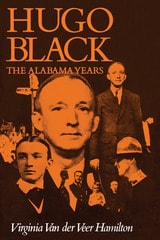
Hugo Black
The Alabama YearsVirginia Van Der Veer Hamilton
University of Alabama Press, 1982
The making of a Supreme Court justice in the crucible of Alabama politics.
Hugo Black: The Alabama Years by Virginia Van der Veer Hamilton is a richly researched political biography that explores the formative experiences of Hugo L. Black, one of the most influential justices in the history of the United States Supreme Court. Focusing on his early life and career in Alabama, Hamilton traces Black's journey from his rural upbringing and legal training to his emergence as a prominent attorney, politician, and United States senator. Through careful analysis of Alabama's social, economic, and political landscape, the book reveals the forces that shaped Black's ideas about government, democracy, and constitutional rights.
Hamilton examines Black's rise during a period of profound change in the South, highlighting the alliances, controversies, and challenges that defined his political career. The study places Black within the broader context of Progressive Era reform, the transformation of Southern politics, and the expanding role of the federal government in American life. At the same time, it provides a nuanced portrait of a complex public figure whose beliefs and actions continue to inspire debate among historians and legal scholars.
Essential reading for students of legal history, political science, Southern studies, and American government, this volume offers valuable insight into the Alabama roots of a justice who would profoundly influence modern constitutional interpretation and civil liberties jurisprudence.
Humanism as Realism
Three Essays Concerning the Thought of Paul Elmer More and Irving BabbittLisa Fretschel
St. Augustine's Press, 2023
"This is a protreptic book. Its main goal is to encourage people to undertake independent studies or more generally, simply to think independently. If we want to think for ourselves, and not like preprogrammed humanoids, we can’t do so in a vacuum. We have to lean on something. In the Author’s view, the more than century-old writings of Paul Elmer More and Irving Babbitt are perfectly suited to the role of such a support for us, living in the here and now. They make it possible for us to dig ourselves out from underneath the heaps of opinions, “principles” or “theories” that allegedly can’t be rejected, that we’re obliged to follow, but that have a paralyzing and dumbing-down effect on us, making our lives from the
outset seems like the dream of a childish old man."
––Taken from the Preface by Pawel Armada
Hyperpolitics
An Interactive Dictionary of Political Science ConceptsMauro Calise and Theodore J. Lowi
University of Chicago Press, 2010
Fifteen years in the making, Hyperpolitics is an interactive dictionary offering a wholly original approach for understanding and working with the most central concepts in political science. Designed and authored by two of the discipline’s most distinguished scholars, its purpose is to provide its readers with fresh critical insights about what informs these political concepts, as well as a method by which readers—and especially students—can unpack and reconstruct them on their own.
International in scope, Hyperpolitics draws upon a global vocabulary in order to turn complex ideas into an innovative teaching aid. Its companion open access website (www.hyperpolitics.net) has already been widely acknowledged in the fields of education and political science and will continue to serve as a formidable hub for the book’s audience. Much more than a dictionary and enhanced by dynamic graphics, Hyperpolitics introduces an ingenious means of understanding complicated concepts that will be an invaluable tool for scholars and students alike.
Hypocrisy and Integrity
Machiavelli, Rousseau, and the Ethics of PoliticsRuth W. Grant
University of Chicago Press, 1997