355 books match the query 'Political and social views' and 17 start with h

cover of Hannah Arendt: A Critical Introduction

Hannah Arendt

A Critical Introduction

Finn Bowring

Pluto Press, 2011

Hannah Arendt is one of the most famous political theorists of the twentieth century, yet in the social sciences her work has rarely been given the attention it deserves. This careful and comprehensive study introduces Arendt to a wider audience.

Finn Bowring shows how Arendt's writings have engaged with and influenced prominent figures in the sociological canon, and how her ideas may shed light on some of the most pressing social and political problems of today. He explores her critique of Marx, her relationship to Weber, the influence of her work on Habermas and the parallels and discrepancies between her and Foucault. This is a clearly written and scholarly text which surveys the leading debates over Arendt’s work, including discussions of totalitarianism, the public sphere and the nature of political responsibility.
This book will bring new perspectives to students and lecturers in sociology and politics.

[more]
cover of Harry's Farewell: Interpreting and Teaching the Truman Presidency

Harry's Farewell

Interpreting and Teaching the Truman Presidency

Edited & Intro by Richard S. Kirkendall

University of Missouri Press, 2004

Harry’s Farewell confronts the biggest issue of Truman historiography: the historical significance of Harry S. Truman’s presidency. Exploring the subject from the point of view of Truman’s Farewell Address of January 15, 1953, the book begins by describing the preparation of the address itself by the president and his closest advisers. In it, they challenged the negative view of his presidency that prevailed as he prepared to leave the White House. The book goes on to appraise the presidency in terms of the topics included in the address: the president and the people, the economy, civil rights, the bomb, Containment, Korea, and the end of the Cold War. Four essays follow that cover key topics that Truman did not mention in his speech: the Red Scare, women’s rights, ethnicity, and the environment. The book ends with essays by two major Truman biographers who present their own interpretations of his historical significance.
In addition to interpreting the Truman presidency, the book also deals with the needs of teachers who must bring this subject into their classrooms. Reflecting the importance of education for the Truman Library’s mission, Harry’s Farewell began as a conference at the library that brought researchers and teachers together for four days of conversation about interpretation and teaching. As a result, this book offers documents that teachers can use in their classes and includes an essay, based on the conversations, on ways of teaching the Truman presidency. In addition to being of great value to researchers and teachers, this book provides the general reader with a clearly focused collection of informative and provocative essays on Harry Truman, a man now widely regarded as a great American president.
[more]
cover of Hegel on Political Identity: Patriotism, Nationality, Cosmopolitanism

Hegel on Political Identity

Patriotism, Nationality, Cosmopolitanism

Lydia L. Moland

Northwestern University Press, 2012
In Hegel on Political Identity, Lydia Moland provocatively draws on Hegel's political philosophy to engage sometimes contentious contemporary issues such as patriotism, national identity, and cosmopolitanism. Moland argues that patriotism for Hegel indicates an attitude toward the state, whereas national identity is a response to culture. The two combine, Hegel claims, to enable citizens to develop concrete freedom. Moland argues that Hegel's account of political identity extends to his notorious theory of world history; she also proposes that his resistance to cosmopolitanism be reassessed in response to our globalized world. By focusing on Hegel's depiction of political identity as a central part of modern life, Moland shows the potential of Hegel's philosophy to address issues that lie at the heart of ethical and political philosophy.
[more]
cover of Hegel's Critique of Liberalism: Rights in Context

Hegel's Critique of Liberalism

Rights in Context

Steven B. Smith

University of Chicago Press, 1989
In Hegel's Critique of Liberalism, Steven B. Smith examines Hegel's critique of rights-based liberalism and its relevance to contemporary political concerns. Smith argues that Hegel reformulated classic liberalism, preserving what was of value while rendering it more attentive to the dynamics of human history and the developmental structure of the moral personality. Hegel's goal, Smith suggests, was to find a way of incorporating both the ancient emphasis on the dignity and even architectonic character of political life with the modern concern for freedom, rights, and mutual recognition. Smith's insightful analysis reveals Hegel's relevance not only to contemporary political philosophers concerned with normative issues of liberal theory but also to political scientists who have urged a revival of the state as a central concept of political inquiry.
[more]
cover of Heidegger's Political Thinking

Heidegger's Political Thinking

James F. Ward

University of Massachusetts Press, 1995

In recent years there has been much controversy concerning Martin Heidegger’s politics, prompted by new research on the nature and extent of his engagement with National Socialism. Examining the political ideas embedded in Heidegger’s larger philosophical oeuvre, James F. Ward moves beyond the narrow preoccupation with Heidegger’s overtly pro-Nazi utterances and activities to show how the central theme of Heidegger’s philosophy—the question of Being—is itself inherently political. 

Ward builds his case on close readings of texts drawn from nearly all of the writings published during Heidegger’s lifetime as well as from lectures, course transcripts, and other materials that appeared posthumously. With subtlety and insight, he uncovers the political content of Heidegger’s thinking on such topics as the temporality of Being, the role of science in the crisis of the West, and the presumed special status and destiny of the German people. In an epilogue, Ward reflects on the implications of Heidegger’s political thinking for postmodern political theory.
[more]
cover of Henry Hotze, Confederate Propagandist: Selected Writings on Revolution, Recognition, and Race

Henry Hotze, Confederate Propagandist

Selected Writings on Revolution, Recognition, and Race

Lonnie A. Burnett

University of Alabama Press, 2008

The life of Henry Hotze encompasses the history of antebellum Mobile, Confederate military recruitment, Civil War diplomacy and international intrigue, and the development of a Darwinian-based effort to find scientific evidence for differences among human “races.” When civil war broke out in his adopted country, Hotze enthusiastically assumed the mindset of the young Southern secessionist, serving first as newspaper correspondent and Confederate soldier until the Confederate government selected him as an agent, with instructions to promote the Southern cause in London. There he founded, edited, and wrote most of the content for The Index, a pro-Southern paper, as a part of the effort to convince the British Government to extend recognition to the Confederacy.

Among the arguments Hotze employed were adaptations of the scientific racism of the period, which attempted to establish a rational basis for assumptions of racial difference. After the collapse of the Confederacy in 1865, Hötze remained in Europe, where he became an active partisan and promoter of the ideas of Arthur de Gobineau (1816–1882) whose work Essai sur L’inégalité des Races Humaines was a founding document in racism’s struggle for intellectual respectability.

This work consists of a biographical essay on Hotze; his contributions to Mobile newspapers during his military service in 1861; his correspondence with Confederate officials during his service in London; articles he published in London to influence British and European opinion; and his correspondence with, and published work in support of, Gobineau.

[more]
cover of Herman Melville's Ship of State

Herman Melville's Ship of State

will morrisey

St. Augustine's Press, 2020

William Morrisey unravels Melville’s “loomings” of the great whale, showing them to be important threads of politics and theories of governance. The Young America of Melville’s day valorized popular sovereignty such that moral law suppressed by the majority rule was bringing America to state of being that could only then be ruled by the mightiest of the mighty––the great Leviathan, who reigns in the boundless chaotic sea separated from “stable land.” The force of the created world and the necessary ordering achieved through conquest are dominating themes of Melville’s great tale, but as Morrisey observes approaching the great whale, ruler of the untamable seas, is for captain (ruler) an opportunity to destroy it. But for the sailor (the ruled) being close to the white whale is a moment for understanding, and in turn of being understood. Yet in what sense is being seen, for human beings of moral bearings, not also an impulse to self-impose? “The modern Ishmael wants to see, not to kill, perhaps to be seen, and surely not to be killed. Americans too need to come to terms with the white whale, if they are to perceive reality as it is without bringing destruction upon themselves.” Is Melville proposing an utterly new philosophy of ruler and ruled, of a proper gauge of the immeasurable chaos that is nature?

“Does Melville also intend to be a founder in the ‘New World’?” Morrisey’s study is a compelling look at the early political moments of a new nation, but one that at the time perceived itself as already aging and maturing in the process of political voyage and adventure. Dangers lie ahead, Melville seems to warn, and in his disenchantment of the vigor of the Young America he once endorsed he tells the story of what really happens when democracy is idealized and the surrounding waters of chaos are thereby veiled; and yet also of what happens when one would seek to command the chaos only to transform into the unpredictably destructive prey he pursues, especially under the guise of moral outrage. 

Melville, like Ishmael, urges a new vision of both God and nature, and challenges the notion of rule in all its expressions. Americans, the people of the New World, are invited to be unafraid, but also careful. In wandering as on the open waters one wonders, beyond civic boundaries and conventions, and in that wonder one may finally come face to face with what is good and grand––but in beholding the great white whale, can one resist the urge to conquest, now that he is likewise by the leviathan beholden? Is the rule of man and the coronation of a specific dialectic of power an untenable victory, given that “‘Nature is nobody’s ally’: it wounds or kills any person or nation that violates it, impartially”? 

Morrisey writes with lucidity and weaves together elements of history, literature, politics and perhaps his own affinity for Ishmael’s passenger spirit to reveal just how broad and boundless of a narrative Melville’s Moby Dick truly is.
[more]
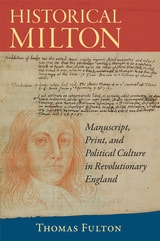
cover of Historical Milton: Manuscript, Print, and Political Culture in Revolutionary England

Historical Milton

Manuscript, Print, and Political Culture in Revolutionary England

Thomas Fulton

University of Massachusetts Press, 2010
John Milton's Commonplace Book is the only known political notebook of a radical polemicist writing during the English civil war, and the most extensive manuscript record of reading we have from any major English poet from this period. In this rethinking of a surprisingly neglected body of evidence, Thomas Fulton explores Milton's reading practices and the ways he used this reading in his writing. Fulton's close study of the Commonplace Book suggests that this reading record is far from the haphazard collection of notes that it first appears but is instead a program of research which had its own ideology that responded to the reading habits and practices of Milton's contemporaries. Created mostly in the late 1630s and during the overthrow of the Stuart government in the 1640s, Milton's reading notes yield a number of surprises, the most fundamental being a highly structured commitment to political history. Fulton explores the relationship between the manuscript author and his polemical persona, placing the Commonplace Book, the manuscript "Digression" to the History of Britain, and some wartime poems in revealing contrast to the printed political texts of this period.
[more]
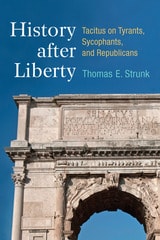
cover of History after Liberty: Tacitus on Tyrants, Sycophants, and Republicans

History after Liberty

Tacitus on Tyrants, Sycophants, and Republicans

Thomas E. Strunk

University of Michigan Press, 2017

Roman historian Tacitus wrote a damning critique of the first century CE Roman empire. The emperors in Tacitus’ works are almost universally tyrants surrounded by flatterers and informants, and the image Tacitus creates is of a society that has lost the liberty enjoyed under the Roman Republic. Yet Tacitus also poignantly depicts those who resist this tyranny and seek to restore a sense of liberty to Rome. In his portrayal of autocrats, sycophants, and republicans Tacitus provides an enduring testament to the value of liberty and the evils of despotism.
 
History after Liberty explores Tacitus’ political thought through his understanding of liberty. Influenced by modern republican writers such as Quentin Skinner and Philip Pettit, this study defines Tacitean libertas as the freedom from the rule of a dominus and as freedom to participate in the traditional politics of Rome through military service, public service in the senate and magistracies, and public speech. All of these elements are balanced in Tacitus’ writings with examples of those resisting the corruption of politics in an effort to restore a sense of free civic engagement. The work concludes with an exploration of Tacitus’ own writings as an act of restoring liberty. In contrast to most studies on Tacitus, History after Liberty argues that Tacitus is a republican who writes both to demonstrate that Rome had become a tyranny and to show a way out of that tyranny.
 
History after Liberty addresses the political thought of Tacitus’ writings. As such it will be of most interest to those who study the history and historiography of the early Roman empire, namely classicists and ancient historians. The work will also be of use to those interested in the antecedents to modern political thought, particularly the history of republicanism and freedom; readers from this category will include political scientists, philosophers, and modern historians.
 

[more]
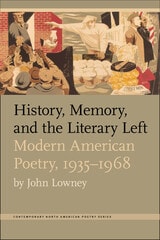
cover of History, Memory, and the Literary Left: Modern American Poetry, 1935-1968

History, Memory, and the Literary Left

Modern American Poetry, 1935-1968

John Lowney

University of Iowa Press, 2006

In this nuanced revisionist history of modern American poetry, John Lowney investigates the Depression era’s impact on late modernist American poetry from the socioeconomic crisis of the 1930s through the emergence of the new social movements of the 1960s. Informed by an ongoing scholarly reconsideration of 1930s American culture and concentrating on Left writers whose historical consciousness was profoundly shaped by the Depression, World War II, and the Cold War, Lowney articulates the Left’s challenges to national collective memory and redefines the importance of late modernism in American literary history. The late modernist writers Lowney studies most closely---Muriel Rukeyser, Elizabeth Bishop, Langston Hughes, Gwendolyn Brooks, Thomas McGrath, and George Oppen---are not all customarily associated with the 1930s, nor are they commonly seen as literary peers. By examining these late modernist writers comparatively, Lowney foregrounds differences of gender and sexuality, race and ethnicity, and social class and region while emphasizing how each writer developed poetic forms that responded to the cultural politics and socioaesthetic debates of the 1930s. In so doing he calls into question the boundaries that have limited the scholarly dialogue about modern poetry.No other study of American poetry has considered the particular gathering of careers that Lowney considers. As poets whose collective historical consciousness was profoundly shaped by the turmoil of the Depression and war years and the Cold War’s repression or rewriting of history, their diverse talents represent a distinct generational impact on U.S. and international literary history.
[more]
cover of Hobbes's Kingdom of Light: A Study of the Foundations of Modern Political Philosophy

Hobbes's Kingdom of Light

A Study of the Foundations of Modern Political Philosophy

Devin Stauffer

University of Chicago Press, 2018

Was Hobbes the first great architect of modern political philosophy? Highly critical of the classical tradition in philosophy, particularly Aristotle, Hobbes thought that he had established a new science of morality and politics. Devin Stauffer here delves into Hobbes’s critique of the classical tradition, making this oft-neglected aspect of the philosopher’s thought the basis of a new, comprehensive interpretation of his political philosophy.

In Hobbes’s Kingdom of Light, Stauffer argues that Hobbes was engaged in a struggle on multiple fronts against forces, both philosophic and religious, that he thought had long distorted philosophy and destroyed the prospects of a lasting peace in politics. By exploring the twists and turns of Hobbes’s arguments, not only in his famous Leviathan but throughout his corpus, Stauffer uncovers the details of Hobbes’s critique of an older outlook, rooted in classical philosophy and Christian theology, and reveals the complexity of Hobbes’s war against the “Kingdom of Darkness.” He also describes the key features of the new outlook—the “Kingdom of Light”—that Hobbes sought to put in its place. Hobbes’s venture helped to prepare the way for the later emergence of modern liberalism and modern secularism. Hobbes’s Kingdom of Light is a wide-ranging and ambitious exploration of Hobbes’s thought.
 
[more]
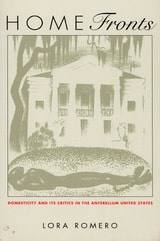
cover of Home Fronts: Domesticity and Its Critics in the Antebellum United States

Home Fronts

Domesticity and Its Critics in the Antebellum United States

Lora Romero

Duke University Press, 1997

Unlike studies of nineteenth-century culture that perpetuate a dichotomy of a public, male world set against a private, female world, Lora Romero’s Home Fronts shows the many, nuanced, and sometimes contradictory cultural planes on which struggles for authority unfolded in antebellum America.
Romero remaps the literary landscape of the last century by looking at the operations of domesticity on the frontier as well as within the middle-class home and by reconsidering such crucial (if sometimes unexpected) sites for the workings of domesticity as social reform movements, African-American activism, and homosocial high culture. In the process, she indicts theories of the nineteenth century based on binarisms and rigidity while challenging models of power and resistance based on the idea that "culture" has the capacity to either free or enslave. Through readings of James Fenimore Cooper, Catherine Beecher, Harriet Beecher Stowe, Maria Stewart, and Nathaniel Hawthorne, Romero shows how the politics of culture reside in local formulations rather than in essential and ineluctable political structures.
[more]
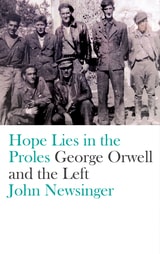
cover of Hope Lies in the Proles: George Orwell and the Left

Hope Lies in the Proles

George Orwell and the Left

John Newsinger

Pluto Press, 2018

Few figures on the left are as widely heralded as George Orwell. Yet his actual politics are poorly understood. Hope Lies in the Proles corrects that, offering a sympathetic yet critical account of Orwell’s often muddied political thinking and its continued relevance today. John Newsinger takes up various aspects of Orwell’s personal politics, exploring his attempts to change working-class consciousness, considering it alternately romantic, realistic, and patronizing—and at times all three at once. He examines Orwell’s antifascism, and how it fits in with his criticism of the Soviet Union; looks into his relationship with the Labour Party and feminism; and delves into Orwell’s shifting views on the United States. The result is the clearest understanding we’ve ever had of Orwell’s politics and their legacy.
[more]
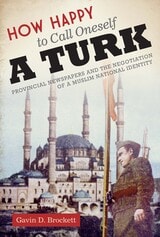
cover of How Happy to Call Oneself a Turk: Provincial Newspapers and the Negotiation of a Muslim National Identity

How Happy to Call Oneself a Turk

Provincial Newspapers and the Negotiation of a Muslim National Identity

By Gavin D. Brockett

University of Texas Press, 2011

The modern nation-state of Turkey was established in 1923, but when and how did its citizens begin to identify themselves as Turks? Mustafa Kemal Atatürk, Turkey's founding president, is almost universally credited with creating a Turkish national identity through his revolutionary program to "secularize" the former heartland of the Ottoman Empire. Yet, despite Turkey's status as the lone secular state in the Muslim Middle East, religion remains a powerful force in Turkish society, and the country today is governed by a democratically elected political party with a distinctly religious (Islamist) orientation.

In this history, Gavin D. Brockett takes a fresh look at the formation of Turkish national identity, focusing on the relationship between Islam and nationalism and the process through which a "religious national identity" emerged. Challenging the orthodoxy that Atatürk and the political elite imposed a sense of national identity from the top down, Brockett examines the social and political debates in provincial newspapers from around the country. He shows that the unprecedented expansion of print media in Turkey between 1945 and 1954, which followed the end of strict, single-party authoritarian government, created a forum in which ordinary people could inject popular religious identities into the new Turkish nationalism. Brockett makes a convincing case that it was this fruitful negotiation between secular nationalism and Islam—rather than the imposition of secularism alone—that created the modern Turkish national identity.
[more]
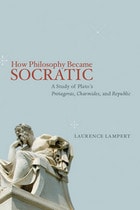
cover of How Philosophy Became Socratic: A Study of Plato's "Protagoras," "Charmides," and "Republic"

How Philosophy Became Socratic

A Study of Plato's "Protagoras," "Charmides," and "Republic"

Laurence Lampert

University of Chicago Press, 2010
Plato’s dialogues show Socrates at different ages, beginning when he was about nineteen and already deeply immersed in philosophy and ending with his execution five decades later. By presenting his model philosopher across a fifty-year span of his life, Plato leads his readers to wonder: does that time period correspond to the development of Socrates’ thought? In this magisterial investigation of the evolution of Socrates’ philosophy, Laurence Lampert answers in the affirmative.

The chronological route that Plato maps for us, Lampert argues, reveals the enduring record of philosophy as it gradually took the form that came to dominate the life of the mind in the West. The reader accompanies Socrates as he breaks with the century-old tradition of philosophy, turns to his own path, gradually enters into a deeper understanding of nature and human nature, and discovers the successful way to transmit his wisdom to the wider world. Focusing on the final and most prominent step in that process and offering detailed textual analysis of Plato’s Protagoras, Charmides, and Republic, How Philosophy Became Socratic charts Socrates’ gradual discovery of a proper politics to shelter and advance philosophy.
[more]
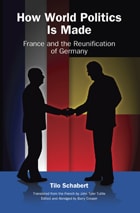
cover of How World Politics Is Made: France and the Reunification of Germany

How World Politics Is Made

France and the Reunification of Germany

Tilo Schabert

University of Missouri Press, 2009
With the collapse of the Soviet Union and its Eastern European bloc, the reunification of Germany was a major episode in the history of modern Europe—and one widely held to have been opposed by that country’s centuries-old enemy, France. But while it has been previously believed that French President François Mitterrand played a negative role in events leading up to reunification, Tilo Schabert shows that Mitterrand’s main concern was not the potential threat of an old nemesis but rather that a reunified Germany be firmly anchored in a unified Europe.
Widely acclaimed in Europe and now available in English for the first time, How World Politics Is Made blends primary research and interviews with key actors in France and Germany to take readers behind the scenes of world governments as a new Europe was formed. Schabert had unprecedented, exclusive access to French presidential archives and here focuses on French diplomacy not only to dispel the notion that Mitterrand was reluctant to accept reunification but also to show how successful he was in bringing it about.
Although accounts of U.S. officials regarding the reunification of Germany boast of American leadership that guided European affairs, Schabert offers a Continental perspective that is far more complex. He reveals the constructive role played by France as he re-creates not only French cabinet meetings but also communications between Mitterrand and George H. W. Bush, Mikhail Gorbachev, Helmut Kohl, Margaret Thatcher, and other world leaders. Along the way, he provides new insight into such major episodes as the fall of the Berlin Wall, European Council summits, the German-Polish border dispute, Germany’s membership in NATO, and the final settlement of reunification.
Schabert’s work is a major piece of scholarship that clearly shows the decisive role that France played in the orchestration of German reunification—by making the “German question” a European question. A primary source in its own right, this book dramatically reshapes our understanding of not only reunification but also the end of the Cold War and the construction of a New Europe.
[more]
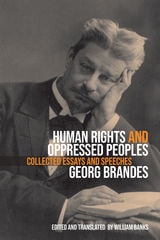
cover of Human Rights and Oppressed Peoples: Collected Essays and Speeches

Human Rights and Oppressed Peoples

Collected Essays and Speeches

Georg Brandes

University of Wisconsin Press, 2020

Georg Brandes was known as the "Father of the Modern Breakthrough" for his influence on Scandinavian writers in the late nineteenth century. A prominent writer, thinker, and speaker, he often examined intellectual topics beyond the literary criticism he was best known for. In this collection, William Banks has translated a number of Brandes's pieces that engage in the concerns of oppressed peoples. By collecting, annotating, and contextualizing these works, Banks reintroduces Brandes as a major progenitor of thinking about the rights of national minorities and the colonized.
Human Rights and Oppressed Peoples includes thirty-five essays and published speeches from the early twenty-first century on subjects as diverse as the Boxer Rebellion, displaced peoples from World War I, Finland's Jewish population, and imperialism. This collection will interest interdisciplinary scholars of human rights as well as those who study Scandinavian intellectual and literary history.
[more]