Results by title
18284 books match the query 'United States' and 552 start with h
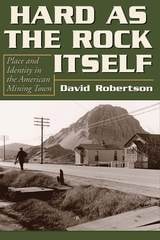
Hard as the Rock Itself
Place and Identity in the American Mining TownDavid Robertson
University Press of Colorado, 2006
Robertson documents the history of Toluca, Illinois; Cokedale, Colorado; and Picher, Oklahoma, from the mineral discovery phase through mine closure, telling for the first time how these century-old mining towns have survived and how sense of place has played a vital role.
Acknowledging the hardships that mining's social, environmental, and economic legacies have created for current residents, Robertson argues that the industry's influences also have contributed to the creation of strong, cohesive communities in which residents have always identified with the severe landscape and challenging, but rewarding way of life.
Robertson contends that the tough, unpretentious appearance of mining landscapes mirrors qualities that residents value in themselves, confirming that a strong sense of place in mining regions, as elsewhere, is not necessarily wedded to an attractive aesthetic or even to a thriving economy.
Mining historians, geographers, and other students of place in the American landscape will find fascinating material in Hard As the Rock Itself.
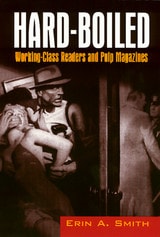
Hard-Boiled
Erin A. Smith
Temple University Press, 2000
Relying on pulp magazine advertising, the memoirs of writers and publishers, Depression-era studies of adult reading habits, social and labor history, Smith offers an innovative account of how these popular stories were generated and read. She shows that although the work of pulp fiction authors like Dashiell Hammett, Raymond Chandler, and Erle Stanley Gardner have become “classics” of popular culture, the hard-boiled genre was dominated by hack writers paid by the word, not self-styled artists. Pulp magazine editors and writers emphasized a gritty realism in the new genre. Unlike the highly rational and respectable British protagonists (Miss Marple and Hercule Poirot, for instance), tough-talking American private eyes relied as much on their fists as their brains as they made their way through tangled plotlines.
Casting working-class readers of pulp fiction as “poachers,” Smith argues that they understood these stories as parables about Taylorism, work, and manhood; as guides to navigating consumer culture; as sites for managing anxieties about working women. Engaged in re-creating white, male privilege for the modern, heterosocial world, pulp detective fiction shaped readers into consumers by selling them what they wanted to hear – stories about manly artisan-heroes who resisted encroaching commodity culture and the female consumers who came with it. Commenting on the genre’s staying power, Smith considers contemporary detective fiction by women, minority, and gay and lesbian writers.
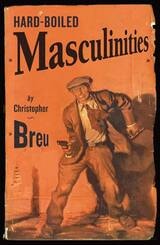
Hard-Boiled Masculinities
Christopher Breu
University of Minnesota Press, 2005
Looking closely at this transformation, Christopher Breu offers a complex account of how and why hard-boiled masculinity emerged during an unsettled time of increased urbanization and tenuous peace and traces the changes in its cultural conception as it moved back and forth across the divide between high and low culture as well as the color line that bifurcated American society.
Examining the work of Ernest Hemingway, Dashiell Hammett, Chester Himes, and William Faulkner, as well as many lesser-known writers for the hypermasculine pulp magazines of the 1920s and 1930s, Breu illustrates how the tough male was a product of cultural fantasy, one that shored up gender and racial stereotypes as a way of lashing out at the destabilizing effects of capitalism and social transformation.
Christopher Breu is assistant professor of English at Illinois State University.
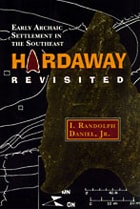
Hardaway Revisited
Early Archaic Settlement in the SoutheastI. Randolph Daniel, Jr.
University of Alabama Press, 1998
A landmark reassessment of Early Archaic settlement and adaptation in the southeastern United States.
Since the early 1970s, southeastern archaeologists have focused their attention on identifying the function of prehistoric sites and settlement practices during the Early Archaic period (ca. 9,000-10,500 B.P.). The Hardaway site in the North Carolina Piedmont, one of the most important archaeological sites in eastern North America, has not yet figured notably in this research. Daniel's reanalysis of the Hardaway artifacts provides a broad range of evidence—including stone tool morphology, intrasite distributions of artifacts, and regional distributions of stoneraw material types—that suggests that Hardaway played a unique role in Early Archaic settlement.
The Hardaway site functioned as a base camp where hunting and gathering groups lived for extended periods. From this camp they exploited nearby stone outcrops in the Uwharrie Mountains to replenish expended toolkits. Based on the results of this study, Daniel's new model proposes that settlement was conditioned less by the availability of food resources than by the limited distribution of high-quality knappable stone in the region. These results challenge the prevalent view of Early Archaic settlement that group movement was largely confined by the availability of food resources within major southeastern river valleys.

Hardboiled in Hollywood
Five Black Mask Writers and the MoviesUniversity of Wisconsin Press, 1991
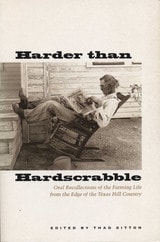
Harder than Hardscrabble
Oral Recollections of the Farming Life from the Edge of the Texas Hill CountryEdited by Thad Sitton
University of Texas Press, 2004
Winner, San Antonio Conservation Society Citation, 2005
Runner-up, Carr P. Collins Award, Best Book of Nonfiction, Texas Institute of Letters, 2005
Until the U.S. Army claimed 300-plus square miles of hardscrabble land to build Fort Hood in 1942, small communities like Antelope, Pidcoke, Stampede, and Okay scratched out a living by growing cotton and ranching goats on the less fertile edges of the Texas Hill Country. While a few farmers took jobs with construction crews at Fort Hood to remain in the area, almost the entire population—and with it, an entire segment of rural culture—disappeared into the rest of the state.
In Harder than Hardscrabble, oral historian Thad Sitton collects the colorful and frequently touching stories of the pre-Fort Hood residents to give a firsthand view of Texas farming life before World War II. Accessible to the general reader and historian alike, the stories recount in vivid detail the hardships and satisfactions of daily life in the Texas countryside. They describe agricultural practices and livestock handling as well as life beyond work: traveling peddlers, visits to towns, country schools, medical practices, and fox hunting. The anecdotes capture a fast-disappearing rural society—a world very different from today's urban Texas.
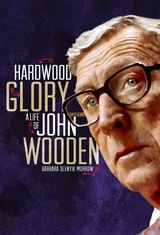
Hardwood Glory
A Life of John WoodenBarbara Olenyik Morrow
Indiana Historical Society Press, 2014
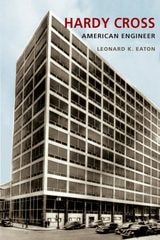
Hardy Cross
American EngineerLeonard K. Eaton
University of Illinois Press, 2006
Hare Krishna In America
Rochford, E. Burke
Rutgers University Press, 1985
Sociologist E. Burke Rochford, Jr., began his study of the Hare Krishna movement in America in the mid-1970s, only to find himself increasingly drawn into the movement even as he struggled to maintain a critical distance. Convinced to wear beads, chant, and take part in religious ceremonies, as well as to move in for occasional stays, Rochford found his new form of devotion a cause of concern for his family, friends, and colleagues. Participation in the movement's activities, however, enabled him to experience from within the forces at play between a society often intolerant of religious deviation and a religion dedicated to the continual recruitment of new followers.
Rochford uses several different sociological approaches--the life history of a single devotee, analysis of male-female recruitment patterns, surveys of members, and extensive field notes--to present he reader with a vivid portrait of the Hare Krishna movement as it has developed and changed in the first twenty years of its existence.
Hare Krishna In America
Rochford, E. Burke
Rutgers University Press, 1985
Hare Krishna
(Studies in Contemporary Religion)Federico Squarcini
Signature Books, 2004
When Bhaktivedanta arrived in America, it was a bold step because historically a guru who ventured outside of India was stripped of his Brahman status. However, the effort bore fruit—not the least of which was the type of intercultural understanding promoted by the current authors through their study of ISKCON’s place within the religion and culture of India.
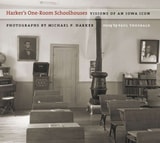
Harker's One-Room Schoolhouses
Visions of an Iowa IconPaul Theobald
University of Iowa Press, 2008
Michael Harker’s goal is to record Iowa’s historically significant architecture before it disappears forever. From Coon Center School no. 5 in Albert City to Pleasant Valley School in Kalona, North River School in Winterset to Douglas Center School in Sioux Rapids, and Iowa’s first school to Grant Wood’s first school, he has achieved this goal on a grand scale in Harker’s One-Room Schoolhouses.
Educational historian Paul Theobald tells the story of the rise and fall of Iowa’s one-room schools, whose numbers fell from close to 15,000 in 1918 to only 1,100 in 1960, all of which had ceased to function as schools by 1980. Moving from the state-wide story to the personal, he introduces us to George Coleman, son of a local farmer and school board director, who kept a sparse diary between December 1869 and June 1870. Young George’s words reveal the intimate way in which one-room schools interacted with the local community, including the local economic scene. Theobald ends by suggesting that these one-room relics of the past may again prove useful.
Harlem's Theaters
A Staging Ground for Community, Class, and Contradiction, 1923-1939Adrienne Macki Braconi
Northwestern University Press, 2015
Honorable Mention, 2016 Errol Hill Book Award for Outstanding Scholarship in African American Theater, Drama and/or Performance
Based on a vast amount of archival research, Adrienne Macki Braconi’s illuminating study of three important community-based theaters in Harlem shows how their work was essential to the formation of a public identity for African Americans and the articulation of their goals, laying the groundwork for the emergence of the Civil Rights movement. Macki Braconi uses textual analysis, performance reconstruction, and audience reception to examine the complex dynamics of productions by the Krigwa Players, the Harlem Experimental Theatre, and the Negro Theatre of the Federal Theatre Project. Even as these theaters demonstrated the extraordinary power of activist art, they also revealed its limits. The stage was a site in which ideological and class differences played out, theater being both a force for change and a collision of contradictory agendas. Macki Braconi’s book alters our understanding of the Harlem Renaissance, the roots of the Civil Rights movement, and the history of community theater in America.
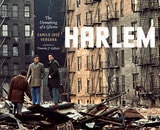
Harlem
The Unmaking of a GhettoCamilo José Vergara
University of Chicago Press, 2013
Photographer Camilo José Vergara has been chronicling the neighborhood for forty-three years, and Harlem: The Unmaking of a Ghetto is an unprecedented record of urban change. Vergara began his documentation of Harlem in the tradition of such masters as Helen Levitt and Aaron Siskind, and he later turned his focus on the neighborhood’s urban fabric, both the buildings that compose it and the life and culture embedded in them. By repeatedly returning to the same locations over the course of decades, Vergara is able to show us a community that is constantly changing—some areas declining, as longtime businesses give way to empty storefronts, graffiti, and garbage, while other areas gentrify, with corporate chain stores coming in to compete with the mom-and-pops. He also captures the ever-present street life of this densely populated neighborhood, from stoop gatherings to graffiti murals memorializing dead rappers to impersonators honoring Michael Jackson in front of the Apollo, as well as the growth of tourism and racial integration.
Woven throughout the images is Vergara’s own account of his project and his experience of living and working in Harlem. Taken together, his unforgettable words and images tell the story of how Harlem and its residents navigated the segregation, dereliction and slow recovery of the closing years of the twentieth century and the boom and racial integration of the twenty-first century. A deeply personal investigation, Harlem will take its place with the best portrayals of urban life.
Harlots, Hussies, and Poor Unfortunate Women
Crime, Transportation, and the Servitude of Female Convicts, 1718-1783Edith M. Ziegler
University of Alabama Press, 2014
In Harlots, Hussies, and Poor Unfortunate Women, Edith M. Ziegler recounts the history of British convict women involuntarily transported to Maryland in the eighteenth century.
Great Britain’s forced transportation of convicts to colonial Australia is well known. Less widely known is Britain’s earlier program of sending convicts—including women—to North America. Many of these women were assigned as servants in Maryland. Titled using epithets that their colonial masters applied to the convicts, Edith M. Ziegler’s Harlots, Hussies, and Poor Unfortunate Women examines the lives of this intriguing subset of American immigrants.
Basing much of her powerful narrative on the experiences of actual women, Ziegler restores individual faces to women stripped of their basic freedoms. She begins by vividly invoking the social conditions of eighteenth-century Britain, which suffered high levels of criminal activity, frequently petty thievery. Contemporary readers and scholars will be fascinated by Ziegler’s explanation of how gender-influenced punishments were meted out to women and often ensnared them in Britain’s system of convict labor.
Ziegler depicts the methods and operation of the convict trade and sale procedures in colonial markets. She describes the places where convict servants were deployed and highlights the roles these women played in colonial Maryland and their contributions to the region’s society and economy. Ziegler’s research also sheds light on escape attempts and the lives that awaited those who survived servitude.
Mostly illiterate, convict women left few primary sources such as diaries or letters in their own words. Ziegler has masterfully researched the penumbra of associated documents and accounts to reconstruct the worlds of eighteenth-century Britain and colonial Maryland and the lives of these unwilling American settlers. In illuminating this little-known episode in American history, Ziegler also discusses not just the fact that these women have been largely forgotten, but why. Harlots, Hussies, and Poor Unfortunate Women makes a valuable contribution to American history, women’s studies, and labor history.
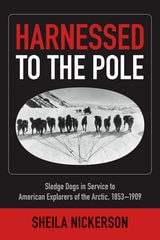
Harnessed to the Pole
Sledge Dogs in Service to American Explorers of the Arctic 1853-1909Sheila Nickerson
University of Alaska Press, 2014
Harnessed to the Pole follows the adventures of eight American explorers and their dog teams, starting with Elisha Kent Kane and ending with Robert Peary, controversial claimant of the title of first to reach the North Pole. While history has long forgotten these “little camels of the north,” Sheila Nickerson reveals how critical dogs were to the Arctic conquest. Besides providing transportation in extreme conditions, sledge dogs protected against wolves and polar bears, helped in hunting, found their way through storms, and provided warmth in extreme cold. They also faced rough handling, starvation, and the possibility of being left behind as expeditions plunged ahead. Harnessed to the Pole is an extraordinary—and unflinching—look at the dogs that raced to the top of the world.
Harold B. Lee
Life and ThoughtNewell G. Bringhurst
Signature Books, 2021
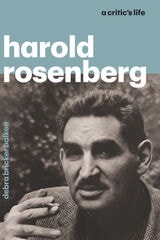
Harold Rosenberg
A Critic‘s LifeDebra Bricker Balken
University of Chicago Press, 2021
With Harold Rosenberg: A Critic’s Life, Debra Bricker Balken offers the first-ever complete biography of this great and eccentric man. Although he is now known mainly for his role as an art critic at the New Yorker from 1962 to 1978, Balken weaves together a complete tapestry of Rosenberg’s life and literary production, cast against the dynamic intellectual and social ferment of his time. She explores his role in some of the most contentious cultural debates of the Cold War period, including those over the commodification of art and the erosion of individuality in favor of celebrity, demonstrated in his famous essay “The Herd of Independent Minds.” An outspoken socialist and advocate for the political agency of art, he formed deep alliances with figures such as Hannah Arendt, Saul Bellow, Paul Goodman, Mary McCarthy, Jean-Paul Sartre, Willem de Kooning, and Jackson Pollock, all of whom Balken portrays with vivid accounts from Rosenberg’s life.
Thoroughly researched and captivatingly written, this book tells in full Rosenberg’s brilliant, fiercely independent life and the five decades in which he played a leading role in US cultural, intellectual, and political history.
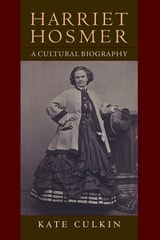
Harriet Hosmer
A Cultural BiographyKate Culkin
University of Massachusetts Press, 2010
In 1852 Hosmer moved from Boston to Rome, where she shared a house with actress Charlotte Cushman and soon formed close friendships with such prominent expatriates as Robert and Elizabeth Barrett Browning and fellow sculptors John Gibson, Emma Stebbins, and William Wetmore Story. References to Hosmer or characters inspired by her appear in the work of Nathaniel Hawthorne, Louisa May Alcott, and Kate Field among others. Culkin argues that Hosmer's success was made possible by her extensive network of supporters, including her famous friends, boosters of American gentility, and women's rights advocates. This unlikely coalition, along with her talent, ambition, and careful maintenance of her public profile, ultimately brought her great acclaim. Culkin also addresses Hosmer's critique of women's position in nineteenth-century culture through her sculpture, women's rights advocates' use of high art to promote their cause, the role Hosmer's relationships with women played in her life and success, and the complex position a female artist occupied within a country increasingly interested in proving its gentility.
Harriet Jacobs
A PlayLydia R. Diamond
Northwestern University Press, 2010
Jacobs’ book—which was published in 1861 and only partially serialized in Horace Greely’s New York Tribune before it was deemed too graphic—chillingly exposed the sexual harassment and abuse of slave girls and women at the hands of their masters. Harriet Jabobs: A Play organically incorporates theatrical elements that extend the book’s enormous power. Through active scenes, piercing direct address, and slave narratives, Diamond is able to give new expression to the horrors and legacies of slavery. Diamond presents African American culture in all its richness—with slavery as a part of it, but not its defining aspect. Though harrowing, Harriet Jacobs addresses the necessary task of reenvisioning a difficult chapter in American history.
Harriet Tubman
Myth, Memory, and HistoryMilton C. Sernett
Duke University Press, 2007
Three biographies of Harriet Tubman were published within months of each other in 2003–04; they were the first book-length studies of the “Queen of the Underground Railroad” to appear in almost sixty years. Sernett examines the accuracy and reception of these three books as well as two earlier biographies first published in 1869 and 1943. He finds that the three recent studies come closer to capturing the “real” Tubman than did the earlier two. Arguing that the mythical Tubman is most clearly enshrined in stories told to and written for children, Sernett scrutinizes visual and textual representations of “Aunt Harriet” in children’s literature. He looks at how Tubman has been portrayed in film, painting, music, and theater; in her Maryland birthplace; in Auburn, New York, where she lived out her final years; and in the naming of schools, streets, and other public venues. He also investigates how the legendary Tubman was embraced and represented by different groups during her lifetime and at her death in 1913. Ultimately, Sernett contends that Harriet Tubman may be America’s most malleable and resilient icon.
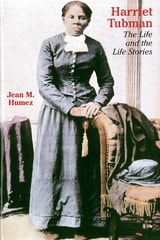
Harriet Tubman
The Life and the Life StoriesJean M. Humez
University of Wisconsin Press, 2005
Harriet Tubman’s name is known world-wide and her exploits as a self-liberated Underground Railroad heroine are celebrated in children’s literature, film, and history books, yet no major biography of Tubman has appeared since 1943. Jean M. Humez’s comprehensive Harriet Tubman is both an important biographical overview based on extensive new research and a complete collection of the stories Tubman told about her life—a virtual autobiography culled by Humez from rare early publications and manuscript sources. This book will become a landmark resource for scholars, historians, and general readers interested in slavery, the Underground Railroad, the Civil War, and African American women.
Born in slavery in Maryland in or around 1820, Tubman drew upon deep spiritual resources and covert antislavery networks when she escaped to the north in 1849. Vowing to liberate her entire family, she made repeated trips south during the 1850s and successfully guided dozens of fugitives to freedom. During the Civil War she was recruited to act as spy and scout with the Union Army. After the war she settled in Auburn, New York, where she worked to support an extended family and in her later years founded a home for the indigent aged. Celebrated by her primarily white antislavery associates in a variety of private and public documents from the 1850s through the 1870s, she was rediscovered as a race heroine by woman suffragists and the African American women’s club movement in the early twentieth century. Her story was used as a key symbolic resource in education, institutional fundraising, and debates about the meaning of "race" throughout the twentieth century.
Humez includes an extended discussion of Tubman’s work as a public performer of her own life history during the nearly sixty years she lived in the north. Drawing upon historiographical and literary discussion of the complex hybrid authorship of slave narrative literature, Humez analyzes the interactive dynamic between Tubman and her interviewers. Humez illustrates how Tubman, though unable to write, made major unrecognized contributions to the shaping of her own heroic myth by early biographers like Sarah Bradford. Selections of key documents illustrate how Tubman appeared to her contemporaries, and a comprehensive list of primary sources represents an important resource for scholars.
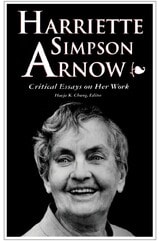
Harriette Simpson Arnow
Critical Essays on Her WorkHaeja K. Chung
Michigan State University Press, 1995
At her death in 1986, Harriette Simpson Arnow left a modest collection of published work: ten short stories, five novels, two non-fiction books, a short autobiography, and nineteen essays and book reviews. Although the sum is small, her writing has been examined from regionalist, Marxist, feminist, and other critical perspectives.
The 1970s saw the first serious attempts to revive interest in Arnow. In 1971, Tillie Olsen identified her as a writer whose "books of great worth suffer the death of being unknown, or at best, a peculiar eclipsing." Joyse Carol Oates wrote in The New York Times Book Review that Arnow's The Dollmaker is "our most unpretentious American masterpiece."
In the 1990s, it is appropriate to take stock of her earlier work and to prompt reexamination of this powerful yet poorly understood writer. This collection of critical essays examines traditional as well as new interpretations of Arnow and her work. It also suggests future directions for Arnow scholarship and includes studies of all of Arnow's writing, fiction and non-fiction, published and unpublished.
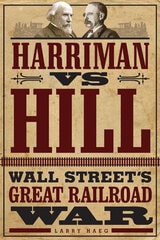
Harriman vs. Hill
Wall Street’s Great Railroad WarLarry Haeg
University of Minnesota Press, 2013
In 1901, the Northern Pacific was an unlikely prize: a twice-bankrupt construction of the federal government, it was a two-bit railroad (literally—five years back, its stock traded for twenty-five cents a share). But it was also a key to connecting eastern markets through Chicago to the rising West. Two titans of American railroads set their sights on it: James J. Hill, head of the Great Northern and largest individual shareholder of the Northern Pacific, and Edward Harriman, head of the Union Pacific and the Southern Pacific. The subsequent contest was unprecedented in the history of American enterprise, pitting not only Hill against Harriman but also Big Oil against Big Steel and J. P. Morgan against the Rockefellers, with a supporting cast of enough wealthy investors to fill the ballroom of the Waldorf Astoria.
The story, told here in full for the first time, transports us to the New York Stock Exchange during the unfolding of the earliest modern-day stock market panic. Harriman vs. Hill re-creates the drama of four tumultuous days in May 1901, when the common stock of the Northern Pacific rocketed from one hundred ten dollars a share to one thousand in a mere seventeen hours of trading—the result of an inadvertent “corner” caused by the opposing forces. Panic followed and then, in short order, a calamity for the “shorts,” a compromise, the near-collapse of Wall Street brokerages and banks, the most precipitous decline ever in American stock values, and the fastest recovery. Larry Haeg brings to life the ensuing stalemate and truce, which led to the forming of a holding company, briefly the biggest railroad combine in American history, and the U.S. Supreme Court ruling against the deal, launching the reputation of Justice Oliver Wendell Holmes as the “great dissenter” and President Theodore Roosevelt as the “trust buster.”
The forces of competition and combination, unfettered growth, government regulation, and corporate ambition—all the elements of American business at its best and worst—come into play in the account of this epic battle, whose effects echo through our economy to this day.
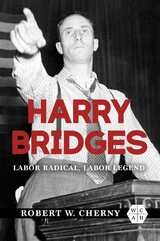
Harry Bridges
Labor Radical, Labor LegendRobert W. Cherny
University of Illinois Press, 2023
- Winner of a Silver Medal from the Independent Publisher Book Awards
- Won Honorable Mention for 2023 ILHA Book of the Year (International Labor History Association)
The iconic leader of one of America’s most powerful unions, Harry Bridges put an indelible stamp on the twentieth century labor movement. Robert Cherny’s monumental biography tells the life story of the figure who built the International Longshore and Warehouse Union (ILWU) into a labor powerhouse that still represents almost 30,000 workers.
An Australian immigrant, Bridges worked the Pacific Coast docks. His militant unionism placed him at the center of the 1934 West Coast Waterfront Strike and spurred him to expand his organizing activities to warehouse laborers and Hawaiian sugar and pineapple workers. Cherny examines the overall effectiveness of Bridges as a union leader and the decisions and traits that made him effective. Cherny also details the price paid by Bridges as the US government repeatedly prosecuted him for his left-wing politics.
Drawing on personal interviews with Bridges and years of exhaustive research, Harry Bridges places an extraordinary individual and the ILWU within the epic history of twentieth-century labor radicalism.
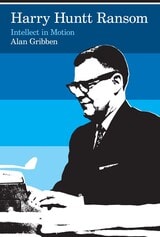
Harry Huntt Ransom
Intellect in MotionBy Alan Gribben
University of Texas Press, 2008
Both a life story and a portrait of public higher education during the twentieth century, Harry Huntt Ransom captures the spirit of a dynamic individual who dedicated his talents to nurturing intellectual life in Texas and beyond. Tracing the details of Ransom's youth in Galveston and Tennessee and his education at Yale, where he earned a doctorate, Alan Gribben provides new insight into the factors that shaped Ransom's future as a renowned administrator and defender of the humanities.
Ransom's career at the University of Texas began in 1935, when he was hired as an instructor of English. He rose through the ranks to become chancellor, stepping down in 1971 during a volatile period when debates about the University's central mission raged—particularly over the question of commercializing higher education. The development of Ransom's lasting legacy, the Humanities Research Center bearing his name, is explored in depth as well. Bringing to life a legendary figure, Harry Huntt Ransom is a colorful testament to a singular man of letters who had the audacity to propose "that there be established somewhere in Texas—let's say in the capital city—a center of our cultural compass, a research center to be the Bibliothèque Nationale of the only state that started out as an independent nation."
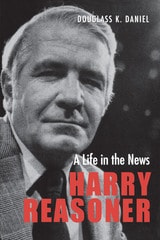
Harry Reasoner
A Life in the NewsBy Douglass K. Daniel
University of Texas Press, 2007
Harry Reasoner was one of the most trusted and well-liked journalists of the golden age of network television news. Whether anchoring the evening newscast on CBS in the 1960s or on ABC in the 1970s, providing in-depth reporting on 60 Minutes, or hosting numerous special programs covering civil rights struggles, the Vietnam War, and Watergate, Reasoner had "that almost mystical quality it seems to take for good television reporting, exuding this atmosphere of truth and believability," in the words of Walter Cronkite. Yet his reassuring manner and urbane, often witty, on-air persona masked a man who was far more complex and contradictory. Though gifted with the intelligence and drive to rise to the top of his profession, Reasoner was regarded by many colleagues as lazy and self-indulgent, a man who never achieved his full potential despite his many accomplishments.
Harry Reasoner: A Life in the News covers the entire sweep of this enigmatic journalist's life and career. Douglass K. Daniel opens with Reasoner's Depression-era Midwestern upbringing and follows him through his early work in newspapers and radio before he joined CBS in 1956. Focusing on Reasoner's thirty-five-year tenure in television news, Daniel presents fascinating, behind-the-scenes accounts of Reasoner's key role in founding the top-rated newsmagazine 60 Minutes. He also explores Reasoner's highly publicized move to ABC in 1970, where he anchored the nightly newscast, first with Howard K. Smith and later with Barbara Walters—a disastrous pairing from which Reasoner's career never fully recovered.
Based on scores of interviews and unpublished letters, memos, and other primary sources, this first biography of the man once rated second in credibility only to Walter Cronkite illuminates an entire era in broadcast journalism, as well as many of the unique personalities, from Andy Rooney to Mike Wallace, who made that era distinctive.
Harry S. Truman and the Cold War Revisionists
Robert H. Ferrell
University of Missouri Press, 2006
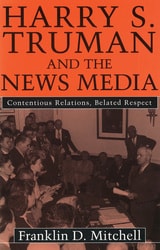
Harry S. Truman and the News Media
Contentious Relations, Belated RespectFranklin D. Mitchell
University of Missouri Press, 1998
Based upon extensive research in the papers of President Harry S. Truman and in several journalistic collections, Harry S. Truman and the News Media recounts the story of a once unpopular chief executive who overcame the censure of the news media to ultimately win both the public's and the press's affirmation of his personal and presidential greatness.
Franklin D. Mitchell traces the major contours of journalism during the lifetime and presidency of Truman. Although newspapers and newsmagazines are given the most emphasis, reporters and columnists of the Washington news corps also figure prominently for their role in the president's news conferences and their continuing coverage of Truman and his family. Broadcast journalism's expanding coverage of the president is also explored through chapters dealing with radio and television.
President Truman's advocacy of a liberal Fair Deal for all Americans and a prudent and visible role for the nation in world affairs drew fire from the anti-administration news media, particularly the publishing empire of William Randolph Hearst, the McCormick-Patterson newspapers, the Scripps-Howard chain, and the Time-Life newsmagazines of Henry R. Luce. Despite press opposition and the almost universal prediction of defeat in the 1948 election, Truman was victorious in the greatest miscalled presidential election in journalistic history.
During his full term, Truman's relations with the news media became contentious over such matters as national security in the Cold War, the conduct of the Korean War, and the continuing charges of communism and corruption in the administration. Although Truman's career in politics was based on honesty and the welfare of the people, his early political alliance with Thomas Pendergast, Kansas City's notorious political boss, provided the opportunity for a portion of the press to charge Truman with subservience to Pendergast's own agenda of corrupt government.
The history and the dynamics of the Truman presidency and the American news media, combined with biographical and institutional sketches of key individuals and news organizations, make Harry S. Truman and the News Media a captivating and original investigation of an American president. Well written and researched, this book will be of great value to Truman scholars, journalists, and anyone interested in American history or presidential studies.

Harry S. Truman versus the Medical Lobby
The Genesis of MedicareMonte M. Poen
University of Missouri Press, 1996
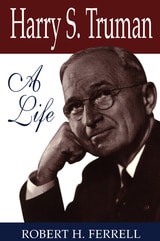
Harry S. Truman
A LifeRobert H. Ferrell
University of Missouri Press, 1995
Few U.S. presidents have captured the imagination of the American people as has Harry S. Truman, “the man from Missouri.”
In this major new biography, Robert H. Ferrell, widely regarded as an authority on the thirty-third president, challenges the popular characterization of Truman as a man who rarely sought the offices he received, revealing instead a man who—with modesty, commitment to service, and basic honesty—moved with method and system toward the presidency.
Truman was ambitious in the best sense of the word. His powerful commitment to service was accompanied by a remarkable shrewdness and an exceptional ability to judge people. He regarded himself as a consummate politician, a designation of which he was proud. While in Washington, he never succumbed to the “Potomac fever” that swelled the heads of so many officials in that city. A scrupulously honest man, Truman exhibited only one lapse when, at the beginning of 1941, he padded his Senate payroll by adding his wife and later his sister.
From his early years on the family farm through his pivotal decision to use the atomic bomb in World War II, Truman’s life was filled with fascinating events. Ferrell’s exhaustive research offers new perspectives on many key episodes in Truman’s career, including his first Senate term and the circumstances surrounding the Truman Doctrine and the Marshall Plan. In addition, Ferrell taps many little-known sources to relate the intriguing story of the machinations by which Truman gained the vice presidential nomination in 1944, a position which put him a heartbeat away from the presidency.
No other historian has ever demonstrated such command over the vast amounts of material that Robert Ferrell brings to bear on the unforgettable story of Truman’s life. Based upon years of research in the Truman Library and the study of many never-before-used primary sources, Harry S. Truman is destined to become the authoritative account of the nation’s favorite president.
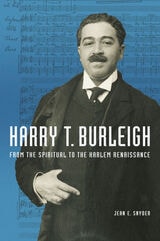
Harry T. Burleigh
From the Spiritual to the Harlem RenaissanceJean E. Snyder
University of Illinois Press, 2021
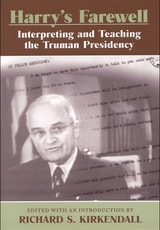
Harry's Farewell
Interpreting and Teaching the Truman PresidencyEdited & Intro by Richard S. Kirkendall
University of Missouri Press, 2004
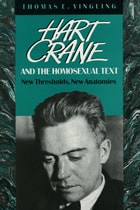
Hart Crane and the Homosexual Text
New Thresholds, New AnatomiesThomas E. Yingling
University of Chicago Press, 1990
"A brilliant critical model for understanding how textuality and sexuality can produce pervasive effects on each other in the writing of a figure like Crane."—Michael Moon, Duke University
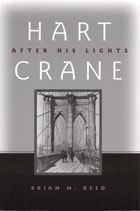
Hart Crane
After His LightsBrian M. Reed
University of Alabama Press, 2006
In Hart Crane: After His Lights, Brian Reed undertakes a study of Crane’s poetic output that takes into account, but also questions, the post-structural and theoretical developments in humanities scholarship of the last decade that have largely approached Crane in a piecemeal way, or pigeonholed him as represen-tative of his class, gender, or sexual orientation. Reed examines Crane’s career from his juvenilia to his posthumous critical reception and his impact on practicing poets following World War II. The first part of the study tests common rubrics of literary theory—nationality, sexuality, period—against Crane’s poetry, and finds that these labels, while enlightening, also obfuscate the origin and character of the poet’s work. The second part examines Crane’s poetry through the process of its composition, sources, and models, taking up questions of style, genealogy, and genre. The final section examines Crane’s influence on subsequent generations of American poets, especially by avant-garde literary circles like the New American poets, the Black Mountain School, the New York School, and the Beats.
The result is a study that complicates and enriches our understandings of Crane’s poetry and contributes to the ongoing reassessment of literary modernism’s origins, course, and legacy.
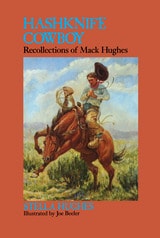
Hashknife Cowboy
Recollections of Mack HughesStella Hughes; Illustrated by Joe Beeler
University of Arizona Press, 1984
Stella Hughes, author of the best-selling Chuck Wagon Cookin' and a cowhand in her own right, has compiled from her husband's reminiscences an authentic look both at Arizona history and at cowboying as it really was. Illustrated by Joe Beeler, founding member of the Cowboy Artists of America.
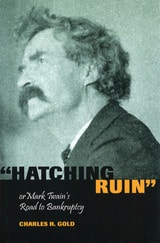
Hatching Ruin
Or Mark Twain's Road to BankruptcyCharles H. Gold
University of Missouri Press, 2003
In “Hatching Ruin,” Charles H. Gold provides a complete description of Samuel L. Clemens’s business relationships with Charles L. Webster and James W. Paige during the 1880s. Gold analyzes how these relationships affected Clemens as a person and an artist, most notably in A Connecticut Yankee in King Arthur’s Court.
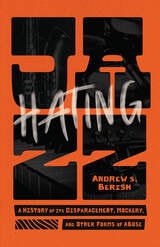
Hating Jazz
A History of Its Disparagement, Mockery, and Other Forms of AbuseAndrew S. Berish
University of Chicago Press, 2025
A rock guitarist plays four notes in front of one thousand people, while a jazz guitarist plays one thousand notes in front of four people. You might laugh or groan at this jazz joke, but what is it about jazz that makes people want to disparage it in the first place?
Andrew S. Berish’s Hating Jazz listens to the voices who have denounced, disparaged, and mocked the music. By focusing on the rejection of the music, Berish says, we see more holistically jazz’s complicated place in American cultural life. Jazz is a display of Black creativity and genius, an art form that is deeply embedded in African American life. Though the explicit racial tenor of jazz jokes has become muted over time, making fun of jazz, either in a lighthearted or aggressive way, is also an engagement with the place of Blackness in America. An individual’s taste in music may seem personal, but Berish’s analysis of jazz hatred demonstrates that musical preferences and trends are a social phenomenon. Criticism of jazz has become inextricable from the ways we understand race in America, past and present. In addition to this form of criticism, Berish also considers jazz hate as a form of taste discrimination and as a conflict over genre boundaries within different jazz cultures.
Both enlightening and original, Hating Jazz shows that our response to music can be a social act, unique to our historical moment and cultural context—we react to music in certain ways because of who we are, where we are, and when we are.

Hatred at Home
al-Qaida on Trial in the American MidwestAndrew Welsh-Huggins
Ohio University Press, 2011
One day in 2002, three friends—a Somali immigrant, a Pakistan–born U.S. citizen, and a hometown African American—met in a Columbus, Ohio coffee shop and vented over civilian casualties in the war in Afghanistan. Their conversation triggered an investigation that would become one of the most unusual and far–reaching government probes into terrorism since the 9/11 attacks.
Over several years, prosecutors charged each man with unrelated terrorist activities in cases that embodied the Bush administration’s approach to fighting terrorism at home.
Government lawyers spoke of catastrophes averted; defense attorneys countered that none of the three had done anything but talk. The stories of these homegrown terrorists illustrate the paradox the government faces after September 11: how to fairly wage a war against alleged enemies living in our midst.
Hatred at Home is a true crime drama that will spark debate from all political corners about safety, civil liberties, free speech, and the government’s war at home.
Hattie and Huey
An Arkansas TourDavid Malone
University of Arkansas Press, 1990
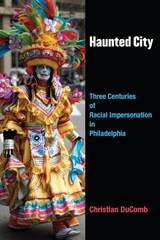
Haunted City
Three Centuries of Racial Impersonation in PhiladelphiaChristian DuComb
University of Michigan Press, 2017
Mummers have long worn blackface makeup during winter holiday celebrations in Europe and North America; in Philadelphia, mummers’ blackface persisted from the colonial period well into the twentieth century. The first annual Mummers Parade, a publicly sanctioned procession from the working-class neighborhoods of South Philadelphia to the city center, occurred in 1901. Despite a ban on blackface in the Mummers Parade after civil rights protests in 1963–64, other forms of racial and ethnic impersonation in the parade have continued to flourish unchecked. Haunted City combines detailed historical research with the author’s own experiences performing in the Mummers Parade to create a lively and richly illustrated narrative. Through its interdisciplinary approach, Haunted City addresses not only theater history and performance studies but also folklore, American studies, critical race theory, and art history. It also offers a fresh take on the historiography of the antebellum minstrel show.

Haunted Heart
A Biography of Susannah McCorkleLinda Dahl
University of Michigan Press, 2006
"In this comprehensive biography, compiled from meticulous research and interviews with many of McCorkle's confidants . . . Dahl reconstructs a career distinguished by great promise and great sadness . . . doing her best to address a large, looming 'Why?' that can never be completely answered."
—New York Times
"A compelling, sympathetic but often chilling view not only of McCorkle's complexities but also of the difficult business of music itself and of the widespread always potentially fatal illness now better known as bipolar disorder, which the singer hid from so many, even from herself for many years."
—Newsweek
“Susannah's life was dark and daunting. Her music was suave and sunny. Both are honored in this remarkably well-researched and constantly revealing keyhole peek into a haunted life that is both chilling and exhilarating. I could not put it down.”
—Rex Reed
“Susannah McCorkle was a mesmerizing singer with a dark side she hid even from her closest friends. Now, thanks to this probing and courageous biography, we can understand the gut ambition that took her to the top of her field and the turmoil that brought her down.”
—James Gavin, author of Deep in a Dream: The Long Night of Chet Baker
“Haunted Heart strikingly resembles the woman it describes: it is vivacious, tender, saturnine, industrious, and deeply intelligent. Like Susannah's way with certain ballads, it opens a wound and begins the work of healing it. I am grateful for Linda Dahl's diligence and sympathy.”
—Leon Wieseltier
Linda Dahl is the author of Stormy Weather: The Music and Lives of a Century of Jazzwomen and Morning Glory: A Biography of Mary Lou Williams. Visit the author’s website at www.dahljazz.com.
Haunted Heartland
Michael Norman
University of Wisconsin Press, 2017
For decades, journalist Michael Norman has been tracking down spine-tingling tales that seem to arise from authentic incidents in Illinois, Indiana, Iowa, Kansas, Michigan, Minnesota, Missouri, Nebraska, Ohio, and Wisconsin. In Haunted Heartland he offers more than eighty entertaining, eerie stories. Are they true in the world that we know, or only in a dark vale of twilight?

Haunted Homes
Dahlia Schweitzer
Rutgers University Press, 2021
Watch a video of the author discussing the topic Haunted Homes (https://youtu.be/_irTEfvtZfQ).
Haunted Wisconsin
Michael Norman
University of Wisconsin Press, 2011
Grab a cozy blanket, light a few flickering candles, and enjoy the unnerving tales of Haunted Wisconsin. Gathered from personal interviews with credible eyewitnesses, on-site explorations, historical archives, newspaper reports, and other sources, these scores of reports date from Wisconsin’s early settlement days to recent inexplicable events.
You’ll read about Wisconsin’s most famous haunted house, Summerwind; three Milwaukee men who encountered the beautiful ghost of National Avenue; a phantom basketball player; a spectral horse that signaled death in the pioneer era of the Wisconsin Dells; a poltergeist in St. Croix County who attracted a crowd of more than three hundred spectators; the Ridgeway Ghost who haunts the driftless valleys of southwestern Wisconsin; a swinging railroad lantern held by unseen hands; the Ghost Island of the Chippewa Flowage; and many others. Are ghosts real? That’s for you to decide!
Now available in a Third Edition with updates and several new accounts, Haunted Wisconsin remains a favorite collection of unexplained midwestern tales, enjoyed by readers of all ages.
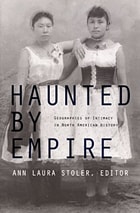
Haunted by Empire
Geographies of Intimacy in North American HistoryAnn Laura Stoler, ed.
Duke University Press, 2006
Haunted by Empire includes Ann Laura Stoler’s seminal essay “Tense and Tender Ties” as well as her bold introduction, which carves out the exciting new analytic and methodological ground animated by this comparative venture. The contributors engage in a lively cross-disciplinary conversation, drawing on history, anthropology, literature, philosophy, and public health. They address such topics as the regulation of Hindu marriages and gay sexuality in the early-twentieth-century United States; the framing of multiple-choice intelligence tests; the deeply entangled histories of Asian, African, and native peoples in the Americas; the racial categorizations used in the 1890 U.S. census; and the politics of race and space in French colonial New Orleans. Linda Gordon, Catherine Hall, and Nancy F. Cott each provide a concluding essay reflecting on the innovations and implications of the arguments advanced in Haunted by Empire.
Contributors. Warwick Anderson, Laura Briggs, Kathleen Brown, Nancy F. Cott, Shannon Lee Dawdy, Linda Gordon, Catherine Hall, Martha Hodes, Paul A. Kramer, Lisa Lowe, Tiya Miles, Gwenn A. Miller, Emily S. Rosenberg, Damon Salesa, Nayan Shah, Alexandra Minna Stern, Ann Laura Stoler, Laura Wexler
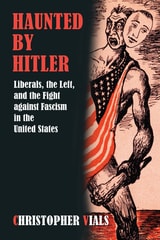
Haunted by Hitler
Liberals, the Left, and the Fight against Fascism in the United StatesChristopher Vials
University of Massachusetts Press, 2014
Although fascism is typically associated with Europe, the threat of fascism in the United States haunted the imaginations of activists, writers, and artists, spurring them to create a rich, elaborate body of cultural and political work. Traversing the Popular Front of the 1930s, the struggle against McCarthyism in the 1950s, the Black Power movement of the 1960s, and the AIDS activism of the 1980s, Haunted by Hitler highlights the value of “antifascist” cultural politics, showing how it helped to frame the national discourse.
Christopher Vials examines the ways in which anxieties about fascism in the United States have been expressed in the public sphere, through American television shows, Off-Broadway theater, party newspapers, bestselling works of history, journalism, popular sociology, political theory, and other media. He argues that twentieth-century liberals and leftists were more deeply unsettled by the problem of fascism than those at the center or the right and that they tirelessly and often successfully worked to counter America's fascist equivalents.
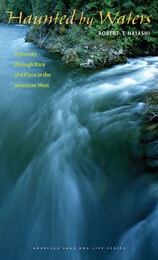
Haunted by Waters
A Journey through Race and Place in the American WestRobert T. Hayashi
University of Iowa Press, 2007
Even though race influenced how Americans envisioned, represented, and shaped the American West, discussions of its history devalue the experiences of racial and ethnic minorities. In this lyrical history of marginalized peoples in Idaho, Robert T. Hayashi views the West from a different perspective by detailing the ways in which they shaped the western landscape and its meaning.
As an easterner, researcher, angler, and third-generation Japanese American traveling across the contemporary Idaho landscape—where his grandfather died during internment during World War II—Hayashi reconstructs a landscape that lured emigrants of all races at the same time its ruling forces were developing cultured processes that excluded nonwhites. Throughout each convincing and compelling chapter, he searches for the stories of dispossessed minorities as patiently as he searches for trout.
Using a wide range of materials that include memoirs, oral interviews, poetry, legal cases, letters, government documents, and even road signs, Hayashi illustrates how Thomas Jefferson’s vision of an agrarian, all-white, and democratic West affected the Gem State’s Nez Perce, Chinese, Shoshone, Mormon, and particularly Japanese residents. Starting at the site of the Corps of Discovery’s journey into Idaho, he details the ideological, aesthetic, and material manifestations of these intertwined notions of race and place. As he ?y-?shes Idaho’s fabled rivers and visits its historical sites and museums, Hayashi reads the contemporary landscape in light of this evolution.
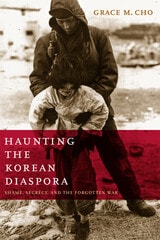
Haunting the Korean Diaspora
Shame, Secrecy, and the Forgotten WarGrace M. Cho
University of Minnesota Press, 2008
Grace M. Cho exposes how Koreans in the United States have been profoundly affected by the forgotten war and uncovers the silences and secrets that still surround it, arguing that trauma memories have been passed unconsciously through a process psychoanalysts call “transgenerational haunting.” Tracing how such secrets have turned into “ghosts,” Cho investigates the mythic figure of the yanggongju, literally the “Western princess,” who provides sexual favors to American military personnel. She reveals how this figure haunts both the intimate realm of memory and public discourse, in which narratives of U.S. benevolence abroad and assimilation of immigrants at home go unchallenged. Memories of U.S. violence, Cho writes, threaten to undo these narratives—and so they have been rendered unspeakable.
At once political and deeply personal, Cho’s wide-ranging and innovative analysis of U.S. neocolonialism and militarism under contemporary globalization brings forth a new way of understanding—and remembering—the impact of the Korean War.

Have Horn, Will Travel
The Life and Music of Herman "Junior" CookCourtney M. Nero
University of North Texas Press, 2025