Results by title
28164 books match the query 'History' and 997 start with i
Inquiry about the Monks in Egypt
Catholic University of America Press, 2020

Insane Sisters
Or, the Price Paid for Challenging a Company TownGregg Andrews
University of Missouri Press, 2020
Insane Sisters is the extraordinary tale of two sisters, Mary Alice Heinbach and Euphemia B. Koller, and their seventeen- year property dispute against the nation's leading cement corporation—the Atlas Portland Cement Company.
In 1903, Atlas built a plant on the border of the small community of Ilasco, located just outside Hannibal—home of the infamous cave popularized in Mark Twain's most acclaimed novels. The rich and powerful Atlas quickly appointed itself as caretaker of Twain's heritage and sought to take control of Ilasco. However, its authority was challenged in 1910 when Heinbach inherited her husband's tract of land that formed much of the unincorporated town site. On grounds that Heinbach's husband had been in the advanced stages of alcoholism when she married him the year before, some of Ilasco's political leaders and others who had ties to Atlas challenged the will, charging Heinbach with undue influence.
To help fight against the local lawyers and politicians who wanted Atlas to own the land, Heinbach enlisted the help of her shrewd and combative sister, Euphemia Koller, by making her co-owner of the tract. In a complex case that went to the Missouri Supreme Court four times, the sisters fiercely sought to hang on to the tract. However, in 1921 the county probate court imposed a guardianship over Heinbach and a circuit judge ordered a sheriff's sale of the property. After Atlas purchased the tract, Koller waged a lonely battle to overturn the sale and expose the political conspiracies that had led to Ilasco's conversion into a company town. Her efforts ultimately resulted in her court- ordered confinement in 1927 to Missouri's State Hospital Number One for the Insane, where she remained until her death at age sixty-eight.
Insane Sisters traces the dire consequences the sisters suffered and provides a fascinating look at how the intersection of gender, class, and law shaped the history and politics of Ilasco. The book also sheds valuable new light on the wider consolidation of corporate capitalism and the use of guardianships and insanity to punish unconventional women in the early twentieth century.
Insatiability
Stanislaw Ignacy Witkiewicz, translated from the Polish by Louis Iribarne
Northwestern University Press, 1994
Insatiable City
Food and Race in New OrleansTheresa McCulla
University of Chicago Press, 2024
A history of food in the Crescent City that explores race, power, social status, and labor.
In Insatiable City, Theresa McCulla probes the overt and covert ways that the production of food and the discourse about it both created and reinforced many strains of inequality in New Orleans, a city significantly defined by its foodways. Tracking the city’s economy from nineteenth-century chattel slavery to twentieth-century tourism, McCulla uses menus, cookbooks, newspapers, postcards, photography, and other material culture to limn the interplay among the production and reception of food, the inscription and reiteration of racial hierarchies, and the constant diminishment and exploitation of working-class people. The consumption of food and people, she shows, was mutually reinforced and deeply intertwined. Yet she also details how enslaved and free people of color in New Orleans used food and drink to carve paths of mobility, stability, autonomy, freedom, profit, and joy. A story of pain and pleasure, labor and leisure, Insatiable City goes far beyond the task of tracing New Orleans's culinary history to focus on how food suffuses culture and our understandings and constructions of race and power.

Insatiable City
Food and Race in New OrleansTheresa McCulla
University of Chicago Press, 2024
A history of food in the Crescent City that explores race, power, social status, and labor.
In Insatiable City, Theresa McCulla probes the overt and covert ways that the production of food and the discourse about it both created and reinforced many strains of inequality in New Orleans, a city significantly defined by its foodways. Tracking the city’s economy from nineteenth-century chattel slavery to twentieth-century tourism, McCulla uses menus, cookbooks, newspapers, postcards, photography, and other material culture to limn the interplay among the production and reception of food, the inscription and reiteration of racial hierarchies, and the constant diminishment and exploitation of working-class people. The consumption of food and people, she shows, was mutually reinforced and deeply intertwined. Yet she also details how enslaved and free people of color in New Orleans used food and drink to carve paths of mobility, stability, autonomy, freedom, profit, and joy. A story of pain and pleasure, labor and leisure, Insatiable City goes far beyond the task of tracing New Orleans's culinary history to focus on how food suffuses culture and our understandings and constructions of race and power.
Insecurities of Expulsion
Afro-Asian Entanglements in Transcontinental UgandaAnneeth Kaur Hundle
Duke University Press, 2025
Inside Abstraction
Interpreting Inka Visual CultureCarolyn Dean
University of Texas Press, 2025
2026 PROSE Award for Art History And Criticism, Association of American Publishers
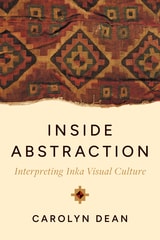
Illuminating the abstract art of the Inka, what it conveys about Inka values, and its relationship to those who view it.
Inka visual culture is unusual in its tendency toward abstraction. Public stonework, vessels used at state feasts, garments worn by the imperial elite—these objects announcing status and power are adorned with geometric designs that refuse figuration. After searching in vain for hidden referents, many scholars have largely given up the search for meaning.
Inside Abstraction develops a novel interpretation. Eminent art historian Carolyn Dean proposes that Inka geometries are neither ornamental nor coded depictions of other objects. Rather, Dean shows that in the Andean world, the designs were functionally self-aware, possessing perspectives of their own, quite literally looking back at and addressing viewers directly. Further, Dean contends that these agent-abstractions were teachers, conveying particular messages concerning social hierarchy: the relations among geometries and colors instructed viewers as to their own proper social relations. Inka designs thereby served imperial aims by wordlessly communicating the state’s values and demands for submission. Extensively illustrated and rigorously argued, Inside Abstraction is a dramatic step forward in our understanding of Inka art and political order.

Inside Alabama
A Personal History of My StateHarvey H. Jackson, III
University of Alabama Press, 2003
This book tells Alabama’s history in a conversational style with an unapologetically subjective approach. Accessible to general readers and students alike, it recounts the history and politics of a state known for its colorful past, told by one of the state’s most noted historians and educators, whose family came to the territory before statehood. A native and resident Alabamian, Harvey Jackson has spent a lifetime discovering and trying to understand his state. Expressing deep love for its people and culture, he is no less critical of its shortcomings.
Inside Alabama, as the title implies, gives Jackson’s insider perspective on the events and conditions that shaped modern-day Alabama. With humor and candor, he explores the state’s cultural, political, and economic development from prehistoric times to the dawning of the new millennium. Mound-builders, Hernando de Soto, William Bartram, Red Sticks, Andy Jackson, Bourbon Democrats, suffragettes, New Dealers, Hugo Black, Martin Luther King Jr., George Wallace, Rosa Parks all play colorful parts in this popular history. By focusing on state politics as the most accessible and tangible expression of these shaping forces, Jackson organizes the fourteen chapters chronologically, artfully explaining why the past is so important today.

Inside Ancient Kitchens
New Directions in the Study of Daily Meals and FeastsElizabeth A. Klarich
University Press of Colorado, 2010

Inside Chinese Theater
Community and Artistry in Nineteenth-Century California and BeyondNancy Yunhwa Rao
University of Illinois Press, 2025
In the mid-nineteenth century, Chinese opera theater arrived as one of the significant performing art forms in California. Nancy Yunhwa Rao excavates and contextualizes the important history of Chinese Opera Theater, bringing to light the ways it became woven into the financial, political, social, and family life in California and beyond.
Chinese opera theater found brick-and-mortar homes with San Francisco theaters like the Hing Chuen Yuen and the Donn Qui Yuen. But troupes had already followed Chinese immigrants to mining and railroad towns, and across the American West. As Chinese theater became part of California and San Francisco culture, popular Chinese actors advocated for their art alongside appeals for civil rights. Rao draws on personal diaries, newspapers and artifacts to place Chinese theater within the everyday lives of San Francisco. She also examines the costumes, singing, staging, and storytelling that impacted mainstream reception and influenced how Chinese communities saw themselves.
Illustrated with seventy photographs, Inside Chinese Theater is an expert and eloquent journey into the early decades of Chinese opera in America.

Inside Colombia
Drugs, Democracy, and WarLivingstone, Grace
Rutgers University Press, 2004
The South American nation of Colombia has seen more than forty years of unrest, conflict, and civil war. It is a country in which social violence and warfare are intricately intertwined. Colombia is also notorious for its drug trade, being one of the leading producers of cocaine in the world, and for its central role as a staging ground for the U.S. “war on drugs.” Since 9/11 the Bush administration has sought to draw political links between the Colombian drug trade, guerrilla organizations, and terrorism.
Inside Colombia offers a valuable introduction and quick reference guide to this complex nation. With chapters devoted to history, human rights issues, the economy, drugs, the controversial antidrug intervention known as Plan Colombia, and relations with the United States, the book offers an easily accessible and comprehensive overview. Readers will learn about the major players in the conflicts, significant political figures, how Colombia’s economy has fared in the twentieth century, how the country’s geography influences its politics and economy, and how U.S. intervention shapes Colombia’s political scene.
Inside Greenwich Village
A New York City Neighborhood, 1898-1918Gerald W. McFarland
University of Massachusetts Press, 2001
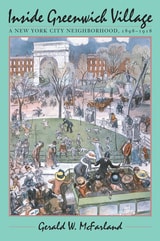
McFarland examines how these Villagers, so divided along class and ethnic lines, interacted with one another. He shows how clashing expectations about what constituted proper behavior in the neighborhood's public spaces—especially streets, parks, and saloons—often led to intergroup conflict, political rivalries, and campaigns by the more privileged Villagers to impose middle-class mores on their working-class neighbors. Occasionally, however, a crisis or common problem led residents to overlook their differences and cooperate across class and ethnic lines. Throughout the book, McFarland connects the evolution of Village life to the profound transformations taking place in American society at large during the same years.

Inside Jobs
Prison Work in the Making of the American Labor Marketreich
Russell Sage Foundation, 2026
From the stone quarries of Sing Sing that supplied marble for early New York City landmarks, to twenty-first-century construction projects staffed by formerly incarcerated workers, Inside Jobs traces the relationship between prison work and the labor market over the past two hundred years. Sociologist Adam Reich demonstrates how prison labor has repeatedly been used to solve economic problems—disciplining workers, lowering labor costs, managing unemployment—revealing unexpected connections that challenge our assumptions about freedom, coercion, and labor itself.
Reich examines the history of work in prisons to understand how it has related to the free labor market. He finds that the organization of prison work, and debates over it, have changed dramatically over time. In the mid to late nineteenth century, prisons helped shape the emerging factory system as the apprentice-based labor market gave way to industrial production. Labor unions opposed prison labor as immoral, and in the early to mid-twentieth century, the moral character of the workforce became central to economic life within the prison and without. Therapeutic professionals worked in prisons to rehabilitate the incarcerated and determine what motivated them to work. Following prison uprisings in the late twentieth century, prison work became a tool of population control. Yet, paradoxically, work programs were remodeled to mirror the free labor market, requiring applications and hiring processes.
Blending archival research, political economy, and sociological theory, Inside Jobs offers a powerful new framework for understanding mass incarceration and reentry today. Reich examines how the dynamics of mass incarceration have begun to shift. He explores how the "mark of a criminal record"—the stigma traditionally associated with felony convictions—has given way to a "market" for criminal records, as employers discover advantages in hiring disadvantaged, dependent, and disciplined workers recently released from prison. Looking toward the future, Reich focuses on promising efforts to transform this system.
Inside Jobs is an illuminating examination of prison work's history, its relationship to work outside prison walls, and how the criminal justice system disempowers workers both behind bars and beyond.
Inside Lincoln's White House
The Complete Civil War Diary of John HayEdited by Michael Burlingame and John R. Turner Ettlinger
Southern Illinois University Press, 1999
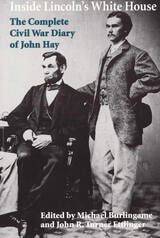
On 18 April 1861, assistant presidential secretary John Hay recorded in his diary the report of several women that "some young Virginian long haired swaggering chivalrous of course. . . and half a dozen others including a daredevil guerrilla from Richmond named Ficklin would do a thing within forty eight hours that would ring through the world."
The women feared that the Virginian planned either to assassinate or to capture the president. Calling this a "harrowing communication," Hay continued his entry: "They went away and I went to the bedside of the Chief couché. I told him the yarn; he quietly grinned."
This is but one of the dramatic entries in Hay’s Civil War diary, presented here in a definitive edition by Michael Burlingame and John R. Turner Ettlinger. Justly deemed the most intimate record we will ever have of Abraham Lincoln in the White House, the Hay diary is, according to Burlingame and Ettlinger, "one of the richest deposits of high-grade ore for the smelters of Lincoln biographers and Civil War historians." While the Cabinet diaries of Salmon P. Chase, Edward Bates, and Gideon Welles also shed much light on Lincoln’s presidency, as does the diary of Senator Orville Hickman Browning, none of these diaries has the literary flair of Hay’s, which is, as Lincoln’s friend Horace White noted, as "breezy and sparkling as champagne." An aspiring poet, Hay recorded events in a scintillating style that the lawyer-politician diarists conspicuously lacked.
Burlingame and Ettlinger’s edition of the diary is the first to publish the complete text of all of Hay’s entries from 1861 through 1864. In 1939 Tyler Dennett published Lincoln and the Civil War in the Diaries and Letters of John Hay, which, as Civil War historian Allan Nevins observed, was "rather casually edited." This new edition is essential in part because Dennett omitted approximately 10 percent of Hay’s 1861–64 entries.
Not only did the Dennett edition omit important parts of the diaries, it also introduced some glaring errors. More than three decades ago, John R. Turner Ettlinger, then in charge of Special Collections at the Brown University Library, made a careful and literal transcript of the text of the diary, which involved deciphering Hay’s difficult and occasionally obscure writing. In particular, passages were restored that had been canceled, sometimes heavily, by the first editors for reasons of confidentiality and propriety. Ettlinger’s text forms the basis for the present edition, which also incorporates, with many additions and much updating by Burlingame, a body of notes providing a critical apparatus to the diary, identifying historical events and persons.
Inside Newark
Decline, Rebellion, and the Search for TransformationCurvin, Robert
Rutgers University Press, 2014
Based on historical records and revealing interviews with over one hundred residents and officials, Inside Newark traces Newark’s history from the 1950s, when the city was a thriving industrial center, to the era of Mayor Cory Booker. Along the way, Curvin covers the disturbances of July 1967, called a riot by the media and a rebellion by residents; the administration of Kenneth Gibson, the first black mayor of a large northeastern city; and the era of Sharpe James, who was found guilty of corruption. Curvin examines damaging housing and mortgage policies, the state takeover of the failing school system, the persistence of corruption and patronage, Newark’s shifting ethnic and racial composition, positive developments in housing and business complexes, and the reign of ambitious mayor Cory Booker.
Inside Newark reveals a central weakness that continues to plague Newark—that throughout this history, elected officials have not risen to the challenges they have faced. Curvin calls on those in positions of influence to work for the social and economic improvement of all groups and concludes with suggestions for change, focusing on education reform, civic participation, financial management, partnerships with agencies and business, improving Newark’s City Council, and limiting the term of the mayor. If Newark’s leadership can encompass these changes, Newark will have a chance at a true turnaround.

Inside Pakistan
Hasnain Kazim
Haus Publishing, 0
As Kazim and his wife arrived in Islamabad in 2009, they found the country of his parents’ birth riven with contradictions: a nuclear power with a tremendous gulf between the rich and poor, Pakistan has experienced a series of natural and manmade disasters in recent years alongside turbulent periods of economic growth and stagnation. What keeps the people of this Islamic society going? What hopes do they hold for the future? As Kazim spoke with Pakistanis at every level of society and of all political persuasions in search of answers to these questions, he discovered a much more complex country than the headlines of violence and extremism would suggest. Told from a sensitive and sympathetic insider’s perspective, Inside Pakistan pulls back the curtain on a section of the world that promises to play an ever more important role in years to come.

Inside Rwanda's /Gacaca/ Courts
Seeking Justice after GenocideBert Ingelaere
University of Wisconsin Press, 2018
Weaving together vivid firsthand recollections, interviews, and trial testimony with systematic analysis, Ingelaere documents how the gacaca shifted over time from confession to accusation, from restoration to retribution. He precisely articulates the importance of popular conceptions of what is true and just. Marked by methodological sophistication, extraordinary evidence, and deep knowledge of Rwanda, this is an authoritative, nuanced, and bittersweet account of one of the most important experiments in transitional justice after mass violence.

Inside Science
Stories from the Field in Human and Animal ScienceRobert E. Kohler
University of Chicago Press, 2019
Resident observing takes place across a range of sciences, from anthropology and sociology to primatology, wildlife ecology, and beyond. What makes it special, Kohler argues, is the direct access it affords scientists to the contexts in which their subjects live and act. These scientists understand their subjects not by keeping their distance but by living among them and engaging with them in ways large and small. This approach also demonstrates how science and everyday life—often assumed to be different and separate ways of knowing—are in fact overlapping aspects of the human experience. This story-driven exploration is perfect for historians, sociologists, and philosophers who want to know how scientists go about making robust knowledge of nature and society.
Inside a Class Action
The Holocaust and the Swiss BanksJane Schapiro
University of Wisconsin Press, 2003
On October 21, 1996, attorney Michael Hausfeld, with a team of lawyers, filed a class-action complaint against Union Bank of Switzerland, Swiss Bank Corporation, and Credit Suisse on behalf of Holocaust victims. The suit accused the banks of, among other things, acting as the chief financiers for Nazi Germany. Hausfeld wanted to use the suit to prove that the banks not only concealed and refused to return millions of dollars in dormant accounts, but that they acted as a conduit for looted assets and slave labor profits. Such behavior, he charged, violated the code of ethics known as customary international law. On August 12, 1998, the plaintiffs and banks reached a $1.25 billion settlement.
Through interviews with a wide range of people involved in the case and detailed research of documents and court transcripts, Jane Schapiro shows the ways that egos, personalities, and values clash in such a complex and emotionally charged case. Inside a Class Action provides an insider’s view of a major lawsuit from its inception to its conclusion, which will appeal to anyone interested in human rights, reparations, and international law.
Inside an Ancient Assyrian Palace
Looking at Austen Henry Layard's ReconstructionAda Cohen and Steven E. Kangas
University Press of New England, 2016

Inside the Antisemitic Mind
The Language of Jew-Hatred in Contemporary GermanyMonika Schwarz-Friesel and Jehuda Reinharz
Brandeis University Press, 2017
Inside the Body of Black Feminism
Science, Race, CultureSamantha Pinto
Duke University Press, 2026
Inside the Body of Black Feminism charts a cultural genealogy of antiracist and feminist engagement with some of the most objectified internal “parts” of racist medical and scientific inquiry: bones and blood, brains and hearts, guts and wombs. In a move counterintuitive to Black feminism’s emphasis on externalized representations of the body, Samantha Pinto reinterprets the relationship between embodiment, health, and race through cultural archives that reimagine the inside of the Black body. Working through materials such as medical textbooks, memoirs, data visualizations, museum displays, speculative fiction, and horror films, Pinto explores how a visually inaccessible corporeal interior becomes discernible and racialized in the public sphere. Inside the Body of Black Feminism engages expressive cultural work to ask how we might know the inside of the Black body differently through Black feminist theory and how scientific and medical inquiry might enable us to understand political subjectivity anew.

Inside the Eagle's Head
An American Indian CollegeAngelle A. Khachadoorian
University of Alabama Press, 2010
Where tradition meets bureaucracy—Native students redefine education on their own terms.
Inside the Eagle’s Head offers a compelling and deeply human portrait of the Southwestern Indian Polytechnic Institute (SIPI), a federally operated college serving Native American students from across the United States. In it, anthropologist Angelle Khachadoorian draws on years of teaching experience and extensive student interviews to illuminate the challenges and successes of life at SIPI. Far more than an institutional history, this book captures the voices of students navigating a complex educational landscape shaped by federal oversight, tribal identity, and personal ambition.
Through vivid metaphors—SIPI as a family, a prison, a reservation—students articulate their struggles and resilience within a system that is at once empowering and restrictive. Khachadoorian’s analysis reveals how SIPI’s hybrid nature—part community college, part BIA legacy—creates both opportunities and obstacles for its students. With empathy and insight, she explores how young Native Americans forge identity, community, and purpose in a setting few outsiders understand. Inside the Eagle’s Head is essential reading for educators, policymakers, and anyone interested in the intersection of Indigenous education, federal institutions, and student agency. It is a powerful testament to the transformative potential of listening to students’ stories.

Inside the Klavern
The Secret History of a Ku Klux Klan of the 1920sEdited by David A. Horowitz
Southern Illinois University Press, 1999
Inside the Klavern is an annotated collection of the minutes of a thriving Ku Klux Klan in La Grande, Oregon, between 1922 and 1924. The most complete set of Klan minutes ever uncovered, these documents illustrate the inner workings of a Klan chapter of more than three hundred members at a time when the national membership reached into the millions and the Invisible Empire was at the peak of its power. Through an extensive introduction and conclusion as well as brief notes previewing each installment of the minutes, David A. Horowitz places these unique documents in historical perspective.
The La Grande minutes demonstrate Klan hostility to Roman Catholics, Jews, blacks, and "hyphenated" Americans. But they also explain how the chapter exercised requirements for admission, how officers were selected, and how Klansmen encountered difficulties enforcing the moral standards of their order. Because the Klan kligrapp (recording secretary) Harold R. Fosner recorded not only the official proceedings but also volunteered extemporaneous comments and gossip, readers get a genuine feeling for what it was like to attend the meetings. Through his own obvious excitement and commitment to the cause, Fosner re-creates the flavor, tone, and atmosphere of these meetings: "Tis beyond my power of expression to relate the harmony and fellowship which reigned supreme. . . . Suffice to say that these were the golden moments of our lives."
His evaluation of Klan propaganda, too, is telling: "The weekly newsletter from Atlanta, Georgia, contained a little book, the official message of our emperor, one Col. William Joseph Simmons, read before the most noble band of men ever assembled and for the noblest cause in the world. To my firm belief this book is the leading masterpiece of our day and age."
Horowitz concludes that "although it is tempting to judge Jazz Age Klansmen by the standards of later generations, the story provided by the minutes is a complex one—a chronicle of both compassion and complicity in cruelty, of positive social accomplishment and arbitrary and dysfunctional divisiveness."
Inside the Presidential Debates
Their Improbable Past and Promising FutureNewton N. Minow and Craig L. LaMay
University of Chicago Press, 2008

Inside the Spiral
The Passions of Robert SmithsonSuzaan Boettger
University of Minnesota Press, 2022
An expansive and revelatory study of Robert Smithson’s life and the hidden influences on his iconic creations
This first biography of the major American artist Robert Smithson, famous as the creator of the Spiral Jetty, deepens understanding of his art by addressing the potent forces in his life that were shrouded by his success, including his suppressed early history as a painter; his affiliation with Christianity, astrology, and alchemy; and his sexual fluidity. Integrating extensive investigation and acuity, Suzaan Boettger uncovers Smithson’s story and, with it, symbolic meanings across the span of his painted and drawn images, sculptures, essays, and earthworks up to the Spiral Jetty and beyond, to the circumstances leading to what became his final work, Amarillo Ramp.
While Smithson is widely known for his monumental earthwork at the edge of the Great Salt Lake, Inside the Spiral delves into the arc of his artistic production, recognizing it as a response to his family’s history of loss, which prompted his birth and shaped his strange intelligence. Smithson configured his personal conflicts within painterly depictions of Christ’s passion, the rhetoric of science fiction, imagery from occult systems, and the impersonal posture of conceptual sculpture. Aiming to achieve renown, he veiled his personal passions and transmuted his professional persona, becoming an acclaimed innovator and fierce voice in the New York art scene.
Featuring copious illustrations never before published of early work that eluded Smithson’s destruction, as well as photographs of Smithson and his wife, the noted sculptor Nancy Holt, and recollections from nearly all those who knew him throughout his life, Inside the Spiral offers unprecedented insight into the hidden impulses of one of modern art’s most enigmatic figures. With great sensitivity to the experiences of loss and existential strife that defined his distinct artistic language, this biographical analysis provides an expanded view of Smithson’s iconic art pilgrimage site and the experiences and works that brought him to its peculiar blood red water.
Insider Histories of the Vietnam Era Underground Press, Part 1
Ken Wachsberger
Michigan State University Press, 2011
This enlightening book offers a collection of histories of underground papers from the Vietnam Era as written and told by key staff members of the time. Their stories (as well as those to be included in Part 2, forthcoming) represent a wide range of publications: counterculture, gay, lesbian, feminist, Puerto Rican, Native American, Black, socialist, Southern consciousness, prisoner's rights, New Age, rank-and-file, military, and more. The edition includes forewords by former Chicago Seed editor Abe Peck, radical attorney William M. Kunstler, and Markos Moulitsas, founder of the Daily Kos, along with an introductory essay by Ken Wachsberger.
Wachsberger notes that the underground press not only produce a few well-known papers but also was truly national and diverse in scope. His goal is to capture the essence of "the countercultural community."
A fundamental resource for anyone seeking a deeper understanding of a dramatic era in U.S. history.
Insider Histories of the Vietnam Era Underground Press, Part 2
Ken Wachsberger
Michigan State University Press, 2011
This enlightening book offers a collection of histories of underground papers from the Vietnam Era as written and told by key staff members of the time. Their stories, building on those presented in Part 1, represent a wide range of publications: countercultural, gay, lesbian, feminist, Puerto Rican, Native American, Black, socialist, Southern consciousness, prisoners’ rights, New Age, rank-and-file, military, and more. Wachsberger notes that the underground press not only produced a few well-known papers but also was truly national and diverse in scope. His goal is to capture the essence of “the countercultural community.” This book will be a fundamental resource for anyone seeking a deeper understanding of a dramatic era in U.S. history, as well as offering a younger readership a glimpse into a generation of idealists who rose up to challenge and improve government and society.

Insiders and Outsiders in the History of Law
Edited by Gwen Seabourne and Joanna McCunn
University of London Press, 2026
Writing the history of law involves choices: whose stories are to be told, and how?
While earlier scholarship centered on judges, lawyers, and legislators, recent work increasingly examines the experiences of women, colonial subjects, and gender-nonconforming people, using new sources and methods. Insiders and Outsiders in the History of Lawpresents research on the boundaries between legal insiders and outsiders across seven centuries of British legal history.
Drawing on underused records from contexts ranging from medieval Wales to twentieth-century British India, the chapters explore how individuals became insiders or outsiders, how the law treated them, and how they used legal processes. This book highlights the fluidity of this divide and calls for a more representative legal history.
Insight Philadelphia
Historical Essays IllustratedFinkel, Kenneth
Rutgers University Press, 2018
Illustrated with scores of rare archival images, Insight Philadelphia will give readers a new appreciation for the people and places that make the City of Brotherly Love so unique.
Insignificant Things
Amulets and the Art of Survival in the Early Black AtlanticMatthew Francis Rarey
Duke University Press, 2023

Inspiration and Interpretation
A Theological Introduction to Sacred ScriptureDenis Farkasfalvy
Catholic University of America Press, 2010

Instability in the Middle East
Structural Causes and Uneven Modernisation 1950–2015Karel Cerný
Karolinum Press, 2017
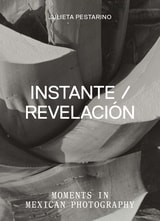
Instante/revelacion
Moments in Mexican PhotographyJulieta Pestarino
J. Paul Getty Trust, The, 2026
Presenting nearly 150 pictures made between 1920 and 2017, Instante/revelación highlights the work of thirteen renowned photographers who feature prominently in the history of the medium in Mexico, including Lola and Manuel Álvarez Bravo, Graciela Iturbide, and Pablo Ortiz Monasterio.
Through a dynamic selection of images, the publication explores some of the intertwined sociocultural forces that shape life and art in Mexico. Among the photographs are stunning presentations of landscapes, architecture, and flora and fauna from across the country; depictions of daily life; and portraits of esteemed Mexican artists and writers such as Diego Rivera, Frida Kahlo, and Octavio Paz. An illustrated essay examines the significant role photobooks and periodicals played in disseminating these images.
The photographers featured in this volume are linked by friendship, influence, and collaboration. Their works, when viewed together as a collective narrative, reveal the spirit of fruitful exchange that characterizes this exciting chapter in Mexico's photographic history.
This volume is published to accompany an exhibition on view at the J. Paul Getty Museum at the Getty Center from September 1, 2026, to January 3, 2027.
Institution and Passivity
Course Notes from the Collège de France (1954-1955)Maurice Merleau-Ponty
Northwestern University Press, 2010
Institution and Passivity is based on course notes for classes taught at the Bibliothèque Nationale de Paris. Philosophically, this collection connects the issue of passive constitution of meaning with the dimension of history, furthering discussions and completing arguments started in The Visible and the Invisible and Signs (both published by Northwestern). Leonard Lawlor and Heath Massey’s translation makes available to an English-speaking readership a critical transitional text in the history of phenomenology.

Institutional Change and Healthcare Organizations
From Professional Dominance to Managed CareW. Richard Scott, Martin Ruef, Peter J. Mendel, and Carol A. Caronna
University of Chicago Press, 2000
This book examines the transformations that have occurred in medical care systems in the San Francisco Bay area since 1945. The authors describe these changes in detail and relate them to both the sociodemographic trends in the Bay Area and to shifts in regulatory systems and policy environments at local, state, and national levels. But this is more than a social history; the authors employ a variety of theoretical perspectives—including strategic management, population ecology, and institutional theory—to examine five types of healthcare organizations through quantitative data analysis and illustrative case studies.
Providing a thorough account of changes for one of the nation's leading metropolitan areas in health service innovation, this book is a landmark in the theory of organizations and in the history of healthcare systems.

Institutional Theatrics
Performing Arts Policy in Post-Wall BerlinBrandon Woolf
Northwestern University Press, 2021
2022 Outstanding Book Award Finalist from the Association for Theater in Higher Education (ATHE)
In a city struggling to determine just how neoliberal it can afford to be, what kinds of performing arts practices and institutions are necessary—and why?
Since the fall of the Berlin Wall, political and economic agendas in the reunified German capital have worked to dismantle long-standing traditions of state‑subsidized theater even as the city has redefined itself as a global arts epicenter. Institutional Theatrics charts the ways theater artists have responded to these shifts and crises both on- and offstage, offering a method for rethinking the theater as a vital public institution.
What is the future of the German theater, grounded historically in large ensembles, extensive repertoires, and auteur directors? Examining the restructuring of Berlin’s theatrical landscape and most prominent performance venues, Brandon Woolf argues that cultural policy is not simply the delegation and distribution of funds. Instead, policy should be thought of as an artistic practice of institutional imagination. Woolf demonstrates how performance can critique its patron institutions in order to transform the relations between the stage and the state, between the theater and the infrastructures of its support. Bold, nuanced, and rigorously documented, Institutional Theatrics offers new insights about art, its administration, and the forces that influence cultural production.

Institutional trust and economic policy Lessons from the history of the Euro
Lessons from the history of the EuroDóra Gyorffy
Central European University Press, 2013
Institutions and Economic Theory
The Contribution of the New Institutional EconomicsEirik Furubotn and Rudolf Richter
University of Michigan Press, 2005
This second edition assesses some of the major refinements, extensions, and useful applications that have developed in neoinstitutionalist thought in recent years. More attention is given to the overlap between the New Institutional Economics and developments in economic history and political science. In addition to updated references, new material includes analysis of parallel developments in the field of economic sociology and its attacks on representatives of the NIE as well as an explanation of the institution-as-an-equilibrium-of-game approach.
Already an international best seller, Institutions and Economic Theory is essential reading for economists and students attracted to the NIE approach. Scholars from such disciplines as political science, sociology, and law will find the work useful as the NIE continues to gain wide academic acceptance. A useful glossary for students is included.
Eirik Furubotn is Honorary Professor of Economics, Co-Director of the Center for New Institutional Economics, University of Saarland, Germany and Research Fellow, Private Enterprise Research Center, Texas A&M University.
Rudolph Richter is Professor Emeritus of Economics and Director of the Center for New Institutional Economics, University of Saarland, Germany.
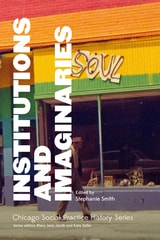
Institutions and Imaginaries
Edited by Stephanie Smith
School of the Art Institute of Chicago, 2014
This volume focuses on how artists and others have worked with, within, and sometimes in opposition to large Chicago institutions, such as public schools, universities, libraries, archives, museums, and other civic bodies. Drawing from a broad range of interdisciplinary sources, it explores the far-reaching effect of socially motivated art on urban life. It grounds recent history within a longer arc of civic self-fashioning, from the Columbian Exposition of 1893 to Jane Addams's Hull House to John Dewey's legacy in arts education. The collection also examines the relationship between the city’s image and the types of artistic work that flourish within its boundaries and resonate far beyond them.
Institutions and Imaginaries is part of the new Chicago Social Practice History series, edited by Mary Jane Jacob and Kate Zeller in the Department of Exhibitions and Exhibition Studies at the School of the Art Institute of Chicago (SAIC).

Institutions and Innovation
Voters, Parties, and Interest Groups in the Consolidation of Democracy - France and Germany, 1870-1939Marcus Kreuzer
University of Michigan Press, 2001
Institutions and Innovations analyzes the troubled history of French and German parties between 1870 and 1939 to develop a general explanation of how the development of responsive parties constitutes a key element for the consolidation of democracies, past and present. It explains why French parties responded more swiftly than German ones to very similar changes in their economic and political environments. The book demonstrates that the national differences in party responsiveness played a key role in the collapse of the German Weimar Republic (1918ñ1933) and in the survival of the French Third Republic (1870ñ1939). It addresses the general fates of French and German democracy by asking three specific questions: Why did German socialists reject Keynesianism while their French counterparts swiftly embraced it? Why did German liberals, compared to French ones, fail to modernize their logistical infrastructure and electioneering methods? Why were German conservatives less effective than French ones in fending off the challenge posed by fascist and peasant insurgent movements that arose in the 1920s and 1930s?
In answering these questions, the book engages new institutional theories and longstanding party literature to demonstrate that the electoral conduct of parties is structured in equal parts by socioeconomic and institutional constraints. The book's interdisciplinary focus sheds a critical light on the exceptionalism of purely historical accounts and reductionist and universal claims of ahistorical political science theories.
Marcus Kreuzer is Assistant Professor of Political Science, Villanova University.

Institutions of Reading
The Social Life of Libraries in the United StatesThomas Augst
University of Massachusetts Press, 2007
Tracing the evolution of the library as a modern institution from the late eighteenth century to the digital era, this book explores the diverse practices by which Americans have shared reading matter for instruction, edification, and pleasure. Writing from a rich variety of perspectives, the contributors raise important questions about the material forms and social shapes of American culture. What is a library? How have libraries fostered communities of readers and influenced the practice of reading in particular communities? How did the development of modern libraries alter the boundaries of individual and social experience, and define new kinds of public culture? To what extent have libraries served as commercial enterprises, as centers of power, and as places of empowerment for African Americans, women, and immigrants? Institutions of Reading offers at once a social history of literacy and leisure, an intellectual history of institutional and technological innovations that facilitated the mass distribution and consumption of printed books and periodicals, and a cultural history of the symbolic meanings and practical uses of reading in American life. In addition to the editors, contributors include Elizabeth Amann, Michael Baenen, James Green, Elizabeth McHenry, Barbara Mitchell, Christine Pawley, Janice Radway, James Raven, Karin Roffman, and Roy Rosenzweig.
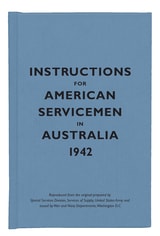
Instructions for American Servicemen in Australia, 1942
Edited by the Bodleian Library
Bodleian Library Publishing, 2006
“Unlike cricket, which is a polite game, Australian Rules Football creates a desire on the part of the crowd to tear someone apart, usually the referee.” This is only one of the entertaining and astute observations the U.S. military provided in the pocket guides distributed to the nearly one million American soldiers who landed on the shores of Australia between 1942 and 1945. Although the Land Down Under felt more familiar than many of their assignments abroad, American GIs still needed help navigating the distinctly different Aussie culture, and coming to their rescue was Instruction for American Servicemen in Australia, 1942. The newest entry in the Bodleian Library’s bestselling series of vintage pocket guides, this pamphlet is filled with pithy notes on Australian customs, language, and other cultural facts the military deemed necessary for every American soldier.
From the native wildlife—a land of “funny animals”—to the nation’s colonial history to the general characteristics of Australians—“an outdoors sort of people, breezy and very democratic”—Instructions for American Servicemen in Australia gives a concise yet amazingly informative overview of the island nation. Regarding Aussie slang, it notes that “the Australian has few equals in the world at swearing. . . . The commonest swear words are ‘bastard’ (pronounced ‘barstud’), ‘bugger,’ and ‘bloody,’ and the Australians have a genius for using the latter nearly every other word.” The pamphlet also contains a humorous explanation of the country’s musical traditions—including an annotated text of “Waltzing Matilda”—as well as amusing passages on sports, politics, and the Aussies’ attitudes toward Yanks and Brits.
A fascinating look at a neglected Allied front in the Southern hemisphere, Instructions for American Servicemen in Australia, 1942 follows its successful predecessors as a captivating historical document of a pivotal era in history.
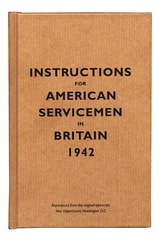
Instructions for American Servicemen in Britain, 1942
Reproduced from the original typescript, War Department, Washington, DCEdited by the Bodleian Library
Bodleian Library Publishing, 2004
The guide was intended to alleviate the culture shock for soldiers taking their first trip to Great Britain, or, for that matter, abroad. The handbook is punctuated with endearingly nostalgic advice and refreshingly candid quips such as: "The British don't know how to make a good cup of coffee. You don't know how to make a good cup of tea. It's an even swap." By turns hilarious and poignant, many observations featured in the handbook remain relevant even today.
Reproduced in a style reminiscent of the era, Instructions for American Servicemen in Britain is a powerfully evocative war-time memento that offers a unique perspective on the longstanding American-British relationship and reveals amusingly incisive American perceptions of the British character and country.

Instructions for American Servicemen in France during World War II
United States Army
University of Chicago Press, 2008
As American soldiers fanned out from their beachhead in Normandy in June of 1944 and began the liberation of France, every soldier carried that reminder in his kit. A compact trove of knowledge and reassurance, Instructions for American Servicemen in France during World War II was issued to soldiers just before they embarked for France to help them understand both why they were going and what they’d find when they got there. After lying unseen in Army archives for decades, this remarkable guide is now available in a new facsimile edition that reproduces the full text and illustrations of the original along with a new introduction by Rick Atkinson setting the book in context.
Written in a straightforward, personal tone, the pamphlet is equal parts guidebook, cultural snapshot, and propaganda piece. A central aim is to dispel any prejudices American soldiers may have about the French—especially relating to their quick capitulation in 1940. Warning soldiers that the defeat “is a raw spot which the Nazis have been riding” since the occupation began, Instructions is careful to highlight France’s long historical role as a major U.S. ally. Following that is a brief, fascinating sketch of the French character (“The French are mentally quick;” “Rich or poor, they are economical”) and stark reminders of the deprivation the French have endured under occupation. Yet an air of reassuring confidence pervades the final section of the pamphlet, which reads like a straightforward tourists’ guide to Paris and the provinces—like a promise of better days to come once the soldiers complete their mission.
Written by anonymous War Department staffers to meet the urgent needs of the moment, with no thought of its historical value, Instructionsfor American Servicemen in France during World War II nevertheless brings to vivid life the closing years of World War II—when optimism was growing, but a long, demanding road still lay ahead.

Instructions for American Servicemen in Iraq during World War II
United States Army
University of Chicago Press, 2007
The U.S. military could certainly have used that bit of wisdom in 2003, as violence began to eclipse the Iraq War’s early successes. Ironically, had the Army only looked in its own archives, they would have found it—that piece of advice is from a manual the U.S. War Department handed out to American servicemen posted in Iraq back in 1943.
The advice in Instructions for American Servicemen in Iraq during World War II,presented here in a new facsimile edition, retains a surprising, even haunting, relevance in light of today’s muddled efforts to win Iraqi hearts and minds. Designed to help American soldiers understand and cope with what was at the time an utterly unfamiliar culture—the manual explains how to pronounce the word Iraq, for instance—this brief, accessible handbook mixes do-and-don’t-style tips (“Always respect the Moslem women.” “Talk Arabic if you can to the people. No matter how badly you do it, they will like it.”) with general observations on Iraqi history and society. The book’s overall message still rings true—dramatically so—more than sixty years later: treat an Iraqi and his family with honor and respect, and you will have a strong ally; treat him with disrespect and you will create an unyielding enemy.
With a foreword by Lieutenant Colonel John A. Nagl reflecting on the manual’s continuing applicability—and lamenting that it was unknown at the start of the invasion—this new edition of Instructions for American Servicemen in Iraq will be essential reading for anyone who cares about the future of Iraq and the fate of the American soldiers serving there.
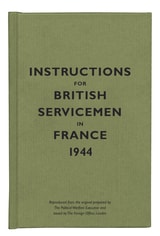
Instructions for British Servicemen in France, 1944
Edited by the Bodleian Library
Bodleian Library Publishing, 2006
Instructions for British Servicemen in France, 1944 reminds British soldiers of the common points of culture and history Britain shares with France, and, above all, their mutual aim of defeating Hitler. The pamphlet attempts to teach British soldiers the ways of the French and warns them not give in to their urges: “If you should happen to imagine that the first pretty French girl who smiles at you intends to dance the can-can or take you to bed, you risk stirring up a lot of trouble for yourself—and for our relations with the French.” The pamphlet also features a pronunciation guide (“Bonjewer, commont-allay-voo?”), a list of useful phrases, and an unflinching account of the diseases and poverty ravaging the citizens of battle-torn France.
Instructions for British Servicemen in France, 1944 captures the complex dynamics of Anglo-French relations during the Second World War on an intimate and often humorous level and reveals all the fascinating aspects of life off the battlefield. Essential for the shelf of every historian and history buff, Instructions for British Servicemen in France, 1944 is a small document that nonetheless speaks volumes about its era.

Instructions for British Servicemen in Germany, 1944
Edited by the Bodleian Library
Bodleian Library Publishing, 2007
The pamphlet is both a succinct survey of German politics, culture, and history and a work of British propaganda. Not only does the pamphlet cover general cultural topics such as food and drink, currency, and social customs, but it also explains the effect of years of the war on Germans and their attitudes toward the British. The book admonishes, “The Germans are not good at controlling their feelings. They have a streak of hysteria. You will find that Germans may often fly into a passion if some little thing goes wrong.” The mix of humor and crude stereotypes—“If you have to give orders to German civilians, give them in a firm, military manner. The German civilian is used to it and expects it”—in the text make this pamphlet a stark reminder of the wartime fears and hopes of the British.
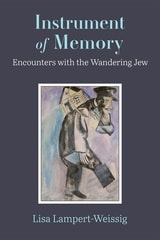
Instrument of Memory
Encounters with the Wandering JewLisa Lampert-Weissig
University of Michigan Press, 2024
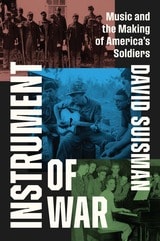
Instrument of War
Music and the Making of America's SoldiersDavid Suisman
University of Chicago Press, 2024
An original history of music in the lives of American soldiers.
Since the Civil War, music has coursed through the United States military. Soldiers have sung while marching, listened to records and armed forces radio, and packed the seats at large-scale USO shows. The bugle call “reveille” has roused soldiers in the morning, and “taps” has marked the end of a long day. Whether the sounds come from brass instruments, weary and homesick singers, or a pair of heavily used earbuds, where there has been war, there has been music, too.
Instrument of War is a first-of-its-kind study of music in the lives of American soldiers. Although musical activity has been part of war since time immemorial, the significance of the U.S. military as a musical institution has generally gone unnoticed. Historian David Suisman traces how the U.S. military has used—and continues to use—music to train soldiers and regulate military life, and how soldiers themselves have turned to music to cope with war’s emotional and psychological realities. Opening our ears to these practices, Suisman reveals how music has enabled more than a century and a half of American war-making. Instrument of War unsettles assumptions about music as a force of uplift and beauty, demonstrating how it has also been entangled in large-scale state violence.
From chanting “Sound off!” in basic training to switching on a phonograph or radio or cueing up an iPod playlist during a patrol, the sound of music has long resonated in soldiers’ wartime experiences. Now we all can finally hear it.