Results by title
3745 books match the query 'Europe' and 130 start with i
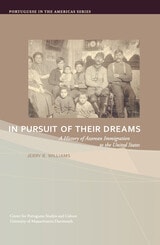
In Pursuit of Their Dreams
A History of Azorean Immigration to the United StatesJerry R. Williams
Tagus Press, 2007
Jerry Williams' history of Azorean immigration to the United States offers us valuable insight into the experience and culture of Portuguese immigrants and their descendants. This account fills a major gap in American immigration history and gives us a comprehensive overview of how Portuguese-Americans—now numbering close to a million people—have come to constitute a vibrant and highly visible presence within southeastern New England, the areas around San Francisco and San Diego, Hawaii, and the New Jersey/New York metropolitan area. Even though Azorean immigrants all came from similar cultural and social backgrounds, Williams shows how regionally specific opportunity structures and social hierarchies have contributed to significant differences within the Portuguese-American experience.
Starting with the whaling routes that first connected the mid-Atlantic archipelago with the ports of call in New England and California in the early 1800s, Williams lays out the complex relationship between the Azores and the US that has continued into the present. We learn how particular patterns of poverty, overpopulation and social inequality in the Azores pushed large numbers of the islands' inhabitants to leave their homes in search of better opportunities for themselves and their children. He tells the story of how the early whalers who jumped ship in New Bedford, San Francisco, or Hawaii were followed by kin and fellow villagers who had heard of plentiful jobs in New England's textile mills, gold and land in California, or agricultural work on Hawaiian plantations. Williams' account allows us to understand the importance of family and community connections throughout the immigrants' arduous transition from peasant life to industrial society.

In Quest of History
On Czech Statehood and IdentityJirí Pribán and Karel Hvíždala
Karolinum Press, 2019
In Search of the Perfect Romanian
National Specificity, Racial Degeneration, and Social Selection in Modern RomaniaMarius Turda
Central European University Press, 2026
The book centers on debates about the Romanian national character and race between 1880s and 1950s. It also argues that during the early 1940s anti-Semitism and anti-Roma racism contributed directly to the programme of ethnic purification pursued by the Antonescu regime. Racism and eugenics explain not just the deportation and murder of the Jews but also the deportation and murder of the Roma. The Holocaust in Romania should therefore be understood as the result not just of anti-Semitism but also of biopolitical nationalism. Finally, the book suggests that the eugenic ideal of the ‘perfect’ Romanian did not disappear in 1945 but was embedded in the socialist definitions of the ‘new man’ and ‘perfect’ society emerging under communism.
In Times of Crisis
Essays on European Culture, Germans, and JewsSteven E. Aschheim
University of Wisconsin Press, 2001
The nineteenth- and twentieth-century relationship between European culture, German history, and the Jewish experience produced some of the West’s most powerful and enduring intellectual creations—and, perhaps in subtly paradoxical and interrelated ways, our century’s darkest genocidal moments. In Times of Crisis explores the flashpoints of this vexed relationship, mapping the coordinates of a complex triangular encounter of immense historical import.
In essays that range from the question of Nietzsche’s legacy to the controversy over Daniel Goldhagen’s Hitler’s Willing Executioners, the distinguished historian Steven E. Aschheim presents this encounter as an ongoing dialogue between two evolving cultural identities. He touches on past dimensions of this exchange (such as the politics of Weimar Germany) and on present dilemmas of grasping and representing it (such as the Israeli discourse on the Holocaust). His work inevitably traces the roots and ramifications of Nazism but at the same time brings into focus historical circumstances and contemporary issues often overshadowed or distorted by the Holocaust.
These essays reveal the ubiquitous charged inscriptions of Nazi genocide within our own culture and illuminate the projects of some later thinkers and historians—from Hannah Arendt to George Mosse to Saul Friedlander—who have wrestled with its problematics and sought to capture its essence. From the broadly historical to the personal, from the politics of Weimar Germany to the experience of growing up German Jewish in South Africa, the essays expand our understanding of German Jewish history in particular, but also of historical processes in general.
In and Of the Mediterranean
Medieval and Early Modern Iberian StudiesMichelle M. Hamilton
Vanderbilt University Press, 2014
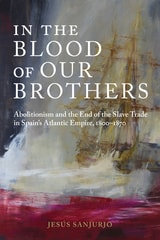
In the Blood of Our Brothers
Abolitionism and the End of the Slave Trade in Spain's Atlantic Empire, 1800–1870Jesús Sanjurjo
University of Alabama Press, 2021
FINALIST FOR THE PAUL E. LOVEJOY BOOK PRIZE
Unraveling the complex politics behind the end of the slave trade in Spain's Atlantic Empire.
Throughout the nineteenth century, very few people in Spain campaigned to stop the slave trade and did even less to abolish slavery. Even when some supported abolition, the reasons that moved them were not always humanitarian, liberal, or egalitarian. How abolitionist ideas were received, shaped, and transformed during this period has been ripe for study. Jesús Sanjurjo’s In the Blood of Our Brothers: Abolitionism and the End of the Slave Trade in Spain’s Atlantic Empire, 1800–1870 provides a comprehensive theory of the history, the politics, and the economics of the persistence and growth of the slave trade in the Spanish empire even as other countries moved toward abolition.
Sanjurjo privileges the central role that British activists and diplomats played in advancing the abolitionist cause in Spain. In so doing, he brings to attention the complex and uneven development of abolitionist and antiabolitionist discourses in Spain’s public life, from the beginning of the nineteenth century to the end of the transatlantic trade. His delineation of the ideological and political tension between Spanish liberalism and imperialism is crucial to formulating a fuller explanation of the reasons for the failure of anti–slave trade initiatives from 1811 to the 1860s. Slave trade was tied to the notion of inviolable property rights, and slavery persisted and peaked following three successful liberal revolutions in Spain.
Visit https://inthebloodofourbrothers.com/ for more information.
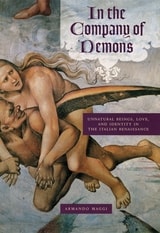
In the Company of Demons
Unnatural Beings, Love, and Identity in the Italian RenaissanceArmando Maggi
University of Chicago Press, 2006
Maggi leads us straight to the heart of what Italian Renaissance culture thought familiar spirits were. Through close readings of Giovan Francesco Pico della Mirandola, Strozzi Cigogna, Pompeo della Barba, Ludovico Sinistrari, and others, we find that these spirits or demons speak through their sudden and striking appearances—their very bodies seen as metaphors to be interpreted. The form of the body, Maggi explains, relies on the spirits’ knowledge of their human interlocutors’ pasts. But their core trait is compassion, and sometimes their odd, eerie arrivals are seen as harbingers or warnings to protect us. It comes as no surprise then that when spiritual beings distort the natural world to communicate, it is vital that we begin to listen.

In the Forest of Metropoles
Karl-Markus Gauß
Seagull Books, 2024
A Herodotus of Mitteleuropa, cultural historian Karl-Markus Gauß is essential reading for anyone trying to understand the breadth and complexities of cultures and societies in Europe before, during, and after its decades of division in the twentieth century.
In this book, Gauß takes his readers on a thirteen-station journey across Europe. From Brussels to Istanbul and from Naples to Opole, Gauß weaves a Sebaldian web of connection and coincidence into a hybrid cultural history. Significantly, Gauß’s metropoles are not the well-trodden, thoroughly explored, and minutely documented megalopolises and cultural capitals that have been mythologized by writers great and small. There are no visits to Berlin, Paris, Rome, or Madrid, although he does make time for Vienna, where he looks not for imperial remnants, but for traces of genius unrecognized by most. Gauß’s lodestars are small but cosmopolitan towns on the periphery, such as Slaghenaufi, Vacaresti, Fontevraud, Dragatus, Vrzdenec, and Sélestat. In these far-flung towns, Gauß assembles a canon of overlooked humanists, expelled or extinguished by political and historical forces that swept the continent.

In the House of the Hangman
The Agonies of German Defeat, 1943-1949Jeffrey K. Olick
University of Chicago Press, 2005
In the House of the Hangman chronicles this delicate process, exploring key debates about the Nazi past and German future during the later years of World War II and its aftermath. What did British and American leaders think had given rise to National Socialism, and how did these beliefs shape their intentions for occupation? What rhetorical and symbolic tools did Germans develop for handling the insidious legacy of Nazism? Considering these and other questions, Jeffrey K. Olick explores the processes of accommodation and rejection that Allied plans for a new German state inspired among the German intelligentsia. He also examines heated struggles over the value of Germany's institutional and political heritage. Along the way, he demonstrates how the moral and political vocabulary for coming to terms with National Socialism in Germany has been of enduring significance—as a crucible not only of German identity but also of contemporary thinking about memory and social justice more generally.
Given the current war in Iraq, the issues contested during Germany's abjection and reinvention—how to treat a defeated enemy, how to place episodes within wider historical trajectories, how to distinguish varieties of victimhood—are as urgent today as they were sixty years ago, and In the House of the Hangman offers readers an invaluable historical perspective on these critical questions.
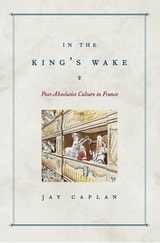
In the King's Wake
Post-Absolutist Culture in FranceJay Caplan
University of Chicago Press, 1999
While absolutist culture had focused on value directly represented in people (e.g., those of noble blood) and things (e.g., coins made of precious metals), post-absolutist culture instead explored the capacity of signs to stand for something real (e.g., John Law's banknotes or Marivaux's plays in which actions rather than birth signify nobility). Between the image of the Sun King and visions of the godlike Romantic self, Caplan discovers a post-absolutist France wracked by surprisingly modern conflicts over the true sources of value and legitimacy.

In the Name of Women's Rights
The Rise of FemonationalismSara R. Farris
Duke University Press, 2017

In the Nineties
John Stokes
University of Chicago Press, 1990
Spurning fixed boundaries, Stokes relates the controversial topics of the day—the status of the "New Journalism," the "degenerative" influence of Impressionist painting, the dubious morality of the music hall, the urgent need for prison reform, and the prevalence of suicide—to primary literary texts, such as The Ballad of Reading Gaol, The Importance of Being Earnest, Jude the Obscure, and Portrait of a Lady. And in the process, he explores crucial areas of sociological and psychological interest: criminality, sexuality, madness, and "morbidity."
Each of the book's six chapters opens with a look at the correspondence columns of daily newspapers and goes on, with a keen eye for the hidden link, to pursue a particular theme. Locations shift from Leicester Square and the Thames embankment to the Normandy coast and the Paris morgue and feature, along with famous names, a lesser known company of acrobats, convicts, aesthetes, "philistines," and mysterious suicides.
Nearly a century later, John Stokes's unrivalled knowledge of how the arts actually functioned in the nineties makes this book a major contribution to modern cultural studies.

In the Shadow of the Magic Mountain
The Erika and Klaus Mann StoryAndrea Weiss
University of Chicago Press, 2008
Thomas Mann’s two eldest children, Erika and Klaus, were unconventional, rebellious, and fiercely devoted to each other. Empowered by their close bond, they espoused vehemently anti-Nazi views in a Europe swept up in fascism and were openly, even defiantly, gay in an age of secrecy and repression. Although their father’s fame has unfairly overshadowed their legacy, Erika and Klaus were serious authors, performance artists before the medium existed, and political visionaries whose searing essays and lectures are still relevant today. And, as Andrea Weiss reveals in this dual biography, their story offers a fascinating view of the literary and intellectual life, political turmoil, and shifting sexual mores of their times.
In the Shadow of the Magic Mountain begins with an account of the make-believe world the Manns created together as children—an early sign of their talents as well as the intensity of their relationship. Weiss documents the lifelong artistic collaboration that followed, showing how, as the Nazis took power, Erika and Klaus infused their work with a shared sense of political commitment. Their views earned them exile, and after escaping Germany they eventually moved to the United States, where both served as members of the U.S. armed forces. Abroad, they enjoyed a wide circle of famous friends, including Andre Gide, Christopher Isherwood, Jean Cocteau, and W. H. Auden, whom Erika married in 1935. But the demands of life in exile, Klaus’s heroin addiction, and Erika’s new allegiance to their father strained their mutual devotion, and in 1949 Klaus committed suicide.
Beautiful never-before-seen photographs illustrate Weiss’s riveting tale of two brave nonconformists whose dramatic lives open up new perspectives on the history of the twentieth century.

In the Shadows of Romance
Romantic Tragic Drama in Germany, England, and FranceJeffrey N. Cox
Ohio University Press, 2011
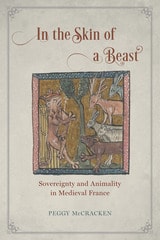
In the Skin of a Beast
Sovereignty and Animality in Medieval FrancePeggy McCracken
University of Chicago Press, 2017
Peggy McCracken discusses a range of literary texts and images from medieval France, including romances in which animal skins appear in symbolic displays of power, fictional explorations of the wolf’s desire for human domestication, and tales of women and snakes converging in a representation of territorial claims and noble status. These works reveal that the qualities traditionally used to define sovereignty—lineage and gender among them—are in fact mobile and contingent. In medieval literary texts, as McCracken demonstrates, human dominion over animals is a disputed model for sovereign relations among people: it justifies exploitation even as it mandates protection and care, and it depends on reiterations of human-animal difference that paradoxically expose the tenuous nature of human exceptionalism.

In the Solitude of My Soul
The Diary of Genevieve Breton, 1867-1871James Smith Allen
Southern Illinois University Press, 1994
Originally published to glowing reviews and literary prizes in France in 1985, this revealing diary not only recounts the moving and tragic relationship of its author, Geneviève Bréton, with the rising young nineteenth-century artist Henri Regnault, it also serves as a valuable historical document concerning the social, cultural, and political life of the French Second Empire.
The young Geneviève Bréton began her journal in 1867 as a consolation for the death of her eldest brother, Antoine. She met Regnault soon after on a trip to Rome. Throughout the next four years of their relationship, Bréton eloquently describes the personal, cultural, and political turbulence that affected her life. Writing against the backdrop of France’s fateful conflict with Prussia and the hardships and dangers of the siege of Paris and the Commune, Bréton, with innate candor and lyricism, creates a text that beautifully illuminates French art, literature, family life, society, and politics of the time. Her poignant account of her love for and engagement to Regnault reveals special insight into the life and mind of an extraordinary, though little known, literary talent. At Regnault’s death in 1871 during the Franco–Prussian War, the expression of her anguish is as much testimony to the political and cultural disorder of the time as it is to her own personal tragedy.
Following Bréton’s own instructions that she left before her death in 1918, this English version of the diary reincorporates material that was deleted from the French edition. Graced by rare photographs of the Bréton family as well as Regnault’s paintings, the book contains a touching foreword by the author’s granddaughter, Daphné Doublet-Vaudoyer. In its first English translation, it is a book for lovers of French life and culture, as well as students of French history; literature, and art.
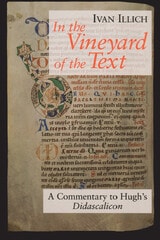
In the Vineyard of the Text
A Commentary to Hugh's DidascaliconIvan Illich
University of Chicago Press, 1993
Examining the Didascalicon of Hugh of St. Victor, Illich celebrates the culture of the book from the twelfth century to the present. Hugh's work, at once an encyclopedia and guide to the art of reading, reveals a twelfth-century revolution as sweeping as that brought about by the invention of the printing press and equal in magnitude only to the changes of the computer age—the transition from reading as a vocal activity done in the monastery to reading as a predominantly silent activity performed by and for individuals.

Inari Sámi Folklore
Stories from AanaarAugust V. Koskimies and Toivo I. Itkonen, revised by Lea Laitinen; Edited and translated by Tim Frandy
University of Wisconsin Press, 2020
First published in 1918 only in the Aanaar Sámi language and in Finnish, this anthology is now available in a centennial English-language edition for a global readership. Translator Tim Frandy has added biographies of the storytellers, maps and period photos, annotations, and a glossary. In headnotes that contextualize the stories, he explains such underlying themes as Aanaar conflicts with neighboring Sámi and Finnish communities, the collapse of the wild reindeer populations less than a century before, and the pre-Christian past in Aanaar. He introduces us to the bawdy humor of Antti Kitti, the didacticism of Iisakki Mannermaa, and the feminist leanings of Juho Petteri Lusmaniemi, emphasizing that folktales and proverbs are rooted in the experiences of individuals who are links in a living tradition.
Increase And Multiply
Governing Cultural Reproduction In Early Modern EnglandDavid Glimp
University of Minnesota Press, 2003
A wide-ranging study of the ideology of population control in early modern England
Across the sixteenth and seventeenth centuries, a growing notion of the value of a large populace created a sense of urgency about reproduction; accordingly, a wide array of English writers of the time voiced the need not merely to add more people but also to ensure that England had an abundance of the right kinds of people. This need, in turn, called for a variety of institutions to train—and thus make, through a kind of nonbiological procreation—pious, enterprising, and dutiful subjects. In Increase and Multiply, David Glimp examines previously unexplored links between this emergent demographic mentality and Renaissance literature.
Glimp’s analysis centers on humanist pedagogy as a mechanism for creating people capable of governing both themselves and others. Acknowledging the ways in which authors such as Sidney, Shakespeare, and Milton advance their own work by appealing to this vision, Glimp argues that their texts allow us to read the scope and limits of this generative ideal, its capacity to reinforce order and to become excessive and destabilizing. His work provides unprecedented insight into the role of fantasies of nonbiological reproduction in early modern political theory, government practice, and literary production.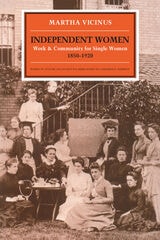
Independent Women
Work and Community for Single Women, 1850-1920Martha Vicinus
University of Chicago Press, 1985
"Feminist insight combines with vast research to produce a dramatic narrative. Independent Women chronicles the energetic lives and imaginative communal structures invented by women who 'pioneered new occupations, new living conditions, and new public roles.'"—Lee R. Edwards, Ms.
"Vicinus is to be congratulated for her brave and unflinching portraits of twisted spinsters as well as stolid saints. That she stretches her net up into the '20s and covers the women's suffrage momement is a brilliant stroke, for one may see clearly how it was possible for women to mount such an enormous and successful political campaign."—Jane Marcus, Chicago Tribune Book World
"Vicinus' beautifully written book abounds in rich historical detail and in subtle psychological insights in the character of its protagonists. The author understands the complexities of the interplay between economic and social conditions, cultural values, and the aims and aspirations of individual personalities who act in history. . . . A superb achievement."—Gerda Lerner, Reviews in American History
"Martha Vicinus has with intelligence and energy paved and landscaped the road on which scholars and students of activist women all travel for many years."—Blanche Wiesen Cook, Women's Review of Books
"Independent Women can be read by anyone with an interest in women's history. But for all contemporary women, unconsciously enjoying privileges and freedoms once bought so dearly, this book should be required reading."—Catharine E. Boyd, History
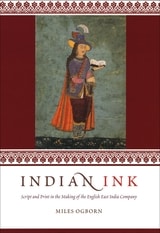
Indian Ink
Script and Print in the Making of the English East India CompanyMiles Ogborn
University of Chicago Press, 2007
A commercial company established in 1600 to monopolize trade between England and the Far East, the East India Company grew to govern an Indian empire. Exploring the relationship between power and knowledge in European engagement with Asia, Indian Ink examines the Company at work and reveals how writing and print shaped authority on a global scale in the seventeenth and eighteenth centuries.
Tracing the history of the Company from its first tentative trading voyages in the early seventeenth century to the foundation of an empire in Bengal in the late eighteenth century, Miles Ogborn takes readers into the scriptoria, ships, offices, print shops, coffeehouses, and palaces to investigate the forms of writing needed to exert power and extract profit in the mercantile and imperial worlds. Interpreting the making and use of a variety of forms of writing in script and print, Ogborn argues that material and political circumstances always undermined attempts at domination through the power of the written word.
Navigating the juncture of imperial history and the history of the book, Indian Ink uncovers the intellectual and political legacies of early modern trade and empire and charts a new understanding of the geography of print culture.
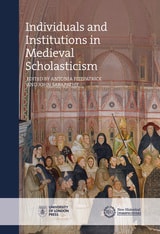
Individuals and Institutions in Medieval Scholasticism
Edited by Antonia Fitzpatrick and John Sabapathy
University of London Press, 2020

Inferno in Chechnya
The Russian-Chechen Wars, the Al Qaeda Myth, and the Boston Marathon BombingsBrian Glyn Williams
University Press of New England, 2015
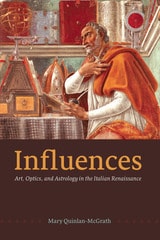
Influences
Art, Optics, and Astrology in the Italian RenaissanceMary Quinlan-McGrath
University of Chicago Press, 2013
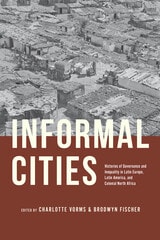
Informal Cities
Histories of Governance and Inequality in Latin Europe, Latin America, and Colonial North AfricaEdited by Charlotte Vorms and Brodwyn Fischer
University of Chicago Press, 2025
An empirically rich reconstruction of how informality became an intrinsic part of urban life across three continents.
Over a quarter of the world’s urban population lives in informal settlements. While informality as a concept has been widely debated, we still know very little about the phenomenon’s urban history or how that history has shaped the evolution of world cities. Spotlighting the historical processes that have created and sustained urban informality for more than a century, editors Charlotte Vorms and Brodwyn Fischer and this volume’s contributors reveal informality as an intrinsic feature of urbanity, shaping not only cities across the globe but also deeper processes of state formation, socioeconomic stratification, and political struggle.
The volume brings together case studies spanning more than a hundred years, drawn from Latin America (Brazil, Chile, Venezuela, and Mexico), Northern Africa (Morocco and Algeria), and Latin Europe (France, Spain, and Italy). Together, they show that informality is neither a contemporary crisis nor a predicament unique to the Global South. Topics include the origins of informal settlements and their relationship with law and institutional power; grassroots efforts to legitimize shantytown communities; mass social movements for rights to the city; the role that shantytown removal campaigns played in populist politics, fascism, and colonialism; and the ways that informality perpetuated racial and ethnic inequalities. Informal Cities is an indispensable guide to the complex and fraught terrain of urban informality in its many historical guises.
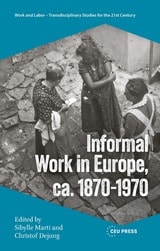
Informal Work in Europe, ca. 1870–1970
Sibylle Marti
Central European University Press, 2026
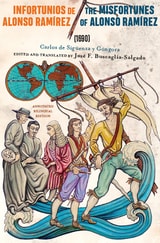
Infortunios de Alonso Ramirez / The Misfortunes of Alonso Ramirez (1690)
Annotated Bilingual EditionBuscaglia-Salgado, José F
Rutgers University Press, 2018

Infrastructural Development, Corruption, Xenophobia, and Colonization in Central and Southeastern Europe
Silvia Marton
Central European University Press, 2026
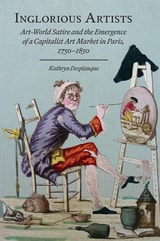
Inglorious Artists
Art World Satire and the Emergence of a Capitalist Art Market in Paris, 1750-1850Kathryn Desplanque
University of Delaware Press, 2025
This book is also freely available online as an open access digital edition.
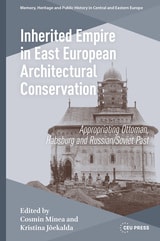
Inherited Empire in East European Architectural Conservation
Appropriating Ottoman, Habsburg and Russian/Soviet PastCosmin Minea
Central European University Press, 2026
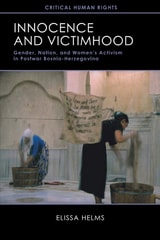
Innocence and Victimhood
Gender, Nation, and Women’s Activism in Postwar Bosnia-HerzegovinaElissa Helms
University of Wisconsin Press, 2013

Innocent Lens
Race and Visibility on the Swedish ScreenBenjamin Mier-Cruz
University of Wisconsin Press, 2027
Sweden, like other Nordic countries, prides itself on being “colorblind” or immune to the kinds of racism found in, for example, the United States. In the 1960s and 1970s, white Swedish documentarians, in the fashion of early anthropologists, recorded racial tensions amid the US civil rights movement. More recently, in the twenty-first century, short films produced by Swedes of color have tackled racism and bigotry within Sweden.
Benjamin Mier-Cruz offers a comparative study of these two periods of Swedish documentary filmmaking. “Racially innocent” white documentarians of the mid-twentieth century developed an “aesthetics of altruism” predicated on Sweden’s assumed racial equalitarianism—a notion that their documentaries in turn helped create and maintain. In contemporary films, on the other hand, Swedes of color use the same filmic format to challenge not only their predecessors’ reductionist, pseudo-anthropological presentations but also Sweden’s purportedly colorblind ideology. Mier-Cruz’s close readings of films from both eras demonstrate the possibilities and limitations of the documentary form and the ways in which it is motivated by politics and activism.
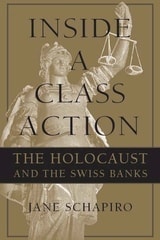
Inside a Class Action
The Holocaust and the Swiss BanksJane Schapiro
University of Wisconsin Press, 2003
On October 21, 1996, attorney Michael Hausfeld, with a team of lawyers, filed a class-action complaint against Union Bank of Switzerland, Swiss Bank Corporation, and Credit Suisse on behalf of Holocaust victims. The suit accused the banks of, among other things, acting as the chief financiers for Nazi Germany. Hausfeld wanted to use the suit to prove that the banks not only concealed and refused to return millions of dollars in dormant accounts, but that they acted as a conduit for looted assets and slave labor profits. Such behavior, he charged, violated the code of ethics known as customary international law. On August 12, 1998, the plaintiffs and banks reached a $1.25 billion settlement.
Through interviews with a wide range of people involved in the case and detailed research of documents and court transcripts, Jane Schapiro shows the ways that egos, personalities, and values clash in such a complex and emotionally charged case. Inside a Class Action provides an insider’s view of a major lawsuit from its inception to its conclusion, which will appeal to anyone interested in human rights, reparations, and international law.

Inside the Antisemitic Mind
The Language of Jew-Hatred in Contemporary GermanyMonika Schwarz-Friesel and Jehuda Reinharz
Brandeis University Press, 2017

Institutional Theatrics
Performing Arts Policy in Post-Wall BerlinBrandon Woolf
Northwestern University Press, 2021
2022 Outstanding Book Award Finalist from the Association for Theater in Higher Education (ATHE)
In a city struggling to determine just how neoliberal it can afford to be, what kinds of performing arts practices and institutions are necessary—and why?
Since the fall of the Berlin Wall, political and economic agendas in the reunified German capital have worked to dismantle long-standing traditions of state‑subsidized theater even as the city has redefined itself as a global arts epicenter. Institutional Theatrics charts the ways theater artists have responded to these shifts and crises both on- and offstage, offering a method for rethinking the theater as a vital public institution.
What is the future of the German theater, grounded historically in large ensembles, extensive repertoires, and auteur directors? Examining the restructuring of Berlin’s theatrical landscape and most prominent performance venues, Brandon Woolf argues that cultural policy is not simply the delegation and distribution of funds. Instead, policy should be thought of as an artistic practice of institutional imagination. Woolf demonstrates how performance can critique its patron institutions in order to transform the relations between the stage and the state, between the theater and the infrastructures of its support. Bold, nuanced, and rigorously documented, Institutional Theatrics offers new insights about art, its administration, and the forces that influence cultural production.
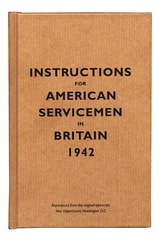
Instructions for American Servicemen in Britain, 1942
Reproduced from the original typescript, War Department, Washington, DCEdited by the Bodleian Library
Bodleian Library Publishing, 2004
The guide was intended to alleviate the culture shock for soldiers taking their first trip to Great Britain, or, for that matter, abroad. The handbook is punctuated with endearingly nostalgic advice and refreshingly candid quips such as: "The British don't know how to make a good cup of coffee. You don't know how to make a good cup of tea. It's an even swap." By turns hilarious and poignant, many observations featured in the handbook remain relevant even today.
Reproduced in a style reminiscent of the era, Instructions for American Servicemen in Britain is a powerfully evocative war-time memento that offers a unique perspective on the longstanding American-British relationship and reveals amusingly incisive American perceptions of the British character and country.

Instructions for American Servicemen in France during World War II
United States Army
University of Chicago Press, 2008
As American soldiers fanned out from their beachhead in Normandy in June of 1944 and began the liberation of France, every soldier carried that reminder in his kit. A compact trove of knowledge and reassurance, Instructions for American Servicemen in France during World War II was issued to soldiers just before they embarked for France to help them understand both why they were going and what they’d find when they got there. After lying unseen in Army archives for decades, this remarkable guide is now available in a new facsimile edition that reproduces the full text and illustrations of the original along with a new introduction by Rick Atkinson setting the book in context.
Written in a straightforward, personal tone, the pamphlet is equal parts guidebook, cultural snapshot, and propaganda piece. A central aim is to dispel any prejudices American soldiers may have about the French—especially relating to their quick capitulation in 1940. Warning soldiers that the defeat “is a raw spot which the Nazis have been riding” since the occupation began, Instructions is careful to highlight France’s long historical role as a major U.S. ally. Following that is a brief, fascinating sketch of the French character (“The French are mentally quick;” “Rich or poor, they are economical”) and stark reminders of the deprivation the French have endured under occupation. Yet an air of reassuring confidence pervades the final section of the pamphlet, which reads like a straightforward tourists’ guide to Paris and the provinces—like a promise of better days to come once the soldiers complete their mission.
Written by anonymous War Department staffers to meet the urgent needs of the moment, with no thought of its historical value, Instructionsfor American Servicemen in France during World War II nevertheless brings to vivid life the closing years of World War II—when optimism was growing, but a long, demanding road still lay ahead.

Instructions for British Servicemen in France, 1944
Edited by the Bodleian Library
Bodleian Library Publishing, 2006
Instructions for British Servicemen in France, 1944 reminds British soldiers of the common points of culture and history Britain shares with France, and, above all, their mutual aim of defeating Hitler. The pamphlet attempts to teach British soldiers the ways of the French and warns them not give in to their urges: “If you should happen to imagine that the first pretty French girl who smiles at you intends to dance the can-can or take you to bed, you risk stirring up a lot of trouble for yourself—and for our relations with the French.” The pamphlet also features a pronunciation guide (“Bonjewer, commont-allay-voo?”), a list of useful phrases, and an unflinching account of the diseases and poverty ravaging the citizens of battle-torn France.
Instructions for British Servicemen in France, 1944 captures the complex dynamics of Anglo-French relations during the Second World War on an intimate and often humorous level and reveals all the fascinating aspects of life off the battlefield. Essential for the shelf of every historian and history buff, Instructions for British Servicemen in France, 1944 is a small document that nonetheless speaks volumes about its era.

Instructions for British Servicemen in Germany, 1944
Edited by the Bodleian Library
Bodleian Library Publishing, 2007
The pamphlet is both a succinct survey of German politics, culture, and history and a work of British propaganda. Not only does the pamphlet cover general cultural topics such as food and drink, currency, and social customs, but it also explains the effect of years of the war on Germans and their attitudes toward the British. The book admonishes, “The Germans are not good at controlling their feelings. They have a streak of hysteria. You will find that Germans may often fly into a passion if some little thing goes wrong.” The mix of humor and crude stereotypes—“If you have to give orders to German civilians, give them in a firm, military manner. The German civilian is used to it and expects it”—in the text make this pamphlet a stark reminder of the wartime fears and hopes of the British.
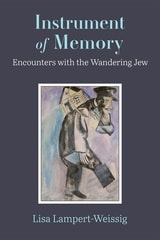
Instrument of Memory
Encounters with the Wandering JewLisa Lampert-Weissig
University of Michigan Press, 2024
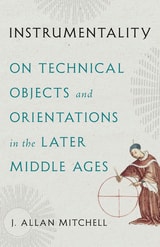
Instrumentality
On Technical Objects and Orientations in the Later Middle AgesJ. Allan Mitchell
University of Minnesota Press, 2024
From medieval to modern, exploring instrumental attitudes toward physical gadgets, diagrams, concepts, methods, and disciplines
Opening up the instrumental condition of the human for critical reflection and renewal, Instrumentality illuminates key moments in the intellectual history of the European Middle Ages. J. Allan Mitchell reveals how, in the predigital past, we can recognize many of the operative technics, analytics, and metaphorics that continue to shape human sense and cognition today.
Exploring the diverse modalities of medieval instruments, Mitchell’s case studies encompass techniques as seemingly distinct as time-keeping mechanisms, mathematical diagrams, logical syllogisms, and the literary devices of Geoffrey Chaucer and John Gower. A cultural and intellectual history, Mitchell’s work leads readers from three-dimensional objects (physical mechanisms) to two-dimensional inscriptions (maps and diagrams) and onward to overarching disciplinary norms in the early liberal and mechanical arts. Prying loose the subtle, adaptable, and generative concept of technical objects from limiting contemporary frameworks, he shows how these instruments are indispensable to the past—and the future—of the arts and culture at large.
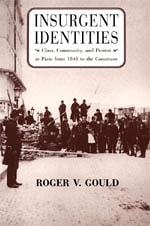
Insurgent Identities
Class, Community, and Protest in Paris from 1848 to the CommuneRoger V. Gould
University of Chicago Press, 1995
The difference was due to Baron Haussmann's massive urban renovation projects between 1852 and 1868, which dispersed workers from Paris's center to newly annexed districts on the outskirts of the city. In these areas, residence rather than occupation structured social relations. Drawing on evidence from trail documents, marriage records, reports of police spies, and the popular press, Gould demonstrates that this fundamental rearrangement in the patterns of social life made possible a neighborhood insurgent movement; whereas the insurgents of 1848 fought and died in defense of their status as workers, those in 1871 did so as members of a besieged urban community.
A valuable resource for historians and scholars of social movements, this work shows that collective identities vary with political circumstances but are nevertheless constrained by social networks. Gould extends this argument to make sense of other protest movements and to offer predictions about the dimensions of future social conflict.
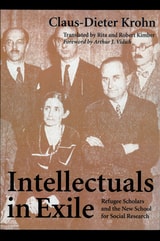
Intellectuals in Exile
Refugee Scholars and the New School for Social ResearchClaus-Dieter Krohn
University of Massachusetts Press, 1993
In the 1930s, with the rise of the Third Reich, thousands of European intellectuals sought refuge in the United States. Through the tireless efforts of Alvin Johnson, director of the New School for Social Research, nearly two hundred of these scholars came to be affiliated with the University in Exile, later known as the Graduate Faculty of Political and Social Science. This book presents an intellectual history of that remarkable group of social and political scientists, documenting their experiences and their influence on both European and American thought.
Johnson was one of the first to recognize the need for action to prevent Hitler’s destruction of the German intellectual tradition. He sought out many of the best European scholars of the day and brought them to the newly created University in Exile in New York. There, the refugees framed as intellectual problems the social and political experiences that had so disrupted their lives and careers. They examined the cultural roots of fascism, the bureaucratization of Western societies, and the prerequisites for a historically and morally informed social science. In the field of economics, the exiles developed theoretical concepts and models that came to be instrumental in the formation of New Deal policies and that remain relevant today.
Interests and Integration
Market Liberalization, Public Opinion, and European UnionMatthew J. Gabel
University of Michigan Press, 1998
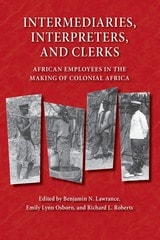
Intermediaries, Interpreters, and Clerks
African Employees in the Making of Colonial AfricaEdited by Benjamin N. Lawrance, Emily Lynn Osborn, and Richard L. Roberts
University of Wisconsin Press, 2006
By uncovering the role of such men (and a few women) in the construction, function, and legal apparatus of colonial states, the essays in this volume highlight a new perspective. They offer important insights on hegemony, collaboration, and resistance, structures and changes in colonial rule, the role of language and education, the production of knowledge and expertise in colonial settings, and the impact of colonization in dividing African societies by gender, race, status, and class.

International Exposure
Perspectives on Modern European Pornography, 1800–2000Sigel, Lisa Z.
Rutgers University Press, 2005
International Exposure demonstrates the wealth of desires woven into the fabric of European history: desires about empire and nation, about self and other, about plenty and dearth. By documenting the diverse meanings of pornography, senior scholars from across disciplines show the ways that sexuality became central to the individual, to the nation, and to the transnational character of modern society.
The ten essays in the volume engage a rich array of topics, including obscenity in the German states, censorship in France’s Third Republic, “she-male” internet porn, the rise of incestuous longings in England, the place of the Hungarian video revolution in the global market, and the politics of pornography in Russia. Taken together, the essays illustrate the latest approaches to content, readership, form, and delivery in modern European pornography.
A substantial discussion of the broad history and state of the field complements the ten in-depth case studies that examine a wide range of sources from literature to magazines, video to the internet. By tackling the highbrow and lowdown of the pornographic form, this volume lays the groundwork for the next surge of studies in the field.

Interrogating Integration
Sport, Celebrity, and Scandal in the Making of New GermanyKate Zambon
University of Michigan Press, 2025
Using touchstones of public memory, including events surrounding men’s World Cup soccer and the record-breaking success of a book blaming Muslims for Germany’s decline, Zambon examines persistent problems in European conceptions of race, where racializing projects take place under an “ideology of racelessness” and the atrocities of historical and transnational racisms are used to deny current local forms of racism.
Interrogation Of Joan Of Arc
Karen Sullivan
University of Minnesota Press, 1999
A radical reassessment of the trial of Joan of Arc that gives a new sense of Joan in her time.
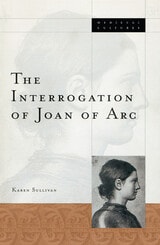
The transcripts of Joan of Arc’s trial for heresy at Rouen in 1431 and the minutes of her interrogation have long been recognized as our best source of information about the Maid of Orleans. Historians generally view these legal texts as a precise account of Joan’s words and, by extension, her beliefs. Focusing on the minutes recorded by clerics, however, Karen Sullivan challenges the accuracy of the transcript. In The Interrogation of Joan of Arc, she re-reads the record not as a perfect reflection of a historical personality’s words, but as a literary text resulting from the collaboration between Joan and her interrogators.
Sullivan provides an illuminating and innovative account of Joan’s trial and interrogation, placing them in historical, social, and religious context. In the fifteenth century, interrogation was a method of truth-gathering identified not with people like Joan, who was uneducated, but with clerics, like those who tried her. When these clerics questioned Joan, they did so as scholastics educated at the University of Paris, as judges and assistants to judges, and as pastors trained in hearing confessions.The Interrogation of Joan of Arc traces Joan’s conflicts with her interrogators not to differing political allegiances, but to fundamental differences between clerical and lay cultures. Sullivan demonstrates that the figure depicted in the transcripts as Joan of Arc is a complex, multifaceted persona that results largely from these cultural differences. Discerning and innovative, this study suggests a powerful new interpretive model and redefines our sense of Joan and her time.
Intersections in Turkish Literature
Essays in Honor of James Stewart-RobinsonWalter G. Andrews, Editor
University of Michigan Press, 2001
Intersections in Turkish Literature is a collection of essays on Turkish literature by former students of James Stewart-Robinson. The topics and methods cover a broad range--from a careful thematic analysis of a traditional Turkish folktale, which reveals its resemblance to well-known Western tales; to an analysis of the "saint tales" recounted by present-day Albanian Bektasi adepts; to a study of narrative rhythm in Nazim Hikhmet's rendition of an account of a fifteenth-century popular uprising.
Walter G. Andrews has assembled the writings of a number of scholars who bridge traditional chasms, inviting us to rethink our approaches to the study of Turkish and Ottoman literature. This collection forms a nucleus that clearly demonstrates the great potential now existing for study in this area, the essays displaying a variety of unusual approaches that bring together seemingly disparate materials: the Turkish story "The Pomegranate Seed" and Disney's "Snow White"; a fifteenth-century chronicle and the poetry of a modern socialist poet; Albanian dervishes in Detroit; a modern Turkish novel; Virginia Woolf; a Yale critic; traditional Japanese poetry; and Ottoman lyrics.
Intersections in Turkish Literature will provide an important stimulus to work that reaches beyond the limits of area studies, intersecting with the interests of scholars and students of literary theory, folklore studies, anthropology, French, Japanese, and Persian.
Walter G. Andrews is Affiliate Professor of Near Eastern Languages and Civilization, University of Washington.
Intimate Reading
Textual Encounters in Medieval Women’s Visions and VitaeJessica Barr
University of Michigan Press, 2020
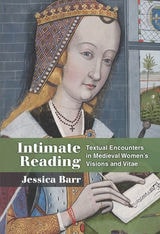
This new volume is structured around five case studies. Chapters consider the biographies of 13th-century holy women from Liège, the writings of Margery Kempe, Gertrude of Helfta, Mechthild of Magdeburg, Marguerite Porete, and Julian of Norwich. At the heart of Intimate Reading is the question of how reading works—what it means to enter imaginatively and intellectually into the words of another. The volume showcases the complexity of medieval understandings of the work of reading, deepening our perception of the written word’s capacity to signify something that lies even beyond rational comprehension.