Results by title
4917 books match the query 'Philosophy' and 177 start with i
Inscriptions
After Phenomenology and StructuralismHugh J. Silverman
Northwestern University Press, 1997
In Inscriptions, Hugh J. Silverman investigates two divergent yet related philosophical movements: phenomenology from the later Husserl through Sartre and Heidegger to Merleau-Ponty, and structuralism from de Saussure through Levi-Strauss and Lacan to Barthes. This reading of the tradition culminates in an assessment of Derrida and Foucault. From this foundation, Silverman moves beyond structuralism and phenomenology, and develops his own philosophical position in the context of semiotics, hermeneutics, and deconstruction. A new preface by the author updates this classic text.
Insecurity
Richard Grusin
University of Minnesota Press, 2022
Investigating insecurity as the predominant logic of life in the present moment
Challenging several key concepts of the twenty-first century, including precarity, securitization, and resilience, this collection explores the concept of insecurity as a predominant logic governing recent cultural, economic, political, and social life in the West. The essays illuminate how attempts to make human and nonhuman systems secure and resilient end up having the opposite effect, making insecurity the default state of life today.
Unique in its wide disciplinary breadth and variety of topics and methodological approaches—from intellectual history and cultural critique to case studies, qualitative ethnography, and personal narrative—Insecurity is written predominantly from the viewpoint of the United States. The contributors’ analyses include the securitization of nongovernmental aid to Palestine, Bangladeshi climate refugees, and the privatization of U.S. military forces; the history of the concept of insecurity and the securitization of finance; racialized urban development in Augusta, Georgia; Amazon’s Mechanical Turk and the consequences of the Marie Kondo method; and the intricate politics of sexual harassment in the U.S. academy.
Contributors: Neel Ahuja, U of California, Santa Cruz; Aneesh Aneesh, U of Wisconsin, Milwaukee; Lisa Bhungalia, Kent State U; Jennifer Doyle, U of California, Riverside; Annie McClanahan, U of California, Irvine; Andrea Miller, Florida Atlantic U; Mark Neocleous, Brunel U London; A. Naomi Paik, U of Illinois, Chicago; Maureen Ryan, U of South Carolina; Saskia Sassen, Columbia U.
Institution and Passivity
Course Notes from the Collège de France (1954-1955)Maurice Merleau-Ponty
Northwestern University Press, 2010
Institution and Passivity is based on course notes for classes taught at the Bibliothèque Nationale de Paris. Philosophically, this collection connects the issue of passive constitution of meaning with the dimension of history, furthering discussions and completing arguments started in The Visible and the Invisible and Signs (both published by Northwestern). Leonard Lawlor and Heath Massey’s translation makes available to an English-speaking readership a critical transitional text in the history of phenomenology.
Instrumental Biology, or The Disunity of Science
Alexander Rosenberg
University of Chicago Press, 1994
In Instrumental Biology, or the Disunity of Science, Alexander Rosenberg argues that while physics and chemistry can develop laws that reveal the structure of natural phenomena, biology is fated to be a practical, instrumental discipline. Because of the complexity produced by natural selection, and because of the limits on human cognition, scientists are prevented from uncovering the basic structure of biological phenomena. Consequently, biology and all of the disciplines that rest upon it—psychology and the other human sciences—must aim at most to provide practical tools for coping with the natural world rather than a complete theoretical understanding of it.
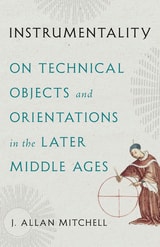
Instrumentality
On Technical Objects and Orientations in the Later Middle AgesJ. Allan Mitchell
University of Minnesota Press, 2024
From medieval to modern, exploring instrumental attitudes toward physical gadgets, diagrams, concepts, methods, and disciplines
Opening up the instrumental condition of the human for critical reflection and renewal, Instrumentality illuminates key moments in the intellectual history of the European Middle Ages. J. Allan Mitchell reveals how, in the predigital past, we can recognize many of the operative technics, analytics, and metaphorics that continue to shape human sense and cognition today.
Exploring the diverse modalities of medieval instruments, Mitchell’s case studies encompass techniques as seemingly distinct as time-keeping mechanisms, mathematical diagrams, logical syllogisms, and the literary devices of Geoffrey Chaucer and John Gower. A cultural and intellectual history, Mitchell’s work leads readers from three-dimensional objects (physical mechanisms) to two-dimensional inscriptions (maps and diagrams) and onward to overarching disciplinary norms in the early liberal and mechanical arts. Prying loose the subtle, adaptable, and generative concept of technical objects from limiting contemporary frameworks, he shows how these instruments are indispensable to the past—and the future—of the arts and culture at large.

Insubordinate Spaces
Improvisation and Accompaniment for Social JusticeBarbara Tomlinson
Temple University Press, 2019
Insubordinate spaces are places of possibility, products of acts of accompaniment and improvisation that deepen capacities for democratic social change. Barbara Tomlinson and George Lipsitz’s Insubordinate Spaces explores the challenges facing people committed to social justice in an era when social institutions have increasingly been reconfigured to conform to the imperatives of a market society.
In their book, the authors argue that education, the arts, and activism are key terrains of political and ideological conflict. They explore and analyze exemplary projects responding to current social justice issues and crises, from the Idle No More movement launched by Indigenous people in Canada to the performance art of Chingo Bling, Fandango convenings, the installation art of Ramiro Gomez, and the mass protests proclaiming “Black Lives Matter" in Ferguson, MO. Tomlinson and Lipsitz draw on key concepts from struggles to advance ideas about reciprocal recognition and co-creation as components in the construction of new egalitarian and democratic social relations, practices, and institutions.
Insult and the Making of the Gay Self
Didier Eribon
Duke University Press, 2004
Eribon describes the emergence of homosexual literature in Britain and France at the turn of the last century and traces this new gay discourse from Oscar Wilde and the literary circles of late-Victorian Oxford to André Gide and Marcel Proust. He asserts that Foucault should be placed in a long line of authors—including Wilde, Gide, and Proust—who from the nineteenth century onward have tried to create spaces in which to resist subjection and reformulate oneself. Drawing on his unrivaled knowledge of Foucault’s oeuvre, Eribon presents a masterful new interpretation of Foucault. He calls attention to a particular passage from Madness and Civilization that has never been translated into English. Written some fifteen years before The History of Sexuality, this passage seems to contradict Foucault’s famous idea that homosexuality was a late-nineteenth-century construction. Including an argument for the use of Hannah Arendt’s thought in gay rights advocacy, Insult and the Making of the Gay Self is an impassioned call for critical, active engagement with the question of how gay life is shaped both from without and within.
Insurgencies
Constituent Power And The Modern StateAntonio Negri
University of Minnesota Press, 1999
Insurgencies
Constituent Power and the Modern StateAntonio Negri
University of Minnesota Press, 2009
New Edition
In the ten years since the initial publication of Insurgencies, Antonio Negri's reputation as one of the world's foremost political philosophers has grown dramatically. An invigorating appraisal of revolutionary thought, Insurgencies is both the precursor to and the historical basis for Antonio Negri and Michael Hardt's masterwork, Empire.
At the center of this book is the conflict between "constituent power," the democratic force of revolutionary innovation, and "constituted power," the fixed power of formal constitutions and central authority. This conflict, Negri argues, defines the drama of modern rebellions. Now with a foreword by Michael Hardt, Insurgencies leads to a new notion of how power and action must be understood if we are to achieve a democratic future.

Intangible Materialism
The Body, Scientific Knowledge, and the Power of LanguageRonald Schleifer
University of Minnesota Press, 2009
Taking as his point of departure Norbert Weiner’s statement that information is basic to understanding materialism in our era, Ronald Schleifer shows how discoveries of modern physics have altered conceptions of matter and energy and the ways in which both information theory and the study of literature can enrich these conceptions. Expanding the reductive notion of “the material” as simply matter and energy, he formulates a new, more inclusive idea of materialism.
Schleifer’s project attempts to bridge the divisions between the humanities and the sciences and to create a nonreductive materialism for the information age. He presents a materialistic account of human bodily experience by delving into language and literature that powerfully represents our faces, voices, hands, and pain. For example, he examines the material resources of poetic “literariness” as it is revealed in the condition of Tourette’s syndrome. Schleifer also investigates gestures of the hand in the formation of sociality, and he studies pain as both a physiological and phenomenological experience.
This ambitious work explores physiological analyses, evolutionary explanations, and semiotic descriptions of materialism to reveal how aspects of physical existence discover meaning in experience.

Integrations
The Struggle for Racial Equality and Civic Renewal in Public EducationLawrence Blum and Zoë Burkholder
University of Chicago Press, 2021
Integrations focuses on multiple marginalized groups in American schooling: African Americans, Native Americans, Latinxs, and Asian Americans. The authors show that in order to grapple with integration in a meaningful way, we must think of integration in the plural, both in its multiple histories and in the many possible definitions of and courses of action for integration. Ultimately, the authors show, integration cannot guarantee educational equality and justice, but it is an essential component of civic education that prepares students for life in our multiracial democracy.
Intellectual Appetite
A Theological GrammarPaul J. Griffiths
Catholic University of America Press, 2009
Intellectual Empathy
Critical Thinking for Social JusticeMaureen Linker
University of Michigan Press, 2014
Intellectual Sacrifice and Other Mimetic Paradoxes
Paolo Diego Bubbio
Michigan State University Press, 2018
Intelligent Guide To Modern Culture
Roger Scruton
St. Augustine's Press, 2000
Intelligibility of Nature
A William A. Wallace ReaderWilliam A. Wallace
Catholic University of America Press, 2022

Intensity
An Essay in Whiteheadian OntologyJudith A. Jones
Vanderbilt University Press, 1998
This important and provocative book on the work of Alfred North Whitehead (1861-1947) explores how his avowed atomism is consistent with his equally essential commitment to a view of reality as a thoroughly interconnected sphere of relations. Judith Jones challenges Whitehead's readers to reconsider certain prevailing interpretations of his organic philosophy. To Jones, a rereading of Whitehead's overall philosophic project is essential to evaluating his contributions to metaphysics and ontology. SinceWhitehead's basic worldview is holistic, a return to viewing Whitehead's work as a whole helps clarify his ontological intentions and contributions to metaphysics.
For this purpose, the concept of "intensity," which Jones defines as the quality and form of feeling involved in subjective experience, is basic to Whitehead's thinking about process at all naturalistic levels and is therefore particularly useful as a lens through which to view his entire system. "Intensity" is at once Whitehead's most basic metaphysical idea and a notion useful in deciphering the overall unity of purpose in his writings. A central aim of this book is to develop an aesthetically sensitive sense of being that demonstrates the profound and original contributions of process philosophy to realism.
Jones shows that a thorough understanding of the concept of intensity yields modes of thought that help overcome knotty problems in conceiving Whitehead's distinction between the private experience of individuals and the public relations those individuals experience in relationship to other entities. Drawing frequently on poetic allusions to aid her interpretations, she focuses specifically on the status of intensity in intellectual and moral experience and develops an ethics of "attention" as an elaboration of Whitehead's aesthetic metaphysics.
The result is a book that should be enthusiastically greeted and debated by scholars of Whitehead and by all who are interested in the field of process thought, including students of theology, literature, and feminist studies. Jones's unorthodox conclusions, backed up with scrupulous attention to both the Whitehead canon and related secondary literature, present challenges to accepted interpretations that cannot be ignored.
Intention Interpretation
edited by Gary Iseminger
Temple University Press, 1995
Intention, Plans and Practical Reason
Michael E. Bratman
CSLI, 1987
Intents and Purposes
Philosophy and the Aesthetics of ImprovisationEric Lewis
University of Michigan Press, 2019
Interactive Cinema
The Ambiguous Ethics of Media ParticipationMarina Hassapopoulou
University of Minnesota Press, 2024
Connecting interactive cinema to media ethics and global citizenship
Interactive Cinema explores various cinematic practices that work to transform what is often seen as a primarily receptive activity into a participatory, multimedia experience. Surveying a multitude of unorthodox approaches throughout the history of motion pictures, Marina Hassapopoulou offers insight into a range of largely ephemeral and site-specific projects that consciously assimilate viewers into their production.
Analyzing examples of early cinema, Hollywood B movies, museum and gallery installations, virtual-reality experiments, and experimental web-based works, Hassapopoulou travels across numerous platforms, highlighting a diverse array of strategies that attempt to unsettle the allegedly passive spectatorship of traditional cinema. Through an exploration of these radically inventive approaches to the medium, many of which emerged out of sociopolitical crises and periods of historical transition, she works to expand notions of interactivity by considering it in both technological and phenomenological terms.
Deliberately revising and expanding Eurocentric scholarship to propose a much broader, transnational scope, the book emphasizes the ethical dimensions of interactive media and their links to larger considerations around community building, citizenship, and democracy. By combining cutting-edge theory with updated conventional film studies methodologies, Interactive Cinema presses at the conceptual limits of cinema and offers an essential road map to the rapidly evolving landscape of contemporary media.
Interanimations
Receiving Modern German PhilosophyRobert B. Pippin
University of Chicago Press, 2015
After opening up his territory with an initial discussion of contemporary revisionist readings of Kant’s moral theory, Pippin sets his sights on his main objects of interest: Hegel and Nietzsche. Through them, however, he offers what few others could: an astonishing synthesis of an immense and diverse set of thinkers and traditions. Deploying an almost dialogical, conversational approach, he pursues patterns of thought that both shape and, importantly, connect the major traditions: neo-Aristotelian, analytic, continental, and postmodern, bringing the likes of Heidegger, Honneth, MacIntyre, McDowell, Brandom, Strauss, Williams, and Žižek—not to mention Hegel and Nietzsche— into the same philosophical conversation.
By means of these case studies, Pippin mounts an impressive argument about a relatively under discussed issue in professional philosophy—the bearing of work in the history of philosophy on philosophy itself—and thereby he argues for the controversial thesis that no strict separation between the domains is defensible.
Interest and Effort in Education
John Dewey. With a new preface by James E. Wheeler
Southern Illinois University Press, 1975
Interior States
Institutional Consciousness and the Inner Life of Democracy in the Antebellum United StatesChristopher Castiglia
Duke University Press, 2008
In the late eighteenth century and early nineteenth, as discourses of interiority gained prominence, so did powerful counter-narratives. Castiglia reveals the flamboyant pages of antebellum popular fiction to be an archive of unruly democratic aspirations. Through close readings of works by Maria Monk and George Lippard, Walt Whitman and Timothy Shay Arthur, Hannah Webster Foster and Hannah Crafts, and Nathaniel Hawthorne and Herman Melville, Castiglia highlights a refusal to be reformed or self-contained. In antebellum authors’ representations of nervousness, desire, appetite, fantasy, and imagination, he finds democratic strivings that refused to disappear. Taking inspiration from those writers and turning to the present, Castiglia advocates a humanism-without-humans that, denied the adjudicative power of interiority, promises to release democracy from its inner life and to return it to the public sphere where U.S. citizens may yet create unprecedented possibilities for social action.
Intermedialities
Political Theory and Cinematic ExperienceDavide Panagia
Northwestern University Press, 2024
Shining new light on our understanding of cinema’s ways of political thinking, Intermedialities: Political Theory and Cinematic Experience puts modern political theory in conversation with the philosophy of film. Davide Panagia argues that there are no natural laws of association that can guarantee a template for democratic participation, as democracy is predicated not on stabilizing foundations but rather on the formation of expansive collectivities and institutions that are responsive to alterability. Instead, democracy requires a relational ontology, one that he elucidates by turning to philosophers of film like Stanley Cavell, Gilles Deleuze, Miriam Hansen, and Jean-Luc Godard—all of whom have articulated a political aesthetic of cinematic experience that is at once aspectual and compositional. Panagia reads these thinkers alongside a countertradition of modern political thought, represented by David Hume, Ludwig Wittgenstein, and Gilbert Simondon. His articulation of cinematic experience thus allows for a political aesthetic that is rooted in the migratory realities of undetermined relations.
Internal Rhetorics
Toward a History and Theory of Self-PersuasionJean Nienkamp
Southern Illinois University Press, 2001
Since its early history in Greek culture, traditional rhetorical study has focused primarily on persuasive language used in the public sphere. There has been little study, however, of what Jean Nienkamp calls internal rhetoric, which “occurs between one aspect of the self and another” inside one’s mind. Nienkamp opens the study of internal rhetoric by discussing how the concept developed alongside traditional classical and modern rhetorical theory.
Nienkamp shows how we talk to ourselves, or more specifically, how we talk ourselves into things: justifications, actions, opinions, theories. She explains that just because we see ourselves as divided, as torn in different directions by conflicting desires, duties, and social mores, it does not mean that we are fragmented, nor does it mean that we are split into discrete identities that neither interrelate nor interact.
In this groundbreaking study, Nienkamp identifies two major aspects of internal rhetoric: “the conscious ‘art’ of cultivated internal rhetoric” and “the unconscious ‘nature’ of primary internal rhetoric.” Selecting a small number of figures from the history of rhetoric—including Isocrates, Plato, Aristotle, Francis Bacon, Lord Shaftesbury, Richard Whately, Kenneth Burke, Chaim Perelman and Lucie Olbrechts-Tyteca, George Herbert Mead, and Lev Vygotsky—Nienkamp argues for a “version of the rhetorical self that takes into account both the ways we are formed by and formulate internal and external rhetorics and the ways our physical bodies act as a contributing scene—an agora—for internal rhetoric.”
International Relations and Scientific Progress
STRUCTURAL REALISM RECONSIDEREDPatrick James
The Ohio State University Press, 2002
Interplay of Things
Religion, Art, and Presence TogetherAnthony B. Pinn
Duke University Press, 2021
Interpretation and Social Knowledge
On the Use of Theory in the Human SciencesIsaac Ariail Reed
University of Chicago Press, 2011
Interpretations
Reading the Present in Light of the PastJude P. Dougherty
Catholic University of America Press, 2018
The first part of Interpretations is an attempt to understand modernity’s break with the past, the repudiation of Scholasticism and the classical tradition. Dougherty does this by referencing the dominant preoccupations of the Middle Ages, of the Renaissance, of the Reformation, of eighteenth-century British empiricism, and of nineteenth-century German philosophy, drawing upon the readings of Remi Brague, Pierre Manent, and others. What unifies these reflections is the role of religion (both in Christianity and Islam) in society and its impact on the culture, as well as looking at what is called “modernity” where this role becomes reduced or absent.
The second part of the volume examines selected addresses by Pope Emeritus Benedict XVI from a philosophical point of view. Benedict, like others through the course of history, has recognized the role of religion in producing cultural unity. These essays are an appreciation primarily of the subtlety of the former pontiff’s thought.
The third part of Interpretations collects essays and addresses on the practice and nature of philosophy that Dean Dougherty has given throughout his career at The Catholic University of America, and reflects the trajectory of his career and the development of his thought.
Interpreting America
Russian and Soviet Studies of the History of American ThoughtJohn Ryder
Vanderbilt University Press, 1999
In his pioneering new book Interpreting America John Ryder makes available for the first time to English-speaking readers Russian views of the full range of American philosophical thought: from seventeenth-century Puritanism through the colonial and revolutionary periods, nineteenth- century idealism, pragmatism, naturalism, and other twentieth-century movements and figures. Using his own accurate translations, he clearly reconstructs a chain of core ideas, emphasizes the most essential concepts of each writer's work, and gives a multidimensional reconstruction of the arguments of each author.
By taking mainstream Soviet philosophical commentators like Baskin, Bogomolov, Karimsky, Melvil, Pokrovsky, Sidorov, and Yulina seriously and letting them speak for themselves, Ryder shows not only what Soviet philosophers and scholars thought of American philosophy (and why they were so interested in the first place) but also the nuances of the internal disagreements among Soviet thinkers about what American philosophers were saying. He also reveals a strong continuity between contemporary, post-Soviet Russian philosophy and earlier Soviet work.
Perhaps no other book has ever explored in such a systematic manner the ways in which one philosophical system has regarded another. Ryder's revealing study of how others have viewed us helps to clarify the depth, richness, and complexity of our own American philosophical heritage.
Interpreting Environments
Tradition, Deconstruction, HermeneuticsBy Robert Mugerauer
University of Texas Press, 1995
In this pioneering book, Robert Mugerauer seeks to make deconstruction and hermeneutics accessible to people in the environmental disciplines, including architecture, planning, urban studies, environmental studies, and cultural geography.
Mugerauer demonstrates each methodology through a case study. The first study uses the traditional approach to recover the meaning of Jung's and Wittgenstein's houses by analyzing their historical, intentional contexts. The second case study utilizes deconstruction to explore Egyptian, French neoclassical, and postmodern attempts to use pyramids to constitute a sense of lasting presence. And the third case study employs hermeneutics to reveal how the American understanding of the natural landscape has evolved from religious to secular to ecological since the nineteenth century.
Interpreting Maimonides
Studies in Methodology, Metaphysics, and Moral PhilosophyMarvin Fox
University of Chicago Press, 1990
Intersubjective Existence
A Critical Reflection on the Theory and the Practice of SelfhoodOliva Blanchette
Catholic University of America Press, 2021
Into God
An Annotated Translation of Saint Bonaventure's Itinerarium Mentis in DeumCap. Regis J. Armstrong,OFM
Catholic University of America Press, 2020

Into New Territory
American Historians and the Concept of US ImperialismJames G. Morgan
University of Wisconsin Press, 2014
Tracing the emergence of the concept of US imperialism, James G. Morgan shows how radical and revisionist scholars in the 1950s and 1960s first challenged the paradigm of denying an American empire. As the Vietnam War created a critical flashpoint, bringing the idea of American imperialism into the US mainstream, radical students of the New Left turned toward Marxist critiques, admiring revolutionaries like Che Guevara. Simultaneously, a small school of revisionist scholars, led by historian William Appleman Williams at the University of Wisconsin, put forward a progressive, nuanced critique of American empire grounded in psychology, economics, and broader historical context. It is this more sophisticated strand of thinking, Morgan argues, which demonstrated that empire can be an effective analytical framework for studying US foreign policy, thus convincing American scholars to engage with the subject seriously for the first time.
Into the Light of Things
The Art of the Commonplace from Wordsworth to John CageGeorge J. Leonard
University of Chicago Press, 1994
In recovering the links between such seemingly disparate figures, Leonard transforms our understanding of modern culture.
Selected by the American Library Association's journal, Choice, as "one of the Outstanding Academic Books of the Year"
"Leonard's book is a fine example of interdisciplinary studies. He shifts focus persuasively from art theory to literature to religious thought and biography, making his method seem the natural mode of inquiry into culture."—Kenneth Baker, San Francisco Chronicle Book Review
"Provocative and illuminating."—Library Journal
"Highly stimulating, impassioned."—Publisher's Weekly
"A rich and rewarding study written in a clear and accessible style with excellent references and a very useful index. Highly recommended."—Choice
Into the Universe of Technical Images
Vilém Flusser
University of Minnesota Press, 2010
Flusser charts how communication evolved from direct interaction with the world to mediation through various technologies. The invention of writing marked one significant shift; the invention of photography marked another, heralding the current age of the technical image. The automation of the processing of technical images carries both promise and threat: the promise of freeing humans to play and invent and the threat for networks of automation to proceed independently of humans.
Intolerable
Writings from Michel Foucault and the Prisons Information Group (1970–1980)Michel Foucault
University of Minnesota Press, 2020
A groundbreaking collection of writings by Michel Foucault and the Prisons Information Group documenting their efforts to expose France’s inhumane treatment of prisoners
Founded by Michel Foucault and others in 1970–71, the Prisons Information Group (GIP) circulated information about the inhumane conditions within the French prison system. Intolerable makes available for the first time in English a fully annotated compilation of materials produced by the GIP during its brief but influential existence, including an exclusive new interview with GIP member Hélène Cixous and writings by Gilles Deleuze and Jean Genet.
These archival documents—public announcements, manifestos, reports, pamphlets, interventions, press conference statements, interviews, and round table discussions—trace the GIP’s establishment in post-1968 political turmoil, the new models of social activism it pioneered, the prison revolts it supported across France, and the retrospective assessments that followed its denouement. At the same time, Intolerable offers a rich, concrete exploration of Foucault’s concept of resistance, providing a new understanding of the arc of his intellectual development and the genesis of his most influential book, Discipline and Punish.
Presenting the account of France’s most vibrant prison resistance movement in its own words and on its own terms, this significant and relevant collection also connects the approach and activities of the GIP to radical prison resistance movements today.

Intoxicated Ways of Knowing
The Untold Story of Intoxicants and the Biological Subject in Nineteenth-Century GermanyMatthew Perkins-McVey
University of Chicago Press, 2026
Intoxicating substances can be found lurking in every corner of modern life, and Matthew Perkins-McVey’s pathbreaking book offers the untold story of how they were implicated in shifting perceptions of embodiment found in the emerging sciences of the body and mind in late-nineteenth-century Germany. Their use in this experimental context gave rise to a dynamic conception of the subject within the scientific, psychological, philosophical, and sociological milieu of the era. The history of the modern biological subject, Perkins-McVey argues, turns on “intoxicated ways of knowing.”
Intoxicated Ways of Knowing identifies the state of intoxication as a tacit form of thinking and knowing with the body. Intoxicants force us to feel, intervening directly in our perceptional awareness, and, Perkins-McVey contends, they bring latent conceptual associations into the foreground of conscious thought, engendering new ways of knowing the world. The book unfurls how intoxicants affected nineteenth-century German science and how, ultimately, the connection between mental life and intoxication is taken up in the works of Friedrich Nietzsche, Max Weber, and Sigmund Freud, bringing the biological subject out of the lab and into the worlds of philosophy, psychoanalysis, sociology, and politics.

Intro Summa Theologiae Thomas Aquinas
John Of St. ThomasJohn Of St. Thomas
St. Augustine's Press, 2004

Introduction Wittgensteins Tractatus
G.E.M. Anscombe
St. Augustine's Press, 2000
Introduction to Aristotle
Second Edition, Revised and EnlargedAristotle
University of Chicago Press, 1974
Aristotle's contribution to Western civilization is enormous. Our language, our distinctions, our ways of thinking, all are profoundly affected by his work. Since an understanding of Aristotle is indispensable for the understanding of our own culture, the ready availability of his work is crucial.
This collection, for students and general readers alike, provides in one volume Posterior Analytics (Logic), De Anima (On the Soul), Nicomachean Ethics, and Poetics, complete and unabridged, together with generous selections from Physics, On the Parts of Animals, Metaphysics, Politics, and Rhetoric. These works, together with Professor McKeon's revised introductions, provide a convenient and thorough exposure to the works of Aristotle and to the structural interrelations in the Aristotelian system of thought.
Introduction to Husserlian Phenomenology
Rudolf Bernet, Iso Kern, and Eduard Marbach
Northwestern University Press, 1993
Introduction to Non-Marxism
François Laruelle
University of Minnesota Press, 2014
Following the collapse of the communist states it was assumed that Marxist philosophy had collapsed with it. In Introduction to Non-Marxism, François Laruelle aims to recover Marxism along with its failure by asking the question “What is to be done with Marxism itself?”
To answer, Laruelle resists the temptation to make Marxism more palatable after the death of metaphysics by transforming Marxism into a mere social science or by simply embracing with evangelical fervor the idea of communism. Instead Laruelle proposes a heretical science of Marxism that will investigate Marxism in both its failure and power so as to fashion new theoretical tools.
In the course of engaging with the material of Marxism, Laruelle takes on the philosophy of Marx along with important philosophers who have extended that philosophy including Althusser, Balibar, Negri as well as the attempt at a phenomenological Marxism found in the work of Michel Henry. Through this engagement Laruelle develops with great precision the history and function of his concept of determination-in-the-last-instance. In the midst of the assumed failure of Marxism and the defections and resentment that followed, Laruelle’s non-Marxism responds with the bold declaration: “Do not give up on theory!”
Introduction to Philosophical Principles
Logic, Physics, and the Human Person, Third editionBrian Kemple
St. Augustine's Press, 2026
Intuition in Medicine
A Philosophical Defense of Clinical ReasoningHillel D. Braude
University of Chicago Press, 2012
Intuition is central to discussions about the nature of scientific and philosophical reasoning and what it means to be human. In this bold and timely book, Hillel D. Braude marshals his dual training as a physician and philosopher to examine the place of intuition in medicine.
Intuition of the Instant
Gaston Bachelard; Translated from the French by Eileen Rizo-Patron
Northwestern University Press, 2013
Appearing in English for the first time, Intuition of the Instant—Bachelard’s first metaphysical meditation on time and its moral implications—was written in 1932 in the wake of Husserl’s lectures on streaming time-consciousness, Heidegger’s Being and Time, and Henri Bergson’s philosophy of the élan vital. A culmination of Bachelard’s earlier studies in scientific epistemology, this work builds the epistemic framework that would lead theorists of all stripes to advance knowledge by breaking with accepted modes of thought. Intuition of the Instant sows the seeds of Bachelard’s future poetics, most notably in the essay “Poetic Instant and Metaphysical Instant” (1939)—included in this volume, along with an excerpt from Jean Lescure’s lecture “Introduction to Bachelard’s Poetics” (1966). Eileen Rizo-Patron’s translation offers a key to Bachelard’s subsequent works on science, time, and imagination, which remain epistemological touchstones.
Inventing Philosophy's Other
Phenomenology in AmericaJonathan Strassfeld
University of Chicago Press, 2022
Phenomenology and so-called “continental philosophy” receive scant attention in most American philosophy departments, despite their foundational influence on intellectual movements such as existentialism, post-structuralism, and deconstruction. In Inventing Philosophy’s Other, Jonathan Strassfeld explores this absence, revealing how everyday institutional practices played a determinative role in the development of twentieth-century academic discourse.
Conventional wisdom holds that phenomenology’s absence from the philosophical mainstream in the United States reflects its obscurity or even irrelevance to America’s philosophical traditions. Strassfeld refutes this story as he traces phenomenology’s reception in America, delivering the first systematic historical study of the movement in the United States. He examines the lives and works of Marjorie Grene, Alfred Schütz, Hubert Dreyfus, and Iris Marion Young, among others, while also providing a fresh introduction to phenomenological philosophy.
Invention Of Modern Science
Isabelle Stengers
University of Minnesota Press, 2000