Results by title
3576 books match the query 'American' and 16 start with k

Kant and the Southern New Critics
By William J. Handy
University of Texas Press, 1963
An author’s true meaning has always been largely a matter of opinion among literary critics, even when only objective language was analyzed. However, a writer’s inner meaning, which perhaps not even he or she consciously realizes, interests the “new critics,” who base their theory of criticism on the writings of Immanuel Kant and hold philosophical values to be essential in studying a literary work.
William J. Handy, a former student of John Crowe Ransom, himself a critic of note, reveals the inadequacy of logical concept to represent the full quality of human experience. In Kant and the Southern New Critics he discusses the theories and practices of some pioneers of philosophical criticism—John Crowe Ransom, Allen Tate, Cleanth Brooks, and others—and traces the influence of the Kantian generative idea on their assumption that a work of art is the celebration of one’s qualitative experience.
Critics in the new school believe that knowledge of experience is distorted when abstracted into scientific, quantitative notations, and that the artist, to portray things in their more natural state, must employ particulars in order to achieve “universals.” Knowledge of any subject or object must include the aesthetic qualities of imagination and emotion that cannot be discovered through analysis.
This study explores Ransom’s theory of “ontological criticism.” The basic difference in symbols representing things and those representing ideas was discerned by Kant, who distinguished between understanding (analysis of an object in order to classify it)and imagination (realization of an object undistorted by logical reduction). Handysuggests that ontological structure requires a writer to use the logic that springs from his image-making faculty—a thought also expressed by T. S. Eliot, who says, “The only way of expressing emotion in the form of art is by finding an ‘objective correlative.’ ”
The discipline of philosophical aesthetics is necessary for the critic, Handy says, if his principles are to be substantial enough to make a significant contribution to knowledge of literary theory. This book clearly delineates the origins of a philosophical approach and leads the reader to an appreciation of the deeper enjoyment and meaning it can give to literary experience.
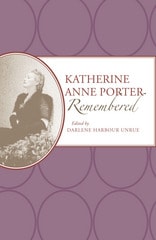
Katherine Anne Porter Remembered
Darlene Harbour Unrue
University of Alabama Press, 2010
Katherine Anne Porter Remembered is a collection of reminiscences and memoirs by contemporaries, friends, and associates of Porter offering a revealing and intimate portrait of the elusive and complex American writer.
From a fractured and vagabond girlhood in Texas, Porter led a wildly itinerant life that took her through five marriages, innumerable love affairs, and homes in Colorado, New York, Paris, Mexico, Louisiana, California, and Maryland. With very little formal education, she grew through sheer force of will to become a major American writer of short stories and the author of several books including Flowering Judas and other stories; Ship of Fools; Pale Horse; Pale Ride; Noon Wine; and The Collected Stories of Katherine Anne Porter, which won both the Pulitzer Prize and the National Book Award.
Because of Porter’s own dissembling and half-truths about her life, as well as the numerous factual errors that persist in biographical entries and literary dictionaries, a complete and accurate portrait of her life has been hard to establish. The 63 reminiscences gathered in this book paint a vivid portrait of Porter and are testaments to her extraordinary beauty, her gift for mesmerizing and charming audiences and friends, her yearnings for a lasting home, her delusions about love, the astonishing range and scope of her reading, her sharp tongue and vindictiveness, and her final paranoid renunciations of friends and family. Along the way, Porter formed friendships with Eudora Welty, Elizabeth Hardwick, Flannery O’Connor, and CleanthBrooks whose remembrances of her are included in this volume.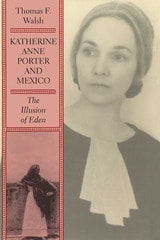
Katherine Anne Porter and Mexico
The Illusion of EdenBy Thomas F. Walsh
University of Texas Press, 1992
In 1920, an unknown journalist named Katherine Anne Porter first sojourned in Mexico. When she left her "familiar country" for the last time in 1931, she was the celebrated author of Flowering Judas and Other Stories and had accumulated a wealth of experiences and impressions that would inspire numerous short stories, essays, and reviews, as well as the opening section of her only novel, Ship of Fools.
In this perceptive study of Porter's Mexican experiences, Thomas Walsh traces the important connections between those events and her literary works. Separating fact from the fictions that Porter constantly created about her life, he follows the active role that she played in Mexican political and intellectual life—even to the discovery of a plot to overthrow the Mexican government, which eventually figured in Flowering Judas.
Most important, Walsh discerns how the great swings between depression and elation that characterized Porter's emotional life influenced her alternating visions of Mexico. In such works as "Xochimilco," Porter saw Mexico as an earthly Eden where hopes for a better society could be realized, but in other stories, including "The Fiesta of Guadalupe," she depicts Mexico as a place of hopeless oppression for the native peoples.
Mexico, Porter once said, gave her back her Texas past. Given the unhappiness of that past, her feelings toward Mexico would always be ambivalent, but her Mexican experiences influenced all her subsequent works to some degree, even those pieces not specifically Mexican in setting. Walsh's study, then, is an essential key for anyone seeking greater understanding of the life or works of Katherine Anne Porter.
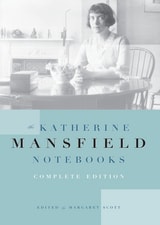
Katherine Mansfield Notebooks
Complete EditionKatherine Mansfield
University of Minnesota Press, 2002
The only unexpurgated collection of Katherine Mansfield’s private writings-now available for the first time!
Edited by Margaret Scott
Katherine Mansfield (1888-1923) published three collections of short stories-In a German Pension, Bliss, and The Garden Party-during her tragically short life, and was acclaimed as one of modernism’s most daring and original writers. After her death from tuberculosis in France, Mansfield’s private writings and letters were edited by her husband, John Middleton Murry, and published in four volumes between 1927 and 1954. Murry, however, took liberties in recasting his wife’s journals and notes. He excluded most of the vast mass of material and revised much of what he included, resulting in a distorted image of Mansfield as a passive, ethereal spirit.More than four decades later, the real Mansfield finally emerges in The Katherine Mansfield Notebooks, the first unexpurgated edition of her private writings. Fully and accurately transcribed by editor Margaret Scott, these infrequent diary entries, drafts of letters, introspective notes jotted on scraps of paper, unfinished stories, half-plotted novels, poems, recipes, and shopping lists offer a complete and compelling portrait of a complex woman who was ambitious and at times ruthless, neurotic and sexually voracious, witty and acerbic, fascinated with the minutiae of daily life and obsessed with death."It is only now, with the publication of Margaret Scott’s complete and unselective transcription of the material bequeathed to Murry, that we can really see Mansfield, off her guard and unexpurgated, for the first time. . . . Mansfield's notebooks are remarkable, touched by a sense of the underlying pathos of things, two parts tragedy and two parts comedy." Times Literary Supplement (London)"Mansfield’s work speaks about what is irretrievably lost, material, mortal, unless it is turned to artifice-and nowhere more than in these notebooks, where she is so reluctantly introspective." London Review of Books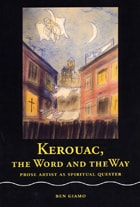
Kerouac, the Word and the Way
Prose Artist as Spiritual QuesterBen Giamo
Southern Illinois University Press, 2000
Kerouac was primarily a religious writer bent on testing and celebrating the profane depths and transcendent heights of experience and reporting both truly. Baptized and buried a Catholic, he was also heavily influenced by Buddhism, especially from 1954 until 1957 when he integrated traditional Eastern belief into several novels. Catholicism remained an essential force in his writing, but his study of Buddhism was serious and not solely in the service of his literary art. As he wrote to Malcolm Cowley in 1954, "Since I saw you I took up the study of Buddhism and for me it’s the word and the way I was looking for."
Giamo also seeks IT—"a vital force in the experience of living that takes one by surprise, suspending for the moment belief in the ‘real’ concrete grey everyday of facts of self and selfhood . . . its various meanings, paths, and oscillations: from romantic lyricism to ‘the ragged and ecstatic joy of pure being and from the void-pit of the Great World Snake to the joyous pain of amorous love, and, finally, from Catholic/Buddhist serenity to the onset of penitential martyrhood."

Kill for Peace
American Artists Against the Vietnam WarBy Matthew Israel
University of Texas Press, 2013
The Vietnam War (1964–1975) divided American society like no other war of the twentieth century, and some of the most memorable American art and art-related activism of the last fifty years protested U.S. involvement. At a time when Pop Art, Minimalism, and Conceptual Art dominated the American art world, individual artists and art collectives played a significant role in antiwar protest and inspired subsequent generations of artists. This significant story of engagement, which has never been covered in a book-length survey before, is the subject of Kill for Peace.
Writing for both general and academic audiences, Matthew Israel recounts the major moments in the Vietnam War and the antiwar movement and describes artists’ individual and collective responses to them. He discusses major artists such as Leon Golub, Edward Kienholz, Martha Rosler, Peter Saul, Nancy Spero, and Robert Morris; artists’ groups including the Art Workers’ Coalition (AWC) and the Artists Protest Committee (APC); and iconic works of collective protest art such as AWC’s Q. And Babies? A. And Babies and APC’s The Artists Tower of Protest. Israel also formulates a typology of antiwar engagement, identifying and naming artists’ approaches to protest. These approaches range from extra-aesthetic actions—advertisements, strikes, walk-outs, and petitions without a visual aspect—to advance memorials, which were war memorials purposefully created before the war’s end that criticized both the war and the form and content of traditional war memorials.
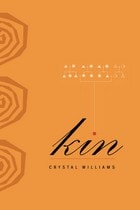
Kin
Crystal Williams
Michigan State University Press, 2000
In her first book-length collection of poetry, Crystal Williams utilizes memory and music as she lyrically weaves her way through American culture, pointing to the ways in which alienation, loss, and sensed "otherness" are corollaries of recent phenomena. Williams writes about being adopted by an interracial couple, a jazz pianist/Ford Foundry worker and a school psychologist, and how that has affected her development as an African American woman. She tries to work out the answers to many difficult questions: in what way do African American artists define themselves? What do they owe the culture and what does it owe them? To what extent does our combined national memory inform our individual selves? These poems are steeped in the black literary tradition. They are brimming over with the oral tradition that Williams perfected while spending years on the poetry "slam" circuit. This, combined with her musical upbringing, give the collection not only a sense of urgency, but also a rhythm, a breath all its own. Kin tackles not only racial issues, but also the troubling realities of violent acts that can occur, especially in our inner cities. But more importantly, the landscape that Williams creates offers readers an alternative to the racial/political dichotomy in which we all live. Overall, the book resonates with a message of reconciliation that will leave the reader uplifted.
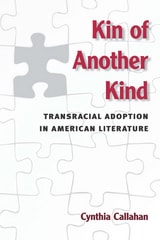
Kin of Another Kind
Transracial Adoption in American LiteratureCynthia Callahan
University of Michigan Press, 2010
"The study of transracial adoption has long been dominated by historians, legal scholars, and social scientists, but with the growth of the lively field of humanistic adoption studies comes a growing understanding of the importance of cultural representations to the social meanings and even the practices of adoption itself . . . This book makes a valuable contribution in showing how important the theme of adoption has been throughout the twentieth century in representations of race relations, and in showing that the adoption theme has served to challenge racial norms as well as uphold them."
---Margaret Homans, Yale University
The subject of transracial adoption seems to be enjoying unprecedented media attention of late, particularly as white celebrities have made headlines by adopting children of color from overseas. But interest in transracial adoption is nothing new---it has long occupied a space in the public imagination, a space disproportionate with the number of people actually adopted across racial lines.
Even before World War II, when transracial adoption was neither legally nor socially sanctioned, American authors wrote about it, often depicting it as an "accident"---the result of racial ambiguity that prevented adopters from knowing who is white or black. After World War II, as the real-world practice of transracial and international adoption increased, American literary representations of it became an index not only of the changing cultural attitudes toward adoption as a way of creating families but also of the social issues that informed it and made it, at times, controversial.
Kin of Another Kind examines the appearance of transracial adoption in American literature at certain key moments from the turn of the twentieth century to the turn of the twenty-first to help understand its literary and social significance to authors and readers alike. In juxtaposing representations of African American, American Indian, and Korean and Chinese adoptions across racial (and national) lines, Kin of Another Kind traces the metaphorical significance of adoption when it appears in fiction. At the same time, aligning these groups calls attention to their unique and divergent cultural histories with adoption, which serve as important contexts for the fiction discussed in this study.
The book explores the fiction of canonical authors such as William Faulkner and Toni Morrison and places it alongside lesser-known works by Robert E. Boles, Dallas Chief Eagle (Lakota), and Sui Sin Far that, when reconsidered, can advance our understanding both of adoption in literature and of twentieth-century American literature in general.
Kin of Another Kind will appeal to students and scholars in adoption in literature, American literature, and comparative multiethnic literatures. It adds to the growing body of work on adoption in literature, which focuses on orphancy and adoption in the nineteenth and early twentieth centuries.
Cynthia Callahan is Assistant Professor in the Department of English at Ohio State University, Mansfield.
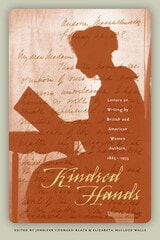
Kindred Hands
Letters on Writing by British and American Women Authors, 1865-1935Jennifer Cognard-Black
University of Iowa Press, 2006
Representing some of the most important female writers of the nineteenth and early twentieth centuries, including transatlantic correspondents, women of color, canonical writers, regional writers, and women living in the British empire, Kindred Hands will enliven scholarship on a host of topics, including reception theory, feminist studies, social history, composition theory, modernism, and nineteenth-century studies. Moreover, because it represents previously unpublished primary sources, the collection will initiate new discussions on race, class, sexuality, ethnicity, and gender with an eye to writing at the turn of the twentieth century.
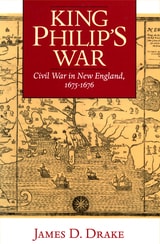
King Philip's War
Civil War in New England, 1675-1676James D. Drake
University of Massachusetts Press, 1999
Sometimes described as “America's deadliest war,” King Philip's War proved a critical turning point in the history of New England, leaving English colonists decisively in command of the region at the expense of native peoples. Although traditionally understood as an inevitable clash of cultures or as a classic example of conflict on the frontier between Indians and whites, in the view of James D. Drake it was neither. Instead, he argues, King Philip's War was a civil war, whose divisions cut across ethnic lines and tore apart a society composed of English colonizers and Native Americans alike. According to Drake, the interdependence that developed between English and Indian in the years leading up to the war helps explain its notorious brutality. Believing they were dealing with an internal rebellion and therefore with an act of treason, the colonists and their native allies often meted out harsh punishments. The end result was nothing less than the decimation of New England's indigenous peoples and the consequent social, political, and cultural reorganization of the region. In short, by waging war among themselves, the English and Indians of New England destroyed the world they had constructed together. In its place a new society emerged, one in which native peoples were marginalized and the culture of the New England Way receded into the past.
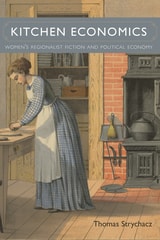
Kitchen Economics
Women’s Regionalist Fiction and Political EconomyThomas Strychacz
University of Alabama Press, 2020
WINNER OF THE ELIZABETH AGEE PRIZE IN AMERICAN LITERATURE
Readers of late nineteenth-century female American authors are familiar with plots, characters, and households that make a virtue of economizing. Scholars often interpret these scenarios in terms of a mythos of parsimony, frequently accompanied by a sort of elegiac republicanism whereby self-sufficiency and autonomy are put to the service of the greater good—a counterworld to the actual economic conditions of the period.
In Kitchen Economics: Women’s Regionalist Fiction and Political Economy, Thomas Strychacz takes a new approach to the question of how female regionalist fictions represent “the economic” by situating them within traditions of classical political economic thought. Offering case studies of key works by Sarah Orne Jewett, Mary Wilkins Freeman, Harriet Beecher Stowe, Rose Terry Cooke, and Alice Dunbar-Nelson, this study focuses on three complex cultural fables—the island commonwealth, stadialism (or stage theory), and feeding the body politic—which found formal expression in political economic thought, made their way into endless public debates about the economic turmoil of the late nineteenth century, and informed female authors. These works represent counterparts, not counterworlds, to modernity; and their characteristic stance is captured in the complex trope of feminaeconomica.
This approach ultimately leads us to reconsider what we mean by the term “economic,” for the emphasis of contemporary neoclassical economics on economic agents given over to infinite wants and complete self-interest has caused the “sufficiency” and “common good” models of female regionalist authors to be misinterpreted and misvalued. These fictions are nowhere more pertinent to modernity than in their alliance with today’s important alternative economic discourses.
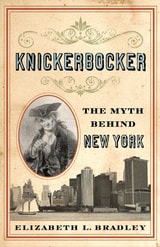
Knickerbocker
The Myth behind New YorkBradley, Elizabeth L
Rutgers University Press, 2009
Includes a gallery of images that brings Diedrich Knickerbocker, his myth, time, and place to life Knickerbocker engagingly traces the creation, evolution, and prevalence of Irving's imaginary historian in New York literature and history, art and advertising, from the early nineteenth century to the present day. Who would imagine this satiric character, at once a snob and a champion of the people, would endure for two hundred years? In Elizabeth L. Bradley's words, "Whether you call it 'blood,' style, attitude, or moxie, the little Dutchman could deliver." And, from this engaging work, it is clear that he does.
Bradley's stunning volume offers a surprising and delightful glimpse behind the scenes of New York history, and invites readers into the world of Knickerbocker, the antihero who surprised everyone by becoming the standard-bearer for the city's exceptional sense of self, or what we now call a New York "attitude."
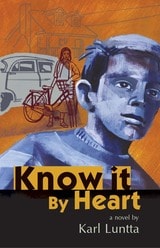
Know It by Heart
Karl Luntta
Northwestern University Press, 2003
When a racially mixed family moves into an all-white neighborhood in East Hartford, Connecticut, in 1961, lives are altered forever. Karl Luntta's Know It by Heart follows the adventures of young Dub Teed, his sister Susan and neighbor Doug Hammer, who befriend newly arrived Ricky Dubois, the daughter of an African-American woman and her white husband. When a burning cross flares in the night—and worse—the young adolescents set out to find justice and discover themselves in the process.
Despite the book's serious anti-racist theme, Know It by Heart is filled with humor reminiscent of Mark Twain. In this suspenseful novel, Karl Luntta brilliantly captures the world of the young adolescent in his characters and dialogue and in the innate comedy and awkwardness of that age. This is a book that will appeal to parents and teenagers alike.
Knowing, Seeing, Being
Jonathan Edwards, Emily Dickinson, Marianne Moore, and the American Typological TraditionJennifer L. Leader
University of Massachusetts Press, 2016
Scholars no longer see Jonathan Edwards as the fire-and-brimstone preacher who deemed his parishioners “sinners in the hands of an angry god.” Edwards now figures as caring and socially conscious and exerts increased influence as a philosopher of the American school of Protestantism. In this study, he becomes the progenitor of an alternative tradition in American letters.
In Knowing, Seeing, Being, Jennifer L. Leader argues that Edwards, the nineteenth-century poet Emily Dickinson, and the twentieth-century poet Marianne Moore share a heretofore underrecognized set of religious and philosophical preoccupations. She contends that they represent an alternative tradition within American literature, one that differs from Transcendentalism and is grounded in Reformed Protestantism and its ways of reading and interpreting the King James Bible and the natural world. According to Leader, these three writers' most significant commonality is the Protestant tradition of typology, a rigorous mode of interpreting scripture and nature through which certain figures or phenomena are read as the fulfillment of prophecy and of God's work. Following from their similar ways of reading, they also share philosophical and spiritual questions about language, epistemology (knowing), perception (seeing), and physical and spiritual ontology (being). In connecting Edwards to these two poets, in exploring each writer's typological imagination, and through a series of insightful readings, this innovative book reevaluates three major figures in American intellectual and literary history and compels a reconsideration of these writers and their legacies.
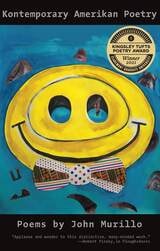
Kontemporary Amerikan Poetry
John Murillo
Four Way Books, 2020
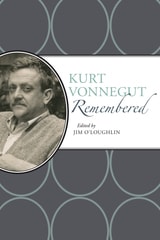
Kurt Vonnegut Remembered
Edited by Jim O'Loughlin
University of Alabama Press, 2019
Kurt Vonnegut (1922–2007), who began his writing career working for popular magazines, held both literary aspirations and an attraction to genre fiction. His conspicuous refusal to respect literary boundaries was part of what made him a countercultural icon in the 1960s and 1970s. Vonnegut’s personal life was marked in large part by public success and private turmoil. Two turbulent marriages, his sudden adoption of his late sister’s four children (and the equally sudden removal of one of those children), and a mid-eighties suicide attempt all signaled the extent of Vonnegut’s inner troubles. Yet, he was a generous friend to many, maintaining close correspondences throughout his life.
Kurt Vonnegut Remembered gathers reminiscences—by those who knew him intimately, and from those met him only once—that span Vonnegut’s entire life. Among the anecdotes in this collection are remembrances from his immediate family, reflections from his comrades in World War II, and tributes from writers he worked with in Iowa City and from those who knew him when he was young. Editor Jim O’Loughlin offers biographical notes on Vonnegut’s relationship with each of these figures.
Since Vonnegut’s death, much has been written on his life and work, but this new volume offers a more generous view of his life, particularly his last years. In O’Loughlin’s introduction to the volume, he argues that we can locate and understand Vonnegut’s best self through his public persona, and that in his performance as the kind and humane figure that many of the speakers here knew him as, Vonnegut became a better person than he ever felt himself to be.