Results by title
18284 books match the query 'United States' and 92 start with k
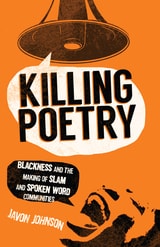
Killing Poetry
Blackness and the Making of Slam and Spoken Word CommunitiesJohnson, Javon
Rutgers University Press, 2017
Co-winner of the 2018 Ethnography Division’s Best Book from the NCA
In recent decades, poetry slams and the spoken word artists who compete in them have sparked a resurgent fascination with the world of poetry. However, there is little critical dialogue that fully engages with the cultural complexities present in slam and spoken word poetry communities, as well as their ramifications.
In Killing Poetry, renowned slam poet, Javon Johnson unpacks some of the complicated issues that comprise performance poetry spaces. He argues that the truly radical potential in slam and spoken word communities lies not just in proving literary worth, speaking back to power, or even in altering power structures, but instead in imagining and working towards altogether different social relationships. His illuminating ethnography provides a critical history of the slam, contextualizes contemporary black poets in larger black literary traditions, and does away with the notion that poetry slams are inherently radically democratic and utopic.
Killing Poetry—at times autobiographical, poetic, and journalistic—analyzes the masculine posturing in the Southern California community in particular, the sexual assault in the national community, and the ways in which related social media inadvertently replicate many of the same white supremacist, patriarchal, and mainstream logics so many spoken word poets seem to be working against. Throughout, Johnson examines the promises and problems within slam and spoken word, while illustrating how community is made and remade in hopes of eventually creating the radical spaces so many of these poets strive to achieve.

Killing the Koala and Poisoning the Prairie
Australia, America, and the EnvironmentCorey J. A. Bradshaw and Paul R. Ehrlich
University of Chicago Press, 2015
In this book, Bradshaw and Ehrlich provide a spirited exploration of the ways in which the United States and Australia can learn from their shared problems and combine their most successful solutions in order to find and develop new resources, lower energy consumption and waste, and grapple with the dynamic effects of climate change. Peppering the book with humor, irreverence, and extensive scientific knowledge, the authors examine how residents of both countries have irrevocably altered their natural environments, detailing the most pressing ecological issues of our time, including the continuing resource depletion caused by overpopulation. They then turn their discussion to the politics behind the failures of environmental policies in both nations and offer a blueprint for what must be dramatically changed to prevent worsening the environmental crisis.
Although focused on two nations, Killing the Koala and Poisoning the Prairie clearly has global implications—the problems facing the United States and Australia are not theirs alone, and the solutions to come will benefit by being crafted in coalition. This book provides a vital opportunity to learn from both countries’ leading environmental thinkers and to heed their call for a way forward together.
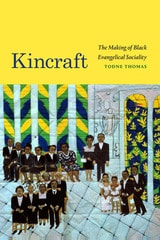
Kincraft
The Making of Black Evangelical SocialityTodne Thomas
Duke University Press, 2021

Kindergarten Magic
Theme-Based Lessons for Building Literacy and Library SkillsKathy MacMillan
American Library Association, 2012
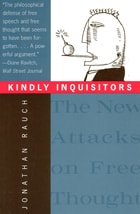
Kindly Inquisitors
The New Attacks on Free ThoughtJonathan Rauch
University of Chicago Press, 1993
"Fiercely argued. . . . What sets his study apart is his attempt to situate recent developments in a long-range historical perspective and to defend the system of free intellectual inquiry as a socially productive method of channeling prejudice."—Michiko Kakutani, New York Times
"Like no other, this book restates the core of our freedom and demonstrates how great, and disregarded, the peril to that freedom has become."—Joseph Coates, Chicago Tribune
"The philosophical defense of free speech and free thought that seems to have been forgotten. . . . A powerful argument."—Diane Ravitch, Wall Street Journal

Kindly Inquisitors
The New Attacks on Free Thought, Expanded EditionJonathan Rauch
University of Chicago Press, 2014
In this expanded edition of Kindly Inquisitors, a new foreword by George F. Will strikingly shows the book’s continued relevance, while a substantial new afterword by Rauch elaborates upon his original argument and brings it fully up to date. Two decades after the book’s initial publication, while some progress has been made, the regulation of hate speech has grown domestically—especially in American universities—and has spread even more internationally, where there is no First Amendment to serve as a meaningful check. But the answer to bias and prejudice, Rauch argues, is pluralism—not purism. Rather than attempting to legislate bias and prejudice out of existence or to drive them underground, we must pit them against one another to foster a more vigorous and fruitful discussion. It is this process that has been responsible for the growing acceptance of the moral acceptability of homosexuality over the last twenty years. And it is this process, Rauch argues, that will enable us as a society to replace hate with knowledge, both ethical and empirical.
“It is a melancholy fact that this elegant book, which is slender and sharp as a stiletto, is needed, now even more than two decades ago. Armed with it, readers can slice through the pernicious ideas that are producing the still-thickening thicket of rules, codes, and regulations restricting freedom of thought and expression.”—George F. Will, from the foreword
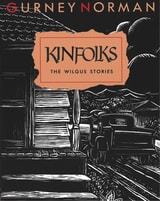
Kinfolks
The Wilgus StoriesGurney Norman
Ohio University Press, 2024
Published in 1977 by Gnomon Press.Kinfolks is a novelistic collection of short stories centered around Wilgus Collier, a young boy growing up in rural Kentucky during the 1940s and 1950s. The stories follow Wilgus from childhood into his early adulthood, exploring his relationships with his extended family and his Appalachian community. Gurney Norman introduces readers to Wilgus’s world through a series of vignettes that depict experiences with his family, particularly his parents and grandparents. These stories highlight the challenges and joys of rural life, offering a poignant look at complex family dynamics and the deep-rooted traditions of Appalachia. Throughout the book, Norman’s writing is characterized by its rich, evocative descriptions of the Appalachian landscape and its authentic portrayal of the region’s culture and people. Kinfolks—adapted for the screen as The Wilgus Stories—is celebrated for vivid storytelling that captures the essence of life in Kentucky coal country.
King Cotton Diplomacy
Foreign Relations of the Confederate States of AmericaFrank L. Owsley Sr., revised by Harriet Chappell Owsley, and with a new Preface by Howard Jones
University of Alabama Press, 2008
The exhaustive, definitive study of Southern attempts to gain international support for the Confederacy by leveraging the cotton supply for European intervention during the Civil War. Using previously untapped sources from Britain and France, along with documents from the Confederacy’s state department, Frank Owsley’s King Cotton Diplomacy is the first archival-based study of Confederate diplomacy.
King George's War and the Thirty Year Peace
The Third Contest for North AmericaMichael G. Laramie
Westholme Publishing, 2027
King George’s War and the Thirty-Year Peace continues the contest for North America from the end of Queen Anne’s War in 1713, marking the beginning of the Thirty-Year Peace, through the start of King George’s War in 1744, to its conclusion with the signing of Treaty of Aix-la-Chapelle four years later. While there would be little fighting between the French, Spanish, and British colonies in North America during the Thirty-Year Peace—the Franco-Spanish conflict of 1719 being an exception—for the French and British internally it did not prove to be peaceful. Conflicts with former Indigenous allies erupted, including with the Three Years War, the Yamassee War, and the Natchez and Chickasaw Wars. In the south the peace was ruptured by the opening of the War of Jenkin’s Ear in 1739, which led to an attempt by South Carolina and the new colony of Georgia to seize Spanish St. Augustine, and a counter-attack by St. Augustine and Cuba aimed at the destruction of the two British colonies. While this Anglo-Spanish conflict would shift farther south into the Caribbean, to the north, news of another war between France and Britain would arrive in 1744. King George’s War, the North American component of Europe’s War of Austrian Succession, would start in Nova Scotia with French attacks on the weakly held British colony. This provocation inspired a response in the form of one of the boldest expeditions of the colonial period—Massachusetts Governor William Shirley’s successful campaign against Louisbourg on Cape Breton Island. With the French fortress in British hands and the cry of delenda est Canadaechoing through the American colonial assemblies, Shirley turned to the conquest of French Canada and convinced London to dispatch a fleet to assist in the capture of Montreal and Quebec. In Paris, news of Louisbourg’s surrender elicited an unexpected reaction in the form of one of the largest French naval expeditions ever sent to North America, with explicit orders to retake Cape Breton and expel the British from Nova Scotia. Thus, by the summer of 1746, both British and French sentries scanned the eastern horizon daily for a fleet that would determine the destiny of the conflict, but neither would be happy with what they found.
The final volume in Michael G. Laramie’s acclaimed histories of the European struggle for North America that set the stage for the French and Indian War, King George’s War and the Thirty-Year Peace: The Third Contest for North America, 1714–1748, takes the reader along with the combatants into the field and waterways, including Native American, French, Spanish, Provincial, and British. Based on a rich variety of primary sources and fully illustrated with original maps, this volume joins the author’s King William’s War and Queen Anne’s War as the modern history of these lesser-known—but enormously important—conflicts that shaped the political story of North America.
King Me
Three One-Act Plays Inspired by the Life and Legacy of Dr. Martin Luther King Jr.Clinnesha D. Sibley
University of Arkansas Press, 2013
King Philip's War
Civil War in New England, 1675-1676James D. Drake
University of Massachusetts Press, 1999
Sometimes described as “America's deadliest war,” King Philip's War proved a critical turning point in the history of New England, leaving English colonists decisively in command of the region at the expense of native peoples. Although traditionally understood as an inevitable clash of cultures or as a classic example of conflict on the frontier between Indians and whites, in the view of James D. Drake it was neither. Instead, he argues, King Philip's War was a civil war, whose divisions cut across ethnic lines and tore apart a society composed of English colonizers and Native Americans alike. According to Drake, the interdependence that developed between English and Indian in the years leading up to the war helps explain its notorious brutality. Believing they were dealing with an internal rebellion and therefore with an act of treason, the colonists and their native allies often meted out harsh punishments. The end result was nothing less than the decimation of New England's indigenous peoples and the consequent social, political, and cultural reorganization of the region. In short, by waging war among themselves, the English and Indians of New England destroyed the world they had constructed together. In its place a new society emerged, one in which native peoples were marginalized and the culture of the New England Way receded into the past.
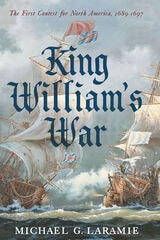
King William's War
The First Contest for North America, 1689–1697Michael Laramie
Westholme Publishing, 2027
Fought in New York, New England, and Canada, the Conflict that Began the Long French and English Struggle for the New World
While much has been written on the French and Indian War of 1754–1763, the colonial conflicts that preceded it have received comparatively little attention. Yet in King William’s War, the first clash between England and France for control of North America, the patterns of conflict for the next seventy years were laid, as were the goals and objectives of both sides, as well as the realization that the colonies of the two nations could not coexist.
King William’s War actually encompassed several proxy wars being fought by the English and the French through their native allies. The Beaver Wars was a long running feud between the Iroquois Confederacy, New France, and New France’s native allies over control of the lucrative fur trade. Fueled by English guns and money, the Iroquois attempted to divert the French fur trade towards their English trading partners in Albany, and in the process gain control over other Indian tribes. To the east the pro-French Wabanaki of Maine, Nova Scotia, and New Brunswick had earlier fought a war with New England, but English expansion and French urgings, aided by foolish moves and political blunders on the part of New England, erupted into a second Wabanaki War on the eve of King William’s War. Thus, these two conflicts officially became one with the arrival of news of a declaration of war between France and England in 1689. The next nine years saw coordinated attacks, including French assaults on Schenectady, New York, and Massachusetts, and English attacks around Montreal and on Nova Scotia. The war ended diplomatically, but started again five years later in Queen Anne’s War.
A riveting history full of memorable characters and events, and supported by extensive primary source material, King William’s War: The First Contest for North America, 1689–1697 by Michael G. Laramie is the first book-length treatment of a war that proved crucial to the future of North America.
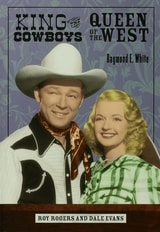
King of the Cowboys, Queen of the West
Roy Rogers and Dale EvansRaymond E. White
University of Wisconsin Press, 2006
King of the Cowboys, Queen of the West presents these two celebrities in the most comprehensive and inclusive account to date. Part narrative, part reference, this impeccably researched, highly accessible survey spans the entire scope of Rogers's and Evans's careers, illuminating and celebrating their place in twentieth-century American popular culture. Following the pair through each stage of their professional and personal trajectories, author Raymond E. White explores the unique alchemy of the singing cowboy and his free-spirited yet feminine partner. In a dual biography, he shows how Rogers and Evans carefully husbanded their public image and—of particular note—incorporated their Christian faith into their performances. And in a series of exhaustive appendixes, he documents their contributions to each medium they worked in. Testifying to both the breadth and the longevity of their careers, the book includes radio logs, discographies, filmographies, and comicographies that will delight historians and collectors alike. With its engaging tone and meticulous research, King of the Cowboys, Queen of the West is bound to become the definitive source on the lives of these two great American icons.
King's Vibrato
Modernism, Blackness, and the Sonic Life of Martin Luther King Jr.Maurice O. Wallace
Duke University Press, 2022
King
A BiographyDavid Levering Lewis
University of Illinois Press, 2013

Kingdom at Any Cost
Right-Wing Visions of Apocalypse in AmericaJohnnie Chamberlin
Parkhurst Brothers, Inc., 2009
Kinship by Design
A History of Adoption in the Modern United StatesEllen Herman
University of Chicago Press, 2008
Beginning in the early 1900s, when children were still transferred between households by a variety of unregulated private arrangements, Ellen Herman details efforts by the U.S. Children’s Bureau and the Child Welfare League of America to establish adoption standards in law and practice. She goes on to trace Americans’ shifting ideas about matching children with physically or intellectually similar parents, revealing how research in developmental science and technology shaped adoption as it navigated the nature-nurture debate.
Concluding with an insightful analysis of the revolution that ushered in special needs, transracial, and international adoptions, Kinship by Design ultimately situates the practice as both a different way to make a family and a universal story about love, loss, identity, and belonging. In doing so, this volume provides a new vantage point from which to view twentieth-century America, revealing as much about social welfare, statecraft, and science as it does about childhood, family, and private life.
Kinship with the Land
Regionalist Thought In Iowa, 1894-1942E. Bradford Burns
University of Iowa Press, 1996
Pioneers moving into Iowa in the nineteenth century created a distinctly rural culture: family, farm, church, and school were its dominant institutions. After decades of settlement, however, several lively and perceptive generations interpreted their political, economic, and cultural environment—their Iowa—much more imaginatively; they offered such abundant insight, understanding, meaning, and mission that they mentally and spiritually recreates Iowa. In Kinship with the Land historian Brad Burns celebrates this intense period of intellectual and cultural development.
Through their novels, short stories, poems, essays, drawings, and paintings, Iowa's regionalists expressed a rich abstraction of people and place. They conferred meaning, imparted understanding, defined the soil and the folk, conveyed a sense of place. Grant Wood in his overalls—the quintessential symbol of sophisticated talent and rural values—clearly represented regionalism's spiritual solidarity with the land and the people who worked it. Burns lets these Iowans speak for themselves, then interprets their distinctive voices to present a cogent case for and an understanding of the rural in an overwhelming urban America.
Kinship with the Land emphasizes the importance of Iowa's intellectual and cultural history and reaffirms the state's identity at the very moment that standardization threatened to eradicate it. By endowing Iowa with vibrant, independent art and literature, regionalists made refreshing sense of their environment. Readers from every state will appreciate their generous legacy.
Kirby Smith's Confederacy
The TransMississippi South, 1863-1865Robert L. Kerby
University of Alabama Press, 1991
Cut off, but not surrendered—one region’s desperate stand in the twilight of the Confederacy.
With the surrender of Vicksburg in July 1863, the Confederacy’s TransMississippi Department, which included Texas, Arkansas, Missouri, western Louisiana, and Indian Territory, was cut off from the remainder of the South. Robert Kerby’s insightful volume, originally published in 1972, “has gone far toward filling one of the most conspicuous gaps in the literature on the Confederacy,” according to The Journal of Southern History.
Kerby investigates the many factors that led to the Department’s disintegrating and offers a case study of a segment of American society that consumed itself by surrendering everything, including its principles and ideals, in pursuit of an unattainable military victory.
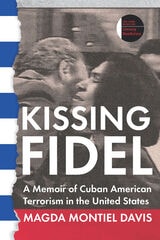
Kissing Fidel
A Memoir of Cuban American Terrorism in the United StatesMagda Montiel Davis
University of Iowa Press, 2020
What does it mean to be instantly transformed into the most hated person in your community? After meeting Fidel Castro at a Havana reception in 1994, Cuban-born Magda Montiel Davis, founder of one of the largest immigration law firms in South Florida, soon found out. The reception—attended by hundreds of other Cuban émigrés—was videotaped for historical archives. In a seconds-long clip, Fidel pecks the traditional protocol kiss on Montiel Davis’s cheek as she thanks him for the social benefits conferred upon the Cuban people. The video, however, was mysteriously sold to U.S. reporters and aired incessantly throughout South Florida. Soon the encounter was an international cause célèbre.
Life as she knew it was over for Montiel Davis and her family, including a father who worked with the CIA to topple Fidel, a nohablo-inglés mother who lived with the family, her five children, and her Jewish Brooklyn-born attorney husband. Kissing Fidel shares the sometimes dismal, sometimes comical realities of an ordinary citizen being thrown into a world of death threats, mob attacks, and terrorism.
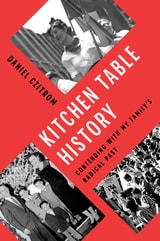
Kitchen Table History
Contending with My Family’s Radical PastDaniel Czitrom
University of Illinois Press, 2027
Czitrom follows three generations of his family as they fled violence in Eastern Europe, built new lives in America, and committed themselves to radical political movements. Their works and trials included union organizing, volunteering to fight fascism in Spain and elsewhere, harassment by the FBI, and everyday acts of survival. Czitrom describes what he discovered in his years of historical detective work while pondering the still-unanswered questions wrapped in silence and pain. He also recounts his years-long journey to balance loyalty to his family’s values with a desire to succeed, question authority, and become his own person.
An engaging blend of memoir and history, Kitchen Table History is the chronicle of a family and a personal search for the meaning of the past.

Kitchens of Hope
Immigrants Share Stories of Resilience and Recipes from HomeLinda S. Svitak
University of Minnesota Press, 2025
Culinary journeys from around the globe: recipes and stories from immigrants to the United States
Immigrants carry more than hope as they cross oceans and traverse continents to come to the United States. They hold tightly to stories and recipes, remembrances of what they left behind. Kitchens of Hope brings together these memories from contributors who hail from more than thirty countries, offering a glimpse into their kitchens and insight into their lives. This book is a celebration of people and cuisines from around the world, infused with the aromas of epazote and cardamom, the tang of fish sauce, the heat of chile peppers, and the bite of mustard greens.
With tales as compelling as the brimming bowls and overflowing platters of these foods that represent home, Kitchens of Hope features immigrants coming from vastly varied circumstances. Some arrived in the United States fleeing war and violence, others were seeking education and opportunity; some have called the United States home for years, and others have only recently arrived. Despite the differing situations that brought them here, the contributors all find comfort and tradition as they gather to share meals with family and friends. They are activists and entrepreneurs, parents and community leaders, and some are affiliated with the Minnesota-based nonprofit the Advocates for Human Rights, the organization that inspired the creation of this book.
Structured around the contributors’ personal stories of their journeys, the chapters reflect the main themes connecting them: community, resilience, opportunity, justice, hope, and celebration. In these pages, readers will find inspiration, along with more than fifty recipes, from curry, mole, biryani, and borscht, to pita, pho, sambusa, pupusas, and so much more. Welcome to the Kitchens of Hope table.
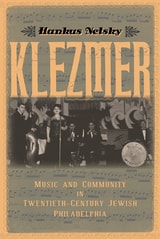
Klezmer
Music and Community in Twentieth-Century Jewish PhiladelphiaHankus Netsky
Temple University Press, 2017
Netsky defines what klezmer music is, how it helped define Jewish immigrant culture in Philadelphia, and how its current revival has changed klezmer’s meaning historically. Klezmer also addresses the place of musicians and celebratory music in Jewish society, the nature of klezmer culture, the tensions between sacred and secular in Jewish music, and the development of Philadelphia's distinctive “Russian Sher” medley, a unique and masterfully crafted composition.
Including a significant amount of musical transcriptions, Klezmer chronicles this special musical genre from its heyday in the immigrant era, through the mid-century period of its decline through its revitalization from the 1980s to today.

Klondike Saga
The Chronicle of a Minnesota Gold Mining CompanyCarl L. Lokke
University of Minnesota Press, 1965
Klondike Saga was first published in 1965. Minnesota Archive Editions uses digital technology to make long-unavailable books once again accessible, and are published unaltered from the original University of Minnesota Press editions.
This is the story of the Monitor Gold Mining and Trading Company, an organization of sixteen Minnesotans who went to the Canadian Klondike region in the late 1890's to prospect for gold. It is based on diaries and letters written by the men during their venture. Most of the company members were of Scandinavian origin, recent immigrants to America, and a number of the letters were written to Nye Normanden, a Norwegian-language newspaper published in Minneapolis at the time.
The leader of the company, Lars Gunderson, was the grandfather of the late Carl L. Lokke, author of the book. Mr. Lokke, a historian, was chief of the foreign affairs branch of the National Archives at the time of his death in 1960.
This is the first book issued under a joint publishing arrangement between the University of Minnesota Press and the Norwegian-American Historical Association. It is Volume 7 in the association's Travel and Description Series. There is a preface by Kenneth O. Bjork, editor of the association, and Senator Ernest Gruening of Alaska writes a foreword.

Klondike Women
True Tales of the 1897–1898 Gold RushMelanie J. Mayer
Ohio University Press, 1989
Challenging the myth that the only women who participated in gold rushes were prostitutes and gold-diggers of the euphemistic sort, Melanie Mayer shows us that Klondike women came from all walks of life—socialites to poor immigrants, single women, wives, widows, and children. They planned to make their money through many different undertakings including mining, business, entertainment, professional, and service enterprises. Their approaches to life were as varied as their roles—optimistic or skeptical; cautious or adventuresome; gregarious or self-contained; contemplative or active. There was no typical Klondike woman. Individually, their stories can be funny, hopeful, tragic, or poignant. Taken together, they give rich, complex images of the people, times, and places of the gold rush.
A visually exciting book, Klondike Women features over 150 photographs and illustrations. This volume should appeal not only to the general reader, but to those interested in history, women’s studies, and the Pacific Northwest as well.
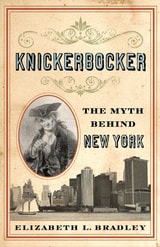
Knickerbocker
The Myth behind New YorkBradley, Elizabeth L
Rutgers University Press, 2009
Includes a gallery of images that brings Diedrich Knickerbocker, his myth, time, and place to life Knickerbocker engagingly traces the creation, evolution, and prevalence of Irving's imaginary historian in New York literature and history, art and advertising, from the early nineteenth century to the present day. Who would imagine this satiric character, at once a snob and a champion of the people, would endure for two hundred years? In Elizabeth L. Bradley's words, "Whether you call it 'blood,' style, attitude, or moxie, the little Dutchman could deliver." And, from this engaging work, it is clear that he does.
Bradley's stunning volume offers a surprising and delightful glimpse behind the scenes of New York history, and invites readers into the world of Knickerbocker, the antihero who surprised everyone by becoming the standard-bearer for the city's exceptional sense of self, or what we now call a New York "attitude."
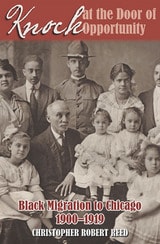
Knock at the Door of Opportunity
Black Migration to Chicago, 1900-1919Christopher Robert Reed
Southern Illinois University Press, 2014
Disputing the so-called ghetto studies that depicted the early part of the twentieth century as the nadir of African American society, this thoughtful volume by Christopher Robert Reed investigates black life in turn-of-the-century Chicago, revealing a vibrant community that grew and developed on Chicago’s South Side in the early 1900s. Reed also explores the impact of the fifty thousand black southerners who streamed into the city during the Great Migration of 1916–1918, effectively doubling Chicago’s African American population. Those already residing in Chicago’s black neighborhoods had a lot in common with those who migrated, Reed demonstrates, and the two groups became unified, building a broad community base able to face discrimination and prejudice while contributing to Chicago’s growth and development.
Reed not only explains how Chicago’s African Americans openly competed with white people for jobs, housing and an independent political voice but also examines the structure of the society migrants entered and helped shape. Other topics include South Side housing, black politics and protest, the role of institutionalized religion, the economic aspects of African American life, the push for citizenship rights and political power for African Americans, and the impact of World War I and the race riot of 1919. The first comprehensive exploration of black life in turn-of-the-century Chicago beyond the mold of a ghetto perspective, this revealing work demonstrates how the melding of migrants and residents allowed for the building of a Black Metropolis in the 1920s.
2015 ISHS Superior Achievement Award
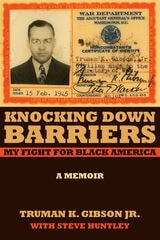
Knocking Down Barriers
My Fight for Black AmericaTruman K. Gibson Jr. with Steve Huntley
Northwestern University Press, 2005
Recipient, 2007 Hyde Park Historical Society Paul Cornell Award
Sixty years ago, when Truman Gibson reported for duty at the War Department, Washington, D.C. was a southern city in its unbending segregation as well as in its steamy summers. Gibson had no illusions, but as someone who'd enjoyed the best of the vibrant black culture of prewar America, he was shocked to find the worst of the Jim Crow South in the nation's capital. What Gibson accomplished as an advocate for African American soldiers-first as a lawyer working for the Secretary of War, then as a member of President Truman's "Black Cabinet"--is a large part of the history of the struggle for civil rights in the American military; and it is a compelling part of the story that Gibson tells in this book, a memoir of a life spent making a difference in the world one step at a time.
A graduate of the University of Chicago Law School, Gibson took his fight for racial justice to the corridors of powers, arguing against restrictive real estate covenants before the U.S. Supreme Court, opposing such iconic figures as Generals Dwight Eisenhower and George C. Marshall in campaigning for the integration of the armed forces, and challenging white control of professional sports by creating a boxing promotion empire that made television history. A firsthand account of the nitty-gritty of twentieth-century race relations in the worlds of law, the military, sports, and entertainment, Gibson's memoir is also an engaging recollection of encounters with the likes of Thurgood Marshall, W. E. B. DuBois, Eleanor Roosevelt, George Patton, Jackie Robinson, and Joe Louis, among others. As a historical record and as an intimate look at a bygone era with all its charms and hardships, the book is an essential chapter in our nation's story.

Knocking on Heaven’s Door
Six Minor Leaguers in Search of the Baseball DreamMarty Dobrow
University of Massachusetts Press, 2010
The rich slice of Americana found in minor league baseball presents a contradictory culture. On the one hand, the minors are filled with wholesome, family-friendly entertainment-fluffy mascots, kitschy promotions, and earnest young men signing autographs for wide-eyed Little Leaguers. On the other, they comprise a world of cutthroat competition in which a teammate's failure or injury can be the cause of quiet celebration and 90 percent of all players never play a single inning in the major leagues.
In Knocking on Heaven's Door, award-winning sportswriter Marty Dobrow examines this double-edged culture by chronicling the lives of six minor leaguers—Brad Baker, Doug Clark, Manny Delcarmen, Randy Ruiz, Matt Torra, and Charlie Zink—all struggling to make their way to “The Show.” What links them together, aside from their common goal, is that they are all represented by the same team of agents—Jim and Lisa Masteralexis and their partner Steve McKelvey—whose own aspirations parallel those of the players they represent.
The story begins during spring training in 2005 and ends in the fall of 2008, followed by a brief epilogue that updates each player's fortunes through the 2009 season. Along the way Dobrow offers a revealing, intimate look at life in minor league baseball: the relentless tedium of its itinerant routines and daily rituals; the lure of performance-enhancing drugs as a means of gaining a competitive edge; the role of agents in negotiating each player's failures as well as his successes; and the influence of wives, girlfriends, and family members who have invested in the dream.
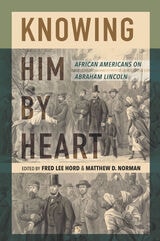
Knowing Him by Heart
African Americans on Abraham LincolnEdited by Frederick Hord and Matthew D. Norman
University of Illinois Press, 2023
Winner of an Abraham Lincoln Institute Book Award
Though not blind to Abraham Lincoln's imperfections, Black Americans long ago laid a heartfelt claim to his legacy. At the same time, they have consciously reshaped the sixteenth president's image for their own social and political ends. Frederick Hord and Matthew D. Norman's anthology explores the complex nature of views on Lincoln through the writings and thought of Frederick Douglass, Ida B. Wells-Barnett, Mary McLeod Bethune, Thurgood Marshall, Malcolm X, Gwendolyn Brooks, Barbara Jeanne Fields, Barack Obama, and dozens of others. The selections move from speeches to letters to book excerpts, mapping the changing contours of the bond--emotional and intellectual--between Lincoln and Black Americans over the span of one hundred and fifty years.
A comprehensive and valuable reader, Knowing Him by Heart examines Lincoln’s still-evolving place in Black American thought.

Knowing Silence
How Children Talk about Immigration Status in SchoolAriana Mangual Figueroa
University of Minnesota Press, 2024
Learning from children about citizenship status and how it shapes their schooling
There is a persistent assumption in the field of education that children are largely unaware of their immigration status and its implications. In Knowing Silence, Ariana Mangual Figueroa challenges this “myth of ignorance.” By listening carefully to both the speech and significant silences of six Latina students from mixed-immigration-status families, from elementary school into middle school and beyond, she reveals the complex ways young people understand and negotiate immigration status and its impact on their lives.
Providing these children with iPod Touches to record their own conversations, Mangual Figueroa observes when and how they choose to talk about citizenship at home, at school, and in public spaces. Analyzing family conversations about school forms, in-class writing assignments, encounters with the police, and applications for college, she demonstrates that children grapple with the realities of citizenship from an early age. Educators who underestimate children’s knowledge, Mangual Figueroa shows, can marginalize or misunderstand these students and their families.
Combining significant empirical findings with reflections on the ethical questions surrounding research and responsibility, Mangual Figueroa models new ways scholars might collaborate with educators, children, and families. With rigorous and innovative ethnographic methodologies, Knowing Silence makes audible the experiences of immigrant-origin students in their own terms, ultimately offering teachers and researchers a crucial framework for understanding citizenship in the contemporary classroom.
Knowing, Seeing, Being
Jonathan Edwards, Emily Dickinson, Marianne Moore, and the American Typological TraditionJennifer L. Leader
University of Massachusetts Press, 2016
Scholars no longer see Jonathan Edwards as the fire-and-brimstone preacher who deemed his parishioners “sinners in the hands of an angry god.” Edwards now figures as caring and socially conscious and exerts increased influence as a philosopher of the American school of Protestantism. In this study, he becomes the progenitor of an alternative tradition in American letters.
In Knowing, Seeing, Being, Jennifer L. Leader argues that Edwards, the nineteenth-century poet Emily Dickinson, and the twentieth-century poet Marianne Moore share a heretofore underrecognized set of religious and philosophical preoccupations. She contends that they represent an alternative tradition within American literature, one that differs from Transcendentalism and is grounded in Reformed Protestantism and its ways of reading and interpreting the King James Bible and the natural world. According to Leader, these three writers' most significant commonality is the Protestant tradition of typology, a rigorous mode of interpreting scripture and nature through which certain figures or phenomena are read as the fulfillment of prophecy and of God's work. Following from their similar ways of reading, they also share philosophical and spiritual questions about language, epistemology (knowing), perception (seeing), and physical and spiritual ontology (being). In connecting Edwards to these two poets, in exploring each writer's typological imagination, and through a series of insightful readings, this innovative book reevaluates three major figures in American intellectual and literary history and compels a reconsideration of these writers and their legacies.

Knowledge LTD
Toward a Social Logic of the DerivativeRandy Martin
Temple University Press, 2015
In Knowledge LTD, Martin explores how both the limits of knowledge and the social constructions of culture reflect the way we organize social life in the face of disasters and their aftermath. He examines this crisis of knowledge as well as the social movements that rose up in its wake. Martin not only treats derivatives as financial contracts for pricing risk, but also shows how the derivative works in economic terms, where the very unity of the economy is undone.
Knowledge LTD ultimately points to a more comprehensive reordering of the once separate spheres of economy, polity, and culture. Martin provides a new way of understanding the social significance of the all-pervasive derivative logic.

Knowledge Regulation and National Security in Postwar America
Mario Daniels and John Krige
University of Chicago Press, 2022
In this groundbreaking book, Mario Daniels and John Krige set out to show the enormous political relevance that export control regulations have had for American debates about national security, foreign policy, and trade policy since 1945. Indeed, they argue that from the 1940s to today the issue of how to control the transnational movement of information has been central to the thinking and actions of the guardians of the American national security state. The expansion of control over knowledge and know-how is apparent from the increasingly systematic inclusion of universities and research institutions into a system that in the 1950s and 1960s mainly targeted business activities. As this book vividly reveals, classification was not the only—and not even the most important—regulatory instrument that came into being in the postwar era.
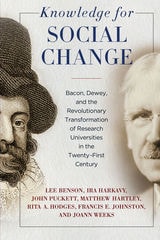
Knowledge for Social Change
Bacon, Dewey, and the Revolutionary Transformation of Research Universities in the Twenty-First CenturyLee Benson, Ira Harkavy, Matthew Hartley
Temple University Press, 2017
Employing history, social theory, and a detailed contemporary case study, Knowledge for Social Change argues for fundamentally reshaping research universities to function as democratic, civic, and community-engaged institutions dedicated to advancing learning and knowledge for social change. The authors focus on significant contributions to learning made by Francis Bacon, Benjamin Franklin, Seth Low, Jane Addams, William Rainey Harper, and John Dewey—as well as their own work at Penn’s Netter Center for Community Partnerships—to help create and sustain democratically-engaged colleges and universities for the public good.
Knowledge for Social Change highlights university-assisted community schools to effect a thoroughgoing change of research universities that will contribute to more democratic schools, communities, and societies. The authors also call on democratic-minded academics to create and sustain a global movement dedicated to advancing learning for the “relief of man’s estate”—an iconic phrase by Francis Bacon that emphasized the continued betterment of the human condition—and to realize Dewey’s vision of an organic “Great Community” composed of participatory, democratic, collaborative, and interdependent societies.
Knowledge in the Time of Cholera
The Struggle over American Medicine in the Nineteenth CenturyOwen Whooley
University of Chicago Press, 2013
These cholera outbreaks raised fundamental questions about medical knowledge and its legitimacy, giving fuel to alternative medical sects that used the confusion of the epidemic to challenge both medical orthodoxy and the authority of the still-new American Medical Association. In Knowledge in the Time of Cholera, Owen Whooley tells us the story of those dark days, centering his narrative on rivalries between medical and homeopathic practitioners and bringing to life the battle to control public understanding of disease, professional power, and democratic governance in nineteenth-century America.
Knut Hamsun Remembers America
Essays and Stories, 1885-1949Knut Hamsun, Edited & Translated by Richard Nelson Current
University of Missouri Press, 2003

Knuth par Knuth
Donald E. Knuth
CSLI, 2020
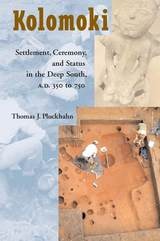
Kolomoki
Settlement, Ceremony, and Status in the Deep South, A.D. 350 to 750Thomas J. Pluckhahn
University of Alabama Press, 2003
A Dan Josselyn Memorial Publication
The first comprehensive and systematic investigation of a Woodland period ceremonial center.
Kolomoki, one of the most impressive archaeological sites in the southeastern United States, includes at least nine large earthen mounds in the lower Chattahoochee River valley of southwest Georgia. The largest, Mound A, rises approximately 20 meters above the terrace that borders it. From its flat-topped summit, a visitor can survey the string of smaller mounds that form an arc to the south and west.
Archaeological research had previously placed Kolomoki within the Mississippian period (ca. A.D. 1000-1500) primarily because of the size and form of the mounds. But this book presents data for the main period of occupation and mound construction that confirm an earlier date, in the Woodland period (ca. A.D. 350-750). Even though the long-standing confusion over Kolomoki’s dating has now been settled, questions remain regarding the lifeways of its inhabitants. Thomas Pluckhahn's research has recovered evidence concerning the level of site occupation and the house styles and daily lives of its dwellers. He presents here a new, revised history of Kolomoki from its founding to its eventual abandonment, with particular attention to the economy and ceremony at the settlement.
This study makes an important contribution to the understanding of middle range societies, particularly the manner in which ceremony could both level and accentuate status differentiation within them. It provides a readable overview of one of the most important but historically least understood prehistoric Native American sites in the United States.

Korea Letters in the William Elliot Griffis Collection
An Annotated SelectionYoung-mee Yu Cho
Rutgers University Press, 2024
The Korean materials in the Griffis Collection at Rutgers University consist of journals, correspondence, articles, maps, prints, photos, postcards, manuscripts, scrapbooks, and ephemera. These papers reflect Griffis's interests and activities in relation to Korea as a historian, scholar, and theologian. They provide a rare window into the turbulent period of late nineteenth- and twentieth-century Korea, witnessed and evaluated by Griffis and early American missionaries in East Asia. The Korea Letters in the William Elliot Griffis Collection are divided into two parts: letters from missionaries and letters from Japanese and Korean political figures. Newly available and accessible through this collection, these letters develop a multifaceted history of early American missionaries in Korea, the Korean independence movement, and Griffis's views on Korean culture.
Korean Showdown
National Policy and Military Strategy in a Limited War, 1951–1952Bryan R. Gibby
University of Alabama Press, 2021
WINNER OF THE 2023 ANDREW F. KREPINEVICH JR. WRITING AWARD
A historical analysis of the policies and military strategies applied during the Korean War stalemate period.
Korean Showdown: National Policy and Military Strategy in a Limited War, 1951–1952 takes a holistic and integrative approach to strategy, operations, and tactics during the Korean War’s stalemate period and demonstrates how these matters shaped each other and influenced, or were influenced by, political and strategic policy decision-making. Bryan R. Gibby offers an analysis of the major political and military decisions affecting how the war was conducted operationally and diplomatically by examining American, Chinese, North Korean, and South Korean operations in the context of fighting a limited war with limited means, but for objectives that were not always limited in scope or ambition. The foundational political decision was Harry Truman’s voluntary repatriation policy, which extended the war by up to eighteen months. Its military counterpart was the American-led Operation Showdown, the last deliberate military offensive to coerce concessions at the negotiation table. Showdown’s failure (and the Communists’ own equally disappointing military efforts) opened up new avenues for solving the war short of a militarily imposed solution.
Gibby’s research draws on primary sources from American, Korean, and Chinese archives and publications. Many of these sources have not yet been mined in diplomatic and military histories of the Korean War. This innovative book also addresses a significant gap in the study of Korean military operations—the linkage between ground and air pressure campaigns, as well as the many Chinese and American operations conducted to establish negotiation positions. Gibby also explores many political and propagandist developments that assumed great importance in the summer of 1952, such as prisoner of war riots, the bombing of hydroelectric dams, and the South Korean constitutional crisis, which significantly influenced American and Chinese military decision-making.
Ultimately, this volume serves as a cautionary analysis of the limits of force, the necessity to understand an adversary, and the importance of strategic consensus. It also offers an effective case study on an underappreciated period of civil-military tension during the Cold War and on how civilian politicians and military leaders must collaborate to determine a realistic and effective strategy.
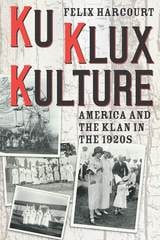
Ku Klux Kulture
America and the Klan in the 1920sFelix Harcourt
University of Chicago Press, 2017
Ku Klux Kulture reveals the extent to which the KKK participated in and penetrated popular American culture, reaching far beyond its paying membership to become part of modern American society. The Klan owned radio stations, newspapers, and sports teams, and its members created popular films, pulp novels, music, and more. Harcourt shows how the Klan’s racist and nativist ideology became subsumed in sunnier popular portrayals of heroic vigilantism. In the process he challenges prevailing depictions of the 1920s, which may be best understood not as the Jazz Age or the Age of Prohibition, but as the Age of the Klan. Ku Klux Kulture gives us an unsettling glimpse into the past, arguing that the Klan did not die so much as melt into America’s prevailing culture.