Results by title
22279 books match the query 'Social Science' and 1072 start with r
RSF
The Russell Sage Foundation Journal of the Social Sciences: The Underground Gun Market: Implications for Regulation and EnforcementPhilip J. Cook
Russell Sage Foundation, 2017
Cook and Pollack initiate the discussion with a comprehensive introduction that includes an original framework for understanding the legality of transactions that arm dangerous offenders. Several contributors review trends in gun ownership across the nation and investigate how guns enter the underground market. Deborah Azrael and coauthors conduct a comprehensive survey of gun owners and find 270 million guns in private circulation. They estimate that 70 million firearms changed hands during a recent five-year period. Most of those transactions were sales by licensed dealers; Garen Wintemute reports on a survey of dealers that assesses the wide disparities among them as sources of guns to offenders. Charles Wellford and coauthors use trace data and prison interviews to study how criminals obtain their guns in three jurisdictions that differ widely with respect to gun regulations and culture.
Other contributors explore the effects of gun regulations and legislation on illegal supply chains. Daniel Webster and coauthors study the effects of Maryland’s 2013 Firearm Safety Act, which required all handgun purchasers to obtain a license. They find that 41 percent of surveyed parolees reported that it was more difficult to obtain a handgun after the law passed due to increased cost, lack of trusted sources, or people being less willing to buy handguns on their behalf. Analyzing over three decades of data on handguns recovered in Boston, Anthony Braga shows that fewer guns are illegally obtained from states that adopt legislation restricting buyers to one gun per month. George Tita and coauthors report the results of an inmate survey in Los Angeles in which they explored respondents’ knowledge of gun laws. These findings suggest that laws aimed at legal gun transactions may also decrease the entry of guns into the underground market.
The rate of gun violence in the U.S. surpasses that of any other advanced nation. This issue of RSF offers new empirical research on the underground market that arms dangerous criminals and provides a rich foundation for policies designed to curb gun violence.
RSF
The Russell Sage Foundation Journal of the Social Sciences: Three Decades Since 'Making Ends Meet': What We Know about How Single Mothers Survive TodayElizabeth O. Ananat
Russell Sage Foundation, 2026
In their seminal 1995 book Making Ends Meet: How Low-Income Single Mothers Survive Welfare and Low-Wage Employment, Kathryn Edin and Laura Lein laid bare the strategies and challenges of low-income single mothers who were struggling to provide for their families. Even in an era when cash welfare was a federal entitlement, these women struggled to get by. In the thirty years since the book’s publication, many single parents wrestle with volatility and precarious resources from work, informal and formal supports. In this double issue of RSF, economist Elizabeth O. Ananat, political scientist and public policy scholar Carolyn Y. Barnes, sociologists Sandra K. Danziger and Kathryn Edin, and an interdisciplinary group of contributors examine how the policy landscape has changed since welfare reform and how it impacts low-income single mothers’ ability to make ends meet today.
Issue 1 has 8 articles that examine how the traditional safety net has evolved and new supports that have been developed since Making Ends Meet. For example, Sarah K. Bruch and colleagues assess changes to the social safety net since welfare reform in the 1990s and find that benefits have become more exclusive, have more constraints, and are less generous. Kelley Fong and Nora McCarthy reveal that, in an attempt to decrease child maltreatment, the child welfare system increasingly provides material resources to system-involved parents, including in-kind donations and assistance accessing childcare. However, parents often avoid obtaining resources through the system because it opens them up to increased state surveillance. Heather D. Hill and colleagues show that access to paid family and medical leave (PFML) varies greatly for single mothers, with two-thirds of single mothers living in states without PMFL. For those who live in states with PFML, the accessibility and generosity of benefits vary greatly.
Issue 2 has 5 articles that look at lessons that can be learned from COVID Era policies, how single mothers currently try to make ends meet, and men’s contributions to families. For example, Natasha V. Pilkauskas and Kevin Bruey find that low-income single mothers, with and without employment, utilize a variety of public and private resources to make ends meet. Despite this, both groups face high levels of material hardship, including food and housing insecurity. Hope Harvey examines how members of doubled up households understand their economic and social relationships and reveals that there are often disagreements about shared resources, such as money and food. However, it is not just the precise contributions that cause conflict, but how the exchanges are interpreted within the context of household members’ relationships. Allison Dwyer Emory and colleagues show that nonresident fathers often have trouble making ends meet themselves and are unable to make up for the loss of cash support post-welfare reform.
This double issue of RSF showcases the persistence of precarity that low-income families face since Making Ends Meet.
Note: This copy refers to both issues of the journal double issue.
RSF
The Russell Sage Foundation Journal of the Social Sciences: Three Decades Since 'Making Ends Meet': What We Know about How Single Mothers Survive TodayElizabeth O. Ananat
Russell Sage Foundation, 2026
In their seminal 1995 book Making Ends Meet: How Low-Income Single Mothers Survive Welfare and Low-Wage Employment, Kathryn Edin and Laura Lein laid bare the strategies and challenges of low-income single mothers who were struggling to provide for their families. Even in an era when cash welfare was a federal entitlement, these women struggled to get by. In the thirty years since the book’s publication, many single parents wrestle with volatility and precarious resources from work, informal and formal supports. In this double issue of RSF, economist Elizabeth O. Ananat, political scientist and public policy scholar Carolyn Y. Barnes, sociologists Sandra K. Danziger and Kathryn Edin, and an interdisciplinary group of contributors examine how the policy landscape has changed since welfare reform and how it impacts low-income single mothers’ ability to make ends meet today.
Issue 1 has 8 articles that examine how the traditional safety net has evolved and new supports that have been developed since Making Ends Meet. For example, Sarah K. Bruch and colleagues assess changes to the social safety net since welfare reform in the 1990s and find that benefits have become more exclusive, have more constraints, and are less generous. Kelley Fong and Nora McCarthy reveal that, in an attempt to decrease child maltreatment, the child welfare system increasingly provides material resources to system-involved parents, including in-kind donations and assistance accessing childcare. However, parents often avoid obtaining resources through the system because it opens them up to increased state surveillance. Heather D. Hill and colleagues show that access to paid family and medical leave (PFML) varies greatly for single mothers, with two-thirds of single mothers living in states without PMFL. For those who live in states with PFML, the accessibility and generosity of benefits vary greatly.
Issue 2 has 5 articles that look at lessons that can be learned from COVID Era policies, how single mothers currently try to make ends meet, and men’s contributions to families. For example, Natasha V. Pilkauskas and Kevin Bruey find that low-income single mothers, with and without employment, utilize a variety of public and private resources to make ends meet. Despite this, both groups face high levels of material hardship, including food and housing insecurity. Hope Harvey examines how members of doubled up households understand their economic and social relationships and reveals that there are often disagreements about shared resources, such as money and food. However, it is not just the precise contributions that cause conflict, but how the exchanges are interpreted within the context of household members’ relationships. Allison Dwyer Emory and colleagues show that nonresident fathers often have trouble making ends meet themselves and are unable to make up for the loss of cash support post-welfare reform.
This double issue of RSF showcases the persistence of precarity that low-income families face since Making Ends Meet.
Note: This copy refers to both issues of the journal double issue.
RSF
The Russell Sage Foundation Journal of the Social Sciences: U.S. Census 2020: Continuity and ChangeZhenchao Qian
Russell Sage Foundation, 2025
The census has registered more than two centuries of growth and transformation in America’s political, social, and economic life. It traditionally gives us the opportunity to ask big questions about and measure changes in American society. Sociologist and demographer Zhenchao Qian, economist Trevon Logan, and an interdisciplinary group of contributors examine how American society has changed — or stayed the same — from 2010-2020.
Topics examined in Issue 1 include the impact of census counts, changes in neighborhood demographics, gender inequality in education, and racial inequality in employment. Lisa Neidert and colleagues find that the census consistently undercounts Hispanics, Blacks, and Native Americans and overcounts Whites and Asians, which has negative impacts on state and federal funding for vulnerable communities. Nima Dahir shows the arrival of Black immigrants into Black American neighborhoods often results in a decline in the native Black American population and an increase in White residents. Claudia Buchmann and colleagues reveal that women are now earning more advanced degrees than men in the U.S., however rising shares of women, including those who are pursing advanced degrees, are attending for profit institutions and carrying student debt. Julie Y. Cai and Marybeth J. Mattingly find that workers with variable hours have lower incomes than those who have more stable hours and Black workers earn substantially less than their White counterparts when working jobs with volatile hours.
Themes explored in Issue 2 include changes in living arrangements, divergent families, and rural America. Hyunjoon Parkand colleagues find that despite growing public concern about the potential rise in solitary living, the likelihood of living alone has not changed much over the last four decades except for older men, who have an increased likelihood of living alone. Christopher S. Carpenter and colleagues show that gender minority individuals, including transgender and nonbinary individuals, are less likely to be married, more likely to be widowed, and less likely to live in a traditional two-adult household compared to their cisgender counterparts. Daniel T. Lichter and Kenneth M. Johnson reveal that while rural America is often envisioned as a monolith, it is made up of complex and diverse economic, social, and demographic conditions.
This volume of RSF provides an updated and insightful snapshot of American society in the 2010s.
RSF
The Russell Sage Foundation Journal of the Social Sciences: U.S. Census 2020: Continuity and ChangeZhenchao Qian
Russell Sage Foundation, 2024
The census has registered more than two centuries of growth and transformation in America’s political, social, and economic life. It traditionally gives us the opportunity to ask big questions about and measure changes in American society. Sociologist and demographer Zhenchao Qian, economist Trevon Logan, and an interdisciplinary group of contributors examine how American society has changed — or stayed the same — from 2010-2020.
Topics examined in Issue 1 include the impact of census counts, changes in neighborhood demographics, gender inequality in education, and racial inequality in employment. Lisa Neidert and colleagues find that the census consistently undercounts Hispanics, Blacks, and Native Americans and overcounts Whites and Asians, which has negative impacts on state and federal funding for vulnerable communities. Nima Dahir shows the arrival of Black immigrants into Black American neighborhoods often results in a decline in the native Black American population and an increase in White residents. Claudia Buchmann and colleagues reveal that women are now earning more advanced degrees than men in the U.S., however rising shares of women, including those who are pursing advanced degrees, are attending for profit institutions and carrying student debt. Julie Y. Cai and Marybeth J. Mattingly find that workers with variable hours have lower incomes than those who have more stable hours and Black workers earn substantially less than their White counterparts when working jobs with volatile hours.
Themes explored in Issue 2 include changes in living arrangements, divergent families, and rural America. Hyunjoon Parkand colleagues find that despite growing public concern about the potential rise in solitary living, the likelihood of living alone has not changed much over the last four decades except for older men, who have an increased likelihood of living alone. Christopher S. Carpenter and colleagues show that gender minority individuals, including transgender and nonbinary individuals, are less likely to be married, more likely to be widowed, and less likely to live in a traditional two-adult household compared to their cisgender counterparts. Daniel T. Lichter and Kenneth M. Johnson reveal that while rural America is often envisioned as a monolith, it is made up of complex and diverse economic, social, and demographic conditions.
This volume of RSF provides an updated and insightful snapshot of American society in the 2010s.
RSF
The Russell Sage Foundation Journal of the Social Sciences: Undocumented Immigrants and Their Experience with IllegalityRoberto G. Gonzales
Russell Sage Foundation, 2017
Caitlin Patler and Nicholas Branic find that undocumented individuals in immigrant detention facilities that are privately operated are less likely to be visited by family members than those in county or city jails, in part because private facilities have restricted visiting hours and are more difficult to access via public transportation. Lauren Heidbrink finds that unaccompanied minors in the custody of the Office of Refugee Resettlement (ORR) are less likely to be released to guardians or reunited with family members because ORR standards are much tougher than those used by child protective services for minor citizens.
Lauren E. Gulbas and Luis H. Zayas find that many children with undocumented parents experience symptoms of anxiety and depression due to fears about their parents’ status. Yet, increased access to financial, educational, legal, and other immigration-related resources for these families can help buffer these children against trauma related to deportation and family separations. Susan K. Brown and Alejandra J. Sanchez focus on children with undocumented mothers and show that because having an undocumented mother is associated with a reduction in children’s years of schooling, it also indirectly lowers their levels of voting, activism, and political awareness as young adults.
Although undocumented immigrants are more enmeshed in the U.S. than they have been in the past, their status prevents further integration into society. This issue reveals the consequences of illegality not just for undocumented immigrants, but also for their families and their communities.
RSF
The Russell Sage Foundation Journal of the Social Sciences: Using Administrative Data for Science and PolicyAndrew M. Penner
Russell Sage Foundation, 2019
In the twenty-first century, administrative data collected by the government, schools, hospitals, and other institutions are essential for effectively managing and evaluating public programs. Yet the U. S. lags behind many other countries when it comes to organizing these data and making linkages across different domains, such as education, health, and the labor market. This double issue of RSF, edited by sociologist Andrew Penner and developmental psychologist Kenneth Dodge, illustrates the tremendous potential of administrative data and provides guidance for the researchers and policymakers. Contributors across multiple disciplines demonstrate how linking disparate sources of administrative data can help us better understand the challenges faced by people in need, thereby improving the reach and efficiency of policy solutions.
Several contributors show how databases tracking educational attainment yield new insights into the role of schools in either ameliorating or perpetuating socioeconomic inequalities. Sean Reardon analyzes standardized test scores of roughly 45 million K-12 students nationwide to explore how educational opportunity varies by school districts over time. He finds that while affluent districts typically provide high levels of early childhood learning opportunities, there are some schools in high-poverty districts that do have increased average test scores between third and eighth grade. However, this growth still does not close the large achievement gap between low-and high-socioeconomic-status students. Megan Austin and coauthors, using student-level longitudinal data from Indiana, analyze the effects of school voucher programs on academic achievement and find that students who switch from a public to a private school with a voucher experience significant declines in achievement, particularly in math.
Other articles demonstrate how the analysis of administrative data can further our understanding of racial and gender inequality. Janelle Downing and Tim Bruckner link housing foreclosure records and birth records to show that foreclosures and related stresses during the Great Recession contributed to premature births and lower birth weights, particularly for Hispanic mothers and their children. Roberto Fernandez and Brian Rubineau investigate hiring data to explore how network recruitment, or recruitment through employer referrals, affects the “glass ceiling” in the workplace. They show that network recruitment increases women’s representation strongly at lower job levels, and to a lesser extent at higher levels.
Researchers now have unprecedented access to administrative data. As this issue shows, finding innovative ways to combine multiple data sets can facilitate partnerships between social scientists, administrators, and policymakers and extend our understanding of pressing social issues.
RSF
The Russell Sage Foundation Journal of the Social Sciences: Using Administrative Data for Science and PolicyAndrew M. Penner
Russell Sage Foundation, 2019
In the twenty-first century, administrative data collected by the government, schools, hospitals, and other institutions are essential for effectively managing and evaluating public programs. Yet the U. S. lags behind many other countries when it comes to organizing these data and making linkages across different domains, such as education, health, and the labor market. This double issue of RSF, edited by sociologist Andrew Penner and developmental psychologist Kenneth Dodge, illustrates the tremendous potential of administrative data and provides guidance for the researchers and policymakers. Contributors across multiple disciplines demonstrate how linking disparate sources of administrative data can help us better understand the challenges faced by people in need, thereby improving the reach and efficiency of policy solutions.
Several contributors show how databases tracking educational attainment yield new insights into the role of schools in either ameliorating or perpetuating socioeconomic inequalities. Sean Reardon analyzes standardized test scores of roughly 45 million K-12 students nationwide to explore how educational opportunity varies by school districts over time. He finds that while affluent districts typically provide high levels of early childhood learning opportunities, there are some schools in high-poverty districts that do have increased average test scores between third and eighth grade. However, this growth still does not close the large achievement gap between low-and high-socioeconomic-status students. Megan Austin and coauthors, using student-level longitudinal data from Indiana, analyze the effects of school voucher programs on academic achievement and find that students who switch from a public to a private school with a voucher experience significant declines in achievement, particularly in math.
Other articles demonstrate how the analysis of administrative data can further our understanding of racial and gender inequality. Janelle Downing and Tim Bruckner link housing foreclosure records and birth records to show that foreclosures and related stresses during the Great Recession contributed to premature births and lower birth weights, particularly for Hispanic mothers and their children. Roberto Fernandez and Brian Rubineau investigate hiring data to explore how network recruitment, or recruitment through employer referrals, affects the “glass ceiling” in the workplace. They show that network recruitment increases women’s representation strongly at lower job levels, and to a lesser extent at higher levels.
Researchers now have unprecedented access to administrative data. As this issue shows, finding innovative ways to combine multiple data sets can facilitate partnerships between social scientists, administrators, and policymakers and extend our understanding of pressing social issues.
RSF
The Russell Sage Foundation Journal of the Social Sciences: Wealth Inequality and Child Development: Implications for Policy and PracticeChristina Gibson-Davis
Russell Sage Foundation, 2021
Contributors Fabian Pfeffer and Nora Waitkus find that child wealth inequality is far worse in the U.S. than in other industrialized countries. Editors Gibson-Davis and Hill show that a relatively small group of American parents—mostly White—control the lion’s share of wealth, with Black and Hispanic parents having only pennies on the dollar for every dollar of White parental wealth. Nina Bandelj and Angelina Grigoryeva show how White parents with above median wealth are more likely than other parents to practice “financially intensive parenting,” saving and borrowing in ways that promote child achievement. After controlling for other measures of family resources and socioeconomic status, Portia Miller and colleagues demonstrate that family wealth is uniquely related to both academic and behavioral development throughout childhood and adolescence and that wealth helps buffer the negative effects of low family income. Jordan Conwell and Leafia Zi Ye find equalizing wealth is not sufficient to eliminate race- and ethnic-based gaps in academic achievement: even among families with the same levels of wealth Black and Hispanic children often have significantly worse scores than Whites.
High levels of childhood wealth inequality are not inevitable; they are the consequence of laws and practices that favor wealth accumulation among few, primarily White, families. Jin Huang and coauthors look at one of the few policy models for increasing savings in low-income child households, Child Development Accounts, which have been shown to increase educational savings and improve maternal mental health, but they have yet to be adopted nationwide. Two studies in this issue, by Margot Jackson and colleagues and by Katherine Michelmore and Leonard Lopoo, find that large-scale income-support programs, the EITC and Medicaid, have positive spillovers onto asset accumulation, but policies designed to fundamentally alter the distribution of wealth among families with children will require more expansive changes to the tax code and program asset caps.
This issue of RSF expands our understanding of wealth inequality and its effects on children, and provides important insights into policies and practices that either directly or indirectly boost wealth acquisition among child households.
RSF
The Russell Sage Foundation Journal of the Social Sciences: Wealth Inequality: Economic and Social DimensionsFabian T. Pfeffer
Russell Sage Foundation, 2016
Several contributors investigate the growing chasm in wealth between the rich and the middle class. Edward Wolff attributes much of the recent wealth loss among the middle class to the housing market crash, as housing accounts for a much greater share of their total wealth than it does for the rich. Jonathan Fisher and coauthors show that wealth inequality is far higher than inequality in income and consumption, and argue that because wealth acts as a buffer to income changes, it is perhaps the most relevant measure of economic inequality. Others explore the persistent racial wealth gap. Alexandra Killewald and Brielle Bryan show that the average wealth return on home ownership for African Americans is only a quarter of the return for whites. Bryan Sykes and Michelle Maroto find that the incarceration of a family member is associated with reduced family wealth, exacerbating the racial wealth gap because of racial disparities in incarceration.
Other articles focus on the effects of wealth inequality on families and relationships. Emily Rauscher finds that that parents’ financial support for their children’s education, which has positive effects on children’s educational attainment, is increasingly connected to parental wealth, tightening the link between wealth inequality and inequality of opportunity. And Alicia Eads and Laura Tach find that while greater family wealth is associated with more stable marriages, lack of wealth—particularly in the form of unsecured debt—is associated with marital instability.
As wealth inequality has increased, it is increasingly important to understand its origins and manifold social and economic consequences for current and future generations.
Race
Gregory, Steven
Rutgers University Press, 1994
“What unites these essays is a common focus on the ‘social construction’ of racial categories and a desire to expose the exercise of racism and its intersection with other forms of social domination such as class, gender, and ethnicity . . . Fascinating.”––Multicultural Review
“The coming together of theoretical, multiethnic, and ‘on-the-ground’ perspectives makes this book a particularly valuable contribution to the discourse on race.”––Paula Giddings
“Timely and thoughtful. . . contributes to our understanding of how race operates as a social process and in the contextualization of power and status.”––Contemporary Sociology
“A treasure chest full of gems. Virtually every article is fascinating and important, and as a collection, its impact is tremendous. Neo-conservative myths and fantasies fall like nine-pins before its well-researched and tightly argued papers.”––Martin Bernal, author of Black Athena
“A timely antidote to that reaction tome, The Bell Curve.”––Daily News (New York)
“Let’s be clear from the start what this book is about,” writes Roger Sanjek. “Race is the framework of ranked categories, segmenting the human population, that was developed by Western Europeans following their global expansion.”To contemporary social scientists, this ranking is baseless, though it has had all-too-real effects.
Drawing on anthropology, history, sociology, ethnic studies, and women's studies, this volume explores the role of race in a variety of cultural and historical contexts. The contributors show how racial ideologies intersect with gender, class, nation and sexuality in the formation of complex social identities and hierarchies. The essays address such topics as race and Egyptian nationalism, the construction of “whiteness” in the United States, and the transformation of racial categories in post-colonial Haiti. They demonstrate how social elites and members of subordinated groups construct and rework racial meanings and identities within the context of global political, economic, and cultural change. Race provides a comprehensive and empirically grounded survey of contemporary theoretical approaches to studying the complex interplay of race, power, and identity.

Race & Archaeology Of Identity
Charles Orser Jr
University of Utah Press, 2002
Race is not a subject most people associate with archaeological research. Yet because of archaeologists’ interest in long time-spans they are perfectly positioned to investigate the “naturalness” of racial designations through time.
Race and the Archaeology of Identity brings together twelve of America’s most perceptive and talented historical archaeologists. Their focus is on the recent archaeological record—stretching geographically from Jamaica to northern Michigan; their time frame is from colonial days to the late nineteenth century; and their subjects range from frontier fur traders to Victorian city dwellers. Using textual and archaeological sources, contributors explore such topics as the connections of race to economics, the creation and maintenance of institutionalized poverty, the role of race in structuring and guiding intercultural connections, and the importance of race in creating and defining space.
Contributors explore such topics as the connections of race to economics, the role of race in structuring and guiding intercultural connections, and the importance of race in creating and defining space.

Race / Queer / Queens
Edited by Mira ‘Assaf and Urvashi Chakravarty
Arizona Center for Medieval and Renaissance Studies, 2026
This expansive volume examines the intersections of gender, race, sexuality, and other formations of identity in early modern representations of queens.
Race/Queer/Queens is a new intervention into the well-established field of queenship and royalty studies. Queens/(queans) are at once the epitome of royal power and the exemplum of gendered disenfranchisement. The essays in this volume address the interlocking methodologies of premodern critical race studies, gender and sexuality studies, and queer and trans theory to shed light on how gendered negotiations of power, reproductive politics, and embodied performance are determined by and inscribed within a hierarchy of gender, race, class, religion, nationhood, and sexuality. Ranging across early modern drama, poetry, and prose by the likes of William Shakespeare, Ben Jonson, Lucy Hutchinson, and Hester Pulter, the essays in Race/Queer/Queens offer new intersectional approaches to studies of early modern history, genealogy, embodiment, and the nation, including model methodologies and directions for future scholarship.
Race And Homicide In Nineteenth-Century California
Clare V. McKanna
University of Nevada Press, 2007
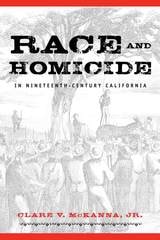
Nineteenth-century California was a society in turmoil, with a rapidly growing population, booming mining camps, insufficient or nonexistent law-enforcement personnel, and a large number of ethnic groups with differing attitudes toward law and personal honor. Violence, including murder, was common, and legal responses varied broadly. Available now for the first time in paperback, Race and Homicide in Nineteenth-Century California examines coroners’ inquest reports, court case files, prison registers, and other primary and printed sources to analyze patterns of homicide and the state’s embryonic justice system. Author Clare V. McKanna discovers that the nature of crimes varied with the ethnicity of perpetrators and victims, as did the conduct and results of trials and sentencing patterns. He presents specific case studies and a vivid portrait of an unruly society in flux. Enhanced with testimony from contemporary sources and illustrated with period photographs, this study richly portrays a frontier society where the law was neither omnipotent nor impartial.
Race And Reconciliation
Essays From The New South AfricaDaniel Herwitz
University of Minnesota Press, 2003
A meditation on the lessons to be learned from South Africa’s transformation in the wake of apartheid
Justice, truth, and identity; race, society, and law—all come into dramatic play as South Africa makes the tumultuous transition to a post-apartheid democracy. Seeking the timeless through the timely and trying to find the deeper meaning in the sweep of events, Daniel Herwitz brings the vast resources of the philosophical essay to bear on the new realities of post-apartheid South Africa—from racial identity to truth commissions, from architecture to film and television.
A public intellectual’s reflections on public life, Herwitz’s essays question how the new South Africa has constructed its concepts of reconciliation and return and how its historical emergence has meant a rethinking, reimagining, reexperiencing, relabeling, and repoliticizing of race. Herwitz’s purpose is to give a philosophical reading of society—a society already relying on implicitly philosophical concepts in its social and political agendas. Working through these concepts, testing their relevance for reading society, his book itself becomes a part of the politics of definition and description in the new South Africa.
Race Appeal
How Candidates Invoke Race in U.S. Political CampaignsAuthored by Charlton D. McIlwain and Stephen M. Caliendo
Temple University Press, 2011
In our evolving American political culture, whites and blacks continue to respond very differently to race-based messages and the candidates who use them. Race Appeal examines the use and influence such appeals have on voters in elections for federal office in which one candidate is a member of a minority group.
Charlton McIlwain and Stephen Caliendo use various analysis methods to examine candidates who play the race card in political advertisements. They offer a compelling analysis of the construction of verbal and visual racial appeals and how the news media covers campaigns involving candidates of color.
Combining rigorous analyses with in-depth case studies-including an examination of race-based appeals in the historic 2008 presidential election—Race Appeal is a groundbreaking work that represents the most extensive and thorough treatment of race-based appeals in American political campaigns to date.
Race Becomes Tomorrow
North Carolina and the Shadow of Civil RightsGerald M. Sider
Duke University Press, 2015
Race Course Against White Supremacy
Against White SupremacyBill Ayers
Northwestern University Press, 2009
Race In The Hood
Conflict and Violence among Urban YouthHoward Pinderhughes
University of Minnesota Press, 1997
A compelling study of the origins of racial conflict and violence in America.
“We’ll just be hanging out, partying. And somebody will say, ‘Hey, let’s go on a mission.’ That’s when you go looking for people who don’t belong in the neighborhood, and you beat ’em up. Sometimes we go out lookin’ for blacks to jump. Sometimes we look for anybody who ain’t supposed to be there.” —Sal, Avenue T Boys
Why are racial conflict and violence among the most enduring problems in American society? Why do some youths express racism violently while others develop tolerance and respect for those who are different? What can we as a society do to foster open-mindedness among children and teenagers? Seeking answers to these questions, Howard Pinderhughes spent two years talking to and studying three groups of New York City adolescents: the predominantly Italian American Avenue T Boys from the Bensonhurst section of Brooklyn; a group of African American teenagers from Schomberg Plaza in East Harlem; and a group of Albanian American youth from Pelham Park in the Bronx. Through the voices of these young people, Pinderhughes examines how racial attitudes and identities develop in communities and are then expressed as either tolerance, resulting in territorial cooperation, or hatred, resulting in racial conflict. Race in the Hood draws a picture of young people who grew up in similar class circumstances, facing remarkably similar problems and issues, with one significant difference in their lives-their race or ethnicity. Pinderhughes argues that the key to success in developing racial tolerance lies in the transformation of racialized grassroots ideologies through community and school-based multicultural education. A sophisticated and nuanced study of race relations in New York City, Race in the Hood points to areas of concern and directions for change in all of our communities.
Race News
Black Journalists and the Fight for Racial Justice in the Twentieth CenturyFred Carroll
University of Illinois Press, 2017
Race Passing and American Individualism
Kathleen Pfeiffer
University of Massachusetts Press, 2009
In this book, Kathleen Pfeiffer explores the implications of this dilemma by analyzing its treatment in the fiction of six writers: William Dean Howells, Frances E. W. Harper, Jean Toomer, James Weldon Johnson, Jessie Fauset, and Nella Larsen. Although passing for white has sometimes been viewed as an expression of racial self-hatred or disloyalty, Pfeiffer argues that the literary evidence is much more ambiguous than that. Rather than indicating a denial of "blackness" or co-optation by the dominant white culture, passing can be viewed as a form of self-determination consistent with American individualism. In their desire to manipulate personal identity in order to achieve social acceptance and upward mobility, light-skinned blacks who pass for white are no different than those Americans who reinvent themselves in terms of class, religion, or family history.
In Pfeiffer's view, to see race passing as a problematic but potentially legitimate expression of individualism is to invite richer and more complex readings of a broad range of literary texts. More than that, it represents a challenge to the segregationist logic of the "one drop" rule and, as such, subverts the ideology of racial essentialism.

Race Riot at East St. Louis, July 2, 1917
Elliott Rudwick
University of Illinois Press, 1982
. . a well-researched and thoughtful inquiry into the circumstances and
social forces producing one of the most violent of twentieth-century American
race riots."
-- American Historical Review
"His work fills a serious
gap in the history of racial violence in the United States. Never before
analyzed by sociologists in the way that the Chicago and Detroit riots
were, the East St. Louis riot outranked both as measured by the number
of deaths."
-- American Journal of Sociology
Race Riot
CHICAGO IN THE RED SUMMER OF 1919William M. Tuttle, Jr.
University of Illinois Press, 1996
Race Struggles
Edited by Theodore Koditschek, Sundiata Keita Cha-Jua, and Helen A. Neville
University of Illinois Press, 2008
These assumptions underlie the organization of the volume, which is divided into three parts: "Racial Structures," which explores the problem of how race has historically been structured in modern capitalist societies; "Racial Ideology and Identity," which tackles diverse but interrelated questions regarding the representation of race and racism in dominant ideologies and discourses; and "Struggle," which builds on the insight that resistance to structures and ideologies of racial oppression is always situated in a particular time and place.
In addition to discussing and analyzing various dimensions of the African American experience, contributors also consider the ways in which race plays itself out in the experience of Asian Americans and in the very different geopolitical environments of the British Empire and postcolonial Africa.
Contributors are Pedro Cabán, Sundiata Keita Cha-Jua, David Crockett, Theodore Koditschek, Scott Kurashige, Clarence Lang, Minkah Makalani, Helen A. Neville, Tola Olu Pearce, David Roediger, Monica M. White, and Jeffrey Williams.

Race Talk in a Mexican Cantina
Tatcho Mindiola
Michigan State University Press, 2021
Race against Liberalism
Black Workers and the UAW in DetroitDavid M. Lewis-Colman
University of Illinois Press, 2007
Race against Liberalism examines how black worker activism in Detroit shaped the racial politics of the labor movement and the white working class. David M. Lewis-Colman traces the substantive, long-standing disagreements between liberals and the black workers who embraced autonomous race-based action. As he shows, black autoworkers placed themselves at the center of Detroit's working-class politics and sought to forge a kind of working class unity that accommodated their interests as African Americans. The book covers the independent caucuses in the 1940s and the Trade Union Leadership Council in the 1950s; the black power movement and Revolutionary Union Movements of the mid-1960s; and the independent race-based activism of the 1970s that resulted in Coleman Young's 1973 election as the city's first black mayor.
Race among Friends
Exploring Race at a Suburban SchoolModica, Marianne
Rutgers University Press, 2015
This intriguing volume focuses on a “racially friendly” suburban charter school called Excellence Academy, highlighting the ways that students and teachers think about race and act out racial identity. Modica finds that even in an environment where students of all racial backgrounds work and play together harmoniously, race affects the daily experiences of students and teachers in profound but unexamined ways. Some teachers, she notes, feared that talking about race in the classroom would open them to charges of racism, so they avoided the topic. And rather than generate honest and constructive conversations about race, student friendships opened the door for insensitive racial comments by whites, resentment and silence by blacks, and racially biased administrative practices. In the end, the school’s friendly environment did not promote—and may have hindered—serious discussion of race and racial inequity.
The desire to ignore race in favor of a “colorblind society,” Modica writes, has become an entrenched part of American culture. But as Race Among Friends shows, when race becomes a taboo subject, it has serious ramifications for students and teachers of all ethnic origins.
Race and Authority in Urban Politics
David J. Greenstone
Russell Sage Foundation, 1974
Race and Authority in Urban Politics
Community Relations and the War on PovertyDavid Greenstone and Paul E. Peterson
University of Chicago Press, 1976
In a series of lively chapters, Greenstone and Peterson show how the coalitions that formed around the community action question developed not out of electoral or organizational interests alone but were strongly influenced by prevailing conceptions of the nature of authority in America. The book stresses the way in which both machine and reform structures affected the ability of minority groups to organize effectively and to form alliances in urban politics. It considers the wide-ranging critiques made of the Community Action Program by conservative, liberal, and radical analysts and finds that all of them fail to appreciate the significance and intensity of the racial cleavage in American politics.
Race and Class Matters at an Elite College
Elizabeth Aries
Temple University Press, 2008
In Race and Class Matters at an Elite College, Elizabeth Aries provides a rare glimpse into the challenges faced by black and white college students from widely different class backgrounds as they come to live together as freshmen. Based on an intensive study Aries conducted with 58 students at Amherst College during the 2005-2006 academic year, this book offers a uniquely personal look at the day-to-day thoughts and feelings of students as they experience racial and economic diversity firsthand, some for the first time.
Through online questionnaires and face-to-face interviews, Aries followed four groups of students throughout their first year of college: affluent whites, affluent blacks, less financially advantaged whites from families with more limited education, and less financially advantaged blacks from the same background. Drawing heavily on the voices of these freshmen, Aries chronicles what they learned from racial and class diversity—and what colleges might do to help their students learn more.
Race and Class on Campus
Conversations with Ricardo’s DaughterJay M. Rochlin
University of Arizona Press, 1997
Here are some insights into the hot issues sparking debate over equal opportunity and American education. In these pages, through the use of a fictional character, author Jay Rochlin presents more than forty very real African American and Mexican American men and women who struggled to earn degrees at a large, nationally recognized university in the west. Their goals, their gains, and their disappointments echo the experiences of millions of others around the country during much of the twentieth century. Perhaps most important, their true stories will provide inspiration to the many young people who wonder whether pursuing the dream of a college education is possible for them.
Readers will warm to the words of Carlos Vélez-Ibáñez, learning as a toddler from his father that the university represented toda la sabiduría del mundo,"all the wisdom in the world." Their hearts will go out to young Laura Banks, barred as a black woman from a "whites only" pool and the swimming class required for her degree in physical education. In the face of open hostility and closed doors, these students and many others persevered. When they were shunned by Anglo social clubs, they created their own. When they were assigned "back of the room" seating because of discrimination, they rose above it. And when their ultimate goal--graduation--was threatened by racism, they fought it.
Looking back, many in the book remember coming from poor families who nonetheless considered themselves middle class and, as such, simply expected their children to go to college. This family support--bolstered by the students' own drive, ambition, and sense of responsibility--seemed to be pivotal to their success. Thus the book comes out strongly on the side of critical race theorists, who emphasize individual effort as a means of combating racism and personal narratives as a way of analyzing the complex issue.
These pages are filled with the voices of everyday men and women. Their language is straightforward and from the heart. Their message is timely, in the midst of current debates over race, class, and affirmative action. And their words--for American education and for the country as a whole--carry force and meaning guaranteed to reach far into the future.
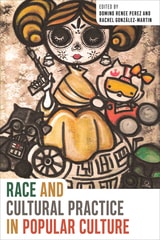
Race and Cultural Practice in Popular Culture
Perez, Domino
Rutgers University Press, 2019
Race and Displacement
Nation, Migration, and Identity in the Twenty-First CenturyEdited by Maha Marouan and Merinda Simmons
University of Alabama Press, 2013

Race and Education, 1954-2007
Raymond Wolters
University of Missouri Press, 2008
In this compelling study, a scholar who has long observed the traumas of school desegregation uncovers the changes and difficulties with which public education has dealt over the last fifty years—and argues that some judicial decisions were ill-advised. Dealing candidly with matters usually considered taboo in academic discourse, Wolters argues that the Supreme Court acted correctly and in accordance with public sentiment in Brown but that it later took a wrong turn by equating desegregation with integration.
Retracing the history of desegregation and integration in America’s schools, Wolters distinguishes between several Court decisions, explaining that while Brown called for desegregation by requiring that schools deal with students on a racially nondiscriminatory basis, subsequent decisions—Green, Swann, Keyes—required actual integration through racial balancing. He places these decisions in the context of educational reform in the 1950s that sought to encourage bright students through advanced placement and honors courses—courses in which African American and Hispanic students were less likely to be enrolled. Then with the racial unrest of the 1960s, the pursuit of academic excellence yielded to concerns for uplifting disadvantaged youths and ensuring the predominance of middle-class peer groups in schools.
Wolters draws on rich historical records to document the devastating consequences of requiring racial balance and sheds new light on America’s legal, social, and cultural landscapes. He reexamines the educational theories of Kenneth Clark and James Coleman, and he challenges statistics that support the results of racial balancing by describing how school desegregation and integration actually proceeded in several towns, cities, and counties.
Race and Education is a bold challenge to political correctness in education and a corrective to the now widely accepted notion that desegregation and racially balanced integration are one and the same. It is essential reading for scholars of law and education and a wake-up call for citizens concerned about the future of America’s schools.
Race and Environmental Justice in the Era of Climate Change and COVID-19
Tatiana Konrad
Michigan State University Press, 2025
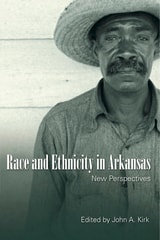
Race and Ethnicity in Arkansas
New PerspectivesJohn A. Kirk
University of Arkansas Press, 2014

Race and Ethnicity in Latin America
Peter Wade
Pluto Press, 2010
For over ten years, Race and Ethnicity in Latin America has been an essential text for students studying the region. This second edition adds new material and brings the analysis up to date.
Race and ethnic identities are increasingly salient in Latin America. Peter Wade examines changing perspectives on Black and Indian populations in the region, tracing similarities and differences in the way these peoples have been seen by academics and national elites. Race and ethnicity as analytical concepts are re-examined in order to assess their usefulness.
This book should be the first port of call for anthropologists and sociologists studying identity in Latin America.
Race and Ethnicity in the Middle Ages, Volume 31
Thomas Hahn, ed.
Duke University Press, 0
"The Difference the Middle Ages Makes: Color and Race before the Modern World" by Thomas Hahn
"Medieval and Modern Concepts of Race and Ethnicity" by Robert Bartlett
"Black Servant, Black Demon: Color Ideology in the Ashburnham Pentateuch" by Dorothy Hoogland Verkerk
"Pagans are wrong and Christians are right: Alterity, Gender, and Nation in the Chanson de Roland" by Sharon Kinoshita
"On Saracen Enjoyment: Some Fantasies of Race in Late Medieval France and England" by Jeffrey Jerome Cohen
"Medieval Travel Writing and the Question of Race" by Linda Lomperis
"Why ‘Race’?" by William Chester Jordan

Race and Gender at War
Writing American Military HistoryEdited by Lesley J. Gordon and Andrew J. Huebner
University of Alabama Press, 2024
Beyond the battlefield: How race and gender redefined war, identity, and memory in Civil War America.
Race and Gender at War is a collection of essays that illuminates ways that race and gender have persistently shaped the military history of the United States. Editors Lesley J. Gordon and Andrew J. Huebner showcase historians with varied research agendas in the field of “war and society,” a fertile area of inquiry that shares space (and often overlaps) with operational studies inside the broader field of military history. Chronicling more than 150 years of American history, the essays in this volume demonstrate that the tensions and injustices surrounding race, gender, and the military remain relevant and controversial, and continue to roil American politics, society, and culture to this day.
Spanning the two centuries from the 1830s to the present, the collection examines topics such as Choctaw Natives who served in the Confederate Army, the trailblazing but fraught experiences of Black servicemen from the Civil War through World War I, the hypersexualized images of World War II servicemen, and the varied and mutable roles of women in the armed services. Utilizing diverse methodologies, the book examines how these factors influenced everything from military policy to civilian experiences, encompassing topics like martial rhetoric, citizenship, propaganda, and patriotism.
CONTRIBUTORS
Kevin Adams / Amanda Bellows / Kari L. Boyd-Weisenberger / Michele Curran Cornell / Lesley J. Gordon / Andrew J. Huebner / Gregory Mixon / Caroline Wood Newhall / Heather Marie Stur / Patrick T. Troester / Chad L. Williams / Fay A. Yarbrough
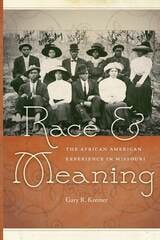
Race and Meaning
The African American Experience in MissouriGary R. Kremer
University of Missouri Press, 2014
In addition to his previously published articles, Kremer includes a personal introduction revealing how he first became interested in researching African American history and how his education at Lincoln University--and specifically the influence of his mentor, Lorenzo Greene--helped him to realize his eventual career path. Race and Meaning makes a collection of largely unheard stories spanning much of Missouri history accessible for the first time in one place, allowing each article to be read in the context of the others, and creating a whole that is much greater than the sum of its parts. Whether you are a student, researcher, or general reader, this book will be essential to anyone with an interest in Missouri history.

Race and Nation in Puerto Rican Folklore
Franz Boas and John Alden Mason in Porto RicoRafael Ocasio
Rutgers University Press, 2020
Race and Performance after Repetition
Soyica Diggs Colbert, Douglas A. Jones Jr., and Shane Vogel, editors
Duke University Press, 2020
Contributors. Joshua Chambers-Letson, Soyica Diggs Colbert, Nicholas Fesette, Patricia Herrera, Jasmine Elizabeth Johnson, Douglas A. Jones Jr., Mario LaMothe, Daphne P. Lei, Jisha Menon, Tavia Nyong’o, Tina Post, Elizabeth W. Son, Shane Vogel, Catherine M. Young, Katherine Zien
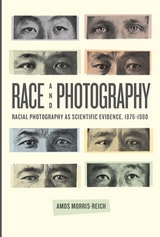
Race and Photography
Racial Photography as Scientific Evidence, 1876-1980Amos Morris-Reich
University of Chicago Press, 2015
Exploring the development of racial photography wherever it took place, including countries like France and England, Morris-Reich pays special attention to the German and Jewish contexts of scientific racism. Through careful reconstruction of individual cases, conceptual genealogies, and patterns of practice, he compares the intended roles of photography with its actual use in scientific argumentation. He examines the diverse ways it was used to establish racial ideologies—as illustrations of types, statistical data, or as self-evident record of racial signs. Altogether, Morris-Reich visits this troubling history to outline important truths about the roles of visual argumentation, imagination, perception, aesthetics, epistemology, and ideology within scientific study.
Race and Place
School Desegregation in Prince George's County, MarylandDeirdre Mayer Dougherty
Rutgers University Press, 2025

Race and Police
The Origin of Our Peculiar InstitutionsBen Brucato
Rutgers University Press, 2024
Race and Police corrects the Eurocentrism in the orthodox history of American police and in predominating critical theories of police. That orthodoxy rests on an origin story that begins with Sir Robert Peel and the London Metropolitan Police Service. Predating the Met by more than a century, America’s first police, often called slave patrols, did more than maintain order—it fabricated a racial order. Prior to their creation, all white citizens were conscripted to police all Blacks. Their participation in the coercive control of Blacks gave definition to their whiteness. Targeted as threats to the security of the economy and white society, being policed defined Blacks who, for the first time, were treated as a single racial group. The boundaries of whiteness were first established on the basis of who was required to regulate slaves, given a specific mandate to prevent Black insurrection, a mandate that remains core to the police role to this day.
Race and Politics
Asian Americans, Latinos, and Whites in a Los Angeles SuburbLeland T. Saito. Foreword by Roger Daniels
University of Illinois Press, 1998
Located a mere fifteen minutes from Los Angeles, the San Gabriel Valley is an incubator for California's new ethnic politics. Here, Latinos and Asian Americans are the dominant groups. Politics are Latino-dominated, while a large infusion of Chinese immigrants and capital has made the San Gabriel Valley the center of the nation's largest Chinese ethnic economy. The white population, meanwhile, has dropped from an overwhelming majority in 1970 to a minority in 1990.
Leland T. Saito presents an insider's view of the political, economic, and cultural implications of this ethnic mix. He examines how diverse residents of the region have worked to overcome their initial antagonisms and develop new, more effective political alliances.
Tracing grassroots political organization along racial and ethnic lines, Race and Politics focuses on the construction of new identities in general and the panethnic affiliation "Asian American" in particular.
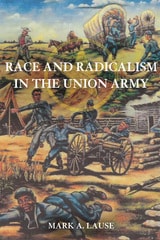
Race and Radicalism in the Union Army
Mark A. Lause
University of Illinois Press, 2013
In this compelling portrait of interracial activism, Mark A. Lause documents the efforts of radical followers of John Brown to construct a triracial portion of the Federal Army of the Frontier. Mobilized and inspired by the idea of a Union that would benefit all, black, Indian, and white soldiers fought side by side, achieving remarkable successes in the field. Against a backdrop of idealism, racism, greed, and the agonies and deprivations of combat, Lause examines links between radicalism and reform, on the one hand, and racialized interactions among blacks, Indians, and whites, on the other.
Lause examines how this multiracial vision of American society developed on the Western frontier. Focusing on the men and women who supported Brown in territorial Kansas, Lause examines the impact of abolitionist sentiment on relations with Indians and the crucial role of nonwhites in the conflict. Through this experience, Indians, blacks, and whites began to see their destinies as interdependent, and Lause discusses the radicalizing impact of this triracial Unionism upon the military course of the war in the upper Trans-Mississippi.
The aftermath of the Civil War destroyed much of the memory of the war in the West, particularly in the Indian Territory (now Oklahoma). The opportunity for an interracial society was quashed by the government's willingness to redefine the lucrative field of Indian exploitation for military and civilian officials and contractors.
Assessing the social interrelations, ramifications, and military impact of nonwhites in the Union forces, Race and Radicalism in the Union Army explores the extent of interracial thought and activity among Americans in this period and greatly expands the historical narrative on the Civil War in the West.
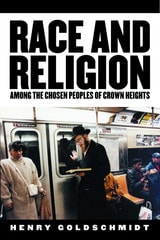
Race and Religion Among the Chosen People of Crown Heights
Goldschmidt, Henry
Rutgers University Press, 2006
In August of 1991, the Brooklyn neighborhood of Crown Heights was engulfed in violence following the deaths of Gavin Cato and Yankel Rosenbaum—a West Indian boy struck by a car in the motorcade of a Hasidic spiritual leader and an orthodox Jew stabbed by a Black teenager. The ensuing unrest thrust the tensions between the Lubavitch Hasidic community and their Afro-Caribbean and African American neighbors into the media spotlight, spurring local and national debates on diversity and multiculturalism. Crown Heights became a symbol of racial and religious division. Yet few have paused to examine the nature of Black-Jewish difference in Crown Heights, or to question the flawed assumptions about race and religion that shape the politics—and perceptions—of conflict in the community.
In Race and Religion among the Chosen Peoples of Crown Heights, Henry Goldschmidt explores the everyday realities of difference in Crown Heights. Drawing on two years of fieldwork and interviews, he argues that identity formation is particularly complex in Crown Heights because the neighborhood’s communities envision the conflict in remarkably diverse ways. Lubavitch Hasidic Jews tend to describe it as a religious difference between Jews and Gentiles, while their Afro-Caribbean and African American neighbors usually define it as a racial difference between Blacks and Whites. These tangled definitions are further complicated by government agencies who address the issue as a matter of culture, and by the Lubavitch Hasidic belief—a belief shared with a surprising number of their neighbors—that they are a “chosen people” whose identity transcends the constraints of the social world.
The efforts of the Lubavitch Hasidic community to live as a divinely chosen people in a diverse Brooklyn neighborhood where collective identities are generally defined in terms of race illuminate the limits of American multiculturalism—a concept that claims to celebrate diversity, yet only accommodates variations of certain kinds. Taking the history of conflict in Crown Heights as an invitation to reimagine our shared social world, Goldschmidt interrogates the boundaries of race and religion and works to create space in American society for radical forms of cultural difference.

Race and Repast
Foodscapes in Twentieth-Century Southern LiteratureUrszula Niewiadomska-Flis
University of Arkansas Press, 2022
Race and Retail
Consumption across the Color LineBay, Mia
Rutgers University Press, 2015