Results by title
22279 books match the query 'Social Science' and 1072 start with r
Roofless
Partnerships, Self-Governance, and Community in a Homeless Tent CampKaren A. Snedker
Rutgers University Press, 2027
Roofless critically examines homelessness and responses to it in the United States through the growing practice of forming tent camps. Karen A. Snedker and Jennifer McKinney position Seattle's "Tent City 3," (the US city with the third-largest homeless population), as an organizational model for other local governments to consider implementing in addressing their homelessness crises. Snedker and McKinney document this tent city's development through a census they conducted from 2019 to 2020, though the efforts behind Tent City 3 have a history dating back two decades. Through such an examination, the authors reveal surprising points of view and outcomes, including grassroots partnerships between city agencies, nonprofits, religious organizations, and educational institutions. In the context of rising homelessness in the US, understanding and having insight into the residents' experience of sanctioned unsheltered homelessness, compared to instances of unsanctioned encampments, allows readers to acquire a complete, nuanced picture of tent-based homelessness. As such, Roofless provides valuable insight to audiences ranging from scholars of sociology and social work, policymakers, homelessness advocates, and politicians.
Room 306
The National Story of the Lorraine MotelBen Kamin
Michigan State University Press, 2012
Rooms of Our Own
Susan Gubar
University of Illinois Press, 2006
With a little help from Virginia Woolf, Susan Gubar contemplates startling transformations produced by the women's movement in recent decades. What advances have women made and what still needs to be done? Taking Woolf's classic A Room of One's Own as her guide, Gubar engages these questions by recounting one year in the life of an English professor.
A meditation on the teaching of literature and on the state of the humanities today, her chapters also provide a crash course on the challenges and changes in feminist intellectual history over the past several decades: the influence of post-structuralism and of critical race, postcolonial, and cultural studies scholarship; the stakes of queer theory and the institutionalization of women's studies; and the effects of globalism and bioengineering on conversations about gender, sex, and sexuality. Yet Rooms of Our Own eschews a scholarly approach. Instead, through narrative criticism it enlists a thoroughly contemporary cast of characters who tell us as much about the comedies and tragedies of campus life today as they do about the sometimes contentious but invariably liberating feminisms of our future.
Rooted Resistance
Agrarian Myth in Modern AmericaNorie R. Singer
University of Arkansas Press, 2020
Through a careful examination of several case studies, Rooted Resistance traverses the ground of agrarian myth in modern America. The authors investigate key figures and movements in the history of modern agrarianism, including the World War I victory garden efforts, the postwar Country Life movement for the vindication of farmers’ rights, the Southern Agrarian critique of industrialism, and the practical and spiritual prophecy of organic farming put forth by J. I. Rodale. This critical history is then brought up to date with recent examples such as the contested South Central Farm in urban Los Angeles and the spectacular rise and fall of the Chipotle “Food with Integrity” branding campaign.
By examining a range of case studies, Singer, Grey, and Motter aim for a deeper critical understanding of the many applications of agrarian myth and reveal why it can help provide a pathway for positive systemic change in the food system.
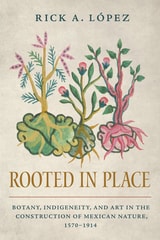
Rooted in Place
Botany, Indigeneity, and Art in the Construction of Mexican Nature, 1570–1914Rick A. López
University of Arizona Press, 2025
Prize for Best Book in Environmental Studies, Latin American Studies Association
Honorable mention for Best Book Prize in Visual Culture, Latin American Studies Association
Honorable mention for Best Book on Mexico, Latin American Studies Association
Since the first moment of conquest, colonizers and the colonized alike in Mexico confronted questions about what it meant to be from this place, what natural resources it offered, and who had the right to control those resources and on what basis.
Focusing on the ways people, environment, and policies have been affected by political boundaries, historian Rick A. López explores the historical connections between political identities and the natural world. López analyzes how scientific intellectuals laid claim to nature within Mexico, first on behalf of the Spanish Empire and then in the name of the republic, during three transformative moments: the Hernández expedition of the late sixteenth century; the Royal Botanical Expedition of the late eighteenth century; and the heyday of scientific societies such as the Sociedad Mexicana de Historia Natural of the late nineteenth century.
This work traces how scientific intellectuals studied and debated what it meant to know and claim the flora that sprang from Mexican soil—ranging from individual plants to forests and vegetated landscapes—and the importance they placed on indigeneity. It also points to the short- and long-term consequences of these efforts. López draws on archival and published sources produced from the sixteenth century through the start of the twentieth century and gives special attention to the use of visual images such as scientific illustrations and landscape art. López employs the term “visualization” in recognition of the degree to which officials, botanists, and draftsmen produced imagery and also how they and others viewed nature.
Rooted in Place reveals how scientific endeavors were not just about cataloging flora but were deeply intertwined with the construction of identity and the political landscape at three pivotal moments in Mexican history.
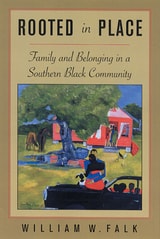
Rooted in Place
Family and Belongings in a Southern Black CommunityFalk, William W
Rutgers University Press, 2004
Throughout the twentieth century, millions of African Americans, many from impoverished, historically black counties, left the South to pursue what they thought would be a better life in the North. But not everyone moved away during what scholars have termed the Great Migration. What has life been like for those who stayed? Why would they remain in a place that many outsiders would see as grim, depressed, economically marginal, and where racial prejudice continues to place them at a disadvantage?
Through oral history William Falk tells the story of an extended family in the Georgia-South Carolina lowcountry. Family members talk about schooling, relatives, work, religion, race, and their love of the place where they have lived for generations. This “conversational ethnography” argues that an interconnection between race and place in the area helps explain African Americans’ loyalty to it. In Colonial County, blacks historically enjoyed a numerical majority as well as deep cultural roots and longstanding webs of social connections that, Falk finds, more than outweigh the racism they face and the economic disadvantages they suffer.
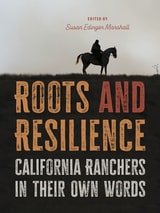
Roots and Resilience
California Ranchers in Their Own WordsSusan Edinger Marshall
University of Nevada Press, 2024
The editors have drawn together these stories, poems, and musings from ranchers across the state, calling upon real people to share their experiences, and beckoning readers to find a shared understanding concerning often divisive land-use topics. Many perspectives are considered, including those of transplanted suburbanites to seventh-generation heirs. Notably, many women’s writings are including in the book, offering unique and valuable perspectives on ranching culture.
Roots and Resilience gives voice to California’s Indigenous, Mexican American, Basque and other European American ranchers, asking the reader to find common ground in the name of land stewardship and conservation.
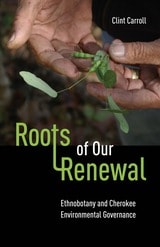
Roots of Our Renewal
Ethnobotany and Cherokee Environmental GovernanceClint Carroll
University of Minnesota Press, 2015
Honorable Mention: Labriola Center American Indian National Book Award
In Roots of Our Renewal, Clint Carroll tells how Cherokee people have developed material, spiritual, and political ties with the lands they have inhabited since removal from their homelands in the southeastern United States. Although the forced relocation of the late 1830s had devastating consequences for Cherokee society, Carroll shows that the reconstituted Cherokee Nation west of the Mississippi eventually cultivated a special connection to the new land—a connection that is reflected in its management of natural resources.
Until now, scant attention has been paid to the interplay between tribal natural resource management programs and governance models. Carroll is particularly interested in indigenous environmental governance along the continuum of resource-based and relationship-based practices and relates how the Cherokee Nation, while protecting tribal lands, is also incorporating associations with the nonhuman world. Carroll describes how the work of an elders’ advisory group has been instrumental to this goal since its formation in 2008.
An enrolled citizen of the Cherokee Nation, Carroll draws from his ethnographic observations of Cherokee government–community partnerships during the past ten years. He argues that indigenous appropriations of modern state forms can articulate alternative ways of interacting with and “governing” the environment.
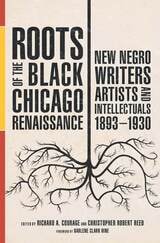
Roots of the Black Chicago Renaissance
New Negro Writers, Artists, and Intellectuals, 1893-1930Edited by Richard A. Courage and Christopher Robert Reed
University of Illinois Press, 2020
Richard A. Courage and Christopher Robert Reed have brought together essays that explore the intersections in the backgrounds, education, professional affiliations, and public lives and achievements of black writers, journalists, visual artists, dance instructors, and other creators working in the late nineteenth and early twentieth centuries. Organized chronologically, the chapters unearth transformative forces that supported the emergence of individuals and social networks dedicated to work in arts and letters. The result is an illuminating scholarly collaboration that remaps African American intellectual and cultural geography and reframes the concept of urban black renaissance.
Contributors: Richard A. Courage, Mary Jo Deegan, Brenda Ellis Fredericks, James C. Hall, Bonnie Claudia Harrison, Darlene Clark Hine, John McCluskey Jr., Amy M. Mooney, Christopher Robert Reed, Clovis E. Semmes, Margaret Rose Vendryes, and Richard Yarborough
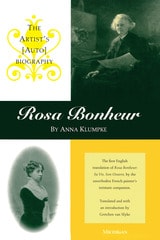
Rosa Bonheur
The Artist's (Auto)biographyAnna Klumpke
University of Michigan Press, 2001
Rosa Bonheur: The Artist's (Auto)Biography brings this extraordinary woman to life in a unique blend of biography and autobiography. Coupling her own memories with Bonheur's first-person account, Anna Klumpke, a young American artist who was Bonheur's lover and chosen portraitist, recounts how she came to meet and fall in love with Bonheur. Bonheur's account of her own life story, set nicely within Klumpke's narrative, sheds light on such topics as gender formation, institutional changes in the art world, governmental intervention in the arts, the social and legal regulation of dress codes, and the perceived transgressive nature of female sexual companionship in a repressive society, all with the distinctive flavor of Bonheur's artistic personality.
Gretchen van Slyke's translation provides a rare glimpse into the unconventional life of this famous French painter, and renders accessible for the first time in English this public statement of Bonheur's artistic credo. More importantly, whether judged by her century's standards (or perhaps even our own), it details a story of lesbian love that is bold, unconventional, and courageous.
"The remarkable life of Rosa Bonheur, one of the most highly decorated artists and certainly the best known female artist of her time in nineteenth-century France, is long overdue for further scrutiny." --Therese Dolan, Temple University
Gretchen van Slyke is Associate Professor of French, University of Vermont.
Rosa Luxemburg, Women's Liberation, and Marx's Philosophy of Revolution
Raya Dunayevskaya
University of Illinois Press, 1991
In this important and wide-ranging critique of Rosa Luxemburg (1871-1919) Raya Dunayevskaya examines the life, political thought, and action of one of the most critical revolutionary figures of our time. Dunayevskaya sheds new light on the questions of socialist democracy after the revolution, disclosing both the unprobed feminist dimension of Rosa Luxemburg and the previously unrecognized new moments in Marx's last decade concerning the role of women and the peasantry. As the founder of Marxist-Humanism in the United States, Dunayevskaya (1910-87) was an internationally respected writer, philosopher, and revolutionary. This new and expanded edition includes two previously unpublished articles by Dunayevskaya, including her "Challenge to all Post-Marx Marxists."

Rosa Luxemburg
Socialism or Barbarism: Selected WritingsRosa Luxemburg
Pluto Press, 2010
Rosa Luxemburg (1871-1919) was one of the most brilliant and passionate minds drawn to the revolutionary socialist movement. An outstanding social and economic theorist of the twentieth century, and a dedicated political activist, she proved willing to go to prison and even give her life for her beliefs.
Providing an extensive overview of her writings, this volume contains a number of items never before anthologised. Her work was broad in scope tackling capitalism and socialism; globalisation and imperialism; history; war and peace; social struggles, trade unions, political parties; class, gender, race; the interconnection of humanity with the natural environment. The editors provide an extensive and informative introduction outlining and evaluating her life and thought.
This is the most comprehensive introduction to the range of Rosa Luxemburg’s thought.
Rough Metaphysics
The Speculative Thought and Mediumship of Jane RobertsPeter Skafish
University of Minnesota Press, 2023
A powerful case for why anthropology should study outsiders of thought and their speculative ideas
What sort of thinking is needed to study anomalies in thought? In this trenchantly argued and beautifully written book, anthropologist Peter Skafish explores this provocative question by examining the writings of the medium and “rough metaphysician” Jane Roberts (1929–1984). Through a close interpretation of her own published texts as well as those she understood herself to have dictated for her cohort of channeled personalities—including one, named “Seth,” who would inspire the New Age movement—Skafish shows her intuitive and dreamlike work to be a source of rigorously inventive ideas about science, ontology, translation, and pluralism. Arguing that Roberts’s writings contain philosophies ahead of their time, he also asks: How might our understanding of speculative thinking change if we consider the way untrained writers, occult visionaries, and their counterparts in other cultural traditions undertake it? What can outsider thinkers teach us about the limitations of even our most critical intellectual habits?
Rough Metaphysics is at once an ethnography of the books of a strange and yet remarkable writer, a commentary on the unlikely philosophy contained in them, and a call for a new way of doing (and undoing) philosophy through anthropology, and vice versa. In guiding the reader through Roberts’s often hallucinatory “world of concepts,” Skafish also develops a series of original interpretations of thinkers—from William James to Claude Lévi-Strauss to Paul Feyerabend—who have been vital to anthropologists and their fellow travelers.
Seductively written and surprising in its turns of thought, Rough Metaphysics is a feast for anyone who wants to learn how to think something new, especially about thought.

Rousing the Nation
Radical Culture in Depression AmericaLaura Browder
University of Massachusetts Press, 0
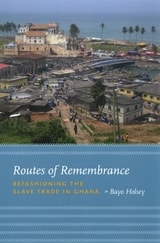
Routes of Remembrance
Refashioning the Slave Trade in GhanaBayo Holsey
University of Chicago Press, 2008
Routes of Remembrance tackles these questions by analyzing the slave trade’s absence from public versions of coastal Ghanaian family and community histories, its troubled presentation in the country’s classrooms and nationalist narratives, and its elaboration by the transnational tourism industry. Bayo Holsey discovers that in the past, African involvement in the slave trade was used by Europeans to denigrate local residents, and this stigma continues to shape the way Ghanaians imagine their historical past. Today, however, due to international attention and the curiosity of young Ghanaians, the slave trade has at last entered the public sphere, transforming it from a stigmatizing history to one that holds the potential to contest global inequalities.
Holsey’s study will be crucial to anyone involved in the global debate over how the slave trade endures in history and in memory.
Routine Crisis
An Ethnography of DisillusionSarah Muir
University of Chicago Press, 2021
Anthropologist Sarah Muir offers a cogent meditation on the limits of critique at this historical moment, drawing on deep experience in Argentina but reflecting on a truly global condition. If we feel things are being upended in a manner that is ongoing, tumultuous, and harmful, what would we need to do—and what would we need to give up—to usher in a revitalized critique for today's world? Routine Crisis is an original provocation and a challenge to think beyond the limits of exhaustion and reimagine a form of criticism for the twenty-first century.
Routing the Opposition
Social Movements, Public Policy, and DemocracyDavid S. Meyer
University of Minnesota Press, 2005
Row by Row
Talking with Kentucky GardenersKatherine J. Black
Ohio University Press, 2015
For two and a half years, Katherine J. Black crisscrossed Kentucky, interviewing home vegetable gardeners from a rich variety of backgrounds. Row by Row: Talking with Kentucky Gardeners is the result, a powerful compilation of testimonies on the connections between land, people, culture, and home.
The people profiled here share a Kentucky backdrop, but their life stories, as well as their gardens, have as many colors, shapes, and tastes as heirloom tomatoes do. Black interviewed those who grow in city backyards, who carve out gardens from farmland, and who have sprawling plots in creek bottoms and former pastures. Many of the gardeners in Row by Row speak eloquently about our industrialized food system’s injuries to the land, water, and health of people. But more often they talk about what they are doing in their gardens to reverse this course.
Row by Row is as sure to appeal to historians, food studies scholars, and sustainability advocates as it is to gardeners and local food enthusiasts. These eloquent portraits, drawn from oral histories and supplemented by Deirdre Scaggs’ color photographs, form a meditation on how gardeners make sense of their lives through what they grow and how they grow it.
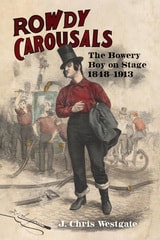
Rowdy Carousals
The Bowery Boy on Stage, 1848-1913J. Chris Westgate
University of Iowa Press, 2024
The book’s examination of working-class whiteness on stage, in the theatre, and in print culture invites theatre historians and critics to check the impulse to downplay or ignore questions about race and ethnicity in discussion of the Bowery Boy. J. Chris Westgate further explores links between the Bowery Boy’s rowdyism in the nineteenth century and the resurgence of white supremacy in the early twenty-first century.
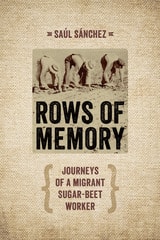
Rows of Memory
Journeys of a Migrant Sugar-Beet WorkerSaul Sanchez
University of Iowa Press, 2014
Rows of Memory tells his story and the story of his family and other migrant farm laborers like them, people who endured dangerous, dirty conditions and low pay, surviving because they took care of each other. Facing racism both on the road and at home, they lived a largely segregated life only occasionally breached by friendly employers.
Despite starting school late and leaving early every year and having to learn English on the fly, young Saúl succeeded academically. At the same time that Mexican Americans in South Texas upended the Anglo-dominated social order by voting their own leaders into local government, he upended his family’s order by deciding to go to college. Like many migrant children, he knew that his decision to pursue an education meant he would no longer be able to help feed and clothe the rest of his family. Nevertheless, with his parents’ support, he went to college, graduating in 1967 and, after a final display of his skill with a short hoe for his new friends, abandoned migrant labor for teaching.
In looking back at his youth, Sánchez invites us to appreciate the largely unrecognized and poorly rewarded strength and skill of the laborers who harvest the fruits and vegetables we eat. A first-person portrait of life on the bottom rung of the food system, this coming-of-age tale illuminates both the history of Latinos in the United States and the human consequences of industrial agriculture.
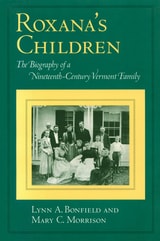
Roxana's Children
The Biography of a Nineteenth-Century Vermont FamilyLynn A. Bonfield
University of Massachusetts Press, 1995
Roy Orbison
Invention Of An Alternative Rock MasculinityPeter Lehman
Temple University Press, 2003
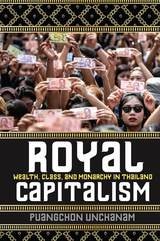
Royal Capitalism
Wealth, Class, and Monarchy in ThailandPuangchon Unchanam
University of Wisconsin Press, 2022
The kingdom positioned itself to connect business elites, patronize local industries, and form strategic partnerships with global corporations. Instead of restraining or regulating royal power, white-collar workers joined with the crown to form a dynamic, symbiotic force that has left the lower classes to struggle in their wake. Unchanam presents a surprising case study that kings and queens live long and large in cooperation with the bourgeoisie's interests and ideology.
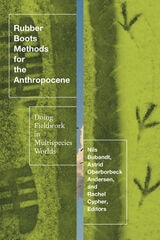
Rubber Boots Methods for the Anthropocene
Doing Fieldwork in Multispecies WorldsAstrid Oberborbeck Andersen
University of Minnesota Press, 2023
A methodological follow-up to Arts of Living on a Damaged Planet
The environmental and climatic crises of our time are fundamentally multispecies crises. And the Anthropocene, a time of “human-made” disruptions on a planetary scale, is a disruption of the fabric of life as a whole. The contributors to Rubber Boots Methods for the Anthropocene argue that understanding the multispecies nature of these disruptions requires multispecies methods.
Answering methodological challenges posed by the Anthropocene, Rubber Boots Methods for the Anthropocene retools the empirical study of the socioecological chaos of the contemporary moment across the arts, human science, and natural science. Based on critical landscape history, multispecies curiosity, and collaboration across disciplines and knowledge systems, the volume presents thirteen transdisciplinary accounts of practical methodological experimentation, highlighting diverse settings ranging from the High Arctic to the deserts of southern Africa and from the pampas of Argentina to the coral reefs of the Western Pacific, always insisting on the importance of firsthand, “rubber boots” immersion in the field.
The methodological companion to Arts of Living on a Damaged Planet: Ghosts and Monsters of the Anthropocene (Minnesota, 2017), this collection puts forth empirical studies of the multispecies messiness of contemporary life that investigate some of the critical questions of our time.
Contributors: Filippo Bertoni, Museum für Naturkunde, Berlin; Harshavardhan Bhat, U of Westminster; Nathalia Brichet, U of Copenhagen; Janne Flora, Aarhus U, Denmark; Natalie Forssman, U of British Columbia; Peter Funch, Aarhus U; Kirsten Hastrup, U of Copenhagen; Colin Hoag, Smith College; Joseph Klein, U of California, Santa Cruz; Andrew S. Mathews, U of California, Santa Cruz; Daniel Münster, U of Oslo; Ursula Münster, U of Oslo; Jon Rasmus Nyquist, U of Oslo; Katy Overstreet, U of Copenhagen; Pierre du Plessis, U of Oslo; Meredith Root-Bernstein; Heather Anne Swanson, Aarhus U; Anna Lowenhaupt Tsing, U of California,
Santa Cruz; Stine Vestbo.
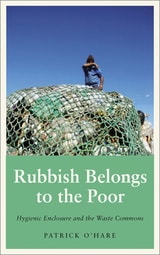
Rubbish Belongs to the Poor
Hygienic Enclosure and the Waste CommonsPatrick O’Hare
Pluto Press, 2021

Rubbish Belongs to the Poor
Hygienic Enclosure and the Waste CommonsPatrick O’Hare
Pluto Press, 2021
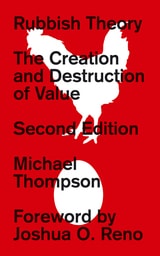
Rubbish Theory
The Creation and Destruction of Value - New EditionMichael Thompson
Pluto Press, 2017
When his highly influential Rubbish Theory, first published in 1979, Michael Thompson launched the discipline of waste studies. It remains the most comprehensive analysis on the culture of waste to date. Thompson argues that there are two mutually exclusive cultural categories that are socially imposed on the world of objects: a transient category and a durable category. However, he identifies a region of flexibility, wherein a transient object that declines in value and life span can linger in a valueless and timeless limbo of rubbish, until it is discovered by a creative individual and transferred into something deemed durable. He links stability and change on one hand, with materiality on the other, providing a rich analysis of social and cultural dynamics. His instrumental theory of rubbish draws on case studies and anthropological fieldwork to highlight the ever-changing subtleties of object value and our complex relationship to waste.
Bringing Rubbish Theory back into print, this updated edition includes a new introduction, preface, foreword, and afterword, thoroughly exploring how Thompson’s key theories have affected our world in the four decades since it was first published and placing it in a contemporary context that shines light on the continued relevance of the book today.
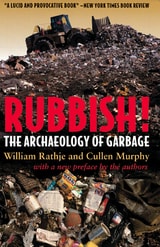
Rubbish!
The Archaeology of GarbageWilliam Rathje and Cullen Murphy
University of Arizona Press, 2001
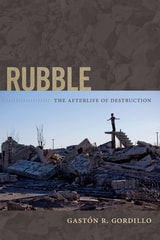
Rubble
The Afterlife of DestructionGastón R. Gordillo
Duke University Press, 2014
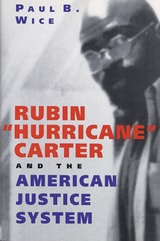
Rubin ' Hurricane' Carter and the American Justice System
Wice, Paul B
Rutgers University Press, 2000
Winner of the 2001 New Jersey Author's Award by the New Jersey Academic Alliance
Paul Wice takes the famous case of Rubin “Hurricane” Carter to another level of scrutiny as he puts the criminal justice system itself on trial. The case illustrates many of the strengths and weaknesses of our nation’s much maligned criminal justice system while affirming the power and resoluteness of the human spirit.
Early on the morning of June 17, 1966, the sound of gunfire echoed through the quite streets of Paterson, New Jersey, as four people were shot, three fatally, inside the Lafayette Bar and Grill. Twenty-nine-year-old Rubin “Hurricane” Carter, a prominent professional boxer, along with his companion, John Artis, were arrested and charged with committing this brutal crime. Prosecutors would later theorize that the murders were racially motivated — Carter and Artis are black, the victims white — to avenge the killing of a black Paterson tavern owner. Despite barely credible and oft-times contradictory evidence presented by both sides, a year after the killings Carter and Artis were convicted of murder and sentenced to life in prison. A second jury upheld the previous convictions in 1976. Artis was imprisoned until 1981, when he was released on parole. Carter remained in jail until 1988, when acting prosecutor John Goceljak elected not to pursue a third trial following the reversal of the 1976 retrial by the Federal District Court, a decision ultimately affirmed by the Circuit Court of Appeals and the U.S. Supreme Court. With the release of the widely discussed movie on Carter starring Denzel Washington, the case has again become visible and controversial.
Wice follows the torturous legal path of this case as it wound its way through first the New Jersey then the federal justice system for the next twenty-two years. His interpretations are informed by interviews with key members of both the prosecution and defense as well as previously unused court documents and transcripts. Wice evaluates the Carter case within a larger theoretical framework to illustrate many of the critical weaknesses of the adversary system and appeals process that is so basic to the American judicial system. Here is what can happen when police and prosecutors act unprofessionally, when critical witnesses lie, and when the justice system itself is unwilling to correct its errors or admit its mistakes.
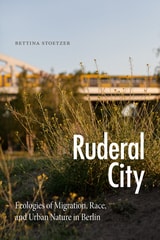
Ruderal City
Ecologies of Migration, Race, and Urban Nature in BerlinBettina Stoetzer
Duke University Press, 2022
Rudolph the Red-Nosed Reindeer
An American HeroRonald D. Lankford
University Press of New England, 2016
Ruins and Rivals
The Making of Southwest ArchaeologyJames E. Snead
University of Arizona Press, 2001
William P. Clements Center for Southwest Studies, Southern Methodist University
Ruins are as central to the image of the American Southwest as are its mountains and deserts, and antiquity is a key element of modern southwestern heritage. Yet prior to the mid-nineteenth century this rich legacy was largely unknown to the outside world. While military expeditions first brought word of enigmatic relics to the eastern United States, the new intellectual frontier was seized by archaeologists, who used the results of their southwestern explorations to build a foundation for the scientific study of the American past.
In Ruins and Rivals, James Snead helps us understand the historical development of archaeology in the Southwest from the 1890s to the 1920s and its relationship with the popular conception of the region. He examines two major research traditions: expeditions dispatched from the major eastern museums and those supported by archaeological societies based in the Southwest itself. By comparing the projects of New York's American Museum of Natural History with those of the Southwest Museum in Los Angeles and the Santa Fe-based School of American Archaeology, he illustrates the way that competition for status and prestige shaped the way that archaeological remains were explored and interpreted. The decades-long competition between institutions and their advocates ultimately created an agenda for Southwest archaeology that has survived into modern times.
Snead takes us back to the days when the field was populated by relic hunters and eastern "museum men" who formed uneasy alliances among themselves and with western boosters who used archaeology to advance their own causes. Richard Wetherill, Frederic Ward Putnam, Charles Lummis, and other colorful characters all promoted their own archaeological endeavors before an audience that included wealthy patrons, museum administrators, and other cultural figures. The resulting competition between scholarly and public interests shifted among museum halls, legislative chambers, and the drawing rooms of Victorian America but always returned to the enigmatic ruins of Chaco Canyon, Bandelier, and Mesa Verde.
Ruins and Rivals contains a wealth of anecdotal material that conveys the flavor of digs and discoveries, scholars and scoundrels, tracing the origins of everything from national monuments to "Santa Fe Style." It rekindles the excitement of discovery, illustrating the role that archaeology played in creating the southwestern "past" and how that image of antiquity continues to exert its influence today.
Ruins of the Past
The Use and Perception of Abandoned Structures in the Maya LowlandsTravis W. Stanton
University Press of Colorado, 2008
Ruins, Caves, Gods, and Incense Burners
Northern Lacandon Maya Myths and RitualsDidier Boremanse
University of Utah Press, 2019
Their cult of incense burners, based on the veneration of Maya ruins and funerary caves and the deities these effigy censers represented, remained free of any Christian influence. Some ceremonies were vestiges of more complex rituals believed to date back to pre-Columbian times. In this volume, Didier Boremanse explores Lacandon beliefs and traditions he observed during the many months of fieldwork he did, spanning four decades.
Throughout the book Boremanse makes Lacandon values and worldviews accessible to readers from western cultures. Rituals are described and explained with extracts of the celebrants’ prayers that were tape-recorded, transcribed, and translated. Other elements of religious oral tradition are included, including incantations, chants, and the myths and beliefs that sustain the rites. Boremanse also discusses how larger social change influences religious change, both through economic means and outside influences. Most of the myths retold in this book have never been published in English. Photographs show rites that are no longer performed and shrines that no longer exist.
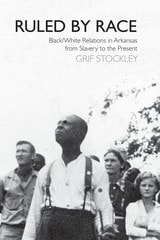
Ruled by Race
Black/White Relations in Arkansas From Slavery to the PresentGrif Stockley
University of Arkansas Press, 2008
Winner of the 2010 Booker Worthen Literary Prize, and the 2009 Ragsdale Award.
From the Civil War to Reconstruction, the Redeemer period, Jim Crow, and the modern civil rights era to the present, Ruled by Race describes the ways that race has been at the center of much of the state’s formation and image since its founding. Grif Stockley uses the work of published and unpublished historians and exhaustive primary source materials along with stories from authors as diverse as Maya Angelou and E. Lynn Harris to bring to life the voices of those who have both studied and lived the racial experience in Arkansas.
Topics range from the well-known Little Rock Central High Crisis of 1957 to lesser-known events such as the Elaine Race Massacres of 1919 and the shocking yet sadly commonplace attitudes found in newspaper reports and speeches. Through the words of the most powerful Arkansans such as racist Arkansas Govenor Jeff Davis (1901–1906) to the least powerful, including an unflinching look at the narratives of former slaves, readers will come away with increased awareness of the ways that race continues to affect where Arkansans live, send their children to school, work, travel, shop, spend leisure time, worship, and choose their friends and life partners.
Rules and Processes
John L. Comaroff and Simon Roberts
University of Chicago Press, 1986
"A work of impressive scholarship in which theoretical sophistication and ethnographic richness are convincingly matched."—Ian Hamnett, Times Higher Education Supplement.
Rules of Descent
Studies in the Sociology of ParentageGuy E. Swanson
University of Michigan Press, 1969
Rules, Games, and Common-Pool Resources
Elinor Ostrom, Roy Gardner, and James Walker
University of Michigan Press, 1994
Explores ways that the tragedy of the commons can be avoided by people who use common-property resources
Ruling Culture
Art Police, Tomb Robbers, and the Rise of Cultural Power in ItalyFiona Greenland
University of Chicago Press, 2021
In 2006, the then-president of Italy declared his country to be “the world’s greatest cultural power.” With Ruling Culture, Fiona Greenland traces how Italy came to wield such extensive legal authority, global power, and cultural influence—from the nineteenth century unification of Italy and the passage of novel heritage laws, to current battles with the international art market. Today, Italy’s belief in its cultural superiority is evident through interactions between citizens, material culture, and the state—crystallized in the Art Squad, the highly visible military-police art protection unit. Greenland reveals the contemporary actors in this tale, taking a close look at the Art Squad and state archaeologists on one side and unauthorized excavators, thieves, and smugglers on the other. Drawing on years in Italy interviewing key figures and following leads, Greenland presents a multifaceted story of art crime, cultural diplomacy, and struggles between international powers.
Ruling Oneself Out
A Theory of Collective AbdicationsIvan Ermakoff
Duke University Press, 2008
Ermakoff distinguishes several mechanisms of alignment in troubled and uncertain times and assesses their significance through a fine-grained examination of actors’ beliefs, shifts in perceptions, and subjective states. To this end, he draws on the analytical and methodological resources of perspectives that usually stand apart: primary historical research, formal decision theory, the phenomenology of group processes, quantitative analyses, and the hermeneutics of testimonies. In elaborating this dialogue across disciplinary boundaries, Ruling Oneself Out restores the complexity and indeterminate character of pivotal collective decisions and demonstrates that an in-depth historical exploration can lay bare processes of crucial importance for understanding the formation of political preferences, the paradox of self-deception, and the makeup of historical events as highly consequential.
Rulings Of The Night
An Ethnography Of Nepalese Shaman Oral TextsGregory G. Maskarinec
University of Wisconsin Press, 1995
It is impossible to discuss what shamans are and what they do, contends Gregory G. Maskarinec, without knowing what shamans say. When Maskarinec took an interest in shaman rituals on his first visit to Nepal, he was told by many Nepalis and Westerners that the shamans he had encountered in the Himalayan foothills of western Nepal engaged in "meaningless mumblings." But in the course of several years of fieldwork he learned from the shamans that both their long, publicly chanted rituals and their whispered, secretive incantations are oral texts meticulously memorized through years of training. In The Rulings of the Night, he shows how the shamans, during their dramatic night-long performances, create the worlds of words in which shamans exist.
Maskarinec analyzes several complete repertoires of the texts that the shamans use to diagnose and treat afflictions that trouble their clients. Through these texts, they intervene to manipulate and change the world, replacing its unbalanced, inexpressible chaos with orderly, balanced, grammatical, and eloquently expressible states. They negotiate the relations between language, action, and social realities, providing a well-constructed and thoroughly consistent intentional universe—and only in that universe can all shaman actions and beliefs be fully comprehended.
Rumba Rules
The Politics of Dance Music in Mobutu’s ZaireBob W. White
Duke University Press, 2008
Drawing partly on his experiences as a member of a local dance band in the country’s capital city Kinshasa, White offers extraordinarily vivid accounts of the live music scene, including the relatively recent phenomenon of libanga, which involves shouting the names of wealthy or powerful people during performances in exchange for financial support or protection. With dynamic descriptions of how bands practiced, performed, and splintered, White highlights how the ways that power was sought and understood in Kinshasa’s popular music scene mirrored the charismatic authoritarianism of Mobutu’s rule. In Rumba Rules, Congolese speak candidly about political leadership, social mobility, and what it meant to be a bon chef (good leader) in Mobutu’s Zaire.
Rumors of Indiscretion
The University of Missouri's "Sex Questionnaire" Scandal in the Jazz AgeLawrence J. Nelson
University of Missouri Press, 2003
Runagate
Songs of the Freedom BoundCrystal Simone Smith
Duke University Press, 2025
Running After Paradise
Hope, Survival, and Activism in Brazil's Atlantic ForestColleen M. Scanlan Lyons
University of Arizona Press, 2022
The pressures on this tropical forest are palpable. So are people’s responses to these pressures. What was once the state’s economic mainstay, cacao production, is only now beginning to make a comeback after a disease decimated the crops of large and small farmers alike. Tourism, another economic hope, is susceptible to economic crises and pandemics. And the threat of a massive state-led infrastructure project involving mining, a railroad, and an international port has loomed over the region for well over a decade.
Southern Bahia is at a crossroads: develop a sustainable, forest-based economy or run the risk of losing the identity and soul of this place forevermore. Through the lives of environmentalists, farmers, quilombolas, and nativos—people who are in and of this place—this book brings alive the people who are grappling with this dilemma.
Anthropologist Colleen M. Scanlan Lyons brings the eye of a storyteller to present this complex struggle, weaving in her own challenges of balancing family and fieldwork alongside the stories of the people who live in this dynamic region. Intertwined tales, friendships, and hope emerge as people both struggle to sustain their lives in a biodiversity hotspot and strive to create their paradise.
Running Amok
An Historical InquiryJohn C. Spores
Ohio University Press, 1988
Spores presents a basic etiological distinction between reactive-motivated and a spontaneous, unmotivated amok; the one an intentional act capable of establishing or restoring dignity and self-respect; the other a result of organic disturbance. He also explores the social-psychological dynamics of engagement in the two types of solitary amok and suggests possible behavioral chains. Further, his study demonstrates the impact of social forces and processes of the late nineteenth and early twentieth century which significantly altered factors in traditional Malay society important in generating expressions of solitary amok.
Running amok demonstrates the utility of bringing historical data to bear on the examination of specific social phenomena, particularly suggesting that the understanding of some present-day forms of mental disorder or other aberrant or deviant behavior can be facilitated and enriched through such analysis.
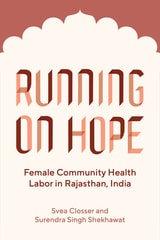
Running on Hope
Female Community Health Labor in Rajasthan, IndiaSvea Closser and Surendra Singh Shekhawat
Vanderbilt University Press, 2025
This book is freely available in an open-access edition thanks to the generous support of Johns Hopkins University.
Throughout India, Accredited Social Health Activists (ASHAs) visit households in their communities to deliver essential health services and link community members with key health benefits. Like many other female Community Health Workers across the world, ASHAs are often portrayed as virtuous, passive volunteers, selflessly providing services to their neighbors.
The reality is more complicated and much more interesting. Drawing on ethnographic work in Rajasthan, Running on Hope follows ASHAs through striking personal transformations. From their positions as rural daughters‑in‑law—a particularly low‑power position in Rajasthan—ASHAs have, over years of work, gained unprecedented autonomy for young rural women. They have also gained a deep understanding of what many argue is the exploitation involved in their low‑ranking position in the health system. ASHAs often earn less than $100 per month for extensive work, well below the legal minimum wage.
To counter this, many ASHAs have joined unions—an endeavor that has ultimately proven disappointing: union leaders’ desires for political advancement are often at odds with ASHAs’ own needs. However, ASHAs do not have connections, money, or social power to organize effectively on their own, without a political patron. In Running on Hope, authors Svea Closser and Surendra Singh Shekhawat interview women who work as ASHAs to learn about their organizing goals, their roles in their community as conduits to health education and resources, and their hopes for a better future.
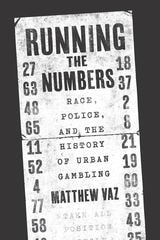
Running the Numbers
Race, Police, and the History of Urban GamblingMatthew Vaz
University of Chicago Press, 2020
How the politics of gambling became snarled in disputes over race, power, and law enforcement.
Every day in the United States, people test their luck in numerous lotteries, from state-run games to massive programs like Powerball and Mega Millions. Yet few are aware that the origins of today’s lotteries can be found in an African American gambling economy that flourished in urban communities in the mid-twentieth century. In Running the Numbers, Matthew Vaz reveals how the politics of gambling became enmeshed in disputes over racial justice and police legitimacy.
As Vaz highlights, early urban gamblers favored low-stakes games built around combinations of winning numbers. When these games became one of the largest economic engines in nonwhite areas like Harlem and Chicago’s south side, police took notice of the illegal business—and took advantage of new opportunities to benefit from graft and other corrupt practices. Eventually, governments found an unusual solution to the problems of illicit gambling and abusive police tactics: coopting the market through legal state-run lotteries, which could offer larger jackpots than any underground game. By tracing this process and the tensions and conflicts that propelled it, Vaz brilliantly calls attention to the fact that, much like education and housing in twentieth-century America, the gambling economy has also been a form of disputed terrain upon which racial power has been expressed, resisted, and reworked.

Running the Numbers
Race, Police, and the History of Urban GamblingMatthew Vaz
University of Chicago Press, 2020
How the politics of gambling became snarled in disputes over race, power, and law enforcement.
Every day in the United States, people test their luck in numerous lotteries, from state-run games to massive programs like Powerball and Mega Millions. Yet few are aware that the origins of today’s lotteries can be found in an African American gambling economy that flourished in urban communities in the mid-twentieth century. In Running the Numbers, Matthew Vaz reveals how the politics of gambling became enmeshed in disputes over racial justice and police legitimacy.
As Vaz highlights, early urban gamblers favored low-stakes games built around combinations of winning numbers. When these games became one of the largest economic engines in nonwhite areas like Harlem and Chicago’s south side, police took notice of the illegal business—and took advantage of new opportunities to benefit from graft and other corrupt practices. Eventually, governments found an unusual solution to the problems of illicit gambling and abusive police tactics: coopting the market through legal state-run lotteries, which could offer larger jackpots than any underground game. By tracing this process and the tensions and conflicts that propelled it, Vaz brilliantly calls attention to the fact that, much like education and housing in twentieth-century America, the gambling economy has also been a form of disputed terrain upon which racial power has been expressed, resisted, and reworked.