Results by title
18284 books match the query 'United States' and 833 start with r

Reconstructing Dixie
Race, Gender, and Nostalgia in the Imagined SouthTara McPherson
Duke University Press, 2003
Illuminating crucial connections between understandings of race, gender, and place on the one hand and narrative and images on the other, McPherson reads a number of representations of the South produced from the 1930s to the present. These are drawn from fiction, film, television, southern studies scholarship, popular journalism, music, tourist sites, the internet, and autobiography. She examines modes of affect or ways of "feeling southern" to reveal how these feelings, along with the narratives and images she discusses, sanction particular racial logics. A wide-ranging cultural studies critique, Reconstructing Dixie calls for vibrant new ways of thinking about the South and for a revamped and reinvigorated southern studies.
Reconstructing Dixie will appeal to scholars in American, southern, and cultural studies, and to those in African American, media, and women’s studies.
Reconstructing Justice
An Agenda for Trial ReformFranklin Strier
University of Chicago Press, 1996
Franklin Strier brings this critical look at trial reform up to date with a new preface in which he discusses how the inordinate amount of public attention of the O. J. Simpson trial, and the power the attorneys had over the court in that case, shed new light on the trial system's weaknesses and inequities.
"Anyone with an interest in courtroom trials will be fascinated by Strier's analysis of the game of law and suggestions for reforming the trail system to provide justice in a greater number of cases. . . . Highly recommended."—Choice
Reconstructing Reconstruction
The Supreme Court and the Production of Historical TruthPamela Brandwein
Duke University Press, 1999
Delving into the circumstances, assumptions, and rhetoric that shaped the “official” story of Reconstruction, Brandwein describes precisely how a dominant interpretation of events ultimately emerged and what its implications have been for twentieth-century judicial decisions, particularly for Supreme Court rulings on civil rights. While analyzing interpretive disputes about slavery, Brandwein offers a detailed rescoring of post–Civil War legislative and constitutional history, including analysis of the original understanding of the Fourteenth Amendment. She identifies the perspectives on Reconstruction that were endorsed or rejected by the Supreme Court. Explaining what it meant—theoretically and practically—to resolve Reconstruction debates with a particular definition of slavery, Brandwein recounts how the Northern Democratic definition of “ending” slavery was not the only definition, just the one that prevailed. Using a familiar historical moment to do new interpretive work, she outlines a sociology of constitutional law, showing how subjective narrative construction can solidify into opaque institutional memory.

Reconstructing the Academy
Women's Education and Women's StudiesEdited by Elizabeth Minnich, Jean F. O'Barr, and Rachel A. Rosenfeld
University of Chicago Press, 1988
Reconstructing the Commercial Republic
Constitutional Design after MadisonStephen L. Elkin
University of Chicago Press, 2006
The deficiencies Elkin points out provide the starting point for his own constitutional theory of the republic—a theory that, unlike Madison’s, lays out a substantive conception of the public interest that emphasizes the power of institutions to shape our political, economic, and civic lives. Elkin argues that his theory should guide us toward building a commercial republic that is rooted in a politics of the public interest and the self-interest of the middle class. He then recommends specific reforms to create this kind of republic, asserting that Americans today can still have the lives a commercial republic is intended to promote: lives with real opportunities for economic prosperity, republican political self-government, and individual liberty.
Reconstructing the National Bank Controversy
Politics and Law in the Early American RepublicEric Lomazoff
University of Chicago Press, 2018
With Reconstructing the National Bank Controversy, Eric Lomazoff offers a far more robust account of the constitutional politics of national banking between 1791 and 1832. During that time, three forces—changes within the Bank itself, growing tension over federal power within the Republican coalition, and the endurance of monetary turmoil beyond the War of 1812 —drove the development of our first major debate over the scope of federal power at least as much as the formal dimensions of the Constitution or the absence of a shared legal definition for the word “necessary.” These three forces—sometimes alone, sometimes in combination—repeatedly reshaped the terms on which the Bank’s constitutionality was contested. Lomazoff documents how these three dimensions of the polity changed over time and traces the manner in which they periodically led federal officials to adjust their claims about the Bank’s constitutionality. This includes the emergence of the Coinage Clause—which gives Congress power to “coin money, regulate the value thereof”—as a novel justification for the institution. He concludes the book by explaining why a more robust account of the national bank controversy can help us understand the constitutional basis for modern American monetary politics.
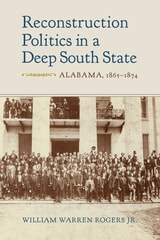
Reconstruction Politics in a Deep South State
Alabama, 1865–1874William Warren Rogers Jr.
University of Alabama Press, 2021
The battle for democracy in reconstruction-era Alabama.
Following the end of the Civil War, white Southerners were forced to concede equal rights to those who had been enslaved, ushering in a new and ruthless brand of politics. Suddenly, the status and place of some four million former slaves dominated the national and regional political dialogue. In Alabama, the Republican Party established itself quickly and powerfully with the participation of a newly freed constituency, firmly aligned against the Democratic Party that had long dictated the governance of the state. Well-heeled planters, merchants, and bankers, joined by yeoman farmers, staged a counterrevolution by gravitating strongly to the Democratic Party and its unabashedly white supremacist measures. The ensuing power struggle in the birthplace of the Confederacy is at the heart of Reconstruction Politics in a Deep South State: Alabama, 1865–1874.
What emerges in William Warren Rogers Jr.’s comprehensive study of the era is a detailed examination of Reconstruction politics, particularly in Alabama. This book explores an explosive and unpredictable political environment that a few years earlier would have been inconceivable. A vivid picture emerges of courthouse rallies and bitter infighting in legislative circles. Rogers’s narrative ventures into darker places as well: to the Tennessee Valley and the Black Belt regions of Alabama, where Klan nightriders used violence against an enemy and ideology they could not abide.
The attempt to capture and account for the unforgiving political landscape created by the extraordinary circumstances of Reconstruction constitutes this study’s most central contribution. Rogers often quotes black and white citizens, Democrats and Republicans. Drawn from newspapers, correspondence, and various federal investigations, these firsthand voices are passionate, unvarnished, and filled with conviction. They offer a startling immediacy and illustrate the temper—or distemper—of the times. Readers are treated to a panoramic unveiling of Reconstruction Alabama politics that provides a sense of what was truly at stake: the values by which a region and the nation as a whole would chart its future for the century to come.

Reconstruction after the Civil War, Third Edition
John Hope Franklin
University of Chicago Press, 2012
Reconstruction after the Civil War explores the role of former slaves during this period in American history. Looking past popular myths and controversial scholarship, John Hope Franklin uses his astute insight and careful research to provide an accurate, comprehensive portrait of the era. His arguments concerning the brevity of the North’s occupation, the limited power wielded by former slaves, the influence of moderate southerners, the flawed constitutions of the radical state governments, and the downfall of Reconstruction remain compelling today. This new edition of Reconstruction after the Civil War also includes a foreword by Eric Foner and a perceptive essay by Michael W. Fitzgerald.
Reconstruction in Texas
By Charles William Ramsdell
University of Texas Press, 1970
A reprint of the 1910 study, Reconstruction in Texas examines the events that still impact upon Texas and the South.
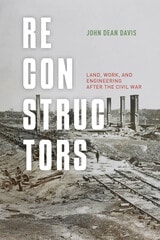
Reconstructors
Land, Work, and Engineering After the Civil WarJohn Dean Davis
University of Chicago Press, 2026
Explores the institutional and environmental transformations that occurred during the Reconstruction Era.
While the Reconstruction Era in America saw a paradigmatic realignment of the country’s core institutions and values, there was a physical quality to Reconstruction as well: the country was not only rebuilding the South after the Civil War, but flat-out building as it expanded westward.
In Reconstructors, John Dean Davis details how the Army Corps of Engineers and its subcontractors designed and redesigned the infrastructural landscape to support the republic’s rebirth. The Corps’ projects not only transformed the landscape; they created markets, fostered a distinctive expansionist culture, and—for a time—enacted a less discriminatory economic and social agenda across the South and West. Davis aims to bring federal power, environmentalism, and capitalism into a frame that reveals the landscape's power to further ideology.
Record Cultures
The Transformation of the U.S. Recording IndustryKyle Barnett
University of Michigan Press, 2020
Through an interdisciplinary and intermedial approach to recording industry history, Record Cultures creates new connections between different strands of media research. It will be of interest to scholars of popular music, media studies, sound studies, American culture, and the history of film, television, and radio.
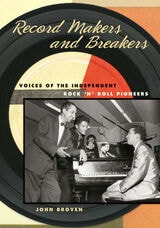
Record Makers and Breakers
Voices of the Independent Rock 'n' Roll PioneersJohn Broven
University of Illinois Press, 2009

Recording Culture
Powwow Music and the Aboriginal Recording Industry on the Northern PlainsChristopher A. Scales
Duke University Press, 2012

Records and Information Management
Patricia C. Franks
American Library Association, 2018
As Information Management put it, "On the strength of its currency and coverage alone, Franks' book is poised to take over as the recommended go-to reference for both students and RIM professionals for many years to come.” The new second edition cements this work’s status as an up-to-date classic, its content updated and expanded to address emerging technologies, most notably blockchain, and evolving standards and practices. Inside, Franks presents complete coverage of the records and information lifecycle model, encompassing paper, electronic (databases, office suites, email), and new media records (blogs, chat messages, and software as a service). Informed by an advisory board of experts in the field and with contributions by noted authorities, the text addresses such key topics as
- the origins and development of records and information;
- the discipline of information governance and developing a strategic records management plan;
- creation/capture and classification;
- retention strategies, inactive records management, archives, and long-term preservation;
- access, storage, and retrieval;
- electronic records and electronic records management systems;
- the latest on rapidly evolving technologies such as web records, social media, and mobile devices;
- vital records, disaster preparedness and recovery, and business continuity;
- monitoring, auditing, and risk management; and
- education and training.
This book’s authoritative blend of theory and practice makes it a matchless resource for everyone in the archives and records management field. Instructor/trainer extras include a set of ready-to-go, customizable PowerPoint slides to accompany the text.

Records and Information Management
Patricia C. Franks
American Library Association, 2013

Records and Information Management
Third EditionPatricia C. Franks
American Library Association, 2025
Widely acknowledged as the benchmark text for both students and RIM professionals ("extremely comprehensive and accessible," raves Archival Issues) the new third edition updates its authoritative blend of theory and practice to reflect the field’s dynamically evolving environment, including the rapid rise of applications powered by AI/ML. Franks presents complete coverage of the records and information lifecycle model, encompassing paper, electronic (databases, office suites such as Microsoft 365, and email), and new media records (blogs, chat messages, and software as a service), while acknowledging the influence of emerging and developing technologies and encouraging new ways of meeting the resulting challenges. In this book, enhanced with supplemental contributions from a wide range of thought leaders and practitioners, readers will explore such keys topics as
- the latest advances in disruptive technologies, including blockchain, Web3, the metaverse, and evolving digital communication tools such as enterprise social media;
- an overview of the origins and development of records and information management;
- the discipline of information governance and the steps to develop a strategic records and information management plan;
- a completely new chapter that demystifies data governance, automation, and AI;
- strategies for the creation/capture and classification of records and information;
- approaches to retention strategies, inactive records management, archives, and long-term digital preservation;
- methods for access, storage, and retrieval of records and information;
- insight into electronic records and electronic records management systems;
- practices for safeguarding essential records, including disaster preparedness, recovery, and business continuity;
- approaches to monitoring, auditing, privacy, security, and risk management;
- fresh discussion of the leadership and management skills required of RIM professionals; and
- expert guidance on trendspotting, education, and training.
Recovering Bodies
Illness, Disability, and Life WritingG. Thomas Couser
University of Wisconsin Press, 1997
Responding to the recent growth of illness and disability narratives in the United States—such works as Juliet Wittman’s Breast Cancer Journal, John Hockenberry’s Moving Violations, Paul Monette’s Borrowed Time: An AIDS Memoir, and Lou Ann Walker’s A Loss for Words: The Story of Deafness in a Family—Couser addresses questions of both poetics and politics. He examines why and under what circumstances individuals choose to write about illness or disability; what role plot plays in such narratives; how and whether closure is achieved; who assumes the prerogative of narration; which conditions are most often represented; and which literary conventions lend themselves to representing particular conditions. By tracing the development of new subgenres of personal narrative in our time, this book explores how explicit consideration of illness and disability has enriched the repertoire of life writing. In addition, Couser’s discussion of medical discourse joins the current debate about whether the biomedical model is entirely conducive to humane care for ill and disabled people.
With its sympathetic critique of the testimony of those most affected by these conditions, Recovering Bodies contributes to an understanding of the relations among bodily dysfunction, cultural conventions, and identity in contemporary America.
Recovering History, Constructing Race
The Indian, Black, and White Roots of Mexican AmericansBy Martha Menchaca
University of Texas Press, 2002
A CHOICE Outstanding Academic Book, 2002
The history of Mexican Americans is a history of the intermingling of races—Indian, White, and Black. This racial history underlies a legacy of racial discrimination against Mexican Americans and their Mexican ancestors that stretches from the Spanish conquest to current battles over ending affirmative action and other assistance programs for ethnic minorities. Asserting the centrality of race in Mexican American history, Martha Menchaca here offers the first interpretive racial history of Mexican Americans, focusing on racial foundations and race relations from prehispanic times to the present.
Menchaca uses the concept of racialization to describe the process through which Spanish, Mexican, and U.S. authorities constructed racial status hierarchies that marginalized Mexicans of color and restricted their rights of land ownership. She traces this process from the Spanish colonial period and the introduction of slavery through racial laws affecting Mexican Americans into the late twentieth-century. This re-viewing of familiar history through the lens of race recovers Blacks as important historical actors, links Indians and the mission system in the Southwest to the Mexican American present, and reveals the legal and illegal means by which Mexican Americans lost their land grants.
Recovering Inequality
Hurricane Katrina, the San Francisco Earthquake of 1906, and the Aftermath of DisasterBy Steve Kroll-Smith
University of Texas Press, 2018
A lethal mix of natural disaster, dangerously flawed construction, and reckless human actions devastated San Francisco in 1906 and New Orleans in 2005. Eighty percent of the built environments of both cities were destroyed in the catastrophes, and the poor, the elderly, and the medically infirm were disproportionately among the thousands who perished. These striking similarities in the impacts of cataclysms separated by a century impelled Steve Kroll-Smith to look for commonalities in how the cities recovered from disaster. In Recovering Inequality, he builds a convincing case that disaster recovery and the reestablishment of social and economic inequality are inseparable.
Kroll-Smith demonstrates that disaster and recovery in New Orleans and San Francisco followed a similar pattern. In the immediate aftermath of the flooding and the firestorm, social boundaries were disordered and the communities came together in expressions of unity and support. But these were quickly replaced by other narratives and actions, including the depiction of the poor as looters, uneven access to disaster assistance, and successful efforts by the powerful to take valuable urban real estate from vulnerable people. Kroll-Smith concludes that inexorable market forces ensured that recovery efforts in both cities would reestablish the patterns of inequality that existed before the catastrophes. The major difference he finds between the cities is that, from a market standpoint, New Orleans was expendable, while San Francisco rose from the ashes because it was a hub of commerce.
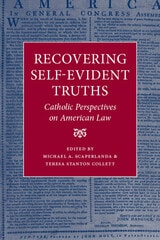
Recovering Self-Evident Truths
Catholic Perspectives on American LawMichael A. Scaperlanda
Catholic University of America Press, 2007
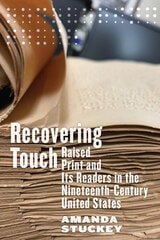
Recovering Touch
Raised Print and Its Readers in the Nineteenth-Century United StatesAmanda Stuckey
University of Massachusetts Press, 2027
Constructing a disability history of reading through the embossed books that shaped and constrained it
When the Maryland Institution for the Instruction of the Blind opened in 1853, its charter defined blindness as the inability to read ink. Embedded in that same document was a small rectangle of embossed roman letters—a “specimen of printing” that encapsulated decades of experimentation and a central contradiction: that a form of print designed to liberate visually impaired readers also asked them to read like sighted ones.
In Recovering Touch, Amanda Stuckey traces raised print developments from the first embossed book in the United States—the Gospel of St. Mark, embossed in 1833—through the late nineteenth-century War of the Dots, the contested debates among educators and administrators over which type system visually impaired readers should use. Focusing predominantly on raised roman letter systems, Stuckey brings visually impaired readers into nineteenth-century histories of reading, connecting individual acts of touch-based reading to broader histories of disability, schooling, and print culture. Embossed books promised to open the world of the printed word to readers marginalized from inked text. Yet educators often deployed these materials as tools to assimilate visually impaired students into the reading, learning, and labor standards of the sighted world.
Recovering Touch constructs a disability history of reading that centers the material conditions of touch-based reading: the paper that had to be felt rather than seen, the types that dulled over time, and the readers who adapted, repurposed, and at times defied the assimilationist expectations built into the books beneath their fingertips.

Recovering the Margins of American Religious History
The Legacy of David Edwin Harrell Jr.B. Dwain Waldrep
University of Alabama Press, 2012
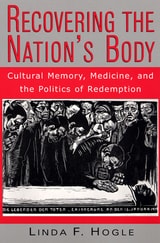
Recovering the Nation's Body
Cultural Memory, Medicine, and the Politics of RedemptionLinda F Hogle
Rutgers University Press, 1999
The body is both a site for medical practice and a source of therapeutic and scientific tools. As such, there are a variety of meanings ascribed to the body which both affect and are affected by cultural, economic, political and legal complexities. In order to access and use body parts, Linda F. Hogle states, transformative scientific and cultural processes are brought into play. Nowhere is this more evident than present-day Germany, where the spectre of Nazi medical experimentation still plays a large role in national policies governing the use of body parts and the way these policies are put into practice. In their efforts to be perceived as not repeating atrocities of the past, German medical practitioners and policy-makers reformulate ideas of bodily violation. To further confuse the issue, the reunification of East and West Germany has engendered new questions about the relationship between individuals’ bodies, science, and the state.
Hogle shows how “universal” medicine is reinterpreted through the lens of national and transnational politics and history, using comparative examples from her research in the United. States. Recovering the Nation’s Body is the first book to analyze the actual practices involved in procuring human tissue, and the first to examine how the German past and the unique present-day situation within the European Union are key in understanding the form that medical practices take within various contexts.
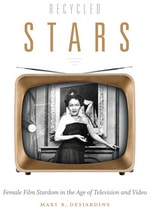
Recycled Stars
Female Film Stardom in the Age of Television and VideoMary R. Desjardins
Duke University Press, 2015

Recycling Land
Understanding the Legal Landscape of Brownfield DevelopmentElizabeth Glass Geltman
University of Michigan Press, 2000

Red Arrow across the Pacific
The Thirty-Second Infantry Division during World War IIMark D. Van Ells
Wisconsin Historical Society Press, 2024
Red Arrow across the Pacific reveals the long-overdue story of the renowned Thirty-Second "Red Arrow" Infantry Division. Discover how this National Guard unit—which originated in Wisconsin and Michigan but soon evolved to include soldiers from California to New England—became one of the first US military units deployed overseas in World War II, eventually logging more combat hours than any other US Army division.
Far more than a traditional battle narrative, Red Arrow across the Pacific offers a cultural history of the Red Arrow's wartime experience, from its mobilization in 1940, to its deployment across New Guinea, Australia, and the Philippines, to its postwar occupation of Japan. Drawing from letters, memoirs, and interviews, author Mark D. Van Ells lets the soldiers speak for themselves, describing in their own words the terror of combat, their impressions of foreign lands, the struggle to maintain their own humanity, and the many ways the war profoundly changed them.
Nuanced and remarkably thorough, this book explores the dramatic evolution of the Thirty-Second Infantry Division and reveals how the story of the Red Arrow reflects the experience of the US military during World War II.
“Exceptionally well researched and engagingly written. This book is a must read for any student of military history.”
—Capt. Florian L. Waitl, Command Historian, Wisconsin Army National Guard
“A superb divisional history. . . . Highly recommended for a general audience, as well as readers interested in the Second World War.”
—Mary Louise Roberts, Lucie Aubrac Distinguished Professor Emerita of History, University of Wisconsin–Madison, and author of Sheer Misery: Soldiers in Battle in WWII
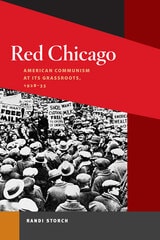
Red Chicago
American Communism at Its Grassroots, 1928-35Randi Storch
University of Illinois Press, 2007
Red Chicago is a social history of American Communism set within the context of Chicago's neighborhoods, industries, and radical traditions. Using local party records, oral histories, union records, party newspapers, and government documents, Randi Storch fills the gap between Leninist principles and the day-to-day activities of Chicago's rank-and-file Communists.
Uncovering rich new evidence from Moscow's former party archive, Storch argues that although the American Communist Party was an international organization strongly influenced by the Soviet Union, at the city level it was a more vibrant and flexible organization responsible to local needs and concerns. Thus, while working for a better welfare system, fairer unions, and racial equality, Chicago's Communists created a movement that at times departed from international party leaders' intentions. By focusing on the experience of Chicago's Communists, who included a large working-class, African American, and ethnic population, this study reexamines party members' actions as an integral part of the communities and industries in which they lived and worked.

Red Diapers
GROWING UP IN THE COMMUNIST LEFTEdited by Judy Kaplan and Linn Shapiro
University of Illinois Press, 1998
Red Diapers is the
first anthology of autobiographical writings by the children of American
communists. These memoirs, short stories, and poems reflect the joys and
perils of growing up in a subculture defined by its opposition to some
of society's most deeply held values. How red diaper babies have come
to terms with their political inheritance is the theme of this compelling
anthology.
Some contributors have fond
memories of family activism; others recall the past with ambivalence or
even pain. The authors range in age from their twenties to their eighties.
Some, such as Watergate reporter Carl Bernstein and sixties activist Bettina
Aptheker, are widely known themselves; some are the children of well-known
American leftists, including Jeff Lawson, son of blacklisted screenwriter
John Howard Lawson, and Robert Meeropol, son of Ethel and Julius Rosenberg.
In disparate voices, the contributors elaborate on how their parents attempted
to pass on to them the torch of radical politics.

Red Dust and Broadsides
A Joint AutobiographyRonald D. Cohen
University of Massachusetts Press, 1999
Perhaps best known for Broadside, the influential magazine they founded in 1962, Agnes “Sis” Cunningham and Gordon Friesen have long been renowned figures on the American left. In this book, these two dedicated social activists—Sis the folk musician and Gordon the radical journalist—offer a spirited account of their personal and political odyssey. The story is illustrated with numerous photographs and drawings.
Born into poverty in rural Oklahoma, further shaped by the hardships of the “dustbowl” Depression years, Sis and Gordon were already committed to radical causes when they met and married in 1941. A short time later they moved to New York City, where they befriended Pete Seeger and Woody Guthrie. Sis joined the folk protest group the Almanac Singers, and Gordon continued his work as a journalist. Although blacklisted for their political views during the McCarthy era, Sis and Gordon persevered and eventually launched Broadside, which they continued to produce for almost twenty years. The magazine was instrumental in promoting the careers of many singer-songwriters, publishing the first works of such artists as Bob Dylan, Janis Ian, Phil Ochs, Buffy Sainte-Marie, and Tom Paxton, as well as the works of more established figures, including Malvina Reynolds and Pete Seeger. Indeed, Broadside gave birth to a musical revival that energized the country and forged a vital link between the folk music of the 1930s and 1940s and the urban folk revivalists of the 1960s and 1970s.

Red Hot Mama
The Life of Sophie TuckerLauren Rebecca Sklaroff
University of Texas Press, 2018
The “First Lady of Show Business” and the “Last of the Red Hot Mamas,” Sophie Tucker was a star in vaudeville, radio, film, and television. A gutsy, song-belting stage performer, she entertained audiences for sixty years and inspired a host of younger women, including Judy Garland, Carol Channing, and Bette Midler. Tucker was a woman who defied traditional expectations and achieved success on her own terms, becoming the first female president of the American Federation of Actors and winning many other honors usually bestowed on men. Dedicated to social justice, she advocated for African Americans in the entertainment industry and cultivated friendships with leading black activists and performers. Tucker was also one of the most generous philanthropists in show business, raising over four million dollars for the religious and racial causes she held dear.
Drawing from the hundreds of scrapbooks Tucker compiled, Red Hot Mama presents a compelling biography of this larger-than-life performer. Lauren Rebecca Sklaroff tells an engrossing story of how a daughter of Russian Jewish immigrants set her sights on becoming one of the most formidable women in show business and achieved her version of the American dream. More than most of her contemporaries, Tucker understood how to keep her act fresh, to change branding when audiences grew tired and, most importantly, how to connect with her fans, the press, and entertainment moguls. Both deservedly famous and unjustly forgotten today, Tucker stands out as an exemplar of the immigrant experience and a trailblazer for women in the entertainment industry.
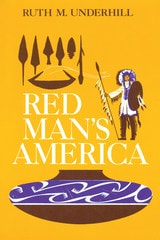
Red Man's America
A History of Indians in the United StatesRuth Murray Underhill
University of Chicago Press, 1971
The material Professor Underhill has gathered from the fields of archaeology, ethnology, and history, together with that drawn from her own experience in the United States Indian Service, produces a fascinating narrative. Red Man's America is an important contribution to our heritage of Indian life and lore.
"A work for which both sociologist and historian will be forever grateful. The author has combined a long period of study with actual field work in the service of the Indian to produce a work that gives a brief, but well written and accurate, sketch of the origins, backgrounds, and customs of the various North American tribes. . . . There is no other modern single volume that contains as much information on the subject."—E.R. Vollmar, The Historical Bulletin
"Liveliness in style and illustration, together with perspicacity in content, makes this book a useful introduction to the civilization of the original inhabitants of the land."—Pacific Historical Review
Red Ore Rising
The Journal of Otto Peltonen, a Finnish Immigrant StoryWilliam Durbin
University of Minnesota Press, 2026
A portrait of the Finnish immigrant experience in Minnesota during the early twentieth century
After journeying across the Atlantic with his mother and two sisters, young Otto Peltonen joins his father in the iron ore mines of northern Minnesota, experiencing the harsh labor conditions that were common at the time, as mining companies cared more about making a profit than for their workers’ safety. Writing in his journal about his family’s struggles and the hard life Finnish immigrants endured in the early twentieth century, Otto ultimately strengthens his resolve to find the freedom his family had first sought in America.

Red Rock and Rawhide
Ranching in the Grand Staircase, Escalante Canyons, and Arizona Strip CountryJerry D. Spangler and Mark E. DeGiovanni Miller
University of Utah Press, 2024
Today, the relatively few cattle ranchers who continue to operate in southern Utah are part of a complex political and social mix of peoples and interests, as Indigenous nations, environmentalists, politicians, and tourists all have differing positions on land use in the region. In Red Rock and Rawhide, Jerry D. Spangler and Mark E. DeGiovanni Miller provide the first comprehensive examination of the history of livestock grazing in the Grand Staircase-Escalante National Monument and surrounding areas, drawing on years of research to show how the culture and industry have changed and continue to evolve.

Red Scare
A Study in National Hysteria, 1919-1920Robert K. Murray
University of Minnesota Press, 1955
Red Scare was first published in 1955. Minnesota Archive Editions uses digital technology to make long-unavailable books once again accessible, and are published unaltered from the original University of Minnesota Press editions.
Few periods in American history have been so dramatic, so fraught with mystery, or so bristling with fear and hysteria as were the days of the great Red Scare that followed World War I. For sheer excitement, it would be difficult to find a more absorbing tale than the one told here. The famous Palmer raids of that era are still remembered as one of the most fantastic miscarriages of justice ever perpetrated upon the nation. The violent labor strife still makes those who lived through it shudder as they recall the Seattle general strike and Boston police strike, the great coal and steel strikes, and the bomb plots, shootings, and riots that accompanied these conflicts. But, exciting as the story may be, it has far greater significance than merely that of a lively tale. For, just as American was swept by a wave of unreasoning fear and was swayed by sensational propaganda in those days, so are we being tormented by similar tensions in the present climate of the cold war.
The objective analysis of the great Red Scare which Mr. Murray provides should go a long way toward helping us to avert some of the tragic consequences that the nation suffered a generation ago before hysteria and fear had finally run their course. The author traces the roots of the phenomenon, relates the outstanding events of the Scare, and evaluates the significant effects of the hysteria upon subsequent American life.
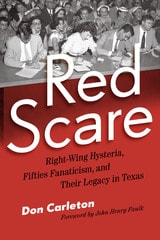
Red Scare
Right-Wing Hysteria, Fifties Fanaticism, and Their Legacy in TexasBy Don Carleton
University of Texas Press, 2014
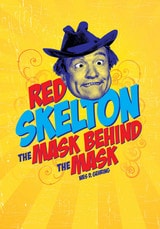
Red Skelton
The Mask behind the MaskWes Gehring
Indiana Historical Society Press, 2008
Red State
An Insider's Story of How the GOP Came to Dominate Texas PoliticsBy Wayne Thorburn
University of Texas Press, 2014
In November 1960, the Democratic party dominated Texas. The newly elected vice president, Lyndon Johnson, was a Texan. Democrats held all thirty statewide elective positions. The state legislature had 181 Democrats and no Republicans or anyone else. Then fast forward fifty years to November 2010. Texas has not voted for a Democratic president since 1976. Every statewide elective office is held by Republicans. Representing Texas in Washington is a congressional delegation of twenty-five Republicans and nine Democrats. Republicans control the Texas Senate by a margin of nineteen to twelve and the Texas House of Representatives by 101 to 49.
Red State explores why this transformation of Texas politics took place and what these changes imply for the future. As both a political scientist and a Republican party insider, Wayne Thorburn is especially qualified to explain how a solidly one-party Democratic state has become a Republican stronghold. He analyzes a wealth of data to show how changes in the state’s demographics—including an influx of new residents, the shift from rural to urban, and the growth of the Mexican American population—have moved Texas through three stages of party competition, from two-tiered politics, to two-party competition between Democrats and Republicans, and then to the return to one-party dominance, this time by Republicans. His findings reveal that the shift from Democratic to Republican governance has been driven not by any change in Texans’ ideological perspective or public policy orientation—even when Texans were voting Democrat, conservatives outnumbered liberals or moderates—but by the Republican party’s increasing identification with conservatism since 1960.
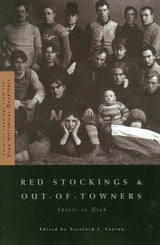
Red Stockings and Out-of-Towners
Sports in UtahStanford J. Layton
Signature Books, 2003
In team sports, the nearly forgotten Salt Lake Seagulls of 1946-47 competed against the best pro football teams in the West, while two baseball teams, the Salt Lake Deserets and their inner-city rival, the Red Stockings, played successfully in 1878-79 against the Cheyenne Reds, the Chicago White Stockings, the Denver Browns, the Nebraska Omahas, and the Rochester Hop Bitters.
Added to these, such pastimes as horse racing at the state fairgrounds, a winter ascent of Mt. Timpanogos in 1916, and angling at Fish Lake National Forest show the diversity and evolution of athletics in Utah. Like replaying the 1998 title game between the Utah Jazz and the Chicago Bulls, these assembled tales of perseverance, skill, exuberance, and heartbreak from long ago are equally thrilling.

Red War on the Family
Sex, Gender, and Americanism in the First Red ScareErica J Ryan
Temple University Press, 2016
In her probing and engaging book, Red War on the Family, Erica Ryan traces the roots of sexual modernism and the history of antiradicalism and antifeminism. She illuminates how Americans responded to foreign and domestic threats and expressed nationalism by strengthening traditional gender and family roles-especially by imposing them on immigrant groups, workers, women, and young people.
Ryan argues that the environment of political conformity in the 1920s was maintained in part through the quest for cultural and social conformity, exemplified by white, middle-class family life. Red War on the Family charts the ways Americanism both reinforced and was reinforced by these sexual and gender norms in the decades after World War I.
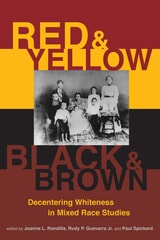
Red and Yellow, Black and Brown
Decentering Whiteness in Mixed Race StudiesRondilla, Joanne L
Rutgers University Press, 2017

Red, Black, and Jew
New Frontiers in Hebrew LiteratureBy Stephen Katz
University of Texas Press, 2009
Between 1890 and 1924, more than two million Jewish immigrants landed on America's shores. The story of their integration into American society, as they traversed the difficult path between assimilation and retention of a unique cultural identity, is recorded in many works by American Hebrew writers. Red, Black, and Jew illuminates a unique and often overlooked aspect of these literary achievements, charting the ways in which the Native American and African American creative cultures served as a model for works produced within the minority Jewish community.
Exploring the paradox of Hebrew literature in the United States, in which separateness, and engagement and acculturation, are equally strong impulses, Stephen Katz presents voluminous examples of a process that could ultimately be considered Americanization. Key components of this process, Katz argues, were poems and works of prose fiction written in a way that evoked Native American forms or African American folk songs and hymns. Such Hebrew writings presented America as a unified society that could assimilate all foreign cultures. At no other time in the history of Jews in diaspora have Hebrew writers considered the fate of other minorities to such a degree. Katz also explores the impact of the creation of the state of Israel on this process, a transformation that led to ambivalence in American Hebrew literature as writers were given a choice between two worlds.
Reexamining long-neglected writers across a wide spectrum, Red, Black, and Jew celebrates an important chapter in the history of Hebrew belles lettres.
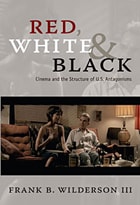
Red, White & Black
Cinema and the Structure of U.S. AntagonismsFrank B. Wilderson III
Duke University Press, 2010
Wilderson provides detailed readings of two films by Black directors, Antwone Fisher (Denzel Washington) and Bush Mama (Haile Gerima); one by an Indian director, Skins (Chris Eyre); and one by a White director, Monster’s Ball (Marc Foster). These films present Red and Black people beleaguered by problems such as homelessness and the repercussions of incarceration. They portray social turmoil in terms of conflict, as problems that can be solved (at least theoretically, if not in the given narratives). Wilderson maintains that at the narrative level, they fail to recognize that the turmoil is based not in conflict, but in fundamentally irreconcilable racial antagonisms. Yet, as he explains, those antagonisms are unintentionally disclosed in the films’ non-narrative strategies, in decisions regarding matters such as lighting, camera angles, and sound.
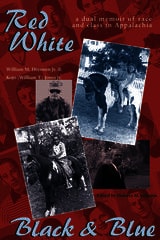
Red, White, Black, and Blue
A Dual Memoir of Race and Class in AppalachiaWilliam M. Drennen Jr., Kojo (William T.) Jones Jr.
Ohio University Press, 2004

Red, White, and Blues
Poets on the Promise of AmericaVirgil & Ryan G. Suarez & Van Cleave
University of Iowa Press, 2004
Red, White, and Blues, a new anthology from the award-winning editors of Like Thunder: Poets Respond to Violence in America and Vespers: Contemporary American Poems of Religion and Spirituality, offers a chorus of contemporary American poets on the idea of liberty, democracy, patriotism, and the American Dream;a twenty-first-century "Song of Myself” for the entire country.
The poems in Red, White, and Blues reflect our collective memory—from icons of pop culture to national disasters and times of unrest. Yet they are not simply reflections of the headline news or political diatribes of the day; instead, they provide roadmaps of American history—roadmaps of where we’ve been, who we are, and where we’re going as a nation.
Poets as diverse as Martín Espada and Paisley Rekdal, J. P. Dancing Bear and Vivian Shipley seek to answer questions that resonate within the heart of our national identity—what does it mean to be an American? What is the American Dream? How does one define patriotism? Regardless of ethnicity, gender, or class, each poet’s answer to such questions proves that our experiences unite us more than they divide us.
Red, White, and Blues is an ambitious collection of the finest contemporary poetry on the subject of America and the indefatigable spirit of its citizens. Its poems don’t pull punches, nor do they celebrate without cause. They show spirit and excitement, outrage and joy, solemnity and ambiguity—all reflections of our wonderfully diverse nation.
Redeemer Nation
The Idea of America's Millennial RoleErnest Lee Tuveson
University of Chicago Press, 1980
Redeeming American Political Thought
Judith N. Shklar
University of Chicago Press, 1997
In these thirteen essays, Shklar explores two themes crucial to discussions of American democracy: first, what she terms the "fundamental social condition" of American life, the tension between expansive political equality and persistent social inequality; and second, "redeeming" American political thought for those who believe it lacks the complexity and depth of the European tradition. She covers issues ranging from the use of history in political discourse to the effect of skepticism on politics and thinkers from Hamilton and Jefferson to Melville. The strength and depth of this collection underscore Shklar's reputation as one of this century's most important liberal scholars.
Judith N. Shklar (1928-1992) was Cowles Professor of Government at Harvard University and the author of nine books in political philosophy.
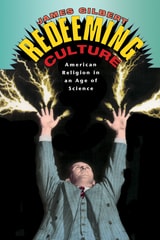
Redeeming Culture
American Religion in an Age of ScienceJames Gilbert
University of Chicago Press, 1997
"Anyone seriously interested in the history of current controversies involving religion and science will find Gilbert's book invaluable."—Peter J. Causton, Boston Book Review
"Redeeming Culture provides some fascinating background for understanding the interactions of science and religion in the United States. . . . Intriguing pictures of some of the highlights in this cultural exchange."—George Marsden, Nature
"A solid and entertaining account of the obstacles to mutual understanding that science and religion are now warily overcoming."—Catholic News Service
"[An] always fascinating look at the conversation between religion and science in America."—Publishers Weekly
Redeeming a People
The Critical Role of Historical Examination in Moving Cultural and Moral TrajectoriesDarius Gray
Utah State University Press, 2020
The Arrington Lecture series, established by one of the twentieth-century West's most distinguished historians, Leonard Arrington, has become a leading forum for prominent historians to address topics related to Mormon history. Utah State University hosts the Leonard J. Arrington Mormon History Lecture Series through the Merrill-Cazier Library Special Collections and Archives department.

Redefining Japaneseness
Japanese Americans in the Ancestral HomelandYamashiro, Jane H
Rutgers University Press, 2017
Redefining Race
Asian American Panethnicity and Shifting Ethnic BoundariesDina G. Okamoto is associate professor of sociology and director of the Center for Research on Race and Ethnicity in Society at Indiana University.
Russell Sage Foundation, 2014