Results by title
1095 books match the query 'Rhetoric' and 70 start with s
Saying And Silence
Frank Farmer
Utah State University Press, 2001
Frank Farmer has contributed important essays to the study of Bakhtin in composition, and in Saying and Silence he gathers some of those, along with several new essays, into a single volume. Scholars who specialize in Bakhtin will find this work engaging, but equally Farmer wants to explicate and apply Bakhtin for readers whose focus is teaching or some other nonspecialist dimension of writing scholarship.
Farmer explores the relationship between the meaningful word and the meaningful pause, between saying and silence, especially as the relationship emerges in our classrooms, our disciplinary conversations, and encounters with publics beyond the academy. Each of his chapters here addresses some aspect of how we and our students, colleagues, and critics have our say and speak our piece, often under conditions where silence is the institutionally sanctioned and preferred alternative. He has enlisted a number of Bakhtinian ideas (the superaddressee, outsideness, voice in dialogue) to help in the project of interpreting the silences we hear, naming the silences we do not hear, and of encouraging all silences to speak in ways that are freely chosen, not enforced.
Scalia v. Scalia
Opportunistic Textualism in Constitutional InterpretationCatherine L. Langford
University of Alabama Press, 2018
Antonin Scalia is considered one of the most controversial justices to have been on the United States Supreme Court. A vocal advocate of textualist interpretation, Justice Scalia argued that the Constitution means only what it says and that interpretations of the document should be confined strictly to the directives supplied therein. This narrow form of constitutional interpretation, which limits constitutional meaning to the written text of the Constitution, is known as textualism.
Scalia v. Scalia:Opportunistic Textualism in Constitutional Interpretation examines Scalia’s discussions of textualism in his speeches, extrajudicial writings, and judicial opinions. Throughout his writings, Scalia argues textualism is the only acceptable form of constitutional interpretation. Yet Scalia does not clearly define his textualism, nor does he always rely upon textualism to the exclusion of other interpretive means.
Scalia is seen as the standard bearer for textualism. But when textualism fails to support his ideological aims (as in cases that pertain to states’ rights or separation of powers), Scalia reverts to other forms of argumentation. Langford analyzes Scalia’s opinions in a clear area of law, the cruel and unusual punishment clause; a contested area of law, the free exercise and establishment cases; and a silent area of law, abortion. Through her analysis, Langford shows that Scalia uses rhetorical strategies beyond those of a textualist approach, concluding that Scalia is an opportunistic textualist and that textualism is as rhetorical as any other form of judicial interpretation.
Science Communication Online
Engaging Experts and Publics on the InternetAshley Rose Mehlenbacher
The Ohio State University Press, 2019
Bringing together genre studies and the rhetoric of science, Mehlenbacher examines a range of new forms of science communication that challenge traditional presumptions about experts and nonexperts—including Twitter and Reddit AMAs, crowdfunding proposals such as Kickstarter and Experiment.com, civic-minded databases such as Safecast, and the PLOS blogging network. Science Communication Online illustrates the unique features of these genres and connects them to their rhetorical functions and the larger context leading to their emergence and evolution—from the democratization of science, challenges to expertise and expert status, and new political economies. Science Communication Online captures the important moment we find ourselves in now—one not defined by science and society but science in society.

Scientific Characters
Rhetoric, Politics, and Trust in Breast Cancer ResearchLisa Keränen
University of Alabama Press, 2010
Searching for Solidarity
Revolutionary Dreams and Radical Social MovementsNoor Ghazal Aswad
The Ohio State University Press, 2025
Secrets to Writing Great Papers
Judi Kesselman-Turkel and Franklynn Peterson
University of Wisconsin Press, 2003
Secrets to Writing Great Papers illustrates how to work with ideas—develop them, hone them, and transform them into words. It provides techniques and exercises for brainstorming, choosing the right approach, working with an unknown or boring assigned topic, overcoming writer’s block, and selecting the best point of view.
Securing a Place for Reading in Composition
The Importance of Teaching for TransferEllen C. Carillo
Utah State University Press, 2014
Securing a Place for Reading in Composition addresses the dissonance between the need to prepare students to read, not just write, complex texts and the lack of recent scholarship on reading-writing connections. Author Ellen C. Carillo argues that including attention-to-reading practices is crucial for developing more comprehensive literacy pedagogies. Students who can read actively and reflectively will be able to work successfully with the range of complex texts they will encounter throughout their post-secondary academic careers and beyond.
Considering the role of reading within composition from both historical and contemporary perspectives, Carillo makes recommendations for the productive integration of reading instruction into first-year writing courses. She details a “mindful reading” framework wherein instructors help students cultivate a repertoire of approaches upon which they consistently reflect as they apply them to various texts. This metacognitive frame allows students to become knowledgeable and deliberate about how they read and gives them the opportunity to develop the skills useful for moving among reading approaches in mindful ways, thus preparing them to actively and productively read in courses and contexts outside first-year composition.
Securing a Place for Reading in Composition also explores how the field of composition might begin to effectively address reading, including conducting research on reading, revising outcome statements, and revisiting the core courses in graduate programs. It will be of great interest to writing program administrators and other compositionists and their graduate students.
Seduction, Sophistry, and the Woman with the Rhetorical Figure
Michelle Ballif
Southern Illinois University Press, 2000
The rhetorical tradition, Michelle Ballif asserts, is based on the systematic exclusion of sophistry. In keeping with Aristotle’s prescription, rhetoric continues to be a counterpart to dialectic, a handmaiden to the pursuit of truth—even if that truth is merely probable.
According to Ballif, this search for truth manifests itself among current rhetoric and composition scholars in the form of an assumption that language is primarily communicative (i.e., that language can represent truth more or less faithfully). Ballif shows how invested we are in the notion of truth, in the idea that language represents truth, and in the assumption that the speaking/writing subject has, or should have, some essential relation to truth.
Provocatively, Ballif questions why the profession wants to retain these beliefs in the face of vociferous arguments from "new rhetorics" that the discipline no longer posits a foundational self or truth, and in the face of the poststructuralist critique, which has demonstrated that founding truth is always accomplished by first positing and then negating an “other.” As an alternative to this negative and violent rhetorical process, Ballif suggests a turn to sophistry as embodied in the figure of Woman, one with the power to seduce us (literally, to lead astray) from our truth and our demand for it.
This figuration of Woman, however, is not the dialectical other used to sustain the identity and privilege of Man. On the contrary, this Woman is an Other Woman: A Third Woman as a Third Sophistic practice that escapes Plato’s binary (philosophic rhetoric vs. sophistry) and renders the distinction between truth and deception incalculable. Ballif examines three figurations of the Third Woman as Third Sophistic as offered by Gorgias, Friedrich Nietzsche, and Jean Baudrillard.
Seeming and Being in Plato’s Rhetorical Theory
Robin Reames
University of Chicago Press, 2018
Robin Reames’s Seeming & Being in Plato’s Rhetorical Theory marks a shift in Plato scholarship. Reames argues that an appropriate understanding of rhetorical theory in Plato’s dialogues illuminates how he developed the technical vocabulary needed to construct the very distinctions between seeming and being that separate true from false speech. By engaging with three key movements of twentieth- and twenty-first-century Plato scholarship—the rise and subsequent marginalization of “orality and literacy theory,” Heidegger’s controversial critique of Platonist metaphysics, and the influence of literary or dramatic readings of the dialogues—Reames demonstrates how the development of Plato’s rhetorical theory across several of his dialogues (Gorgias, Phaedrus, Protagoras, Theaetetus, Cratylus, Republic, and Sophist) has been both neglected and misunderstood.
Selected Essays on Rhetoric
Thomas De Quincey, Edited with a Critical Introduction by Frederick Burwick. Foreword by David Potter
Southern Illinois University Press, 1967
The five essays presented here—Rhetoric, Style, Language, Conversation, and Greek Literature—were published together for the first time in The Collected Writings of Thomas De Quincey in 1889–1890. Frederick Burwick brings the essays together again in this volume, introducing them by tracing the sources and development of a belletristic theory of rhetoric, which he says “is one of the most original, and for a few critics, the most puzzling of the nineteenth century.” Burwick makes the edition complete with a comprehensive index and a selected bibliography.
Self+Culture+Writing
Autoethnography for/as Writing StudiesRebecca Jackson
Utah State University Press, 2021
Interest in autoethnography is growing among writing studies scholars, who see clear connections to well-known disciplinary conversations about personal narrative, as well as to the narrative turn in general and social justice efforts in particular. Contributions by authors from diverse backgrounds and institutional settings are organized into three parts: a section of writing studies autoethnographies, a section on how to teach autoethnography, and a section on how ideas about autoethnography in writing studies are evolving.
Self+Culture+Writing discusses the use of autoethnography in the writing classroom as both a research method and a legitimate way of knowing, providing examples of the genre and theoretical discussions that highlight the usefulness and limitations of these methods.
Contributors: Leslie Akst, Melissa Atienza, Ross Atkinson, Alison Cardinal, Sue Doe, Will Duffy, John Gagnon, Elena Garcia, Guadalupe Garcia, Caleb Gonzalez, Lilly Halboth, Rebecca Hallman Martini, Kirsten Higgins, Shereen Inayatulla, Aliyah Jones, Autumn Laws, Soyeon Lee, Louis M. Maraj, Kira Marshall-McKelvey, Jennifer Owen, Tiffany Rainey, Marcie Sims, Amanda Sladek, Trixie Smith, Anthony Warnke
Self-Development and College Writing
Nick Tingle
Southern Illinois University Press, 2004
Nick Tingle investigates the psychoanalytic dimensions of composition instruction in Self-Development and College Writing to boldly illustrate that mastering academic prose requires students to develop psychologically as well as cognitively. Asserting that writing instruction should be an engaging, developmental process for both teachers and students, he urges reaching for new levels of consciousness in the classroom to aid students in realigning their subjective relationships with knowledge and truth.
Drawing on psychoanalytic theory and twenty years of experience as a teacher, Tingle outlines the importance of moving beyond usual ways of thinking, abandoning the common sense of everyday reality, and coming to understand beliefs as beliefs and not absolutes. These developmental moves must be accompanied, Tingle says, by a new attitude towards language—not as something that points to things, but as a series of concepts that arrange the very things one points to. And this development is necessary not just in order to perform well in the writing class, but also to fully participate in and reap the academic rewards of structured, university life.
Self-Development and College Writing calls attention to the psychological destabilization this method may produce for students. Tingle explains that, if writing instructors are to respond to this destabilization, they must conceive of the classroom as a transitional space, or a kind of holding environment. They must also become aware of their psychological allegiances to particular theories of writing if they are to construct such environments.
But the goal of the transitional environment is worth pursuing, Tingle argues, contending that university education fails to address students’ developmental needs. With purposeful writing and deft analyses, Tingle shows that this goal also affords a means by which to place writing courses at the center of the educational curriculum. Conceived as a transitional space, the writing class may support and stabilize students in their developmental passage, thereby fostering an improved understanding of their academic work and, more importantly, an increased intellectual understanding of themselves and the complex world in which they live.
Semantic Tectonics
Writing Studies, Intersubjectivity, and the End of SolipsismDylan B. Dryer
Utah State University Press, 2026
Semantic Tectonics offers an engaging contribution to the ongoing conversation about the alliances of convenience and fissiparous relations among second--language writing, rhetoric, technical and professional communication, composition, and basic writing. From a theoretical perspective, the book brings together insights from a range of important scholars who have advanced relational alternatives to Cartesian dualisms of mind and body, self and other, thought and language. Naming these dualisms “solipsism,” the book extends these alternatives into empirical inquiries into the lexicogrammar of contemporary writing studies scholarship, using corpus analytics to bolster, and sometimes challenge, critical-discourse and content--analytic approaches.
With frequent pauses to explain and model corpus tools and applications, to pose questions for further inquiry, and to contemplate pedagogical or civic applications, Semantic Tectonics shows how the field’s social mission is constrained by tacit beliefs about critical concepts like language, self, context, genre, reflection, agency, and development. By foregrounding the empirical study of patterns in language itself, this book inspires readers to shift their perspective to the operational significance of word- and phrase-level discourse as sites for ideological and pedagogical intervention.
Sensemaking for Writing Programs and Writing Centers
Rita Malenczyk
Utah State University Press, 2023
The book is divided into two sections: Sensemaking with Tutors and Teachers, and Sensemaking and Institutional Structures. Chapter authors employ several theoretical approaches to sensemaking, ranging from individual experience to institutional history to document design, providing readers with ideas for how to administer and teach within their programs more effectively; how to advocate for their programs within larger university contexts; and how to positively influence the lives and careers of those they work with.
Sensemaking for Writing Programs and Writing Centers theorizes daily experiences from working lives and suggests problem-solving strategies. Writing program administrators, writing department chairs, and writing center directors, tutors, and staff will find value in its pages.

Sensus Communis
Vico, Rhetoric, and the Limits of RelativismJohn D. Schaeffer
Duke University Press, 1990
In extended commentaries on Gadamer, the Gadamer/Habermas debate, and Derrida, Schaeffer shows that Vico offers the possibility of analyzing social phenomena and constellations of power from within the humanist rhetorical tradition. Vico’s achievements have powerful implications for relating ethics and hermeneutics to the world of concrete social practice, particularly in an age in which the electronic media have replaced print as the primary means of communication and in which a “secondary orality” (a cast of mind similar to that of nonliterate peoples) is appearing within our literate civilization.
Serendipity in Rhetoric, Writing, and Literacy Research
Maureen Daly Goggin
Utah State University Press, 2018
In the course of research, most scholars have known moments of surprise, catastrophe, or good fortune, though they seldom refer to these occurrences in reports or discuss them with students. Serendipity in Rhetoric, Writing, and Literacy Research reveals the different kinds of work scholars, particularly those in rhetoric, writing, and literacy, need to do in order to recognize a serendipitous discovery or a missed opportunity.
In published scholarship and research, the path toward discovery seems clean and direct. The dead ends, backtrackings, start-overs, and stumbles that occur throughout the research process are elided, and seems that the researchers started at point A and arrived safely and neatly at point B without incident, as if by magic. The path, however, is never truly clear and straight. Research and writing is messy. Serendipity in Rhetoric, Writing, and Literacy Research features chapters from twenty-three writing scholars who have experienced moments of serendipity in their own work—not by magic or pure chance but through openness and active waiting, which offer an opportunity to prepare the mind.
Serendipity in Rhetoric, Writing, and Literacy Research illustrates the reality of doing research: there is no reliable prescription or one-size-fits-all manual, but success can be found with focused dedication and an open mind.
Contributors: Ellen Barton, Zachary C. Beare, Lynn Z. Bloom, Jennifer Clary-Lemon, Caren Wakerman Converse, Gale Coskan-Johnson, Kim Donehower, Bill Endres, Shirley E. Faulkner-Springfield, Lynée Lewis Gaillet, Brad Gyori, Judy Holiday, Gesa E. Kirsch, Lori Ostergaard, Doreen Piano, Liz Rohan, Ryan Skinnell, Patricia Wilde, Daniel Wuebben
Sex Panic Rhetorics, Queer Interventions
Ian Barnard
University of Alabama Press, 2020
Analyzes the rhetoric of contemporary sex panics to expose how homophobia, heterosexism, and transphobia define public, political, and scholarly preoccupations with sexuality and gender
In Sex Panic Rhetorics, Queer Interventions, Ian Barnard makes the counter-intuitive argument that contemporary “sex panics” are undergirded by queerphobia, even when the panics in question don’t appear to have much to do with queerness. Barnard presents six case studies that treat a wide range of sex panic rhetorics around child molesters, sex trafficking, transgenderism, incest, queer kids, and pedagogy to demonstrate this argument. By using examples from academic scholarship, political discourse, and popular culture, including the Kevin Spacey scandal and the award-winning film Moonlight, Barnard shows how homophobia and transphobia continue to pervade contemporary Western culture.
Barnard is concerned not so much with looking at the overt homophobia and transphobia that are the more obvious objects of antihomophobic and antitransphobic critique. The author’s focus, rather, is on excavating the significant traces of these panics in a neoliberal culture that has supposedly demonstrated its civility by its embrace of diversity, renunciation of its homophobic past, and attentiveness to the transgender revolution that has swept popular media and political culture in the United States and elsewhere. During a time of increasing conservative backlashes against advancing LGBTQ rights and human rights discourses in general, this book shows why it is important to attend to the liberal covers for sex panics that are not too far removed from their rhetorically conservative cousins.
Sexuality and the Politics of Ethos in the Writing Classroom
Zan Meyer Goncalves
Southern Illinois University Press, 2005
Applying the complexities of literacy development and personal ethos to the teaching of composition, Zan Meyer Goncalves challenges writing teachers to consider ethos as a series of identity performances shaped by the often-inequitable social contexts of their classrooms and communities. Using the rhetorical experiences of students who identify as lesbian, gay, bisexual, and/or transgender, she proposes a new way of thinking about ethos that addresses the challenges of social justice, identity, and transfer issues in the classroom.
Goncalves offers an innovative approach to teaching identity performance theory bound by social contexts. She applies this new approach to theories of specificity and intersectionality, illustrating how teachers can help students redefine the relationship between their social identities and their writing. She also addresses bringing social activism and identity politics into the classroom, helping writers make transfers across rhetorical contexts and linking students' interests to public conversations.
Theoretical and practical, Sexuality and the Politics of Ethos in the Writing Classroom provides teachers of first-year and advanced composition studies with useful, detailed assignments based in specific identity performance. Goncalves offers techniques to subvert oppressive language practices, while encouraging students to recognize themselves as writers, citizens, and active participants in their own educations and communities.
Shakespeare from the Margins
Language, Culture, ContextPatricia Parker
University of Chicago Press, 1996
Combining feminist and historical approaches with attention to the "matter" of language as well as of race and gender, Parker's brilliant "edification from the margins" illuminates much that has been overlooked, both in Shakespeare and in early modern culture. This book, a reexamination of popular and less familiar texts, will be indispensable to all students of Shakespeare and the early modern period.
Shakespeare's Women
A Playscript for Performance and AnalysisLibby Appel and Michael Flachmann
Southern Illinois University Press, 1986
Serves both as a script for performance and as a text for high school and college theater and English classes.
This self-contained script brings together different scenes from Shakespeare’s plays to portray women “in all their infinite variety.” Two narrators, a man and a woman, introduce and comment on these scenes, weaving together the different characters and situations.
This book combines literary and theatrical techniques in examining Shakespeare’s women. Its promptbook format provides clear, helpful stage directions on pages facing each of the scenes. Also helpful are concise glosses and footnotes to define difficult words and phrases plus a commentary to explain each scene in its dramatic context.
Other features include sheet music for each song in the play, a bibliography on the topic of women in Shakespeare’s plays, and suggestions for directors who wish to stage the play.
Shaping Information
The Rhetoric of Visual ConventionsCharles Kostelnick and Michael Hassett
Southern Illinois University Press, 2003
From charts, texts, and graphs to illustrations, icons, and screens, we live in an information age saturated with visual language. Yet the underlying principles that provide structure for visual language have long eluded scholars of rhetoric, design, and engineering. To function as a language that reliably conveys meaning, visual language must embody codes that normalize its practices among both the designers who employ it and the readers who interpret it.
In this wide-ranging analysis, Charles Kostelnick and Michael Hassett demonstrate how visual language in professional communication—text design, data displays, illustrations—is shaped by conventional practices that are invented, codified, and modified by users in visual discourse communities. Drawing on rhetorical theory, design studies, and a broad array of historical and contemporary examples, Shaping Information: The Rhetoric of Visual Conventions explores the processes by which conventions evolve and proliferate and shows how conventions serve as the medium that designers use to shape, stabilize, and streamline visual information.
Kostelnick and Hassett extend contemporary theories that define rhetoric as a social act, arguing that visual conventions also thrive within discourse communities and are fragile forms that vary widely in their longevity and scope. Shaping Information: The Rhetoric of Visual Conventions is a thorough guide for scholars, teachers and practitioners of rhetoric and business and technical communication and for professionals in engineering, science, design, and business.
Shaping Language Policy in the U.S.
The Role of Composition StudiesScott Wible
Southern Illinois University Press, 2013
In Shaping Language Policy in the U.S.: The Role of Composition Studies, author Scott Wible explores the significance and application of two of the Conference on College Composition and Communication’s key language policy statements: the 1974 Students’ Right to Their Own Language resolution and the 1988 National Language Policy. Wible draws from a wealth of previously unavailable archived material and professional literature to offer for the first time a comprehensive examination of these policies and their legacies that continue to shape the worlds of rhetoric, politics, and composition.
Wible demonstrates the continued relevance of the CCCC’s policies, particularly their role in influencing the recent, post-9/11 emergence of a national security language policy. He discusses in depth the role the CCCC’s language policy statements can play in shaping the U.S. government’s growing awareness of the importance of foreign language education, and he offers practical discussions of the policies’ pedagogical, professional, and political implications for rhetoric and composition scholars who engage contemporary debates about the politics of linguistic diversity and language arts education in the United States. Shaping Language Policy in the U.S. reveals the numerous ways in which the CCCC language policies have usefully informed educators’ professional practices and public service and investigates how these policies can continue to guide scholars and teachers in the future.
Shaping Science with Rhetoric
The Cases of Dobzhansky, Schrodinger, and WilsonLeah Ceccarelli
University of Chicago Press, 2001
In Shaping Science with Rhetoric, Leah Ceccarelli addresses such questions through close readings of three scientific monographs in their historical contexts—Theodosius Dobzhansky's Genetics and the Origin of Species (1937), which inspired the "modern synthesis" of evolutionary biology; Erwin Schrödinger's What Is Life? (1944), which catalyzed the field of molecular biology; and Edward O. Wilson's Consilience (1998), a so far not entirely successful attempt to unite the social and biological sciences. She examines the rhetorical strategies used in each book and evaluates which worked best, based on the reviews and scientific papers that followed in their wake.
Ceccarelli's work will be important for anyone interested in how interdisciplinary fields are formed, from historians and rhetoricians of science to scientists themselves.

Shared Land/Conflicting Identity
Trajectories of Israeli & Palestinian Symbol UseRobert C. Rowland
Michigan State University Press, 2002
Shared Land/Conflicting Identity: Trajectories of Israeli and Palestinian Symbol Use argues that rhetoric, ideology, and myth have played key roles in influencing the development of the 100-year conflict between first the Zionist settlers and the current Israeli people and the Palestinian residents in what is now Israel. The Israeli-Palestinian conflict is usually treated as an issue of land and water. While these elements are the core of the conflict, they are heavily influenced by the symbols used by both peoples to describe, understand, and persuade each other. The authors argue that symbolic practices deeply influenced the Oslo Accords, and that the breakthrough in the peace process that led to Oslo could not have occurred without a breakthrough in communication styles.
Rowland and Frank develop four crucial ideas on social development: the roles of rhetoric, ideology, and myth; the influence of symbolic factors; specific symbolic factors that played a key role in peace negotiations; and the identification and value of criteria for evaluating symbolic practices in any society.
Shifting Borders
Rhetoric, Immigration And Prop 187Kent Ono
Temple University Press, 2002
"Like articles representing the positions of proponents of the measure, those representing opponents constructing the nation as potentially in danger as a result of undocumented immigration."
How do we learn to recognize the damning effects of good rhetorical intentions? And where will we find arguments which escape this trap that permeates the liberal social policy world? Shifting Borders uses an evaluation of the debate over California Proposition 187 to demonstrate how this quandary is best understood by close interrogation of mainstream reports and debates and by bringing to the fore voices that are often left out of mediated discussions.
It is these voices outside the mainstream, so-called "outlaw" discourses, that hold the best possibilities for real social change. To illustrate their claim, the authors present dominant and outlaw discourses around Proposition 187, from television reports, internet chat sites, and religious discourse to coverage of the Los Angeles Times. Their critique ably demonstrates how difficult it is to maintain a position outside the mainstream, but also how important it is for the press, citizens and scholars to actively search out such voices. The findings are organized through a model that provides an innovative method for understanding events and arguments through their rhetorical and communicative construction. In a world where the mediated word defines so much of what we know, Shifting Borders provides a lucid introduction to analyzing the spoken and written word that constitutes political debate in contemporary U.S. culture. In doing so, it makes an important contribution to any future development of progressive political strategy.
postamble();
Silence and Listening as Rhetorical Arts
Edited by Cheryl Glenn and Krista Ratcliffe
Southern Illinois University Press, 2011
In Silence and Listening as Rhetorical Arts,editors Cheryl Glenn and Krista Ratcliffe bring together seventeen essays by new and established scholars that demonstrate the value and importance of silence and listening to the study and practice of rhetoric. Building on the editors’ groundbreaking research, which respects the power of the spoken word while challenging the marginalized status of silence and listening, this volumemakes a strong case for placing these overlooked concepts, and their intersections, at the forefront of rhetorical arts within rhetoric and composition studies.
Divided into three parts—History, Theory and Criticism, and Praxes—this book reimagines traditional histories and theories of rhetoric and incorporates contemporary interests, such as race, gender, and cross-cultural concerns, into scholarly conversations about rhetorical history, theory, criticism, and praxes. For the editors and the other contributors to this volume, silence is not simply the absence of sound and listening is not a passive act. When used strategically and with purpose—together and separately—silence and listening are powerful rhetorical devices integral to effective communication. The essays cover a wide range of subjects, including women rhetors from ancient Greece and medieval and Renaissance Europe; African philosophy and African American rhetoric; contemporary antiwar protests in the United States; activist conflict resolution in Israel and Palestine; and feminist and second-language pedagogies.
Taken together, the essays in this volume advance the argument that silence and listening are as important to rhetoric and composition studies as the more traditionally emphasized arts of reading, writing, and speaking and are particularly effective for theorizing, historicizing, analyzing, and teaching. An extremely valuable resource for instructors and students in rhetoric, composition, and communication studies, Silence and Listening as Rhetorical Arts will also have applications beyond academia, helping individuals, cultural groups, and nations more productively discern and implement appropriate actions when all parties agree to engage in rhetorical situations that include not only respectful speaking, reading, and writing but also productive silence and rhetorical listening.
Simple and Direct
A Rhetoric for WritersJacques Barzun
University of Chicago Press, 1994
Singular Texts/Plural Authors
Perspectives on Collaborative WritingLisa Ede and Andrea Lunsford
Southern Illinois University Press, 1992
Lisa Ede and Andrea Lunsford challenge the assumption that writing is a solitary act. That challenge is grounded in their own personal experience as long-term collaborators and in their extensive research, including a three-stage study of collaborative writing supported by the Fund for the Improvement of Post-Secondary Education.
The authors urge a fundamental change in our institutions to accommodate collaboration by radically resituating power in the classroom and by instituting rewards for collaborative work that equal rewards for single-authored work. They conclude with the injunction: "Today and in the twenty-first century, our data suggest, writers must be able to work together. They must, in short, be able to collaborate."
Sites of Translation
What Multilinguals Can Teach Us about Digital Writing and RhetoricLaura Gonzales
University of Michigan Press, 2018
Winner of the 2016 Sweetland Digital Rhetoric Collaborative Book Prize
Sites of Translation illustrates the intricate rhetorical work that multilingual communicators engage in as they translate information for their communities. Blending ethnographic and empirical methods from multiple disciplines, Laura Gonzales provides methodological examples of how linguistic diversity can be studied in practice, both in and outside the classroom, and provides insights into the rhetorical labor that is often unacknowledged and made invisible in multilingual communication. Sites of Translation is relevant to researchers and teachers of writing as well as technology designers interested in creating systems, pedagogies, and platforms that will be more accessible and useful to multilingual audiences. Gonzales presents multilingual communication as intellectual labor that should be further valued in both academic and professional spaces, and supported by multilingual technologies and pedagogies that center the expertise of linguistically diverse communicators.
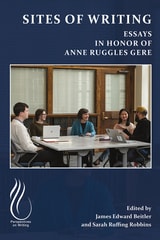
Sites of Writing
Essays in Honor of Anne Ruggles GereJames Edward Beitler
University Press of Colorado, 2026
Sites of Writing builds upon the multiple contributions of Anne Ruggles Gere across a long and highly productive career. The chapters in this edited collection, written by leading scholars (including some of Gere’s former students) to track her major contributions to writing studies, situate those contributions within the broader landscape of field development, and draw on those findings to assess important trends and project productive pathways for the future. The contributors to the collection consider disciplinary history, language and literacy, writing across the curriculum, digital rhetoric, writing’s extracurriculum, assessment, and English education, among other areas. Connecting these multiple fields of activity, Sites of Writing affirms Gere’s view of writing as a powerful social and cultural activity and of literacy, broadly conceived, as enabling cultural transformations and, in the process, transforming writing studies and other fields.
Situating Composition
Composition Studies and the Politics of LocationLisa Ede
Southern Illinois University Press, 2004
Responding to a growing pedagogical paralysis in debates over the nature and status of composition studies as an academic discipline, Lisa Ede offers a provocative inquiry into the politics of composition’s place in the academy. The result is a timely and engaging reflection on the rhetoric, ideology, and ethics of scholarship and instruction in composition studies today.
Situating Composition: Composition Studies and the Politics of Location delves into some of the most vexing issues presently facing the field: its status in relation to English studies, the nature and consequences of the writing process movement, the uneven professionalization of composition teachers, and the widening chasm between theory and practice. Ede interrogates key moments and texts in composition’s evolution, from the writing process movement to Susan Miller’s Textual Carnivals, through the interpretive lenses of historical analysis, theoretical critique, feminist and cultural theory, and Ede’s own two decades of experiences as a teacher and writing program administrator.
Questioning the narratives of progress and paradigm shifts that inform the field’s highly regarded recent theoretical studies, Ede urges scholars to carefully reconsider these claims, to honor the roles of teachers and students as more than dupes of ideology, and to more fully acknowledge—and utilize—the differences between the practice of theory and the practice of teaching. As academic hierarchies of knowledge increasingly privilege scholarship over instruction, Ede warns researchers to be cognizant of the politics and power inherent in their own location in the academy, particularly when professing to speak for teachers and students. To that end, the volume’s conclusion advocates pragmatic avenues for change and proffers topics for future discussion and debate.
Sixteen Teachers Teaching
Two-Year College PerspectivesPatrick Sullivan
Utah State University Press, 2020
All of these teachers have spent their careers teaching multiple sections of writing classes each semester or term, so this book presents readers with an impressive—and perhaps unprecedented—abundance of pedagogical expertise, teaching knowledge, and classroom experience. Sixteen Teachers Teaching is a book filled with joyfulness, wisdom, and pragmatic advice. It has been designed to be a source of inspiration for high school and college English teachers as they go about their daily work in the classroom.
Contributors: Peter Adams, Jeff Andelora, Helane Adams Androne, Taiyon J. Coleman, Renee DeLong, Kathleen Sheerin DeVore, Jamey Gallagher, Shannon Gibney, Joanne Baird Giordano, Brett Griffiths, Holly Hassel, Darin Jensen, Jeff Klausman, Michael C. Kuhne, Hope Parisi, and Howard Tinberg
Soapbox Rebellion
The Hobo Orator Union and the Free Speech Fights of the Industrial Workers of the World, 1909-1916Matthew S. May
University of Alabama Press, 2013
Social Controversy and Public Address in the 1960s and Early 1970s
A Rhetorical History of the United States, Volume IXRichard J. Jensen
Michigan State University Press, 2017

Society as Text
Essays on Rhetoric, Reason, and RealityRichard Harvey Brown
University of Chicago Press, 1987
Sojourning in Disciplinary Cultures
A Case Study of Teaching Writing in EngineeringMaureen Mathison
Utah State University Press, 2019
This volume represents the collective experiences and insights of writing consultants involved in the large-scale curriculum reform of the entire College of Engineering; they collaborated closely with faculty members of the various departments and taught writing to engineering students in engineering classrooms. Collaborators developed syllabi that incorporated writing into their courses in meaningful ways, designed lessons to teach various aspects of writing, created assignments that integrated engineering and writing theory and concepts, and worked one-on-one with students to provide revision feedback. Though interactions were sometimes tense, the two groups––writing and engineering––developed a “third culture” that generally placed students at the center of learning.
Sojourning in Disciplinary Cultures provides a guide to successful collaborations with STEM faculty that will be of interest to WPAs, instructors, and a range of both composition scholars and practitioners seeking to understand more about the role of writing and communication in STEM disciplines.
Contributors:
Linn K. Bekins, Sarah A. Bell, Mara K. Berkland, Doug Downs, April A. Kedrowicz, Sarah Read, Julie L. Taylor, Sundy Watanabe
Something Old, Something New
College Writing Teachers and Classroom ChangeWendy Bishop. Foreword by Patrick Hartwell
Southern Illinois University Press, 1990
How do college writing teachers learn new ways to teach? Most current composition research focuses almost exclusively on student writers, ignoring the role the teacher plays in classroom development. Here is the first book to focus on college writing teachers and the ways in which they are affected by graduate rhetoric pedagogy courses.
Wendy Bishop observed teachers enrolled in a doctoral seminar, titled "Teaching Basic Writing," and then conducted case studies of five of those teachers in their college writing classrooms to investigate how their teaching practices changed and how their previous professional and personal histories influenced their ability to make those changes.
Sovereign, Settler, Leaker, Lie
Forms of the Secret in US Political RhetoricAtilla Hallsby
The Ohio State University Press, 2026
In Sovereign, Settler, Leaker, Lie, Atilla Hallsby argues that secrets play a pivotal role in organizing political discourse in the United States. Hallsby takes up contemporary case studies—ranging from the Valerie Plame scandal during the George W. Bush presidency, to the use of Saul Alinsky’s name as a partisan codeword for politicizing Obama’s Blackness, to Chelsea Manning’s public naming and outing—to show how dramatic revelations increasingly fail to produce meaningful change and instead reproduce entrenched racial, gendered, and colonial hierarchies.
The core feature of these interlinked moments of crisis is the secret: a rhetorical patterning of political life organized by specific forms, each one lending a familiar shape to the shadows of American empire. These forms, theorized here as tropes, connect decades of secrets, linking the George W. Bush administration’s War on Terror to the Trump-era reemergence of “deep state” conspiracy theories. As an extension of secrecy and surveillance studies, and with the aim of attaining a more accountable and just form of US governmentality, Sovereign, Settler, Leaker, Lie explains how still-unfolding political realities in the United States emerged, transformed, and regenerate.

Space Monkeys!
Remembering the Nonhuman Astronauts in US Space ExplorationJohn A. Lynch
University of Alabama Press, 2026
Exposes how emotion, memory, and national pride shape the stories we tell about science, animals, and the history of the “race to space”
Before humans ever left Earth’s atmosphere, a handful of primates paved the way—earning fame and fascination but leaving behind a complicated and often highly debated legacy. As the Cold War intensified, the US space program turned to monkeys—Able, Baker, Ham, and Enos—to test and explore the limits of human survival in space. These animals became media sensations, museum exhibits, and symbols of American ingenuity, even as their suffering was often overlooked.
With insight and empathy, Lynch unpacks the stories we tell about these primates and how they are remembered through culture and time, both modern and historically. Lynch argues that the public memory of these animals often justifies their use in the name of scientific progress. Sometimes they are portrayed as tools, other times as human stand-ins, and frequently as objects of sympathy—but rarely as subjects of critique.
Lynch shows how feelings—compassion, cuteness, patriotism, and the technological sublime—shape the stories we tell about these animals and the ethical frameworks we build around them. Each chapter focuses on a different genre of memory-making, from newspaper and photojournalism to museum exhibits, children’s literature, and fictional films.
By reframing these animal pioneers, Lynch uncovers the ethical and emotional narratives that shape how we remember science. Space Monkeys! is a vital reflection on memory, identity, and the more-than-human costs of progress.
Spanish American Saints and the Rhetoric of Identity, 1600-1810
Ronald J. Morgan
University of Arizona Press, 2002
Speaking Respect, Respecting Speech
Richard L. Abel
University of Chicago Press, 1998
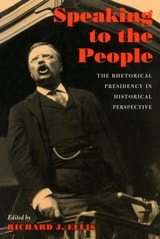
Speaking to the People
The Rhetorical Presidency in Historical PerspectiveRichard Ellis
University of Massachusetts Press, 1998

Speechwright
An Insider's Take on Political RhetoricWilliam F. Gavin
Michigan State University Press, 2011
For almost thirty years, William F. Gavin wrote speeches at the highest levels of government. Speechwright is his insider’s view of politics, a shrewd critique of presidential and congressional rhetoric, and a personal look at the political leaders for whom he wrote speeches. While serving President Richard Nixon and candidate Ronald Reagan, Gavin advocated for “working rhetoric”—well-crafted, clear, hard-hitting arguments that did not off er visions of the unattainable, but instead limited political discourse to achievable ends reached through practical means. Filled with hard-earned wisdom about politics and its discontents, Speechwright describes Gavin’s successes, his failures, and his call for political rhetoric built on strong argument rather than the mere search for eloquence.

Spirits of the Cold War
Contesting Worldviews in the Classical Age of American Security StrategyNed O'Gorman
Michigan State University Press, 2012
In spring of 1953, newly elected President Eisenhower sat down with his staff to discuss the state of American strategy in the cold war. America, he insisted, needed a new approach to an urgent situation. From this meeting emerged Eisenhower’s teams of “bright young fellows,” charged with developing competing policies, each of which would come to shape global politics. In Spirits of the Cold War, Ned O’Gorman argues that the early Cold War was a crucible not only for contesting political strategies, but also for competing conceptions of America and its place in the world. Drawing on extensive archival research and wide reading in intellectual and rhetorical histories, this comprehensive account shows cold warriors debating “worldviews” in addition to more strictly instrumental tactical aims. Spirits of the Cold War is a rigorous scholarly account of the strategic debate of the early Cold War—a cultural diagnostic of American security discourse and an examination of its origins.
Spreading the Word
Poetry and the Survival of Community in AmericaRoss Talarico
Duke University Press, 1995
Drawing on his workshops in Rochester, Talarico describes a unique approach for eliciting poetry from people of many ages and backgrounds—particularly underpriviledged urban kids and the elderly. The process—from dialogue to self-expression to publication to public event—illuminates the urgency and meaning of releasing the spirit captured in each man and woman and child’s experience. "Some people say that Ross Talarico has done the impossible," the Today Show remarked of his success in Rochester; and with this book Talarico offers the same opportunity to others. Teachers, community leaders, parents, and children will be able to follow his practical, hands-on approach to encouraging self-expression in diverse, even unlikely, settings. They will see here how poetry is indeed relevant, ever more crucial to our identity as the culture evolves—how it is, finally, the place where the inarticulate can come to speak for themselves.
Staging Masculinity
The Rhetoric of Performance in the Roman WorldErik Gunderson
University of Michigan Press, 2000
Standing at the Threshold
Working through Liminality in the Composition and Rhetoric TAshipWilliam J. Macauley
Utah State University Press, 2021
These authors enrich the TA experience by supporting agency and self-efficacy, encouraging TAs to take active roles in understanding their positions and making the most of that experience. Many chapters are written by current or former TAs who are writing as a means of preparing, informing, and guiding new rhet/comp TAs, encouraging them to make choices about how they want to think through and participate in their teaching work.
The first work on the market to delve deeply into the TAship itself and what it means for the larger discipline, Standing at the Threshold provides a rich new theorizing based in the real experiences and liminalities of teaching assistants in composition and rhetoric, approached from a productive array of perspectives.
Contributors: Lew Caccia, Lillian Campbell, Rachel Donegan, Jaclyn Fiscus-Cannady, Jennifer K. Johnson, Ronda Leathers Dively, Faith Matzker, Jessica Restaino, Elizabeth Saur, Megan Schoettler, Kylee Thacker Maurer
Starring the Text
The Place of Rhetoric in Science StudiesAlan G. Gross
Southern Illinois University Press, 2006
Starring the Text: The Place of Rhetoric in Science Studies firmly establishes the rhetorical analysis of science as a respected field of study. Alan G. Gross, one of rhetoric’s foremost authorities, summarizes the state of the field and demonstrates the role of rhetorical analysis in the sciences. He documents the limits of such analyses with examples from biology and physics, explores their range of application, and sheds light on the tangled relationships between science and society. In this deep revision of his important Rhetoric of Science, Gross examines how rhetorical analyses have a wide range of application, effectively exploring the generation, spread, certification, and closure that characterize scientific knowledge. Gross anchors his position in philosophical rather than in rhetorical arguments and maintains there is rhetorical criticism from which the sciences cannot be excluded.
Gross employs a variety of case studies and examples to assess the limits of the rhetorical analysis of science. For example, in examining avian taxonomy, he demonstrates that both taxonomical and evolutionary species are the product of rhetorical interactions. A review of Newton’s two formulations of optical research illustrates that their only significant difference is rhetorical, a difference in patterns of style, arrangement, and argument. Gross also explores the range of rhetorical analysis in his consideration of the “evolution of evolution” of Darwin’s notebooks. In his analysis of science and society, he explains the limits of citizen action in executive, judicial, and legislative democratic realms in the struggle to prevent, ameliorate, and provide adequate compensation for occupational disease. By using philosophical, historical, and psychological perspectives, Gross concludes, rhetorical analysis can also supplement other viewpoints in resolving intellectual problems.
Starring the Text, which includes fourteen illustrations, is an updated, readable study geared to rhetoricians, historians, philosophers, and sociologists interested in science. The volume effectively demonstrates that the rhetoric of science is a natural extension of rhetorical theory and criticism.
States at War, Volume 2
A Reference Guide for New York in the Civil WarEdited by Richard F. Miller
University Press of New England, 2014
Stigma Stories
Rhetoric, Lived Experience, and Chronic IllnessMolly Margaret Kessler
The Ohio State University Press, 2022
Engaging interdisciplinary conversations from the rhetoric of health and medicine, disability studies, narrative medicine, and sociology, Kessler takes an innovative look at how stigma functions on individual, interpersonal, and societal levels. In doing so, Kessler reveals how stories and lived experiences have much to teach us not only about how stigma functions but also about how it can be dismantled.