Results by title
18284 books match the query 'United States' and 1181 start with s
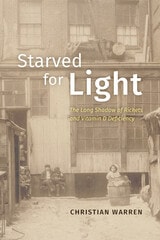
Starved for Light
The Long Shadow of Rickets and Vitamin D DeficiencyChristian Warren
University of Chicago Press, 2024
Rickets, a childhood disorder that causes soft and misshapen bones, transformed from an ancient but infrequent threat to a common scourge during the Industrial Revolution. Factories, mills, and urban growth transformed the landscape. Malnutrition and insufficient exposure to sunlight led to severe cases of rickets across Europe and the United States, affecting children in a variety of settings: dim British cities and American slave labor camps, moneyed households and impoverished ones. By the late 1800s, it was one of the most common pediatric diseases, seemingly an intractable consequence of modern life.
Starved for Light offers the first comprehensive history of this disorder. Tracing the efforts to understand, prevent, and treat rickets—first with the traditional remedy of cod liver oil, then with the application of a breakthrough corrective, industrially produced vitamin D supplements—Christian Warren places the disease at the center of a riveting medical history, one alert to the ways society shapes our views on illness. Warren shows how physicians and public health advocates in the United States turned their attention to rickets among urban immigrants, both African Americans and southern Europeans; some concluded that the disease was linked to race, while others blamed poverty, sunless buildings and cities, or cultural preferences in diet and clothing. Spotlighting rickets’ role in a series of medical developments, Warren leads readers through the encroachment on midwifery by male obstetricians, the development of pediatric orthopedic devices and surgeries, early twentieth-century research into vitamin D, appalling clinical experiments on young children testing its potential, and the eventual commercialization of all manner of vitamin D supplements. As vitamin D consumption rose in the mid-twentieth century, rickets—previously a major concern for doctors, parents, and public health institutions—faded in its severity and frequency, and as a topic of discussion. But despite the availability of drugstore supplements and fortified milk, small numbers of cases still appear today, and concerns and controversies about vitamin D deficiency in general continue to grow.
Sweeping and engaging, Starved for Light illuminates the social conditions underpinning our cures and our choices, helping us to see history’s echoes in contemporary prescriptions.
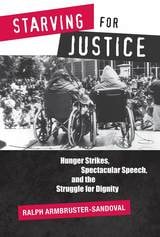
Starving for Justice
Hunger Strikes, Spectacular Speech, and the Struggle for DignityRalph Armbruster-Sandoval
University of Arizona Press, 2017
In the 1990s three college campuses in California exploded as Chicano/a and Latino/a students went on hunger strikes. Through courageous self-sacrifice, these students risked their lives to challenge racial neoliberalism, budget cuts, and fee increases. The strikers acted and spoke spectacularly and, despite great odds, produced substantive change.
Social movement scholars have raised the question of why some people risk their lives to create a better world. In Starving for Justice, Ralph Armbruster-Sandoval uses interviews and archival material to examine people’s willingness to make the extreme sacrifice and give their lives in order to create a more just society.
Popular memory and scholarly discourse around social movements have long acknowledged the actions of student groups during the 1960s. Now Armbruster-Sandoval extends our understanding of social justice and activism, providing one of the first examinations of Chicana/o and Latina/o student activism in the 1990s.
Students at University of California, Los Angeles; University of California, Santa Barbara; and Stanford University went on hunger strikes to demand the establishment and expansion of Chicana/o studies departments. They also had even broader aspirations—to obtain dignity and justice for all people. These students spoke eloquently, making their bodies and concerns visible. They challenged anti-immigrant politics. They scrutinized the rapid growth of the prison-industrial complex, racial and class polarization, and the university’s neoliberalization. Though they did not fully succeed in having all their demands met, they helped generate long-lasting social change on their respective campuses, making those learning institutions more just.
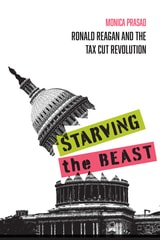
Starving the Beast
Ronald Reagan and the Tax Cut RevolutionMonica Prasad
Russell Sage Foundation, 2018
Drawing on never-before seen archival documents, Prasad traces the history of the 1981 tax cut—the famous “supply side” tax cut, which became the cornerstone for the next several decades of Republican domestic economic policy. She demonstrates that the main impetus behind this tax cut was not business group pressure, racial animus, or a belief that tax cuts would pay for themselves.
Rather, the tax cut emerged because in America--unlike in the rest of the advanced industrial world—progressive policies are not embedded within a larger political economy that is favorable to business. Since the end of World War II, many European nations have combined strong social protections with policies to stimulate economic growth such as lower taxes on capital and less regulation on businesses than in the United State. Meanwhile, the United States emerged from World War II with high taxes on capital and some of the strongest regulations on business in the advanced industrial world. This adversarial political economy could not survive the economic crisis of the 1970s.
Starving the Beast suggests that taking inspiration from the European model of progressive policies embedded in market-promoting political economy could serve to build an American economy that works better for all.
State Constitutional Politics
Governing by Amendment in the American StatesJohn Dinan
University of Chicago Press, 2018
With State Constitutional Politics, John Dinan looks at the various occasions in American history when state constitutional amendments have served as instruments of governance. Among other things, amendments have constrained state officials in the way they levy taxes and spend money; enacted policies unattainable through legislation on issues ranging from minimum wage to the regulation of marijuana; and updated understandings of rights, including religious liberty, equal protection, and the right to bear arms. In addition to comprehensively chronicling the ways amendments shape politics in the states, Dinan also assesses the consequences of undertaking changes in governance through amendments rather than legislation or litigation. For various reasons, including the greater stability and legitimacy of changes achieved through the amendment process, he argues that it might be a more desirable way of achieving change.

State Employment Policy in Hard Times
Michael Barker, ed.
Duke University Press, 1983

State Taxation Policy and Economic Growth
Michael Barker, ed.
Duke University Press, 1983
State and Reservation
New Perspectives on Federal Indian PolicyEdited by George Pierre Castile and Robert L. Bee
University of Arizona Press, 1992
CONTENTS
Introduction, George Pierre Castile & Robert L. Bee
Part I—Historical Foundations of the Reservation System
An Elusive Institution: The Meanings of Indian Reservations in Gold Rush California, John M. Findlay
Crow Leadership Amidst Reservation Oppression, Frederick E. Hoxie
Part II—The Nonreservation Experience
Utah Indians and the Homestead Laws, Martha C. Knack
The Enduring Reservations of Oklahoma, John H. Moore
Without Reservation: Federal Indian Policy and the Landless Tribes of Washington, Frank W. Porter, III
Part III—Power and Symbols
Riding the Paper Tiger, Robert L. Bee
Indian Sign: Hegemony and Symbolism in Federal Indian Policy, George P. Castile
Part IV—The Resource Base
Primitive Accumulation, Reservations, and the Alaska Native Claims Settlement Act, Lawrence Weiss & David C.Maas
Shortcomings of the Indian Self-Determination Policy, George S. Esber, Jr.
Getting to Yes in the New West: The Negotiation of Policy, Thomas R. McGuire

State of Empowerment
Low-Income Families and the New Welfare StateCarolyn Barnes
University of Michigan Press, 2020
On weekday afternoons, dismissal bells signal not just the end of the school day but also the beginning of another important activity: the federally funded after-school programs that offer tutoring, homework help, and basic supervision to millions of American children. Nearly one in four low-income families enroll a child in an after-school program. Beyond sharpening students’ math and reading skills, these programs also have a profound impact on parents. In a surprising turn—especially given the long history of social policies that leave recipients feeling policed, distrusted, and alienated—government-funded after-school programs have quietly become powerful forces for political and civic engagement by shifting power away from bureaucrats and putting it back into the hands of parents. In State of Empowerment Carolyn Barnes uses ethnographic accounts of three organizations to reveal how interacting with government-funded after-school programs can enhance the civic and political lives of low-income citizens.

State of Exception
Giorgio Agamben
University of Chicago Press, 2004
The sequel to Agamben's Homo Sacer: Sovereign Power and Bare Life, State of Exception is the first book to theorize the state of exception in historical and philosophical context. In Agamben's view, the majority of legal scholars and policymakers in Europe as well as the United States have wrongly rejected the necessity of such a theory, claiming instead that the state of exception is a pragmatic question. Agamben argues here that the state of exception, which was meant to be a provisional measure, became in the course of the twentieth century a normal paradigm of government. Writing nothing less than the history of the state of exception in its various national contexts throughout Western Europe and the United States, Agamben uses the work of Carl Schmitt as a foil for his reflections as well as that of Derrida, Benjamin, and Arendt.
In this highly topical book, Agamben ultimately arrives at original ideas about the future of democracy and casts a new light on the hidden relationship that ties law to violence.
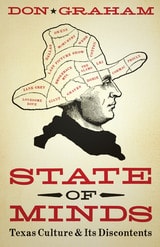
State of Minds
Texas Culture and Its DiscontentsBy Don Graham
University of Texas Press, 2011
John Steinbeck once famously wrote that "Texas is a state of mind." For those who know it well, however, the Lone Star State is more than one mind-set, more than a collection of clichés, more than a static stereotype. There are minds in Texas, Don Graham asserts, and some of the most important are the writers and filmmakers whose words and images have helped define the state to the nation, the world, and the people of Texas themselves. For many years, Graham has been critiquing Texas writers and films in the pages of Texas Monthly and other publications. In State of Minds, he brings together and updates essays he published between 1999 and 2009 to paint a unique, critical picture of Texas culture.
In a strong personal voice—wry, humorous, and ironic—Graham offers his take on Texas literary giants ranging from J. Frank Dobie to Larry McMurtry and Cormac McCarthy and on films such as The Alamo, The Last Picture Show, and Brokeback Mountain. He locates the works he discusses in relation to time and place, showing how they sprang (or not) from the soil of Texas and thereby helped to define Texas culture for generations of readers and viewers—including his own younger self growing up on a farm in Collin County. Never shying from controversy and never dull, Graham's essays in State of Minds demolish the notion that "Texas culture" is an oxymoron.
State of Segregation
America’s Freedom Rights Struggles as Told by AlabamaMark J. Tenhundfeld
University of Alabama Press, 2026
A revealing legal journey through Alabama’s civil rights battles, exposing systemic discrimination and the enduring fight for justice via landmark Supreme Court cases
State of Segregation: America’s Freedom Rights Struggles, as Told by Alabama by Mark J. Tenhundfeld offers a compelling exploration of Alabama’s civil rights and civil liberties history through the lens of thirty-two pivotal US Supreme Court cases. Each case, rooted in Alabama’s social and legal conflicts, reveals the persistent struggle to fulfill the Constitution’s promises of equal protection and due process. From early twentieth-century challenges to the Alabama Constitution of 1901 to contemporary battles over gerrymandering, Tenhundfeld traces how discrimination was embedded in the state’s institutions—and how it was contested.
State of Segregation uniquely blends legal analysis, historical narrative, and social commentary to expose the deep-rooted systems of racial, gender, and class-based discrimination in Alabama. Tenhundfeld argues that while discrimination is the most defining feature of Alabama’s past, it remains the most difficult to confront. By illuminating the legal strategies used to uphold and dismantle injustice, State of Segregation contributes to the broader understanding of how historical inequities continue to shape modern society.
Accessible to general readers and scholars alike, this work stands apart by combining Alabama history, civil rights struggles, and Supreme Court jurisprudence into a single, powerful narrative. It offers both cautionary tales about the fragility of freedom and enduring lessons for today’s social justice advocates.
State of the Union
America in the 1990s, Economic TrendsReynolds Farley
Russell Sage Foundation, 1995
State of the Union
America in the 1990s, Social TrendsReynolds Farley
Russell Sage Foundation, 1995

State-Corporate Crime
Wrongdoing at the Intersection of Business and GovernmentMichalowski, Raymond J
Rutgers University Press, 2006
Despite growing attention to crimes by those in positions of trust, however, violations in business and similar wrongdoing in government are still often treated as fundamentally separate problems. In State-Corporate Crime, Raymond J. Michalowski and Ronald C. Kramer bring together fifteen essays to show that those in positions of political and economic power frequently operate in collaboration, and are often all too willing to sacrifice the well-being of the many for the private profit and political advantage of the few.
Drawing on case studies including the explosion of the space shuttle Challenger, Ford Explorer rollovers, the crash of Valujet flight 592, nuclear weapons production, and war profiteering, the essays bear frank witness to those who have suffered, those who have died, and those who have contributed to the greatest human and environmental devastations of our time. This book is a much needed reminder that the most serious threats to public health, security, and safety are not those petty crimes that appear nightly on local news broadcasts, but rather are those that result from corruption among the wealthiest and most powerful members of society.
States Of Exception
Everyday Life and Postcolonial IdentityKeya Ganguly
University of Minnesota Press, 2001
Explores the conflict between capitalism and tradition in an immigrant community.
A philosophical anthropology of everyday experience, this book is also a deeply informed and thought-provoking reflection on the work of cultural critique. States of Exception looks into a community of immigrants from India living in southern New Jersey—a group to whom the author, as a daughter of two of its members, enjoyed unprecedented access.
Her position allows Keya Ganguly to approach the culture of a middle-class group (albeit one that is marginalized by racial prejudice), while the group’s relatively comfortable and protected style of life offers unusual insight into the concept of the everyday and the sense in which a seemingly commonplace existence can be understood as in crisis: a state of exception. Thus, Ganguly draws on the work of the Frankfurt School, particularly Walter Benjamin and Theodor Adorno, to explore the possibilities of a dialectical critique of the everyday—a state of exception informing ordinary yet crisis-ridden narratives of the self under late capitalism.
States at War, Volume 1
A Reference Guide for Connecticut, Maine, Massachusetts, New Hampshire, Rhode Island, and Vermont in the Civil WarEdited by Richard F. Miller
University Press of New England, 2013
States at War, Volume 2
A Reference Guide for New York in the Civil WarEdited by Richard F. Miller
University Press of New England, 2014
States at War, Volume 3
A Reference Guide for Pennsylvania in the Civil WarEdited by Richard F. Miller
University Press of New England, 2014

States at War, Volume 4
A Reference Guide for Delaware, Maryland, and New Jersey in the Civil WarEdited by Richard F. Miller
University Press of New England, 2015

States at War, Volume 5
A Reference Guide for Ohio in the Civil WarEdited by Richard F. Miller
University Press of New England, 2015
States at War, Volume 6
The Confederate States Chronology and a Reference Guide for South Carolina in the Civil WarEdited by Richard F. Miller
University Press of New England, 2018
States at War
A Reference Guide for Michigan in the Civil WarRichard F. Miller
University of Michigan Press, 2020
Unlike most books about the Civil War, which address individual battles or the war at the national level, States at War: A Reference Guide for Michigan in the Civil War chronicles the actions of an individual state government and its citizenry coping with the War and its ramifications, from transformed race relations and gender roles, to the suspension of habeas corpus, to the deaths of over 10,000 Michigan fathers, husbands, sons, and brothers who had been in action. The book compiles primary source material—including official reports, legislative journals, executive speeches, special orders, and regional newspapers—to provide an exhaustive record of the important roles Michigan and Michiganders had in the War. Though not burdened by marching armies or military occupation like some states to the southeast, Michigan nevertheless had a fascinating Civil War experience that was filled with acute economic anxieties, intense political divisions, and vital contributions on the battlefield. This comprehensive volume will be the essential starting point for all future research into Michigan’s Civil War-era history.
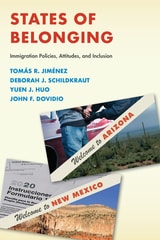
States of Belonging
Immigration Policies, Attitudes, and InclusionTomas R. Jimenez
Russell Sage Foundation, 2021
Arizona and New Mexico are historically and demographically similar, but they differ in their immigration policies. Arizona has enacted unwelcoming policies towards immigrants, restricting the access of immigrants to state resources, social services, and public institutions. New Mexico is more welcoming, actively seeking to protect the rights of immigrants and extending access to state resources and institutions. The authors draw on an original survey and in-depth interviews of a cross-section of each state’s population to illustrate how these differing approaches affect the sense of belonging not only among immigrants, but among the U.S.-born as well.
Respondents in Arizona, regardless of whether they were foreign- or native-born or their ethno-racial background, agreed that the state is unwelcoming to immigrants, and they pointed to Arizona’s restrictive policies as the primary factor. The sense of rejection perceived by Latinos in Arizona, including the foreign-born and the U.S.-born, was profound. They felt the effects of administrative and symbolic exclusions of the state’s unwelcoming policies as they went about their daily lives.
New Mexico’s more welcoming approach had positive effects on the Latino immigrant population, and these policies contributed to an increased sense of belonging among U.S.-born Latinos and U.S.-born whites as well. The authors show that exposure to information about welcoming policies is associated with an improved sense of belonging across most population groups. They also find that the primary dividing line when it came to reactions to welcoming policies was political, not ethno-racial. Only self-identified Republicans, Latino as well as white, showed reduced feelings of belonging.
States of Belonging demonstrates that welcoming policies cultivate a greater sense of belonging for immigrants and other state citizens, suggesting that policies aimed at helping immigrants gain a social, economic, and political foothold in this country can pay a broad societal dividend.
States of Desire Revisited
Travels in Gay AmericaEdmund White
University of Wisconsin Press, 2014
White frames those past travels with a brief, bracing review of gay America since the 1970s ("now we were all supposed to settle down with a partner in the suburbs and adopt a Korean daughter"), and a reflection on how Internet culture has diminished unique gay places and scenes but brought isolated individuals into a global GLBTQ community.
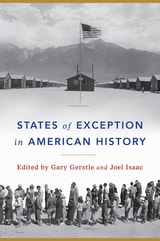
States of Exception in American History
Edited by Gary Gerstle and Joel Isaac
University of Chicago Press, 2020
The first comprehensive account of the politics of exceptions and emergencies in the history of the United States, this book weaves together historical studies of moments and spaces of exception with conceptual analyses of emergency, the state of exception, sovereignty, and dictatorship. The Civil War, the Great Depression, and the Cold War figure prominently in the essays; so do Francis Lieber, Frederick Douglass, John Dewey, Clinton Rossiter, and others who explored whether it was possible for the United States to survive states of emergency without losing its democratic way. States of Exception combines political theory and the history of political thought with histories of race and political institutions. It is both inspired by and illuminating of the American experience with constitutional rule in the age of terror and Trump.
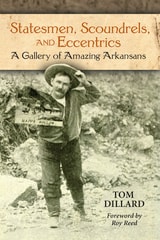
Statesmen, Scoundrels, and Eccentrics
A Gallery of Amazing ArkansansTom Dillard
University of Arkansas Press, 2010

Stations of the Cross
Adorno and Christian Right RadioPaul Apostolidis
Duke University Press, 2000
Public ideology and institutional tendencies clash, the author argues, in the restructuring of the welfare state, the financing of the electoral system, and the backlash against women and minorities. These frictions are nowhere more apparent than on Christian right radio. Reinvigorating the intellectual tradition of the Frankfurt School, Apostolidis shows how ideas derived from early critical theory—in particular that of Theodor W. Adorno—can illuminate the political and social dynamics of this aspect of contemporary American culture. He uses and reworks Adorno’s theories to interpret the nationally broadcast Focus on the Family, revealing how the cultural discourse of the Christian right resonates with recent structural transformations in the American political economy. Apostolidis shows that the antidote to the Christian right’s marriage of religious and market fundamentalism lies not in a reinvocation of liberal fundamentals, but rather depends on a patient cultivation of the affinities between religion’s utopian impulses and radical, democratic challenges to the present political-economic order.
Mixing critical theory with detailed analysis, Stations of the Cross provides a needed contribution to sociopolitical studies of mass movements and will attract readers in sociology, political science, philosophy, and history.

Stations of the Lost
The Treatment of Skid Row AlcoholicsJacqueline P. Wiseman
University of Chicago Press, 1979
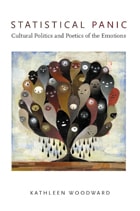
Statistical Panic
Cultural Politics and Poetics of the EmotionsKathleen Woodward
Duke University Press, 2009
Referring discreetly to her own experience, Woodward examines the interpenetration of social structures and subjectivity, considering how psychological emotions are social phenomena, with feminist anger, racial shame, old-age depression, and sympathy for non-human cyborgs (including robots) as key cases in point. She discusses how emerging institutional and discursive structures engender “new” affects that in turn can help us understand our changing world if we are attentive to them—the “statistical panic” produced by the risk society, with its numerical portents of disease and mortality; the rage prompted by impenetrable and bloated bureaucracies; the brutal shame experienced by those caught in the crossfire of the media; and the conservative compassion that is not an emotion at all, only an empty political slogan.
The orbit of Statistical Panic is wide, drawing in feminist theory, critical phenomenology, and recent theories of the emotions. But at its heart are stories. As an antidote to the vacuous dramas of media culture, with its mock emotions and scattershot sensations, Woodward turns to the autobiographical narrative. Stories of illness—by Joan Didion, Yvonne Rainer, Paul Monette, and Alice Wexler, among others—receive special attention, with the inexhaustible emotion of grief framing the book as a whole.
Statutes in Court
The History and Theory of Statutory InterpretationWilliam D. Popkin
Duke University Press, 1999
Popkin begins by discussing the British origins of statutory interpretation in this country. He then maps the evolving conceptions of the judicial role in the United States from Revolutionary times through the twentieth century before presenting his “ordinary judging” theory—one that asks the judge to use modest judicial discretion to assist the legislature in implementing good government. Claiming that theory cannot account for everything a judge does when determining statutory meaning or writing an opinion, Popkin shows how judges who strive to be conscientious in interpreting the law are often hampered by the lack of both a framework in which to fit their approach and a well-understood common vocabulary to explain what they do. Statutes in Court fills that gap.
This work will be valuable to anyone concerned about the judicial role in the interpretation of laws—from judiciary officials and law professors to legal historians and political scientists.

Stay Tuned
Listening to the Network EraPatrick Sullivan
Rutgers University Press, 2026
Since the 1950s, television flooded the American soundscape with not just pictures but sounds, a constant aural stream infiltrating domestic life. In Stay Tuned, Patrick Sullivan treats network-era television sound not as background noise or auxiliary signal but as a formative texture of aesthetic life in postwar America. He theorizes how television’s sonic forms—asynchronous audiovisuals, noises, affective rhythms, what he collectively terms “network aurality”—trouble traditional aesthetic theory. Stay Tuned takes up critiques of television sound and repurposes them as evidence of a deeper philosophical discomfort: Namely, that television sound does something to aesthetic categories that they weren’t built to handle. From the laugh track to the cartoon “boinks,” from noises to the jingle, Sullivan reads television sounds not as cultural detritus but as formal interventions—forcing a redefinition of what aesthetics means when form is mass-produced, commercial, and built for syndication. What emerges is not just a new theory and history of television sound but a reimagined account of aesthetic experience itself—expanded, recalibrated, and a little wacky.
Staying Italian
Urban Change and Ethnic Life in Postwar Toronto and PhiladelphiaJordan Stanger-Ross
University of Chicago Press, 2009
Despite their twin positions as two of North America’s most iconic Italian neighborhoods, South Philly and Toronto’s Little Italy have functioned in dramatically different ways since World War II. Inviting readers into the churches, homes, and businesses at the heart of these communities, Staying Italian reveals that daily experience in each enclave created two distinct, yet still Italian, ethnicities.
As Philadelphia struggled with deindustrialization, Jordan Stanger-Ross shows, Italian ethnicity in South Philly remained closely linked with preserving turf and marking boundaries. Toronto’s thriving Little Italy, on the other hand, drew Italians together from across the wider region. These distinctive ethnic enclaves, Stanger-Ross argues, were shaped by each city’s response to suburbanization, segregation, and economic restructuring. By situating malleable ethnic bonds in the context of political economy and racial dynamics, he offers a fresh perspective on the potential of local environments to shape individual identities and social experience.

Staying The Course
A Runner’s Toughest RaceDick Beardsley
University of Minnesota Press, 2004

Steadfast in the Faith
The Life of Patrick Cardinal O'BoyleMorris J. MacGregor
Catholic University of America Press, 2006
Steady Gains and Stalled Progress
Inequality and the Black-White Test Score GapKatherine Magnuson
Russell Sage Foundation, 2008
Stealing Indian Women
Native Slavery in the Illinois CountryCarl J. Ekberg
University of Illinois Press, 2009
Stealing the General
The Great Locomotive Chase and the First Medal of HonorRussell S. Bonds
Westholme Publishing, 2007
Selected by Civil War Interactive as One of the Top Civil War Books of All Time
On April 12, 1862—one year to the day after Confederate guns opened on Fort Sumter and started the Civil War—a tall, mysterious smuggler and self-appointed Union spy named James J. Andrews and nineteen infantry volunteers infiltrated north Georgia and stole a steam engine called the General. Racing northward at speeds approaching sixty miles an hour, cutting telegraph lines and destroying track along the way, Andrews planned to open East Tennessee to the Union army, cutting off men and matériel from the Confederate forces in Virginia. If they succeeded, Andrews and his raiders could change the course of the war. But the General's young conductor, William A. Fuller, chased the stolen train first on foot, then by handcar, and finally aboard another engine, the Texas. He pursued the General until, running out of wood and water, Andrews and his men abandoned the doomed locomotive, ending the adventure that would soon be famous as The Great Locomotive Chase. But the ordeal of the soldiers involved was just beginning. In the days that followed, the "engine thieves" were hunted down and captured. Eight were tried and executed as spies, including Andrews. Eight others made a daring escape to freedom, including two assisted by a network of slaves and Union sympathizers. For their actions, before a personal audience with President Abraham Lincoln, six of the raiders became the first men in American history to be awarded the Medal of Honor—the nation's highest decoration for gallantry.
Americans north and south, both at the time and ever since, have been astounded and fascinated by this daring raid. But until now, there has not been a complete history of the entire episode and the fates of all those involved. Based on eyewitness accounts, as well as correspondence, diaries, military records, newspaper reports, deposition testimony and other primary sources, Stealing the General: The Great Locomotive Chase and the First Medal of Honor by Russell S. Bonds is a blend of meticulous research and compelling narrative that is now considered to be the definitive history of "the boldest adventure of the war."

Steam & Cinders
The Advent of Railroads in WisconsinAxel Lorenzsonn
Wisconsin Historical Society Press, 2009
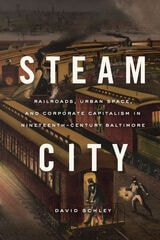
Steam City
Railroads, Urban Space, and Corporate Capitalism in Nineteenth-Century BaltimoreDavid Schley
University of Chicago Press, 2020
Steam City tells the story of corporate capitalism starting from the street and moving outward, looking at how the rise of the railroad altered the fabric of everyday life in the United States. The B&O’s founders believed that their new line would remap American economic geography, but no one imagined that the railroad would also dramatically reshape the spaces of its terminal city. As railroad executives wrangled with city officials over their use of urban space, they formulated new ideas about the boundaries between public good and private profit. Ultimately, they reinvented the B&O as a private enterprise, unmoored to its home city. This bold reconception had implications not only for the people of Baltimore, but for the railroad industry as a whole. As David Schley shows here, privatizing the B&O helped set the stage for the rise of the corporation as a major force in the post-Civil War economy.
Steam City examines how the birth and spread of the American railroad—which brought rapid communications, fossil fuels, and new modes of corporate organization to the city—changed how people worked, where they lived, even how they crossed the street. As Schley makes clear, we still live with the consequences of this spatial and economic order today.
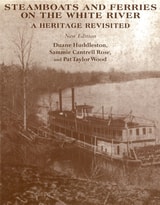
Steamboats and Ferries on the White River
A Heritage RevisitedDuane Huddleston
University of Arkansas Press, 1998
From the time the Waverly first steamed up the White River to Batesville from the Mississippi River in 1831, the haunting blast of river whistles signaled service, comfort, and delight for residents along this major Arkansas waterway. In a terrain that lacked good roads, steamboats contributed significantly to new economic development and settlement of the region. They carried animal hides, cotton, and rendered bear oil downriver to market and transported settlers, food staples, and manufactured goods upriver. For a hundred years these elegant boats were used for mail delivery, excursion parties, and freight hauling, eventually bringing about their own demise when they hauled in the material to build the railroads.
Over 120 black-and-white photographs, sketches, and maps illustrate the colorful text. Interwoven with the history of steamboats is that of ferries keelboats, flatboats, and Civil War tinclads, all of which plied the White River in the 1800s and early 1900s. A keenly researched regional study, this book is nonetheless representative of conditions and activities on similar river systems in many parts of America during the same period. Steamboats and Ferries on the White River pays lasting tribute to the golden age of steam travel.

Steaming to the North
The First Summer Cruise of the US Revenue Cutter Bear, Alaska and Chukotka, Siberia, 1886Katherine C. Donahue and David C. Switzer
University of Alaska Press, 2014
Steaming to the North follows the Bear from May to October 1886 as it takes its first summer cruise from San Francisco up to Point Barrow and back again. This is the first book to exhibit the photographs taken by 3rd Lt. Charles Kennedy of New Bedford, introducing rarely seen photos of the last sail-and-steam whaling ships, capturing early interactions of Natives with white whalemen and explorers, and showing lives otherwise lost to time. Essays follow the logbook of the cruise and allow readers to vividly ride alongside the crew on a history-making voyage.
Steel Helmet and Mortarboard
An Academic in Uncle Sam's ArmyFrancis H. Heller
University of Missouri Press, 2009
Stegner
Conversations On History And LiteratureWallace Stegner
University of Nevada Press, 1996
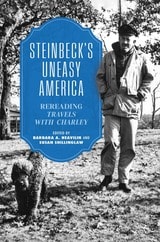
Steinbeck’s Uneasy America
Rereading “Travels with Charley”Edited by Barbara A. Heavilin and Susan Shillinglaw
University of Alabama Press, 2025
A road trip through Steinbeck’s America—revisited, reimagined, and reinterpreted.
Steinbeck’s Uneasy America is the first collection of critical scholarship devoted to Travels with Charley in Search of America, John Steinbeck’s best-selling, late-career travel memoir. In 1960, Steinbeck was a renowned man of American letters. Many considered him America’s troubadour of ordinary people, the conscience of the country. But weakened by two small strokes and anxious that he had lost touch with America, he embarked on a cross-country road trip accompanied by his wife’s standard poodle, Charley. Two years later, he published Travels with Charley to popular acclaim and robust sales.
Throughout this narrative, Steinbeck insists that all of our perceptions are “warped” by personality, history, and society. And while this hybrid and experimental book has long been accepted as an accurate account of his journey, journalists and scholars agree that the narrative is part factual, part fiction—America as seen through Steinbeck’s particular “warp.” The work is long overdue for scholarly assessment.
Steinbeck’s Uneasy America explores three main topics. Part 1 explores genre and form to consider the degree to which the work is fiction or nonfiction. Part 2 assesses Steinbeck’s increasingly bleak assessment of America—almost a jeremiad that warns citizens of ecological excess and political apathy. Part 3 focuses on Travels with Charley as a road text, travel adventure, and literary influence.
This volume’s authors offer rich scholarly insights and a wealth of stories, facts, and anecdotes about Steinbeck and the adventures and misadventures he and Charley met on the road. Lively and groundbreaking, the collection both enlightens and enlivens discussions of Steinbeck and of the twentieth-century American book world.

Stellar Transformations
Movie Stars of the 2010sSteven Rybin
Rutgers University Press, 2022

Stephen A. Douglas
Robert W. Johannsen
University of Illinois Press, 1997
For the quarter-century before 1860 Stephen A. Douglas was a dominant
figure on the American political scene, far outshadowing Abraham Lincoln.
This first paperback printing of Robert Johannsen's authoritative biography
features a new preface.
"At once a work of enormous scholarship and of deep insight. Here,
for the first time, is the full story of a great career, told with such
skill that we can now understand why Abraham Lincoln found the 'Little
Giant' the most formidable political rival he ever faced." -- David
H. Donald, author of Lincoln and two-time winner of the Pulitzer
Prize
"Well-organized and marvelously detailed. . . . The book demonstrates
the virtues of large-scale, straightforward narrative biography at its
best. Its completeness and objectivity will make it the standard authority
for many years to come." -- Richard N. Current, The New York Times
Book Review
"Superb. . . . Will doubtless stand as the definitive biography
of Stephen A. Douglas for this generation." -- Hans L. Trefousse,
The Journal of American History
"An impressive work--impressive in scope, in research, and in maturity
of understanding. . . . Johannsen has constructed a biography that is
rich in detail and full of conviction." -- James Z. Rabun, The
Journal of Southern History
"Should take its place in the tradition of magisterial biographies
. . . in which so much of the best writing on American history is to be
found." -- Harry V. Jaffa, National Review
"The research is amazingly exhaustive and the writing is unusually
readable. . . . Outstanding biography of a quality not often matched."
-- LeRoy H. Fischer, Manuscripta
Supported by the Dickerson Fund of the University of Illinois at Urbana-Champaign

Stephen Crane Remembered
Edited by Paul Sorrentino
University of Alabama Press, 2006
Revealing episodes in the life of the elusive writer, as told by acquaintances
This book collects reminiscences by contemporaries, friends, and associates of Stephen Crane that illuminate the life of this often misunderstood and misrepresented writer. Although Crane is widely regarded as a major American author, conclusions about his life, work, and thought remain obscure due to the difficulties in separating fact from fiction. His first biographer recorded mostly vague impressions and, to mythologize his subject, invented a multitude of the episodes and letters used in his account of Crane’s life. Subsequent biographies were either cursory summations or compendiums of verifiable facts. Crane himself was both reclusive and mercurial, protective of his inner life while projecting a variety of personae to suit others.
A flamboyant personality and close friend of writers such as William Dean Howells, Henry James, and Joseph Conrad, Crane made telling impressions on his contemporaries. They often constitute the best assessments of Crane’s own personality and work. The 90 reminiscences gathered here offer a much-needed account of Crane’s life from a variety of viewpoints, as well as important information about the contributors themselves.
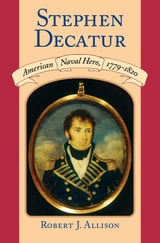
Stephen Decatur
American Naval Hero, 1779-1820Robert J. Allison
University of Massachusetts Press, 2005
Born to a prominent Philadelphia family in 1779, Stephen Decatur at age twenty-five became the youngest man ever to serve as a captain in the U.S. Navy. His intrepid heroism, leadership, and devotion to duty made him a perfect symbol of the aspirations of the growing nation. Leading men to victory in Tripoli, the War of 1812, and the Algerian war of 1815, and coining the phrase “Our country, right or wrong,” Decatur created an enduring legend of bravery, celebrated in poetry, song, paintings, and the naming of dozens of towns—from Georgia to Alabama to Illinois.
After the War of 1812, Decatur moved to Washington to help direct naval policy. His close friendships with James Madison, John Quincy Adams, and other political leaders soon made him a rising star in national politics. He and his wife Susan made their elegant home on Lafayette Square near the White House a center of Washington society. The capital and the entire nation were shocked in 1820 when Decatur died at the age of forty-one in a duel with a rival navy captain.
In this carefully researched and well-written biography, historian Robert Allison tells the story of Decatur's eventful life at a time when the young republic was developing its own identity—when the American people were deciding what kind of nation they would become. Although he died prematurely, Decatur played a significant role in the shaping of that national identity.
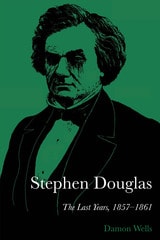
Stephen Douglas
The Last Years, 1857–1861By Damon Wells
University of Texas Press, 1971
Stephen Douglas and the old Union lived out their last years together. It was the most critical time in the life of both the Illinois senator and his country. During most of the period 1857–1861 the American nation could still choose between adjustment of its sectional differences and civil war, and the man they called the Little Giant seemed the one statesman most likely to lead the country onto a course of compromise and reconciliation.
But Douglas’ intense involvement with the American political scene—his great accomplishments in enacting the Compromises of 1850 and 1854, and his victory in the senatorial campaign of 1858—tended at times to disguise a growing alienation from the mainstream of American political life. By 1857 that alienation had reached acute proportions. In part, Douglas fell victim to his own virtues. He sought to be a nationalist in an age of sectionalism; he preached the value of compromise when most Americans questioned its worth.
In other respects, Douglas’ political failures are less excusable. His attempt to convert an apparently amoral attitude toward slavery into a principle—popular sovereignty—found him dismissed by antislavery citizens as immoral and by proslavery citizens as unreliable. For too long, Douglas, professing to “care not” about the future of slavery, overlooked how much Americans could care once their consciences had been aroused or their way of life supposedly threatened.
Douglas failed to win the presidential campaign of 1860 largely because he could satisfy neither the proponents nor the enemies of slavery. Yet if the last years of Douglas’ life were marred by failure, he was not ultimately the tragic figure some historians have suggested. During the campaign of 1860 a profound change began to take place in Stephen Douglas. The outmoded nationalism he had preached for so long began to give way to Unionism. In his eventual support of Lincoln and his defense of the Union, Douglas at last found a policy worthy of his great talents.
Damon Wells first became interested in Stephen Douglas in 1959 after seeing a Broadway dramatization of the Lincoln-Douglas Debates. Later, his studies convinced him that playwright and historian alike were often unfair to Douglas. If Lincoln was to be a hero, then Douglas had to be cast as a villain.
This study fills the need for a fresh and dispassionate look at Douglas and provides a fairer assessment than can be reached by simply endorsing contradictory views of apologists and critics. It places particular emphasis on the Little Giant’s struggle with President James Buchanan, the debates with Lincoln, the presidential campaign of 1860, Douglas’ complex relationship with the South, and a careful analysis of the elusive and at times exasperating principle of popular sovereignty.

Stephen King's America
Jonathan P. Davis
University of Wisconsin Press, 1994
Stephen King's America aims to heighten awareness of the numerous American issues that resonate throughout King's fiction, issues that bear universal application to the evolution of the human condition.