Results by title
3745 books match the query 'Europe' and 247 start with s
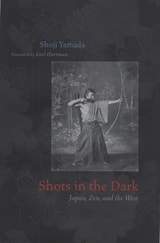
Shots in the Dark
Japan, Zen, and the WestShoji Yamada
University of Chicago Press, 2009
In the years after World War II, Westerners and Japanese alike elevated Zen to the quintessence of spirituality in Japan. Pursuing the sources of Zen as a Japanese ideal, Shoji Yamada uncovers the surprising role of two cultural touchstones: Eugen Herrigel’s Zen in the Art of Archery and the Ryoanji dry-landscape rock garden. Yamada shows how both became facile conduits for exporting and importing Japanese culture.
First published in German in 1948 and translated into Japanese in 1956, Herrigel’s book popularized ideas of Zen both in the West and in Japan. Yamada traces the prewar history of Japanese archery, reveals how Herrigel mistakenly came to understand it as a traditional practice, and explains why the Japanese themselves embraced his interpretation as spiritual discipline. Turning to Ryoanji, Yamada argues that this epitome of Zen in fact bears little relation to Buddhism and is best understood in relation to Chinese myth. For much of its modern history, Ryoanji was a weedy, neglected plot; only after its allegorical role in a 1949 Ozu film was it popularly linked to Zen. Westerners have had a part in redefining Ryoanji, but as in the case of archery, Yamada’s interest is primarily in how the Japanese themselves have invested this cultural site with new value through a spurious association with Zen.
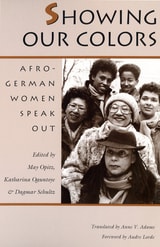
Showing Our Colors
Afro-German Women Speak OutMay Optiz
University of Massachusetts Press, 1992
Showing Our Colors: Afro-German Women Speak Out is an English translation of the German book Farbe bekennen, edited by author May Ayim, Katharina Oguntoye, and Dagmar Schultz. It is the first published book by Afro-Germans. It is the first written use of the term Afro-German.
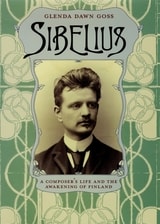
Sibelius
A Composer's Life and the Awakening of FinlandGlenda Dawn Goss
University of Chicago Press, 2009
One of the twentieth century’s greatest composers, Jean Sibelius (1865–1957) virtually stopped writing music during the last thirty years of his life. Recasting his mysterious musical silence and his undeniably influential life against the backdrop of Finland’s national awakening, Sibelius will be the definitive biography of this creative legend for many years to come.
Glenda Dawn Goss begins her sweeping narrative in the Finland of Sibelius’s youth, which remained under Russian control for the first five decades of his life. Focusing on previously unexamined events, Goss explores the composer’s formative experiences as a Russian subject and a member of the Swedish-speaking Finnish minority. She goes on to trace Sibelius’s relationships with his creative contemporaries, with whom he worked to usher in a golden age of music and art that would endow Finns with a sense of pride in their heritage and encourage their hopes for the possibilities of nationhood. Skillfully evoking this artistic climate—in which Sibelius emerged as a leader—Goss creates a dazzling portrait of the painting, sculpture, literature, and music it inspired. To solve the deepest riddles of Sibelius’s life, work, and enigmatic silence, Goss contends, we must understand the awakening in which he played so great a role.
Situating this national creative tide in the context of Nordic and European cultural currents, Sibelius dramatically deepens our knowledge of a misunderstood musical giant and an important chapter in the intellectual history of Europe.
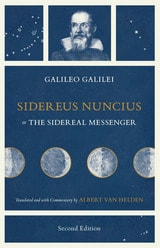
Sidereus Nuncius, or The Sidereal Messenger
Galileo Galilei
University of Chicago Press, 2015
Albert Van Helden’s beautifully rendered and eminently readable translation is based on the Venice 1610 edition’s original Latin text. An introduction, conclusion, and copious notes place the book in its historical and intellectual context, and a new preface, written by Van Helden, highlights recent discoveries in the field, including the detection of a forged copy of Sidereus Nuncius, and new understandings about the political complexities of Galileo’s work.
Siena
City of SecretsJane Tylus
University of Chicago Press, 2015
As Tylus leads us through the city, she shares her passion for Siena in novelistic prose, while never losing sight of the historical complexities that have made Siena one of the most fascinating and beautiful towns in Europe. Today, Siena can appear on the surface standoffish and old-fashioned, especially when compared to its larger, flashier cousins Rome and Florence. But first impressions wear away as we learn from Tylus that Siena was an innovator among the cities of Italy: the first to legislate the building and maintenance of its streets, the first to publicly fund its university, the first to institute a municipal bank, and even the first to ban automobile traffic from its city center.
We learn about Siena’s great artistic and architectural past, hidden behind centuries of painting and rebuilding, and about the distinctive characters of its different neighborhoods, exemplified in the Palio, the highly competitive horserace that takes place twice a year in the city’s main piazza and that serves as both a dividing and a uniting force for the Sienese. Throughout we are guided by the assured voice of a seasoned scholar with a gift for spinning a good story and an eye for the telling detail, whether we are traveling Siena’s modern highways, exploring its underground tunnels, tracking the city’s financial history, or celebrating giants of painting like Simone Martini or giants of the arena, Siena’s former Serie A soccer team.
A practical and engaging guide for tourists and armchair travelers alike, Siena is a testament to the powers of community and resilience in a place that is not quite as timeless and serene as it may at first appear.

Sigurd and His Brave Companions
A Tale of Medieval NorwaySigrid Undset
University of Minnesota Press, 2013
Inspired by tales of the hero Vilmund Vidutan and his fellow knights, Sigurd Jonsson and his young friends Ivar and Helge set out to reenact these exploits on their medieval Norwegian farm. They carve swords and lances and spend hours making shields. With a little imagination, a pasture becomes a battlefield, an old boar their greatest foe, and they pass many hours jousting and dueling. But when the summer is nearly over, the three boys stumble into real trouble and must prove their courage in an adventure all their own.
Written during Sigrid Undset’s time in New York, Sigurd and His Brave Companions will make medieval Norway come alive for young and old readers alike.
Silenced Voices
Uncovering a Family’s Colonial History in IndonesiaInez Hollander
Ohio University Press, 2008
Like a number of Netherlanders in the post–World War II era, Inez Hollander only gradually became aware of her family’s connections with its Dutch colonial past, including a Creole great-grandmother. For the most part, such personal stories have been, if not entirely silenced, at least only whispered about in Holland, where society has remained uncomfortable with many aspects of the country’s relationship with its colonial empire.
Unlike the majority of memoirs that are soaked in nostalgia for tempo dulu, Hollander’s story sets out to come to grips with her family’s past by weaving together personal records with historical and literary accounts of the period. She seeks not merely to locate and preserve family memories, but also to test them against a more disinterested historical record. Hers is a complicated and sometimes painful personal journey of realization, unusually mindful of the ways in which past memories and present considerations can be intermingled when we seek to understand a difficult past. Silenced Voices is an important contribution to the literature on how Dutch society has dealt with its recent colonial history.
Silver “Thieves," Tin Barons, and Conquistadors
Small-Scale Mineral Production in Southern BoliviaMary Van Buren
University of Arizona Press, 2024
The methods of historian Bertell Ollman, particularly a dialectical approach and “doing history backwards,” are used to examine small-scale mineral production in Porco, Bolivia. The research is based on nine seasons of archaeological fieldwork and historical research, with a particular focus on labor and technology. Van Buren argues that artisanal mineral production must be understood in relation to large-scale mining rather than as a traditional practice and that the Bolivian case is a culturally specific instantiation of a broader economic phenomenon that began under colonial regimes.
Singing Sappho
Improvisation and Authority in Nineteenth-Century Italian OperaMelina Esse
University of Chicago Press, 2021
Sinners and Citizens
Bestiality and Homosexuality in Sweden, 1880-1950Jens Rydström
University of Chicago Press, 2003
Based on medical journals, psychiatric reports, and court records from the period, as well as testimonies from men in diaries, letters, and interviews, Sinners and Citizens reveals that bestiality was once a dreaded crime in Sweden. But in time, mention of the practice disappeared completely from legal and medical debates. This, Rydström contends, is because models of penetrative sodomy shifted from bestiality to homosexuality as Sweden transformed from a rural society into a more urban one. As the nation's economy and culture became less identified with the countryside, so too did its idea of deviant sexual behavior.
Sir Philip Sidney
Selected Prose and PoetryEdited by Robert Kimbrough
University of Wisconsin Press, 1983
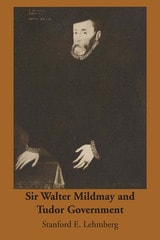
Sir Walter Mildmay and Tudor Government
By Stanford E. Lehmberg
University of Texas Press, 1964
This is the first biography of Sir Walter Mildmay, who dutifully served Queen Elizabeth I for thirty years as Chancellor of the Exchequer. Sir Walter Mildmay and Tudor Government, by Stanford E. Lehmberg, brings Mildmay into proper historical perspective alongside other prominent Tudor leaders.
Virtually none of Mildmay’s writings had been printed, and his activities had not been studied, partly because of the inaccessibility of necessary materials. In the mid-twentieth century, however, the Northamptonshire Record Office was able to acquire family papers, of which Lehmberg happily took advantage. These, together with materials in the British Museum and the Public Record Office, yield a detailed account of Mildmay’s contributions to English financial administration.
But Mildmay was not merely an Exchequer official. As a Member of Parliament he gained towering stature; his model orations and indefatigable work in committees provided invaluable leadership from 1576 to 1589. As a Privy Councillor he was twice sent on important embassies to Mary, Queen of Scots; he gave carefully considered advice about Scottish and Dutch affairs; and he was called on to examine numerous minor matters. As a trusted administrator he helped oversee the great recoinage of 1560. As a private citizen deeply concerned for good learning and true religion he founded Emmanuel College, Cambridge, and engaged in other philanthropic enterprises. By the time of his death in 1589 he had led a full and dedicated life serving his country and his Queen.
Into Lehmberg’s scholarly, readable volume have been blended aspects of Mildmay’s public life and his associations with historically famous contemporaries, discriminately selected segments of his speeches, elements of his personal philosophy, and the achievements and failures of his political life. Enhancing the value of this study are carefully annotated footnotes and a complementary bibliography. Tudor specialists as well as lay readers will undoubtedly profit from this significant biography.
Sisters and Workers in the Middle Ages
Edited by Judith M. Bennett, Elizabeth A. Clark, Jean F. O'Barr, B. Anne Vilen,
University of Chicago Press, 1989
These essays provide a greater understanding of the ways in which gender has played a part in determining relations of power in Western cultures. This volume makes a vital contribution to the current scholarship about women in the Middle Ages.
Sites of European Antisemitism in the Age of Mass Politics, 1880–1918
Edited by Robert Nemes and Daniel Unowsky
Brandeis University Press, 2014
Sites of the Unconscious
Hypnosis and the Emergence of the Psychoanalytic SettingAndreas Mayer
University of Chicago Press, 2013
Sites of the Unconscious analyzes the major controversies between competing French schools of hypnotism that emerged at this time, stressing their different views on the production of viable evidence and their different ways of deploying hypnosis. Mayer then reconstructs in detail the reception of French hypnotism in German-speaking countries, arguing that the distinctive features of Freud’s psychoanalytic setting of the couch emerged out of the clinical laboratories and private consulting rooms of the practitioners of hypnosis.
Situated Marxism
Theoretical Practices in State Socialist EuropeAdela Hincu
Central European University Press, 2026
Slavery and Religious Conversion in Portugal's Indian Empire, 1500-1700
Stephanie Hassell
Ohio University Press, 2025
In the sixteenth and seventeenth centuries, enslaved Africans and Asians were part of the larger Portuguese project of building and maintaining a Catholic empire in the Indian Ocean. Both the Church and the Crown influenced the owner-slave relationship across households, the most basic organizational unit of power over the populace. Responsible for their enslaved dependents’ conversion to Catholicism, slaveholders became religious stewards whose spiritual duties toward their slaves helped expand the Christian population. This converted population was part of the imperial security apparatus, which conceptualized enslaved Catholics as loyal allies against neighboring Muslim states. They became members of the broader colonial community in which Catholicism also conveyed rights, enabled agency, and provoked household struggles between owners and slaves. Thus, the making of a Catholic empire was a contested process tied to the complex relationships between enslaved individuals, their enslavers, and the Church. The Portuguese Inquisition was a hybrid ecclesiastical and state institution, and its records detail the Crown’s commitment to the creation of a worldwide Catholic empire. Accordingly, inquisitorial encounters brought conversion, slavery, and empire into one field of vision. The Portuguese Inquisition had only one overseas tribunal, located in Goa, India. While most trial records of the Goa Tribunal were destroyed, author Stephanie Hassell has utilized extant sixteenth- and seventeenth-century cases featuring enslaved defendants and witnesses. Her use of thousands of case summaries provides a broader inquisitorial context by showing how prosecutorial trends reflected the anxieties of the Portuguese imperial state. Parish records, ecclesiastical council records, and municipal council records likewise emphasize the significance of religious conversion.
Slavery and the Invention of Dutch Art
Caroline Fowler
Duke University Press, 2025
Small Privatization
The Transformation of Retail Trade and Consumer Services in the Czech Republic, Hungary and PolandRoman Frydman
Central European University Press, 1994
Small Towns in Europe in the 20th and 21st Centuries
Heritage and Development StrategiesLud'a Klusáková et al.
Karolinum Press, 2017
Smile of the Midsummer Night
A Picture of SwedenLars Gustafsson and Agneta Blomqvist
Haus Publishing, 2015
The first work of contemporary travel writing about Sweden by Swedish writers to have been translated into English, Smile of the Midsummer Night is a loving and poetic ode to this beautiful nation and a must-have for anyone interested in Scandinavia.

Smollett's Britain
Jeremy Black
St. Augustine's Press, 2022
Social Contracts Under Stress
The Middle Classes of America, Europe, and Japan at the Turn of the CenturyOlivier Zunz
Russell Sage Foundation, 2002

Social Control in Europe
Volume 1, 1500–1800Herman Roodenburg and Pieter Spierenburg
The Ohio State University Press, 2004

Social Control in Europe
Volume 2, 1800–2000Clive Emsley, Eric Johnson, and Pieter Spierenburg
The Ohio State University Press, 2004
The essays in this volume explore the various means by which communities in nineteenth- and twentieth-century Europe were subjected to forms of discipline, noting how the communities themselves generated their own forms of internal control. In addition, the essays discuss various policing institutions, exploring in particular the question of how liberal and totalitarian regimes differed in their styles of control, repression, and surveillance.
Social Currents in Eastern Europe
The Sources and Consequences of the Great TransformationSabrina P. Ramet
Duke University Press, 1994
Ramet draws on interviews conducted over a ten-year period with individuals active in arenas for social change—intellectual dissent, feminism, religious activism, youth cultures and movements, and trade unionism—in eight East European countries: East Germany, Poland, Czechoslovakia, Hungary, Yugoslavia, Romania, Bulgaria, and Albania. She shows how the processes leading to the ultimate collapse of communism began more than a decade earlier and how they were necessarily manifested in spheres as diverse as religion and rock music.
Ramet also examines the consequences of the "Great Transformation" and analyzes the numerous unresolved problems that these societies currently confront, whether it be in the arena of economics, political legitimation, or the challenges of establishing a civil society free of chauvinism.
Social Security Pension Reform in Europe
Edited by Martin Feldstein and Horst Siebert
University of Chicago Press, 2002
The essays here highlight the problems that the European pension reform process faces and how it differs from that of the United States. This timely volume will significantly enrich the debate on pension reform worldwide.

Social Trust in the Nordic World
Gert Tinggaard Svendsen and Christian Bjørnskov
University of Wisconsin Press, 2023
Is the Nordic countries’ high level of social trust just as important for creating prosperity and happiness within a population as other, more tangible economic factors? If so, where does this stock of social trust in Scandinavia come from? Does it help to explain the development of the universal welfare states and their surprisingly high business competitiveness? Can other nations learn from the region and apply that knowledge to settings where social trust levels are low or in danger of being eroded?
Social trust has proven economic value, and Gert Tinggaard Svendsen warns that its benefits should never be taken for granted. Trust can dissolve and vanish quickly, and once gone, it is very difficult to rebuild. Governments and corporations are gradually increasing their control over people’s public and private lives, with predictably worrying results. When people feel taken advantage of or lied to, public confidence evaporates. Since strong social cohesion drives long-term prosperity, Nordic exceptionalism on maintaining and restoring trust offers valuable lessons.
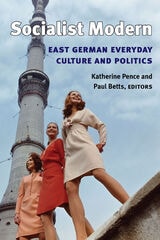
Socialist Modern
East German Everyday Culture and PoliticsKatherine Pence & Paul Betts, editors
University of Michigan Press, 2008
The reunification of Germany in 1989 may have put an end to the experiment in East German communism, but its historical assessment is far from over. Where most of the literature over the past two decades has been driven by the desire to uncover the relationship between power and resistance, complicity and consent, more recent scholarship tends to concentrate on the everyday history of East German citizens.
This volume builds on the latest literature by exploring the development and experience of life in East Germany, with a particular view toward addressing the question: What did modernity mean for the East German state and society? As such, the collection moves beyond the conceptual divide between state-level politics and everyday life to sharply focus on the specific contours of the GDR's unique experiment in Cold War socialism. What unites all the essays is the question of how the very tensions around "socialist modernity" shaped the views, memories, and actions of East Germans over four decades.
"An impressive volume drawing together rich, diverse essays by some of the most interesting, well-known, and experienced scholars on the GDR in the field, on both sides of the Atlantic."
---Dr. Jan Palmowski, Senior Lecturer in European Studies at King's College London, and Review Editor for German History
"Delving into many sides of the GDR modern, Pence and Betts present both new empirical evidence and offer insightful theoretical perspectives. The idea of the 'Socialist Modern' provides an excellent conceptual framework; the focus on culture fills a hole in the literature, the introduction is theoretically sophisticated and well-grounded in the historiography, and the span and heterogeneity of the articles are impressive."
---Donna Harsch, Associate Professor of History, Carnegie Mellon University
Katherine Pence is Assistant Professor of History, Baruch College, City University of New York.
Paul Betts is Reader in Modern German History, University of Sussex, Brighton, England.
Contributors
Daphne Berdahl
Paul Betts
Alon Confino
Greg Eghigian
Dagmar Herzog
Young-Sun Hong
Thomas Lindenberger
Alf Lüdtke
Ina Merkel
Katherine Pence
Judd Stitziel
Dorothee Wierling
Socialist Subjectivities
Queering East Germany under HoneckerScott Harrison, Jeff Hayton, and Katharine White, Editors
University of Michigan Press, 2025
Whether one was an apparatchik, artist, or alcoholic, the everyday interactions, experiences, and rituals of late socialism proved crucial to establishing the conditions around which subjecthood was constructed. Despite stereotypes of apathy and inertia, East Germans lent a considerable dynamism to their society, and by generating a cacophony of opinions and a heterogeneity of ideas, they constantly transformed state socialism. By foregrounding socialist subjects and the iterative nature of socialism during these decades, this volume paints a richer portrait of East Germany—one that illuminates how East Germans imagined their futures in a society whose collapse they could not foresee.
Soldier of the Press
Covering the Front in Europe and North Africa, 1936-1943Henry T. Gorrell, Edited & Intro by Kenneth Gorrell, & Foreword by John C. McManus
University of Missouri Press, 2009

Soldiers of the French Revolution
Alan Forrest
Duke University Press, 1989
Revolutionary idealists thought of the French soldier as a willing volunteer sacrificing himself for the principles of the Revolution; Forrest examines the convergence of these ideals with the ordinary, and often dreadful, experience of protracted warfare that the soldier endured.

Solidarity's Secret
The Women Who Defeated Communism in PolandShana Penn
University of Michigan Press, 2006
---Lech Walesa, former President of Poland and winner of the 1983 Nobel Peace Prize
Solidarity's Secret is the first book to record the crucial yet little-known role women played in the rise of an independent press in Poland and in the fall of that country's communist government.
Shana Penn pieces together a decade of interviews with the women behind the Polish pro-democracy movement-women whose massive contributions were obscured by the more public successes of their male counterparts.
Penn reveals the story of how these brave women ran Solidarity and the main opposition newspaper, Tygodnik Mazowsze, while prominent men like Lech Walesa were underground or in jail during the 1980s martial law years. The same women then went on to play influential roles in post-communist Poland.
Solidarity's Secret gives us a richly detailed story-within-a-story-unheard of not only in the West, but until recently even within Poland itself-from one of the most important eras in modern history.
Some Intellectual Consequences of the English Revolution
Christopher Hill
University of Wisconsin Press, 1980
In Some Intellectual Consequences of the English Revolution, Christopher Hill takes up themes that have emerged from a lifetime’s investigation into the causes of the English Revolution. However, Hill does more than analyze the origins of the Revolution. He examines the ways the seeds of change sown during the revolution, grew into transformative politics in the period following the restoration of the monarchy in 1660.
Hill argues that the intellectual heritage of the English Revolution was mixed. While he acknowledges its achievements, he also depicts some of its failings. Consequently, he challenges the view that radical notions faded with the Restoration, suggesting instead, that they continued in pervasive and subtle ways throughout the course of English and American history. The apparent similarity between the England of 1640 and that of 1660 is shown to be illusory. Each period’s institutions survived but the social context had changed. In this way, Hill demonstrates how intellectual consequences cannot be separated from the social and economic factors of the nation that produced them. He concludes that historians should turn their attention to the “unofficial” radical heritage that is less easy to comprehend, though no less important.
This is a highly readable and provocative account by one of the world’s foremost historians.

Some Reflections Upon Marriage
Mary Astell. Introduction by John A. Dussinger
University of Illinois Press, 2015
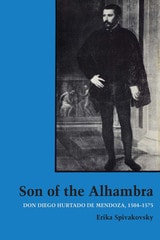
Son of the Alhambra
Don Diego Hurtado de Mendoza, 1504-1575By Erika Spivakovsky
University of Texas Press, 1970
Last of the Spanish Renaissance men, Diego Hurtado de Mendoza (1504–1575) was a master of the humanist disciplines as well as an active diplomat whose correspondence provides insight into the workings of power politics in the first post-Machiavellian decades.
This account of Mendoza's diplomatic career is a living commentary on the mid-sixteenth century, the time of the Spanish Inquisition and the Reformation, with its upheavals in the European balance of power. Mendoza served as ambassador of Charles V to Venice and Rome and as governor of Siena. His political life complements the reign of the Emperor whose ambition was to become a universal monarch.
An interesting contradiction in Mendoza's thought—his humanist theories versus personal ambition—prevented him from successful implemention of tyrannical imperial policies. His role in the government of the Holy Roman Empire shows how the exertion of imperialist power, humanist ethics notwithstanding, inevitably entails corruption, hypocrisy, greed, and imbalance in the one who tries to wield this power.
Gifted to the point of universal genius, Mendoza was perhaps the foremost representative of the splendid but little-known epoch of Spanish humanism, the era between the death of Queen Isabel (1504) and the abdication of her grandson Charles V (1556). Spain's short-lived Renaissance came to an abrupt end with the accession of Philip II and the almost simultaneous onset of the Counter Reformation. To this changed Spain, under monolithic thought control now exacted and enforced by monarch and Inquisition, Mendoza returned to live the last third of his life, mostly in obscurity, and in the last few years in royal disgrace.
Based on primary sources, this first biography of Mendoza in English also examines the relevance of some of Don Diego's disputed literary works to the legend that grew up around him as a spokesman for latent unorthodox opinion.
Song and Self
A Singer's Reflections on Music and PerformanceIan Bostridge
University of Chicago Press, 2023
Like so many performers, renowned tenor Ian Bostridge spent much of 2020 and 2021 unable to take part in live music. The enforced silence of the pandemic led him to question an identity that was previously defined by communicating directly with audiences in opera houses and concert halls. It also allowed him to delve deeper into many of the classical works he has encountered over the course of his career, such as Claudio Monteverdi’s seventeenth-century masterpiece Il Combattimento di Tancredi e Clorinda and Robert Schumann’s popular song cycle Frauenliebe und Leben. In lucid and compelling prose, Bostridge explores the ways Monteverdi, Schumann, and Britten employed and disrupted gender roles in their music; questions colonial power and hierarchy in Ravel’s Songs of Madagascar; and surveys Britten’s reckoning with death in works from the War Requiem to his final opera, Death in Venice.
As a performer reconciling his own identity and that of the musical text he delivers on stage, Bostridge unravels the complex history of each piece of music, showing how today’s performers can embody that complexity for their audiences. As readers become privy to Bostridge’s unique lines of inquiry, they are also primed for the searching intensity of his interpretations, in which the uncanny melding of song and self brings about moments of epiphany for both the singer and his audience.
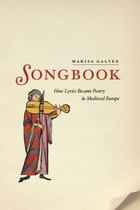
Songbook
How Lyrics Became Poetry in Medieval EuropeMarisa Galvez
University of Chicago Press, 2012
Today we usually think of a book of poems as composed by a poet, rather than assembled or adapted by a network of poets and readers. But the earliest European vernacular poetries challenge these assumptions. Medieval songbooks remind us how lyric poetry was once communally produced and received—a collaboration of artists, performers, live audiences, and readers stretching across languages and societies.
The only comparative study of its kind, Songbook treats what poetry was before the emergence of the modern category “poetry”: that is, how vernacular songbooks of the thirteenth to fifteenth centuries shaped our modern understanding of poetry by establishing expectations of what is a poem, what is a poet, and what is lyric poetry itself. Marisa Galvez analyzes the seminal songbooks representing the vernacular traditions of Occitan, Middle High German, and Castilian, and tracks the process by which the songbook emerged from the original performance contexts of oral publication, into a medium for preservation, and, finally, into an established literary object. Galvez reveals that songbooks—in ways that resonate with our modern practice of curated archives and playlists—contain lyric, music, images, and other nonlyric texts selected and ordered to reflect the local values and preferences of their readers. At a time when medievalists are reassessing the historical foundations of their field and especially the national literary canons established in the nineteenth century, a new examination of the songbook’s role in several vernacular traditions is more relevant than ever.
Sonnets for Michelangelo
A Bilingual EditionVittoria Colonna
University of Chicago Press, 2005
This book presents for the very first time a body of Colonna's verse that reveals much about her poetic aims and outlook, while also casting new light on one of the most famous friendships of the age. Sonnets for Michelangelo, originally presented in manuscript form to her close friend Michelangelo Buonarroti as a personal gift, illustrates the striking beauty and originality of Colonna's mature lyric voice and distinguishes her as a poetic innovator who would be widely imitated by female writers in Italy and Europe in the sixteenth century. After three centuries of relative neglect, this new edition promises to restore Colonna to her rightful place at the forefront of female cultural production in the Renaissance.
Sound Authorities
Scientific and Musical Knowledge in Nineteenth-Century BritainEdward J. Gillin
University of Chicago Press, 2021
Sound Authorities shows how experiences of music and sound played a crucial role in nineteenth-century scientific inquiry in Britain.
In Sound Authorities, Edward J. Gillin focuses on hearing and aurality in Victorian Britain, claiming that the development of the natural sciences in this era cannot be understood without attending to the study of sound and music.
During this time, scientific practitioners attempted to fashion themselves as authorities on sonorous phenomena, coming into conflict with traditional musical elites as well as religious bodies. Gillin pays attention to sound in both musical and nonmusical contexts, specifically the cacophony of British industrialization. Sound Authorities begins with the place of acoustics in early nineteenth-century London, examining scientific exhibitions, lectures, spectacles, workshops, laboratories, and showrooms. He goes on to explore how mathematicians mobilized sound in their understanding of natural laws and their vision of a harmonious ordered universe. In closing, Gillin delves into the era’s religious and metaphysical debates over the place of music (and humanity) in nature, the relationship between music and the divine, and the tensions between spiritualist understandings of sound and scientific ones.
Sound Diplomacy
Music and Emotions in Transatlantic Relations, 1850-1920Jessica C. E. Gienow-Hecht
University of Chicago Press, 2009
Sound Figures of Modernity
German Music and PhilosophyEdited by Jost Hermand and Gerhard Richter
University of Wisconsin Press, 2006
The rich conceptual and experiential relays between music and philosophy—echoes of what Theodor W. Adorno once called Klangfiguren, or "sound figures"—resonate with heightened intensity during the period of modernity that extends from early German Idealism to the Critical Theory of the Frankfurt School. This volume traces the political, historical, and philosophical trajectories of a specifically German tradition in which thinkers take recourse to music, both as an aesthetic practice and as the object of their speculative work.
The contributors examine the texts of such highly influential writers and thinkers as Schelling, Schopenhauer, Nietzsche, Bloch, Mann, Adorno, and Lukács in relation to individual composers including Beethoven, Wagner, Schönberg, and Eisler. Their explorations of the complexities that arise in conceptualizing music as a mode of representation and philosophy as a mode of aesthetic practice thematize the ways in which the fields of music and philosophy are altered when either attempts to express itself in terms defined by the other.
Contributors: Albrecht Betz, Lydia Goehr, Beatrice Hanssen, Jost Hermand, David Farrell Krell, Ludger Lütkehaus, Margaret Moore, Rebekah Pryor Paré, Gerhard Richter, Hans Rudolf Vaget, Samuel Weber
Sound Knowledge
Music and Science in London, 1789-1851Edited by J. Q. Davies and Ellen Lockhart
University of Chicago Press, 2017
Sound Knowledge examines how scientific truth was accrued by means of visual and aural experience, and, in turn, how musical knowledge was located in relation to empirical scientific practice. James Q. Davies and Ellen Lockhart gather work by leading scholars to explore a crucial sixty-year period, beginning with Charles Burney’s ambitious General History of Music, a four-volume study of music around the globe, and extending to the Great Exhibition of 1851, where musical instruments were assembled alongside the technologies of science and industry in the immense glass-encased collections of the Crystal Palace. Importantly, as the contributions show, both the power of science and the power of music relied on performance, spectacle, and experiment. Ultimately, this volume sets the stage for a new picture of modern disciplinarity, shining light on an era before the division of aural and visual knowledge.

Sounding Dissent
Rebel Songs, Resistance, and Irish RepublicanismStephen R. Millar
University of Michigan Press, 2020
Sounding Dissent draws on three years of sustained fieldwork within Belfast's rebel music scene, in-depth interviews with republican musicians, contemporary audiences, and former paramilitaries, as well as diverse historical and archival material, including songbooks, prison records, and newspaper articles, to understand the history of political violence in Ireland.The book examines the potential of rebel songs to memorialize a pantheon of republican martyrs, and demonstrates how musical performance and political song not only articulate experiences and memories of oppression and violence, but also play a central role in the reproduction of conflict and exclusion in times of peace.
Soundscapes of Liberation
African American Music in Postwar FranceCeleste Day Moore
Duke University Press, 2021
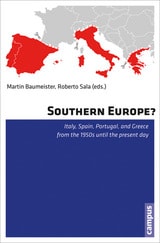
Southern Europe?
Italy, Spain, Portugal, and Greece from the 1950s Until the Present DayEdited by Martin Baumeister and Roberto Sala
Campus Verlag, 2015
Now, old inequalities long believed to be things of the past have resurfaced, and a new debt crisis appears to be splitting the continent apart along historic lines. This book raises the important question of whether studying the geopolitics and social history of southern Europe might be a valuable analytical tool for understanding these contemporary financial catastrophes.
Sovereignty and the Responsibility to Protect
A New HistoryLuke Glanville
University of Chicago Press, 2013
In Sovereignty and the Responsibility to Protect, Luke Glanville argues that this responsibility extends back to the sixteenth and seventeenth centuries, and that states have since been accountable for this responsibility to God, the people, and the international community. Over time, the right to national self-governance came to take priority over the protection of individual liberties, but the noninterventionist understanding of sovereignty was only firmly established in the twentieth century, and it remained for only a few decades before it was challenged by renewed claims that sovereigns are responsible for protection.
Glanville traces the relationship between sovereignty and responsibility from the early modern period to the present day, and offers a new history with profound implications for the present.
Soviet Military Intervention in Hungary, 1956
Alexandr Kirov
Central European University Press, 2000
This first detailed account of Soviet military operations is based on access to unpublished material in Soviet archives, which have recently been reclassified.
The major contribution made by the book is its source material, which reveals new information on the organization, command, strategy, and tactics of the Soviet armed forces which invaded Hungary in 1956. Particularly interesting is the precise documentation of the irrationally large size of the forces. The volume is based on research in Soviet archives, and this alone makes it of unique scholarly importance.
The book opens with a substantial introductory essay by the editors, and includes a major study by the Russian military historian Alexandr Kirov, based on research in Soviet military archives. One of the real strengths of the book is that it also includes the memoirs of General Yevgeny Malashenko, in 1956 a colonel in the Soviet Army and acting Chief of Staff of the Special Corps in Budapest. He provides unparalleled insights into Soviet military procedures, politico-military co-operation, and the actual fighting strengths and weaknesses of the Red Army. Very few other high-ranking Soviet officers have ever published their memoirs in the West.
Soviet Occupation of Romania, Hungary, and Austria 1944/45–1948/49
László Borhi
Central European University Press, 2015

Soviet Signoras
Personal and Collective Transformations in Eastern European MigrationMartina Cvajner
University of Chicago Press, 2019
Cvajner details the personal and collective changes brought about by the experience of migration for these women: from the first hours arriving in a new country with no friends, relatives, or existing support networks, to later remaking themselves for their new environment. In response to their traumatic displacement, the women of Soviet Signoras—nearly all of whom found work in their new Western homes as elder care givers—refashioned themselves in highly sexualized, materialistic, and intentionally conspicuous ways. Cvajner’s focus on overt sexuality and materialism is far from sensationalist, though. By zeroing in on these elements of personal identity, she reveals previously unexplored sides of the social psychology of migration, coloring our contemporary discussion with complex shades of humanity.