Results by title
593 books match the query 'Jews' and 130 start with t
Tangled Roots
The Emergence of Israeli CultureIsrael Bartal
SBL Press, 2020
A new interpretation of the roots of Israeli culture
In Tangled Roots: The Emergence of Israeli Culture, Israel Bartal traces the history of modern Hebrew culture prior to the emergence of political Zionism. Bartal examines how traditional and modernist ideals and Western and non-European Jewish cultures merged in an unprecedented encounter between an ancient land (Israel) and a multigenerational people (the Jews). Premodern Jewish traditionalists, Palestinian locals, foreign imperial forces, and Jewish intellectuals, writers, journalists, and party functionaries each affected the Israeli culture that emerged. As this new Hebrew culture was taking shape, the memory of the recent European past played a highly influential role in shaping the image of the New Hebrew, that mythological hero who was meant to supplant the East European exilic Jew.
Features
- A critical revision of most contemporary politicized histories of Jewish nationalism
- An examination of the history of modern Hebrew culture prior to political Zionism
Teaching Israel
Studies of Pedagogy from the FieldEdited by Sivan Zakai and Matt Reingold
Brandeis University Press, 2024
Jewish Americans are divided in their views on Israel. While scholars have outlined philosophical principles to guide educators who teach about Israel, there has been less scholarship focused on the pedagogy surrounding the country. This book resituates teaching—the questions, dilemmas, and decision-making that teachers face—as central to both Israel studies and Israel education. Contributors illuminate how educators from differing pedagogical orientations, who teach in a range of educational settings learn, understand, undertake, and ultimately improve the work of teaching Israel. The volume also looks at the professional support and learning opportunities teachers may need to engage with these pedagogical questions.
Telling the Little Secrets
American Jewish Writing since the 1980sJanet Handler Burstein
University of Wisconsin Press, 2006
Janet Burstein argues that American Jewish writers since the 1980s have created a significant literature by wrestling with the troubled legacy of trauma, loss, and exile. Their ranks include Cynthia Ozick, Todd Gitlin, Art Spiegelman, Pearl Abraham, Aryeh Lev Stollman, Jonathan Rosen, and Gerda Lerner. Whether confronting the massive losses of the Holocaust, the sense of “home” in exile, or the continuing power of Jewish memory, these Jewish writers search for understanding within “the little secrets” of their dark, complicated, and richly furnished past.
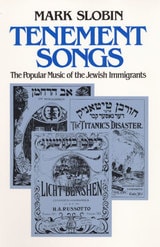
Tenement Songs
The Popular Music of the Jewish ImmigrantsMark Slobin
University of Illinois Press, 1982
Textual Sources for the Study of Judaism
Edited and Translated by Philip S. Alexander
University of Chicago Press, 1990
"The texts . . . which are drawn from over two thousand years of history, are usefully divided, annotated and glossed. They enable students to explore the tradition in a new way [and] give a marvellous insight into the richness and liveliness of the Jewish religion and culture: we are given wit and pathos in addition to popular story and religious law."—Janet Trotter, Resource
The "Spirit of Poesy"
Essays on Jewish and German Literature and Thought in Honor of Geza von MolnarRichard Block and Peter Fenves
Northwestern University Press, 2000
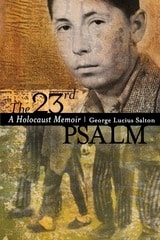
The 23rd Psalm
A Holocaust MemoirGeorge Lucius Salton, with Anna Salton Eisen
University of Wisconsin Press, 2004
The Americanization of the Synagogue, 1820–1870
Leon A. Jick
Brandeis University Press, 1992
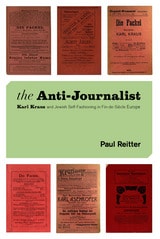
The Anti-Journalist
Karl Kraus and Jewish Self-Fashioning in Fin-de-Siècle EuropePaul Reitter
University of Chicago Press, 2008
The Anti-Semitic Moment
A Tour of France in 1898Pierre Birnbaum
University of Chicago Press, 2011
In 1898, the Dreyfus Affair plunged French society into a yearlong frenzy. In Paris and provincial villages throughout the country, angry crowds paraded through the streets, threatening to attack Jews and destroy Jewish-owned businesses. Anger about the imagined power of Jewish capital, as well as fears of treason and racial degeneration, made anti-Semitism a convenient banner behind which social and political factions could fall in line. Anti-Semitic feelings that had been simmering in France for decades came boiling to the surface.
Here Pierre Birnbaum guides readers on a tour of France during this crisis. He shows that in the midst of violence, Jewish citizens bravely and effectively defended themselves and were aided by a police force determined to maintain order. Birnbaum paints a vivid portrait of French Jewish culture at the time and explains why the French state remained strong in this time of widespread unrest.
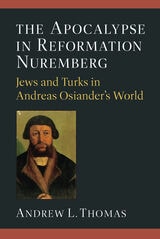
The Apocalypse in Reformation Nuremberg
Jews and Turks in Andreas Osiander’s WorldAndrew L. Thomas
University of Michigan Press, 2022
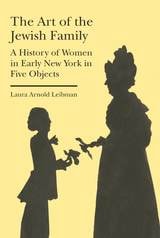
The Art of the Jewish Family
A History of Women in Early New York in Five ObjectsLaura Arnold Leibman
Bard Graduate Center, 2020
Each chapter creates a biography of a single woman through an object, offering a new methodology that looks past texts alone to material culture in order to further understand early Jewish American women’s lives and restore their agency as creators of Jewish identity. While much of the available history was written by men, the objects that Leibman studies were made for and by Jewish women. Speaking to American Jewish life, women’s studies, and American history, The Art of the Jewish Family sheds new light on the lives and values of these women, while also revealing the social and religious structures that led to Jewish women being erased from historical archives.
The Art of the Jewish Family was the winner of three 2020 National Jewish Book Awards: the Celebrate 350 Award for American Jewish Studies, the Gerrard and Ella Berman Memorial Award for History, and the Barbara Dobkin Award for Women's Studies.
The Ashes of Babi Yar
The Massacre of Jews in KyivAntonella Salomoni, Translated by Antony Shugaar
University of Wisconsin Press, 2025
Beginning with an explication of the mass murders and their aftermath, Antonella Salomoni examines the afterlife of a massacre whose physical remains were intentionally hidden. She focuses especially on how the arts—prose, poetry, music, architecture, and painting—shaped a collective narrative that, despite repression, played a crucial role in preserving the history and memory of the genocide.
The Beginnings of Anti-Jewish Legislation
The 1920 Numerus Clausus Law in HungaryMária M. Kovács
Central European University Press, 2024
The Nazi 1933 Civil Service Law and the 1935 Nuremberg Laws are often considered the first anti-Jewish decrees in interwar Europe. Mária M. Kovács convincingly argues that Hungary’s numerus clausus law of 1920, which introduced a Jewish quota at Hungary’s institutions of higher learning, was, in fact, interwar Europe’s first antisemitic law. By defining—and discriminating against—Jews as a separate “racial” or “national” group, it abrogated the principle of equal rights that had been enshrined into law; as such, it marked an abrupt reversal of Jewish emancipation in Hungary. Moreover, the numerus clausus law set the stage for subsequent “Jewish Laws” (in the late 1930s and early 1940s) that sought to solve Hungary’s “Jewish Question” by means of extraordinary legal measures that targeted Jews alone. This book examines the origins and implementation of the numerus clausus, as well as the attempts to dampen its impact on Hungary’s international reputation, focusing on the debates surrounding it promulgation (1920), its modification (1928) and its eventual application to other areas of Jewish life (1938–45).
The Benderly Boys and American Jewish Education
Jonathan B. Krasner
Brandeis University Press, 2011
The Black Seasons
Glowinski
Northwestern University Press, 2005
When six-year-old Michal Glowinski first heard the adults around him speak of the ghetto, he understood only that the word was connected with moving-and conjured up a fantastical image of a many-storied carriage pulled through the streets by some umpteen horses. He was soon to learn that the ghetto was something else entirely. A half-century later, Glowinski, now an eminent Polish literary scholar, leads us haltingly into Nazi-occupied Poland. Scrupulously attentive to the distance between a child's experience and an adult's reflection, Glowinski revisits the images and episodes of his childhood: the emaciated violinist playing a Mendelssohn concerto on the ghetto streets; his game of chess with a Polish blackmailer threatening to deliver him to the Gestapo; and his eventual rescue by Catholic nuns in an impoverished, distant convent. In language at once spare and eloquent, Glowinski explores the horror of those years, the fragility of existence, and the fragmented nature of memory itself.
The Body of Brooklyn
David Lazar
University of Iowa Press, 2003
The Call of Conscience
Protestant Clergy and Jews in the NetherlandsJohan Hegeman
Central European University Press, 2026
The Chosen Folks
Jews on the Frontiers of TexasBy Bryan Edward Stone
University of Texas Press, 2010
Texas has one of the largest Jewish populations in the South and West, comprising an often-overlooked vestige of the Diaspora. The Chosen Folks brings this rich aspect of the past to light, going beyond single biographies and photographic histories to explore the full evolution of the Jewish experience in Texas.
Drawing on previously unpublished archival materials and synthesizing earlier research, Bryan Edward Stone begins with the crypto-Jews who fled the Spanish Inquisition in the late sixteenth century and then discusses the unique Texas-Jewish communities that flourished far from the acknowledged centers of Jewish history and culture. The effects of this peripheral identity are explored in depth, from the days when geographic distance created physical divides to the redefinitions of "frontier" that marked the twentieth century. The rise of the Ku Klux Klan, the creation of Israel in the wake of the Holocaust, and the civil rights movement are covered as well, raising provocative questions about the attributes that enabled Texas Jews to forge a distinctive identity on the national and world stage. Brimming with memorable narratives, The Chosen Folks brings to life a cast of vibrant pioneers.
The Correspondence of Hannah Arendt and Gershom Scholem
Hannah Arendt and Gershom Scholem
University of Chicago Press, 2017
Arendt and Scholem met in 1932 in Berlin and quickly bonded over their mutual admiration for and friendship with Walter Benjamin. They began exchanging letters in 1939, and their lively correspondence continued until 1963, when Scholem’s vehement disagreement with Arendt’s Eichmann in Jerusalem led to a rupture that would last until Arendt’s death a dozen years later. The years of their friendship, however, yielded a remarkably rich bounty of letters: together, they try to come to terms with being both German and Jewish, the place and legacy of Germany before and after the Holocaust, the question of what it means to be Jewish in a post-Holocaust world, and more. Walter Benjamin is a constant presence, as his life and tragic death are emblematic of the very questions that preoccupied the pair. Like any collection of letters, however, the book also has its share of lighter moments: accounts of travels, gossipy dinner parties, and the quotidian details that make up life even in the shadow of war and loss.
In a world that continues to struggle with questions of nationalism, identity, and difference, Arendt and Scholem remain crucial thinkers. This volume offers us a way to see them, and the development of their thought, anew.
The Faith of Fallen Jews
Yosef Hayim Yerushalmi and the Writing of Jewish HistoryEdited by David N. Myers and Alexander Kaye
Brandeis University Press, 2013
The Fatal Embrace
Jews and the StateBenjamin Ginsberg
University of Chicago Press, 1993
The Figural Jew
Politics and Identity in Postwar French ThoughtSarah Hammerschlag
University of Chicago Press, 2010
The rootless Jew, wandering disconnected from history, homeland, and nature, was often the target of early twentieth-century nationalist rhetoric aimed against modern culture. But following World War II, a number of prominent French philosophers recast this maligned figure in positive terms, and in so doing transformed postwar conceptions of politics and identity.
Sarah Hammerschlag explores this figure of the Jew from its prewar usage to its resuscitation by Jean-Paul Sartre, Emmanuel Levinas, Maurice Blanchot, and Jacques Derrida. Sartre and Levinas idealized the Jew’s rootlessness in order to rethink the foundations of political identity. Blanchot and Derrida, in turn, used the figure of the Jew to call into question the very nature of group identification. By chronicling this evolution in thinking, Hammerschlag ultimately reveals how the figural Jew can function as a critical mechanism that exposes the political dangers of mythic allegiance, whether couched in universalizing or particularizing terms.
Both an intellectual history and a philosophical argument, The Figural Jew will set the agenda for all further consideration of Jewish identity, modern Jewish thought, and continental philosophy.
The Flood
A NovelCarol Ascher
Northwestern University Press, 1997
The Genealogical Science
The Search for Jewish Origins and the Politics of EpistemologyNadia Abu El-Haj
University of Chicago Press, 2012
The Geographical Encyclopedia of the Holocaust in Hungary
Randolph L. Braham, Foreword by Elie Wiesel
Northwestern University Press, 2013
Winner of the 2013 National Jewish Book Award
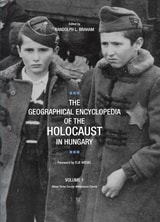
The illustrated three-volume Geographical Encyclopedia of the Holocaust in Hungary is a definitive, authoritative, and magisterial resource, thorough and exhaustive. It documents and chronicles the wartime fate of the Jewish communities in that country where virulent antisemitism is anything but dead, even today. With scores of detailed maps and hundreds of photographs, this reference work is organized alphabetically by county, each prefaced with a map and a contextual history describing its Jewish population up to and into 1944.
Entries track the demographic, cultural, and religious changes in even the smallest communities where Jews lived before their marginalization, dispossession, ghettoization, and, finally, deportation to labor and death camps. The encyclopedia endows scholars and lay researchers with both panoramic and microscopic views of the virtually last-minute destruction of most of the Jews of Hungary, until then the last sizable surviving Jewish community in occupied Europe.
The German Officer’s Boy
Harlan Greene
University of Wisconsin Press, 2005
The Great Latke-Hamantash Debate
Edited by Ruth Fredman Cernea
University of Chicago Press, 2005
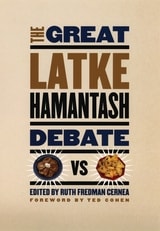
What began as an informal gathering is now an institution that has been replicated on campuses nationwide. Highly absurd yet deeply serious, the annual debate is an
opportunity for both ethnic celebration and academic farce. In poetry, essays, jokes, and revisionist histories, members of elite American academies attack the latke-versus-hamantash question with intellectual panache and an unerring sense of humor, if not chutzpah. The Great Latke-Hamantash Debate is the first collection of the best of these performances, from Martha Nussbaum's paean to both foods—in the style of Hecuba's Lament—to Nobel laureate Leon Lederman's proclamation on the union of the celebrated dyad. The latke and the hamantash are here revealed as playing a critical role in everything from Chinese history to the Renaissance, the works of Jane Austen to constitutional law.
Philosopher and humorist Ted Cohen supplies a wry foreword, while anthropologist Ruth Fredman Cernea provides historical and social context as well as an overview of the Jewish holidays, latke and hamantash recipes, and a glossary of Yiddish and Hebrew terms, making the book accessible even to the uninitiated. The University of Chicago may have split the atom in 1942, but it's still working on the equally significant issue of the latke versus the hamantash.
The Holocaust & the Exile of Yiddish
A History of the Algemeyne EntsiklopedyeBarry Trachtenberg
Rutgers University Press, 2022
The Holocaust & the Exile of Yiddish untangles the complicated saga of the Algemeyne entsiklopedye and its editors. The editors continued to publish volumes and revise the encyclopedia’s mission while their primary audience, Eastern European Jews, faced persecution and genocide under Nazi rule, and the challenge of reestablishing themselves in the first decades after World War II. Historian Barry Trachtenberg reveals how, over the course of the middle decades of the twentieth century, the project sparked tremendous controversy in Jewish cultural and political circles, which debated what the purpose of a Yiddish encyclopedia should be, as well as what knowledge and perspectives it should contain. Nevertheless, this is not only a story about destruction and trauma, but also one of tenacity and continuity, as the encyclopedia’s compilers strove to preserve the heritage of Yiddish culture, to document its near-total extermination in the Holocaust, and to chart its path into the future.
The Holocaust Averted
An Alternate History of American Jewry, 1938-1967Gurock, Jeffrey S
Rutgers University Press, 2015
This alternate history—where, among many scenarios, Hitler is assassinated, Japan does not bomb Pearl Harbor, and Franklin Delano Roosevelt is succeeded after two terms by Robert A. Taft—does cause us to review and better appreciate history. As Gurock tells his tale, he concludes every chapter with a short section that describes what actually happened and, thus, further educates the reader.
The Holocaust Odyssey of Daniel Bennahmias, Sonderkommando
Rebecca Fromer
University of Alabama Press, 1993
A poignant reminder of the ways enslaved Jews and others were forced to destroy their families and fellow prisoners.
The Holocaust Odyssey of Daniel Bennahmias, Sonderkommando presents the extraordinary testimony of Daniel Bennahmias, a Greek Jew whose life was forever altered by the Holocaust. Deported to Auschwitz-Birkenau as a teenager, Bennahmias was separated from his family and forced into the Sonderkommando, the prisoner unit compelled to work in the crematoria and gas chamber complex. Through painstaking collaboration with survivor and author Rebecca Fromer, this powerful narrative documents his struggle to endure unimaginable brutality while preserving his humanity. Bennahmias's account sheds rare light on the inner workings of Auschwitz, the Sonderkommando revolt, the death marches, and the difficult path toward liberation and recovery. More than a historical record, the book is a testament to courage, memory, and resilience in the face of systematic dehumanization. An essential contribution to Holocaust literature, it preserves the voice of a survivor whose experiences deepen our understanding of one of history's darkest chapters.
The Holocaust in Hungary
Seventy Years LaterRandolph L. Braham
Central European University Press, 2016
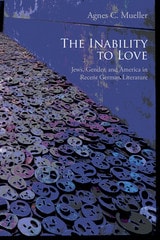
The Inability to Love
Jews, Gender, and America in Recent German LiteratureAgnes C. Mueller
Northwestern University Press, 2014
The Inability to Love borrows its title from Alexander and Margarete Mitscherlich’s 1967 landmark book The Inability to Mourn, which discussed German society’s lack of psychological reckoning with the Holocaust. Challenging that notion, Agnes Mueller turns to recently published works by prominent contemporary German, non-Jewish writers to examine whether there has been a thorough engagement with German history and memory. She focuses on literature that invokes Jews, Israel, and the Holocaust. Mueller’s aim is to shed light on pressing questions concerning German memories of the past, and on German images of Jews in Germany at a moment that s ideologically and historically fraught.
The Indigenous Anti-Colonial
A Palestinian Resistance Tradition and a World Beyond Settler ColonialismLinda Tabar
Duke University Press, 2026
The Individual in History
Essays in Honor of Jehuda ReinharzEdited by ChaeRan Y. Freeze, Sylvia Fuks Fried, and Eugene R. Sheppard
Brandeis University Press, 2015
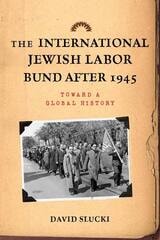
The International Jewish Labor Bund after 1945
Toward a Global HistorySlucki, David
Rutgers University Press, 2012
The Jewish Labor Bund was one of the major political forces in early twentieth-century Eastern Europe. But the decades after the Second World War were years of enormous difficulty for Bundists. Like millions of other European Jews, they faced the challenge of resurrecting their lives, so gravely disrupted by the Holocaust. Not only had the organization lost many members, but its adherents were also scattered across many continents. In this book, David Slucki charts the efforts of the surviving remnants of the movement to salvage something from the wreckage.
Covering both the Bundists who remained in communist Eastern Europe and those who emigrated to the United States, France, Australia, and Israel, the book explores the common challenges they faced—building transnational networks of friends, family, and fellow Holocaust survivors, while rebuilding a once-local movement under a global umbrella. This is a story of resilience and passion—passion for an idea that only barely survived Auschwitz.
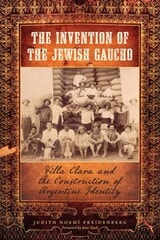
The Invention of the Jewish Gaucho
Villa Clara and the Construction of Argentine IdentityBy Judith Noemí Freidenberg
University of Texas Press, 2009
By the mid-twentieth century, Eastern European Jews had become one of Argentina's largest minorities. Some represented a wave of immigration begun two generations before; many settled in the province of Entre Ríos and founded an agricultural colony. Taking its title from the resulting hybrid of acculturation, The Invention of the Jewish Gaucho examines the lives of these settlers, who represented a merger between native cowboy identities and homeland memories.
The arrival of these immigrants in what would be the village of Villa Clara coincided with the nation's new sense of liberated nationhood. In a meticulous rendition of Villa Clara's social history, Judith Freidenberg interweaves ethnographic and historical information to understand the saga of European immigrants drawn by Argentine open-door policies in the nineteenth century and its impact on the current transformation of immigration into multicultural discourses in the twenty-first century. Using Villa Clara as a case study, Freidenberg demonstrates the broad power of political processes in the construction of ethnic, class, and national identities. The Invention of the Jewish Gaucho draws on life histories, archives, material culture, and performances of heritage to enhance our understanding of a singular population—and to transform our approach to social memory itself.
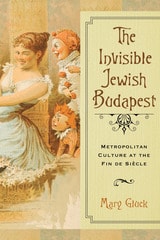
The Invisible Jewish Budapest
Metropolitan Culture at the Fin de SiècleMary Gluck
University of Wisconsin Press, 2019
Famed for its cosmopolitan culture and vibrant nightlife, Budapest owed much to its Jewish population. Indeed, it was Jews who helped shape the city's complex urban modernity between 1867 and 1914. Yet these contributions were often unacknowledged, leading to a metaphoric, if not literal, invisible status for many of Budapest's Jews.
In the years since, particularly between the wars, anti-Semites within and outside Budapest sought to further erase Jewish influences in the city. Appellations such as the "sinful city" and "Judapest" left a toxic inheritance that often inhibited serious conversation or scholarly research on the subject.
Into this breach strides Mary Gluck, whose goal is no less than to retrieve the lost contours of Jewish Budapest. She delves into the popular culture of the city's coffee houses, music halls, and humor magazines to uncover the enormous influence of assimilated Jews in creating modernist Budapest. She explores the paradox of this culture, which was Jewish-identified yet lacked a recognizable Jewish face. Because much of the Jewish population embraced and promoted a secular, metropolitan culture, their influence as Jews was both profound and invisible.
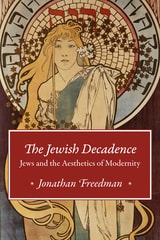
The Jewish Decadence
Jews and the Aesthetics of ModernityJonathan Freedman
University of Chicago Press, 2021
The first to tell this sweeping story, Freedman demonstrates the centrality of decadence to the aesthetics of modernity and its inextricability from Jewishness. Freedman recounts a series of diverse and surprising episodes that he insists do not belong solely to the past, but instead reveal that the identification of Jewishness with decadence persists today.
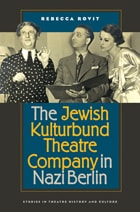
The Jewish Kulturbund Theatre Company in Nazi Berlin
Rebecca Rovit
University of Iowa Press, 2012
The Kulturbund’s directors were repeatedly caught between escalating demands from their Nazi overseers and from their own Jewish constituents. By examining why and how an all-Jewish repertory theatre could coexist with the Nazi regime, Rovit raises broader questions about the nature of art in an environment of coercion and isolation, artistic integrity and adaptability, and community and identity.
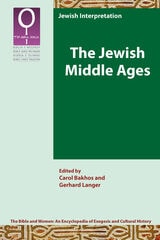
The Jewish Middle Ages
Carol Bakhos
SBL Press, 2023
For many, the Middle Ages in general evokes a sense of the sinister and brings to mind a world of fear, superstition, and religious fanaticism. For Jews it was a period marked by persecutions, pogroms, and expulsions. Yet at the same time, the Middle Ages was also a time of lively cultural exchange and heightened creativity for Jews. In The Jewish Middle Ages, contributors explore the ways in which the stories of biblical women, including, Eve, Sarah, Hagar, Rebekah, Zipporah, Ruth, Esther, and Judith, make their way into the rich tapestry of medieval Jewish literature, mystical texts, and art, particularly in works emanating from Ashkenazic circles. Contributors include Carol Bakhos, Judith R. Baskin, Elisheva Baumgarten, Dagmar Börner-Klein, Constanza Cordoni, Rachel Elior, Meret Gutmann-Grün, Robert A. Harris, Yuval Katz-Wilfing, Sheila Tuller Keiter, Katrin Kogman-Appel, Gerhard Langer, Aurora Salvatierra Ossorio, and Felicia Waldman. These essays give us a glimpse into the role women played and the authority they assumed in medieval Jewish culture beyond the rabbinic centers of Palestine and Babylonia.
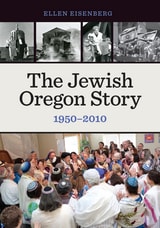
The Jewish Oregon Story, 1950-2010
Ellen Eisenberg
Oregon State University Press, 2016
Six chapters examine a community grappling with, and increasingly embracing, change, from the dramatic national shifts in women’s roles and inter-group relations, to local issues such as the razing of the historic South Portland Jewish neighborhood. An original community musical frames the creation of a new Portland Jewish identity, emerging out of the ashes of South Portland and tapping ethnic expression as an antidote to suburbanization and assimilation. A peek behind the scenes exposes the crucial role of women’s voluntarism, and traces the impact of women entering the workforce and winning acceptance as equals in organizational and ritual life. Chapters on involvement in liberal politics and advocacy for Israel explore communal engagement that reflected national trends, but, beginning in the 1980s, were increasingly shaped by emerging local progressivism. A final chapter charts recent shifts in Oregon Jewish geography, demographics, and organizational life, exploring the rebirth of smaller communities and the embrace of post-denominational Jewry, spirituality, and an ethos of environmentalism and inclusion.
The Jewish Oregon Story will appeal to readers of American Jewish history and Oregon/western history, particularly those interested in questions of ethnicity and identity. Drawing on extensive archival sources and recent scholarship, the book aims to engage both academic audiences and general readers.
The Jewish Question Again
Edited by Joyce Dalsheim and Gregory Starrett
Prickly Paradigm Press, 2020
Such striking similarities between present and past suggest that we are not done with the issues raised by the historical Jewish Question: that is, what is the place of “the Jew”—the minority, the relic, the rootless stranger, the racialized other, the exiled, the displaced, the immigrant, the diasporic? In The Jewish Question Again, leading scholars grapple with our inability to keep these struggles in the past and why we continue to repeat these atrocities. This book explores the haunting recurrence of the Jewish Question today and begs why we find ourselves here yet again.
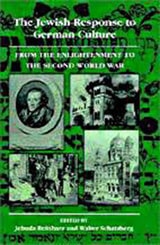
The Jewish Response to German Culture
From the Enlightenment to the Second World WarJehuda Reinharz
Brandeis University Press, 1991
The Jews in Mussolini's Italy
From Equality to PersecutionMichele Sarfatti; Translated by John and Anne C. Tedeschi
University of Wisconsin Press, 2006
The Jews in Palestine in the Eighteenth Century
Under the Patronage of the Istanbul committee of Officials for PalestineJacob Barnai
University of Alabama Press, 1992
Research reveals a clear connection between the legal and social status of the Jews in Palestine in the 18th century and their ties with the Diaspora. The Jews who had immigrated to Palestine in that period were mostly poor and elderly. The country was economically backward and politically unstable, which made it impossible for the immigrants to support themselves through productive work. Therefore they lived off the contributions of their brethren overseas. Taxes and fees imposed by the Ottoman rulers increased the financial desperation of the Jews in Palestine. Prohibitions against young unmarried immigrant men and women made for an unstable population largely of old men, many of whom died shortly after immigrating. Families succumbed to disease, earthquakes, and famine, but in the face of these problems, the Jewish communities in Palestine persevered.
The Jews in Polish Culture
Aleksander Hertz
Northwestern University Press, 1988
The Jews of Chicago
From Shtetl to SuburbIrving Cutler
University of Illinois Press, 1994
The Jews of Europe in the Modern Era
A Socio-Historical OutlineVictor Karady
Central European University Press, 2003
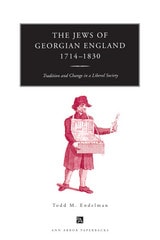
The Jews of Georgian England, 1714-1830
Tradition and Change in a Liberal SocietyTodd M. Endelman
University of Michigan Press, 1999