Results by title
254 books match the query 'Sports' and 52 start with t
Taking The Field
Women, Men, and SportsMichael A. Messner
University of Minnesota Press, 2002
Teaching U.S. History through Sports
Edited by Brad Austin and Pamela Grundy
University of Wisconsin Press, 2022
Teaching U.S. History through Sports provides strategies for incorporating sports into any U.S. history curriculum. Drawing upon their own classroom experiences, the authors suggest creative ways to use sports as a lens to examine a broad range of historical subjects, including Puritan culture, the rise of Jim Crow, the Cold War, the civil rights movement, and the women's movement. Essays focus on the experiences of African American women, working-class southerners, Latinos, and members of LGBTQ communities, as well as topics including the controversy over Native American mascots and the globalization of U.S. sports.
Testing for Athlete Citizenship
Regulating Doping and Sex in SportHenne, Kathryn E
Rutgers University Press, 2015
Texas Sports
Unforgettable Stories for Every Day of the YearBy Chad S. Conine
University of Texas Press, 2017
When it comes to sports, Texas more than earns its bragging rights. The Lone Star State has produced championship teams and legendary athletes not only in football, baseball, and basketball, but in dozens of other sports as well. Texas Sports celebrates more than a century of achievements in a day-by-day record of the people and events—both unforgettable and little-known—that have made Texas a powerhouse in the world of sports.
Chad S. Conine packs a wealth of sports facts and stories into 366 days. He ranges from firsts such as UT’s first football game (an 1893 win against Dallas University Football Club) to peak moments such as Earl Campbell running through defenders, Nolan Ryan throwing heat past baffled batters, and Babe Didrickson Zaharias winning the Western Open golf championship for the fourth time. Conine covers more than twenty-five sports and all levels from high school to professional, reminding us that if Texas had never seen a pigskin or a backboard, its sports legacy would still be secure. With a winning combination of victories and heartbreaks, men’s and women’s sports, and all regions of the state, Texas Sports is a must-read for all sports fans and trivia buffs.
That’s Gotta Hurt
The Injuries That Changed Sports ForeverDr. David Geier
University Press of New England, 2017
The Audacity of Hoop
Basketball and the Age of ObamaAlexander Wolff
Temple University Press, 2015
While basketball didn’t take up residence in the White House in January 2009, the game nonetheless played an outsized role in forming the man who did. In The Audacity of Hoop, celebrated sportswriter Alexander Wolff examines Barack Obama, the person and president, by the light of basketball. This game helped Obama explore his identity, keep a cool head, impress his future wife, and define himself as a candidate.
Wolff chronicles Obama’s love of the game from age 10, on the campaign trail—where it eventually took on talismanic meaning—and throughout his two terms in office. More than 125 photographs illustrate Obama dribbling, shooting free throws, playing pickup games, cooling off with George Clooney, challenging his special assistant Reggie Love for a rebound, and taking basketball to political meetings. There is also an assessment of Obama’s influence on the NBA, including a dawning political consciousness in the league’s locker rooms.
Sidebars reveal the evolution of the president’s playing style, “Baracketology”—a not-entirely-scientific art of filling out the commander in chief’s NCAA tournament bracket—and a timeline charts Obama’s personal and professional highlights.
Equal parts biographical sketch, political narrative, and cultural history, The Audacity of Hoop shows how the game became a touchstone in Obama’s exercise of the power of the presidency.
The Beckoning World
A NovelDouglas Bauer
University of Iowa Press, 2022
But dreams sometimes suffer from a lovely abundance, and in Earl’s case her name is Emily Marchand. They fall quickly and deeply in love, but with that love comes heartbreaking complications.
The Beckoning World gathers a cast of characters that include Babe Ruth and Lou Gehrig; a huge-hearted Pullman steward offering aphoristic wisdom; and countless others, not least of which is the 1918 Spanish flu taking vivid spectral form. At the center is a relentless love that Earl and Emily are defenseless against, allied as they are “in this business of their hearts.”
The Best of Bacon
Select CutsJohn U. Bacon
University of Michigan Press, 2018
From the Preface:
“I wrote these stories between 1992 and 2018. They cover a dozen different sports for a dozen different media outlets, from the Ann Arbor News to National Public Radio, and they stretch from a couple pages to a dozen. But they have one thing in common: they all meant a lot to me when I wrote them, and they still do today.”
The Best of Bacon presents both new and familiar stories by best-selling author John U. Bacon, all centered on sports in his home state of Michigan. Best known for his acclaimed books on college football, Bacon’s writing has been praised for going beyond traditional Xs and Os sports reporting. True to that reputation, this collection showcases personal, behind-the-scenes stories of players, coaches, and even fans. Many of these stories are connected to specific moments in time—a great season, the passing of a legendary broadcaster, or a star player’s daily grind before a big game—and will immediately transport readers to some of the highs (and lows) of their own sports memories. More often, Bacon’s writing explores timeless themes—why we love sports, how we pass that passion down to the next generation, and how it will be threatened or preserved in the future.
Michigan is one of the nation’s best sports states, home to countless amateur squads, two Big Ten schools, and professional teams in all four major sports whose histories reach back to the start of their leagues—something only New York, Massachusetts, and Illinois can also claim. This book covers the spectrum, from insider profiles of big names like Magic Johnson, Bo Schembechler, and Joe Louis, to cautionary tales of the debilitating greed threatening our favorite pastimes, to uplifting stories of the unsung heroes whose passion drives them to coach Little League baseball teams or run summer camps for peanuts. These stories speak to the value of sports, but also to our values. Whether a Spartan or a Wolverine, a long-suffering Lions’ backer or a diehard Wing-Nut, a lifetime sports fan or just someone who loves a good story, there is something here for everyone.

The Bingo Long Traveling All-Stars and Motor Kings
A NOVELWilliam Brashler. Introduction by Peter C. Bjarkman
University of Illinois Press, 1993
The Bottom Line
Observations and Arguments on the Sports BusinessAndrew Zimbalist
Temple University Press, 2006

The Breakaway
The Inside Story of the Wirtz Family Business and the Chicago BlackhawksBryan Smith
Northwestern University Press, 2018
When Rocky Wirtz took over the Wirtz Corporation in 2007, including management of the Chicago Blackhawks, the fiercely beloved hockey team had fallen to a humiliating nadir. As chronic losers playing to a deserted stadium, they were worse than bad—they were irrelevant. ESPN named the franchise the worst in all of sports. Rocky's resurrection of the team's fortunes was—publicly, at least—a feel-good tale of shrewd acumen. Behind the scenes, however, it would trigger a father, son, and brother-against-brother drama of Shakespearean proportions. The Breakaway reveals that untold story.
Arthur Wirtz founded the family's business empire during the Depression. From roots in real estate, "King Arthur" soon expanded into liquor and banking, running his operations with an iron hand and a devotion to profit that earned him the nickname Baron of the Bottom Line. His son Bill further expanded the conglomerate, taking the helm of the Blackhawks in 1966. "Dollar Bill" Wirtz demanded unflinching adherence to Arthur's traditions and was notorious for an equally fierce temperament.
Yet when Rocky took the reins of the business after Bill's death, it was an organization out of step with the times and financially adrift. The Hawks weren't only failing on the ice—the parlous state of the team's finances imperiled every facet of the Wirtz empire. To save the team and the company, Rocky launched a radical turnaround campaign. Yet his modest proposal to televise the Hawks' home games provoked fierce opposition from Wirtz family insiders, who considered any deviation from Arthur and Bill's doctrines to be heresy.
Rocky's break with the edicts of his grandfather and father led to a reversal for the ages—three Stanley Cup championships in six years, a feat Fortune magazine called "the greatest turnaround in sports business history." But this resurrection came at a price, a fracturing of Rocky's relationships with his brother and other siblings. In riveting prose that recounts a story spanning three generations, The Breakaway reveals an insider's view of a brilliant but difficult Chicago business and sports dynasty and the inspiring story of perseverance and courage in the face of intense family pressures.
The Burden of Over-representation
Race, Sport, and PhilosophyGrant Farred
Temple University Press, 2018
The Burden of Over-representation artfully explores three curious racial moments in sport: Jackie Robinson’s expletive at a Dodgers spring training game; the transformation of a formality into an event at the end of the 1995 rugby World Cup in South Africa; and a spectral moment at the 2010 FIFA World Cup. Grant Farred examines the connotations at play in these moments through the lenses of race, politics, memory, inheritance and conciliation, deploying a surprising cast of figures in Western thought, ranging from Jacques Derrida and Friedrich Nietzsche to Judith Butler, William Shakespeare, and Jesus-the-Christ. Farred makes connection and creates meaning through the forces at play and the representational burdens of team, country and race.
Farred considers Robinson’s profane comments at black Dodgers fans, a post-match exchange of “thank yous” on the rugby pitch between white South African captain François Pienaar and Nelson Mandela, and being “haunted” by the ghost of Derrida on the occasion of the first FIFA World Cup on African soil. In doing so, The Burden of Over-representation provides a passionate, insightful analysis of the social, political, racial, and cultural consequences of conciliation at key sporting events.
The Business of Professional Sports
Edited by Paul D. Staudohar and James A. Mangan
University of Illinois Press, 1991
Beyond the highly publicized heroics and foibles of players and teams, when the grandstands are empty and the scoreboards dark, there is a world of sport about which little is known by even the most ardent fan. It is the business world of sport; it is characterized by a thirst for power and money, and its players are just as active as those on the professional teams they oversee. In this collection, some of the best scholars in the field use examples from baseball, football, basketball, and hockey to illuminate the significant economic, legal, social, and historic aspects of the business of professional sports.
Contributors: Dennis A. Ahlburg, Rob B. Beamish, Joan M. Chandler, James B. Dworkin, Lawrence M. Kahn, Charles P. Korr, John J. MacAloon, David Mills, Roger G. Noll, Steven A. Reiss, Gary R. Roberts, Stephen F. Ross, Peter D. Sherer, Leigh Steinberg, and David G. Voigt,

The Chattertooth Eleven
Eduard Bass
Karolinum Press, 2009
In 1922, the same year that saw the establishment of the Czechoslovak Football Association, a former singer and cabaret director from Prague published a novel about soccer. Eighty-six years later, that novel, Eduard Bass’s The Chattertooth Eleven, has been reprinted more than thirty times, has been made into a film, and has become one of the most popular works of Czech fiction.
The novel tells the extraordinary adventures of an ordinary father, Chattertooth, and his eleven sons—whom he has raised as an unbeatable soccer team. This humorous tale—set in the aftermath of World War I—celebrates fair play and perseverance while simultaneously taking a gently ironic stance towards the Czech infatuation with soccer. This edition, in a new graphic layout by Zdenek Ziegler, is accompanied by charming illustrations by Jirí Grus.
The Cheer Reader
Inside an American InstitutionNatalie G. Adams
University of Texas Press, 2026
Wide-ranging essays on cheerleading, from the pep rally to the NFL sidelines to All-Star competitions, and why it matters.
Cheer is deeply associated with a wholesome, simple Americana. Yet this often clichéd image belies its complex history and current status as a global industry made up of diverse participants and forms. Indeed, cheerleading—its culture, controversies, and evolution—has always offered a revealing lens on race, class, gender, and sexuality in American society..
Cheerleading was born in 1869 as a diversion for Ivy League men. The Cheer Reader collects fourteen wide-ranging essays on what happened next and why it matters: how cheer became feminized, sexualized, professionalized, even radicalized. Contributors examine the role of cheer in the Civil Rights Movement, a landmark student free-speech case, and the emergence of competitive-only and queer cheer teams. Other essays consider cheer’s quest for sport legitimacy, social media “cheerlebrities” and eating disorders, and the working conditions of NFL and NBA cheerleaders. Amid these tensions between empowerment and objectification, cheer is only getting more popular, with some seven million participants worldwide. The Cheer Reader is a nuanced account of the activity they share and what it means today.
The Crown Games of Ancient Greece
Archaeology, Athletes, and HeroesDavid Lunt
University of Arkansas Press, 2022
The Crown Games were the apex of competition in ancient Greece. Along with prestigious athletic contests in honor of Zeus at Olympia, they comprised the Pythian Games for Apollo at Delphi, the Isthmian Games for Poseidon, and the Nemean Games, sacred to Zeus. For over nine hundred years, the Greeks celebrated these athletic and religious festivals, a rare point of cultural unity amid the fierce regional independence of the numerous Greek city-states and kingdoms.
The Crown Games of Ancient Greece examines these festivals in the context of the ancient Greek world, a vast and sprawling cultural region that stretched from modern Spain to the Black Sea and North Africa. Illuminating the unique history and features of the celebrations, David Lunt delves into the development of the contest sites as sanctuaries and the Panhellenic competitions that gave them their distinctive character. While literary sources have long been the mainstay for understanding the evolution of the Crown Games and ancient Greek athletics, archaeological excavations have significantly augmented contemporary understandings of the events. Drawing on this research, Lunt brings deeper context to these gatherings, which were not only athletics competitions but also occasions for musical contests, dramatic performances, religious ceremonies, and diplomatic summits—as well as raucous partying. Taken as a circuit, the Crown Games offer a more nuanced view of ancient Greek culture than do the well-known Olympian Games on their own. With this comprehensive examination of the Crown Games, Lunt provides a new perspective on how the ancient Greeks competed and collaborated both as individuals and as city-states.
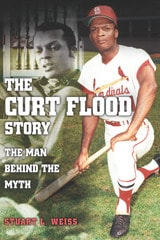
The Curt Flood Story
The Man behind the MythStuart L. Weiss
University of Missouri Press, 2018
Curt Flood, former star center fielder for the St. Louis Cardinals, is a hero to many for selflessly sacrificing his career to challenge the legality of baseball’s reserve system. Although he lost his case before the Supreme Court, he has become for many a martyr in the eventually successful battle for free agency. Sportswriters and fans alike have helped to paint a picture of Flood as a larger-than-life figure, a portrait that, unhappily, cannot stand closer inspection. This book reveals the real Curt Flood—more man than myth.
Flood stirred up a hornet’s nest by refusing to be traded from the Cardinals to the Philadelphia Phillies after the 1969 season, arguing that Major League Baseball’s reserve system reduced him to the status of bondage. Flood decided to resist a system in which his contract could be traded without his consent and in which he was not at liberty to negotiate his services in an open market. Stuart Weiss examines the man behind the decision, exploring the span of Flood’s life and shedding light on his relationships with those who helped shape his determination to sue baseball and providing a new perspective on the lawsuit that found its way to the U.S. Supreme Court.
Although a superb player, Flood was known to be temperamental and sensitive; in suing Major League Baseball he transformed his grievances against the Cardinals front office into an attack on how the business of big-league ball was conducted. Weiss shows that Flood was far from the stereotypical “dumb jock” but was rather a proud, multifaceted black man in a business run by white moguls. By illuminating Flood’s private side, rarely seen by the public, he reveals how Flood misled a gullible press on a regular basis and how his 1971 memoir, The Way It Is, didn’t tell it the way it really was.
Drawing on previously untapped sources, Weiss examines more fully and deeply than other writers the complexities of Flood’s decision to pursue his lawsuit—and demonstrates that the picture of Flood as a martyr for free agency is a myth. He suggests why, of all the players traded or sold through the years, it was Flood who brought this challenge. Weiss also explains how Flood’s battle against the reserve system cannot be understood in isolation from the personal experiences that precipitated it, such as his youth in a dysfunctional home, his troubled first marriage, his financial problems, and his unwavering commitment to the Cardinals.
The Curt Flood Story is a realistic account of an eloquent man who presented a warm, even vulnerable, face to the public as well as to friends, while hiding his inner furies. It shows that Flood was neither a hero nor a martyr but a victim of unique circumstances and his own life.
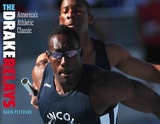
The Drake Relays
America's Athletic ClassicDavid Peterson
University of Iowa Press, 2014
Pulitzer Prize–winning photographer David Peterson has been covering the Drake Relays for nearly forty years, but his love affair with the meet started earlier, when he ran on three winning relay teams there for Kansas State University. Now, drawing upon an unmatched personal archive, he offers the pictures of a lifetime spent on the Blue Oval. He captures on camera athletes of all levels in triumph and defeat, in mid-stride or leap, embracing their fans, their moms and dads, and their kids. In addition to the stars of the past, such as Carl Lewis, Suzy Favor Hamilton, and Herschel Walker, and those of the ’00s, like Lolo Jones and Jeremy Wariner, we see teenagers who may be the stars of the future, as well as the many athletes who will never be famous but nonetheless show themselves—and their sport—at their best.
A beautiful celebration of the Drake Relays and the diverse sports that make up “track and field,” this book will evoke memories and inspire runners, throwers, and jumpers everywhere.
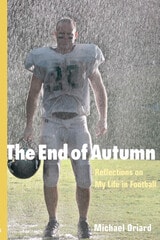
The End of Autumn
Reflections on My Life in FootballMichael Oriard
University of Illinois Press, 2009
After graduating, he signed with the Kansas City Chiefs and head coach Hank Stram. There he learned what it meant to be "owned." He rediscovered the game as it was played by grown men with families who were still treated like children and who dreaded nothing more than the end of their football careers. And without their fully realizing the consequences, every hard tackle inflicted its injury, some gradually growing into chronic conditions, some suddenly cutting a player's career short and ushering him off the field to be soon forgotten.
In this thoughtful narrative, Oriard describes the dreams of glory, the game day anxieties, the brutal training camps and harsh practices, his starry-eyed experience at Notre Dame, and the cold-blooded business of professional football. Told from the inside, the book leaves aside the hype and the pathos of the game to present a direct and honest account of the personal rewards but also the costs players paid to make others rich and entertained.
Originally published in 1982, The End of Autumn recounts the experiences of an ordinary player in a bygone era--before ESPN, before the Bowl Championship Series, before free agency and million-dollar salaries for NFL players. In a new afterword, Oriard reflects on the process of writing the book and how the game has changed in the thirty years since his "retirement" from football at the age of twenty-six.
The Eternal Present of Sport
Rethinking Sport and ReligionDaniel A. Grano
Temple University Press, 2017
Grano asserts that it is precisely through sport’s highest religious ideals that controversies are taking shape and constituting points of political and social rupture. He examines issues of transcendence, “legacy”—e.g., “greatest ever,” or “all-time”—and “witnessing” through instant replay, which undermine institutional authority. Grano also reflects on elite athletes representing especially powerful embodiments of religious and social conflict, including around issues related to gender, sexuality, ability doping, traumatic brain injury, and institutional greed.
Elite sport is in a period of profound crisis. It is through the ideals Grano analyzes that we can imagine a radically alternative future for elite sport.
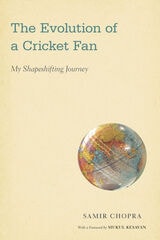
The Evolution of a Cricket Fan
My Shapeshifting JourneySamir Chopra
Temple University Press, 2021
Samir Chopra is an immigrant, a “voluntary exile,” who discovers he can tell the story of his life through cricket, a game that has long been an influence—really, an obsession—for him. In so doing, he reveals how his changing views on the sport mirror his journey of self-discovery. In The Evolution of a Cricket Fan, Chopra is thus able to reflect on his changing perceptions of self, and of the nations and cultures that have shaped his identity, politics, displacement, and fandom.
Chopra’s passion for the sport began as a child, when he rooted for Pakistan and against his native India. When he migrated, he became a fan of the Indian team that gave him a sense of home among the various cultures he encountered in North America and Australia. This “shapeshifting” exposes the rift between the Old and the New world, which Chopra acknowledges is “cricket’s greatest modern crisis.” But it also illuminates the identity dilemmas of post-colonial immigrants in the Indian diaspora.
Chopra’s thoughts about the sport and its global influence are not those of a player. He provides access to the inner world of the global cricket fan navigating the world that colonial empire wrought and that cricket continues to connect and animate. He observes that the Indian cricket team carries many burdens—not only must they win cricket matches, but their style of play must generate a pride that assuages generations of wounds inflicted by history. And Chopra must navigate where he stands in that history.
The Evolution of a Cricket Fan shows Chopra’s own wins and losses as his life takes new directions and his fandom changes allegiances.
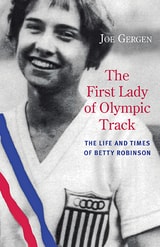
The First Lady of Olympic Track
The Life and Times of Betty RobinsonJoe Gergen
Northwestern University Press, 2014
The 1928 Olympic Games in Amsterdam were the first in which women—over the objections of many, including Pope Pius XI and the founder of the modern Olympics, Baron Pierre de Coubertin—were allowed to run in the marquee track events.
Equally remarkable is the story behind the first female gold medal winner in the 100-meter dash, sixteen-year-old American Betty Robinson. A prodigy running in just her fourth organized meet, Robinson stunned the world, earning special praise from the president of the 1928 American Olympic Committee, General Douglas MacArthur. But Robinson’s triumph soon became tragedy when in 1931 she was involved in a life-threatening plane crash. Unable to assume a sprinter’s crouch, she nevertheless joined fellow pioneer Jesse Owens at the infamous 1936 Berlin Olympics, and achieved further glory on the relay team. Journalist Joe Gergen’s The First Lady of Olympic Track rescues an exceptional figure from obscurity.
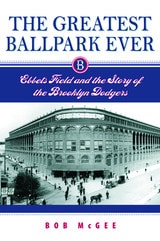
The Greatest Ballpark Ever
Ebbets Field and the Story of the Brooklyn DodgersMcGee, Bob
Rutgers University Press, 2005
In this lively story of sports, politics, and the talented, hilarious, and charming characters associated with the Brooklyn Dodgers, Bob McGee chronicles the ballpark's vibrant history from the drawing board to the wrecking ball, beginning with Charley Ebbets and the heralded opening in 1913, on through the eras that followed. McGee weaves a story about how Ebbets Field's architectural details, notable flaws, and striking facade brought Brooklyn and its team together in ways that allowed each to define the other.
Drawing on original interviews and letters, as well as published and archival sources, The Greatest Ballpark Ever explores the struggle of Charley Ebbets to build Ebbets Field, the days of Wilbert Robinson's early pennant winners, the eras of the Daffiness Boys, Larry MacPhail, and Branch Rickey, the tumultuous field leadership of Leo the Lip, the fiery triumph of Jackie Robinson, the golden days of the Boys of Summer, and Walter O'Malley's ignominious departure.
With humor and passion, The Greatest Ballpark Ever lets readers relive a day in the raucous ballpark with its quirky angles and its bent right-field wall, with the characters and events that have become part of the nation's folklore.
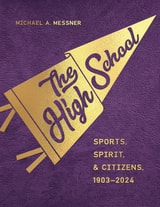
The High School
Sports, Spirit, and Citizens, 1903-2024Michael A. Messner
Rutgers University Press, 2025
In The High School, acclaimed sociologist Michael A. Messner reads through 120 years of El Gabilan, the yearbook from his own alma mater, Salinas High School in California, where his father taught and coached. Treating the yearbooks as a historical archive, Messner makes surprising discoveries about the school he thought he knew so well. For example, over fifty years before Title IX, the earliest yearbooks gave equal spotlights to boys’ and girls’ athletics, while the cheerleaders were all boys.
Tracing American life and culture from 1903 to 2024, Messner illuminates shifts in social practices at his high school that reflect broader changes in American culture across the twentieth century. The High School spotlights how the meanings and iconography of certain activities have changed radically over the decades, even as the “sports spirit complex”—involving athletes, cheerleaders, band members, and community boosters—has remained a central part of the high school experience. By exploring evolving sports cultures, socioeconomic conditions, racial demographics, and gender norms, Messner offers a fresh perspective on a defining feature of American teenage life.

The Ice Bucket Challenge
Pete Frates and the Fight against ALSCasey Sherman and Dave Wedge
University Press of New England, 2017
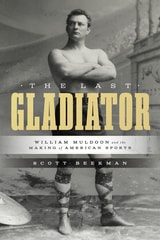
The Last Gladiator
William Muldoon and the Making of American SportsScott Beekman
University of Texas Press, 2025
2026 Honorable Mention in Monographs, North American Society for Sport History (NASSH)
The incredible career of the forgotten but foundational pro wrestler who shaped American sports culture.
William Muldoon was an infamous athlete whose prowess, savvy, and chicanery across his six-decade career led him to wealth, cultural importance, and political power. Muldoon, the child of poor Irish immigrants, began wrestling in the 1870s and quickly became one of the most famous athletes of the post–Civil War era. He started acting and modeling as his popularity grew, making him one of the first sports stars to achieve crossover success. After a triumphant stint rehabilitating fallen boxing heavyweight champion John L. Sullivan in 1889, he retired from the ring and began a new career as a fitness impresario, founding an elite gymnasium and remaking himself as a health authority in the press. He became trainer to the rich, famous, and politically powerful, which led to his appointment as chair of the New York State Athletic Commission in the 1920s. From this position, Muldoon exerted his influence over the rules of boxing and wrestling and weaponized his power to maintain segregation in sport.
The Last Gladiator is a deep, insightful dive into Muldoon’s life and impact, demonstrating the significance of this often-controversial figure in the development of American sports, professional wrestling, and physical and popular culture.
The Market Structure of Sports
Gerald W. Scully
University of Chicago Press, 1994
This book offers technical insights that will interest business economists and professionals in sports management.
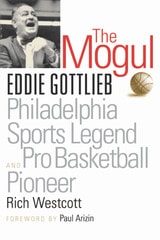
The Mogul
Eddie Gottlieb, Philadelphia Sports Legend and Pro Basketball PioneerRich Westcott
Temple University Press, 2008
Drawing upon sixty-plus interviews and many archival sources, well-known Philadelphia sports historian Rich Westcott vividly portrays Gottlieb's role in a pivotal era in city sports, in the process offering histories of the SPHAs, Warriors, and Stars and the role of Jews and African Americans in the city's sporting history.
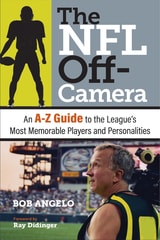
The NFL Off-Camera
An A–Z Guide to the League's Most Memorable Players and PersonalitiesBob Angelo
Temple University Press, 2023
Angelo effuses about his meeting with the larger-than-life Jim Brown and appreciates the trash talking John Randle. He poignantly reflects on “Bullet” Bob Hayes, the world's fastest man who “could not outrun his demons,” and showcases the mercurial Duane Thomas and the free-wheeling Tony Siragusa. The NFL Off-Camera reveals why Angelo sparred with Hall-of-Fame player turned broadcaster Frank Gifford and demonstrates why Super Bowl champion head coach Sean Payton is his “least favorite person in pro football.”
From Jared Allen to Jim Zorn, The NFL Off-Camera explores nearly 100 of the game’s outsized personalities and debunks some of football's most enduring myths. Angelo’s original, unfiltered look at Pro Football is as hard-hitting and exciting as any one of his NFL Films.
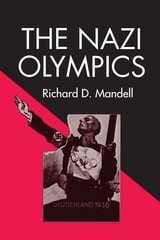
The Nazi Olympics
Richard D. Mandell
University of Illinois Press, 1987
The New American Sport History
Recent Approaches and PerspectivesEdited by S. W. Pope
University of Illinois Press, 1996
In this collection, sixteen scholars explore topics as diverse as the historical debate over black athletic superiority, the selling of sport in society, the eroticism of athletic activity, sexual fears of women athletes, and the marketing of the marathon.
In line with the changing nature of sport history as a field of study, the essays focus less on traditional topics and more on themes of class, gender, race, ethnicity, and national identity, which also define the larger parameters of social and cultural history. It is the first anthology to situation sport history within the broader fields of social history and cultural studies.
Contributors are Melvin L. Adelman, William J. Baker, Pamela L. Cooper, Mark Dyreson, Gerald R. Gems, Elliott J. Gorn, Allen Guttmann, Stephen H. Hardy, Peter Levine, Donald J. Mrozek, Michael Oriard, S. W. Pope, Benjamin G. Rader, Steven A. Riess, Nancy L. Struna, and David K. Wiggins.
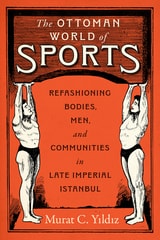
The Ottoman World of Sports
Refashioning Bodies, Men, and Communities in Late Imperial IstanbulMurat C. Yildiz
University of Texas Press, 2025
2026 co-winner of the Ottoman and Turkish Studies Association Book Prize
A revision of the history of modern sports in late Ottoman Istanbul, showing how Muslims, Christians, and Jews created a shared sports culture that was simultaneously global, imperial, and local.
The history of sports in Turkey is deeply contested. Over the decades, journalists, pundits, non-professional historians, sports scholars, and everyday people have offered competing narratives about the origins of modern sports in the late Ottoman Empire.
The Ottoman World of Sports tells the story of how Istanbul’s Muslims, Christians, and Jews—gymnastics teachers, football coaches, weightlifters, journalists, athletes, and fans—created a gendered and class-stratified civic project that promoted athletics as a source of fun, beauty, and moral education. Influenced by the emerging global vogue for organized sports, all boys from the expanding middle class of the late nineteenth- and early twentieth-century imperial capital were expected to exercise and compete on the playing field in order to develop into moral men. Yet even as the embrace of modern athletics transcended ethnoreligious divisions, it did not erase them. Drawing on a wide range of archival research in multiple languages, historian Murat Cihan Yıldız shows that sportsmen created new communal boundaries in team affiliations, fandom, and sports media. Adeptly reconstructing Istanbul’s imperial culture as it was experienced more than a century ago, The Ottoman World of Sports recovers a lived imperial culture whose defining features were shaped by its multiethnic, multireligious, and multilingual sportsmen.

The Philly Fan's Code
The 50 Toughest, Craziest, Most Legendary Philadelphia Athletes of the Last 50 YearsMike Tanier
Temple University Press, 2011
Face it: Philadelphia athletes are often as tough as their fans are passionate. How else to explain the rabid appeal of the bone-crunching Broad Street Bullies? Chuck Bednarik was one of the looniest tunes in Philadelphia sports history, but fuggedabout him. In The Philly Fan's Code, New York Times sportswriter Mike Tanier provides fun and opinionated essays that evaluate the 50 greatest, toughest, and most eccentric legends of Philly sports since Concrete Charlie hung up his cleats.
Using his own "rubric" to calculate the impact of each athlete, Tanier ranks well-adjusted players like Mark Howe alongside both unpredictable athletes like Brad Lidge—who followed an almost perfect season with a 162-game catastrophe—and quirky ones, such as Wilt Chamberlain, who may be better known for bragging about his sexual conquests than for scoring 100 points in a game. And let's not forget our visitor from Planet Lovetron… Then there are the real wild cards-players like Terrell Owens, who does sit-ups in his driveway and whose impact—for better or worse— outlasted the few actual games he played for the Eagles. As for Tanier's choice for the No. 1 toughest, craziest, most legendary player, well, you'll have to read the book to see if you agree. Whether you do or don't, The Philly Fan's Code will provide hours of debates and memories of who our toughest sports heroes were—or weren't.
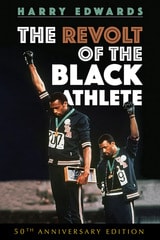
The Revolt of the Black Athlete
50th Anniversary EditionHarry Edwards
University of Illinois Press, 2017
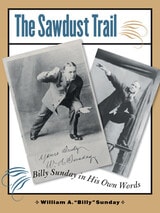
The Sawdust Trail
Billy Sunday in His Own WordsWilliam A. Sunday
University of Iowa Press, 2005
Published serially in the Ladies’ Home Journal in 1932 and 1933 and now in book form for the first time, The Sawdust Trail is the only autobiography that this hugely popular and hugely controversial preacher ever wrote. From his childhood days in Iowa to the early days of his conversion in Illinois, from his baseball career with the National League teams in Chicago, Pittsburgh, and Philadelphia to the challenges of preaching in New York City during his heyday, the sections of Sunday’s autobiography roll out like so many exuberant sermons, yet the sympathetic reader can hear echoes of the loneliness and misery of his early years.
In The Sawdust Trail the sometimes appalling but always appealing Billy Sunday creates a usable past for himself, notable for what he omits as well as for what he includes, which gives us insight not just into his own life and career but also into the peculiar history of evangelism in America.
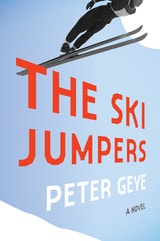
The Ski Jumpers
A NovelPeter Geye
University of Minnesota Press, 2022
Now in paperback: a writer and former ski jumper facing a terminal diagnosis takes one more leap—into a past of soaring flights and broken family bonds
A brilliant ski jumper has to be fearless—Jon Bargaard remembers this well. His memories of daring leaps and risks might be the key to the book he’s always wanted to write: a novel about his family, beginning with Pops, once a champion ski jumper himself, who also took Jon and his younger brother Anton to the heights. But Jon has never been able to get past the next, ruinous episode of their history, and now that he has received a terrible diagnosis, he’s afraid he never will.
In a bravura performance, Peter Geye follows Jon deep into the past he tried so hard to leave behind, telling the story he spent his life escaping. It begins with a flourish, his father and his hard-won sweetheart fleeing Chicago, and a notoriously ruthless gangster, to land in North Minneapolis. That, at least, was the tale Jon heard, one that becomes more and more suspect as he revisits the events that eventually tore the family in two, sending his father to prison, his mother to the state hospital, and placing himself, a teenager, in charge of thirteen-year-old Anton. Traveling back and forth in time, Jon tells his family’s story—perhaps his last chance to share it—to his beloved wife Ingrid, circling ever closer to the truth about those events and his own part in them, and revealing the perhaps unforgivable violence done to the brothers’ bond.
The dream of ski jumping haunts Jon as his tale unfolds, daring time to stop just long enough to stick the landing. As thrilling as those soaring flights, as precarious as the Bargaard family’s complicated love, as tender as Jon’s backward gaze while disease takes him inexorably forward, Peter Geye’s gorgeous prose brings the brothers to the precipice of their relationship, where they have to choose: each other, or the secrets they’ve held so tightly for so long.
Cover alt text: Lightly gradiented periwinkle sky background with white cloud in upper right corner and snow in lower left. At top, a cutout black-and-white image of a ski jumper appears and is cut off at the neck. Foreground: Book title in all-caps red, with author name beneath in all-caps white and “A Novel” beneath in all-cap dark grey. All text reads at a motion slant.

The Small Book of Hip Checks
On Queer Gender, Race, and WritingErica Rand
Duke University Press, 2021
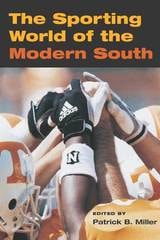
The Sporting World of the Modern South
Edited by Patrick B. Miller
University of Illinois Press, 2002
Engaging a medley of perspectives and methodologies, these collected essays explore the sport-related symbols and events that have shaped southern regional identities since the Civil War. The authors range from the "backcountry" fighter stereotypes portrayed in modern professional wrestling to the significance of Crimson Tide coaching legend Paul "Bear" Bryant for white Alabamians while other essays tackle gender and race relations in intercollegiate athletics, the roles athletic competitions played in desegregating the South, and NASCAR's popularity in southern states.
Pairing the action and anecdotes of good sportswriting with rock-solid scholarship, The Sporting World of the Modern South adds historical and anthropological perspectives to legends and lore from the gridiron to the racetrack.
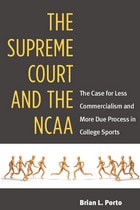
The Supreme Court and the NCAA
The Case for Less Commercialism and More Due Process in College SportsBrian L. Porto
University of Michigan Press, 2013
Two Supreme Court decisions, NCAA v. Board of Regents (1984) and NCAA v. Tarkanian (1988), have shaped college sports by permitting the emergence of a supercharged commercial enterprise with high financial stakes for institutions and individuals, while failing to guarantee adequate procedural protections for persons charged with wrongdoing within that enterprise. Brian L. Porto examines the conditions that led to the cases, the reasoning behind the justices' rulings, and the consequences of those rulings.
Arguing that commercialized college sports should be compatible with the goals of higher education and fair to all participants, Porto suggests that the remedy is a federal statute. His proposed College Sports Legal Reform Act would grant the NCAA a limited "educational exemption" from the antitrust laws, enabling it to enhance academic opportunities for athletes. The Act would also afford greater procedural protections to accused parties in NCAA disciplinary proceedings. Porto's prescription for reform in college sports makes a significant contribution to the debate about how best to address perennial problems in college sports such as cost containment, access to a meaningful education for athletes, and fairness in rule enforcement.
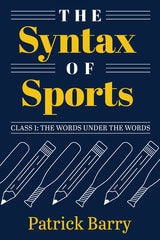
The Syntax of Sports, Class 1
The Words Under the WordsPatrick Barry
Michigan Publishing Services, 2019
The beginning of a multi-volume series, this initial book recreates the first day of class as it was taught to undergraduates at the University of Michigan. The examples are compelling. The dialogue is fast moving. The stories are ones you’ll want to return to and retell over and over again. There is a reason the actual students who took The Syntax of Sports said the following things about it:
“Every class I learned something new that I know I’ll actually use in my writing for years to come. Couldn’t be happier that I took a chance on Syntax of Sports.”
“Prof. Barry has structured the course so that it’s almost impossible not to learn something valuable to take with you to future classes and future career possibilities.”
“I have learned a ton of techniques for being a better writer in this class. I have also learned many life lessons that will undoubtedly guide how I act in the future.”
“I absolutely loved this course because the teacher was so awesome. I enjoyed sitting through class listening to Professor Barry and falling in love with his brain.”
The Syntax of Sports, Class 2
The Power of the ParticularPatrick Barry
Michigan Publishing Services, 2020
What can we learn from baseball great Ted Williams about how to improve our writing? What can we learn we from the iconic ESPN show SportsCenter about how to manage information? And are you sure you really know what the word “peruse” means?
Explore these and other questions in the second volume of The Syntax of Sports, a series designed to recreate a popular course at the University of Michigan. Here are a few things students have said about the experience of taking it.
-
“Patrick Barry is the best teacher I have ever had. I have never learned so much in a class. I hated English my whole life until I took this course.”
-
“I feel like this is and always will be the most valuable class I've ever taken here.”
-
“I genuinely wanted to show up to this class due to the amount I knew I would learn.”
-
“I'm going to severely SEVERELY miss this course.”
-
“Every student should try to take one of Prof. Barry’s classes if he or she wants to become a better writer.”
-
“My writing is now 113x better.”
The Syntax of Sports, Class 3
The Rule of ThreePatrick Barry
Michigan Publishing Services, 2021
It’s not an accident that hall of fame coaches, Pulitzer Prize-winning writers, and the marketing teams at the most innovative companies in the world often rely on a certain three-part structure when trying to communicate their ideas. This third volume of The Syntax of Sports series explores the mechanics of that structure and shows how it can add a compelling mix of clarity and sophistication to your writing.
Like in the previous volumes, the materials come from a popular course at the University of Michigan. Here are comments from students who have taken it:
“The quality of this course was fantastic!”
“Professor Barry really knows how to keep students engaged.”
“Professor Barry is very passionate about teaching, and his enthusiasm made me want to write and learn.”
“This course not only helps you become a better writer but also sheds light on how you might become a better person.”
The Syntax of Sports, Class 4
Parallel StructurePatrick Barry
Michigan Publishing Services, 2022
“Once you find the right structure, perhaps it will be easier to find the right content.” That’s one of the key insights from this fourth book in the series The Syntax of Sports. Others include:
- The importance of being “radically inclusive”
- The power of defining something by what it is not
- The creative elegance of the word “as”
So join Professor Patrick Barry as he continues to share lessons from the popular writing course at the University of Michigan on which The Syntax of Sports is based. You’ll learn about language. You’ll learn about advocacy. And you’ll get to explore some illuminating connections between everything from the speeches of Winston Churchill, to the paintings of Leonardo da Vinci, to—perhaps most surprisingly—the face of NFL legend (and former University of Michigan quarterback) Tom Brady.
The Syntax of Sports, Class 5
Rhetorical RepetitionPatrick Barry
Michigan Publishing Services, 2024
- "Fantastic"
- "Phenomenal"
- "Very engaging and informative:
- "Incredibly useful
- "Full of practical lessons for both my career and life generally"
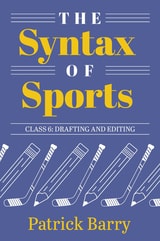
The Syntax of Sports, Class 6
Drafting and EditingPatrick Barry
Michigan Publishing Services, 2024
How do you start a piece of writing? How do you edit one? And what can be done to combat those pesky—and paralyzing—feelings of perfectionism that often derail our most important sentences and paragraphs?
This sixth volume of the Syntax of Sports series creatively uses the language of baseball, football, tennis, and many other sports to explore these questions. Based on a popular course at the University of Michigan, it captures the energy, originality, and discipline - crossing insights that make its author, Professor Patrick Barry, such a sought-after teacher and presenter.
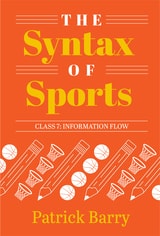
The Syntax of Sports, Class 7
Information FlowPatrick Barry
Michigan Publishing Services, 2025
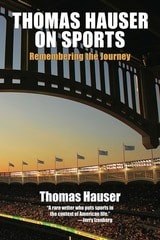
Thomas Hauser on Sports
Remembering the JourneyThomas Hauser
University of Arkansas Press, 2013
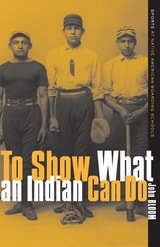
To Show What an Indian Can Do
Sports at Native American Boarding SchoolsJohn Bloom
University of Minnesota Press, 2005
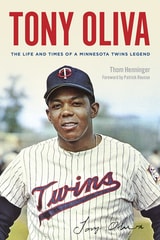
Tony Oliva
The Life and Times of a Minnesota Twins LegendThom Henninger
University of Minnesota Press, 2019
If not for the botched Bay of Pigs invasion, Minnesota might never have known one of its most popular baseball players, Twins three-time batting champion and eight-time All-Star Tony Oliva. In April 1961, the twenty-two-year-old Cuban prospect failed to impress the Twins in a tryout, but the sudden rupture in U.S.–Cuba relations made a return visa all but impossible. The story of how Oliva’s unexpected stay led to a second chance and success with the Twins—as well as decades of personal and cultural isolation—is told for the first time in this full-scale biography of the man the fans affectionately call “Tony O.”
With unprecedented access to the very private Oliva, baseball writer Thom Henninger captures what life was like for the Cuban newcomer as he adjusted to major league play and American culture—and at the same time managed to earn Rookie of the Year honors and win the American League batting title in his first two seasons, all while playing with a knuckle injury. Packed with never-before-published photographs, the book follows Oliva through the 1965 season, all the way to the World Series, and then, with repaired knuckle and knee, into one of the most dramatic pennant races in baseball history in 1967. Through the voices of Oliva, his family, and his teammates—including the Cuban players who shared his cultural challenges and the future Hall of Famers he mentored, Rod Carew and Kirby Puckett—the personal and professional highs and lows of the years come alive: the Gold Glove Award in 1966, a third batting title in 1971, the devastating injury that curtailed his career, and, through it all, the struggle to build a family and recover the large and close-knit one he had left behind in Cuba.
Nearly forty years after Oliva’s retirement, the debate continues over whether his injury-shortened career was Hall of Fame caliber—a question that gets a measured and resounding answer here.
Training the Body for China
Sports in the Moral Order of the People's RepublicSusan Brownell
University of Chicago Press, 1995
Training the Body for China is the first book on Chinese sports based on extended fieldwork by a Westerner. Brownell introduces the notion of "body culture" to analyze Olympic sports as one element in a whole set of Chinese body practices: the "old people's disco dancing" craze, the new popularity of bodybuilding (following reluctant official acceptance of the bikini), mass calisthenics, martial arts, military discipline, and more.
Translating official and dissident materials into English for the first time and drawing on performance theory and histories of the body, Brownell uses the culture of the body as a focal point to explore the tensions between local and global organizations, the traditional and the modern, men and women. Her intimate knowledge of Chinese social and cultural life and her wide range of historic examples make Training the Body for China a unique illustration of how gender, the body, and the nation are interlinked in Chinese culture.