Results by title
967 books match the query 'Theater' and 260 start with t
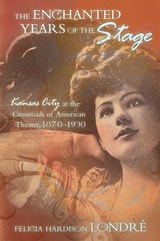
The Enchanted Years of the Stage
Kansas City at the Crossroads of American Theater, 1870-1930Felicia Hardison Londré
University of Missouri Press, 2007
Sarah Bernhardt, Sir Henry Irving, Edwin Booth . . . there was a time when they all played Kansas City. From star-studded engagements at ornate opera houses to risqué shows in Fourth Street honky-tonks, Kansas City was a cow town that wanted to civilize itself through the performing arts. And because it was a railway hub in the heyday of trouping, it opened its doors to America’s traveling performers.
This book chronicles the “first golden age” of Kansas City theater, from the opening of the Coates Opera House in 1870 through the gradual decline of touring productions after World War I. Drawing on the recollections of renowned theater critic David Austin Latchaw and on newspaper archives of the era, Felicia Londré has gleaned long-lost nuggets of theater life—both the legitimate stage and popular fare—to create a fascinating account of a city and its theater culture.
The Enchanted Years of the Stage is brimming with forgotten stories and historical illustrations that offer a new perspective on both the history of American theater and the humor and pathos of performers’ lives. It tells how James O’Neill once chased a messenger boy for ruining a big scene, while Louis James played practical jokes on fellow actors in the middle of Shakespeare performances; how police kept watch over the burlesque girls at the Folly to make sure their act wouldn’t reach the level of indecency allowed in St. Louis; how Orth Stein shot the manager of the Theatre Comique; and how Eddie Foy played his death scene in Kansas City—by dying there. Throughout the book, sidebars of Latchaw’s writing reflect the style and spirit of this bygone era.
Offering a richer view of American theater than have accounts centered on New York, Londré’s book also yields a wealth of new insights into the social and political fabric of an emerging metropolis and testifies to the importance of the arts in the growth and reputation of a great city. By conveying the richness and complexity of road shows in Kansas City—a microcosm of the burgeoning national stage—she gives us a key piece in the mosaic that was American theater in a neglected but unforgettable era.
The Ethos of Drama
Rhetorical Theory and Dramatic WorthRobert L. King
Catholic University of America Press, 2010
The Feminist Spectator as Critic
Jill Dolan
University of Michigan Press, 2012
The Feminist Spectator as Criticbroke new ground as one of the pioneering books on feminist spectatorship, encouraging resistant readings to generate feminist meanings in performance. Approaching live spectatorship through a range of interdisciplinary methods, the book has been foundational in theater studies, performance studies, and gender/sexuality/women's studies. This updated and enlarged second edition celebrates the book's twenty-fifth anniversary with a substantial new introduction and up-to-the-moment bibliography, detailing the progress to date in gender equity in theater and the arts, and suggesting how far we have yet to go.
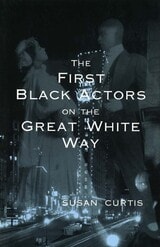
The First Black Actors on the Great White Way
Susan Curtis
University of Missouri Press, 1998
On April 5, 1917, Three Plays for a Negro Theater by Ridgely Torrence opened at the Garden Theatre in New York City. This performance was a monumental event in American stage history. Not only was this the first dramatic production to portray African American life beyond the cliché, it was also the first production on Broadway to feature an all-black cast. The morning after the three plays were performed, newspapers were filled with praise for the cast, crew, and playwright. Audience member W. E. B. Du Bois declared the show "epoch making." Despite such early critical acclaim, Three Plays for a Negro Theater closed before the end of the month and received little attention thereafter.
Why was a nation, so fascinated with firsts, able to forget these black actors and this production so quickly? It is this question that Susan Curtis addresses in The First Black Actors on the Great White Way.
Set against the backdrop of transforming theater conventions in the early 1900s and the war in 1917, this important study relates the stories of the actors, stage artists, critics, and many others—black and white—involved in this groundbreaking production. Curtis explores in great depth both the progress in race relations that led to this production and the multifaceted reasons for its quick demise.
Three Plays for a Negro Theater opened on the eve of the United States' entrance into World War I. Curtis attributes the early closure of the three plays to this coincidence, but she does not settle for so simple an explanation. Rather, she investigates the heightened national self-consciousness that followed the United States' entry into the war. America was ready to "make the world safe for democracy," but it was not fully ready to accept democracy and equality in its own culture.
The First Black Actors on the Great White Way is not simply a study of African American theater and its entrance into American culture. By focusing on a single event at a critical moment in history, Curtis offers a unique glimpse into race relations in early-twentieth-century American society. The experience of these pioneering artists reveals an unexplored aspect of the painfully slow evolution of racial equality.
A remarkable story about people who waged an extraordinary campaign against racism, The First Black Actors on the Great White Way will be of special interest to scholars of American studies, race relations, and cultural history, as well as the general reader.
The Fourth Estate at the Fourth Wall
Newspapers on Stage in July Monarchy FranceCary Hollinshead-Strick
Northwestern University Press, 2019
July Monarchy plays, which provided affordable entertainment to a broad section of the public, constitute a large, nearly untapped reservoir of commentary on the arrival of the forty-franc press. Vaudevilles and comedies ask whether journalism that benefits from advertisement can be unbiased. Dramas explore whether threatening to spread false news is an acceptable way for journalists to exercise their influence. Hollinshead-Strick uses both plays and novels to show that despite their claims to enlighten their readers, newspapers were often accused of obscuring public access to information. Balzac’s interventions in this media sphere reveal his utopian views on print technology. Nerval’s and Pyat’s demonstrate the nefarious impact that corrupt theater critics could have on authors and on the public alike.
Scholars of press and media studies, French literature, theater, and nineteenth-century literature more generally will find this book a valuable introduction to a cross-genre debate about press publicity that remains surprisingly resonant today.
The Gay and Lesbian Theatrical Legacy
A Biographical Dictionary of Major Figures in American Stage History in the Pre-Stonewall EraBilly J. Harbin, Kim Marra, and Robert A. Schanke, Editors
University of Michigan Press, 2005
“A superb tribute to theatrical pioneers—The Gay and Lesbian Theatrical Legacy is required reading for both theatre scholars and gay/lesbian/bisexual history aficionados. A fascinating journey awaits them all in this highly recommended volume.”
—Broadside: Newsletter of the Theatre Library Association
The Gay and Lesbian Theatrical Legacy collects in a single volume biographies of more than one hundred notable figures whose careers flourished in the years before the 1969 Stonewall Riots marked the beginning of the gay and lesbian civil rights movement in the United States. The leading lights in American theater have included innumerable individuals whose sexualities have deviated from prevailing norms, but this history has until recently been largely unwritten and unknown. This book contributessignificantly to the recovery of this history, fashioning a much fuller, more nuanced portrait of American theater as it evolved and shedding light on the influence that sexual desire may have had on professional choices, relationships, and artistic achievements.
The Gay and Lesbian Theatrical Legacy collects biographies and portraits of influential actors, playwrights, composers, directors, designers, dancers, producers, managers, critics, choreographers, and technicians who made their mark on the American theater. Its broad coverage provides an extended glimpse into lives and careers that intersected and into networks of affiliation that made theatrical history and, by extension, social and cultural history.
The late Billy J. Harbin was Professor of Theater, Louisiana State University. Kim Marra is Associate Professor of Theater, University of Iowa. Robert A. Schanke is Professor of Theater Emeritus, Central College, Pella, Iowa.
The Gendering of Men, 1600–1750
Volume 2, Queer ArticulationsThomas A. King
University of Wisconsin Press, 2008
The Ghosts of the Avant-Garde(s)
Exorcising Experimental Theater and PerformanceJames M. Harding
University of Michigan Press, 2015
James M. Harding revisits iconic sites of early 20th-century performance to examine how European avant-gardists attempted—unsuccessfully—to employ that discourse as a strategy for enforcing uniformity among a politically and culturally diverse group of artists. He then takes aim at historical and aesthetic categories that have promoted a restrictive history and theory of the avant-garde and narrow readings of avant-garde performance. Harding reveals the Eurocentric undercurrents that underlie these categories and urges a consideration of the global political dimensions of avant-garde gestures. His book will interest scholars of theater and performance, art history, and literary studies, as well as those interested in the relation of art to politics in various historical periods and cultures.
The Global White Snake
Liang Luo
University of Michigan Press, 2021
The Global White Snake uncovers how the White Snake legend often acts as an unsettling narrative of radical tolerance for hybrid sexualities, loving across traditional boundaries, subverting authority, and valuing the strange and the uncanny. A timely mediation and reflection on our contemporary moment of continued struggle for minority rights and social justice, The Global White Snake revives the radical anti-authoritarian spirit slithering under the tales of monsters and demons, love and lust, and reminds us of the power of the fantastic and the fabulous in inspiring and empowering personal and social transformations.
The Gospel According to James and Other Plays
Charles R. Smith
Ohio University Press, 2012
This collection of five award-winning plays by Charles Smith includes Jelly Belly, Free Man of Color, Pudd’nhead Wilson, Knock Me a Kiss, and The Gospel According to James. Powerful, provocative, and entertaining, these plays have been produced by professional theater companies across the country and abroad. Four of the plays are based on historical people and events from W.E.B. Du Bois and Countee Cullen to the Harlem Renaissance. Accurate in the way they capture the political and cultural milieu of their historical settings, and courageous in the way they grapple with difficult questions such as race, education, religion, and social class, these plays jump off the page just as powerfully as they come to life on stage. This first-ever collection from one of the nation’s leading African American playwrights is a journey down the complex road of race and history.
The Great White Way
Race and the Broadway MusicalHoffman, Warren
Rutgers University Press, 2014
Broadway musicals are one of America’s most beloved art forms and play to millions of people each year. But what do these shows, which are often thought to be just frothy entertainment, really have to say about our country and who we are as a nation?
The Great White Way is the first book to reveal the racial politics, content, and subtexts that have haunted musicals for almost one hundred years from Show Boat (1927) to The Scottsboro Boys (2011). Musicals mirror their time periods and reflect the political and social issues of their day. Warren Hoffman investigates the thematic content of the Broadway musical and considers how musicals work on a structural level, allowing them to simultaneously present and hide their racial agendas in plain view of their audiences. While the musical is informed by the cultural contributions of African Americans and Jewish immigrants, Hoffman argues that ultimately the history of the American musical is the history of white identity in the United States.
Presented chronologically, The Great White Way shows how perceptions of race altered over time and how musicals dealt with those changes. Hoffman focuses first on shows leading up to and comprising the Golden Age of Broadway (1927–1960s), then turns his attention to the revivals and nostalgic vehicles that defined the final quarter of the twentieth century. He offers entirely new and surprising takes on shows from the American musical canon—Show Boat (1927), Oklahoma! (1943), Annie Get YourGun (1946), The Music Man (1957), West Side Story (1957), A Chorus Line (1975), and 42nd Street (1980), among others.
New archival research on the creators who produced and wrote these shows, including Leonard Bernstein, Jerome Robbins, Stephen Sondheim, and Edward Kleban, will have theater fans and scholars rethinking forever how they view this popular American entertainment.
The Great White Way
Race and the Broadway MusicalWarren Hoffman
Rutgers University Press, 2020
Now in a new second edition, The Great White Way is the first book to reveal the racial politics, content, and subtexts that have haunted musicals for almost one hundred years from Show Boat (1927) to Hamilton (2015). This revised edition includes a new introduction and conclusion, updated chapters, as well as a brand-new chapter that looks at the blockbuster musicals The Book of Mormon and Hamilton.
Musicals mirror their time periods and reflect the political and social issues of their day. Warren Hoffman investigates the thematic content of the Broadway musical and considers how musicals work on a structural level, allowing them to simultaneously present and hide their racial agendas in plain view of their audiences. While the musical is informed by the cultural contributions of African Americans and Jewish immigrants, Hoffman argues that ultimately the history of the American musical is the history of white identity in the United States.
Presented chronologically, The Great White Way shows how perceptions of race altered over time and how musicals dealt with those changes. Hoffman focuses first on shows leading up to and comprising the Golden Age of Broadway (1927–1960s), then turns his attention to the revivals and nostalgic vehicles that defined the final quarter of the twentieth century. He offers entirely new and surprising takes on shows from the American musical canon—Show Boat (1927), Oklahoma! (1943), Annie Get Your Gun (1946), The Music Man (1957), West Side Story (1957), A Chorus Line (1975), and 42nd Street (1980), among others. In addition to a new chapter on Hamilton and The Book of Mormon, this revised edition brings The Great White Way fully into the twenty-first century with an examination of jukebox musicals and the role of off-Broadway and regional theaters in the development of the American musical.
New archival research on the creators who produced and wrote these shows, including Leonard Bernstein, Jerome Robbins, Stephen Sondheim, and Edward Kleban, will have theater fans and scholars rethinking forever how they view this popular American entertainment.
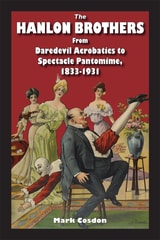
The Hanlon Brothers
From Daredevil Acrobatics to Spectacle Pantomime, 1833-1931Mark Cosdon
Southern Illinois University Press, 2010
The Hanlons—a family of six brothers from Manchester, England—were one of the world’s premiere performing troupes in the mid-nineteenth and early twentieth centuries, yet their legacy has been mostly forgotten. In The Hanlon Brothers: From Daredevil Acrobatics to Spectacle Pantomime, 1833–1931, Mark Cosdon carefully documents the careers of this talented family and enumerates their many contributions to modern popular entertainment.
As young men, the Hanlons stunned audiences all over the world with their daring acrobatic feats. After a tragic accident severely injured one brother (and indirectly led to his suicide in a manner achievable only by someone with considerable acrobatic talents), they moved into the safer arena of spectacle pantomime, where they became the rage of Parisian popular theatre. They achieved fame with their uproariously funny and technically astonishing production of Le Voyage en Suisse. After settling permanently in the northeastern United States, they developed two more full-length pantomimes, Fantasma and Superba. The three shows toured for more than thirty years, a testament to their popularity and to the Hanlons’ impressive business acumen.
The book’s illustrations—including sketches of their performances, studio photographs of the Hanlons, and posters for all three of their major pantomimes—are essential to the understanding of their work. The Hanlon Brothers is painstakingly researched yet accessible and engaging. Cosdon has managed to provide a thorough and engrossing account of the Hanlons’ lives and careers, which will no doubt help to reestablish their legacy in the world of popular entertainment.
The Haunted Stage
The Theatre as Memory MachineMarvin Carlson
University of Michigan Press, 2003
Marvin Carlson is Sidney E. Cohn Distinguished Professor of Theatre and Comparative Literature at the City University of New York.
The Healing Stage
Black Women, Incarceration, and the Art of TransformationLisa Biggs
The Ohio State University Press, 2022
The Humana Festival
The History of New Plays at Actors Theatre of LouisvilleJeffrey Ullom
Southern Illinois University Press, 2008
Far from the glittering lights of Broadway, in a city known more for its horse racing than its artistic endeavors, an annual festival in Louisville, Kentucky, has transformed the landscape of the American theater. The Actors Theatre of Louisville—the Tony Award–winning state theater of Kentucky—in 1976 successfully created what became the nation's most respected new-play festival, the Humana Festival of New American Plays.
The Humana Festival: The History of New Plays at Actors Theatre of Louisville examines the success of the festival and theater’s Pulitzer Prize–winning productions that for decades have reflected new-play trends in regional theaters and on Broadway—the result of the calculated decisions, dogged determination, and good luck of its producing director, Jon Jory.
The volume details how Actors Theatre of Louisville was established, why the Humana Festival became successful in a short time, and how the event’s success has been maintained by the Louisville venue that has drawn theater critics from around the world for more than thirty years.
Author Jeffrey Ullom charts the theater’s early struggles to survive, the battles between troupe leaders, and the desperate measures to secure financial support from the Louisville community. He examines how Jory established and expanded the festival to garner extraordinary local support, attract international attention, and entice preeminent American playwrights to premier their works in the Kentucky city.
In The Humana Festival, Ullom provides a broad view of new-play development within artistic, administrative, and financial contexts. He analyzes the relationship between Broadway and regional theaters, outlining how the Humana Festival has changed the process of new-play development and even Broadway’s approach to discovering new work, and also highlights the struggles facing regional theaters across the country as they strive to balance artistic ingenuity and economic viability.
Offering a rare look at the annual event, The Humana Festival provides the first insider’s view of the extraordinary efforts that produced the nation’s most successful new-play festival.
The Idea of the Theater in Latin Christian Thought
Augustine to the Fourteenth CenturyDonnalee Dox
University of Michigan Press, 2004
---Margaret Knapp, Arizona State University
"...an elegantly concise survey of the way classical notions of theater have been interpreted in the Latin Middle Ages. Dox convincingly demonstrates that far from there being a single 'medieval' attitude towards theater, there was in fact much debate about how theater could be understood to function within Christian tradition, even in the so-called 'dark ages' of Western culture. This book makes an innovative contribution to studies of the history of the theater, seen in terms of the history of ideas, rather than of practice."
---Constant Mews, Director, Centre for the Study of Religion & Theology, University of Monash, Australia
"In the centuries between St. Augustine and Bartholomew of Bruges, Christian thought gradually moved from a brusque rejection of classical theater to a progressively nuanced and positive assessment of its value. In this lucidly written study, Donnalee Dox adds an important facet to our understanding of the Christian reaction to, and adaptation of, classical culture in the centuries between the Church Fathers and the rediscovery of Aristotle."
---Philipp W. Rosemann, University of Dallas
This book considers medieval texts that deal with ancient theater as documents of Latin Christianity's intellectual history. As an exercise in medieval historiography, this study also examines biases in modern scholarship that seek links between these texts and performance practices. The effort to bring these texts together and place them in their intellectual contexts reveals a much more nuanced and contested discourse on Greco-Roman theater and medieval theatrical practice than has been acknowledged. The book is arranged chronologically and shows the medieval foundations for the Early Modern integration of dramatic theory and theatrical performance.
The Idea of the Theater in Latin Christian Thought will be of interest to theater historians, intellectual historians, and those who work on points of contact between the European Middle Ages and Renaissance. The broad range of documents discussed (liturgical treatises, scholastic commentaries, philosophical tracts, and letters spanning many centuries) renders individual chapters useful to philosophers, aestheticians, and liturgists as well as to historians and historiographers. For theater historians, this study offers an alternative reading of familiar texts which may alter our understanding of the emergence of dramatic and theatrical traditions in the West. Because theater is rarely considered as a component of intellectual projects in the Middle Ages, this study opens a new topic in the writing of medieval intellectual history.
The Immigrant Scene
Ethnic Amusements in New York, 1880–1920Sabine Haenni
University of Minnesota Press, 2008
Explores the relationship between immigrant and national culture
Yiddish melodramas about the tribulations of immigration. German plays about alpine tourism. Italian vaudeville performances. Rubbernecking tours of Chinatown. In the New York City of the late nineteenth and early twentieth centuries, these seemingly disparate leisure activities played similar roles: mediating the vast cultural, demographic, and social changes that were sweeping the nation’s largest city.
In The Immigrant Scene, Sabine Haenni reveals how theaters in New York created ethnic entertainment that shaped the culture of the United States in the early twentieth century. Considering the relationship between leisure and mass culture, The Immigrant Scene develops a new picture of the metropolis in which the movement of people, objects, and images on-screen and in the street helped residents negotiate the complexities of modern times. In analyzing how communities engaged with immigrant theaters and the nascent film culture in New York City, Haenni traces the ways in which performance and cinema provided virtual mobility—ways of navigating the socially complex metropolis—and influenced national ideas of immigration, culture, and diversity in surprising and lasting ways.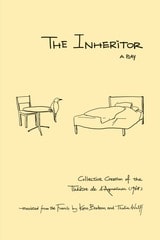
The Inheritor
A PlayKate Bredeson and Thalia Wolff
Northwestern University Press, 2025
The first English-language translation of the 1968 activist play about inequality and access to education
In The Inheritor, surrealist imagery and experimental forms convey the radically different experience of two students, the Inheritor and the Non-Inheritor, as they prepare for a high-stakes exam. Revealing a world of privilege where “there is no such thing as luck,” the play features a beheaded knight, a talking record player, and a boisterous chorus of professors depicted as a flock of squawking birds.
Based on sociologists Pierre Bourdieu and Jean-Claude Passeron’s The Inheritors: French Students and Their Relations to Culture, the play was collectively created by Théâtre de l’Aquarium, a company then composed entirely of students. It proved a powerful success when it premiered in May 1968 amid student and worker protests in Paris, and it continues to speak forcefully to education inequity on campuses across anglophone countries today.
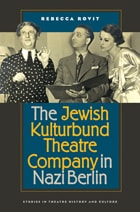
The Jewish Kulturbund Theatre Company in Nazi Berlin
Rebecca Rovit
University of Iowa Press, 2012
The Kulturbund’s directors were repeatedly caught between escalating demands from their Nazi overseers and from their own Jewish constituents. By examining why and how an all-Jewish repertory theatre could coexist with the Nazi regime, Rovit raises broader questions about the nature of art in an environment of coercion and isolation, artistic integrity and adaptability, and community and identity.
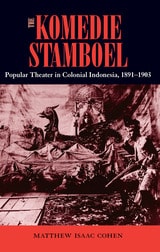
The Komedie Stamboel
Popular Theater in Colonial Indonesia, 1891–1903Matthew Isaac Cohen
Ohio University Press, 2006
Originating in 1891 in the port city of Surabaya, the Komedie Stamboel, or Istanbul-style theater, toured colonial Indonesia, Singapore, and Malaysia by rail and steamship. The company performed musical versions of the Arabian Nights, European fairy tales and operas such as Sleeping Beauty and Aida, as well as Indian and Persian romances, Southeast Asian chronicles, true crime stories, and political allegories. The actors were primarily Eurasians, the original backers were Chinese, and audiences were made up of all races and classes. The Komedie Stamboel explores how this new hybrid theater pointed toward possibilities for the transformation of self in a colonial society and sparked debates on moral behavior and mixed-race politics.
While audiences marveled at spectacles involving white-skinned actors, there were also racial frictions between actors and financiers, sexual scandals, fights among actors and patrons, bankruptcies, imprisonments, and a murder.
Matthew Isaac Cohen's evocative social history situates the Komedie Stamboel in the culture of empire and in late nineteenth-century itinerant entertainment. He shows how the theater was used as a symbol of cross-ethnic integration in postcolonial Indonesia and as an emblem of Eurasian cultural accomplishment by Indische Nederlanders. A pioneering study of nineteenth-century Southeast Asian popular culture, The Komedie Stamboel gives a new picture of the region's arts and culture and explores the interplay of currents in global culture, theatrical innovation, and movement in colonial Indonesia.ABOUT THE AUTHOR---Matthew Isaac Cohen is senior lecturer in Drama and Theatre Studies at Royal Holloway University of London. His articles on Southeast Asian performance have appeared in New Theatre Quarterly, Asian Theatre Journal, Journal of the Royal Asiatic Society, and Archipel. As a practicing shadow puppeteer, he has performed in the United States, Europe, and Asia.
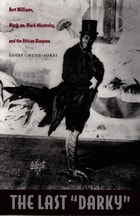
The Last "Darky"
Bert Williams, Black-on-Black Minstrelsy, and the African DiasporaLouis Chude-Sokei
Duke University Press, 2006
Chude-Sokei makes the crucial argument that Williams’s minstrelsy negotiated the place of black immigrants in the cultural hotbed of New York City and was replicated throughout the African diaspora, from the Caribbean to Africa itself. Williams was born in the Bahamas. When performing the “darky,” he was actually masquerading as an African American. This black-on-black minstrelsy thus challenged emergent racial constructions equating “black” with African American and marginalizing the many diasporic blacks in New York. It also dramatized the practice of passing for African American common among non-American blacks in an African American–dominated Harlem. Exploring the thought of figures such as Booker T. Washington, W. E. B. Du Bois, Marcus Garvey, and Claude McKay, Chude-Sokei situates black-on-black minstrelsy at the center of burgeoning modernist discourses of assimilation, separatism, race militancy, carnival, and internationalism. While these discourses were engaged with the question of representing the “Negro” in the context of white racism, through black-on-black minstrelsy they were also deployed against the growing international influence of African American culture and politics in the twentieth century.
The Last Judgment of Kings / Le Jugement dernier des rois
A Bilingual EditionYann Robert
Bucknell University Press, 2025
Joué pour la première fois le lendemain de l’exécution de Marie-Antoinette, Le Jugement dernier des rois met en scène le procès burlesque des autres rois et reines d’Europe : exhibés et enchaînés tels des animaux, contraints de se battre pour un tonneau de biscuits, et finalement anéantis par l’éruption spectaculaire d’un volcan. Tel est le contexte scandaleux—tragédie et farce à la fois—de la pièce la plus célèbre de la Révolution française, bien connue de tous les spécialistes de cette période. Jusqu’à maintenant, pourtant, il n’existait ni édition critique ni traduction anglaise de cet ouvrage historique. Notre édition bilingue fait revivre la pièce de Maréchal et la replace au centre des plus grands débats chez les historiens de la Révolution, traitant de justice, religion, commémoration, comédie, et propagande. Provocateur, facile à lire, et concis—parfaitement adapté aux étudiants d’un cours de français ou d’histoire—Le Jugement dernier des rois propose ainsi une introduction idéale à la période révolutionnaire et à ses principales controverses.
Published by Bucknell University Press. Distributed worldwide by Rutgers University Press.
The Life of Comedy after the Death of Plautus and Terence
Mathias Hanses
University of Michigan Press, 2020
Scholars have commonly believed that the plays fell out of favor with theatrical audiences by the end of the first century BCE, but The Life of Comedy demonstrates that performances of these comedies continued at least until the turn of the second century CE. Mathias Hanses traces the plays’ reception in Latin literature from the late first century BCE to the early second century CE, and shines a bright light on the relationships between comic texts and the works of contemporary and later Latin writers.
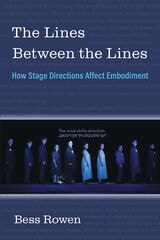
The Lines Between the Lines
How Stage Directions Affect EmbodimentBess Rowen
University of Michigan Press, 2021
What is the purpose of a stage direction? These italicized lines written in between the lines of spoken dialogue tell us a great deal of information about a play's genre, mood, tone, visual setting, cast of characters, and more. Yet generations of actors have been taught to cross these words out as records of previous performances or signs of overly controlling playwrights, while scholars have either treated them as problems to be solved or as silent lines of dialogue. Stage directions can be all of these things, and yet there are examples from over one-hundred years of American playwriting that show that stage directions can also be so much more. The Lines Between the Lines focuses on how playwrights have written stage directions that engage readers, production team members, and scholars in a process of embodied creation in order to determine meaning. Author Bess Rowen calls the products of this method “affective stage directions” because they reach out from the page and affect the bodies of those who encounter them. Affective stage directions do not tell a reader or production team what a given moment looks like, but rather how a moment feels. In this way, these stage directions provide playgrounds for individual readers or production teams to make sense of a given moment in a play based on their own individual cultural experience, geographic location, and identity-markers. Affective stage directions enable us to check our assumptions about what kinds of bodies are represented on stage, allowing for a greater multitude of voices and kinds of embodied identity to make their own interpretations of a play while still following the text exactly. The tools provided in this book are as useful for the theater scholar as they are for the theater audience member, casting director, and actor. Each chapter covers a different function of stage directions (spoken, affective, choreographic, multivalent, impossible) and looks at it through a different practical lens (focusing on actors, directors, designers, dramaturgs, and readers). Every embodied person will have a slightly different understanding of affective stage directions, and it is precisely this diversity that makes these stage directions crucial to understanding theater in our time.

The London Stage, 1660-1800 Part 5, 1776-1800
A Calendar of Plays, Entertainment & Afterpieces Together with Casts, Box-Reciepts and ContemporaryEdited by Charles Beecher Hogan, William Van Lennep, Emmett L. Avery, Arthur H.Scouten, George Winchester Stone
Southern Illinois University Press, 1970
The Making of Theatrical Reputations
Studies from the Modern London TheatreYael Zarhy-Levo
University of Iowa Press, 2008
Today's successful plays and playwrights achieve their prominence not simply because of their intrinsic merit but because of the work of mediators, who influence the whole trajectory of a playwright's or a theatre company's career. Critics and academic writers are primarily considered the makers of reputations, but funding organizations and various media agents as well as artistic directors, producers, and directors also pursue separate agendas in shaping the reputations of theatrical works. In The Making of Theatrical Reputations Yael Zarhy-Levo demonstrates the processes through which these mediatory practices by key authority figures situate theatrical companies and playwrights within cultural and historical memory.
To reveal how these authorizing powers-that-be promote theatrical events, companies, and playwrights, Zarhy-Levo presents four detailed case studies that reflect various angles of the modern London theatre. In the case of the English Stage Company's production of John Osborne's Look Back in Anger, she centers on a specific event. She then focuses on the trajectory of a single company, the Theatre Workshop, particularly through its first decade at the Theatre Royal, Stratford East, London. Next, she explores the career of the dramatist John Arden, especially its first ten years, in part drawing upon an interview with Arden and his wife, actress and playwright Margaretta D'Arcy, before turning to her fourth study: the playwright Harold Pinter's shifting reputation throughout the different phases of his career.
Zarhy-Levo's accounts of these theatrical events, companies, and playwrights through the prism of mediation bring fresh insights to these landmark productions and their creators.
The Mee-Ow Show at 50
From Cultural Rebellion to Comedy InstitutionJoseph B. Radding and Paul W. Warshauer
Northwestern University Press, 2025
The fifty-year history of the Mee-Ow Show at Northwestern University and its influence on contemporary comedy
In the fall of 1973, two students at Northwestern University resolved to create something on stage that was wholly their own. Soon, they would be joined by a cohort of performers, musicians, and staff, and the resulting production would go on to launch the careers of scores of entertainment professionals, including some of the most well-known and awarded names in comedy today. This book is not only an account of the rebellious fifty-year history of the Mee-Ow Show, now the longest-running student sketch comedy and improv show in the country, but also its far-reaching influence. The storied group’s alumni include such household names as Craig Bierko, Ana Gasteyer, Julia Louis-Dreyfus, John Cameron Mitchell, Dermot Mulroney, Seth Meyers, and Kristen Schaal.
Based on more than a hundred new interviews with group members, presenting their words alongside never-before-published photographs and ephemera, The Mee-Ow Show at 50 provides a chronicle of the last half-century of the American undergraduate experience—and reveals how, from New York to Los Angeles, contemporary comedy can trace its roots to an upstart student production in Evanston, Illinois.
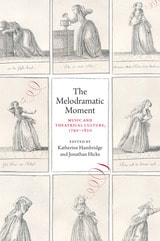
The Melodramatic Moment
Music and Theatrical Culture, 1790–1820Edited by Katherine G Hambridge and Jonathan Hicks
University of Chicago Press, 2018
This anthology proposes to address the sometimes bewilderingly broad understandings of melodrama by insisting on the historical specificity of its genesis on the stage in late-eighteenth-century Europe. Melodrama emerged during this time in the metropolitan centers of London, Paris, Vienna, and Berlin through stage adaptations of classical subjects and gothic novels, and they became famous for their use of passionate expression and spectacular scenery. Yet, as contributors to this volume emphasize, early melodramas also placed sound at center stage, through their distinctive—and often disconcerting—alternations between speech and music. This book draws out the melo of melodrama, showing the crucial dimensions of sound and music for a genre that permeates our dramatic, literary, and cinematic sensibilities today.
A richly interdisciplinary anthology, The Melodramatic Moment will open up new dialogues between musicology and literary and theater studies.
The Modern Brazilian Stage
By David George
University of Texas Press, 1992
Reading a play and watching it performed onstage are quite different experiences. Likewise, studying a country's theatrical tradition with reference only to playtexts overlooks the vital impact of a play's performance on the audience and on the whole artistic community. In this performance-centered approach to Brazilian theatre since the 1940s, David George explores a total theatrical language—the plays, the companies that produced them, and the performances that set a standard for all future stagings.
George structures the discussion around several important companies. He begins with Os Comediantes, whose revolutionary 1943 staging of Nelson Rodrigues' Vestido de Noiva (Bridal Gown) broke with the outmoded comedy-of-manners formula that had dominated the national stage since the nineteenth century. He considers three companies of the 1950s and 1960s—Teatro Brasileiro de Comédia, Teatro de Arena, and Teatro Oficina—along with the 1967 production of O Rei da Vela (The Candle King) by Teatro Oficina.
The 1970s represented a wasteland for Brazilian theatre, George finds, in which a repressive military dictatorship muzzled artistic expression. The Grupo Macunaíma brought theatre alive again in the 1980s, with its productions of Macunaíma and Nelson 2 Rodrigues.
Common to all theatrical companies, George concludes, was the desire to establish a national aesthetic, free from European and United States models. The creative tension this generated and the successes of modern Brazilian theatre make lively reading for all students of Brazilian and world drama.

The Morality of Mrs. Dulska
A Play by Gabriela ZapolskaGabriela Zapolska
Intellect Books, 2007
The Most American Thing in America
Circuit Chautauqua as PerformanceCanning, Charlotte M.
University of Iowa Press, 2005
Between 1904 and the Great Depression, Circuit Chautauquas toured the rural United States, reflecting and reinforcing its citizens’ ideas, attitudes, and politics every summer through music (the Jubilee Singers, an African American group, were not always welcome in a time when millions of Americans belonged to the KKK), lectures (“Civic Revivalist” Charles Zueblin speaking on “Militancy and Morals”), elocutionary readers (Lucille Adams reading from Little Lord Fauntleroy), dramas (the Ben Greet Players’ cleaned-up version of She Stoops to Conquer), orations (William Jennings Bryan speaking about the dangers of greed), and special programs for children (parades and mock weddings).
Theatre historians have largely ignored Circuit Chautauquas since they did not meet the conventional conditions of theatrical performance: they were not urban; they produced no innovative performance techniques, stage material, design effects, or dramatic literature. In this beautifully written and illustrated book, Charlotte Canning establishes an analytical framework to reveal the Circuit Chautauquas as unique performances that both created and unified small-town America.
One of the last strongholds of the American traditions of rhetoric and oratory, the Circuits created complex intersections of community, American democracy, and performance. Canning does not celebrate the Circuit Chautauquas wholeheartedly, nor does she describe them with the same cynicism offered by Sinclair Lewis. She acknowledges their goals of community support, informed public thinking, and popular education but also focuses on the reactionary and regressive ideals they sometimes embraced. In the true interdisciplinary spirit of Circuit Chautauquas, she reveals the Circuit platforms as places where Americans performed what it meant to be American.
The Myopia and Other Plays by David Greenspan
David Greenspan and Marc Robinson
University of Michigan Press, 2012
Playwright and actor David Greenspan has been a leading figure in Manhattan's downtown performance scene for over twenty years. His numerous accolades include a Guggenheim fellowship and four Obie Awards for his acting and writing, and most recently a fifth Obie for Sustained Achievement. Tony Kushner once declared Greenspan "probably all-around the most talented theater artist of my generation," and the New York Times has called his performances "irresistible." The Myopia and Other Playsbrings together five of Greenspan's most important works, accompanied by a critical introduction and new interview with the playwright.
Greenspan's work---often semiautobiographical, always psychologically intense---deals with issues of memory, family, doubt, and sexuality. The plays in this collection take particular interest in the motivations for erotic and aesthetic expression, forces inextricably linked in Greenspan's world. Critic and scholar Marc Robinson's informative introduction and lively interview with Greenspan further increase the collection's appeal to lovers of inventive playwriting, as well as students and scholars in the fields of Performance Studies, English, American Studies, and LGBT Studies.
The Mystic in the Theatre
Eleonora DuseEva Le Gallienne
Southern Illinois University Press, 1973

The National Stage
Theatre and Cultural Legitimation in England, France, and AmericaLoren Kruger
University of Chicago Press, 1992
The National Stage answers this question by tracing the relation between theatre institution and public sphere in the discourses of national identity in Britain, France, and the United States. Exploring the boundaries between history and theory, text and performance, this book speaks to theatre and social historians as well as those interested in the theoretical range of cultural studies.
The Necromantic State
Spectral Remains in the Afterglow of Venezuela's Bolivarian RevolutionIrina R. Troconis
Duke University Press, 2025
The Necropolitical Theater
Race and Immigration on the Contemporary Spanish StageJeffrey K. Coleman
Northwestern University Press, 2020
Coleman identifies an inherent racial hierarchy informed by the legacies of colonization and religious intolerance.
Drawing on theatrical texts, performances, legal documents, interviews, and critical reviews, this book challenges Spanish theater to develop a new theatrical space. Jeffrey K. Coleman proposes a “convivial theater” that portrays immigrants as contributors to the Spanish state and better represents the multicultural reality of the nation today.
The Novel Stage
Narrative Form from the Restoration to Jane AustenMarcie Frank
Bucknell University Press, 2020
2020 Choice Outstanding Academic Title
Marcie Frank’s study traces the migration of tragicomedy, the comedy of manners, and melodrama from the stage to the novel, offering a dramatic new approach to the history of the English novel that examines how the collaboration of genres contributed to the novel’s narrative form and to the modern organization of literature. Drawing on media theory and focusing on the less-examined narrative contributions of such authors as Aphra Behn, Frances Burney, and Elizabeth Inchbald, alongside those of Samuel Richardson, Henry Fielding, and Jane Austen, The Novel Stage tells the story of the novel as it was shaped by the stage.
Published by Bucknell University Press. Distributed worldwide by Rutgers University Press.
The Only Way Out
The Racial and Sexual Performance of EscapeKatherine Brewer Ball
Duke University Press, 2024
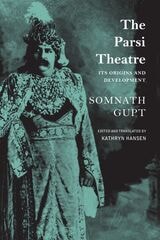
The Parsi Theatre
Its Origins and DevelopmentSomnath Gupt
Seagull Books, 2005
Unrivaled in its long-term impact, Parsi theater remains a crucial component of South Asia’s cultural heritage. Like vaudeville in America, Parsi theater dominated mass entertainment in colonial India in the era before cinema. Drawn by the magic of sight and sound, crowds filled the country’s urban playhouses each night. Marked by extravagant acting, operatic singing, and melodramatic stage effects, this cosmopolitan theater brought an unprecedented level of sophistication to the South Asian stage and transformed commercial drama into a modern industry, paving the way for Indian cinema. This volume presents Somnath Gupt’s classic history of Parsi theater in an English translation enhanced by illustrations, annotations, and appendices, which make it a more comprehensive and accurate reference work.
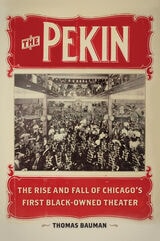
The Pekin
The Rise and Fall of Chicago's First Black-Owned TheaterThomas Bauman
University of Illinois Press, 2014
A missing chapter in African American theatrical history, Bauman's saga presents how Motts used his entrepreneurial acumen to create a successful black-owned enterprise. Concentrating on institutional history, Bauman explores the Pekin's philosophy of hiring only African American staff, its embrace of multi-racial upper class audiences, and its ready assumption of roles as diverse as community center, social club, and fundraising instrument.
The Pekin's prestige and profitability faltered after Motts' death in 1911 as his heirs lacked his savvy, and African American elites turned away from pure entertainment in favor of spiritual uplift. But, as Bauman shows, the theater had already opened the door to a new dynamic of both intra- and inter-racial theater-going and showed the ways a success, like the Pekin, had a positive economic and social impact on the surrounding community.
The Penelope Project
An Arts-Based Odyssey to Change Elder CareAnne Basting, Maureen Towey, and Ellie Rose
University of Iowa Press, 2016
At Milwaukee’s Luther Manor, a team of artists from the University of Wisconsin’s theatre department and Sojourn Theatre Company, university students, staff, residents, and volunteers traded their bingo cards for copies of The Odyssey. They embarked on a two-year project to examine this ancient story from the perspective of the hero who never left home: Penelope, wife of Odysseus. Together, the team staged a play that engaged everyone and transcended the limits not just of old age and disability but also youth, institutional regulations, and disciplinary boundaries.
Inviting readers to see through the eyes of residents, students, artists, staff, family members, and experts in the fields of education, long-term care, and civically engaged arts practice, this book underscores the essential role of the arts and humanities in living richly. Waiting, as Penelope waited, need not be a time of loss and neglect. The Penelope Project boldly dreams of how to make late life a time of growth and learning. If you dream of improving people’s lives through creative endeavors, this book provides practical advice.
The Performance Apparatus
On Ideological Production of BehaviorsBranislav Jakovljevic
University of Michigan Press, 2025
Jakovljević suggests that the centrality of behavior in early performance theory is important for the understanding of contemporary society, which is dominated by surveillance capitalism. If ideology is lodged in behaviors, and if surveillance capitalism thrives on the monetization of the behavioral surplus, then performance theory can make significant contributions to our understanding of the moment in which we live and the future we are facing. The Performance Apparatus argues for the importance of continuing attention to the question of ideology in contemporary, neoliberal order.
The Performance of Power
Theatrical Discourse and PoliticsSue-Ellen Case
University of Iowa Press, 1991
Recently in the field of theatre studies there has been an increasing amount of debate and dissonance regarding the borders of its territory, its methodologies, subject matter, and scholarly perspectives. The nature of this debate could be termed "political" and, in fact, concerns "the performance of power"—the struggle over power relations embedded in texts, methodologies, and the academy itself.
This striking new collection of nineteen divergent essays represents this performance of power and the way in which the recent convergence of new critical theories with historical studies has politicized the study of the theatre. Neither play text, performance, nor scholarship and teaching can safely reside any longer in the "free," politically neutral, self-signifying realm of the aesthetic. Politicizing theatrical discourse means that both the hermeneutics and the histories of theatre reveal the role of ideology and power dynamics.
New strategies and concepts—and a vital new phase of awareness—appear in these illuminating essays. A variety of historical periods, from the Renaissance through the Victorian and up to the most contemporary work of the Wooster group, illustrate the ways in which contemporary strategies do not require contemporary texts and performances but can combine with historical methods and subjects to produce new theatrical discourse.
The Philosopher's Toothache
Embodied Stoicism in Early Modern English DramaDonovan Sherman
Northwestern University Press, 2022
Informed by work in both classical philosophy and performance studies, Donovan Sherman argues that Stoicism infused the complex theatrical culture of early modern England. Plays written and performed during this period gave life to Stoic exercises that instructed audiences to cultivate their virtue, self-awareness, and creativity. By foregrounding Stoicism’s embodied nature, Sherman recovers a vital dimension too often lost in reductive portrayals of the Stoics by early modern writers and contemporary scholars alike. The Philosopher’s Toothache features readings of dramatic works by William Shakespeare, Cyril Tourneur, and John Marston alongside considerations of early modern adaptations of classical Stoics (Seneca, Epictetus, and Marcus Aurelius) and Neo-Stoics such as Justus Lipsius. These plays model Stoic virtues like unpredictability, indifference, vulnerability, and dependence—attributes often framed as negative but that can also rekindle a sense of responsible public action.
The Philosophical Actor
A Practical Meditation for Practicing Theatre ArtistsDonna Soto-Morettini
Intellect Books, 2010
There have been many books published on acting, actor training, and practical theories for preparing for a role, but none of these books have ever looked philosophically at the language and the concepts that we use when we talk about acting. The Philosophical Actor is the first attempt to grapple with the fundamental questions of truth, art, and human nature unexamined in past treatments, from the first great essay by Diderot to the exhaustive system described by Stanislavski. With wide appeal to actors, directors, acting students, acting teachers and trainers, Donna Soto-Morettini draws from twenty-five years of experience as an acting teacher and director to introduce innovative ways of thinking about acting.
The Place of the Stage
License, Play, and Power in Renaissance EnglandSteven Mullaney
University of Michigan Press, 1995
In this richly textured multidisciplinary work, Steven Mullaney examines the cultural situation of popular drama in Elizabethan and Jacobean England. Relying upon a dynamic model of cultural production, Mullaney defines an original and historically grounded perspective on the emergence of popular theater and illustrates the critical, revisionary role it played in the symbolic economy of Renaissance England. Combining literary, historical, and broadly conceived cultural analysis, he investigates, among other topics, the period's exhaustive "rehearsal" of other cultures and its discomfiting apprehensions of the self; the politics of vanished forums for ideological production such as the wonder-cabinet and the leprosarium; the cultural poetics of royal entries; and the incontinent, uncanny language of treason. As Mullaney demonstrates, Shakespearean drama relied upon and embodied the marginal license of the popular stage and, as a result, provides us with powerful readings of the shifting bases of power, license, and theatricality in Elizabethan and Jacobean England. "A major study, not merely of selected Shakespearean plays but of the very conditions of the possibility of Renaissance drama." --Louis Montrose, University of California, San Diego "Mullaney's rich and engaged reading of the place of Shakespeare's stage represents the texture of early modern life and its cultural productions in the vivid tradition of annales history and brilliantly exemplifies his theoretical call for a poetics of culture." -- Shakespeare Quarterly "Mullaney marshals an impressive range of cultural representations which, taken together, will undoubtedly force a reconsideration of the semiotics of the Elizabethan stage." --Times Higher Education Supplement ". . . something of a dramatic feat in cultural studies: literary critic Mullaney calls in a cast ranging from Clifford Geertz and Pierre Bourdieu to Raymond Williams, Mary Douglas, and Michel Foucault." --Contemporary Sociology.
The Player's Passion
Studies in the Science of ActingJoseph R. Roach
University of Michigan Press, 1993
The Plays of David Garrick, Volume 3
Garrick's Adaptations of Shakespeare, 1744 - 1756Edited by Harry William Pedicord and Fredrick Louis Bergmann
Southern Illinois University Press, 1981
David Garrick’s accomplishments as an actor, manager, and theatrical innovator brought him great fame and fortune, and his ideas influenced not only his own age but succeeding ages as well. Yet as a playwright, a part of the elegant combination of talents that was David Garrick, he has never achieved the critical reputation he richly deserves, in main because of the unavailability of texts and the lack of proper assessment of the historic importance of his plays in the English theatre.
This first complete edition makes available to scholars and students all the plays of Garrick in well edited texts, with commentary and notes.
Contents: Macbeth. A Tragedy, 1744; Romeo and Juliet, 1748; The Fairies. An Opera, 1755; Catherine and Petruchio. A Comedy, 1756; Florizel and Perdita. A Dramatic Pastoral, 1756; The Tempest. An Opera, 1756; and King Lear. A Tragedy, 1756.
The Plays of David Storey
A Thematic StudyBy William Hutchings
Southern Illinois University Press, 1988
This is the first comprehensive play-by-play analysis of the drama of David Storey, one of the most acclaimed and innovative, sometimes controversial, writers in the British theatre since World War II. Grouping the plays according to theme, Hutchings demonstrates that the central focus in the drama of David Storey is the devaluation of traditional rituals in contemporary life and the disintegration of the family. A playwright attuned to the poetry in the ordinary, to the profundity, subtle eloquence, and dramatic tension in the mundane, Storey explores the ways people cope, or fail to cope, with complexity, with uncertainty, with constant, bewildering flux. He writes about groups—families (In Celebration, The Farm), rugby teams (The Changing Room), and construction crews (The Contractor). In his plays, individuals seek to overcome isolation and integrate themselves into a significant assemblage that transcends the self.
Hutchings notes that Storey frequently deals with working-class parents who cannot "understand their grown children’s anxieties, their discontentedness with life, their unstable marriages, and their inability to enjoy the benefits of the education and advantages they labored so hard for so many years to provide."
Storey understands and sympathizes with parents who have paid to educate their children out of their own spheres. He saw it happen in his own family, knew the disapproval of his father: "What else could my father think when, nearing sixty, he came home each day from the pit exhausted, shattered by fatigue, to find me—a young man ideally physically equipped to do the job which now left him totally prostrated—painting a picture of flowers, or writing a poem about a cloud. There was, and there is, no hope of reconciliation."
Hutchings supplements his thematic analysis of Storey’s plays by interweaving into his text 90 percent of a major interview with the playwright, the only such comprehensive interview in existence. Storey, who believes that readers "ought to be chary of all interviews," discusses alleged literary influences on his work, the current state of British theatre, and his reactions to critics. He also provides insight into various productions and performances in his work.