4531 books match the query 'Cultural & Ethnic Studies' and 804 start with t

cover of The Eagle Has Eyes: The FBI Surveillance of César Estrada Chávez of the United Farm Workers Union of America, 1965–1975

The Eagle Has Eyes

The FBI Surveillance of César Estrada Chávez of the United Farm Workers Union of America, 1965–1975

José Angel Gutiérrez

Michigan State University Press, 2019

This book is the first of its kind to bring transparency to the FBI’s attempts to destroy the incipient Chicano Movement of the 1960s. While the activities of the deep state are current research topics, this has not always been the case. The role of the U.S. government in suppressing marginalized racial and ethnic minorities began to be documented with the advent of the Freedom of Information Act and most recently by disclosures of whistle blowers. This book utilizes declassified files from the FBI to investigate the agency’s role in thwarting Cesar E. Chavez’s efforts to build a labor union for farm workers and documents the roles of the FBI, California state police, and local police in assisting those who opposed Chavez. Ultimately, The Eagle Has Eyes is a must-read for academics and activists alike.
[more]
cover of The Early Black History Movement, Carter G. Woodson, and Lorenzo Johnston Greene

The Early Black History Movement, Carter G. Woodson, and Lorenzo Johnston Greene

Pero Gaglo Dagbovie

University of Illinois Press, 2007
Pero Gaglo Dagbovie examines the lives, works, and contributions of two of the most important figures of the early black history movement, Carter G. Woodson and Lorenzo Johnston Greene. Drawing on the two men's personal papers as well as the materials of the Association for the Study of Negro Life and History (ASNLH), Dagbovie probes the struggles, sacrifices, and achievements of the black history pioneers and offers the first major examination of Greene's life. Equally important, it also addresses a variety of overlooked issues pertaining to Woodson, including the historian's image in popular and scholarly writings and memory, the democratic approach of the ASNLH, and the pivotal role women played in the association.
[more]
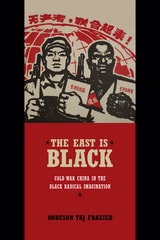
cover of The East Is Black: Cold War China in the Black Radical Imagination

The East Is Black

Cold War China in the Black Radical Imagination

Robeson Taj Frazier

Duke University Press, 2015

During the Cold War, several prominent African American radical activist-intellectuals—including W.E.B. and Shirley Graham Du Bois, journalist William Worthy, Marxist feminist Vicki Garvin, and freedom fighters Mabel and Robert Williams—traveled and lived in China. There, they used a variety of media to express their solidarity with Chinese communism and to redefine the relationship between Asian struggles against imperialism and black American movements against social, racial, and economic injustice. In The East Is Black, Taj Frazier examines the ways in which these figures and the Chinese government embraced the idea of shared struggle against U.S. policies at home and abroad. He analyzes their diverse cultural output (newsletters, print journalism, radio broadcasts, political cartoons, lectures, and documentaries) to document how they imagined communist China’s role within a broader vision of a worldwide anticapitalist coalition against racism and imperialism.
[more]
cover of The Echoes of Trauma: An Oral Historical Study on the Impact of the World War II Mass Incarceration on the Health of Japanese Americans

The Echoes of Trauma

An Oral Historical Study on the Impact of the World War II Mass Incarceration on the Health of Japanese Americans

Gwenn M. Jensen

University Press of Colorado, 2026

In Echoes of Trauma, medical anthropologist Gwenn Jensen traces the longitudinal ramifications of racism, the chronic stress of imprisonment in concentration camps, and widespread healthcare inadequacies on the well-being of Japanese American Nisei during WWII and beyond.

Based on ninety oral history interviews conducted between 1995 and 2005, Jensen’s work uncovers long-term health impacts on former incarcerees, relating personal stories of Japanese Americans with archival corroboration of their traumatic experiences of having been made prisoners in their own land. These memories illuminate the betrayal and lifelong consequences of imprisonment not only on physical and psychological health but also including intergenerational trauma passed on to subsequent generations. Echoes of Trauma details these short- and long-term health effects and records the stories of these Americans for posterity.

In the wake of the current political climate, with echoes of this past reverberating, the reexamination of Japanese American incarceration undertaken here underscores the importance of comprehending the fallout from incomprehensible injustice visited upon innocent and law-abiding citizens.
[more]
cover of The Economic Development of Manchuria: The Rise of a Frontier Economy

The Economic Development of Manchuria

The Rise of a Frontier Economy

Kang Chao

University of Michigan Press, 1983
The economic development of Manchuria holds special fascination, since within the compass of a limited area and a self-contained time span of about one hundred years—between 1860 and 1960—we witness three different types of development patterns, based on three alternative sources of economic growth. The first and longest period, extending roughly from 1860 to 1930, was based on the development of an open frontier, the settlement of a new region. Application of the staple theory of growth to Manchurian conditions can help to illuminate the character of the growth process during this first period. In this connection the Manchurian development case invites comparison with growth processes in other newly settled regions, for example, the US, Canada, and Australia. [1]
[more]
cover of The Economy of Communist China, 1949–1969

The Economy of Communist China, 1949–1969

Cheng Chu-yuan

University of Michigan Press, 1971
Economic development in mainland China during the first two decades of Communist control provides a typical example for the difficult task to transform a vast underdeveloped agrarian economy into a modern industrial one. In the first half of this period, a series of massive transformations of social and economic institutions was accompanied by a drafted industrialization program; the result was an impressive speed-up in economic growth. The second decade witnessed an economic crisis (1960–62) and a political upheaval (1966–68). These disruptions marred the economic performance over the period as a whole. Consequently, the long-term growth rate appears to have been only moderate.
The Economy of Communist China reviews selected aspects of the economy. After examining the development strategy, it analyzes the quantitative trends and the structural changes. The book goes on to analyze the key factors contributing to the earlier growth and the elements responsible for the later disruption and finally assesses the impact of the Cultural Revolution on the Chinese economy and the prospects of the current Third Five-Year Plan.
The text includes a bibliography of selected materials on Chinese economic development.
[more]
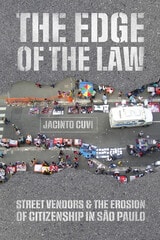
cover of The Edge of the Law: Street Vendors and the Erosion of Citizenship in São Paulo

The Edge of the Law

Street Vendors and the Erosion of Citizenship in São Paulo

Jacinto Cuvi

University of Chicago Press, 2025

How street vendors tangle with the law in São Paulo, Brazil.
 
With a little initiative and very little startup money, an outgoing individual might sell you a number of delights and conveniences familiar to city dwellers—from cold water bottles while you’re sitting in traffic to a popsicle from a cart on a summer afternoon in the park. Such vendors form a significant share of the workforce in São Paulo, Brazil, but their ubiquity belies perpetual struggle. Some have the right to practice their trade; others do not. All of them strive to make it—or stay afloat.
 
In The Edge of the Law, sociologist Jacinto Cuvi introduces us to the world of street vendors and teases out the relationship between the construction of legality and the experience of citizenship. As São Paulo’s city government undertakes a large-scale plan to cancel street vending licenses and evict street vendors, Cuvi reveals how the rights of informal workers can be revoked or withheld and how the lines can be redrawn between work that is “legal” and work that takes place under constant fear of law enforcement. Alongside the mechanics of disenfranchisement, Cuvi captures the lived experience of criminalization, dissecting the distribution of (shallow) rights among vendors who continually reinvent strategies to eke out a living while dealing with the constraints and pressures of informal citizenship at the edge of the law.
 
[more]
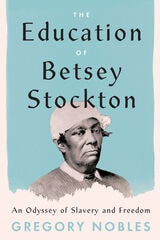
cover of The Education of Betsey Stockton: An Odyssey of Slavery and Freedom

The Education of Betsey Stockton

An Odyssey of Slavery and Freedom

Gregory Nobles

University of Chicago Press, 2022

A perceptive and inspiring biography of an extraordinary woman born into slavery who, through grit and determination, became a historic social and educational leader.
                          
The life of Betsey Stockton (ca. 1798–1865) is a remarkable story of a Black woman’s journey from slavery to emancipation, from antebellum New Jersey to the Hawai‘ian Islands, and from her own self-education to a lifetime of teaching others—all told against the backdrop of the early United States’ pervasive racism. It’s a compelling chronicle of a critical time in American history and a testament to the courage and commitment of a woman whose persistence grew into a potent form of resistance.

When Betsey Stockton was a child, she was “given, as a slave” to the household of Rev. Ashbel Green, a prominent pastor and later the president of what is now Princeton University. Although she never went to school, she devoured the books in Green’s library. After being emancipated, she used that education to benefit other people of color, first in Hawai‘i as a missionary, then Philadelphia, and, for the last three decades of her life, Princeton—a college town with a genteel veneer that never fully hid its racial hostility. Betsey Stockton became a revered figure in Princeton’s sizeable Black population, a founder of religious and educational institutions, and a leader engaged in the day-to-day business of building communities.

In this first book-length telling of Betsey Stockton’s story, Gregory Nobles illuminates both a woman and her world, following her around the globe, and showing how a determined individual could challenge her society’s racial obstacles from the ground up. It’s at once a revealing lesson on the struggles of Stockton’s times and a fresh inspiration for our own.
[more]
cover of The Education of a WASP

The Education of a WASP

Lois M. Stalvey

University of Wisconsin Press, 1989

Brimming with honestly and passion, The Education of a WASP chronicles one white woman's discovery of racism in 1960s America. First published in 1970 and highly acclaimed by reviewers, Lois Stalvey's account is as timely now as it was then. Nearly twenty years later, with ugly racial incidents occurring on college campuses, in neighborhoods, and in workplaces everywhere, her account of personal encounters with racism remains deeply disturbing. Educators and general readers interested in the subtleties of racism will find the story poignant, revealing, and profoundly moving.

“Delightful and horrible, a singular book.” —Choice

“An extraordinarily honest and revealing book that poses the issue: loyalty to one’s ethnic group or loyalty to conscience.” —Publishers Weekly
[more]
cover of The Elaine Massacre and Arkansas: A Century of Atrocity and Resistance, 1819-1919

The Elaine Massacre and Arkansas

A Century of Atrocity and Resistance, 1819-1919

Guy Lancaster

Butler Center for Arkansas Studies, 2018

Although it occurred nearly a century ago, the Elaine Massacre of 1919 remains the subject of intense inquiry as historians try to answer a multitude of questions, such as why authorities in the Arkansas Delta used such overwhelming violence to put down a farmers’ union, exactly how many people were killed in the massacre, and how the event shaped the following century.

We cannot fully understand what happened at Elaine without examining the one hundred years leading up to the massacre. An analysis of the years from 1819, when Arkansas officially became an American territory, to 1919 provides the historical foundation for understanding one of the bloodiest manifestations of racial violence in U.S. history.
During the antebellum years, slaveholders grew paranoid about possible “insurrections,” and after the Civil War and Emancipation, these fears lingered and led to numerous atrocities long before Elaine. At the same time, African Americans—particularly fieldworkers—worked to organize themselves to resist oppression, setting the stage for the farmers’ union that was the target for mob and military wrath during the Elaine Massacre.

These essays provide the larger history necessary for understanding what happened at Elaine in 1919—and thus provide a window into the current state of Arkansas and the nation at large. Contributors include Richard Buckelew, Nancy Snell Griffith, Matthew Hild, Adrienne Jones, Kelly Houston Jones, Cherisse Jones-Branch, Brian K. Mitchell, William H. Pruden III, and Steven Teske.

[more]
cover of The Ellis Island Snow Globe

The Ellis Island Snow Globe

Erica Rand

Duke University Press, 2005

In The Ellis Island Snow Globe, Erica Rand, author of the smart and entertaining book Barbie’s Queer Accessories, takes readers on an unconventional tour of Ellis Island, the migration station turned heritage museum, and its neighbor, the Statue of Liberty. By pausing to reflect on what is and is not on display at these two iconic national monuments, Rand focuses attention on whose heritage is honored and whose obscured. She also reveals the shifting connections between sex, money, material products, and ideas of the nation in everything from the ostensible father-mother-child configuration on an Ellis Island golf ball purchased at the gift shop to the multi-million dollar July 4, 1986 Liberty Weekend extravaganza celebrating the Statue’s centennial just days after the Supreme Court’s un-Libertylike decision upholding the antisodomy laws challenged in Bowers v. Hardwick.

Rand notes that portrayals of the Statue of Liberty as a beacon for immigrants tend to suppress the Statue’s connections to people brought to this country by force. She examines what happened to migrants at Ellis Island whose bodies did not match the gender suggested by the clothing they wore. In light of contemporary ideas about safety and security, she examines the “Decide an Immigrant’s Fate” program, which has visitors to Ellis Island act as a 1910 board of inspectors hearing the appeal of an immigrant about to be excluded from the country. Rand is a witty, insightful, and open-minded tour guide, able to synthesize numerous diverse ideas—about tourism, immigration history, sexuality, race, ethnicity, commodity culture, and global capitalism—and to candidly convey her delight in her Ellis Island snow globe. And pen. And lighter. And back scratcher. And golf ball. And glittery pink key chain.
[more]
cover of The Elsewhere Is Black: Ecological Violence and Improvised Life

The Elsewhere Is Black

Ecological Violence and Improvised Life

Marisa Solomon

Duke University Press, 2025
In The Elsewhere Is Black, Marisa Solomon examines how waste is a mundane part of poor Black survival and a condition of settler colonial racial capitalism. Tracing the flow of trash and waste across Black spaces, from Brooklyn’s historically Black Bedford-Stuyvesant to the post-plantation towns of Virginia’s Tidewater, Solomon contends that waste infrastructures concentrate environmental risk in an elsewhere that is routinely Black. Solomon emphasizes that ecological violence is a form of racialized heteropatriarchal environmental control that upholds whiteness as a propertied way of life and criminalizes Black survival. As she points to acute sites of toxicity, Solomon theorizes the relationship between the devaluation of land and Black and more-than-human life to reveal how the risks of poisoning, police violence, dispossession, and poverty hold Black life captive. Locating Black survival as a site from which alternative eco-political imaginations spring, she foregrounds how people live and dream amidst waste’s daily accumulation. Solomon opens new ecological horizons to ask: What forms of environmentalism emerge when Black un/freedom has never been distant from waste?
[more]
cover of The Emancipation Circuit: Black Activism Forging a Culture of Freedom

The Emancipation Circuit

Black Activism Forging a Culture of Freedom

Thulani Davis

Duke University Press, 2022

In The Emancipation Circuit Thulani Davis provides a sweeping rethinking of Reconstruction by tracing how the four million people newly freed from bondage created political organizations and connections that mobilized communities across the South. Drawing on the practices of community they developed while enslaved, freedpeople built new settlements and created a network of circuits through which they imagined, enacted, and defended freedom. This interdisciplinary history shows that these circuits linked rural and urban organizations, labor struggles, and political culture with news, strategies, education, and mutual aid. Mapping the emancipation circuits, Davis shows the geography of ideas of freedom---circulating on shipping routes, via army maneuvers, and with itinerant activists---that became the basis for the first mass Black political movement for equal citizenship in the United States. In this work, she reconfigures understandings of the evolution of southern Black political agendas while outlining the origins of the enduring Black freedom struggle from the Jim Crow era to the present.
[more]
cover of The Emigrants

The Emigrants

George Lamming

University of Michigan Press, 1994

The Emigrants is an elaborately conceived novel, dense with dynamic characters and evocative details. First published in 1954, it focuses initially on the emigrant journey, then on the settling-in process. The journey by sea and subsequent attempts at resettlement provide the fictional framework for Lamming's exploration of the alienation and displacement caused by colonialism.

This is the epic journey of a group of West Indians who emigrate to Great Britain in the 1950s in search of educational opportunities unattainable at home. Seeking to redefine themselves in the "mother country," an idealized landscape that they have been taught to revere, the emigrants settle uncomfortably in England's industrial cities. Within two years, ghettoization is firmly in place. The emigrants discover the meaning of their marginality in the British Empire in an environment that is unexpectedly hostile and strange. For some, alienation prompts a new sense of community, a new sense of identity as West Indians. For others, alienation leads to a crisis of confrontation with the law and fugitive status.

There is a wealth of information here about the genesis of the black British community and about the cultural differences between the black British and West Indian/Caribbean.
[more]
cover of The Emperor’s New Epistemology: Music, Empire, and Empiricism in Early Modern China

The Emperor’s New Epistemology

Music, Empire, and Empiricism in Early Modern China

Lester Hu

University of Chicago Press, 2027

An innovative account of listening and empire-building in 17th- and 18th-century China.

The Emperor’s New Epistemology explores how listening shaped knowledge and empire-building in seventeenth- and eighteenth-century China. As the Manchu dynasty expanded deep into Inner Asian territories deemed foreign by the majority-Han population, the Qing Empire’s musical culture encompassed the sounds of Mongols, Uyghurs, and Tibetans, as well as Western music brought by Jesuit and other Christian missionaries. Lester Hu reveals that this diversity transformed not only Qing court culture but the very grounds on which knowledge and power could be established.

In one revealing episode from 1692, the Kangxi Emperor (1654–1722) misinterpreted a key term of Classical Chinese music after studying European music with the Jesuits. Hu situates this anecdote within the political, social, and epistemic shifts that transformed late-imperial China. As Hu shows, listening was an instrument of Qing imperial authority: Knowledge about music, language, and even the universe could only be verified through the emperor’s ears. Furthermore, listening facilitated new theories of empirical knowledge, which both lent themselves to Qing-imperial ideology and generated new epistemic tensions. By exploring their echoes in similar shifts in early modern Europe, Hu’s book brings a global perspective to the study of music in the early modern world and reconsiders the transcendental ground on which such comparative and intercultural knowledge is possible.
[more]
cover of The End of American Lynching

The End of American Lynching

Ashraf H. A. Rushdy

Rutgers University Press, 2012

The End of American Lynching questions how we think about the dynamics of lynching, what lynchings mean to the society in which they occur, how lynching is defined, and the circumstances that lead to lynching. Ashraf H. A. Rushdy looks at three lynchings over the course of the twentieth century—one in Coatesville, Pennsylvania, in 1911, one in Marion, Indiana, in 1930, and one in Jasper, Texas, in 1998—to see how Americans developed two distinct ways of thinking and talking about this act before and after the 1930s.

One way takes seriously the legal and moral concept of complicity as a way to understand the dynamics of a lynching; this way of thinking can give us new perceptions into the meaning of mobs and the lynching photographs in which we find them. Another way, which developed in the 1940s and continues to influence us today, uses a strategy of denial to claim that lynchings have ended. Rushdy examines how the denial of lynching emerged and developed, providing insight into how and why we talk about lynching the way we do at the dawn of the twenty-first century.  In doing so, he forces us to confront our responsibilities as American citizens and as human beings.
[more]
cover of The End of White World Supremacy: Black Internationalism and the Problem of the Color Line

The End of White World Supremacy

Black Internationalism and the Problem of the Color Line

Roderick Bush

Temple University Press, 2009

The End of White World Supremacy explores a complex issue— integration of Blacks into White America—from multiple perspectives: within the United States, globally, and in the context of movements for social justice. Roderick Bush locates himself within a tradition of African American activism that goes back at least to W.E.B. Du Bois. In so doing, he communicates between two literatures—worldsystems analysis and radical Black social movement history—and sustains the dialogue throughout the book.

Bush explains how racial troubles in the U.S. are symptomatic of the troubled relationship between the white and dark worlds globally. Beginning with an account of white European dominance leading to capitalist dominance by White America, The End of White World Supremacy ultimately wonders whether, as Myrdal argued in the 1940s, the American creed can provide a pathway to break this historical conundrum and give birth to international social justice.
[more]
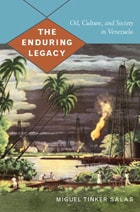
cover of The Enduring Legacy: Oil, Culture, and Society in Venezuela

The Enduring Legacy

Oil, Culture, and Society in Venezuela

Miguel Tinker Salas

Duke University Press, 2009

Oil has played a major role in Venezuela’s economy since the first gusher was discovered along Lake Maracaibo in 1922. As Miguel Tinker Salas demonstrates, oil has also transformed the country’s social, cultural, and political landscapes. In The Enduring Legacy, Tinker Salas traces the history of the oil industry’s rise in Venezuela from the beginning of the twentieth century, paying particular attention to the experiences and perceptions of industry employees, both foreign and Venezuelan. He reveals how class ambitions and corporate interests combined to reshape many Venezuelans’ ideas of citizenship. Middle-class Venezuelans embraced the oil industry from the start, anticipating that it would transform the country by introducing modern technology, sparking economic development, and breaking the landed elites’ stranglehold. Eventually Venezuelan employees of the industry found that their benefits, including relatively high salaries, fueled loyalty to the oil companies. That loyalty sometimes trumped allegiance to the nation-state.

North American and British petroleum companies, seeking to maintain their stakes in Venezuela, promoted the idea that their interests were synonymous with national development. They set up oil camps—residential communities to house their workers—that brought Venezuelan employees together with workers from the United States and Britain, and eventually with Chinese, West Indian, and Mexican migrants as well. Through the camps, the companies offered not just housing but also schooling, leisure activities, and acculturation into a structured, corporate way of life. Tinker Salas contends that these practices shaped the heart and soul of generations of Venezuelans whom the industry provided with access to a middle-class lifestyle. His interest in how oil suffused the consciousness of Venezuela is personal: Tinker Salas was born and raised in one of its oil camps.
[more]
cover of The Enigma of Diversity: The Language of Race and the Limits of Racial Justice

The Enigma of Diversity

The Language of Race and the Limits of Racial Justice

Ellen Berrey

University of Chicago Press, 2015

Diversity these days is a hallowed American value, widely shared and honored. That’s a remarkable change from the Civil Rights era—but does this public commitment to diversity constitute a civil rights victory? What does diversity mean in contemporary America, and what are the effects of efforts to support it?

Ellen Berrey digs deep into those questions in The Enigma of Diversity. Drawing on six years of fieldwork and historical sources dating back to the 1950s and making extensive use of three case studies from widely varying arenas—housing redevelopment in Chicago’s Rogers Park neighborhood, affirmative action in the University of Michigan’s admissions program, and the workings of the human resources department at a Fortune 500 company—Berrey explores the complicated, contradictory, and even troubling meanings and uses of diversity as it is invoked by different groups for different, often symbolic ends. In each case, diversity affirms inclusiveness, especially in the most coveted jobs and colleges, yet it resists fundamental change in the practices and cultures that are the foundation of social inequality. Berrey shows how this has led racial progress itself to be reimagined, transformed from a legal fight for fundamental rights to a celebration of the competitive advantages afforded by cultural differences.

Powerfully argued and surprising in its conclusions, The Enigma of Diversity reveals the true cost of the public embrace of diversity: the taming of demands for racial justice.

[more]
cover of The Erotic Life of Racism

The Erotic Life of Racism

Sharon Patricia Holland

Duke University Press, 2012

A major intervention in the fields of critical race theory, black feminism, and queer theory, The Erotic Life of Racism contends that theoretical and political analyses of race have largely failed to understand and describe the profound ordinariness of racism and the ways that it operates as a quotidian practice. If racism has an everyday life, how does it remain so powerful and yet mask its very presence? To answer this question, Sharon Patricia Holland moves into the territory of the erotic, understanding racism's practice as constitutive to the practice of racial being and erotic choice.

Reemphasizing the black/white binary, Holland reinvigorates critical engagement with race and racism. She argues that only by bringing critical race theory, queer theory, and black feminist thought into conversation with each other can we fully envision the relationship between racism and the personal and political dimensions of our desire. The Erotic Life of Racism provocatively redirects our attention to a desire no longer independent of racism but rather embedded within it.
[more]
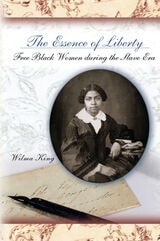
cover of The Essence of Liberty: Free Black Women During the Slave Era

The Essence of Liberty

Free Black Women During the Slave Era

Wilma King

University of Missouri Press, 2006

Before 1865, slavery and freedom coexisted tenuously in America in an environment that made it possible not only for enslaved women to become free but also for emancipated women to suddenly lose their independence. Wilma King now examines a wide-ranging body of literature to show that, even in the face of economic deprivation and draconian legislation, many free black women were able to maintain some form of autonomy and lead meaningful lives.

The Essence of Liberty blends social, political, and economic history to analyze black women’s experience in both the North and the South, from the colonial period through emancipation. Focusing on class and familial relationships, King examines the myriad sources of freedom for black women to show the many factors that, along with time spent in slavery before emancipation, shaped the meaning of freedom. Her book also raises questions about whether free women were bound to or liberated from gender conventions of their day.

Drawing on a wealth of untapped primary sources—not only legal documents and newspapers but also the diaries, letters, and autobiographical writings of free women—King opens a new window on the world of black women. She examines how they became free, educated themselves, found jobs, maintained self-esteem, and developed social consciousness—even participating in the abolitionist movement. She considers the stance of southern free women toward their enslaved contemporaries and the interactions between previously free and newly freed women after slavery ended. She also looks closely at women’s spirituality, disclosing the dilemma some women faced when they took a stand against men—even black men—in order to follow their spiritual callings.

Throughout this engaging history, King underscores the pernicious constraints that racism placed on the lives of free blacks in spite of the fact that they were not enslaved. The Essence of Liberty shows the importance of studying these women on their own terms, revealing that the essence of freedom is more complex than the mere absence of shackles.

[more]
cover of The Essential Senghor: African Philosophy and Black Aesthetics

The Essential Senghor

African Philosophy and Black Aesthetics

Léopold Sédar Senghor. Edited and Translated by Doyle D. Calhoun, Alioune B. Fall, and Cheikh Thiam.

Duke University Press, 2026
Senegalese poet, philosopher, and politician Leopold Sédar Senghor, together with Aimé Césaire and others, developed the influential and perennially relevant negritude movement—a Black artistic, philosophical, and political expression of Black presence in the modern colonial world. The Essential Senghor provides a new opportunity for English-language readers to engage with Senghor’s critical and philosophical writings spanning from 1937 to 1985. This collection includes Senghor’s key philosophical interventions in discourses on freedom, Blackness and being, humanism, history, and more. It portrays Senghor as a pivotal intellectual in the fields of African and Black studies whose work engages a wide range of disciplines, including literature, linguistics, anthropology, religion, and art history. The Essential Senghor invites readers not only to reflect on negritude and its importance for our political present, but also to reconsider intellectual genealogies of decolonial thought, Black liberation, and African philosophy.
[more]
cover of The Experience of Modernity: Chinese Autobiography of the Early Twentieth Century

The Experience of Modernity

Chinese Autobiography of the Early Twentieth Century

Janet Ng

University of Michigan Press, 2003
Autobiography of the first half of the twentieth century was used variously by different groups of writers to interrogate, negotiate, and even to program the social and political progress of China. However, despite the popularity and success of this genre, it has also been the most forgotten in literary and historical discussions. Personal stories and individual expressions seem to have had no place in 1920s, 1930s, and 1940s China, smothered instead by the grander rhetoric of nationalism. For this reason, autobiography's popularity during the era is an odd phenomenon and also an important genre for study.
The May Fourth Era (1917-40) began as a movement to make the classical literary language accessible to the common people and became a broader political movement against imperialism. The writing of autobiography was influenced by the idea of literature's social and political mission, yet at the same time autobiography was a uniquely potent venue for individual expression. Janet Ng examines this notion in The Experience of Modernity within the framework of autobiographical writings by Chen Hengzhe, Lu Xun, Hu Shi, Xie Bingying, Xiao Hong, Eileen Chang, Yu Dafu, and Shen Congwen.
Janet Ng is Assistant Professor of Asian Literature, the College of Staten.
[more]
cover of The Extinction of Menai: A Novel

The Extinction of Menai

A Novel

Chuma Nwokolo

Ohio University Press, 2017
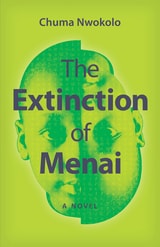
In the early 1980s, a pharmaceutical company administers an unethical drug trial to residents of the Niger Delta village of Kreektown. When children die as a result of the trial, the dominoes of language extinction and cultural collapse begin to topple. Decades later the end looms for the Menai people. Continents-apart twin brothers separated at birth, an excommunicated daughter living an urbane life with her doctor husband, and an infamous vigilante are among the indelible characters whose lives are shaped by this collective tragedy. Not least of these is the spiritual leader Mata Nimito, who retraces his people’s ancient migration on his quest to preserve the soul of the Menai and resolve the consequences of a centuries-old betrayal. In The Extinction of Menai, Chuma Nwokolo moves across time and continents to deliver a story that speaks to urgent contemporary concerns. He confronts power relations between large corporations and small communities, corporate lobbies and governments, and big pharma and consumers, all expressed through the competing narratives that record the life and death of a civilization.In a novel of stunning scope, Chuma Nwokolo moves across time and place to deliver a story that speaks to urgent contemporary concerns. His characters’ indelible voices offer perspectives that are simultaneously global, political, and intimately human.
[more]
cover of The Fabric of Resistance: Textile Workshops and the Rise of Rebellious Landscapes in Colonial Peru

The Fabric of Resistance

Textile Workshops and the Rise of Rebellious Landscapes in Colonial Peru

Di Hu

University of Alabama Press, 2022

Textiles as sites of power, production, and rebellion in the early modern Andes.

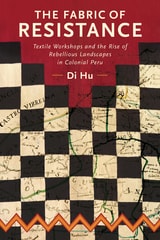
The Fabric of Resistance: Textile Workshops and the Rise of Rebellious Landscapes in Colonial Peru documents the impact of Spanish colonial institutions of labor on identity and social cohesion in Peru. Through archaeological and historical lines of evidence, Di Hu examines the long-term social conditions that enabled the large-scale rebellions in the late Spanish colonial period in Peru. Hu argues that ordinary people from different backgrounds pushed back against the top-down identity categories imposed by the Spanish colonial government and in the process created a cosmopolitan social landscape that later facilitated broader rebellion.

Hu’s case study is Pomacocha, the site of an important Spanish colonial hacienda (agricultural estate) and obraje (textile workshop). At its height, the latter had more than one hundred working families and sold textiles all over the Andes. Through analysis of this site, Hu explores three main long-term causes of rebellions against Spanish oppression. First, the Spanish colonial economy provided motivation and the social spaces for intercaste (indigenous, African, and mestizo) mixing at textile workshops. Second, new hybrid cultural practices and political solidarity arose there that facilitated the creation of new rebellious identities. Third, the maturation in the eighteenth century of popular folklore that reflected the harsh nature of Spanish labor institutions helped workers from diverse backgrounds gain a systemic understanding of exploitation.

This study provides a fresh archaeological and historical perspectives on the largest and most cosmopolitan indigenous-led rebellions of the Americas. Hu interweaves analyses of society at multiple scales including fine-grained perspectives of social networks, demography, and intimate details of material life in the textile workshop. She examines a wide range of data sources including artifacts, food remains, architectural plans, account books, censuses, court documents, contracts, maps, and land title disputes.
 

[more]
cover of The Face of Peace: Government Pedagogy amid Disinformation in Colombia

The Face of Peace

Government Pedagogy amid Disinformation in Colombia

Gwen Burnyeat

University of Chicago Press, 2022

A multi-scale ethnography of government pedagogy in Colombia and its impact on peace. 

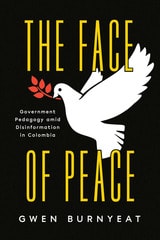
Colombia’s 2016 peace agreement with the FARC guerrillas sought to end fifty years of war and won President Juan Manuel Santos the Nobel Peace Prize. Yet Colombian society rejected it in a polarizing referendum, amid an emotive disinformation campaign. Gwen Burnyeat joined the Office of the High Commissioner for Peace, the government institution responsible for peace negotiations, to observe and participate in an innovative “peace pedagogy” strategy to explain the agreement to Colombian society. Burnyeat’s multi-scale ethnography reveals the challenges government officials experienced communicating with skeptical audiences and translating the peace process for public opinion. She argues that the fatal flaw in the peace process lay in government-society relations, enmeshed in culturally liberal logics and shaped by the politics of international donors. The Face of Peace offers the Colombian case as a mirror to the global crisis of liberalism, shattering the fantasy of rationality that haunts liberal responses to “post-truth” politics.
[more]
cover of The Feeling of Kinship: Queer Liberalism and the Racialization of Intimacy

The Feeling of Kinship

Queer Liberalism and the Racialization of Intimacy

David L. Eng

Duke University Press, 2010

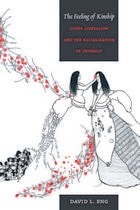
In The Feeling of Kinship, David L. Eng investigates the emergence of “queer liberalism”—the empowerment of certain gays and lesbians in the United States, economically through an increasingly visible and mass-mediated queer consumer lifestyle, and politically through the legal protection of rights to privacy and intimacy. Eng argues that in our “colorblind” age the emergence of queer liberalism is a particular incarnation of liberal freedom and progress, one constituted by both the racialization of intimacy and the forgetting of race. Through a startling reading of Lawrence v. Texas, the landmark legal decision overturning Texas’s antisodomy statute, Eng reveals how the ghosts of miscegenation haunt both Lawrence and the advent of queer liberalism.

Eng develops the concept of “queer diasporas” as a critical response to queer liberalism. A methodology drawing attention to new forms of family and kinship, accounts of subjects and subjectivities, and relations of affect and desire, the concept differs from the traditional notions of diaspora, theories of the nation-state, and principles of neoliberal capitalism upon which queer liberalism thrives. Eng analyzes films, documentaries, and literature by Asian and Asian American artists including Wong Kar-wai, Monique Truong, Deann Borshay Liem, and Rea Tajiri, as well as a psychoanalytic case history of a transnational adoptee from Korea. In so doing, he demonstrates how queer Asian migrant labor, transnational adoption from Asia, and the political and psychic legacies of Japanese internment underwrite narratives of racial forgetting and queer freedom in the present. A focus on queer diasporas also highlights the need for a poststructuralist account of family and kinship, one offering psychic alternatives to Oedipal paradigms. The Feeling of Kinship makes a major contribution to American studies, Asian American studies, diaspora studies, psychoanalysis, and queer theory.
[more]
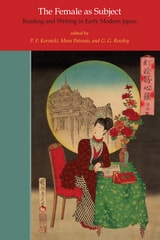
cover of The Female as Subject: Reading and Writing in Early Modern Japan

The Female as Subject

Reading and Writing in Early Modern Japan

P. F. Kornicki, Mara Patessio, and G. G. Rowley, Editors

University of Michigan Press, 2010
The Female as Subject presents 11 essays by an international group of scholars from Europe, Japan, and North America examining what women of different social classes read, what books were produced specifically for women, and the genres in which women themselves chose to write. The authors explore the different types of education women obtained and the levels of literacy they achieved, and they uncover women’s participation in the production of books, magazines, and speeches. The resulting depiction of women as readers and writers is also enhanced by thirty black-and-white illustrations.
For too long, women have been largely absent from accounts of cultural production in early modern Japan. By foregrounding women, the essays in this book enable us to rethink what we know about Japanese society during these centuries. The result is a new history of women as readers, writers, and culturally active agents.
The Female as Subject is essential reading for all students and teachers of Japan during the Edo and Meiji periods. It also provides valuable comparative data for scholars of the history of literacy and the book in East Asia.
[more]
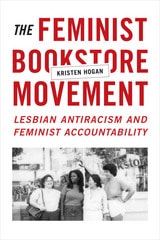
cover of The Feminist Bookstore Movement: Lesbian Antiracism and Feminist Accountability

The Feminist Bookstore Movement

Lesbian Antiracism and Feminist Accountability

Kristen Hogan

Duke University Press, 2016
From the 1970s through the 1990s more than one hundred feminist bookstores built a transnational network that helped shape some of feminism's most complex conversations. KA Hogan traces the feminist bookstore movement's rise and eventual fall, restoring its radical work to public feminist memory. The bookwomen at the heart of this story—mostly lesbians and including women of color—measured their success not by profit, but by developing theories and practices of lesbian antiracism and feminist accountability. At bookstores like BookWoman in Austin, the Toronto Women’s Bookstore, and Old Wives’ Tales in San Francisco, and in the essential Feminist Bookstore News, bookwomen changed people’s lives and the world. In retelling their stories, Hogan not only shares the movement's tools with contemporary queer antiracist feminist activists and theorists, she gives us a vocabulary, strategy, and legacy for thinking through today's feminisms.
 
[more]
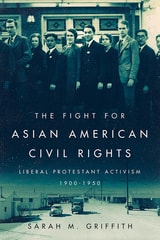
cover of The Fight for Asian American Civil Rights: Liberal Protestant Activism, 1900-1950

The Fight for Asian American Civil Rights

Liberal Protestant Activism, 1900-1950

Sarah M Griffith

University of Illinois Press, 2018
From the early 1900s, liberal Protestants grafted social welfare work onto spiritual concerns on both sides of the Pacific. Their goal: to forge links between whites and Asians that countered anti-Asian discrimination in the United States. Their test: uprooting racial hatreds that, despite their efforts, led to the shameful incarceration of Japanese Americans in World War II. Sarah M. Griffith draws on the experiences of liberal Protestants, and the Young Men's Christian Association in particular, to reveal the intellectual, social, and political forces that powered this movement. Engaging a wealth of unexplored primary and secondary sources, Griffith explores how YMCA leaders and their partners in the academy and distinct Asian American communities labored to mitigate racism. The alliance's early work, based in mainstream ideas of assimilation and integration, ran aground on the Japanese exclusion law of 1924. Yet their vision of Christian internationalism and interracial cooperation maintained through the World War II internment trauma. As Griffith shows, liberal Protestants emerged from that dark time with a reenergized campaign to reshape Asian-white relations in the postwar era.
[more]
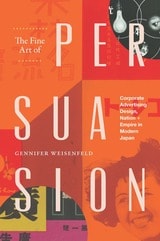
cover of The Fine Art of Persuasion: Corporate Advertising Design, Nation, and Empire in Modern Japan

The Fine Art of Persuasion

Corporate Advertising Design, Nation, and Empire in Modern Japan

Gennifer Weisenfeld

Duke University Press, 2025
Commercial art is more than just mass-produced publicity; it constructs social and political ideologies that impact the public’s everyday life. In The Fine Art of Persuasion, Gennifer Weisenfeld examines the evolution of Japanese advertising graphic design from the early 1900s through the 1964 Tokyo Olympics, a pivotal design event that rebranded Japan on the world stage. Through richly illustrated case studies, Weisenfeld tells the story of how modern corporations and consumer capitalism transformed Japan’s visual culture and artistic production across the pre- and postwar periods, revealing how commercial art helped constitute the ideological formations of nation- and empire-building. Weisenfeld also demonstrates, how under the militarist regime of imperial Japan, national politics were effectively commodified and marketed through the same mechanisms of mass culture that were used to promote consumer goods. Using a multilayered analysis of the rhetorical intentions of design projects and the context of their production, implementation, and consumption, Weisenfeld offers an interdisciplinary framework that illuminates the importance of Japanese advertising design within twentieth-century global visual culture.
[more]
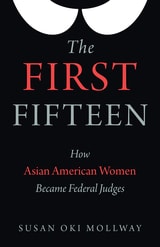
cover of The First Fifteen: How Asian American Women Became Federal Judges

The First Fifteen

How Asian American Women Became Federal Judges

Susan Oki Mollway

Rutgers University Press, 2022

In 1998, an Asian woman first joined the ranks of federal judges with lifetime appointments. It took ten years for the second Asian woman to be appointed. Since then, however, over a dozen more Asian women have received lifetime federal judicial appointments.
 
This book tells the stories of the first fifteen. In the process, it recounts remarkable tales of Asian women overcoming adversity and achieving the American dream, despite being the daughters of a Chinese garment worker, Japanese Americans held in internment camps during World War II, Vietnamese refugees, and penniless Indian immigrants. Yet The First Fifteen also explores how far Asian Americans and women still have to go before the federal judiciary reflects America as a whole. 
 
In a candid series of interviews, these judges reflect upon the personal and professional experiences that led them to this distinguished position, as well as the nerve-wracking political process of being nominated and confirmed for an Article III judgeship. By sharing their diverse stories, The First Fifteen paints a nuanced portrait of how Asian American women are beginning to have a voice in determining American justice.
[more]
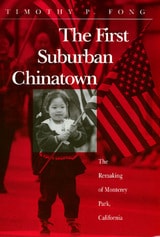
cover of The First Suburban Chinatown: The Remaking of Monterey Park, California

The First Suburban Chinatown

The Remaking of Monterey Park, California

Timothy P. Fong

Temple University Press, 1994

Monterey Park, California, only eight miles east of downtown Los Angeles, was dubbed by the media as the "First Suburban Chinatown." The city was a predominantly white middle-class bedroom community in the 1970s when large numbers of Chinese immigrants transformed it into a bustling international boomtown. It is now the only city in the United States with a majority Asian American population. Timothy P. Fong examines the demographic, economic, social, and cultural changes taking place there, and the political reactions to the change.

Fong, a former journalist, reports on how pervasive anti-Asian sentiment fueled a series of initiatives intended to strengthen "community control," including a movement to make English the official language. Recounting the internal strife and the beginnings of recovery, Fong explores how race and ethnicity issues are used as political organizing tools and weapons.


In the series Asian American History and Culture, edited by Sucheng Chan, David Palumbo-Liu, Michael Omi, K. Scott Wong, and Linda Trinh Võ.
[more]
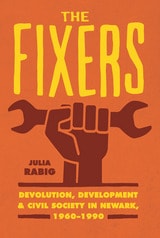
cover of The Fixers: Devolution, Development, and Civil Society in Newark, 1960-1990

The Fixers

Devolution, Development, and Civil Society in Newark, 1960-1990

Julia Rabig

University of Chicago Press, 2016

Stories of Newark’s postwar decline are easy to find. But in The Fixers, Julia Rabig supplements these tales of misery with the story of the many imaginative challenges to the city’s decline mounted by Newark’s residents and suburban neighbors. In these pages, we meet the black nationalists whose dynamic organizing elected African American candidates in unprecedented numbers. There are tenants who mounted a historic rent strike to transform public housing and renegade white Catholic priests who joined black laywomen to pioneer the construction of low-income housing and influence housing policy. These are just a few of the “fixers” we meet—people who devised ways to work with limited resources and pull together the threads of a patchwork welfare state.

Rabig argues that fixers play dual roles. They support resistance, but also mediation; they fight for reform, but also more radical and far-reaching alternatives; they rally others to a collective cause, but sometimes they broker factions. Fixers reflect longer traditions of organizing while responding to the demands of their times. In so doing, they end up fixing (like a fixative) a new and enduring pattern of activist strategies, reforms, and institutional expectations—a pattern we continue to see today.

[more]
cover of The Florida Room

The Florida Room

Alexandra T. Vazquez

Duke University Press, 2022
In The Florida Room Alexandra T. Vazquez listens to the music and history of Miami to offer a lush story of place and people, movement and memory, dispossession and survival. She transforms the “Florida room”—an actual architectural phenomenon—into a vibrant spatial imaginary for Miami’s musical cultures and everyday life. Drawing on songs, ephemera, and oral histories from artists, families, and inheritors of their traditions, Vazquez hears Miami as a city that has long been shaped by Indigenous Florida, the Bahamas, the Caribbean, and southern Georgia. She draws connections between seemingly disparate artists, sounds, and stories, from singer Gwen McCrae to pirate radio innovator DJ Uncle Al, from the Miccosukee rock band Tiger Tiger to the Cuban-American songwriter Desmond Child, among the percussionists Dafnis Prieto, Obed Calvaire, and Yosvany Terry, and through the notes of Eloise Lewis, Betty Wright, and the Miami Bass group Anquette. By listening to musical collaborations and ancestral ties across place and time, Vazquez brings together formal musical details, the histories of people and locations they hold, and the aesthetic traditions transformed inside them.
[more]
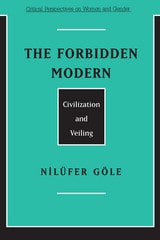
cover of The Forbidden Modern: Civilization and Veiling

The Forbidden Modern

Civilization and Veiling

Nilufer Gole

University of Michigan Press, 1997
This book by prominent Turkish scholar Nil_fer G+le examines the complex relationships among modernity, religion, and gender relations in the Middle East. Her focus is on the factors that influence young women pursuing university educations in Turkey to adopt seemingly fundamentalist Islamist traditions, such as veiling, and the complex web of meanings attributed to these gender-separating practices. Veiling, a politicized practice that conceptually forces people to choose between the "modern" and the "backward," provides an insightful way of looking at the contemporary Islam-West conflict, shedding light on the recent rise of Islamist fundamentalism in many countries and providing insight into what is a more complex phenomenon than is commonly portrayed in accounts by Western journalists. G+le's sociological approach, employing a number of personal interviews, allows for both a detailed case study of these young Turkish women who are turning to the tenets of fundamental Islamist gender codes, and for a broader critique of Eurocentrism and the academic literature regarding the construction of meaning. Both perspectives serve as a springboard for the launching of theoretical innovations into feminist, religious, cultural, and area studies. "A timely book, whose publication in English will contribute to a variety of scholarly debates. It promises to be provocative and widely read among scholars interested in issues of modernism and identity, women's social movements, the status of women in Islamic societies, and the broader issues of public versus private spheres." --Nil_fer Isvan, State University of New York, Stony Brook The Forbidden Modern: Civilization and Veiling was originally published as Modern Mahrem by the Turkish publisher Metis and has been translated into French, German, and Spanish. Nil_fer G+le is Professor of Sociology, Bogazi¦i University.
[more]
cover of The Force of Witness: Contra Feminicide

The Force of Witness

Contra Feminicide

Rosa-Linda Fregoso

Duke University Press, 2023

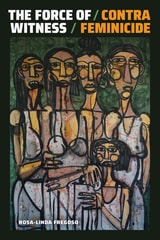
In The Force of Witness Rosa-Linda Fregoso examines the contra feminicide movement in Mexico and other feminist efforts to eradicate gender violence. Drawing on interviews, art, documentaries, and her years of activism, Fregoso traces the micro and macro scales of misogyny and the patterns of state complicity with gender violence. She shows how different forms of witnessing—from activist-mothers’ bearing witness to the memories of their daughters and expert witnesses in court cases to communal witnessing and a scholar-activist-citizen witnessing her own actions—are key to resisting feminicidal violence. Fregoso situates these forms of witness in the histories, contexts, structures, bodies, and intersectional struggles they emerge from. By outlining the complexities of feminicidal violence in relation to witnessing processes, Fregoso challenges the notion of witness as an individual or autonomous subject inscribed solely in the legal or religious arenas. Rather, she theorizes witness as a force of collectivity and a constellation of multiple social locations and intersectional practices that work together to abolish feminicidal violence.
[more]
cover of The Forgotten Army: India's Armed Struggle for Independence 1942-1945

The Forgotten Army

India's Armed Struggle for Independence 1942-1945

Peter Ward Fay

University of Michigan Press, 1995

The last days of the Raj bring to mind Gandhi's nonviolence and Nehru's diplomacy. These associations obscure another reality: that an army of Indian men and women who tried to throw the British off the subcontinent. The Forgotten Army brings to life for the first time the story of how Subhas Chandra Bose, a charismatic Bengali, attempted to liberate India with an army of former British Indian soldiers -- the Indian National Army (INA). The story begins with the British Indian Army fighting a heroic rearguard action against the invading Japanese down the Malaysian peninsula and ends with many of these same soldiers defeated in their effort to invade India as allies of Japan. Peter Ward Fay intertwines powerful descriptions of military action with a unique knowledge of how the INA was formed and its role in the broader struggle for Indian independence. Fay incorporates the personal reminiscences of Prem Saghal, a senior officer in the INA, and Lakshmi Swaminadhan, leader of its women's sections, to help the reader understand the motivations of those who took part. Their experiences offer an engagingly personal counterpoint to the political and military history. ". . . a well-crafted and thought-provoking mixture of oral history and original research, providing the most comprehensive account yet published of the events leading to the formation of the INA." -- Guardian "Fay has made a magnificent attempt to analyse all the credible information on the history of [Subhas Chandra] Bose's legendary Indian National Army (INA)." -- Times Higher Education Supplement "This fine study of the Indian National Army (INA) seeks to demonstrate this army's significance in the attainment of Indian independence and the termination of the British Empire. . . . Throughout, Fay seeks to explain why 'constant and true' Indians like Sahgal and Swaminadhan chose to fight alongside the Japanese and against the British . . . ." -- Pacific Affairs
[more]
cover of The Forgotten Ones: A Sociological Study of Anglo and Chicano Retardates

The Forgotten Ones

A Sociological Study of Anglo and Chicano Retardates

By Anne-Marie Henshel

University of Texas Press, 1972

In The Forgotten Ones, originally published in 1972, Anne-Marie Henshel examines the lives of a group of persons living within the community who had been diagnosed at one time or another as mentally retarded. The analysis makes use of three sets of comparisons—Anglo and Chicano, married and single, male and female—and the subjects in each category are analyzed in terms of personal characteristics, employment situation, material possessions, living conditions, family background, social activities, and contacts with “officials”—including the police. In addition, Henshel gives a detailed presentation of the conjugal lives of the married subjects: mutual feelings, marital satisfaction, reproduction, parenthood.

All data were gathered through three in-depth interviews with each subject, at intervals of about three months. In the case of a married respondent, the spouse was interviewed simultaneously, whenever possible, but separately. Interviewer was matched with subject by sex and ethnicity. Although the respondent’s reports were complemented by the interviewer’s perception, emphasis was placed on the individual’s perception of his or her own situation, and the data were analyzed accordingly.

The predominant themes are cultural differences between the two ethnic groups, especially in marriage, the relative superiority of the married over the single, the advantages and disadvantages of the male and the female in view of sex-role norms, and some of the problems with which the respondents are besieged—on the whole, problems very similar to those of other poor people. All-pervasive are social isolation, loneliness, lack of money, deficient education, poor physical appearance, failure in birth-control efforts, the presence of handicapped children, and the need for humane guidance and training.

Suggestions for improving relations with individuals once labeled retardates are presented in the last chapter.
[more]
cover of The Fornes Frame: Contemporary Latina Playwrights and the Legacy of Maria Irene Fornes

The Fornes Frame

Contemporary Latina Playwrights and the Legacy of Maria Irene Fornes

Anne García-Romero

University of Arizona Press, 2016

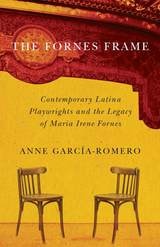
A key way to view Latina plays today is through the foundational frame of playwright and teacher Maria Irene Fornes, who has trained a generation of theatre artists and transformed the field of American theatre. Fornes, author of Fefu and Her Friends and Sarita and a nine-time Obie Award winner, is known for her plays that traverse cultural, spiritual, and aesthetic borders.

In The Fornes Frame: Contemporary Latina Playwrights and the Legacy of Maria Irene Fornes, Anne García-Romero considers the work of five award-winning Latina playwrights in the early twenty-first century, offering her unique perspective as a theatre studies scholar who is also a professional playwright.

The playwrights in this book include Pulitzer Prize–winner Quiara Alegría Hudes; Obie Award–winner Caridad Svich; Karen Zacarías, resident playwright at Arena Stage in Washington, DC; Elaine Romero, member of the Goodman Theatre Playwrights Unit in Chicago, Illinois; and Cusi Cram, company member of the LAByrinth Theater Company in New York City.

Using four key concepts—cultural multiplicity, supernatural intervention, Latina identity, and theatrical experimentation—García-Romero shows how these playwrights expand past a consideration of a single culture toward broader, simultaneous connections to diverse cultures. The playwrights also experiment with the theatrical form as they redefine what a Latina play can be. Following Fornes’s legacy, these playwrights continue to contest and complicate Latina theatre.
[more]
cover of The Freedom to Remember: Narrative, Slavery, and Gender in Contemporary Black Women's Fiction

The Freedom to Remember

Narrative, Slavery, and Gender in Contemporary Black Women's Fiction

Mitchell, Angelyn

Rutgers University Press, 2002

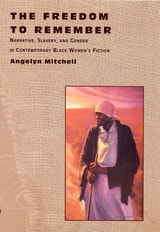
The Freedom to Remember examines contemporary literary revisions of slavery in the United States by black women writers. The narratives at the center of this book include: Octavia E. Butler’s Kindred, Sherley Anne Williams’s Dessa Rose, Toni Morrison’s Beloved, J. California Cooper’s Family, and Lorene Cary’s The Price of a Child.

Recent studies have investigated these works only from the standpoint of victimization. Angelyn Mitchell changes the conceptualization of these narratives, focusing on the theme of freedom, not slavery, defining these works as “liberatory narratives.” These works create a space to problematize the slavery/freedom dichotomy from which contemporary black women writers have the “safe” vantage point to reveal aspects of enslavement that their ancestors could not examine. The nineteenth-century female emancipatory narrative, by contrast, was written to aid the cause of abolition by revealing the unspeakable realitiesof slavery. Mitchell shows how the liberatory narrative functions to emancipate its readers from the legacies of slavery in American society: by facilitating a deeper discussion of the issues and by making them new through illumination and interrogation.
[more]
cover of The Fruits of Opportunism: Noncompliance and the Evolution of China's Supplemental Education Industry

The Fruits of Opportunism

Noncompliance and the Evolution of China's Supplemental Education Industry

Le Lin

University of Chicago Press, 2022

An in-depth examination of the regulatory, entrepreneurial, and organizational factors contributing to the expansion and transformation of China’s supplemental education industry.

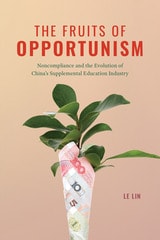
Like many parents in the United States, parents in China, increasingly concerned with their children’s academic performance, are turning to for-profit tutoring businesses to help their children get ahead in school. China’s supplemental education industry is now the world’s largest and most vibrant for-profit education market, and we can see its influence on the US higher education system: more than 70% of Chinese students studying in American universities have taken test preparation classes for overseas standardized tests. The Fruits of Opportunism offers a much-needed thorough investigation into this industry. This book examines how opportunistic organizations thrived in an ambiguous policy environment and how they catalyzed organizational and institutional changes in this industry.

A former insider in China’s Education Industry, sociologist Le Lin shows how and why this industry evolved to become a for-profit one dominated by private, formal, nationally operating, and globally financed corporations, despite restrictions the Chinese state placed on the industry. Looking closely at the opportunistic organizations that were founded by marginal entrepreneurs and quickly came to dominate the market, Lin finds that as their non-compliant practices spread across the industry, these opportunistic organizations pushed privatization and marketization from below. The case of China’s Education Industry laid out in The Fruits of Opportunism illustrates that while opportunism leaves destruction in its wake, it can also drive the formation and evolution of a market.

[more]
cover of The Funding of Scientific Racism: Wickliffe Draper and the Pioneer Fund

The Funding of Scientific Racism

Wickliffe Draper and the Pioneer Fund

William H. Tucker

University of Illinois Press, 2001
The Pioneer Fund, established in 1937 by Wickliffe Preston Draper, is one of the most controversial nonprofit organizations in the United States. Long suspected of misusing social science to fuel the politics of oppression, the fund has specialized in supporting research that seeks to prove the genetic and intellectual inferiority of blacks while denying its ties to any political agenda.This powerful and provocative volume proves that the Pioneer Fund has indeed been the primary source for scientific racism. Revealing a lengthy history of concerted and clandestine activities and interests, The Funding of Scientific Racism examines for the first time archival correspondence that incriminates the fund's major players, including Draper, recently deceased president Harry F. Weyher, and others.Divulging evidence of the Pioneer Fund's political motivations, William H. Tucker links Draper to a Klansman's crusade to repatriate blacks in the 1930s. Subsequent directors and grantees are implicated in their support of campaigns organized in the 1960s to reverse the Brown decision, prevent passage of the Civil Rights Act, and implement a system of racially segregated private schools.Tucker shows that these and other projects have been officially sponsored by the Pioneer Fund or surreptitiously supervised by its directors. This evidence demonstrates that any results of genuine, scientific value produced with the fund's support have been a salutary, if incidental, consequence of its actual purpose: to provide ammunition for what has essentially been a lobbying campaign to prevent the full participation of blacks in society and the polity.
[more]
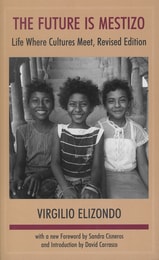
cover of The Future is Mestizo: Life Where Culture Meet, Revised Edition

The Future is Mestizo

Life Where Culture Meet, Revised Edition

Virgilio Elizondo

University Press of Colorado, 2000
Twelve years after it was first published, The Future is Mestizo is now updated and revised with a new foreword, introduction, and epilogue. This book speaks to the largest demographic change in twentieth-century United States history—the Latinization of music, religion, and culture.
[more]
cover of The Future of Black Studies

The Future of Black Studies

Abdul

Pluto Press, 2022

At a turning point for the growing field of Black Studies, one of its founders looks to its future

'A timely, future-oriented and necessary contribution which provides clarity to the multivalent tendencies in this field' - Carole Boyce Davies

The marginalization of Black voices from the academy is a problem in the Western world. But Black Studies, where it exists, is a powerful, boundary-pushing discipline, grown out of struggle and community action. Here, Abdul Alkalimat, one of the founders of Black Studies in the US, presents a reimagining of the future trends in the study of the Black experience.

Taking Marxism and Black Experientialism, Afro-Futurist and Diaspora frameworks, he projects a radical future for the discipline at this time of social crisis. Choosing cornerstones of culture, such as the music of Sun Ra, the movie Black Panther and the writer Octavia Butler, he looks at the trajectory of Black liberation thought since slavery, including new research on the rise in the comparative study of Black people all over the world.

Turning to look at how digital tools enhance the study of the discipline, this book is a powerful read that will inform and inspire students and activists.
[more]
cover of The Future of Black Studies

The Future of Black Studies

Abdul Alkalimat

Pluto Press, 2022

At a turning point for the growing field of Black Studies, one of its founders looks to its future

'A timely, future-oriented and necessary contribution which provides clarity to the multivalent tendencies in this field' - Carole Boyce Davies

The marginalization of Black voices from the academy is a problem in the Western world. But Black Studies, where it exists, is a powerful, boundary-pushing discipline, grown out of struggle and community action. Here, Abdul Alkalimat, one of the founders of Black Studies in the US, presents a reimagining of the future trends in the study of the Black experience.

Taking Marxism and Black Experientialism, Afro-Futurist and Diaspora frameworks, he projects a radical future for the discipline at this time of social crisis. Choosing cornerstones of culture, such as the music of Sun Ra, the movie Black Panther and the writer Octavia Butler, he looks at the trajectory of Black liberation thought since slavery, including new research on the rise in the comparative study of Black people all over the world.

Turning to look at how digital tools enhance the study of the discipline, this book is a powerful read that will inform and inspire students and activists.
[more]
cover of The Future of Futurity: Affective Capitalism and Potentiality in a Global City

The Future of Futurity

Affective Capitalism and Potentiality in a Global City

Purnima Mankekar and Akhil Gupta

Duke University Press, 2025
In The Future of Futurity, Purnima Mankekar and Akhil Gupta examine the lives and experiences of call center agents in India’s business process outsourcing (BPO) industry, who live in Bengaluru and work for customers in the Global North. Mankekar and Gupta show how futurity—an affective-temporal potentiality and mode of being that emphasizes the unfolding of time—enables BPO workers to strive for hopeful futures despite their experiences of growing inequality, volatility, and violence. Drawing on long-term fieldwork with managers, owners, and workers of BPO companies, the authors explore how workers find pathways for navigating a globalized world and for imagining their futures in it. They point to the heterogeneous lives, yearnings, and anxieties of BPO workers, foregrounding the disjunctions and conjunctions between labor, corporeality, intimacy, family life, and mobility. Mankekar and Gupta show how workers’ daily lives and imaginings of the future point to the relationships between futurity, capital, and technology as well as futurity’s imbrications with contemporary racial capitalism. In so doing, the authors insist on the transformative potential of futurity even in conditions of extreme precarity.
[more]
cover of The Futures of American Studies

The Futures of American Studies

Donald E. Pease and Robyn Wiegman, eds.

Duke University Press, 2002

Originating as a proponent of U.S. exceptionalism during the Cold War, American Studies has now reinvented itself, vigorously critiquing various kinds of critical hegemony and launching innovative interdisciplinary endeavors. The Futures of American Studies considers the field today and provides important deliberations on what it might yet become. Essays by both prominent and emerging scholars provide theoretically engaging analyses of the postnational impulse of current scholarship, the field's historical relationship to social movements, the status of theory, the state of higher education in the United States, and the impact of ethnic and gender studies on area studies. They also investigate the influence of poststructuralism, postcolonial studies, sexuality studies, and cultural studies on U.S. nationalist—and antinationalist—discourses. No single overriding paradigm dominates the anthology. Instead, the articles enter into a lively and challenging dialogue with one another. A major assessment of the state of the field, The Futures of American Studies is necessary reading for American Studies scholars.

Contributors. Lindon Barrett, Nancy Bentley, Gillian Brown, Russ Castronovo, Eric Cheyfitz, Michael Denning, Winfried Fluck, Carl Gutierrez-Jones, Dana Heller, Amy Kaplan, Paul Lauter, Günter H. Lenz, George Lipsitz, Lisa Lowe, Walter Benn Michaels, José Estaban Muñoz, Dana D. Nelson, Ricardo L. Ortiz, Janice Radway, John Carlos Rowe, William V. Spanos
[more]
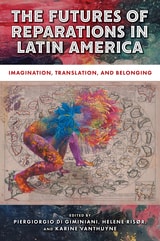
cover of The Futures of Reparations in Latin America: Imagination, Translation, and Belonging

The Futures of Reparations in Latin America

Imagination, Translation, and Belonging

Piergiorgio Di Giminiani

Rutgers University Press, 2026

Over the last thirty years, Latin America has undergone an unprecedented wave of reparations targeting victims of political violence during military regimes, Indigenous and Afro-Latin groups affected by historical processes of dispossession, and citizens suffering from environmental harm. Reparations prompt us to face uncomfortable pasts and in so doing, create conditions for imagination of multiple futures. In representing the experiences and hopes of those affected by political violence in El Salvador and Argentina, environmental harm in Guatemala and Peru, and colonial dispossession in Chile and Bolivia, reparations are built upon conflictive forms of future imagination, translation of harm and new forms of belonging to and beyond the nation state, which reifies as much as challenges state authority over the promises of actual repair. In today’s Latin American political debate, hopes for justice and democracy remain anchored to the question of the kinds of future that can be imagined through and after reparation.
 
[more]
cover of The Genealogical Imagination: Two Studies of Life over Time

The Genealogical Imagination

Two Studies of Life over Time

Michael Jackson

Duke University Press, 2021

In The Genealogical Imagination Michael Jackson juxtaposes ethnographic and imaginative writing to explore intergenerational trauma and temporality. Drawing on over fifty years of fieldwork, Jackson recounts the 150-year history of a Sierra Leone family through its periods of prosperity and powerlessness, war and peace, jihad and migration. Jackson also offers a fictionalized narrative loosely based on his family history and fieldwork in northeastern Australia that traces how the trauma of wartime in one generation can reverberate into the next. In both stories Jackson reflects on different modes of being-in-time, demonstrating how genealogical time flows in stops and starts—linear at times, discontinuous at others—as current generations reckon with their relationships to their ancestors. Genealogy, Jackson demonstrates, becomes a powerful model for understanding our experience of being-in-the-world, as nobody can escape kinship and the pull of the past. Unconventional and evocative, The Genealogical Imagination offers a nuanced account of how lives are lived, while it pushes the bounds of the forms that scholarship can take.
[more]