Results by title
28164 books match the query 'History' and 259 start with v

Virginia Woolf Icon
Brenda R. Silver
University of Chicago Press, 1999
From Virginia Woolf's 1937 appearance on the cover of Time magazine to her current roles in theater, film, and television, Silver traces the often contradictory representations and the responses they provoke, highlighting the recurring motifs that associate Virginia Woolf with fear. By looking more closely at who is afraid and the contexts in which she is perceived to be frightening, Silver illustrates how Virginia Woolf has become the site of conflicts about cultural boundaries and legitimacy that continue to rage today.

Virginia Woolf and the Fictions of Psychoanalysis
Elizabeth Abel
University of Chicago Press, 1989
"Virginia Woolf and the Fictions of Psychoanalysis brings Woolf's extraordinary craftsmanship back into view; the book combines powerful claims about sexual politics and intellectual history with the sort of meticulous, imaginative close reading that leaves us, simply, seeing much more in Woolf's words than we did before. It is the most exciting book on Woolf to come along in some time."—Lisa Ruddick, Modern Philology
Virtual Americas
Transnational Fictions and the Transatlantic ImaginaryPaul Giles
Duke University Press, 2002
Throughout Virtual Americas Giles focuses on specific examples of transatlantic cultural interactions such as Frederick Douglass’s experiences and reputation in England; Herman Melville’s satirizing fictions of U.S. and British nationalism; and Vladimir Nabokov’s critique of European high culture and American popular culture in Lolita. He also reverses his perspective, looking at the representation of San Francisco in the work of British-born poet Thom Gunn and Sylvia Plath’s poetic responses to England. Giles develops his theory about the need to defamiliarize the study of American literature by considering the cultural legacy of Surrealism as an alternative genealogy for American Studies and by examining the transatlantic dimensions of writers such as Henry James and Robert Frost in the context of Surrealism.
Virtual Hallyu
Korean Cinema of the Global EraKyung Hyun Kim
Duke University Press, 2011
In the late 1990s, South Korean film and other cultural products, broadly known as hallyu (Korean wave), gained unprecedented international popularity. Korean films earned an all-time high of $60.3 million in Japan in 2005, and they outperformed their Hollywood competitors at Korean box offices. In Virtual Hallyu, Kyung Hyun Kim reflects on the precariousness of Korean cinema’s success over the past decade. Arguing that state film policies and socioeconomic factors cannot fully explain cinema’s true potentiality, Kim draws on Deleuze’s concept of the virtual—according to which past and present and truth and falsehood coexist—to analyze the temporal anxieties and cinematic ironies embedded in screen figures such as a made-in-the-USA aquatic monster (The Host), a postmodern Chosun-era wizard (Jeon Woo-chi), a schizo man-child (Oasis), a weepy North Korean terrorist (Typhoon), a salary man turned vengeful fighting machine (Oldboy), and a sick nationalist (the repatriated colonial-era film Spring of Korean Peninsula). Kim maintains that the full significance of hallyu can only be understood by exposing the implicit and explicit ideologies of protonationalism and capitalism that, along with Korea’s ambiguous post-democratization and neoliberalism, are etched against the celluloid surfaces.
Virtual Modernism
Writing and Technology in the Progressive EraKatherine Biers
University of Minnesota Press, 2013
In Virtual Modernism, Katherine Biers offers a fresh view of the emergence of American literary modernism from the eruption of popular culture in the early twentieth century. Employing dynamic readings of the works of Stephen Crane, Henry James, James Weldon Johnson, Djuna Barnes, and Gertrude Stein, she argues that American modernist writers developed a “poetics of the virtual” in response to the rise of mass communications technologies before World War I. These authors’ modernist formal experimentation was provoked by the immediate, individualistic pleasures and thrills of mass culture. But they also retained a faith in the representational power of language—and the worth of common experience—more characteristic of realism and naturalism. In competition with new media experiences such as movies and recorded music, they simultaneously rejected and embraced modernity.
Biers establishes the virtual poetics of these five writers as part of a larger “virtual turn” in the United States, when a fascination with the writings of Henri Bergson, William James, and vitalist philosophy—and the idea of virtual experience—swept the nation. Virtual Modernism contends that a turn to the virtual experience of language was a way for each of these authors to carve out a value for the literary, both with and against the growth of mass entertainments. This technologically inspired reengagement with experience was formative for American modernism.
Situated at the crossing points of literary criticism, philosophy, media studies, and history, Virtual Modernism provides an examination of Progressive Era preoccupations with the cognitive and corporeal effects of new media technologies that traces an important genealogy of present-day concerns with virtuality.
Virtue and Venom
Catalogs of Women from Antiquity to the RenaissanceGlenda McLeod
University of Michigan Press, 1991
Virtue and Venom
Catalogs of Women from Antiquity to the RenaissanceGlenda McLeod
University of Michigan Press, 1991
Virtue, Fortune, and Faith
A Genealogy of FinanceMarieke de Goede
University of Minnesota Press, 2005
Virtuous Citizens
Counterpublics and Sociopolitical Agency in Transatlantic LiteratureKendall McClellan
University of Alabama Press, 2021
Transatlantic Perspectives on Civic Identity and Political Participation.
The rise of the bourgeois public sphere and the contemporaneous appearance of counterpublics in the eighteenth century deeply influenced not only how politicians and philosophers understood the relationships among citizens, disenfranchised subjects, and the state but also how members of the polity understood themselves. In Virtuous Citizens: Counterpublics and Sociopolitical Agency in Transatlantic Literature, Kendall McClellan uncovers a fundamental and still redolent transformation in conceptions of civic identity that occurred over the course of the eighteenth and nineteenth centuries. Literature of this period exposes an emotional investment in questions of civic selfhood born out of concern for national stability and power, which were considered products of both economic strength and a nation’s moral fiber. McClellan shows how these debates traversed the Atlantic to become a prominent component of early American literature, evident in works by James Fenimore Cooper, Catharine Maria Sedgwick, Sarah Josepha Hale, and Harriet Beecher Stowe, among others.
Underlying popular opinion about who could participate in the political public, McClellan argues, was an impassioned rhetorical wrestling match over the right and wrong ways to demonstrate civic virtue. Relying on long-established tropes of republican virtue that lauded self-sacrifice and disregard for personal safety, abolitionist writers represented loyalty to an ideals-based community as the surest safeguard of both private and public virtue. This evolution in civic virtue sanctioned acts of protest against the state, offered disenfranchised citizens a role in politics, and helped usher in the modern transnational public sphere.
Virtuous Citizens shows that the modern public sphere has always constituted a vital and powerful space for those invested in addressing injustice and expanding democracy. To illuminate some of the fundamental issues underlying today’s sociopolitical unrest, McClellan traces the transatlantic origins of questions still central to the representation of movements like Black Lives Matter, the Women’s March, and the Alt-Right: What is the primary loyalty of a virtuous citizen? Are patriots those who defend the current government against attacks, external and internal, or those who challenge the government to fulfill sociopolitical ideals?
Virtuous Necessity
Conduct Literature and the Making of the Virtuous Woman in Early Modern EnglandJessica C. Murphy
University of Michigan Press, 2015
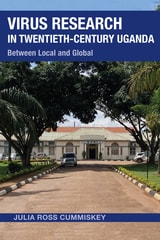
Virus Research in Twentieth-Century Uganda
Between Local and GlobalJulia Ross Cummiskey
Ohio University Press, 2024
Virus Research in Twentieth-Century Uganda presents the stories of scientists at the Uganda Virus Research Institute (UVRI), a biomedical center founded in 1936. The book analyzes the strategies and conditions that allowed the institute to endure and thrive through successive political and scientific regimes of the interwar period, the postwar period, the transition to independence, the conflicts of the 1970s and 1980s, and the Museveni presidency. Julia Ross Cummiskey combines methods and themes from the history of medicine and public health, science and technology studies, and African studies to show that the story of the UVRI and the people who worked there transforms our understanding of the nature of local and international expertise and the evolution of global health research over the course of the twentieth century.
Global health is one of the chief areas in which African and foreign institutions interact today. Billions of dollars are invested in global health projects on the continent, many involving strategically selected “local partners.” In the discourse of these projects, local and global are often framed as complementary but distinct categories of people, institutions, traditions, and practices. But the history of biomedical research at the UVRI shows that these distinctions are unstable and mutable and that people and institutions have mobilized both categories to attract funding, professional prestige, and research opportunities. The book complicates the local/global binary that is implicit (and sometimes explicit) in many studies of colonial, international, and global health and medical research, especially in Africa. Moreover, it challenges assumptions about global health as an enterprise dominated by researchers based in the Global North and recenters the history of biomedicine in Africa.
Vise and Shadow
Essays on the Lyric Imagination, Poetry, Art, and CulturePeter Balakian
University of Chicago Press, 2015
Vise and Shadow draws into conversation such disparate figures as W. B. Yeats, Hart Crane, Joan Didion, Primo Levi, Robert Rauschenberg, Bob Dylan, Elia Kazan, and Arshile Gorky, revealing how the lyric imagination of these artists grips experience, "shadows history," and "casts its own type of illumination," creating one of the deepest kinds of human knowledge and sober truth. In these elegantly written essays, Balakian offers a fresh way to think about the power of poetry, art, and the lyrical imagination as well as history, trauma, and memory.
Visible Dissent
Latin American Writers, Small U.S. Presses, and Progressive Social ChangeTeresa V. Longo
University of Iowa Press, 2018
As Teresa Longo’s groundbreaking examination reveals, North America’s dissident literature has its roots in the Latin American literary tradition. From Pablo Neruda’s Canto General to Eduardo Galeano’s Open Veins of Latin America to Gabriel García Márquez’s One Hundred Years of Solitude—among others—contemporary writers throughout the Americas have forced us to reconsider the United States’s relationship with Latin America, and more broadly with the Global South. Highlighting the importance of reading and re-reading the Latin American canon in the United States, Longo finds that literature can be an instrument of progressive social change, and argues that small literary presses—City Lights, Curbstone, and Seven Stories—have made that dissent visible in the United States. In the book’s final two chapters on the Robert F. Kennedy Center’s Speak Truth to Power initiative and the publication of Marc Falkoff’s Poems from Guantánamo, the author turns our attention further outward, probing the role poetry, theater, and photography play in global human rights work.
Locating the work of artists and writers alongside that of scholars and legal advocates, Visible Dissent not only unveils the staying-power of committed writing, it honors the cross-currents and the on-the-ground implications of humane political engagement.
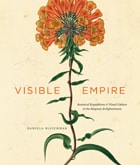
Visible Empire
Botanical Expeditions and Visual Culture in the Hispanic EnlightenmentDaniela Bleichmar
University of Chicago Press, 2012
Between 1777 and 1816, botanical expeditions crisscrossed the vast Spanish empire in an ambitious project to survey the flora of much of the Americas, the Caribbean, and the Philippines. While these voyages produced written texts and compiled collections of specimens, they dedicated an overwhelming proportion of their resources and energy to the creation of visual materials. European and American naturalists and artists collaborated to manufacture a staggering total of more than 12,000 botanical illustrations. Yet these images have remained largely overlooked—until now.
In this lavishly illustrated volume, Daniela Bleichmar gives this archive its due, finding in these botanical images a window into the worlds of Enlightenment science, visual culture, and empire. Through innovative interdisciplinary scholarship that bridges the histories of science, visual culture, and the Hispanic world, Bleichmar uses these images to trace two related histories: the little-known history of scientific expeditions in the Hispanic Enlightenment and the history of visual evidence in both science and administration in the early modern Spanish empire. As Bleichmar shows, in the Spanish empire visual epistemology operated not only in scientific contexts but also as part of an imperial apparatus that had a long-established tradition of deploying visual evidence for administrative purposes.
Visible Histories, Disappearing Women
Producing Muslim Womanhood in Late Colonial BengalMahua Sarkar
Duke University Press, 2008
Drawing on extensive archival research and oral histories of Muslim women who lived in Calcutta and Dhaka in the first half of the twentieth century, Sarkar traces Muslim women as they surface and disappear in colonial, Hindu nationalist, and liberal Muslim writings, as well as in the memories of Muslim women themselves. The oral accounts provide both a rich source of information about the social fabric of urban Bengal during the final years of colonial rule and a glimpse of the kind of negotiations with stereotypes that even relatively privileged, middle-class Muslim women are still frequently obliged to make in India today. Sarkar concludes with some reflections on the complex links between past constructions of Muslim women, current representations, and the violence against them in contemporary India.
Visible Ruins
The Politics of Perception and the Legacies of Mexico's RevolutionMónica M. Salas Landa
University of Texas Press, 2024
2026 Honorable Mention, Mejor Libro, Historia Reciente y Memoria Section of the Latin American Studies Association
An examination of the failures of the Mexican Revolution through the visual and material records.
The Mexican Revolution (1910–1920) introduced a series of state-led initiatives promising modernity, progress, national grandeur, and stability; state surveyors assessed land for agrarian reform, engineers used nationalized oil for industrialization, archaeologists reconstructed pre-Hispanic monuments for tourism, and anthropologists studied and photographed Indigenous populations to achieve their acculturation. Far from accomplishing their stated goals, however, these initiatives concealed violence, and permitted land invasions, forced displacement, environmental damage, loss of democratic freedom, and mass killings. Mónica M. Salas Landa uses the history of northern Veracruz to demonstrate how these state-led efforts reshaped the region's social and material landscapes, affecting what was and is visible. Relying on archival sources and ethnography, she uncovers a visual order of ongoing significance that was established through postrevolutionary projects and that perpetuates inequality based on imperceptibility.
Visible Writings
Cultures, Forms, ReadingsDalbello, Marija
Rutgers University Press, 2011
Multicultural in character and historical in range, essays discuss pre-Colombian Mesoamerican scripts, inscriptions on ancient Greek vases, medieval illuminations, Renaissance prints, Enlightenment concepts of the legible, and the Western "reading" of Chinese ideograms. A rich array of modern forms, including comics, poster art, typographic signs, scribblings in writers' manuscripts, anthropomorphic statistical pictograms, the street writings of 9/11, intersections between poetry and painting, the use of color in literary texts, and the use of writing in visual art are also addressed.
Visible Writings reaches outside the traditional venues of literature and art history into topics that consider design, history of writing, philosophy of language, and the emerging area of visual studies. Marija Dalbello, Mary Shaw, and the other contributors offer both scholars and those with a more casual interest in literature and art the opportunity, simply stated, to see the writing on the wall.
Visible and Invisible Realms
Power, Magic, and Colonial Conquest in BaliMargaret J. Wiener
University of Chicago Press, 1995
Wiener challenges colonial and academic claims that Klungkung had no "real" power and argues that such claims enabled colonial domination. By focusing on Balinese discourses she makes clear the choices open to Balinese, both at the time of the Dutch conquest and in its narration. At the same time, she shows how these discourses, which revolve around magical weapons acquired from invisible agents such as gods, spirits, and ancestors, offer an alternative understanding of Klungkung's power.
Moving between Balinese and Dutch narratives and between past and present, Wiener critiques colonial accounts by recounting Balinese memories and interpretations. Her attention to history and local situations illuminates the ways in which colonialism and orientalist scholarship have obscured the power of indigenous rulers and shows how Klungkung, once Bali's paramount realm, was relegated to a peripheral corner of the Indonesian nation-state. Both as a fascinating story and as a rich example of interdisciplinary scholarship, this book will interest students of colonialism, anthropology, history, religion, and Southeast Asia.
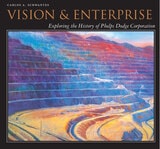
Vision and Enterprise
Exploring the History of Phelps Dodge CorporationCarlos A. Schwantes
University of Arizona Press, 2000
Phelps Dodge Corporation has shaped the landscape of America from the industrial revolution to the information technology revolution. A name synonymous with copper, Phelps Dodge has grown from a cotton and metal trading firm founded in 1834 to its present position as the world's largest publicly traded copper company.
Carlos Schwantes has written a sweeping corporate history of Phelps Dodge. Using landscape as an organizing concept to underscore the company's impact and accomplishments, he offers a close look at this corporate giant within the context of American technological and social history. In tracing the progress of Phelps Dodge through its 165-year history, Schwantes takes readers from the streets of Bisbee, Arizona, to the boardrooms of New York and Phoenix in order to examine the impact the company has had on the many landscapes in which it figures so prominently. Considering factors ranging from the environment to labor, he examines how Phelps Dodge has influenced, and has been influenced by, such forces as the global economy, technological innovation, urban growth, and social change.
Exhaustively researched and profusely illustrated with over 200 photographs, Vision and Enterprise makes a unique contribution to the history of the United States and the evolution of industry by considering the changing face of labor, the environment, and technology from one dynamic company's point of view.

Vision and Violence
Arthur P. Mendel
University of Michigan Press, 1999
Much of the book is devoted to an examination of the persistence of the apocalyptic heritage from ancient Greek and Hebrew civilizations, through the religious revivals of the Middle Ages and the Enlightenment belief in progress, to its importance in Hegelian and Bolshevik thought, and finally to its expression today in the resurgence of religious fundamentalism in Judaism, Christianity, and Islam.
Mendel concludes his remarkable book with an appeal for the more modest and humane philosophy of the "repair of the world," which, he argues, is central to biblical teaching.
The late Arthur P. Mendel was Professor of History, University of Michigan, specializing in Russian intellectual history. His first book, Dilemmas of Progress in Tsarist Russia: Legal Marxism and Legal Populism, established him as one of the outstanding historians of his generation. Richard Landes is co-founder, with Stephen O'Leary, of the Center for Millennial Studies. He is also Associate Professor of History, Boston University, and author of Relics, Apocalypse, and the Deceits of History: Ademar of Chabannes, 989-1034.
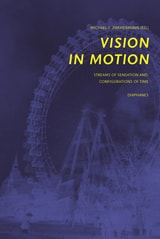
Vision in Motion
Streams of Sensation and Configurations of TimeEdited by Michael F. Zimmermann
Diaphanes, 2015
Bringing together a renowned international group of contributors, Vision in Motion explores one of the most vexing problems in the study of vision and cognition: To make sense of the sensations we experience when we see something, we must configure many moments into a synchronous image. This volume offers a critical reexamination of seeing that restores a concept of “vision in motion” that avoids reducing the sensations we experience to narrative chronological sequencing. The contributors draw on Hume, Bergson, and Deleuze, among others, to establish a nuanced idea of how we perceive.

Vision/Re-Vision
Adapting Contemporary American Fiction To FilmBarbara Tepa Lupack
University of Wisconsin Press, 1996
The essays in Vision/Re-Vision analyze in detail ten popular and important films adapted from contemporary American fiction by women, addressing the ways in which the writers' latent or overt feminist messages are reinterpreted by the filmmakers who bring them to the screen, demonstrating that there is much to praise as well as much to fault in the adaptations and that the process of adaptation itself is instructive rather than destructive, since it enriches understanding about both media.

Visions and Victims
Art Melodrama in the Films of Carl Th. DreyerAmanda Doxtater
University of Wisconsin Press, 2024
Amanda Doxtater offers a necessary corrective to this narrative of his bifurcated career. Close readings of Dreyer’s Nordisk films alongside his mature work reveal a stylistic throughline Doxtater terms “art melodrama,” a form combining the ambiguity, stylization, and consciousness of art cinema with the heightened emotional expressivity and dramatic embodiments characteristic of melodrama. She argues that Dreyer’s major artistic concerns known from his later work—pathos, authenticity, the embodiment of psychological duress, and so on—find their first expression in his Nordisk melodramas, complicating our understanding not only of his later films but also of his early works, and even our understanding of the melodramatic mode in general. Indeed, extending well beyond the career of a singular director, this book challenges assumptions about the relationship between “low-brow” melodrama and “high-brow” art cinema.
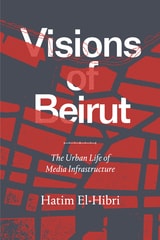
Visions of Beirut
The Urban Life of Media InfrastructureHatim El-Hibri
Duke University Press, 2021
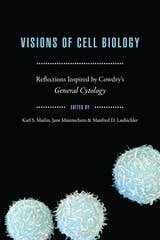
Visions of Cell Biology
Reflections Inspired by Cowdry's "General Cytology"Edited by Karl S. Matlin, Jane Maienschein, and Manfred D. Laubichler
University of Chicago Press, 2017
Despite extraordinary advances in describing both the structure and function of cells, cell biology tends to be overshadowed by molecular biology, a field that developed contemporaneously. This book remedies that unjust disparity through an investigation of cell biology’s evolution and its role in pushing forward the boundaries of biological understanding. Contributors show that modern concepts of cell organization, mechanistic explanations, epigenetics, molecular thinking, and even computational approaches all can be placed on the continuum of cell studies from cytology to cell biology and beyond. The first book in the series Convening Science: Discovery at the Marine Biological Laboratory, Visions of Cell Biology sheds new light on a century of cellular discovery.

Visions of Loveliness
Great Flower Breeders of the PastJudith M. Taylor
Ohio University Press, 2014
Gardeners of today take for granted the many varieties of geraniums, narcissi, marigolds, roses, and other beloved flowers for their gardens. Few give any thought at all to how this incredible abundance came to be or to the people who spent a good part of their lives creating it. These breeders once had prosperous businesses and were important figures in their communities but are only memories now. They also could be cranky and quirky.
In the eighteenth and nineteenth centuries, new and exotic species were arriving in Europe and the United States from all over the world, and these plants often captured the imaginations of the unlikeliest of men, from aristocratic collectors to gruff gardeners who hardly thought of themselves as artists. But whatever their backgrounds, they all shared a quality of mind that led them to ask “What if?” and to use their imagination and skills to answer that question themselves. The newest rose from China was small and light pink, but what if it were larger and came in more colors? Lilac was very nice in its way, but what if its blossoms were double and frilly?
While there are many books about plant collectors and explorers, there are none about plant breeders. Drawing from libraries, archives, and the recollections of family members, horticultural historian Judith M. Taylor traces the lives of prominent cultivators in the context of the scientific discoveries and changing tastes of their times. Visions of Loveliness is international in scope, profiling plant breeders from many countries—for example, China and the former East Germany—whose work may be unknown to the Anglophone reader.
In addition to chronicling the lives of breeders, the author also includes chapters on the history behind the plants by genus, from shrubs and flowering trees to herbaceous plants.
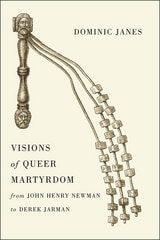
Visions of Queer Martyrdom from John Henry Newman to Derek Jarman
Dominic Janes
University of Chicago Press, 2015
Janes finds the beginnings of queer martyrdom in the nineteenth-century Church of England and the controversies over Cardinal John Henry Newman’s sexuality. He then considers how liturgical expression of queer desire in the Victorian Eucharist provided inspiration for artists looking to communicate their own feelings of sexual deviance. After looking at Victorian monasteries as queer families, he analyzes how the Biblical story of David and Jonathan could be used to create forms of same-sex partnerships. Finally, he delves into how artists and writers employed ecclesiastical material culture to further queer self-expression, concluding with studies of Oscar Wilde and Derek Jarman that illustrate both the limitations and ongoing significance of Christianity as an inspiration for expressions of homoerotic desire.
Providing historical context to help us reevaluate the current furor over homosexuality in the Church, this fascinating book brings to light the myriad ways that modern churches and openly gay men and women can learn from the wealth of each other’s cultural and spiritual experience.

Visions of Science
Books and Readers at the Dawn of the Victorian AgeJames A. Secord
University of Chicago Press, 2015
In Visions of Science, James A. Secord offers a new way to capture this unique moment of change. He explores seven key books—among them Charles Babbage’s Reflections on the Decline of Science, Charles Lyell’s Principles ofGeology, Mary Somerville’s Connexion of the Physical Sciences, and Thomas Carlyle’s Sartor Resartus—and shows how literature that reflects on the wider meaning of science can be revelatory when granted the kind of close reading usually reserved for fiction and poetry. These books considered the meanings of science and its place in modern life, looking to the future, coordinating and connecting the sciences, and forging knowledge that would be appropriate for the new age. Their aim was often philosophical, but Secord shows it was just as often imaginative, projective, and practical: to suggest not only how to think about the natural world but also to indicate modes of action and potential consequences in an era of unparalleled change.
Visions of Science opens our eyes to how genteel ladies, working men, and the literary elite responded to these remarkable works. It reveals the importance of understanding the physical qualities of books and the key role of printers and publishers, from factories pouring out cheap compendia to fashionable publishing houses in London’s West End. Secord’s vivid account takes us to the heart of an information revolution that was to have profound consequences for the making of the modern world.
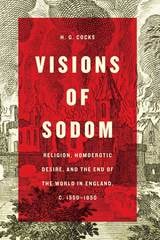
Visions of Sodom
Religion, Homoerotic Desire, and the End of the World in England, c. 1550-1850H. G. Cocks
University of Chicago Press, 2017
In Visions of Sodom, H. G. Cocks examines the many different ways in which the story of Sodom’s destruction provided a template for understanding homoerotic desire and behaviour in Britain between the Reformation and the nineteenth century. Sodom was not only a marker of sexual sins, but also the epitome of false—usually Catholic—religion, an exemplar of the iniquitous city, a foreshadowing of the world’s fiery end, an epitome of divine and earthly punishment, and an actual place that could be searched for and discovered. Visions of Sodom investigates each of these ways of reading Sodom’s annihilation in the three hundred years after the Reformation. The centrality of scripture to Protestant faith meant that Sodom’s demise provided a powerful origin myth of homoerotic desire and sexual excess, one that persisted across centuries, and retains an apocalyptic echo in the religious fundamentalism of our own time.
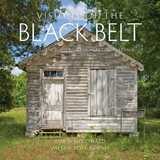
Visions of the Black Belt
A Cultural Survey of the Heart of AlabamaRobin McDonald and Valerie Pope Burnes
University of Alabama Press, 2015
Capturing the soul of the South’s Black Belt.
In Visions of the Black Belt, Robin McDonald and Valerie Pope Burnes offer a richly illustrated tour of the Black Belt, the fertile arc that represents the cultural efflorescence of Alabama’s heartland. Like knowledgeable friends, McDonald and Burnes guide readers through the Black Belt’s towns and architecture and introduce the region’s great panoply of citizens, farmers, craftspeople, cooks, writers, and musicians.
A constellation of Black Belt towns arose during Alabama’s territorial decades, communities like Selma, Camden, Eutaw, Tuskegee, Greenville, and many more. Visions of the Black Belt recounts their stories and others, such as Demopolis’s founding by exiles from Napoleon’s France. As an escarpment of clouds scuds across an indigo sky, the ruins of Alabama’s lost capital of Cahaba reveal the secrets of its lost squares. Also on this picturesque tour are the Black Belt’s homes, from artless cabins wreathed in fern to ozymandian manses wrapped by stately columns, such as Kirkwood and Reverie.
Among the emblematic houses of worship lovingly photographed in Visions of the Black Belt is Prairieville’s St. Andrew’s Episcopal Church, noted for its “carpenter gothic” style. Also reflecting the region’s history of faith are poignant graveyards such as Greenville’s Pioneer Cemetery with its homespun memorials of seashell-and-concrete and the elegant marbles clad in ebon lichen of Selma's Live Oak Cemetery.
In photos and text, McDonald and Burnes bring to life the layers of history that shaped the Black Belt’s tastes, sounds, and colors. Their gastronomic discoveries include the picant crawfish of the Faunsdale Bar & Grill and GainesRidge Dining Club’s famed Black Bottom pie. They bring the sounds of the Black Belt to life by presenting a wide range of musicians and musical events, from bona fide blues and soul masters to Eutaw’s Black Belt Roots Festival.
Including two maps and more than 370 full-color photographs, Visions of the Black Belt offers a timeless message of faith, determination, and the rich simplicity of living in harmony with the rhythms of the land and nature.
Published in Cooperation with the Black Belt Treasures Cultural Arts Center, Camden, Alabama.
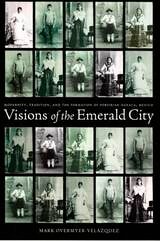
Visions of the Emerald City
Modernity, Tradition, and the Formation of Porfirian Oaxaca, MexicoMark Overmyer-Velázquez
Duke University Press, 2006
Incorporating a nuanced understanding of visual culture into his analysis, Overmyer-Velázquez shows how ideas of modernity figured in Oaxacans’ ideologies of class, race, gender, sexuality, and religion and how they were expressed in Oaxaca City’s streets, plazas, buildings, newspapers, and public rituals. He pays particular attention to the roles of national and regional elites, the Catholic church, and popular groups—such as Oaxaca City’s madams and prostitutes—in shaping the discourses and practices of modernity. At the same time, he illuminates the dynamic interplay between these groups. Ultimately, this well-illustrated history provides insight into provincial life in pre-Revolutionary Mexico and challenges any easy distinctions between the center and the periphery or modernity and tradition.
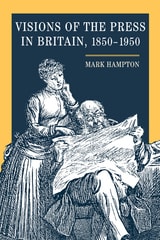
Visions of the Press in Britain, 1850-1950
Mark Hampton
University of Illinois Press, 2004
In Visions of the Press in Britain, 1850-1950, Mark Hampton argues that qualities expected of the contemporary British press--lively writing, speed, impartiality, depth, and the ability to topple corrupt governments by informing readers--are not obvious attributes of journalism but derive from more than a century of debate. He analyzes the various historical conceptions of the British press that helped to create its modern role, and demonstrates that these conceptions were intimately involved in the emergence of mass democracy in the late nineteenth and early twentieth centuries.
Hampton surveys a diversity of sources--Parliamentary speeches and commissions, books, pamphlets, periodicals and select private correspondence--in order to identify how governmental elites, the educated public, professional journalists, and industry moguls characterized the political and cultural function of the press. The resulting blend of cultural history and media sociology demonstrates how once optimistic visions of the press have given way to more pessimistic contemporary views about the power of the mass media.
With clarity and panache, this book shows that many competing conceptions continued to influence twentieth-century understandings of the press but did not remain satisfactory in new political, cultural, and media environments. Visions of the Press in Britain, 1850-1950 provides a rich tapestry against which to understand the contemporary realities of journalism, democracy, and mass media.
Visions of the Sociological Tradition
Donald N. Levine
University of Chicago Press, 1995
"Visions" has three meanings, each of which corresponds to a part of the book. In Part 1, Levine presents the ways previous sociologists have rendered accounts of their discipline, as a series of narratives—or "life stories"—that build upon each other, generation to generation, a succession of efforts to envisage a coherent past for the sake of a purposive present.
In Part 2, the heart of the book, Levine offers his own narrative, reconnecting centuries of voices into a richly textured dialogue among the varied strands of the sociological tradition: Hellenic, British, French, German, Marxian, Italian, and American. Here, in a tour de force of clarity and conciseness, he tracks the formation of the sociological imagination through a series of conversations across generations. From classic philosophy to pragmatism, Aristotle to W. I. Thomas, Levine maps the web of visionary statements—confrontations and oppositions—from which social science has grown.
At the same time, this is much more than an expert synthesis of social theory. Throughout each stage, Levine demonstrates social knowledge has grown in response to three recurring questions: How shall we live? What makes humans moral creatures? How do we understand the world? He anchors the creation of social knowledge to ethical foundations, and shows for the first time how differences in those foundations disposed the shapers of modern social science—among them, Marshall and Spencer, Comte and Durkheim, Simmel and Weber, Marx and Mosca, Dewey and Park—to proceed in vastly different ways.
In Part 3, Levine offers a vision of the contemporary scene, setting the crisis of fragmentation in social sciences against the fragmentation of experience and community. By reconstructing the history of social thought as a series of fundamentally moral engagements with common themes, he suggests new uses for sociology's intellectual resources: not only as insight about the nature of modernity, but also as a model of mutually respectful communication in an increasingly fractious world.
Visions of the Southland
A Year in Los Angeles CountyEdited by Wade Graham and William Deverell
University of Chicago Press, 2026
Experience a year in Los Angeles County, in all its glitter and grit, through a unique anthology that pairs essays by acclaimed writers and historians with custom maps.
When many of us picture Los Angeles, we’re actually thinking of LA County. Home to roughly ten million people, the county alone is more populous than forty-two US states. Its eighty-eight cities include places made famous by Hollywood glamor and California dreaming—Beverly Hills, Malibu, and Santa Monica—but also working-class municipalities and the self-explanatory City of Industry. With a territory that includes the Pacific coastline, mountain ranges, and the high Mojave Desert, the county’s landscapes have been touched by earthquakes, droughts, and, of course, devastating fires. LA County is a place of extremes: progress and injustice, innovation and stagnation.
Visions of the Southland collects essays by writers, journalists, and historians to create a nuanced portrait of LA that’s grounded in the county itself—its sites, structures, and stories. Contributors—including Gustavo Arellano, Keri Blakinger, Lynell George, Christopher Hawthorne, Michael Hiltzik, Greg Hise, Carolina Miranda, Becky Nicolaides, Susan Straight, and David L. Ulin—delve into LA’s infamous air pollution, movie ranches, prisons, aqueducts, urban forests, SoCal Bohemianism, and more. A custom map by Ezra Rawitsch enriches each piece and grounds the reader in specific locations throughout the county. Unfolding over the course of a year, the book traces the rhythms of politics, sports, weather, and wildlife across this sprawling and enigmatic place.
Sweeping in its scope and gorgeous in its design, Visions of the Southland will delight Angelenos, history buffs, urbanists, and map enthusiasts alike.

Visiting Mackinac
150 Years of Tourism at Michigan's Fabled StraitsFrank Boles
Michigan State University Press, 2025
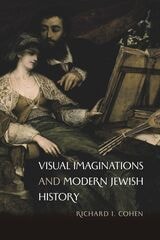
Visual Imaginations and Modern Jewish History
Richard I. Cohen
Brandeis University Press, 2026
Establishes the centrality of visual culture within Judaism and Jewish history.
Visual Imaginations and Modern Jewish History traces how visual experience reflected and shaped Jewish life from the late seventeenth century onward. Richard I. Cohen shows how images, spaces, and objects were central to the making of modern Jewish identities and how the act of seeing itself became a site of cultural negotiation. Cohen claims that the prominence of visual art in modern Jewish life cannot be overlooked. Visual expression has become such a significant factor in Jewish life that it serves as both a mirror and an agent of Jewish modernity.
Cohen engages with a range of artists, figures like Moses Mendelssohn, Uriel Da Costa, and Baruch Spinoza, and such topics as the visual imaginings of the Mishnah, Jews in the military, and the motif of the Wandering Jew. Taken as a whole, the studies in this book argue that approaching modern Jewish history through images is not to replace the written word, but to restore to it the world of sight that Jews inhabited, created, and transformed.
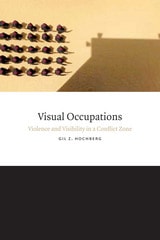
Visual Occupations
Violence and Visibility in a Conflict ZoneGil Z. Hochberg
Duke University Press, 2015
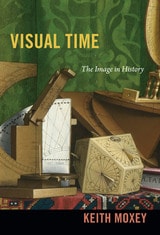
Visual Time
The Image in HistoryKeith Moxey
Duke University Press, 2013
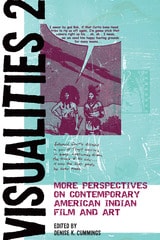
Visualities 2
More Perspectives on Contemporary American Indian Film and ArtDenise K. Cummings
Michigan State University Press, 2019
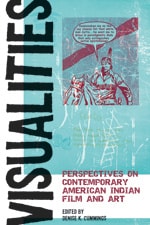
Visualities
Perspectives on Contemporary American Indian Film and ArtDenise K. Cummings
Michigan State University Press, 2011
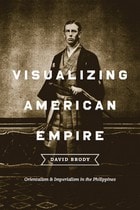
Visualizing American Empire
Orientalism and Imperialism in the PhilippinesDavid Brody
University of Chicago Press, 2010
In 1899 an American could open a newspaper and find outrageous images, such as an American soldier being injected with leprosy by Filipino insurgents. These kinds of hyperbolic accounts, David Brody argues in this illuminating book, were just one element of the visual and material culture that played an integral role in debates about empire in late nineteenth- and early twentieth-century America.
Visualizing American Empire explores the ways visual imagery and design shaped the political and cultural landscape. Drawing on a myriad of sources—including photographs, tattoos, the decorative arts, the popular press, maps, parades, and material from world’s fairs and urban planners—Brody offers a distinctive perspective on American imperialism. Exploring the period leading up to the Spanish-American War, as well as beyond it, Brody argues that the way Americans visualized the Orient greatly influenced the fantasies of colonial domestication that would play out in the Philippines. Throughout, Brody insightfully examines visual culture’s integral role in the machinery that runs the colonial engine. The result is essential reading for anyone interested in the history of the United States, art, design, or empire.
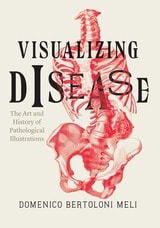
Visualizing Disease
The Art and History of Pathological IllustrationsDomenico Bertoloni Meli
University of Chicago Press, 2018
Starting in the Renaissance, Bertoloni Meli delves into the wide range of figures involved in the early study and representation of disease, including not just men of medicine, like anatomists, physicians, surgeons, and pathologists, but also draftsmen and engravers. Pathological preparations proved difficult to preserve and represent, and as Bertoloni Meli takes us through a number of different cases from the Renaissance to the mid-nineteenth century, we gain a new understanding of how knowledge of disease, interactions among medical men and artists, and changes in the technologies of preservation and representation of specimens interacted to slowly bring illustration into the medical world.
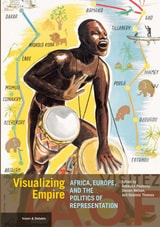
Visualizing Empire
Africa, Europe, and the Politics of RepresentationRebecca Peabody
J. Paul Getty Trust, The, 2021
An exploration of how an official French visual culture normalized France’s colonial project and exposed citizens and subjects to racialized ideas of life in the empire.
By the end of World War I, having fortified its colonial holdings in the Caribbean, Latin America, Africa, the Indian Ocean, and Asia, France had expanded its dominion to the four corners of the earth. This volume examines how an official French visual culture normalized the country’s colonial project and exposed citizens and subjects alike to racialized ideas of life in the empire. Essays analyze aspects of colonialism through investigations into the art, popular literature, material culture, film, and exhibitions that represented, celebrated, or were created for France’s colonies across the seas.
These studies draw from the rich documents and media—photographs, albums, postcards, maps, posters, advertisements, and children’s games—related to the nineteenth- and twentieth-century French empire that are held in the Getty Research Institute’s Association Connaissance de l’histoire de l’Afrique contemporaine (ACHAC) collections. ACHAC is a consortium of scholars and researchers devoted to exploring and promoting discussions of race, iconography, and the colonial and postcolonial periods of Africa and Europe.
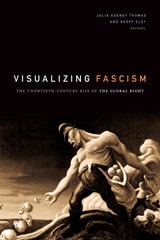
Visualizing Fascism
The Twentieth-Century Rise of the Global RightJulia Adeney Thomas and Geoff Eley, editors
Duke University Press, 2020
Contributors. Nadya Bair, Paul D. Barclay, Ruth Ben-Ghiat, Maggie Clinton, Geoff Eley, Lutz Koepnick, Ethan Mark, Bertrand Metton, Lorena Rizzo, Julia Adeney Thomas, Claire Zimmerman

Visualizing Secularism and Religion
Egypt, Lebanon, Turkey, IndiaAlev Cinar, Srirupa Roy and Maha Yahya, Editors
University of Michigan Press, 2012
Over the past two decades secular polities across the globe have witnessed an increasing turn to religion-based political movements, such as the rise of political Islam and Hindu nationalism, which have been fueling new and alternative notions of nationhood and national ideologies. The rise of such movements has initiated widespread debates over the meaning, efficacy, and normative worth of secularism. Visualizing Secularism and Religion examines the constitutive role of religion in the formation of secular-national public spheres in the Middle East and South Asia, arguing that in order to establish secularism as the dominant national ideology of countries such as Turkey, Lebanon, and India, the discourses, practices, and institutions of secular nation-building include rather than exclude religion as a presence within the public sphere. The contributors examine three fields---urban space and architecture, media, and public rituals such as parades, processions, and commemorative festivals---with a view to exploring how the relation between secularism, religion, and nationalism is displayed and performed. This approach demands a reconceptualization of secularism as an array of contextually specific practices, ideologies, subjectivities, and "performances" rather than as simply an abstract legal bundle of rights and policies.
Visualizing the Sacred
Cosmic Visions, Regionalism, and the Art of the Mississippian WorldEdited by George E. Lankford, F. Kent Reilly III, and James F. Garber
University of Texas Press, 2011
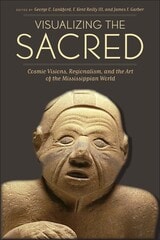
The prehistoric native peoples of the Mississippi River Valley and other areas of the Eastern Woodlands of the United States shared a complex set of symbols and motifs that constituted one of the greatest artistic traditions of the pre-Columbian Americas. Traditionally known as the Southeastern Ceremonial Complex, these artifacts of copper, shell, stone, clay, and wood were the subject of the groundbreaking 2007 book Ancient Objects and Sacred Realms: Interpretations of Mississippian Iconography, which presented a major reconstruction of the rituals, cosmology, ideology, and political structures of the Mississippian peoples.
Visualizing the Sacred advances the study of Mississippian iconography by delving into the regional variations within what is now known as the Mississippian Iconographic Interaction Sphere (MIIS). Bringing archaeological, ethnographic, ethnohistoric, and iconographic perspectives to the analysis of Mississippian art, contributors from several disciplines discuss variations in symbols and motifs among major sites and regions across a wide span of time and also consider what visual symbols reveal about elite status in diverse political environments. These findings represent the first formal identification of style regions within the Mississippian Iconographic Interaction Sphere and call for a new understanding of the MIIS as a network of localized, yet interrelated religious systems that experienced both continuity and change over time.
Vita Sexualis
Karl Ulrichs and the Origins of Sexual ScienceRalph M. Leck
University of Illinois Press, 2020

Vital Enemies
Slavery, Predation, and the Amerindian Political Economy of LifeBy Fernando Santos-Granero
University of Texas Press, 2009
Analyzing slavery and other forms of servitude in six non-state indigenous societies of tropical America at the time of European contact, Vital Enemies offers a fascinating new approach to the study of slavery based on the notion of "political economy of life." Fernando Santos-Granero draws on the earliest available historical sources to provide novel information on Amerindian regimes of servitude, sociologies of submission, and ideologies of capture.
Estimating that captive slaves represented up to 20 percent of the total population and up to 40 percent when combined with other forms of servitude, Santos-Granero argues that native forms of servitude fulfill the modern understandings of slavery, though Amerindian contexts provide crucial distinctions with slavery as it developed in the American South. The Amerindian understanding of life forces as being finite, scarce, unequally distributed, and in constant circulation yields a concept of all living beings as competing for vital energy. The capture of human beings is an extreme manifestation of this understanding, but it marks an important element in the ways Amerindian "captive slavery" was misconstrued by European conquistadors.
Illuminating a cultural facet that has been widely overlooked or miscast for centuries, Vital Enemies makes possible new dialogues regarding hierarchies in the field of native studies, as well as a provocative re-framing of pre- and post-contact America.
Vital Minimum
Need, Science, and Politics in Modern FranceDana Simmons
University of Chicago Press, 2015
The result was the concept of the "vital minimum"--the living wage, a measure of physical and social needs. In this book, Dana Simmons traces the history of this concept, revealing the intersections between technologies of measurement, such as calorimeters and social surveys, and technologies of wages and welfare, such as minimum wages, poor aid, and welfare programs. In looking at how we define and measure need, Vital Minimum raises profound questions about the authority of nature and the nature of inequality.
Vital Voids
Cavities and Holes in Mesoamerican Material CultureBy Andrew Finegold
University of Texas Press, 2021
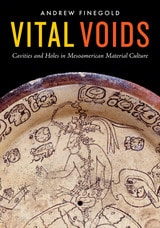
The Resurrection Plate, a Late Classic Maya dish, is decorated with an arresting scene. The Maize God, assisted by two other deities, emerges reborn from a turtle shell. At the center of the plate, in the middle of the god’s body and aligned with the point of emergence, there is a curious sight: a small, neatly drilled hole.
Art historian Andrew Finegold explores the meanings attributed to this and other holes in Mesoamerican material culture, arguing that such spaces were broadly understood as conduits of vital forces and material abundance, prerequisites for the emergence of life. Beginning with, and repeatedly returning to, the Resurrection Plate, this study explores the generative potential attributed to a wide variety of cavities and holes in Mesoamerica, ranging from the perforated dishes placed in Classic Maya burials, to caves and architectural voids, to the piercing of human flesh. Holes are also discussed in relation to fire, based on the common means through which both were produced: drilling. Ultimately, by attending to what is not there, Vital Voids offers a fascinating approach to Mesoamerican cosmology and material culture.