Results by title
45 books match the query 'Pressure groups'
Activism, Majority Rule, and Local Democracy
Rethinking Public InfluenceBrian E. Adams
Temple University Press, 2026
Local democracy doesn’t work as it should, declares Brian Adams in Activism, Majority Rule, and Local Democracy. Local politics is where citizens have the most opportunity for direct participation, control, and influence, but that activism doesn’t necessarily translate into majority rule.
While greater local engagement can produce policy that better reflects activists’ strong preferences, Adams explains that activists are not representative of the public-at-large and states that a reconceptualization of how the public should be able to influence local officials is required. Based on interviews with activists in San Diego, California, Adams concludes that activism can be beneficial, but we need to view it as distinct from majority rule, with a focus on managing the tension between the two.
Improving local democracy is not just a matter of generating more activism. It requires articulating when we want policy to reflect majority preferences and when we want activists to hold sway.
Affirmative Advocacy
Race, Class, and Gender in Interest Group PoliticsDara Z. Strolovitch
University of Chicago Press, 2007
The United States boasts scores of organizations that offer crucial representation for groups that are marginalized in national politics, from women to racial minorities to the poor. Here, in the first systematic study of these organizations, Dara Z. Strolovitch explores the challenges and opportunities they face in the new millennium, as waning legal discrimination coincides with increasing political and economic inequalities within the populations they represent.
Drawing on rich new data from a survey of 286 organizations and interviews with forty officials, Strolovitch finds that groups too often prioritize the interests of their most advantaged members: male rather than female racial minorities, for example, or affluent rather than poor women. But Strolovitch also finds that many organizations try to remedy this inequity, and she concludes by distilling their best practices into a set of principles that she calls affirmative advocacy—a form of representation that aims to overcome the entrenched but often subtle biases against people at the intersection of more than one marginalized group. Intelligently combining political theory with sophisticated empirical methods, Affirmative Advocacy will be required reading for students and scholars of American politics.

Air Wars
Fight To Reclaim Public BroadcastingJerold Starr
Temple University Press, 2001
These citizens believed strongly in public television's unique mission to serve the diverse social and cultural needs of local communities. When their own station neglected this mission in the search for national prestige and bigger revenues, they felt profoundly betrayed.
Jerold Starr exposes the political and commercial pressures that made strange bedfellows of the top officials of public broadcasting, the Democratic Party establishment, Pat Robertson and the Christian Coalition, home-shopping and "infomall" king Lowell "Bud" Paxson, and billionaire right-wing publisher/philanthropist Richard Mellon Scaife.
What began as a bitterly contested local struggle that disturbed the serenity of Mister Rogers' Neighborhood later became front-page national news with revelations of presidential candidate John McCain's influence-peddling scandal on behalf of media mogul Paxson. This was followed by congressional resolutions attacking the FCC's authority to regulate noncommercial educational broadcast licenses. The "Pittsburgh case" promises to be in the news for some time to come.
Far beyond Pittsburgh, Starr looks at how the reform movement has spread to major cities like Chicago, Phoenix, Jacksonville, and San Francisco, where citizen activists have successfully challenged public stations to be more community responsive.
Finally, he outlines an innovative plan for restructuring the public broadcasting service as an independently funded public trust. Joining this vision with a practical strategy, Starr describes the formation of Citizens for Independent Public Broadcasting, a national membership organization with a grassroots approach to putting the public back into public broadcasting.

Allies and Obstacles
Disability Activism and Parents of Children with DisabilitiesAllison C. Carey, Pamela Block, and Richard K. Scotch
Temple University Press, 2020
Parents of children with disabilities often situate their activism as a means of improving the world for their child. However, some disabled activists perceive parental activism as working against the independence and dignity of people with disabilities. This thorny relationship is at the heart of the groundbreaking Allies and Obstacles.
The authors chronicle parents’ path-breaking advocacy in arenas such as the right to education and to liberty via deinstitutionalization as well as how they engaged in legal and political advocacy. Allies and Obstacles provides a macro analysis of parent activism using a social movement perspective to reveal and analyze the complex—and often tense—relationship of parents to disability rights organizations and activism.
The authors look at organizational and individual narratives using four case studies that focus on intellectual disability, psychiatric diagnoses, autism, and a broad range of physical disabilities including cerebral palsy and muscular dystrophy. These cases explore the specific ways in which activism developed among parents and people with disabilities, as well as the points of alliance and the key points of contestation. Ultimately, Allies and Obstacles develops new insights into disability activism, policy, and the family.
American Business and Political Power
Public Opinion, Elections, and DemocracyMark A. Smith
University of Chicago Press, 2000
Rather than succumbing to corporate America, Smith argues, representatives paradoxically become more responsive to their constituents when facing a united corporate front. Corporations gain the most influence over legislation when they work with organizations such as think tanks to shape Americans' beliefs about what government should and should not do.

American Relief Aid and the Spanish Civil War
Eric R. Smith
University of Missouri Press, 2013
The Spanish Civil War created a conflict for Americans who preferred that the United States remain uninvolved in foreign affairs. Despite the country's isolationist tendencies, opposition to the rise of fascism across Europe convinced many Americans that they had to act in support of the Spanish Republic. While much has been written about the war itself and its international volunteers, little attention has been paid to those who coordinated these relief efforts at home.
American Relief Aid and the Spanish Civil War tells the story of the political campaigns to raise aid for the Spanish Republic as activists pushed the limits of isolationist thinking. Those concerned with Spain’s fate held a range of political convictions (including anarchists, socialists, liberals, and communists) with very different understandings of what fascism was. Yet they all agreed that fascism’s advance must be halted. With labor strikes, fund-raising parties, and ambulance tours, defenders of Spain in the United States sought to shift the political discussion away from isolation of Spain’s elected government and toward active assistance for the faltering Republic.
Examining the American political organizations affiliated with this relief effort and the political repression that resulted as many of Spain’s supporters faced the early incarnations of McCarthyism’s trials, Smith provides new understanding of American politics during the crucial years leading up to World War II. By also focusing on the impact the Spanish Civil War had on those of Spanish ethnicity in the United States, Smith shows how close to home the seemingly distant war really hit.

Beyond Civil Society
Activism, Participation, and Protest in Latin AmericaSonia E. Alvarez, Jeffrey W. Rubin, Millie Thayer, Gianpaolo Baiocchi, and Agustín Laó-Montes, editors
Duke University Press, 2017
Contributors. Sonia E. Alvarez, Kiran Asher, Leonardo Avritzer, Gianpaolo Baiocchi, Andrea Cornwall, Graciela DiMarco, Arturo Escobar, Raphael Hoetmer, Benjamin Junge, Luis E. Lander, Agustín Laó-Montes, Margarita López Maya, José Antonio Lucero, Graciela Monteagudo, Amalia Pallares, Jeffrey W. Rubin, Ana Claudia Teixeira, Millie Thayer
Beyond the Boomerang
From Transnational Advocacy Networks to Transcalar Advocacy in International PoliticsEdited by Christopher L. Pallas and Elizabeth A. Bloodgood
University of Alabama Press, 2022
From Networks to Scales: Rethinking Advocacy Power in Global Politics.
Margaret E. Keck and Kathryn Sikkink introduced the boomerang theory in their 1998 book, Activists beyond Borders: Advocacy Networks in International Politics. It remains one of the first broadly applicable theories for why groups of NGOs and interested individuals form transnational advocacy networks. Since its publication, however, the empirical conditions that prompted their theory have changed. The types of actors involved in transnational advocacy have diversified. Northern NGOs have lost power and influence and have been restricted in their access to southern states. Southern NGOs have developed the capacity to undertake advocacy on their own and often built closer relationships with their own governments. The architecture of global governance has likewise changed, providing new avenues of access and influence for southern voices.
In Beyond the Boomerang: From Transnational Advocacy Networks to Transcalar Advocacy in International Politics, editors Christopher L. Pallas and Elizabeth A. Bloodgood offer cutting-edge scholarship that synthesizes a new theoretical framework to develop a coherent, integrated picture of the current dynamics in global advocacy. This new theory of transcalar advocacy focuses on advocacy activities and policy impacts that transcend different levels or scales of political action. In transcalar advocacy, all NGOs–northern and southern–are treated as strategic actors, choosing the targets, scales of advocacy, and partnerships that best suit their capacities and goals. The case studies in the volume develop the empirical grounding of this theory using data from Latin America, Africa, Europe, and Asia, with several chapters featuring cross-national comparison. The chapters highlight the wide variety of actors involved in advocacy work, including NGOs, social movements, international institutions, governments, and businesses. Contributors use both qualitative and quantitative methodologies and bring to bear insights from political science, international relations, and sociology. The case studies also include diverse issue areas, from women’s rights to environmental protection, sustainable agriculture, health policy, and democracy promotion.

Bureaucrats, Clients, and Geography
The Bailly Nuclear Power Plant Battle in Northern IndianaNancy J. Obermeyer
University of Chicago Press, 1989
Challenges to Globalization
Analyzing the EconomicsEdited by Robert E. Baldwin and L. Alan Winters
University of Chicago Press, 2004
Challenges to Globalization evaluates the arguments of pro-globalists and anti-globalists regarding issues such as globalization's relationship to democracy, its impact on the environment and on labor markets including the brain drain, sweat shop labor, wage levels, and changes in production processes, and the associated expansion of trade and its effects on prices. Baldwin, Winters, and the contributors to this volume look at multinational firms, foreign investment, and mergers and acquisitions and present surprising findings that often run counter to the claim that multinational firms primarily seek countries with low wage labor. The book closes with papers on financial opening and on the relationship between international economic policies and national economic growth rates.

Change the World Without Taking Power
The Meaning of Revolution TodayJohn Holloway
Pluto Press, 2019
After a century of failed attempts by radical projects, the concept of revolution itself is in crisis. By asking the deepest questions about the nature of humanity, work, capitalism, organisation and resistance, John Holloway looks sharply at modern protest movements and provides tools for creating new strategies.
First published in 2002, this book marked a shift in the understanding of Autonomism, Anarchism and Marxism, addressing the doubts activists had in their own political history and work, and helped form the perspectives of a new generation who are today changing the world.
Choices and Changes
Interest Groups in the Electoral ProcessMichael M. Franz
Temple University Press, 2008
Choices and Changes is the most comprehensive examination to date of the impact of interest groups on recent American electoral politics. Richly informed, theoretically and empirically, it is the first book to explain the emergence of aggressive interest group electioneering tactics in the mid-1990s—including “soft money” contributions, issue ads, and “527s” (IRS-classified political organizations).
Michael Franz argues that changing political and legal contexts have clearly influenced the behavior of interest groups. To support his argument, he tracks in detail the evolution of campaign finance laws since the 1970s, examines all soft money contributions—nearly $1 billion in total—to parties by interest groups from 1991-2002, and analyzes political action committee (PAC) contributions to candidates and parties from 1983-2002. He also draws on his own interviews with campaign finance leaders.
Based on this rigorous data analysis and a formidable knowledge of its subject, Choices and Changes substantially advances our understanding of the significance of interest groups in U.S. politics.
Citizens and Groups in Contemporary China
Victor C. Falkenheim, Editor
University of Michigan Press, 1987
Congress and the Rent-Seeking Society
Glenn R. Parker
University of Michigan Press, 1996
Skillfully blending historical data with microeconomic theory, Glenn Parker argues that the incentives for congressional service have declined over the years, and that with that decline has come a change in the kind of person who seeks to enter Congress. The decline in the attractiveness of Congress is a consequence of congressional careerists and of the growth in the rent-seeking society, a term which describes the efforts of special interests to obtain preferential treatment by using the machinery of government--legislation and regulations.
Parker provides a fresh and controversial perspective to the debate surrounding the relative merits of career or amateur politicians. He argues that driving career politicians from office can have pernicious effects on the political system: it places the running of Congress in the hands of amateur politicians, who stand to lose little if they are found engaging in illegal or quasi-legal practices. On the other hand, career legislators risk all they have invested in their long careers in public service if they engage in unsavory practices. As Parker develops this controversial argument, he provides a fresh perspective on the debate surrounding the value of career versus amateur politicians.
Little attention has been given to the long-term impact of a rent-seeking society on the evolution of political institutions. Parker examines empirically and finds support for hypotheses that reflect potential symptoms of adverse selection in the composition of Congress: (1) rent-seeking politicians are more inclined than others to manipulate institutional arrangements for financial gain; (2) the rent-seeking milieu of legislators are more likely to engage in rent-seeking activity than earlier generations; (3) and the growth of rent-seeking activity has hastened the departure of career legislators.
Glenn R. Parker is Distinguished Research Professor, Florida State University.
Constituent Interests and U.S. Trade Policies
Alan V. Deardorff and Robert M. Stern
University of Michigan Press, 1998
Democracy in America?
What Has Gone Wrong and What We Can Do About ItBenjamin I. Page and Martin Gilens
University of Chicago Press, 2017
How did we get here? Through decades of dysfunctional government. In Democracy in America? veteran political observers Benjamin I. Page and Martin Gilens marshal an unprecedented array of evidence to show that while other countries have responded to a rapidly changing economy by helping people who’ve been left behind, the United States has failed to do so. Instead, we have actually exacerbated inequality, enriching corporations and the wealthy while leaving ordinary citizens to fend for themselves.
What’s the solution? More democracy. More opportunity for citizens to shape what their government does. To repair our democracy, Page and Gilens argue, we must change the way we choose candidates and conduct our elections, reform our governing institutions, and curb the power of money in politics. By doing so, we can reduce polarization and gridlock, address pressing challenges, and enact policies that truly reflect the interests of average Americans.
This book presents a damning indictment. But the situation is far from hopeless. With increased democratic participation as their guide, Page and Gilens lay out a set of proposals that would boost citizen participation, curb the power of money, and democratize the House and Senate. The only certainty is that inaction is not an option. Now is the time to act to restore and extend American democracy.

Democracy in America?
What Has Gone Wrong and What We Can Do About ItBenjamin I. Page and Martin Gilens
University of Chicago Press, 2020
What’s the solution? More democracy. More opportunities for citizens to shape what their government does. To repair our democracy, Page and Gilens argue, we must change the way we choose candidates and conduct our elections, reform our governing institutions, and curb the power of money in politics. By doing so, we can reduce polarization and gridlock, address pressing challenges, and enact policies that truly reflect the interests of average Americans.
Updated with new information, this book lays out a set of proposals that would boost citizen participation, curb the power of money, and democratize the House and Senate.
Empowering Exporters
Reciprocity, Delegation, and Collective Action in American Trade PolicyMichael J. Gilligan
University of Michigan Press, 1997
From Outrage to Action
The Politics of Grass-Roots DissentLaura R. Woliver
University of Illinois Press, 1993
Through in-depth interviews with activists, Laura Woliver examines these community actions, studying the groups involved and linking her conclusions to larger questions of political power and the impact of social movements. Her findings will make fascinating reading for those interested in the rise and fall of grass-roots interest groups, the nature of dissent, and the reasons why people volunteer countless hours, sometimes in the face of community opposition and isolation, to dedicate themselves to a cause. The ad hoc interest groups studied are the Committee to Recall Judge Archie Simonson (Madison), the Coalition for Justice for Ernest Lacy (Milwaukee), Concerned Citizens for Children (Grant County, Wisconsin), and Citizens Taking Action (Madison). Woliver relates the community responses in these cases to those in the Jeffrey Dahmer mass murder case and the beating by Los Angeles police of Rodney King.
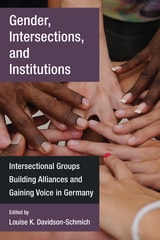
Gender, Intersections, and Institutions
Intersectional Groups Building Alliances and Gaining Voice in GermanyEdited by Louise K. Davidson-Schmich
University of Michigan Press, 2017

Grassroots Library Advocacy
Lauren Comito
American Library Association, 2012
How Policies Make Interest Groups
Governments, Unions, and American EducationMichael T. Hartney
University of Chicago Press, 2022
As most American labor organizations struggle for survival and relevance in the twenty-first century, teachers unions appear to be an exception. Despite being all but nonexistent until the 1960s, these unions are maintaining members, assets—and political influence. As the COVID-19 epidemic has illustrated, today’s teachers unions are something greater than mere labor organizations: they are primary influencers of American education policy. How Policies Make Interest Groups examines the rise of these unions to their current place of influence in American politics.
Michael Hartney details how state and local governments adopted a new system of labor relations that subsidized—and in turn, strengthened—the power of teachers unions as interest groups in American politics. In doing so, governments created a force in American politics: an entrenched, subsidized machine for membership recruitment, political fundraising, and electoral mobilization efforts that have informed elections and policymaking ever since. Backed by original quantitative research from across the American educational landscape, Hartney shows how American education policymaking and labor relations have combined to create some of the very voter blocs to which it currently answers. How Policies Make Interest Groups is trenchant, essential reading for anyone seeking to understand why some voices in American politics mean more than others.
Improper Influence
Campaign Finance Law, Political Interest Groups, and the Problem of EqualityThomas Gais
University of Michigan Press, 1998

Institutions and Innovation
Voters, Parties, and Interest Groups in the Consolidation of Democracy - France and Germany, 1870-1939Marcus Kreuzer
University of Michigan Press, 2001
Institutions and Innovations analyzes the troubled history of French and German parties between 1870 and 1939 to develop a general explanation of how the development of responsive parties constitutes a key element for the consolidation of democracies, past and present. It explains why French parties responded more swiftly than German ones to very similar changes in their economic and political environments. The book demonstrates that the national differences in party responsiveness played a key role in the collapse of the German Weimar Republic (1918ñ1933) and in the survival of the French Third Republic (1870ñ1939). It addresses the general fates of French and German democracy by asking three specific questions: Why did German socialists reject Keynesianism while their French counterparts swiftly embraced it? Why did German liberals, compared to French ones, fail to modernize their logistical infrastructure and electioneering methods? Why were German conservatives less effective than French ones in fending off the challenge posed by fascist and peasant insurgent movements that arose in the 1920s and 1930s?
In answering these questions, the book engages new institutional theories and longstanding party literature to demonstrate that the electoral conduct of parties is structured in equal parts by socioeconomic and institutional constraints. The book's interdisciplinary focus sheds a critical light on the exceptionalism of purely historical accounts and reductionist and universal claims of ahistorical political science theories.
Marcus Kreuzer is Assistant Professor of Political Science, Villanova University.
Interest Group Politics in the Southern States
Ronald J. Hrebenar
University of Alabama Press, 1992
This is the first volume comprehensively to explore the dynamics of political interest groups in the twelve southern states – the types of group, lobbyists and lobbying tactics, state regulation of lobbying activity, and the power they exert in the individual states. The authors bring a new dimension to the study of southern politics, which traditionally has emphasized electoral politics and the politics of race, and their work underscores the pivotal, and at times controlling, role played by interest groups.
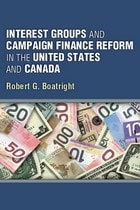
Interest Groups and Campaign Finance Reform in the United States and Canada
Robert G. Boatright
University of Michigan Press, 2011
In the early 2000s, the United States and Canada implemented new campaign finance laws restricting the ability of interest groups to make political contributions and to engage in political advertising. Whereas both nations' legislative reforms sought to reduce the role of interest groups in campaigns, these laws have had opposite results in the two nations. In the United States, interest groups remained influential by developing broad coalitions aimed at mobilizing individual voters and contributors. In Canada, interest groups largely withdrew from election campaigns, and, thus, important voices in elections have gone silent. Robert G. Boatright explains such disparate results by placing campaign finance reforms in the context of ongoing political and technological changes.
Robert G. Boatright is Associate Professor of Political Science at Clark University.
Cover photo: © iStockphoto.com / alfabravoalpharomeo

LITIGATION AS LOBBYING
REPRODUCTIVE HAZARDS & INTEREST AGGREGATIONJULIANNA S. GONEN
The Ohio State University Press, 2003

Media, Culture, and the Environment
Anderson, Alison
Rutgers University Press, 1997
Media, Culture and the Environment provides an accessible introduction to key issues and debates surrounding the media politics of risk assessment and the environment. Anderson looks at nature as contested terrain and reveals how news sources use it to compete for our emotions and attention. She shows how framings of risk in relation to the environment are influenced by social, political, and cultural factors, but she also rejects extreme versions of social constructionism.
The book moves beyond traditional disciplinary boundaries by synthesizing recent debates in cultural theory and media studies with key developments in human geography. It offers an in-depth analysis of pressure politics and environmental lobbying groups, while examining the production, transmission and negotiation language of news discourse. The examples, drawn from both Europe and North America, include the tremendous headline controversies over oil spills and killing of baby seals. Difficult issues, clearly surveyed and incisively presented, make this book essential reading for anyone interested in how and why journalists handle environmental news in the ways they do.
Mobilizing Interest Groups in America
Patrons, Professions, and Social MovementsJack L. Walker
University of Michigan Press, 1991
Networks of Champions
Leadership, Access, and Advocacy in the U.S. House of RepresentativesChristine A. DeGregorio
University of Michigan Press, 1999
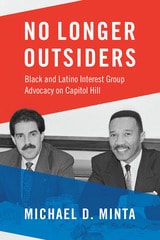
No Longer Outsiders
Black and Latino Interest Group Advocacy on Capitol HillMichael D. Minta
University of Chicago Press, 2021
In No Longer Outsiders, Minta provides a comprehensive account of the effectiveness of minority civil rights organizations and their legislative allies. He finds that the organizations’ legislative priorities are consistent with black and Latino preferences for stronger enforcement of civil rights policy and immigration reform. Although these groups focus mainly on civil rights for blacks and immigration issues for Latinos, their policy agendas extend into other significant areas. Minta concludes with an examination of how diversity in Congress helps groups gain greater influence and policy success despite many limits placed upon them.
Organizational State
Social Choice: In National Policy DomainsEdward O. Laumann
University of Wisconsin Press, 1987
But this says nothing about politics. Professor Lauman and Knoke have asked, in this book, how policies were made, in the period 1977-1980, in the areas of energy and health. The question is a very different one from the question of how the positions of president and Congress are filled.

Political Groups in Chile
The Dialogue between Order and ChangeBy Ben G. Burnett
University of Texas Press, 1970
Before the Pinochet coup in 1973, Chile had a lengthy history of constitutionalism. Early in the republican era the aristocracy established order in the political system; a century later the emergent middle sectors infused politics with wider democratic practices and, relative to most of Latin America, a level of pluralism came to characterize group politics.
Despite the distinctive advantages that embellished Chile’s political system, however, certain unfulfilled promises still marred the actual picture in the early 1960s. As the lower economic strata of society were continually passed over by most of the social reforms and economic advances that bettered the general outlook of the nation, their frustrations were brought out into the open and their votes were appealed to by reformist and radical political parties anxious to break the political hegemony of moderates and conservatives.
Thus, the 1960s stood out as a high-water mark in the confrontation between, on the one side, those desirous of maintaining the status quo, or at most admitting to prescriptive change, and, on the other, progressive elements demanding deep structural alterations in the entire social fabric. This study seeks to analyze the sources of alienation, the styles and objectives of the participants in the confrontation, and the relative ability of groups to gain satisfaction of their claims upon the political system. Ben G. Burnett delineates this dialogue between order and change as it inexorably pushed toward a showdown in the presidential elections of 1964 and the congressional elections of 1965.

Re-Forming the State
The Politics of Privatization in Latin America and EuropeHector E. Schamis
University of Michigan Press, 2002
The experience of privatization shows that the public and the private are neither contradictory nor mutually exclusive spheres, and that power relations between them are not necessarily zero-sum. To stress the point, the author borrows from the literature on state formation, which has extensively examined the historical processes of key private groups. The evidence presented shows why and how, by restructuring coalitional and institutional arenas, the state uses marketization to generate political order and to distribute political power. Thus, the author specifies the conditions under which political change is conceived in terms of and channeled through economic policy; in other words, how the state is "re-formed" through privatization. Re-forming the State thus highlights how privatization is simultaneously a movement from public to private, but also a movement from non-state to state, as the reduction of state assets leads to institutional changes that increase state capacities for defining and enforcing property rights, extracting revenue, and centralizing administrative and political resources.
Hector E. Schamis is Assistant Professor of Government, Cornell University.

Roots of Reform
Farmers, Workers, and the American State, 1877-1917Elizabeth Sanders
University of Chicago Press, 1999
Based on new evidence from legislative records and other sources, Sanders shows that this tenuous alliance of "producers versus plutocrats" shaped early regulatory legislation, remained powerful through the populist and progressive eras, and developed a characteristic method of democratic state expansion with continued relevance for subsequent reform movements.
Roots of Reform is essential reading for anyone interested in this crucial period of American political development.
THE INDIRECT EFFECT OF DIRECT LEGISLATION
HOW INSTITUTIONS SHAPE INTEREST GROUP SYSTEMSFREDERICK J BOEHMKE
The Ohio State University Press, 2005
To demonstrate this, the author models the incentives that the initiative process creates for interests to organize and for how they communicate their preferences to policy makers. Interests that represent a broader range of the public are found to gain the most from the option to propose initiatives, implying that the set of organized interests in initiative states should reflect this advantage. Ironically, an effect of direct legislation is to potentially increase the effectiveness of special interest lobbying in state legislatures—in a sense, the opposite of the direct control that gives direct legislation its theoretical appeal. Yet, the clear effect is one of empowering voices that traditionally had very little effect in the legislative process. If greater representation is the goal of direct legislation, it is a clear success, even though that success does not really come in the act of ballot initiatives itself.
The Governors' Lobbyists
Federal-State Relations Offices and Governors Associations in WashingtonJennifer M. Jensen
University of Michigan Press, 2016
The New Politics of Indian Gaming
The Rise of Reservation Interest GroupsKenneth N. Hansen
University of Nevada Press, 2015
The Organization of Interests
Incentives and the Internal Dynamics of Political Interest GroupsTerry M. Moe
University of Chicago Press, 1980
"The Organization of Interests is a valuable addition to the literature. It reminds us that the interior life of groups has political significance and gives us a conceptual framework for exploring that life. It balances nicely between the pluralists—who tend to interpret interest group behaviour entirely in political terms—and Olson—who has no satisfactory explanation for behaviour that is not attributable to economic self-interest. In the concept of the entrepreneur Moe gives us a useful analytical device which deserves operationalization. The book is well worth study."—A. Paul Pross, Canadian Journal of Political Science
The People's Lobby
Organizational Innovation and the Rise of Interest Group Politics in the United States, 1890-1925Elisabeth S. Clemens
University of Chicago Press, 1997
Clemens sheds new light on how farmers, workers, and women invented strategies to circumvent the parties. Voters learned to monitor legislative processes, to hold their representatives accountable at the polls, and to institutionalize their ongoing participation in shaping policy. Closely analyzing the organizational politics in three states—California, Washington, and Wisconsin—she demonstrates how the political opportunity structure of federalism allowed regional innovations to exert leverage on national political institutions.
An authoritative statement on the changes in American politics during the Progressive Era, this book will interest political scientists, sociologists, and American historians.
The Political Economy of Expertise
Information and Efficiency in American National PoliticsKevin M. Esterling
University of Michigan Press, 2004
More than mere touts for the interests of Washington insiders, these groups encourage Congress to enact policies that are likely to succeed while avoiding those that have too great of a risk of failure. The surprising result is greater legislative efficiency. The Political Economy of Expertise illustrates that this system actually favors effective and informed decision making, thereby increasing the likelihood that new policies will benefit the American public.
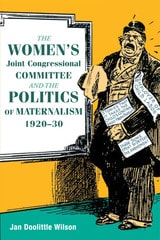
The Women's Joint Congressional Committee and the Politics of Maternalism, 1920-30
Jan Doolittle Wilson
University of Illinois Press, 2006
Jan Doolittle Wilson offers the first comprehensive history of the umbrella organization founded by former suffrage leaders in order to coordinate activities around women's reform. Encompassing nearly every major national women's organization of its time, the Women's Joint Congressional Committee (WJCC) evolved into a powerful lobbying force for the legislative agendas of more than twelve million women. Critics and supporters alike came to recognize it as "the most powerful lobby in Washington."
Examining the WJCC's most consequential and contentious campaigns, Wilson traces how the group's strategies, rhetoric, and success generated congressional and grassroots support for their far-reaching, progressive reforms. But the committee's early achievements sparked a reaction by big business that challenged and ultimately limited the programs these women envisioned. Using the WJCC as a lens, Wilson analyzes women's political culture during the 1920s. She also sheds new light on the initially successful ways women lobbied for social legislation, the limitations of that process for pursuing class-based reforms, and the enormous difficulties the women soon faced in trying to expand public responsibility for social welfare.
A volume in the series Women in American History, edited by Anne Firor Scott, Susan Armitage, Susan K. Cahn, and Deborah Gray White

U.S. Foreign Policy in the Middle East
The Role of Lobbies and Special Interest GroupsJanice J. Terry
Pluto Press, 2005
Israel is America's key ally in the Middle East, and helps maintain U.S. dominance in the region. This book shows how pro-Israeli lobbyists and domestic interest groups have been hugely successful in creating government and financial support for Israel. By contrast, Arab-American groups and Arab governments have had less success putting forward their agencies.
Janice J. Terry shows how special interest groups work, and why certain lobbying techniques are more effective than others. She sets this within the wider cultural context, showing how the U.S. media -- and the general public -- view the Middle East.
To explain how lobbies work, Terry draws on case studies including the Sinai accords and Camp David under Presidents Ford and Carter, the Conflict between Green and Turkish lobbies over Cyprus, and the major campaign against the Arab boycott.
Making use of primary sources, and unpublished material from various presidential libraries, this is a fascinating exposé of the role that lobby groups really play in determining U.S. foreign policy in the Middle East. It will be of interest to students of American politics and Middle East studies.

Unbroken Ties
The State, Interest Associations, and Corporatism in Post-Soviet UkrainePaul Kubicek
University of Michigan Press, 2000
Since the collapse of communism in Eastern Europe and the former Soviet Union, there has been a spate of books--optimistic at first--highlighting the transitions to democracy in these countries and the leading role of "civil society" in pushing forward political and economic reform. This study explains why this transition did not take place as anticipated. In essence, organized labor in Ukraine is weak and has been co-opted by the state; in the meantime, leading groups of industrialists and agricultural collectives have strong political influence and shape policies in accordance with their interests. This is very similar to the situation in Russia.
In contrast to works that implicitly assume a pluralist model of development for state-society relations, Unbroken Ties employs corporatism as the basic organizing structure for the study of state-interest group relations in post-Soviet Ukraine. Finding that much of the Soviet "residue" still functions in Ukraine, it argues that a form of state corporatism, which envisions a major role for the state in structuring and controlling interest associations, captures much of the post-Soviet Ukrainian reality. Old groups persist and prosper due to a variety of ties with state elites, whereas new and independent groups find themselves marginalized.
This book will appeal to political scientists, economists, and sociologists studying the transformation of post-communist societies, as well as those interested in the broader, more comparative aspects of democratization and economic reform.
Paul Kubicek is Kenneth Boulding Post-Doctoral Fellow, University of Colorado, Boulder.
WARRING FACTIONS
INTEREST GROUPS, MONEY, SENATE CONFIRMATIONLAUREN COHEN BELL
The Ohio State University Press, 2002
Warring Factions focuses on the United States Senate’s confirmation process, the constitutional process the Senate uses to approve or reject the president’s choices to fill federal government positions. It is a book about history, the evolution, and, arguably, the decline of the process. Most significantly, it is a book that demonstrates the extent to which interest groups and money have transformed the Senate’s confirmation process into a virtual circus.
Based on in-depth research, including two dozen original interviews with United States senators, former senators and Senate staff members and interest group leaders, this volume demonstrates that today’s confirmation process is nothing more than an extension of the Senate’s legislative work. Changes to internal Senate norms in the 1960s and 1970s, coupled with changes to the external political environment, have allowed interest groups to dominate the Senate confirmation process.