
 A SCHOLARLY BOOK REPOSITORY
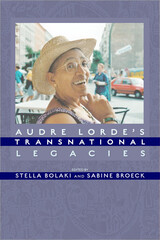
Audre Lorde's Transnational Legacies is the first book to systematically document and thoroughly investigate Lorde's influence beyond the United States. Arranged in three thematically interrelated sections—Archives, Connections, and Work—the volume brings together scholarly essays, interviews, Lorde's unpublished speech about Europe, and personal reflections and testimonials from key figures throughout the world. Using a range of interdisciplinary approaches, contributors assess the reception, translation, and circulation of Lorde's writing and activism within different communities, audiences, and circles. They also shed new light on the work Lorde inspired across disciplinary borders.
In addition the volume editors, contributors include Sarah Cefai, Cassandra Ellerbe-Dueck, Paul M. Farber, Tiffany N. Florvil, Katharina Gerund, Alexis Pauline Gumbs, Gloria Joseph, Jackie Kay, Marion Kraft, Christiana Lambrinidis, Zeedah Meierhofer-Mangeli, Rina Nissim, Chantal Oakes, Lester C. Olson, Pratibha Parmar, Peggy Piesche, Dagmar Schultz, Tamara Lea Spira, and Gloria Wekker.
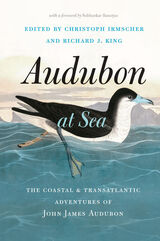
The American naturalist John James Audubon (1785–1851) is widely remembered for his iconic paintings of American birdlife. But as this anthology makes clear, Audubon was also a brilliant writer—and his keen gaze took in far more than creatures of the sky. Culled from his published and unpublished writings, Audubon at Sea explores Audubon’s diverse observations of the ocean, the coast, and their human and animal inhabitants. With Audubon expert Christoph Irmscher and scholar of the sea Richard J. King as our guides, we set sail from the humid expanses of the American South to the shores of England and the chilly landscapes of the Canadian North. We learn not only about the diversity of sea life Audubon documented—birds, sharks, fish, and whales—but also about life aboard ship, travel in early America, Audubon’s work habits, and the origins of beloved paintings. As we face an unfathomable loss of seabirds today, Audubon’s warnings about the fragility of birdlife in his time are prescient and newly relevant.
Charting the course of Audubon’s life and work, from his birth in Haiti to his death in New York City, Irmscher and King’s sweeping introduction and carefully drawn commentary confront the challenges Audubon’s legacy poses for us today, including his participation in American slavery and the thousands of birds he killed for his art. Rounded out by hundreds of historical and ornithological notes and beautiful illustrations, and with a foreword by distinguished photographer and conservationist Subhankar Banerjee, Audubon at Sea is the most comprehensively annotated collection of Audubon’s work ever published.

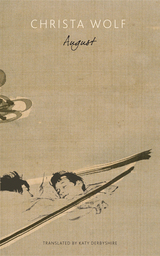
August is Christa Wolf’s last piece of fiction, written in a single sitting as an anniversary gift to her husband. In it, she revisits her stay at a tuberculosis hospital in the winter of 1946, a real life event that was the inspiration for the closing scenes of her 1976 novel Patterns of Childhood. This time, however, her fictional perspective is very different. The story unfolds through the eyes of August, a young patient who has lost both his parents to the war. He adores an older girl, Lilo, a rebellious teenager who controls the wards. Sixty years later, August reflects on his life and the things that she taught him.
Written in taut, affectionate prose, August offers a new entry into Christa Wolf’s work and, incidentally, her first and only male protagonist. More than a literary artifact, this new novel is a perfectly constructed story of a quiet life well lived. For both August and Christa Wolf, the past never dies.
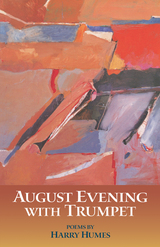
From its first poem, “String,” with its mythic overtones to the final “The Movement of Ice,” August Evening with Trumpet deals with the varieties of surprise and mystery, pain and wonder in the human experience. In constant motion, this collection ranges across a broad landscape, one in which trout swim through a house, where a coal miner father on vacation digs clams, where an old mother refuses help as she walks a narrow plank across a brook, and where in the quietly moving “Late November,” the speaker releases a raccoon from a leg-hold steel trap.
Uncluttered, clear, and direct, the poems move effortlessly and seamlessly into one another, gathering an overall pleasing unity and narrative energy. And if there is a vein of quiet sorrow and darkness running through the collection, it is balanced against courage, grace, and good humor. At the book’s center is a deep reverence for childhood, for parents, for children, for language, and for landscape, all of which Humes admirably holds up for us. Harry Humes’s work brings to mind William Blake’s “To see a World in a Grain of Sand / And a Heaven in a Wild Flower.”
During the decades of Bourbon ascendancy after 1874, Alabama institutions like those in other southern states were dominated by whites. Former slave and sharecropper Jack Turner refused to accept a society so structured. Highly intelligent, physically imposing, and an orator of persuasive talents, Turner was fearless before whites and emerged as a leader of his race. He helped to forge a political alliance between blacks and whites that defeated and humiliated the Bourbons in Choctaw County, the heart of the Black Belt, in the election of 1882. That summer, after a series of bogus charges and arrests, Turner was accused of planning to lead his private army of blacks in a general slaughter of the county whites. Justice was forgotten in the resultant fear and hysteria.
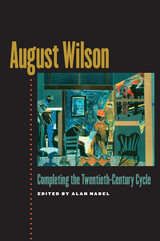
Just prior to his death in 2005, August Wilson, arguably the most important American playwright of the last quarter-century, completed an ambitious cycle of ten plays, each set in a different decade of the twentieth century. Known as the Twentieth-Century Cycle or the Pittsburgh Cycle, the plays, which portrayed the struggles of African-Americans, won two Pulitzer Prizes for Drama, a Tony Award for Best Play, and seven New York Drama Critics Circle Awards. August Wilson: Completing the Twentieth-Century Cycle is the first volume devoted to the last five plays of the cycle individually—Jitney,Seven Guitars, King Hedley II, Gem of the Ocean, and Radio Golf—and in the context of Wilson's entire body of work.
Editor Alan Nadel's May All Your Fences Have Gates: Essays on the Drama of August Wilson, a work Henry Louis Gates called definitive, focused on the first five plays of Wilson's cycle. This new collection examines from myriad perspectives the way Wilson's final works give shape and focus to his complete dramatic opus. It contains an outstanding and diverse array of discussions from leading Wilson scholars and literary critics. Together, the essays in Nadel's two volumes give Wilson's work the breadth of analysis and understanding that this major figure of American drama merits.
Contributors
Herman Beavers
Yvonne Chambers
Soyica Diggs Colbert
Harry J. Elam, Jr.
Nathan Grant
David LaCroix
Barbara Lewis
Alan Nadel
Donald E. Pease
Sandra Shannon
Vivian Gist Spencer
Anthony Stewart
Steven C. Tracy
Dana Williams
Kimmika L. H. Williams-Witherspoon

A fascinating biography about Augusta Jane Evans, a nearly forgotten writer who was nevertheless one of the most popular writers of her era. She wrote nine novels about southern women, including St. Elmo, which sold a staggering one million copies within four months of its release in 1866. William Fidler traces the life of Augusta Jane Evans from her birth in 1835 in Columbus, Georgia till her death in Alabama in 1909.
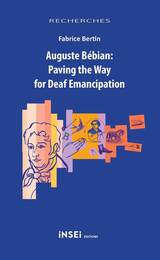
To some, he is a mythical figure; to others, he is unknown. Auguste Bébian (1789-1839) reflects society’s ambivalence toward Deaf history: sometimes recognized, often ignored. In the wake of Abbé de l’Épée, whose name is remembered in posterity and who demonstrated that the large-scale education of Deaf people was possible, Auguste Bébian was nonetheless a key player in an unprecedented upheaval, which in many ways went beyond the educational sphere. The goal of this research on Auguste Bébian, combining biographical elements and analysis of his thinking in unprecedented ways, is not to deconstruct the myth, but rather to decipher the messages it conveys, and to understand what it tells us, indirectly, about the Deaf experience.
Born in 1789 in Guadeloupe, part of the French West Indies, it was on the other side of the Atlantic Ocean, in France, that Auguste Bébian fulfilled most of his destiny. While living at the National Institution for the Deaf in Paris at the beginning of the 19th century, his daily contact with the young students made him the first known hearing person in France to achieve true mastery of sign language, the natural language of Deaf people, and a deep understanding of its inherent culture. On becoming a teacher, he constantly defended the use of sign language as a linguistic system in its own right in order to awaken the intelligence of Deaf children, to whom “we pay no more attention than to the sunlight that shines on us every day.” His numerous publications display a level of modernity rarely seen before or since. This biographical and historical study shows how the passion evinced by Auguste Bébian was a crucial link in the chain of events that led to the emancipation of Deaf people.
Saint Augustine's political thought has usually been interpreted by modern readers as suggesting that politics is based on sin. In Augustine and Politics as Longing in the World, John von Heyking shows that Augustine actually considered political life a substantive good that fulfills a human longing for a kind of wholeness.
Rather than showing Augustine as supporting the Christian church's domination of politics, von Heyking argues that he held a subtler view of the relationship between religion and politics, one that preserves the independence of political life. And while many see his politics as based on a natural-law ethic or on one in which authority is conferred by direct revelation, von Heyking shows how Augustine held to an understanding of political ethics that emphasizes practical wisdom and judgment in a mode that resembles Aristotle rather than Machiavelli.
Augustine and Politics as Longing in the World demonstrates some of the deficiencies in the way Augustine's political thought has been interpreted. It also explains why a rereading of his thought illuminates the current debates between "secularists" and proponents of "orthodoxy" and shows why these debates are miscast. By examining Augustine's political thought, von Heyking provides a way of resolving this controversy and shows how we can move beyond conflicting claims and thus moderate yet elevate political life.
Behind Augustine's apparent antipolitical rhetoric lies his substantial agreement with his Roman philosophical interlocutors on virtue and politics. This allegedly antipolitical rhetoric is meant to tame the lust for domination of Roman patriots by showing that lust can never be satisfied by political goods. By opposing extreme "worldliness" with extreme "otherworldliness," Augustine appears to reject politics as a natural good. On the contrary, he affirmed politics as a natural good.
Augustine and Politics as Longing in the World shows how Augustine's belief that politics was a way for humans to fulfill their longings for a kind of wholeness discloses a deeper affirmation of a more meaningful, pluralistic, and robust political life than his interpreters have previously appreciated.

The Augustinian Epic, Petrarch to Milton rewrites the history of the Renaissance Vergilian epic by incorporating the neo-Latin side of the story alongside the vernacular one, revealing how epics spoke to each other "across the language gap" and together comprised a single, "Augustinian tradition" of epic poetry. Beginning with Petrarch's Africa, Warner offers major new interpretations of Renaissance epics both famous and forgotten—from Milton's Paradise Lost to a Latin Christiad by his near-contemporary, Alexander Ross—thereby shedding new light on the development of the epic genre. For advanced undergraduate students, graduate students, and scholars in the fields of Italian, English, and Comparative literatures as well as the Classics and the history of religion and literature.
Aunt Bird is an astonishing, hybrid poetry of witness that observes and testifies to social, political, and historical realities through the recovery of one life silenced by the past. Within these pages, poet Yerra Sugarman confronts the Holocaust as it was experienced by a young Jewish woman: the author’s twenty-three-year-old aunt, Feiga Maler, whom Sugarman never knew, and who died in the Kraków Ghetto in German-occupied Poland in 1942. In lyric poems, prose poems, and lyric essays, Aunt Bird combines documentary poetics with surrealism: sourcing from the testimonials of her kin who survived, as well as official Nazi documents about Feiga Maler, these poems imagine Sugarman’s relationship with her deceased aunt and thus recreate her life. Braiding speculation, primary sources, and the cultural knowledge-base of postmemory, Aunt Bird seeks what Eavan Boland calls “a habitable grief,” elegizing the particular loss of one woman while honoring who Feiga was, or might have been, and recognizing the time we have now.
In Aunt Rachel’s Fur, Raymond Federman—French by birth, American by adoption, Jew by memory—plays with the language of his childhood to construct a story from digressions. Federman’s narrative spirals into a temporal abyss as he rummages in old memories tattooed with cabbages, plump breasts, and the Final Solution. His book swirls with the narrative innovations that mark him as a leading experimental surfictioneer.
Aunt Rachel’s Fur is a novel about its own telling, an intimate meeting between voice and reader, in which flesh and blood are reduced to fiction, and fiction, by its telling, becomes fact. Reymond Namredef, a French expatriate, has returned to France after a disastrous decade in America, with 365 boxes of pasta and the hope of publishing his novel about a novelist. In a cafe in Paris, he meets a "professional listener," and, through a series of conversations, offers a loose account of his life that shows little respect for chronology. His story is woven of fragments, branching out over a lifetime and capturing the alchemy of fiction and memory.
Faced with the chaos of the twentieth century, Federman finds humanity in the absurd. Like novelists Mark Amerika and Ronald Sukenick, he skewers literary convention and pushes the boundary of postmodernism. Aunt Rachel’s Fur is both a tribute to his love of the word—the story as it is told—and a further exploration of our understanding of fiction.
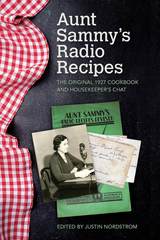
From the 1920s through the 1940s, American kitchens had a welcome guest in “Aunt Sammy,” a creation of the US Department of Agriculture and its Bureau of Home Economics. Through the radio program Housekeeper’s Chat, Aunt Sammy gave lively advice on food preparation, household chores, parenting and children, and gender dynamics as she encouraged women to embrace the radio and a host of modern consumer household products. The recipes she shared were gathered, in 1927, into a cookbook that became a valuable household manual for tens of thousands of Americans.
Aunt Sammy’s Radio Recipes revives the famous cookbook and joins it with extensive excerpts from the accompanying radio broadcasts, providing a fascinating study of how a witty and charming fictionalized personae became one of the early celebrity chefs of the radio age.
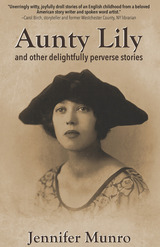
Munro’s stories were born five decades ago in a small English village where children were seen and not heard, fathers were wacky, neighbors were snoopy, and maiden aunts were beautifully crafted artifices. Her original stories, dolloped with characters reminiscent of those from her childhood, telling of domestic shenanigans and outings gone revealingly awry are written with meticulous timing. Rich in details about the frailty and strength of the human spirit, her stories resonate with the truth of what is means to be human.

Starting at a basic level, the handbook begins appropriately with matters of immediate concern to someone who hopes to see an auroral display: what causes the aurora, where and when it is most often seen, and how best to capture it on film. Later sections provide a thorough and clear review of all aspects of auroral science, including the mysterious realm of auroral sound. In a concise and readable fashion, the handbook covers what is known about auroras, encompassing overviews of the northern Natives' legends and myths and the several theories geophysicists have produced to explain why auroras behave as they do. The Aurora Watcher's Handbook includes numerous illustrations, ranging from cartoons to color plates and drawings.
"I am confident [this book] will become the aurora watcher's bible for many years to come." (Sky & Telescope)
"This is participatory science at its best!" (Midwest Book Review)
"A delightful book, highly recommended." (CHOICE )
"A complete course for the layman with an interest in the northern lights." (Fairbanks Daily News-Miner)
"[Davis] has written the book in a smooth, how-it-works style, and his presentation is remarkably clear. . . . [He] expended much effort on this book, forming from his lifetime of knowledge a coherent and comprehensible picture of the aurora for the non-specialist." (ARCTIC)
"For a comprehensive guide to the northern lights, read Neil Davis's The Aurora." (Small Press Magazine)
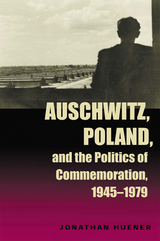
Few places in the world carry as heavy a burden of history as Auschwitz. Recognized and remembered as the most prominent site of Nazi crimes, Auschwitz has had tremendous symbolic weight in the postwar world.
Auschwitz, Poland, and the Politics of Commemoration is a history of the Auschwitz memorial site in the years of the Polish People’s Republic. Since 1945, Auschwitz has functioned as a memorial and museum. Its monuments, exhibitions, and public spaces have attracted politicians, pilgrims, and countless participants in public demonstrations and commemorative events.
Jonathan Huener’s study begins with the liberation of the camp and traces the history of the State Museum at Auschwitz from its origins immediately after the war until the 1980s, analyzing the landscape, exhibitions, and public events at the site.
Based on extensive research and illustrated with archival photographs, Auschwitz, Poland, and the Politics of Commemoration accounts for the development and durability of a Polish commemorative idiom at Auschwitz. Emphasis on Polish national “martyrdom” at Auschwitz, neglect of the Shoah as the most prominent element of the camp’s history, political instrumentalization of the grounds and exhibitions—these were some of the more controversial aspects of the camp’s postwar landscape.
Professor Huener locates these and other public manifestations of memory at Auschwitz in the broad scope of Polish history, in the specific context of postwar Polish politics and culture, and against the background of Polish-Jewish relations. Auschwitz, Poland, and the Politics of Commemoration will be of interest to scholars, students, and general readers of the history of modern Poland and the Holocaust.
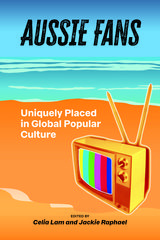
Australia holds a unique place in the global scheme of fandom. Much of the media consumed by Australian audiences originates from either the United States or the United Kingdom, yet several Australian productions have also attracted international fans in their own right. This first-ever academic study of Australian fandom explores the national popular culture scene through themes of localization and globalization.
The essays within reveal how Australian audiences often seek authentic imports and eagerly embrace different cultures, examining both Hollywood’s influence on Australian fandom and Australian fan reactions to non-Western content. By shining a spotlight on Australian fandom, this book not only provides an important case study for fan studies scholars, it also helps add nuance to a field whose current literature is predominantly U.S. and U.K. focused.Contributors: Kate Ames, Ahmet Atay, Jessica Carniel, Toija Cinque, Ian Dixon, Leigh Edmonds, Sharon Elkind, Jacqui Ewart, Lincoln Geraghty, Sarah Keith, Emerald L. King, Renee Middlemost
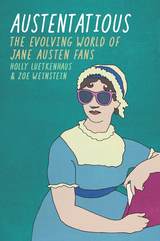
This book explores online fan spaces in search of “Janeites” all over the world to discover what fans are making, how fans are sharing their work, and why it matters that so many women and nonbinary individuals find a haven not only in Jane Austen, but also in Jane Austen fandom. In relatable chapters based on firsthand experience, the authors explore how Austen fandom has and continues to build communities around women, people of color, and the LGBTQ+ community. Whether Janeites are shrewdly picking up on the latent sexual tension between women in Emma or casting people of color in leading roles, Luetkenhaus and Weinstein argue that Austen fans are particularly adept at marrying fantasy and feminism.
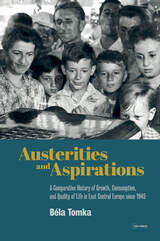
This monograph provides an analysis of the economic performance and living standard in Czechoslovakia and its successor states, Hungary, and Poland since 1945. The novelty of the book lies in its broad comparative perspective: it places East Central Europe in a wider European framework that underlines the themes of regional disparities and European commonalities. Going beyond the traditional growth paradigm, the author systematically studies the historical patterns of consumption, leisure, and quality of life—aspects that Tomka argues can best be considered in relation to one other. By adopting this “triple approach,” he undertakes a truly interdisciplinary research drawing from history, economics, sociology, and demography.
As a result of Tomka’s three-pillar comparative analysis, the book makes a major contribution to the debates on the dynamics of economic growth in communist and postcommunist East Central Europe, on the socialist consumer culture along with its transformation after 1990, and on how the accounts on East Central Europe can be integrated into the emerging field of historical quality of life research.
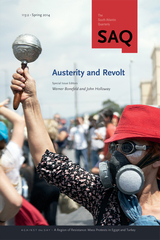
By combining insider knowledge with sophisticated theoretical scrutiny, the contributors to this issue approach eruptions of rebellion from a variety of historical, economic, and methodological perspectives. Writing not only about but also within such forces of progressive resistance around the world, they investigate the complex, hopeful, and contradictory process of creating new social, economic, and political structures through negation.

In Austerity Ireland, Kieran Allen challenges this official image and argues that the Irish state's response to the crash has primarily been designed to protect economic privilege. The resulting austerity has been a failure and is likely to produce a decade of hardship.
The book offers a deeply informed and penetrating diagnosis of Ireland's current socio-economic and political malaise, suggesting that a political earthquake is underway which may benefit the left. Austerity Ireland is essential reading for all students of Irish politics and economics, as well as those interested in the politics of austerity and the eurozone crisis.
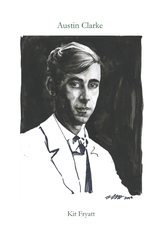
Kit Fryatt assesses Clarke's work in its entirety but focuses on key works which reveal how resourcefully Clarke explored themes such as the coherence of the personality, the inner lives of women and the roots of repression.
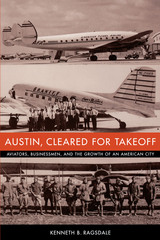
Austin, Texas, entered the aviation age on October 29, 1911, when Calbraith Perry Rodgers landed his Wright EX Flyer in a vacant field near the present-day intersection of Duval and 45th Streets. Some 3,000 excited people rushed out to see the pilot and his plane, much like the hundreds of thousands who mobbed Charles A. Lindbergh and The Spirit of St. Louis in Paris sixteen years later. Though no one that day in Austin could foresee all the changes that would result from manned flight, people here—as in cities and towns across the United States—realized that a new era was opening, and they greeted it with all-out enthusiasm.
This popularly written history tells the story of aviation in Austin from 1911 to the opening of Austin-Bergstrom International Airport in 1999. Kenneth Ragsdale covers all the significant developments, beginning with military aviation activities during World War I and continuing through the barnstorming era of the 1920s, the inauguration of airmail service in 1928 and airline service in 1929, and the dedication of the first municipal airport in 1930. He also looks at the University of Texas's role in training pilots during World War II, the growth of commercial and military aviation in the postwar period, and the struggle over airport expansion that occupied the last decades of the twentieth century. Throughout, he shows how aviation and the city grew together and supported each other, which makes the Austin aviation experience a case study of the impact of aviation on urban communities nationwide.
Three forces—dwindling British power, rising American influence, and nationalism in a variety of forms—have transformed Australia, New Zealand, and the adjacent islands since 1919. In this volume, some of the most distinguished scholars of the Pacific region assess these significant historical changes.
These essays deal with international relations, politics, changing social structures, and literature since World War I. The themes of the volume as a whole are social and humanistic; they concern the evolution of both a regional identity and separate national identities in the Southwest Pacific. The unique areal and thematic concentration of this book makes it essential reading for all those interested in the history, politics, and culture of the Pacific.
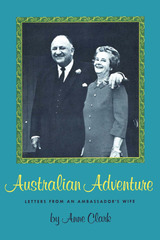
From August 1965 to February 1968, during his period of service in Australia, Ambassador Edward Clark traveled in that country as no other American and probably few Australians ever have. His wife, Anne Clark, traveled with him, then wrote her observations and impressions to friends and family in the United States.
Her letters, published for the first time in this volume, reveal the isolations and involvements as well as the opportunities and the pleasures of embassy life. The etiquette of official functions at times posed problems, as in the Clarks' first black-tie dinner with the Acting Governor General, where Mrs. Clark was supposed to curtsy. "Some Ambassadors feel strongly that the representative of the President of the United States should never bend his knee (or rather his wife's) to any man. Mrs. Battle, wife of our predecessor ... put the question directly to President Kennedy. His answer to her was, 'Curtsy you must, but keep a stiff upper knee.'"
Soon, Anne Clark realized that the routine of appearances and entertainments was constant: "I do not know when I will make peace with the schedule. I am a slave to the little black book that is my calendar."
In addition to the intricacies of embassy life, the Clarks encountered much that was unfamiliar—new people, almost a new language, new flowers, new animals—even a sky with its new moon upside down. But their warm hospitality and genuine interest in things Australian attracted friends throughout the continent. Figures from the government, the church, the diplomatic circle, and everyday life, plus well-known guests from home, all become known to the reader in this perceptive account of official life from the inside.

Contemporary Australian fiction is attracting a world audience, particularly in the United States, where a growing readership eagerly awaits new works. In Australian Voices, Ray Willbanks goes beyond the books to their authors, using sixteen interviews to reveal the state of fiction writing in Australia—what nags from the past, what engages the imagination for the future.
Willbanks engages the writers in lively discussions of their own work, as well as topics of collective interest such as the past, including convict times; the nature of the land; the treatment of Aborigines; national identity and national flaws; Australian-British antipathy; sexuality and feminism; drama and film; writing, publishing, and criticism in Australia; and the continuous and pervasive influence of the United States on Australia.
The interviews in Australian Voices are gossipy, often funny, and always informative, as Willbanks builds a structured conversation that reveals biography, personality, and significant insight into the works of each writer. They will be important for both scholars and the reading public.
Authentic Blackness looks at the place of the “folk”—those African Americans “furthest down,” in the words of Alain Locke—and how the representation of the folk and the black middle class both spurred the New Negro Movement and became one of its most serious points of contention. Drawing on vernacular theories of African American literature from such figures as Henry Louis Gates Jr. and Houston Baker as well as theorists Judith Butler and Stuart Hall, Favor looks closely at the work of four Harlem Renaissance fiction writers: James Weldon Johnson, Nella Larsen, George Schuyler, and Jean Toomer. Arguing that each of these writers had, at best, an ambiguous relationship to African American folk culture, Favor demonstrates how they each sought to redress the notion of a fixed black identity. Authentic Blackness illustrates how “race” has functioned as a type of performative discourse, a subjectivity that simultaneously builds and conceals its connections with such factors as class, gender, sexuality, and geography.
Long before Sam Peckinpah finished shooting his 1973 Western, Pat Garrett and Billy the Kid, there was open warfare between him and the studio. In this scrupulously researched new book Paul Seydor reconstructs the riveting history of a brilliant director fighting to preserve an artistic vision while wrestling with his own self‑destructive demons. Meticulously comparing the film five extant versions, Seydor documents why none is definitive, including the 2005 Special Edition, for which he served as consultant. Viewing Peckinpah’s last Western from a variety of fresh perspectives, Seydor establishes a nearly direct line from the book Garrett wrote after he killed Billy the Kid to Peckinpah’s film ninety-one years later and shows how, even with directors as singular as this one, filmmaking is a collaborative medium. Art, business, history, genius, and ego all collide in this story of a great director navigating the treacherous waters of collaboration, compromise, and commerce to create a flawed but enduringly powerful masterpiece.
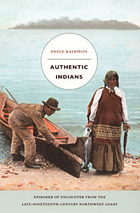
Drawing on research in newspapers, magazines, agency and missionary records, memoirs, and diaries, Raibmon combines cultural and labor history. She looks at three historical episodes: the participation of a group of Kwakwaka’wakw from Vancouver in the 1893 World’s Columbian Exposition in Chicago; the work of migrant Aboriginal laborers in the hop fields of Puget Sound; and the legal efforts of Tlingit artist Rudolph Walton to have his mixed-race step-children admitted to the white public school in Sitka, Alaska. Together these episodes reveal the consequences of outsiders’ attempts to define authentic Aboriginal culture. Raibmon argues that Aboriginal culture is much more than the reproduction of rituals; it also lies in the means by which Aboriginal people generate new and meaningful ways of identifying their place in a changing modern environment.
The myths examined in this book are:
- Authentic texts are inaccessible to beginners.
- Authentic texts cannot be used to teach grammar.
- Shorter texts are more beneficial for language learners.
- Activating background knowledge or making a word list is sufficient to prepare students for authentic texts.
- Authentic texts can be used to teach only listening and reading.
- Modifying or simplifying authentic texts always helps language learners.
- For learners to benefit from using authentic texts, the associated tasks must also be authentic.
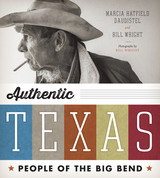
Winner, Southwest Book Award, Border Regional Library Association, 2015
The Texas of vast open spaces inhabited by independent, self-reliant men and women may be more of a dream than a reality for the state’s largely urban population, but it still exists in the Big Bend. One of the most sparsely settled areas of the United States, the Big Bend attracts people who are willing to forego many modern conveniences for a lifestyle that proclaims “don’t fence me in.” Marcia Hatfield Daudistel and Bill Wright believe that the character traits exemplified by folks in the Big Bend—including self-sufficiency, friendliness, and neighborliness—go back to the founding of the state. In this book, they introduce us to several dozen Big Bend residents—old and young, long-settled and recently arrived, racially diverse—who show us what it means to be an authentic Texan.
Interviewing people in Marathon, Big Bend National Park, Terlingua, Redford, Presidio, Alpine, Marfa, Valentine, Balmorhea, Limpia Crossing, and Fort Davis, Daudistel and Wright discover the reasons why residents of the Big Bend make this remote area of Texas their permanent home. In talking to ranchers and writers, entrepreneurs and artists, people living off the grid and urban refugees, they find a common willingness to overcome difficulties through individual skill and initiative. As one interviewee remarks, you have to have a lot of “try” in you to make a life in the Big Bend. Bill Wright’s photographs of the people and landscapes are a perfect complement to the stories of these authentic Texans. Together, these voices and images offer the most complete, contemporary portrait of the Texas Big Bend.
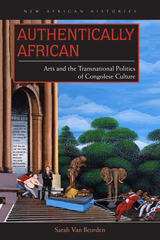
Together, the Royal Museum for Central Africa in Tervuren, Belgium, and the Institut des Musées Nationaux du Zaire (IMNZ) in the Congo have defined and marketed Congolese art and culture. In Authentically African, Sarah Van Beurden traces the relationship between the possession, definition, and display of art and the construction of cultural authenticity and political legitimacy from the late colonial until the postcolonial era. Her study of the interconnected histories of these two institutions is the first history of an art museum in Africa, and the only work of its kind in English.
Drawing on Flemish-language sources other scholars have been unable to access, Van Beurden illuminates the politics of museum collections, showing how the IMNZ became a showpiece in Mobutu’s effort to revive “authentic” African culture. She reconstructs debates between Belgian and Congolese museum professionals, revealing how the dynamics of decolonization played out in the fields of the museum and international heritage conservation. Finally, she casts light on the art market, showing how the traveling displays put on by the IMNZ helped intensify collectors’ interest and generate an international market for Congolese art.
The book contributes to the fields of history, art history, museum studies, and anthropology and challenges existing narratives of Congo’s decolonization. It tells a new history of decolonization as a struggle over cultural categories, the possession of cultural heritage, and the right to define and represent cultural identities.
Author Stuart Z. Charmé explores how debates over authenticity and struggles for recognition are a key to understanding a wide range of controversies between Orthodox and liberal Jews, Zionist and diaspora Jews, white Jews and Jews of color, as well as the status of intermarried and messianic Jews, and the impact of Jewish genetics. In addition, it discusses how and when various cultural practices and traditions such as klezmer music, Israeli folk dance, Jewish yoga and meditation, and others are recognized as authentically Jewish, or not.

Americans love to hate consumerism. Scholars, intellectuals, musicians, and writers of all kinds take pleasure in complaining that consumer culture endangers the “real” things in life, including self-determination and individualism. In Authenticity Guaranteed, Sally Robinson brings to light the unacknowledged gender and class assumptions of anti-consumerist critique in the second half of the twentieth century. American anti-consumerism, despite its apparent complexity, takes a remarkably consistent and predictable narrative form. From the mid-century Organization Man to the millennial No Logo, anti-consumerist critique reinforces the gender order by insisting that authenticity is threatened, and masculine agency curtailed, by the feminizing forces of consumer culture.
Robinson identifies a tradition of masculine protest and rebellion against feminization in iconic texts such as The Catcher in the Rye and Fight Club, as well as in critiques of postmodernism, academic denunciations of shopping, and a variety of other discourses that aim to diagnose what ails American consumer culture. This fresh and timely argument enters into conversation with a wide range of existing scholarship and opens up new questions for scholarly and political discussion.

Through close examination of four writers, Unseld shows how the author's personality can affect the publisher's dilemma. Hermann Hesse, by virtue of his loyalty and his desire for financial independence, enjoyed an exemplary relationship with his publishers. With Bertolt Brecht it was all confusion; with Rainer Maria Rilke, a one-author-one-publisher lifetime alliance; with Swiss poet Robert Walser, a mire of difficulties ("Each book printed," he once said, was "a grave for its author").
The Prometheus Bound has proved to be both the most problematic and the most influential of extant Greek tragedies. Especially during the past two hundred years the character here created has transcended the boundaries of nationality, ideology, and race: Goethe, Shelley, Marx, and—to judge by other published translations—modern Russia and China have in turn been fascinated by this being who is tortured by the gods for furthering the progress of humanity. Yet the interpretation of the play itself and its relation to the group of now-lost plays with which it was originally produced continue to arouse violent controversy. At the center of the controversy stand the questions, raised with increasing urgency during the twentieth century, whether the play is by Aeschylus at all and when it was written.
This monograph attempts a systematic answer to these questions. It first surveys the general conditions of the authenticity problem as they appeared after the redating of Aeschylus’ Supplices. Next, it catalogues in detail the stylistic, metrical, and thematic features of the Prometheus that have been supposed to tell against Aeschylus’ authorship. Finally, it suggests that these phenomena will not make sense on the assumption that the play was written by anyone other than Aeschylus, and that the date of composition must fall after the Oresteia, in the last two years of Aeschylus’ life. Given this definite context and date, many of the apparent problems of the Prometheus Bound either fall away or at least can be more precisely formulated by reference to the other extant tragedies of Aeschylus’ latest phase.
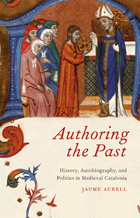
Authoring the Past surveys medieval Catalan historiography, shedding light on the emergence and evolution of historical writing and autobiography in the Middle Ages, on questions of authority and authorship, and on the links between history and politics during the period. Jaume Aurell examines texts from the late twelfth to the late fourteenth century—including the Latin Gesta comitum Barcinonensium and four texts in medieval Catalan: James I’s Llibre dels fets, the Crònica of Bernat Desclot, the Crònica of Ramon Muntaner, and the Crònica of Peter the Ceremonious—and outlines the different motivations for the writing of each.
For Aurell, these chronicles are not mere archaeological artifacts but rather documents that speak to their writers’ specific contemporary social and political purposes. He argues that these Catalonian counts and Aragonese kings were attempting to use their role as authors to legitimize their monarchical status, their growing political and economic power, and their aggressive expansionist policies in the Mediterranean. By analyzing these texts alongside one another, Aurell demonstrates the shifting contexts in which chronicles were conceived, written, and read throughout the Middle Ages.
The first study of its kind to make medieval Catalonian writings available to English-speaking audiences, Authoring the Past will be of interest to scholars of history and comparative literature, students of Hispanic and Romance medieval studies, and medievalists who study the chronicle tradition in other languages.
Drawing on extensive fieldwork and a variety of Syrian artistic practices, Wedeen lays bare the ideological investments that sustain ambivalent attachments to established organizations of power and contribute to the ongoing challenge of pursuing political change. This masterful book is a testament to Wedeen’s deep engagement with some of the most troubling concerns of our political present and future.
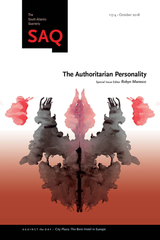
Contributors: Fadi Bardawil, Benjamin Y. Fong, Samantha Hill, Robert Hullot-Kentor, Robyn Marasco, Andrew Poe, Michael Stein, Christian Thorne, Barbara Umrath
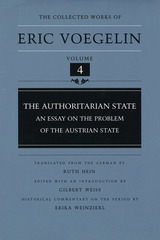
Published in Vienna in 1936, The Authoritarian State by Eric Voegelin has remained virtually unknown to the public until now. Sales of the German edition were halted following the Nazi invasion of Austria in 1938, and the entire printing was later destroyed by wartime bombing. In this volume, Voegelin offers a critical examination of the most prominent European theories of state and constitutional law of the period while providing a political and historical analysis of the Austrian situation. He discusses the dismissal of Parliament in 1933, the civil war, the murder of Federal Chancellor Dollfuss, the adoption of the "Authoritarian Constitution" of 1934, and the predicament of being sandwiched between Hitler and Mussolini.
A radical critique of Hans Kelsen's pure theory of law lies at the heart of this work, marking Voegelin's definitive departure from Neo-Kantian epistemology. For the first time, Voegelin elaborates on the important distinction between theoretical concepts and political symbols as a basis for explaining the nontheoretical and speculative character of ideologies, both left and right. He shows that total and authoritarian are symbols of ideological self-interpretation that have no theoretical value, a distinction basic to his later work in The New Science of Politics.
Available for the first time in English, The Authoritarian State is a valuable addition to the Voegelin canon and to the field of intellectual history in general.
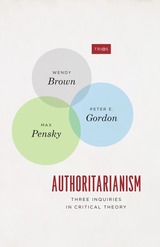
In this volume, three distinguished scholars draw on critical theory to address our current predicament. Wendy Brown, Peter E. Gordon, and Max Pensky share a conviction that critical theory retains the power to illuminate the forces producing the current political constellation as well as possible paths away from it. Brown explains how “freedom” has become a rallying cry for manifestly un-emancipatory movements; Gordon dismantles the idea that fascism is rooted in the susceptible psychology of individual citizens and reflects instead on the broader cultural and historical circumstances that lend it force; and Pensky brings together the unlikely pair of Tocqueville and Adorno to explore how democracies can buckle under internal pressure. These incisive essays do not seek to smooth over the irrationality of the contemporary world, and they do not offer the false comforts of an easy return to liberal democratic values. Rather, the three authors draw on their deep engagements with nineteenth–and twentieth–century thought to investigate the historical and political contradictions that have brought about this moment, offering fiery and urgent responses to the demands of the day.
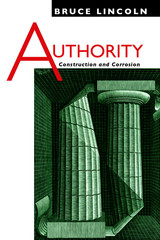
Employing a vast array of examples drawn from classical antiquity, Scandinavian law, Cold War scholarship, and American presidential politics, Lincoln offers a telling analysis of the performance of authority, and subversions of it, from ancient times to the present. Using a small set of case studies that highlight critical moments in the construction of authority, he goes on to offer a general examination of "corrosive" discourses such as gossip, rumor, and curses; the problematic situation of women, who often are barred from the authorizing sphere; the role of religion in the construction of authority; the question of whether authority in the modern and postmodern world differs from its premodern counterpart; and a critique of Hannah Arendt's claims that authority has disappeared from political life in the modern world. He does not find a diminution of authority or a fundamental change in the conditions that produce it. Rather, Lincoln finds modern authority splintered, expanded, and, in fact, multiplied as the mechanisms for its construction become more complex—and more expensive.


"An important publication, ably served by the editing of Alexander Stephan; the knowledgeable translation by Jan Van Heurck; and Grace Paley's sisterly introduction, which . . . claims at least the later Christa Wolf for a pacifist feminism."—Peter Demetz, New York Times
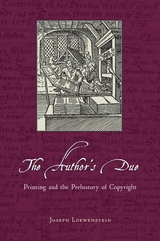
As Loewenstein shows, copyright is a form of monopoly that developed alongside a range of related protections such as commercial trusts, manufacturing patents, and censorship, and cannot be understood apart from them. The regulation of the press pitted competing interests and rival monopolistic structures against one another—guildmembers and nonprofessionals, printers and booksellers, authors and publishers. These struggles, in turn, crucially shaped the literary and intellectual practices of early modern authors, as well as early capitalist economic organization.
With its probing look at the origins of modern copyright, The Author's Due will prove to be a watershed for historians, literary critics, and legal scholars alike.
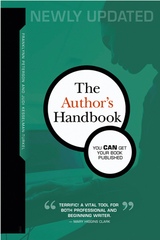
Providing essential guidance for both aspiring and experienced authors, the second edition of The Author’s Handbook is a valuable resource for writers of all levels. Extensively updated and expanded to account for significant changes in the publishing industry, The Author’s Handbook outlines effective techniques to develop marketable book ideas, research those ideas, and write a manuscript—either fiction or nonfiction—for publication. The authors provide many tips on topics that include choosing a publisher, negotiating contracts, understanding legal matters, and promoting your work. With this guide, the reader will gain insight into virtually every aspect of publishing.
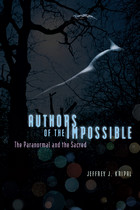
Most scholars dismiss research into the paranormal as pseudoscience, a frivolous pursuit for the paranoid or gullible. Even historians of religion, whose work naturally attends to events beyond the realm of empirical science, have shown scant interest in the subject. But the history of psychical phenomena, Jeffrey J. Kripal contends, is an untapped source of insight into the sacred and by tracing that history through the last two centuries of Western thought we can see its potential centrality to the critical study of religion.
Kripal grounds his study in the work of four major figures in the history of paranormal research: psychical researcher Frederic Myers; writer and humorist Charles Fort; astronomer, computer scientist, and ufologist Jacques Vallee; and philosopher and sociologist Bertrand Méheust. Through incisive analyses of these thinkers, Kripal ushers the reader into a beguiling world somewhere between fact, fiction, and fraud. The cultural history of telepathy, teleportation, and UFOs; a ghostly love story; the occult dimensions of science fiction; cold war psychic espionage; galactic colonialism; and the intimate relationship between consciousness and culture all come together in Authors of the Impossible, a dazzling and profound look at how the paranormal bridges the sacred and the scientific.
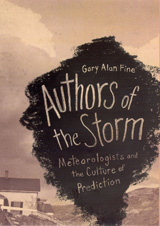
Whether it is used as an icebreaker in conversation or as the subject of serious inquiry, “the weather” is one of the few subjects that everyone talks about. And though we recognize the faces that bring us the weather on television, how government meteorologists and forecasters go about their jobs is rarely scrutinized. Given recent weather-related disasters, it’s time we find out more. In Authors of the Storm, Gary Alan Fine offers an inside look at how meteorologists and forecasters predict the weather.
Based on field observation and interviews at the Storm Prediction Center in Oklahoma, the National Weather Service in Washington, D.C., and a handful of midwestern outlets, Fine finds a supremely hard-working, insular clique of professionals who often refer to themselves as a “band of brothers.” In Fine’s skilled hands, we learn their lingo, how they “read” weather conditions, how forecasts are written, and, of course, how those messages are conveyed to the public. Weather forecasts, he shows, are often shaped as much by social and cultural factors inside local offices as they are by approaching cumulus clouds. By opening up this unique world to us, Authors of the Storm offers a valuable and fascinating glimpse of a crucial profession.

Authoring a film adaptation of a literary source not only requires a media conversion but also a transformation as a result of the differing dramatic demands of cinema. The most critical central step in this transformation of a literary source to the screen is the writing of the screenplay. The screenplay usually serves to recruit producers, director, and actors; to attract capital investment; and to give focus to the conception and production of the film project. Often undergoing multiple revisions prior to production, the screenplay represents the crucial decisions of writer and director that will determine how and to what end the film will imitate or depart from its original source.
Authorship in Film Adaptation is an accessible, provocative text that opens up new areas of discussion on the central process of adaptation surrounding the screenplay and screenwriter-director collaboration. In contrast to narrow binary comparisons of literary source text and film, the twelve essays in this collection also give attention to the underappreciated role of the screenplay and film pre-production that can signal the primary intention for a film. Divided into four parts, this collection looks first at the role of Hollywood's activist producers and major auteurs such as Hitchcock and Kubrick as they worked with screenwriters to formulate their audio-visual goals. The second part offers case studies of Devil in a Blue Dress and The Sweet Hereafter, for which the directors wrote their own adapted screenplays. Considering the variety of writer-director working relationships that are possible, Part III focuses on adaptations that alter genre, time, and place, and Part IV investigates adaptations that alter stories of romance, sexuality, and ethnicity.
Published by University of Delaware Press. Distributed worldwide by Rutgers University Press.

In Autism and Gender: From Refrigerator Mothers to Computer Geeks, Jack focuses on the ways gender influences popular discussion and understanding of autism's causes and effects. She identifies gendered theories like the “refrigerator mother” theory, for example, which blames emotionally distant mothers for autism, and the “extreme male brain” theory, which links autism to the modes of systematic thinking found in male computer geeks. Jack's analysis reveals how people employ such highly gendered theories to craft rhetorical narratives around stock characters--fix-it dads, heroic mother warriors rescuing children from autism--that advocate for ends beyond the story itself while also allowing the storyteller to gain authority, understand the disorder, and take part in debates.
Autism and Gender reveals the ways we build narratives around controversial topics while offering new insights into the ways rhetorical inquiry can and does contribute to conversations about gender and disability.

Global awareness of autism has skyrocketed since the 1980s, and popular culture has caught on, with film and television producers developing ever more material featuring autistic characters. Autism in Film and Television brings together more than a dozen essays on depictions of autism, exploring how autistic characters are signified in media and how the reception of these characters informs societal understandings of autism.
Editors Murray Pomerance and R. Barton Palmer have assembled a pioneering examination of autism’s portrayal in film and television. Contributors consider the various means by which autism has been expressed in films such as Phantom Thread, Mercury Rising, and Life Animated and in television and streaming programs including Atypical, The Bridge, Stranger Things, Star Trek: The Next Generation, and Community. Across media, the figure of the brilliant, accomplished, and “quirky” autist has proven especially appealing. Film and television have thus staked out a progressive position on neurodiversity by insisting on screen time for autism but have done so while frequently ignoring the true diversity of autistic experience. As a result, this volume is a welcome celebration of nonjudgmental approaches to disability, albeit one that is still freighted with stereotypes and elisions.
Autistic Disturbances pursues these resonances and explores the tensions of language and culture that lead to the classification of some verbal expression as disordered while other, similar expression enjoys prized status as literature. It identifies the most characteristic patterns of autistic expression-repetition, monologue, ejaculation, verbal ordering or list-making, and neologism-and adopts new language to describe and reimagine these categories in aesthetically productive terms. In so doing, the book seeks to redress the place of verbal autistic language, to argue for the value and complexity of autistic ways of speaking, and to invite recognition of an obscured tradition of literary autism at the very center of Anglo-American text culture.
Winner 2024 Outstanding Recent Contribution in Social Psychology Award, Social Psychology Section, American Sociological Association
Winner 2024 Melvin Pollner Prize, Ethnomethodology and Conversation Analysis Section, American Sociological Association
As autism has grown in prevalence, so too have our attempts to make sense of it. From placing unfounded blame on vaccines to seeking a genetic cause, Americans have struggled to understand what autism is and where it comes from. Amidst these efforts, however, a key aspect of autism has been largely overlooked: the diagnostic process itself. That process is the central focus of Autistic Intelligence. The authors ask us to question the norms by which we measure autistic behavior, to probe how that behavior can be considered sensible rather than disordered, and to explore how we can better appreciate the individuality of those who receive the diagnosis.Drawing on hundreds of hours of video recordings and ethnographic observations at a clinic where professionals evaluated children for autism, the authors’ analysis of interactions among clinicians, parents, and children demystifies the categories, tools, and practices involved in the diagnostic process. Autistic Intelligence shows that autism is not a stable category; it is the outcome of complex interactional processes involving professionals, children, families, and facets of the social and clinical environments they inhabit. The authors suggest that diagnosis, in addition to carefully classifying children, also can highlight or include unique and particular contributions those with autism potentially can make to the world around us.
Explores the connection between new theories, new technologies, and new ways of thinking.
In this book, Patricia Ticineto Clough reenergizes critical theory by viewing poststructuralist thought through the lens of "teletechnology," using television as a recurring case study to illuminate the changing relationships between subjectivity, technology, and mass media.
Autoaffection links diverse forms of cultural criticism-feminist theory, queer theory, film theory, postcolonial theory, Marxist cultural studies and literary criticism, the cultural studies of science and the criticism of ethnographic writing—to the transformation and expansion of teletechnology in the late twentieth century. These theoretical approaches, Clough suggests, have become the vehicles of unconscious thought in our time.In individual chapters, Clough juxtaposes the likes of Derridean deconstruction, Deleuzian philosophy, and Lacanian psychoanalysis. She works through the writings of Fredric Jameson, Donna Haraway, Judith Butler, Bruno Latour, Nancy Fraser, Elizabeth Grosz—to name only a few—placing all in dialogue with a teletechnological framework. Clough shows how these cultural criticisms have raised questions about the foundation of thought, allowing us to reenvision the relationship of nature and technology, the human and the machine, the virtual and the real, the living and the inert.
Since the late 1960s, American film and video makers of all genres have been fascinated with themes of self and identity. Though the documentary form is most often used to capture the lives of others, Jim Lane turns his lens on those media makers who document their own lives and identities. He looks at the ways in which autobiographical documentaries—including Roger and Me, Sherman’s March, and Silverlake Life—raise weighty questions about American cultural life. What is the role of women in society? What does it mean to die from AIDS? How do race and class play out in our personal lives? What does it mean to be a member of a family? Examining the history, diversity, and theoretical underpinnings of this increasingly popular documentary form, Lane tracks a fundamental transformation of notions of both autobiography and documentary.
The editors’ introduction presents a condensed history of academic writing, chronicles the origins of autobiographical criticism, and emphasizes the role of feminism in championing the value of personal narrative to disciplinary discourse. The essays are all explicitly informed by the identities of their authors, among whom are a feminist scientist, a Jewish filmmaker living in Germany, a potential carrier of Huntington’s disease, and a doctor pregnant while in medical school. Whether describing how being a professor of ethnic literature necessarily entails being an activist, how music and cooking are related, or how a theology is shaped by cultural identity, the contributors illuminate the relationship between their scholarly pursuits and personal lives and, in the process, expand the boundaries of their disciplines.
Contributors:
Kwame Anthony Appiah
Ruth Behar
Merrill Black
David Bleich
James Cone
Brenda Daly
Laura B. DeLind
Carlos L. Dews
Michael Dorris
Diane P. Freedman
Olivia Frey
Peter Hamlin
Laura Duhan Kaplan
Perri Klass
Muriel Lederman
Deborah Lefkowitz
Eunice Lipton
Robert D. Marcus
Donald Murray
Seymour Papert
Carla T. Peterson
David Richman
Sara Ruddick
Julie Tharp
Bonnie TuSmith
Alex Wexler
Naomi Weisstein
Patricia Williams
"Pamuk is a writer who shares my reverence for the great art of the novel. He takes the novel seriously in a way that is perhaps no longer possible for Western writers, boldly describing it as European civilization’s greatest invention."—Michael McGaha
Turkish novelist Orhan Pamuk is a prominent voice in Turkish literature, speaking to the country’s history, culture, and politics. In 2006, he became the first Turkish writer to receive the Nobel Prize for Literature.
Autobiographies of Orhan Pamuk is the first book-length study of the life and writings of Pamuk. It provides both a historical and cultural context that will help readers better understand and appreciate both the man and his work. It begins with a brief biography, outlines Pamuk’s contributions to Turkish literature and history, examines how his art has evolved over the past thirty years, and discusses some of the writers who provided inspiration. Though his books deal with specifically Turkish issues, like all great literature the themes they explore are universal. In addition to a thorough analysis of his seven published novels, including Snow and My Name is Red, an entire chapter is devoted to his first two novels, Cevdet Bey and Sons and The Silent House, which have yet to be translated into English.
This is a comprehensive examination of the Nobel laureate’s work, free of jargon and of interest to anyone who enjoys good literature.
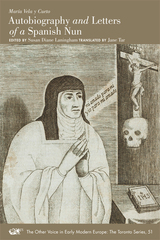
When María Vela y Cueto (1561–1617) declared that God had personally ordered her to take only the Eucharist as food and to restore primitive dress and public penance in her aristocratic convent, the entire religious community, according to her confessor, “rose up in wrath.” Yet, when Vela died, her peers joined with the populace to declare her a saint. In her autobiography and personal letters, Vela speaks candidly of the obstacles, perils, and rewards of re-negotiating piety in a convent where devotion to God was no longer expressed through rigorous asceticism. Vela’s experience, told in her own words, reveals her shrewd understanding of the persuasive power of a woman’s body.
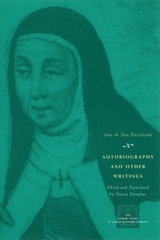
Her autobiography, clearly inseparable from her religious vocation, expresses the tensions and conflicts that often accompanied the lives of women whose relationship to the divine endowed them with an authority at odds with the temporary powers of church and state. Last translated into English in 1916, Ana’s writings give modern readers fascinating insights into the nature of monastic life during the highly charged religious and political climate of late-sixteenth- and early-seventeenth-century Spain.

Autobiography in Early Modern Spain was first published in 1991. Minnesota Archive Editions uses digital technology to make long-unavailable books once again accessible, and are published unaltered from the original University of Minnesota Press editions.
Autobiography in Early Modern Spain Nicholas Spadaccini and Jenaro Talens, Editors
Introduction. The Construction of the Self: Notes on Autobiography in Early Modern Spain
Nicholas Spadaccini and Jenaro TalensChapter 1. Narration and Argumentation in Autobiographical Discourse Antonio Gomez-Moriana
Chapter 2. A Clown at Court: Francesillo de Zuniga's Cronica burlesca George Mariscal
Chapter 3. A Methodological Prolegomenon to a Post-Modernist Reading of Santa Teresa's Autobiography
Patrick DustChapter 4. Golden Age Autobiography: The Soldiers Margarita Levisi
Chapter 5. The Picaresque as Autobiography: Story and History Edward Friedman
Chapter 6. The Historical Function of Picaresque Autobiographies: Toward a History of Social Offenders
Anthony N. ZahareasChapter 7. Fortune's Monster and the Monarchy in Las relaciones de Antonio Perez Helen H. Reed
Chapter 8. The Woman at the Border: Some Thoughts on Cervantes and Autobiography Ruth El Saffar
Chapter 9. Poetry as Autobiography: Theory and Poetic Practice in Cervantes Jenaro Talens
Appendix Curriculum vitae
Miguel de Cervantes Saavedra
Born in 1609 into an artisan family, Cecilia Ferrazzi wanted to become a nun. When her parents' death in the plague of 1630 made it financially impossible for her to enter the convent, she refused to marry and as a single laywoman set out in pursuit of holiness. Eventually she improvised a vocation: running houses of refuge for "girls in danger," young women at risk of being lured into prostitution.
Ferrazzi's frequent visions persuaded her, as well as some clerics and acquaintances among the Venetian elite, that she was on the right track. The socially valuable service she was providing enhanced this impresssion. Not everyone, however, was convinced that she was a genuine favorite of God. In 1664 she was denounced to the Inquisition.
The Inquisition convicted Ferrazzi of the pretense of sanctity. Yet her autobiographical act permits us to see in vivid detail both the opportunities and the obstacles presented to seventeenth-century women.
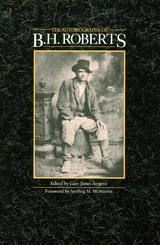
The story-book adventures of Roberts’s life made him a household name during his lifetime. His impassioned speeches incited riots, his reasoned writings defined and codified religious beliefs, and his candid disclosures of Utah history brought him both respect and censure. He is best remembered today as a largely self-educated intellectual. Several of his landmark published works are still in print more than fifty years after his death. His life story, told here in his own words and published for the first time, may well stand as his greatest, most enduring achievement.
For many today, B. H. Roberts is the quintessential Mormon intellectual of the twentieth century. But his theological writings came late in life and his historical views were more subjective than definitive. His autobiography, on the other hand, is a forthright account of the events and acquaintances that contributed to his unique faith and intellectual independence. Troubled by the memory of being abandoned as a child, and of the abusive care of quarrelling and intemperate foster-parents, he survived a stormy youth of poverty and neglect. He describes his nearly ten years as a missionary to the southern United States, his subsequent tenure as an outspoken member of the First Quorum of Seventy, his public opposition to women’s suffrage, and his controversial bid for the U.S. House of Representatives as a Mormon polygamist.
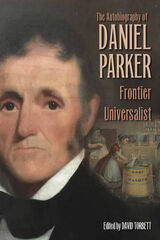
A vastly informative and rare early-American pioneer autobiography rescued from obscurity.
In this remarkable memoir, Daniel Parker (1781–1861) recorded both the details of everyday life and the extraordinary historical events he witnessed west of the Appalachian Mountains between 1790 and 1840. Once a humble traveling salesman for a line of newly invented clothes washing machines, he became an outspoken advocate for abolition and education. With his wife and son, he founded Clermont Academy, a racially integrated, coeducational secondary school—the first of its kind in Ohio.
However, Parker’s real vocation was as a self-ordained, itinerant preacher of his own brand of universal salvation. Raised by Presbyterian parents, he experienced a dramatic conversion to the Halcyon Church, an alternative, millenarian religious movement led by the enigmatic prophet Abel Sarjent, in 1803. After parting ways with the Halcyonists, he continued his own biblical and theological studies, arriving at the universalist conclusions that he would eventually preach throughout the Ohio River Valley.
David Torbett has transcribed Parker’s manuscript and publishes it here for the first time, together with an introduction, epilogue, bibliography, and extensive notes that enrich and contextualize this rare pioneer autobiography.

One of the few autobiographies to have survived from the Middle Ages, this life history of one of the most influential rulers of the fourteenth century, Charles IV of Bohemia, covers his life from birth until his election as King of Germany in 1346.
Charles IV describes his childhood, spent mainly in the court of French kings, his juvenile years, his marriage and his first steps into the international political scene during the early part of the fourteenth century.
A unique addition to this volume is the first ever English translation of the Legend of Saint Wenceslas, written by Charles IV of Luxemburg.
READERS
Browse our collection.
PUBLISHERS
See BiblioVault's publisher services.
STUDENT SERVICES
Files for college accessibility offices.
RECENTLY PUBLISHED



UChicago Accessibility Resources
home | accessibility | search | about | contact us
BiblioVault ® 2001 - 2026
The University of Chicago Press