
 A SCHOLARLY BOOK REPOSITORY
95 start with C start with C
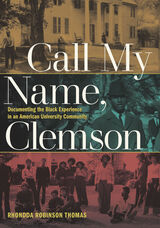
Between 1890 and 1915, a predominately African American state convict crew built Clemson University on John C. Calhoun’s Fort Hill Plantation in upstate South Carolina. Calhoun’s plantation house still sits in the middle of campus. From the establishment of the plantation in 1825 through the integration of Clemson in 1963, African Americans have played a pivotal role in sustaining the land and the university. Yet their stories and contributions are largely omitted from Clemson’s public history.
This book traces “Call My Name: African Americans in Early Clemson University History,” a Clemson English professor’s public history project that helped convince the university to reexamine and reconceptualize the institution’s complete and complex story from the origins of its land as Cherokee territory to its transformation into an increasingly diverse higher-education institution in the twenty-first century. Threading together scenes of communal history and conversation, student protests, white supremacist terrorism, and personal and institutional reckoning with Clemson’s past, this story helps us better understand the inextricable link between the history and legacies of slavery and the development of higher education institutions in America.
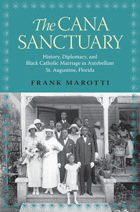
In the late seventeenth century a group of about a dozen escaped African slaves from the English colony of Carolina reached the Spanish settlement of St. Augustine. In a diplomatic bid for sanctuary, to avoid extradition and punishment, they requested the sacrament of Catholic baptism from the Spanish Catholic Church. Their negotiations brought about their baptism and with it their liberation. The Cana Sanctuary focuses on what author Frank Marotti terms “folk diplomacy”—political actions conducted by marginalized, non-state sectors of society—in this instance by formerly enslaved African Americans in antebellum East Florida. The book explores the unexpected transformations that occurred in seventeenth- and eighteenth-century St. Augustine as more and more ex-slaves arrived to find their previously disregarded civil rights upheld under sacred codes by an international, nongovernmental, authoritative organization.
With the Catholic Church acting as an equalizing, empowering force for escaped African slaves, the Spanish religious sanctuary policy became part of popular historical consciousness in East Florida. As such, it allowed for continual confrontations between the law of the Church and the law of the South. Tensions like these survived, ultimately lending themselves to an “Afro-Catholicism” sentiment that offered support for antislavery arguments.

The Great Migration--the exodus of more than six million blacks from
their southern homes hoping for better lives in the North--is a defining
event of post-emancipation African-American life and a central feature
of twentieth-century black literature. Lawrence Rodgers explores the historical
and literary significance of this event and in the process identifies
the Great Migration novel as a literary form that intertwines geography
and identity.
Drawing on a wide range of major literary voices, including Richard Wright,
Ralph Ellison, and Toni Morrison, as well as lesser-known writers such
as William Attaway (Blood on the Forge) and Dorothy West (The Living Is
Easy), Rodgers conducts a kind of literary archaeology of the Great Migration.
He mines the writers' biographical connections to migration and teases
apart the ways in which individual novels relate to one another, to the
historical situation of black America, and to African-American literature
as a whole.
In reading migration novels in relation to African-American literary
texts such as slave narratives, folk tales, and urban fiction, Rodgers
affirms the southern folk roots of African-American culture and argues
for a need to stem the erosion of southern memory.


A collection of essays grappling with the many, often overlooked, forms of unfree labor in the West.
When Americans think of unfree labor—coerced, extracted from workers unable to freely enter and exit contracts—what comes to mind is Black slavery and peonage in the South. But other forms of unfree labor also built the United States. Collecting a diverse range of sharply argued historical essays, Capturing Labor shares the story of unfree labor in the Southwest, affecting mainly Indigenous people, Mexican Americans, and people of color.
In Texas and elsewhere, state agents developed various methods for directing the movement of workers, seizing their time, and controlling the products of their efforts. Case studies highlight the detention during World War I of Indigenous children and unaccompanied women, who were placed in boarding schools, fined, and obligated to work off the resulting debt. Other essays expose authorities forcing workers to break strikes and jailing Americans who supported labor uprisings in rural Mexico and the United States. Prisons and asylums supplied coerced agricultural workers and musicians who were never compensated for their labor or by the labels that took their recordings.
Editors Jessica Pliley and John Mckiernan-González contend that unfree labor continues to shape American life, and is all around us today. Understanding its history aids us in recognizing and bringing attention to the grim realities of the present.
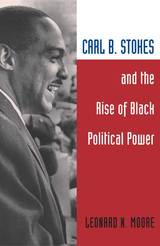
In this wide-ranging political biography, Leonard N. Moore examines the convictions and alliances that brought Stokes to power. Impelled by the problems plaguing Cleveland's ghettos in the decades following World War II, Stokes and other Clevelanders questioned how the sit-ins and marches of the civil rights movement could correct the exclusionary zoning practices, police brutality, substandard housing, and de facto school segregation that African Americans in the country's northern urban centers viewed as evidence of their oppression.
As civil unrest in the country's ghettos turned to violence in the 1960s, Cleveland was one of the first cities to heed the call of Malcolm X's infamous "The Ballot or the Bullet" speech. Understanding the importance of controlling the city's political system, Cleveland's blacks utilized their substantial voting base to put Stokes in office in 1967.
Stokes was committed to showing the country that an African American could be an effective political leader. He employed an ambitious and radically progressive agenda to clean up Cleveland's ghettos, reform law enforcement, move public housing to middle-class neighborhoods, and jump-start black economic power. Hindered by resistance from the black middle class and the Cleveland City Council, spurned by the media and fellow politicians who deemed him a black nationalist, and unable to prove that black leadership could thwart black unrest, Stokes finished his four years in office with many of his legislative goals unfulfilled.
Focusing on Stokes and Cleveland, but attending to themes that affected many urban centers after the second great migration of African Americans to the North, Moore balances Stokes's failures and successes to provide a thorough and engaging portrait of his life and his pioneering contributions to a distinct African American political culture that continues to shape American life.
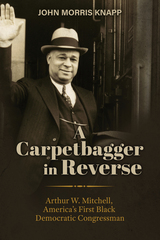
From Alabama to Congress—Arthur W. Mitchell’s fight for justice rewrote the rules of Black political power.
A Carpetbagger in Reverse offers a landmark reassessment of the life, career, and accomplishments of groundbreaking Congressman Arthur W. Mitchell, the first Black Democrat elected to Congress and the only Black member of Congress during his four terms of service from 1935 to 1943.
Born to former enslaved people in Alabama in 1883, Mitchell studied with Booker T. Washington at Tuskegee Institute and later moved to Washington DC and became a lawyer. He continued his career in Chicago, where the Great Migration had helped transform the city’s South Side into a vibrant, multiracial enclave.
As a congressman, Mitchell helped to create an enduring alliance between Black Americans and the Democratic party. Seeing his primary role as representing the South’s disempowered Black population, his belief that solutions to the region’s racial problems should arise from a new cadre of locally trained leaders brought him into frequent, vituperative conflict with the NAACP, the Republican Party, and the Black press. The first Black lawyer to argue successfully before the Supreme Court, his unanimous victory in Mitchell v. United States would have long-term consequences for the Civil Rights Movement.
A Carpetbagger in Reverse is the first publication significantly based on Mitchell’s papers, an essential and often overlooked source of insights about the development of Black political and culture life in the 1930s and 1940s.
An extraordinary powerful exposition of social patterns in a small town, Caste and Class in a Southern Town has become a benchmark in social science methodology and a classic in American studies. Now fifty years after its original publication, John Dollard’s most famous work offers timeless insights and remains essential to those interested in race-related social issues.
In 1937, W. E. B. Du Bois observed, "Dr. Dollard’s study is one of the most interesting and penetrating that has been made concerning the South and is marked by courage and real insight. . . . Dr. Dollard’s book marks a distinct advance in the study of the Southern scene."
Through compelling stories of South Central, including his own experience as an immigrant of color, Vargas presents portraits of four groups. He talks daily with women living in a low-income Watts apartment building; works with activists in a community organization against police brutality; interacts with former gang members trying to maintain a 1992 truce between the Bloods and the Crips; and listens to amateur jazz musicians who perform in a gentrified section of the neighborhood. In each case he describes the worldviews and the definitions of “blackness” these people use to cope with oppression. Vargas finds, in turn, that blackness is a form of racial solidarity, a vehicle for the renewal of African American culture, and a political expression of revolutionary black nationalism.
Vargas reveals that the social fault lines in South Central reflect both contemporary disparities and long-term struggles. In doing so, he shows both the racialized power that makes “blackness” a prized term of identity and the terrible price that African Americans have paid for this emphasis. Ultimately, Catching Hell in the City of Angels tells the story of urban America through the lives of individuals from diverse, overlapping, and vibrant communities.
João H. Costa Vargas is assistant professor in the Center for African and African American Studies and the department of anthropology at the University of Texas, Austin.
Robin D. G. Kelley is the William B. Ransford Professor of Cultural and Historical Studies at Columbia University. He is the author of numerous books, including Yo Mama's Disfunktional: Fighting the Culture Wars in Urban America.
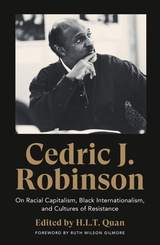
"Like W. E. B. Du Bois, Michel Foucault, Sylvia Wynter, and Edward Said, Robinson was that rare polymath capable of seeing the whole....He left behind a body of work to which we must return constantly and urgently"—Robin D. G. Kelley, author of Freedom Dreams
Cedric J. Robinson is one of the doyens of Black Studies and a pioneer in study of the Black Radical Tradition. His works have been essential texts, deconstructing racial capitalism and inspiring insurgent movements from Ferguson, Missouri to the West Bank. For the first time, Robinson's essays come together, spanning over four decades and reflective of his diverse interests in the interconnections between culture and politics, radical social theory, and classic and modern political philosophy.
Themes explored include Africa and Black internationalism, World politics, race and US Foreign Policy, representations of blackness in popular culture, and reflections on popular resistance to racial capitalism, white supremacy and more. Essays here include:
*The Black Detective and American Memory
*Slavery and the Platonic Origins of Anti-Democracy
*Africa: In Hock to History and the Banks
*Blaxploitation and the Misrepresentation of Liberalism
*The Mulatta on Film
*Race, Capitalism, and Anti-democracy
*The Killing in Ferguson
*And much more!
Accompanied by an introduction by H. L. T. Quan and a foreword by Ruth Wilson Gilmore, this collection, which includes previously unpublished materials, extends the many contributions by a giant in Black radical thought.
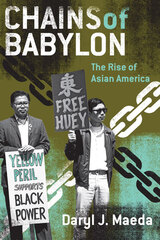
In Chains of Babylon, Daryl J. Maeda presents a cultural history of Asian American activism in the late 1960s and early 1970s, showing how the movement created the category of "Asian American" to join Asians of many ethnicities in racial solidarity. Drawing on the Black Power and antiwar movements, Asian American radicals argued that all Asians in the United States should resist assimilation and band together to oppose racism within the country and imperialism abroad.
As revealed in Maeda's in-depth work, the Asian American movement contended that people of all Asian ethnicities in the United States shared a common relationship to oppression and exploitation with each other and with other nonwhite peoples. In the early stages of the civil rights era, the possibility of assimilation was held out to Asian Americans under a model minority myth. Maeda insists that it was only in the disruption of that myth for both African Americans and Asian Americans in the 1960s and 1970s that the full Asian American culture and movement he describes could emerge. Maeda challenges accounts of the post-1968 era as hopelessly divisive by examining how racial and cultural identity enabled Asian Americans to see eye-to-eye with and support other groups of color in their campaigns for social justice.
Asian American opposition to the war in Vietnam, unlike that of the broader antiwar movement, was predicated on understanding it as a racial, specifically anti-Asian genocide. Throughout he argues that cultural critiques of racism and imperialism, the twin "chains of Babylon" of the title, informed the construction of a multiethnic Asian American identity committed to interracial and transnational solidarity.
Grady-Willis describes Black activism within a framework of human rights rather than in terms of civil rights. As he demonstrates, civil rights were only one part of a larger struggle for self-determination, a fight to dismantle a system of inequalities that he conceptualizes as “apartheid structures.” Drawing on archival research and interviews with activists of the 1960s and 1970s, he illuminates a wide range of activities, organizations, and achievements, including the neighborhood-based efforts of Atlanta’s Black working poor, clandestine associations such as the African American women’s group Sojourner South, and the establishment of autonomous Black intellectual institutions such as the Institute of the Black World. Grady-Willis’s chronicle of the politics within the Black freedom movement in Atlanta brings to light overlapping ideologies, gender and class tensions, and conflicts over divergent policies, strategies, and tactics. It also highlights the work of grassroots activists, who take center stage alongside well-known figures in Challenging U.S. Apartheid. Women, who played central roles in the human rights struggle in Atlanta, are at the foreground of this history.
—Notes
"No one has written this way about music in a long, long time. Lucid, insightful, with real spiritual, political, intellectual, and emotional grasp of the whole picture. A book about why music matters, and how, and to whom."
—Dave Marsh, author of Louie, Louie and Born to Run: The Bruce Springsteen Story
"This book is urgently needed: a comprehensive look at the various forms of black popular music, both as music and as seen in a larger social context. No one can do this better than Craig Werner."
—Henry Louis Gates, Jr., W.E.B. Du Bois Professor of the Humanities, Harvard University
"[Werner has] mastered the extremely difficult art of writing about music as both an aesthetic and social force that conveys, implies, symbolizes, and represents ideas as well as emotion, but without reducing its complexities and ambiguities to merely didactic categories."
—African American Review
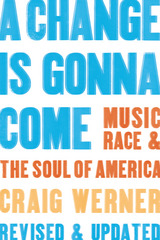
A Change Is Gonna Come is the story of more than four decades of enormously influential black music, from the hopeful, angry refrains of the Freedom movement, to the slick pop of Motown; from the disco inferno to the Million Man March; from Woodstock's "Summer of Love" to the war in Vietnam and the race riots that inspired Marvin Gaye to write "What's Going On."
Originally published in 1998, A Change Is Gonna Come drew the attention of scholars and general readers alike. This new edition, featuring four new and updated chapters, will reintroduce Werner's seminal study of black music to a new generation of readers.
Craig Werner is Professor of Afro-American Studies at the University of Wisconsin, and author of many books, including Playing the Changes: From Afro-Modernism to the Jazz Impulse and Up Around the Bend: An Oral History of Creedence Clearwater Revival. His most recent book is Higher Ground: Stevie Wonder, Aretha Franklin, Curtis Mayfield, and the Rise and Fall of American Soul.
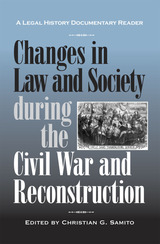
The first comprehensive collection of legal history documents from the Civil War and Reconstruction, this volume shows the profound legal changes that occurred during the Civil War era and highlights how law, society, and politics inextricably mixed and set American legal development on particular paths that were not predetermined. Editor Christian G. Samito has carefully selected excerpts from legislation, public and legislative debates, court cases, investigations of white supremacist violence in the South, and rare court-martial records, added his expert analysis, and illustrated the selections with telling period artwork to create an outstanding resource that demonstrates the rich and important legal history of the era.

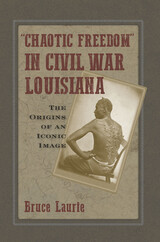
Bruce Laurie uncovers the people and events that created this seminal image, telling the tale of three men, two Yankee soldiers from western Massachusetts who were serving the Union Army in Louisiana and a man named Peter whose scarred back horrified all who saw it. The two soldiers were so shocked by what had been done to Peter, they sought to capture the image and document slavery's cruelty, the likes of which was all too common among those fleeing bondage in Louisiana. Meticulously researched and briskly told, this short volume unearths the story behind an iconic image.
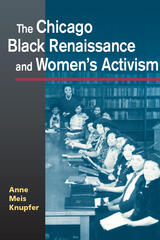
The book examines various groups of black female activists, including writers and actresses, social workers, artists, school teachers, and women's club members to document the impact of social class, gender, nativity, educational attainment, and professional affiliations on their activism. Together, these women worked to sponsor black history and literature, to protest overcrowded schools, and to act as a force for improved South Side housing and employment opportunities. Knupfer also reveals the crucial role these women played in founding and sustaining black cultural institutions, such as the first African American art museum in the country; the first African American library in Chicago; and various African American literary journals and newspapers. As a point of contrast, Knupfer also examines the overlooked activism of working-class and poor women in the Ida B. Wells and Altgeld Gardens housing projects.
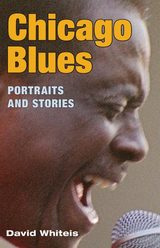
Through revealing portraits of selected local artists and slice-of-life vignettes drawn from the city’s pubs and lounges, Chicago Blues encapsulates the sound and spirit of the blues as it is lived today. As a committed participant in the Chicago blues scene for more than a quarter century, David Whiteis draws on years of his observations and extensive interviews to paint a full picture of the Chicago blues world, both on and off the stage.
In addition to portraits of blues artists he has personally known and worked with, Whiteis takes readers on a tour of venues like East of Ryan and the Starlight Lounge, home to artists such as Jumpin’ Willie Cobbs, Willie D., and Harmonica Khan. He tells the stories behind the lives of past pioneers, including Junior Wells, pianist Sunnyland Slim, and harpist Big Walter Horton, whose music reflects the universal concerns with love, loss, and yearning that continue to keep the blues so vital for so many.
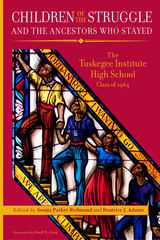
WINNER OF THE ANNE B. AND JAMES B. MCMILLAN PRIZE
A powerful collection of firsthand stories from the Tuskegee Institute High School Class of 1964—students who came of age in the crucible of the Civil Rights Movement. Their stories uncover the bold choices of their ancestors who chose to stay and help shape the South.
Children of the Struggle and the Ancestors Who Stayed, edited by Sonjia Parker Redmond and Beatrice J. Adams, brings together twenty-one deeply personal narratives from members of the Tuskegee Institute High School Class of 1964. These students grew up at the heart of the Civil Rights Movement, coming of age during landmark legal battles, community-led voter registration efforts, and the long shadow of Jim Crow.
Graduating in the year of the Civil Rights Act and Freedom Summer, these young people had already helped desegregate Alabama schools. They marched from Selma to Montgomery, mourned the assassination of classmate Sammy Younge Jr., and witnessed firsthand the violent resistance to change that defined the era.
Rather than join the Great Migration northward, many of them followed the lead of their ancestors and chose to stay—becoming educators, organizers, and civic leaders. Their lives reflect a powerful legacy of resistance and renewal, rooted in a deep sense of place and purpose. This collection preserves their voices and honors the generations of Black families who fought for justice not only through protest, but by staying, building, and believing in the promise of the South.
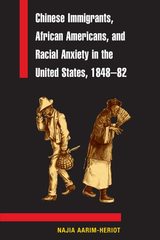
The “Chinese question” and the “Negro problem” were bound up with one another in nineteenth-century America. Indeed, the negative stereotypes, exclusionary laws, and incendiary rhetoric employed against both populations bore striking similarities.
Najia Aarim-Heriot forcefully demonstrates that the anti-Chinese sentiment behind the passage of the Chinese Exclusion Act of 1882 is inseparable from the racial double standards applied by mainstream white society toward white and nonwhite groups during the same period. Aarim-Heriot argues that previous studies on American Sinophobia have overemphasized the resentment labor organizations felt toward incoming Chinese workers. As a result, scholars have overlooked the broader ways in which the growing nation sought to define and unify itself through the exclusion and oppression of nonwhite peoples.
A challenge to traditional approaches to Chinese American history, Chinese immigrants, African Americans, and Racial Anxiety in the United States, 1848–82 offers a holistic examination of American Sinophobia and the racialization of national immigration policies.
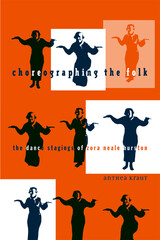
Recovers an important dimension of the work of the renowned African American artist
While Zora Neale Hurston and her 1937 novel Their Eyes Were Watching God have become widely celebrated, she was also a prolific stage director and choreographer. In the 1930s Hurston produced theatrical concerts that depicted a day in the life of a railroad work camp in Florida and featured a rousing Bahamian Fire Dance as the dramatic finale. In Choreographing the Folk, Anthea Kraut traces the significance and influence of Hurston’s little-known choreographic work.
Hurston’s concerts were concrete illustrations of the “real Negro art theatre” she was eager to establish, and they compellingly demonstrate how she used the arena of performance to advance a nuanced understanding of the black diaspora. Her version of the Fire Dance was staged in a variety of venues during the 1930s. In its multiple representations, Kraut asserts, the dance raised critical issues about ownership, artistry, and authenticity. Choreographing the Folk argues for the significance of Hurston’s choreography, and with perceptiveness, sensitivity, and originality, Kraut illuminates the important and often-contested place of black folk dance in American culture.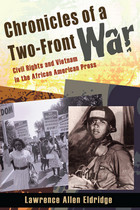
Eldridge reveals how the black press not only reported the war but also weighed its significance in the context of the civil rights movement.
Eldridge examines not only the role of reporters during the war, but also those of editors, commentators, and cartoonists. Especially enlightening is the research drawn from extensive oral histories by prominent journalist Ethel Payne, the first African American woman to receive the title of war correspondent. She described a widespread practice in black papers of reworking material from major white papers without providing proper credit, as the demand for news swamped the small budgets and limited staffs of African American papers. The author analyzes both the strengths of the black print media and the weaknesses in their coverage.
The black press ultimately viewed the Vietnam War through the lens of African American experience, blaming the war for crippling LBJ’s Great Society and the War on Poverty. Despite its waning hopes for an improved life, the black press soldiered on.
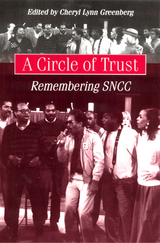
"The reminiscences and reflections voiced at the SNCC reunion remind us of the remarkable vision and courageous dedication of the civil rights movement of the 1960s. Framed by Cheryl Greenberg's eloquent and probing introduction, the SNCC veterans' comments about the triumphs and limitations of their movement represent a major contribution to the historical literature on race and power in modern America." --Raymond Arsenault, University of South Florida
On the occasion of the SNCC's 25th anniversary, more than 500 people gathered at Trinity College in Connecticut to both celebrate and critique its accomplishments. More than 40 SNCC members tell their stories and reflect on the contributions, limits and legacies of the movement in A Circle of Trust. Engaging in spirited debate with each other, with historians of the movement, and with contemporary political culture more broadly, these former and perpetual activists speak of their vision of a just society and what still remains to be done. With increasing racial tension and the continued debate over integration and separatism in America in the 1990s, the content of this conference is more relevant than ever.
Cheryl Lynn Greenberg begins with an overview of SNCC and introduces each of the chapters of oral history. Participants explore the origins of SNCC, its early adoption of nonviolent protest, its ultimate renunciation of liberal integration and embrace of militant black radicalism, its refusal to repudiate far-left organizations, and controversies over the roles of women in SNCC and society at large. The result is a thoughtful, moving, sometimes acrimonious, sometimes celebratory account of one of the most significant civil rights organizations and its successes and failures.
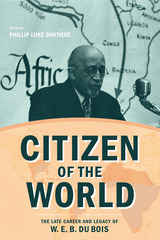
From his birth in 1868 until his death in 1963, Du Bois sought the liberation of black people in the United States and across the world through intellectual and political labor. His tireless efforts documented and demonstrated connections between freedom for African-descended people abroad and black freedom at home.
In concert with growing scholarship on his twilight years, the essays in this volume assert the fundamental importance of considering Du Bois’s later decades not as a life in decline that descended into blind ideological allegiance to socialism and communism but as the life of a productive, generative intellectual who responded rationally, imaginatively, and radically to massive mid-century changes around the world, and who remained committed to freedom’s realization until his final hour.

Within the discipline of American political science and the field of political theory, African American prophetic political critique as a form of political theorizing has been largely neglected. Stephen Marshall, in The City on the Hill from Below, interrogates the political thought of David Walker, Frederick Douglass, W. E. B. DuBois, James Baldwin, and Toni Morrison to reveal a vital tradition of American political theorizing and engagement with an American political imaginary forged by the City on the Hill.
Originally articulated to describe colonial settlement, state formation, and national consolidation, the image of the City on the Hill has been transformed into one richly suited to assessing and transforming American political evil. The City on the Hill from Below shows how African American political thinkers appropriated and revised languages of biblical prophecy and American republicanism.
A City within a City cogently argues that the post-war political reform championed by local Republicans transformed the city's racial geography, creating a racialized "city within a city," featuring a system of "managerial racism" designed to keep blacks in declining inner-city areas. As Robinson indicates, this bold, provocative framework for understanding race relations in Grand Rapids has broader implications for illuminating the twentieth-century African American urban experience in secondary cities.
Many of the documents included were previously scattered in hard-to-find sources, not readily available to instructors and students. Civil Rights and African Americans is the first collection of all the seminal texts of the civil rights struggle, an invaluable scholarly reference and riveting reading for anyone interested in the history of racial conflict in the United States.
Will Guzmán delves into Nixon's lifelong struggle against Jim Crow. Linking Nixon's activism to his independence from the white economy, support from the NAACP, and the man's own indefatigable courage, Guzmán also sheds light on Nixon's presence in symbolic and literal borderlands--as an educated professional in a time when few went to college, as an African American who made waves when most feared violent reprisal, and as someone living on the mythical American frontier as well as an international boundary.
A powerful addition to the literature on African Americans in the Southwest, Civil Rights in the Texas Borderlands explores seldom-studied corners of the Black past and the civil rights movement.
A compelling history of school desegregation and activism in San Francisco
The picture of school desegregation in the United States is often painted with broad strokes of generalization and insulated anecdotes. Its true history, however, is remarkably wide ranging. Class Action tells the story of San Francisco’s long struggle over school desegregation in the wake of the 1954 U.S. Supreme Court decision Brown v. Board of Education.
San Francisco’s story provides a critical chapter in the history of American school discrimination and the complicated racial politics that emerged. It was among the first large cities outside the South to face court-ordered desegregation following the Brown rulings, and it experienced the same demographic shifts that transformed other cities throughout the urban West. Rand Quinn argues that the district’s student assignment policies—including busing and other desegregative mechanisms—began as a remedy for state discrimination but transformed into a tool intended to create diversity. Drawing on extensive archival research—from court docket files to school district records—Quinn describes how this transformation was facilitated by the rise of school choice, persistent demand for neighborhood schools, evolving social and legal landscapes, and local community advocacy and activism.
Class Action is the first book to present a comprehensive political history of post-Brown school desegregation in San Francisco. Quinn illuminates the evolving relationship between jurisprudence and community-based activism and brings a deeper understanding to the multiracial politics of urban education reform. He responds to recent calls by scholars to address the connections between ideas and policy change and ultimately provides a fascinating look at race and educational opportunity, school choice, and neighborhood schools in the aftermath of Brown v. Board of Education.
When the beautiful, up-to-date hospital opened, it attracted more black residents than any other such program in the United States. Patients also flocked to the hospital, as did nursing students who found there excellent training, ready employment, and a boost into the middle class. For decades, the hospital thrived; by the 1950s, three-quarters of African-American babies in St. Louis were born at Homer G.
But the 1960s and 1970s brought less need for all-black hospitals, as faculty, residents, and patients were increasingly welcome in the many newly integrated institutions. Ever-tightening city budgets meant less money for the hospital, and in 1979, despite protests from the African-American community, HGPH closed. Years later, the venerated, long-vacant building came to life again as the Homer G. Phillips Senior Living Community.
Candace O’Connor draws upon contemporary newspaper articles, institutional records, and dozens of interviews with former staff members to create the first, full history of the Homer G. Phillips Hospital. She also brings new facts and insights into the life and mysterious murder (still an unsolved case) of the hospital’s namesake, a pioneering Black attorney and civil rights activist who led the effort to build the sorely needed medical facility in the Ville neighborhood.

"The Closing Door is a crucial breath of fresh air . . . an important and timely text which will help to alter the 'underclass' debate in favor of reconsidering race-specific policies. Orfield and Ashkinaze construct a convincing argument with which those who favor 'race-neutrality' will have to contend. In readable prose they make a compelling case that economic growth is not enough."—Preston H. Smith II, Transition

In Codes of Conduct, Karla Holloway meditates on the dynamics of race and ethnicity as they are negotiated in the realms of power. Her uniquely insightful and intelligent analysis guides us in a fresh way through Anita Hill’s interrogation, the assault on Tawana Brawley, the mass murders of Atlanta’s children, the schisms between the personal and public domains of her life as a black professor, and––in a moving epilogue––the story of her son’s difficulties growing up as a young black male in contemporary society. Its three main sections: “The Body Politic,” “Language, Thought, and Culture,” and “The Moral Lives of Children,” relate these issues to the visual power of the black and female body, the aesthetic resonance and racialized drama of language, and our children’s precarious habits of surviving. Throughout, Holloway questions the consequences in African-American community life of citizenship that is meted out sparingly when one’s ethnicity is colored.
This is a book of a culture’s stories––from literature, public life, contemporary and historical events, aesthetic expression, and popular culture––all located within the common ground of African-American ethnicity. Holloway writes with a passion, urgency, and wit that carry the reader swiftly through each chapter. The book should take its place among those other important contemporary works that speak to the future relationships between whites and blacks in this country.
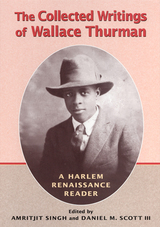
This book is the definitive collection of the writings of Wallace Thurman (1902-1934), providing a comprehensive anthology of both the published and unpublished works of this bohemian, bisexual writer. Widely regarded as the enfant terrible of the Harlem Renaissance scene, Thurman was a leader among a group of young artists and intellectuals that included, among others, Langston Hughes, Zora Neale Hurston, Richard Bruce Nugent, Gwendolyn Bennett, and Aaron Douglas. Through the publication of magazines such as FIRE!! and Harlem: A Forum of Negro Life, Thurman tried to organize the opposition of the younger generation against the programmatic and promotional ideologies of the older generation of black leaders and intellectuals such as W.E.B. Du Bois and Benjamin Brawley. Thurman also left a permanent mark on the period through his prolific work as a novelist, playwright, short story writer, and literary critic, as well as by claiming for himself a voice as a public intellectual.
The Collected Writings of Wallace Thurman is divided into eight sections to highlight the variety of genres and styles Thurman practiced as he courageously pursued controversial subjects throughout his short and brilliant career. It includes Essays on Harlem, Social Essays and Journalism, Correspondence, Literary Essays and Reviews, Poetry and Short Fiction, Plays, and Excerpts from Novel.
Filling an important gap in Harlem Renaissance literature, this collection brings together all of Thurman’s essays, nearly all of his letters to major black and white figures of the 1920s, and three previously unpublished major works. These books are Aunt Hagar’s Children, which is a collection of essays and two full-length plays, Harlem, and Jeremiah the Magnificent. The introduction to the volume, along with the carefully researched introductory notes to each of the eight sections, provides a challenging new reevaluation of Thurman and the Harlem Renaissance for both the general reader and scholar.
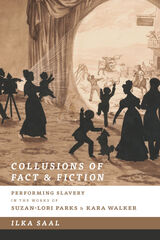
Saal argues that the attempt to reconstruct or recuperate the experience of African Americans under slavery is no longer at stake in the works of artists growing up in the post–Civil Rights era. Instead, they lay bare the discursive dimension of our contemporary understanding of the past and address the continued impact of its various verbal and visual signs upon contemporary identities. In this manner, Parks and Walker stake out new possibilities for engaging the past and inhabiting the present and future.
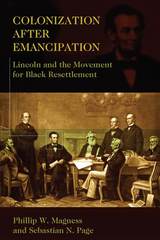
Colonization after Emancipation: Lincoln and the Movement for Black Resettlement explores the previously unknown truth about Lincoln’s attitude toward colonization. Scholars Phillip W. Magness and Sebastian N. Page combed through extensive archival materials, finding evidence, particularly within British Colonial and Foreign Office documents, which exposes what history has neglected to reveal—that Lincoln continued to pursue colonization for close to a year after emancipation. Their research even shows that Lincoln may have been attempting to revive this policy at the time of his assassination.
Using long-forgotten records scattered across three continents—many of them untouched since the Civil War—the authors show that Lincoln continued his search for a freedmen’s colony much longer than previously thought. Colonization after Emancipation reveals Lincoln’s highly secretive negotiations with the British government to find suitable lands for colonization in the West Indies and depicts how the U.S. government worked with British agents and leaders in the free black community to recruit emigrants for the proposed colonies. The book shows that the scheme was never very popular within Lincoln’s administration and even became a subject of subversion when the president’s subordinates began battling for control over a lucrative “colonization fund” established by Congress.
Colonization after Emancipation reveals an unexplored chapter of the emancipation story. A valuable contribution to Lincoln studies and Civil War history, this book unearths the facts about an ill-fated project and illuminates just how complex, and even convoluted, Abraham Lincoln’s ideas about the end of slavery really were.
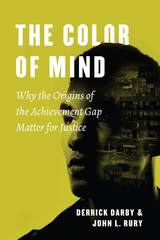
Telling the story of what they call the Color of Mind—the idea that there are racial differences in intelligence, character, and behavior—they show how philosophers, such as David Hume and Immanuel Kant, and American statesman Thomas Jefferson, contributed to the construction of this pernicious idea, how it influenced the nature of schooling and student achievement, and how voices of dissent such as Frederick Douglass, Frances Ellen Watkins Harper, and W. E. B. Du Bois debunked the Color of Mind and worked to undo its adverse impacts.
Rejecting the view that racial differences in educational achievement are a product of innate or cultural differences, Darby and Rury uncover the historical interplay between ideas about race and American schooling, to show clearly that the racial achievement gap has been socially and institutionally constructed. School leaders striving to bring justice and dignity to American schools today must work to root out the systemic manifestations of these ideas within schools, while still doing what they can to mitigate the negative effects of poverty, segregation, inequality, and other external factors that adversely affect student achievement. While we cannot expect schools alone to solve these vexing social problems, we must demand that they address the dignitary injustices associated with how we track, discipline, and deal with special education that reinforce long-standing racist ideas. That is the only way to expel the Color of Mind from schools, close the racial achievement gap, and afford all children the dignity they deserve.
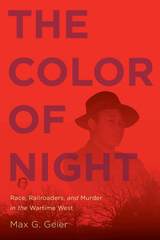
In this deeply researched and detailed account, Geier explores how race, gender, and class affected the attitudes of local town-folk, law officers, and courtroom jurors toward Black trainmen on the West Coast, at a time when militarization skewed perceptions of virtue, status, and authority. He delves into the working conditions and experiences of unionized Black trainmen in their “home and away” lives in Los Angeles and Portland, while illuminating the different ways that they, and other residents of Oregon and southern California, responded to news of “Oregon’s murdered war bride.” Reporters, civil rights activists, and curiosity seekers transformed the trial and appeals process into a public melodrama.
The investigation, trial, and conviction of Robert Folkes galvanized civil rights activists, labor organizers, and community leaders into challenging the flawed judicial process and ultimately the death penalty in Oregon, serving as a catalyst for civil rights activism that bridged rural and urban divides. The Color of Night will appeal to “true crime” aficionados, and to anyone interested in the history of race and labor relations, working conditions, community priorities, and attitudes toward the death penalty in the first half of the 20th century.
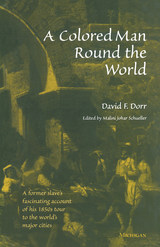
Malini Johar Schueller has edited and annotated the 1858 text and added a critical introduction that provides a useful context for understanding and appreciating this important but heretofore neglected document. Her edition of A Colored Man Round the World provides a fascinating account of Dorr's negotiation of the conflicting roles of slave versus man, taking into account all of the racial complexities that existed at the time. As a traveler abroad, Dorr claimed an American selfhood that allowed him mobility in Europe, and he benefited from the privileges accorded American "Orientalists" venturing in the near East. However, any empowerment that Dorr experienced while a tourist vanished upon his return to America.
The book will be welcomed for the rare perspective it provides of the mid-nineteenth century, through the eyes of an African-American slave and for the light it casts on world and U.S. history as well as on questions of racial and national identity.
Malini Johar Schueller is Professor of English, University of Florida.
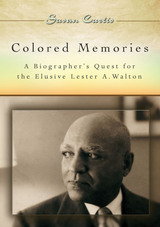
Lester A. Walton was a well-known public figure in his day. An African American journalist, cultural critic, diplomat, and political activist, he was an adviser to presidents and industrialists in a career that spanned the first six decades of the twentieth century. He was a steadfast champion of democracy and lived to see the passage of major civil rights legislation. But one word best describes Walton today: forgotten.
Exploring the contours of this extraordinary life, Susan Curtis seeks to discover why our collective memory of Walton has failed. In a unique narrative of historical research, she recounts a fifteen-year journey, from the streets of Harlem and “The Ville” in St. Louis to scattered archives and obscure public records, as she uncovers the mysterious circumstances surrounding Walton’s disappearance from national consciousness. And despite numerous roadblocks and dead ends in her quest, she tells how she came to know this emblematic citizen of the American Century in surprising ways.
In this unconventional book—a postmodern ghost story, an unprecedented experiment in life-writing—Curtis shares her discoveries as a researcher. Relating her frustrating search through long-overlooked documents to discover this forgotten man, she offers insight into how America’s obsession with race has made Walton’s story unwelcome. She explores the treachery, duplicity, and archival accidents that transformed a man dedicated to the fulfillment of American democracy into a shadowy figure.
Combining anecdotal memories with the investigative instincts of the historian, Curtis embraces the subjectivity of her research to show that what a society forgets or suppresses is just as important as what it includes in its history. Colored Memories is a highly original work that not only introduces readers to a once-influential figure but also invites us to reconsider how we view, understand, and preserve the past.
Cherene Sherrard-Johnson's introduction places this literary classic in both the new modernist and transatlantic contexts and will be embraced by those interested in earlytwentieth-century women writers, novels about passing, the Harlem Renaissance, the black/white divide, and diaspora studies. Selected essays and poems penned by Fauset are also included, among them "Yarrow Revisited" and "Oriflamme," which help highlight the full canon of her extraordinary contribution to literature and provide contextual background to the novel.
An ALA “Best of the Best” Book
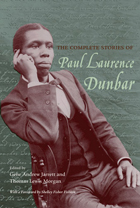
The son of former slaves, Paul Laurence Dunbar was one of the most prominent figures in American literature at the turn of the twentieth century. Thirty-three years old at the time of his death in 1906, he had published four novels, four collections of short stories, and fourteen books of poetry, as well as numerous songs, plays, and essays in newspapers and magazines around the world.
In the century following his death, Dunbar slipped into relative obscurity, remembered mainly for his dialect poetry or as a footnote to other more canonical figures of the period. The Complete Stories of Paul Laurence Dunbar showcases his gifts as a writer of short fiction and provides key insights into the tensions and themes of Dunbar's literary achievement. The 104 stories written by Dunbar between 1890 and 1905 reveal Dunbar's attempts to maintain his artistic integrity while struggling with America's racist stereotypes. Making them available for the first time in one convenient, comprehensive, and definitive volume, The Complete Stories of Paul Laurence Dunbar illustrates the complexity of his literary life and legacy.
Composition and Cornel West: Notes toward a Deep Democracy identifies and explains key aspects of the work of Cornel West—the highly regarded scholar of religion, philosophy, and African American studies—as they relate to composition studies, focusing especially on three rhetorical strategies that West suggests we use in our questioning lives as scholars, teachers, students, and citizens.
In this study, author Keith Gilyard examines the strategies of Socratic Commitment (a relentless examination of received wisdom), Prophetic Witness (an abiding concern with justice and the plight of the oppressed), and Tragicomic Hope (a keep-on-pushing sensibility reflective of the African American freedom struggle). Together, these rhetorical strategies comprise an updated form of cultural criticism that West calls prophetic pragmatism.
This volume, which contains the only interview in which Cornel West directly addresses the field of composition,sketches the development of Cornel West’s theories of philosophy, political science, religion, and cultural studies and restates the link between Deweyan notions of critical intelligence and the notion of critical literacy developed by Ann Berthoff, Ira Shor, and Henry Giroux. Gilyard provides examples from the classroom to illustrate the possibilities of Socratic Commitment as part of composition pedagogy, shows the alignment of Prophetic Witness with traditional aims of critical composition, and in his chapter on Tragicomic Hope, addresses African American expressive culture with an emphasis on music and artists such as Curtis Mayfield, Marvin Gaye, Aretha Franklin, and Kanye West.
The first book to comprehensively connect the ideas of one of America's premier scholars of religion, philosophy and African American studies with composition theory and pedagogy, Composition and Cornel West will be valuable to scholars, teachers, and students interested in race, class, critical literacy, and the teaching of writing.
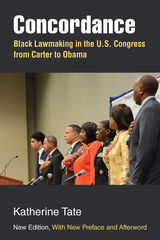
Focusing on the Congressional Black Caucus (CBC), Katherine Tate studies the ways in which the nation’s most prominent group of Black legislators has developed politically. Organized in 1971, the CBC set out to increase the influence of Black legislators. Indeed, over the past four decades, they have made progress toward the goal of becoming recognized players within Congress. And yet, Tate argues, their incorporation is transforming their policy preferences. Since the Clinton Administration, CBC members—the majority of whom are Democrats—have been less willing to oppose openly congressional party leaders and both Republican and Democratic presidents. Tate documents this transformation with a statistical analysis of Black roll-call votes, using the important Poole-Rosenthal scores from 1977 to 2010. While growing partisanship has affected Congress as a whole, not just minority caucuses, Tate warns that incorporation may mute the independent voice of Black political leaders.
During the height of the civil rights movement, Blacks were among the most liberal Americans. Since the 1970s, however, increasing representation in national, state, and local government has brought about a more centrist outlook among Black political leaders.
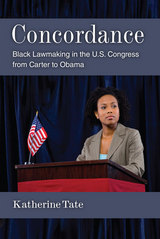
Focusing on the Congressional Black Caucus (CBC), Katherine Tate studies the ways in which the nation’s most prominent group of Black legislators has developed politically. Organized in 1971, the CBC set out to increase the influence of Black legislators. Indeed, over the past four decades, they have made progress toward the goal of becoming recognized players within Congress. And yet, Tate argues, their incorporation is transforming their policy preferences. Since the Clinton Administration, CBC members—the majority of whom are Democrats—have been less willing to oppose openly congressional party leaders and both Republican and Democratic presidents. Tate documents this transformation with a statistical analysis of Black roll-call votes, using the important Poole-Rosenthal scores from 1977 to 2010. While growing partisanship has affected Congress as a whole, not just minority caucuses, Tate warns that incorporation may mute the independent voice of Black political leaders.
Contributors. Elizabeth Alexander, Jennifer DeVere Brody, Daphne A. Brooks, Linh U. Hua, Janet Neary, Marlon B. Ross, Robyn Wiegman
A superb work in the social history of American industry
A Gettysburg College "Top 200 Civil War Books" selection
Mayflower Award Winner for 1970
The authors examine in detail how the Republican Party slowly withdrew its support for a meaningful civil rights agenda, as well as how Democrats and Republicans worked together to keep civil rights off the legislative agenda at various points. In doing so, Jenkins and Peck show how legal institutions can be used both to liberate and protect oppressed minorities and to assert the power of the white majority against those same minority groups.
Both the U.S. Supreme Court and the Congressional Black Caucus (CBC) claim to advocate minority political interests, yet they disagree over the intent and scope of the Voting Rights Act (VRA), as well as the interpretation of the equal protection clause of the 14th Amendment. Whereas the Court promotes color-blind policies, the CBC advocates race-based remedies. Setting this debate in the context of the history of black political thought, Rivers examines a series of high-profile districting cases, from Rodgers v. Lodge (1982) through NAMUDNO v. Holder (2009). She evaluates the competing approaches to racial equality and concludes, surprisingly, that an originalist, race-conscious interpretation of the 14th Amendment, along with a revised states' rights position regarding electoral districting, may better serve minority political interests.
In the tradition of Uncle Remus, the conjure tale listens in on a poor black southerner, speaking strong dialect, as he recounts a local incident to a transplanted northerner for the northerner's enlightenment and edification. But in Chesnutt's hands the tradition is transformed. No longer a reactionary flight of nostalgia for the antebellum South, the stories in this book celebrate and at the same time question the folk culture they so pungently portray, and ultimately convey the pleasures and anxieties of a world in transition. Written in the late nineteenth century, a time of enormous growth and change for a country only recently reunited in peace, these stories act as the uneasy meeting ground for the culture of northern capitalism, professionalism, and Christianity and the underdeveloped southern economy, a kind of colonial Third World whose power is manifest in life charms, magic spells, and ha'nts, all embodied by the ruling figure of the conjure woman.
Humorous, heart-breaking, lyrical, and wise, these stories make clear why the fiction of Charles W. Chesnutt has continued to captivate audiences for a century.

Reflecting the structure of the ring shout—the counterclockwise song, dance, drum, and story in African American history and culture—Conjuring Freedom offers three new concepts to cultural studies in order to describe the practices, techniques, and implications of the troop’s performance: (1) Black Communal Conservatories, borrowing from Robert Farris Thompson’s “invisible academies” to describe the structural but spontaneous quality of black music-making, (2) Listening Hermeneutics, which accounts for the generative and material affects of sound on meaning-making, and (3) Sonic Politics, which points to the political implications of music’s use in contemporary representations of race and history.
In a series of revisionary readings, Nicholls studies how the "folk" is shaped by the ideology of form. He examines the presence of a spectral "folk" in Toomer's modernist pastiche, Cane. He explores how Hurston presents folklore as a contemporary language of resistance in her ethnography, Mules and Men. In Claude McKay's naturalistic romance, Banana Bottom, Nicholls discovers the figuration of an alternative modernity in the heroine's recovery of her lost "folk" identity. He unearths the individualist ethos of Booker T. Washington in two novels by George Wylie Henderson. And he reveals how Richard Wright's photo-documentary history, 12 Million BlackVoices, places the "folk" in a Marxian narrative of modernization toward class-consciousness.
A provocative rereading of the cultural politics of the Harlem Renaissance, Conjuring the Folk offers a new way of understanding literary responses to migration, modernization, and the concept of the "folk" itself.
David G. Nicholls is a post-doctoral fellow in the Center for the Study of Race, Politics, and Culture, University of Chicago.
Constructing a Black Curriculum reframes how we understand Black Americans’ intellectual and political engagement with education during the first half of the twentieth century. It traces the powerful, diffuse movement created by Black Americans to build what Nocera calls a “Black Curriculum:" a communal effort to represent Black identity, guide racial consciousness, and rebut claims of inferiority. This curriculum first developed as a public educational project in Black learned societies and during the Harlem Renaissance before making its way into schools. The struggle for a Black curriculum was not only a fight against white supremacy, but also an internal debate among Black advocates over the very nature of how race should be represented and taught. This book illuminates this struggle through the work of Black intellectuals (Alexander Crummell, Carter G. Woodson, Hubert Harrison, and Alain Locke) and the intellectual contributions of African American educators (Nannie Burroughs, Jane Dabney Shackelford, and Julia Davis). This essential history provides vital context for contemporary debates over curriculum reform, racial knowledge, and the enduring quest for educational equity.
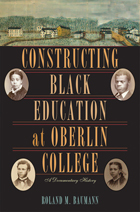
In 1835 Oberlin became the first institute of higher education to make a cause of racial egalitarianism when it decided to educate students “irrespective of color.” Yet the visionary college’s implementation of this admissions policy was uneven. In Constructing Black Education at Oberlin College: A Documentary History, Roland M. Baumann presents a comprehensive documentary history of the education of African American students at Oberlin College.
Following the Reconstruction era, Oberlin College mirrored the rest of society as it reduced its commitment to black students by treating them as less than equals of their white counterparts. By the middle of the twentieth century, black and white student activists partially reclaimed the Oberlin legacy by refusing to be defined by race. Generations of Oberlin students, plus a minority of faculty and staff, rekindled the college’s commitment to racial equality by 1970. In time, black separatism in its many forms replaced the integrationist ethic on campus as African Americans sought to chart their own destiny and advance curricular change.
Oberlin’s is not a story of unbroken progress, but rather of irony, of contradictions and integrity, of myth and reality, and of imperfections. Baumann takes readers directly to the original sources by including thirty complete documents from the Oberlin College Archives. This richly illustrated volume is an important contribution to the college’s 175th anniversary celebration of its distinguished history, for it convincinglydocuments how Oberlin wrestled over the meaning of race and the destiny of black people in American society.
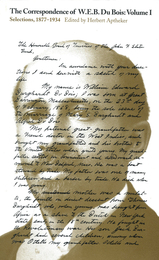
Scholar, author, editor, teacher, reformer, and civil rights leader, W.E.B. Du Bois (1868–1963) was a major figure in American life and one of the earliest proponents of equality for Black Americans. He was a founder and leader of the Niagara Movement, the NAACP, and the Pan-African Movement; a progenitor of the 1920s Harlem Renaissance; an advocate of anticolonialism, anti-imperialism, unionism, and equality for women; and a champion of the rights of oppressed people around the world.
The three-volume Correspondence of W.E.B. Du Bois offers a unique perspective on Du Bois's experiences and views. In recognition of the significance of the Correspondence, the final volume was named a Best Book of the Year by the New York Times Book Review.
Herbert Aptheker has provided an introduction and notes to each volume, illuminating the circumstances and identifying the personalities involved in the correspondence. A long time friend and colleague of Du Bois, Aptheker is a well-known historian of the African American experience. In 1939 and again in 1969, he won the history award given by the Association for the Study of Negro Life and History. Among his most prominent works are American Negro Slave Revolts and the three-volume Documentary History of the Negro People in the United States.
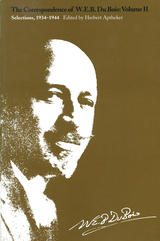
Scholar, author, editor, teacher, reformer, and civil rights leader, W.E.B. Du Bois (1868–1963) was a major figure in American life and one of the earliest proponents of equality for black Americans. He was a founder and leader of the Niagara Movement, the NAACP, and the Pan-African Movement; a progenitor of the 1920s Harlem Renaissance; an advocate of anticolonialism, anti-imperialism, unionism, and equality for women; and a champion of the rights of oppressed people around the world.
The three-volume Correspondence of W.E.B. Du Bois offers a unique perspective on Du Bois's experiences and views. In recognition of the significance of the Correspondence, the final volume was named a Best Book of the Year by the New York Times Book Review.
Herbert Aptheker has provided an introduction and notes to each volume, illuminating the circumstances and identifying the personalities involved in the correspondence. A long time friend and colleague of Du Bois, Aptheker is a well-known historian of the African American experience. In 1939 and again in 1969, he won the history award given by the Association for the Study of Negro Life and History. Among his most prominent works are American Negro Slave Revolts and the three-volume Documentary History of the Negro People in the United States.
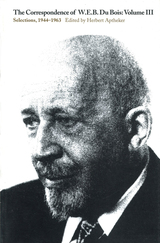
Scholar, author, editor, teacher, reformer, and civil rights leader, W.E.B. Du Bois (1868–1963) was a major figure in American life and one of the earliest proponents of equality for black Americans. He was a founder and leader of the Niagara Movement, the NAACP, and the Pan-African Movement; a progenitor of the 1920s Harlem Renaissance; an advocate of anticolonialism, anti-imperialism, unionism, and equality for women; and a champion of the rights of oppressed people around the world.
The three-volume Correspondence of W.E.B. Du Bois offers a unique perspective on Du Bois's experiences and views. In recognition of the significance of the Correspondence, the final volume was named a Best Book of the Year by the New York Times Book Review.
Herbert Aptheker has provided an introduction and notes to each volume, illuminating the circumstances and identifying the personalities involved in the correspondence. A long time friend and colleague of Du Bois, Aptheker is a well-known historian of the African American experience. In 1939 and again in 1969, he won the history award given by the Association for the Study of Negro Life and History. Among his most prominent works are American Negro Slave Revolts and the three-volume Documentary History of the Negro People in the United States.
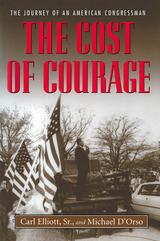
This deeply moving story chronicles the tenacity and vision that carried Carl Elliott from the hills of northwest Alabama to eight distinguished terms in the United States House of Representatives.
Born in a log cabin on a tenant farm in 1913, Carl Elliott worked his way through The University of Alabama during the Great Depression and was elected to Congress in 1948. With a no-nonsense philosophy of fairness and equal opportunity, he established himself as one of the most effective members of the House of Representatives during the 1950s. He was a progressive Democrat and he fought hard for the dirt farmers and coal miners he grew up with and who sent him to Congress.
In an era when racial segregationists dominated southern politics, Elliott worked with many of the important political leaders of the 20th century, including Presidents Truman, Eisenhower, and Kennedy and powerful House Speaker Sam Rayburn. He was instrumental in passing the National Defense Education Act of 1958, which continues to provide college loans to more than 20 million Americans. But his brave stand against racism and George Wallace in the 1966 Alabama gubernatorial race ruined him professionally (he never returned to elected office) and financially (he cashed in his congressional pension to help fund the campaign). Even as a destitute invalid in his old age, however, Elliott kept his dignity and integrity intact.
The life story of Carl Elliott is full of humor and wry wisdom and explains how he made his way across a stage as big as America, influencing its politics and future, and then emerged, belatedly, as an unsung hero of the fight for civil rights and equality.
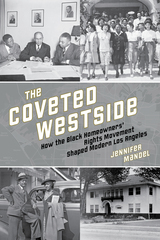
Mandel exposes the enduring struggle between Whites determined to establish their hegemony and create residential heterogeneity in the growing city, and people of color equally determined to obtain full access to the city and the opportunities, including residential, that it offered. Not only does this book document the Black homeowners’ fight against housing discrimination, it shares personal accounts of Blacks’ efforts to settle in the highly desirable Westside of Los Angeles. Mandel explores the White-derived social and legal mechanisms that created this segregated city and the African American-led movement that challenged efforts to block access to fair housing.
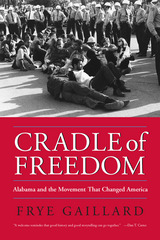
Cradle of Freedom puts a human face on the story of the black American struggle for equality in Alabama during the 1960s.
While exceptional leaders such as Martin Luther King Jr., Rosa Parks, Fred Shuttlesworth, Ralph Abernathy, John Lewis, and others rose up from the ranks and carved their places in history, the burden of the movement was not carried by them alone. It was fueled by the commitment and hard work of thousands of everyday people who decided that the time had come to take a stand.
Cradle of Freedom is tied to the chronology of pivotal events occurring in Alabama the Montgomery bus boycott, the Freedom Rides, the Letter from the Birmingham Jail, the bombing of the 16th Street Baptist Church, Bloody Sunday, and the Black Power movement in the Black Belt. Gaillard artfully interweaves fresh stories of ordinary people with the familiar ones of the civil rights icons. We learn about the ministers and lawyers, both black and white, who aided the movement in distinct ways at key points. We meet Vernon Johns, King's predecessor at the Dexter Avenue Baptist Church in Montgomery, who first suggested boycotting the buses and who wrote later, "It is a heart strangely un-Christian that cannot thrill with joy when the least of men begin to pull in the direction of the stars." We hear from John Hulett who tells how terror of lynching forced him down into ditches whenever headlights appeared on a night road. We see the Edmund Pettus Bridge beatings from the perspective of marcher JoAnne Bland, who was only a child at the time. We learn of E. D. Nixon, a Pullman porter who helped organize the bus boycott and who later choked with emotion when, for the first time in his life, a white man extended his hand in greeting to him on a public street.
How these ordinary people rose to the challenges of an unfair system with a will and determination that changed their times forever is a fascinating and extraordinary story that Gaillard tells with his hallmark talent. Cradle of Freedom unfolds with the dramatic flow of a novel, yet it is based on meticulous research. With authority and grace, Gaillard explains how the southern state deemed the cradle of the Confederacy became with great struggle, some loss, and much hope the cradle of freedom.
Drawing upon little studied speeches, newspapers, magazines, and other public discourse, Condit and Lucaites survey the shifting meaning of equality from 1760 to the present as a process of interaction and negotiation among different social groups in American politics and culture. They make a powerful case for the critical role of black Americans in actively shaping what equality has come to mean in our political conversation by chronicling the development of an African-American rhetorical community. The story they tell supports a vision of equality that embraces both heterogeneity and homogeneity as necessary for maintaining the balance between liberty and property.
A compelling revision of an important aspect of America's history, Crafting Equality will interest anyone wanting to better understand the role public discourse plays in affecting the major social and political issues of our times. It will also interest readers concerned with the relationship between politics and culture in America's increasingly multi-cultural society.
Corresponding to a particular form of popular culture, each section features two essays, one by an African American scholar and one by a Latino/a scholar, as well as a short response by each scholar to the other’s essay. The essays and responses are lively, varied, and often personal. One contributor puts forth a “brown” theology of hip hop that celebrates hybridity, contradiction, and cultural miscegenation. Another analyzes the content of the message transmitted by African American evangelical preachers who have become popular sensations through television broadcasts, video distribution, and Internet promotions. The other essays include a theological reading of the Latina body, a consideration of the “authenticity” of representations of Jesus as white, a theological account of the popularity of telenovelas, and a reading of African American ideas of paradise in one of Toni Morrison’s novels. Creating Ourselves helps to make popular culture available as a resource for theology and religious studies and for facilitating meaningful discussions across racial and ethnic boundaries.
Contributors. Teresa Delgado, James H. Evans Jr., Joseph De León, Cheryl Kirk-Duggan, Angel F. Méndez Montoya, Alexander Nava, Anthony B. Pinn, Mayra Rivera, Suzanne E. Hoeferkamp Segovia, Benjamín Valentín, Jonathan L. Walton, Traci C. West, Nancy Lynne Westfield, Sheila F. Winborne
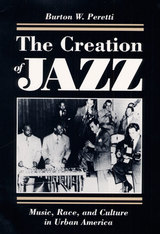
The story of jazz is more than a history of the music. The racial and cultural dynamics of American cities created the music, life, and business that was jazz.
Burton W. Peretti's classic study charts the life of jazz culture from its origins in the jook joints of sharecroppers and the streets and dance halls of 1890s New Orleans to the eve of bebop and World War II. As Perett shows, jazz was the epic story of players who transitioned from childhood spasm bands to Carnegie Hall and worldwide touring and fame. It became the music of the Twenties, a decade of Prohibition, of adolescent discontent, of Harlem pride, and of Americans hoping to preserve cultural traditions in an urban, commercial age. Finally, jazz was where black and white musicians performed together, as uneasy partners, in the big bands of Artie Shaw and Benny Goodman.
Drawing on archives and the firsthand testimony of more than seventy musicians and singers (among them Benny Carter, Bud Freeman, Kid Ory, and Mary Lou Williams), The Creation of Jazz offers a comprehensive analysis of the role of early jazz in American social history.
In this collection, Amy Louise Wood and Natalie J. Ring present nine groundbreaking essays about the carceral system and its development over time. Topics range from activism against police brutality to the peculiar path of southern prison reform to the fraught introduction of the electric chair. The essays tell nuanced stories of rapidly changing state institutions, political leaders who sought to manage them, and African Americans who appealed to the regulatory state to protect their rights.
Contributors: Pippa Holloway, Tammy Ingram, Brandon T. Jett, Seth Kotch, Talitha L. LeFlouria, Vivien Miller, Silvan Niedermeier, K. Stephen Prince, and Amy Louise Wood
In writing Black Boy, the centerpiece of the Chicago Renaissance, Wright was inspired by Theodore Dreiser. Because the European and African cultural visions that Wright, Ralph Ellison, Alice Walker, and Toni Morrison acquired were buttressed by the universal humanism that is common to all cultures, this ideology is shown to transcend the problems of society. Fascinated by Eastern thought and art, Wright, Walker, Sonia Sanchez, and James Emanuel wrote highly accomplished poetry and prose. Like Ezra Pound, Wright was drawn to classic haiku, as reflected in the 4,000 haiku he wrote at the end of his life. As W. B. Yeats’s symbolism was influenced by his cross-cultural visions of noh theatre and Irish folklore, so is James Emanuel’s jazz haiku energized by his cross-cultural rhythms of Japanese poetry and African American music.
The book demonstrates some of the most visible cultural exchanges in modern and postmodern African American literature. Such a study can be extended to other contemporary African American writers whose works also thrive on their cross-cultural visions, such as Amiri Baraka, Ishmael Reed, Charles Johnson, and haiku poet Lenard Moore.
Examining works by Toni Morrison, Paule Marshall, Faith Ringgold, and Betye Saar, this innovative book frames black women's aesthetic sensibilities across art forms. Investigating the relationship between vernacular folk culture and formal expression, this study establishes how each of the four artists engaged the identity issues of the 1960s and used folklore as a strategy for crossing borders in the works they created during the following two decades.
As a dynamic, open-ended process, folklore historically has enabled African-descended people to establish differential identity, resist dominance, and affirm group solidarity. This book documents the use of expressive forms of folklore in the fiction of Morrison and Marshall and the use of material forms of folklore in the visual representations of Ringgold and Saar. Offering a conceptual paradigm of a folk aesthetic to designate the practices these women use to revise and reverse meanings—especially meanings imposed on images such as Aunt Jemima and Sambo—Crossing Borders through Folklore explains how these artists locate sites of intervention and reconnection. From these sites, in keeping with the descriptive and prescriptive formulations for art during the sixties, Morrison, Marshall, Ringgold, and Saar articulate new dimensions of consciousness and creatively theorize identity.
Crossing Borders through Folklore is a significant and creative contribution to scholarship in both established and still- emerging fields. This volume also demonstrates how recent theorizing across scholarly disciplines has created elastic metaphors that can be used to clarify a number of issues. Because of its interdisciplinary approach, this study will appeal to students and scholars in many fields, including African American literature, art history, women's studies, diaspora studies, and cultural studies.
In this book, Timothy B. Neary reveals the history of Bishop Bernard Sheil’s Catholic Youth Organization (CYO), which brought together thousands of young people of all races and religions from Chicago’s racially segregated neighborhoods to take part in sports and educational programming. Tens of thousands of boys and girls participated in basketball, track and field, and the most popular sport of all, boxing, which regularly filled Chicago Stadium with roaring crowds. The history of Bishop Sheil and the CYO shows a cosmopolitan version of American Catholicism, one that is usually overshadowed by accounts of white ethnic Catholics aggressively resisting the racial integration of their working-class neighborhoods. By telling the story of Catholic-sponsored interracial cooperation within Chicago, Crossing Parish Boundaries complicates our understanding of northern urban race relations in the mid-twentieth century.
How formerly enslaved people found freedom and built community in Ontario
In 1849, the Reverend William King and fifteen once-enslaved people he had inherited founded the Canadian settlement of Buxton on Ontario land set aside for sale to Blacks. Though initially opposed by some neighboring whites, Buxton grew into a 700-person agricultural community that supported three schools, four churches, a hotel, a lumber mill, and a post office.
Sharon A. Roger Hepburn tells the story of the settlers from Buxton’s founding of through its first decades of existence. Buxton welcomed Black men, woman, and children from all backgrounds to live in a rural setting that offered benefits of urban life like social contact and collective security. Hepburn’s focus on social history takes readers inside the lives of the people who built Buxton and the hundreds of settlers drawn to the community by the chance to shape new lives in a country that had long represented freedom from enslavement.
"This book's history of Chicago public housing should be required reading for anyone interested in social policy in the United States."—Jens Ludwig, Social Service Review
"[The authors'] work is rightly cited as one of the important precedents in the field. . . . This is a remarkable, unassailable accomplishment and this book is an important record of their scholarly contribution."—John M. Goering, Ethnic and Racial Studies
Wald begins her reading of twentieth-century passing narratives by analyzing works by African American writers James Weldon Johnson, Jessie Fauset, and Nella Larsen, showing how they use the “passing plot” to explore the negotiation of identity, agency, and freedom within the context of their protagonists' restricted choices. She then examines the 1946 autobiography Really the Blues, which details the transformation of Milton Mesirow, middle-class son of Russian-Jewish immigrants, into Mezz Mezzrow, jazz musician and self-described “voluntary Negro.” Turning to the 1949 films Pinky and Lost Boundaries, which imagine African American citizenship within class-specific protocols of race and gender, she interrogates the complicated representation of racial passing in a visual medium. Her investigation of “post-passing” testimonials in postwar African American magazines, which strove to foster black consumerism while constructing “positive” images of black achievement and affluence in the postwar years, focuses on neglected texts within the archives of black popular culture. Finally, after a look at liberal contradictions of John Howard Griffin’s 1961 auto-ethnography Black Like Me, Wald concludes with an epilogue that considers the idea of passing in the context of the recent discourse of “color blindness.”
Wald’s analysis of the moral, political, and theoretical dimensions of racial passing makes Crossing the Line important reading as we approach the twenty-first century. Her engaging and dynamic book will be of particular interest to scholars of American studies, African American studies, cultural studies, and literary criticism.
Essays range from a close reading of the 1838 memoirs of a black and Native freewoman to an analysis of how Afro-Native intermarriage has impacted the identities and federal government classifications of certain New England Indian tribes. One contributor explores the aftermath of black slavery in the Choctaw and Chickasaw nations, highlighting issues of culture and citizenship. Another scrutinizes the controversy that followed the 1998 selection of a Miss Navajo Nation who had an African American father. A historian examines the status of Afro-Indians in colonial Mexico, and an ethnographer reflects on oral histories gathered from Afro-Choctaws. Crossing Waters, Crossing Worlds includes evocative readings of several of Toni Morrison’s novels, interpretations of plays by African American and First Nations playwrights, an original short story by Roberta J. Hill, and an interview with the Creek poet and musician Joy Harjo. The Native American scholar Robert Warrior develops a theoretical model for comparative work through an analysis of black and Native intellectual production. In his afterword, he reflects on the importance of the critical project advanced by this volume.
Contributors. Jennifer D. Brody, Tamara Buffalo, David A. Y. O. Chang, Robert Keith Collins, Roberta J. Hill, Sharon P. Holland, ku'ualoha ho’omnawanui, Deborah E. Kanter, Virginia Kennedy, Barbara Krauthamer, Tiffany M. McKinney, Melinda Micco, Tiya Miles, Celia E. Naylor, Eugene B. Redmond, Wendy S. Walters, Robert Warrior
One day in the dentist's office journalist Walt Harrington heard a casual racist joke that left him enraged. Married to a black woman, Harrington is the father of two biracial children. His experience in the dentist's office made him realize not only that the joke was about his own children but also that he really knew very little about what it was like to be a black person in America.
After this rude awakening, Harrington set off on a twenty- five-thousand-mile journey through black America, talking with scores of black and white people along the way, including an old sharecropper, a city police chief, a jazz trumpeter, a convicted murderer, a welfare mother, and a corporate mogul. In Crossings, winner of the Gustavus Myers Award for the Study of Human Rights, he relates what he learned as he listened.
An essential reconsideration of black literature and culture and its response to modernity
In the African American encounter with modernism, all was not confrontation. Rather, as Edward M. Pavli´c demonstrates here, African American artists negotiated the intersection of high modernism in Europe and American discourse to fashion their own distinctive response to American modernity. A deft repositioning of black literature and culture, Pavli´c’s book re-envisions the potentials and dilemmas where the different traditions of modernism meet and firmly establishes African American modernism at this cultural crossroads.
Offering new insights into the work of a variety of African American artists—including Ralph Ellison, Richard Wright, Zora Neale Hurston, James Baldwin, Toni Morrison, Robert Hayden, David Bradley, Yusef Komunyakaa, Romare Bearden, and John Coltrane—Pavli´c explores the complex ways in which key modernist philosophical ideas and creative techniques have informed black culture. Crossroads Modernism also provides an in-depth look at how West African cultural legacies are brought to bear in the structure of a truly African American modernist creative process. The book brings to light two interrelated strains of black modernism: Afro-Modernism, which employs established modernist concerns and conceits to illuminate internal and psychological experience; and Diasporic Modernism, which places greater emphasis on shared cultural space and builds on traditions rooted in West African cultures.Whereas much has been said about the (generally racist) use of "blackness" in constituting modernism, Crossroads Modernism is the first book to expose the key role that modernism has played in the constitution of "blackness" in African-American aesthetics. In light of this work, canonical texts in African American literature can no longer be read as devoid of their own singular contribution to international modernism.
In Crucibles of Black Empowerment, Jeffrey Helgeson recounts the rise of African American political power and activism from the 1930s onward, revealing how it was achieved through community building. His book tells stories of the housewives who organized their neighbors, building tradesmen who used connections with federal officials to create opportunities in a deeply discriminatory employment sector, and the social workers, personnel managers, and journalists who carved out positions in the white-collar workforce. Looking closely at black liberal politics at the neighborhood level in Chicago, Helgeson explains how black Chicagoans built the networks that eventually would overthrow the city’s seemingly invincible political machine.
Rejecting slavery from a young age, Coles's early wishes to free his family's slaves initially were stymied by legal, practical, and family barriers. Instead he went to Washington, D.C., where his work in the White House was a life-changing blend of social glitter, secretarial drudge, and distasteful political patronage. Returning home, he researched places where he could live out his ideals. After considerable planning and preparation, he left his family's Virginia tobacco plantation in 1819 and started the long trip west to Edwardsville, Illinois, pausing along the Ohio River on an emotional April morning to free his slaves and offer each family 160 acres of Illinois land of their own. Some continued to work for Coles, while others were left to find work for themselves. This book revisits the lives of the slaves Coles freed, including a noted preacher and contributor to the founding of what is now the second-oldest black Baptist organization in America.
Crusade Against Slavery details Coles's struggles with frontier life and his surprise run and election to the office of Illinois governor as well as his continuing antislavery activities. At great personal cost, he led the effort to block a constitutional convention that would have legalized slavery in the state, which resulted in an acrimonious civil suit brought on by his political enemies, who claimed he violated the law by not issuing a bond of emancipation for his slaves. Although initially convicted by a partisan jury, Coles was vindicated when the Illinois Supreme Court overturned the decisions of the lower courts. Through the story of Coles's moral and legal battles against slavery, Leichtle and Carveth unearth new perspectives on an institution that was on unsure footing yet strongly ingrained in the business interests at the economic base of the fledgling state.
In 1831, after less than a decade in Illinois-and after losing a bid for Congress-Coles left for Philadelphia, where he remained in correspondence with Madison about the issue of slavery. Drawing on previous incomplete treatments of Coles's life, including his own short memoir, Crusade Against Slavery includes the first published analysis of Madison's failure to free his slaves despite his plans to do so through his will and a fascinating exploration of Coles's struggle to understand Madison's inability to live up to the ideals both men shared.

Singleton develops the concept of "cultural melancholy" as a response to scholarship that calls for the separation of critical race studies and psychoanalysis, excludes queer theoretical approaches from readings of African American literatures and cultures, and overlooks the status of racialized performance culture as a site of serious academic theorization. In doing so, he weaves critical race studies, psychoanalysis, queer theory, and performance studies into conversation to uncover a host of hidden dialogues—psychic and social, personal and political, individual and collective—for the purpose of promoting a culture of racial grieving, critical race consciousness, and collective agency.
Wide-ranging and theoretically bold, Cultural Melancholy counteracts the racial legacy effects that plague our twenty-first century multiculture.
These essays examine the cultural territories of race through topics such as blacks' strategies for dealing with racism, public categories for definition of race, and definitions of rules for cultural memberships. Empirically grounded, these studies analyze divisions among blacks according to their relationships with whites or with alternative black culture; differences among whites regarding their attitudes toward blacks; and differences both among blacks and between blacks and whites, in their cultural understandings of various aspects of social life ranging from material success to marital life and to ideas about feminism. The essays teach us about the largely underexamined cultural universes of black executives, upwardly mobile college students, fast-food industry workers, so-called deadbeat dads, and proponents of Afrocentric curricula.
The Cultural Territories of Race makes an important contribution to current policy debates by amplifying muted voices that have too often been ignored by other social scientists.
Contributors are: Elijah Anderson, Amy Binder, Bethany Bryson, Michael C. Dawson, Catherine Ellis, Herbert J. Gans, Jennifer L. Hochschild, Michèle Lamont, Jane J. Mansbridge, Katherine S. Newman, Maureen R. Waller, Pamela Barnhouse Walters, Mary C. Waters, Julia Wrigley, Alford A. Young Jr.
Examines the prehistory of the American struggle to address cultural difference.
"Culture" is a term we commonly use to explain the differences in our ways of living. In this book Michael A. Elliott returns to the moment this usage was first articulated, tracing the concept of culture to the writings-folktales, dialect literature, local color sketches, and ethnographies-that provided its intellectual underpinnings in turn-of-the-century America.
The Culture Concept explains how this now-familiar definition of "culture" emerged during the late nineteenth century through the intersection of two separate endeavors that shared a commitment to recording group-based difference-American literary realism and scientific ethnography. Elliott looks at early works of cultural studies as diverse as the conjure tales of Charles Chesnutt, the Ghost Dance ethnography of James Mooney, and the prose narrative of the Omaha anthropologist-turned-author Francis La Flesche. His reading of these works-which struggle to find appropriate theoretical and textual tools for articulating a less chauvinistic understanding of human difference-is at once a recovery of a lost connection between American literary realism and ethnography and a productive inquiry into the usefulness of the culture concept as a critical tool in our time and times to come.
Powell forcefully supports this argument with evidence drawn from a survey of nineteenth-century portraits, in-depth case studies of the postwar fashion model Donyale Luna and the contemporary portraitist Barkley L. Hendricks, and insightful analyses of images created since the late 1970s. Along the way, he discusses major artists—such as Frédéric Bazille, John Singer Sargent, James Van Der Zee, and David Hammons—alongside such overlooked producers of black visual culture as the Tonka and Nike corporations. Combining previously unpublished images with scrupulous archival research, Cutting a Figure illuminates the ideological nature of the genre and the centrality of race and cultural identity in understanding modern and contemporary portraiture.
READERS
Browse our collection.
PUBLISHERS
See BiblioVault's publisher services.
STUDENT SERVICES
Files for college accessibility offices.
RECENTLY PUBLISHED



UChicago Accessibility Resources
home | accessibility | search | about | contact us
BiblioVault ® 2001 - 2026
The University of Chicago Press