
 A SCHOLARLY BOOK REPOSITORY
56 start with D start with D
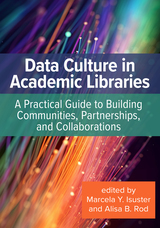
In five parts, Data Culture in Academic Libraries: A Practical Guide to Building Communities, Partnerships, and Collaborations can help you foster an institutional culture that favors the curation, creation, and wider use of datasets.
- Data at all Levels
- Data Services and Instruction
- Data Outreach
- Data Communities
- Data Partnerships
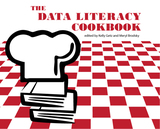
The Data Literacy Cookbook includes a variety of approaches to and lesson plans for teaching data literacy, from simple activities to self-paced learning modules to for-credit and discipline-specific courses. Sixty-five recipes are organized into nine sections based on learning outcomes:
- Interpreting Polls and Surveys
- Finding and Evaluating Data
- Data Manipulation and Transformation
- Data Visualization
- Data Management and Sharing
- Geospatial Data
- Data in the Disciplines
- Data Literacy Outreach and Engagement
- Data Literacy Programs and Curricula
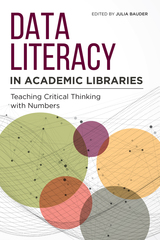
We live in a data-driven world, much of it processed and served up by increasingly complex algorithms, and evaluating its quality requires its own skillset. As a component of information literacy, it's crucial that students learn how to think critically about statistics, data, and related visualizations. Here, Bauder and her fellow contributors show how librarians are helping students to access, interpret, critically assess, manage, handle, and ethically use data. Offering readers a roadmap for effectively teaching data literacy at the undergraduate level, this volume explores such topics as
- the potential for large-scale library/faculty partnerships to incorporate data literacy instruction across the undergraduate curriculum;
- how the principles of the ACRL Framework for Information Literacy for Higher Education can help to situate data literacy within a broader information literacy context;
- a report on the expectations of classroom faculty concerning their students’ data literacy skills;
- various ways that librarians can partner with faculty;
- case studies of two initiatives spearheaded by Purdue University Libraries and University of Houston Libraries that support faculty as they integrate more work with data into their courses;
- Barnard College’s Empirical Reasoning Center, which provides workshops and walk-in consultations to more than a thousand students annually;
- how a one-shot session using the PolicyMap data mapping tool can be used to teach students from many different disciplines;
- diving into quantitative data to determine the truth or falsity of potential “fake news” claims; and
- a for-credit, librarian-taught course on information dissemination and the ethical use of information.

Data manipulation and analysis are far easier than you might imagine—in fact, using tools that come standard with your desktop computer, you can learn how to extract, manipulate, and analyze data (and metadata) of any size and complexity. In this handbook, data wizard Banerjee will familiarize you with easily digestible but powerful concepts that will enable you to feel confident working with data. With his expert guidance, you’ll learn how to
- use a single-word command to sort files of any size by any criteria, identify duplicates, and perform numerous other common library tasks;
- understand data formats, delimited text and CSV files, XML, JSON, scripting, and other key components of data;
- undertake more sophisticated tasks such as comparing files, converting data from one format to another, reformatting values, combining data from multiple files, and communicating with APIs (Application Programming Interfaces);
- save time and stress through simple techniques for transforming text, recognizing symbols that perform important tasks, a Regular Expression cheat sheet, a glossary, and other tools.
Library technologists and those involved in maintaining and analyzing data and metadata will find Banerjee’s resource essential.


The design of information literacy instruction and the building of it are two distinct skillsets and processes; yet all too often everything gets mashed together, creating needless confusion and stress. In this book Turnbow, an instructional designer, and Roth, an instructional technologist, suggest a better way to organize the work. They shed light on the people, processes, and resources required to create a sustainable portfolio of online instruction. With the goal of fostering conversations in your library about the most streamlined and effective ways to get the work done, they provide guidance on such topics as
- design and development processes, complete with “I.D. in Action” examples and sample design documents;
- thumbnail descriptions of ADDIE, SAM, and design thinking methods;
- creating learning objects;
- types of software tools and how to evaluate them;
- crafting the best documentation of your work for efficient maintenance and reuse;
- adapting assessment to your learning outcomes and purpose;
- when to design for performance support, an underutilized method in libraries; and
- starting points for those interested in developing instructional design and development skills.
Demystifying the instructional design and development process used to create online learning objects, this book will help you understand how instructional design principles and approaches can benefit your learners.
- a history of archives, including the roles of historical societies and local history collections in libraries;
- new sections on community archives, diversity, and inclusion;
- conducting a survey and starting an archival program;
- selection, appraisal, acquisition, accessioning, and deaccessioning;
- important points of copyright, privacy, and ethics;
- arrangement of archival collections, with a discussion of new theories;
- description, including DACS, EAD, and tools such as ArchivesSpace;
- access, reference, and outreach, with a look at how recent innovations in finding aids can help researchers;
- preservation, including guidance on how to handle rare books, maps, architectural records, and artifacts;
- digital records, addressing new and popular methods of storage and preservation of email, social media, image files, webpages, Word documents, spreadsheets, databases, and media files;
- disaster planning, security, and theft prevention;
- metrics, assessment, establishing employee procedures and policies, working with interns and volunteers, and other managerial duties;
- public relations and marketing, from social media and the Web to advocacy; and
- professional guidelines and codes, such as the newly developed SAA Statement of Core Values of Archivists.
- come to understand what is meant by disability and why libraries have obligations to support disabled users;
- learn about a wide range of software and hardware for creating inclusive spaces and services regardless of your budget limitations or staffing levels;
- get comfortable with the overarching principles of online accessibility and how they specifically apply to library websites, digital media and files, digital communications, and emerging technologies such as augmented reality, virtual reality, and artificial intelligence (AI);
- discover how libraries can verify the accessibility of the tools they develop or subscribe to, including best practices for working with vendors to optimize the accessibility of their library products;
- be invited to reflect upon the future of digital accessibility, particularly concerning education and hiring to ensure that accessibility remains central to the work done at all libraries.
Digital projects can empower communities through collaboration and create new primary sources, collapse barriers, and spark new dialogue. Digital Community Engagement “lifts the hood” and presents nine examples of digital collaborations from constructing a public response to police violence, to creating digital stories of homelessness, to young activists united around local people in the Deep South to build a grassroots movement for social change.
Wingo, Heppler and Schadewald bring together cutting-edge campus-community partnerships with a focus on digital projects. The case studies, authored by academics and their community partners, explore models for digital community engagement that leverage new media through reciprocal partnerships. The contributions to this volume stand at the crossroads of digital humanities, public history, and community
Provocative yet sober, Digital Critical Editions examines how transitioning from print to a digital milieu deeply affects how scholars deal with the work of editing critical texts. On one hand, forces like changing technology and evolving reader expectations lead to the development of specific editorial products, while on the other hand, they threaten traditional forms of knowledge and methods of textual scholarship.
Using the experiences of philologists, text critics, text encoders, scientific editors, and media analysts, Digital Critical Editions ranges from philology in ancient Alexandria to the vision of user-supported online critical editing, from peer-directed texts distributed to a few to community-edited products shaped by the many. The authors discuss the production and accessibility of documents, the emergence of tools used in scholarly work, new editing regimes, and how the readers' expectations evolve as they navigate digital texts. The goal: exploring questions such as, What kind of text is produced? Why is it produced in this particular way?
Digital Critical Editions provides digital editors, researchers, readers, and technological actors with insights for addressing disruptions that arise from the clash of traditional and digital cultures, while also offering a practical roadmap for processing traditional texts and collections with today's state-of-the-art editing and research techniques thus addressing readers' new emerging reading habits.
As an in-depth explanation of the entire digital curation lifecycle, from creation to appraisal to preservation to organization/access to transformation, the first edition of this text set a benchmark for both thoroughness and clarity. Boasting the expert guidance of international authorities Oliver and Harvey, this revamped and expanded edition widens the scope to address continuing developments in the strategies, technological approaches, and activities that are part of this rapidly changing field. In addition to current practitioners, those pursuing a career as librarian, archivist, or records manager will find this definitive survey invaluable. Filled with up-to-date best practices, it covers such important topics as
- the scope and incentives of digital curation, detailing Digital Curation Centre's (DCC) lifecycle model as well as the Data Curation Continuum;
- key requirements for digital curation, from description and representation to planning and collaboration;
- the value and utility of metadata;
- considering the needs of producers and consumers when creating an appraisal and selection policy for digital objects;
- the paradigm shift by institutions towards cloud computing and its impact on costs, storage, and other key aspects of digital curation;
- the quality and security of data;
- new and emerging data curation resources, including innovative digital repository software and digital forensics tools;
- mechanisms for sharing and reusing data, with expanded sections on open access, open data, and open standards initiatives; and
- processes to ensure that data are preserved and remain usable over time.
Useful as both a teaching text and day-to-day working guide, this book outlines the essential concepts and techniques that are crucial to preserving the longevity of digital resources.
This revised and expanded edition of 2015’s Digital Humanities in the Library includes key reprints from the first edition and new chapters that explore digital humanities and diversity, inclusion, and equity; issues of labor, precarity, and infrastructure; scholarly communication and taxonomies of credit; long-term sustainability; and library digital humanities in the age of institutional austerity.
Divided into sections on theory and practice, chapter authors work in a variety of institution types in many different roles and offer ideas and strategies for cross-institutional collaborations and new approaches to the digital humanities work being done. As Paige Morgan says in the foreword, “Any digital humanist who can enthuse about data can also tell you that computers alone cannot do the work—you need the thoughtfulness of a human expert to find the way forward. This collection can help us do that.”

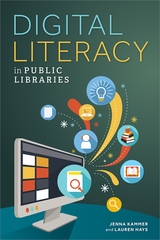
- delve into the concept of digital literacy, the ways in which it empowers individuals in digital systems of information, and how it fits in with other kinds of literacy;
- find ideas for effective digital literacy technical support, programming, services, spaces, collection development, outreach, and more;
- learn how to measure the impact of digital literacy initiatives, identify gaps within the community where the library can make an impact, and overcome challenges;
- discover guidance on building partnerships, both internal and external, and finding additional sources of funding to expand digital literacy opportunities within the scope of what is already available;
- receive practical advice from the "Ask the Expert" sidebars throughout the book, where practitioners share their knowledge and experience; and
- get adaptable tools such as sample language, an expenditure budget, an individual needs assessment, a digital literacy readiness checklist, survey instruments, and a lesson plan template that can be used for digital literacy programming.
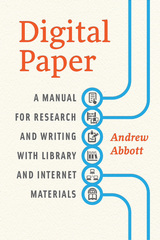
Abbott tells what every senior researcher knows: that research is not a mechanical, linear process, but a thoughtful and adventurous journey through a nonlinear world. He breaks library research down into seven basic and simultaneous tasks: design, search, scanning/browsing, reading, analyzing, filing, and writing. He moves the reader through the phases of research, from confusion to organization, from vague idea to polished result. He teaches how to evaluate data and prior research; how to follow a trail to elusive treasures; how to organize a project; when to start over; when to ask for help. He shows how an understanding of scholarly values, a commitment to hard work, and the flexibility to change direction combine to enable the researcher to turn a daunting mass of found material into an effective paper or thesis.
More than a mere how-to manual, Abbott’s guidebook helps teach good habits for acquiring knowledge, the foundation of knowledge worth knowing. Those looking for ten easy steps to a perfect paper may want to look elsewhere. But serious scholars, who want their work to stand the test of time, will appreciate Abbott’s unique, forthright approach and relish every page of Digital Paper.
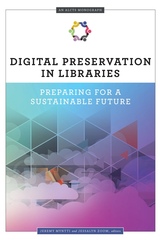
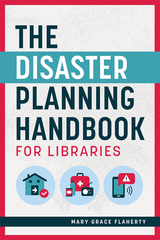
Your library is a vital information hub and resource provider every single day, and that’s doubly true when calamity strikes. In fact, your library’s role as an “essential community function” during disasters is now encoded in U.S. law. Engaging as a partner in planning and preparedness will build much-needed community support should disaster strike, and even a basic plan will also save you time and stress later on. No matter where your library is in the disaster planning cycle, this handbook will make the process clearer and less daunting. You’ll get tools, activities, easy-to-adapt templates, and hands-on guidance on such topics as
- the six phases of disaster response;
- 15 first-hand accounts of library disaster planning or responses, helping you identify the library services most needed during a disaster;
- three essential factors that will shape the form of your disaster plan;
- preparing for hurricanes, tornadoes, fires, floods, and earthquakes;
- ideas for connecting with your community’s emergency response teams;
- federal government planning resources;
- pointers on working with state and local governments;
- a sample Memorandum of Understanding to outline mutual support for a speedier recovery;
- recommended courses and training, many of which are free;
- targeted advice for archives and special collections;
- sample building inspection checklists; and
- recommended games to help children and families prepare.
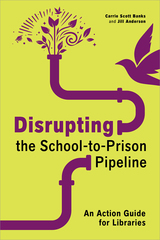
The school-to-prison pipeline impacts communities across the country; often, this system and families impacted by it remain invisible. But librarians, educators, and others who work with youth know first-hand that libraries and reading can be life-altering for youth impacted by incarceration. Written by public librarians who have supported youth before, during, and after incarceration, this book draws from their own experiences while showcasing insights from other library workers, researchers, educators, people who work in the juvenile justice fields, and mental health professionals. Designed to empower libraries and their staff to provide children and teens with information, visibility, knowledge and skills, recreation, and role models, it shares practical strategies for helping youth avoid the school-to-prison pipeline or contend with it. Readers will discover
- a concise explanation of the school-to-prison pipeline, including statistics on how and why it disproportionately impacts LGBTQ+, BIPOC, and disabled youth;
- concrete, proven strategies for disrupting youth incarceration pathways by giving young people the tools and support they need to avoid incarceration;
- steps for bolstering youth engagement during out of school time;
- guidance on how to align disciplinary approaches with trauma-informed practices when dealing with rowdy youth and other disruptive behavior;
- an overview of what libraries are doing to provide programs and services inside a youth facility, including literacy support, high school equivalency/GED programs, and televisiting;
- strategies for combatting the isolation of children of incarcerated parents by creating inclusive and welcoming library environments;
- information about the complex and difficult process of reentry for incarcerated youth, with adaptable ideas and lessons from the work being done in libraries for reentering adults; and
- an inspiring vision, extrapolating from work in adjacent fields, of what libraries can do to overcome barriers to bringing more youth into the library.
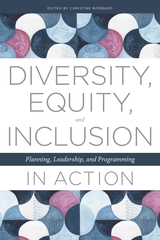
All too often, in a hurried attempt to “catch up,” diversity training can create division among staff or place undue burdens on a handful of employees. Instead, academic libraries need approaches to diversity, equity, and inclusion (DEI) that position these priorities as ongoing institutional and professional goals. This book’s model programs will help academic libraries do exactly that, sharing a variety of initiatives that possess clear goals, demonstrable outcomes, and reproducible strategies. Librarians, administrators, and directors will all benefit from the programs detailed inside, which include such topics as
- a university library’s community of practice for interactions and learning around DEI;
- cultural competency training to create more welcoming instruction spaces;
- student workshops on literature searches that mitigate bias;
- overcoming the historic tendency to marginalize LGBTQ+ representation in archives;
- a curriculum and design workshop that moved from discussing social values to embedding them in actions;
- the founding of a library-led LGBT club for students at a rural community college;
- a liberal arts college’s retention-boosting program for first-generation students;
- tailoring a collection and library services to the unique needs of student veterans; and
- a framework for moving from diversity to equity and inclusion, toward a goal of social justice.


READERS
Browse our collection.
PUBLISHERS
See BiblioVault's publisher services.
STUDENT SERVICES
Files for college accessibility offices.
RECENTLY PUBLISHED



UChicago Accessibility Resources
home | accessibility | search | about | contact us
BiblioVault ® 2001 - 2026
The University of Chicago Press