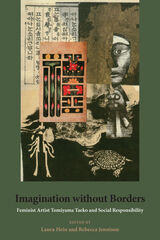
front cover of Imagination without Borders
Imagination without Borders
Feminist Artist Tomiyama Taeko and Social Responsibility
Laura Hein and Rebecca Jennison, Editors
University of Michigan Press, 2010
Tomiyama Taeko, a Japanese visual artist born in 1921, is changing the way World War II is remembered in Japan, Asia, and the world. Her work deals with complicated moral and emotional issues of empire and war responsibility that cannot be summed up in simple slogans, which makes it compelling for more than just its considerable beauty.
Japanese today are still grappling with the effects of World War II, and, largely because of the inconsistent and ambivalent actions of the government, they are widely seen as resistant to accepting responsibility for their nation’s violent actions against others during the decades of colonialism and war. Yet some individuals, such as Tomiyama, have produced nuanced and reflective commentaries on those experiences, and on the difficulty of disentangling herself from the priorities of the nation despite her lifelong political dissent. Tomiyama’s sophisticated visual commentary on Japan’s history—and on the global history in which Asia is embedded—provides a compelling guide through the difficult terrain of modern historical remembrance, in a distinctively Japanese voice.
[more]

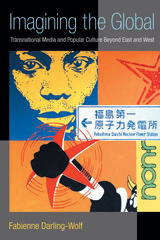
front cover of Imagining the Global
Imagining the Global
Transnational Media and Popular Culture Beyond East and West
Fabienne Darling-Wolf
University of Michigan Press, 2014
Based on a series of case studies of globally distributed media and their reception in different parts of the world, Imagining the Global reflects on what contemporary global culture can teach us about transnational cultural dynamics in the 21st century. A focused multisited cultural analysis that reflects on the symbiotic relationship between the local, the national, and the global, it also explores how individuals’ consumption of global media shapes their imagination of both faraway places and their own local lives. Chosen for their continuing influence, historical relationships, and different geopolitical positions, the case sites of France, Japan, and the United States provide opportunities to move beyond common dichotomies between East and West, or United States and “the rest.” From a theoretical point of view, Imagining the Global endeavors to answer the question of how one locale can help us understand another locale. Drawing from a wealth of primary sources—several years of fieldwork; extensive participant observation; more than 80 formal interviews with some 160 media consumers (and occasionally producers) in France, Japan, and the United States; and analyses of media in different languages—author Fabienne Darling-Wolf considers how global culture intersects with other significant identity factors, including gender, race, class, and geography. Imagining the Global investigates who gets to participate in and who gets excluded from global media representation, as well as how and why the distinction matters.
[more]

front cover of Immortal Wishes
Immortal Wishes
Labor and Transcendence on a Japanese Sacred Mountain
Ellen Schattschneider
Duke University Press, 2003
Immortal Wishes is a powerful ethnographic rendering of religious experiences of landscape, healing, and self-fashioning on a northern Japanese sacred mountain. Working at the intersection of anthropology, religion, and Japan studies, Ellen Schattschneider focuses on Akakura Mountain Shrine, a popular Shinto institution founded by a rural woman in the 1920s. For decades, local spirit mediums and worshipers, predominantly women, have undertaken extended periods of shugyo (ascetic discipline) within the shrine and on the mountain's slopes. Schattschneider argues that their elaborate, transforming repertoire of ritual practice and ascetic discipline has been generated by complex social and historical tensions largely emerging out of the uneasy status of the surrounding area within the modern nation's industrial and postindustrial economies.

Schattschneider shows how, through dedicated work at the shrine including demanding ascents up the sacred mountain, the worshipers come to associate the rugged mountain landscape with their personal biographies, the life histories of certain exemplary predecessors and ancestors, and the collective biography of the extended congregation. She contends that this body of ritual practice presents worshipers with fields of imaginative possibilities through which they may dramatize or reflect upon the nature of their relations with loved ones, ancestors, and divinities. In some cases, worshipers significantly redress traumas in their own lives or in those of their families. In other instances, these ritualized processes lead to deepening crises of the self, the accelerated fragmentation of local households, and apprehension of possession by demons or ancestral forces. Immortal Wishes reveals how these varied practices and outcomes have over time been incorporated into the changing organization of ritual, space, and time on the mountainscape.

For more information about this book and to read an excerpt, please click here.

[more]

front cover of Imperial Screen
Imperial Screen
Japanese Film Culture In The Fifteen Years War,
Peter B. High
University of Wisconsin Press, 2003
From the late 1920s through World War II, film became a crucial tool in the state of Japan. Detailing the way Japanese directors, scriptwriters, company officials, and bureaucrats colluded to produce films that supported the war effort, The Imperial Screen is a highly-readable account of the realities of cultural life in wartime Japan. Widely hailed as "epoch-making" by the Japanese press, it presents the most comprehensive survey yet published of "national policy" films, relating their montage and dramatic structures to the cultural currents, government policies, and propaganda goals of the era. Peter B. High’s treatment of the Japanese film world as a microcosm of the entire sphere of Japanese wartime culture demonstrates what happens when conscientious artists and intellectuals become enmeshed in a totalitarian regime.
[more]

logo for University of Minnesota Press
In Search of Identity
The Japanese Overseas Scholar in America and Japan
John Bennett
University of Minnesota Press, 1958
In Search of Identity was first published in 1958. Minnesota Archive Editions uses digital technology to make long-unavailable books once again accessible, and are published unaltered from the original University of Minnesota Press editions.Educated Japanese have been faced with a basic ideological problem emerging out of their country’s modernization program. They have had to declare themselves on the great issues involved in their nation’s planning: West versus Orient, democracy opposed to autocracy, individualism versus collectivism. To the individual this ideological debate became a search for identity, and it is this problem, the search for identity, that forms the background of this book.The authors report upon a cross-disciplinary study of the Amerikaryugakusei – “those who study in America” – in the historical context of the modernization of Japanese society and Japan’s cultural relations with the United States; they describe and portray the experiences of the individual Japanese student on the American campus and back in Japan; and they analyze the adjustment of the Japanese student to different cultural environments.One group studied included Japanese students who were enrolled at two American universities. Another group consisted of Japanese who had returned to their homeland after their American education. The study is concerned, not with education per se, but with social and psychological aspects of the educational experiences.This is the fourth in a series of monographs resulting from a program of research sponsored by the Committee on Cross-Cultural Education of the Social Science Research Council.
[more]

front cover of In the Presence of Gods and Spirits
In the Presence of Gods and Spirits
Hirata Atsutane and His Collaborators
Anne Walthall
University of Michigan Press, 2025
In the Presence of Gods and Spirits brings to life the early nineteenth-century Japanese religious leader and scholar Hirata Atsutane, whose fear of Russian incursion onto Japan’s soil led him to redefine what it means to be Japanese. Atsutane advocated the study of the Way of the Gods, commonly known as Shinto, to explain what happens to the soul after death and to cultivate a  Japanese identity centered on gods, spirits, and the emperor. His teachings would later attract thousands of followers and feed the movements that led to the Meiji Restoration. Drawing on the concept of material religion, Walthall demonstrates how Atsutane and his collaborators sought out knowledge of the unseen world and educated others, while seeking to bring themselves closer to the gods and spirits. This work showcases Atsutane and his community’s legacy, which has had a profound influence on Japanese society, religious belief, and culture far beyond his lifetime.
[more]

front cover of In the Province of the Gods
In the Province of the Gods
Kenny Fries
University of Wisconsin Press, 2021
Kenny Fries embarks on a journey of profound self-discovery as a disabled foreigner in Japan, a society historically hostile to difference. As he visits gardens, experiences Noh and butoh, and meets artists and scholars, he also discovers disabled gods, one-eyed samurai, blind chanting priests, and A-bomb survivors. When he is diagnosed as HIV positive, all his assumptions about Japan, the body, and mortality are shaken, and he must find a way to reenter life on new terms.
[more]

front cover of In the Shadow of Empire
In the Shadow of Empire
Art in Occupied Japan
Alicia Volk
University of Chicago Press, 2025
A pioneering look at an immensely creative period in Japanese art that developed amid the Cold War.
 
Alicia Volk brings to light a significant body of postwar Japanese art, exploring how it accommodated and resisted the workings of the American empire during the early Cold War. Volk’s groundbreaking account presents the points of view of Japanese artists and their audiences under American occupation and amid the ruins of war. Each chapter reveals how artists embraced new roles for art in the public sphere—at times by enacting radical critiques of established institutions, values, and practices—and situates a range of compelling art objects in their intersecting artistic and political worlds.
 
Centering on the diverse and divisive terrain of Japanese art between 1945 and 1952, In the Shadow of Empire creates a fluid map of relationality that brings multiple Cold War spheres into dialogue, stretching beyond US-occupied Japan to art from China, Europe, the Soviet Union, and the United States, and demonstrates the rich potential of this transnational site of artmaking for rethinking the history of Japanese and global postwar art.
 
[more]

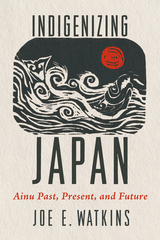
front cover of Indigenizing Japan
Indigenizing Japan
Ainu Past, Present, and Future
Joe E. Watkins
University of Arizona Press, 2025
In Indigenizing Japan, archaeologist Joe E. Watkins provides a comprehensive look at the rich history and cultural resilience of the Ainu, the Indigenous people of Hokkaido, Japan, tracing their journey from ancient times to their contemporary struggles for recognition.

Relaying the deep history of the islands of Japan, Watkins tells the archaeological story from the earliest arrivals some 40,000 years ago to 16,000 years ago when local cultures began utilizing pottery and stone tools. About 2,300 years ago, another group of people immigrated from the Korean peninsula into the Japanese archipelago, bringing wet rice agriculture with them. They intermarried with the people who were there, forming the basis of the contemporary Japanese majority culture. As the Japanese state developed on the central Islands of Honshu, Ryukyu, and Shikoku, the people of Hokkaido continued developing along a different trajectory with minimal interaction with the mainland until colonization in the mid-nineteenth century, when the people known as the Ainu came under Japanese governmental policy.

Watkins’s insightful analysis highlights the Ainu’s enduring spirit and their resurgence as part of the global Indigenous movement. Key events such as the 1997 Nibutani Dam case and the 2007 recognition of the Ainu as Japan’s Indigenous people are explored in depth, showcasing the Ainu’s ongoing fight for cultural preservation and self-determination. By situating the Ainu’s experiences within broader global colonial histories, Indigenizing Japan underscores the shared struggles and resilience of Indigenous communities worldwide.
[more]

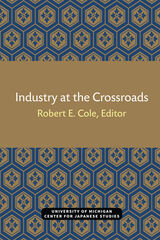
front cover of Industry at the Crossroads
Industry at the Crossroads
Robert E. Cole, Editor
University of Michigan Press, 1982
The mood of the first U of M U.S.-Japan Auto conference in January 1981 could only be described as electric. People wanted to know what our problems were and how we could begin to solve them. Inherent in the latter issue was the questions, what could we learn from the Japanese? One left the conference with a sense that there was a call for action, a mandate to address the problems facing industry.
The mood, about a year later, at the March 1982 U.S.-Japan Auto Conference was far more subdued. While undoubtedly this reflected the stream of statistics confirming the continually depressed state of the industry, another dynamic was possibly operating as well. Whereas the 1981 conference was "electric," a state of mind which flowed from a certain frustration at seemingly overwhelming difficulties and often vague expectations of what we might learn from the Japanese, the 1982 conference was more "workmanlike" in the sense that speakers discussed specifically what progress was being made in addressing problems. This more subdued, pragmatic approach continued throughout wand was reinforced by workshops held the day after the main conference.
Instead of discussing the virtues of the Just-In-Time system in Japan, speakers addressed the practical problems of introducing such a system in the U.S. firms. Instead of railing about the benefits or failings of regulation of the industry, they discussed what we could reasonably expect from regulation. Instead of exhorting the industry to adopt Japanese practices willy-nilly, they focused on some of the limitations of the Japanese model in a range of different areas. Instead of trying to identify some magic key to Japanese success in the automotive industry, they discussed the interrelationships among various factors. At the same, they continued to explore the basic issues transforming the auto industry worldwide. In this connection, they sought to unravel some of the complexities associated with the internalization of the auto industry and trade obligations under the GATT.
[more]

front cover of Infinity Net
Infinity Net
The Autobiography of Yayoi Kusama
Yayoi Kusama
University of Chicago Press, 2011

In 1957, encouraged by Georgia O’Keeffe, artist Yayoi Kusama left Japan for New York City to become a star. By the time she returned to her home country in 1973, she had established herself as a leader of New York’s avant-garde movement, known for creating happenings and public orgies to protest the Vietnam War and for the polka dots that had become a trademark of her work. Her sculptures, videos, paintings, and installations are to this day included in major international exhibitions.

Available for the first time in English, Infinity Net paints a multilayered portrait of this fascinating artist. Taking us from her oppressive childhood in postwar Japan to her present life in the psychiatric hospital where she voluntarily stays—and is still productive—Kusama’s autobiography offers insight into the persona of mental illness that has informed her work. While she vibrantly describes the hallucinatory episodes she experiences, her tale is punctuated by stories of her pluck and drive in making her artistic voice heard. Conveying the breadth and ambition of her own work, Kusama also offers a dazzling snapshot of 1960s and 1970s New York City and her encounters with its artists—she collaborates with Andy Warhol, shares an apartment with Donald Judd, and becomes romantically entangled with Joseph Cornell. Replete with the sense of the sheer necessity within an artist to create, Infinity Net is an energetic and juicy page-turner that offers a glimpse into Kusama’s exhilarating world.
[more]

front cover of Inheritance of Loss
Inheritance of Loss
China, Japan, and the Political Economy of Redemption after Empire
Yukiko Koga
University of Chicago Press, 2016
How do contemporary generations come to terms with losses inflicted by imperialism, colonialism, and war that took place decades ago? How do descendants of perpetrators and victims establish new relations in today’s globalized economy? With Inheritance of Loss, Yukiko Koga approaches these questions through the unique lens of inheritance, focusing on Northeast China, the former site of the Japanese puppet state Manchukuo, where municipal governments now court Japanese as investors and tourists. As China transitions to a market-oriented society, this region is restoring long-neglected colonial-era structures to boost tourism and inviting former colonial industries to create special economic zones, all while inadvertently unearthing chemical weapons abandoned by the Imperial Japanese Army at the end of World War II.
 
Inheritance of Loss chronicles these sites of colonial inheritance––tourist destinations, corporate zones, and mustard gas exposure sites––to illustrate attempts by ordinary Chinese and Japanese to reckon with their shared yet contested pasts. In her explorations of everyday life, Koga directs us to see how the violence and injustice that occurred after the demise of the Japanese Empire compound the losses that later generations must account for, and inevitably inherit.
[more]

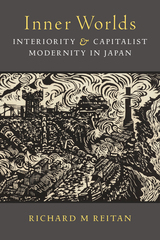
front cover of Inner Worlds
Inner Worlds
Interiority and Capitalist Modernity in Japan
Richard M Reitan
University of Michigan Press, 2026

Inner Worlds examines the emergence and operation of  representations of interiority—consciousness, “folk mind,” “spirit”—in Japan from its industrial revolution to the rise of fascism during the interwar period. These representations functioned to reproduce the capitalist system by containing its excesses. Thus, poverty in the 1880s was ostensibly the result of defects in one’s innate mental character. A degenerate “crowd mind” explained the strikes and riots of the early twentieth century. State subversion during the 1930s supposedly reflected an attenuated “folk spirit.” By locating the roots of capitalism’s excesses not within the socioeconomic order itself but within a defective interiority, ideologies of interiority operated to contain disruptions to Japan’s socioeconomic order, conceal its defects, and sustain the capitalist system. Inner Worlds reveals how interiority was constituted in ways consistent with both the demands of the emerging capitalist order of the late nineteenth century and the conditions that coalesced to form a fascist conjecture in the 1930s.

[more]

front cover of Insurgent Identities
Insurgent Identities
Class, Community, and Protest in Paris from 1848 to the Commune
Roger V. Gould
University of Chicago Press, 1995
In this important contribution both to the study of social protest and to French social history, Roger Gould breaks with previous accounts that portray the Paris Commune of 1871 as a continuation of the class struggles of the 1848 Revolution. Focusing on the collective identities framing conflict during these two upheavals and in the intervening period, Gould reveals that while class played a pivotal role in 1848, it was neighborhood solidarity that was the decisive organizing force in 1871.

The difference was due to Baron Haussmann's massive urban renovation projects between 1852 and 1868, which dispersed workers from Paris's center to newly annexed districts on the outskirts of the city. In these areas, residence rather than occupation structured social relations. Drawing on evidence from trail documents, marriage records, reports of police spies, and the popular press, Gould demonstrates that this fundamental rearrangement in the patterns of social life made possible a neighborhood insurgent movement; whereas the insurgents of 1848 fought and died in defense of their status as workers, those in 1871 did so as members of a besieged urban community.

A valuable resource for historians and scholars of social movements, this work shows that collective identities vary with political circumstances but are nevertheless constrained by social networks. Gould extends this argument to make sense of other protest movements and to offer predictions about the dimensions of future social conflict.

[more]

front cover of Intermediate Technical Japanese, Volume 1
Intermediate Technical Japanese, Volume 1
Readings and Grammatical Patterns
James L. Davis
University of Wisconsin Press, 2002

     Learn how to read and translate technical manuals, research publications, and reference works. This two-volume set is designed to help the intermediate-level learner of Japanese build a technical vocabulary, reinforce understanding of frequently used grammatical patterns, improve reading comprehension, and practice translating technical passages. The glossary in volume 2 clarifies words and phrases that often puzzle beginning readers.
     The sample readings on technical topics are drawn from a broad range of specialties, from mathematics and computer science to electronics and polymer science. The initial grammar lesson and the first nine field-specific lessons constitute the common core to be used by all instructors or students. Topics of interest from the remaining thirty-one field-specific lessons may be selected to produce a customized course of study. Intermediate Technical Japanese is designed to fulfill a typical two-semester sequence.

Volume 1 contains:
o  information about 600 key kanji
o  explanations of 100 important grammatical patterns
o  more than 700 scientific or technical essays
o  an index of the grammatical patterns.

Volume 2 contains:
o  a complete glossary

[more]

front cover of Intermediate Technical Japanese, Volume 2
Intermediate Technical Japanese, Volume 2
Glossary
James L. Davis
University of Wisconsin Press, 2002

     Learn how to read and translate technical manuals, research publications, and reference works. This two-volume set is designed to help the intermediate-level learner of Japanese build a technical vocabulary, reinforce understanding of frequently used grammatical patterns, improve reading comprehension, and practice translating technical passages. The glossary in volume 2 clarifies words and phrases that often puzzle beginning readers.
     The sample readings on technical topics are drawn from a broad range of specialties, from mathematics and computer science to electronics and polymer science. The initial grammar lesson and the first nine field-specific lessons constitute the common core to be used by all instructors or students. Topics of interest from the remaining thirty-one field-specific lessons may be selected to produce a customized course of study. Intermediate Technical Japanese is designed to fulfill a typical two-semester sequence.

Volume 1 contains:
o  information about 600 key kanji
o  explanations of 100 important grammatical patterns
o  more than 700 scientific or technical essays
o  an index of the grammatical patterns.

Volume 2 contains:
o  a complete glossary
[more]

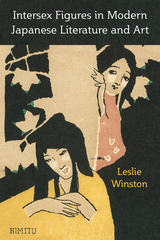
front cover of Intersex Figures in Modern Japanese Literature and Art
Intersex Figures in Modern Japanese Literature and Art
Leslie Winston
University of Michigan Press, 2025

Intersex Figures in Modern Japanese Literature and Art explores the history of intersex or futanari figures in modern Japanese literature and culture to examine the provocative discourses that defied a sexual regime as the modern nation-state of Japan advanced its national and imperial designs. As sexologists and medical practitioners continued reinforcing categories of “male” and “female,” “normal” and “pathological,” intersex literary figures garnered attention because the perceived subject was expected to be male or female—any variation was unintelligible. Many of the same century-old tropes and societal attitudes of needing to “cure” intersex persist. At the same time the 1991 novel Ringu by Suzuki Kōji testifies to a denial of futanari subjectivity, while the 1998 Japanese horror film (Ringu) and its 2002 American remake (The Ring) erase intersex all together.

Winston interrogates how the trope of the futanari is deployed for pragmatic or aesthetic purposes, thereby complicating the trajectory of the dominant sexological ideology of the time. Winston reads the figurative futanari in the works of Shimizu Shikin, Tanizaki Jun’ichirō, and Takabatake Kashō, and reveals how the artists’ different approaches to the futanari served their agendas and expressed views that challenged the dominant discourse on intersex.

[more]

front cover of Intimate Disconnections
Intimate Disconnections
Divorce and the Romance of Independence in Contemporary Japan
Allison Alexy
University of Chicago Press, 2020
In many ways, divorce is a quintessentially personal decision—the choice to leave a marriage that causes harm or feels unfulfilling to the two people involved. But anyone who has gone through a divorce knows the additional public dimensions of breaking up, from intense shame and societal criticism to friends’ and relatives’ unsolicited advice. In Intimate Disconnections, Allison Alexy tells the fascinating story of the changing norms surrounding divorce in Japan in the early 2000s, when sudden demographic and social changes made it a newly visible and viable option. Not only will one of three Japanese marriages today end in divorce, but divorces are suddenly much more likely to be initiated by women who cite new standards for intimacy as their motivation. As people across Japan now consider divorcing their spouses, or work to avoid separation, they face complicated questions about the risks and possibilities marriage brings: How can couples be intimate without becoming suffocatingly close? How should they build loving relationships when older models are no longer feasible? What do you do, both legally and socially, when you just can’t take it anymore?
 
Relating the intensely personal stories from people experiencing different stages of divorce, Alexy provides a rich ethnography of Japan while also speaking more broadly to contemporary visions of love and marriage during an era in which neoliberal values are prompting wide-ranging transformations in homes across the globe.

[more]

front cover of Intimate Distance
Intimate Distance
Andean Music in Japan
Michelle Bigenho
Duke University Press, 2012
What does it mean to play "someone else’s music"? Intimate Distance delves into this question through a focus on Bolivian musicians who tour Japan playing Andean music and Japanese audiences, who often go beyond fandom to take up these musical forms as hobbyists and even as professional musicians. Michelle Bigenho conducted part of her ethnographic research while performing with Bolivian musicians as they toured Japan. Drawing on interviews with Bolivian musicians as well as Japanese fans and performers of these traditions, Bigenho explores how transcultural intimacy is produced at the site of Andean music and its performances.

Bolivians and Japanese involved in these musical practices often express narratives of intimacy and racial belonging that reference shared but unspecified indigenous ancestors. Along with revealing the story of Bolivian music's route to Japan and interpreting the transnational staging of indigenous worlds, Bigenho examines these stories of closeness, thereby unsettling the East-West binary that often structures many discussions of cultural difference and exotic fantasy.
[more]

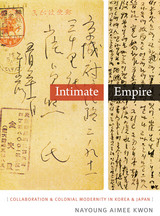
front cover of Intimate Empire
Intimate Empire
Collaboration and Colonial Modernity in Korea and Japan
Nayoung Aimee Kwon
Duke University Press, 2015
In Intimate Empire Nayoung Aimee Kwon examines intimate cultural encounters between Korea and Japan during the colonial era and their postcolonial disavowal. After the Japanese empire’s collapse in 1945, new nation-centered histories in Korea and Japan actively erased these once ubiquitous cultural interactions that neither side wanted to remember.  Kwon reconsiders these imperial encounters and their contested legacies through the rise and fall of Japanese-language literature and other cultural exchanges between Korean and Japanese writers and artists in the Japanese empire. The contrast between the prominence of these and other forums of colonial-era cultural collaboration between the colonizers and the colonized, and their denial in divided national narrations during the postcolonial aftermath, offers insights into the paradoxical nature of colonial collaboration, which Kwon characterizes as embodying desire and intimacy with violence and coercion. Through the case study of the formation and repression of imperial subjects between Korea and Japan, Kwon considers the imbrications of colonialism and modernity and the entwined legacies of colonial and Cold War histories in the Asia-Pacific more broadly.
 
[more]

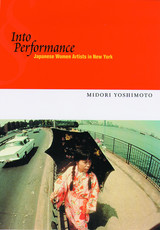
front cover of Into Performance
Into Performance
Japanese Women Artists in New York
Yoshimoto, Midori
Rutgers University Press, 2005

The 1960s was a time of incredible freedom and exploration in the art world, particularly in New York City, which witnessed the explosion of New Music, Happenings, Fluxus, New Dance, pop art, and minimalist art. Also notable during this period, although often overlooked, is the inordinate amount of revolutionary art that was created by women.

Into Performance fills a critical gap in both American and Japanese art history as it brings to light the historical significance of five women artists-Yoko Ono, Yayoi Kusama, Takako Saito, Mieko Shiomi, and Shigeko Kubota. Unusually courageous and self-determined, they were among the first Japanese women to leave their country-and its male-dominated, conservative art world-to explore the artistic possibilities in New York. They not only benefited from the New York art scene, however, they played a major role in the development of international performance and intermedia art by bridging avant garde movements in Tokyo and New York.

This book traces the pioneering work of these five women artists and the socio-cultural issues that shaped their careers. Into Performance also explores the transformation of these artists' lifestyle from traditionally confined Japanese women to internationally active artists. Yoshimoto demonstrates how their work paved the way for younger Japanese women artists who continue to seek opportunities in the West today.

[more]

front cover of The Invention of Religion in Japan
The Invention of Religion in Japan
Jason Ananda Josephson Storm
University of Chicago Press, 2012
Throughout its long history, Japan had no concept of what we call “religion.” There was no corresponding Japanese word, nor anything close to its meaning. But when American warships appeared off the coast of Japan in 1853 and forced the Japanese government to sign treaties demanding, among other things, freedom of religion, the country had to contend with this Western idea. In this book, Jason Ananda Josephson reveals how Japanese officials invented religion in Japan and traces the sweeping intellectual, legal, and cultural changes that followed.
 
More than a tale of oppression or hegemony, Josephson’s account demonstrates that the process of articulating religion offered the Japanese state a valuable opportunity. In addition to carving out space for belief in Christianity and certain forms of Buddhism, Japanese officials excluded Shinto from the category. Instead, they enshrined it as a national ideology while relegating the popular practices of indigenous shamans and female mediums to the category of “superstitions”—and thus beyond the sphere of tolerance. Josephson argues that the invention of religion in Japan was a politically charged, boundary-drawing exercise that not only extensively reclassified the inherited materials of Buddhism, Confucianism, and Shinto to lasting effect, but also reshaped, in subtle but significant ways, our own formulation of the concept of religion today. This ambitious and wide-ranging book contributes an important perspective to broader debates on the nature of religion, the secular, science, and superstition.
[more]

front cover of Invisibility by Design
Invisibility by Design
Women and Labor in Japan's Digital Economy
Gabriella Lukács
Duke University Press, 2020
In the wake of labor market deregulation during the 2000s, online content sharing and social networking platforms were promoted in Japan as new sites of work that were accessible to anyone. Enticed by the chance to build personally fulfilling careers, many young women entered Japan's digital economy by performing unpaid labor as photographers, net idols, bloggers, online traders, and cell phone novelists. While some women leveraged digital technology to create successful careers, most did not. In Invisibility by Design Gabriella Lukács traces how these women's unpaid labor became the engine of Japan's digital economy. Drawing on interviews with young women who strove to sculpt careers in the digital economy, Lukács shows how platform owners tapped unpaid labor to create innovative profit-generating practices without employing workers, thereby rendering women's labor invisible. By drawing out the ways in which labor precarity generates a demand for feminized affective labor, Lukács underscores the fallacy of the digital economy as a more democratic, egalitarian, and inclusive mode of production.
[more]

front cover of Issues and Options for U.S.-Japan Trade Policies
Issues and Options for U.S.-Japan Trade Policies
Robert M. Stern, Editor
University of Michigan Press, 2002
Because of the close links between the United States and Japan in trade, foreign direct investment, financial flows, exchange rates, international prices, and government policies, it is important to develop a better understanding of these links and how they may be turned to the advantage of all involved by improvements in the international policy environment. This book deals with the potential for such improvements as part of formal government-to-government negotiations in the multilateral context in the World Trade Organization (WTO), regionally in the Asia-Pacific Economic Cooperation (APEC) forum, and bilaterally with the administration of national trade laws and the negotiation of free trade agreements.
The chapters represent a spectrum of approaches, including theoretical analysis, quantitative measurement, and evaluations of policies and institutions from economic and legal perspectives. The multi-lateral issues cover the analysis of the economic effects of a new WTO negotiating round and the range of issues that are to be addressed there, including reform of Japan's agricultural policies, services liberalization, antidumping, intellectual property rights, and trade and the environment. The regional issues include theoretical and simulation analysis of the benefits of preferential trading arrangements and the policy of open regionalism that is being sought by APEC members. U.S.-Japan bilateral relations are studied by analyzing the major actions and positions taken by the two nations in the context of their national trade laws and policies, how trade policies are implemented, the effects of bilateral trade agreements on the United States and Japan, and the interplay of legal decisions reached in WTO actions with bilateral and unilateral measures undertaken by the two nations.
The book is designed for a broad audience consisting of academic economists, lawyers, policymakers, and students interested in U.S.-Japan international economic relations.
Robert M. Stern is Professor Emeritus of Economics and Public Policy, University of Michigan.
[more]

front cover of The Iwakura Embassy, 1871-1873, Volume I
The Iwakura Embassy, 1871-1873, Volume I
The United States of America
Kunitake Kume
MHM Limited, 2002
The newly established Meiji government sent a large delegation on a tour of Western countries to report on how Japan might modernize its political, economic, and social infrastructure. This embassy of some fifty top officials was headed by Iwakura Tomomi and included such luminaries as Ito Hirobumi and Kido Takayoshi. These emissaries journeyed to the United States and eleven European countries, making thorough investigations into each country's politics, military affairs, trade and industry, education, and culture. Their reports, which helped Japan emerge as a modern industrial nation, constitute an indispensable documentary resource. Volume I covers the departure of the Embassy from Yokohama, the Pacific crossing, the arrival in San Francisco, the wintry rail journey across the United States, the unexpectedly long stay in Washington, D.C., and the departure from Boston.
[more]

front cover of The Iwakura Embassy, 1871-1873, Volume II
The Iwakura Embassy, 1871-1873, Volume II
Britain
Kunitake Kume
MHM Limited, 2002
The newly established Meiji government sent a large delegation on a tour of Western countries to report on how Japan might modernize its political, economic, and social infrastructure. This embassy of some fifty top officials was headed by Iwakura Tomomi and included such luminaries as Ito Hirobumi and Kido Takayoshi. These emissaries journeyed to the United States and eleven European countries, making thorough investigations into each country's politics, military affairs, trade and industry, education, and culture. Their reports, which helped Japan emerge as a modern industrial nation, constitute an indispensable documentary resource. Volume II covers the period of seventeen weeks from August 16th, 1872, when the ambassadors sighted the Irish coast after a ten-day crossing from Boston, to December 15th, the day before they left Britain for France.
[more]

front cover of The Iwakura Embassy, 1871-1873, Volume III
The Iwakura Embassy, 1871-1873, Volume III
Continental Europe, 1
Kunitake Kume
MHM Limited, 2002
The newly established Meiji government sent a large delegation on a tour of Western countries to report on how Japan might modernize its political, economic, and social infrastructure. This embassy of some fifty top officials was headed by Iwakura Tomomi and included such luminaries as Ito Hirobumi and Kido Takayoshi. These emissaries journeyed to the United States and eleven European countries, making thorough investigations into each country's politics, military affairs, trade and industry, education, and culture. Their reports, which helped Japan emerge as a modern industrial nation, constitute an indispensable documentary resource. Volume III covers the first three and a half months of the journey across the Continent, recording the party's impressions in France, Belgium, Holland and Prussia.
[more]

front cover of The Iwakura Embassy, 1871-1873, Volume IV
The Iwakura Embassy, 1871-1873, Volume IV
Continental Europe, 2
Kunitake Kume
MHM Limited, 2002
"The newly established Meiji government sent a large delegation on a tour of Western countries to report on how Japan might modernize its political, economic, and social infrastructure. This embassy of some fifty top officials was headed by Iwakura Tomomi and included such luminaries as Ito Hirobumi and Kido Takayoshi. These emissaries journeyed to the United States and eleven European countries, making thorough investigations into each country's politics, military affairs, trade and industry, education, and culture. Their reports, which helped Japan emerge as a modern industrial nation, constitute an indispensable documentary resource. Volume IV covers the journeys made by the various members of the Embassy as they travelled through Russia, Denmark, Sweden, several of the German states, Italy and the Austro-Hungarian empire.
[more]

front cover of The Iwakura Embassy, 1871-1873, Volume V
The Iwakura Embassy, 1871-1873, Volume V
Continental Europe, 3; and the Voyage Home
Kunitake Kume
MHM Limited, 2002
The newly established Meiji government sent a large delegation on a tour of Western countries to report on how Japan might modernize its political, economic, and social infrastructure. This embassy of some fifty top officials was headed by Iwakura Tomomi and included such luminaries as Ito Hirobumi and Kido Takayoshi. These emissaries journeyed to the United States and eleven European countries, making thorough investigations into each country's politics, military affairs, trade and industry, education, and culture. Their reports, which helped Japan emerge as a modern industrial nation, constitute an indispensable documentary resource. Volume V covers the ambassadors' visit to the Universal Exposition in Vienna, their travels in Switzerland, the few days they spent in Lyons and Marseilles, and their journey home, during which they travelled through the Mediterranean, the Suez Canal, the Arabian Sea, the Gulf of Bengal and the China Sea, calling at Aden, Galle (in Ceylon), Singapore (where a cholera epidemic prevented their landing), Saigon, Hong Kong and Shanghai.
[more]


Send via email Share on Facebook Share on Twitter