
 A SCHOLARLY BOOK REPOSITORY
In this collection of essays, leading New Testament scholars reassess the reciprocal relationship between Matthew and Second Temple Judaism. Some contributions focus on the relationship of the Matthean Jesus to torah, temple, and synagogue, while others explore theological issues of Jewish and gentile ethnicity and universalism within and behind the text.
Recent research reveals that among both Jews and Christians of the first century many groups believed in Jesus while remaining close to Judaism. Saldarini argues that the author of the Gospel of Matthew belonged to such a group, supporting his claim with an informed reading of Matthew's text and historical context. Matthew emerges as a Jewish teacher competing for the commitment of his people after the catastrophic loss of the Temple in 70 C.E., his polemics aimed not at all Jews but at those who oppose him. Saldarini shows that Matthew's teaching about Jesus fits into first-century Jewish thought, with its tradition of God-sent leaders and heavenly mediators.
In Saldarini's account, Matthew's Christian-Jewish community is a Jewish group, albeit one that deviated from the larger Jewish community. Contributing to both New Testament and Judaic studies, this book advances our understanding of how religious groups are formed.
Ruth Christa Mathieson’s unique reading of Matthew’s parable of the royal wedding feast (Matt 22:1–14), which concludes with the king’s demand that one of the guests be bound and cast out into the outer darkness, focuses on the means of the underdressed guest’s expulsion. Using sociorhetorical interpretation, Mathieson draws the parable into conversation with early Jewish narratives of the angel Raphael binding hands and feet (1 Enoch; Tobit) and the protocol for expelling individuals from the community in Matt 18. She asserts that readers are invited to consider if the person who is bound and cast out is a danger to the little ones of the community of faith unless removed and restrained.


Erectile dysfunction treatments like Viagra are popular in Mexico, where stereotypes of men as sex-obsessed "machos" persist. However, most of the men Wentzell interviewed saw erectile difficulty as a chance to demonstrate difference from this stereotype. Rather than using drugs to continue youthful sex lives, many collaborated with wives and physicians to frame erectile difficulty as a prompt to embody age-appropriate, mature masculinities.


Fifty years after the declaration of the state of emergency, Mau Mau still excites argument and controversy, not least in Kenya itself. Mau Mau and Nationhood is a collection of essays providing the most recent thinking on the uprising and its aftermath.
The work of well-established scholars as well as of young researchers with fresh perspectives, Mau Mau and Nationhood achieves a multilayered analysis of a subject of enduring interest. According to Terence Ranger, Emeritus Rhodes Professor, Oxford, “In some ways the historiography of Mau Mau is a supreme example not only of ambiguity and complexity, but also of redemption of a topic once thought incapable of rational analysis.”
John Lonsdale says in his introduction:
“This is the oral evidence of the Kikuyu villagers with whom Greet Kershaw lived as an aid worker during the Mau Mau ‘Emergency’ in the 1950s, and which is now totally irrecoverable in any form save in her own field notes.
Professor Kershaw has uncovered long local histories of social tension which could have been revealed by no other means than patient enquiry, of both her neighbour’s memory and government archives…
Nobody, whether Kikuyu participant, Kenyan or European scholar, has provided such startlingly authoritative ethnographic insights into the values, fears and expectations of Kikuyu society and thus of the motivation of Kikuyu action…
Her data suggests, as other scholars have also accepted, that there never was a single such movement and that none of its members, even those who supposed themselves to be its leaders, ever saw it whole, not because they did not have a political aim, but because that agenda was contested within different political circles over which they had no control and of which they may scarcely have had any knowledge.
And why is this finding important? It is because others, including almost all the movement’s enemies, did see Mau Mau whole in order to try to comprehend it, a first step towards defeating it.”
The book breaks new ground in following the story of the participants of the rural movement during the decade after the defeat of the Mau Mau. New archival sources and interviews provide exciting material on the mechanics of the sociology of decolonization and on the containment of rural radicalism in Kenya. For the first time an account of decolonization in Kenya based on primary sources is offered to the reader.
The Mau Mau was militarily crushed in the mid-fifties, but the struggle for land rights was only contained in the post independence era of Kenya. Kikuyu squatters on European estates who formed the backbone of this movement are the main subject of this book.
Furedi’s account considers how the radicalization of rural protest in the so-called White Highlands led to the Mau Mau explosion and how it was sustained during the subsequent fifteen years.
The book establishes a focus for discussion of these critical events through exploring the relationship between rural resistance and decolonization. The author argues that the main issue facing post-colonial policies in Kenya was to resolve the problems raised by the Mau Mau revolt.
Written from an interdisciplinary perspective, with a special emphasis on historical and political sociology, this book is aimed at students of African politics and political sociologists interested in rural revolution and revolt.
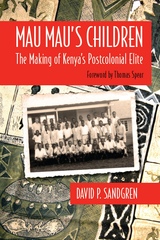
In 1963 David P. Sandgren went to Kenya to teach in a small, rural school for boys, where he remained for the next four years. These were heady times for Kenyans, as the nation gained its independence, approved a new constitution, and held its first elections. In the school where Sandgren taught, the sons of Gikuyu farmers rose to the challenges of this post colonial era and, in time, entered Kenyan society as adults, joining Kenya’s first generation of post colonial elites.
In Mau Mau’s Children, Sandgren has reconnects with these former students. Drawing on more than one hundred interviews, he provides readers with a collective biography of the lives of Kenya’s first postcolonial elite, stretching from their 1940s childhood to the peak of their careers in the 1990s. Through these interviews, Mau Mau’s Children shows the trauma of growing up during the Mau Mau Rebellion, the nature of nationalism in Kenya, the new generational conflicts arising, and the significance of education and Gikuyu ethnicity on his students' path to success.


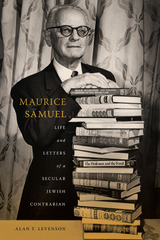
An intellectual biography that reassesses one of the premier Jewish humanists of the mid-twentieth century
In Maurice Samuel: Life and Letters of a Secular Jewish Contrarian, Alan T. Levenson captures the life, works, and milieu of the Romanian-born, English-educated, American belletrist Maurice Samuel. A diaspora intellectual—or a rooted cosmopolitan, as Levenson describes him—Samuel made an indelible mark on many features of contemporary Jewish thought and culture. A generalist in an age of experts, an independent scholar in an age of rabbis and professors, Samuel was one of the most productive and visible members of the group dubbed the “other” New York Jewish intellectuals.
His fame as a public intellectual and popular speaker were well warranted: no mere popularizer, Samuel contributed significantly to four seemingly unrelated but critical areas of modern Jewish thought. Samuel is characterized by some as principally a Zionist, by others as an accomplished translator and many Americans’ first entrée into the world of Yiddish literature, by still others as a polemicist and campaigner against anti-Semitism, and finally as a media-savvy Biblical critic, essayist, and radio personality. But he was all of these things, since Samuel succeeded in an era when it was possible to be a public intellectual without being an expert.
Drawing on Samuel’s vast literary opus, as well as previously unexplored archival material from three continents, this study writes Samuel back into the history of mid-twentieth-century American letters. Levenson argues that Samuel’s varied and substantive contributions demand reconsideration of our assumptions about the means and ends of cultural transmission, and merit him a place as one of twentieth-century American Jewry’s most significant cultural and intellectual voices.

In 1914, an unknown French filmmaker arrived in New York; within four years, Maurice Tourneur (1876–1961) would become one of America’s most acclaimed directors. In this masterful biography, Christine Leteux shows how intimately connected Tourneur’s life was to major events of the twentieth century as well as to the profound transformations in movie making. A master of directing silent films, he quickly managed the transition to sound. His last major work was created for Continental Films, the German-owned firm that controlled the French film industry during the Nazi Occupation. His son, Jacques, followed in his footsteps, also becoming an acclaimed director.
Drawing heavily on previously unpublished archival documents, Leteux reinvigorates film history and demonstrates that we know far less about this era of filmmaking than we often assume. She reveals not only how Tourneur jumped from France to the United States and back again but also how he shifted from one company to another, moving quickly up the ladder to bigger productions and ever larger studios. Tourneur’s drive, insight, technical proficiency, skill with actors, ability to create new forms of storytelling, and fame on both sides of the Atlantic make it all the more surprising that he is not better known today—an oversight that has now been corrected thanks to Leteux’s impressively detailed research and nuanced storytelling.
Maury Maverick was possibly the first liberal United States Congressman from Texas to achieve national and even international stature. A dedicated Democrat, he was ready to attack Franklin D. Roosevelt whenever he felt that Roosevelt was flagging in his enthusiasm for reform. He was honest to the point of rudeness, and he belonged to the "damn the torpedoes" class that pulled ahead regardless of political consequences.
He was at home with the literate—he was a prodigious writer and speaker—but always ready to puncture their pretensions. And he could cuss with sailors, pecan shellers, and any breed of saloon keeper. Put all that together with a short, stocky, bulldog frame, a fierce face and a voice to match, and you have one of the nation's more colorful political figures.

Best Memoir of 2008, San Diego Book Awards
Illinois State Historical Society Certificate of Excellence, 2008

In 1927, at the peak of his career, Zane Grey bought a three-masted schooner, which he sailed to the Galapagos Islands, later journeying to Tahiti, New Zealand, Australia, and Fiji.
As colorful as his characters were, so too was their creator. A consummate explorer, Zane Grey toured the world, was an acclaimed expert on salt- and freshwater fishing, and incorporated the sights and sounds he witnessed into his writings.
As a companion to his biographical work of Grey’s literary life, Zane Grey: Romancing the West, author Stephen J. May now gives as a remarkable look into another aspect of Grey’s existence, the side little known but central to the measure of the man.
Maverick Heart makes use of Grey’s own memoirs and letters to give an enlightening portrait of this larger-than-life American character and a telling insight into one of the key shapers of the cultural heritage of our country.
A collection of biographical essays on fourteen contemporary Nevadans. The subjects of the essays are Maude Frazier; Moe Dalitz; James B. McMillan; William F. Harrah; Hank Greenspun; Alan Bible; Robert Laxalt; Grant Sawyer; Molly Flagg Knudtsen; Paul Laxalt; Steve Wynn; William Raggio; Sue Wagner; and Jerry Tarkanian.
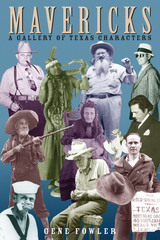
Texas has been home to so many colorful characters, out-of-staters might wonder if any normal people live here. And it's true that the "Texian" desire to act out sometimes overcomes even the most sober citizens—which makes it a real challenge for the genuine eccentrics to distinguish themselves from the rest of us. Fortunately, though, many maverick Texans have risen to the test, and in this book, Gene Fowler introduces us to a gallery of Texas eccentrics from the worlds of oil, ranching, real estate, politics, rodeo, metaphysics, showbiz, art, and folklore.
Mavericks rounds up dozens of Fowler's favorite Texas characters, folks like the Trinity River prophet Commodore Basil Muse Hatfield; the colorful poet-politician Cyclone Davis Jr.; Big Bend tourist attraction Bobcat Carter; and the dynamic chief executive of the East Texas Oil Field Governor Willie. Fowler persuasively argues that many of these characters should be viewed as folk performance artists who created "happenings" long before the modern art world took up that practice in the 1960s. Other featured mavericks run the demographic gamut from inspirational connoisseurs of the region's native quirkiness to creative con artists and carnival oddities. But, artist or poser, all of the eccentrics in Mavericks completely embody the style and spirit that makes Texas so interesting, entertaining, and culturally unique.
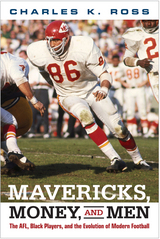
The American Football League, established in 1960, was innovative both in its commitment to finding talented, overlooked players—particularly those who played for historically black colleges and universities—and in the decision by team owners to share television revenues.
In Mavericks, Money and Men, football historian Charles Ross chronicles the AFL’s key events, including Buck Buchanan becoming the first overall draft pick in 1963, and the 1965 boycott led by black players who refused to play in the AFL-All Star game after experiencing blatant racism. He also recounts how the success of the AFL forced a merger with the NFL in 1969, which arguably facilitated the evolution of modern professional football.
Ross shows how the league, originally created as a challenge to the dominance of the NFL, pressured for and ultimately accelerated the racial integration of pro football and also allowed the sport to adapt to how African Americans were themselves changing the game.

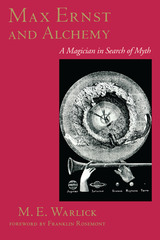
Surrealist artist Max Ernst defined collage as the "alchemy of the visual image." Students of his work have often dismissed this comment as simply a metaphor for the transformative power of using found images in a new context. Taking a wholly different perspective on Ernst and alchemy, however, M. E. Warlick persuasively demonstrates that the artist had a profound and abiding interest in alchemical philosophy and often used alchemical symbolism in works created throughout his career.
A revival of interest in alchemy swept the artistic, psychoanalytic, historical, and scientific circles of the late nineteenth and early twentieth centuries, and Warlick sets Ernst's work squarely within this movement. Looking at both his art (many of the works she discusses are reproduced in the book) and his writings, she reveals how thoroughly alchemical philosophy and symbolism pervade his early Dadaist experiments, his foundational work in surrealism, and his many collages and paintings of women and landscapes, whose images exemplify the alchemical fusing of opposites. This pioneering research adds an essential key to understanding the multilayered complexity of Ernst's works, as it affirms his standing as one of Germany's most significant artists of the twentieth century.
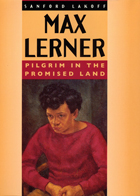
Politically, Lerner went through a series of metamorphoses. During the 1930s, he was an anti-fascist "popular front progressive" writing for the Nation and the New Republic. From the 1940s through the 1970s, he became the country's leading liberal columnist—first with the lively but short-lived PM, then for the New York Post. In the 1980s, however, he was repelled by the New Left and the counterculture and joined the ranks of the neoconservatives, scandalizing some readers but insisting he owed it to them to tell the truth as he saw it.
This riveting biography begins with Lerner's own gripping account of the hardships his family endured in emigrating from Russia and his own boyhood triumphs and frustrations. Sanford Lakoff traces Lerner's American pilgrimage from his education at Yale, where he felt the bitter sting of anti-Semitism, through his years as a radical inspired by Thorstein Veblen, into mellower maturity as a widely read columnist, an inspiring teacher, the author of America as a Civilization, a much-loved father, and—to the end—an unapologetic romantic, who liked to say that he never learned anything worth knowing except from women.

Dive into the thrilling adventures of the daring explorer who pushed the limits of underwater exploration.
From discovering a pocket of air beneath a half-sunken rowboat as a young boy to setting a world diving record hundreds of feet below the surface of Lake Michigan, Max Nohl never stopped chasing the mysteries of our lakes, seas, and oceans. In Max Nohl’s Underwater Adventures, young readers will dive into the remarkable true story of the man who helped to modernize scuba diving and expand our ability to explore the watery depths.
Inventor, engineer, and explorer, Nohl was pushing the limits of human courage beneath the waves long before scuba diving became a recreational pastime. Readers of this biography for ages 8–11 will follow his riveting shipwreck treasure hunts, daring salvage expeditions, close encounters with sharks, and dramatic escapes from the many dangers under the sea.
But Nohl was more than an adventurer and thrill-seeker. Determined to make diving safer, he studied engineering at MIT and invented new equipment and techniques, including self-contained underwater breathing systems and helium-oxygen mixtures that opened the door to deeper exploration. He also helped pioneer advances in underwater camera equipment that allowed Hollywood moviemakers and others to capture watery scenes on film. Looking beyond Nohl’s own life story, this biography includes sidebars that give readers a peek into the history of deep-sea diving, tales of Great Lakes shipwrecks, and exploits of other record-breaking divers.
Filled with peril, discovery, ingenuity, and larger-than-life escapades, Max Nohl’s Underwater Adventures introduces young readers to an innovator whose curiosity and determination helped to unlock one of Earth’s last great frontiers—the mysterious world beneath the sea.

Max Ophuls, who is considered one of the greatest film directors of all time, has long been seen as an “auteur”––the artist in complete control of his work. Lutz Bacher’s examination of his American career gives us a unique perspective on the workings of the Hollywood system and the struggle of a visionary to function within it. He thus establishes clear connections between the production contexts of Ophuls' American films and their idiosyncratic style.
Drawing on documents in many archives and on interviews with more than sixty of Ophuls' contemporaries, Bacher traces the European director's struggle to find a niche in the U.S. film industry. He describes how Ophuls ran the gamut from ghost writing to substitute directing, to a debilitating association with Preston Sturges and Howard Hughes, to making four films––Letter from an Unknown Woman and Caught among them––in thirty months, and then returning to Europe with a runaway production that was to have starred Greta Garbo. Throughout, Bacher demonstrates that Ophuls' bending of conventional Hollywood methods to his own will through compromise and subversion allowed him to achieve a style that was both uniquely American and a point of departure for his later work. A rare synthesis of production history, stylistic analysis, and biography, this book is essential reading for serious film scholars and fans of the director’s work.

At the same time, Reinhardt soon longed for an international range: guest performances throughout Europe and to the US soon made him into a global star – and even a brand. He represents a metropolitan culture that roots in the late nineteenth century but comes to an end when Fasicsm in Europe ended any hopes for an international culture. As a Jew, Reinhardt himself had to flee the Nazis but when he eventually arrived in the US, he could not follow up with his earlier successes. Marx provides a broad panorama of Reinhardt's work, portraying not only his work method and some of his best known productions, but also the cultural conditions of his visionary enterprise.


This searching work offers the first comprehensive introduction to Weber's thought for students and newcomers. Fritz Ringer locates Weber in his historical context, relating his ideas to the controversies and politics of his day. Ringer also considers the importance of Weber to contemporary life, discussing his insights into the limits of scholarly research and the future of Western capitalist societies. Weber, Ringer reminds us, believed in democracy, liberalism, and fundamental human rights; his ethic of responsibility remains as vital to our historical moment as it was to his own.
A concise and incisive look at the man and personality behind the thought, Max Weber is a masterful outing in intellectual biography and social theory.
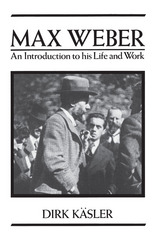
Käsler offers a comprehensive account of Weber's views, giving attention both to the context in which Weber produced his most significant contributions to social science, and to the changes involved in his work over the course of his career. This volume also serves as an introduction to the controversies that Weber's writings have stimulated, from the time of their first appearance to the present day.
This book will be of vital interest to anyone concerned with Max Weber and will undoubtedly become the leading student text on Weber in the English-speaking world.
First published in German in 1959, Max Weber and German Politics appeared in a revised edition in 1974 and became available in an English translation only in 1984. In writing this work, Mommsen drew extensively on Weber's published and unpublished essays, newspaper articles, memoranda, and correspondence.

In Maxanax Chempapísi / Bloodwriting lyric poems exploring Esselen words and concepts traverse a supporting cast of prose poems about contemporary life as a queer, Indigenous recovering academic. Deborah A. Miranda witnesses the lives of women who are lovers, mothers, daughters, sisters, and grandmothers caught in a chain of ongoing apocalypse that stretches from the colonization of North America to the current Anthropocene.
These poems are small but potent ceremonies that center relationship as medicinal. They speak of the ugliness of genocide, substance abuse, environmental destruction, and homophobia with searing fury. They linger on the sacred powers found within a river—“A web of fireflies weaving constellations in the alder’s branches”—or the wonder of “The first woman / who stole my heart / rose up / from the earth / like a creation story.” Throughout this collection, images weave connections between women’s bodies and the moon, bodies and earth, bodies and constellations that surround us. Esselen, Miranda’s Indigenous language, acts as a bridge that translates some of these ancient struggles and insights into contemporary images.
This collection resists the separation of the body, the spirit, and the sacred. It seeks a reunion of true relationship in the midst of chaos and uncertainty. Miranda balances praise for the burning—but still beautiful and holy—world and grief for the loss of beings and places that cannot be recovered.

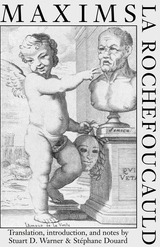
This is the first-ever French-English edition of La Rochefoucauld’s Réflexions, ou sentences et maximes morales, long known in English simply as the Maxims. The translation, the first to appear in forty years, is completely new and aims – unlike all previous versions – at being as literal as possible. This involves, among other things, rendering the same word – for example, amour-propre as “self-love” – as consistently throughout as good sense allows. This also means that the translators have made every effort to maintain La Rochefoucauld’s word order. This allows the reader the best vantage point for viewing La Rochefoucauld’s dramatic and paradoxical juxtapositions of words and ideas, juxtapositions of the utmost importance to understanding his thought. Despite the translation’s concern with literalness, careful attention has been paid to the nuances of the literary character of the Maxims. In addition, this work contains a series of detailed indices that will greatly aid the reader in finding just the right maxim, and an updated version, in English, of the original French index of the work.
At the heart of La Rochefoucauld’s Maxims lies the attempt to disclose the great disparity between the exaggerated self-estimation of men and women and their actual condition. As La Rochefoucauld (1613–1680) unremittingly unmasks various pretenses, heelaborately exposes the complexity of motives which underlie and inform human conduct: whereas many endeavor to reveal a unity in plurality, La Rochefoucauld endeavors to reveal a plurality in unity. Playful, yet serious, humorous, ironic yet direct, poetic yet philosophical, the Maxims penetrate to themes at the center of reflection and judgment about the human situation. Worthy of study at any time, the Maxims are especially relevant in the strange times in which we live.
This edition includes the 504 maxims of the definitive, fifth edition of 1678, along with 137 other maxims which were either withdrawn from earlier editions or published posthumously. In addition to the maxims, La Rochefoucauld’s self-portrait and Cardinal de Retz’s portrait of La Rochefoucauld are also included.
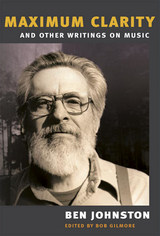
This collection spans forty years and brings together forty-one of Johnston's most important writings, including many rare and several previously unpublished selections. They include position papers, theoretical treatises, program notes, historical reflections, lectures, excerpts from interviews, and letters, and they cover a broad spectrum of concerns--from the technical exegesis of microtonality to the personal and the broadly humanistic. A discography of commercially available recordings of Johnston's music closes out the collection.



Based on years of frontline experience in New York's inner-city schools, Maximum Security demonstrates that such policing strategies are not only ineffectual, they divorce students and teachers from their ethical and behavioral responsibilities. Exploring the culture of violence from within, John Devine argues that the security system, with its uniformed officers and invasive high-tech surveillance, has assumed presumptive authority over students' bodies and behavior, negating the traditional roles of teachers as guardians and agents of moral instruction. The teacher is reduced to an information bureaucrat, a purveyor of technical knowledge, while the student's physical well-being and ethical actions are left to the suspect scrutiny of electronic devices and security specialists with no pedagogical mission, training, or interest. The result is not a security system at all, but an insidious institutional disengagement from the caring supervision of the student body.
With uncompromising honesty, Devine provides a powerful portrayal of an educational system in crisis and bold new insight into the malignant culture of school violence.

This volume reproduces major portions of the text of Maxwell's classic papers on concepts that are key to both modern physics and the modern world. Through Simpson's engaginbg commentaries and notes and Anne Farrell's illustrations, readers with limited knowledge of math or physics as well as scientists and historians of science will be able to follow the emergence of Maxwell's ideas and to appreciate the magnitude of his achievement. This book includes a long biographical introduction that explores the personal, historical, and scientific context of Maxwell's book.
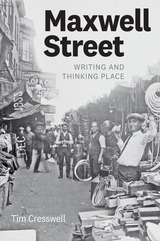
In Maxwell Street, Cresswell advocates approaching the study of place as an “assemblage” of things, meanings, and practices. He models this innovative approach through a montage format that exposes the different types of texts—primary, secondary, and photographic sources—that have attempted to capture the essence of the area. Cresswell studies his historical sources just as he explores the different elements of Maxwell Street—exposing them layer by layer. Brilliantly interweaving words and images, Maxwell Street sheds light on a historic Chicago neighborhood and offers a new model for how to write about place that will interest anyone in the fields of geography, urban studies, or cultural history.
Winner of several prestigious honors, including the 2014 ABC-CLIO Greenwood Award for the Best Book in Library Literature, the first edition of this clear and comprehensive handbook has become an essential resource for catalogers, LIS students, and cataloging instructors. Now, in this second edition, Maxwell explains the changes to RDA: Resource Description and Access brought about by 3R, and brings his handbook fully in line with all the new developments. Designed to interpret and explain RDA, this resource illustrates the cataloging standard for every type of information format. From books to electronic materials to music and beyond, Maxwell
- explains the alignment of the new RDA with the IFLA’s Library Reference Model (LRM), offering value to library and cultural heritage communities;
- incorporates the changes made to the RDA Toolkit after the completion of the 3R Project that allow for greater personalization and accessibility;
- addresses the new structural changes to RDA that allow for greater flexibility and reuse;
- explores the new emphasis on relationships between entities and what it means for RDA users; and
- provides abundant sample records to illustrate RDA principles.

Contributors: Ludivine Bantigny, Françoise Blum, Tony Côme, Boris Gobille, Bethany Keenan, Salar Mohandesi, Donald Reid, Sandrine Sanos, Daniel Sherman

Kristin Ross shows how the current official memory of May '68 came to serve a political agenda antithetical to the movement's aspirations. She examines the roles played by sociologists, repentant ex-student leaders, and the mainstream media in giving what was a political event a predominantly cultural and ethical meaning. Recovering the political language of May '68 through the tracts, pamphlets, and documentary film footage of the era, Ross reveals how the original movement, concerned above all with the question of equality, gained a new and counterfeit history, one that erased police violence and the deaths of participants, removed workers from the picture, and eliminated all traces of anti-Americanism, anti-imperialism, and the influences of Algeria and Vietnam. May '68 and Its Afterlives is especially timely given the rise of a new mass political movement opposing global capitalism, from labor strikes and anti-McDonald's protests in France to the demonstrations against the World Trade Organization in Seattle.



Sharon Ammen's in-depth study traces Irwin's hurly-burly life. Irwin gained fame when, layering aspects of minstrelsy over ragtime, she popularized a racist "Negro song" genre. Ammen examines this forgotten music, the society it both reflected and entertained, and the ways white and black audiences received Irwin's performances. She also delves into Irwin's hands-on management of her image and career, revealing how Irwin carefully built a public persona as a nurturing housewife whose maternal skills and performing acumen reinforced one another. Irwin's act, soaked in racist song and humor, built a fortune she never relinquished. Yet her career's legacy led to a posthumous obscurity as the nation that once adored her evolved and changed.
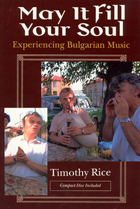
In the context of this history, Rice brings Bulgarian folk music to life by focusing on the biography of the Varimezov family, including the musician Kostadin and his wife Todora, a singer. Combining interviews with his own experiences of learning how to play, sing and dance Bulgarian folk music, Rice presents one of the most detailed accounts of traditional, aural learning processes in the ethnomusicological literature.
Using a combination of traditionally dichotomous musicological and ethnographic approaches, Rice tells the story of how individual musicians learned their tradition, how they lived it during the pre-Communist era of family farming, how the tradition changed with industrialization brought under Communism, and finally, how it flourished and evolved in the recent, unstable political climate.
This work—complete with a compact disc and numerous illustrations and musical examples—contributes not only to ethnomusicological theory and method, but also to our understanding of Slavic folklore, Eastern European anthropology, and cultural processes in Socialist states.
Obsession, adultery, infidelity, unrequited love, suicide, betrayal, death—Tereze Glück's clear-sighted characters coolly assess their actions and reactions. When a man's wife dies suddenly, he feels liberated, and learning this stuns him. Taking a leap into personhood, a child watching her mother in the garden experiences empathy. A woman addicted to a lover realizes how she has squandered herself. A kiss in a taxicab sets two people on the road to inevitability. Scars, even small ones, reflect the power and mystery of the roads people take from one life into another. In the intense title story, suicide, long-distance love, and a cat's nine lives overshadow a woman's subterranean life.
Glück's wry and rueful stories chronicle her characters' struggles to tell the truth regardless of where that might lead them. Insistent, stubbornly spirited voices inform these tales; Glück's characters dig in their heels and announce, for good or ill, “This is who I am.” In the end their moral integrity forces them to come face to face with themselves. At the intersection where these insightful stories take place, what is in one's heart and what one reveals to the world converge. Each story is a resonant act of self-discovery for both writer and reader.
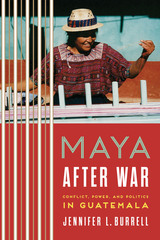
Guatemala’s thirty-six-year civil war culminated in peace accords in 1996, but the postwar transition has been marked by continued violence, including lynchings and the rise of gangs, as well as massive wage-labor exodus to the United States. For the Mam Maya municipality of Todos Santos Cuchumatán, inhabited by a predominantly indigenous peasant population, the aftermath of war and genocide resonates with a long-standing tension between state techniques of governance and ancient community-level power structures that incorporated concepts of kinship, gender, and generation. Showing the ways in which these complex histories are interlinked with wartime and enduring family/class conflicts, Maya after War provides a nuanced account of a unique transitional postwar situation, including the complex influence of neoliberal intervention.
Drawing on ethnographic field research over a twenty-year period, Jennifer L. Burrell explores the after-war period in a locale where community struggles span culture, identity, and history. Investigating a range of tensions from the local to the international, Burrell employs unique methodologies, including mapmaking, history workshops, and an informal translation of a historic ethnography, to analyze the role of conflict in animating what matters to Todosanteros in their everyday lives and how the residents negotiate power. Examining the community-based divisions alongside national postwar contexts, Maya after War considers the aura of hope that surrounded the signing of the peace accords, and the subsequent doubt and waiting that have fueled unrest, encompassing generational conflicts. This study is a rich analysis of the multifaceted forces at work in the quest for peace, in Guatemala and beyond.
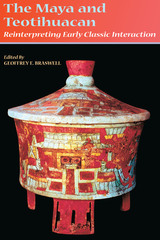
The contributors to this volume present extensive new evidence from archaeology, iconography, and epigraphy to offer a more nuanced understanding of the interaction between the Early Classic Maya and Teotihuacan.
Winner, Choice Outstanding Academic Book, 2005
Since the 1930s, archaeologists have uncovered startling evidence of interaction between the Early Classic Maya and the great empire of Teotihuacan in Central Mexico. Yet the exact nature of the relationship between these two ancient Mesoamerican civilizations remains to be fully deciphered. Many scholars have assumed that Teotihuacan colonized the Maya region and dominated the political or economic systems of certain key centers—perhaps even giving rise to state-level political organizations. Others argue that Early Classic rulers merely traded with Teotihuacan and skillfully manipulated its imported exotic goods and symbol sets to increase their prestige.
Moving beyond these traditional assumptions, the contributors to this volume present extensive new evidence from archaeology, iconography, and epigraphy to offer a more nuanced understanding of the interaction between the Early Classic Maya and Teotihuacan. Investigating a range of Maya sites, including Kaminaljuyu, Copán, Tikal, Altun Ha, and Oxkintok, they demonstrate that the influence of Teotihuacan on the Maya varied in nature and duration from site to site, requiring a range of models to explain the patterns of interaction. Moreover, they show that the interaction was bidirectional and discuss how the Maya in turn influenced Teotihuacan.
Embracing a wide range of research, this book offers various views on the intellectual history of Maya archaeology and ethnohistory and the processes operating in the rise and fall of Maya civilization.
The fourteen studies were selected from those presented at the Second Cambridge Symposium on Recent Research in Mesoamerican Archaeology and are presented in three major sections.
The first of these deals with the application of theory, both anthropological and historical, to the great civilization of the Classic Maya, which flourished in the Yucatan, Guatemala, and Belize during the first millennium A.D. The structural remains of the Classic Period have impressed travelers and archaeologists for over a century, and aspects of the development and decline of this strange and brilliant tropical forest culture are examined here in the light of archaeological research.
The second section presents the results of field research ranging from the Highlands of Mexico east to Honduras and north into the Lowland heart of Maya civilization, and iconographic study of excavated material.
The third section covers the ethnohistoric approach to archaeology, the conjunction of material and documentary evidence. Early European documents are used to illuminate historic Maya culture. This section includes transcriptions of previously unpublished archival material.
Although not formally linked beyond their common field of inquiry, the essays here offer a conspectus of late-twentieth century Maya research and a series of case histories of the work of some of the leading scholars in the field.
Based on nearly a decade of fieldwork in the Guatemalan highlands, Tiffany D. Creegan Miller discusses images that are sonic, pictorial, gestural, and alphabetic. She reveals various forms of creativity and agency that are woven through a rich media landscape in Indigenous Guatemala, as well as Maya diasporas in Mexico and the United States. Miller discusses how technologies of inscription and their mediations are shaped by human editors, translators, communities, and audiences, as well as by voices from the natural world.
These texts push back not just on linear and compartmentalized Western notions of media but also on the idea of the singular author, creator, scholar, or artist removed from their environment. The persistence of orality and the interweaving of media forms combine to offer a challenge to audiences to participate in decolonial actions through language preservation.
The Maya Art of Speaking Writing calls for centering Indigenous epistemologies by doing research in and through Indigenous languages as we engage in debates surrounding Indigenous literatures, anthropology, decoloniality, media studies, orality, and the digital humanities.
Combining the organic dye indigo and the inorganic clay mineral palygorskite in a highly stable chemical hybrid that, unlike indigo, resists attacks by acids, alkalines, and organic solvents and endures without fading, Maya Blue has a rich blue color that has survived for centuries in one of the world’s harshest climates. First used at the site of Calakmul in the tropical forest of southern Mexico during the Late Preclassic period, the Maya’s abiding hue diffused across Mesoamerica over a period of 1,700 years. It appears on Maya pottery, sculpture, murals, and codices and carries multiple meanings, standing as a symbol for cultural cornerstones such as sacrifice and the rain god Chaak. It was discovered in 1931 at Chichén Itzá, and its composition was a mystery for more than three decades, then questions about its source, how and why it achieved such stability, and how and why the Maya made the pigment persisted even longer.
In Maya Blue, Arnold summarizes ethnographic, archaeological, chemical, and material science research over the last century from an anthropological perspective. This thorough, engaging, and accessible book chronicles the history of this pigment as no work has done before.
Scholarship on Maya healing traditions has focused primarily on the roles of midwives, shamans, herbalists, and diviners. Bonesetters, on the other hand, have been largely excluded from conversations about traditional health practitioners and community health resources. Maya Bonesetters is the first book-length study of bonesetting in Guatemala and situates the manual healing tradition within the current cultural context—one in which a changing medical landscape potentially threatens bonesetters’ work yet presents an opportunity to strengthen its relevance.
Drawing on extensive field research in highland Guatemala, Servando Z. Hinojosa introduces readers to a seldom documented, though nonetheless widespread, variety of healer. This book examines the work of Kaqchikel and Tz’utujiil Maya bonesetters, analyzes how they diagnose and treat injuries, and contrasts the empirical and sacred approaches of various healers. Hinojosa shows how bonesetters are carefully adapting certain biomedical technologies to meet local expectations for care and concludes that, despite pressures and criticisms from the biomedical community, bonesetting remains culturally meaningful and vital to Maya people, even if its future remains uncertain.
In Maya Political Science: Time, Astronomy, and the Cosmos, Prudence M. Rice proposed a new model of Maya political organization in which geopolitical seats of power rotated according to a 256-year calendar cycle known as the May. This fundamental connection between timekeeping and Maya political organization sparked Rice's interest in the origins of the two major calendars used by the ancient lowland Maya, one 260 days long, and the other having 365 days. In Maya Calendar Origins, she presents a provocative new thesis about the origins and development of the calendrical system.
Integrating data from anthropology, archaeology, art history, astronomy, ethnohistory, myth, and linguistics, Rice argues that the Maya calendars developed about a millennium earlier than commonly thought, around 1200 BC, as an outgrowth of observations of the natural phenomena that scheduled the movements of late Archaic hunter-gatherer-collectors throughout what became Mesoamerica. She asserts that an understanding of the cycles of weather and celestial movements became the basis of power for early rulers, who could thereby claim "control" over supernatural cosmic forces. Rice shows how time became materialized—transformed into status objects such as monuments that encoded calendrical or temporal concerns—as well as politicized, becoming the foundation for societal order, political legitimization, and wealth. Rice's research also sheds new light on the origins of the Popol Vuh, which, Rice believes, encodes the history of the development of the Mesoamerican calendars. She also explores the connections between the Maya and early Olmec and Izapan cultures in the Isthmian region, who shared with the Maya the cosmovision and ideology incorporated into the calendrical systems.
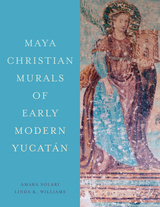
The first study of Christian murals created by indigenous artists in sixteenth and seventeenth century Yucatán.
In the sixteenth and seventeenth centuries, Maya artists painted murals in churches and conventos of Yucatán using traditional techniques to depict iconography brought from Europe by Franciscan friars. The fragmentary visual remains and their placement within religious structures embed Maya conceptions of sacredness beyond the didactic imagery. Mobilizing both cutting-edge technology and tried-and-true analytical methods, art historians Amara Solari and Linda K. Williams reexamine the Maya Christian murals, centering the agency of the people who created them.
The first volume to comprehensively document the paintings, Maya Christian Murals of Early Modern Yucatán collects new research on the material composition of the works, made possible by cutting-edge imaging methods. Solari and Williams investigate pigments and other material resources, as well as the artists and historical contexts of the murals. The authors uncover numerous local innovations in form and content, including images celebrating New World saints, celestial timekeeping, and ritual processions. Solari and Williams argue that these murals were not simply vehicles of coercion, but of cultural “grafting,” that allowed Maya artists to shape a distinctive and polyvocal legacy in their communities.
Maya Creation Myths provides not only new and outstanding translations of these myths but also an interpretive journey through these often misunderstood texts, providing insight into Maya cosmology and how Maya intellectuals met the challenge of the European clergy's attempts to eradicate their worldviews. Unlike many scholars who focus primarily on traces of pre-Hispanic culture or Christian influence within the Books of Chilam Balam, Knowlton emphasizes the diversity of Maya mythic traditions and the uniquely Maya discursive strategies that emerged in the Colonial period.
This book will be of significant interest to Maya scholars, folklorists, and historians, as well as students and scholars of religion, cosmology, and anthropology.
Maya Cultural Activism in Guatemala marks a new era in Guatemalan studies by offering an up-to-the-minute look at the pan-Maya movement and the future of the Maya people as they struggle to regain control over their cultural destiny. The successful emergence of what is in some senses a nationalism grounded in ethnicity and language has challenged scholars to reconsider their concepts of nationalism, community, and identity.
Editors Edward F. Fischer and R. McKenna Brown have brought together essays by virtually all the leading U.S. experts on contemporary Maya communities and the top Maya scholars working in Guatemala today. Supplementing scholarly analysis of Mayan cultural activism is a position statement originating within the movement and more wide-ranging and personal reflections by anthropologists and linguists who have worked with the Maya over the years. Among the broader issues that come in for examination are the complex relations between U.S. Mayanists and the Mayan cultural movement, efforts to promote literacy in Mayan languages, the significance of woven textiles and native dress, the relations between language and national identity, and the cultural meanings that the present-day Maya have encountered in ancient Mayan texts and hieroglyphic writing.

The use of such calendars is mentioned in historical and ethnographic works, but very few examples are known to exist. Each of the three calendars transcribed and translated by John M. Weeks, Frauke Sachse, and Christian M. Prager - and housed at the University of Pennsylvania Museum of Archaeology and Anthropology - is unique in structure and content. Moreover, except for an unpublished study of the 1722 calendar by Rudolf Schuller and Oliver La Farge (1934), these little-known works appear to have escaped the attention of most scholars. Introductory essays contextualize each document in time and space, and a series of appendixes present previously unpublished calendrical notes assembled in the early twentieth century.
Providing considerable information on the divinatory use of calendars in colonial highland Maya society previously unavailable without a visit to the University of Pennsylvania's archives, Maya Daykeeping is an invaluable primary resource for Maya scholars. Mesoamerican Worlds Series
This widespread poverty was endemic throughout northwestern Guatemala, where 80 percent of Maya children were chronically malnourished, and forced wide-scale migration to the Pacific coast. The self-help aid that flowed into the area in the 1960s and 1970s raised hopes for justice and equity that were brutally suppressed by Guatemala's military government. This military reprisal led to a massive diaspora of Maya throughout Canada, the United States, Mexico, and Central America.
This collection describes that process and the results. The chapters show the dangers and problems of the migratory/refugee process and the range of creative cultural adaptations that the Maya have developed. It provides the first comparative view of the formation and transformation of this new and expanding transnational population, presented from the standpoint of the migrants themselves as well as from a societal and international perspective. Together, the chapters furnish ethnographically grounded perspectives on the dynamic implications of uprooting and resettlement, social and psychological adjustment, long-term prospects for continued links to migration history from Guatemala, and the development of a sense of co-ethnicity with other indigenous people of Maya descent. As the Maya struggle to find their place in a more global society, their stories of quiet courage epitomize those of many other ethnic groups, migrants, and refugees today.
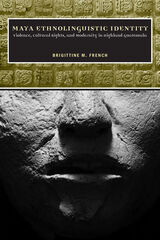
French shows, with useful examples, how constructions of language and collective identity are in fact strategies undertaken to serve the goals of institutions (including the government, the military, the educational system, and the church) and social actors (including linguists, scholars, and activists). But by incorporating in-depth fieldwork with groups that speak Kaqchikel and K’iche’ along with analyses of Spanish-language discourses, Maya Ethnolinguistic Identity also shows how some individuals in urban, bilingual Indian communities have disrupted the essentializing projects of multiculturalism. And by focusing on ideologies of language, the author is able to explicitly link linguistic forms and functions with larger issues of consciousness, gender politics, social positions, and the forging of hegemonic power relations.
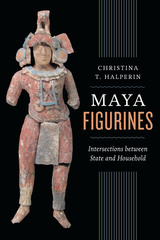
Rather than view the contours of Late Classic Maya social life solely from towering temple pyramids or elite sculptural forms, this book considers a suite of small anthropomorphic, zoomorphic, and supernatural figurative remains excavated from household refuse deposits. Maya Figurines examines these often neglected objects and uses them to draw out relationships between the Maya state and its subjects.
These figurines provide a unique perspective for understanding Maya social and political relations; Christina T. Halperin argues that state politics work on the microscale of everyday routines, localized rituals, and small-scale representations. Her comprehensive study brings together archeology, anthropology, and art history with theories of material culture, performance, political economy, ritual humor, and mimesis to make a fascinating case for the role politics plays in daily life. What she finds is that, by comparing small-scale figurines with state-sponsored, often large-scale iconography and elite material culture, one can understand how different social realms relate to and represent one another. In Maya Figurines, Halperin compares objects from diverse households, archeological sites, and regions, focusing especially on figurines from Petén, Guatemala, and comparing them to material culture from Belize, the northern highlands of Guatemala, the Usumacinta River, the Campeche coastal area, and Mesoamerican sites outside the Maya zone. Ultimately, she argues, ordinary objects are not simply passive backdrops for important social and political phenomena. Instead, they function as significant mechanisms through which power and social life are intertwined.
The Yucatan Peninsula draws many North American and European travelers each year to view the ruins of the pre-Columbian Classical Maya civilization and the abundant native flora and fauna. For these travelers, as well as armchair travelers and students, Gary Bevington has prepared the first general English-language introduction to Yucatec Maya, the native language of the people indigenous to the region.
Written in nontechnical terms for learners who have a basic knowledge of simple Mexican Spanish, the book presents easily understood, practical information for anyone who would like to communicate with the Maya in their native language. In addition to covering the pronunciation and grammar of Maya, Bevington includes invaluable tips on learning indigenous languages "in the field." Most helpful are his discussions of the cultural and material worlds of the Maya, accompanied by essential words and expressions for common objects and experiences. A Maya-English-Spanish glossary with extensive usage examples and an English-Maya glossary conclude the book.
Note: The supplemental audiocasette, Spoken Maya for Travelers and Students, is now available as a free download through the book's page on the University of Texas Press's website.
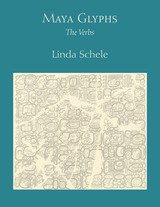
The key to the study of the language and history of the Classic Maya (A.D. 293–900) is the verb. Maya Glyphs: The Verbs is a comprehensive study of the verb morphology and syntax of the Maya writing system.
Linda Schele's summary of methodology makes available in a single place many important discoveries and approaches to the Maya language. Hers is the first sourcebook to include so broad a range of dates and to identify for the first time so many Maya rulers and events.
The admirably lucid text provides an excellent introduction to Maya hieroglyphics for the beginner, and, for the experienced Mayanist, it offers a fascinating explanation of methodology, including paraphrasing, and important information about syntactical structures, special verbal constructions, and literary conventions.
Schele's extensive catalog of known verbal phrases is useful for a variety of purposes. Because it is organized according to verbal affix patterns, it provides the only available source for the distribution of such patterns in the writing system. At the same time it registers the date of each event, its agent and patient (if recorded), the dedication date of the monument on which the glyphs occur, and a pictorial illustration, rather than a T-number transcription, of each example. Extensive notes treating problems of dating, interpretation, and dynastic information contain theories about the meaning and function of the events recorded in the Maya inscriptions.
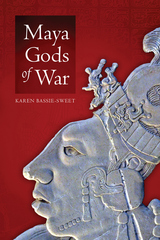
Author Karen Bassie-Sweet traces the semantic markers used to distinguish flint from other types of stone, surveys various types of Chahk thunderbolt deities and their relationship to flint weapons, and explores the connection between lightning and the ruling elite. Additional chapters review these fire and solar deities and their roles in Maya warfare and examine the nature and manifestations of the Central Mexican thunderbolt god Tlaloc, his incorporation into the Maya pantheon, and his identification with meteors and obsidian weapons. Finally, Bassie-Sweet addresses the characteristics of the deity God L, his role as an obsidian merchant god, and his close association with the ancient land route between the highland Guatemalan obsidian sources and the lowlands.
Through analysis of the nature of the Teotihuacán deities and exploration of the ways in which these gods were introduced into the Maya region and incorporated into the Maya worldview, Maya Gods of War offers new insights into the relationship between warfare and religious beliefs in Mesoamerica. This significant work will be of interest to scholars of Maya religion and iconography.
Tatiana Proskouriakoff, a preeminent student of the Maya, made many breakthroughs in deciphering Maya writing, particularly in demonstrating that the glyphs record the deeds of actual human beings, not gods or priests. This discovery opened the way for a history of the Maya, a monumental task that Proskouriakoff was engaged in before her death in 1985. Her work, Maya History, has been made ready for press by the able editorship of Rosemary Joyce.
Maya History reconstructs the Classic Maya period (roughly A.D. 250-900) from the glyphic record on stelae at numerous sites, including Altar de Sacrificios, Copan, Dos Pilas, Naranjo, Piedras Negras, Quirigua, Tikal, and Yaxchilan. Proskouriakoff traces the spread of governmental institutions from the central Peten, especially from Tikal, to other city-states by conquest and intermarriage. Thirteen line drawings of monuments and over three hundred original drawings of glyphs amplify the text.
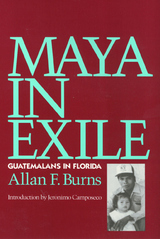
The Maya are the single largest group of indigenous people living in North and Central America. Beginning in the early 1980s, hundreds of thousands of Maya fled the terror of Guatemalan civil strife to safety in Mexico and the U.S. This ethnography of Mayan immigrants who settled in Indiatown, a small agricultural community in south central Florida, presents the experiences of these traditional people, their adaptations to life in the U.S., and the ways they preserve their ancestral culture. For more than a decade, Allan F. Burns has been researching and doing advocacy work for these immigrant Maya, who speak Kanjobal, Quiche, Mamanâ, and several other of the more than thirty distinct languages in southern Mexico and Guatemala. In this fist book on the Guatemalan Maya in the U.S, he uses their many voices to communicate the experience of the Maya in Florida and describes the advantages and results of applied anthropology in refugee studies and cultural adaptation.
Burns describes the political and social background of the Guatemalan immigrants to the U.S. and includes personal accounts of individual strategies for leaving Guatemala and traveling to Florida. Examining how they interact with the community and recreate a Maya society in the U.S., he considers how low-wage labor influences the social structure of Maya immigrant society and discusses the effects of U.S. immigration policy on these refugees.
When Mayan leaders protested the celebration of the Quincentenary of the "discovery" of America and joined with other indigenous groups in the Americas to proclaim an alternate celebration of 500 years of resistance, they rose to national prominence in Guatemala. This was possible in part because of the cultural, political, economic, and religious revitalization that occurred in Mayan communities in the later half of the twentieth century. Another result of the revitalization was Mayan students' enrollment in graduate programs in order to reclaim the intellectual history of the brilliant Mayan past. Victor Montejo was one of those students.
This is the first book to be published outside of Guatemala where a Mayan writer other than Rigoberta Menchu discusses the history and problems of the country. It collects essays Montejo has written over the past ten years that address three critical issues facing Mayan peoples today: identity, representation, and Mayan leadership. Montejo is deeply invested in furthering the discussion of the effectiveness of Mayan leadership because he believes that self-evaluation is necessary for the movement to advance. He also criticizes the racist treatment that Mayans experience, and advocates for the construction of a more pluralistic Guatemala that recognizes cultural diversity and abandons assimilation. This volume maps a new political alternative for the future of the movement that promotes inter-ethnic collaboration alongside a reverence for Mayan culture.
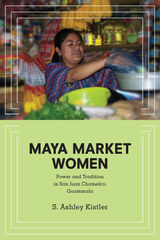
As cultural mediators, Chamelco's market women offer a model of contemporary Q'eqchi' identity grounded in the strength of the Maya historical legacy. Guatemala's Maya communities have faced nearly five hundred years of constant challenges to their culture, from colonial oppression to the instability of violent military dictatorships and the advent of new global technologies. In spite of this history, the people of San Juan Chamelco, Guatemala, have effectively resisted significant changes to their cultural identities. Chamelco residents embrace new technologies, ideas, and resources to strengthen their indigenous identities and maintain Maya practice in the 21st century, a resilience that sets Chamelco apart from other Maya towns.
Unlike the region's other indigenous women, Chamelco's Q'eqchi' market women achieve both prominence and visibility as vendors, dominating social domains from religion to local politics. These women honor their families' legacies through continuation of the inherited, high-status marketing trade. In Maya Market Women, S. Ashley Kistler describes how market women gain social standing as mediators of sometimes conflicting realities, harnessing the forces of global capitalism to revitalize Chamelco's indigenous identity. Working at the intersections of globalization, kinship, gender, and memory, Kistler presents a firsthand look at Maya markets as a domain in which the values of capitalism and indigenous communities meet.
Bassie-Sweet and Hopkins show that both visual and verbal media present carefully planned narratives, and that the two are intimately related in the composition of Classic Maya monuments. Text and image interaction is discussed through examples of stelae, wall panels, lintels, benches, and miscellaneous artifacts including ceramic vessels and codices. Bassie-Sweet and Hopkins consider the principles of contrast and complementarity that underlie narrative structures and place this study in the context of earlier work, proposing a new paradigm for Maya epigraphy. They also address the narrative organization of texts and images as manifested in selected hieroglyphic inscriptions and the accompanying illustrations, stressing the interplay between the two.
Arguing for a more holistic approach to Classic Maya art and literature, Maya Narrative Arts reveals how close observation and reading can be equally if not more productive than theoretical discussions, which too often stray from the very data that they attempt to elucidate. The book will be significant for Mesoamerican art historians, epigraphers, linguists, and archaeologists.
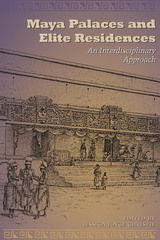
Maya "palaces" have intrigued students of this ancient Mesoamerican culture since the early twentieth century, when scholars first applied the term "palace" to multi-room, gallery-like buildings set on low platforms in the centers of Maya cities. Who lived in these palaces? What types of ceremonial and residential activities took place there? How do the physical forms and spatial arrangement of the buildings embody Maya concepts of social organization and cosmology?
This book brings together state-of-the-art data and analysis regarding the occupants, ritual and residential uses, and social and cosmological meanings of Maya palaces and elite residences. A multidisciplinary team of senior researchers reports on sites in Belize (Blue Creek), Western Honduras (Copan), the Peten (Tikal, Dos Pilas, Aguateca), and the Yucatan (Uxmal, Chichen-Itza, Dzibilchaltun, Yaxuna). Archaeologist contributors discuss the form of palace buildings and associated artifacts, their location within the city, and how some palaces related to landscape features. Their approach is complemented by art historical analyses of architectural sculpture, epigraphy, and ethnography. Jessica Joyce Christie concludes the volume by identifying patterns and commonalties that apply not only to the cited examples, but also to Maya architecture in general.
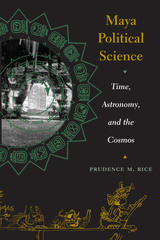
How did the ancient Maya rule their world? Despite more than a century of archaeological investigation and glyphic decipherment, the nature of Maya political organization and political geography has remained an open question. Many debates have raged over models of centralization versus decentralization, superordinate and subordinate status—with far-flung analogies to emerging states in Europe, Asia, and Africa. But Prudence Rice asserts that neither the model of two giant "superpowers" nor that which postulates scores of small, weakly independent polities fits the accumulating body of material and cultural evidence.
In this groundbreaking book, Rice builds a new model of Classic lowland Maya (AD 179-948) political organization and political geography. Using the method of direct historical analogy, she integrates ethnohistoric and ethnographic knowledge of the Colonial-period and modern Maya with archaeological, epigraphic, and iconographic data from the ancient Maya. On this basis of cultural continuity, she constructs a convincing case that the fundamental ordering principles of Classic Maya geopolitical organization were the calendar (specifically a 256-year cycle of time known as the may) and the concept of quadripartition, or the division of the cosmos into four cardinal directions. Rice also examines this new model of geopolitical organization in the Preclassic and Postclassic periods and demonstrates that it offers fresh insights into the nature of rulership, ballgame ritual, and warfare among the Classic lowland Maya.
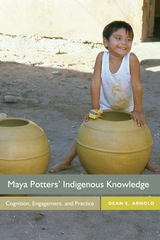
Based on fieldwork and reflection over a period of almost fifty years, Maya Potters’ Indigenous Knowledge utilizes engagement theory to describe the indigenous knowledge of traditional Maya potters in Ticul, Yucatán, Mexico. In this heavily illustrated narrative account, Dean E. Arnold examines craftspeople’s knowledge and skills, their engagement with their natural and social environments, the raw materials they use for their craft, and their process for making pottery.
Following Lambros Malafouris, Tim Ingold, and Colin Renfrew, Arnold argues that potters’ indigenous knowledge is not just in their minds but extends to their engagement with the environment, raw materials, and the pottery-making process itself and is recursively affected by visual and tactile feedback. Pottery is not just an expression of a mental template but also involves the interaction of cognitive categories, embodied muscular patterns, and the engagement of those categories and skills with the production process. Indigenous knowledge is thus a product of the interaction of mind and material, of mental categories and action, and of cognition and sensory engagement—the interaction of both human and material agency.
Engagement theory has become an important theoretical approach and “indigenous knowledge” (as cultural heritage) is the focus of much current research in anthropology, archaeology, and cultural resource management. While Dean Arnold’s previous work has been significant in ceramic ethnoarchaeology, Maya Potters' Indigenous Knowledge goes further, providing new evidence and opening up different concepts and approaches to understanding practical processes. It will be of interest to a wide variety of researchers in Maya studies, material culture, material sciences, ceramic ecology, and ethnoarchaeology.
The Maya of Santiago Chimaltenango have experienced increasingly rapid, even violent, integration into Guatemalan society in the last fifty years, yet they still distinguish themselves ethnically from Spanish-speaking Guatemalans and other Maya. Why this sense of ethnic identity persists—and also changes—over time is the focus of Maya Saints and Souls in a Changing World, a beautifully written ethnography of a Mam-speaking Maya town in the western highlands of Guatemala.
John Watanabe uniquely explores how Chimaltecos themselves define their local distinctiveness. This approach uncovers significant continuities in lifeways and world view that might otherwise remain imperceptible to an outsider.
Another important feature of the study is that it updates Charles Wagley's pioneering research in the community during the 1930s. Watanabe identifies both the external, historical factors that have prompted change in the community since Wagley's time and the people's responses to these changes.
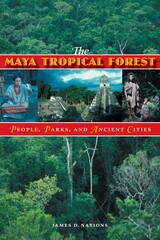
The Maya Tropical Forest, which occupies the lowlands of southern Mexico, Guatemala, and Belize, is the closest rainforest to the United States and one of the most popular tourist destinations in the Western Hemisphere. It has been home to the Maya peoples for nearly four millennia, starting around 1800 BC. Ancient cities in the rainforest such as Palenque, Yaxchilan, Tikal, and Caracol draw thousands of tourists and scholars seeking to learn more about the prehistoric Maya. Their contemporary descendants, the modern Maya, utilize the forest's natural resources in village life and international trade, while striving to protect their homeland from deforestation and environmental degradation.
Writing for both visitors and conservationists, James Nations tells the fascinating story of how ancient and modern Maya peoples have used and guarded the rich natural resources of the Maya Tropical Forest. He opens with a natural history that profiles the forest's significant animals and plants. Nations then describes the Maya peoples, biological preserves, and major archaeological sites in Mexico, Guatemala, and Belize. Drawing on more than twenty-five years of conservation work in the Maya Tropical Forest, Nations tells first-hand stories of the creation of national parks and other protected areas to safeguard the region's natural resources and archaeological heritage. He concludes with an expert assessment of the forest's future in which he calls for expanded archaeological tourism to create an ecologically sustainable economic base for the region.
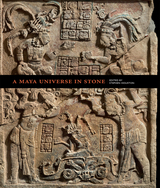
In 1950, Dana Lamb, an explorer of some notoriety, stumbled on a Maya ruin in the tropical forests of northern Guatemala. Lamb failed to record the location of the site he called Laxtunich, turning his find into the mystery at the center of this book. The lintels he discovered there, long since looted, are probably of a set with two others that are among the masterworks of Maya sculpture from the Classic period. Using fieldwork, physical evidence, and Lamb’s expedition notes, the authors identify a small area with archaeological sites where the carvings were likely produced.
Remarkably, the vividly colored lintels, replete with dynastic and cosmic information, can be assigned to a carver, Mayuy, who sculpted his name on two of them. To an extent nearly unique in ancient America, Mayuy can be studied over time as his style developed and his artistic ambition grew. An in-depth analysis of Laxtunich Lintel 1 examines how Mayuy grafted celestial, seasonal, and divine identities onto a local magnate and his overlord from the kingdom of Yaxchilan, Mexico. This volume contextualizes the lintels and points the way to their reprovenancing and, as an ultimate aim, repatriation to Guatemala.
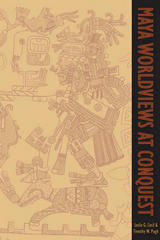
Focusing on the Postclassic and Colonial periods, Maya Worldviews at Conquest provides a regional investigation of archaeological and epigraphic evidence of Maya ideology, landscape, historical consciousness, ritual practices, and religious symbolism before and during the Spanish conquest. Through careful investigation, the volume focuses on the impact of conversion, hybridization, resistance, and revitalization on the Mayans’ understanding of their world and their place in it.
The volume also addresses the issue of anthropologists unconsciously projecting their modern worldviews on the culture under investigation. Thus, the book critically defines and strengthens the use of worldviews in the scholarly literature regardless of the culture studied, making it of value not only to Maya scholars but also to those interested in the anthropologist’s projection of worldview on other cultures in general.
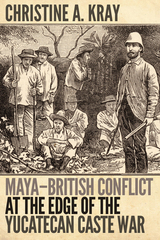
Official British declarations of neutrality in the Caste War were confounded by a variety of political and economic factors, including competing land claims befuddled by a tangled set of treaties, mahogany extraction by British companies in contested territories, Maya rent demands, British trade in munitions to different groups of Maya combatants, and a labor system reliant on debt servitude. All these factors contributed to uneasy alliances and opportunistic crossings of imagined geopolitical borders in both directions, ultimately leading to a new military conflict in the western and northern regions of the territory claimed by Britain. What frequently began as hyper-local disputes spun out into international affairs as actors called upon more powerful groups for assistance. Evading reductionism, this work traces the decisions and actions of key figures as they maneuvered through the miasma of violence, abuse, deception, fear, flight, and glimpses of freedom.
Positioning the historiographic and ethnographic gaze on the English side without adopting the colonialist narratives and objectives found in English repositories, Maya-British Conflict at the Edge of the Yucatecan Caste War is an important and original contribution to a neglected area of study. It will appeal to students, scholars, and general readers interested in anthropology, Latin American cultures and history, Central American history, British imperialism, Indigenous rights, political anthropology, and colonialism and culture.
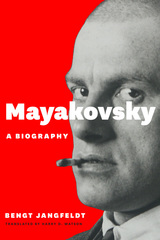
With Mayakovsky, Bengt Jangfeldt offers the first comprehensive biography of Mayakovsky, revealing a troubled man who was more dreamer than revolutionary, more political romantic than hardened Communist. Jangfeldt sets Mayakovsky’s life and works against the dramatic turbulence of his times, from the aesthetic innovations of the pre-revolutionary avant-garde to the rigidity of Socialist Realism and the destruction of World War I to the violence—and hope—of the Russian Revolution, through the tightening grip of Stalinist terror and the growing disillusion with Russian communism that eventually led the poet to take his life.
Through it all is threaded Mayakovsky’s celebrated love affair with Lili Brik and the moving relationship with Lili’s husband, Osip, along with a brilliant depiction of the larger circle of writers and artists around Mayakovsky, including Maxim Gorky, Viktor Shklovsky, Alexander Rodchenko, and Roman Jakobson. The result is a literary life viewed in the round, enabling us to understand the personal and historical furies that drove Mayakovsky and generated his still-startling poetry.
Illustrated throughout with rare images of key characters and locations, Mayakovsky is a major step in the revitalization of a crucial figure of the twentieth-century avant-garde.

Mayakovsky: Plays includes Mystery Bouffe, a mock medieval mystery written in 1918 to celebrate the first anniversary of the Revolution; The Bathhouse, a sharp attack on Soviet bureaucracy subtitled "a drama of circus and fireworks"; and The Bedbug, in which a worker with bourgeois pretensions is frozen and resurrected fifty years later, when the world has become a material paradise. The collection also includes Mayakovsky's more personal first play, Vladimir Mayakovsky: A Tragedy.

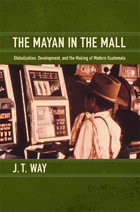
Using a wide array of historical and contemporary sources, Way explores the multiple intersections of development and individual life, focusing on the construction of social space through successive waves of land reform, urban planning, and economic policy. His explorations move from Guatemala City's poorest neighborhoods and informal economies (run predominantly by women) to a countryside still recovering from civil war and anti-Mayan genocide, and they encompass such artifacts of development as the modernist Pan-American Highway and the postmodern Grand Tikal Futura, a Mayan-themed shopping mall ringed by gated communities and shantytowns. Capitalist development, Way concludes, has dramatically reshaped the country's physical and social landscapes—engendering poverty, ethnic regionalism, and genocidal violence—and positioned Guatemala as a harbinger of globalization's future.
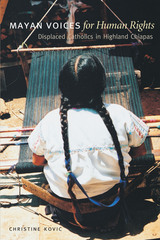
In the last decades of the twentieth century, thousands of Mayas were expelled, often violently, from their homes in San Juan Chamula and other highland communities in Chiapas, Mexico, by fellow Mayas allied with the ruling Institutional Revolutionary Party (PRI). State and federal authorities generally turned a blind eye to these human rights abuses, downplaying them as local conflicts over religious conversion and defense of cultural traditions. The expelled have organized themselves to fight not only for religious rights, but also for political and economic justice based on a broad understanding of human rights.
This pioneering ethnography tells the intertwined stories of the new communities formed by the Mayan exiles and their ongoing efforts to define and defend their human rights. Focusing on a community of Mayan Catholics, the book describes the process by which the progressive Diocese of San Cristóbal and Bishop Samuel Ruiz García became powerful allies for indigenous people in the promotion and defense of human rights. Drawing on the words and insights of displaced Mayas she interviewed throughout the 1990s, Christine Kovic reveals how the exiles have created new communities and lifeways based on a shared sense of faith (even between Catholics and Protestants) and their own concept of human rights and dignity. She also uncovers the underlying political and economic factors that drove the expulsions and shows how the Mayas who were expelled for not being "traditional" enough are in fact basing their new communities on traditional values of duty and reciprocity.
2005 — Best Book Award – New England Council of Latin American Studies
Selling handicrafts to tourists has brought the Maya peoples of Guatemala into the world market. Vendors from rural communities now offer their wares to more than 500,000 international tourists annually in the marketplaces of larger cities such as Antigua, Guatemala City, Panajachel, and Chichicastenango. Like businesspeople anywhere, Maya artisans analyze the desires and needs of their customers and shape their products to meet the demands of the market. But how has adapting to the global marketplace reciprocally shaped the identity and cultural practices of the Maya peoples?
Drawing on over a decade of fieldwork, Walter Little presents the first ethnographic study of Maya handicraft vendors in the international marketplace. Focusing on Kaqchikel Mayas who commute to Antigua to sell their goods, he explores three significant issues:
- how the tourist marketplace conflates global and local distinctions.
- how the marketplace becomes a border zone where national and international, developed and underdeveloped, and indigenous and non-indigenous come together.
- how marketing to tourists changes social roles, gender relationships, and ethnic identity in the vendors' home communities.
Little's wide-ranging research challenges our current understanding of tourism's negative impact on indigenous communities. He demonstrates that the Maya are maintaining a specific, community-based sense of Maya identity, even as they commodify their culture for tourist consumption in the world market.

The poems in Maybe form a tapestry of voices that slip from visibility to invisibility, illusion to disillusion, the conceivable to the inconceivable. Alice Attie writes of boundaries loosening, of transformations and transfigurations born of the unknown and the uncertain. Her poems suggest that this world will dissolve, and it will reappear as something other, something ineffable yet lodged in language, something fraught with an urgency that is both sublime and unbearable. Attie asks from what vantage point can the seer see, the writer write, the listener hear, learning ultimately that “for the length of my years to lengthen, I place the pebble on my tongue and rearrange the boundaries”?

An October 2022 IndieNext pick
”[An] engaging and beautifully narrated quest for personal fulfillment and musical recognition...This is a fast-paced tale in which music and love always take center stage...A truly gifted musician, Price writes about her journey with refreshing candor.”—Kirkus, starred review
”Brutally honest…a vivid and poignant memoir.”—The Guardian
Country music star Margo Price shares the story of her struggle to make it in an industry that preys on its ingenues while trying to move on from devastating personal tragedies.
When Margo Price was nineteen years old, she dropped out of college and moved to Nashville to become a musician. She busked on the street, played open mics, and even threw out her TV so that she would do nothing but write songs. She met Jeremy Ivey, a fellow musician who would become her closest collaborator and her husband. But after working on their craft for more than a decade, Price and Ivey had no label, no band, and plenty of heartache.
Maybe We’ll Make It is a memoir of loss, motherhood, and the search for artistic freedom in the midst of the agony experienced by so many aspiring musicians: bad gigs and long tours, rejection and sexual harassment, too much drinking and barely enough money to live on. Price, though, refused to break, and turned her lowest moments into the classic country songs that eventually comprised the debut album that launched her career. In the authentic voice hailed by Pitchfork for tackling "Steinbeck-sized issues with no-bullshit humility," Price shares the stories that became songs, and the small acts of love and camaraderie it takes to survive in a music industry that is often unkind to women. Now an award-winning artist with a global fanbase, Price tells a love story of music, collaboration, and the struggle to build a career while trying to maintain her singular voice and style.

The Mayflies of North and Central America was first published in 1976. Minnesota Archive Editions uses digital technology to make long-unavailable books once again accessible, and are published unaltered from the original University of Minnesota Press editions.
Mayflies have fascinated man for centuries because of the brief span of their adult lives. These aquatic insects spend most of their lives as nymphs in water, then develop into winged stages and soon die, most species having an adult life of only two or three days. This brevity is implied in the very name of the order, Ephemeroptera.
The mayflies are almost worldwide in distribution, being found everywhere except in Antarctica, the extreme Arctic, and many small oceanic islands. All by three of the twenty families in the world occur in North or Central America, the regions covered in this volume. The book provides a modern, useful, and well-illustrated key to the adults and nymphs. Data on habitats, behavior, and life history are given for each genus. Characteristics of nymphs and adults are given for families, subfamilies, and genera, with brief accounts for extralimital families.
A discussion of methods of collecting and preserving specimens precedes the main portion of the text. The book is generously illustrated with drawings, photographs, and a map.
The role of aquatic insects as indicators of water pollution has received increasing attention, and in this connection this book will be of special interest to those concerned with pollution problems. Mayflies, besides indicating the presence of pollutants, also help remove such substances from the waters, the authors explain.
As a basic reference work, the book is essential for all biological science libraries. Many fly-fishermen are amateur students of mayflies, since the nymphs of larger species are used as bait. With the help of this volume the fisherman can acquire a greater knowledge of aquatic entomology and relate to his sport.
In 1970, Kenneth Gibson was elected as Newark, New Jersey’s first African-American mayor, a position he held for an impressive sixteen years. Yet even as Gibson served as a trailblazer for black politicians, he presided over a troubled time in the city’s history, as Newark’s industries declined and its crime and unemployment rates soared.
This book offers a balanced assessment of Gibson’s leadership and his legacy, from the perspectives of the people most deeply immersed in 1970s and 1980s Newark politics: city employees, politicians, activists, journalists, educators, and even fellow big-city mayors like David Dinkins. The contributors include many of Gibson’s harshest critics, as well as some of his closest supporters, friends, and family members—culminating in an exclusive interview with Gibson himself, reflecting on his time in office.
Together, these accounts provide readers with a compelling inside look at a city in crisis, a city that had been rocked by riots three years before Gibson took office and one that Harper’s magazine named “America’s worst city” at the start of his second term. At its heart, it raises a question that is still relevant today: how should we evaluate a leader who faced major structural and economic challenges, but never delivered all the hope and change he promised voters?
READERS
Browse our collection.
PUBLISHERS
See BiblioVault's publisher services.
STUDENT SERVICES
Files for college accessibility offices.
RECENTLY PUBLISHED


UChicago Accessibility Resources
home | accessibility | search | about | contact us
BiblioVault ® 2001 - 2026
The University of Chicago Press