front cover of Making Jet Engines in World War II
Making Jet Engines in World War II
Britain, Germany, and the United States
Hermione Giffard
University of Chicago Press, 2016
Our stories of industrial innovation tend to focus on individual initiative and breakthroughs. With Making Jet Engines in World War II, Hermione Giffard uses the case of the development of jet engines to offer a different way of understanding technological innovation, revealing the complicated mix of factors that go into any decision to pursue an innovative, and therefore risky technology.
 
Giffard compares the approaches of Britain, Germany, and the United States. Each approached jet engines in different ways because of its own war aims and industrial expertise. Germany, which produced more jet engines than the others, did so largely as replacements for more expensive piston engines. Britain, on the other hand, produced relatively few engines—but, by shifting emphasis to design rather than production, found itself at war's end holding an unrivaled range of designs. The US emphasis on development, meanwhile, built an institutional basis for postwar production. Taken together, Giffard's work makes a powerful case for a more nuanced understanding of technological innovation, one that takes into account the influence of the many organizational factors that play a part in the journey from idea to finished product.
[more]

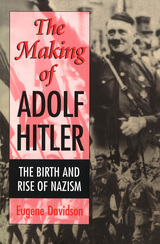
front cover of The Making of Adolf Hitler
The Making of Adolf Hitler
The Birth and Rise of Nazism
Eugene Davidson
University of Missouri Press, 1997

The harsh Armistice terms of 1918, the short-lived Weimar Republic, Hindenburg's senile vacillations, and behind-the-scene power plays form the backbone of this excellent study covering German history during the first three-and-a-half decades of the century.

[more]

front cover of Making Security Social
Making Security Social
Disability, Insurance, and the Birth of the Social Entitlement State in Germany
Greg Eghigian
University of Michigan Press, 2000
While welfare has been subject to pronounced criticism throughout the twentieth century, social insurance has consistently enjoyed the overwhelming support of European policy makers and citizens. This volume argues that the emergence of social insurance represents a paradigmatic shift in modern understandings of health, work, political participation, and government. By institutionalizing compensation, social insurance transformed it into a right that the employed population quickly came to assume. Theoretically informed and based on intensive archival research on disability insurance records, most of which have never been used by historians, the book considers how social science and political philosophy combined to give shape to the idea of a "social" insurance in the nineteenth century; the process by which social insurance gave birth to modern notions of "disability" and "rehabilitation"; and the early-twentieth-century development of political action groups for the disabled. Most earlier histories of German social insurance have been legislative histories that stressed the system's coercive features and functions. Making Security Social, by contrast, emphasizes the administrative practices of everyday life, the experience of consumers, and the ability of workers not only to resist, but to transform, social insurance bureaucracy and political debate. It thus demonstrates that social insurance was pivotal in establishing a general attitude of demand, claim, and entitlement as the primary link between the modern state and those it governed. In addition to historians of Germany, Making Security Social will attract researchers across disciplines who are concerned with public policy, disability studies, and public health.
[more]

front cover of Male Fantasies
Male Fantasies
Volume 1: Women Floods Bodies History
Klaus Theweleit
University of Minnesota Press, 1987

This first volume of Male Fantasies centers on the fantasies that preoccupied a group of men who played a crucial role in the rise of Nazism. These men were officers in the Freikorps--private, volunteer armies that roamed Germany, serving the cause of domestic repression in the aftermath of World War I. Klaus Theweleit draws upon the novels, letters, and autobiographies of these proto-fascists and their contemporaries, as well as cartoons, advertisements, engravings, and posters. He explores these sources, not to discover what their creators thought about fighting or the fatherland, but to seek out and reconstruct their images of women. He shows that the Freikorps male identity was shaped by the dread and revulsion that characterized their relations with women (real or imagined) and that this dread was, in turn, linked to the aggressive racism and anticommunism at the heart of most fascist movements.

Theweleit’s second volume, Male Bodies: Psychoanalyzing the White Terror, carries Male Fantasies from the female image to the self-image of manhood and its ritualized forms of mass behavior, culminating in warfare. It also is available from the University of Minnesota Press.
[more]

front cover of Male Fantasies
Male Fantasies
Volume 2: Male Bodies: Psychoanalyzing the White Terror
Klaus Theweleit
University of Minnesota Press, 1989

Theweleit’s project in Male Fantasies is to discover the emotional core of fascism as it was revealed in the novels and memoirs of the Freikorps, mercenary bands that fought Germany’s border disputes and put down worker revolts in the aftermath of World War I. His excavation of Freikorps literary remains (and the writings of some of their protofascist contemporaries) enabled Theweleit to reconstruct the mythical content of the fascist imagination. An integral part of Male Fantasies is Theweleit’s choice of illustrations--cartoons, advertisements, engravings, posters--that serve as an ironic commentary on the text and extend its meaning in time and space.

In this second volume of the two-volume work Theweleit discovers how the repudiation of one’s own body--and of femininity--became a psychic compulsion associating masculinity with hardness, self-denial, and destruction. We are shown how the body becomes a mechanism for eluding the dreaded liquid--the “Red Flood,” lava, mud--and the “feminine” emotions associated with it. Armored, organized by mental and physical procedures like the military drill, the male body is transformed into a “man of steel.” As Theweleit shows, only in war does this body find redemption from constraint.

The first volume of Male Fantasies, also available from the University of Minnesota Press, deals primarily with the image of women in the collective unconscious of the fascist warrior that threatens to engulf the male ego.

[more]

front cover of Markets and Medicine
Markets and Medicine
The Politics of Health Care Reform in Britain, Germany, and the United States
Susan Giaimo
University of Michigan Press, 2002
Are advanced industrialized countries converging on a market response to reform their systems of social protection? By comparing the health care reform experiences of Britain, Germany, and the United States in the 1990s, Susan Giaimo explores how countries pursue diverse policy responses and how such variations reflect distinctive institutions, actors, and reform politics in each country.
In Britain, the Thatcher government's plan to inject a market into the state-administered national health service resulted in a circumscribed experiment orchestrated from above. In Germany, the Kohl government sought to repair defects in the corporatist arrangement with doctors and insurers, thus limiting the market experiment and designing it to enhance the solidarity of the national health insurance system. In the United States, private market actors foiled Clinton's bid to expand the federal government's role in the private health care system through managed competition and national insurance. But market reform continued, albeit led by private employers and with government officials playing a reactive role. Actors and institutions surrounding the existing health care settlement in each country created particular reform politics that either militated against or fostered the deployment of competition.
The finding that major transformations are occurring in private as well as public systems of social protection suggests that studies of social policy change expand their focus beyond statutory welfare state programs. The book will interest political scientists and policymakers concerned with welfare state reform in advanced industrial societies; social scientists interested in the changing balance among state, market, and societal interests in governance; and health policy researchers, health policymakers, and health care professionals.
Susan Giaimo is an independent scholar. She completed her Ph.D. in Political Science at the University of Wisconsin-Madison. She also earned an MSc in Politics from the London School of Economics and Political Science, with the Politics and Government of Western Europe as the branch of study. After completing her doctorate, she was a postdoctoral fellow in the Robert Wood Johnson Foundation Scholars in Health Policy Research Program, University of California at Berkeley, and the Robert Bosch Foundation Scholars Program in Comparative Public Policy and Comparative Institutions, American Institute for Contemporary German Studies, Johns Hopkins University. She taught in the Political Science Department at Massachusetts Institute of Technology for five years. During that period she won the Society for the Advancement of Socio-Economics Founder's Prize for "Adapting the Welfare State: The Case of Health Care Reform in Britain, Germany, and the United States," a paper she coauthored with Philip Manow. She has also worked for health maintenance organizations (HMOs) and medical practices in the United States.
[more]

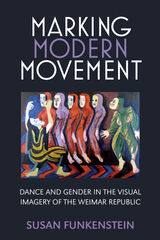
front cover of Marking Modern Movement
Marking Modern Movement
Dance and Gender in the Visual Imagery of the Weimar Republic
Susan Funkenstein
University of Michigan Press, 2020
Imagine yourself in Weimar Germany: you are visually inundated with depictions of dance.  Perusing a women’s magazine, you find photograph after photograph of leggy revue starlets, clad in sequins and feathers, coquettishly smiling at you.  When you attend an art exhibition, you encounter Otto Dix’s six-foot-tall triptych Metropolis, featuring Charleston dancers in the latest luxurious fashions, or Emil Nolde’s watercolors of Mary Wigman, with their luminous blues and purples evoking her choreographies’ mystery and expressivity.  Invited to the Bauhaus, you participate in the Metallic Festival, and witness the school’s transformation into a humorous, shiny, technological total work of art; you costume yourself by strapping a metal plate to your head, admire your reflection in the tin balls hanging from the ceiling, and dance the Bauhaus’ signature step in which you vigorously hop and stomp late into the night.
 
Yet behind the razzle dazzle of these depictions and experiences was one far more complex involving issues of gender and the body during a tumultuous period in history, Germany’s first democracy (1918-1933).  Rather than mere titillation, the images copiously illustrated and analyzed in Marking Modern Movement illuminate how visual artists and dancers befriended one another and collaborated together.  In many ways because of these bonds, artists and dancers forged a new path in which images revealed artists’ deep understanding of dance, their dynamic engagement with popular culture, and out of that, a possibility of representing women dancers as cultural authorities to be respected.  Through six case studies, Marking Modern Movement explores how and why these complex dynamics occurred in ways specific to their historical moment.
 
Extensively illustrated and with color plates, Marking Modern Movement is a clearly written book accessible to general readers and undergraduates. Coming at a time of a growing number of major art museums showcasing large-scale exhibitions on images of dance, the audience exists for a substantial general-public interest in this topic.  Conversing across German studies, art history, dance studies, gender studies, and popular culture studies, Marking Modern Movement is intended to engage readers coming from a wide range of perspectives and interests.

 
[more]

front cover of Marlene Dietrich
Marlene Dietrich
Life and Legend
Steven Bach
University of Minnesota Press, 2011
From the stages of Berlin to anti-Nazi efforts and silver-screen stardom, Steven Bach reveals the fascinating woman behind the myth surrounding Marlene Dietrich in a biography that will stand as the ultimate authority on a singular star. Based on six years of research and hundreds of interviews—including conversations with Dietrich—this is the life story of one of the century’s greatest movie actresses and performers, an icon who embodied glamour and sophistication for audiences around the globe.
[more]

front cover of Marlene Dietrich, Rita Hayworth, & My Mother
Marlene Dietrich, Rita Hayworth, & My Mother
Rita Maria Magdaleno
University of Arizona Press, 2003
Her blood is both Aryan and Aztec and runs as deep as the waters between two worlds.

Rita Magdaleno was born near Dachau shortly after World War II to a German mother and a Mexican American GI. Her family moved to Arizona in 1947, and Rita was raised with her father's traditions—but she remains at heart a child of two cultures.

This poetic memoir, recalling Magdaleno's return to the land of her birth, is an intertwining of personal and public history, bridging continents and cultures in search of family secrets. Her poems recall a mother "Marlene Dietrich pretty, / her smoky voice / & those wide Aryan / eyes that promised / never to lie," a war bride who named her child after a Hollywood movie star even before casting eyes on America. They also offer a new, intimate view of the war—and of today's reunified Germany—and show that the consequences of events played out half a century ago continue to resonate with the children of that era.

Magdaleno navigates currents of emotion that would drown less capable poets. With patience, courage, and abiding love, she draws on memories of mother and motherland to show us that healing can come in many forms.

[more]

front cover of Martin Buber's Formative Years
Martin Buber's Formative Years
From German Culture to Jewish Renewal, 1897–1909
Gilya Gerda Schmidt
University of Alabama Press, 1995
An illuminating look at an understudied, but critical, period in Buber’s early career.

Martin Buber (1878–1965) has had a tremendous impact on the development of Jewish thought as a highly influential figure in 20th-century philosophy and theology. However, most of his key publications appeared during the last forty years of his life and little is known of the formative period in which he was searching for, and finding, the answers to crucial dilemmas affecting Jews and Germans alike. Now available in paperback, Martin Buber’s Formative Years illuminates this critical period in which the seeds were planted for all of his subsequent work.
 
During the period from 1897 to 1909, Buber's keen sense of the crisis of humanity, his intimate knowledge of German culture and Jewish sources, and his fearlessness in the face of possible ridicule challenged him to behave in a manner so outrageous and so contrary to German-Jewish tradition that he actually achieved a transformation of himself and those close to him. Calling on spiritual giants of great historical periods in German, Christian, and Jewish history—such as Nicolas of Cusa, Jakob Boehme, Israel Baal Shem Tov, Rabbi Nachman of Brazlav, Johann Wolfgang von Goethe, and Friedrich Nietzsche—Buber proceeded to subvert the existing order by turning his upside-down world of slave morality right side up once more.
 
By examining the multitude of disparate sources that Buber turned to for inspiration, Gilya Gerda Schmidt elucidates Buber's creative genius and his contribution to turn-of-the-century Jewish renewal. This comprehensive study concludes that Buber was successful in creating the German-Jewish symbiosis that emancipation was to have created for the two peoples but that this synthesis was tragic because it came too late for practical application by Jews in Germany.

[more]

front cover of Martin Monath
Martin Monath
A Jewish Resistance Fighter Amongst Nazi Soldiers
Nathaniel Flakin
Pluto Press, 2019
A dramatisation of Martin Monath's short life (1913-1944) would need little artistic embellishment; his identity shrouded in mystery, and executed by the Gestapo - twice - the historical record reads like a detective novel. Pieced together for the first time by Wladek Flakin, this biography tells the story of the Jewish socialist and editor of Arbeiter und Soldat ('Worker and Soldier'), and his efforts to turn German rank-and-file soldiers against their Nazi officers in occupied France. Born in Berlin in 1913, Martin Monath was a child of war and revolution. In the 1930s he became a leader of the socialist Zionist youth organisation Hashomer Hatzair in Germany. Fleeing from Berlin to Brussels in 1939, he joined the underground Trotskyist party led by Abraham Leon, and soon became a leading member of the Fourth International in Europe. His relocation to Paris in 1943 saw the birth of Arbeiter und Soldat and his work organising illegal cells of German soldiers for a revolutionary struggle against the Nazis. Drawing on extensive archival research, Flakin uses letters, testimonies and unpublished documents to bring Monath's story to life - weaving a tale rich with conviction and betrayal, ideology and espionage.
[more]

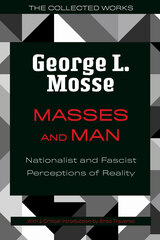
front cover of Masses and Man
Masses and Man
Nationalist and Fascist Perceptions of Reality
George L. Mosse
University of Wisconsin Press, 2024
In fourteen essays that speak to the full breadth of George L. Mosse’s intellectual horizons and scholarly legacy, Masses and Man explores radical nationalism, fascism, and Jewish modernity in twentieth-century Europe. Breaking from the conventions of historical analysis, Mosse shows that “secular religions” like fascism cannot be understood only as the products of socioeconomic or intellectual histories but rather must be approached first and foremost as cultural phenomena.

Masses and Man comprises three parts. The first lays out a cultural history of nationalism, essentially the first of its kind, emphasizing the importance of sacred expressions like myths, symbols, and rituals as appropriated in a political context. The second zeroes in on fascism’s most dramatic irruptions in European history in the rise of Italian Fascism and the Nazi Party in Germany, elucidating these as not just political movements but also cultural and even aesthetic ones. The third part considers nationalism and fascism from the particular standpoint of German Jews.

Taken in full, the volume offers an eloquent summation of Mosse’s groundbreaking insights into European nationalism, fascism, and Jewish history in the twentieth century. A new critical introduction by Enzo Traverso helpfully situates Mosse’s work in context and exposes the many ways in which Masses and Man, first published in 1980, remains relevant today.

[more]

front cover of A Matter of Time
A Matter of Time
Alex Capus
Haus Publishing, 2009
A little known backwater of the history of the Great War is vividly rendered by a great story-teller - the central characters and events of this book are based on fact, but their surroundings and experiences are richly drawn from the author's imagination and detailed research.
[more]

front cover of Max Reinhardt
Max Reinhardt
From Bourgeois Theater to Metropolitan Culture
Peter W. Marx, translated from the German by Robert E. Goodwin
Northwestern University Press, 2024
Max Reinhardt was one of the formative directors of modern theater. Starting as an actor, it soon became clear that he wanted more. His vision of a theater "that returns joy to the people" was vast and expansive: It included intimate theatrical arrangement as well as mass production in the circus arena. Reinhardt's aesthetics were not restricted to a single program but indulged in a playful eclecticism. Thus, his career as a director that lasted for almost 40 years comprises a broad variety of artists of various genres as well as many different styles.

At the same time, Reinhardt soon longed for an international range: guest performances throughout Europe and to the US soon made him into a global star – and even a brand. He represents a metropolitan culture that roots in the late nineteenth century but comes to an end when Fasicsm in Europe ended any hopes for an international culture. As a Jew, Reinhardt himself had to flee the Nazis but when he eventually arrived in the US, he could not follow up with his earlier successes. Marx provides a broad panorama of Reinhardt's work, portraying not only his work method and some of his best known productions, but also the cultural conditions of his visionary enterprise.
 
[more]

front cover of Max Weber
Max Weber
An Introduction to His Life and Work
Dirk Käsler
University of Chicago Press, 1988
Max Weber: An Introduction to His Life and Work has established itself as the standard short introduction in German to the work of Max Weber, and appears here for the first time in English translation. Sociologist Dirk Käsler has a profound sense of Weber's writings, yet manages to make Weber's ideas accessible to the beginner.

Käsler offers a comprehensive account of Weber's views, giving attention both to the context in which Weber produced his most significant contributions to social science, and to the changes involved in his work over the course of his career. This volume also serves as an introduction to the controversies that Weber's writings have stimulated, from the time of their first appearance to the present day.

This book will be of vital interest to anyone concerned with Max Weber and will undoubtedly become the leading student text on Weber in the English-speaking world.

[more]

front cover of Max Weber and German Politics, 1890-1920
Max Weber and German Politics, 1890-1920
Wolfgang J. Mommsen
University of Chicago Press, 1990
A major work of German historiography, this comprehensive account of Weber's political views and activities reveals that, paradoxically, Weber was at once an ardent liberal and a determined German nationalist and imperialist. Wolfgang J. Mommsen shows the important links between these seemingly conflicting positions and provides a critique of Weber's sociology of power and his concept of democratic rule.

First published in German in 1959, Max Weber and German Politics appeared in a revised edition in 1974 and became available in an English translation only in 1984. In writing this work, Mommsen drew extensively on Weber's published and unpublished essays, newspaper articles, memoranda, and correspondence.
[more]

front cover of Max Weber's Comparative-Historical Sociology
Max Weber's Comparative-Historical Sociology
Stephen Kalberg
University of Chicago Press, 1994
The revival of historical sociology in recent decades has largely neglected the contributions of Max Weber. Yet Weber's writings offer a fundamental resource for analyzing problems of comparative historical development. Stephen Kalberg rejects the view that Weber's historical writings consist of an ambiguous mixture of fragmented ideal types on the one hand and the charting of vast processes of rationalization and bureaucracy on the other. On the contrary, Weber's substantive work offers a coherent and distinctive model for comparative analysis. A reconstruction of Weber's comparative historical method, Kalberg argues, uncovers a sophisticated outlook that addresses problems of agency and structure, multiple causation, and institutional interpretation. Kalberg shows how such a representation of Weber's work casts a direct light upon issues of pressing importance in comparative historical studies today. Weber addresses in a forceful way the whole range of issues confronted by the comparative historical enterprise. Once the full analytical and empirical power of Weber's historical writings becomes clear, Weber's work can be seen to generate procedures and strategies appropriate to the study of present day as well as past social processes. Written in an accessible and engaging fashion, this book will appeal to students and professionals in the areas of sociology, anthropology, and comparative history.
[more]

front cover of Mediating Culture in the Seventeenth-Century German Novel
Mediating Culture in the Seventeenth-Century German Novel
Eberhard Werner Happel, 1647-1690
Gerhild Scholz Williams
University of Michigan Press, 2014
Eberhard Happel, German Baroque author of an extensive body of work of fiction and nonfiction, has for many years been categorized as a “courtly-gallant” novelist. In Mediating Culture in the Seventeenth-Century German Novel, author Gerhild Scholz Williams argues that categorizing him thus is to seriously misread him and to miss out on a fascinating perspective on this dynamic period in German history.

Happel primarily lived and worked in the vigorous port city of Hamburg, which was a “media center” in terms of the access it offered to a wide library of books in public and private collections. Hamburg’s port status meant it buzzed with news and information, and Happel drew on this flow of data in his novels. His books deal with many topics of current interest—national identity formation, gender and sexualities, Western European encounters with neighbors to the East, confrontations with non-European and non-Western powers and cultures—and they feature multiple media, including news reports, news collections, and travel writings. As a result, Happel’s use of contemporary source material in his novels feeds our current interest in the impact of the production of knowledge on seventeenth-century narrative. Mediating Culture in the Seventeenth-Century German Novel explores the narrative wealth and multiversity of Happel’s work, examines Happel’s novels as illustrative of seventeenth-century novel writing in Germany, and investigates the synergistic relationship in Happel’s writings between the booming print media industry and the evolution of the German novel.

[more]

front cover of Medical Misinformation in Early Modern Germany
Medical Misinformation in Early Modern Germany
Christopher Hutchinson
University of Delaware Press, 2026

Medical Misinformation in Early Modern Germany examines how doctors, writers, and printers in sixteenth-century Germany responded to the rapid expansion of print and its implications for medical knowledge. The spread of printed texts generated widespread suspicion about print’s reliability as a conduit of information and led writers to reflect on questions of audience, vernacularity, and medical authority in their responses to disease. The book investigates literary texts alongside popular vernacular medical pamphlets on the major epidemic diseases of the period––plague, syphilis, and the English sweating sickness––to reveal a widespread concern with the impact of printed texts on public health. During the 1529 outbreak of the English sweating sickness, this concern culminated in writers’ use of a “rhetoric of virality,” explicitly comparing the circulation of texts to the spread of disease, as they confronted the parallel contagions of disease and information.

[more]

front cover of Memoirs (1630-1680)
Memoirs (1630-1680)
Sophia of Hanover
Iter Press, 2013
Granddaughter of James I of England, Sophia (1630–1714) began life a penniless princess in exile. She ended it as electress dowager of Hanover, an emerging European power. Had she lived two months longer, she would have succeeded to the British crown before her son, George I. In keeping with Sophia’s reputation as the era’s “most entertaining woman,” her memoirs, which she wrote in French, paint a captivating and often humorous portrait of her life as one of Europe’s preeminent noblewomen and celebrities. They also recall, with insight and verve, her interactions with leading men and ladies (Charles II, Louis XIV, Queen Christina of Sweden) and long-forgotten bit players (cavaliers, concubines, clerics, and quacks). The memoirs, which recount the first fifty years of Sophia’s life, appear here in English for the first time in their entirety. Their publication in this series is particularly timely, as it coincides with the three hundredth anniversary of the Hanoverian succession (2014).
[more]

front cover of Memory Passages
Memory Passages
Holocaust Memorials in the United States and Germany
Natasha Goldman
Temple University Press, 2020

For decades, artists and architects have struggled to relate to the Holocaust in visual form, resulting in memorials that feature a diversity of aesthetic strategies. In Memory Passages, Natasha Goldman analyzes both previously-overlooked and internationally-recognized Holocaust memorials in the United States and Germany from the postwar period to the present, drawing on many historical documents for the first time. From the perspectives of visual culture and art history, the book examines changing attitudes toward the Holocaust and the artistic choices that respond to it.

The book introduces lesser-known sculptures, such as Nathan Rapoport’s Monument to the Six Million Jewish Martyrs in Philadelphia, as well as internationally-acclaimed works, such as Peter Eisenman’s Memorial to the Murdered Jews of Europe in Berlin. Other artists examined include Will Lammert, Richard Serra, Joel Shapiro, Gerson Fehrenbach, Margit Kahl, and Andy Goldsworthy.Archival documents and interviews with commissioners, survivors, and artists reveal the conversations and decisions that have shaped Holocaust memorials.

Memory Passages suggests that memorial designers challenge visitors to navigate and activate spaces to engage with history and memory by virtue of walking or meandering. This book will be valuable for anyone teaching—or seeking to better understand—the Holocaust.
[more]

front cover of Metropolitan Governance
Metropolitan Governance
Different Paths in Contrasting Contexts: Germany and Israel
Edited by Hubert Heinelt, Eran Razin, and Karsten Zimmermann
Campus Verlag, 2011

As urban areas have grown and sprawl has spread in recent decades, metropolitan governments around the world have begun to look beyond city borders, establishing regional partnerships to help them deal with issues of transit, resource use, and more. Metropolitan Governance examines this trend through a close comparative study of seven metropolitan areas in Israel and Germany. While not neglecting the reasons behind these changes in governance, the authors pay particular attention to their effects on—and diminishing of—democratic participation and accountability.
[more]

front cover of Michael Polanyi and His Generation
Michael Polanyi and His Generation
Origins of the Social Construction of Science
Mary Jo Nye
University of Chicago Press, 2011
In Michael Polanyi and His Generation, Mary Jo Nye investigates the role that Michael Polanyi and several of his contemporaries played in the emergence of the social turn in the philosophy of science. This turn involved seeing science as a socially based enterprise that does not rely on empiricism and reason alone but on social communities, behavioral norms, and personal commitments. Nye argues that the roots of the social turn are to be found in the scientific culture and political events of Europe in the 1930s, when scientific intellectuals struggled to defend the universal status of scientific knowledge and to justify public support for science in an era of economic catastrophe, Stalinism and Fascism, and increased demands for applications of science to industry and social welfare.
 
At the center of this struggle was Polanyi, who Nye contends was one of the first advocates of this new conception of science. Nye reconstructs Polanyi’s scientific and political milieus in Budapest, Berlin, and Manchester from the 1910s to the 1950s and explains how he and other natural scientists and social scientists of his generation—including J. D. Bernal, Ludwik Fleck, Karl Mannheim, and Robert K. Merton—and the next, such as Thomas Kuhn, forged a politically charged philosophy of science, one that newly emphasized the social construction of science.
[more]

front cover of Mies van der Rohe
Mies van der Rohe
A Critical Biography
Franz Schulze
University of Chicago Press, 1985
Mies van der Rohe: A Critical Biography is a major rewriting and expansion of Franz Schulze’s acclaimed 1985 biography, the first full treatment of the master German-American modern architect. Coauthored with architect Edward Windhorst, this revised edition, three times the length of the original text, features extensive new research and commentary and draws on the best recent work of American and German scholars. The authors’ major new discoveries include the massive transcript of the early-1950s Farnsworth House court case, which discloses for the first time the facts about Mies’s epic battle with his client Edith Farnsworth. Giving voice to dozens of architects who knew and worked with (and sometimes against) Mies, this comprehensive biography tells the compelling story of how Mies and his students and followers created some of the most significant buildings of the twentieth century.
 
“Franz Schulze’s 1985 biography of Ludwig Mies van der Rohe has always been acknowledged as the most comprehensive and thoughtful biography of one of the key figures in twentieth-century architecture. This revised edition with significant new scholarship by its two authors will undoubtedly come to occupy the same position.”—Dietrich Neumann, Brown University
[more]

front cover of Mies van der Rohe
Mies van der Rohe
A Critical Biography, New and Revised Edition
Franz Schulze and Edward Windhorst
University of Chicago Press, 2012
Mies van der Rohe: A Critical Biography is a major rewriting and expansion of Franz Schulze’s acclaimed 1985 biography, the first full treatment of the master German-American modern architect. Coauthored with architect Edward Windhorst, this revised edition, three times the length of the original text, features extensive new research and commentary and draws on the best recent work of American and German scholars. The authors’ major new discoveries include the massive transcript of the early-1950s Farnsworth House court case, which discloses for the first time the facts about Mies’s epic battle with his client Edith Farnsworth. Giving voice to dozens of architects who knew and worked with (and sometimes against) Mies, this comprehensive biography tells the compelling story of how Mies and his students and followers created some of the most significant buildings of the twentieth century.
 
 
[more]

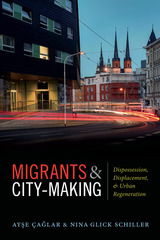
front cover of Migrants and City-Making
Migrants and City-Making
Dispossession, Displacement, and Urban Regeneration
Ayse Caglar and Nina Glick Schiller
Duke University Press, 2018
In Migrants and City-Making Ayşe Çağlar and Nina Glick Schiller trace the participation of migrants in the unequal networks of power that connect their lives to regional, national, and global institutions. Grounding their work in comparative ethnographies of three cities struggling to regain their former standing—Mardin, Turkey; Manchester, New Hampshire; and Halle/Saale, Germany—Çağlar and Glick Schiller challenge common assumptions that migrants exist on society’s periphery, threaten social cohesion, and require integration. Instead Çağlar and Glick Schiller explore their multifaceted role as city-makers, including their relationships to municipal officials, urban developers, political leaders, business owners, community organizers, and social justice movements. In each city Çağlar and Glick Schiller met with migrants from around the world; attended cultural events, meetings, and religious services; and patronized migrant-owned businesses, allowing them to gain insights into the ways in which migrants build social relationships with non-migrants and participate in urban restoration and development. In exploring the changing historical contingencies within which migrants live and work, Çağlar and Glick Schiller highlight how city-making invariably involves engaging with the far-reaching forces that dispossess people of their land, jobs, resources, neighborhoods, and hope. 
[more]

front cover of Mission on the Rhine
Mission on the Rhine
"Reeducation" and Denazification in American-Occupied Germany
James F. Tent
University of Chicago Press, 1982
German society underwent greater change under the four years of military occupation than it had under Hitler and the Nazis. The issue of reeducation lay at the heart of America's occupation policies. Encompassing denazification, restructuring of the school system, university reform, and cultural exchange, reeducation began as an idealistic (and naive) attempt to democratize Germany by making her over in the American image.

For this meticulously researched study, James F. Tent has drawn on a wealth of recently declassified documents and on numerous personal interviews with veterans of the Occupation. He brings to life not only the dilemmas American officials faced in balancing the need for a political purge against the need to rehabilitate a disrupted society but also the paradoxes involved in a democracy's attempt to impose its ideals on another people. His book chronicles the dedicated work of many Americans; it also illuminates America's Occupation experience as a whole.
[more]

front cover of Mobility and Modernity
Mobility and Modernity
Migration in Germany, 1820-1989
Steve Hochstadt
University of Michigan Press, 1999
Mobility and Modernity uses voluminous German data on migrations over the past two centuries to demonstrate why conventional assumptions about the relationship between mobility and modernity must be revised.
 
Thus far the changing total volume of migration has not been traced over a long period for any country. Unique migration registration statistics, both detailed and broadly geographical in coverage, allow the precise plotting of migration rates in Germany since 1820. Steve Hochstadt combines careful quantitative methods, easily understood numerical data, and social analysis based upon broad reading in German social history to show that current beliefs about the direction and timing of changes in German mobility, which have been based on late nineteenth-century anxieties about urbanization and industrialization, do not match the data.
 
Migration rates in Germany rose continuously throughout the nineteenth century, and have fallen during the twentieth century. Mobility, Hochstadt argues, was not an unprecedented accompaniment to industrialization, but a traditional rural response to specific economic changes. Hochstadt's more precise analysis of urban in- and outmigration shows the mechanism of urbanization to have been the migration of families rather than the much greater, but also more circular, migration of single men and women.
 
Hochstadt demonstrates the importance of examining historical behavior, powerfully justifying the methods of historical demography as a path to social understanding. The data and specific conclusions are German, but the methods and reinterpretaion of migration history have much wider application, both to other modern European nations and to currently developing countries. Those who study the modern social history of Europe, the mechanisms that formed urban working classes, and the methods of historical demography will be interested in Hochstadt's work.
[more]

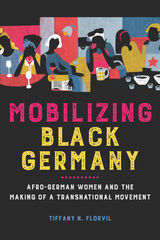
front cover of Mobilizing Black Germany
Mobilizing Black Germany
Afro-German Women and the Making of a Transnational Movement
Tiffany N. Florvil
University of Illinois Press, 2020
In the 1980s and 1990s, Black German women began to play significant roles in challenging the discrimination in their own nation and abroad. Their grassroots organizing, writings, and political and cultural activities nurtured innovative traditions, ideas, and practices. These strategies facilitated new, often radical bonds between people from disparate backgrounds across the Black Diaspora.

Tiffany N. Florvil examines the role of queer and straight women in shaping the contours of the modern Black German movement as part of the Black internationalist opposition to racial and gender oppression. Florvil shows the multifaceted contributions of women to movement making, including Audre Lorde’s role in influencing their activism; the activists who inspired Afro-German women to curate their own identities and histories; and the evolution of the activist groups Initiative of Black Germans and Afro-German Women. These practices and strategies became a rallying point for isolated and marginalized women (and men) and shaped the roots of contemporary Black German activism.

Richly researched and multidimensional in scope, Mobilizing Black Germany offers a rare in-depth look at the emergence of the modern Black German movement and Black feminists’ politics, intellectualism, and internationalism.
[more]

front cover of Moderate Modernity
Moderate Modernity
The Newspaper Tempo and the Transformation of Weimar Democracy
Jochen Hung
University of Michigan Press, 2023
Focusing on the fate of a Berlin-based newspaper during the 1920s and 1930s, Moderate Modernity: The Newspaper Tempo and the Transformation of Weimar Democracy chronicles the transformation of a vibrant and liberal society into an oppressive and authoritarian dictatorship. Tempo proclaimed itself as “Germany’s most modern newspaper” and attempted to capture the spirit of Weimar Berlin, giving a voice to a forward-looking generation that had grown up under the Weimar Republic’s new democratic order. The newspaper celebrated modern technology, spectator sports, and American consumer products, constructing an optimistic vision of Germany’s future as a liberal consumer society anchored in Western values.

The newspaper’s idea of a modern, democratic Germany was undermined by the political and economic crises that hit Germany at the beginning of the 1930s. The way the newspaper described German democracy changed under these pressures. Flappers, American fridges, and modern music—the things that Tempo had once marshalled as representatives of a German future—were now rejected by the newspaper as emblems of a bygone age. The changes in Tempo’s vision of Germany’s future show that descriptions of Weimar politics as a standoff between upright democrats and rabid extremists do not do justice to the historical complexity of the period. Rather, we need to accept the Nazis as a lethal product of a German democracy itself. The history of Tempo teaches us how liberal democracies can create and nurture their own worst enemies.

[more]

front cover of The Modern Israeli and Palestinian Diasporas
The Modern Israeli and Palestinian Diasporas
A Comparative Approach
Edited by Nahum Karlinsky
University of Texas Press, 2024

A comparative study of contemporary Israeli and Palestinian diasporas.

Exilic and diasporic experience have become ubiquitous in recent decades. Jews, lacking a homeland, spread to various parts of the world, making the Jewish diaspora paradigmatic. But after the establishment of Israel in 1948, a different kind of diaspora emerged, as more than a tenth of Israeli citizens have chosen to leave their newly established state and resettle. Meanwhile, about half of all Palestinians, including Palestinian citizens of Israel, now reside in exile, predominantly as a result of the ongoing Palestinian-Israeli conflict.

Recognizing that Israeli-Jewish and Palestinian-Arab societies coexist and are engaged in constant relations, Nahum Karlinsky has assembled an impressive array of contributors to explore these diasporas alongside one another and in dialogue with other diasporic communities. The collected essays cover such topics as Palestinian exiles and diasporas, the demographics of today’s Israeli diaspora, immigrant enterprises, transnationalism and development, the unique place of Israeli Jews in the United States, the literature of Palestinian transnationals, and the emergence of Berlin as a queer Israeli-Jewish immigrant enclave.The Modern Israeli and Palestinian Diasporas challenges and reimagines the very notion of a homeland.

[more]

front cover of Modern Nature
Modern Nature
The Rise of the Biological Perspective in Germany
Lynn K. Nyhart
University of Chicago Press, 2009

In Modern Nature,Lynn K. Nyhart traces the emergence of a “biological perspective” in late nineteenth-century Germany that emphasized the dynamic relationships among organisms, and between organisms and their environment. Examining this approach to nature in light of Germany’s fraught urbanization and industrialization, as well the opportunities presented by new and reforming institutions, she argues that rapid social change drew attention to the role of social relationships and physical environments in rendering a society—and nature—whole, functional, and healthy.

This quintessentially modern view of nature, Nyhart shows, stood in stark contrast to the standard naturalist’s orientation toward classification. While this new biological perspective would eventually grow into the academic discipline of ecology, Modern Nature locates its roots outside the universities, in a vibrant realm of populist natural history inhabited by taxidermists and zookeepers, schoolteachers and museum reformers, amateur enthusiasts and nature protectionists.

Probing the populist beginnings of animal ecology in Germany, Nyhart unites the history of popular natural history with that of elite science in a new way. In doing so, she brings to light a major orientation in late nineteenth-century biology that has long been eclipsed by Darwinism.
[more]

front cover of Modernism and Masculinity
Modernism and Masculinity
Mann, Wedekind, Kandinsky through World War I
Gerald Izenberg
University of Chicago Press, 2000
Modernism and Masculinity argues that a crisis of masculinity among European writers and artists played a key role in the modernist revolution. Gerald Izenberg revises the notion that the feminine provided a premodern refuge for artists critical of individualism and materialism. Industrialization and the growing power of the market inspired novelist Thomas Mann, playwright Frank Wedelind, and painter Wassily Kandinsky to feel the problematic character of their own masculinity. As a result, these artists each came to identify creativity, transcendence, and freedom with the feminine.

But their critique of masculinity created enormous challenges: How could they appropriate a feminine aesthetic while retaining their own masculine idenitites? How did appropiating the feminine affect their personal relationships or their political views? Modernism and Masculinity seeks to answer these questions. In this absorbing combination of biography and formal critique, Izenberg reconsiders the works of Mann, Wedekind, Kandinsky and semonstrates how the cirses of masculinity they endure are found not just within the images and forms of their art, but in the distinct and very personal impulses that inspired it.
[more]

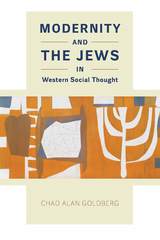
front cover of Modernity and the Jews in Western Social Thought
Modernity and the Jews in Western Social Thought
Chad Alan Goldberg
University of Chicago Press, 2017
In the late nineteenth and early twentieth centuries, prominent social thinkers in France, Germany, and the United States sought to understand the modern world taking shape around them. Although they worked in different national traditions and emphasized different features of modern society, they repeatedly invoked Jews as a touchstone for defining modernity and national identity in a context of rapid social change.

In Modernity and the Jews in Western Social Thought, Chad Alan Goldberg brings us a major new study of Western social thought through the lens of Jews and Judaism. In France, where antisemites decried the French Revolution as the “Jewish Revolution,” Émile Durkheim challenged depictions of Jews as agents of revolutionary subversion or counterrevolutionary reaction. When German thinkers such as Karl Marx, Georg Simmel, Werner Sombart, and Max Weber debated the relationship of the Jews to modern industrial capitalism, they reproduced, in secularized form, cultural assumptions derived from Christian theology. In the United States, William Thomas, Robert Park, and their students conceived the modern city and its new modes of social organization in part by reference to the Jewish immigrants concentrating there. In all three countries, social thinkers invoked real or purported differences between Jews and gentiles to elucidate key dualisms of modern social thought. The Jews thus became an intermediary through which social thinkers discerned in a roundabout fashion the nature, problems, and trajectory of their own wider societies. Goldberg rounds out his fascinating study by proposing a novel explanation for why Jews were such an important cultural reference point. He suggests a rethinking of previous scholarship on Orientalism, Occidentalism, and European perceptions of America, arguing that history extends into the present, with the Jews—and now the Jewish state—continuing to serve as an intermediary for self-reflection in the twenty-first century.
[more]

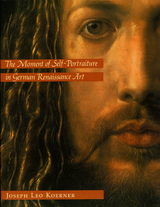
front cover of The Moment of Self-Portraiture in German Renaissance Art
The Moment of Self-Portraiture in German Renaissance Art
Joseph Leo Koerner
University of Chicago Press, 1993
In this groundbreaking and elegantly written study, Joseph Koerner establishes the character of Renaissance art in Germany. Opening up new modes of inquiry for historians of art and early modern Europe, Koerner examines how artists such as Albrecht Durer and Hans Baldung Grien reflected in their masterworks the changing status of the self in sixteenth-century Germany.

"[A] dazzling book. . . . He has turned out one of the most powerful, as well as one of the most ambitious, art-historical works of the last decade." — Anthony Grafton, New Republic

"Rich and splendid. . . . Joseph Koerner's book is a dazzling display of scholarship, enfolding Durer's artistic achievement within the broader issues of self and salvation, and like [Durer's] great Self-
Portrait it holds up a mirror to the modern fable of identity." — Bruce Boucher, The Times

"Remarkable and densely argued." — Marcia Pointon, British Journal of Aesthetics

"Herculean and brilliant. . . . Will echo in fields beyond the Sixteenth-Century and Art History." — Larry Silver, Sixteenth Century Journal

"May be the most ambitious of recent American reflections on the mysteries of German art. His elegantly written book deals with the fateful period in the history of German art when it reached its highest point. . . . Offers deeper and more disturbing insights into German Renaissance art than most earlier scholarship." — Willibald Sauerlander, New York Review of Books

[more]

front cover of Moral Entanglements
Moral Entanglements
Conserving Birds in Britain and Germany
Stefan Bargheer
University of Chicago Press, 2018
At the center of Stefan Bargheer’s account of bird watching, field ornithology, and nature conservation in Britain and Germany stands the question of how values change over time and how individuals develop moral commitments. Using life history data derived from written narratives and oral histories, Moral Entanglements follows the development of conservation from the point in time at which the greatest declines in bird life took place to the current efforts in large-scale biodiversity conservation and environmental policy within the European Union. While often depicted as the outcome of an environmental revolution that has taken place since the 1960s, Bargheer demonstrates to the contrary that the relevant practices and institutions that shape contemporary conservation have evolved gradually since the early nineteenth century. Moral Entanglements further shows that the practices and institutions in which bird conservation is entangled differ between the two countries. In Britain, birds derived their meaning in the context of the game of bird watching as a leisure activity. Here birds are now, as then, the most popular and best protected taxonomic group of wildlife due to their particularly suitable status as toys in a collecting game, turning nature into a playground. In Germany, by contrast, birds were initially part of the world of work. They were protected as useful economic tools, rendering services of ecological pest control in a system of agricultural production modeled after the factory shop floor. Based on this extensive analysis, Bargheer formulates a sociology of morality informed by a pragmatist theory of value.
[more]

front cover of The Moral Meaning of Nature
The Moral Meaning of Nature
Nietzsche’s Darwinian Religion and Its Critics
Peter J. Woodford
University of Chicago Press, 2018
What, if anything, does biological evolution tell us about the nature of religion, ethical values, or even the meaning and purpose of life? The Moral Meaning of Nature sheds new light on these enduring questions by examining the significance of an earlier—and unjustly neglected—discussion of Darwin in late nineteenth-century Germany.
 
We start with Friedrich Nietzsche, whose writings staged one of the first confrontations with the Christian tradition using the resources of Darwinian thought. The lebensphilosophie, or “life-philosophy,” that arose from his engagement with evolutionary ideas drew responses from other influential thinkers, including Franz Overbeck, Georg Simmel, and Heinrich Rickert. These critics all offered cogent challenges to Nietzsche’s appropriation of the newly transforming biological sciences, his negotiation between science and religion, and his interpretation of the implications of Darwinian thought. They also each proposed alternative ways of making sense of Nietzsche’s unique question concerning the meaning of biological evolution “for life.” At the heart of the discussion were debates about the relation of facts and values, the place of divine purpose in the understanding of nonhuman and human agency, the concept of life, and the question of whether the sciences could offer resources to satisfy the human urge to discover sources of value in biological processes. The Moral Meaning of Nature focuses on the historical background of these questions, exposing the complex ways in which they recur in contemporary philosophical debate.

[more]

front cover of The Moral Triangle
The Moral Triangle
Germans, Israelis, Palestinians
Sa'red Atshan and Katharina Galor
Duke University Press, 2020
Berlin is home to Europe’s largest Palestinian diaspora community and one of the world’s largest Israeli diaspora communities. Germany’s guilt about the Nazi Holocaust has led to a public disavowal of anti-Semitism and strong support for the Israeli state. Meanwhile, Palestinians in Berlin report experiencing increasing levels of racism and Islamophobia. In The Moral Triangle Sa’ed Atshan and Katharina Galor draw on ethnographic fieldwork and interviews with Israelis, Palestinians, and Germans in Berlin to explore these asymmetric relationships in the context of official German policies, public discourse, and the private sphere. They show how these relationships stem from narratives surrounding moral responsibility, the Holocaust, the Israel/Palestine conflict, and Germany’s recent welcoming of Middle Eastern refugees. They also point to spaces for activism and solidarity among Germans, Israelis, and Palestinians in Berlin that can help foster restorative justice and account for multiple forms of trauma. Highlighting their interlocutors’ experiences, memories, and hopes, Atshan and Galor demonstrate the myriad ways in which migration, trauma, and contemporary state politics are inextricably linked.
[more]

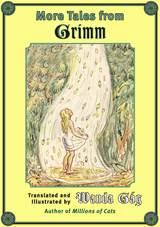
front cover of More Tales from Grimm
More Tales from Grimm
Wanda Gág
University of Minnesota Press, 2006
Renowned children’s book author Wanda Gág presents these classic Grimm tales, accompanied by whimsical illustrations. Drawing on her peasant heritage and childlike sense of wonder, Gág translated the fairy tales in a uniquely American vernacular tongue. More Tales from Grimm contains over thirty more, including “The Golden Key,” “The Seven Swabians,” and “The Wolf and the Fox,” as well as almost one hundred illustrations. No other editions of Grimm’s fairy tales for children can match Gág’s richness of prose and the humor, beauty, and sheer magic of her pictorial interpretation. Best known for her Newbery Honor winner Millions of Cats, Wanda Gág (1893–1946) was a pioneer in children’s book writing, integrating text and illustration. Born in New Ulm, Minnesota, she rose to international acclaim. In recognition of her artistry, she was posthumously awarded the 1958 Lewis Carroll Shelf Award for Millions of Cats and the 1977 Kerlan Award for her body of work.
[more]

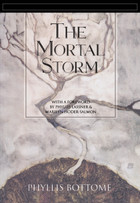
front cover of The Mortal Storm
The Mortal Storm
Phyllis Bottome
Northwestern University Press, 1998
A highly acclaimed anti-fascist novel, The Mortal Storm was Phyllis Bottome's dramatic warning against the warmongering, antisemitism, and misogyny of the Nazis. The story pits the developing political and feminist consciousness of Freya Roth against the Nazi machine that will destroy the fabric of her family and nation. In its combination of adventure and love story, political analysis and history, The Mortal Storm remains a powerful reminder of the greatest crisis of the twentieth century, as well as a riveting personal saga.
[more]

front cover of Mosques in the Metropolis
Mosques in the Metropolis
Incivility, Caste, and Contention in Europe
Elisabeth Becker
University of Chicago Press, 2021
Mosques in the Metropolis offers a unique look into two of Europe’s largest mosques and the communities they support. Elisabeth Becker provides a complex picture of Islam in Europe at a particularly fraught time, shedding light on both experiences of deep and enduring marginalization and the agency of Muslim populaces. She balances individual Muslim voices with the historical and structural forces at play, revealing, in all their complexity, the people for whom the mosques are centers of religion and community life. As her interlocutors come to life in the pages, the metropolis emerges as a space alternative to the nation in which they can contend with degrading images of Islam and Muslims. Ultimately Becker insists that caste is a crucial lens through which to view Muslims in Europe, and through this lens she critiques what she perceives as the failures of European pluralism. To amplify her point, she brings Jewish history and twentieth-century Jewish thought into the conversation directly, drawing on scholars such as Walter Benjamin, Zygmunt Bauman, and Hannah Arendt to describe both Jewish and Muslim life and marginality. By challenging Eurocentric notions, from “progress” to “civility,” “tolerance” to “freedom” and “equality, what is at stake, Becker insists, is the possibility of a truly plural Europe.
[more]

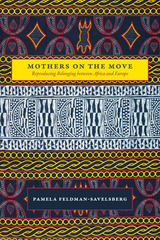
front cover of Mothers on the Move
Mothers on the Move
Reproducing Belonging between Africa and Europe
Pamela Feldman-Savelsberg
University of Chicago Press, 2016
The massive scale and complexity of international migration today tends to obscure the nuanced ways migrant families seek a sense of belonging. In this book, Pamela Feldman-Savelsberg takes readers back and forth between Cameroon and Germany to explore how migrant mothers—through the careful and at times difficult management of relationships—juggle belonging in multiple places at once: their new country, their old country, and the diasporic community that bridges them.
           
Feldman-Savelsberg introduces readers to several Cameroonian mothers, each with her own unique history, concerns, and voice. Through scenes of their lives—at a hometown association’s year-end party, a celebration for a new baby, a visit to the Foreigners’ Office, and many others—as well as the stories they tell one another, Feldman-Savelsberg enlivens our thinking about migrants’ lives and the networks and repertoires that they draw on to find stability and, ultimately, belonging. Placing women’s individual voices within international social contexts, this book unveils new, intimate links between the geographical and the generational as they intersect in the dreams, frustrations, uncertainties, and resolve of strong women holding families together across continents.

 
[more]

front cover of Murder Scenes
Murder Scenes
Normality, Deviance, and Criminal Violence in Weimar Berlin
Sace Elder
University of Michigan Press, 2010
"Sace Elder has exhaustively researched both newspaper and other popular and professional treatments of murder cases and archival sources of police investigations and trials in Berlin between 1919 and 1931. Murder Scenes is an innovative and insightful exploration of the ways in which these investigations and trials, and the publicity surrounding them, reflected and shaped changing notions of normality and deviance in Weimar-era Berlin."
---Kenneth Ledford, Case Western Reserve University

 
Using police reports, witness statements, newspaper accounts, and professional publications, Murder Scenes examines public and private responses to homicidal violence in Berlin during the tumultuous years of the Weimar era. Criminology and police science, both of which became increasingly professionalized over the period, sought to control and contain the blurring of these boundaries but could only do so by relying on a public that was willing to participate in the project. These Weimar developments in police practice in Berlin had important implications for what Elder identifies as an emerging culture of mutual surveillance that was successful both because and in spite of the incompleteness of the system police sought to construct, a culture that in many ways anticipated the culture of denunciation in the Nazi period. In addition to historians of Weimar, modern Germany, and modern Europe, German studies and criminal justice scholars will find this book of interest.
 
Sace Elder is Associate Professor of History at Eastern Illinois University.
[more]

front cover of The Museum in the Cultural Sciences
The Museum in the Cultural Sciences
Collecting, Displaying, and Interpreting Material Culture in the Twentieth Century
Edited by Peter N. Miller
Bard Graduate Center, 2021
In early twentieth-century Berlin, Wilhelm von Bode sparked a controversy with his sweeping proposal to reorganize a group of the city’s museums. Debates about the role and structure of museums played out in 1907 and 1910 with two striking series of articles that appeared in the journal Museumskunde: Journal for the Administration and Technology of Public and Private Collections. The first was a six-part essay by Otto Lauffer on history museums, and the second was a ten-part piece by Oswald Richter regarding ethnographic museums. Together, they initiated a century of significant dialogue.

The Museum in the Cultural Sciences offers the first full English translations of these articles, which remain influential in conversations about the implications of art, historical, and ethnographic museums. They show how sophisticated the discussion of museums and museum display was in the early twentieth century and how much could be gained from revisiting these reflections today. Accompanied by short commentaries from museum professionals, these articles offer an intervention into and intensification of the current debate about the function and purpose of museums.

[more]

front cover of Music and German National Identity
Music and German National Identity
Celia Applegate and Pamela Potter
University of Chicago Press, 2002
Is it merely a coincidence that the three "Bs" of classical music—Bach, Beethoven, Brahms—are all German composers? Why do concert halls all over the world feature mostly the works of German and Austrian composers as their standard repertoire? Over the past three centuries, supporters of German music ranging from music scholars to politicians have nurtured the notion that the German-speaking world possesses a peculiar strength in the cultivation of music.

This book explores the questions of how music came to be associated with German identity, when and how Germans came to be regarded as the "people of music," and how music came to be designated as "the most German art." Drawing on the expertise of leading scholars in German history, musicology, and German literature, the essays assembled here examine philosophy, literature, politics, and social currents, as well as the creation and performance of folk music, art music, church music, jazz, and pop to explore the ways in which music has continued to play a central role in the German national imagination and in shaping German identity.

[more]

front cover of Music in German Philosophy
Music in German Philosophy
An Introduction
Edited by Stefan Lorenz Sorgner and Oliver Fürbeth
University of Chicago Press, 2011

Though many well-known German philosophers have devoted considerable attention to music and its aesthetics, surprisingly few of their writings on the subject have been translated into English. Stefan Lorenz Sorgner, a philosopher, and Oliver Fürbeth, a musicologist, here fill this important gap for musical scholars and students alike with this compelling guide to the musical discourse of ten of the most important German philosophers, from Kant to Adorno.

Music in German Philosophy includes contributions from a renowned group of ten scholars, including some of today’s most prominent German thinkers, all of whom are specialists in the writers they treat. Each chapter consists of a short biographical sketch of the philosopher concerned, a summary of his writings on aesthetics, and finally a detailed exploration of his thoughts on music. The book is prefaced by the editors’ original introduction, presenting music philosophy in Germany before and after Kant, as well as a new introduction and foreword to this English-language addition, which places contemplations on music by these German philosophers within a broader intellectual climate.

[more]

logo for University of Chicago Press
Music Metropolis Berlin
Three Centuries of Musical Culture in the Capital City
Pamela M. Potter
University of Chicago Press

Tracing the development of Berlin as a center of music from the eighteenth century to the present, examining how its music survived despite its turbulent history.

Berlin is a music-lover’s paradise, offering up everything from operas to raves. Yet unlike Vienna, Leipzig, or even Nashville, Berlin does not immediately come to mind as a city of music. Instead, its turbulent history evokes images of industry, commerce, militarism, destruction, division, and resurrection. Over the past three centuries, Berlin was the capital of a kingdom, an empire, a republic, and a dictatorship; it was ravaged by war and occupied by foreign powers; and its division and reunification made it a powerful symbol of the Cold War. Through all these highs and lows, the music played on. Music Metropolis Berlin is the first full-length exploration of how Berlin became a city of music against all odds. 

Unlike the other European music centers that stake their reputations on the fame of composers like Bach or Beethoven, Berlin is known for its ensembles, artists, theaters, organizers, intellectuals, and media stars. This is because Berlin took a very different, and almost accidental, route to becoming a city of music. Hampered for centuries by rulers who were more focused on military and industrial expansion than on cultural prestige, Berlin’s musical life prospered thanks to the ambitions of entrepreneurs and politicians who saw the value in serving the ever-changing music public in an expanding urban landscape. By focusing on Berlin as a rapidly developing global capital, Music Metropolis Berlin looks beyond the music, its creators, and its institutions to reveal how political, economic, and social forces fueled the creation of the Berlin metropolis and continue to nurture a vibrant and diverse musical life. 
 

[more]

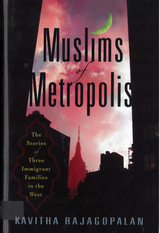
front cover of Muslims of Metropolis
Muslims of Metropolis
The Stories of Three Immigrant Families in the West
Rajagopalan, Kavitha
Rutgers University Press, 2008
Finalist in the Non Fiction category of the 2009 Twelfth Annual Asian America Literary Award

The Muslim population globally is comprised of hundreds of ethnic, linguistic, and religious sub-communities. Yet, more often than not, the public conflates these diverse and unrelated communities, branding Muslim immigrants as a single, suspicious, and culturally antagonistic group of people. Generalizations like these have compromised many Muslim immigrants' sense of belonging and acceptance in places where they have lived, in some cases, for three or four generations.

In Muslims of Metropolis, Kavitha Rajagopalan takes a much needed step in personalizing and humanizing our understanding of the Muslim diaspora. Tracing the stories of three very different families-a Palestinian family moving to London, a Kurdish family moving to Berlin, and a Bangladeshi family moving to New York-she reveals a level of complexity and nuance that is seldom considered. Through their voices and in their words, Rajagopalan describes what prompted these families to leave home, what challenges they faced in adjusting to their new lives, and how they came to view their place in society. Interviews with community leaders, social justice organizations, and with academics and political experts in each of the countries add additional layers of insight to how broad political issues, like nationalist conflict, immigration reform, and antiterrorism strategies affect the lives of Muslims who have migrated in search of economic stability and personal happiness.

Although recent thinking about immigration policy in the United States and Europe emphasizes the importance of long-term integration, a global attitude that continues to sensationalize divisions between Muslim and other communities thwarts this possibility. Integration cannot occur with policy solutions alone-people must feel that they belong to a larger society. Whether read as simple stories or broader narratives, the voices in this revealing book are among the many speaking against generalization, prejudice, and fear that has so far surrounded Muslims living in the West.
[more]

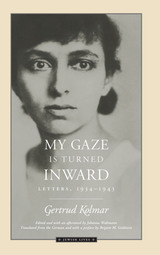
front cover of My Gaze Is Turned Inward
My Gaze Is Turned Inward
Letters 1938-1943
Gertrud Kolmar
Northwestern University Press, 2004
"Event of the time are a bit like Impressionist paintings . . . which combine into a recognizable whole only when observed from a distance." —Gertrude Kolmar in a letter to her sister, October 22, 1939

So a picture of Gertrud Kolmar, a gifted Jewish writer struggling to sustain her art and family, emerges from these eloquent and allusive letters. Written in the stolen moments before her day as a forced laborer in a munitions factory began, the letters tell of Kolmar's move from the family home in Finkenkrug to a three-room flat in Berlin, which she and her father must soon share with other displaced Jews. They describe her factory work as a learning experience and assert, in the face of ever worsening conditions, that true art, never dependent on comfort or peace, is "capable of triumphing over . . . time and place."

These letters are a triumph of art, proclaiming the freedom of the human will amidst oppression. Though prevented by Nazi censorship from saying too much too directly, Kolmar still conveys the intensity and determination of her inner world, as well as the relentlessness of the outer world bent on crushing her. For its insight into the mind and soul of a poet submitting to and denying fate, and for its interior vision of one of history's darkest moments, My Gaze Is Turned Inward is a unique document of literary, historical, and spiritual power.

[more]

front cover of My Germany
My Germany
A Jewish Writer Returns to the World His Parents Escaped
Lev Raphael
University of Wisconsin Press, 2009

Haunted by his parents’ horrific suffering and traumatic losses under Nazi rule, Lev Raphael grew up loathing everything German. Those feelings shaped his Jewish identity, his life, and his career. While researching his mother’s war years after her death, he discovers a distant relative living in the very city where she had worked in a slave labor camp, found freedom, and met his father. Soon after, Raphael is launched on book tours in Germany and, in the process, redefines himself as someone unafraid to face the past and let it go.

Bookmarks, “Top Ten Nonfiction Titles of 2009”

[more]

front cover of My Mother's Silver Fox
My Mother's Silver Fox
Alois Hotschnig
Seagull Books, 2025
A gripping, deeply moving novel about one man’s search for truth and identity in the long shadow of war.

Heinz Fitz has only one tangible clue to his past: a worn piece of paper from the SS-Lebensborn program, a Nazi initiative designed to promote so-called racial purity. His mother, a Norwegian woman, fell in love with the wrong man—an Austrian soldier—during the German occupation. Betrayed and abandoned, she fled to Austria, only to be turned away by his family. Branded a collaborator in her homeland and a pariah in a foreign land, she was left to survive as best she could. Now, years later, her son is determined to piece together the fragments of his origins.

But every answer leads to more questions, and as he unearths painful truths, an alternative story—one of resilience, love, and survival—emerges from the darkness. Inspired by real events, Alois Hotschnig’s novel is both a fierce reckoning with history and a poignant tribute to a mother’s strength. A masterful meditation on memory and storytelling, My Mother’s Silver Fox asks whether the past can ever truly be understood—or if it will always slip through our grasp, like snow through our fingers.
[more]

front cover of A Mythology of Forms
A Mythology of Forms
Selected Writings on Art
Carl Einstein
University of Chicago Press, 2019
The German art historian and critic Carl Einstein (1885-1940) was at the forefront of the modernist movement that defined the twentieth century. One of the most prolific and brilliant early commentators on cubism, he was also among the first authors to assess African sculpture as art. Yet his writings remain relatively little known in the Anglophone world. With A Mythology of Forms, the first representative collection of Einstein’s art theory and criticism to appear in English translation, Charles W. Haxthausen fills this gap. Spanning three decades, it assembles the most important of Einstein’s writings on the art that was central to his critical project—on cubism, surrealism, Pablo Picasso, Georges Braque, and Paul Klee, and includes the full texts of his two pathbreaking books on African art, Negro Sculpture (1915) and African Sculpture (1921). With fourteen texts by Einstein, each presented with extensive commentary, A Mythology of Forms will bring a pivotal voice in the history of modern art into English.
[more]


Send via email Share on Facebook Share on Twitter