
 A SCHOLARLY BOOK REPOSITORY
136 start with M start with M

On the social consequences of machines
Automation, animation, and ecosystems are terms of central media-philosophical concern in today’s society of humans and machines. This volume describes the social consequences of machines as a mediating concept for the animation of life and automation of technology. Bernard Stiegler’s automatic society illustrates how digital media networks establish a new proletariat of knowledge workers. Gertrud Koch offers the animation of the technical to account for the pathological relations that arise between people and their devices. And Thomas Pringle synthesizes how automation and animation explain the history of intellectual exchanges that led to the hybrid concept of the ecosystem, a term that blends computer and natural science. All three contributions analyse how categories of life and technology become mixed in governmental policies, economic exploitation and pathologies of everyday life thereby both curiously and critically advancing the term that underlies those new developments: ‘machine.’

In answering these questions, the authors explore not just the online commentary but also Mad Men fans’ fan fiction, cosplay, cocktail making, and vintage furniture collecting. Whether tweeting as one of the main characters (or just a lowly mail clerk), setting Peggy up with the man who’ll treat her right, or figuring out just which “Mad Man” they are at heart, fans integrate the show into their lives and use it to make sense of their own choices in work, leisure, and love.
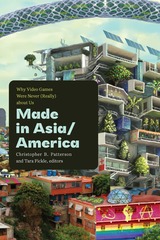
Contributors. Matthew Seiji Burns, Edmond Y. Chang, Naomi Clark, Miyoko Conley, Toby Đỗ, Anthony Dominguez, Tara Fickle, Sarah Christina Ganzon, Yuxin Gao, Domini Gee, Melos Han-Tani, Huan He, Matthew Jungsuk Howard, Rachael Hutchinson, Paraluman (Luna) Javier, Sisi Jiang, Marina Ayano Kittaka, Minh Le, Haneul Lee, Rachel Li, Christian Kealoha Miller, Patrick Miller, Keita C. Moore, Souvik Mukherjee, Christopher B. Patterson, Pamela (Pam) Punzalan, Takeo Rivera, Yasheng She, D. Squinkifer, Lien B. Tran, Prabhash Ranjan Tripathy, Emperatriz Ung, Gerald Voorhees, Yizhou (Joe) Xu, Robert Yang, Mike Ren Yi


Maid for Television examines race, class, and gender relations as embodied in a long history of television servants from 1950 to the turn of the millennium. Although they reside at the visual peripheries, these figures are integral to the idealized American family. Author L. S. Kim redirects viewers' gaze towards the usually overlooked interface between characters, which is drawn through race, class, and gender positioning. Maid for Television tells the stories of servants and the families they work for, in so doing it investigates how Americans have dealt with difference through television as a medium and a mediator.The book philosophically redirects the gaze of television and its projection of racial discourse.
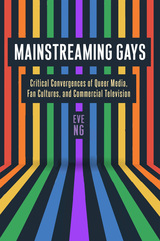
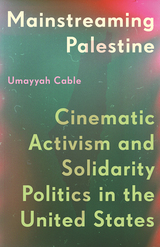
A history of cinema’s role in popularizing the politics of Palestinian liberation
For decades, Arab American activists and allies have used film, video, and multimedia to mobilize support for the Palestinian cause in the United States. In this detailed history of cinema’s role within the broader solidarity movement, Umayyah Cable analyzes the various strands of cinematic activism that have helped move Palestinian liberation politics from the periphery and into the mainstream.
Cable charts the shifting discourse around Palestine as it has been shaped by grassroots film production and alternative media distribution networks as well as more conventional outlets. Ranging from the circulation of educational filmstrips by the Association of Arab American University Graduates in the 1970s to the treatment of Palestinian solidarity at contemporary Hollywood awards ceremonies and film festivals, Mainstreaming Palestine tells the story of how cinema has promoted Palestinian liberation and solidarity politics. While highlighting various public controversies and struggles against censorship, Cable also acknowledges the drawbacks of the Palestinian cause being subsumed by the mainstream, discussing how activism risks becoming fashionable, undermining the radical potential of the very tools that helped bring it there.
Combining archival research, ethnographic observation and interviews, text analysis, and visual analysis of film, video, and multimedia, Mainstreaming Palestine encourages readers to critically assess the relationship between the politics of liberation and the all-consuming engine of contemporary capitalism. By underscoring the impact of visual media on the evolution of the Palestinian solidarity discourse, this book offers both a treatise on the practical power of cinema and a necessary historicization of an urgent issue in American politics.
Retail e-book files for this title are screen-reader friendly with images accompanied by short alt text and/or extended descriptions.
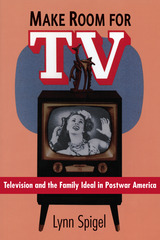
In this fascinating book, Lynn Spigel chronicles the enormous impact of television in the formative years of the new medium: how, over the course of a single decade, television became an intimate part of everyday life. What did Americans expect from it? What effects did the new daily ritual of watching television have on children? Was television welcomed as an unprecedented "window on the world," or as a "one-eyed monster" that would disrupt households and corrupt children?
Drawing on an ambitious array of unconventional sources, from sitcom scripts to articles and advertisements in women's magazines, Spigel offers the fullest available account of the popular response to television in the postwar years. She chronicles the role of television as a focus for evolving debates on issues ranging from the ideal of the perfect family and changes in women's role within the household to new uses of domestic space. The arrival of television did more than turn the living room into a private theater: it offered a national stage on which to play out and resolve conflicts about the way Americans should live.
Spigel chronicles this lively and contentious debate as it took place in the popular media. Of particular interest is her treatment of the way in which the phenomenon of television itself was constantly deliberated—from how programs should be watched to where the set was placed to whether Mom, Dad, or kids should control the dial.
Make Room for TV combines a powerful analysis of the growth of electronic culture with a nuanced social history of family life in postwar America, offering a provocative glimpse of the way television became the mirror of so many of America's hopes and fears and dreams.
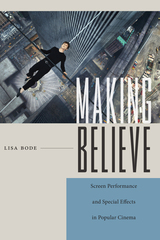
Making Believe incorporates North American film reviews and editorials, actor and crew interviews, trade and fan magazine commentary, actor training manuals, and film production publicity materials to discuss the shifts in screen acting practice and philosophy around transfiguring makeup, doubles, motion capture, and acting to absent places or characters. Along the way it considers how performers and visual and special effects crew work together, and struggle with the industry, critics, and each other to define the aesthetic value of their work, in an industrial system of technological reproduction. Bode opens our eyes to the performing illusions we love and the tensions we experience in wanting to believe in spite of our knowledge that it is all make believe in the end.

This news ethnography brings to bear the overarching value clashes at play in a digital news world. The book argues that emergent news values are reordering the fundamental processes of news production. Immediacy, interactivity, and participation now play a role unlike any time before, creating clashes between old and new. These values emerge from the social practices, pressures, and norms at play inside the newsroom as journalists attempt to negotiate the new demands of their work. Immediacy forces journalists to work in a constant deadline environment, an ASAP world, but one where the vaunted traditions of yesterday's news still appear in the next day's print paper. Interactivity, inspired by the new user-computer directed capacities online and the immersive Web environment, brings new kinds of specialists into the newsroom, but exacts new demands upon the already taxed workflow of traditional journalists. And at time where social media presents the opportunity for new kinds of engagement between the audience and media, business executives hope for branding opportunities while journalists fail to truly interact with their readers.

The film star is not simply an actor but a historical phenomenon that derives from the production of an actor's attractiveness, the circulation of his or her name and likeness, and the support of media consumers. This book analyzes the establishment and transformation of the transnational film star system and the formations of historically important film stars—Japanese and non-Japanese—and casts new light on Japanese modernity as it unfolded between the 1910s and 1930s.
Hideaki Fujiki illustrates how film stardom and the star system emerged and evolved, touching on such facets as the production, representation, circulation, and reception of performers' images in films and other media. Examining several individual performers—particularly benshi narrators, Onoe Matsunosuke, Tachibana Teijiro, Kurishima Sumiko, Clara Bow, and Natsukawa Shizue—as well as certain aspects of different star systems that bolstered individual stardom, this study foregrounds the associations of contradictory, multivalent social factors that constituted modernity in Japan, such as industrialization, capitalism, colonialism, nationalism, and consumerism. Through its nuanced treatment of the production and consumption of film stars, this book shows that modernity is not a simple concept, but an intricate, contested, and paradoxical nexus of diverse social elements emerging in their historical contexts.
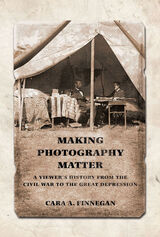
Cara A. Finnegan analyzes a wealth of newspaper and magazine articles, letters to the editor, trial testimony, books, and speeches produced by viewers in response to specific photos they encountered in public. From the portrait of a young Lincoln to images of child laborers and Depression-era hardship, Finnegan treats the photograph as a locus for viewer engagement and constructs a history of photography's viewers that shows how Americans used words about images to participate in the politics of their day. As she shows, encounters with photography helped viewers negotiate the emergent anxieties and crises of U.S. public life through not only persuasion but action, as well.

A Los Angeles Times Book Prize Finalist
Most of us learn about science from media coverage, and anyone seeking factual information on climate change, vaccine safety, genetically modified foods, or the dangers of peanut allergies has to sift through an avalanche of bogus assertions, misinformation, and carefully packaged spin. Cornelia Dean draws on thirty years of experience as a science reporter at the New York Times to expose the tricks that handicap readers with little background in science. She reveals how activists, business spokespersons, religious leaders, and talk show hosts influence the way science is reported and describes the conflicts of interest that color research. At a time when facts are under daily assault, Making Sense of Science seeks to equip nonscientists with a set of critical tools to evaluate the claims and controversies that shape our lives.
“Making Sense of Science explains how to decide who is an expert, how to understand data, what you need to do to read science and figure out whether someone is lying to you… If science leaves you with a headache trying to figure out what’s true, what it all means and who to trust, Dean’s book is a great place to start.”
—Casper Star-Tribune
“Fascinating… Its mission is to help nonscientists evaluate scientific claims, with much attention paid to studies related to health.”
—Seattle Times
“This engaging book offers non-scientists the tools to connect with and evaluate science, and for scientists it is a timely call to action for effective communication.”
—Times Higher Education

With Making the News, Amber Boydstun offers an eye-opening look at the explosive patterns of media attention that determine which issues are brought before the public. At the heart of her argument is the observation that the media have two modes: an “alarm mode” for breaking stories and a “patrol mode” for covering them in greater depth. While institutional incentives often initiate alarm mode around a story, they also propel news outlets into the watchdog-like patrol mode around its policy implications until the next big news item breaks. What results from this pattern of fixation followed by rapid change is skewed coverage of policy issues, with a few receiving the majority of media attention while others receive none at all. Boydstun documents this systemic explosiveness and skew through analysis of media coverage across policy issues, including in-depth looks at the waxing and waning of coverage around two issues: capital punishment and the “war on terror.”
Making the News shows how the seemingly unpredictable day-to-day decisions of the newsroom produce distinct patterns of operation with implications—good and bad—for national politics.
From universities to governments, the Big Five publishers to Amazon, the influence of institutions abounds in US publishing. A diverse array of books from around the globe have been made into world literature in the US, selected by editors, publishers, and bureaucrats, produced by non-profits and for-profit presses of all sizes, and distributed through schools, publishing programs, and bookstores. The resulting world literary canon is the product of complex negotiations between individual preferences and institutional mandates, as well as economic, cultural, and pedagogical logics. While book publishing has fallen increasingly under the sway of global capitalism, yet the literary world remains made up of a series of individuals making choices about whom to fund, teach, translate, edit, and publish. The “world” of world literature, Anna Muenchrath argues, is a heterogeneous network of people whose circulation of literature is necessarily imbricated in the market economy, but whose selections might resist that economy and open new literary futures. Through archival research and close readings, this book considers what those participating are trying to do in circulating a text, and what communities they are helping to form or strengthen.
Making World Literature posits that network theory can effectively model the agency of actors and institutions in the literary field, making visible both the long-term accrual of power, as well as the choices of authors, translators, editors, and readers who do not simply replicate the values of a global literary marketplace, but divert, question, and undermine them. Muenchrath closely examines the paratexts and archival documents surrounding moments of global circulation in and through institutions like US world literature anthologies, the Council of Books in Wartime, the Iowa Writer’s Workshop, Oprah’s Book Club, and Amazon’s translation imprint. The granularity of these case studies reveals the increasingly limited agency of the individual in the global literary field, demonstrating how such players are important actors, and how their choices open up further options for later actors seeking to take texts down new paths toward or after publication.
Founded in 1999 by Steven Gan and Premesh Chandran, Malaysiakini was one of many online portals that sprung up in the wake of Reformasi, a period of public protests sparked by Prime Minister Mahathir Mohammad’s 1998 firing of his deputy Anwar Ibrahim. At first, there was no reason to think that Malaysiakini would be anything momentous. However, Malaysiakini wanted to do something much more important than just reporting on Reformasi—its founders intended to bring independent journalism to Malaysia in hopes of changing the country for the better.
Based on more than fifteen years of observation of Malaysiakini's newsroom practices, Malaysiakini and the Power of Independent Media in Malaysia is an intimate portrait of the people and issues behind Malaysia’s only truly independent media outlet. The author illustrates Malaysiakini’s unique mix of idealism in action, studying how sensitive issues such as race, religion, politics, and citizenship are discussed in the newsroom. This attention to the inner workings of one of the most important media institutions in the region yields not only a deep newsroom ethnography but a nuanced, rich history of modern Malaysia.

When communication becomes the engine of white supremacist violence.
Manifesting Violence: White Terrorism, Digital Culture, and the Rhetoric of Replacement by Casey Ryan Kelly and William Joseph Sipe is a compelling exploration of how the digital world has become a fertile ground for white supremacist ideology. Through an in-depth analysis of white supremacist manifestos, online rhetoric, and the myth of “white genocide,” Kelly and Sipe uncover the disturbing ways in which digital culture facilitates the spread of racist ideology and the radicalization of individuals. By examining the language of white nationalism—calls to defend the white race, family, and children—Kelly and Sipe reveal how these messages, often disguised as entertainment or humor, gradually transform passive consumers into active participants in a dangerous ideology.
Manifesting Violence sheds light on the alarming shift from organized white supremacist groups to a decentralized digital arena where hate speech is disguised as humor and online conversations foster a culture of violence. Kelly and Sipe’s thorough investigation of this growing digital ecosystem offers a chilling glimpse into the dark underbelly of online extremism. A must-read for anyone seeking to understand the growing threat of hate-motivated violence and the urgent need to address its roots in digital culture, Kelly and Sipe offer rich insights to readers, researchers, academics, and policymakers concerned about extremism, online radicalization, and white supremacy.
There is little argument that mass media news projects a particular point of view. The question is how that bias is formed. Most media critics look to the attitudes of reporters and editors, the covert news policy of a publisher, or the outside pressures of politicians and advertisers. Manufacturing the News takes a different tack. Mark Fishman’s research shows how the routine methods of gathering news, rather than any hidden manipulators, determine the ideological character of the product.
News organizations cover the world mainly through “beats,” which tend to route reporters exclusively through governmental agencies and corporate bureaucracies in their search for news. Crime, for instance, is covered through the police and court bureaucracies; local politics through the meetings of the city council, county commissioners, and other official agencies. Reporters under daily deadlines come to depend upon these organizations for the predictable, steady flow of raw news material they provide.
It is part of the function of such bureaucracies to transform complex happenings into procedurally defined “cases.” Thus the information they produce for newsworkers represents their own bureaucratic reality. Occurrences which are not part of some bureaucratic phase are simply ignored. Journalists participate in this system by publicizing bureaucratic reality as hard fact, while accounts from other sources are treated as unconfirmed reports which cannot be published without time-consuming investigation.
Were journalists to employ different methods of news gathering, Fishman concludes, a different reality would emerge in the news—one that might challenge the legitimacy of prevailing political structures. But, under the traditional system, news reports will continue to support the interests of the status quo independently of the attitudes and intentions of reporters, editors, and news sources.
In The Mark of Criminality: Rhetoric, Race, and Gangsta Rap in the War-on-Crime Era, Bryan J. McCann argues that gangsta rap should be viewed as more than a damaging reinforcement of an era’s worst racial stereotypes. Rather, he positions the works of key gangsta rap artists, as well as the controversies their work produced, squarely within the law-and-order politics and popular culture of the 1980s and 1990s to reveal a profoundly complex period in American history when the meanings of crime and criminality were incredibly unstable.
At the center of this era—when politicians sought to prove their “tough-on-crime” credentials—was the mark of criminality, a set of discourses that labeled members of predominantly poor, urban, and minority communities as threats to the social order. Through their use of the mark of criminality, public figures implemented extremely harsh penal polices that have helped make the United States the world’s leading jailer of its adult population.
At the same time when politicians like Ronald Reagan, George H. W. Bush, and Bill Clinton and television shows such as COPS and America’s Most Wanted perpetuated images of gang and drug-filled ghettos, gangsta rap burst out of the hip-hop nation, emanating mainly from the predominantly black neighborhoods of South Central Los Angeles. Groups like NWA and solo artists (including Dr. Dre, Snoop Dogg, and Tupac Shakur) became millionaires by marketing the very discourses political and cultural leaders used to justify their war on crime. For these artists, the mark of criminality was a source of power, credibility, and revenue. By understanding gangsta rap as a potent, if deeply imperfect, enactment of the mark of criminality, we can better understand how crime is always a site of struggle over meaning. Furthermore, by underscoring the nimble rhetorical character of criminality, we can learn lessons that may inform efforts to challenge our nation’s failed policies of mass incarceration.

A media theory of markets
Markets abound in media—but a media theory of markets is still emerging. Anthropology offers media archaeologies of markets, and the sociology of markets and finance unravels how contemporary financial markets have witnessed a media technological arms race. Building on such work, this volume brings together key thinkers of economic studies with German media theory, describes the central role of the media specificity of markets in new detail and inflects them in three distinct ways. Nik-Khah and Mirowski show how the denigration of human cognition and the concomitant faith in computation prevalent in contemporary market-design practices rely on neoliberal conceptions of information in markets. Schröter confronts the asymmetries and abstractions that characterize money as a medium and explores the absence of money in media. Beverungen situates these inflections and gathers further elements for a politically and historically attuned media theory of markets concerned with contemporary phenomena such as high-frequency trading and cryptocurrencies.

From ancient times to the present day, writers and thinkers have remarked on the unique power of music to evoke emotions, signal identity, and bond or divide entire societies, all without the benefit of literal representation. Even if we can't say precisely what our favorite melody means, we know very well what kind of effect it has on us, and on our friends and neighbors.
According to Aram Sinnreich, this power helps to explain why music has so often been regulated in societies around the globe and throughout history. Institutional authorities ranging from dynastic China's “Office to Harmonize Sounds” to today's copyright collecting societies like BMI and ASCAP leverage the rule of law and the power of the market to make sure that some musical forms and practices are allowed and others are prohibited.
Yet, despite the efforts of these powerful regulators, musical cultures consistently devise new and innovative ways to work around institutional regulations. These workarounds often generate new styles and traditions in turn, with effects far beyond the cultural sphere.
Mashed Up chronicles the rise of “configurability,” an emerging musical and cultural moment rooted in today's global, networked communications infrastructure. Based on interviews with dozens of prominent DJs, attorneys, and music industry executives, the book argues that today's battles over sampling, file sharing, and the marketability of new styles such as “mash-ups” and “techno” presage social change on a far broader scale.
Specifically, the book suggests the emergence of a new ethic of configurable collectivism; an economic reunion of labor; a renegotiation of the line between public and private; a shift from linear to recursive logic; and a new “DJ consciousness,” in which the margins are becoming the new mainstream. Whether these changes are sudden or gradual, violent or peaceful, will depend on whether we heed the lessons of configurability, or continue to police and punish the growing ranks of the mashed up.

Mass Deception argues that the George W. Bush administration manufactured public support for the war on Iraq. Scott A. Bonn introduces a unique, integrated, and interdisciplinary theory called "critical communication" to explain how and why political elites and the news media periodically create public panics that benefit both parties. Using quantitative analysis of public opinion polls and presidential rhetoric pre- and post-9/11 in the news media, Bonn applies the moral panic concept to the Iraq war. He critiques the war and occupation of Iraq as violations of domestic and international law. Finally, Mass Deception connects propaganda and distortion efforts by the Bush administration to more general theories of elite deviance and state crime.
As United States television programs, movies, music, and other cultural products make their way around the globe, a vigorous debate over "cultural imperialism" is growing in many countries. This book brings together experts in economics, sociology, anthropology, the humanities, and communications to explore what effects the North American Free Trade Agreement will have on the flow of cultural products among Mexico, the United States, and Canada.
After an overview of free trade and the cultural industries, the book covers the following topics: dominance and resistance, cultural trade and identity in relation to Mexico and to French Canada, and intellectual property rights. Based on present trends, the contributors predict that there will be a steadily increasing flow of cultural products from the United States to its neighbors.
This book grew out of a 1994 conference that brought together leaders of the cultural industries, policy makers, and scholars. It represents state-of-the-art thinking about the global influence of U.S. cultural industries.
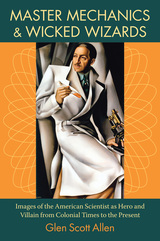
From the earliest depictions of Benjamin Franklin and his kite experiment to 21st-century renderings of mad scientists, representations of American scientists in the popular media reveal a great deal about our cultural hopes and fears. In an entertaining and insightful survey of popular media over three hundred years of American history—religious tracts, political cartoons, literature, theater, advertising, art, comic books, radio, music, television, and film—Glen Scott Allen examines the stereotypes assigned to scientists for what they tell us about America's pride in its technological achievements as well as our prejudices about certain “suspect” kinds of scientific investigation.
Working in the tradition of cultural studies, Allen offers an analysis that is historically comprehensive and critically specific. Integrating both “high” literature and “low” comedy, he delves into the assumptions about scientists—good, bad, and mad—that have been shaped by and have in turn shaped American cultural forces. Throughout the book, his focus is on why certain kinds of scientists have been lionized as American heroes, while others have been demonized as anti-American villains.
Allen demonstrates that there is a continuous thread running from the seminal mad scientists of Hawthorne's nineteenth-century fiction to modern megalomaniacs like Dr. Strangelove; that marketing was as important to the reputation of the great independent inventors as technological prowess was; and that cultural prejudices which can be traced all the way back to Puritan ideology are at work in modern scientific controversies over cloning and evolution.
The periods and movements examined are remarkably far-ranging: the literature and philosophy of the Romantics; the technology fairs and utopian fiction of the nineteenth century; political movements of the 1930s and 1940s; the science fiction boom of the 1950s; the space and arms races of the 1960s and 1970s; the resurgence of pseudo-sciences in the 1980s and 1990s. This book will be of interest not just to teachers and students of cultural studies and the history of science and technology but to anyone interested in American culture and how it shapes our experience and defines our horizons.

Today’s world offers no shortage of media for us to consume, and the ever-expanding array of available media has changed the way scholars think about its production and reception. Missing from these conversations about new media, however, is the maker—the one with the power to produce media from their own pocket.
In Material Media-Making in the Digital Age, Daniel Binns looks at the current media landscape in order to understand his own media practice. The result is a personal journey through media theory, history, and technology, furnished with practical lessons on the digital form for teachers, students, professionals, and enthusiasts. A refreshing combination of theory and practice written in a personal, engaging style, this book will enable readers to understand how a personal creative practice might unlock deeper thinking about media and its place in the world.
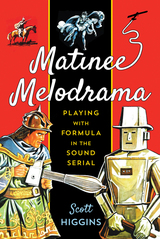
Matinee Melodrama is the first book about the adventure serial as a distinct artform, one that uniquely encouraged audience participation and imaginative play. Media scholar Scott Higgins proposes that the serial’s incoherent plotting and reliance on formula, far from being faults, should be understood as some of its most appealing attributes, helping to spawn an active fan culture. Further, he suggests these serials laid the groundwork not only for modern-day cinematic blockbusters like Star Wars and Raiders of the Lost Ark, but also for all kinds of interactive media that combine spectacle, storytelling, and play.
As it identifies key elements of the serial form—from stock characters to cliffhangers—Matinee Melodrama delves deeply into questions about the nature of suspense, the aesthetics of action, and the potentials of formulaic narrative. Yet it also provides readers with a loving look at everything from Zorro’s Fighting Legion to Daredevils of the Red Circle, conveying exactly why these films continue to thrill and enthrall their fans.
As the nineteenth century came to a close and questions concerning the future of African American life reached a fever pitch, many social scientists and reformers approached post-emancipation Black life as an empirical problem that could be systematically solved with the help of new technologies like the social survey, photography, and film. What ensued was nothing other than a “racial data revolution,” one which rendered African American life an inanimate object of inquiry in the name of social order and racial regulation. At the very same time, African American cultural producers and intellectuals such as W. E. B. Du Bois, Kelly Miller, Sutton Griggs, and Zora Neale Hurston staged their own kind of revolution, un-disciplining racial data in ways that captured the dynamism of Black social life.
The Matter of Black Living excavates the dynamic interplay between racial data and Black aesthetic production that shaped late nineteenth-century social, cultural, and literary atmosphere. Through assembling previously overlooked archives and seemingly familiar texts, Womack shows how these artists and writers recalibrated the relationship between data and Black life. The result is a fresh and nuanced take on the history of documenting Blackness. The Matter of Black Living charts a new genealogy from which we can rethink the political and aesthetic work of racial data, a task that has never been more urgent.
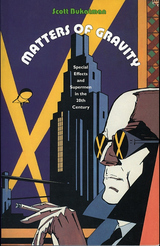
Considering theme parks, cyberspace, cinematic special effects, superhero comics, and musical films, Matters of Gravity highlights phenomena that make technology spectacular, permit unfettered flights of fantasy, and free us momentarily from the weight of gravity and history, of past and present. Bukatman delves into the dynamic ways pop culture imagines that apotheosis of modernity: the urban metropolis. He points to two genres, musical films and superhero comics, that turn the city into a unique site of transformative power. Leaping in single bounds from lively descriptions to sharp theoretical insights, Matters of Gravity is a deft, exhilarating celebration of the liberatory effects of popular culture.


In Medea's Daughters, Jennifer Jones explores the legal, cultural, and dramatic representations of six accused murderesses to look at how English-speaking society responded to and controlled anxiety over female transgressions. The woman who kills—in particular, the woman who kills a member of her own family—has not only broken the law, she has also violated gender expectations. Jones argues that dramatic representations of criminal women, especially women who kill, proliferate during times of heightened feminist activity and that theatrical narratives, as evidenced in plays, television, and film, serve to contain women and deflect attention away from issues of women’s systematic repression.
Medea’s Daughters focuses on six women (of whom Lizzie Borden, Susan Smith, and Louise Woodward are the best known) whose murder trials caught the attention of their respective cultures. This broad spectrum allows an examination of how women’s legal status has evolved over five centuries.
MEDIA: A Transdisciplinary Inquiry explores evolving definitions of media and interrogates how media technologies are transforming media theory and practice. The collection addresses the emerging roles of media across a wide range of disciplines, featuring contributions from an array of internationally known scholars and practitioners.
The definition of media itself is in a constant state of flux, expanding to include an ever-widening range of concepts, products, services, and institutions. Here, the authors reconceptualize media, drawing not only on media and communication studies, but also philosophy, sociology, political science, biology, art, computer science, and information studies, among other disciplines. The collection challenges traditional notions of media, explores emerging media, and reexamines concepts including technology, environment, and ecology; multimedia, mediation, and labor; and participation, repair, and curation. These timely and original discussions by established scholars in the field provide a valuable contribution to the fusion of media across disciplines.
All the tips, ideas and advice given to, and requested by, MA students in Media and Communications, are brought together in an easy-to-use accessible guide to help students study most effectively.
Based upon many years of teaching study skills and hundreds of lecture slides and handouts this introduction covers a range of general and generic skills that the author relates specifically towards media and communications studies. As well as the mechanics of writing and presentations, the book also shows how students can work on and engage with the critical and contemplative elements of their degrees whilst retaining motivation and refining timekeeping skills.
Of course the nuts and bolts of reading, writing, listening, seminars and the dreaded dissertation and essays are covered too. In addition advice on referencing, citation and academic style is offered for those with concerns over English grammar and expression.
Aimed primarily at postgraduate students, there is significant crossover with undergraduate work, so this book will also prove of use to upper level undergraduate readers whether using English as a first or second language.


An essential account of how the media devices we use today inherit the management practices governing factory labor
This book argues that management is enabled by media forms, just as media gives life to management. Media technologies central to management have included the stopwatch, the punch card, the calculator, and the camera, while management theories are taught in printed and virtual textbooks and online through TED talks. In each stage of the evolving relationship between workers and employers, management innovations are learned through media, with media formats producing fresh opportunities for management.
Drawing on rich historical and ethnographic case studies, this book approaches key instances of the industrial and service economy—the legacy of Toyotism in today’s software industry, labor mediators in electronics manufacturing in Central and Eastern Europe, and app-based food-delivery platforms in China—to push media and management studies in new directions. Media and Management offers a provocative insight on the future of labor and media that inevitably cross geographical boundaries.
How media shapes our actions and feelings about race
Amid fervent conversations about antiracism and police violence, Media and the Affective Life of Slavery delivers vital new ideas about how our feelings about race are governed and normalized by our media landscape. Allison Page examines U.S. media from the 1960s to today, analyzing how media culture instructs viewers to act and feel in accordance with new racial norms created for an era supposedly defined by an end to legal racism.
From the classic television miniseries Roots to the edutainment video game Mission 2: Flight to Freedom and the popular website slaveryfootprint.org, Media and the Affective Life of Slavery provides an in-depth look at the capitalist and cultural artifacts that teach the U.S. public about slavery. Page theorizes media not only as a system of representation but also as a technology of citizenship and subjectivity, wherein race is seen as a problem to be solved. Ultimately, she argues that visual culture works through emotion, a powerful lever for shaping and managing racialized subjectivity.
Media and the Affective Life of Slavery delivers compelling, provocative material and includes a wealth of archival research into such realms as news, entertainment, television, curricula, video games, and digital apps, providing new and innovative scholarship where none currently exists.
This is the first book to explore both sides of the media equation. Examining how local radio was used as a tool of hate, encouraging neighbors to turn against each other, the book also presents a critique of international media coverage. Bringing together local reporters, high-profile Western journalists, and leading media theorists, this is the only book to identify the extent of the media's accountability. It also examines deliberations by the International Criminal Tribunal for Rwanda on the role of the media in the genocide. This book is a startling record of the negative influence that the media can have. The authors put forward suggestions for the future, outlining how we can avoid censorship and propaganda and they argue for a new responsibility in media reporting.
Media backends--the electronics, labor, and operations behind our screens--significantly influence our understanding of the sociotechnical relations, economies, and operations of media. Lisa Parks, Julia Velkova, and Sander De Ridder assemble essays that delve into the evolving politics of the media infrastructural landscape. Throughout, the contributors draw on feminist, queer, and intersectional criticism to engage with infrastructural and industrial issues. This focus reflects a concern about the systemic inequalities that emerge when tech companies and designers fail to address workplace discrimination and algorithmic violence and exclusions. Moving from smart phones to smart dust, the essayists examine topics like artificial intelligence, human-machine communication, and links between digital infrastructures and public service media alongside investigations into the algorithmic backends at Netflix and Spotify, Google’s hyperscale data centers, and video-on-demand services in India.
A fascinating foray into an expanding landscape of media studies, Media Backends illuminates the behind-the-screen processes influencing our digital lives.
Contributors: Mark Andrejevic, Philippe Bouquillion, Jonathan Cohn, Faithe J. Day, Sander De Ridder, Fatima Gaw, Christine Ithurbide, Anne Kaun, Amanda Lagerkvist, Alexis Logsdon, Stine Lomborg, Tim Markham, Vicki Mayer, Rahul Mukherjee, Kaarina Nikunen, Lisa Parks, Vibodh Parthasarathi, Philipp Seuferling, Ranjit Singh, Jacek Smolicki, Fredrik Stiernstedt, Matilda Tudor, Julia Velkova, and Zala Volcic
The media draws the cultural boundaries of our environmental imagination--and influences just who benefits. Murphy's analysis emphasizes social context, institutional alignments, and commercial media's ways of rendering discussion. He identifies and examines key terms, phrases, and metaphors as well as the ways consumers are presented with ideas like agency and the place of nature. What emerges is the link between pervasive messaging and an "environment" conjured by our media-saturated social imagination. As the author shows, today's complex, integrated media networks shape, frame, and deliver many of our underlying ideas about the environment. Increasingly--and ominously--individuals and communities experience these ideas not only in the developed world but in the increasingly consumption-oriented Global South.


Media, Culture, and Decolonization: Re-righting the Subaltern Histories of Ghana invites us to look at media and culture from a decolonial perspective. Through Dagbaŋ epistemologies and knowledge systems, this book examines media by highlighting how African languages, cultures, and traditions can shift how we think of knowledge. It is an offering to anyone curious about the relationship between culture, language, and media. By focusing on African language media in Ghana such as film, television, and radio, the book emphasizes the importance of espousing a decolonial politic and praxis in the process of co-creating knowledge with Indigenous communities. It connects the struggles of global majority countries and demonstrates the ways in which (neo)colonialism and imperialism impede the work toward liberatory futures. This book demonstrates the potential that African language media hold as tools of cultural and epistemological decolonization.

Written by an interdisciplinary group of experts, this edited collection addresses the mutual influence among disparate spheres of public life that enabled the media “Wild West” of the first post-Soviet decade. As a joint platform, the volume and the associated Multimedia Sourcebook of the Russian 1990s present the decade’s media cultures in a manner that reflects their historical interconnectedness and relationship to the global present.
Edited by Maya Vinokour with contributions from Bradley Gorski, Courtney Doucette, Fabrizio Fenghi, Rita Safariants, Daniil Leiderman, Thomas Keenan, and Pavel Khazanov.
Media, Democracy and European Culture presents up-to-date and cutting-edge research on the political and cultural dimension of democracy in Europe and its representation in the media. This interdisciplinary volume brings together the work of some of the most prominent European scholars in media, political science, sociology, cultural studies and law. The contributors explore issues of globalization, the role of the media and communication policy to order to provide a comparative country-to-country look at how the media constructs European identity. This timely and forward-looking collection will be of interest to scholars of media, international and cultural studies.

Judith Farquhar examines how health magazines serve as sources of both medical information and erotic titillation to readers in urban China. Tom Boellstorff analyzes how queer zines produced in Indonesia construct the relationship between same-sex desire and citizenship. Purnima Mankekar examines the rearticulation of commodity affect, erotics, and nation on Indian television. Louisa Schein describes how portrayals of Hmong women in videos shot in Laos create desires for the homeland among viewers in the diaspora. Taken together, the essays offer fresh insights into research on gender, erotics, media, and Asia transnationally conceived.
Contributors. Anne Allison, Tom Boellstorff, Nicole Constable, Heather Dell, Judith Farquhar, Sarah L. Friedman, Martin F. Manalansan IV, Purnima Mankekar, Louisa Schein, Everett Yuehong Zhang

Herman Wasserman analyzes the debates surrounding South Africa's new media presence against the backdrop of rapidly changing geopolitics. His exploration reveals how South African disputes regarding access to, and representation in, the media reflect the domination and inequality in the global communication sphere. Optimists see post-apartheid media as providing a vital space that encourages exchanges of opinion in a young democracy. Critics argue the public sphere mirrors South Africa's past divisions and privileges the viewpoints of the elite. Wasserman delves into the ways these simplistic narratives obscure the country's internal tensions, conflicts, and paradoxes even as he charts the diverse nature of South African entry into the global arena.
Media in Europe Today provides a comprehensive overview of European media in its current state of transformation. Through a focus on specific European media sectors, it assesses the impact of new technologies across industries and addresses a wide range of practices, strategies, and challenges facing European media today. The Euromedia Research Group has more than twenty years of experience in the observation of trends affecting media today, and this book marks the strong continuation of that long tradition.
Yesil confronts essential questions regarding: the role of the state and military in building the structures that shaped Turkey's media system; media adaptations to ever-shifting contours of political and economic power; how the far-flung economic interests of media conglomerates leave them vulnerable to state pressure; and the ways Turkey's politicized judiciary criminalizes certain speech.
Drawing on local knowledge and a wealth of Turkish sources, Yesil provides an engrossing look at the fault lines carved by authoritarianism, tradition, neoliberal reform, and globalization within Turkey's increasingly far-reaching media.
Looking beyond national and cultural boundaries, Media in the Enlarged Europe focuses on the complexity and instability of the European Union and its relationship with the mass media. Contributors to this volume address the continuing growth and expansion of the European Union, relationships between old and new Europe, and social and political developments in the former communist countries. Media in the Enlarged Europe presents snapshots of media politics, policies, industries, and cultures in the European Union as a whole, while incorporating case studies of the history and current state of mass media in specific nations. This will be an essential volume for students and experts in media studies, international relations, and international studies.

The horrific events of October 7 and the devastating war in Gaza have brought Israel/Palestine to the headlines once again. We have seen this all play out before: another ambitious peace plan, which secured a ceasefire, is imagined as the dawn of a new era of peace in the Middle East. But is it? Critiquing traditional state-centered approaches to peace, which usually highlight the work of diplomats and politicians, and which historically failed miserably in Israel/Palestine, Media Making as Peacemaking shifts our attention to the experiences of ordinary people. Investigating the idea of media encounters, this book shows how the collaboration of Palestinian and Jewish media practitioners and the popular texts they create together in television dramas, digital activism and mainstream journalism offer a new and exciting way to think about peace . A peace which does not maintain a repressive status quo, but seeks to deliver equality and justice to all people, Palestinians and Jews, living between the Jordan River and the Mediterranean Sea.
Using a sample of European newspapers and their TV listings as a stepping stone, Media, Markets and Public Spheres presents an overview of changes in European public spheres over the last fifty years. With in-depth analyses of structural changes in press and broadcasting, changing relations between media, and changes in media policies, this book explores how and why the media decisively influence most aspects of society. Media, Markets and Public Spheres will be useful to students in media and communication studies and European studies, as well as for those studying sociology and political science.
Media Materialities brings together a team of scholars to analyze the increasingly complex relationships between media forms and formats, materiality, and meaning. Deploying a number of different qualitative methodologies, the contributors address three overarching concepts: form, format, and ephemeral meaning. They investigate a range of media artifacts, such as 8mm film, board game maps, videogames, cassette tapes, transistor radios, and Twitter. Their goal is to create spaces for conversation and debate about the implications that this plurality of material meanings might have for the study of media, culture, and society.

In the transition to a media landscape increasingly dominated by broadband internet distribution and the dominance of US-centric new media behemoths Google, Facebook, Apple, Amazon, and Netflix, Media Pluralism and Online News investigates measures that can be taken to reduce this ongoing march of concentration and the attenuation of media voices. The authors argue that there is an urgent need for revitalized thinking for a media policy agenda to deal with the trend of concentrated media power, which is an ongoing global risk to public interest journalism. Securing the public interest in a vibrant and sustainable news media sector will require that merger decisions assess whether there is a reduction in diversity, calling for a new public interest test and a more expansive policy focus than in the past.
Award-winning author David J. Park argues that the battle against global warming is also a fight for media reform. With his new book Media Reform and the Climate Emergency: Rethinking Communication in the Struggle for a Sustainable Future, he critically examines how advertising, the digital infrastructure, and journalism advance the climate emergency and lays out a path of reform to help create a more sustainable world. The production and consumption of goods and services within consumer societies lead to unsustainable greenhouse gas emissions, and Park finds that much of mass communication is either dependent upon or closely tied to the success of this social organization. As a result, he suggests successful environmental movements creatively dismantle or reform institutional infrastructures that extend the planetary global warming crisis and the unsustainable consumption of nature.
Communication policies and industries are part of these infrastructures. Advertising evolved to propel a new consumer society that would encourage the over-consumption of goods and services with harmful and unsustainable production processes. Our digital infrastructure is largely premised upon the surveillance of online consumer habits and preferences, with the goal to create individualized messages to more effectively persuade people to increase their consumption habits. Much of commercial journalism resists the drastic and immediate regulatory changes necessary to address the worst aspects of this crisis. This is because so many of the needed changes challenge the media’s source of income, their libertarian philosophy, and the general status quo, which is preferred by elites. Bound to foster conversations among scholars, activists, politicians, and those who work in the communication industries, this book rethinks mass communication and highlights how immediate reform is needed in the struggle for a sustainable planet.

Contributors. Christopher Ali, Patrick Bresnihan, Patrick Brodie, Darin Barney, Jenna Burrell, Jordan B. Kinder, Burç Köstem, Cindy Lin, Emily Ng, Lisa Parks, Anne Pasek, Esther Peeren, Nicole Starosielski, Ishita Tiwary, Hunter Vaughan, Ayesha Vemuri, Megan Wiessner, Assatu Wisseh
"This book is the perfect primer for understanding media in the digital age. We are in an era when newspaper, radio, and television are fast becoming archeological concepts. Herein are the reasons why."
---Nicholas Negroponte, founder and chairman of One Laptop per Child and cofounder of the MIT Media Laboratory
"Congratulations to Neuman and colleagues for a fascinating exploration of how previous new media were constructed, whether things could have been otherwise, and what can be learned for future media."
---Sonia Livingstone, Department of Media and Communications, the London School of Economics and Political Science
In Media, Technology, and Society, some of the most prominent figures in media studies explore the issue of media evolution. Focusing on a variety of compelling examples in media history, ranging from the telephone to the television, the radio to the Internet, these essays collectively address a series of notoriously vexing questions about the nature of technological change. Is it possible to make general claims about the conditions that enable or inhibit innovation? Does government regulation tend to protect or thwart incumbent interests? What kinds of concepts are needed to address the relationship between technology and society in a nonreductive and nondeterministic manner? To what extent can media history help us to understand and to influence the future of media in constructive ways? The contributors' historically grounded responses to these questions will be relevant to numerous fields, including history, media and communication studies, management, sociology, and information studies.
W. Russell Neuman is John Derby Evans Professor of Media Technology and Research Professor, Center for Political Studies, Institute for Social Research, at the University of Michigan.
DIGITALCULTUREBOOKS: a collaborative imprint of the University of Michigan Press and the University of Michigan Library
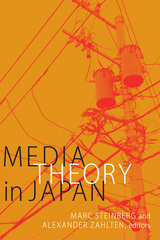

Media studies courses, particularly introductory courses, are often narrowly focused on US and Western European canons. Instructors for introductory media studies courses wishing to expand the offerings in their curricula will find in these essays new ways of approaching foundational concepts and issues in the field, including globalization, social difference, and diverse media cultures. Scholars wishing to expand their research into specific media forms or representational issues can also turn to these case studies for approaches from beyond the US. By including a variety of media and several geographical areas, the collection introduces readers to the formal, technological, and cultural diversity of global media studies.
Edited by Juan Llamas-Rodriguez with contributions from Anthony Adah and Añulika Agina, Maria Corrigan, Benjamin Han, Anna Shah Hoque, Meryem Kamil, Angelica Marie Lawson, Lilia Adriana Perez Limon, Sonia Robles, Kuhu Tanvir, David Tenorio, and Rachel van der Merwe.
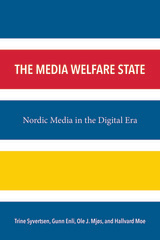
The Media Welfare State: Nordic Media in the Digital Era comprehensively addresses the central dynamics of the digitalization of the media industry in the Nordic countries—Sweden, Norway, Denmark, Finland, and Iceland—and the ways media organizations there are transforming to address the new digital environment. Taking a comparative approach, the authors provide an overview of media institutions, content, use, and policy throughout the region, focusing on the impact of information and communication technology/internet and digitalization on the Nordic media sector. Illustrating the shifting media landscape the authors draw on a wide range of cases, including developments in the press, television, the public service media institutions, and telecommunication.
This volume focuses on the matrix offered by the media-democracy paradox in Ghana, Africa, and the Global South. As the first black African country south of the Sahara to attain political independence from Great Britain, Ghana is widely acknowledged by the international community as a model of democracy. This book examines the praxis of this democracy and its media, delving into Ghana’s evolvement, media practices, leadership aspirations, pressure group politics, and ideological cleavages.
A rich data source for students, scholars, researchers, and political actors on both the African continent and the diaspora, The Media-Democracy Paradox in Ghana challenges the dominant Western theories of media and democracy, examines the growing influence of social media in political discourse, and provides insightful analysis of debates surrounding political communication and its implications for strengthening democratic culture.
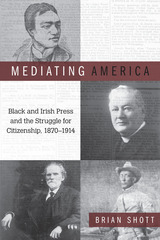
Until recently, print media was the dominant force in American culture. The power of the paper was especially true in minority communities. African Americans and European immigrants vigorously embraced the print newsweekly as a forum to move public opinion, cohere group identity, and establish American belonging.
Mediating America explores the life and work of T. Thomas Fortune and J. Samuel Stemons as well as Rev. Peter C. Yorke and Patrick Ford—respectively two African American and two Irish American editor/activists in the late nineteenth and early twentieth centuries. Historian Brian Shott shows how each of these “race men” (the parlance of the time) understood and advocated for his group’s interests through their newspapers. Yet the author also explains how the newspaper medium itself—through illustrations, cartoons, and photographs; advertisements and page layout; and more—could constrain editors’ efforts to guide debates over race, religion, and citizenship during a tumultuous time of social unrest and imperial expansion.
Black and Irish journalists used newspapers to recover and reinvigorate racial identities. As Shott proves, minority print culture was a powerful force in defining American nationhood.
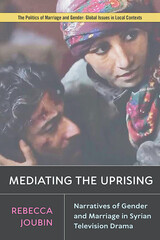
While for some screenwriters a return to pre-2011 life would be welcome after so much bloodshed, others advocated profound cultural and social transformation, instead. They employed marriage and gender metaphors in the stories they wrote to engage in political critique, even at the risk of creating marketing difficulties for the shows or they created escapist stories such as transnational adaptations and Old Damascus tales. Serving as heritage preservation, Mediating the Uprising underscores that television drama creators in Syria have many ways of engaging in protest, with gender and marriage at the heart of the polemic.
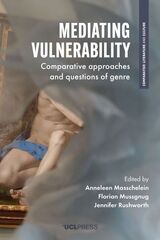
To experience vulnerability is to experience the tension between ruin and creativity: a vulnerable species faces extinction but also evolution, and a vulnerable person risks both irreparable harm and transformative connection. Mediating Vulnerability explores how this tension plays out across contemporary literary studies. Examining a variety of approaches to the destructive and remediating powers of genre, the authors consider how vulnerability intersects a range of representational forms including high-profile fiction by Margaret Atwood and Cormac McCarthy as well as lesser-known graphic novels, video games, television, and photography.
Over the past year, international and national media have been full of stories about protest movements and tumultuous social upheaval from Tunisia to California. But scholars have not yet fully addressed the connection between these movements and the media and communication channels through which their messages spread. Correcting that imbalance, Mediation and Protest Movements explores the nature of the relationship between protest movements, media representation, and communication strategies and tactics.
In a series of fascinating essays, contributors to this timely volume focus on the processes and practices in which contemporary protesters engage when acting with and through media. Covering both online and offline contexts as well as mainstream and alternative media, they consider media environments around the world in all their complexity. They also provide a broad and comparative perspective on the ways that protest movements at local and transnational levels engage in mediation processes and develop media practices. Bridging the gap between social movement theory and media and communication studies, Mediation and Protest Movements will serve as an important reference for students and scholars of the media and social change.
This book presents the work of key authorities on mediatization from Europe and Latin America in one single volume, integrating macro-level theorization with applied observations of mediatization processes from a multidisciplinary perspective. Presented in a handbook format, with comprehensive introductory sections written by the editors and original texts signed by world-renowned researchers, this collection is a vital new resource for researchers and students alike.
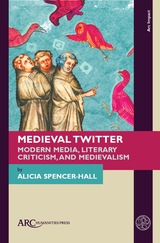
This pioneering monograph provocatively explodes current research paradigms for the modern and the medieval by showing that Twitter shares key similarities with medieval literary forms, texts, and narrative techniques. Analyzing tweets with medieval texts, and vice versa, Spencer-Hall initiates readers into an innovative methodology of interdisciplinary literary criticism, posing vital questions about the politics of medievalism today. Chapters include brand-new readings of The Owl and the Nightingale, the Chastelaine de Vergi, and Marie de France’s Laüstic, and arresting insights into troubadour style, Margery Kempe, and #MedievalTwitter. The book culminates in a medieval(ist) reading of Twitter’s premature demise, and Elon Musk’s medievalism. Throughout, points of contact and divergence are dissected, re-contextualizing the socio-cultural meaning of communication and texts across the temporal divide.

Contributors. Keith Broadfoot, Rex Butler, Patrick Crogan, Wolfgang Ernst, Gary Hall, Rosemary Hawker, Peter Krapp, Catherine Liu, John MacArthur, Andrew McNamara, Toni Ross, Lisa Trahair, Georg Stanitzek, Georg Christoph Tholen, Lisa Trahair, Samuel Weber, Simon Morgan Wortham
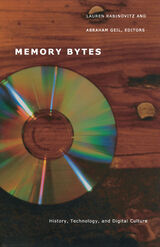
These essays from scholars in the social sciences and humanities cover topics related to science and medicine, politics and war, mass communication, philosophy, film, photography, and art. Whether describing how the cultural and legal conflicts over player piano rolls prefigured controversies over the intellectual property status of digital technologies such as mp3 files; comparing the experiences of watching QuickTime movies to Joseph Cornell’s “boxed relic” sculptures of the 1930s and 1940s; or calling for a critical history of electricity from the Enlightenment to the present, Memory Bytes investigates the interplay of technology and culture. It relates the Information Age to larger and older political and cultural phenomena, analyzes how sensory effects have been technologically produced over time, considers how human subjectivity has been shaped by machines, and emphasizes the dependence of particular technologies on the material circumstances within which they were developed and used.
Contributors. Judith Babbitts, Scott Curtis, Ronald E. Day, David Depew, Abraham Geil, Sharon Ghamari-Tabrizi, Lisa Gitelman, N. Katherine Hayles, John Durham Peters, Lauren Rabinovitz, Laura Rigal, Vivian Sobchack, Thomas Swiss

These lively and accessible essays expand the conversation in the blogosphere about the novels and films by connecting the controversies about gender roles to social trends in the real world.
Ultimately, Metafilm reframes materialism as a multimodal composing-in-action, or reflexive materialism, focusing on movies that dramatize their entanglement in economic and historical trauma while provoking forms of resistance during and after viewing. Carter contends that even as we recognize the division of social power in the films, we must also recognize how the concept is subversive and eludes control. In looking at the interplay between the films’ content and their production, circulation, and reception, Carter explores how the films persuade us to identify with onscreen worlds before probing our expectations—validating some, rejecting others, and sometimes proposing new ways of watching altogether.
Contributors. Idelber Avelar, Albert Bell, Dan Bendrups, Harris M. Berger, Paul D. Greene, Ross Hagen, Sharon Hochhauser, Shuhei Hosokawa, Keith Kahn-Harris, Kei Kawano, Rajko Muršič,Steve Waksman, Jeremy Wallach, Robert Walser, Deena Weinstein, Cynthia P. Wong
In The Metaphysics of Media, award-winning media critic Peter K. Fallon tackles the complicated question of how a succession of dominant forms of media have supported—and even to some extent created—different conceptions of reality. To do so, he starts with the basics: a critical discussion of the very idea of objective reality and the various postmodern responses that have tended to dominate recent philosophical approaches to the subject. From there, he embarks on a survey of the evolution of communication through four major eras: orality; literacy; print; and electricity.
Within each era, Fallon argues, the dominant form of media supported particular ways of understanding the world, from the ascendance of reason that followed the development of alphabets to the obliteration of space and time that we associate with electronic communications. Fallon concludes with a hard look at the mass ignorance that prevails today despite (or perhaps because of) the sea of information with which contemporary life is surrounded.
A stirring, philosophically rich investigation, The Metaphysics of Media offers not only a clear picture of where our society has been but also a road map to a more engaged, informed, and fully human future.
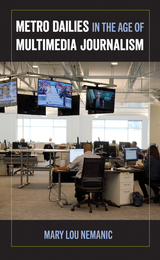
The death of the daily newspaper in the internet age has been predicted for decades. While print newspapers are struggling from drops in advertising and circulation, their survival has been based on original reporting. Instead of a death knell, metro dailies are experiencing an identity crisis—a clash between traditional print journalism’s formality and detail and digital journalism’s informality and brevity.
In Metro Dailies in the Age of Multimedia Journalism, Mary Lou Nemanic provides in-depth case studies of five mid-size city newspapers to show how these publications are adapting to the transition from print-only to multiplatform content delivery—and how newsroom practices are evolving to address this change. She considers the successes when owners allow journalists to manage their newspapers—to ensure production of quality journalism under the protection of newspaper guilds—as well as how layoffs and resource cutbacks have jeopardized quality standards.
Arguing for an integrated approach in which print and online reporting are considered complementary and visual journalism is emphasized across platforms, Nemanic suggests that there is a future for the endangered daily metro newspaper.

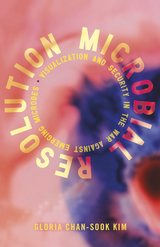
An interdisciplinary study charting the war against microbial futures leads to a new theory of contemporary vision and visuality
In 1989, a group of U.S. government scientists met to discuss some surprising findings: new diseases were appearing around the world, and viruses that they thought long vanquished were resurfacing. Their appearance heralded a future perpetually threatened by unforeseeable biological risks, sparking a new concept of disease: the “emerging microbe.” With the Cold War nearing its end, American scientists and security experts turned to confront this new “enemy,” redirecting national security against its risky horizons. In order to be fought, emerging microbes first needed to be made perceptible; but how could something immaterial, unknowable, and ever mutating be coaxed into visibility, knowability, and operability?
Microbial Resolution charts the U.S.-led war on the emerging microbe to show how their uncertain futures were transformed into objects of global science and security. Moving beyond familiar accounts that link scientific knowledge production to optical practices of visualizing the invisible, Gloria Chan-Sook Kim develops a theory of “microbial resolution” to analyze the complex problematic that arises when dealing with these entities: what can be seen when there is nothing to see? Through a syncretic analysis of data mining, animal-tracking technologies, media networks, computer-modeled futures, and global ecologies and infrastructures, she shows how a visual impasse—the impossibility of seeing microbial futures—forms the basis for new modes of perceiving, knowing, and governing in the present.
Timely and thought provoking, Microbial Resolution opens up the rich paradoxes, irreconcilabilities, and failures inherent in this project and demonstrates how these tensions profoundly animate twenty-first-century epistemologies, aesthetics, affects, and ecologies.

In the early 1980s, the scrappy radio station 93.3 WMMR was on the verge of a major takeover of the Philadelphia airwaves. Erin Riley, who had her finger on the pulse of new artists like Bon Jovi, whose music would define a generation, was hired as the station’s Music Director in 1983.
The Mighty WMMR is Riley’s affectionate and nostalgic oral history of the station’s early years, especially its 1980s heyday, covering everything from the pioneering influence of The Marconi Experiment and the success of The Morning Zoo to how WMMR broke artists like Bruce Springsteen, Billy Joel, and local favorites The Hooters onto the national scene. Featuring anecdotes and memories by beloved on-air personalities including John DeBella, Pierre Robert, and Michael Tearson, Riley chronicles the memorable songs and musicians; concerts, contests, and clubs; and the live broadcasts that marked the height of an unforgettable era in Philadelphia radio.
Riley breezily captures the station’s impact on listeners, which made WMMR a perfect storm of the times, the culture, and the counterculture. The Mighty WMMR is a captivating look back at Philadelphia’s rock history and the station that shaped a city and a generation.

The Migration of Musical Film shows how the folk musical was rooted in the challenges faced by immigrants and migrants who had to adapt to new environments, balancing American individualism with family values and cultural traditions. Uncovering fresh material from film industry archives, Garcia considers how folk musicals were initially marginal productions, designed to appeal to specific minority audiences, and yet introduced themes that were gradually assimilated into the Hollywood mainstream.
No other book offers a comparative historical study of the folk musical, from the first sound films in the 1920s to the genre’s resurgence in the 1970s and 1980s. Using an illustrative rather than comprehensive approach, Garcia focuses on significant moments in the sub-genre and rarely studied films such as Allá en el Rancho Grande along with familiar favorites that drew inspiration from earlier folk musicals—everything from The Wizard of Oz to Zoot Suit. If you think of movie musicals simply as escapist mainstream entertainment, The Migration of Musical Film is sure to leave you singing a different tune.

Offering a nuanced reading of a figure that was simultaneously conservative and radical, Reich considers how the cinematic black soldier lent a human face to ongoing debates about racial integration, black internationalism, and American militarism. Militant Visions thus not only presents a new history of how American cinema represented race, but also demonstrates how film images helped to make history, shaping the progress of the civil rights movement itself.
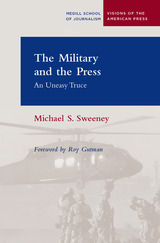
Author Michael S. Sweeney takes a chronological approach, considering freedoms and restraints such as the First Amendment, court decisions, and government and military directives that have affected the press during World Wars I and II, the Korean War, the Vietnam War, and the more recent conflicts. He explores the ongoing themes of wartime censorship and propaganda, as well as operational security in the battle zone. In chapters addressing the recent shift in military strategy in dealing with the press, Sweeney discusses new forms of control--from embedding journalists and discouraging unaccredited "unilaterals" to developing the news agenda through a barrage of briefings, sound bites, and visuals and appeals to patriotism that border on domestic propaganda. With profiles of a few specific journalists--from Richard Harding Davis covering the Spanish-American War to Christiane Amanpour reporting from the conflicts in Bosnia and Iraq--this deft blend of journalistic history and analysis should serve as a call-to-arms to a public not always well served by a military-press standoff.
With the rise of drones and computer-controlled weapons, the line between war and video games continues to blur. In this book, the authors trace how the realities of war are deeply inflected by their representation in popular entertainment. War games and other media, in turn, feature an increasing number of weapons, tactics, and threat scenarios from the War on Terror.
While past analyses have emphasized top-down circulation of pro-military ideologies through government public relations efforts and a cooperative media industry, The Military-Entertainment Complex argues for a nonlinear relationship, defined largely by market and institutional pressures. Tim Lenoir and Luke Caldwell explore the history of the early days of the video game industry, when personnel and expertise flowed from military contractors to game companies; to a middle period when the military drew on the booming game industry to train troops; to a present in which media corporations and the military influence one another cyclically to predict the future of warfare.
In addition to obvious military-entertainment titles like America’s Army, Lenoir and Caldwell investigate the rise of best-selling franchise games such as Call of Duty, Battlefield, Medal of Honor, and Ghost Recon. The narratives and aesthetics of these video games permeate other media, including films and television programs. This commodification and marketing of the future of combat has shaped the public’s imagination of war in the post-9/11 era and naturalized the U.S. Pentagon’s vision of a new way of war.
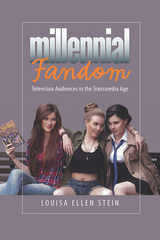
These conflicting narratives of entrepreneurial creativity and digital immorality operate to quell the growing threat represented by millennials’ media agency. With fan activities becoming ever more visible on social media platforms including YouTube, Facebook, LiveJournal, Twitter, Polyvore, and Tumblr, the fan has become the avatar of our digital hopes and fears.
In an ambitious study encompassing a wide range of media texts, including popular television series like Kyle XY, Glee, Gossip Girl, Veronica Mars, and Pretty Little Liars and online works like The Lizzie Bennet Diaries, as well as fan texts from blog posts and tweets to remix videos, YouTube posts, and image-sharing streams, author Louisa Ellen Stein traces the circulation of the contradictory tropes of millennial hope and millennial noir. Looking at what millennials do with digital technology demonstrates the molding impact of commercial representations, and at the same time reveals how millennials are undermining, negotiating, and changing those narratives.
This generation—and the fans it represents—is actively transforming the media landscape into a dynamic, culturally transgressive space of collective authorship. Offering a rich and complex vision of the relationship between fandom and millennial culture, Millennial Fandom will interest fans, millennials, students, and scholars of contemporary media culture alike.
READERS
Browse our collection.
PUBLISHERS
See BiblioVault's publisher services.
STUDENT SERVICES
Files for college accessibility offices.
RECENTLY PUBLISHED




UChicago Accessibility Resources
home | accessibility | search | about | contact us
BiblioVault ® 2001 - 2026
The University of Chicago Press